


Bible translations

Encyclopedia
The Bible
has been translated
into many languages
from the biblical languages
of Hebrew, Aramaic
and Greek
. Indeed, the full Bible has been translated into over 450 languages, although sections of the Bible have been translated into over 2,000 languages.
The Latin Vulgate
was dominant in Western Christianity
through the Middle Ages. Since then, the Bible has been translated into many more languages
. English Bible translations in particular have a rich and varied history of more than a millennium.
was mainly written in Biblical Hebrew, with some portions (notably in Daniel
and Ezra
) in Biblical Aramaic
. From the 9th century to the 15th century, Jewish scholars, today known as Masoretes
, compared the text of all known biblical manuscript
s in an effort to create a unified, standardized text. A series of highly similar texts eventually emerged, and any of these texts are known as Masoretic Texts (MT). The Masoretes also added vowel points (called niqqud) to the text, since the original text only contained consonant letters. This sometimes required the selection of an interpretation, since some words differ only in their vowels—their meaning can vary in accordance with the vowels chosen. In antiquity, variant Hebrew readings existed, some of which have survived in the Samaritan Pentateuch
and other ancient fragments, as well as being attested in ancient versions in other languages.
is written in Koine Greek
.
The discovery of older manuscripts, which belong to the Alexandrian text-type, including the 4th century Codex Vaticanus and Codex Sinaiticus, led scholars to revise their view about the original Greek text. Attempts to reconstruct the original text are called critical editions. Karl Lachmann
based his critical edition of 1831 on manuscripts dating from the 4th century and earlier, to demonstrate that the Textus Receptus
must be corrected according to these earlier texts.
The autographs, the Greek manuscripts
written by the original authors, have not survived. Scholars surmise the original Greek text from the versions that do survive. The three main textual traditions of the Greek New Testament are sometimes called the Alexandrian text-type
(generally minimalist), the Byzantine text-type
(generally maximalist), and the Western text-type
(occasionally wild). Together they comprise most of the ancient manuscripts.
Most variants among the manuscripts are minor, such as alternative spelling, alternative word order, the presence or absence of an optional definite article ("the"), and so on. Occasionally, a major variant happens when a portion of a text was accidentally omitted (or perhaps even censored), or was added from a marginal gloss. Fortunately, major variants tend to be easier to correct. Examples of major variants are the endings of Mark
, the Pericope Adulteræ
, the Comma Johanneum
, and the Western version of Acts.
Early manuscripts of the letters of Paul and other New Testament writings show no punctuation whatsoever. The punctuation
was added later by other editors, according to their own understanding of the text.
of the Jews. With most people speaking only Aramaic and not understanding Hebrew, the Targum
s were created to allow the common person to understand the Torah as it was read in ancient synagogues.
had become the center of Hellenistic Judaism
, and a Koine Greek
translation was compiled in several stages during the 3rd to 2nd centuries BC (known to have been complete by 132 BC). The Talmud
ascribes the translation effort to Ptolemy II Philadelphus
(r. 285-246 BC) who is said to have hired 72 Jewish scholars for the purpose, for which reason the translation is commonly known as the Septuagint, a name which it gained around AD 354-430, "the time of Augustine of Hippo
". The Septuagint (LXX) was the very first translation of the Hebrew Bible
into Greek
, and later became the accepted text of the Old Testament
in the church and the basis of its canon
. The Latin Vulgate
by Jerome
was based upon the Hebrew for those books of the Bible preserved in the Jewish canon (as reflected in the masoretic text
), and on the Greek text for the deuterocanonical books
.
In his City of God 18.42, while repeating the story of Aristeas
with typical embellishments, Augustine adds the remark, "It is their translation that it has now become traditional to call the Septuagint" ...[Latin omitted]... Augustine thus indicates that this name for the Greek translation of the scriptures was a recent development. However, he offers no clue as to which of the possible antecedents led to this development: and was widely used by Greek-speaking Jews, and later by Christians. It differs somewhat from the later standardized Hebrew (Masoretic Text
). This translation was promoted by way of a legend (primarily recorded as the Letter of Aristeas
) that seventy (or in some sources, seventy-two) separate translators all produced identical texts; supposedly proving it's accuracy.
Versions of the Septuagint contain several passages and whole books beyond what was included in the Masoretic texts of the Tanakh
. In some cases these additions were originally composed in Greek, while in other cases they are translations of Hebrew books or variants not present in the Masoretic texts. Recent discoveries have shown that more of the Septuagint additions have a Hebrew origin than was once thought. While there are no complete surviving manuscripts of the Hebrew texts on which the Septuagint was based, many scholars believe that they represent a different textual tradition ("Vorlage") from the one that became the basis for the Masoretic texts.
placed side by side six versions of the Old Testament, including the 2nd century Greek translations of Aquila of Sinope
and Symmachus the Ebionite
. His eclectic recension of the Septuagint had a significant influence on the Old Testament text in several important manuscripts. The canonical Christian Bible was formally established by Bishop Cyril of Jerusalem
in 350 (although it had been generally accepted by the church previously), confirmed by the Council of Laodicea
in 363 (both lacked the book of Revelation
), and later established by Athanasius of Alexandria
in 367 (with Revelation
added), and Jerome
's Vulgate
Latin translation dates to between AD 382 and 420. Latin
translations predating Jerome are collectively known as Vetus Latina
texts.
Christian translations also tend to be based upon the Hebrew, though some denominations prefer the Septuagint (or may cite variant readings from both). Bible translations incorporating modern textual criticism usually begin with the masoretic text, but also take into account possible variants from all available ancient versions. The received text
of the Christian
New Testament
is in Koine Greek
, and nearly all translations are based upon the Greek text.
Jerome began by revising the earlier Latin translations, but ended by going back to the original Greek, bypassing all translations, and going back to the original Hebrew wherever he could instead of the Septuagint.
The New Testament was translated into Gothic
in the 4th century by Ulfilas
. In the 5th century, Saint Mesrob
translated the bible into Armenian
. Also dating from the same period are the Syriac
, Coptic
, Ethiopic
and Georgian
translations.
There are also several ancient translations, most important of which are in the Syriac
dialect of Aramaic (including the Peshitta
and the Diatessaron
gospel harmony), in the Ethiopian language of Ge'ez
, and in Latin
(both the Vetus Latina
and the Vulgate
). The Bishop of the Goths Wulfila in the today's Bulgaria translated the Bible into Gothic
in the mid-4th century.
In 331, the Emperor Constantine
commissioned Eusebius to deliver fifty Bibles for the Church of Constantinople. Athanasius (Apol. Const. 4) recorded Alexandrian scribes around 340 preparing Bibles for Constans
. Little else is known, though there is plenty of speculation. For example, it is speculated that this may have provided motivation for canon lists
, and that Codex Vaticanus Graecus 1209, Codex Sinaiticus
and Codex Alexandrinus
are examples of these Bibles. Together with the Peshitta
, these are the earliest extant Christian Bibles.
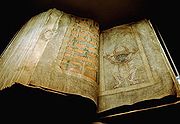 When ancient scribes copied earlier books, they wrote notes on the margins of the page (marginal glosses) to correct their text—especially if a scribe accidentally omitted a word or line—and to comment about the text. When later scribes were copying the copy, they were sometimes uncertain if a note was intended to be included as part of the text. See textual criticism
. Over time, different regions evolved different versions, each with its own assemblage of omissions and additions.
The earliest surviving complete manuscript of the entire Bible is the Codex Amiatinus
, a Latin Vulgate edition produced in 8th century England at the double monastery of Wearmouth-Jarrow
.
During the Middle Ages
, translation, particularly of the Old Testament was discouraged. Nevertheless, there are some fragmentary Old English Bible translations
, notably a lost translation of the Gospel of John
into Old English by the Venerable Bede
, which he is said to have prepared shortly before his death around the year 735. An Old High German
version of the gospel of Matthew dates to 748. Charlemagne
in ca. 800 charged Alcuin
with a revision of the Latin Vulgate. The translation into Old Church Slavonic
was started in 836 by Cyril and Methodius.
Alfred the Great
had a number of passages of the Bible circulated in the vernacular in around 900. These included passages from the Ten Commandments
and the Pentateuch, which he prefixed to a code of laws he promulgated around this time. In approximately 990, a full and freestanding version of the four Gospels in idiomatic Old English appeared, in the West Saxon dialect; these are called the Wessex Gospels
.
Pope Innocent III
in 1199 banned unauthorized versions of the Bible as a reaction to the Cathar
and Waldensian heresies. The synods of Toulouse and Tarragona (1234) outlawed possession of such renderings. There is evidence of some vernacular translations being permitted while others were being scrutinized.
The complete Bible was translated into Old French in the late 13th century. Parts of this translation were included in editions of the popular Bible historiale, and there is no evidence of this translation being suppressed by the Church.
The most notable Middle English Bible translation, Wyclif's Bible
(1383), based on the Vulgate, was banned by the Oxford Synod in 1408. A Hungarian Hussite
Bible appeared in the mid 15th century, and in 1478, a Catalan translation in the dialect of Valencia. Many parts of the Bible were printed by William Caxton
in his translation of the Golden Legend
, and in Speculum Vitae Christi (The Mirror of the Blessed Life of Jesus Christ
).
press, by Desiderius Erasmus, who reconstructed its Greek text from several recent manuscripts of the Byzantine text-type. He occasionally added a Greek translation of the Latin Vulgate for parts that did not exist in the Greek manuscripts. He produced four later editions of this text. Erasmus was Roman Catholic, but his preference for the Byzantine Greek manuscripts rather than the Latin Vulgate led some church authorities to view him with suspicion.
In 1521, Martin Luther
was placed under the Ban of the Empire, and he retired to the Wartburg Castle
. During his time there, he translated the New Testament from Greek into German. It was printed in September 1522. The first complete Dutch Bible, partly based on the existing portions of Luther's translation, was printed in Antwerp in 1526 by Jacob van Liesvelt.
The first printed edition with critical apparatus
(noting variant readings among the manuscripts) was produced by the printer Robert Estienne
of Paris in 1550. The Greek text of this edition and of those of Erasmus became known as the Textus Receptus
(Latin for "received text"), a name given to it in the Elzevier
edition of 1633, which termed it as the text nunc ab omnibus receptum ("now received by all").
Later critical editions incorporate ongoing scholarly research, including discoveries of Greek papyrus fragments from near Alexandria, Egypt, that date in some cases within a few decades of the original New Testament writings. Today, most critical editions of the Greek New Testament, such as UBS4 and NA27, consider the Alexandrian text-type corrected by papyri, to be the Greek text that is closest to the original autographs. Their apparatus includes the result of votes among scholars, ranging from certain {A} to doubtful {E}, on which variants best preserve the original Greek text of the New Testament.
Critical editions that rely primarily on the Alexandrian text-type inform nearly all modern translations (and revisions of older translations). For reasons of tradition, however, some translators prefer to use the Textus Receptus for the Greek text, or use the Majority Text which is similar to it but is a critical edition that relies on earlier manuscripts of the Byzantine text-type. Among these, some argue that the Byzantine tradition contains scribal additions, but these later interpolations preserve the orthodox interpretations of the biblical text—as part of the ongoing Christian experience—and in this sense are authoritative. Distrust of the textual basis of modern translations has contributed to the King-James-Only Movement
.
The churches of the Protestant Reformation
translated the Greek of the Textus Receptus to produce vernacular
Bibles, such as the German Luther Bible
, the Polish Brest Bible
and the English King James Bible
.
Tyndale's
New Testament translation (1526, revised in 1534, 1535 and 1536) and his translation of the Pentateuch (1530, 1534) and the Book of Jonah
were met with heavy sanctions given the widespread belief that Tyndale changed the Bible as he attempted to translate it. The first complete French Bible was a translation by Jacques Lefèvre d'Étaples
, published in 1530 in Antwerp. The Froschauer Bible of 1531 and the Luther Bible
of 1534 (both appearing in portions throughout the 1520s) were an important part of the Reformation
.
The first English translations of Psalms
(1530), Isaiah
(1531), Proverbs
(1533), Ecclesiastes
(1533), Jeremiah
(1534) and Lamentations
(1534), were executed by the Protestant Bible translator George Joye
in Antwerp. In 1535 Myles Coverdale published the first complete English Bible
also in Antwerp.
In 1584 both Old and New Testaments were translated to Slovene by Protestant
writer and theologian Jurij Dalmatin
. The Slovenes thus became the 12th nation in the world with a complete Bible in their language. Samuel Bogusław Chyliński
(1631–1668) translated and published the first Bible translation into Lithuanian
.
The missionary activity of the Jesuit order led to a large number of 17th century translations into languages of the New World
.
, including 680 languages in Africa, followed by 590 in Asia, 420 in Oceania, 420 in Latin America and the Caribbean, 210 in Europe, and 75 in North America. The United Bible Societies are presently assisting in over 600 Bible translation projects. The Bible is available in whole or in part to some 98 percent of the world's population in a language in which they are fluent.
The United Bible Society announced that as of 31 December 2007 the Bible was available in 438 languages, 123 of which included the deuterocanonical material as well as the Tanakh and New Testament. Either the Tanakh or the New Testament alone was available in an additional 1168 languages, and portions of the Bible were available in another 848 languages, for a total of 2,454 languages.
In 1999, Wycliffe Bible Translators announced Vision 2025. This project aims to see Bible translation begun by 2025 in every remaining language community that needs it. They currently estimate that 2,251 languages, representing 193 million people, lack a Bible translation.
In 2001, Mike Coles, an RE
teacher in Stepney
, translated The Bible into Cockney
Rhyming slang and in 2008, graphic representations of The Bible in Manga
and Lego brick
form were given approval by the Archbishop of Canterbury
.
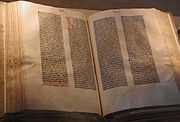
though modern linguists such as Bible scholar Dr. Joel Hoffman disagrees with this classification.
As Hebrew and Greek
, the original languages of the Bible, like all languages, have some idiom
s and concepts not easily translated, there is in some cases an ongoing critical tension about whether it is better to give a word for word translation or to give a translation that gives a parallel idiom in the target language. For instance, in the English language Catholic
translation, the New American Bible
, as well as the Protestant translations of the Christian Bible, translations like the King James Version, the Darby Bible
, the New Revised Standard Version
, the Recovery Version, and the New American Standard Bible
are seen as more literal translations (or "word for word"), whereas translations like the New International Version
and New Living Translation
sometimes attempt to give relevant parallel idioms. The Living Bible
and The Message
are two paraphrases of the Bible that try to convey the original meaning in contemporary language. The further away one gets from word for word translation, the text becomes easier to read while relying more on the theological, linguistic or cultural understanding of the translator, which one would not normally expect a lay reader to require.
Among these the New World Translation, produced by Jehovah's Witnesses, is seen as controversial by some because of the renderings of key verses. Especially verses, that in other Bible translations support the deity of Christ, are rendered differently in the NWT.
Also, the NWT often translates the New Testament Kyrios, "Lord," as "Jehovah
" when referring to God. The publishers argue that this can be supported by the fact that the oldest copies of the Greek Septuagint found among the Dead Sea Scrolls
(such as 8HevXIIgr) generally have the Hebrew tetragrammaton
in the Greek text rather than Greek Kyrios as found in later Septuagint manuscripts An exception to this is the Cave4 Leviticus fragment which has Greek Iao. The NWT translators believe that when Jesus read from such earlier scrolls he would have used his father's name and not the title. (Luke 4:18, Jo 17:6, 26) The NWT translators did this despite the fact that the tetragrammaton does not appear in the Greek manuscript of the New Testament books. The Greek manuscripts use Kyrios to refer both to Jesus Christ and God the Father.
English Translations:
Other languages:
Related:
Bible
The Bible refers to any one of the collections of the primary religious texts of Judaism and Christianity. There is no common version of the Bible, as the individual books , their contents and their order vary among denominations...
has been translated
Translation
Translation is the communication of the meaning of a source-language text by means of an equivalent target-language text. Whereas interpreting undoubtedly antedates writing, translation began only after the appearance of written literature; there exist partial translations of the Sumerian Epic of...
into many languages
Bible translations by language
Bible translations have been made into 2,572+ languages, one of the two Testaments in 1,668 languages, and the full Protestant Canon of the Bible in 457 languages as of May 2011....
from the biblical languages
Biblical languages
Biblical languages are any of the languages employed in the original writings of the Bible. Partially owing to the significance of the Bible in society, Biblical languages are studied more widely than many other dead languages...
of Hebrew, Aramaic
Biblical Aramaic
Biblical Aramaic is the form of the Aramaic language that is used in the books of Daniel, Ezra and a few other places in the Hebrew Bible and should not be confused with the Aramaic translations of the Hebrew Bible known as targumim....
and Greek
Koine Greek
Koine Greek is the universal dialect of the Greek language spoken throughout post-Classical antiquity , developing from the Attic dialect, with admixture of elements especially from Ionic....
. Indeed, the full Bible has been translated into over 450 languages, although sections of the Bible have been translated into over 2,000 languages.
The Latin Vulgate
Vulgate
The Vulgate is a late 4th-century Latin translation of the Bible. It was largely the work of St. Jerome, who was commissioned by Pope Damasus I in 382 to make a revision of the old Latin translations...
was dominant in Western Christianity
Western Christianity
Western Christianity is a term used to include the Latin Rite of the Catholic Church and groups historically derivative thereof, including the churches of the Anglican and Protestant traditions, which share common attributes that can be traced back to their medieval heritage...
through the Middle Ages. Since then, the Bible has been translated into many more languages
Bible translations by language
Bible translations have been made into 2,572+ languages, one of the two Testaments in 1,668 languages, and the full Protestant Canon of the Bible in 457 languages as of May 2011....
. English Bible translations in particular have a rich and varied history of more than a millennium.
Hebrew Bible
The TanakhTanakh
The Tanakh is a name used in Judaism for the canon of the Hebrew Bible. The Tanakh is also known as the Masoretic Text or the Miqra. The name is an acronym formed from the initial Hebrew letters of the Masoretic Text's three traditional subdivisions: The Torah , Nevi'im and Ketuvim —hence...
was mainly written in Biblical Hebrew, with some portions (notably in Daniel
Book of Daniel
The Book of Daniel is a book in the Hebrew Bible. The book tells of how Daniel, and his Judean companions, were inducted into Babylon during Jewish exile, and how their positions elevated in the court of Nebuchadnezzar. The court tales span events that occur during the reigns of Nebuchadnezzar,...
and Ezra
Book of Ezra
The Book of Ezra is a book of the Hebrew Bible. Originally combined with the Book of Nehemiah in a single book of Ezra-Nehemiah, the two became separated in the early centuries of the Christian era...
) in Biblical Aramaic
Biblical Aramaic
Biblical Aramaic is the form of the Aramaic language that is used in the books of Daniel, Ezra and a few other places in the Hebrew Bible and should not be confused with the Aramaic translations of the Hebrew Bible known as targumim....
. From the 9th century to the 15th century, Jewish scholars, today known as Masoretes
Masoretes
The Masoretes were groups of mostly Karaite scribes and scholars working between the 7th and 11th centuries, based primarily in present-day Israel in the cities of Tiberias and Jerusalem, as well as in Iraq...
, compared the text of all known biblical manuscript
Biblical manuscript
A biblical manuscript is any handwritten copy of a portion of the text of the Bible. The word Bible comes from the Greek biblia ; manuscript comes from Latin manu and scriptum...
s in an effort to create a unified, standardized text. A series of highly similar texts eventually emerged, and any of these texts are known as Masoretic Texts (MT). The Masoretes also added vowel points (called niqqud) to the text, since the original text only contained consonant letters. This sometimes required the selection of an interpretation, since some words differ only in their vowels—their meaning can vary in accordance with the vowels chosen. In antiquity, variant Hebrew readings existed, some of which have survived in the Samaritan Pentateuch
Samaritan Pentateuch
The Samaritan Pentateuch, sometimes called Samaritan Torah, , is a version of the Hebrew language Pentateuch, the first five books of the Bible, used by the Samaritans....
and other ancient fragments, as well as being attested in ancient versions in other languages.
New Testament
The New TestamentNew Testament
The New Testament is the second major division of the Christian biblical canon, the first such division being the much longer Old Testament....
is written in Koine Greek
Koine Greek
Koine Greek is the universal dialect of the Greek language spoken throughout post-Classical antiquity , developing from the Attic dialect, with admixture of elements especially from Ionic....
.
The discovery of older manuscripts, which belong to the Alexandrian text-type, including the 4th century Codex Vaticanus and Codex Sinaiticus, led scholars to revise their view about the original Greek text. Attempts to reconstruct the original text are called critical editions. Karl Lachmann
Karl Lachmann
Karl Konrad Friedrich Wilhelm Lachmann was a German philologist and critic.-Biography:He was born in Brunswick, in what is now Lower Saxony....
based his critical edition of 1831 on manuscripts dating from the 4th century and earlier, to demonstrate that the Textus Receptus
Textus Receptus
Textus Receptus is the name subsequently given to the succession of printed Greek texts of the New Testament which constituted the translation base for the original German Luther Bible, the translation of the New Testament into English by William Tyndale, the King James Version, and for most other...
must be corrected according to these earlier texts.
The autographs, the Greek manuscripts
Biblical manuscript
A biblical manuscript is any handwritten copy of a portion of the text of the Bible. The word Bible comes from the Greek biblia ; manuscript comes from Latin manu and scriptum...
written by the original authors, have not survived. Scholars surmise the original Greek text from the versions that do survive. The three main textual traditions of the Greek New Testament are sometimes called the Alexandrian text-type
Alexandrian text-type
The Alexandrian text-type , associated with Alexandria, is one of several text-types used in New Testament textual criticism to describe and group the textual character of biblical manuscripts...
(generally minimalist), the Byzantine text-type
Byzantine text-type
The Byzantine text-type is one of several text-types used in textual criticism to describe the textual character of Greek New Testament manuscripts. It is the form found in the largest number of surviving manuscripts, though not in the oldest...
(generally maximalist), and the Western text-type
Western text-type
The Western text-type is one of several text-types used in textual criticism to describe and group the textual character of Greek New Testament manuscripts...
(occasionally wild). Together they comprise most of the ancient manuscripts.
Most variants among the manuscripts are minor, such as alternative spelling, alternative word order, the presence or absence of an optional definite article ("the"), and so on. Occasionally, a major variant happens when a portion of a text was accidentally omitted (or perhaps even censored), or was added from a marginal gloss. Fortunately, major variants tend to be easier to correct. Examples of major variants are the endings of Mark
Mark 16
Mark 16 is the final chapter of the Gospel of Mark in the New Testament of the Christian Bible. It begins with the discovery of the empty tomb by Mary Magdalene, Mary the mother of James, and Salome — there they encounter a man dressed in white who announces the Resurrection of Jesus.Verse 8 ends...
, the Pericope Adulteræ
Pericope Adulteræ
The Pericope Adulterae or Pericope de Adultera is a traditional name for a famous passage about Jesus and the woman taken in adultery from verses of the Gospel of John. The passage describes a confrontation between Jesus and the scribes and Pharisees over whether a woman, caught in an act of...
, the Comma Johanneum
Comma Johanneum
The Comma Johanneum is a comma in the First Epistle of John according to the Latin Vulgate text as transmitted since the Early Middle Ages, based on Vetus Latina minority readings dating to the 7th century...
, and the Western version of Acts.
Early manuscripts of the letters of Paul and other New Testament writings show no punctuation whatsoever. The punctuation
Punctuation
Punctuation marks are symbols that indicate the structure and organization of written language, as well as intonation and pauses to be observed when reading aloud.In written English, punctuation is vital to disambiguate the meaning of sentences...
was added later by other editors, according to their own understanding of the text.
Aramaic Targums
Some of the first translations of the Jewish Torah began during the first exile in Babylonia, when Aramaic became the lingua francaLingua franca
A lingua franca is a language systematically used to make communication possible between people not sharing a mother tongue, in particular when it is a third language, distinct from both mother tongues.-Characteristics:"Lingua franca" is a functionally defined term, independent of the linguistic...
of the Jews. With most people speaking only Aramaic and not understanding Hebrew, the Targum
Targum
Taekwondo is a Korean martial art and the national sport of South Korea. In Korean, tae means "to strike or break with foot"; kwon means "to strike or break with fist"; and do means "way", "method", or "path"...
s were created to allow the common person to understand the Torah as it was read in ancient synagogues.
Greek Septuagint
By the 3rd century BC, AlexandriaAlexandria
Alexandria is the second-largest city of Egypt, with a population of 4.1 million, extending about along the coast of the Mediterranean Sea in the north central part of the country; it is also the largest city lying directly on the Mediterranean coast. It is Egypt's largest seaport, serving...
had become the center of Hellenistic Judaism
Hellenistic Judaism
Hellenistic Judaism was a movement which existed in the Jewish diaspora that sought to establish a Hebraic-Jewish religious tradition within the culture and language of Hellenism...
, and a Koine Greek
Koine Greek
Koine Greek is the universal dialect of the Greek language spoken throughout post-Classical antiquity , developing from the Attic dialect, with admixture of elements especially from Ionic....
translation was compiled in several stages during the 3rd to 2nd centuries BC (known to have been complete by 132 BC). The Talmud
Talmud
The Talmud is a central text of mainstream Judaism. It takes the form of a record of rabbinic discussions pertaining to Jewish law, ethics, philosophy, customs and history....
ascribes the translation effort to Ptolemy II Philadelphus
Ptolemy II Philadelphus
Ptolemy II Philadelphus was the king of Ptolemaic Egypt from 283 BCE to 246 BCE. He was the son of the founder of the Ptolemaic kingdom Ptolemy I Soter and Berenice, and was educated by Philitas of Cos...
(r. 285-246 BC) who is said to have hired 72 Jewish scholars for the purpose, for which reason the translation is commonly known as the Septuagint, a name which it gained around AD 354-430, "the time of Augustine of Hippo
Augustine of Hippo
Augustine of Hippo , also known as Augustine, St. Augustine, St. Austin, St. Augoustinos, Blessed Augustine, or St. Augustine the Blessed, was Bishop of Hippo Regius . He was a Latin-speaking philosopher and theologian who lived in the Roman Africa Province...
". The Septuagint (LXX) was the very first translation of the Hebrew Bible
Hebrew Bible
The Hebrew Bible is a term used by biblical scholars outside of Judaism to refer to the Tanakh , a canonical collection of Jewish texts, and the common textual antecedent of the several canonical editions of the Christian Old Testament...
into Greek
Greek language
Greek is an independent branch of the Indo-European family of languages. Native to the southern Balkans, it has the longest documented history of any Indo-European language, spanning 34 centuries of written records. Its writing system has been the Greek alphabet for the majority of its history;...
, and later became the accepted text of the Old Testament
Old Testament
The Old Testament, of which Christians hold different views, is a Christian term for the religious writings of ancient Israel held sacred and inspired by Christians which overlaps with the 24-book canon of the Masoretic Text of Judaism...
in the church and the basis of its canon
Biblical canon
A biblical canon, or canon of scripture, is a list of books considered to be authoritative as scripture by a particular religious community. The term itself was first coined by Christians, but the idea is found in Jewish sources. The internal wording of the text can also be specified, for example...
. The Latin Vulgate
Vulgate
The Vulgate is a late 4th-century Latin translation of the Bible. It was largely the work of St. Jerome, who was commissioned by Pope Damasus I in 382 to make a revision of the old Latin translations...
by Jerome
Jerome
Saint Jerome was a Roman Christian priest, confessor, theologian and historian, and who became a Doctor of the Church. He was the son of Eusebius, of the city of Stridon, which was on the border of Dalmatia and Pannonia...
was based upon the Hebrew for those books of the Bible preserved in the Jewish canon (as reflected in the masoretic text
Masoretic Text
The Masoretic Text is the authoritative Hebrew text of the Jewish Bible and is regarded as Judaism's official version of the Tanakh. While the Masoretic Text defines the books of the Jewish canon, it also defines the precise letter-text of these biblical books, with their vocalization and...
), and on the Greek text for the deuterocanonical books
Deuterocanonical books
Deuterocanonical books is a term used since the sixteenth century in the Catholic Church and Eastern Christianity to describe certain books and passages of the Christian Old Testament that are not part of the Hebrew Bible. The term is used in contrast to the protocanonical books, which are...
.
In his City of God 18.42, while repeating the story of Aristeas
Letter of Aristeas
The so-called Letter of Aristeas or Letter to Philocrates is a Hellenistic work of the 2nd century BCE, one of the Pseudepigrapha. Josephus who paraphrases about two-fifths of the letter, ascribes it to Aristeas and written to Philocrates, describing the Greek translation of the Hebrew Law by...
with typical embellishments, Augustine adds the remark, "It is their translation that it has now become traditional to call the Septuagint" ...[Latin omitted]... Augustine thus indicates that this name for the Greek translation of the scriptures was a recent development. However, he offers no clue as to which of the possible antecedents led to this development: and was widely used by Greek-speaking Jews, and later by Christians. It differs somewhat from the later standardized Hebrew (Masoretic Text
Masoretic Text
The Masoretic Text is the authoritative Hebrew text of the Jewish Bible and is regarded as Judaism's official version of the Tanakh. While the Masoretic Text defines the books of the Jewish canon, it also defines the precise letter-text of these biblical books, with their vocalization and...
). This translation was promoted by way of a legend (primarily recorded as the Letter of Aristeas
Letter of Aristeas
The so-called Letter of Aristeas or Letter to Philocrates is a Hellenistic work of the 2nd century BCE, one of the Pseudepigrapha. Josephus who paraphrases about two-fifths of the letter, ascribes it to Aristeas and written to Philocrates, describing the Greek translation of the Hebrew Law by...
) that seventy (or in some sources, seventy-two) separate translators all produced identical texts; supposedly proving it's accuracy.
Versions of the Septuagint contain several passages and whole books beyond what was included in the Masoretic texts of the Tanakh
Tanakh
The Tanakh is a name used in Judaism for the canon of the Hebrew Bible. The Tanakh is also known as the Masoretic Text or the Miqra. The name is an acronym formed from the initial Hebrew letters of the Masoretic Text's three traditional subdivisions: The Torah , Nevi'im and Ketuvim —hence...
. In some cases these additions were originally composed in Greek, while in other cases they are translations of Hebrew books or variants not present in the Masoretic texts. Recent discoveries have shown that more of the Septuagint additions have a Hebrew origin than was once thought. While there are no complete surviving manuscripts of the Hebrew texts on which the Septuagint was based, many scholars believe that they represent a different textual tradition ("Vorlage") from the one that became the basis for the Masoretic texts.
Early translations in Late Antiquity
Origen's HexaplaHexapla
Hexapla is the term for an edition of the Bible in six versions. Especially it applies to the edition of the Old Testament compiled by Origen of Alexandria, which placed side by side:#Hebrew...
placed side by side six versions of the Old Testament, including the 2nd century Greek translations of Aquila of Sinope
Aquila of Sinope
Aquila of Sinope was a 2nd Century CE native of Pontus in Anatolia known for producing an exceedingly literal translation of the Hebrew Bible into Greek around 130 CE. He was a proselyte to Judaism and a disciple of Rabbi Akiba...
and Symmachus the Ebionite
Symmachus the Ebionite
Symmachus was the author of one of the Greek versions of the Old Testament. It was included by Origen in his Hexapla and Tetrapla, which compared various versions of the Old Testament side by side with the Septuagint...
. His eclectic recension of the Septuagint had a significant influence on the Old Testament text in several important manuscripts. The canonical Christian Bible was formally established by Bishop Cyril of Jerusalem
Cyril of Jerusalem
Cyril of Jerusalem was a distinguished theologian of the early Church . He is venerated as a saint by the Roman Catholic Church, the Eastern Orthodox Church, and the Anglican Communion. In 1883, Cyril was declared a Doctor of the Church by Pope Leo XIII...
in 350 (although it had been generally accepted by the church previously), confirmed by the Council of Laodicea
Council of Laodicea
The Council of Laodicea was a regional synod of approximately thirty clerics from Asia Minor that assembled about 363–364 AD in Laodicea, Phrygia Pacatiana.-Historical context:...
in 363 (both lacked the book of Revelation
Book of Revelation
The Book of Revelation is the final book of the New Testament. The title came into usage from the first word of the book in Koine Greek: apokalupsis, meaning "unveiling" or "revelation"...
), and later established by Athanasius of Alexandria
Athanasius of Alexandria
Athanasius of Alexandria [b. ca. – d. 2 May 373] is also given the titles St. Athanasius the Great, St. Athanasius I of Alexandria, St Athanasius the Confessor and St Athanasius the Apostolic. He was the 20th bishop of Alexandria. His long episcopate lasted 45 years Athanasius of Alexandria [b....
in 367 (with Revelation
Revelation
In religion and theology, revelation is the revealing or disclosing, through active or passive communication with a supernatural or a divine entity...
added), and Jerome
Jerome
Saint Jerome was a Roman Christian priest, confessor, theologian and historian, and who became a Doctor of the Church. He was the son of Eusebius, of the city of Stridon, which was on the border of Dalmatia and Pannonia...
's Vulgate
Vulgate
The Vulgate is a late 4th-century Latin translation of the Bible. It was largely the work of St. Jerome, who was commissioned by Pope Damasus I in 382 to make a revision of the old Latin translations...
Latin translation dates to between AD 382 and 420. Latin
Latin
Latin is an Italic language originally spoken in Latium and Ancient Rome. It, along with most European languages, is a descendant of the ancient Proto-Indo-European language. Although it is considered a dead language, a number of scholars and members of the Christian clergy speak it fluently, and...
translations predating Jerome are collectively known as Vetus Latina
Vetus Latina
Vetus Latina is a collective name given to the Biblical texts in Latin that were translated before St Jerome's Vulgate Bible became the standard Bible for Latin-speaking Western Christians. The phrase Vetus Latina is Latin for Old Latin, and the Vetus Latina is sometimes known as the Old Latin Bible...
texts.
Christian translations also tend to be based upon the Hebrew, though some denominations prefer the Septuagint (or may cite variant readings from both). Bible translations incorporating modern textual criticism usually begin with the masoretic text, but also take into account possible variants from all available ancient versions. The received text
Textus Receptus
Textus Receptus is the name subsequently given to the succession of printed Greek texts of the New Testament which constituted the translation base for the original German Luther Bible, the translation of the New Testament into English by William Tyndale, the King James Version, and for most other...
of the Christian
Christian
A Christian is a person who adheres to Christianity, an Abrahamic, monotheistic religion based on the life and teachings of Jesus of Nazareth as recorded in the Canonical gospels and the letters of the New Testament...
New Testament
New Testament
The New Testament is the second major division of the Christian biblical canon, the first such division being the much longer Old Testament....
is in Koine Greek
Koine Greek
Koine Greek is the universal dialect of the Greek language spoken throughout post-Classical antiquity , developing from the Attic dialect, with admixture of elements especially from Ionic....
, and nearly all translations are based upon the Greek text.
Jerome began by revising the earlier Latin translations, but ended by going back to the original Greek, bypassing all translations, and going back to the original Hebrew wherever he could instead of the Septuagint.
The New Testament was translated into Gothic
Gothic language
Gothic is an extinct Germanic language that was spoken by the Goths. It is known primarily from the Codex Argenteus, a 6th-century copy of a 4th-century Bible translation, and is the only East Germanic language with a sizable Text corpus...
in the 4th century by Ulfilas
Ulfilas
Ulfilas, or Gothic Wulfila , bishop, missionary, and Bible translator, was a Goth or half-Goth and half-Greek from Cappadocia who had spent time inside the Roman Empire at the peak of the Arian controversy. Ulfilas was ordained a bishop by Eusebius of Nicomedia and returned to his people to work...
. In the 5th century, Saint Mesrob
Saint Mesrob
Saint Mesrop Mashtots was an Armenian monk, theologian and linguist. He is best known for having invented the Armenian alphabet, which was a fundamental step in strengthening the Armenian Church, the government of the Armenian Kingdom, and ultimately the bond between the Armenian Kingdom and...
translated the bible into Armenian
Armenian language
The Armenian language is an Indo-European language spoken by the Armenian people. It is the official language of the Republic of Armenia as well as in the region of Nagorno-Karabakh. The language is also widely spoken by Armenian communities in the Armenian diaspora...
. Also dating from the same period are the Syriac
Peshitta
The Peshitta is the standard version of the Bible for churches in the Syriac tradition.The Old Testament of the Peshitta was translated into Syriac from the Hebrew, probably in the 2nd century AD...
, Coptic
Coptic language
Coptic or Coptic Egyptian is the current stage of the Egyptian language, a northern Afro-Asiatic language spoken in Egypt until at least the 17th century. Egyptian began to be written using the Greek alphabet in the 1st century...
, Ethiopic
Ge'ez language
Ge'ez is an ancient South Semitic language that developed in the northern region of Ethiopia and southern Eritrea in the Horn of Africa...
and Georgian
Georgian language
Georgian is the native language of the Georgians and the official language of Georgia, a country in the Caucasus.Georgian is the primary language of about 4 million people in Georgia itself, and of another 500,000 abroad...
translations.
There are also several ancient translations, most important of which are in the Syriac
Syriac language
Syriac is a dialect of Middle Aramaic that was once spoken across much of the Fertile Crescent. Having first appeared as a script in the 1st century AD after being spoken as an unwritten language for five centuries, Classical Syriac became a major literary language throughout the Middle East from...
dialect of Aramaic (including the Peshitta
Peshitta
The Peshitta is the standard version of the Bible for churches in the Syriac tradition.The Old Testament of the Peshitta was translated into Syriac from the Hebrew, probably in the 2nd century AD...
and the Diatessaron
Diatessaron
The Diatessaron is the most prominent Gospel harmony created by Tatian, an early Christian apologist and ascetic. The term "diatessaron" is from Middle English by way of Latin, diatessarōn , and ultimately Greek, διὰ τεσσάρων The Diatessaron (c 160 - 175) is the most prominent Gospel harmony...
gospel harmony), in the Ethiopian language of Ge'ez
Ge'ez language
Ge'ez is an ancient South Semitic language that developed in the northern region of Ethiopia and southern Eritrea in the Horn of Africa...
, and in Latin
Latin
Latin is an Italic language originally spoken in Latium and Ancient Rome. It, along with most European languages, is a descendant of the ancient Proto-Indo-European language. Although it is considered a dead language, a number of scholars and members of the Christian clergy speak it fluently, and...
(both the Vetus Latina
Vetus Latina
Vetus Latina is a collective name given to the Biblical texts in Latin that were translated before St Jerome's Vulgate Bible became the standard Bible for Latin-speaking Western Christians. The phrase Vetus Latina is Latin for Old Latin, and the Vetus Latina is sometimes known as the Old Latin Bible...
and the Vulgate
Vulgate
The Vulgate is a late 4th-century Latin translation of the Bible. It was largely the work of St. Jerome, who was commissioned by Pope Damasus I in 382 to make a revision of the old Latin translations...
). The Bishop of the Goths Wulfila in the today's Bulgaria translated the Bible into Gothic
Gothic language
Gothic is an extinct Germanic language that was spoken by the Goths. It is known primarily from the Codex Argenteus, a 6th-century copy of a 4th-century Bible translation, and is the only East Germanic language with a sizable Text corpus...
in the mid-4th century.
In 331, the Emperor Constantine
Constantine I and Christianity
During the reign of the Emperor Constantine the Great, Christianity became the dominant religion of the Roman Empire. Constantine, also known as Constantine I, had a significant religious experience following his victory at the Battle of Milvian Bridge in 312...
commissioned Eusebius to deliver fifty Bibles for the Church of Constantinople. Athanasius (Apol. Const. 4) recorded Alexandrian scribes around 340 preparing Bibles for Constans
Constans
Constans , was Roman Emperor from 337 to 350. He defeated his brother Constantine II in 340, but anger in the army over his personal life and preference for his barbarian bodyguards saw the general Magnentius rebel, resulting in Constans’ assassination in 350.-Career:Constans was the third and...
. Little else is known, though there is plenty of speculation. For example, it is speculated that this may have provided motivation for canon lists
Biblical canon
A biblical canon, or canon of scripture, is a list of books considered to be authoritative as scripture by a particular religious community. The term itself was first coined by Christians, but the idea is found in Jewish sources. The internal wording of the text can also be specified, for example...
, and that Codex Vaticanus Graecus 1209, Codex Sinaiticus
Codex Sinaiticus
Codex Sinaiticus is one of the four great uncial codices, an ancient, handwritten copy of the Greek Bible. It is an Alexandrian text-type manuscript written in the 4th century in uncial letters on parchment. Current scholarship considers the Codex Sinaiticus to be one of the best Greek texts of...
and Codex Alexandrinus
Codex Alexandrinus
The Codex Alexandrinus is a 5th century manuscript of the Greek Bible,The Greek Bible in this context refers to the Bible used by Greek-speaking Christians who lived in Egypt and elsewhere during the early history of Christianity...
are examples of these Bibles. Together with the Peshitta
Peshitta
The Peshitta is the standard version of the Bible for churches in the Syriac tradition.The Old Testament of the Peshitta was translated into Syriac from the Hebrew, probably in the 2nd century AD...
, these are the earliest extant Christian Bibles.
Middle Ages
Textual criticism
Textual criticism is a branch of literary criticism that is concerned with the identification and removal of transcription errors in the texts of manuscripts...
. Over time, different regions evolved different versions, each with its own assemblage of omissions and additions.
The earliest surviving complete manuscript of the entire Bible is the Codex Amiatinus
Codex Amiatinus
The Codex Amiatinus, designated by siglum A, is the earliest surviving manuscript of the nearly complete Bible in the Latin Vulgate version, and is considered to be the most accurate copy of St. Jerome's text. It is missing the Book of Baruch. It was produced in the Anglo-Saxon kingdom of...
, a Latin Vulgate edition produced in 8th century England at the double monastery of Wearmouth-Jarrow
Monkwearmouth-Jarrow Abbey
Wearmouth-Jarrow is a twin-foundation English monastery, located on the River Wear in Sunderland and the River Tyne at Jarrow respectively, in the Kingdom of Northumbria . Its formal name is The Abbey Church of Saint Peter and Saint Paul, Wearmouth-Jarrow...
.
During the Middle Ages
Middle Ages
The Middle Ages is a periodization of European history from the 5th century to the 15th century. The Middle Ages follows the fall of the Western Roman Empire in 476 and precedes the Early Modern Era. It is the middle period of a three-period division of Western history: Classic, Medieval and Modern...
, translation, particularly of the Old Testament was discouraged. Nevertheless, there are some fragmentary Old English Bible translations
Old English Bible translations
A number of Old English Bible translations were prepared in medieval England, rendering parts of the Bible into the Old English language....
, notably a lost translation of the Gospel of John
Gospel of John
The Gospel According to John , commonly referred to as the Gospel of John or simply John, and often referred to in New Testament scholarship as the Fourth Gospel, is an account of the public ministry of Jesus...
into Old English by the Venerable Bede
Bede
Bede , also referred to as Saint Bede or the Venerable Bede , was a monk at the Northumbrian monastery of Saint Peter at Monkwearmouth, today part of Sunderland, England, and of its companion monastery, Saint Paul's, in modern Jarrow , both in the Kingdom of Northumbria...
, which he is said to have prepared shortly before his death around the year 735. An Old High German
Old High German
The term Old High German refers to the earliest stage of the German language and it conventionally covers the period from around 500 to 1050. Coherent written texts do not appear until the second half of the 8th century, and some treat the period before 750 as 'prehistoric' and date the start of...
version of the gospel of Matthew dates to 748. Charlemagne
Charlemagne
Charlemagne was King of the Franks from 768 and Emperor of the Romans from 800 to his death in 814. He expanded the Frankish kingdom into an empire that incorporated much of Western and Central Europe. During his reign, he conquered Italy and was crowned by Pope Leo III on 25 December 800...
in ca. 800 charged Alcuin
Alcuin
Alcuin of York or Ealhwine, nicknamed Albinus or Flaccus was an English scholar, ecclesiastic, poet and teacher from York, Northumbria. He was born around 735 and became the student of Archbishop Ecgbert at York...
with a revision of the Latin Vulgate. The translation into Old Church Slavonic
Old Church Slavonic
Old Church Slavonic or Old Church Slavic was the first literary Slavic language, first developed by the 9th century Byzantine Greek missionaries Saints Cyril and Methodius who were credited with standardizing the language and using it for translating the Bible and other Ancient Greek...
was started in 836 by Cyril and Methodius.
Alfred the Great
Alfred the Great
Alfred the Great was King of Wessex from 871 to 899.Alfred is noted for his defence of the Anglo-Saxon kingdoms of southern England against the Vikings, becoming the only English monarch still to be accorded the epithet "the Great". Alfred was the first King of the West Saxons to style himself...
had a number of passages of the Bible circulated in the vernacular in around 900. These included passages from the Ten Commandments
Ten Commandments
The Ten Commandments, also known as the Decalogue , are a set of biblical principles relating to ethics and worship, which play a fundamental role in Judaism and most forms of Christianity. They include instructions to worship only God and to keep the Sabbath, and prohibitions against idolatry,...
and the Pentateuch, which he prefixed to a code of laws he promulgated around this time. In approximately 990, a full and freestanding version of the four Gospels in idiomatic Old English appeared, in the West Saxon dialect; these are called the Wessex Gospels
Wessex Gospels
The Wessex Gospels are a full translation of the four gospels into a West Saxon dialect of Old English. Produced in approximately 990, they are the first translation of all four gospels into English without the Latin text. Seven manuscript copies survive.The text of , the Lord's Prayer, is as...
.
Pope Innocent III
Pope Innocent III
Pope Innocent III was Pope from 8 January 1198 until his death. His birth name was Lotario dei Conti di Segni, sometimes anglicised to Lothar of Segni....
in 1199 banned unauthorized versions of the Bible as a reaction to the Cathar
Cathar
Catharism was a name given to a Christian religious sect with dualistic and gnostic elements that appeared in the Languedoc region of France and other parts of Europe in the 11th century and flourished in the 12th and 13th centuries...
and Waldensian heresies. The synods of Toulouse and Tarragona (1234) outlawed possession of such renderings. There is evidence of some vernacular translations being permitted while others were being scrutinized.
The complete Bible was translated into Old French in the late 13th century. Parts of this translation were included in editions of the popular Bible historiale, and there is no evidence of this translation being suppressed by the Church.
The most notable Middle English Bible translation, Wyclif's Bible
Wyclif's Bible
Wycliffe's Bible is the name now given to a group of Bible translations into Middle English that were made under the direction of, or at the instigation of, John Wycliffe. They appeared over a period from approximately 1382 to 1395...
(1383), based on the Vulgate, was banned by the Oxford Synod in 1408. A Hungarian Hussite
Hussite
The Hussites were a Christian movement following the teachings of Czech reformer Jan Hus , who became one of the forerunners of the Protestant Reformation...
Bible appeared in the mid 15th century, and in 1478, a Catalan translation in the dialect of Valencia. Many parts of the Bible were printed by William Caxton
William Caxton
William Caxton was an English merchant, diplomat, writer and printer. As far as is known, he was the first English person to work as a printer and the first to introduce a printing press into England...
in his translation of the Golden Legend
Golden Legend
The Golden Legend is a collection of hagiographies by Jacobus de Voragine that became a late medieval bestseller. More than a thousand manuscripts of the text have survived, compared to twenty or so of its nearest rivals...
, and in Speculum Vitae Christi (The Mirror of the Blessed Life of Jesus Christ
The Mirror of the Blessed Life of Jesus Christ
The Mirror of the Blessed Life of Jesus Christ is an adaptation/translation of Pseudo-Bonaventura's Meditationes Vitae Christi into English by Nicholas Love, OCart, the Carthusian prior of Mount Grace Priory, written ca...
).
Reformation and Early Modern period
The earliest printed edition of the Greek New Testament appeared in 1516 from the FrobenJohann Froben
Johann Froben, in Latin: Johannes Frobenius , was a famous printer and publisher in Basel...
press, by Desiderius Erasmus, who reconstructed its Greek text from several recent manuscripts of the Byzantine text-type. He occasionally added a Greek translation of the Latin Vulgate for parts that did not exist in the Greek manuscripts. He produced four later editions of this text. Erasmus was Roman Catholic, but his preference for the Byzantine Greek manuscripts rather than the Latin Vulgate led some church authorities to view him with suspicion.
In 1521, Martin Luther
Martin Luther
Martin Luther was a German priest, professor of theology and iconic figure of the Protestant Reformation. He strongly disputed the claim that freedom from God's punishment for sin could be purchased with money. He confronted indulgence salesman Johann Tetzel with his Ninety-Five Theses in 1517...
was placed under the Ban of the Empire, and he retired to the Wartburg Castle
Wartburg Castle
The Wartburg is a castle situated on a 1230-foot precipice to the southwest of, and overlooking the town of Eisenach, in the state of Thuringia, Germany...
. During his time there, he translated the New Testament from Greek into German. It was printed in September 1522. The first complete Dutch Bible, partly based on the existing portions of Luther's translation, was printed in Antwerp in 1526 by Jacob van Liesvelt.
The first printed edition with critical apparatus
Critical apparatus
The critical apparatus is the critical and primary source material that accompanies an edition of a text. A critical apparatus is often a by-product of textual criticism....
(noting variant readings among the manuscripts) was produced by the printer Robert Estienne
Robert Estienne
Robert I Estienne , known as Robertus Stephanus in Latin and also referred to as Robert Stephens by 18th and 19th-century English writers, was a 16th century printer and classical scholar in Paris...
of Paris in 1550. The Greek text of this edition and of those of Erasmus became known as the Textus Receptus
Textus Receptus
Textus Receptus is the name subsequently given to the succession of printed Greek texts of the New Testament which constituted the translation base for the original German Luther Bible, the translation of the New Testament into English by William Tyndale, the King James Version, and for most other...
(Latin for "received text"), a name given to it in the Elzevier
House of Elzevir
Elzevir is the name of a celebrated family of Dutch booksellers, publishers, and printers of the 17th and early 18th centuries. The duodecimo series of "Elzevirs" became very famous and very desirable among bibliophiles, who sought to obtain the tallest and freshest copies of these tiny...
edition of 1633, which termed it as the text nunc ab omnibus receptum ("now received by all").
- The use of numbered chapters and verses was not introduced until the Middle Ages and later. The system used in English was developed by Stephanus (Robert EstienneRobert EstienneRobert I Estienne , known as Robertus Stephanus in Latin and also referred to as Robert Stephens by 18th and 19th-century English writers, was a 16th century printer and classical scholar in Paris...
of Paris) (see Chapters and verses of the BibleChapters and verses of the BibleThe Bible is a compilation of many shorter books written at different times and later assembled into the Biblical canon. All but the shortest of these books have been divided into chapters, generally a page or so in length, since the early 13th century. Since the mid-16th century, each chapter has...
)
Later critical editions incorporate ongoing scholarly research, including discoveries of Greek papyrus fragments from near Alexandria, Egypt, that date in some cases within a few decades of the original New Testament writings. Today, most critical editions of the Greek New Testament, such as UBS4 and NA27, consider the Alexandrian text-type corrected by papyri, to be the Greek text that is closest to the original autographs. Their apparatus includes the result of votes among scholars, ranging from certain {A} to doubtful {E}, on which variants best preserve the original Greek text of the New Testament.
Critical editions that rely primarily on the Alexandrian text-type inform nearly all modern translations (and revisions of older translations). For reasons of tradition, however, some translators prefer to use the Textus Receptus for the Greek text, or use the Majority Text which is similar to it but is a critical edition that relies on earlier manuscripts of the Byzantine text-type. Among these, some argue that the Byzantine tradition contains scribal additions, but these later interpolations preserve the orthodox interpretations of the biblical text—as part of the ongoing Christian experience—and in this sense are authoritative. Distrust of the textual basis of modern translations has contributed to the King-James-Only Movement
King-James-Only Movement
The "King James Only movement" advocates the superiority of the Authorized King James Version of the Protestant Bible. The topic increased in newsworthiness in 2011, the 400th anniversary of the translation's 1611 initial publication....
.
The churches of the Protestant Reformation
Protestant Reformation
The Protestant Reformation was a 16th-century split within Western Christianity initiated by Martin Luther, John Calvin and other early Protestants. The efforts of the self-described "reformers", who objected to the doctrines, rituals and ecclesiastical structure of the Roman Catholic Church, led...
translated the Greek of the Textus Receptus to produce vernacular
Vernacular
A vernacular is the native language or native dialect of a specific population, as opposed to a language of wider communication that is not native to the population, such as a national language or lingua franca.- Etymology :The term is not a recent one...
Bibles, such as the German Luther Bible
Luther Bible
The Luther Bible is a German Bible translation by Martin Luther, first printed with both testaments in 1534. This translation became a force in shaping the Modern High German language. The project absorbed Luther's later years. The new translation was very widely disseminated thanks to the printing...
, the Polish Brest Bible
Brest Bible
The Brest Bible was the first comprehensive Polish language Protestant Bible translation, published in 1563 in Brest and dedicated to King Sigismund II Augustus....
and the English King James Bible
King James Version of the Bible
The Authorized Version, commonly known as the King James Version, King James Bible or KJV, is an English translation of the Christian Bible by the Church of England begun in 1604 and completed in 1611...
.
Tyndale's
William Tyndale
William Tyndale was an English scholar and translator who became a leading figure in Protestant reformism towards the end of his life. He was influenced by the work of Desiderius Erasmus, who made the Greek New Testament available in Europe, and by Martin Luther...
New Testament translation (1526, revised in 1534, 1535 and 1536) and his translation of the Pentateuch (1530, 1534) and the Book of Jonah
Book of Jonah
The Book of Jonah is a book in the Hebrew Bible. It tells the story of a Hebrew prophet named Jonah ben Amittai who is sent by God to prophesy the destruction of Nineveh but tries to escape the divine mission...
were met with heavy sanctions given the widespread belief that Tyndale changed the Bible as he attempted to translate it. The first complete French Bible was a translation by Jacques Lefèvre d'Étaples
Jacques Lefèvre d'Étaples
Jacques Lefèvre d’Étaples or Jacob Faber Stapulensis was a French theologian and humanist. He was a precursor of the Protestant movement in France. The "d’Étaples" was not part of his name as such, but used to distinguish him from Jacques Lefèvre of Deventer, a less significant contemporary, a...
, published in 1530 in Antwerp. The Froschauer Bible of 1531 and the Luther Bible
Luther Bible
The Luther Bible is a German Bible translation by Martin Luther, first printed with both testaments in 1534. This translation became a force in shaping the Modern High German language. The project absorbed Luther's later years. The new translation was very widely disseminated thanks to the printing...
of 1534 (both appearing in portions throughout the 1520s) were an important part of the Reformation
Protestant Reformation
The Protestant Reformation was a 16th-century split within Western Christianity initiated by Martin Luther, John Calvin and other early Protestants. The efforts of the self-described "reformers", who objected to the doctrines, rituals and ecclesiastical structure of the Roman Catholic Church, led...
.
The first English translations of Psalms
Psalms
The Book of Psalms , commonly referred to simply as Psalms, is a book of the Hebrew Bible and the Christian Bible...
(1530), Isaiah
Isaiah
Isaiah ; Greek: ', Ēsaïās ; "Yahu is salvation") was a prophet in the 8th-century BC Kingdom of Judah.Jews and Christians consider the Book of Isaiah a part of their Biblical canon; he is the first listed of the neviim akharonim, the later prophets. Many of the New Testament teachings of Jesus...
(1531), Proverbs
Book of Proverbs
The Book of Proverbs , commonly referred to simply as Proverbs, is a book of the Hebrew Bible.The original Hebrew title of the book of Proverbs is "Míshlê Shlomoh" . When translated into Greek and Latin, the title took on different forms. In the Greek Septuagint the title became "paroimai paroimiae"...
(1533), Ecclesiastes
Ecclesiastes
The Book of Ecclesiastes, called , is a book of the Hebrew Bible. The English name derives from the Greek translation of the Hebrew title.The main speaker in the book, identified by the name or title Qoheleth , introduces himself as "son of David, king in Jerusalem." The work consists of personal...
(1533), Jeremiah
Jeremiah
Jeremiah Hebrew:יִרְמְיָה , Modern Hebrew:Yirməyāhū, IPA: jirməˈjaːhu, Tiberian:Yirmĭyahu, Greek:Ἰερεμίας), meaning "Yahweh exalts", or called the "Weeping prophet" was one of the main prophets of the Hebrew Bible...
(1534) and Lamentations
Book of Lamentations
The Book of Lamentations ) is a poetic book of the Hebrew Bible composed by the Jewish prophet Jeremiah. It mourns the destruction of Jerusalem and the Holy Temple in the 6th Century BCE....
(1534), were executed by the Protestant Bible translator George Joye
George Joye
George Joye was a 16th-century Bible translator who produced the first printed translation of several books of the Old Testament into English , as well as the first English Primer .-Education:...
in Antwerp. In 1535 Myles Coverdale published the first complete English Bible
Coverdale Bible
The Coverdale Bible, compiled by Myles Coverdale and published in 1535, was the first complete Modern English translation of the Bible , and the first complete printed translation into English . The later editions published in 1539 were the first complete Bibles printed in England...
also in Antwerp.
In 1584 both Old and New Testaments were translated to Slovene by Protestant
Protestantism
Protestantism is one of the three major groupings within Christianity. It is a movement that began in Germany in the early 16th century as a reaction against medieval Roman Catholic doctrines and practices, especially in regards to salvation, justification, and ecclesiology.The doctrines of the...
writer and theologian Jurij Dalmatin
Jurij Dalmatin
Jurij Dalmatin was a Slovene Lutheran minister, writer and translator.Born in Krško in around 1546, Dalmatin became a preacher in Ljubljana in 1572. He was the author of several religious books, such as Karšanske lepe molitve , Ta kratki würtemberški katekizmus , and Agenda...
. The Slovenes thus became the 12th nation in the world with a complete Bible in their language. Samuel Bogusław Chyliński
Samuel Bogusław Chyliński
Samuel Bogusław Chyliński was the translator and publisher of the first translation of the Bible into Lithuanian. Chyliński produced his work in Oxford and printed it in London. 15 Oxford professors signed a certificate that Chylinski was "a learned and polite scholar"...
(1631–1668) translated and published the first Bible translation into Lithuanian
Lithuanian language
Lithuanian is the official state language of Lithuania and is recognized as one of the official languages of the European Union. There are about 2.96 million native Lithuanian speakers in Lithuania and about 170,000 abroad. Lithuanian is a Baltic language, closely related to Latvian, although they...
.
The missionary activity of the Jesuit order led to a large number of 17th century translations into languages of the New World
New World
The New World is one of the names used for the Western Hemisphere, specifically America and sometimes Oceania . The term originated in the late 15th century, when America had been recently discovered by European explorers, expanding the geographical horizon of the people of the European middle...
.
Modern translation efforts
The Bible continues to be the most translated book in the world. The following numbers are approximations. , at least one book of the Bible has been translated into 2,400 of the 6,900 languages listed by SILSIL International
SIL International is a U.S.-based, worldwide, Christian non-profit organization, whose main purpose is to study, develop and document languages, especially those that are lesser-known, in order to expand linguistic knowledge, promote literacy, translate the Christian Bible into local languages,...
, including 680 languages in Africa, followed by 590 in Asia, 420 in Oceania, 420 in Latin America and the Caribbean, 210 in Europe, and 75 in North America. The United Bible Societies are presently assisting in over 600 Bible translation projects. The Bible is available in whole or in part to some 98 percent of the world's population in a language in which they are fluent.
The United Bible Society announced that as of 31 December 2007 the Bible was available in 438 languages, 123 of which included the deuterocanonical material as well as the Tanakh and New Testament. Either the Tanakh or the New Testament alone was available in an additional 1168 languages, and portions of the Bible were available in another 848 languages, for a total of 2,454 languages.
In 1999, Wycliffe Bible Translators announced Vision 2025. This project aims to see Bible translation begun by 2025 in every remaining language community that needs it. They currently estimate that 2,251 languages, representing 193 million people, lack a Bible translation.
In 2001, Mike Coles, an RE
Religious education
In secular usage, religious education is the teaching of a particular religion and its varied aspects —its beliefs, doctrines, rituals, customs, rites, and personal roles...
teacher in Stepney
Stepney
Stepney is a district of the London Borough of Tower Hamlets in London's East End that grew out of a medieval village around St Dunstan's church and the 15th century ribbon development of Mile End Road...
, translated The Bible into Cockney
Cockney
The term Cockney has both geographical and linguistic associations. Geographically and culturally, it often refers to working class Londoners, particularly those in the East End...
Rhyming slang and in 2008, graphic representations of The Bible in Manga
Manga
Manga is the Japanese word for "comics" and consists of comics and print cartoons . In the West, the term "manga" has been appropriated to refer specifically to comics created in Japan, or by Japanese authors, in the Japanese language and conforming to the style developed in Japan in the late 19th...
and Lego brick
Lego
Lego is a line of construction toys manufactured by the Lego Group, a privately held company based in Billund, Denmark. The company's flagship product, Lego, consists of colorful interlocking plastic bricks and an accompanying array of gears, minifigures and various other parts...
form were given approval by the Archbishop of Canterbury
Archbishop of Canterbury
The Archbishop of Canterbury is the senior bishop and principal leader of the Church of England, the symbolic head of the worldwide Anglican Communion, and the diocesan bishop of the Diocese of Canterbury. In his role as head of the Anglican Communion, the archbishop leads the third largest group...
.
Differences in Bible translations
Dynamic or formal translation policy
A variety of linguistic, philological and ideological approaches to translation have been used. Inside the Bible-translation community, these are commonly categorized as:- Dynamic equivalence translation
- Formal equivalence translation (similar to literal translationLiteral translationLiteral translation, or direct translation, is the rendering of text from one language to another "word-for-word" rather than conveying the sense of the original...
) - Idiomatic, or ParaphrasticParaphraseParaphrase is restatement of a text or passages, using other words. The term "paraphrase" derives via the Latin "paraphrasis" from the Greek , meaning "additional manner of expression". The act of paraphrasing is also called "paraphrasis."...
translation, as used by the late Kenneth N. Taylor
though modern linguists such as Bible scholar Dr. Joel Hoffman disagrees with this classification.
As Hebrew and Greek
Koine Greek
Koine Greek is the universal dialect of the Greek language spoken throughout post-Classical antiquity , developing from the Attic dialect, with admixture of elements especially from Ionic....
, the original languages of the Bible, like all languages, have some idiom
Idiom
Idiom is an expression, word, or phrase that has a figurative meaning that is comprehended in regard to a common use of that expression that is separate from the literal meaning or definition of the words of which it is made...
s and concepts not easily translated, there is in some cases an ongoing critical tension about whether it is better to give a word for word translation or to give a translation that gives a parallel idiom in the target language. For instance, in the English language Catholic
Catholic
The word catholic comes from the Greek phrase , meaning "on the whole," "according to the whole" or "in general", and is a combination of the Greek words meaning "about" and meaning "whole"...
translation, the New American Bible
New American Bible
The New American Bible is a Catholic Bible translation first published in 1970. It had its beginnings in the Confraternity Bible, which began to be translated from the original languages in 1948....
, as well as the Protestant translations of the Christian Bible, translations like the King James Version, the Darby Bible
Darby Bible
The Darby Bible refers to the Bible as translated from Hebrew and Greek by John Nelson Darby. Darby published a translation of the New Testament in 1867, with revised editions in 1872 and 1884...
, the New Revised Standard Version
New Revised Standard Version
The New Revised Standard Version of the Bible is an English translation of the Bible released in 1989 in the USA. It is a thorough revision of the Revised Standard Version .There are three editions of the NRSV:...
, the Recovery Version, and the New American Standard Bible
New American Standard Bible
The New American Standard Bible , also informally called New American Standard Version , is an English translation of the Bible....
are seen as more literal translations (or "word for word"), whereas translations like the New International Version
New International Version
The New International Version is an English translation of the Christian Bible. Published by Zondervan in the United States and by Hodder & Stoughton in the UK, it has become one of the most popular modern translations in history.-History:...
and New Living Translation
New Living Translation
The New Living Translation is a translation of the Bible into modern English. Originally starting out as an effort to revise The Living Bible, the project evolved into a new English translation from Hebrew and Greek texts...
sometimes attempt to give relevant parallel idioms. The Living Bible
The Living Bible
The Living Bible is an English version of the Bible created by Kenneth N. Taylor. It was first published in 1971. Unlike most English Bibles, The Living Bible is a paraphrase. Mr...
and The Message
The Message (Bible)
The Message: The Bible in Contemporary Language was created by Eugene H. Peterson and published in segments from 1993 to 2002. It is an idiomatic translation of the original languages of the Bible.-History:...
are two paraphrases of the Bible that try to convey the original meaning in contemporary language. The further away one gets from word for word translation, the text becomes easier to read while relying more on the theological, linguistic or cultural understanding of the translator, which one would not normally expect a lay reader to require.
Doctrinal differences and translation policy
In addition to linguistic concerns, theological issues also drive Bible translations. Some translations of the Bible, produced by single churches or groups of churches, may be seen as subject to a point of view by the translation committee.Among these the New World Translation, produced by Jehovah's Witnesses, is seen as controversial by some because of the renderings of key verses. Especially verses, that in other Bible translations support the deity of Christ, are rendered differently in the NWT.
Also, the NWT often translates the New Testament Kyrios, "Lord," as "Jehovah
Jehovah
Jehovah is an anglicized representation of Hebrew , a vocalization of the Tetragrammaton , the proper name of the God of Israel in the Hebrew Bible....
" when referring to God. The publishers argue that this can be supported by the fact that the oldest copies of the Greek Septuagint found among the Dead Sea Scrolls
Dead Sea scrolls
The Dead Sea Scrolls are a collection of 972 texts from the Hebrew Bible and extra-biblical documents found between 1947 and 1956 on the northwest shore of the Dead Sea, from which they derive their name...
(such as 8HevXIIgr) generally have the Hebrew tetragrammaton
Tetragrammaton
The term Tetragrammaton refers to the name of the God of Israel YHWH used in the Hebrew Bible.-Hebrew Bible:...
in the Greek text rather than Greek Kyrios as found in later Septuagint manuscripts An exception to this is the Cave4 Leviticus fragment which has Greek Iao. The NWT translators believe that when Jesus read from such earlier scrolls he would have used his father's name and not the title. (Luke 4:18, Jo 17:6, 26) The NWT translators did this despite the fact that the tetragrammaton does not appear in the Greek manuscript of the New Testament books. The Greek manuscripts use Kyrios to refer both to Jesus Christ and God the Father.
See also
Ancient and classical translations:- Septuagint (Greek)
- TargumTargumTaekwondo is a Korean martial art and the national sport of South Korea. In Korean, tae means "to strike or break with foot"; kwon means "to strike or break with fist"; and do means "way", "method", or "path"...
and PeshittaPeshittaThe Peshitta is the standard version of the Bible for churches in the Syriac tradition.The Old Testament of the Peshitta was translated into Syriac from the Hebrew, probably in the 2nd century AD...
(Aramaic) - Vetus LatinaVetus LatinaVetus Latina is a collective name given to the Biblical texts in Latin that were translated before St Jerome's Vulgate Bible became the standard Bible for Latin-speaking Western Christians. The phrase Vetus Latina is Latin for Old Latin, and the Vetus Latina is sometimes known as the Old Latin Bible...
and VulgateVulgateThe Vulgate is a late 4th-century Latin translation of the Bible. It was largely the work of St. Jerome, who was commissioned by Pope Damasus I in 382 to make a revision of the old Latin translations...
(Latin) - Coptic versions of the BibleCoptic versions of the BibleThere have been many Coptic versions of the Bible, including some of the earliest translations into any language. Several different versions were made in the ancient world, with different editions of the Old and New Testament in all four of the major dialects of Coptic: Bohairic , Fayyumic, Sahidic...
- Syriac versions of the BibleSyriac versions of the BibleSyria played an important or even predominant role in the beginning of Christianity. Here were written the Gospel of Matthew, the Gospel of Luke, the Didache, Ignatiana, and the Gospel of Thomas. Syria was the country in which the Greek language intersected with the Syriac, which was closely...
English Translations:
- English translations of the BibleEnglish translations of the BibleThe efforts of translating the Bible from its original languages into over 2,000 others have spanned more than two millennia. Partial translations of the Bible into languages of the English people can be traced back to the end of the 7th century, including translations into Old English and Middle...
- Old English Bible translationsOld English Bible translationsA number of Old English Bible translations were prepared in medieval England, rendering parts of the Bible into the Old English language....
- Middle English Bible translationsMiddle English Bible translationsMiddle English Bible translations covers the age of Middle English, beginning with the Norman conquest and ending about 1500. Aside from Wycliffe's Bible, this was not a fertile time for Bible translation...
- Golden LegendGolden LegendThe Golden Legend is a collection of hagiographies by Jacobus de Voragine that became a late medieval bestseller. More than a thousand manuscripts of the text have survived, compared to twenty or so of its nearest rivals...
- Early Modern English Bible translationsEarly Modern English Bible translationsEarly Modern English Bible translations are those translations of the Bible which were made between about 1500 and 1800, the period of Early Modern English. This was the first major period of Bible translation into the English language including the King James Version and Douai Bibles...
- Modern English Bible translationsModern English Bible translationsMany attempts have been made to translate the Bible into modern English, which is defined as the form of English in use after 1800 . Since the early nineteenth century, there have been several translational responses to the rapid spread of Christianity throughout the world...
- Jewish English Bible translationsJewish English Bible translationsJewish English Bible translations are English translations of the Tanakh according to the masoretic text, in the traditional division and order of Torah, Nevi'im, and Ketuvim...
Other languages:
- Bible translations by languageBible translations by languageBible translations have been made into 2,572+ languages, one of the two Testaments in 1,668 languages, and the full Protestant Canon of the Bible in 457 languages as of May 2011....
- Bibelarchiv Vegelahn: Bible translations in german
Related:
- Bible version debateBible version debateThere have been various debates concerning the proper medium and translation of the Bible since the first translations of the Hebrew Bible into Greek and Aramaic...
- TranslationTranslationTranslation is the communication of the meaning of a source-language text by means of an equivalent target-language text. Whereas interpreting undoubtedly antedates writing, translation began only after the appearance of written literature; there exist partial translations of the Sumerian Epic of...
- Hermeneutics
- ExegesisExegesisExegesis is a critical explanation or interpretation of a text, especially a religious text. Traditionally the term was used primarily for exegesis of the Bible; however, in contemporary usage it has broadened to mean a critical explanation of any text, and the term "Biblical exegesis" is used...
- List of languages by year of first Bible translation
- Institute for Bible TranslationInstitute for Bible TranslationThe Institute for Bible Translation was founded in Stockholm, Sweden in 1973 by Borislav Arapovic, its main task being to publish Bibles for "non-Slavic peoples in Slavic countries." These 85 million people in non-Slavic ethnic groups living in the former Soviet Union - now CIS, including Russia -...
External links
- Repackaging the Bible by Eric Marrapodi, CNN, December 24, 2008
- Bible Versions and Translations on BibleStudyTools.com
- Choosing a Bible Translation - Daniel B. Wallace
- Huge selection of Bibles in Foreign Languages - bibleinmylanguage.com