


Alexandrian text-type

Encyclopedia
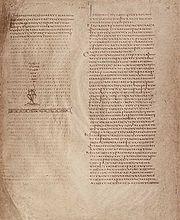
Text types
Textual types refer to the following four basic aspects of writing: descriptive, narrative, expository, and argumentative.-The descriptive text type:...
used in New Testament
New Testament
The New Testament is the second major division of the Christian biblical canon, the first such division being the much longer Old Testament....
textual criticism
Textual criticism
Textual criticism is a branch of literary criticism that is concerned with the identification and removal of transcription errors in the texts of manuscripts...
to describe and group the textual character of biblical manuscript
Biblical manuscript
A biblical manuscript is any handwritten copy of a portion of the text of the Bible. The word Bible comes from the Greek biblia ; manuscript comes from Latin manu and scriptum...
s. The Alexandrian text-type is the form of the Greek
Greek language
Greek is an independent branch of the Indo-European family of languages. Native to the southern Balkans, it has the longest documented history of any Indo-European language, spanning 34 centuries of written records. Its writing system has been the Greek alphabet for the majority of its history;...
New Testament
New Testament
The New Testament is the second major division of the Christian biblical canon, the first such division being the much longer Old Testament....
that predominates in the earliest surviving documents, as well as the text type used in Egyptian Coptic
Coptic language
Coptic or Coptic Egyptian is the current stage of the Egyptian language, a northern Afro-Asiatic language spoken in Egypt until at least the 17th century. Egyptian began to be written using the Greek alphabet in the 1st century...
manuscripts. In later manuscripts (from the 9th century onwards), the Byzantine text-type
Byzantine text-type
The Byzantine text-type is one of several text-types used in textual criticism to describe the textual character of Greek New Testament manuscripts. It is the form found in the largest number of surviving manuscripts, though not in the oldest...
became far more common and remains as the standard text in the Greek Orthodox church and also underlies most Protestant translations of the Reformation
Protestant Reformation
The Protestant Reformation was a 16th-century split within Western Christianity initiated by Martin Luther, John Calvin and other early Protestants. The efforts of the self-described "reformers", who objected to the doctrines, rituals and ecclesiastical structure of the Roman Catholic Church, led...
era. Most modern New Testament translations, however, now use an Eclectic Greek text that is closest to the Alexandrian text-type.
Manuscripts of the Alexandrian text-type
Up until the 9th century, Greek texts were written entirely in upper case letters, referred to as Uncials. During the 9th and 10th centuries, the new lower-case writing hand of MinusculesMinuscule Greek
The minuscule script was a writing style in the history of Greek writing which was used as a book hand in Byzantine manuscripts since the 9th and 10th centuries. It replaced the earlier style of uncial writing, from which it differed in using smaller, more rounded and more connected letter forms,...
came gradually to replace the older style. Most Greek Uncial manuscripts were recopied in this period and their parchment leaves typically scraped clean for re-use. Consequently, surviving Greek New Testament manuscripts from before the 9th century are relatively rare; but nine — over half of the total that survive — witness a more or less pure Alexandrian text. These include the oldest near-complete manuscripts of the New Testament Codex Vaticanus Graecus 1209 and Codex Sinaiticus
Codex Sinaiticus
Codex Sinaiticus is one of the four great uncial codices, an ancient, handwritten copy of the Greek Bible. It is an Alexandrian text-type manuscript written in the 4th century in uncial letters on parchment. Current scholarship considers the Codex Sinaiticus to be one of the best Greek texts of...
(believed to date from the early 4th century CE).
A number of substantial papyrus
Papyrus
Papyrus is a thick paper-like material produced from the pith of the papyrus plant, Cyperus papyrus, a wetland sedge that was once abundant in the Nile Delta of Egypt....
manuscripts of portions of the New Testament survive from earlier still, and those that can be ascribed a text-type — such as
 66 and
  75 from the early 3rd century — also tend to witness to the Alexandrian text.
The earliest translation of the New Testament into an Egyptian Coptic version
Coptic versions of the Bible
There have been many Coptic versions of the Bible, including some of the earliest translations into any language. Several different versions were made in the ancient world, with different editions of the Old and New Testament in all four of the major dialects of Coptic: Bohairic , Fayyumic, Sahidic...
— the Sahidic of the late 2nd century — uses the Alexandrian text as a Greek base; although other 2nd and 3rd century translations — into Old Latin
Old Latin
Old Latin refers to the Latin language in the period before the age of Classical Latin; that is, all Latin before 75 BC...
and Syriac tend rather to conform to the Western text-type
Western text-type
The Western text-type is one of several text-types used in textual criticism to describe and group the textual character of Greek New Testament manuscripts...
. Although the overwhelming majority of later minuscule manuscripts conform to the Byzantine text-type; detailed study has, from time to time, identified individual minuscules that transmit the alternative Alexandrian text. Around 17 such manuscripts have been discovered so far — consequently the Alexandrian text-type is witnessed by around 30 surviving manuscripts — by no means all of which are associated with Egypt
Egypt
Egypt , officially the Arab Republic of Egypt, Arabic: , is a country mainly in North Africa, with the Sinai Peninsula forming a land bridge in Southwest Asia. Egypt is thus a transcontinental country, and a major power in Africa, the Mediterranean Basin, the Middle East and the Muslim world...
, although that area is where Alexandrian witnesses are most prevalent.
It was used by Clement
Clement of Alexandria
Titus Flavius Clemens , known as Clement of Alexandria , was a Christian theologian and the head of the noted Catechetical School of Alexandria. Clement is best remembered as the teacher of Origen...
, Athanasius
Athanasius of Alexandria
Athanasius of Alexandria [b. ca. – d. 2 May 373] is also given the titles St. Athanasius the Great, St. Athanasius I of Alexandria, St Athanasius the Confessor and St Athanasius the Apostolic. He was the 20th bishop of Alexandria. His long episcopate lasted 45 years Athanasius of Alexandria [b....
, and Cyril of Alexandria
Cyril of Alexandria
Cyril of Alexandria was the Patriarch of Alexandria from 412 to 444. He came to power when the city was at its height of influence and power within the Roman Empire. Cyril wrote extensively and was a leading protagonist in the Christological controversies of the later 4th and 5th centuries...
.
List of notable manuscripts represented Alexandrian text-type:
| Sign | Name | Date | Content |
 46 46 |
Chester Beatty II | c. 200 | Pauline Epistles Pauline epistles The Pauline epistles, Epistles of Paul, or Letters of Paul, are the thirteen New Testament books which have the name Paul as the first word, hence claiming authorship by Paul the Apostle. Among these letters are some of the earliest extant Christian documents... |
 66 66 |
Bodmer II Papyrus 66 Papyrus 66 is a near complete codex of the Gospel of John, and part of the collection known as the Bodmer Papyri.-Description:... |
c. 200 | Gospels |
 72 72 |
Bodmer VII/VIII Papyrus 72 Papyrus 72 is an early New Testament papyrus. It contains all the text of 1 Peter, 2 Peter, and Jude. Paleographically it had been assigned to the 3rd or 4th century.- Description :... |
3rd/4th | 1-2 Peter; Jude |
 75 75 |
Bodmer XIV-XV Papyrus 75 Papyrus 75 is an early Greek New Testament papyrus.- Description :Originally '[it] contained about 144 pages ... of which 102 have survived, either in whole or in part.' It 'contains about half the text of ... two Gospels' – Luke and John in Greek... |
3rd | fragments of Luke — John |
| א | Codex Sinaiticus Codex Sinaiticus Codex Sinaiticus is one of the four great uncial codices, an ancient, handwritten copy of the Greek Bible. It is an Alexandrian text-type manuscript written in the 4th century in uncial letters on parchment. Current scholarship considers the Codex Sinaiticus to be one of the best Greek texts of... |
330-360 | NT |
| B | Codex Vaticanus Graecus 1209 | 325-350 | Matt. — Hbr 9, 14 |
| A | Codex Alexandrinus Codex Alexandrinus The Codex Alexandrinus is a 5th century manuscript of the Greek Bible,The Greek Bible in this context refers to the Bible used by Greek-speaking Christians who lived in Egypt and elsewhere during the early history of Christianity... |
c. 400 | (except Gospels) |
| C | Codex Ephraemi Rescriptus Codex Ephraemi Rescriptus Codex Ephraemi Rescriptus is an early 5th century Greek manuscript of the Bible, the last in the group of the four great uncial manuscripts... |
5th | (except Gospels) |
| Q | Codex Guelferbytanus B Codex Guelferbytanus B Codex Guelferbytanus B designated by Q or 026 , ε 4 , is a Greek uncial manuscript of the Gospels, dated palaeographically to the 5th century.It is a palimpsest.- Contents :Gospel of Luke... |
5th | fragments Luke — John |
| T | Codex Borgianus Codex Borgianus Codex Borgianus, designated by T or 029 , ε 5 , is a Greek and Sahidic uncial manuscript of the Gospels, dated palaeographically to the 5th century... |
5th | fragments Luke — John |
| I | Codex Freerianus Codex Freerianus Codex Freerianus, designated by I or 016 , α 1041 , also called the Washington Manuscript of the Pauline Epistles, is a 5th century manuscript in an uncial hand on vellum in Greek.... |
5th | Pauline epistles Pauline epistles The Pauline epistles, Epistles of Paul, or Letters of Paul, are the thirteen New Testament books which have the name Paul as the first word, hence claiming authorship by Paul the Apostle. Among these letters are some of the earliest extant Christian documents... |
| Z | Codex Dublinensis Codex Dublinensis Codex Dublinensis designated by Z or 035 , ε 26 , is a Greek uncial manuscript of the Gospels, dated palaeographically to the 6th century. The manuscript is lacunose.- Description :... |
6th | fragments of Matt. |
| L | Codex Regius Codex Regius (New Testament) Codex Regius designated by siglum Le or 019 , ε 56 , is a Greek uncial manuscript of the New Testament, dated paleographically to the 8th century. The manuscript is lacunose. It has marginalia.... |
8th | Gospels |
| W | Codex Washingtonianus Codex Washingtonianus The Codex Washingtonianus or Codex Washingtonensis, designated by W or 032 , ε 014 , also called the Washington Manuscript of the Gospels, and The Freer Gospel, contains the four biblical gospels and was written in Greek on vellum in the fourth or fifth century... |
5th | Luke 1:1–8:12; J 5:12–21:25 |
| 057 | Uncial 057 Uncial 057 Uncial 057 , is a Greek uncial manuscript of the New Testament, dated palaeographically to the 4th or 5th century.- Description :... |
4/5th | Acts 3:5–6,10-12 |
| 0220 | Uncial 0220 Uncial 0220 Uncial 0220 , is a leaf of a late third century Greek codex containing The Epistle to the Romans.- Description :... |
6th | NT (except Rev.) |
| 33 | Minuscule 33 Minuscule 33 Minuscule 33 , δ 48 , formerly it was called Codex Colbertinus 2844, is a Greek minuscule manuscript of the New Testament on parchment, dated palaeographically to the 9th century. The manuscript is lacunose. It has marginalia... |
9th | Romans |
| 81 | Minuscule 81 Minuscule 81 Minuscule 81 , or α162 is a Greek minuscule manuscript of the New Testament, on a parchment. It is dated by a colophon to the year 1044. Formerly it was labelled by 61a and 61p . The manuscript is lacunose... |
1044 | Acts, Paul |
| 892 | Minuscule 892 Minuscule 892 Minuscule 892 , ε 1016 . It is a Greek minuscule manuscript of the New Testament, on 353 parchment leaves . It is dated palaeografically to the 9th century.- Description :... |
9th | Gospels |
Other manuscripts:
Papyri:
 1,
1,  4
4Papyrus 4
Papyrus 4 is an early New Testament papyri of the Gospel of Luke in Greek. It is dated as being a late 2nd/early 3rd century manuscript.- Description :...
,
 5,
5,  6,
6,  8,
8,  9,
9,  10,
10,  11,
11,  12,
12,  13
13Papyrus 13
Papyrus 13, designated by siglum in the Gregory-Aland numbering, is a fragmented manuscript of the New Testament in Greek. It was copied on papyrus in the 3rd century at approximately 225-250 CE.- Description :...
,
 14,
14,  15,
15,  16,
16,  17,
17,  18,
18,  19,
19,  20,
20,  22
22Papyrus 22
Boom! Boom! The Explosion of Irish Comedy was a four-part Irish television programme broadcast on RTÉ One in 2008. Presented by Colm Meaney it focused on the positive changes that occurred in Irish comedy during the Celtic Tiger years...
,
 23,
23,  24
24Papyrus 24
Madí is an international abstract art movement initiated in Buenos Aires in 1946 by the Hungarian-Argentinian artist and poet Gyula Kosice and the Uruguayans Carmelo Arden Quin and Rhod Rothfuss.-Concrete art:...
,
 26,
26,  27
27Papyrus 27
"Appelle mon numéro" is a 2008 song recorded by French singer Mylène Farmer. Released on 3 November 2008, it was the second single from her seventh studio album, Point de Suture. It received generally positive reviews from critics and was more aired on radio and television than Farmer's previous...
,
 28
28Papyrus 28
Harry Jarman was a Welsh international forward who played club rugby for Newport and Pontypool. He won four caps for Wales and also played for the British Isles in their 1910 tour of South Africa...
,
 29,
29,  30,
30,  31,
31,  32,
32,  33,
33,  34,
34,  35,
35,  37,
37,  39,
39,  40,
40,  43,
43,  44,
44,  45
45Papyrus 45
Papyrus 45 is an early New Testament manuscript which is a part of the Chester Beatty Papyri. It was probably created around 250 in Egypt. It contains the texts of Matthew 20-21 and 25-26; Mark 4-9 and 11-12; Luke 6-7 and 9-14; John 4-5 and 10-11; and Acts 4-17...
,
 47,
47,  49,
49,  51,
51,  53,
53,  55,
55,  56,
56,  57,
57,  61,
61,  62,
62,  64,
64,  65,
65,  70,
70,  71,
71,  72
72Papyrus 72
Papyrus 72 is an early New Testament papyrus. It contains all the text of 1 Peter, 2 Peter, and Jude. Paleographically it had been assigned to the 3rd or 4th century.- Description :...
,
 74,
74,  77,
77,  78,
78,  79,
79,  80 (?),
  81,
81,  82,
82,  85 (?),
  86,
86,  87,
87,  90,
90,  91,
91,  92,
92,  95,
95,  100,
100,  104,
104,  106,
106,  107,
107,  108,
108,  110,
110,  111,
111,  115
115Papyrus 115
Papyrus 115 is a fragmented manuscript of the New Testament written in Greek on papyrus. It consists of 12 fragments of a codex containing parts of the Book of Revelation. It dates to the 3rd century, ca. 225-275 AD...
,
 122.
122.Uncials:
Codex Coislinianus
Codex Coislinianus
Codex Coislinianus designated by Hp or 015 , α 1022 , was named also as Codex Euthalianus. It is a Greek uncial manuscript of the Pauline epistles, dated palaeographically to the 6th century. The text is written stichometrically.It has marginalia...
, Porphyrianus
Codex Porphyrianus
Codex Porphyrianus designated by Papr or 025 , α 3 , is a Greek uncial manuscript of the Acts of Apostles, Pauline epistles, and General epistles, with some lacunae, dated paleographically to the 9th century. It is one of a few uncial manuscripts that include the Book of Revelation.It was...
(except Acts, Rev), Dublinensis
Codex Dublinensis
Codex Dublinensis designated by Z or 035 , ε 26 , is a Greek uncial manuscript of the Gospels, dated palaeographically to the 6th century. The manuscript is lacunose.- Description :...
, Sangallensis (only in Mark), Zacynthius
Codex Zacynthius
Codex Zacynthius, designated by siglum Ξ or 040 , A1 , is a Greek New Testament codex, dated paleographically to the 6th century. Formerly it was dated to the 8th century . It is a palimpsest, a former text had been washed off its vellum pages...
, Athous Lavrensis (in Mark and Cath. epistles), Vaticanus 2061
Codex Vaticanus 2061
Codex Vaticanus Graecus 2061, usually known as Uncial 048 , α1 , is a Greek uncial manuscript on parchment. It contains some parts of the New Testament, homilies of several authors, and Strabo's Geographica...
, 059
Uncial 059
Uncial 059 , ε 09 , is a Greek uncial manuscript of the New Testament, dated paleographically to the 4th or 5th century.- Description :The codex contains a part of the Gospel of Mark , on 1 parchment leaf...
, 068
Uncial 068
Uncial 068 , ε 3 , is a Greek uncial manuscript of the New Testament, dated paleographically to the 5th century. Tischendorf designated it by Ib, Scrivener by Nb.It has some marginalia.- Description :...
, 071
Uncial 071
Uncial 071 , ε 015 , is a Greek uncial manuscript of the New Testament, dated paleographically to the 5th or 6th century. It came from Oxyrhynchus.- Description :...
, 073
Uncial 073
Uncial 073 , ε 7 , is a Greek uncial manuscript of the New Testament, dated palaeographically to the 6th century.- Description :...
, 076
Uncial 076
Uncial 076 , α1008 , is a Greek uncial manuscript of the New Testament, dated palaeographically to the 5th or 6th century. Formerly it was labeled by יa.C. R. Gregory, "Textkritik des Neuen Testaments", Leipzig 1909, vol. 3, p. 1061.- Description :Survived only one parchment leaf...
, 077
Uncial 077
Uncial 077 , is a Greek uncial manuscript of the New Testament, paleographically has been assigned to the 5th century. To the present day only one leaf of the codex has survived.- Description :...
, 081
Uncial 081
Codex Tischendorfianus II – designated by Uncial 081 α 1023 , – is a Greek uncial manuscript of the New Testament, dated paleographically to the 6th century.- Description :...
, 083
Uncial 083
Uncial 083 , ε 31 , is a Greek uncial manuscript of the New Testament, dated paleographically to the 6th/7th century. The codex now is located at the Russian National Library in Saint Petersburg.- Description :...
, 085
Uncial 085
Uncial 085 , ε 23 , is a Greek uncial manuscript of the New Testament, dated palaeographically to the 6th century.- Description :...
, 087
Uncial 087
Uncial 087 , ε 27 ; is a Greek uncial manuscript of the New Testament, dated paleographically to the 6th century. Formerly it was labelled by Θc.- Description :...
, 088
Uncial 088
Uncial 088 , α 1021 , is a Greek uncial manuscript of the New Testament, dated paleographically to the 5th or 6th century.- Description :...
, 089
Uncial 089
Uncial 089 in the Gregory-Aland numbering), ε 28 , is a Greek uncial manuscript of the New Testament, dated paleographically to the 6th century. The codex now is located at the Russian National Library in Saint Petersburg...
, 091
Uncial 091
Uncial 091 in the Gregory-Aland numbering), ε 30 , is a Greek uncial manuscript of the New Testament, dated paleographically to the 6th century.- Description :...
, 093
Uncial 093
Uncial 093 , is a Greek uncial manuscript of the New Testament, dated palaeographically to the 6th century. Formerly it was designated by siglum ל.- Description :...
(except Acts), 094
Uncial 094
Uncial 094 , ε 016 ; is a Greek uncial manuscript of the New Testament, dated paleographically to the 6th century.- Description :...
, 096
Uncial 096
Uncial 096 , α 1004 , is a Greek uncial manuscript of the New Testament, dated paleographically to the 7th century.- Descritpion :...
, 098
Uncial 098
Uncial 098 , α 1025 , is a Greek uncial manuscript of the New Testament, dated palaeographically to the 7th century. It is also named Codex Cryptoferratensis .- Description :...
, 0101
Uncial 0101
Uncial 0101 , ε 48 , is a Greek uncial manuscript of the New Testament. It is dated palaeographically to the 8th century. Formerly it was labelled by TV. The manuscript has survived in very fragmentary condition....
, 0102
Uncial 0102
Uncial 0102 , ε 42 , is a Greek uncial manuscript of the New Testament. It is dated paleographically to the 7th century.- Description :...
, 0108
Uncial 0108
Uncial 0108 , ε 60 , is a Greek uncial manuscript of the New Testament, dated paleographically to the 7th century. Formerly it was labelled by Θd.- Description :...
, 0111
Uncial 0111
Uncial 0111 , is a Greek uncial manuscript of the New Testament, dated paleographically to the 7th century.- Description :...
, 0114
Uncial 0114
Uncial 0114 , ε 53 ; is a Greek–Coptic diglot uncial manuscript of the New Testament, dated palaeographically to the 8th century.- Description :...
, 0129
Uncial 0129
Uncial 0129 , α 1037 , is a Greek-Coptic diglot uncial manuscript of the New Testament, dated paleographically to the 9th century.- Description :...
, 0142
Uncial 0142
Uncial 0142 , O6 , is a Greek uncial manuscript of the New Testament, dated paleographically to the 10th century...
, 0155
Uncial 0155
Uncial 0155 , ε 1055 , is a Greek uncial manuscript of the New Testament, dated palaeographically to the 9th century....
, 0156
Uncial 0156
Uncial 0156 , is a Greek uncial manuscript of the New Testament, dated palaeographically to the 8th century.The codex contains a small parts of the Second Epistle of Peter 3:2-10, on one parchment leaf...
, 0162
Uncial 0162
Codex 0162 , ε 023 , is one vellum leaf of the late third century Greek codex containing John.- Description :...
, 0167
Uncial 0167
Uncial 0167 , is a Greek uncial manuscript of the New Testament, dated paleographically to the 7th century.- Description :...
, 0172
Uncial 0172
Uncial 0172 , is a Greek uncial manuscript of the New Testament, dated palaeographically to the 5th century.- Description :...
, 0173
Uncial 0173
Uncial 0173 , is a Greek uncial manuscript of the New Testament, dated paleographically to the 5th century.- Description :The codex contains a small part of the Epistle of James 1:25-27, on one parchment leaf...
, 0175
Uncial 0175
Uncial 0175 , is a Greek uncial manuscript of the New Testament, dated palaeographically to the 5th century The manuscript has survived in a very fragmentary condition.- Description :...
, 0181
Uncial 0181
Uncial 0181 , is a Greek uncial manuscript of the New Testament, dated paleographically to the 4th century .- Description :...
, 0183
Uncial 0183
Uncial 0183 , is a Greek uncial manuscript of the New Testament, dated palaeographically to the 7th century.- Description :...
, 0184
Uncial 0184
Uncial 0184 , is a Greek-Coptic diglot uncial manuscript of the New Testament, dated paleographically to the 6th century.- Description :...
, 0185
Uncial 0185
Uncial 0185 , is a Greek uncial manuscript of the New Testament, dated palaeographically to the 4th century.- Description :...
, 0189
Uncial 0189
Uncial 0189 , is the oldest parchment manuscript of the New Testament.- Description :It consists of a single vellum leaf of a late second or early third century Greek codex, containing only a small part of the Acts of the Apostles.Its history is unknown prior to its current possession by the...
, 0201
Uncial 0201
Uncial 0201 , is a Greek uncial manuscript of the New Testament, dated paleographically to the 5th century.- Description :...
, 0204
Uncial 0204
Uncial 0204 , is a Greek-Coptic diglot uncial manuscript of the New Testament, dated paleographically to the 7th century.- Description :...
, 0205
Uncial 0205
Codex 0205 . It is a Greek-Coptic uncial manuscript of the Epistle to Titus and the Epistle to Philemon, dated paleographically to the 8th century .- Description :...
, 0207
Uncial 0207
Uncial 0207 , is a Greek uncial manuscript of the New Testament, dated paleographically to the 4th century.- Description :...
, 0223
Uncial 0223
Uncial 0223 , is a Greek uncial manuscript of the New Testament. The manuscript paleographically had been assigned to the 6th century. It contains a small parts of the Second Epistle to the Corinthians , on 1 parchment leaf...
, 0225
Uncial 0225
Uncial 0225 , is a Greek uncial manuscript of the New Testament. The manuscript paleographically had been assigned to the 6th century. It contains a small parts of the Second Epistle to the Corinthians , on 3 parchment leaves . Written in two columns per page, 21-27 lines per page. It is a...
, 0232
Uncial 0232
Uncial 0232 , is a Greek uncial manuscript of the New Testament. The manuscript palaeographically has been assigned to the 5th or 6th century....
, 0234
Uncial 0234
Uncial 0234 , ε 49 , is a Greek uncial manuscript of the New Testament. Paleographically it has been assigned to the 8th century.- Description :...
, 0240
Uncial 0240
Uncial 0240 , is a Greek uncial manuscript of the New Testament. Palaeographically it has been assigned to the 5th century.- Description :...
, 0243
Uncial 0243
Uncial 0243 , is a Greek uncial manuscript of the New Testament. Paleographically it has been assigned to the 10th century.- Description :...
, 0244
Uncial 0244
Uncial 0244 , is a Greek uncial manuscript of the New Testament. Paleographically it has been assigned to the 5th century.- Description :Currently it is dated by the INTF to the 5th century....
, 0245
Uncial 0245
Uncial 0245 , is a Greek uncial manuscript of the New Testament. Paleographically it has been assigned to the 6th century.- Description :...
, 0247
Uncial 0247
Uncial 0247 , is a Greek uncial manuscript of the New Testament. Paleographically it has been assigned to the 5th or 6th century.- Description :...
, 0254
Uncial 0254
Uncial 0254 , is a Greek uncial manuscript of the New Testament. Palaeographically it has been assigned to the 5th century.- Description :...
, 0270
Uncial 0270
Uncial 0270 , is a Greek uncial manuscript of the New Testament. The manuscript paleographically has been assigned to the 4th/5th century.- Description :...
, 0271
Uncial 0271
Uncial 0271 , is a Greek uncial manuscript of the New Testament. Paleographically it has been assigned to the 9th century.- Description :...
, 0274
Uncial 0274
Uncial 0274 , is a Greek uncial manuscript of the New Testament. Paleographically it has been assigned to the 5th century.- Description :...
.
Minuscules: 20
Minuscule 20
Minuscule 20 , A138 . It is a Greek minuscule manuscript of the New Testament, dated paleographically to the 11th century. The manuscript has complex contents and full marginalia. It was prepared for the church reading....
, 94
Minuscule 94
Minuscule 94 , O31 , is a Greek minuscule manuscript of the New Testament, on parchment and paper, dated to the 12th or 13th century...
, 104
Minuscule 104
Minuscule 104 , α 103 , is a Greek minuscule manuscript of the New Testament, on parchment leaves. Palaeographically it has been assigned to the 12th century.Formerly it was labelled by 25a, 31p, and 7r....
(Epistles), 157
Minuscule 157
Minuscule 157 , ε 207 , is a Greek minuscule manuscript of the New Testament, on vellum. According to the colophon it is dated to the year 1122. Formerly date was wrongly deciphered as 1128?...
, 164
Minuscule 164
Minuscule 164 , ε 116 , is a Greek minuscule manuscript of the New Testament, on parchment. It is dated by its colophon to the year 1039. It has complex contents, with full marginalia.- Description :...
, 215
Minuscule 215
Minuscule 215 , A134 , is a Greek minuscule manuscript of the New Testament, on parchment. Paleographically it has been assigned to the 11th century. It has full marginalia.- Description :...
, 241
Minuscule 241
Minuscule 241 , δ 507 , is a Greek minuscule manuscript of the New Testament, on parchment. Palaeographically it has been assigned to the 11th century. Formerly it was labelled by 241e, 104a, 120p, and 47r....
, 254
Minuscule 254
Minuscule 254 , ΟΘ42 , is a Greek minuscule manuscript of the New Testament, on papert. Palaeographically it had been assigned to the 11th century. Formerly it was labelled by 251a, 301p, 122r...
, 322
Minuscule 322
Minuscule 322 , α 550 , is a Greek minuscule manuscript of the New Testament, on paper. Palaeographically it has been assigned to the 15th century.Formerly it was labelled by 27a and 33p.- Description :...
, 323
Minuscule 323
Minuscule 323 , α 157 , is a Greek minuscule manuscript of the New Testament, on parchment. Palaeographically it has been assigned to the 12th century.Formerly it was designated by 29a and 35p.- Description :...
, 326
Minuscule 326
Minuscule 326 , α 257 , is a Greek minuscule manuscript of the New Testament, on parchment. Paleographically it has been assigned to the 10th century.Formerly it was labelled by 33a and 39p ....
, 376
Minuscule 376
Minuscule 376 , ε 100 , is a Greek minuscule manuscript of the New Testament, on parchment. Paleographically it has been assigned to the 11th century.It has marginalia.- Description :...
, 383
Minuscule 383
Minuscule 383 , α 353 , is a Greek minuscule manuscript of the New Testament, on parchment. Paleographically it has been assigned to the 13th century.Formerly it was labelled by 58a and 224p.- Description :...
, 442
Minuscule 442
Minuscule 442 , O18 , is a Greek minuscule manuscript of the New Testament, on parchment. Palaeographically it has been assigned to the 12 or 13th century.Formerly it was assigned by 68a and 73p...
, 579
Minuscule 579
Minuscule 579 , ε 376 , is a Greek minuscule manuscript of the New Testament, on parchment leaves. Palaeographically it has been assigned to the 13th century. Formerly it was labelled as 80e...
(except Matthew), 614
Minuscule 614
Minuscule 614 , α 364 , is a Greek minuscule manuscript of the New Testament, on parchment. Palaeographically it has been assigned to the 13th century. The manuscript is lacunose...
, 718
Minuscule 718
Minuscule 718 , ε352 , is a Greek minuscule manuscript of the New Testament, on parchment. Palaeographically it has been assigned to the 14th century. The manuscript is lacunose...
, 850
Minuscule 850 (Gregory-Aland)
Minuscule 850 , Κι20 , is a 12th-century Greek minuscule manuscript of the New Testament on parchment. The manuscript has no complex context.- Description :...
, 1006, 1175, 1241 (except Acts), 1243, 1292 (Cath.), 1342 (Mark), 1506 (Paul), 1611, 1739
Minuscule 1739
Minuscule 1739 ; α 78 per is a Greek minuscule manuscript of the New Testament, on 102 parchment leaves . It is dated paleographically to the 10th century.- Description :...
, 1841, 1852, 1908, 2040, 2053
Minuscule 2053
Minuscule 2053 , Oα31 , is a Greek minuscule manuscript of the New Testament, on 138 parchment leaves . Paleografically it has been assigned to the 13th century.- Description :...
, 2062
Minuscule 2062
Minuscule 2062 , Oα42 , is a Greek minuscule manuscript of the New Testament, on 29 paper leaves . Palaeografically it had been assigned to the 13th century.- Description :...
, 2298, 2344
Minuscule 2344
Minuscule 2344 , is a Greek minuscule manuscript of the New Testament.- Description :The codex contains the text of the Acts, CE, Paul, Rev, on 61 parchment leaves...
(CE, Rev), 2351, 2427, 2464
Minuscule 2464
Minuscule 2464 , is a Greek minuscule manuscript of the New Testament, on 213 parchment leaves. Dated palaeografically to the 9th century. The text is written in one column per page, in 26 lines per page.- Description :...
.
According to the present critics codices
 75 and B are the best Alexandrian witnesses, which present the pure Alexandrian text. All other witnesses are classified according to whether they preserve the excellent
  75-B line of text. With the primary Alexandrian witnesses are included
  66 and citations of Origen
Origen
Origen , or Origen Adamantius, 184/5–253/4, was an early Christian Alexandrian scholar and theologian, and one of the most distinguished writers of the early Church. As early as the fourth century, his orthodoxy was suspect, in part because he believed in the pre-existence of souls...
. With the secondary witnesses are included manuscripts C, L. 33, and the writings of Didymus the Blind
Didymus the Blind
Didymus the Blind was a Coptic Church theologian of Alexandria, whose famous Catechetical School he led for about half a century. He became blind at a very young age, and therefore ignorant of the rudiments of learning...
.
Characteristics of the Alexandrian text-type
All extant manuscripts of all text-types are at least 85% identical and most of the variations are not translatable into English, such as word order or spelling. When compared to witnesses of the Western text-type, Alexandrian readings tend to be shorter; and are commonly regarded as having a lower tendency to expand or paraphrase. Some of the manuscripts representing the Alexandrian text-type have the Byzantine corrections made by later hands (Papyrus 66, Codex Sinaiticus, Codex Ephraemi, Codex Regius, and Codex Sangallensis). When compared to witnesses of the Byzantine text type, Alexandrian manuscripts tend:- to have a larger number of abrupt readings — such as the shorter ending of the Gospel of MarkGospel of MarkThe Gospel According to Mark , commonly shortened to the Gospel of Mark or simply Mark, is the second book of the New Testament. This canonical account of the life of Jesus of Nazareth is one of the three synoptic gospels. It was thought to be an epitome, which accounts for its place as the second...
, which finishes in the Alexandrian text at Mark 16:8 (".. for they were afraid.") omitting verses Mark 16:9-20; Matthew 16:2b–3, John 5:4; John 7:53-8:11;
- Omitted verses: Matt 12:47; 17:21; 18:11; Mark 9:44.46; 11:26; 15:28; Luke 17:36; Acts 8:37; 15:34; 24:7; 28:29.
- In Matthew 15:6 omitted (αυτου) (or (his) mother) — א B D copsa;
- In Mark 10:7 omitted phrase (and be joined to his wife), in codices Sinaiticus, Vaticanus, Athous Lavrensis, 892, ℓ 48Lectionary 48Lectionary 48, designated by siglum ℓ 48 . It is a Greek manuscript of the New Testament, on parchment leaves. Dated by a colophon it has been assigned to the year 1055.- Description :...
, syrs, goth.
- Mark 10:37 (left) instead of (left), in phrase εξ αριστερων (B Δ 892v.l.) or σου εξ αριστερων (L Ψ 892*);
- In Luke 11:4 phrase (but deliver us from evil) omitted. Omission is supported by the manuscripts: Sinaiticus, B, L, f1, 700, vg, syrs, copsa, bo, arm, geo.
- In Luke 9:55-56 it has only (but He turned and rebuked them) — p45 p75 א B C L W X Δ Ξ Ψ 28 33 565 892 1009 1010 1071 Byzpt Lect
- to display more variations between parallel synopticSynopticSynoptic is derived from the Greek words σύν and ὄψις , and describes observations that give a broad view of a subject at a particular time. Specific uses include:*Synoptic scale meteorology*Synoptic Gospels*SynOptics...
passages — as in the Lukan version of the Lord's PrayerLord's PrayerThe Lord's Prayer is a central prayer in Christianity. In the New Testament of the Christian Bible, it appears in two forms: in the Gospel of Matthew as part of the discourse on ostentation in the Sermon on the Mount, and in the Gospel of Luke, which records Jesus being approached by "one of his...
(Luke 11:2), which in the Alexandrian text opens "Father.. ", whereas the Byzantine text reads (as in the parallel Matthew 6:9) "Our Father in heaven.. ";
- to have a higher proportion of "difficult" readings — as in Matthew 24:36 which reads in the Alexandrian text "But of that day and hour no one knows, not even the angels of heaven, nor the Son, but the Father only"; whereas the Byzantine text omits the phrase "nor the Son", thereby avoiding the implication that Jesus lacked full divine foreknowledge. Another difficult reading: Luke 4:44.
It must be noted that the above comparisons are tendencies, rather than consistent differences. Hence there are a number of passages in the Gospel of Luke
Gospel of Luke
The Gospel According to Luke , commonly shortened to the Gospel of Luke or simply Luke, is the third and longest of the four canonical Gospels. This synoptic gospel is an account of the life and ministry of Jesus of Nazareth. It details his story from the events of his birth to his Ascension.The...
where the Western text-type witnesses a shorter text — the Western non-interpolations
Western non-interpolations
Western non-interpolations are readings in the Western text-type that are shorter than those of other New Testament text types. The term was coined by F. J. A. Hort....
. Also there are a number of readings where the Byzantine text displays variation between synoptic passages, that is not found in either the Western or Alexandrian texts — as in the rendering into Greek of the Aramaic last words of Jesus, which are reported in the Byzantine text as "Eloi, Eloi.." in Mark 15:34, but as "Eli, Eli.." in Matthew 27:46.
Peculiar readings
In Gospel of Matthew 27:49 was added this text: "The other took a spear and pierced His side, and immediately water and blood came out" (see: John 19:34). We can find this textual variant in codices: Sinaiticus, Vaticanus, Regius, and several other witnesses of Alexandrian text-type. Probably this text was added in a result of fighting with DocetismDocetism
In Christianity, docetism is the belief that Jesus' physical body was an illusion, as was his crucifixion; that is, Jesus only seemed to have a physical body and to physically die, but in reality he was incorporeal, a pure spirit, and hence could not physically die...
.
Mark 5:9
- λεγιων ονομα μοι — א B C L Δ
- απεκριτη — D
- απεκριθη λεγων — E 565 700
- λεγεων — A W Θ f1 f13 Byz
Mark 6:22
- θυγατρος αυτου Ηρωδιαδος — א B D L Δ 565
- θυγατρος αυτης της Ηρωδιαδος — A C K Θ Π
- θυγατρος αυτης Ηρωδιαδος — W f13 28 33 700 892 1009 1010 1071 1079 1195 1216 1230 1241 1242 Byz it vg
- θυγατρος της Ηρωδιαδος — f1 itaur, b, c, f syr cop goth arm eth geo
Luke 1:76 — προ προσωπου ] ενωπιον
Luke 9:35
- εκλελεγμενος — א B Ξ 892 1241
- εκλεκτος — Θ f1 1365
- αγαπητος — A C K P W X Δ Π f13 28 33 565 700 Byz
- αγαπητος εν ο ευδοκησα — C3 D Ψ ℓ 19Lectionary 19Lectionary 19, designated by siglum ℓ 19 . It is a Greek manuscript of the New Testament, on vellum leaves. Palaeographically it has been assigned to the 13th century.- Description :...
ℓ 31Lectionary 31Lectionary 31, designated by siglum ℓ 31 . It is a Greek manuscript of the New Testament, on parchment leaves. Palaeographically it has been assigned to the 12th century.- Description :...
ℓ 47Lectionary 47Lectionary 47, designated by siglum ℓ 47 . It is a Greek manuscript of the New Testament, on parchment leaves. Palaeographically it has been assigned to the 10th century.- Description :...
ℓ 48Lectionary 48Lectionary 48, designated by siglum ℓ 48 . It is a Greek manuscript of the New Testament, on parchment leaves. Dated by a colophon it has been assigned to the year 1055.- Description :...
ℓ 49Lectionary 49Lectionary 49, designated by siglum ℓ 49 . It is a Greek manuscript of the New Testament, on parchment leaves. Palaeographically it has been assigned to the 10th or 11th century.- Description :...
Acts 27:41
- υπο της βιας — א, A, B, arm, geo
- υπο των κυματων — Ψ (ℓ 1441 των κυματων with obeli and omitted υπο)
- υπο της βιας των κυματων —
 74, C, P, 049Uncial 049Uncial 049 , α 2 . It is a Greek uncial manuscript of the New Testament. Paleographically it has been assigned to the 9th century.- Description :...
, 056, 0142, (אc 104 απο), 33, 81, 88, 181, 326, 330Minuscule 330Minuscule 330 , δ 259 , is a Greek minuscule manuscript of the New Testament, on parchment. Palaeographically it has been assigned to the 12th century.It has marginalia.- Description :...
, 436, 451, 614, (629 των ανεμων), 630, 945, 1241, 1505, 1739, 1877, 2127, 2412, 2492, 2495, Byz, Lect, syrp, h, cop, ethpp
1 Corinthians 2:1
- μυστηριον –
 46, א, Α, C, 88, 436, ita,r, syrp, copbo
 - μαρτυριον – B D G P Ψ 33 81 104 181 326 330 451 614 629 630 1241 1739 1877 1881 1962 1984 2127 2492 2495 Byz Lect it vg syrh copsa arm eth
1 Corinthians 2:4
- πειθοις σοφιας λογοις (plausible words of wisdom) – (א λογος) B (Dgr 33 πιθοις) Dc 181 1739 1877 1881 itr1 vgww eth
- πειθοις σοφιας (plausible wisdom) –
 46 Ggr
 - πειθοι σοφιας (plausible wisdom) – 35Minuscule 35Minuscule 35 , δ309 , is a Greek minuscule manuscript of the New Testament, written on 328 parchment leaves . Paleographically it has been assigned to the 11th century. The manuscript has complex contents, marginalia, and many corrections.- Description :The codex contains the entire New Testament...
itf,g - πειθοις ανθρωπινης σοφιας λογοις – C Ψ (A P 326 330 πιθοις) 81 88 104 436 451 614 629 1241 1984 2127 2492 Byz vgcl syrh copbo
1 Corinthians 7:5
- τη προσευχη (prayer) –
 11,
11,  46, א*, A, B, C, D, F, G, P, Ψ, 6, 33, 81, 104, 181, 629, 630, 1739, 1877, 1881, 1962, it vg, cop, arm, eth
 - τη νηστεια και τη προσευχη (fasting and prayer) – אc, K, L, 88, 326, 436, 614, 1241, 1984, 1985, 2127, 2492, 2495, Byz, Lect, syrp,h, goth
- τη προσευχη και νηστεια (prayer and fasting) – 330, 451, John of DamascusJohn of DamascusSaint John of Damascus was a Syrian monk and priest...
1 Corinthians 7:14
- αδελφω –
 46, א*, A, B, C, D, F, G, P, Ψ, 33, 181, 1739, 1877, 1962, d, e, f, g, cop
 - ανδρι – אc, Dc, K, L, 81, 88, 104, 326, 330, 436, 451, 614, 630, 1241, 1881, 1984, 1985, 2127, 2492, 2495, Byz, Lect, syrh, goth, arm, eth
1 Corinthians 9:20
- μη ων αυτος υπο νομον – א*, A, B, C, D, F, G, P, 33, 104, 181, 436, 629, 630, 1739, 1877, 2127, 2495, it, vg, cop, goth, arm
1 Corinthians 11:24
- υμων —
 46, א*, A, B, C*, 33, 1739, arm
 - υμων κλωμενον — אc, C3, Db, c, G, K, Ψ, 81, 88, 104, 181, 326, 330, 436, 451, 614, 629, 630, 1241, 1739mg, 1877, 1881, 1962, 1984, 1985, 2127, 2492, 2495, Byz, Lect
- υμων διδομενον — c, dem, f, t, x, zc, vg (tradetur), cop, eth
1 Corinthians 15:47
- δευτερος ανθρωπος — א*, B, C, D, F, G, 0243Uncial 0243Uncial 0243 , is a Greek uncial manuscript of the New Testament. Paleographically it has been assigned to the 10th century.- Description :...
, 33, 1739, it, vg, copbo eth - δευτερος ανθρωπος ο κυριος — אc, A, Dc, K, P, Ψ, 81, 104, 181, 326, 330, 436, 451, 614, 629, 1241, 1739mg, 1877, 1881, 1984, 1985, 2127, 2492, 2495, Byz, Lect
Evaluations of text-types
Most textual criticsTextual criticism
Textual criticism is a branch of literary criticism that is concerned with the identification and removal of transcription errors in the texts of manuscripts...
of the New Testament favor the Alexandrian text-type as the closest representative of the autographs for many reasons. One reason is that Alexandrian manuscripts are the oldest we have found, and some of the earliest church fathers used readings found in the Alexandrian text. Another is that the Alexandrian readings are adjudged more often to be the ones that can best explain the origin of all the variant readings found in other text-types.
Nevertheless, there are some dissenting voices to this general consensus. A few textual critics, especially those in France, argue that the Western text-type
Western text-type
The Western text-type is one of several text-types used in textual criticism to describe and group the textual character of Greek New Testament manuscripts...
, an old text from which the Old Latin
Vetus Latina
Vetus Latina is a collective name given to the Biblical texts in Latin that were translated before St Jerome's Vulgate Bible became the standard Bible for Latin-speaking Western Christians. The phrase Vetus Latina is Latin for Old Latin, and the Vetus Latina is sometimes known as the Old Latin Bible...
versions of the New Testament are derived, is closer to the originals.
In the United States, some critics have a dissenting view that prefers the Byzantine text-type
Byzantine text-type
The Byzantine text-type is one of several text-types used in textual criticism to describe the textual character of Greek New Testament manuscripts. It is the form found in the largest number of surviving manuscripts, though not in the oldest...
(Maurice Robonson). They assert that Egypt, almost alone, offers optimal climatic conditions favoring preservation of ancient manuscripts while, on the other hand, the papyri used in the east (Asia Minor and Greece) would not have survived due to the unfavourable climatic conditions. So, it is not surprising that if we were to find ancient Biblical manuscripts, they would come mostly from the Alexandrian geographical area and not from the Byzantine geographical area. The argument for the authoritative nature of the latter is that the much greater number of Byzantine manuscripts copied in later centuries, in detriment to the Alexandrian manuscripts, indicates a superior understanding by scribes of those being closer to the autograph
Autograph
An autograph is a document transcribed entirely in the handwriting of its author, as opposed to a typeset document or one written by an amanuensis or a copyist; the meaning overlaps with that of the word holograph.Autograph also refers to a person's artistic signature...
s. Eldon Jay Epp argumented that the manuscripts circulated in the Roman world and many documents from other parts of the Roman Empire were found in Egypt since the late 19th century.
Alexandrian popular proponents counter that the Byzantine church was dominated by Arianism
Arianism
Arianism is the theological teaching attributed to Arius , a Christian presbyter from Alexandria, Egypt, concerning the relationship of the entities of the Trinity and the precise nature of the Son of God as being a subordinate entity to God the Father...
(which is in opposition to mainstream Trinitarian Christological dogma) around the time that we first see evidence of the Byzantine text emerging. However, most scholars generally agree that there is no evidence of systematic theological alteration in any of the text types.
The evidence of the papyri suggests that — in Egypt at least — very different manuscript readings co-existed in the same area in the early Christian period. So, whereas the early 3rd century papyrus P75 witnesses a text in Luke and John that is very close to that found a century later in the Codex Vaticanus, the nearly contemporary P66 has a much freer text of John; with many unique variants; and others that are now considered distinctive to the Western and Byzantine text-types, albeit that the bulk of readings are Alexandrian. Most modern text critics therefore do not regard any one text-type as deriving in direct succession from autograph manuscripts, but rather, as the fruit of local exercises to compile the best New Testament text from a manuscript tradition that already displayed wide variations.
History of research
GriesbachJohann Jakob Griesbach
Johann Jakob Griesbach , German biblical textual critic, was born at Butzbach, a small town in the state of Hesse, where his father, Konrad Kaspar , was pastor...
produced a list of nine manuscripts which represent the Alexandrian text: C, L
Codex Regius (New Testament)
Codex Regius designated by siglum Le or 019 , ε 56 , is a Greek uncial manuscript of the New Testament, dated paleographically to the 8th century. The manuscript is lacunose. It has marginalia....
, K
Codex Cyprius
Codex Cyprius, designated by Ke or 017 , ε 71 , is a Greek uncial manuscript of the four Gospels, on parchment. It was variously dated in the past , currently it is dated to the 9th century. It was brought from Cyprus to Paris...
, 1
Minuscule 1
Codex Basilensis A. N. IV. 2, Minuscule 1 , δ 254 ; formerly it was designated by 1eap...
, 13
Minuscule 13
Minuscule 13 , ε 368 , is a Greek minuscule manuscript of the New Testament, on a parchment, dated to the 13th century. The manuscript is lacunose. The text of the manuscript is important for the textual critic...
, 33
Minuscule 33
Minuscule 33 , δ 48 , formerly it was called Codex Colbertinus 2844, is a Greek minuscule manuscript of the New Testament on parchment, dated palaeographically to the 9th century. The manuscript is lacunose. It has marginalia...
, 69
Minuscule 69
Minuscule 69 , δ 505 , known as Codex Leicester, or Codex Leicestrensis, is a Greek minuscule manuscript of the New Testament on paper and parchment leaves. The manuscript palaeographically has been assigned to the 15th century. Some leaves of the codex were lost. The text-type is eclectic...
, 106
Minuscule 106
Minuscule 106 , ε 1380 , is a Greek minuscule manuscript of the New Testament, on parchment leaves. Palaeographically it has been assigned to the 10th century.- Description :...
, and 118
Minuscule 118
Minuscule 118 , ε 346 , is a Greek minuscule manuscript of the New Testament, on parchment leaves. Paleographically it has been assigned to the 13th century...
. Codex Vaticanus was not on this list. In 1796 in second edition of his Greek New Testament Griesbach added Codex Vaticanus as witness to the Alexandrian text in Mark, Luke, and John. He still thought that the first half of Matthew represents the Western text-type.
Johann Leonhard Hug
Johann Leonhard Hug
Johann Leonhard Hug , was a German Roman Catholic theologian.-Life:In 1783 he entered the University of Freiburg, where he became a pupil in the seminary for the training of priests, and soon distinguished himself in classical and Oriental philology as well as in biblical exegesis and criticism...
(1765–1846) suggested that the Alexandrian recension was to be dated about the middle of the 3rd century, and it was the purification of a wild text, which was similar to the text of Codex Bezae
Codex Bezae
The Codex Bezae Cantabrigensis, designated by siglum Dea or 05 , δ 5 , is a codex of the New Testament dating from the 5th century written in an uncial hand on vellum. It contains, in both Greek and Latin, most of the four Gospels and Acts, with a small fragment of the 3 John...
. In result of this recension interpolations were removed and some grammar refinements were made. The result was the text of the codices B, C, L, and the text of Athanasius
Athanasius of Alexandria
Athanasius of Alexandria [b. ca. – d. 2 May 373] is also given the titles St. Athanasius the Great, St. Athanasius I of Alexandria, St Athanasius the Confessor and St Athanasius the Apostolic. He was the 20th bishop of Alexandria. His long episcopate lasted 45 years Athanasius of Alexandria [b....
and Cyril of Alexandria
Cyril of Alexandria
Cyril of Alexandria was the Patriarch of Alexandria from 412 to 444. He came to power when the city was at its height of influence and power within the Roman Empire. Cyril wrote extensively and was a leading protagonist in the Christological controversies of the later 4th and 5th centuries...
.
Starting with Karl Lachmann (1850), manuscripts of the Alexandrian text-type have been the most influential in modern, critical editions of the Greek
Greek language
Greek is an independent branch of the Indo-European family of languages. Native to the southern Balkans, it has the longest documented history of any Indo-European language, spanning 34 centuries of written records. Its writing system has been the Greek alphabet for the majority of its history;...
New Testament
New Testament
The New Testament is the second major division of the Christian biblical canon, the first such division being the much longer Old Testament....
, achieving widespread acceptance in the text of Westcott & Hort
The New Testament in the Original Greek
The New Testament in the Original Greek is the name of a Greek language version of the New Testament published in 1881. It is also known as the Westcott and Hort text, after its editors Brooke Foss Westcott and Fenton John Anthony Hort...
(1881), and culminating in the United Bible Society 4th edition and Nestle-Aland 27th edition of the New Testament.
Until to the publication of the Introduction of Westcott and Hort in 1881 remained opinion that the Alexandrian text is represented by codices B, C, L. The Alexandrian text is one of the three ante-Nicene texts of the New Testament (Neutral and Western). The text of the Codex Vaticanus stays in closest affinity to the Neutral Text.
After discovering the manuscripts
 66
66  75 the Neutral text and Alexandrian text were unified.
See also
- Differences between codices Sinaiticus and VaticanusDifferences between codices Sinaiticus and VaticanusCodex Sinaiticus and Codex Vaticanus, two of great uncial codices, representatives of the Alexandrian text-type, are considered excellent manuscript witnesses of the text of the New Testament. Most critical editions of the Greek New Testament give precedence to these two chief uncial manuscripts,...
- Categories of New Testament manuscriptsCategories of New Testament manuscriptsNew Testament manuscripts in Greek are categorized into five groups, according to a scheme introduced in 1981 by Kurt and Barbara Aland in Der Text des Neuen Testaments. The categories are based on how each manuscript relates to the various text-types. Generally speaking, earlier Alexandrian...
- Byzantine text-typeByzantine text-typeThe Byzantine text-type is one of several text-types used in textual criticism to describe the textual character of Greek New Testament manuscripts. It is the form found in the largest number of surviving manuscripts, though not in the oldest...
- Caesarean text-typeCaesarean text-typeCaesarean text-type is the term proposed by certain scholars to denote a consistent pattern of variant readings that is claimed to be apparent in certain Greek manuscripts of the four Gospels, but which is not found in any of the other commonly recognized New Testament text-types; the Byzantine...
- Western text-typeWestern text-typeThe Western text-type is one of several text-types used in textual criticism to describe and group the textual character of Greek New Testament manuscripts...
Further reading
- Bruce M. Metzger & Bart D. EhrmanBart D. EhrmanBart D. Ehrman is an American New Testament scholar, currently the James A. Gray Distinguished Professor of Religious Studies at the University of North Carolina at Chapel Hill....
, The Text of the New Testament: Its Transmission, Corruption and Restoration, Oxford University Press, 2005, pp. 277–278. - Bruce M. Metzger, A Textual Commentary on the Greek New Testament: A Companion Volume to the United Bible Societies' Greek New Testament, 1994, United Bible Societies, London & New York, pp. 5*, 15*.
- Carlo Maria Martini, La Parola di Dio Alle Origini della Chiesa, (Rome: Bibl. Inst. Pr. 1980), pp. 153–180.
- Gordon D. Fee, P75, P66, and Origen: The Myth of Early Textual Recension in Alexandria, in: Studies in the Theory and Method of New Testament Textual Criticism, vol. 45, Wm. Eerdmans 1993, pp. 247–273.