

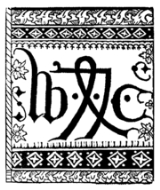
William Caxton

Encyclopedia
William Caxton was an English merchant
, diplomat
, writer
and printer
. As far as is known, he was the first English person to work as a printer and the first to introduce a printing press
into England. He was also the first English retailer of printed books (his London contemporaries in the same trade were all Dutch, German or French).
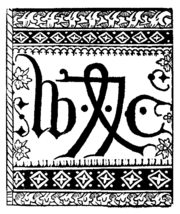 William Caxton's parentage is uncertain. His date of birth is unknown, but records place it in the region of 1415–1424, based on the date his apprenticeship fees were paid in 1438. Caxton would have been 14 at the date of apprenticeship, but masters often paid the fees late. In the preface to his first printed work, The recuyell of the historyes of Troye, he claims to have been born and educated in the Weald
of Kent
. Oral tradition in Hadlow
claims that Caxton was born there; as does Tenterden
. One of the manors of Hadlow was Caustons, owned by the Caxton family. A house in Hadlow reputed to be the birthplace of William Caxton was dismantled in 1436, and incorporated into a larger house rebuilt in Forest Row
, Sussex
.
Caxton was in London
by 1438, when the registers of the Mercers' Company record his apprenticeship to Robert Large
, a wealthy London mercer
, or dealer in luxury goods, who served as Master of the Mercer's Company
, and Lord Mayor of London
in 1439. After Large died in 1441, Caxton was left a small sum of money (£20). As other apprentices were left larger sums, it would seem he was not a senior apprentice at this time.
 He was making trips to Bruges
by 1450 at the latest and had settled there by 1453, when he may have taken his Liberty of the Mercers' Company. There he was successful in business and became governor of the Company of Merchant Adventurers of London
. His trade brought him into contact with Burgundy
and it was thus that he became a member of the household of Margaret, Duchess of Burgundy, the sister of the English king. This led to more continental travel, including travel to Cologne
, in the course of which he observed the new printing industry, and was significantly influenced by German printing. He wasted no time in setting up a printing press in Bruges in collaboration with a Fleming
, Colard Mansion
, on which the first book to be printed in English
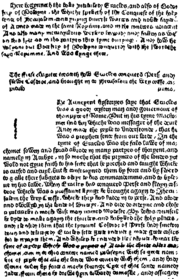
was produced in 1473: Recuyell of the Historyes of Troye
, a translation by Caxton himself. His translation had become popular in the Burgundian court and requests for copies of his translation were the stimulus for him to set up a press. Bringing the knowledge back to his native land, he set up a press at Westminster
in 1476 and the first book known to have been issued there was an edition of Chaucer's Canterbury Tales (Blake, 2004–07). Another early title was Dictes or Sayengis of the Philosophres (Sayings of the Philosophers), first printed on 18 November 1477, written by Earl Rivers
, the king's brother-in-law. Caxton's translation of the Golden Legend
, published in 1483, and The Book of the Knight in the Tower
, published in 1484, contain perhaps the earliest verses of the Bible to be printed in English. It is important to note that Caxton did not begin printing until he was in his middle fifties, so he was only able to print for approximately 20 years before his death.
Caxton produced chivalric romances, classical works and English and Roman histories. These books strongly appealed to the English upper classes in the late fifteenth century. Caxton was supported by, but not dependent on, members of the nobility and gentry.
, tend to show that he died near March of the calendar year 1492. However, George D. Painter makes numerous references to the year 1491 in his book William Caxton: a biography as the year of Caxton's death, since according to the calendar used at the time (March 24th being the last day of the year), the year-change hadn't happened yet. Painter writes, "However, Caxton's own output reveals the approximate time of his death, for none of his books can be later than 1491, and even those which are assignable to that year are hardly enough for a full twelve months' production; so a date of death towards autumn of 1491 could be deduced even without confirmation of documentary evidence." (p. 188)
However, the English language was changing rapidly in Caxton's time and the works he was given to print were in a variety of styles and dialects. Caxton was a technician rather than a writer and he often faced dilemmas concerning language standardization in the books he printed. (He wrote about this subject in the preface to his Eneydos.) His successor Wynkyn de Worde
faced similar problems.
Caxton is credited with standardising the English language (that is, homogenising regional dialects) through printing. This facilitated the expansion of English vocabulary, the regularisation of inflection
and syntax
, and the ever-widening gap between the spoken and the written word.
However, Richard Pynson
, who started printing in London in 1491 or 1492 and who favoured Chancery Standard, was a more accomplished stylist and consequently pushed the English language further toward standardisation.
It is asserted that the spelling ghost with the silent letter h was adopted by Caxton due to the influence of Dutch spelling habits.
Merchant
A merchant is a businessperson who trades in commodities that were produced by others, in order to earn a profit.Merchants can be one of two types:# A wholesale merchant operates in the chain between producer and retail merchant...
, diplomat
Diplomat
A diplomat is a person appointed by a state to conduct diplomacy with another state or international organization. The main functions of diplomats revolve around the representation and protection of the interests and nationals of the sending state, as well as the promotion of information and...
, writer
Writer
A writer is a person who produces literature, such as novels, short stories, plays, screenplays, poetry, or other literary art. Skilled writers are able to use language to portray ideas and images....
and printer
Printer (publisher)
In publishing, printers are both companies providing printing services and individuals who directly operate printing presses. With the invention of the moveable type printing press by Johannes Gutenberg around 1450, printing—and printers—proliferated throughout Europe.Today, printers are found...
. As far as is known, he was the first English person to work as a printer and the first to introduce a printing press
Printing press
A printing press is a device for applying pressure to an inked surface resting upon a print medium , thereby transferring the ink...
into England. He was also the first English retailer of printed books (his London contemporaries in the same trade were all Dutch, German or French).
Early life
Weald
The Weald is the name given to an area in South East England situated between the parallel chalk escarpments of the North and the South Downs. It should be regarded as three separate parts: the sandstone "High Weald" in the centre; the clay "Low Weald" periphery; and the Greensand Ridge which...
of Kent
Kent
Kent is a county in southeast England, and is one of the home counties. It borders East Sussex, Surrey and Greater London and has a defined boundary with Essex in the middle of the Thames Estuary. The ceremonial county boundaries of Kent include the shire county of Kent and the unitary borough of...
. Oral tradition in Hadlow
Hadlow
Hadlow is a village in the Medway valley, near Tonbridge, Kent; it is in the Tonbridge and Malling district. The Saxon name for the settlement was Haeselholte...
claims that Caxton was born there; as does Tenterden
Tenterden
Tenterden is a Cinque Port town in the Ashford District of Kent, England. It stands on the edge of the Weald, overlooking the valley of the River Rother....
. One of the manors of Hadlow was Caustons, owned by the Caxton family. A house in Hadlow reputed to be the birthplace of William Caxton was dismantled in 1436, and incorporated into a larger house rebuilt in Forest Row
Forest Row
Forest Row is a village and relatively large civil parish in the Wealden District of East Sussex, England. The village is located three miles south-east of East Grinstead.-History:...
, Sussex
Sussex
Sussex , from the Old English Sūþsēaxe , is an historic county in South East England corresponding roughly in area to the ancient Kingdom of Sussex. It is bounded on the north by Surrey, east by Kent, south by the English Channel, and west by Hampshire, and is divided for local government into West...
.
Caxton was in London
London
London is the capital city of :England and the :United Kingdom, the largest metropolitan area in the United Kingdom, and the largest urban zone in the European Union by most measures. Located on the River Thames, London has been a major settlement for two millennia, its history going back to its...
by 1438, when the registers of the Mercers' Company record his apprenticeship to Robert Large
Robert Large
Robert Large was a London merchant and member of the Worshipful Company of Mercers. He was served as one of the Mercers' four yearly wardens in 1427, was sheriff of London in 1430-1431. In 1437/8 he was the wealthy master to whom the young William Caxton was apprenticed. Robert Large also served...
, a wealthy London mercer
Mercery
Mercery initially referred to silk, linen, and fustian textiles imported to England in the 12th century.The term later extended to goods made of these and the sellers of those goods.-Mercer:...
, or dealer in luxury goods, who served as Master of the Mercer's Company
Worshipful Company of Mercers
The Worshipful Company of Mercers is the premier Livery Company of the City of London and ranks first in order of precedence. It is the first of the so-called "Great Twelve City Livery Companies". It was incorporated under a Royal Charter in 1394...
, and Lord Mayor of London
Lord Mayor of London
The Right Honourable Lord Mayor of London is the legal title for the Mayor of the City of London Corporation. The Lord Mayor of London is to be distinguished from the Mayor of London; the former is an officer only of the City of London, while the Mayor of London is the Mayor of Greater London and...
in 1439. After Large died in 1441, Caxton was left a small sum of money (£20). As other apprentices were left larger sums, it would seem he was not a senior apprentice at this time.
Printing and later life
Bruges
Bruges is the capital and largest city of the province of West Flanders in the Flemish Region of Belgium. It is located in the northwest of the country....
by 1450 at the latest and had settled there by 1453, when he may have taken his Liberty of the Mercers' Company. There he was successful in business and became governor of the Company of Merchant Adventurers of London
Company of Merchant Adventurers of London
The Company of Merchant Adventurers of London brought together London's leading overseas merchants in a regulated company, in the nature of a guild. Its members' main business was the export of cloth, especially white broadcloth...
. His trade brought him into contact with Burgundy
Duchy of Burgundy
The Duchy of Burgundy , was heir to an ancient and prestigious reputation and a large division of the lands of the Second Kingdom of Burgundy and in its own right was one of the geographically larger ducal territories in the emergence of Early Modern Europe from Medieval Europe.Even in that...
and it was thus that he became a member of the household of Margaret, Duchess of Burgundy, the sister of the English king. This led to more continental travel, including travel to Cologne
Cologne
Cologne is Germany's fourth-largest city , and is the largest city both in the Germany Federal State of North Rhine-Westphalia and within the Rhine-Ruhr Metropolitan Area, one of the major European metropolitan areas with more than ten million inhabitants.Cologne is located on both sides of the...
, in the course of which he observed the new printing industry, and was significantly influenced by German printing. He wasted no time in setting up a printing press in Bruges in collaboration with a Fleming
Flemish people
The Flemings or Flemish are the Dutch-speaking inhabitants of Belgium, where they are mostly found in the northern region of Flanders. They are one of two principal cultural-linguistic groups in Belgium, the other being the French-speaking Walloons...
, Colard Mansion
Colard Mansion
Colard Mansion was a 15th century Flemish scribe and printer who worked together with William Caxton. He is known as the first printer of a book with copper engravings, and as the printer of the first books in English and French.-Biography:Colard Mansion was a central figure in the early printing...
, on which the first book to be printed in English
English language
English is a West Germanic language that arose in the Anglo-Saxon kingdoms of England and spread into what was to become south-east Scotland under the influence of the Anglian medieval kingdom of Northumbria...
was produced in 1473: Recuyell of the Historyes of Troye
Recuyell of the Historyes of Troye
Recuyell of the Historyes of Troye or Recueil des Histoires de Troye, is a French courtly romance written by Raoul Lefevre, chaplain to Philip III, Duke of Burgundy. Translated by William Caxton, and printed by him probably with Colard Mansion in 1473 or 1474 at Bruges. The work is now known...
, a translation by Caxton himself. His translation had become popular in the Burgundian court and requests for copies of his translation were the stimulus for him to set up a press. Bringing the knowledge back to his native land, he set up a press at Westminster
Westminster
Westminster is an area of central London, within the City of Westminster, England. It lies on the north bank of the River Thames, southwest of the City of London and southwest of Charing Cross...
in 1476 and the first book known to have been issued there was an edition of Chaucer's Canterbury Tales (Blake, 2004–07). Another early title was Dictes or Sayengis of the Philosophres (Sayings of the Philosophers), first printed on 18 November 1477, written by Earl Rivers
Anthony Woodville, 2nd Earl Rivers
Anthony Woodville, 2nd Earl Rivers was an English nobleman, courtier, and writer.He was the eldest son of Richard Woodville, 1st Earl Rivers and Jacquetta of Luxembourg. Like his father, he was originally a Lancastrian, fighting on that side at the Battle of Towton, but later became a Yorkist...
, the king's brother-in-law. Caxton's translation of the Golden Legend
Golden Legend
The Golden Legend is a collection of hagiographies by Jacobus de Voragine that became a late medieval bestseller. More than a thousand manuscripts of the text have survived, compared to twenty or so of its nearest rivals...
, published in 1483, and The Book of the Knight in the Tower
The Book of the Knight in the Tower
The Book of the Knight of the Tower is a book commenced by Geoffroy IV de la Tour Landry in 1371, and which he continued writing at least until 1372...
, published in 1484, contain perhaps the earliest verses of the Bible to be printed in English. It is important to note that Caxton did not begin printing until he was in his middle fifties, so he was only able to print for approximately 20 years before his death.
Caxton produced chivalric romances, classical works and English and Roman histories. These books strongly appealed to the English upper classes in the late fifteenth century. Caxton was supported by, but not dependent on, members of the nobility and gentry.
Death
Caxton's precise date of death is uncertain, but estimates from the records of his burial in St. Margaret's, WestminsterSt. Margaret's, Westminster
The Anglican church of St. Margaret, Westminster Abbey is situated in the grounds of Westminster Abbey on Parliament Square, and is the parish church of the House of Commons of the United Kingdom in London...
, tend to show that he died near March of the calendar year 1492. However, George D. Painter makes numerous references to the year 1491 in his book William Caxton: a biography as the year of Caxton's death, since according to the calendar used at the time (March 24th being the last day of the year), the year-change hadn't happened yet. Painter writes, "However, Caxton's own output reveals the approximate time of his death, for none of his books can be later than 1491, and even those which are assignable to that year are hardly enough for a full twelve months' production; so a date of death towards autumn of 1491 could be deduced even without confirmation of documentary evidence." (p. 188)
Caxton and the English language
Caxton printed four-fifths of his works in English. He translated a large number of works into English. He translated and edited a large amount of the work himself. Caxton is credited with printing as many as 108 books, 87 of which were different titles. Caxton also translated 26 of the titles himself. His major guiding principle in translating was an honest desire to provide the most linguistically exact replication of foreign language texts into English, but the hurried publishing schedule and inadequate skill as a translator often led to wholesale transference of French words into English and numerous misunderstandings.However, the English language was changing rapidly in Caxton's time and the works he was given to print were in a variety of styles and dialects. Caxton was a technician rather than a writer and he often faced dilemmas concerning language standardization in the books he printed. (He wrote about this subject in the preface to his Eneydos.) His successor Wynkyn de Worde
Wynkyn de Worde
Wynkyn de Worde was a printer and publisher in London known for his work with William Caxton, and is recognized as the first to popularize the products of the printing press in England....
faced similar problems.
Caxton is credited with standardising the English language (that is, homogenising regional dialects) through printing. This facilitated the expansion of English vocabulary, the regularisation of inflection
Inflection
In grammar, inflection or inflexion is the modification of a word to express different grammatical categories such as tense, grammatical mood, grammatical voice, aspect, person, number, gender and case...
and syntax
Syntax
In linguistics, syntax is the study of the principles and rules for constructing phrases and sentences in natural languages....
, and the ever-widening gap between the spoken and the written word.
However, Richard Pynson
Richard Pynson
Richard Pynson was one of the first printers of English books. The 500 books he printed were influential in the standardisation of the English language...
, who started printing in London in 1491 or 1492 and who favoured Chancery Standard, was a more accomplished stylist and consequently pushed the English language further toward standardisation.
It is asserted that the spelling ghost with the silent letter h was adopted by Caxton due to the influence of Dutch spelling habits.
Further reading
- N. F. Blake, "Caxton, William (1415~24–1492)", Oxford Dictionary of National BiographyDictionary of National BiographyThe Dictionary of National Biography is a standard work of reference on notable figures from British history, published from 1885...
, Oxford University Press, 2004 accessed 1 July 2006 - The English Charlemagne Romances, Parts III and IV, The Lyf of the Noble and Crysten Prynce Charles the Grete, Translated from the French By William Caxton And Printed By Him 1485.
- The Introduction of Printing into England and the Early Work of the Press: The First Book printed in English (1907), from The Cambridge History of English and American LiteratureThe Cambridge History of English and American LiteratureThe Cambridge History of English and American Literature was originally published by Cambridge University Press in 1907–1921. The 18 volumes include 303 chapters and more than 11,000 pages edited and written by a worldwide panel of 171 leading scholars and thinkers of the early twentieth century...
, Vol II - Caxton's Views on the English Language.
- Caxton's Canterbury Tales: The British Library Copies Images and full transcripts of the whole of Caxton's two editions of Geoffrey Chaucer's Canterbury Tales; a fuller version of this is published on CD-ROM by Scholarly Digital Editions
- Game and Playe of the Chesse A Verbatim Reprint of the First Edition, 1474
- Lienhard, John H. (2006): How Invention Begins: Echoes of Old Voices in the Rise of New Machines. Oxford University Press. ISBN 0-19-530599-X pp. 165–168.
- Painter, George D.George PainterGeorge Duncan Painter, OBE known as George D. Painter, was an English author most famous as a biographer of Marcel Proust....
(1976): William Caxton - Biography. Chatto & Windus.
External links
- Images from Myrrour of the Worlde from the State Library of VictoriaState Library of VictoriaThe State Library of Victoria is the central library of the state of Victoria, Australia, located in Melbourne. It is on the block bounded by Swanston, La Trobe, Russell, and Little Lonsdale streets, in the northern centre of the central business district...
- Caxton's apprenticeship to Robert Large