
All Topics  
Bede

 
Bede

   Email Print
   Bookmark   Link


Bede


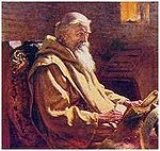
Bede (also Saint Bede, the Venerable Bede, or (from Latin) Beda ), (672/673–May 26, 735), was a monk
Monasticism

Monasticism is the religion practice in which one renounces world pursuits in order to fully devote one's life to spiritual work. The origin of the word is from Ancient Greek, and the idea was originally related to Christian monks....
 at the Northumbria
Northumbria

Northumbria is primarily the name of both a medieval petty kingdom of the Angles people, in what is now north east England and southern Scotland, and of the earldom which succeeded it when a united Anglo-Saxon kingdom became England....
n monastery
Monastery

Monastery , a term derived from the Greek language word ???ast?????, neut. of ???ast????? - monasterios denotes the building, or complex of buildings, that houses a room reserved for prayer as well as the domestic quarters and workplace of Monk, whether monks or nuns, and whether living in Cenobium or alone ....
 of Saint Peter at Monkwearmouth
Monkwearmouth

Monkwearmouth is an area of Sunderland located at the north side of the mouth of the River Wear. It was one of the three original settlements on the banks of the River Wear along with Bishopwearmouth and Sunderland, the area now known as the East End....
, today part of Sunderland
Sunderland

Sunderland is a city in Tyne and Wear, England. It was formerly a county borough but now forms part of the City of Sunderland. It is situated at the mouth of the River Wear....
, England
England

native_name =|conventional_long_name = England|common_name = England|image_flag = Flag of England.svg|image_coat = England COA.svg|symbol_type = Royal Coat of Arms...
, and of its companion monastery, Saint Paul's, in modern Jarrow
Jarrow

Jarrow is a town in Tyne and Wear, England. It is located on the River Tyne and has a population of around 27,000 ....
 (see Wearmouth-Jarrow), both in the Kingdom of Northumbria
Kingdom of Northumbria

#REDIRECT Northumbria...
.

He is well known as an author and scholar, and his most famous work, Historia ecclesiastica gentis Anglorum
Historia ecclesiastica gentis Anglorum

The Historia ecclesiastica gentis Anglorum is a work in Latin by the Bede on the history of the Church in England, and of England generally; its main focus is on the conflict between Roman Catholic Church and Celtic Christianity....
 (The Ecclesiastical History of the English People) gained him the title "The Father of English History
History of England

The history of England did not begin until the arrival of the Anglo-Saxons, when the partition of Britain into several countries largely began. It was the history of Britain that began in the prehistoric during which time Stonehenge was erected....
".


Discussion
Ask a question about 'Bede'
Start a new discussion about 'Bede'
Answer questions from other users
Full Discussion Forum


Recent Posts


Encyclopedia


Bede (also Saint Bede, the Venerable Bede, or (from Latin) Beda ), (672/673–May 26, 735), was a monk
Monasticism

Monasticism is the religion practice in which one renounces world pursuits in order to fully devote one's life to spiritual work. The origin of the word is from Ancient Greek, and the idea was originally related to Christian monks....
 at the Northumbria
Northumbria

Northumbria is primarily the name of both a medieval petty kingdom of the Angles people, in what is now north east England and southern Scotland, and of the earldom which succeeded it when a united Anglo-Saxon kingdom became England....
n monastery
Monastery

Monastery , a term derived from the Greek language word ???ast?????, neut. of ???ast????? - monasterios denotes the building, or complex of buildings, that houses a room reserved for prayer as well as the domestic quarters and workplace of Monk, whether monks or nuns, and whether living in Cenobium or alone ....
 of Saint Peter at Monkwearmouth
Monkwearmouth

Monkwearmouth is an area of Sunderland located at the north side of the mouth of the River Wear. It was one of the three original settlements on the banks of the River Wear along with Bishopwearmouth and Sunderland, the area now known as the East End....
, today part of Sunderland
Sunderland

Sunderland is a city in Tyne and Wear, England. It was formerly a county borough but now forms part of the City of Sunderland. It is situated at the mouth of the River Wear....
, England
England

native_name =|conventional_long_name = England|common_name = England|image_flag = Flag of England.svg|image_coat = England COA.svg|symbol_type = Royal Coat of Arms...
, and of its companion monastery, Saint Paul's, in modern Jarrow
Jarrow

Jarrow is a town in Tyne and Wear, England. It is located on the River Tyne and has a population of around 27,000 ....
 (see Wearmouth-Jarrow), both in the Kingdom of Northumbria
Kingdom of Northumbria

#REDIRECT Northumbria...
.

He is well known as an author and scholar, and his most famous work, Historia ecclesiastica gentis Anglorum
Historia ecclesiastica gentis Anglorum

The Historia ecclesiastica gentis Anglorum is a work in Latin by the Bede on the history of the Church in England, and of England generally; its main focus is on the conflict between Roman Catholic Church and Celtic Christianity....
 (The Ecclesiastical History of the English People) gained him the title "The Father of English History
History of England

The history of England did not begin until the arrival of the Anglo-Saxons, when the partition of Britain into several countries largely began. It was the history of Britain that began in the prehistoric during which time Stonehenge was erected....
". Bede is regarded as a Doctor of the Church
Doctor of the Church

Doctor of the Church is a title given by a variety of Christian churches to individuals whom they recognize as having been of particular importance, particularly regarding their additions to theological or doctrinal matters....
 by the Roman Catholic Church
Roman Catholic Church

The Roman Catholic Church, officially known as the Catholic Church is the world's largest Christianity Ecclesia , representing over half of all Christians and one-sixth of the world population....
, a position of theological significance; he is the only man from Great Britain
Great Britain

Great Britain is an island lying to the northwest of Continental Europe. It is the List of islands by area, and the largest in Europe. With a population of 58.9 million people it is List of islands by population....
 to achieve this designation (Anselm of Canterbury
Anselm of Canterbury

Saint Anselm of Canterbury was an Italian medieval philosopher, theology, and church official who held the office of Archbishop of Canterbury from 1093 to 1109....
, also a Doctor of the Church, was originally from Italy).

Works


His works show that he had at his command all the learning of his time. It was thought that the library at Wearmouth-Jarrow was between 300-500 books, making it one of the largest and most extensive in England. It is clear that Biscop made strenuous efforts to collect books during his extensive travels.

Bede wrote scientific, historical and theological works, reflecting the range of his writings from music
Music

Music is an art form whose media is sound organized in time. Common elements of music are pitch , rhythm , dynamics , and the sonic qualities of timbre and texture ....
 and metrics to exegetical Scripture commentaries. He knew patristic literature, as well as Pliny the Elder
Pliny the Elder

Gaius Plinius Secundus , better known as Pliny the Elder, was an ancient author, naturalist or natural philosopher and naval and military commander of some importance who wrote Natural History ....
, Virgil
Virgil

Publius Vergilius Maro was a classical Roman poet, best known for three major works?the Bucolics , the Georgics and the Aeneid?although several Appendix Vergiliana are also attributed to him....
, Lucretius
Lucretius

Titus Lucretius Carus was a Roman Republic poet and philosopher. His only known work is the epic philosophical poem on Epicureanism De rerum natura, translated into English as On the Nature of Things....
, Ovid
Ovid

Publius Ovidius Naso was a Roman Empire poet known as Ovid to the English language-speaking world, who wrote about love, seduction, and Roman mythology transformation....
, Horace
Horace

This article is about the Roman poet Horace. For other uses, see Horace .Quintus Horatius Flaccus, , known in the English language world as Horace, was the leading Roman Empire Lyric poetry during the time of Augustus....
 and other classical
Classical antiquity

Classical antiquity is a broad term for a long period of cultural history centered on the Mediterranean Sea, comprising the interlocking civilizations of Ancient Greece and Ancient Rome....
 writers. He knew some Greek
Greek language

Greek is an Indo-European languages native to the southern Balkan peninsula, the language of the Greek people. It forms an independent branch within Indo-European....
 and Hebrew
Hebrew language

Hebrew is a Semitic languages of the Afro-Asiatic languages. Modern Hebrew is spoken by more than seven million people in Israel and Classical Hebrew is used for prayer or study in Jews communities around the world....
. His Latin is generally clear, but his Biblical commentaries are more technical.

Bede's scriptural commentaries employed the allegorical
Allegory

Allegory is generally treated as a figure of rhetoric, but an allegory does not have to be expressed in language: it may be addressed to the eye, and is often found in realistic painting, sculpture or some other form of Mimesis, or representative art....
 method of interpretation and his history includes accounts of miracles, which to modern historians has seemed at odds with his critical approach to the materials in his history. Modern studies have shown the important role such concepts played in the world-view of Early Medieval scholars.

He dedicated his work on the Apocalypse and the De Temporum Ratione to the successor of Ceolfrid as abbot, Hwaetbert.

Modern historians have completed many studies of Bede's works, including during anniversary celebrations held during 1935 and 1973, as well as a series of annual lectures at Jarrow. The historian Walter Goffart
Walter Goffart

Walter Goffart is a historian of the later Roman Empire and the early Middle Ages who specializes in research on the barbarian kingdoms of those periods....
 says of Bede that he "holds a privileged and unrivaled place among first historians of Christian Europe".

Although Bede is mainly studied as a historian now, in his time his works on grammar, chronology, and biblical studies were as important as his historical and haigiographical works. The non-historical works contributed greatly to the Carolingian renaissance
Carolingian Renaissance

The Carolingian Renaissance was a period of intellectual and cultural revival occurring in the late Eighth century and Ninth century centuries, with the peak of the activities occurring during the reigns of the Carolingian rulers Charlemagne and Louis the Pious....
.

Sources


The monastery at Jarrow had an excellent library. Both Benedict Biscop and Ceolfrith had acquired books from the continent, and in Bede's day the monastery was a renowned centre of learning.

For the period prior to Augustine's arrival in 597, Bede drew on earlier writers, including Orosius
Orosius

Paulus Orosius was a Christianity historian, theology and disciple of Augustine of Hippo who came from Gallaecia , probably from the capital city Bracara Augusta....
, Eutropius
Eutropius

IntroductionNot much is known about the early life of Eutropius because there are no written texts that document his life. Eutropius should not be confused with Eutropius of Valencia or Saint Eutropius....
, Pliny
Pliny the Elder

Gaius Plinius Secundus , better known as Pliny the Elder, was an ancient author, naturalist or natural philosopher and naval and military commander of some importance who wrote Natural History ....
, and Solinus. He used Constantius
Constantius of Lyon

Constantius of Lyon was a priest from what is Auvergne in modern-day France, who wrote a hagiography of Saint Germanus of Auxerre.He was a friend of Sidonius Apollinaris and Bishop Lupus of Troyes....
's Life of Germanus as a source for Germanus
Germanus

Germanus is the Latin term referring to the Germanic peoples. A probably related meaning for the word in Latin is "blood relation", cognate to germen "seed" ....
's visits to Britain. Bede's account of the invasion of the Anglo-Saxons is drawn largely from Gildas
Gildas

Saint Gildas was a 6th century Britons cleric. He is one of the best-documented figures of the Christianity church in the British Isles during the 6th century....
's De Excidio Britanniae. Bede would also have been familiar with more recent accounts such as Eddius Stephanus's Life of Wilfrid, and anonymous Lives of Gregory the Great and Cuthbert. He also drew on Josephus
Josephus

Josephus , also known as Yosef Ben Matityahu and, after he became a Roman citizenship, as Titus Flavius Josephus, was a first-century Jewish historian and apologist of priestly and royal ancestry who survived and recorded the destruction of Jerusalem in AD 70....
's Antiquities, and the works of Cassiodorus
Cassiodorus

Flavius Magnus Aurelius Cassiodorus Senator , commonly known as Cassiodorus, was a Roman Empire statesman and writer, serving in the administration of Theodoric the Great, king of the Ostrogoths....
, and there was a copy of the Liber Pontificalis
Liber Pontificalis

The Liber Pontificalis is a book of biography of popes from Saint Peter until the 15th century. The original publication of the Liber Pontificalis stopped with Pope Adrian II or Pope Stephen V , but it was later supplemented in a different style until Pope Eugene IV and then Pope Pius II ....
 in Bede's monastery.

Bede also had correspondents who supplied him with material. Albinus, the abbot of the monastery in Canterbury, provided much information about the church in Kent, and with the assistance of Nothhelm
Nothelm

Saint Nothelm was the eleventh Archbishop of Canterbury....
, at that time a priest in London, obtained copies of Gregory the Great's correspondence from Rome relating to Augustine's mission. Almost all of Bede's information regarding Augustine is taken from these letters. Bede acknowledged his correspondents in the preface to the Historia Ecclesiastica; he was in contact with Daniel
Daniel of Winchester

Daniel of Winchester was Bishop of the West Saxons, and Bishop of Winchester from ca. 705 to 744....
, the Bishop of Winchester, for information about the history of the church in Wessex, and also wrote to the monastery at Lastingham
Lastingham

Lastingham is a village which lies in the Ryedale district of North Yorkshire, England. It was the home of the early missionaries to the Anglo-Saxonss, such as St....
 for information about Cedd
Cedd

Saint Cedd was the Evangelism of the Middle Angles and Kingdom of Essex in England....
 and Chad
Chad of Mercia

Saint Chad of Mercia was a 7th century Anglo-Saxons churchman, who became abbot of several monasteries, Bishop of York and later Bishop of Lichfield....
. Bede also mentions an Abbot Esi as a source for the affairs of the East Anglian church, and Bishop Cynibert
Kinebertus

Kinebertus was a medieval Bishop of Lindsey.He was consecrated between 716 and 731. He died in 732....
 for information about Lindsey.

The historian Walter Goffart
Walter Goffart

Walter Goffart is a historian of the later Roman Empire and the early Middle Ages who specializes in research on the barbarian kingdoms of those periods....
 argues that Bede based the structure of the Historia on three works, using them as the framework around which the three main sections of the work were structured. For the early part of the work, up until the Gregorian mission, Goffart feels that Bede used Gildas
Gildas

Saint Gildas was a 6th century Britons cleric. He is one of the best-documented figures of the Christianity church in the British Isles during the 6th century....
's De excidio. The second section, detailing the Gregorian mission
Gregorian mission

The Gregorian mission was the missionary endeavour sent by Pope Gregory the Great to the Anglo-Saxons in 596 AD, headed by Augustine of Canterbury, which attempted to convert the Anglo-Saxons to Christianity....
 of Augustine of Canterbury was framed on the anonymous Life of Gregory the Great written at Whitby. The last section, detailing events after the Gregorian mission, Goffart feels were modeled on Stephen of Ripon
Eddius

Eddius Stephanus is the traditional name of the author of the eighth-century Vita Sancti Wilfridi . He is also known as ?ddi Stephanus or Stephen of Ripon....
's Life of Wilfrid. Most of Bede's informants for information after Augustine's mission came from the eastern part of Britain, leaving significant gaps in the knowledge of the western areas, which were those areas likely to have a native Briton presence.

Models


Bede's stylistic models included some of the same authors from whom he drew the material for the earlier parts of his history. His introduction imitates the work of Orosius., and his title is an echo of Eusebius's Historia Ecclesiastica
Church History (Eusebius)

The Church History of Eusebius of Caesarea was a fourth-century pioneer work giving a chronological account of the development of Christianity from the first century....
. Bede also followed Eusebius in taking the Acts of the Apostles
Acts of the Apostles

The Acts of the Apostles is a book of the Bible, which now stands fifth in the New Testament. It is commonly referred to as simply Acts. The title "Acts of the Apostles" was first used by Irenaeus in the late second century, but some have suggested that the title "Acts" be interpreted as "the Acts of the Holy Spirit" or even "the Acts...
 as the model for the overall work: where Eusebius used the Acts as the theme for his description of the development of the church , Bede made it the model for his history of the Anglo-Saxon church. Bede quoted his sources at length in his narrative, as Eusebius had done. Bede also appears to have taken quotes directly from his correspondents at times. For example, he almost always uses the terms "Australes" and "Occidentales" for the South and West Saxons respectively, but in a passage in the first book he uses "Meridiani" and "Occidui" instead, as perhaps his informant had done. At the end of the work, Bede added a brief autobiographical note; this was an idea taken from Gregory of Tours
Gregory of Tours

Saint Gregory of Tours was a Gallo-Roman History and Bishops of Tours, which made him a leading prelate of Gaul. He was born Georgius Florentius, later adding the name Gregorius in honour of his maternal great-grandfather....
' earlier History of the Franks.

Bede's work as a hagiographer, and his detailed attention to dating, were both useful preparation for the task of writing the Historia Ecclesiastica. His interest in computus
Computus

Computus is the calculation of the date of Easter in the Christian calendar. The name has been used for this procedure since the early Middle Ages, as it was one of the most important computations of the age....
, the science of calculating the date of Easter, was also useful in the account he gives of the controversy between the British and Anglo-Saxon church over the correct method of obtaining the Easter date.

Themes


One of the important themes of the Historia Ecclesiastica is that in the conversion of the British Isles to Christianity, it had all been the work of Irish and Italian missionaries, with no efforts being made by the native Britons. This theme was developed from Gildas' work, which denounced the sins of the native rulers during the invasions, with the elaboration by Bede that the invasion and settlement of the British Isles by the Angles and Saxons was God's punishment for the lack of missionary effort and the refusal to accept the Roman date for celebrating Easter. Although Bede discusses the history of Christianity in Roman Britain, significantly he utterly ignores the missionary work of Saint Patrick
Saint Patrick

Saint Patrick , said to have been born Maewyn Succat , was a Roman Britain-born Christianity missionary and is the patron saint of Ireland along with Brigid of Kildare and Columba....
. He writes approvingly of Aidan and Columba
Columba

Early life in IrelandColumba was born to Fedlimid and Eithne of the Cenel Conaill in Gartan, near Lough Gartan, County Donegal, in Ireland. On his father's side he was great-great-grandson of Niall of the Nine Hostages, an High King of Ireland of the 5th century....
, who came from Ireland as missionaries to the Picts and Northumbrians, but disapproved of the failure of the Welsh to evangelize the invading Anglo-Saxons. Bede was a partisan of Rome, regarding Gregory the Great, rather than Augustine, as the true apostle of the English. Likewise, in his treatment of the conversion of the invaders, any native involvement is minimized, such as when discussing Chad of Mercia
Chad of Mercia

Saint Chad of Mercia was a 7th century Anglo-Saxons churchman, who became abbot of several monasteries, Bishop of York and later Bishop of Lichfield....
's first consecration, when Bede mentions that two British bishops took part in the consecration, thus invalidating it. No information on who or where these two bishops came from is presented. Also important is Bede's view of the conversion process as an upper-class phenomenon, with little discussion of any missionary efforts among the non-noble or royal population.

Another view, taken by historian D.H. Farmer, is that the theme of the work is "the progression from diversity to unity". According to Farmer, Bede took this idea from Gregory the Great, and illustrates it in his work by showing how Christianity brought together the native and invading races into one church. Farmer cites Bede's intense interest in the schism over the correct date for Easter as support for this argument, and also cites the lengthy description of the Synod of Whitby, which Farmer regards as "the dramatic centre-piece of the whole work." The historian Alan Thacker wrote in 1983 that Bede's works should be seen as advocating a monastic rather than secular ministry, and Thacker argues that Bede's treatment of St Cuthbert is meant to make Cuthbert a role-model for the role of the clergy advocated by Gregory the Great.

The historian Walter Goffart
Walter Goffart

Walter Goffart is a historian of the later Roman Empire and the early Middle Ages who specializes in research on the barbarian kingdoms of those periods....
 says of the Historia that many modern historians find it a "tale of origins framed dynamically as the Providence-guided advance of a people from heathendom to Christianity; a cast of saints rather than rude warriors; a mastery of historical technique incomparable for its time; beauty of form and diction; and, not least, an author whose qualities of life and spirit set a model of dedicated schoalrship." Goffart also feels that a major theme of the Historia is concerned with local, Northumbrian concerns, and that Bede treated matters outside Northumbria as secondary concerns to his main concern with northern history. Goffart sees the writing of the Historia as motivated by a political struggle in Northumbria between a party devoted to Wilfrid, and those opposed to Wilfrid's policies.

Much of the "current" history in the Historia is concerned with Wilfrid
Wilfrid

Wilfrid was an English bishop and saint. Born a Northumbria nobleman, he entered the religious life as a teenager, studying at Lindisfarne, Canterbury, Gaul and Rome, before returning to Northumbria around 660 to become abbot of a newly founded monastery at Ripon....
, who was an bishop in Northumbria and whose stormy career is documented not only in Bede's works, but in a Life of Wilfrid. A theme in Bede's treatment of Wilfrid is the need to minimize the conflict between Wilfrid and Theodore of Tarsus
Theodore of Tarsus

Theodore was the eighth Archbishop of Canterbury, best known for his reform of the English Church and establishment of a school in Canterbury with major scholarly achievements....
, the Archbishop of Canterbury
Archbishop of Canterbury

The Archbishop of Canterbury is the chief bishop and principal leader of the Church of England, the symbolic head of the worldwide Anglican Communion and the Diocesan Bishop of the Diocese of Canterbury, the Episcopal see that churches must be in communion with in order to be a part of the Anglican Communion....
, who was involved in many of Wilfrid's difficulties.

The Historia Ecclesiastica includes many accounts of miracles and visions. These were de rigueur in medieval religious narrative, but Bede appears to have avoided relating the more extraordinary tales; and, remarkably, he makes almost no claims for miraculous events at his own monastery. There is no doubt that Bede did believe in miracles, but the ones he does include are often stories of healing, or of events that could plausibly be explained naturally. The miracles served the purpose of setting an example to the reader, and Bede explicitly states that his goal is to teach morality through history, saying "If history records good things of good men, the thoughtful reader is encouraged to imitate what is good; if it records evil of wicked men, the devout reader is encouraged to avoid all that is sinful and perverse."

Omissions and bias


Bede apparently had no informant at any of the main Mercian religious houses. His information about Mercia came from Lastingham
Lastingham

Lastingham is a village which lies in the Ryedale district of North Yorkshire, England. It was the home of the early missionaries to the Anglo-Saxonss, such as St....
, in Northumbria, and from Lindsey, a province on the borders of Northumbria and Mercia. As a result there are noticeable gaps in his coverage of Mercian church history, such as his omission of the division of the huge Mercian diocese by Theodore in the late 7th century. His sympathies were with Northumbria; Bede viewed Mercia under King Penda
Penda of Mercia

Penda was a 7th-century List of monarchs of Mercia of Mercia, a monarchy in what is today the English Midlands. A Anglo-Saxon polytheism at a time when Christianity was taking hold in many of the Anglo-Saxons kingdoms, Penda participated in the defeat of the powerful Northumbrian monarch Edwin of Northumbria at the Battle of Hatfield Chase...
 in the 7th century as an aggressive pagan force, responsible for the death of the Christian king Edwin of Northumbria
Edwin of Northumbria

Saint Edwin was the List of monarchs of Northumbria of Deira and Bernicia - which would later become known as Northumbria - from about 616 until his death....
. Mercia was a rising power when Bede wrote the Historia Ecclesiastica, and Bede's regional bias is apparent.

There were clearly gaps in Bede's knowledge, but Bede also says little on some topics that he must have been familiar with. For example, although Bede recounts Wilfrid's missionary activities, he does not give a full account of his conflict with Archbishop Theodore of Canterbury, or his ambition and aristocratic lifestyle. Only the existence of other sources such as the Life of Wilfrid make it clear what Bede discreetly avoids saying. The omissions are not restricted to Wilfrid; Bede makes no mention at all of Boniface, though it is unlikely he knew little of him; and the final book contains less information about the church in his own day than could be expected. A possible explanation for Bede's discretion may be found in his comment that one should not make public accusations against church figures, no matter what their sins; Bede may have found little good to say about the church in his day and hence preferred to keep silent. It is clear that he did have fault to find; his letter to Ecgberht contains several criticisms of the church.

The Historia Ecclesiastica has more to say about episcopal events than it does about the monasteries of England. Bede does shed some light on monastic affairs; in particular he comments in book V that many Northumbrians are laying aside their arms and entering monasteries "rather than study the arts of war. What the result of this will be the future will show."Bede, HE, V.23 This veiled comment, another example of Bede's discretion in commenting on current affairs, could be interpreted as ominous given Bede's more specific criticism of quasi-monasteries in his letter to Ecgberht, written three years later.

Bede's account of life at the court of the Anglo-Saxon kings includes little of the violence that Gregory of Tours mentions as a frequent occurrence at the Frankish court. It is possible that the courts were as different as their descriptions makes them appear but it is more likely that Bede omitted some of the violent reality. Bede states that he wrote the work as an instruction for rulers, in order that "the thoughtful listener is spurred on to imitate the good". It also was no part of Bede's purpose to describe the kings who did not convert to Christianity in the Historia.

Anno Domini


Bede's use of something similar to the anno Domini era, created by the monk Dionysius Exiguus
Dionysius Exiguus

Dionysius Exiguus was a sixth century monk born in Scythia Minor, in what is now the territory of Dobruja, Romania, and a member of the so called "Scythian monks" community....
 in 525, throughout Historia Ecclesiastica was very influential in causing that era to be adopted thereafter in Western Europe. Specifically, he used anno ab incarnatione Domini (in the year from the incarnation of the Lord) or anno incarnationis dominicae (in the year of the incarnation of the Lord). He never abbreviated the term like the modern AD. Unlike the modern assumption that anno Domini was from the birth of Christ, Bede explicitly refers to his incarnation or conception, traditionally on 25 March. Within this work, he was also the first writer to use a term similar to the English before Christ. In book I chapter 2 he used ante incarnationis dominicae tempus (before the time of the incarnation of the Lord). However, the latter was not very influential—only this isolated use was repeated by other writers during the rest of the Middle Ages
Middle Ages

File:Karl 1 mit papst gelasius gregor1 sacramentar v karl d kahlen.jpgThe Middle Ages of European history are a period in history which lasted for roughly a millennium, commonly dated from the fall of the Roman Empire in the 5th century to the beginning of the Early Modern Period in the 16th century, marked by the division of Western Christi...
. The first extensive use of 'BC' (hundreds of times) occurred in Fasciculus Temporum by Werner Rolevinck
Werner Rolevinck

Werner Rolevinck was a Carthusian monk and historian who wrote about 50 titles. He was born near Laer, Westphalia, the son of a wealthy farmer....
 in 1474, alongside years of the world (anno mundi).

Continuation of Bede

Some early manuscripts contain additional annalistic entries that extend past the date of completion of the Historia Ecclesiastica, with the latest entry dated 766. No manuscripts earlier than the twelfth-century contain these entries, except for the entries for 731 through 734, which do occur in earlier manuscripts. Much of the material replicates what is found in Simeon of Durham's chronicle; the remaining material is thought to derive from northern chronicles from the 8th century. The Historia was translated into Old English sometime in the 9th century in southern Britain, and this translation has traditionally been held to have been done by King Alfred of England, but scholarship now has cast doubt on this tradition. Although Alfred may not have personally made the translation, it probably was connected with the promotion of learning that Alfred fostered. The Anglo-Saxon Chronicle, composed around this time, drew heavily on the Historia, which formed the chronological framework of the early parts of the Chronicle.

Assessment

The Historia Ecclesiastica was copied often in the Middle Ages, and about 160 manuscripts containing it survive. About half of those are located on the European continent, rather than on the British Isles. Most of the 8th and 9th century texts of Bede's Historia come from the northern parts of the Carolingian Empire. This total does not include manuscripts with only a part of the work, of which another 100 or so survive. It was printed for the first time between 1474 and 1482, probably at Strasbourg, France. Modern historians have studied the Historia extensively, and a number of editions have been produced. For many years, early Anglo-Saxon history was essentially a retelling of the Historia, but recent scholarship has focused as much on what Bede did not write as what he did. The belief that the Historia was the culmination of Bede's works, the aim of all his scholarship, a belief current among historians in the past, is no longer accepted by most scholars.

The Historia Ecclesiastica has given Bede a high reputation, but his concerns were different from those of a modern writer of history. His focus on the history of the organization of the English church, and on heresies and the efforts made to root them out, led him to exclude the secular history of kings and kingdoms except where a moral lesson could be drawn or where they illuminated events in the church. Besides the Anglo-Saxon Chronicle, the medieval writers William of Malmesbury
William of Malmesbury

William of Malmesbury , English historians in the Middle Ages, was born about the year 1080/1095, in Wiltshire. His father was Normans and his mother English....
, Henry of Huntingdon
Henry of Huntingdon

Henry of Huntingdon was an English historians in the Middle Ages and archdeacon of Huntingdon....
, and Geoffrey of Monmouth
Geoffrey of Monmouth

Geoffrey of Monmouth was a clergyman and one of the major figures in the English historians in the Middle Ages and the popularity of tales of King Arthur....
 used his works as sources and inspirations. Early modern writers, such as Polydore Virgil and Matthew Parker
Matthew Parker

Matthew Parker was Archbishop of Canterbury from 1559 until his death in 1575. He was also an influential theologian and arguably the co-founder of Anglican theological thought....
, the Elizabethan Archbishop of Canterbury, also utilized the Historia, and his works were used by both Protestant and Catholic sides in the Wars of Religion.

Some historians have questioned the reliablity of some of Bede's accounts. One historian, Charlotte Behr, feels that the Historia's account of the arrival of the Germanic invaders in Kent should not be considered to relate what actually happened, but rather relates myths that were current in Kent during Bede's time.

Printing history

The first printed copy of the Historia Ecclesiastica appeared from the press of Heinrich Eggestein
Heinrich Eggestein

Heinrich Eggestein is considered, along with Johannes Mentelin, to be the earliest book Printer in Strasbourg and therefore one of the earliest anywhere in Europe outside Mainz....
 in Strasbourg
Strasbourg

Strasbourg is the capital and principal city of the Alsace Regions of France in northeastern France. With 702,412 inhabitants in 2007, its metropolitan area is the Aire urbaine....
, probably between 1475 and 1480. A defect in the text allows the identification of the manuscript Eggestein used; it subsequently appeared in a catalogue of the Vienna Dominicans of 1513. Eggestein had also printed an edition of Rufinus
Rufinus

Rufinus may refer to:*Saints Rufinus, eleven saints named Rufinus in Roman Martyrology*Rufinus of Assisi, 3rd century saint and martyr*Rufinus , Christian martyr...
's translation of Eusebius
Eusebius of Caesarea

Eusebius of Caesarea became the bishop of Caesarea Maritima c 314. He is often referred to as the Father of Church History because of his work in recording the history of the early Christianity church, especially Chronicon and Church_History_....
's Ecclesiastical History
Church History (Eusebius)

The Church History of Eusebius of Caesarea was a fourth-century pioneer work giving a chronological account of the development of Christianity from the first century....
, and the two works were reprinted, bound as a single volume, on 14 March 1500 by Georg Husner, also of Strasbourg. Another reprint appeared on 7 December 1506, from Heinrich Gran
Heinrich Gran

File:Eucharius R??lin Rosgarten Titel.jpgHeinrich Gran was a Germany book Printer of the incunabulum time. Together with Johannes Mentelin and Heinrich Eggestein, he was one of the pioneers of book-printing in Alsace....
 and S. Ryman at Haguenau
Haguenau

Haguenau is a Commune in France located in northeastern France, in the Bas-Rhin D?partement in France, of which it is a sous-pr?fecture....
.

A Paris edition appeared in 1544, and in 1550 John de Grave produced an edition at Antwerp
Antwerp

||-||-||-||}Antwerp is a city and municipality in Belgium and the capital of the Antwerp in Flanders, one of Belgium's three regions....
. Two reprints of this edition appeared, in 1566 and 1601. In 1563, Johann Herwagen included it in volume III of his eight-volume Opera Omnia, and this was in turn reprinted in 1612 and 1688. Michael Sonnius produced an edition in Paris in 1587, including the Historia Ecclesiastica in a collection of other historical works; and in 1587 Johann Commelin included it in a similar compilation, printed at Heidelberg
Heidelberg

Heidelberg is a city in Baden-W?rttemberg, Germany. As of 2006, over 140,000 people live within the city's area. The town of Heidelberg is an administrative district of its own....
. The first English edition did not appear until 1643, when Abraham Whelock produced an edition with the Old English text and the Latin text in parallel columns.

All of the above editions were based on the c-text. The first edition to use the m-type manuscripts was printed by Pierre Chifflet in 1681, using a descendant of the Moore MS. In 1722, John Smith obtained the Moore MS., and also having access to two copies in the Cotton Library
Cotton library

The Cotton or Cottonian library was the library compiled by Sir Robert Bruce Cotton , an antiquarian and bibliophile. Cotton's library included his collection of books, manuscripts, coins and medallions in his personal estate....
 was able to print a very high quality edition. Subsequently the most notable edition was that of Charles Plummer, whose 1896 Venerabilis Bedae Opera Historica, with a full commentary, has been a foundation-stone for all subsequent scholarship.

Other historical works


Chronicles

As Chapter 66 of his On the Reckoning of Time, in 725 Bede wrote the Greater Chronicle (chronica maiora), which sometimes circulated as a separate work. For recent events the Chronicle, like his Ecclesiastical History, relied upon Gildas, upon a version of the Liber pontificalis
Liber Pontificalis

The Liber Pontificalis is a book of biography of popes from Saint Peter until the 15th century. The original publication of the Liber Pontificalis stopped with Pope Adrian II or Pope Stephen V , but it was later supplemented in a different style until Pope Eugene IV and then Pope Pius II ....
 current at least to the papacy of Pope Sergius I
Pope Sergius I

Pope Saint Sergius I was Pope from 687–701. He came from an Antiochene Syrian family which had settled at Palermo in Sicily, and owed his election as Pope Conon's successor to skillful intrigues against Paschalis and Theodorus, the other candidates....
 (687-701), and other sources. For earlier events he drew on Eusebius's Chronikoi Kanones. The dating of events in the Chronicle is inconsistent with his other works, using the era of creation, the anno mundi
Anno Mundi

File:Rotunda Yard Thessaloniki 05 Jew Tomb remains.JPG abbreviated as 'AM' or 'A.M.', refers to a Calendar era counting from the Bible Creation according to Genesis of the world....
.

Lives

His other historical works included lives of the abbots of Wearmouth and Jarrow
Jarrow

Jarrow is a town in Tyne and Wear, England. It is located on the River Tyne and has a population of around 27,000 ....
, as well as verse and prose lives of Saint Cuthbert of Lindisfarne
Cuthbert of Lindisfarne

St Cuthbert of Lindisfarne was an Angles monk and bishop in the Kingdom of Northumbria which at that time included, in modern terms, north east England and south east Scotland as far as the Firth of Forth....
, an adaptation of Paulinus of Nola
Paulinus of Nola

Saint Paulinus of Nola or Pontius Meropius Anicius Paulinus was a Roman senate who converted to a severe monasticism in 394. He eventually became Bishop of Nola, helped to resolve the disputed election of Pope Boniface I, and was recognized as a saint....
's Life of St Felix, and a translation of the Greek Passion of St Anastasius. He also created a listing of saints, the Martyrology.

Theological works


In his own time, Bede was as well known for his biblical commentaries and exegetical, as well as other theological works. The majority of his writings were of this type, and covered the Old Testament and the New Testament. Most survived the middle ages, but a few were lost. It was for his theological writings that he earned the title of Doctor Anglorum, and why he was made a saint.

Bede was not an innovative religious thinker. He made no original writings or thoughts on the beliefs of the church, instead working to synthesize and transmit the learning from his predeccessors. In order to do this, he learned Greek, and attempted to learn Hebrew. He spent time reading and rereading both the Old and the New Testaments. He mentions that he studied from a text of Jerome
Jerome

Saint Jerome was a Christian priest and Christian apologetics best known for translating the Vulgate. He is recognized by the Catholic Church as a canonized saint and Doctor of the Church, and his version of the Bible is still an important text in Catholicism....
's Vulgate
Vulgate

The Vulgate is an early Fifth Century version of the Bible in Latin, and largely the result of the labors of Jerome, who was commissioned by Pope Damasus I in 382 to make a revision of Vetus Latina....
, which itself was from the Hebrew text. He also studied both the Latin and the Greek Fathers of the Church. In the monastic library at Jarrow were a number of books by theologians, including works by Basil
Basil of Caesarea

Basil of Caesarea, also called Saint Basil the Great, was the bishop of Caesarea Mazaca in Cappadocia, Asia Minor . He was an influential 4th century Christian theologian and monastic....
, Cassian
John Cassian

Saint John Cassian , John the Ascetic, or John Cassian the Roman, is a Christian theology celebrated in both the Western and Eastern Churches for his mystical writings....
, John Chrysostom
John Chrysostom

'Saint John Chrysostom' , archbishop of Constantinople, was an important Early Church Father. He is known for his eloquence in Sermon and public speaking, his denunciation of abuse of authority by both ecclesiastical and political leaders, the Divine Liturgy of St....
, Isidore of Seville
Isidore of Seville

Saint Isidore of Seville was Archbishop of Seville for more than three decades and has the reputation of being one of the greatest scholars of the early Middle Ages....
, Origen
Origen

Origen was an Early Christianity scholar, theology, and one of the most distinguished of the early Church father of the Christian Church. According to tradition, he is held to have been an Ancient Egypt who taught in Alexandria, reviving the Catechetical School of Alexandria where Clement of Alexandria had taught....
, Gregory of Nazianzus
Gregory of Nazianzus

Gregory of Nazianzus was a 4th-century Archbishop of Constantinople. He is widely considered the most accomplished rhetorical stylist of the Church Fathers....
, Augustine of Hippo, Jerome, Pope Gregory I
Pope Gregory I

Pope Saint Gregory I or Gregory the Great was pope from 3 September 590 until his death.He is also known as Gregory the Dialogist in Eastern Orthodoxy because of his Dialogues....
 and Ambrose of Milan. He used these, in conjunction with the Biblical texts themselves, to write his commentaries and other theological works. He also used lesser known writers, such as Fulgentius
Fulgentius of Ruspe

Saint Fulgentius of Ruspe was bishop of the city of Ruspe, North Africa, in the 5th and 6th century who was canonization as a Christianity saint....
, Julian of Eclanum
Julian of Eclanum

Julian of Eclanum was bishop of Eclanum, near today's Benevento . He was a distinguished leader of the heretical Pelagians of 5th century....
, Tyconius, and Prosperius. Bede was the first to refer to Jerome, Augustine, Pope Gregory and Ambrose as the four Latin Fathers of the Church. It is clear from Bede's own comments that he felt his job was to explain to his students and readers the theology and thoughts of the Church Fathers.

Bede also wrote homilies, works written to explain theology used in worship services. Bede wrote homilies not only on the major Christian festivals such as Advent
Advent

Advent is a Liturgical year of the Christianity, the period of expectant waiting and preparation for the celebration of the Nativity of Jesus; in other words, the period immediately before Christmas....
, Lent
Lent

Lent, in Christianity, is the period of the liturgical year leading up to Easter. Conventionally it is described as being forty days long, though different Christian denominations calculate the forty days differently....
 or Easter
Easter

Easter is the most important religious feast in the Christianity liturgical year.Christians believe that Jesus was Resurrection of Jesus from the dead three days after his Crucifixion of Jesus, and celebrate this resurrection on Easter Day or Easter Sunday , two days after Good Friday....
, but on other subjects such as anniversaries of significant events.

Both types of Bede's theological works circulated widely in the Middle Ages. A number of his biblical commentaries were incorporated into the Glossa Ordinaria
Glossa Ordinaria

A glossa ordinaria was an assembly of glosses which came to be widely accepted in universities, esp. in the 13th century. Such books were official commentaries which professors read after the ordinary ....
, an 11th century collection of biblical commentaries. Some of Bede's homilies were collected by Paul the Deacon
Paul the Deacon

Paul the Deacon , also known as Paulus Diaconus, Warnefred and Cassinensis, , was a Benedictine monk and historian of the Lombards....
, and they were used in that form in the Monastic Office. Saint Boniface
Saint Boniface

Saint Boniface , the Apostle of the Germans, born Winfrid or Wynfrith at Crediton in the kingdom of Wessex , was a missionary who propagated Christianity in the Frankish Empire during the 8th century....
 used Bede's homilies in his missionary efforts on the continent.

Works on the Old Testament

The works dealing with the Old Testament included Commentary on Samuel, Commentary on Genesis, Commentaries on Ezra and Nehemiah, On the Temple, On the Tabernacle, Commentaries on Tobit, Commentaries on Proverbs, Commentaries on the Song of Songs, Commentaries on the Canticle of Habakkuk, The works on Ezra, the Tabernacle and the Temple were especially influenced by Gregory the Great's writings.

Works on the New Testament


Bede's works included Commentary on Revelation, Commentary on the Catholic Epistles,, Commentary on Acts, Reconsideration on the Books of Acts, On the Gospel of Mark, On the Gospel of Luke, and Homilies on the Gospels.

Works on chronology and the dating of Easter

De temporibus, or On Time, written in about 703, provides an introduction to the principles of Easter
Easter

Easter is the most important religious feast in the Christianity liturgical year.Christians believe that Jesus was Resurrection of Jesus from the dead three days after his Crucifixion of Jesus, and celebrate this resurrection on Easter Day or Easter Sunday , two days after Good Friday....
 computus
Computus

Computus is the calculation of the date of Easter in the Christian calendar. The name has been used for this procedure since the early Middle Ages, as it was one of the most important computations of the age....
. This was based on parts of Isidore of Seville
Isidore of Seville

Saint Isidore of Seville was Archbishop of Seville for more than three decades and has the reputation of being one of the greatest scholars of the early Middle Ages....
's Etymologies
Etymologiae

Etymologiae is an encyclopedia compiled byIsidore of Seville towards the end of his life, at the urging of his friend Braulio, Bishop of Saragossa, to whom Isidore, at the end of his life, sent his codex inemendatus , which seems to have begun circulating before Braulio was able to revise it, and issue it, with a dedication to t...
, and Bede also include a chronology of the world which was derived from Eusebius, with some revisions based on Jerome's translation of the bible. In about 723, Bede wrote a longer work on the same subject, On the Reckoning of Time, which was popular throughout the Middle Ages. He also wrote several shorter letters and essays discussing specific aspects of computus.

On the Reckoning of Time (De temporum ratione
De temporum ratione

De temporum ratione is a treatise written in Latin by the Northumbrian Anglo-Saxon monk Bede in 725. The treatise includes an introduction to the traditional ancient and medieval view of the cosmos, including an explanation of how the spherical earth influenced the changing length of daylight, of how the seasonal motion of the Sun and Mo...
) included an introduction to the traditional ancient and medieval view of the cosmos
Cosmos

In its most general sense, a cosmos is an orderly or harmonious system. It originates from a Greek language term ??s??? meaning "order, orderly arrangement, ornaments," and is the antithetical concept of chaos....
, including an explanation of how the spherical earth
Spherical Earth

The concept of a Sphere Earth dates back to around the 6th century BCE in ancient Greek philosophy and possibly ancient Indian philosophy.The concept of a spherical Earth displaced earlier beliefs in a flat Earth: In early Mesopotamian thought, the world was portrayed as a flat disk floating in the ocean, and this forms the premise for ear...
 influenced the changing length of daylight, of how the season
Season

A season is one of the major divisions of the year, generally based on yearly periodic changes in weather.Seasons result from the yearly revolution of the Earth around the Sun and the Axial tilt....
al motion of the Sun and Moon influenced the changing appearance of the New Moon
New moon

In astronomical terminology, the new moon is the lunar phase that occurs when the Moon, in its monthly orbital motion around Earth, lies between Earth and the Sun, and is therefore in Conjunction with the Sun as seen from Earth....
 at evening twilight, and a quantitative relation between the changes of the Tides at a given place and the daily motion of the moon. Since the focus of his book was calculation, Bede gave instructions for computing the date of Easter
Easter controversy

The Easter controversy is a series of controversies about the proper date to celebrate the Christianity festival of Easter. To date, there are four distinct phases of the dispute....
 and the related time of the Easter Full Moon, for calculating the motion of the Sun and Moon through the zodiac
Zodiac

Zodiac denotes an annual cycle of twelve stations along the ecliptic, the apparent path of the Sun across the heavens through the constellations that divide the ecliptic into twelve equal zones of celestial longitude....
, and for many other calculations related to the calendar. He gives some information about the months of the Anglo-Saxon calendar in chapter XV. Any codex of Bede's Easter cycle
Beda Venerabilis' Easter cycle

In the year 616 an anonymous extended Dionysius Exiguus' Easter table to an Easter table concerning the years 532 up to and including 721, and it is this Easter table which about the year 650 was accepted by the church of Rome, which from the third century up till then had given preference to go on using her own, relatively inadequate, Easter table...
 is normally found together with a codex of his "De Temporum Ratione".

For calendric purposes, Bede made a new calculation of the age of the world
Dating Creation

Cultures throughout history have believed the world formed or was formed at some time in the past, so methods of dating Creation have involved analysing Religious text and some physical data....
 since the creation
Creation according to Genesis

Creation according to Genesis is the creation myth found in the Hebrew Bible, . It describes the making of the Firmament and the Earth and of the first humans by God in Abrahamic religions ....
, which he dated as 3952 BC. Due to his innovations in computing the age of the world, he was accused of heresy at the table of Bishop Wilfred, his chronology being contrary to accepted calculations. Once informed of the accusations of these "lewd rustics," Bede refuted them in his Letter to Plegwin.

His works were so influential that late in the ninth century Notker the Stammerer, a monk of the Monastery of St. Gall
Abbey of St. Gall

The Abbey of Saint Gall was for many centuries one of the chief Benedictine abbeys in Europe. It is located in the city of St. Gallen in present-day Switzerland....
 in Switzerland, wrote that "God, the orderer of natures, who raised the Sun from the East on the fourth day of Creation, in the sixth day of the world has made Bede rise from the West as a new Sun to illuminate the whole Earth".

Educational works


Bede wrote some works designed to help teach grammar in the abbey school. One of these was his De arte metrica, a discussion of the composition of Latin verse, drawing on previous grammarians work. It was based on Donatus' De pedibus and Servius' De finalibus, and used examples from Christian poets as well as Virgil. It became a standard text for the teaching of Latin verse during the next few centuries. Bede dedicated this work to Cuthbert, apparantly a student, for he is named "beloved son" in the dedication, and Bede says "I have labored to educate you in divine letters and ecclesiastical statutes" Another textbook of Bede's is the De orthographia, a work on orthography
Orthography

The orthography of a language specifies the correct way of using a specific writing system to write the language. Orthography is derived from Greek language ????? orth?s and ???fe?? gr?phein ....
, designed to help a medieval reader of Latin with unfamiliar abbreviations and words from classical Latin works. Although it could serve as a textbook, it appears to have been mainly intended as a reference work. The exact date of composition for both of these works is unknown.

Another educational work is De schematibus et tropis sacrae scripturae, which discusses the Bible's use of rhetoric. Bede was familiar with pagan authors such as Virgil, but it was not considered appropriate to teach grammar from such texts, and in De schematibus ... Bede argues for the superiority of Christian texts. Similarly, his text on poetic metre uses only Christian poetry for examples.

Vernacular poetry


According to his disciple Cuthbert, Bede was also doctus in nostris carminibus ("learned in our songs"). Cuthbert's letter on Bede's death, the Epistola Cuthberti de obitu Bedae, moreover, commonly is understood to indicate that Bede also composed a five line vernacular poem known to modern scholars as Bede’s Death Song

And he used to repeat that sentence from St. Paul
Paul of Tarsus

Saint Paul, also called Paul the Apostle, the Apostle Paul or Paul of Tarsus , was a Hellenistic Judaism, who called himself the "Apostle to the Gentiles", and was, together with Saint Peter and James the Just, the most notable of early Christian missionaries....
 “It is a fearful thing to fall into the hands of the living God,” and many other verses of Scripture, urging us thereby to awake from the slumber of the soul by thinking in good time of our last hour. And in our own language,—for he was familiar with English poetry,—speaking of the soul’s dread departure from the body:


Facing that enforced journey, no man can be
More prudent than he has good call to be,
If he consider, before his going hence,
What for his spirit of good hap or of evil
After his day of death shall be determined.
Fore ðæm nedfere nænig wiorðe
ðonc snottora ðon him ðearf siæ
to ymbhycgenne ær his hinionge
hwæt his gastæ godes oððe yfles
æfter deað dæge doemed wiorðe.:


As Opland notes, however, it is not entirely clear that Cuthbert is attributing this text to Bede: most manuscripts of the letter do not use a finite verb
Finite verb

A finite verb is a verb that is Inflection for grammatical person and for grammatical tense according to the rules and categories of the languages in which it occurs....
 to describe Bede's presentation of the song, and the theme was relatively common in Old English and Anglo-Latin literature. The fact that Cuthbert's description places the performance of the Old English poem in the context of a series of quoted passages from Sacred Scripture, indeed, might be taken as evidence simply that Bede also cited analogous vernacular texts. On the other hand, the inclusion of the Old English text of the poem in Cuthbert’s Latin letter, the observation that Bede "was learned in our song," and the fact that Bede composed a Latin poem on the same subject all point to the possibility of his having written it. By citing the poem directly, Cuthbert seems to imply that its particular wording was somehow important, either since it was a vernacular poem endorsed by a scholar who evidently frowned upon secular entertainment or because it is a direct quotation of Bede’s last original composition.

Nuremberg Chronicle Venerable Bede

Other works

He wrote several major works, including De natura rerum, or On the Nature of Things, modeled in part after the work of the same title by Isidore of Seville
Isidore of Seville

Saint Isidore of Seville was Archbishop of Seville for more than three decades and has the reputation of being one of the greatest scholars of the early Middle Ages....
.

Manuscript tradition


Manuscripts of the Historia Ecclesiastica fall generally into two groups, known to historians as the "c-type" and the "m-type". Charles Plummer
Charles Plummer

Charles Plummer was an England historian, best known for editing Sir John Fortescue's The Governance of England, and for coining the term 'bastard feudalism'....
, in his 1896 edition of Bede, identified six characteristic differences between the two manuscript types. For example, the c-type manuscripts omit one of the miracles attributed to St Oswald in book IV, chapter 14, and the c-type also includes the years 733 and 734 in the chronological summary at the end of the work, whereas the m-type manuscripts stop with the year 731. Plummer thought that this meant the m-type was definitely earlier than the c-type, but this has been disputed by Bertram Colgrave in his 1969 edition of the text. Colgrave points out that the addition of a couple of annals is a simple alteration for a copyist to make at any point in the manuscript history; he also notes that the omission of one of Oswald's miracles is not the mistake of a copyist, and strongly implies that the m-type is a later revision.

Some genealogical relationships can be discerned among the numerous manuscripts that have survived. The earliest manuscripts used to establish the c-text and m-text are as follows. The letters under the "Version" column are identifying letters used by historians to refer to these manuscripts.

Version Type Location Manuscript
K c-text Kassel
Kassel

Kassel is a city situated along the Fulda River in northern Hessen, Germany, one of the two sources of the Weser river . It is the administrative seat of the Kassel and of the Kassel of the same name....
, Landesbibliothek
4° MS. theol. 2
C c-text London, British Museum
British Museum

The British Museum is a museum of human history and culture situated in London. Its collections, which number more than 7 million Object , are amongst the largest and most comprehensive in the world and originate from all continents, illustrating and documenting the story of human culture from its beginning to the present....
 
Cotton Tiberius C. II
O c-text Oxford
Oxford

Oxford is a City status in the United Kingdom, and the county town of Oxfordshire, in South East England. It has a population of 151,000. The rivers River Cherwell and River Thames run through Oxford and meet south of the city centre....
, Bodleian Library
Bodleian Library

The Bodleian Library , the main research library of the University of Oxford, is one of the oldest library in Europe, and in England is second in size only to the British Library....
 
Hatton 43 (4106)
n/a c-text Zürich
Zürich

Z?rich is the largest city in Switzerland and the capital of the canton of Z?rich. The city is Switzerland's main commercial and cultural centre and sometimes called the Cultural Capital of Switzerland, the political capital of Switzerland being Berne....
, Zentralbibliothek
Rh. 95
M m-text Cambridge
Cambridge

The city status in the United Kingdom of Cambridge is a College town and the administrative centre of the county of Cambridgeshire, England. It lies about 50 miles north of London....
, University Library
Kk. 5. 16
L m-text Leningrad
Leningrad

Leningrad is the former name of Saint Petersburg, Russia.Leningrad may also refer to:* Leningrad Oblast, a federal subject of Russia* Soviet helicopter carrier Leningrad, of the Soviet Navy...
, Public Library
Lat. Q. v. I. 18
U m-text Wolfenbüttel
Wolfenbüttel

Wolfenb?ttel is a town in Lower Saxony, Germany, located on the Oker river about 13 kilometres south of Braunschweig. It is the seat of the Wolfenb?ttel and of the bishop of the Protestant Lutheran State Church of Brunswick....
, Herzog-August Bibliothek
Weissenburg 34
E m-text Würzburg
Würzburg

W?rzburg is a city in the region of Franconia which lies in the northern tip of Bavaria, Germany. Located on the Main River, it is the capital of the Regierungsbezirk Unterfranken....
, Universitätsbibliothek
M. p. th. f. 118
N m-text Namur
Namur (city)

Namur is a city and Municipalities in Belgium in Wallonia, in southern Belgium. It is both the capital of the Provinces of Belgium of Namur and of the Walloon Region ....
, Public Library
Fonds de la ville 11


Relationships between the manuscripts

With few exceptions, Continental copies of the Historia Ecclesiastica are of the m-type, while English copies are of the c-type. Among the c-texts, manuscript K only includes books IV and V, but C and O are complete. O is a later text than C but is independent of it and so the two are a valuable check on correctness. They are thought to have both derived from an earlier manuscript, marked "c2" in the diagram, which does not survive. A comparison of K and c2 yields an accurate understanding of the original c-text, but for the first three books, which are not in K, it is sometimes impossible to know if a variant reading in C and O represents the original state of the c-text, or is a variation only found in c2. One long chapter, book I chapter 27, is also found in another manuscript, Rh. 95 at the Zürich Zentralbibliothek; this is another witness to the c-text and appears to be independent of c2, and so is useful as a further cross-check on the c-text.

The m-text depends largely on manuscripts M and L, which are very early copies, made not long after Bede's death. Both seem likely to have been taken from the original, though this is not certain. Three further manuscripts, U, E and N, are all apparently the descendants of a Northumbrian manuscript that does not survive but which went to the continent in the late eighth century. These three are all early manuscripts, but are less useful than might be thought, since L and M are themselves so close to the original.

The text of both the m-type and c-type seems to have been extremely accurately copied. Taking a consensus text from the earliest manuscripts, Bertram Colgrave counted 32 places where there was an apparent error of some kind. However, 26 of these are to be found within a transcription from an earlier source, and it is apparent by checking independent copies of those sources that in such cases Bede copied the mistake faithfully into his own text.

History of the manuscripts

  • K appears to have been written in Northumbria in the late 8th century. Only books IV and V survive; the others were probably lost during the Middle Ages. The manuscript bears a 15th century pressmark of the Abbey of Fulda.
  • C was written in the south of England in the second half of the 8th century. Plummer argued that it was from Durham, but this is dismissed by Colgrave. The manuscript contains glosses in Old English that were added in the south during the 9th century.
  • O dates to the early 11th century, and has subsequent corrections many of which are from the 12th century.
  • L, also known as the St Petersburg Bede, was copied by four scribes no later than 747. The scribes were probably at either Wearmouth or Jarrow Abbey.
  • M was written in Northumbria in 737 or shortly thereafter. The manuscript was owned at one time by John Moore
    John Moore (Bishop of Ely)

    John Moore was an England cleric, scholar, and book collector. He was bishop of Norwich and bishop of Ely .At the time of his death, Moore's collection of books and papers contained over 30,000 items, and may have been the largest in England....
    , the Bishop of Ely, and as a result it is known as the Moore MS. Moore's collection was purchased by King George I and given to Cambridge University in 1715, where it still resides.
  • U dates to the late 8th century, and is thought to be a copy, made on the continent, of a earlier Northumbrian manuscript ("c2" in the diagram above). It has been at Weissenburg since the end of the Middle Ages.
  • E dates from the middle third of the 9th century. In 800, a list was made of books at Würzburg cathedral; the list includes one Historia Anglorum and E may be a copy of that manuscript. Subsequently E is known to have been in the possession of the Ebrach Abbey
    Ebrach Abbey

    Ebrach Abbey was a Cistercian monastery in Ebrach in Oberfranken, Bavaria, Germany. It is located in the Bishopric of W?rzburg.The abbey, dedicated to the Virgin Mary, Saint John the Evangelist and Saint Nicholas, was founded in 1126 or 1127 by Conrad III of Germany, his consort Gertrude von Sulzbach, who at her death in 1146 was burie...
    .
  • N was copied in the 9th century by several scribes; at one point it was owned by St Hubert
    Hubertus

    Saint Hubertus or Hubert , called the "Apostle of the Ardennes" was the first Bishop of Li?ge. Hubertus is a Christian saint, the patron saint of hunters, mathematicians, opticians and metalworkers, and used to be invoked to cure rabies....
     in the Ardennes
    Ardennes

    The Ardennes is a region of extensive forests, rolling hills and old mountains formed on the Givetian Ardennes mountains, primarily in Belgium and Luxembourg, but stretching into France , and geologically into the Eifel....
    .


Manuscripts written before AD 900 include:

  • Corbie MS, Bibliothèque Nationale, Paris
  • St. Gall Monastery Library


Copies are sparse throughout the 10th century and for much of the 11th century. The greatest number of copies of Bede's work was made in the 12th century, but there was a significant revival of interest in the 14th and 15th centuries. Many of the copies are of English provenance, but also surprisingly many are Continental. Bede's collected works were published in Patrologia Latina
Patrologia Latina

The Patrologia Latina is an enormous collection of the writings of the Church Fathers and other ecclesiastical writers published by Jacques-Paul Migne between 1844 and 1855, with indices published between 1862 and 1865....
 vols. 90-95, but this edition was "bad on a monumental scale, and included more spuria than any previous edition".

Palatine Library:

  • De natura rerum [685]/1
  • De tabernaculo [245]/1
  • Commentarius in Parabolas Salomonis [759]/1
  • In Marci evangelium expositio [247]/1
  • In Lucae evangelium expositio [242], 1ra-157va. excerpts [50], passim
  • Super epistolas catholicas expositio [246], 1r-80r. [947], 92r-99r . excerpt (prologue to 2.Ioh.) [1], 8ra
  • Homilies [50], passim; [563], passim. Hom. I 3 [193], 258ra-vb (exc.); hom. I 8 [193], 166ra-vb (exc.); hom. I 9 [193], 164rb-165ra (exc.); hom. I 12 [193], 177va-179ra; hom. I 15 [193], 174ra-175vb
  • Liber hymnorum Hymnus 1 [809]/4
  • De schematibus et tropis [345]/1 (exc.)
  • De temporibus liber [685]/2
  • De temporum ratione [685]/3


Veneration


There is no evidence for cult being paid to Bede in England in the 8th century. One reason for this may be that he died on the feast day of Augustine of Canterbury. Later, when he was venerated in England, he was either commemorated after Augustine on 26 May, or his feast was moved to 27 May. However, he was venerated outside England, mainly through the efforts of Saint Boniface and Alcuin, both of whom promoted the cult on the Continent. Boniface wrote repeatedly back to England during his missionary efforts, requesting copies of Bede's theological works. Alcuin, who was taught at the school set up in York by Bede's pupil Egbert, praised Bede as an example for monks to follow and was instruemental in diseminating Bede's works to all of Alcuin's friends. Bede's cult became prominent in England during the 10th century revival of monasticism, and by the 14th century had spread to many of the cathedrals of England. Wulfstan, Bishop of Worcester (c. 1008-11095) was a particular devotee of Bede's, dedicating a church to him in 1062, which was Wulfstan's first undertaking after his consecration as bishop.

His body was stolen from Jarrow and transferred to Durham Cathedral around 1020, where it was placed in the same tomb with Saint Cuthbert of Lindisfarne
Cuthbert of Lindisfarne

St Cuthbert of Lindisfarne was an Angles monk and bishop in the Kingdom of Northumbria which at that time included, in modern terms, north east England and south east Scotland as far as the Firth of Forth....
. Later they were moved to a shrine in Galilee Chapel
Durham Cathedral

The Cathedral Church of Christ, Blessed Mary the Virgin and St Cuthbert of Durham, commonly referred to as Durham Cathedral, in the city of Durham, England, is the seat of the Anglican Church Bishop of Durham....
 at Durham Cathedral in 1370. The shrine was destroyed during the English Reformation, but the bones were reburied in the chapel. In 1831 the bones were dug up and then reburied in a new tomb, which is still there. Other relic
Relic

A relic is an object or a personal item of Religion significance, carefully preserved with an air of veneration as a tangible memorial. Relics are an important aspect of some forms of Buddhism, Christianity, Hinduism, shamanism, and many other religions....
s were claimed by York
York Minster

York Minster is a Gothic architecture cathedral in York, England and is one of the largest of its kind in Northern Europe alongside Cologne Cathedral....
, Glastonbury
Glastonbury Abbey

Glastonbury Abbey, founded in the seventh century, was a rich and powerful monastery in Glastonbury, Somerset, England. It became associated with the legends of the Holy Grail and King Arthur in the tenth century....
 and Fulda
Fulda

Fulda is a city in Hesse, Germany; it is located on the Fulda River and is the administrative seat of the Fulda ....
.

His scholarship and importance to Catholicism were recognised in 1899 when he was declared a Doctor of the Church
Doctor of the Church

Doctor of the Church is a title given by a variety of Christian churches to individuals whom they recognize as having been of particular importance, particularly regarding their additions to theological or doctrinal matters....
, and was declared a sanctus in 1935. He is the only Englishman named a Doctor of the Church. He is also the only Englishman in Dante
DANTE

DANTE is a not-for-profit organisation that plans, builds and operates the international networks that interconnect the various National Research and Education Networks in Europe and surrounding regions....
's Paradise (Paradiso X.130), mentioned among theologians and doctors of the church in the same canto as Isidore of Seville
Isidore of Seville

Saint Isidore of Seville was Archbishop of Seville for more than three decades and has the reputation of being one of the greatest scholars of the early Middle Ages....
 and the Scot Richard of St. Victor
Richard of St. Victor

Richard of Saint Victor , was one of the most important Christian mysticism theology of 12th century Paris, then the intellectual center of Europe....
.

His feast day was included in the General Roman Calendar in 1899, for celebration on May 27 rather than on his date of death, May 26, which was then the feast day of Pope Saint Gregory VII
Pope Gregory VII

Pope Saint Gregory VII , born Hildebrand of Soana , was papacy from April 22, 1073, until his death. One of the great reforming popes, he is perhaps best known for the part he played in the Investiture Controversy, his dispute with Henry IV, Holy Roman Emperor affirming the primacy of the papal authority and the new canon law governing...
; however, the 1969 calendar reforms allowed Bede's feast day to move to its proper day. He is venerated in both the Anglican and Roman Catholic Church, with a feast day of 25 May.

Bede became known as Venerable
Venerable

The Venerable is used as a style or epithet in several Christianity. It is also the common English language translation of a number of Buddhist titles....
 Bede
(Lat.: Beda Venerabilis) by the ninth century, but this was not linked to consideration for sainthood
Canonization

Canonization is the act by which a particular Christian church declares a deceased person to be a saint and is included in the canon, or list, of recognized saints....
 by the Roman Catholic Church
Roman Catholic Church

The Roman Catholic Church, officially known as the Catholic Church is the world's largest Christianity Ecclesia , representing over half of all Christians and one-sixth of the world population....
. According to a legend the epithet was miraculously supplied by angels, thus completing his unfinished epitaph. It is first utilized in connection with Bede in the 9th century, where Bede was grouped with others who were called "venerable" at two ecclesiastical councils held at Aix in 816 and 836. Paul the Deacon
Paul the Deacon

Paul the Deacon , also known as Paulus Diaconus, Warnefred and Cassinensis, , was a Benedictine monk and historian of the Lombards....
 then referred to him as venerable consistently. By the 11th and 12th century, it had become commonplace. However, there are no descriptions of Bede by that term right after his death.

See also


  • List of works by Bede
    List of works by Bede

    The following is a list of works by Bede....
  • Bede's World Museum in Jarrow
    Jarrow

    Jarrow is a town in Tyne and Wear, England. It is located on the River Tyne and has a population of around 27,000 ....


Sources


Primary sources


Secondary sources


External links


  • , Books 1-5, L.C. Jane's 1903 Temple Classics translation. From the Internet Medieval Sourcebook.
  • , at , edited & translated by A.M. Sellar.
  • from In Our Time (BBC Radio 4)
    In Our Time (BBC Radio 4)

    In Our Time is a discussion programme hosted since 2002 by Melvyn Bragg on BBC Radio 4 in the United Kingdom, described as a series investigating the "history of ideas"....
  • at The Online Library of Liberty