


Ten Commandments

Encyclopedia
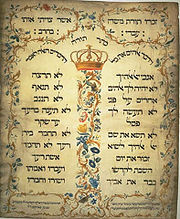
Ethics
Ethics, also known as moral philosophy, is a branch of philosophy that addresses questions about morality—that is, concepts such as good and evil, right and wrong, virtue and vice, justice and crime, etc.Major branches of ethics include:...
and worship
Worship
Worship is an act of religious devotion usually directed towards a deity. The word is derived from the Old English worthscipe, meaning worthiness or worth-ship — to give, at its simplest, worth to something, for example, Christian worship.Evelyn Underhill defines worship thus: "The absolute...
, which play a fundamental role in Judaism
Judaism
Judaism ) is the "religion, philosophy, and way of life" of the Jewish people...
and most forms of Christianity
Christianity
Christianity is a monotheistic religion based on the life and teachings of Jesus as presented in canonical gospels and other New Testament writings...
. They include instructions to worship only God and to keep the Sabbath
Sabbath
Sabbath in Christianity is a weekly day of rest or religious observance, derived from the Biblical Sabbath.Seventh-day Sabbath observance, i.e. resting from labor from Friday sunset to Saturday sunset, is practiced by seventh-day Sabbatarians...
, and prohibitions against idolatry
Idolatry
Idolatry is a pejorative term for the worship of an idol, a physical object such as a cult image, as a god, or practices believed to verge on worship, such as giving undue honour and regard to created forms other than God. In all the Abrahamic religions idolatry is strongly forbidden, although...
, blasphemy
Blasphemy
Blasphemy is irreverence towards religious or holy persons or things. Some countries have laws to punish blasphemy, while others have laws to give recourse to those who are offended by blasphemy...
, murder, theft
You shall not steal
You shall not steal is one of the Ten Commandments, of the Torah , which are widely understood as moral imperatives by legal scholars, Jewish scholars, Catholic scholars, and Post-Reformation scholars....
, and adultery
Adultery
Adultery is sexual infidelity to one's spouse, and is a form of extramarital sex. It originally referred only to sex between a woman who was married and a person other than her spouse. Even in cases of separation from one's spouse, an extramarital affair is still considered adultery.Adultery is...
. Different groups follow slightly different traditions for interpreting and numbering them.
The Ten Commandments appear twice in the Hebrew Bible
Hebrew Bible
The Hebrew Bible is a term used by biblical scholars outside of Judaism to refer to the Tanakh , a canonical collection of Jewish texts, and the common textual antecedent of the several canonical editions of the Christian Old Testament...
, in the books of Exodus and Deuteronomy
Deuteronomy
The Book of Deuteronomy is the fifth book of the Hebrew Bible, and of the Jewish Torah/Pentateuch...
. According to the story in Exodus, God inscribed them on two stone tablets, which he gave to Moses
Moses
Moses was, according to the Hebrew Bible and Qur'an, a religious leader, lawgiver and prophet, to whom the authorship of the Torah is traditionally attributed...
on Mount Sinai
Mount Sinai
Mount Sinai , also known as Mount Horeb, Mount Musa, Gabal Musa , Jabal Musa meaning "Moses' Mountain", is a mountain near Saint Catherine in the Sinai Peninsula of Egypt. A mountain called Mount Sinai is mentioned many times in the Book of Exodus in the Torah and the Bible as well as the Quran...
. Modern scholarship has found likely influences in Hittite
Hittites
The Hittites were a Bronze Age people of Anatolia.They established a kingdom centered at Hattusa in north-central Anatolia c. the 18th century BC. The Hittite empire reached its height c...
and Mesopotamian laws and treaties, but is divided over exactly when the Ten Commandments were written and who wrote them.
The Ten Commandments have been at the center of a recurring debate over the legality of displaying religious texts on public property in the United States of America, whose constitution, in its First Amendment
First Amendment to the United States Constitution
The First Amendment to the United States Constitution is part of the Bill of Rights. The amendment prohibits the making of any law respecting an establishment of religion, impeding the free exercise of religion, abridging the freedom of speech, infringing on the freedom of the press, interfering...
, forbids the making of any law respecting an establishment of religion.
Terminology
In biblical HebrewBiblical Hebrew language
Biblical Hebrew , also called Classical Hebrew , is the archaic form of the Hebrew language, a Canaanite Semitic language spoken in the area known as Canaan between the Jordan River and the Mediterranean Sea. Biblical Hebrew is attested from about the 10th century BCE, and persisted through...
, the Ten Commandments are called (transliterated
Romanization of Hebrew
Hebrew uses the Hebrew alphabet with optional vowel points. The romanization of Hebrew is the use of the Latin alphabet to transliterate Hebrew words....
) and in Rabbinical Hebrew
Mishnaic Hebrew language
The term Mishnaic Hebrew refers to the Hebrew dialects found in the Talmud, excepting quotations from the Hebrew Bible. The dialects can be further sub-divided into Mishnaic Hebrew , which was a spoken language, and Amoraic Hebrew , which was a literary...
(transliterated ), both translatable as "the ten words", "the ten sayings" or "the ten matters". The Tyndale
Tyndale Bible
The Tyndale Bible generally refers to the body of biblical translations by William Tyndale. Tyndale’s Bible is credited with being the first English translation to work directly from Hebrew and Greek texts. Furthermore it was the first English biblical translation that was mass produced as a result...
and Coverdale
Coverdale Bible
The Coverdale Bible, compiled by Myles Coverdale and published in 1535, was the first complete Modern English translation of the Bible , and the first complete printed translation into English . The later editions published in 1539 were the first complete Bibles printed in England...
English translations used "ten verses". The Geneva Bible
Geneva Bible
The Geneva Bible is one of the most historically significant translations of the Bible into the English language, preceding the King James translation by 51 years. It was the primary Bible of the 16th century Protestant movement and was the Bible used by William Shakespeare, Oliver Cromwell, John...
appears to be the first to use "tenne commandements", which was followed by the Bishops' Bible
Bishops' Bible
The Bishops' Bible is an English translation of the Bible which was produced under the authority of the established Church of England in 1568. It was substantially revised in 1572, and this revised edition was to be prescribed as the base text for the Authorized King James Version of...
and the Authorized King James Version as "ten commandments". Most major English versions follow the Authorized Version.
The English name "Decalogue" is derived from the Greek
Ancient Greek
Ancient Greek is the stage of the Greek language in the periods spanning the times c. 9th–6th centuries BC, , c. 5th–4th centuries BC , and the c. 3rd century BC – 6th century AD of ancient Greece and the ancient world; being predated in the 2nd millennium BC by Mycenaean Greek...
translation "ten terms", found in the Septuagint (or LXX) at Exodus 34:28 and Deuteronomy 10:4.
The Revelation at Sinai
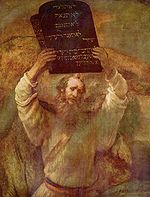
Biblical Mount Sinai
The Biblical Mount Sinai is the mountain at which the Book of Exodus states that the Ten Commandments were given to Moses by God...
, also called Mount Horeb
Mount Horeb
Mount Horeb, Hebrew: , Greek in the Septuagint: , Latin in the Vulgate: , is the mountain at which the book of Deuteronomy in the Hebrew Bible states that the Ten Commandments were given to Moses by God. It is described in two places as the Mountain of God or perhaps Mountain of the gods...
, receiving God's revelation. Moses is said to have conveyed God's commandments to the children of Israel in the third month after their exodus from Egypt
The Exodus
The Exodus is the story of the departure of the Israelites from ancient Egypt described in the Hebrew Bible.Narrowly defined, the term refers only to the departure from Egypt described in the Book of Exodus; more widely, it takes in the subsequent law-givings and wanderings in the wilderness...
. Israel's receipt of the commandments occurred on the third day of preparations at the foot of the mount.
The Ten Commandments were revealed to Moses and the Israelites at Sinai per Exodus 20-23, along with a miscellaneous set of laws conventionally called the "book of the covenant
Covenant Code
The Covenant Code, or alternatively Book of the Covenant, is the name given by academics to a text appearing in the Torah at Exodus - . Biblically, the text is the second of the law codes given to Moses by God at Mount Sinai...
". These laws are not named until Exodus 24, which refers to a "book of the covenant" and "stone tablets" as two parts of the revelation.
While Moses was receiving the Ten Commandments and the book of the covenant, the children of Israel compelled Aaron to build a golden calf
Golden calf
According to the Hebrew Bible, the golden calf was an idol made by Aaron to satisfy the Israelites during Moses' absence, when he went up to Mount Sinai...
, and he "built an altar before it" and the people "worshipped" the calf. After forty days, Moses came down from the mountain with Joshua, with the Ten Commandments: "And it came to pass, as soon as he came nigh unto the camp, that he saw the calf, and the dancing: and Moses’ anger waxed hot, and he cast the tables out of his hands, and brake them beneath the mount." After the events in chapters 32 and 33, the told Moses, "Hew thee two tables of stone like unto the first: and I will write upon these tables the words that were in the first tables, which thou brakest." This section of Exodus has text that historians call the "Ritual Decalogue
Ritual Decalogue
The Ritual Decalogue is a list of laws in the Book of Exodus, . These laws are similar to the Covenant Code and are followed by the phrase ten commandments...
" or the "Small Covenant Code".
According to Jewish tradition, Exodus 20:1-17 constitutes God's first recitation and inscription of the Ten Commandments on two tablets, which were broken in pieces by Moses, and later rewritten on replacement stones and placed in the ark of the covenant
Ark of the Covenant
The Ark of the Covenant , also known as the Ark of the Testimony, is a chest described in Book of Exodus as solely containing the Tablets of Stone on which the Ten Commandments were inscribed...
; and Deuteronomy 5:4-20 consists of God's re-telling of the Ten Commandments to the younger generation who were to enter the promised land. The passage in Exodus 20 contains more than ten imperative statements, totalling 14 or 15 in all. While the Bible itself assigns the count of "ten", using the Hebrew phrase asereth ha-debarim ('the ten words', 'statements' or 'sayings'), this phrase does not appear in Exodus 20.
Two texts with numbering schemes
The two texts commonly known as the ten commandments are given in two books of the Bible: and . (Links go to Hebrew text with English side-by-side.)Religious groups use one of three historical divisions of Exodus 20:1–17 into ten parts tabulated below:
- Phi. The Philonic division is the oldest, from the writings of PhiloPhiloPhilo , known also as Philo of Alexandria , Philo Judaeus, Philo Judaeus of Alexandria, Yedidia, "Philon", and Philo the Jew, was a Hellenistic Jewish Biblical philosopher born in Alexandria....
and JosephusJosephusTitus Flavius Josephus , also called Joseph ben Matityahu , was a 1st-century Romano-Jewish historian and hagiographer of priestly and royal ancestry who recorded Jewish history, with special emphasis on the 1st century AD and the First Jewish–Roman War, which resulted in the Destruction of...
(first century), which labels verse 3 as number 1, verses 4–6 as number 2, and so on. Groups that generally follow this scheme include Hellenistic Jews, Greek Orthodox and Protestants except Lutherans. Most representations of the commandments include the prologue of verse 2 as either part of the first commandment or as a preface. - Tal. The Talmudic division, from the third century Jewish TalmudTalmudThe Talmud is a central text of mainstream Judaism. It takes the form of a record of rabbinic discussions pertaining to Jewish law, ethics, philosophy, customs and history....
, makes verses 1–2 as the first "saying" or "declaration" (rather than "commandment"), and combines verses 3–6 as number 2. - Aug. The Augustinian division (fifth century) starts with number 2 of the Talmudic division, and makes an extra commandment by dividing the prohibition on coveting into two. Both Roman Catholics and Martin LutherMartin LutherMartin Luther was a German priest, professor of theology and iconic figure of the Protestant Reformation. He strongly disputed the claim that freedom from God's punishment for sin could be purchased with money. He confronted indulgence salesman Johann Tetzel with his Ninety-Five Theses in 1517...
adopted the Augustinian method. Roman Catholics use Deuteronomy by default when quoting the Ten Commandments whereas Luther used the Exodus version.
| Phi | Tal | Aug | ||
|---|---|---|---|---|
| — | 1 | — | 1 And God spoke all these words, saying, | 4–5 The talked with you face to face in the mount out of the midst of the fire ... saying, |
| Pre | 1 | — | 2 I am the thy God, which have brought thee out of the land of Egypt, out of the house of bondage. | 6 I am the thy God, which brought thee out of the land of Egypt, from the house of bondage. |
| 1 | 2 | 1 | 3 Thou shalt have no other gods before me. | 7 Thou shalt have none other gods before me. |
| 2 | 2 | 1 | 4 Thou shalt not make unto thee any graven image, or any likeness of any thing that is in heaven above, or that is in the earth beneath, or that is in the water under the earth: | 8 Thou shalt not make thee any graven image, or any likeness of any thing that is in heaven above, or that is in the earth beneath, or that is in the waters beneath the earth: |
| 2 | 2 | 1 | 5 Thou shalt not bow down thyself to them, nor serve them: for I the thy God am a jealous God, visiting the iniquity of the fathers upon the children unto the third and fourth generation of them that hate me; | 9 Thou shalt not bow down thyself unto them, nor serve them: for I the thy God am a jealous God, visiting the iniquity of the fathers upon the children unto the third and fourth generation of them that hate me, |
| 2 | 2 | 1 | 6 And shewing mercy unto thousands of them that love me, and keep my commandments. | 10 And shewing mercy unto thousands of them that love me and keep my commandments. |
| 3 | 3 | 2 | 7 Thou shalt not take the name of the thy God in vain; for the will not hold him guiltless that taketh his name in vain. | 11 Thou shalt not take the name of the thy God in vain: for the will not hold him guiltless that taketh his name in vain. |
| 4 | 4 | 3 | 8 Remember the sabbath day, to keep it holy. | 12 Keep the sabbath day to sanctify it, as the thy God hath commanded thee. |
| 4 | 4 | 3 | 9 Six days shalt thou labour, and do all thy work: | 13 Six days thou shalt labour, and do all thy work: |
| 4 | 4 | 3 | 10 But the seventh day is the sabbath of the thy God: in it thou shalt not do any work, thou, nor thy son, nor thy daughter, thy manservant, nor thy maidservant, nor thy cattle, nor thy stranger that is within thy gates: | 14 But the seventh day is the sabbath of the thy God: in it thou shalt not do any work, thou, nor thy son, nor thy daughter, nor thy manservant, nor thy maidservant, nor thine ox, nor thine ass, nor any of thy cattle, nor thy stranger that is within thy gates; that thy manservant and thy maidservant may rest as well as thou. |
| 4 | 4 | 3 | 11 For in six days the made heaven and earth, the sea, and all that in them is, and rested the seventh day: wherefore the LORD blessed the sabbath day, and hallowed it. | 15 And remember that thou wast a servant in the land of Egypt, and that the thy God brought thee out thence through a mighty hand and by a stretched out arm: therefore the thy God commanded thee to keep the sabbath day. |
| 5 | 5 | 4 | 12 Honour thy father and thy mother: that thy days may be long upon the land which the thy God giveth thee. | 16 Honour thy father and thy mother, as the LORD thy God hath commanded thee; that thy days may be prolonged, and that it may go well with thee, in the land which the thy God giveth thee. |
| 6 | 6 | 5 | 13 Thou shalt not kill. | 17 Thou shalt not kill. |
| 7 | 7 | 6 | 14 Thou shalt not commit adultery. | 18 Neither shalt thou commit adultery. |
| 8 | 8 | 7 | 15 Thou shalt not steal. | 19 Neither shalt thou steal. |
| 9 | 9 | 8 | 16 Thou shalt not bear false witness against thy neighbour. | 20 Neither shalt thou bear false witness against thy neighbour. |
| 10 | 10 | 9 | 17 Thou shalt not covet thy neighbour's house, | 21 Neither shalt thou desire thy neighbour's wife, |
| 10 | 10 | 10 | thou shalt not covet thy neighbour's wife, nor his manservant, nor his maidservant, nor his ox, nor his ass, nor any thing that is thy neighbour's. | neither shalt thou covet thy neighbour's house, his field, or his manservant, or his maidservant, his ox, or his ass, or any thing that is thy neighbour's. |
* All scripture quotes above are from the Authorized Version. Click on verses at top of columns for other versions.
Importance within Judaism and Christianity
The Ten Commandments concern only matters of fundamental importance: the greatest obligation (to worship God), the greatest injury to a person (murder), the greatest injury to family bonds (adultery), the greatest injury to commerce and law (bearing false witness), the greatest intergenerational obligation (honor to parents), the greatest obligation to community (truthfulness), the greatest injury to moveable property (theft).Because they are fundamental, the Ten Commandments are written with room for varying interpretation. They are not as explicit or detailed as rules and regulations or many other biblical laws and commandments, because they provide guiding principles that apply universally, across changing circumstances. They do not specify punishments for their violation. Their precise import must be worked out in each separate situation.
The Bible indicates the special status of the Ten Commandments among all other Old Testament laws in several ways. They have a uniquely terse style, as noted above. Of all the Biblical laws and commandments, the Ten Commandments alone were "written with the finger of God" . And lastly, the stone tablets were placed in the Ark of the Covenant .
In Judaism, the Ten Commandments provide God's universal and timeless standard of right and wrong, unlike the other 603 commandments
613 mitzvot
The 613 commandments is a numbering of the statements and principles of law, ethics, and spiritual practice contained in the Torah or Five Books of Moses...
in the Torah
Torah
Torah- A scroll containing the first five books of the BibleThe Torah , is name given by Jews to the first five books of the bible—Genesis , Exodus , Leviticus , Numbers and Deuteronomy Torah- A scroll containing the first five books of the BibleThe Torah , is name given by Jews to the first five...
, which describe various duties and ceremonies such as the kashrut
Kashrut
Kashrut is the set of Jewish dietary laws. Food in accord with halakha is termed kosher in English, from the Ashkenazi pronunciation of the Hebrew term kashér , meaning "fit" Kashrut (also kashruth or kashrus) is the set of Jewish dietary laws. Food in accord with halakha (Jewish law) is termed...
dietary laws and now-obsolete rituals to be performed by priests in the Holy Temple.
They form the basis of Jewish law.
During the period of the Second Temple
Second Temple
The Jewish Second Temple was an important shrine which stood on the Temple Mount in Jerusalem between 516 BCE and 70 CE. It replaced the First Temple which was destroyed in 586 BCE, when the Jewish nation was exiled to Babylon...
, the Ten Commandments were recited daily. They were removed from daily liturgy to dispute a claim by early Christians that only the Ten Commandments were handed down at Mount Sinai rather than the whole Torah. In later centuries, rabbis continued to omit the Ten Commandments from daily liturgy in order to prevent a confusion among Jews that they are only bound by the Ten Commandments, and not also by many other biblical and talmudic laws, such as the requirement to observe holy days other than the Sabbath. Today, the Ten Commandments are heard in the synagogue three times a year: as they come up during the readings of Exodus and Deuteronomy, and during the festival of Shavuot
Shavuot
The festival of is a Jewish holiday that occurs on the sixth day of the Hebrew month of Sivan ....
. The worshippers rise for their reading to highlight their special significance.
The Eastern Orthodox Church holds its moral truths to be chiefly contained in the Ten Commandments. A confession
Confession
This article is for the religious practice of confessing one's sins.Confession is the acknowledgment of sin or wrongs...
begins with the Confessor reciting the Ten Commandments and asking the penitent which of them he has broken.
In Roman Catholicism, Jesus freed Christians from the Jewish obligation to keep the 613 mitzvot
613 mitzvot
The 613 commandments is a numbering of the statements and principles of law, ethics, and spiritual practice contained in the Torah or Five Books of Moses...
, but not from their obligation to keep the Ten Commandments. They are to the moral order what the creation story is to the natural order.
Even after rejecting the Roman Catholic moral theology, giving less importance to biblical law
Law and Gospel
In Christianity the relationship between God's Law and the Gospel is a major topic in Lutheran and Reformed theology. In these traditions, the distinction between the doctrines of Law, which demands obedience to God's ethical will, and Gospel, which promises the forgiveness of sins in light of the...
in order to better hear and be moved by the gospel
Gospel
A gospel is an account, often written, that describes the life of Jesus of Nazareth. In a more general sense the term "gospel" may refer to the good news message of the New Testament. It is primarily used in reference to the four canonical gospels of Matthew, Mark, Luke, and John...
, early Protestant theologians still took the Ten Commandments to be the starting point of Christian moral life. Different versions of Christianity have varied in how they have translated the bare principles into the specifics that make up a full Christian ethic. Where Catholicism emphasizes taking action to fulfill the Ten Commandments, Protestantism uses the Ten Commandments for two purposes: to outline the Christian life to each person, and to make each person realize, through their failure to live that life, that they lack the ability to do it on their own. Thus for Protestant Christianity, the Ten Commandments primarily serve to lead each Christian to the grace of God.
The Two Tablets
The arrangement of the commandments on the two tablets is interpreted in different ways in the classical Jewish tradition. Rabbi Hanina ben Gamaliel says that each tablet contained five commandments, "but the Sages say ten on one tablet and ten on the other". Because the commandments establish a covenant, it is likely that they were duplicated on both tablets. This can be compared to diplomatic treaties of Ancient EgyptAncient Egypt
Ancient Egypt was an ancient civilization of Northeastern Africa, concentrated along the lower reaches of the Nile River in what is now the modern country of Egypt. Egyptian civilization coalesced around 3150 BC with the political unification of Upper and Lower Egypt under the first pharaoh...
, in which a copy was made for each party.
According to the Talmud
Talmud
The Talmud is a central text of mainstream Judaism. It takes the form of a record of rabbinic discussions pertaining to Jewish law, ethics, philosophy, customs and history....
, the compendium of traditional Rabbinic Jewish
Rabbinic Judaism
Rabbinic Judaism or Rabbinism has been the mainstream form of Judaism since the 6th century CE, after the codification of the Talmud...
law, tradition, and interpretation, the biblical verse "the tablets were written on both their sides", implies that the carving went through the full thickness of the tablets. The stones in the center part of some letters were not connected to the rest of the tablet, but they did not fall out. Moreover, the writing was also legible from both sides; it was not a mirror image of the text on the other side. The Talmud regards both phenomena as miraculous.
Traditional division and interpretation
According to the Medieval Sefer ha-ChinuchSefer ha-Chinuch
The Sefer ha-Chinuch , often simply "the Chinuch" is a work which systematically discusses the 613 commandments of the Torah. It was published anonymously in 13th century Spain...
, the first four statements concern the relationship between God and humans, while the next six statements concern the relationships between people. Rabbinic literature
Rabbinic literature
Rabbinic literature, in its broadest sense, can mean the entire spectrum of rabbinic writings throughout Jewish history. However, the term often refers specifically to literature from the Talmudic era, as opposed to medieval and modern rabbinic writing, and thus corresponds with the Hebrew term...
holds that the Ten Statements in fact contain 14 or 15 distinct instructions
Mitzvah
The primary meaning of the Hebrew word refers to precepts and commandments as commanded by God...
; see listing under Yitro (parsha)
Yitro (parsha)
Yitro, Yithro, or Yisro is the seventeenth weekly Torah portion in the annual Jewish cycle of Torah reading and the fifth in the book of Exodus...
.
- "I am the LORD your GodI am the Lord your GodI am the Lord your God is the opening phrase of the Ten Commandments, which are widely understood as moral imperatives by ancient legal historians and Jewish and Christian biblical scholars....
who brought you out of the land of Egypt, from the house of slavery. You shall have no other gods in My presence...You shall have no other gods before meYou shall have no other gods before me is one of the Ten Commandments found in the Hebrew Bible .This commandment establishes the exclusive nature of the relationship between the nation of Israel and its national god, Yahweh the God of Israel, a covenant initiated by Yahweh after delivering the...
"- This commandment is to be aware that the God of Israel exists absolutely and influences all events in the world and that the goal of the redemption from Egypt was to become His servants (RashiRashiShlomo Yitzhaki , or in Latin Salomon Isaacides, and today generally known by the acronym Rashi , was a medieval French rabbi famed as the author of a comprehensive commentary on the Talmud, as well as a comprehensive commentary on the Tanakh...
). It requires the acknowledgment of the single God of Abraham, Isaac and Jacob, and the denial of the existence of false gods (Rashi).
- This commandment is to be aware that the God of Israel exists absolutely and influences all events in the world and that the goal of the redemption from Egypt was to become His servants (Rashi
- "Do not make an image or any likeness of what is in the heavens above...You shall not make for yourself an idol“You shall not make for yourself an idol” is an abbreviated form of one of the Ten Commandments which, according to the book of Deuteronomy, were spoken by God to Israel and then written on stone tablets by God himself...
"- This prohibits the construction or fashioning of "idols" in the likeness of created things (beasts, fish, birds, people) and worshipping them (aniconismAniconismAniconism is the practice or belief in avoiding or shunning images of divine beings, prophets or other respected religious figures, or in different manifestations, any human beings or living creatures. The term aniconic may be used to describe the absence of graphic representations in a particular...
). It also prohibits making an image of the God of Israel for use in worship (see the incident of the golden calfGolden calfAccording to the Hebrew Bible, the golden calf was an idol made by Aaron to satisfy the Israelites during Moses' absence, when he went up to Mount Sinai...
).
- This prohibits the construction or fashioning of "idols" in the likeness of created things (beasts, fish, birds, people) and worshipping them (aniconism
- "Do not swear falsely by the name of the LORD...You shall not make wrongful use of the name of your GodThou shalt not take the name of the Lord thy God in vain is one of the Ten Commandments....
"- This is a prohibition against making false oaths in the name of the God of Israel, specifically those which are pointless, insincere or never carried out.
- "Remember [zachor] the Sabbath day and keep it holyBiblical SabbathSabbath in the Bible is usually a weekly day of rest and time of worship. The Sabbath is first mentioned in the Genesis creation narrative. The seventh day is there set aside as a day of rest—the Sabbath. It is observed differently in Judaism and Christianity and informs a similar occasion in...
" (the version in Deuteronomy reads shamor, "observe")- The seventh day of the week is termed ShabbatShabbatShabbat is the seventh day of the Jewish week and a day of rest in Judaism. Shabbat is observed from a few minutes before sunset on Friday evening until a few minutes after when one would expect to be able to see three stars in the sky on Saturday night. The exact times, therefore, differ from...
and is holy, just as God ceased creative activity during Creation. The aspect of zachor is performed by declaring the greatness of the day (kiddushKiddushKiddush , literally, "sanctification," is a blessing recited over wine or grape juice to sanctify the Shabbat and Jewish holidays.-Significance:...
), by having three festive meals, and by engaging in Torah studyTorah studyTorah study is the study by Jewish people of the Torah, Hebrew Bible, Talmud, responsa, rabbinic literature and similar works, all of which are Judaism's religious texts...
and pleasurable activities. The aspect of shamor is performed by abstaining from productive activity (39 melachot39 categories of activity prohibited on ShabbatThe commandment to keep Shabbat as a day of rest is repeated many times in the Tanakh, the Hebrew Bible. The commandment is usually expressed in English in terms of refraining from the doing of work on Shabbat, but the Hebrew term used in the Bible is melakha , which has a slightly different...
) on the Shabbath.
- The seventh day of the week is termed Shabbat
- "Honor your father and your motherHonor your father and your motherThe commandment Honor your father and your mother is the fifth of the Ten Commandments in the Hebrew Bible. The commandment is generally regarded in Protestant and Jewish sources as the fifth in both the list in Exodus 20:1-21, and in Deuteronomy 5:1-23, though in Catholic counting this is the...
..."- The obligation to honor one's parents is an obligation that one owes to God and fulfills this obligation through one's actions towards one's parents.
- "Do not murder"
- Murdering a human being is a capital sin.
- "Do not commit adulteryYou shall not commit adultery"You shall not commit adultery" is one of the Ten Commandments. Adultery is sexual relations in which at least one participant is married to someone else. According to the Genesis narrative, marriage is a union established by God himself...
."- AdulteryAdulteryAdultery is sexual infidelity to one's spouse, and is a form of extramarital sex. It originally referred only to sex between a woman who was married and a person other than her spouse. Even in cases of separation from one's spouse, an extramarital affair is still considered adultery.Adultery is...
is defined as sexual intercourse between a man and a married woman who is not his wife.
- Adultery
- "Do not steal."
- According to the TalmudTalmudThe Talmud is a central text of mainstream Judaism. It takes the form of a record of rabbinic discussions pertaining to Jewish law, ethics, philosophy, customs and history....
, this commandment refers to kidnapping and not to theft of material property, as theft of property is forbidden elsewhere, and it is not a capital offense. In this context it is to be taken as "do not kidnap."
- According to the Talmud
- "Do not bear false witness against your neighborYou shall not bear false witness against your neighborYou shall not bear false witness against your neighbor is one of the Ten Commandments, which are widely understood as moral imperatives by legal scholars, Jewish scholars, Catholic scholars, and Post-Reformation scholars...
"- One must not bring a false testimony in a court of law or other proceeding.
- "Do not covet your neighbor's wifeYou shall not covet"You shall not covet" is the most common translation of one of the Ten Commandments, which are widely understood as moral imperatives by legal scholars, Jewish scholars, Catholic scholars, and Post-Reformation scholars...
"- One is forbidden to desire and plan how one may obtain that which God has given to another. MaimonidesMaimonidesMoses ben-Maimon, called Maimonides and also known as Mūsā ibn Maymūn in Arabic, or Rambam , was a preeminent medieval Jewish philosopher and one of the greatest Torah scholars and physicians of the Middle Ages...
makes a distinction in codifying the laws between the instruction given here in Exodus (You shall not covet) and that given in Deuteronomy (You shall not desire), according to which one does not violate the Exodus commandment unless there is a physical action associated with the desire, even if this is legally purchasing an envied object.
- One is forbidden to desire and plan how one may obtain that which God has given to another. Maimonides
Significance of the Decalogue
The Ten Commandments are not given any greater significance in observance or special status. In fact, when undue emphasis was being placed on them, their daily communal recitation was discontinued. Jewish tradition does, however, recognize them as the theological basis for the rest of the commandments; a number of works (starting with Rabbi Saadia GaonSaadia Gaon
Saʻadiah ben Yosef Gaon was a prominent rabbi, Jewish philosopher, and exegete of the Geonic period.The first important rabbinic figure to write extensively in Arabic, he is considered the founder of Judeo-Arabic literature...
) have made groupings of the commandments according to their links with the Ten Commandments.
The traditional Rabbinical Jewish belief is that the observance of these commandments and the other mitzvot are required solely of the Jewish people, and that the laws incumbent on humanity in general are outlined in the seven Noahide Laws
Noahide Laws
The Seven Laws of Noah form the major part of the Noachide Laws, or Noahide Code. This code is a set of moral imperatives that, according to the Talmud, were given by God as a binding set of laws for the "children of Noah" – that is, all of humankind...
(several of which overlap with the Ten Commandments). In the era of the Sanhedrin
Sanhedrin
The Sanhedrin was an assembly of twenty-three judges appointed in every city in the Biblical Land of Israel.The Great Sanhedrin was the supreme court of ancient Israel made of 71 members...
transgressing any one of six of the Ten Commandments theoretically carried the death penalty, the exceptions being the First Commandment, honoring your father and mother, saying God's name in vain, and coveting, though this was rarely enforced due to a large number of stringent evidentiary requirements
Rules of evidence
Rules of evidence govern whether, when, how, and for what purpose, proof of a legal case may be placed before a trier of fact for consideration....
imposed by the oral law
Oral Torah
The Oral Torah comprises the legal and interpretative traditions that, according to tradition, were transmitted orally from Mount Sinai, and were not written in the Torah...
.
Use in Jewish ritual
The MishnahMishnah
The Mishnah or Mishna is the first major written redaction of the Jewish oral traditions called the "Oral Torah". It is also the first major work of Rabbinic Judaism. It was redacted c...
records that it was the practice, in the Temple, to recite the Ten Commandments every day before the reading of the Shema (as preserved, for example, in the Nash Papyrus
Nash Papyrus
The Nash Papyrus is a collection of four papyrus fragments acquired in Egypt in 1898 by W. L. Nash, the secretary of the Society of Biblical Archaeology. He presented to Cambridge University Library. They comprise a single sheet and are not part of a scroll. The papyrus is of unknown provenance,...
from c. 150 BCE); but that this practice was abolished in the synagogues so as not to give ammunition to heretics who claimed that they were the only important part of Jewish law.
In the normal course of the reading of the Torah, the Ten Commandments are read twice a year: the Exodus version in parashat Yitro
Yitro (parsha)
Yitro, Yithro, or Yisro is the seventeenth weekly Torah portion in the annual Jewish cycle of Torah reading and the fifth in the book of Exodus...
around late January–February, and the Deuteronomy version in parashat Va'etchanan
Va'etchanan
Va'etchanan is the 45th weekly Torah portion in the annual Jewish cycle of Torah reading and the second in the book of Deuteronomy. It constitutes Jews in the Diaspora generally read it in late July or August...
in August–September. In addition, the Exodus version constitutes the main Torah reading for the festival of Shavuot
Shavuot
The festival of is a Jewish holiday that occurs on the sixth day of the Hebrew month of Sivan ....
. It is widespread custom for the congregation to stand while they are being read.
In printed Bibles the Ten Commandments carry two sets of cantillation
Cantillation
Cantillation is the ritual chanting of readings from the Hebrew Bible in synagogue services. The chants are written and notated in accordance with the special signs or marks printed in the Masoretic text of the Hebrew Bible to complement the letters and vowel points...
marks. The ta'am 'elyon (upper accentuation), which makes each Commandment into a separate verse, is used for public Torah reading, while the ta'am tachton (lower accentuation), which divides the text into verses of more even length, is used for private reading or study. The verse numbering in Christian Bibles follows the ta'am elyon while that in Jewish Bibles follows the ta'am tachton. In Jewish Bibles the references to the Ten Commandments are therefore Exodus 20:2–14 and Deuteronomy 5:6–18.
Samaritan
The Samaritan PentateuchSamaritan Pentateuch
The Samaritan Pentateuch, sometimes called Samaritan Torah, , is a version of the Hebrew language Pentateuch, the first five books of the Bible, used by the Samaritans....
varies in the Ten Commandments passages, both in that the Samaritan Deuteronomical version of the passage is much closer to that in Exodus, and in the addition of a commandment on the sanctity of Mount Gerizim
Mount Gerizim
Mount Gerizim is one of the two mountains in the immediate vicinity of the West Bank city of Nablus , and forms the southern side of the valley in which Nablus is situated,...
.
The text of the commandment follows:
- And it shall come to pass when the Lord thy God will bring thee into the land of the Canaanites whither thou goest to take possession of it, thou shalt erect unto thee large stones, and thou shalt cover them with lime, and thou shalt write upon the stones all the words of this Law, and it shall come to pass when ye cross the Jordan, ye shall erect these stones which I command thee upon Mount Gerizim, and thou shalt build there an altar unto the Lord thy God, an altar of stones, and thou shalt not lift upon them iron, of perfect stones shalt thou build thine altar, and thou shalt bring upon it burnt offerings to the Lord thy God, and thou shalt sacrifice peace offerings, and thou shalt eat there and rejoice before the Lord thy God. That mountain is on the other side of the Jordan at the end of the road towards the going down of the sun in the land of the Canaanites who dwell in the Arabah facing Gilgal close by Elon Moreh facing Shechem.
Reference by Jesus
In the Gospel of MatthewGospel of Matthew
The Gospel According to Matthew is one of the four canonical gospels, one of the three synoptic gospels, and the first book of the New Testament. It tells of the life, ministry, death, and resurrection of Jesus of Nazareth...
, Jesus
Jesus
Jesus of Nazareth , commonly referred to as Jesus Christ or simply as Jesus or Christ, is the central figure of Christianity...
repeated five of the Ten Commandments, followed by that commandment called "the second" after the first and great commandment
Great Commandment
The Great Commandment, or Greatest Commandment, is an appellation applied to either the first, or both, of two commandments which appear in , and...
.
Reference by Paul
In his epistle to the RomansEpistle to the Romans
The Epistle of Paul to the Romans, often shortened to Romans, is the sixth book in the New Testament. Biblical scholars agree that it was composed by the Apostle Paul to explain that Salvation is offered through the Gospel of Jesus Christ...
, the apostle Paul also mentioned five of the Ten Commandments and associated them with the neighborly love commandment.
Roman Catholicism
According to the Catechism of the Catholic ChurchCatechism of the Catholic Church
The Catechism of the Catholic Church is the official text of the teachings of the Catholic Church. A provisional, "reference text" was issued by Pope John Paul II on October 11, 1992 — "the thirtieth anniversary of the opening of the Second Vatican Ecumenical Council" — with his apostolic...
—the official exposition of the Catholic Church's Christian beliefs—the Commandments are considered essential for spiritual good health and growth, and serve as the basis for social justice
Catholic social teaching
Catholic social teaching is a body of doctrine developed by the Catholic Church on matters of poverty and wealth, economics, social organization and the role of the state...
. Church teaching of the Commandments is largely based on the Old
Old Testament
The Old Testament, of which Christians hold different views, is a Christian term for the religious writings of ancient Israel held sacred and inspired by Christians which overlaps with the 24-book canon of the Masoretic Text of Judaism...
and New Testament
New Testament
The New Testament is the second major division of the Christian biblical canon, the first such division being the much longer Old Testament....
s and the writings of the early Church Fathers
Church Fathers
The Church Fathers, Early Church Fathers, Christian Fathers, or Fathers of the Church were early and influential theologians, eminent Christian teachers and great bishops. Their scholarly works were used as a precedent for centuries to come...
. In the New Testament, Jesus acknowledged their validity
Sermon on the Mount
The Sermon on the Mount is a collection of sayings and teachings of Jesus, which emphasizes his moral teaching found in the Gospel of Matthew...
and instructed his disciples
Disciple (Christianity)
In Christianity, the disciples were the students of Jesus during his ministry. While Jesus attracted a large following, the term disciple is commonly used to refer specifically to "the Twelve", an inner circle of men whose number perhaps represented the twelve tribes of Israel...
to go further, demanding a righteousness exceeding that of the scribes
Scribes
Scribes is a minimalist and extensible text editor for GNOME that combines simplicity with power. Scribes focuses on ways workflow and productivity can be intelligently automated and radically improved...
and Pharisees
Pharisees
The Pharisees were at various times a political party, a social movement, and a school of thought among Jews during the Second Temple period beginning under the Hasmonean dynasty in the wake of...
. Summarized by Jesus into two "great commandments" that teach the love of God
Great Commandment
The Great Commandment, or Greatest Commandment, is an appellation applied to either the first, or both, of two commandments which appear in , and...
and love of neighbor
Great Commandment
The Great Commandment, or Greatest Commandment, is an appellation applied to either the first, or both, of two commandments which appear in , and...
, they instruct individuals on their relationships with both.
Lutheranism
The Lutheran division of the commandments follows the one established by St. AugustineAugustine of Hippo
Augustine of Hippo , also known as Augustine, St. Augustine, St. Austin, St. Augoustinos, Blessed Augustine, or St. Augustine the Blessed, was Bishop of Hippo Regius . He was a Latin-speaking philosopher and theologian who lived in the Roman Africa Province...
, following the then current synagogue scribal division. The first three commandments govern the relationship between God and humans, the fourth through eighth govern public relationships between people, and the last two govern private thoughts. See Luther's Small Catechism and Large Catechism.
New Covenant Theology
New Covenant Theology (NCT) is a recently expressed Christian theological view of redemptive historyRedemptive-Historical Preaching
- History :Redemptive-historical preaching is a method of preaching that was forged in the fires of debate in the Reformed churches of the Netherlands in the early 1940s. The debate concerned itself with the question: “How are we to preach the historical narratives of the Bible?”On one side of the...
which claims that all Old Covenant
Old Covenant
The Old Covenant was the name of the agreement which effected the union of Iceland and Norway. It is also known as Gissurarsáttmáli, named after Gissur Þorvaldsson, the Icelandic chieftain who worked to promote it. The name "Old Covenant", however, is probably due to historical confusion...
laws have been cancelled
Abrogation of Old Covenant laws
While many Christian theology systems reflect the view that at least some Mosaic laws have been set aside under the New Covenant, there are some theology systems that view the entire Mosaic or Old Covenant as abrogated in that all of the Mosaic laws are set aside for the Law of Christ...
in favor of the Law of Christ or New Covenant
New Covenant
The New Covenant is a concept originally derived from the Hebrew Bible. The term "New Covenant" is used in the Bible to refer to an epochal relationship of restoration and peace following a period of trial and judgment...
law of the New Testament
New Testament
The New Testament is the second major division of the Christian biblical canon, the first such division being the much longer Old Testament....
. This can be summarized as the ethical expectation found in the New Testament
New Testament
The New Testament is the second major division of the Christian biblical canon, the first such division being the much longer Old Testament....
. New Covenant Theology does not reject all religious law
Religious law
In some religions, law can be thought of as the ordering principle of reality; knowledge as revealed by a God defining and governing all human affairs. Law, in the religious sense, also includes codes of ethics and morality which are upheld and required by the God...
, they only reject Old Covenant law. NCT is in contrast with other views on biblical law
Biblical law in Christianity
Christian views of the Old Covenant have been central to Christian theology and practice since the circumcision controversy in Early Christianity. There are differing views about the applicability of the Old Covenant among Christian denominations...
in that most others do not believe the Ten Commandments and Divine law
Divine law
Divine law is any law that in the opinion of believers, comes directly from the will of God . Like natural law it is independent of the will of man, who cannot change it. However it may be revealed or not, so it may change in human perception in time through new revelation...
s of the Old Covenant have been cancelled and prefer the term "Supersessionism
Supersessionism
Supersessionism is a term for the dominant Christian view of the Old Covenant, also called fulfillment theology and replacement theology, though the latter term is disputed...
" (rather than "cancelled" or "abrogated") for the rest. In 2001, Richard Barcellos, an associate professor and pastor of a Reformed Baptist
Reformed Baptist
Reformed Baptists are Baptists that hold to a Calvinist soteriology. They can trace their history through the early modern Particular Baptists of England. The first Reformed Baptist church was formed in the 1630s...
Church in California, published a critique of NCT for proposing that the Ten Commandments have been cancelled.
Islam
The Qur'an states that "tablets" were given to Moses, without quoting their contents explicitly:- "And We ordained laws for him in the tablets in all matters, both commanding and explaining all things, (and said): 'Take and hold these with firmness, and enjoin thy people to hold fast by the best in the precepts: soon shall I show you the homes of the wicked,- (How they lie desolate).'"
These tablets are not broken in the Qur'an, but picked up later:
- "When Moses came back to his people, angry and grieved, he said: 'Evil it is that ye have done in my place in my absence: did ye make haste to bring on the judgment of your Lord?' He put down the tablets, seized his brother by (the hair of) his head, and dragged him to him..." . "When the anger of Moses was appeased, he took up the tablets: in the writing thereon was guidance and Mercy for such as fear their Lord." .
Sabbath day
Sabbath in Christianity is a weekly day of restLeisure
Leisure, or free time, is time spent away from business, work, and domestic chores. It is also the periods of time before or after necessary activities such as eating, sleeping and, where it is compulsory, education....
or religious observance, derived from the biblical sabbath
Biblical Sabbath
Sabbath in the Bible is usually a weekly day of rest and time of worship. The Sabbath is first mentioned in the Genesis creation narrative. The seventh day is there set aside as a day of rest—the Sabbath. It is observed differently in Judaism and Christianity and informs a similar occasion in...
. Non-Sabbatarianism
Non-Sabbatarianism
Nonsabbatarianism is the affirmation of the religious liberty not to observe a weekly rest or worship day , usually in Christianity. While keepers of weekly days usually also believe in religious liberty, nonsabbatarians believe themselves particularly free to uphold Sabbath principles, or not,...
is the principle of Christian liberty from being bound to physical Sabbath observance. Most dictionaries provide both first-day and seventh-day definitions for "Sabbath" and "Sabbatarian", among other related uses.
Until the 2nd and 3rd century most Christian groups kept the Jewish sabbath, with the practice of Sunday observance emerging after the Jewish-Roman wars
Jewish-Roman wars
The Jewish–Roman wars were a series of large-scale revolts by the Jews of Iudaea Province and Eastern Mediterranean against the Roman Empire. Some sources use the term to refer only to the First Jewish–Roman War and Bar Kokhba revolt...
. The Catholic Church's general repudiation of Jewish practices during this period is apparent in the Council of Laodicea
Council of Laodicea
The Council of Laodicea was a regional synod of approximately thirty clerics from Asia Minor that assembled about 363–364 AD in Laodicea, Phrygia Pacatiana.-Historical context:...
(4th Century AD) where Canon 37–38 states: "It is not lawful to receive portions sent from the feasts of Jews or heretics, nor to feast together with them" and "It is not lawful to receive unleavened bread from the Jews, nor to be partakers of their impiety". Canon 29 of the Laodicean council specificially refers to the Sabbath: "Christians must not judaize by resting on the [Jewish] Sabbath, but must work on that day, rather honoring the Lord's Day; and, if they can, resting then as Christians. But if any shall be found to be judaizers
Judaizers
Judaizers is predominantly a Christian term, derived from the Greek verb ioudaïzō . This term is most widely known from the single use in the New Testament where Paul publicly challenges Peter for compelling Gentile believers to "judaize", also known as the Incident at Antioch.According to the...
, let them be anathema
Anathema
Anathema originally meant something lifted up as an offering to the gods; it later evolved to mean:...
(excommunicated
Excommunication
Excommunication is a religious censure used to deprive, suspend or limit membership in a religious community. The word means putting [someone] out of communion. In some religions, excommunication includes spiritual condemnation of the member or group...
) from Christ."
Killing or murder
Multiple translations exist of the fifth/sixth commandment; the Hebrew words לא תרצח (lo tirtzach) are variously translated as "thou shalt not kill" or "thou shalt not murder".The imperative is against unlawful killing resulting in bloodguilt. The Hebrew Bible contains numerous prohibitions against unlawful killing, but also allows for justified killing in the context of warfare , capital punishment
Capital punishment
Capital punishment, the death penalty, or execution is the sentence of death upon a person by the state as a punishment for an offence. Crimes that can result in a death penalty are known as capital crimes or capital offences. The term capital originates from the Latin capitalis, literally...
and self-defence . The New Testament is in agreement that murder is a grave moral evil, and maintains the Old Testament view of bloodguilt.
Jewish translations almost all use "murder" – an exception is the Artscroll
ArtScroll
ArtScroll is an imprint of translations, books and commentaries from an Orthodox Jewish perspective published by Mesorah Publications, Ltd., a publishing company based in Brooklyn, New York...
or Stone Edition tanach
Tanakh
The Tanakh is a name used in Judaism for the canon of the Hebrew Bible. The Tanakh is also known as the Masoretic Text or the Miqra. The name is an acronym formed from the initial Hebrew letters of the Masoretic Text's three traditional subdivisions: The Torah , Nevi'im and Ketuvim —hence...
(1996).
You shall not steal
Significant voices among academic theologians (such as German Old Testament scholar Albrecht AltAlbrecht Alt
Albrecht Alt , was a leading German Protestant theologian.Eldest son of a Lutheran minister, he completed high school in Ansbach and studied theology at the Friedrich-Alexander-University in Erlangen and the University of Leipzig...
: Das Verbot des Diebstahls im Dekalog (1953)) suggest that commandment "you shall not steal" was originally intended against stealing people—against abductions and slavery, in agreement with the Talmudic interpretation of the statement as "you shall not kidnap" (Sanhedrin 86a).
Idolatry
In Christianity's earliest centuries, some Christians had informally adorned their homes and places of worship with images of Christ and the saints, while some thought it inappropriate; no church council had ruled on whether such practices constituted idolatry. The controversy reached crisis level in the 8th century, during the period of iconoclasmIconoclasm
Iconoclasm is the deliberate destruction of religious icons and other symbols or monuments, usually with religious or political motives. It is a frequent component of major political or religious changes...
: the smashing of icons. In 726, Emperor Leo III
Leo III the Isaurian
Leo III the Isaurian or the Syrian , was Byzantine emperor from 717 until his death in 741...
ordered all images removed from all churches; in 730, a council forbade veneration of images, citing the Second Commandment; in 787, the Seventh Ecumenical Council reversed the preceding rulings, condemning iconoclasm and sanctioning the veneration of images; in 815, Leo V
Leo V the Armenian
Leo V the Armenian was emperor of the Byzantine Empire from 813 to 820. A senior general, he forced his predecessor, Michael I Rangabe, to abdicate and assumed the throne. He ended the decade-long war with the Bulgars, and initiated the second period of Byzantine Iconoclasm...
called yet another council, which reinstated iconoclasm; in 843, Empress Theodora again reinstated veneration of icons. This mostly settled the matter until the Protestant Reformation
Protestant Reformation
The Protestant Reformation was a 16th-century split within Western Christianity initiated by Martin Luther, John Calvin and other early Protestants. The efforts of the self-described "reformers", who objected to the doctrines, rituals and ecclesiastical structure of the Roman Catholic Church, led...
, when John Calvin
John Calvin
John Calvin was an influential French theologian and pastor during the Protestant Reformation. He was a principal figure in the development of the system of Christian theology later called Calvinism. Originally trained as a humanist lawyer, he broke from the Roman Catholic Church around 1530...
declared that the ruling of the Seventh Ecumenical Council "emanated from Satan". Protestant iconoclasts at this time destroyed statues, pictures, stained glass, and artistic masterpieces.
The Eastern Orthodox Church
Eastern Orthodox Church
The Orthodox Church, officially called the Orthodox Catholic Church and commonly referred to as the Eastern Orthodox Church, is the second largest Christian denomination in the world, with an estimated 300 million adherents mainly in the countries of Belarus, Bulgaria, Cyprus, Georgia, Greece,...
celebrates Theodora's restoration of the icons every year on the First Sunday of Great Lent
Great Lent
Great Lent, or the Great Fast, is the most important fasting season in the church year in Eastern Christianity, which prepares Christians for the greatest feast of the church year, Pascha . In many ways Great Lent is similar to Lent in Western Christianity...
. Eastern Orthodox tradition teaches that while images of God, the Father, remain prohibited, depictions of Jesus as the incarnation of God as a visible human are permissible. To emphasize the theological importance of the incarnation, the Orthodox Church encourages the use of icons in church and private devotions, but prefers a two-dimensional depiction
"The images or Icons, as they are called, of the Greek Church are not, it must be remarked, sculptured images, but flat pictures or mosaics; not even the Crucifix is sanctioned; and herein consists the difference between the Greek and Roman Churches, in the latter of which both pictures and statues are allowed, and venerated with equal honour. p.353
as a reminder of this theological aspect. Icons depict the spiritual dimension of their subject rather than attempting a naturalistic portrayal. In modern use (usually as a result of Roman Catholic influence), more naturalistic images and images of the Father, however, also appear occasionally in Orthodox churches, but statues, i.e. three-dimensional depictions, continue to be banned.
The Roman Catholic Church
Roman Catholic Church
The Catholic Church, also known as the Roman Catholic Church, is the world's largest Christian church, with over a billion members. Led by the Pope, it defines its mission as spreading the gospel of Jesus Christ, administering the sacraments and exercising charity...
holds that one may build and use "likenesses", as long as the object is not worshipped. Many Roman Catholic Churches and services feature images; some feature statues. For Roman Catholics, this practice is understood as fulfilling the Second Commandment, as they understand that these images are not being worshipped.
For Jews and Muslims, veneration violates the Second Commandment. Jews and Muslims read this commandment as prohibiting the use of idols and images in any way.
Some Protestants will picture Jesus in his human form, while refusing to make any image of God or Jesus in Heaven.
Strict Amish
Amish
The Amish , sometimes referred to as Amish Mennonites, are a group of Christian church fellowships that form a subgroup of the Mennonite churches...
people forbid any sort of image, such as photographs.
Early theories
Critical scholarship is divided over its interpretation of the ten commandment texts.The classic form of higher criticism was Julius Wellhausen
Julius Wellhausen
Julius Wellhausen , was a German biblical scholar and orientalist, noted particularly for his contribution to scholarly understanding of the origin of the Pentateuch/Torah ....
's documentary hypothesis (see JEDP), first published in 1878. According to his scheme, Exodus 20-23 and 34 were composed by the J or Jehovist writer and "might be regarded as the document which formed the starting point of the religious history of Israel." Deuteronomy 5 would then reflect Josiah's attempt to link the document produced by his court to the older Mosaic tradition.
In a 2002 analysis of the history of this position, Dr. Bernard M. Levinson
Bernard M. Levinson
Bernard M. Levinson serves as Professor of Classical and Near Eastern Studies and of Law at the University of Minnesota, where he holds the Berman Family Chair in Jewish Studies and Hebrew Bible...
has argued that this reconstruction assumes a Christian perspective, and dates back to Johann Wolfgang von Goethe
Johann Wolfgang von Goethe
Johann Wolfgang von Goethe was a German writer, pictorial artist, biologist, theoretical physicist, and polymath. He is considered the supreme genius of modern German literature. His works span the fields of poetry, drama, prose, philosophy, and science. His Faust has been called the greatest long...
's polemic against Judaism, which asserted that religions evolve from the more ritualistic to the more ethical. Goethe thus argued that the Ten Commandments revealed to Moses at Mt. Sinai would have emphasized rituals, and that the "ethical" Decalogue Christians recite in their own churches was composed at a later date, when Israelite prophets had begun to prophesize the coming of the messiah, Jesus Christ. Dr. Levinson points out that there is no evidence, internal to the Hebrew Bible or in external sources, to support this conjecture. He concludes that its vogue among later critical historians represents the persistance of this polemic that the supersession of Judaism by Christianity is part of a longer history of progress from the ritualistic to the ethical.
By the 1930s, historians who accepted the basic premises of multiple authorship had come to reject the idea of an orderly evolution of Israelite religion. Critics instead began to suppose that law and ritual could be of equal importance, while taking different form, at different times. This means that there is no longer any a priori reason to believe that Exodus 20: 2-17 and Exodus 34: 10-28 were composed during different stages of Israelite history. For example, critical historian John Bright
John Bright (biblical scholar)
John Bright was an American biblical scholar, the author of several important books including the influential A History of Israel , currently in its fourth edition. He was closely associated with the American school of Biblical criticism pioneered by William F...
also dates the Jahwist texts to the tenth century BCE, but believes that they express a theology that "had already been normalized in the period of the Judges" (i.e. of the tribal alliance). He concurs about the importance of the decalogue as "a central feature in the covenant that brought together Israel into being as a people" but views the parallels between Exodus 20 and Deuteronomy 5, along with other evidence, as reason to believe that it is relatively close to its original form and Mosaic in origin.
Hittite treaties
According to John Bright, however, there is an important distinction between the Decalogue and the "book of the covenant" (Exodus 21-23 and 34:10–24). The Decalogue, he argues, was modeled on the suzerainty treaties of the HittitesHittites
The Hittites were a Bronze Age people of Anatolia.They established a kingdom centered at Hattusa in north-central Anatolia c. the 18th century BC. The Hittite empire reached its height c...
(and other Mesopotamian Empires), that is, represents the relationship between God and Israel as a relationship between king and vassal, and enacts that bond.
"The prologue of the Hittite treaty reminds his vassals of his benevolent acts.. (compare with Exodus 20:2 “I am the LORD your God, who brought you out of the land of Egypt, out of the house of slavery.") The Hittite treaty also stipulated the obligations imposed by the ruler on his vassals, which included a prohibition of relations with peoples outside the empire, or enmity between those within." (Exodus 20:3 “You shall have no other gods before Me.") Viewed as a treaty rather than a law code, its purpose is not so much to regulate human affairs as to define the scope of the king's power.
Julius Morgenstern argued that Exodus 34 is distinct from the Jahwist document, identifying it with king Asa's reforms in 899 BCE. Bright, however, believes that like the Decalogue this text has its origins in the time of the tribal alliance. The book of the covenant, he notes, bears a greater similarity to Mesopotamian law codes (e.g. the Code of Hammurabi
Code of Hammurabi
The Code of Hammurabi is a well-preserved Babylonian law code, dating to ca. 1780 BC . It is one of the oldest deciphered writings of significant length in the world. The sixth Babylonian king, Hammurabi, enacted the code, and partial copies exist on a human-sized stone stele and various clay...
which was inscribed on a stone stele
Stele
A stele , also stela , is a stone or wooden slab, generally taller than it is wide, erected for funerals or commemorative purposes, most usually decorated with the names and titles of the deceased or living — inscribed, carved in relief , or painted onto the slab...
). He argues that the function of this "book" is to move from the realm of treaty to the realm of law: "The Book of the Covenant (Ex., chs. 21 to 23; cf. ch. 34), which is no official state law, but a description of normative Israelite judicial procedure in the days of the Judges, is the best example of this process." According to Bright, then, this body of law too predates the monarchy.
Dating
If the Ten Commandments are based on HittiteHittites
The Hittites were a Bronze Age people of Anatolia.They established a kingdom centered at Hattusa in north-central Anatolia c. the 18th century BC. The Hittite empire reached its height c...
forms that would date it somewhere between the 14th-12th century BCE. Archaeologists Israel Finkelstein
Israel Finkelstein
Israel Finkelstein is an Israeli archaeologist and academic. He is currently the Jacob M. Alkow Professor of the Archaeology of Israel in the Bronze Age and Iron Ages at Tel Aviv University and is also the co-director of excavations at Megiddo in northern Israel...
and Neil Asher Silberman
Neil Asher Silberman
Neil Asher Silberman is an archaeologist and historian with a special interest in history, archaeology, public interpretation and heritage policy. He is a graduate of Wesleyan University and was trained in Near Eastern archaeology at the Hebrew University of Jerusalem...
argue that "the astonishing composition came together... in the seventh century BCE". Critical scholar Yehezkel Kaufmann
Yehezkel Kaufmann
Yehezkel Kaufmann was an Israeli philosopher and Biblical scholar associated with Hebrew University.- Biography :...
(1960) dates the oral form of the covenant to the time of Josiah
Josiah
Josiah or Yoshiyahu or Joshua was a king of Judah who instituted major reforms. Josiah is credited by most historians with having established or compiled important Jewish scriptures during the Deuteronomic reform that occurred during his rule.Josiah became king of Judah at the age of eight, after...
. An even later date (after 586 BCE) is suggested by David H. Aaron.
The Ritual Decalogue
Some proponents of the Documentary hypothesisDocumentary hypothesis
The documentary hypothesis , holds that the Pentateuch was derived from originally independent, parallel and complete narratives, which were subsequently combined into the current form by a series of redactors...
have argued that the biblical text in Exodus 34:28 identifies a different list as the ten commandments, that of Exodus 34:11–27. Since this passage does not prohibit murder, adultery, theft, etc., but instead deals with the proper worship of Yahweh
Yahweh
Yahweh is the name of God in the Bible, the God of Abraham, Isaac, Jacob, Jews and Christians.The word Yahweh is a modern scholarly convention for the Hebrew , transcribed into Roman letters as YHWH and known as the Tetragrammaton, for which the original pronunciation is unknown...
, some scholars call it the "Ritual Decalogue
Ritual Decalogue
The Ritual Decalogue is a list of laws in the Book of Exodus, . These laws are similar to the Covenant Code and are followed by the phrase ten commandments...
", and disambiguate the ten commandments of traditional understanding as the "Ethical Decalogue".
According to these scholars the Bible includes multiple versions of events. On the basis of many points of analysis including linguistic it is shown as a patchwork of sources sometimes with bridging comments by the editor (Redactor) but otherwise left intact from the original, frequently side by side.
The Ten Commandments at Exodus 20:1-17 "does not appear to belong to any of the major sources. It is likely to be an independent document, which was inserted here by the Redactor." The Covenant Code
Covenant Code
The Covenant Code, or alternatively Book of the Covenant, is the name given by academics to a text appearing in the Torah at Exodus - . Biblically, the text is the second of the law codes given to Moses by God at Mount Sinai...
follows that version of the Ten Commandments in the northern Israel E narrative. In the J narrative in Exodus 34 the editor of the combined story known as the Redactor (or RJE), adds in an explanation that these are a replacement for the earlier tablets which were shattered. "In the combined JE text, it would be awkward to picture God just commanding Moses to make some tablets, as if there were no history to this matter, so RJE adds the explanation that these are a replacement for the earlier tablets that were shattered." According to Richard Elliott Friedman
Richard Elliott Friedman
Richard Elliott Friedman is a biblical scholar and the Ann and Jay Davis Professor of Jewish Studies at the University of Georgia. He joined the faculty of the UGA Religion Department in 2006. Prior to his appointment there, he was the Katzin Professor of Jewish Civilization: Hebrew Bible; Near...
, Exodus 34:14-26 is the J text of the Ten Commandments. "The first two commandments and the Sabbath commandment have parallels in the other versions of the Ten Commandments. (Exodus 20 and Deuteronomy 5)..The other seven commandments here are completely different." He suggests that differences in the J and E versions of the Ten Commandments story are a result of power struggles in the priesthood. The writer has Moses smash the tablets "because this raised doubts about the Judah's central religious shrine"
According to Kaufmann, the Decalogue and the book of the covenant represent two ways of manifesting God's presence in Israel: the Ten Commandments taking the archaic and material form of stone tablets kept in the ark of the covenant
Ark of the Covenant
The Ark of the Covenant , also known as the Ark of the Testimony, is a chest described in Book of Exodus as solely containing the Tablets of Stone on which the Ten Commandments were inscribed...
, while the book of the covenant took oral form to be recited to the people.
United States debate over display on public property
United States
The United States of America is a federal constitutional republic comprising fifty states and a federal district...
concerning the posting of the ten commandments on public property
Public property
Public property is property, which is dedicated to the use of the public. It is a subset of state property. The term may be used either to describe the use to which the property is put, or to describe the character of its ownership...
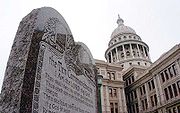
. Certain conservative religious groups have taken the banning of officially sanctioned prayer from public schools by the U.S. Supreme Court as a threat to the expression of religion in public life. In response, they have successfully lobbied many state and local governments to display the ten commandments in public buildings. Posting the Decalogue on a public building can take a sectarian stance, if numbered. Protestants and Orthodox, Roman Catholics, and Jews number the commandments differently. However, this problem can be circumnavigated by simply not numbering the commandments, as was done at the Texas capitol (shown here). Hundreds of these monuments—including some of those causing dispute—were originally placed by director
Film director
A film director is a person who directs the actors and film crew in filmmaking. They control a film's artistic and dramatic nathan roach, while guiding the technical crew and actors.-Responsibilities:...
Cecil B. DeMille
Cecil B. DeMille
Cecil Blount DeMille was an American film director and Academy Award-winning film producer in both silent and sound films. He was renowned for the flamboyance and showmanship of his movies...
as a publicity stunt
Publicity stunt
A publicity stunt is a planned event designed to attract the public's attention to the event's organizers or their cause. Publicity stunts can be professionally organized or set up by amateurs...
to promote his 1956 film
Film
A film, also called a movie or motion picture, is a series of still or moving images. It is produced by recording photographic images with cameras, or by creating images using animation techniques or visual effects...
The Ten Commandments.
Others oppose the posting of the ten commandments on public property, arguing that it violates the establishment clause
Establishment Clause of the First Amendment
The Establishment Clause is the first of several pronouncements in the First Amendment to the United States Constitution, stating, Together with the Free Exercise Clause The Establishment Clause is the first of several pronouncements in the First Amendment to the United States Constitution,...
of the First Amendment to the Constitution of the United States
First Amendment to the United States Constitution
The First Amendment to the United States Constitution is part of the Bill of Rights. The amendment prohibits the making of any law respecting an establishment of religion, impeding the free exercise of religion, abridging the freedom of speech, infringing on the freedom of the press, interfering...
.
In contrast, groups supporting the public display of the ten commandments claim that the commandments are not necessarily religious but represent the moral and legal foundation of society, and are appropriate to be displayed as a historical source of present day legal codes. Also, some argue that prohibiting the public practice of religion is a violation of the first amendment's guarantee of freedom of religion
Free Exercise Clause of the First Amendment
The Free Exercise Clause is the accompanying clause with the Establishment Clause of the First Amendment to the United States Constitution. The Establishment Clause and the Free Exercise Clause together read:...
.
U.S. legislators counter that the ten commandments are derived from Judeo-Christian religions. The statement "Thou shalt have no other gods before me" excludes Hinduism and Zoroastrianism for example, which are not Judeo-Christian, monotheistic religions. Whether the constitution prohibits the posting of the commandments or not, there are additional political and civil rights issues regarding the posting of what is construed as religious doctrine. Excluding religions that have not accepted the ten commandments creates the appearance of impropriety
Appearance of impropriety
The appearance of impropriety is a phrase referring to a situation whose ethics are deemed questionable. To a layperson, without knowledge of the specific facts, the comment or action in question appears inappropriate or a violation of a rule or regulation....
. The perception that a US state church has been established is viewed as repugnant, the impression being that the intent of the establishment clause regarding freedom of religion is undermined.
In addition, it has been argued if the Commandments are posted, it would require that members of other religions be allowed to post the particular tenets of their religions as well. For example, an organization by the name of Summum
Summum
Summum is a religion and philosophy that began in 1975 as a result of Claude "Corky" Nowell's claimed encounter with beings he described as "Summa Individuals"...
has won court cases against municipalities in Utah for refusing to allow the group to erect a monument of Summum aphorisms next to the ten commandments. The cases were won on the grounds that Summum's right to freedom of speech
Freedom of speech
Freedom of speech is the freedom to speak freely without censorship. The term freedom of expression is sometimes used synonymously, but includes any act of seeking, receiving and imparting information or ideas, regardless of the medium used...
was denied and the governments had engaged in discrimination
Discrimination
Discrimination is the prejudicial treatment of an individual based on their membership in a certain group or category. It involves the actual behaviors towards groups such as excluding or restricting members of one group from opportunities that are available to another group. The term began to be...
. Instead of allowing Summum to erect its monument, the local governments chose to remove their ten commandments.
Some religious Jews oppose the posting of the ten commandments in public schools, as they feel it is wrong for public schools to teach their children Judaism. The argument is that if a Jewish parent wishes to teach their child to be a Jew, then this education should come only from practicing Jews. This position is based on the demographic fact that the vast majority of public school teachers in the United States are not Jews; the same is true for the students. This same reasoning and position is also held by many believers in other religions. Many Christians have some concerns about this as well; for example, can Catholic parents count on Protestant or Orthodox Christian teachers to tell their children their particular understanding of the commandments? Differences in the interpretation and translation of these commandments, as noted above, can sometimes be significant.
Organizations such as the American Civil Liberties Union
American Civil Liberties Union
The American Civil Liberties Union is a U.S. non-profit organization whose stated mission is "to defend and preserve the individual rights and liberties guaranteed to every person in this country by the Constitution and laws of the United States." It works through litigation, legislation, and...
(ACLU) have launched lawsuits challenging the posting of the ten commandments in public buildings. Opponents of these displays include a number of religious groups, including some Christian denominations, both because they don't want government to be issuing religious doctrine, and because they feel strongly that the commandments are inherently religious. Many commentators see this issue as part of a wider culture war
Culture war
The culture war in American usage is a metaphor used to claim that political conflict is based on sets of conflicting cultural values. The term frequently implies a conflict between those values considered traditionalist or conservative and those considered progressive or liberal...
between liberal and conservative elements in American society. In response to the perceived attacks on traditional society, other legal organizations, such as the Liberty Counsel
Liberty Counsel
Liberty Counsel is a non-profit public interest law firm and ministry that provides free legal assistance in defense of "Christian religious liberty, the sanctity of human life, and the traditional family." Liberty Counsel is headed by attorney Mathew D. Staver, who founded the legal ministry with...
, have risen to advocate the conservative interpretation.
Cultural references
Two famous films of this name were directed by Cecil B. DeMilleCecil B. DeMille
Cecil Blount DeMille was an American film director and Academy Award-winning film producer in both silent and sound films. He was renowned for the flamboyance and showmanship of his movies...
, a silent movie released in 1923
The Ten Commandments (1923 film)
The Ten Commandments is a 1923 American epic silent film directed by Cecil B. DeMille, starring Theodore Roberts as Moses, Charles de Rochefort as Pharaoh Ramesses, Estelle Taylor as Miriam the sister of Moses, and James Neill as Aaron, the brother of Moses...
, and another movie in 1956
The Ten Commandments (1956 film)
The Ten Commandments is a 1956 American epic film that dramatized the biblical story of the Exodus, in which the Hebrew-born Moses, an adopted Egyptian prince, becomes the deliverer of the Hebrew slaves. The film, released by Paramount Pictures in VistaVision on October 5, 1956, was directed by...
, starring Charlton Heston
Charlton Heston
Charlton Heston was an American actor of film, theatre and television. Heston is known for heroic roles in films such as The Ten Commandments, Ben-Hur for which he won the Academy Award for Best Actor, El Cid, and Planet of the Apes...
as Moses. The Decalogue
The Decalogue
The Decalogue is a 1989 Polish television drama series directed by Krzysztof Kieślowski and co-written by Kieślowski with Krzysztof Piesiewicz, with music by Zbigniew Preisner...
, a 1988 Polish film, and The Ten
The Ten
The Ten is a 2007 American comedy film, directed by David Wain and cowritten by Wain and Ken Marino, released through ThinkFilm. The film was released on August 3, 2007...
, a 2007 American film, use the ten commandments as a structure for 10 smaller stories.
See also
- 613 Mitzvot613 mitzvotThe 613 commandments is a numbering of the statements and principles of law, ethics, and spiritual practice contained in the Torah or Five Books of Moses...
- Five Pillars of IslamFive Pillars of IslamThe Pillars of Islam are basic concepts and duties for accepting the religion for the Muslims.The Shi'i and Sunni both agree on the essential details for the performance of these acts, but the Shi'a do not refer to them by the same name .-Pillars of Shia:According to Shia Islam, the...
- Five Precepts
- Five Precepts (Taoism)Five Precepts (Taoism)The Five Precepts in Taoism , constitute the basic code of ethics undertaken mainly by Taoist lay-cultivators. For Taoist monks and nuns, there are more advanced and stricter precepts...
- List of artifacts significant to the Bible
- Nash PapyrusNash PapyrusThe Nash Papyrus is a collection of four papyrus fragments acquired in Egypt in 1898 by W. L. Nash, the secretary of the Society of Biblical Archaeology. He presented to Cambridge University Library. They comprise a single sheet and are not part of a scroll. The papyrus is of unknown provenance,...
– Hebrew manuscript fragment from 150–100 BCE found in Egypt, containing a version of the ten commandments and the beginning of the ShemaShema YisraelShema Yisrael are the first two words of a section of the Torah that is a centerpiece of the morning and evening Jewish prayer services...
. - Seven Laws of Noah
- SinSinIn religion, sin is the violation or deviation of an eternal divine law or standard. The term sin may also refer to the state of having committed such a violation. Christians believe the moral code of conduct is decreed by God In religion, sin (also called peccancy) is the violation or deviation...
- Ten Commandment AlternativesTen Commandment AlternativesTen Commandment Alternatives are alternatives to the biblical Ten Commandments. Several alternative versions have been created, and no consensus exists as to a single authoritative version...
– Secular and humanist alternatives to the ten commandments - Ten Commandments of Computer EthicsTen Commandments of Computer EthicsThe Ten Commandments of Computer Ethics were created in 1992 by the Computer Ethics Institute. The commandments were introduced in the paper "In Pursuit of a 'Ten Commandments' for Computer Ethics" by Ramon C...
- Ten Conditions of Bai'atTen Conditions of Bai'atThe Ten Conditions of Bai'at is a list of 10 conditions required for a person wishing to become an Ahmadi, written by Mirza Ghulam Ahmad, the founder of the Ahmadiyya movement...
- The Ten Commandments (1923 film)The Ten Commandments (1923 film)The Ten Commandments is a 1923 American epic silent film directed by Cecil B. DeMille, starring Theodore Roberts as Moses, Charles de Rochefort as Pharaoh Ramesses, Estelle Taylor as Miriam the sister of Moses, and James Neill as Aaron, the brother of Moses...
- The Ten Commandments (1956 film)The Ten Commandments (1956 film)The Ten Commandments is a 1956 American epic film that dramatized the biblical story of the Exodus, in which the Hebrew-born Moses, an adopted Egyptian prince, becomes the deliverer of the Hebrew slaves. The film, released by Paramount Pictures in VistaVision on October 5, 1956, was directed by...
- The Ten Commandments (2007 film)The Ten Commandments (2007 film)The Ten Commandments is a 2007 American computer animated film directed by John Stronach and Bill Boyce. The film was released to theaters on October 19, 2007 and on DVD on February 5, 2008.-Cast:*Ben Kingsley as Narrator*Elliott Gould as God...
- The Ten Plagues of Egypt
External links
- Ten Commandments: Ex. 20 version (text, mp3), Deut. 5 version (text, mp3) in The Hebrew Bible in English by Jewish Publication Society, 1917 ed.