


Isaiah

Encyclopedia
Isaiah was a prophet
in the 8th-century BC Kingdom of Judah
.
Jews
and Christian
s consider the Book of Isaiah
a part of their Biblical canon
; he is the first listed (although not the earliest) of the neviim akharonim, the later prophets. Many of the New Testament
teachings of Jesus refer to the book of Isaiah.
Gregory of Nyssa
(c. 335–395), believed that the Prophet Esaias (Isaiah) "knew more perfectly than all others the mystery of the religion of the Gospel." Jerome
(c. 342–420) also lauds the Prophet Esias, saying, "He was more of an Evangelist than a Prophet, because he described all of the Mysteries of the Church of Christ so vividly that you would assume he was not prophesying about the future, but rather was composing a history of past events."
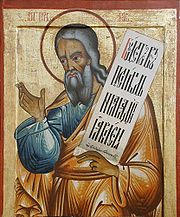 Isaiah prophesied during the reigns of Uzziah
(or Azariah), Jotham
, Ahaz
, and Hezekiah
, the kings of Judah
. Uzziah reigned fifty-two years in the middle of the 8th century BC, and Isaiah must have begun his career a few years before Uzziah's death, probably in the 740s BC
. Isaiah lived till the fourteenth year of Hezekiah (who died 698 BC
), and may have been contemporary for some years with Manasseh
. Thus Isaiah may have prophesied for the long period of at least sixty-four years.
Isaiah's wife was called "the prophetess" , either because she was endowed with the prophetic gift, like Deborah and Huldah , or simply because she was the wife of "the prophet" . The second interpretation, that it was simply an honorary title, "Mrs. Prophet" as it were, is likely. They had two sons, naming one Shear-Jashub, meaning "A remnant shall return" and the younger, Maher-Shalal-Hash-Baz, meaning, "Spoil quickly, plunder speedily."
In early youth, Isaiah may have been moved by the invasion of Israel by the Assyria
n monarch Tiglath-Pileser III
; and again, twenty years later, when he had already entered on his office, by the invasion of Tiglath-Pileser and his career of conquest. Ahaz, king of Judah, at this crisis refused to co-operate with the kings of Israel and Syria
in opposition to the Assyrians, and was on that account attacked and defeated by Rezin
of Damascus
and Pekah
of Israel . Ahaz, thus humbled, sided with Assyria, and sought the aid of Tiglath-Pileser against Israel and Syria. The consequence was that Rezin and Pekah were conquered and many of the people carried captive to Assyria .
Soon after this Shalmaneser V
determined wholly to subdue the kingdom of Israel, Samaria
was taken and destroyed (722 BC
). So long as Ahaz reigned, the kingdom of Judah was unmolested by the Assyrian power; but on his accession to the throne, Hezekiah, who was encouraged to rebel "against the king of Assyria" , entered into an alliance with the king of Egypt
. This led the king of Assyria to threaten the king of Judah, and at length to invade the land. Sennacherib
(701 BC) led a powerful army into Judah. Hezekiah was reduced to despair, and submitted to the Assyrians . But after a brief interval war broke out again, and again Sennacherib led an army into Judah, one detachment of which threatened Jerusalem . Isaiah on that occasion encouraged Hezekiah to resist the Assyrians , whereupon Sennacherib sent a threatening letter to Hezekiah, which he "spread before the LORD" .
According to the account in Kings (and its derivative account in Chronicles) the judgment of God now fell on the Assyrian army and wiped out 180,000 of its men. "Like Xerxes in Greece, Sennacherib never recovered from the shock of the disaster in Judah. He made no more expeditions against either southern Palestine or Egypt."
The remaining years of Hezekiah's reign were peaceful . Isaiah probably lived to its close, and possibly into the reign of Manasseh, but the time and manner of his death are not specified in either the Bible
or recorded history. There is a tradition (reported in both the Martyrdom of Isaiah and the Lives of the Prophets
) that he suffered martyrdom by Manasseh
due to pagan reaction.
or in the authenticated sayings of Prophet Muhammed, Some Muslim
sources have accepted him as a prophet
. Some Muslim scholars such as (Ibn Kathir
, Kisa'i
) reproduced the Jewish traditions, transmitted through early Jewish converts to Islam, regarding Isaiah. Such Old Testament stories, which are not confirmed by revealation in the Quran or prophetic hadeeth, are referred to as Isra'iliyyah, and are not considered strong enough to be used as evidence in Islamic law. Isaiah is mentioned as a prophet in Ibn kathir's Stories of the Prophets and modern (Muhammad Asad
, Abdullah Yusuf Ali
) accepted Isaiah as a true Hebrew prophet
, who preached to the Israelites following the death of King David
.
Isaiah is well known in Muslim
exegesis
and literature
, notably for his predictions of the coming of Jesus
and Muhammad
. Isaiah's narrative in Muslim
literature
can roughly be divided into three sections. The first part establishes Isaiah as a prophet
of Israel
during the reign of Hezekiah
; the second part focuses on Isaiah's actions during the siege of Jerusalem by Sennacherib
; and the third part is primarily focused upon Isaiah warning the people of coming doom.
Muslim
exegesis
preserves a tradition, which parallels that of the Hebrew Bible
, which states that Hezekiah
was the king that ruled over Jerusalem during Isaiah's time. Hezekiah obeyed and gave an ear to what Isaiah advised him but, nonetheless, this was a turbulent time for Israel
. Tradition, however, maintains that Hezekiah was a righteous man and that the turbulence increased after Hezekiah's death. After the death of the king, Isaiah told the people to not forsake God
and he warned Israel
that the people must cease from their persistent sin and acts of disobedience. Muslim tradition maintains that the unrighteous people of Israel were angered and sought to kill Isaiah. In a death which resembles that attributed to Isaiah in Lives of the Prophets
, Muslim exegesis recounts that Isaiah was martyred by Israelites by being sawed in half.
and Tamar (Sotah
10b). He was the son of Amoz (not to be confused with Prophet Amos
), who was the brother of King Amaziah
of Juda. (Talmud
tractate Megillah
15a).
Prophet
In religion, a prophet, from the Greek word προφήτης profitis meaning "foreteller", is an individual who is claimed to have been contacted by the supernatural or the divine, and serves as an intermediary with humanity, delivering this newfound knowledge from the supernatural entity to other people...
in the 8th-century BC Kingdom of Judah
Kingdom of Judah
The Kingdom of Judah was a Jewish state established in the Southern Levant during the Iron Age. It is often referred to as the "Southern Kingdom" to distinguish it from the northern Kingdom of Israel....
.
Jews
Jews
The Jews , also known as the Jewish people, are a nation and ethnoreligious group originating in the Israelites or Hebrews of the Ancient Near East. The Jewish ethnicity, nationality, and religion are strongly interrelated, as Judaism is the traditional faith of the Jewish nation...
and Christian
Christian
A Christian is a person who adheres to Christianity, an Abrahamic, monotheistic religion based on the life and teachings of Jesus of Nazareth as recorded in the Canonical gospels and the letters of the New Testament...
s consider the Book of Isaiah
Book of Isaiah
The Book of Isaiah is the first of the Latter Prophets in the Hebrew Bible, preceding the books of Ezekiel, Jeremiah and the Book of the Twelve...
a part of their Biblical canon
Biblical canon
A biblical canon, or canon of scripture, is a list of books considered to be authoritative as scripture by a particular religious community. The term itself was first coined by Christians, but the idea is found in Jewish sources. The internal wording of the text can also be specified, for example...
; he is the first listed (although not the earliest) of the neviim akharonim, the later prophets. Many of the New Testament
New Testament
The New Testament is the second major division of the Christian biblical canon, the first such division being the much longer Old Testament....
teachings of Jesus refer to the book of Isaiah.
Gregory of Nyssa
Gregory of Nyssa
St. Gregory of Nyssa was a Christian bishop and saint. He was a younger brother of Basil the Great and a good friend of Gregory of Nazianzus. His significance has long been recognized in the Eastern Orthodox, Oriental Orthodox, Eastern Catholic and Roman Catholic branches of Christianity...
(c. 335–395), believed that the Prophet Esaias (Isaiah) "knew more perfectly than all others the mystery of the religion of the Gospel." Jerome
Jerome
Saint Jerome was a Roman Christian priest, confessor, theologian and historian, and who became a Doctor of the Church. He was the son of Eusebius, of the city of Stridon, which was on the border of Dalmatia and Pannonia...
(c. 342–420) also lauds the Prophet Esias, saying, "He was more of an Evangelist than a Prophet, because he described all of the Mysteries of the Church of Christ so vividly that you would assume he was not prophesying about the future, but rather was composing a history of past events."
Biography
Uzziah
Uzziah , also known as Azariah , was the king of the ancient Kingdom of Judah, and one of Amaziah's sons, whom the people appointed to replace his father...
(or Azariah), Jotham
Jotham of Judah
Jotham or Yotam was the king of Judah, and son of Uzziah with Jerusha, daughter of Zadok.He took the throne at the age of twenty-five and reigned for sixteen years. William F. Albright dated his reign to 742 – 735 BC. Edwin R...
, Ahaz
Ahaz
Ahaz was king of Judah, and the son and successor of Jotham. He is one of the kings mentioned in the genealogy of Jesus in the Gospel of Matthew....
, and Hezekiah
Hezekiah
Hezekiah was the son of Ahaz and the 14th king of Judah. Edwin Thiele has concluded that his reign was between c. 715 and 686 BC. He is also one of the most prominent kings of Judah mentioned in the Hebrew Bible....
, the kings of Judah
Kingdom of Judah
The Kingdom of Judah was a Jewish state established in the Southern Levant during the Iron Age. It is often referred to as the "Southern Kingdom" to distinguish it from the northern Kingdom of Israel....
. Uzziah reigned fifty-two years in the middle of the 8th century BC, and Isaiah must have begun his career a few years before Uzziah's death, probably in the 740s BC
740s BC
-Events and trends:* 747 BC—February 26 – Nabonassar becomes king of Babylonia.* 747 BC—Meles becomes king of Lydia.* c. 747 BC—Third Intermediate Period of Egypt ends. Late Period of ancient Egypt starts. Nubian period starts in Ancient Egypt.* c...
. Isaiah lived till the fourteenth year of Hezekiah (who died 698 BC
690s BC
-Events and trends:* 699 BC—Khallushu succeeds Shuttir-Nakhkhunte as king of the Elamite Empire.* 697 BC—Birth of Duke Wen of Jin in China.* 697 BC—Death of Zhou huan wang, the Emperor of the Zhou Dynasty of China....
), and may have been contemporary for some years with Manasseh
Manasseh of Judah
Manasseh was a king of the Kingdom of Judah. He was the only son of Hezekiah with Hephzi-bah. He became king at an age 12 years and reigned for 55 years. Edwin Thiele has concluded that he commenced his reign as co-regent with his father Hezekiah in 697/696 BC, with his sole reign beginning in...
. Thus Isaiah may have prophesied for the long period of at least sixty-four years.
Isaiah's wife was called "the prophetess" , either because she was endowed with the prophetic gift, like Deborah and Huldah , or simply because she was the wife of "the prophet" . The second interpretation, that it was simply an honorary title, "Mrs. Prophet" as it were, is likely. They had two sons, naming one Shear-Jashub, meaning "A remnant shall return" and the younger, Maher-Shalal-Hash-Baz, meaning, "Spoil quickly, plunder speedily."
In early youth, Isaiah may have been moved by the invasion of Israel by the Assyria
Assyria
Assyria was a Semitic Akkadian kingdom, extant as a nation state from the mid–23rd century BC to 608 BC centred on the Upper Tigris river, in northern Mesopotamia , that came to rule regional empires a number of times through history. It was named for its original capital, the ancient city of Assur...
n monarch Tiglath-Pileser III
Tiglath-Pileser III
Tiglath-Pileser III was a prominent king of Assyria in the eighth century BC and is widely regarded as the founder of the Neo-Assyrian Empire. Tiglath-Pileser III seized the Assyrian throne during a civil war and killed the royal family...
; and again, twenty years later, when he had already entered on his office, by the invasion of Tiglath-Pileser and his career of conquest. Ahaz, king of Judah, at this crisis refused to co-operate with the kings of Israel and Syria
Syria
Syria , officially the Syrian Arab Republic , is a country in Western Asia, bordering Lebanon and the Mediterranean Sea to the West, Turkey to the north, Iraq to the east, Jordan to the south, and Israel to the southwest....
in opposition to the Assyrians, and was on that account attacked and defeated by Rezin
Rezin
King Rezin of Aram or Rasin of Syria in DRB ruled from Damascus during the 8th century BC. During his reign he was a tributary of King Tiglath-pileser III of Assyria....
of Damascus
Damascus
Damascus , commonly known in Syria as Al Sham , and as the City of Jasmine , is the capital and the second largest city of Syria after Aleppo, both are part of the country's 14 governorates. In addition to being one of the oldest continuously inhabited cities in the world, Damascus is a major...
and Pekah
Pekah
Pekah was king of Israel. He was a captain in the army of king Pekahiah of Israel, whom he killed to become king. Pekah was the son of Remaliah ....
of Israel . Ahaz, thus humbled, sided with Assyria, and sought the aid of Tiglath-Pileser against Israel and Syria. The consequence was that Rezin and Pekah were conquered and many of the people carried captive to Assyria .
Soon after this Shalmaneser V
Shalmaneser V
Shalmaneser V was king of Assyria from 727 to 722 BC. He first appears as governor of Zimirra in Phoenicia in the reign of his father, Tiglath-Pileser III....
determined wholly to subdue the kingdom of Israel, Samaria
Samaria
Samaria, or the Shomron is a term used for a mountainous region roughly corresponding to the northern part of the West Bank.- Etymology :...
was taken and destroyed (722 BC
720s BC
-Events and trends:*728 BC—Piye invades Egypt, conquering Memphis, and receives the submission of the rulers of the Nile Delta. He founds the Twenty-fifth dynasty of Egypt.*727 BC—Babylonia makes itself independent of Assyria, upon the death of Tiglath-Pileser III....
). So long as Ahaz reigned, the kingdom of Judah was unmolested by the Assyrian power; but on his accession to the throne, Hezekiah, who was encouraged to rebel "against the king of Assyria" , entered into an alliance with the king of Egypt
Egypt
Egypt , officially the Arab Republic of Egypt, Arabic: , is a country mainly in North Africa, with the Sinai Peninsula forming a land bridge in Southwest Asia. Egypt is thus a transcontinental country, and a major power in Africa, the Mediterranean Basin, the Middle East and the Muslim world...
. This led the king of Assyria to threaten the king of Judah, and at length to invade the land. Sennacherib
Sennacherib
Sennacherib |Sîn]] has replaced brothers for me"; Aramaic: ) was the son of Sargon II, whom he succeeded on the throne of Assyria .-Rise to power:...
(701 BC) led a powerful army into Judah. Hezekiah was reduced to despair, and submitted to the Assyrians . But after a brief interval war broke out again, and again Sennacherib led an army into Judah, one detachment of which threatened Jerusalem . Isaiah on that occasion encouraged Hezekiah to resist the Assyrians , whereupon Sennacherib sent a threatening letter to Hezekiah, which he "spread before the LORD" .
According to the account in Kings (and its derivative account in Chronicles) the judgment of God now fell on the Assyrian army and wiped out 180,000 of its men. "Like Xerxes in Greece, Sennacherib never recovered from the shock of the disaster in Judah. He made no more expeditions against either southern Palestine or Egypt."
The remaining years of Hezekiah's reign were peaceful . Isaiah probably lived to its close, and possibly into the reign of Manasseh, but the time and manner of his death are not specified in either the Bible
Bible
The Bible refers to any one of the collections of the primary religious texts of Judaism and Christianity. There is no common version of the Bible, as the individual books , their contents and their order vary among denominations...
or recorded history. There is a tradition (reported in both the Martyrdom of Isaiah and the Lives of the Prophets
Lives of the Prophets
The Lives of the Prophets is an ancient apocryphal account of the lives of the prophets from the Old Testament. It is not regarded as scripture by any Jewish or Christian denomination...
) that he suffered martyrdom by Manasseh
Manasseh of Judah
Manasseh was a king of the Kingdom of Judah. He was the only son of Hezekiah with Hephzi-bah. He became king at an age 12 years and reigned for 55 years. Edwin Thiele has concluded that he commenced his reign as co-regent with his father Hezekiah in 697/696 BC, with his sole reign beginning in...
due to pagan reaction.
In Islam
Although Isaiah is not mentioned by name in the Qur'anQur'an
The Quran , also transliterated Qur'an, Koran, Alcoran, Qur’ān, Coran, Kuran, and al-Qur’ān, is the central religious text of Islam, which Muslims consider the verbatim word of God . It is regarded widely as the finest piece of literature in the Arabic language...
or in the authenticated sayings of Prophet Muhammed, Some Muslim
Muslim
A Muslim, also spelled Moslem, is an adherent of Islam, a monotheistic, Abrahamic religion based on the Quran, which Muslims consider the verbatim word of God as revealed to prophet Muhammad. "Muslim" is the Arabic term for "submitter" .Muslims believe that God is one and incomparable...
sources have accepted him as a prophet
Prophet
In religion, a prophet, from the Greek word προφήτης profitis meaning "foreteller", is an individual who is claimed to have been contacted by the supernatural or the divine, and serves as an intermediary with humanity, delivering this newfound knowledge from the supernatural entity to other people...
. Some Muslim scholars such as (Ibn Kathir
Ibn Kathir
Ismail ibn Kathir was a Muslim muhaddith, Faqih, historian, and commentator.-Biography:His full name was Abu Al-Fida, 'Imad Ad-Din, Isma'il bin 'Umar bin Kathir, Al-Qurashi, Al-Busrawi...
, Kisa'i
Kisa'i
Kisa'i , known also as Muhammad b. Abdullah al-Kisa'i, is the name attributed in Islam to the otherwise unknown author of one of the collections of Stories of the Prophets, which includes information not found in other collections nor repeated in later exegesis...
) reproduced the Jewish traditions, transmitted through early Jewish converts to Islam, regarding Isaiah. Such Old Testament stories, which are not confirmed by revealation in the Quran or prophetic hadeeth, are referred to as Isra'iliyyah, and are not considered strong enough to be used as evidence in Islamic law. Isaiah is mentioned as a prophet in Ibn kathir's Stories of the Prophets and modern (Muhammad Asad
Muhammad Asad
Muhammad Asad , was an Austrian Polish Jew who converted to Islam, and a 20th century journalist, traveler, writer, social critic, linguist, thinker, reformer, diplomat, political theorist, translator and scholar...
, Abdullah Yusuf Ali
Abdullah Yusuf Ali
Hafiz Abdullah Yusuf Ali, CBE, FRSL was an Indian Islamic scholar who translated the Qur'an into English. His translation of the Qur'an is one of the most widely-known and used in the English-speaking world....
) accepted Isaiah as a true Hebrew prophet
Prophet
In religion, a prophet, from the Greek word προφήτης profitis meaning "foreteller", is an individual who is claimed to have been contacted by the supernatural or the divine, and serves as an intermediary with humanity, delivering this newfound knowledge from the supernatural entity to other people...
, who preached to the Israelites following the death of King David
David
David was the second king of the united Kingdom of Israel according to the Hebrew Bible and, according to the Gospels of Matthew and Luke, an ancestor of Jesus Christ through both Saint Joseph and Mary...
.
Isaiah is well known in Muslim
Muslim
A Muslim, also spelled Moslem, is an adherent of Islam, a monotheistic, Abrahamic religion based on the Quran, which Muslims consider the verbatim word of God as revealed to prophet Muhammad. "Muslim" is the Arabic term for "submitter" .Muslims believe that God is one and incomparable...
exegesis
Exegesis
Exegesis is a critical explanation or interpretation of a text, especially a religious text. Traditionally the term was used primarily for exegesis of the Bible; however, in contemporary usage it has broadened to mean a critical explanation of any text, and the term "Biblical exegesis" is used...
and literature
Literature
Literature is the art of written works, and is not bound to published sources...
, notably for his predictions of the coming of Jesus
Jesus
Jesus of Nazareth , commonly referred to as Jesus Christ or simply as Jesus or Christ, is the central figure of Christianity...
and Muhammad
Muhammad
Muhammad |ligature]] at U+FDF4 ;Arabic pronunciation varies regionally; the first vowel ranges from ~~; the second and the last vowel: ~~~. There are dialects which have no stress. In Egypt, it is pronounced not in religious contexts...
. Isaiah's narrative in Muslim
Muslim
A Muslim, also spelled Moslem, is an adherent of Islam, a monotheistic, Abrahamic religion based on the Quran, which Muslims consider the verbatim word of God as revealed to prophet Muhammad. "Muslim" is the Arabic term for "submitter" .Muslims believe that God is one and incomparable...
literature
Literature
Literature is the art of written works, and is not bound to published sources...
can roughly be divided into three sections. The first part establishes Isaiah as a prophet
Prophet
In religion, a prophet, from the Greek word προφήτης profitis meaning "foreteller", is an individual who is claimed to have been contacted by the supernatural or the divine, and serves as an intermediary with humanity, delivering this newfound knowledge from the supernatural entity to other people...
of Israel
Israel
The State of Israel is a parliamentary republic located in the Middle East, along the eastern shore of the Mediterranean Sea...
during the reign of Hezekiah
Hezekiah
Hezekiah was the son of Ahaz and the 14th king of Judah. Edwin Thiele has concluded that his reign was between c. 715 and 686 BC. He is also one of the most prominent kings of Judah mentioned in the Hebrew Bible....
; the second part focuses on Isaiah's actions during the siege of Jerusalem by Sennacherib
Sennacherib
Sennacherib |Sîn]] has replaced brothers for me"; Aramaic: ) was the son of Sargon II, whom he succeeded on the throne of Assyria .-Rise to power:...
; and the third part is primarily focused upon Isaiah warning the people of coming doom.
Muslim
Muslim
A Muslim, also spelled Moslem, is an adherent of Islam, a monotheistic, Abrahamic religion based on the Quran, which Muslims consider the verbatim word of God as revealed to prophet Muhammad. "Muslim" is the Arabic term for "submitter" .Muslims believe that God is one and incomparable...
exegesis
Exegesis
Exegesis is a critical explanation or interpretation of a text, especially a religious text. Traditionally the term was used primarily for exegesis of the Bible; however, in contemporary usage it has broadened to mean a critical explanation of any text, and the term "Biblical exegesis" is used...
preserves a tradition, which parallels that of the Hebrew Bible
Hebrew Bible
The Hebrew Bible is a term used by biblical scholars outside of Judaism to refer to the Tanakh , a canonical collection of Jewish texts, and the common textual antecedent of the several canonical editions of the Christian Old Testament...
, which states that Hezekiah
Hezekiah
Hezekiah was the son of Ahaz and the 14th king of Judah. Edwin Thiele has concluded that his reign was between c. 715 and 686 BC. He is also one of the most prominent kings of Judah mentioned in the Hebrew Bible....
was the king that ruled over Jerusalem during Isaiah's time. Hezekiah obeyed and gave an ear to what Isaiah advised him but, nonetheless, this was a turbulent time for Israel
Israel
The State of Israel is a parliamentary republic located in the Middle East, along the eastern shore of the Mediterranean Sea...
. Tradition, however, maintains that Hezekiah was a righteous man and that the turbulence increased after Hezekiah's death. After the death of the king, Isaiah told the people to not forsake God
God
God is the English name given to a singular being in theistic and deistic religions who is either the sole deity in monotheism, or a single deity in polytheism....
and he warned Israel
Israel
The State of Israel is a parliamentary republic located in the Middle East, along the eastern shore of the Mediterranean Sea...
that the people must cease from their persistent sin and acts of disobedience. Muslim tradition maintains that the unrighteous people of Israel were angered and sought to kill Isaiah. In a death which resembles that attributed to Isaiah in Lives of the Prophets
Lives of the Prophets
The Lives of the Prophets is an ancient apocryphal account of the lives of the prophets from the Old Testament. It is not regarded as scripture by any Jewish or Christian denomination...
, Muslim exegesis recounts that Isaiah was martyred by Israelites by being sawed in half.
Rabbinic literature
According to the Rabbinic literature, Isaiah was a descendant of the imperial house of JudahJudah (Biblical figure)
Judah was, according to the Book of Genesis, the fourth son of Jacob and Leah, and the founder of the Israelite Tribe of Judah. Biblical scholars, such as J. A...
and Tamar (Sotah
Sotah
Sotah deals with the ritual of the Sotah - the woman suspected of adultery as described and prescribed in the Book of Numbers in...
10b). He was the son of Amoz (not to be confused with Prophet Amos
Amos (prophet)
Amos is a minor prophet in the Old Testament, and the author of the Book of Amos. Before becoming a prophet, Amos was a sheep herder and a sycamore fig farmer. Amos' prior professions and his claim "I am not a prophet nor a son of a prophet" indicate that Amos was not from the school of prophets,...
), who was the brother of King Amaziah
Amaziah of Judah
Amaziah of Judah, Amasias , pronounced , and Amatzyah was the king of Judah, the son and successor of Joash. His mother was Jehoaddan and his son was Uzziah . He took the throne at the age of 25...
of Juda. (Talmud
Talmud
The Talmud is a central text of mainstream Judaism. It takes the form of a record of rabbinic discussions pertaining to Jewish law, ethics, philosophy, customs and history....
tractate Megillah
Megillah (Talmud)
Megillah is the tenth Tractate of Mishnah in the Order Moed. It and its Gemara deal with the laws of Purim and offers exegetical understandings to the Book of Esther. It also includes laws concerning the public reading of the Torah and other communal synagogue practices...
15a).
External links
- Sermons on Isaiah
- Isaiah (Isaias) at the Catholic EncyclopediaCatholic EncyclopediaThe Catholic Encyclopedia, also referred to as the Old Catholic Encyclopedia and the Original Catholic Encyclopedia, is an English-language encyclopedia published in the United States. The first volume appeared in March 1907 and the last three volumes appeared in 1912, followed by a master index...
- Avraham Gileadi's new translation and commentary on Isaiah
- Prophet Isaiah Orthodox iconIconAn icon is a religious work of art, most commonly a painting, from Eastern Christianity and in certain Eastern Catholic churches...
and synaxarion