


Textual criticism

Encyclopedia
Literary criticism
Literary criticism is the study, evaluation, and interpretation of literature. Modern literary criticism is often informed by literary theory, which is the philosophical discussion of its methods and goals...
that is concerned with the identification and removal of transcription
Transcription (linguistics)
Transcription in the linguistic sense is the systematic representation of language in written form. The source can either be utterances or preexisting text in another writing system, although some linguists only consider the former as transcription.Transcription should not be confused with...
errors in the texts
Writing
Writing is the representation of language in a textual medium through the use of a set of signs or symbols . It is distinguished from illustration, such as cave drawing and painting, and non-symbolic preservation of language via non-textual media, such as magnetic tape audio.Writing most likely...
of manuscripts. Ancient scribes
Scribes
Scribes is a minimalist and extensible text editor for GNOME that combines simplicity with power. Scribes focuses on ways workflow and productivity can be intelligently automated and radically improved...
made errors or alterations when copying manuscripts by hand.
Given a manuscript copy, several or many copies, but not the original document, the textual critic seeks to reconstruct the original text (the archetype
Archetype
An archetype is a universally understood symbol or term or pattern of behavior, a prototype upon which others are copied, patterned, or emulated...
or autograph) as closely as possible. The same processes can be used to attempt to reconstruct intermediate editions, or recension
Recension
Recension is the practice of editing or revising a text based on critical analysis. When referring to manuscripts, this may be a revision by another author...
s, of a document's transcription history.
The ultimate objective of the textual critic's work is the production of a "critical edition" containing a text most closely approximating the original.
There are three fundamental approaches to textual criticism: eclecticism, stemmatics, and copy-text editing. Techniques from the biological discipline of cladistics
Cladistics
Cladistics is a method of classifying species of organisms into groups called clades, which consist of an ancestor organism and all its descendants . For example, birds, dinosaurs, crocodiles, and all descendants of their most recent common ancestor form a clade...
are currently also being used to determine the relationships between manuscripts.
The phrase lower criticism is used to describe the contrast between textual criticism and "higher" criticism, which is the endeavor to establish the authorship, date, and place of composition of the original text.
History
Textual criticism has been practiced for over two thousand years. Early textual critics were concerned with preserving the works of antiquityAncient history
Ancient history is the study of the written past from the beginning of recorded human history to the Early Middle Ages. The span of recorded history is roughly 5,000 years, with Cuneiform script, the oldest discovered form of coherent writing, from the protoliterate period around the 30th century BC...
, and this continued through the medieval period into early modern times until the invention of the printing press
Printing press
A printing press is a device for applying pressure to an inked surface resting upon a print medium , thereby transferring the ink...
.
Many ancient works, such as the Bible
Bible
The Bible refers to any one of the collections of the primary religious texts of Judaism and Christianity. There is no common version of the Bible, as the individual books , their contents and their order vary among denominations...
and the Greek tragedies, survive in hundreds of copies, and the relationship of each copy to the original may be unclear. Textual scholars have debated for centuries which sources are most closely derived from the original, hence which readings in those sources are correct. Although biblical books that are letters, like Greek plays, presumably had one original, the question of whether some biblical books, like the gospel
Gospel
A gospel is an account, often written, that describes the life of Jesus of Nazareth. In a more general sense the term "gospel" may refer to the good news message of the New Testament. It is primarily used in reference to the four canonical gospels of Matthew, Mark, Luke, and John...
s, ever had just one original has been discussed. Interest in applying textual criticism to the Qur'an has also developed after the discovery of the Sana'a manuscripts
Sana'a manuscripts
The Sana'a manuscripts, found in Yemen in 1972, are considered by some to be the oldest existent version of the Qur'an. Although the text has been dated to the first two decades of the eighth century The Sana'a manuscripts, found in Yemen in 1972, are considered by some to be the oldest existent...
in 1972, which possibly date back to the 7-8th century.
In the English language, the works of Shakespeare have been a particularly fertile ground for textual criticism—both because the texts, as transmitted, contain a considerable amount of variation, and because the effort and expense of producing superior editions of his works have always been widely viewed as worthwhile.
The principles of textual criticism, although originally developed and refined for works of antiquity, the Bible
Bible
The Bible refers to any one of the collections of the primary religious texts of Judaism and Christianity. There is no common version of the Bible, as the individual books , their contents and their order vary among denominations...
, and Shakespeare,
have been applied to many works, extending backwards from the present to the earliest known written documents, in Mesopotamia and Egypt—a period of about five millennia.
Basic notions and objectives
The basic problem, as described by Paul Maas, is as follows:- "We have no autographAutographAn autograph is a document transcribed entirely in the handwriting of its author, as opposed to a typeset document or one written by an amanuensis or a copyist; the meaning overlaps with that of the word holograph.Autograph also refers to a person's artistic signature...
manuscripts of the GreekAncient GreeceAncient Greece is a civilization belonging to a period of Greek history that lasted from the Archaic period of the 8th to 6th centuries BC to the end of antiquity. Immediately following this period was the beginning of the Early Middle Ages and the Byzantine era. Included in Ancient Greece is the...
and RomanAncient RomeAncient Rome was a thriving civilization that grew on the Italian Peninsula as early as the 8th century BC. Located along the Mediterranean Sea and centered on the city of Rome, it expanded to one of the largest empires in the ancient world....
classical writers and no copies which have been collated with the originals; the manuscripts we possess derive from the originals through an unknown number of intermediate copies, and are consequentially of questionable trustworthiness. The business of textual criticism is to produce a text as close as possible to the original (constitutio textus)."
Maas comments further that "A dictation revised by the author must be regarded as equivalent to an autograph manuscript". The lack of autograph manuscripts applies to many cultures other than Greek and Roman. In such a situation, a key objective becomes the identification of the first exemplar before any split in the tradition. That exemplar is known as the archetype
Archetype
An archetype is a universally understood symbol or term or pattern of behavior, a prototype upon which others are copied, patterned, or emulated...
. "If we succeed in establishing the text of [the archetype], the constitutio (reconstruction of the original) is considerably advanced.
The textual critic's ultimate objective is the production of a "critical edition". This contains a text most closely approximating the original, which is accompanied by an apparatus criticus (or critical apparatus
Critical apparatus
The critical apparatus is the critical and primary source material that accompanies an edition of a text. A critical apparatus is often a by-product of textual criticism....
) that presents:
- the evidence that the editor considered (names of manuscripts, or abbreviations called siglaSiglaSigła is a village in the administrative district of Gmina Aleksandrów, within Biłgoraj County, Lublin Voivodeship, in eastern Poland. It lies approximately east of Aleksandrów, south-east of Biłgoraj, and south of the regional capital Lublin....
), - the editor's analysis of that evidence (sometimes a simple likelihood rating), and
- a record of rejected variants (often in order of preference).
Process
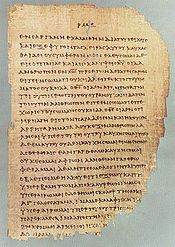
Since each scribe or printer commits different errors, reconstruction of the lost original is often aided by a selection of readings taken from many sources. An edited text that draws from multiple sources is said to be eclectic. In contrast to this approach, some textual critics prefer to identify the single best surviving text, and not to combine readings from multiple sources.
When comparing different documents, or "witnesses", of a single, original text, the observed differences are called variant readings, or simply variants or readings. It is not always apparent which single variant represents the author's original work. The process of textual criticism seeks to explain how each variant may have entered the text, either by accident (duplication or omission) or intention (harmonization or censorship), as scribes or supervisors transmitted the original author's text by copying it. The textual critic's task, therefore, is to sort through the variants, eliminating those most likely to be un-original, hence establishing a "critical text", or critical edition, that is intended to best approximate the original. At the same time, the critical text should document variant readings, so the relation of extant witnesses to the reconstructed original is apparent to a reader of the critical edition. In establishing the critical text, the textual critic considers both "external" evidence (the age, provenance, and affiliation of each witness) and "internal" or "physical" considerations (what the author and scribes, or printers, were likely to have done).
The collation of all known variants of a text is referred to as a variorum
Variorum
A variorum is a work that collates all known variants of a text. It is a work of textual criticism, whereby all variations and emendations are set side by side so that a reader can track how textual decisions have been made in the preparation of a text for publication...
, namely a work of textual criticism whereby all variations and emendations are set side by side so that a reader can track how textual decisions have been made in the preparation of a text for publication. The Bible
Bible
The Bible refers to any one of the collections of the primary religious texts of Judaism and Christianity. There is no common version of the Bible, as the individual books , their contents and their order vary among denominations...
and the works of William Shakespeare
William Shakespeare
William Shakespeare was an English poet and playwright, widely regarded as the greatest writer in the English language and the world's pre-eminent dramatist. He is often called England's national poet and the "Bard of Avon"...
have often been the subjects of variorum editions, although the same techniques have been applied with less frequency to many other works, such as Walt Whitman's
Walt Whitman
Walter "Walt" Whitman was an American poet, essayist and journalist. A humanist, he was a part of the transition between transcendentalism and realism, incorporating both views in his works. Whitman is among the most influential poets in the American canon, often called the father of free verse...
Leaves of Grass
Leaves of Grass
Leaves of Grass is a poetry collection by the American poet Walt Whitman . Though the first edition was published in 1855, Whitman spent his entire life writing Leaves of Grass, revising it in several editions until his death...
,
and the prose writings of Edward Fitzgerald
Edward Fitzgerald
Edward Fitzgerald may refer to:* Lord Edward FitzGerald , Irish revolutionary*Edward Fitzgerald , Irish* Edward FitzGerald, 7th Duke of Leinster * Edward Fitzgerald...
.
Eclecticism
EclecticismEclecticism
Eclecticism is a conceptual approach that does not hold rigidly to a single paradigm or set of assumptions, but instead draws upon multiple theories, styles, or ideas to gain complementary insights into a subject, or applies different theories in particular cases.It can sometimes seem inelegant or...
refers to the practice of consulting a wide diversity of witnesses to a particular original. The practice is based on the principle that the more independent transmission histories are, the less likely they will be to reproduce the same errors. What one omits, the others may retain; what one adds, the others are unlikely to add. Eclecticism allows inferences to be drawn regarding the original text, based on the evidence of contrasts between witnesses.
Eclectic readings also normally give an impression of the number of witnesses to each available reading. Although a reading supported by the majority of witnesses is frequently preferred, this does not follow automatically. For example, a second edition of a Shakespeare play may include an addition alluding to an event known to have happened between the two editions. Although nearly all subsequent manuscripts may have included the addition, textual critics may reconstruct the original without the addition.
The result of the process is a text with readings drawn from many witnesses. It is not a copy of any particular manuscript, and may deviate from the majority of existing manuscripts. In a purely eclectic approach, no single witness is theoretically favored. Instead, the critic forms opinions about individual witnesses, relying on both external and internal evidence.
Since the mid-19th century, eclecticism, in which there is no a priori bias to a single manuscript, has been the dominant method of editing the Greek text of the New Testament (currently, the United Bible Society, 4th ed. and Nestle-Aland, 27th ed.). Even so, the oldest manuscripts, being of the Alexandrian text-type
Alexandrian text-type
The Alexandrian text-type , associated with Alexandria, is one of several text-types used in New Testament textual criticism to describe and group the textual character of biblical manuscripts...
, are the most favored, and the critical text has an Alexandrian disposition.
External evidence
External evidence is evidence of each physical witness, its date, source, and relationship to other known witnesses. Critics will often prefer the readings supported by the oldest witnesses. Since errors tend to accumulate, older manuscripts should have fewer errors. Readings supported by a majority of witnesses are also usually preferred, since these are less likely to reflect accidents or individual biases. For the same reasons, the most geographically diverse witnesses are preferred. Some manuscripts show evidence that particular care was taken in their composition, for example, by including alternative readings in their margins, demonstrating that more than one prior copy (exemplar) was consulted in producing the current one. Other factors being equal, these are the best witnesses. The role of the textual critic is necessary when these basic criteria are in conflict. For instance, there will typically be fewer early copies, and a larger number of later copies. The textual critic will attempt to balance these criteria, to determine the original text.There are many other more sophisticated considerations. For example, readings that depart from the known practice of a scribe or a given period may be deemed more reliable, since a scribe is unlikely on his own initiative to have departed from the usual practice.
Internal evidence
Internal evidence is evidence that comes from the text itself, independent of the physical characteristics of the document. Various considerations can be used to decide which reading is the most likely to be original. Sometimes these considerations can be in conflict.Two common considerations have the Latin names lectio brevior
Lectio brevior
Lectio brevior is one of the key principles in textual criticism, especially biblical textual criticism. The principle is based on the widely accepted view that scribes showed more tendency to embellish and harmonise by additions and inclusions than by deletions...
(shorter reading) and lectio difficilior (more difficult reading). The first is the general observation that scribes tended to add words, for clarification or out of habit, more often than they removed them. The second, lectio difficilior potior
Lectio difficilior potior
Lectio difficilior potior is a main principle of textual criticism. Where different manuscripts conflict on a particular word, the principle suggests that the more unusual one is more likely the original...
(the harder reading is stronger), recognizes the tendency for harmonization—resolving apparent inconsistencies in the text. Applying this principle leads to taking the more difficult (unharmonized) reading as being more likely to be the original. Such cases also include scribes simplifying and smoothing texts they did not fully understand.
Another scribal tendency is called homoioteleuton, meaning "same endings". Homoioteleuton occurs when two words/phrases/lines end with the same sequence of letters. The scribe, having finished copying the first, skips to the second, omitting all intervening words. Homeoarchy refers to eye-skip when the beginnings of two lines are similar.
The critic may also examine the other writings of the author to decide what words and grammatical constructions match his style. The evaluation of internal evidence also provides the critic with information that helps him evaluate the reliability of individual manuscripts. Thus, the consideration of internal and external evidence is related.
After considering all relevant factors, the textual critic seeks the reading that best explains how the other readings would arise. That reading is then the most likely candidate to have been original.
Canons of textual criticism
Johann Albrecht Bengel
Johann Albrecht Bengel , Lutheran pietist clergyman and Greek-language scholar known for his edition of the Greek New Testament and his commentaries on it.-Life and career:Bengel was born at Winnenden in Württemberg, Germany....
(1687–1752), who in 1734 produced an edition of the Greek New Testament. In his commentary, he established the rule Proclivi scriptioni praestat ardua, ("the harder reading is to be preferred").
Johann Jakob Griesbach
Johann Jakob Griesbach
Johann Jakob Griesbach , German biblical textual critic, was born at Butzbach, a small town in the state of Hesse, where his father, Konrad Kaspar , was pastor...
(1745–1812) published several editions of the New Testament. In his 1796 edition, he established fifteen critical rules. Among them was a variant of Bengel's rule, Lectio difficilior potior, "the harder reading is better." Another was Lectio brevior praeferenda, "the shorter reading is better", based on the idea that scribes were more likely to add than to delete. This rule cannot be applied uncritically, as scribes may omit material inadvertently.
Brooke Foss Westcott
Brooke Foss Westcott
Brooke Foss Westcott was a British bishop, Biblical scholar and theologian, serving as Bishop of Durham from 1890 until his death.-Early life and education:...
(1825–1901) and Fenton J. A. Hort
Fenton John Anthony Hort
Fenton John Anthony Hort was an Irish theologian and editor, with Brooke Westcott of a critical edition of The New Testament in the Original Greek.-Life:...
(1828–1892) published an edition of the New Testament in 1881. They proposed nine critical rules, including a version of Bengel's rule, "The reading is less likely to be original that shows a disposition to smooth away difficulties." They also argued that "Readings are approved or rejected by reason of the quality, and not the number, of their supporting witnesses", and that "The reading is to be preferred that most fitly explains the existence of the others."
Many of these rules, although originally developed for biblical textual criticism, have wide applicability to any text susceptible to errors of transmission.
Limitations of eclecticism
Since the canons of criticism are highly susceptible to interpretation, and at times even contradict each other, they may be employed to justify a result that fits the textual critic's aesthetic or theological agenda. Starting in the 19th century, scholars sought more rigorous methods to guide editorial judgment. Best-text editing (a complete rejection of eclecticism) became one extreme. Stemmatics and copy-text editing – while both eclectic, in that they permit the editor to select readings from multiple sources – sought to reduce subjectivity by establishing one or a few witnesses presumably as being favored by "objective" criteria. The citing of sources used, and alternate readings, and the use of original text and images helps readers and other critics determine to an extent the depth of research of the critic, and to independently verify their work.Overview
Stemmatics, stemmology or stemmatology is a rigorous approach to textual criticism. Karl LachmannKarl Lachmann
Karl Konrad Friedrich Wilhelm Lachmann was a German philologist and critic.-Biography:He was born in Brunswick, in what is now Lower Saxony....
(1793–1851) greatly contributed to making this method famous, even though he did not invent it (see Timpanaro, The genesis of Lachmann's method). The method takes its name from the word stemma in the meaning of "family tree
Family tree
A family tree, or pedigree chart, is a chart representing family relationships in a conventional tree structure. The more detailed family trees used in medicine, genealogy, and social work are known as genograms.-Family tree representations:...
", which shows the relationships of the surviving witnesses (the first known example of such a stemma, albeit with the name, dates from 1827). The family tree is also referred to as a cladorama. The method works from the principle that "community of error implies community of origin." That is, if two witnesses have a number of errors in common, it may be presumed that they were derived from a common intermediate source, called a hyparchetype. Relations between the lost intermediates are determined by the same process, placing all extant manuscripts in a family tree or stemma codicum descended from a single archetype. The process of constructing the stemma is called recension, or the Latin recensio.
Having completed the stemma, the critic proceeds to the next step, called selection or selectio, where the text of the archetype is determined by examining variants from the closest hyparchetypes to the archetype and selecting the best ones. If one reading occurs more often than another at the same level of the tree, then the dominant reading is selected. If two competing readings occur equally often, then the editor uses his judgment to select the correct reading.
After selectio, the text may still contain errors, since there may be passages where no source preserves the correct reading. The step of examination, or examinatio is applied to find corruptions. Where the editor concludes that the text is corrupt, it is corrected by a process called "emendation", or emendatio (also sometimes called divinatio). Emendations not supported by any known source are sometimes called conjectural emendations
Conjecture (textual criticism)
Conjecture is a critical reconstruction of the original reading of a clearly corrupt, contaminated, nonsensical or illegible textual fragment. Conjecture is one of the techniques of textual criticism used by philologists while commenting on or preparing editions of manuscripts...
.
The process of selectio resembles eclectic textual criticism, but applied to a restricted set of hypothetical hyparchetypes. The steps of examinatio and emendatio resemble copy-text editing. In fact, the other techniques can be seen as special cases of stemmatics in which a rigorous family history of the text cannot be determined but only approximated. If it seems that one manuscript is by far the best text, then copy text editing is appropriate, and if it seems that a group of manuscripts are good, then eclecticism on that group would be proper.
The Hodges–Farstad edition of the Greek New Testament attempts to use stemmatics for some portions.
Limitations and criticism
The stemmatic method assumes that each witness is derived from one, and only one, predecessor. If a scribe refers to more than one source when creating his copy, then the new copy will not clearly fall into a single branch of the family tree. In the stemmatic method, a manuscript that is derived from more than one source is said to be contaminated.The method also assumes that scribes only make new errors – they do not attempt to correct the errors of their predecessors. When a text has been improved by the scribe, it is said to be sophisticated, but "sophistication" impairs the method by obscuring a document's relationship to other witnesses, and making it more difficult to place the manuscript correctly in the stemma.
The stemmatic method requires the textual critic to group manuscripts by commonality of error. It is required, therefore, that the critic can distinguish erroneous readings from correct ones. This assumption has often come under attack. W. W. Greg noted, "That if a scribe makes a mistake he will inevitably produce nonsense is the tacit and wholly unwarranted assumption."
Franz Anton Knittel
Franz Anton Knittel
Franz Anton Knittel , was a German, Lutheran orthodox theologian, priest, and palaeographer. He examined palimpsests' text of the Codex Guelferbytanus 64 Weissenburgensis and deciphered text of Codex Carolinus. He was the author of many works.- Life :In 1751 he became a priest, in 1753 Archdeacon...
defended the traditional point of view in theology and was against the modern textual criticism. He defended an authenticity of the Pericopa Adulterae (John 7:53–8:11), Comma Johanneum
Comma Johanneum
The Comma Johanneum is a comma in the First Epistle of John according to the Latin Vulgate text as transmitted since the Early Middle Ages, based on Vetus Latina minority readings dating to the 7th century...
(1 John 5:7), and Testimonium Flavianum. According to him Erasmus
Desiderius Erasmus
Desiderius Erasmus Roterodamus , known as Erasmus of Rotterdam, was a Dutch Renaissance humanist, Catholic priest, and a theologian....
in his Novum Instrumentum omne
Novum Instrumentum omne
Novum Instrumentum omne was the first published New Testament in Greek . It was prepared by Desiderius Erasmus and printed by Johann Froben of Basel. Although the first printed Greek New Testament was the Complutensian Polyglot , it was the second to be published...
did not incorporate the Comma from Codex Montfortianus, because of grammar differences, but used Complutensian Polyglotta
Complutensian Polyglot Bible
The Complutensian Polyglot Bible is the name given to the first printed polyglot of the entire Bible, initiated and financed by Cardinal Francisco Jiménez de Cisneros . It includes the first printed editions of the Greek New Testament, the complete Septuagint, and the Targum Onkelos...
. According to him the Comma was known for Tertullian
Tertullian
Quintus Septimius Florens Tertullianus, anglicised as Tertullian , was a prolific early Christian author from Carthage in the Roman province of Africa. He is the first Christian author to produce an extensive corpus of Latin Christian literature. He also was a notable early Christian apologist and...
.
The critic Joseph Bédier
Joseph Bédier
Joseph Bédier was a French writer and scholar and historian of medieval France.-Biography:Bédier was born in Paris, France to Adolphe Bédier, a lawyer of Breton origin, and spent his childhood in Réunion. He was a professor of medieval French literature at the Université de Fribourg, Switzerland ...
(1864–1938) launched a particularly withering attack on stemmatics in 1928. He surveyed editions of medieval French texts that were produced with the stemmatic method, and found that textual critics tended overwhelmingly to produce trees divided into just two branches. He concluded that this outcome was unlikely to have occurred by chance, and that therefore, the method was tending to produce bipartite stemmas regardless of the actual history of the witnesses. He suspected that editors tended to favor trees with two branches, as this would maximize the opportunities for editorial judgment (as there would be no third branch to "break the tie" whenever the witnesses disagreed). He also noted that, for many works, more than one reasonable stemma could be postulated, suggesting that the method was not as rigorous or as scientific as its proponents had claimed.
The stemmatic method's final step is emendatio, also sometimes referred to as "conjectural emendation." But in fact, the critic employs conjecture at every step of the process. Some of the method's rules that are designed to reduce the exercise of editorial judgment do not necessarily produce the correct result. For example, where there are more than two witnesses at the same level of the tree, normally the critic will select the dominant reading. However, it may be no more than fortuitous that more witnesses have survived that present a particular reading. A plausible reading that occurs less often may, nevertheless, be the correct one.
Lastly, the stemmatic method assumes that every extant witness is derived, however remotely, from a single source. It does not account for the possibility that the original author may have revised his work, and that the text could have existed at different times in more than one authoritative version.
Copy-text editing
When copy-text editing, the scholar fixes errors in a base text, often with the help of other witnesses. Often, the base text is selected from the oldest manuscript of the text, but in the early days of printing, the copy text was often a manuscript that was at hand.Using the copy-text method, the critic examines the base text and makes corrections (called emendations) in places where the base text appears wrong to the critic. This can be done by looking for places in the base text that do not make sense or by looking at the text of other witnesses for a superior reading. Close-call decisions are usually resolved in favor of the copy-text.
The first published, printed edition of the Greek New Testament
New Testament
The New Testament is the second major division of the Christian biblical canon, the first such division being the much longer Old Testament....
was produced by this method. Erasmus, the editor, selected a manuscript from the local Dominican monastery in Basle and corrected its obvious errors by consulting other local manuscripts. The Westcott
Brooke Foss Westcott
Brooke Foss Westcott was a British bishop, Biblical scholar and theologian, serving as Bishop of Durham from 1890 until his death.-Early life and education:...
and Hort
Fenton John Anthony Hort
Fenton John Anthony Hort was an Irish theologian and editor, with Brooke Westcott of a critical edition of The New Testament in the Original Greek.-Life:...
text, which was the basis for the Revised Version
Revised Version
The Revised Version of the Bible is a late 19th-century British revision of the King James Version of 1611. It was the first and remains the only officially authorized and recognized revision of the King James Bible. The work was entrusted to over 50 scholars from various denominations in Britain...
of the English bible, also used the copy-text method, using the Codex Vaticanus
Codex Vaticanus
The Codex Vaticanus , is one of the oldest extant manuscripts of the Greek Bible , one of the four great uncial codices. The Codex is named for the residence in the Vatican Library, where it has been stored since at least the 15th century...
as the base manuscript.
McKerrow's concept of copy-text
The bibliographer Ronald B. McKerrow introduced the term copy-text in his 1904 edition of the works of Thomas NasheThomas Nashe
Thomas Nashe was an English Elizabethan pamphleteer, playwright, poet and satirist. He was the son of the minister William Nashe and his wife Margaret .-Early life:...
, defining it as "the text used in each particular case as the basis of mine." McKerrow was aware of the limitations of the stemmatic method, and believed it was more prudent to choose one particular text that was thought to be particularly reliable, and then to emend it only where the text was obviously corrupt. The French critic Joseph Bédier
Joseph Bédier
Joseph Bédier was a French writer and scholar and historian of medieval France.-Biography:Bédier was born in Paris, France to Adolphe Bédier, a lawyer of Breton origin, and spent his childhood in Réunion. He was a professor of medieval French literature at the Université de Fribourg, Switzerland ...
likewise became disenchanted with the stemmatic method, and concluded that the editor should choose the best available text, and emend it as little as possible.
In McKerrow's method as originally introduced, the copy-text was not necessarily the earliest text. In some cases, McKerrow would choose a later witness, noting that "if an editor has reason to suppose that a certain text embodies later corrections than any other, and at the same time has no ground for disbelieving that these corrections, or some of them at least, are the work of the author, he has no choice but to make that text the basis of his reprint."
By 1939, in his Prolegomena for the Oxford Shakespeare, McKerrow had changed his mind about this approach, as he feared that a later edition – even if it contained authorial corrections – would "deviate more widely than the earliest print from the author's original manuscript." He therefore concluded that the correct procedure would be "produced by using the earliest "good" print as copy-text and inserting into it, from the first edition which contains them, such corrections as appear to us to be derived from the author." But, fearing the arbitrary exercise of editorial judgment, McKerrow stated that, having concluded that a later edition had substantive revisions attributable to the author, "we must accept all the alterations of that edition, saving any which seem obvious blunders or misprints."
W. W. Greg's rationale of copy-text
Anglo-American textual criticism in the last half of the 20th century came to be dominated by a landmark 1950 essay by Sir Walter W. GregWalter Wilson Greg
Sir Walter Wilson Greg was one of the leading bibliographers and Shakespeare scholars of the 20th century....
, "The Rationale of Copy-Text". Greg proposed:
Greg observed that compositors at printing shops tended to follow the "substantive" readings of their copy faithfully, except when they deviated unintentionally; but that "as regards accidentals they will normally follow their own habits or inclination, though they may, for various reasons and to varying degrees, be influenced by their copy."
He concluded:
Greg's view, in short, was that the "copy-text can be allowed no over-riding or even preponderant authority
Authority (textual criticism)
The authority of a text is its reliability as a witness to the author's intentions. These intentions could be initial, medial or final, but intentionalist editors generally attempt to retrieve final authorial intentions...
so far as substantive readings are concerned." The choice between reasonable competing readings, he said:
Although Greg argued that an editor should be free to use his judgment to choose between competing substantive readings, he suggested that an editor should defer to the copy-text when "the claims of two readings ... appear to be exactly balanced. ... In such a case, while there can be no logical reason for giving preference to the copy-text, in practice, if there is no reason for altering its reading, the obvious thing seems to be to let it stand." The "exactly balanced" variants are said to be indifferent.
Editors who follow Greg's rationale produce eclectic editions, in that the authority for the "accidentals" is derived from one particular source (usually the earliest one) that the editor considers to be authoritative, but the authority for the "substantives" is determined in each individual case according to the editor's judgment. The resulting text, except for the accidentals, is constructed without relying predominantly on any one witness.
Greg–Bowers–Tanselle
W. W. Greg did not live long enough to apply his rationale of copy-text to any actual editions of works. His rationale was adopted and significantly expanded by Fredson BowersFredson Bowers
Fredson Thayer Bowers was an American bibliographer and scholar of textual editing.-Life:Bowers was a graduate of Brown University and Harvard University...
(1905–1991). Starting in the 1970s, G. Thomas Tanselle (1934–) vigorously took up the method's defense and added significant contributions of his own. Greg's rationale as practiced by Bowers and Tanselle has come to be known as the "Greg–Bowers" or the "Greg–Bowers–Tanselle" method.
Application to works of all periods
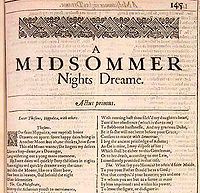
Whereas Greg had limited his illustrative examples to English Renaissance drama, where his expertise lay, Bowers argued that the rationale was "the most workable editorial principle yet contrived to produce a critical text that is authoritative in the maximum of its details whether the author be Shakespeare
William Shakespeare
William Shakespeare was an English poet and playwright, widely regarded as the greatest writer in the English language and the world's pre-eminent dramatist. He is often called England's national poet and the "Bard of Avon"...
, Dryden
John Dryden
John Dryden was an influential English poet, literary critic, translator, and playwright who dominated the literary life of Restoration England to such a point that the period came to be known in literary circles as the Age of Dryden.Walter Scott called him "Glorious John." He was made Poet...
, Fielding
Henry Fielding
Henry Fielding was an English novelist and dramatist known for his rich earthy humour and satirical prowess, and as the author of the novel Tom Jones....
, Nathaniel Hawthorne
Nathaniel Hawthorne
Nathaniel Hawthorne was an American novelist and short story writer.Nathaniel Hawthorne was born in 1804 in the city of Salem, Massachusetts to Nathaniel Hathorne and the former Elizabeth Clarke Manning. His ancestors include John Hathorne, a judge during the Salem Witch Trials...
, or Stephen Crane
Stephen Crane
Stephen Crane was an American novelist, short story writer, poet and journalist. Prolific throughout his short life, he wrote notable works in the Realist tradition as well as early examples of American Naturalism and Impressionism...
. The principle is sound without regard for the literary period." For works where an author's manuscript survived – a case Greg had not considered – Bowers concluded that the manuscript should generally serve as copy-text. Citing the example of Nathaniel Hawthorne, he noted:
Following Greg, the editor would then replace any of the manuscript readings with substantives from printed editions that could be reliably attributed to the author: "Obviously, an editor cannot simply reprint the manuscript, and he must substitute for its readings any words that he believes Hawthorne changed in proof.
Uninfluenced final authorial intention
McKerrow had articulated textual criticism's goal in terms of "our ideal of an author's fair copy of his work in its final state". Bowers asserted that editions founded on Greg's method would "represent the nearest approximation in every respect of the author's final intentions." Bowers stated similarly that the editor's task is to "approximate as nearly as possible an inferential authorial fair copy." Tanselle notes that, "Textual criticism ... has generally been undertaken with a view to reconstructing, as accurately as possible, the text finally intended by the author".Bowers and Tanselle argue for rejecting textual variants that an author inserted at the suggestion of others. Bowers said that his edition of Stephen Crane
Stephen Crane
Stephen Crane was an American novelist, short story writer, poet and journalist. Prolific throughout his short life, he wrote notable works in the Realist tradition as well as early examples of American Naturalism and Impressionism...
's first novel, Maggie, presented "the author's final and uninfluenced artistic intentions." In his writings, Tanselle refers to "unconstrained authorial intention" or "an author's uninfluenced intentions." This marks a departure from Greg, who had merely suggested that the editor inquire whether a later reading "is one that the author can reasonably be supposed to have substituted for the former", not implying any further inquiry as to why the author had made the change.
Tanselle discusses the example of Herman Melville
Herman Melville
Herman Melville was an American novelist, short story writer, essayist, and poet. He is best known for his novel Moby-Dick and the posthumous novella Billy Budd....
's Typee
Typee
Typee is American writer Herman Melville's first book, a classic in the literature of travel and adventure partly based on his actual experiences as a captive on the island Nuku Hiva in the South Pacific Marquesas Islands, in 1842...
. After the novel's initial publication, Melville's publisher asked him to soften the novel's criticisms of missionaries in the South Seas. Although Melville pronounced the changes an improvement, Tanselle rejected them in his edition, concluding that "there is no evidence, internal or external, to suggest that they are the kinds of changes Melville would have made without pressure from someone else."
Bowers confronted a similar problem in his edition of Maggie. Crane originally printed the novel privately in 1893. To secure commercial publication in 1896, Crane agreed to remove profanity, but he also made stylistic revisions. Bowers's approach was to preserve the stylistic and literary changes of 1896, but to revert to the 1893 readings where he believed that Crane was fulfilling the publisher's intention rather than his own. There were, however, intermediate cases that could reasonably have been attributed to either intention, and some of Bowers's choices came under fire – both as to his judgment, and as to the wisdom of conflating readings from the two different versions of Maggie.
Hans Zeller argued that it is impossible to tease apart the changes Crane made for literary reasons and those made at the publisher's insistence:
Bowers and Tanselle recognize that texts often exist in more than one authoritative version. Tanselle argues that:
He suggests that where a revision is "horizontal" (i.e., aimed at improving the work as originally conceived), then the editor should adopt the author's later version. But where a revision is "vertical" (i.e., fundamentally altering the work's intention as a whole), then the revision should be treated as a new work, and edited separately on its own terms.
Format for apparatus
Bowers was also influential in defining the form of critical apparatusCritical apparatus
The critical apparatus is the critical and primary source material that accompanies an edition of a text. A critical apparatus is often a by-product of textual criticism....
that should accompany a scholarly edition. In addition to the content of the apparatus, Bowers led a movement to relegate editorial matter to appendices, leaving the critically established text "in the clear", that is, free of any signs of editorial intervention. Tanselle explained the rationale for this approach:
Some critics believe that a clear-text edition gives the edited text too great a prominence, relegating textual variants to appendices that are difficult to use, and suggesting a greater sense of certainty about the established text than it deserves. As Shillingsburg notes, "English scholarly editions have tended to use notes at the foot of the text page, indicating, tacitly, a greater modesty about the "established" text and drawing attention more forcibly to at least some of the alternative forms of the text".
The MLA's CEAA and CSE
In 1963, the Modern Language Association of AmericaModern Language Association
The Modern Language Association of America is the principal professional association in the United States for scholars of language and literature...
(MLA) established the Center for Editions of American Authors (CEAA). The CEAA's Statement of Editorial Principles and Procedures, first published in 1967, adopted the Greg–Bowers rationale in full. A CEAA examiner would inspect each edition, and only those meeting the requirements would receive a seal denoting "An Approved Text."
Between 1966 and 1975, the Center allocated more than $1.5 million in funding from the National Endowment for the Humanities to various scholarly editing projects, which were required to follow the guidelines (including the structure of editorial apparatus) as Bowers had defined them. According to Davis, the funds coordinated by the CEAA over the same period were more than $6 million, counting funding from universities, university presses, and other bodies.
The Center for Scholarly Editions (CSE) replaced the CEAA in 1976. The change of name indicated the shift to a broader agenda than just American authors. The Center also ceased its role in the allocation of funds. The Center's latest guidelines (2003) no longer prescribe a particular editorial procedure.
Cladistics
Cladistics
Cladistics is a method of classifying species of organisms into groups called clades, which consist of an ancestor organism and all its descendants . For example, birds, dinosaurs, crocodiles, and all descendants of their most recent common ancestor form a clade...
is a technique borrowed from biology
Biology
Biology is a natural science concerned with the study of life and living organisms, including their structure, function, growth, origin, evolution, distribution, and taxonomy. Biology is a vast subject containing many subdivisions, topics, and disciplines...
, where it was originally named phylogenetic systematics by Willi Hennig
Willi Hennig
Emil Hans Willi Hennig was a German biologist who is considered the founder of phylogenetic systematics, also known as cladistics. With his works on evolution and systematics he revolutionised the view of the natural order of beings...
. In biology, the technique is used to determine the evolution
Evolution
Evolution is any change across successive generations in the heritable characteristics of biological populations. Evolutionary processes give rise to diversity at every level of biological organisation, including species, individual organisms and molecules such as DNA and proteins.Life on Earth...
ary relationships between different species
Species
In biology, a species is one of the basic units of biological classification and a taxonomic rank. A species is often defined as a group of organisms capable of interbreeding and producing fertile offspring. While in many cases this definition is adequate, more precise or differing measures are...
. In its application in textual criticism, the text of a number of different manuscripts is entered into a computer, which records all the differences between them. The manuscripts are then grouped according to their shared characteristics. The difference between cladistics and more traditional forms of statistical analysis is that, rather than simply arranging the manuscripts into rough groupings according to their overall similarity, cladistics assumes that they are part of a branching family tree and uses that assumption to derive relationships between them. This makes it more like an automated approach to stemmatics. However, where there is a difference, the computer does not attempt to decide which reading is closer to the original text, and so does not indicate which branch of the tree is the "root"—which manuscript tradition is closest to the original. Other types of evidence must be used for that purpose.
The major theoretical problem with applying cladistics to textual criticism is that cladistics assumes that, once a branching has occurred in the family tree, the two branches cannot rejoin; so all similarities can be taken as evidence of common ancestry. While this assumption is applicable to the evolution of living creatures, it is not always true of manuscript traditions, since a scribe can work from two different manuscripts at once, producing a new copy with characteristics of both.
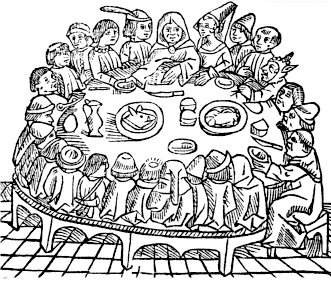
Nonetheless, software developed for use in biology has been applied with some success to textual criticism; for example, it is being used by the Canterbury Tales Project to determine the relationship between the 84 surviving manuscripts and four early printed editions of the Canterbury Tales.
Application of textual criticism to religious documents
All texts are subject to investigation and systematic criticism where the original verified first document is not available. Believers in sacred texts and scriptures sometimes are reluctant to accept any form of challenge to what they believe to be divine revelationRevelation
In religion and theology, revelation is the revealing or disclosing, through active or passive communication with a supernatural or a divine entity...
. Some opponents and polemicists may look for any way to find fault with a particular religious text. Legitimate textual criticism may be resisted by both believers and skeptics.
Qur'an
Textual criticism of the Quran is a beginning area of study, there is no higher criticism of the Quran. In some countries textual criticism can be seen as apostasy.Muslims consider the original Arabic text to be the final revelation, revealed to Muhammad from AD 610 to his death in 632. In Islamic tradition, the Qur'an
Qur'an
The Quran , also transliterated Qur'an, Koran, Alcoran, Qur’ān, Coran, Kuran, and al-Qur’ān, is the central religious text of Islam, which Muslims consider the verbatim word of God . It is regarded widely as the finest piece of literature in the Arabic language...
was memorised and written down by Muhammad's companions and copied as needed. However, it is well known to scholars that: "written versions vary enormously in materials, format and aspect".
In the 1970s, 14,000 fragments of Qur'an were discovered in an old mosque in Sanaa, the Sana'a manuscripts
Sana'a manuscripts
The Sana'a manuscripts, found in Yemen in 1972, are considered by some to be the oldest existent version of the Qur'an. Although the text has been dated to the first two decades of the eighth century The Sana'a manuscripts, found in Yemen in 1972, are considered by some to be the oldest existent...
. About 12,000 fragments belonged to 926 copies of the Qur'an, the other 2,000 were loose fragments. The oldest known copy of the Qur'an so far belongs to this collection: it dates to the end of the 7th–8th centuries. The important find uncovered many textual variants not known from the canonical 7 (or 10 or 14) texts.
However, the latter claim of variants being not from the canonical 7 cannot be demonstrated as the only known version of the Qur'an has been the current form, accepted as the Uthmani recension, with wall inscriptions of certain verses dating further back than the Sana'a manuscripts mirroring the current content.
In effect the San'aa manuscripts could just as easily fall into one of the oral traditions of the known Ahruf or dialect of the Quran as preserved by Ali or Ibn Masud. Additionally, the examination of the texts yielded a demonstration that the textual difficulties pointed towards a very strong oral tradition which would be indicative of the manuscript being written in the Qiraat or recitation style of the author – a phenomenon already seen in older inscriptions and wall markings.
The examination of Gerd R. Puin
Gerd R. Puin
Gerd Rüdiger Puin is a German scholar and an authority on Qur'anic historical orthography, the study and scholarly interpretation of ancient manuscripts. He is also specialist in Arabic paleography...
who led the restoration project revealed, "unconventional verse orderings, minor textual variations, and rare styles of orthography and artistic embellishment." Recent authors have also proposed that the Koran may have been written in Arabic–Syriac.
Book of Mormon
The Church of Jesus Christ of Latter-day Saints (LDS Church) includes the Book of MormonBook of Mormon
The Book of Mormon is a sacred text of the Latter Day Saint movement that adherents believe contains writings of ancient prophets who lived on the American continent from approximately 2600 BC to AD 421. It was first published in March 1830 by Joseph Smith, Jr...
as a foundational reference. LDS members typically believe the book to be a literal historical record.
Although some earlier unpublished studies had been prepared, not until the early 1970s was true textual criticism applied to the Book of Mormon. At that time BYU Professor Ellis Rasmussen and his associates were asked by the LDS Church to begin preparation for a new edition of the Holy Scriptures. One aspect of that effort entailed digitizing the text and preparing appropriate footnotes, another aspect required establishing the most dependable text. To that latter end, Stanley R. Larson (a Rasmussen graduate student) set about applying modern text critical standards to the manuscripts and early editions of the Book of Mormon as his thesis project – which he completed in 1974. To that end, Larson carefully examined the Original Manuscript (the one dictated by Joseph Smith
Joseph Smith
Joseph Smith was founder of what later became known as the Latter Day Saint movement or Mormons.Joseph Smith may also refer to:-Latter Day Saints:* Joseph Smith, Sr. , father of Joseph Smith...
to his scribes) and the Printer’s Manuscript (the copy Oliver Cowdery
Oliver Cowdery
Oliver H. P. Cowdery was, with Joseph Smith, Jr., an important participant in the formative period of the Latter Day Saint movement between 1829 and 1836, becoming one of the Three Witnesses of the Book of Mormon's golden plates, one of the first Latter Day Saint apostles, and the Second Elder of...
prepared for the Printer in 1829–1830), and compared them with the 1st, 2nd, and 3rd editions of the Book of Mormon to determine what sort of changes had occurred over time and to make judgments as to which readings were the most original. Larson proceeded to publish a useful set of well-argued articles on the phenomena which he had discovered. Many of his observations were included as improvements in the 1981 LDS edition of the Book of Mormon.
By 1979, with the establishment of the Foundation for Ancient Research and Mormon Studies
Foundation for Ancient Research and Mormon Studies
The Foundation for Ancient Research and Mormon Studies is an informal collaboration of academics devoted to Latter-day Saint historical scholarship. The group is formally part of the Neal A...
(FARMS) as a California non-profit research institution, an effort led by Robert F. Smith began to take full account of Larson’s work and to publish a Critical Text of the Book of Mormon. Thus was born the FARMS Critical Text Project which published the first volume of the 3-volume Book of Mormon Critical Text in 1984. The third volume of that first edition was published in 1987, but was already being superseded by a second, revised edition of the entire work, greatly aided through the advice and assistance of then Yale doctoral candidate Grant Hardy
Grant Hardy
Grant Hardy is a professor of history and religious studies at the University of North Carolina, Asheville and a scholar who has written on the history of pre-modern China as well as examinations of the Book of Mormon as literature....
, Dr. Gordon C. Thomasson, Professor John W. Welch
John W. Welch
John Woodland "Jack" Welch is an LDS law and religion scholar who currently teaches at the J. Reuben Clark Law School at Brigham Young University .- Biography :...
(the head of FARMS), Professor Royal Skousen
Royal Skousen
Royal Jon Skousen is a professor of linguistics and English at Brigham Young University , where he is editor of the Book of Mormon Critical Text Project...
, and others too numerous to mention here. However, these were merely preliminary steps to a far more exacting and all-encompassing project.
In 1988, with that preliminary phase of the project completed, Professor Skousen took over as editor and head of the FARMS Critical Text of the Book of Mormon Project and proceeded to gather still scattered fragments of the Original Manuscript of the Book of Mormon and to have advanced photographic techniques applied to obtain fine readings from otherwise unreadable pages and fragments. He also closely examined the Printer’s Manuscript (owned by the Community of Christ
Community of Christ
The Community of Christ, known from 1872 to 2001 as the Reorganized Church of Jesus Christ of Latter Day Saints , is an American-based international Christian church established in April 1830 that claims as its mission "to proclaim Jesus Christ and promote communities of joy, hope, love, and peace"...
—RLDS Church in Independence, Missouri) for differences in types of ink or pencil, in order to determine when and by whom they were made. He also collated the various editions of the Book of Mormon down to the present to see what sorts of changes have been made through time.
Thus far, Professor Skousen has published complete transcripts of the Original and Printer’s Manuscripts, as well as a six-volume analysis of textual variants. Still in preparation are a history of the text, and a complete electronic collation of editions and manuscripts (volumes 3 and 5 of the Project, respectively). Yale University has in the meantime published an edition of the Book of Mormon which incorporates all aspects of Skousen’s research.
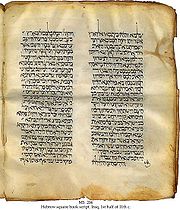
Hebrew Bible
.jpg)
Biblical manuscript
A biblical manuscript is any handwritten copy of a portion of the text of the Bible. The word Bible comes from the Greek biblia ; manuscript comes from Latin manu and scriptum...
versions of the following sources (dates refer to the oldest extant manuscripts in each family):
| Manuscript | |Examples | Dead Sea Scrolls Dead Sea scrolls The Dead Sea Scrolls are a collection of 972 texts from the Hebrew Bible and extra-biblical documents found between 1947 and 1956 on the northwest shore of the Dead Sea, from which they derive their name... | Tanakh at Qumran Tanakh at Qumran The Tanakh is the Hebrew Bible and Qumran is an archaeological site near the Dead Sea. More than two hundred portions of the Tanakh have been found near Qumran, forming part of the Dead Sea Scrolls. The scrolls were found in a series of caves, which have since been numbered, and these numbers used... |
Hebrew, Paleo Hebrew Paleo-Hebrew alphabet The Paleo-Hebrew alphabet , is an abjad offshoot of the ancient Semitic alphabet, identical to the Phoenician alphabet. At the very least it dates to the 10th century BCE... and Greek(Septuagint) |
c. 150 BCE – 70 CE | c. 150 BCE – 70 CE |
|---|---|---|---|---|---|---|
| Septuagint | Codex Vaticanus, Codex Sinaiticus Codex Sinaiticus Codex Sinaiticus is one of the four great uncial codices, an ancient, handwritten copy of the Greek Bible. It is an Alexandrian text-type manuscript written in the 4th century in uncial letters on parchment. Current scholarship considers the Codex Sinaiticus to be one of the best Greek texts of... and other earlier papyri |
Greek | 300–100 BCE | 2nd century BCE(fragments) 4th century CE(complete) |
||
| Peshitta Peshitta The Peshitta is the standard version of the Bible for churches in the Syriac tradition.The Old Testament of the Peshitta was translated into Syriac from the Hebrew, probably in the 2nd century AD... |
Syriac | early 5th century CE | ||||
| Vulgate Vulgate The Vulgate is a late 4th-century Latin translation of the Bible. It was largely the work of St. Jerome, who was commissioned by Pope Damasus I in 382 to make a revision of the old Latin translations... |
Latin | early 5th century CE | ||||
| Masoretic | Aleppo Codex Aleppo Codex The Aleppo Codex is a medieval bound manuscript of the Hebrew Bible. The codex was written in the 10th century A.D.The codex has long been considered to be the most authoritative document in the masorah , the tradition by which the Hebrew Scriptures have been preserved from generation to generation... , Leningrad Codex Leningrad Codex The Leningrad Codex is the oldest complete manuscript of the Hebrew Bible in Hebrew, using the masoretic text and Tiberian vocalization. It is dated AD 1008 according to its colophon... and other incomplete mss |
Hebrew | ca. 100 CE | 10th century CE | ||
| Samaritan Pentateuch Samaritan Pentateuch The Samaritan Pentateuch, sometimes called Samaritan Torah, , is a version of the Hebrew language Pentateuch, the first five books of the Bible, used by the Samaritans.... |
Samaritan alphabet Samaritan alphabet The Samaritan alphabet is used by the Samaritans for religious writings, including the Samaritan Pentateuch, writings in Samaritan Hebrew, and for commentaries and translations in Samaritan Aramaic and occasionally Arabic.... |
200–100 BCE | Oldest extant mss c.11th century CE, oldest mss available to scholars 16th century CE | |||
| Targum Targum Taekwondo is a Korean martial art and the national sport of South Korea. In Korean, tae means "to strike or break with foot"; kwon means "to strike or break with fist"; and do means "way", "method", or "path"... |
Aramaic | 500–1000 CE | 5th century CE | |||
Given the sacred nature of the Hebrew Bible in Judaism
Judaism
Judaism ) is the "religion, philosophy, and way of life" of the Jewish people...
, those unaware of the details dealt with in textual criticism might think that there are no corruptions in the text, since these texts were meticulously transmitted and written. And yet, as in the New Testament, in particular in the Masoretic texts, changes, corruptions, and erasures have been found. This is ascribed to the fact that early soferim (scribes) did not treat copy errors in the same manner later on.
New Testament
The New TestamentNew Testament
The New Testament is the second major division of the Christian biblical canon, the first such division being the much longer Old Testament....
has been preserved in more than 5,800 Greek
Greek language
Greek is an independent branch of the Indo-European family of languages. Native to the southern Balkans, it has the longest documented history of any Indo-European language, spanning 34 centuries of written records. Its writing system has been the Greek alphabet for the majority of its history;...
manuscripts, 10,000 Latin
Latin
Latin is an Italic language originally spoken in Latium and Ancient Rome. It, along with most European languages, is a descendant of the ancient Proto-Indo-European language. Although it is considered a dead language, a number of scholars and members of the Christian clergy speak it fluently, and...
manuscripts and 9,300 manuscripts in various other ancient languages including Syriac
Syriac language
Syriac is a dialect of Middle Aramaic that was once spoken across much of the Fertile Crescent. Having first appeared as a script in the 1st century AD after being spoken as an unwritten language for five centuries, Classical Syriac became a major literary language throughout the Middle East from...
, Slavic
Slavic languages
The Slavic languages , a group of closely related languages of the Slavic peoples and a subgroup of Indo-European languages, have speakers in most of Eastern Europe, in much of the Balkans, in parts of Central Europe, and in the northern part of Asia.-Branches:Scholars traditionally divide Slavic...
, Ethiopic and Armenian
Armenian language
The Armenian language is an Indo-European language spoken by the Armenian people. It is the official language of the Republic of Armenia as well as in the region of Nagorno-Karabakh. The language is also widely spoken by Armenian communities in the Armenian diaspora...
. The sheer number of witnesses presents unique difficulties, chiefly in that it makes stemmatics impractical. Consequently, New Testament textual critics have adopted eclecticism
Eclecticism
Eclecticism is a conceptual approach that does not hold rigidly to a single paradigm or set of assumptions, but instead draws upon multiple theories, styles, or ideas to gain complementary insights into a subject, or applies different theories in particular cases.It can sometimes seem inelegant or...
after sorting the witnesses into three major groups, called text-types. The most common division today is as follows:
| Text type | |Date | Characteristics | Bible version |
|---|---|---|---|
| The Alexandrian text-type Alexandrian text-type The Alexandrian text-type , associated with Alexandria, is one of several text-types used in New Testament textual criticism to describe and group the textual character of biblical manuscripts... (also called Minority Text) |
2nd–4th century CE | This family constitutes a group of early and well-regarded texts, including Codex Vaticanus and Codex Sinaiticus Codex Sinaiticus Codex Sinaiticus is one of the four great uncial codices, an ancient, handwritten copy of the Greek Bible. It is an Alexandrian text-type manuscript written in the 4th century in uncial letters on parchment. Current scholarship considers the Codex Sinaiticus to be one of the best Greek texts of... . Most of this tradition appear to come from around Alexandria, Egypt. It contains readings that are often terse, shorter, somewhat rough, less harmonised, and generally more difficult. The family was once thought to be a very carefully edited 3rd century recension Recension Recension is the practice of editing or revising a text based on critical analysis. When referring to manuscripts, this may be a revision by another author... but now is believed to be merely the result of a carefully controlled and supervised process of copying and transmission. It underlies most modern translations of the New Testament. |
NIV, NAB New American Bible The New American Bible is a Catholic Bible translation first published in 1970. It had its beginnings in the Confraternity Bible, which began to be translated from the original languages in 1948.... , TNIV, NASB New American Standard Bible The New American Standard Bible , also informally called New American Standard Version , is an English translation of the Bible.... , RSV Revised Standard Version The Revised Standard Version is an English translation of the Bible published in the mid-20th century. It traces its history to William Tyndale's New Testament translation of 1525. The RSV is an authorized revision of the American Standard Version of 1901... , ESV English Standard Version The English Standard Version is an English translation of the Christian Bible. It is a revision of the 1971 edition of the Revised Standard Version... , EBR Emphasized Bible Rotherham's Emphasized Bible is a translation of the Bible that uses various methods, such as "emphatic idiom" and special diacritical marks, to bring out nuances of the underlying Greek, Hebrew, and Aramaic texts... , NWT New World Translation of the Holy Scriptures The New World Translation of the Holy Scriptures is a translation of the Bible published by the Watch Tower Bible and Tract Society in 1961; it is used and distributed by Jehovah's Witnesses. Though it is not the first Bible to be published by the group, it is their first original translation of... , LB The Living Bible The Living Bible is an English version of the Bible created by Kenneth N. Taylor. It was first published in 1971. Unlike most English Bibles, The Living Bible is a paraphrase. Mr... , ASV American Standard Version The Revised Version, Standard American Edition of the Bible, more commonly known as the American Standard Version , is a version of the Bible that was released in 1901... , NC New Century Version The New Century Version of the Bible is a revision of the International Children's Bible. The ICB was aimed at young readers and those with low reading skills/limited vocabulary in English. It is written at a 3rd grade level and is both conservative and evangelical in tone. The New Testament was... , GNB Good News Bible The Good News Bible , also called the Good News Translation , is an English language translation of the Bible by the American Bible Society, first published as the New Testament under the name Good News for Modern Man in 1966... |
| The Western text-type Western text-type The Western text-type is one of several text-types used in textual criticism to describe and group the textual character of Greek New Testament manuscripts... |
3rd–9th centuries CE | This is also very early and comes from a wide geographical area stretching from North Africa to Italy from Gaul Gaul Gaul was a region of Western Europe during the Iron Age and Roman era, encompassing present day France, Luxembourg and Belgium, most of Switzerland, the western part of Northern Italy, as well as the parts of the Netherlands and Germany on the left bank of the Rhine. The Gauls were the speakers of... to Syria. It is found in Greek manuscripts and in the Latin translations used by the Western church. It is much less controlled than the Alexandrian family and its witnesses are seen to be more prone to paraphrase Paraphrase Paraphrase is restatement of a text or passages, using other words. The term "paraphrase" derives via the Latin "paraphrasis" from the Greek , meaning "additional manner of expression". The act of paraphrasing is also called "paraphrasis."... and other corruptions. |
Vetus Latina Vetus Latina Vetus Latina is a collective name given to the Biblical texts in Latin that were translated before St Jerome's Vulgate Bible became the standard Bible for Latin-speaking Western Christians. The phrase Vetus Latina is Latin for Old Latin, and the Vetus Latina is sometimes known as the Old Latin Bible... |
| The Byzantine text-type Byzantine text-type The Byzantine text-type is one of several text-types used in textual criticism to describe the textual character of Greek New Testament manuscripts. It is the form found in the largest number of surviving manuscripts, though not in the oldest... (also called Majority Text) |
5th–16th centuries CE | This is a group of around 80% of all manuscripts, the majority of which are comparatively very late in the tradition. It had become dominant at Constantinople Constantinople Constantinople was the capital of the Roman, Eastern Roman, Byzantine, Latin, and Ottoman Empires. Throughout most of the Middle Ages, Constantinople was Europe's largest and wealthiest city.-Names:... from the 5th century on and was used throughout the Byzantine church. It contains the most harmonistic readings, paraphrasing and significant additions, most of which are believed to be secondary readings. It underlies the Textus Receptus Textus Receptus Textus Receptus is the name subsequently given to the succession of printed Greek texts of the New Testament which constituted the translation base for the original German Luther Bible, the translation of the New Testament into English by William Tyndale, the King James Version, and for most other... used for most Reformation Protestant Reformation The Protestant Reformation was a 16th-century split within Western Christianity initiated by Martin Luther, John Calvin and other early Protestants. The efforts of the self-described "reformers", who objected to the doctrines, rituals and ecclesiastical structure of the Roman Catholic Church, led... -era translations of the New Testament. |
KJV, NKJV, Tyndale Tyndale Bible The Tyndale Bible generally refers to the body of biblical translations by William Tyndale. Tyndale’s Bible is credited with being the first English translation to work directly from Hebrew and Greek texts. Furthermore it was the first English biblical translation that was mass produced as a result... , Coverdale Coverdale Bible The Coverdale Bible, compiled by Myles Coverdale and published in 1535, was the first complete Modern English translation of the Bible , and the first complete printed translation into English . The later editions published in 1539 were the first complete Bibles printed in England... , Geneva Geneva Bible The Geneva Bible is one of the most historically significant translations of the Bible into the English language, preceding the King James translation by 51 years. It was the primary Bible of the 16th century Protestant movement and was the Bible used by William Shakespeare, Oliver Cromwell, John... , Bishops' Bible Bishops' Bible The Bishops' Bible is an English translation of the Bible which was produced under the authority of the established Church of England in 1568. It was substantially revised in 1572, and this revised edition was to be prescribed as the base text for the Authorized King James Version of... , Douay-Rheims, JB Jerusalem Bible The Jerusalem Bible is a Roman Catholic translation of the Bible which first was introduced to the English-speaking public in 1966 and published by Darton, Longman & Todd... , NJB New Jerusalem Bible The New Jerusalem Bible is a Roman Catholic translation of the Bible published in 1985 by Darton, Longman & Todd and Les Editions du Cerf, and edited by the Reverend Henry Wansbrough.- Contents :... , OSB |
Alexandrian text versus Byzantine text
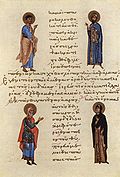
Textus Receptus
Textus Receptus is the name subsequently given to the succession of printed Greek texts of the New Testament which constituted the translation base for the original German Luther Bible, the translation of the New Testament into English by William Tyndale, the King James Version, and for most other...
, a Greek text prepared by Erasmus based on a few late medieval Greek manuscripts of the Byzantine text-type (1
Minuscule 1
Codex Basilensis A. N. IV. 2, Minuscule 1 , δ 254 ; formerly it was designated by 1eap...
, 1rK
Minuscule 2814
Minuscule 2814 , Aν20 . Formerly it was labelled as 1rK in all catalogues, but it was renumbered as a 2814 by Aland. It is a Greek minuscule manuscript of the New Testament, dated palaeographically to the 12th century....
, 2e
Minuscule 2
Codex Basiliensis A. N. IV. 1, known as Minuscule 2 , ε 1214 . It is a Greek minuscule manuscript of the New Testament, dated palaeographically to the 11th or 12th century. It was used by Erasmus in his edition of Greek text of the New Testament and became the basis for the Textus Receptus in the...
, 2ap
Minuscule 2815
Minuscule 2815 , α 253 . Formerly was labelled as 2ap in all catalogues, but it was renumbered by Aland.It is a Greek minuscule manuscript of the New Testament, dated paleographically to the 12th century....
, 4
Minuscule 4
Minuscule 4 , ε 371 , is a Greek minuscule manuscript of the New Testament, on 212 parchment leaves , dated palaeographically to the 13th century. Formerly it was named Codex Regius 84.It has full marginalia...
, 7
Minuscule 7
Minuscule 7 ; ε 287 . It is a Greek minuscule manuscript of the New Testament, on parchment. Palaeographically it has been assigned to the 12th century.- Description :...
, 817
Minuscule 817 (Gregory-Aland)
Minuscule 817 , Θε52 , is a Greek minuscule manuscript of the New Testament written on paper, with a commentary. It was used by Erasmus...
). For some books of the Bible, Erasmus used just single manuscripts, and for small sections made his own translations into Greek from the Vulgate
Vulgate
The Vulgate is a late 4th-century Latin translation of the Bible. It was largely the work of St. Jerome, who was commissioned by Pope Damasus I in 382 to make a revision of the old Latin translations...
. However, following Westcott
Brooke Foss Westcott
Brooke Foss Westcott was a British bishop, Biblical scholar and theologian, serving as Bishop of Durham from 1890 until his death.-Early life and education:...
and Hort
Fenton John Anthony Hort
Fenton John Anthony Hort was an Irish theologian and editor, with Brooke Westcott of a critical edition of The New Testament in the Original Greek.-Life:...
, most modern New Testament textual critics have concluded that the Byzantine text-type was formalised at a later date than the Alexandrian and Western text-types. Among the other types, the Alexandrian text-type
Alexandrian text-type
The Alexandrian text-type , associated with Alexandria, is one of several text-types used in New Testament textual criticism to describe and group the textual character of biblical manuscripts...
is viewed by some as more pure than the Western and Byzantine text-types, however, this view is held by the minority of scholars, and so one of the central tenets of current science of New Testament textual criticism is that one should follow the readings of the Alexandrian texts unless those of the other types are clearly superior. Most modern New Testament translations now use an Eclectic Greek text (UBS4 and NA 27
Novum Testamentum Graece
Novum Testamentum Graece is the Latin name editions of the original Greek-language version of the New Testament.The first printed edition was the Complutensian Polyglot Bible by Cardinal Francisco Jiménez de Cisneros, printed in 1514, but not published until 1520...
) that is closest to the Alexandrian text-type. The United Bible Societies's Greek New Testament (UBS4) and Nestle Aland
Novum Testamentum Graece
Novum Testamentum Graece is the Latin name editions of the original Greek-language version of the New Testament.The first printed edition was the Complutensian Polyglot Bible by Cardinal Francisco Jiménez de Cisneros, printed in 1514, but not published until 1520...
(NA 27) are accepted by most of the academic community as the best attempt at reconstructing the original texts of the Greek NT.
A majority position represented by The Greek New Testament According to the Majority Text edition by Zane C. Hodges
Zane C. Hodges
Zane Clark Hodges was an American pastor, seminary professor, and Bible scholar. He was reared in Chambersburg, Pennsylvania, and came to Dallas, Texas in 1954 after receiving a bachelor's degree from Wheaton College. He received master of theology degree from Dallas Theological Seminary in 1958...
and Arthur L. Farstad argues that the Byzantine text-type
Byzantine text-type
The Byzantine text-type is one of several text-types used in textual criticism to describe the textual character of Greek New Testament manuscripts. It is the form found in the largest number of surviving manuscripts, though not in the oldest...
represents an earlier text-type than the surviving Alexandrian texts. This position is also held by Maurice A. Robinson and William G. Pierpont in their The New Testament in the Original Greek: Byzantine Textform, and the King James Only Movement. The argument states that the far greater number of surviving later Byzantine manuscripts implies an equivalent preponderance of Byzantine texts amongst lost earlier manuscripts; and hence that a critical reconstruction of the predominant text of the Byzantine tradition would have a superior claim to being closest to the autographs.
Another position is that of the Neo-Byzantine School. The Neo-Byzantines (or new Byzantines) of the 16th and 17th centuries first formally compiled the New Testament Received Text under such textual analysts as Erasmus, Stephanus, Beza, and Elzevir. The early 21st century saw the rise of the first textual analyst of this school in over three centuries with Gavin McGrath (b. 1960). A religiously conservative Protestant from Australia, his Neo-Byzantine School principles maintain that the representative or majority Byzantine text such as compiled by Hodges & Farstad (1985) or Robinson & Pierpont (2005) is to be upheld unless there is a "clear and obvious" textual problem with it. When this occurs, he adopts either a minority Byzantine reading, a Latin text reading, or a church writer reading (if so, usually an ancient church writer). The Neo-Byzantine School considers that the doctrine of the Divine Preservation of Scripture means that God preserved the Byzantine Greek manuscripts, Latin manuscripts, and Greek and Latin church writers citations of Scripture over time and through time. These are regarded as "a closed class of sources" i.e., non-Byzantine Greek manuscripts such as the Alexandrian texts, or manuscripts in other languages such as Armenian, Syriac, or Ethiopian, are regarded as "outside the closed class of sources" providentially protected over time, and so not used to compose the New Testament text.
Other scholars have criticized the current categorization of manuscripts into text-types and prefer either to subdivide the manuscripts in other ways or to discard the text-type taxonomy.
Textual criticism is also used by those who assert that the New Testament was written in Aramaic (see Aramaic primacy
Aramaic primacy
The hypothesis of Aramaic primacy holds that the original text of the New Testament was not written in Greek, as held by the majority of scholars, but in the Aramaic language, which was the primary language of Jesus and his Twelve Apostles....
).
Interpolations
In attempting to determine the original text of the New Testament books, some modern textual critics have identified sections as interpolationsInterpolation (manuscripts)
An interpolation, in relation to literature and especially ancient manuscripts, is an entry or passage in a text that was not written by the original author...
. In modern translations of the Bible such as the New International Version
New International Version
The New International Version is an English translation of the Christian Bible. Published by Zondervan in the United States and by Hodder & Stoughton in the UK, it has become one of the most popular modern translations in history.-History:...
, the results of textual criticism have led to certain verses, words and phrases being left out or marked as not original. Previously, translations of the New Testament such as the King James Version had mostly been based on Erasmus's redaction of the New Testament in Greek, the Textus Receptus
Textus Receptus
Textus Receptus is the name subsequently given to the succession of printed Greek texts of the New Testament which constituted the translation base for the original German Luther Bible, the translation of the New Testament into English by William Tyndale, the King James Version, and for most other...
from the 16th century based on later manuscripts.
According to Bart D. Ehrman
Bart D. Ehrman
Bart D. Ehrman is an American New Testament scholar, currently the James A. Gray Distinguished Professor of Religious Studies at the University of North Carolina at Chapel Hill....
, "These scribal additions are often found in late medieval manuscripts of the New Testament, but not in the manuscripts of the earlier centuries," he adds. And because the King James Bible is based on later manuscripts, such verses "became part of the Bible tradition in English-speaking lands."
Most modern Bibles have footnotes to indicate passages that have disputed source documents. Bible Commentaries also discuss these, sometimes in great detail.
These possible later additions include the following:
- the ending of MarkGospel of MarkThe Gospel According to Mark , commonly shortened to the Gospel of Mark or simply Mark, is the second book of the New Testament. This canonical account of the life of Jesus of Nazareth is one of the three synoptic gospels. It was thought to be an epitome, which accounts for its place as the second...
, see Mark 16Mark 16Mark 16 is the final chapter of the Gospel of Mark in the New Testament of the Christian Bible. It begins with the discovery of the empty tomb by Mary Magdalene, Mary the mother of James, and Salome — there they encounter a man dressed in white who announces the Resurrection of Jesus.Verse 8 ends...
. - Jesus sweating bloodHematidrosisHematidrosis is a very rare condition in which a human being sweats blood. It may occur when a person is suffering extreme levels of stress, for example, facing his or her own death...
in LukeGospel of LukeThe Gospel According to Luke , commonly shortened to the Gospel of Luke or simply Luke, is the third and longest of the four canonical Gospels. This synoptic gospel is an account of the life and ministry of Jesus of Nazareth. It details his story from the events of his birth to his Ascension.The...
. - the story in JohnGospel of JohnThe Gospel According to John , commonly referred to as the Gospel of John or simply John, and often referred to in New Testament scholarship as the Fourth Gospel, is an account of the public ministry of Jesus...
of the woman taken in adultery, the Pericope Adulterae. - an explicit reference to the TrinityTrinityThe Christian doctrine of the Trinity defines God as three divine persons : the Father, the Son , and the Holy Spirit. The three persons are distinct yet coexist in unity, and are co-equal, co-eternal and consubstantial . Put another way, the three persons of the Trinity are of one being...
in 1 John, the Comma JohanneumComma JohanneumThe Comma Johanneum is a comma in the First Epistle of John according to the Latin Vulgate text as transmitted since the Early Middle Ages, based on Vetus Latina minority readings dating to the 7th century...
.
Other disputed NT passages
- Opinions are divided on whether Jesus is referred to as "unique Son" or "unique God", in
- 1 Corinthians 14:33–35. Some scholars regard the instruction for women to be silent in churches as a later, non-Pauline addition to the Letter, more in keeping with the viewpoint of the Pastoral EpistlesPastoral epistlesThe three pastoral epistles are books of the canonical New Testament: the First Epistle to Timothy the Second Epistle to Timothy , and the Epistle to Titus. They are presented as letters from Paul of Tarsus...
(see 1 Tim 2.11–12; Titus 2.5) than of the certainly Pauline EpistlesPauline epistlesThe Pauline epistles, Epistles of Paul, or Letters of Paul, are the thirteen New Testament books which have the name Paul as the first word, hence claiming authorship by Paul the Apostle. Among these letters are some of the earliest extant Christian documents...
. A few manuscripts place these verses after 40
It is also worthy to note that various groups of highly conservative Christians believe that when Ps.12:6–7 speaks of the preservation of the words of God, that this nullifies the need for textual criticism, lower, and higher. Such people include Gail Riplinger
Gail Riplinger
Gail Riplinger is an American author and speaker well-known for her support of the King-James-Only movement.-Bible comparisons:In 1993, Riplinger wrote a comparison of modern Bible translations to the King James Version...
, Peter Ruckman
Peter Ruckman
Peter Sturges Ruckman is an Independent Baptist pastor, teacher, writer, and founder of Pensacola Bible Institute, an unaccredited school in Pensacola, Florida...
, and others. Many theological organisations, societies, newsletters, and churches also hold to this belief, including "AV Publications", Sword of The LORD Newsletter, The Antioch Bible Society and others. On the other hand, Reformation biblical scholars such as Martin Luther saw the academic analysis of biblical texts and their provenance as entirely in line with orthodox Christian faith. Many of these men called themselves Christian humanists, precisely because textual criticism (usually of biblical texts) lay at the heart of their work.
Talmud
Textual criticism of the Talmud has a long pre-history but has become a separate discipline from Talmudic study only recently. Much of the research is in Hebrew and German language periodicals.Classical texts
While textual criticism developed into a discipline of thorough analysis of the Bible — both the Hebrew BibleHebrew Bible
The Hebrew Bible is a term used by biblical scholars outside of Judaism to refer to the Tanakh , a canonical collection of Jewish texts, and the common textual antecedent of the several canonical editions of the Christian Old Testament...
and the New Testament
New Testament
The New Testament is the second major division of the Christian biblical canon, the first such division being the much longer Old Testament....
— scholars also use it to determine the original content of classic texts, such as Plato
Plato
Plato , was a Classical Greek philosopher, mathematician, student of Socrates, writer of philosophical dialogues, and founder of the Academy in Athens, the first institution of higher learning in the Western world. Along with his mentor, Socrates, and his student, Aristotle, Plato helped to lay the...
's Republic. There are far fewer witnesses to classical texts than to the Bible, so scholars can use stemmatics and, in some cases, copy text editing. However, unlike the New Testament where the earliest witnesses are within 200 years of the original, the earliest existing manuscripts of most classical texts were written about a millennium after their composition. Other things being equal, textual scholars expect that a larger time gap between an original and a manuscript means more changes in the text.
Topics
- Authority (textual criticism)Authority (textual criticism)The authority of a text is its reliability as a witness to the author's intentions. These intentions could be initial, medial or final, but intentionalist editors generally attempt to retrieve final authorial intentions...
- A Historical Account of Two Notable Corruptions of Scripture
- Biblical glossesGlosses to the BibleBiblical scholars use the word glossa or gloss, in connexion with glosses of Biblical texts. A gloss meant an explanation of a purely verbal difficulty of the text, to the exclusion of explanations required by doctrinal, ritual, historical, and other obscurities...
- Categories of New Testament manuscriptsCategories of New Testament manuscriptsNew Testament manuscripts in Greek are categorized into five groups, according to a scheme introduced in 1981 by Kurt and Barbara Aland in Der Text des Neuen Testaments. The categories are based on how each manuscript relates to the various text-types. Generally speaking, earlier Alexandrian...
- Biblical manuscriptBiblical manuscriptA biblical manuscript is any handwritten copy of a portion of the text of the Bible. The word Bible comes from the Greek biblia ; manuscript comes from Latin manu and scriptum...
- Bible version debateBible version debateThere have been various debates concerning the proper medium and translation of the Bible since the first translations of the Hebrew Bible into Greek and Aramaic...
- Comma JohanneumComma JohanneumThe Comma Johanneum is a comma in the First Epistle of John according to the Latin Vulgate text as transmitted since the Early Middle Ages, based on Vetus Latina minority readings dating to the 7th century...
- Hermeneutics
- John 21John 21The chapter John 21 in the Bible contains an account of the post-Resurrection appearance in Galilee, which the text describes as the third time Jesus had appeared to his disciples...
- List of omitted Bible verses
- Mark 16Mark 16Mark 16 is the final chapter of the Gospel of Mark in the New Testament of the Christian Bible. It begins with the discovery of the empty tomb by Mary Magdalene, Mary the mother of James, and Salome — there they encounter a man dressed in white who announces the Resurrection of Jesus.Verse 8 ends...
- PalaeographyPalaeographyPalaeography, also spelt paleography is the study of ancient writing. Included in the discipline is the practice of deciphering, reading, and dating historical manuscripts, and the cultural context of writing, including the methods with which writing and books were produced, and the history of...
- Pericope AdulteræPericope AdulteræThe Pericope Adulterae or Pericope de Adultera is a traditional name for a famous passage about Jesus and the woman taken in adultery from verses of the Gospel of John. The passage describes a confrontation between Jesus and the scribes and Pharisees over whether a woman, caught in an act of...
- Source criticismSource criticismA source criticism is a published source evaluation . An information source may be a document, a person, a speech, a fingerprint, a photo, an observation or anything used in order to obtain knowledge. In relation to a given purpose, a given information source may be more or less valid, reliable or...
- Wiseman hypothesisWiseman hypothesisThe Wiseman hypothesis, sometimes called the tablet theory, is a theory of the authorship and composition of the Book of Genesis which suggests that Moses compiled Genesis from tablets handed down through Abraham and the other patriarchs. Originally advocated by P. J...
- List of Bible verses not included in modern translations
- Modern English Bible translationsModern English Bible translationsMany attempts have been made to translate the Bible into modern English, which is defined as the form of English in use after 1800 . Since the early nineteenth century, there have been several translational responses to the rapid spread of Christianity throughout the world...
- Textus ReceptusTextus ReceptusTextus Receptus is the name subsequently given to the succession of printed Greek texts of the New Testament which constituted the translation base for the original German Luther Bible, the translation of the New Testament into English by William Tyndale, the King James Version, and for most other...
- Dean Burgon SocietyDean Burgon SocietyThe Dean Burgon Society is an organization that promotes and defends the King James Bible and the underlying Hebrew and Greek manuscripts. It should not be confused with the academic Burgon Society. They are separate organizations....
Critical editions
Book of Mormon- Book of Mormon Critical Text – FARMS 2nd edition
Hebrew Bible
- Septuaginta – Rahlf's 2nd edition
- Biblia Hebraica StuttgartensiaBiblia Hebraica StuttgartensiaThe Biblia Hebraica Stuttgartensia, or ', is an edition of the Masoretic Text of the Hebrew Bible as preserved in the Leningrad Codex, and supplemented by masoretic and text-critical notes...
– 4th edition
New Testament
- Editio octava critica maiorEditio Octava Critica MaiorEditio Octava Critica Maior is a critical edition of the Greek New Testament produced by Constantin von Tischendorf. It was Tischendorf's eighth edition of the Greek Testament, and the most important, published between 1864 and 1894.- Edition :...
– Tischendorf edition - The Greek New Testament According to the Majority Text – Hodges & Farstad edition
- The New Testament in the Original GreekThe New Testament in the Original GreekThe New Testament in the Original Greek is the name of a Greek language version of the New Testament published in 1881. It is also known as the Westcott and Hort text, after its editors Brooke Foss Westcott and Fenton John Anthony Hort...
– Westcott & Hort edition - Novum Testamentum GraeceNovum Testamentum GraeceNovum Testamentum Graece is the Latin name editions of the original Greek-language version of the New Testament.The first printed edition was the Complutensian Polyglot Bible by Cardinal Francisco Jiménez de Cisneros, printed in 1514, but not published until 1520...
Nestle-Aland 27 edition (NA 27) - United Bible Society's Greek New Testament (UBS4)
- Novum Testamentum Graece et Latine – Merk edition
- Editio Critica MaiorEditio Critica MaiorEditio Critica Maior is a critical edition of the Greek New Testament being produced by the Institut für neutestamentliche Textforschung. It is a work in multiple volumes, and is intended to cite a more complete list of variant readings than can be incorporated in a manual edition...
– German Bible Society edition
Critical Translations
- The Comprehensive New Testament – standardardized Nestle-Aland 27 edition
- The Dead Sea Scrolls Bible – with textual mapping to Masoretic, Dead Sea Scrolls, and Septuagint variants
Lists
- List of New Testament papyri
- List of New Testament uncials
- List of manuscripts
- List of Biblical commentaries
- Textual variants in the New TestamentTextual variants in the New TestamentTextual variants arise when a copyist makes deliberate or inadvertent alterations to a text being reproduced. Some common alterations include the deletion, rearrangement, repetition, or replacement of one or more words when the copyist's eye returns to a similar word in the wrong location of the...
Further reading
- Epp, Eldon J., The Eclectic Method in New Testament Textual Criticism: Solution or Symptom?, The Harvard Theological Review, Vol. 69, No. 3/4 (Jul. – Oct., 1976), pp. 211–257
- Aland B.Barbara AlandBarbara Aland, née Ehlers is a German theologian and was a Professor of New Testament Research and Church History at Westphalian Wilhelms-University of Münster until 2002.- Biography :...
, J. Delobel, New Testament Textual Criticism, Exegesis, and Early Church History, Peeters Publishers, 1994. - Hagen, Kenneth, The Bible in the Churches: How Various Christians Interpret the Scriptures, Marquette Studies in Theology, Vol 4; Marquette University Press, 1998, ISBN 0-874-62628-5
- Hodges, Zane C. and Farstad, Arthur L. The Greek New Testament According to the Majority Text with Apparatus, Thomas Nelson; 2nd ed edition (January 1, 1985), ISBN 0-840-74963-5
- Komoszewski, Sawyer and Wallace, (2006), Reinventing Jesus, Kregel Publications, 2006, ISBN 978-0825429828
- MetzgerBruce MetzgerBruce Manning Metzger was a professor at Princeton Theological Seminary and Bible editor who served on the board of the American Bible Society. He was a scholar of Greek, New Testament and Old Testament, and wrote prolifically on these subjects.- Biography :Metzger was born in Middletown,...
& Ehrman, (2005), The text of the New Testament, OUP, ISBN 978-0195161229 - Schiffman, Lawrence H., Reclaiming the Dead Sea Scrolls: The History of Judaism, the Background of Christianity, the Lost Library of Qumran; Jewish Publication Society, 1st ed. 1994, ISBN 0-827-60530-7
- Soulen, Richard N. and Soulen, R. Kendall, Handbook of Biblical Criticism; Westminster John Knox Press; 3 edition (October 2001), ISBN 0-664-22314-1
General
- An example of cladistics applied to textual criticism
- Stemma and Stemmatics
- Stemmatics and Information Theory
- Computer-assisted stemmatology challenge & benchmark data-sets
- Searching for the Better Text: How errors crept into the Bible and what can be done to correct them Biblical Archaeology Review
Bible
- Manuscript Comparator — allows two or more New Testament manuscript editions to be compared in side-by-side and unified views (similar to diffDiffIn computing, diff is a file comparison utility that outputs the differences between two files. It is typically used to show the changes between one version of a file and a former version of the same file. Diff displays the changes made per line for text files. Modern implementations also...
output) - A detailed discussion of the textual variants in the Gospels (covering about 1200 variants on 2000 pages)
- A complete list of all New Testament Papyri with link to images
- An Electronic Edition of The Gospel According to John in the Byzantine Tradition
- A Site Inspired By The Encyclopedia of New Testament Textual Criticism
- Mailing list textual criticism
- Forum Textual Criticism
- A book review for Hodges & Farstad
- Aramaic Peshitta Bible Repository – argues for Aramaic primacyAramaic primacyThe hypothesis of Aramaic primacy holds that the original text of the New Testament was not written in Greek, as held by the majority of scholars, but in the Aramaic language, which was the primary language of Jesus and his Twelve Apostles....
- Evangelical Textual Criticism Blog
- New Testament Manuscripts (listing of the manuscript evidence for more than 11000 variants in the New Testament)
- Library of latest modern books of biblical studies and biblical criticism