


Samaritan Pentateuch

Encyclopedia
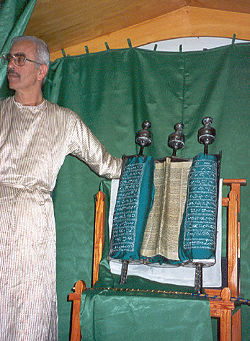
The Samaritan Pentateuch, sometimes called Samaritan Torah, (Hebrew: תורה שומרונית torah shomroniyt), is a version of the Hebrew language Pentateuch
, the first five books of the Bible
, used by the Samaritans.
Scholars consult the Samaritan Pentateuch when trying to determine the meaning of text of the original Pentateuch and to trace the development of text-families. Scrolls among the Dead Sea scrolls
have been identified as proto-Samaritan Pentateuch text-type.
Samaritan practices are based on their version of the Five Books of Moses, which is slightly different from the Masoretic text
or the Greek Septuagint texts. Some differences are minor, such as the ages of different people mentioned in genealogy, while others are major, such as the commandment to be monogamous which appears in the Samaritan text. (See .)
Special importance is attached to the Abisha Scroll, which is used in the Samaritan synagogue of Nablus
. The Samaritans claim it was penned by Abishua
, great-grandson of Aaron
, thirteen years after the entry into the land of Israel under the leadership of Joshua
, son of Nun. Modern scholars, however, have observed that the scroll appears to include scraps of work by different scribes from different centuries, with the oldest texts dating to the 12th century A.D.
 Samaritans claim that they are descended from the northern Kingdom of Israel, which had parted ways with the southern Kingdom of Judah
after the death of King Solomon (see 1 Kings 12). Eventually the northern kingdom was conquered by the Assyrians, and the southern by the Babylonians.
Jews have never accepted this account of Samaritan origins, relying instead on the account given in II Kings 17:24-41.
Samaritans reject the Talmud
and use their own oral traditions, which have been passed down through the generations and which they believe is the original practice that Moses taught the children of Israel at Mount Sinai
. There have been numerous conflicts between Jews and Samaritans in history.
, but in the Samaritan alphabet
, which differs from the Hebrew alphabet
, and was the form in general use before the Babylonian captivity
. There are other peculiarities in the writing. Frank Moore Cross
(1966) considers that archaizing forms and pseudo-archaic forms point to a post-Maccabaean date.
It is claimed that there are significant differences between the Hebrew and the Samaritan versions in the readings of many sentences. In about two thousand out of the six thousand instances in which the Samaritan and the Jewish texts (Masoretic text
) differ, the Septuagint (LXX) agrees with the Samaritan. For example, in the Samaritan and the LXX reads:
In the Masoretic text, the passage reads:
The Samaritan version of the Ten Commandments
commands them to build the altar on Mount Gerizim
, which would be the site at which all sacrifices should be offered.
Wider interest in the Samaritan Pentateuch commenced in 1616, when the traveler Pietro della Valle
brought a copy of the text from Damascus
. Subsequently, other copies were brought to Europe and later, America. In 1645, an edited copy of the text was published in the Le Jay's (Paris) Polyglot
by Jean Morin, a Jesuit-convert from Calvinism
to Catholicism
, who believed that the Septuagint and the Samaritan texts were superior to the Hebrew Masoretic text. It was republished again in Walton's Polyglot in 1657.
Scholarly evaluation of the Samaritan Pentateuch has changed after the discovery of the Dead Sea Scrolls
, some manuscripts of which display a text that corresponds closely to that of the Samaritan Pentateuch. This shows that, apart from the clearly Samaritan references to the worship of God on Mount Gerizim, the distinction at that date between the Samaritan and non-Samaritan versions was not as clear-cut as previously thought.
Also, Benjamin Kennicott
states, the Hebrew version cannot be more authentic just because it is the Hebrew version:
"We see then that as the evidence of one text destroys the evidence of the other and as there is in fact the authority of versions to oppose to the authority of versions no certain argument or rather no argument at all can be drawn from hence to fix the corruption on either side".
The Masoretic text is neutral in regards to "place of worship," instead of being inclined towards the view of the Jews (Jerusalem being the "chosen place"). On the other hand the Samaritan text is inclined specifically towards Mt. Gerizim, agreeing with the view of the Samaritans.
The New Testament
agrees with the Masoretic version designating Jerusalem
as the "chosen place".
Torah
Torah- A scroll containing the first five books of the BibleThe Torah , is name given by Jews to the first five books of the bible—Genesis , Exodus , Leviticus , Numbers and Deuteronomy Torah- A scroll containing the first five books of the BibleThe Torah , is name given by Jews to the first five...
, the first five books of the Bible
Bible
The Bible refers to any one of the collections of the primary religious texts of Judaism and Christianity. There is no common version of the Bible, as the individual books , their contents and their order vary among denominations...
, used by the Samaritans.
Scholars consult the Samaritan Pentateuch when trying to determine the meaning of text of the original Pentateuch and to trace the development of text-families. Scrolls among the Dead Sea scrolls
Dead Sea scrolls
The Dead Sea Scrolls are a collection of 972 texts from the Hebrew Bible and extra-biblical documents found between 1947 and 1956 on the northwest shore of the Dead Sea, from which they derive their name...
have been identified as proto-Samaritan Pentateuch text-type.
Samaritan practices are based on their version of the Five Books of Moses, which is slightly different from the Masoretic text
Masoretic Text
The Masoretic Text is the authoritative Hebrew text of the Jewish Bible and is regarded as Judaism's official version of the Tanakh. While the Masoretic Text defines the books of the Jewish canon, it also defines the precise letter-text of these biblical books, with their vocalization and...
or the Greek Septuagint texts. Some differences are minor, such as the ages of different people mentioned in genealogy, while others are major, such as the commandment to be monogamous which appears in the Samaritan text. (See .)
Special importance is attached to the Abisha Scroll, which is used in the Samaritan synagogue of Nablus
Nablus
Nablus is a Palestinian city in the northern West Bank, approximately north of Jerusalem, with a population of 126,132. Located in a strategic position between Mount Ebal and Mount Gerizim, it is the capital of the Nablus Governorate and a Palestinian commercial and cultural center.Founded by the...
. The Samaritans claim it was penned by Abishua
Abishua
Abishua was an early High priest of Israel.Abishua is mentioned in the books 1 Chronicles and Ezra as the son of the High Priest Phinehas, son of Eleazar...
, great-grandson of Aaron
Aaron
In the Hebrew Bible and the Qur'an, Aaron : Ααρών ), who is often called "'Aaron the Priest"' and once Aaron the Levite , was the older brother of Moses, and a prophet of God. He represented the priestly functions of his tribe, becoming the first High Priest of the Israelites...
, thirteen years after the entry into the land of Israel under the leadership of Joshua
Joshua
Joshua , is a minor figure in the Torah, being one of the spies for Israel and in few passages as Moses's assistant. He turns to be the central character in the Hebrew Bible's Book of Joshua...
, son of Nun. Modern scholars, however, have observed that the scroll appears to include scraps of work by different scribes from different centuries, with the oldest texts dating to the 12th century A.D.
Background
Kingdom of Judah
The Kingdom of Judah was a Jewish state established in the Southern Levant during the Iron Age. It is often referred to as the "Southern Kingdom" to distinguish it from the northern Kingdom of Israel....
after the death of King Solomon (see 1 Kings 12). Eventually the northern kingdom was conquered by the Assyrians, and the southern by the Babylonians.
Jews have never accepted this account of Samaritan origins, relying instead on the account given in II Kings 17:24-41.
Samaritans reject the Talmud
Talmud
The Talmud is a central text of mainstream Judaism. It takes the form of a record of rabbinic discussions pertaining to Jewish law, ethics, philosophy, customs and history....
and use their own oral traditions, which have been passed down through the generations and which they believe is the original practice that Moses taught the children of Israel at Mount Sinai
Mount Sinai
Mount Sinai , also known as Mount Horeb, Mount Musa, Gabal Musa , Jabal Musa meaning "Moses' Mountain", is a mountain near Saint Catherine in the Sinai Peninsula of Egypt. A mountain called Mount Sinai is mentioned many times in the Book of Exodus in the Torah and the Bible as well as the Quran...
. There have been numerous conflicts between Jews and Samaritans in history.
Differences from the Masoretic text
The Samaritan Pentateuch is written in the Hebrew languageHebrew language
Hebrew is a Semitic language of the Afroasiatic language family. Culturally, is it considered by Jews and other religious groups as the language of the Jewish people, though other Jewish languages had originated among diaspora Jews, and the Hebrew language is also used by non-Jewish groups, such...
, but in the Samaritan alphabet
Samaritan alphabet
The Samaritan alphabet is used by the Samaritans for religious writings, including the Samaritan Pentateuch, writings in Samaritan Hebrew, and for commentaries and translations in Samaritan Aramaic and occasionally Arabic....
, which differs from the Hebrew alphabet
Hebrew alphabet
The Hebrew alphabet , known variously by scholars as the Jewish script, square script, block script, or more historically, the Assyrian script, is used in the writing of the Hebrew language, as well as other Jewish languages, most notably Yiddish, Ladino, and Judeo-Arabic. There have been two...
, and was the form in general use before the Babylonian captivity
Babylonian captivity
The Babylonian captivity was the period in Jewish history during which the Jews of the ancient Kingdom of Judah were captives in Babylon—conventionally 587–538 BCE....
. There are other peculiarities in the writing. Frank Moore Cross
Frank Moore Cross
Frank Moore Cross, Jr. is Hancock Professor of Hebrew and Other Oriental Languages Emeritus at Harvard University, notable for his work in the interpretation of the Dead Sea Scrolls, his 1973 magnum opus Canaanite Myth and Hebrew Epic, and his work in Northwest Semitic epigraphy...
(1966) considers that archaizing forms and pseudo-archaic forms point to a post-Maccabaean date.
It is claimed that there are significant differences between the Hebrew and the Samaritan versions in the readings of many sentences. In about two thousand out of the six thousand instances in which the Samaritan and the Jewish texts (Masoretic text
Masoretic Text
The Masoretic Text is the authoritative Hebrew text of the Jewish Bible and is regarded as Judaism's official version of the Tanakh. While the Masoretic Text defines the books of the Jewish canon, it also defines the precise letter-text of these biblical books, with their vocalization and...
) differ, the Septuagint (LXX) agrees with the Samaritan. For example, in the Samaritan and the LXX reads:
- "Now the sojourning of the children of Israel and of their fathers which they had dwelt in the land of CanaanCanaanCanaan is a historical region roughly corresponding to modern-day Israel, Palestine, Lebanon, and the western parts of Jordan...
and in EgyptEgyptEgypt , officially the Arab Republic of Egypt, Arabic: , is a country mainly in North Africa, with the Sinai Peninsula forming a land bridge in Southwest Asia. Egypt is thus a transcontinental country, and a major power in Africa, the Mediterranean Basin, the Middle East and the Muslim world...
was four hundred and thirty years."
In the Masoretic text, the passage reads:
- "Now the sojourning of the children of Israel, who dwelt in Egypt, was four hundred and thirty years."
The Samaritan version of the Ten Commandments
Ten Commandments
The Ten Commandments, also known as the Decalogue , are a set of biblical principles relating to ethics and worship, which play a fundamental role in Judaism and most forms of Christianity. They include instructions to worship only God and to keep the Sabbath, and prohibitions against idolatry,...
commands them to build the altar on Mount Gerizim
Mount Gerizim
Mount Gerizim is one of the two mountains in the immediate vicinity of the West Bank city of Nablus , and forms the southern side of the valley in which Nablus is situated,...
, which would be the site at which all sacrifices should be offered.
Wider interest in the Samaritan Pentateuch commenced in 1616, when the traveler Pietro della Valle
Pietro Della Valle
Pietro della Valle was an Italian who traveled throughout Asia during the Renaissance period. His travels took him to the Holy Land, the Middle East, Northern Africa, and as Far as India.-Biography:...
brought a copy of the text from Damascus
Damascus
Damascus , commonly known in Syria as Al Sham , and as the City of Jasmine , is the capital and the second largest city of Syria after Aleppo, both are part of the country's 14 governorates. In addition to being one of the oldest continuously inhabited cities in the world, Damascus is a major...
. Subsequently, other copies were brought to Europe and later, America. In 1645, an edited copy of the text was published in the Le Jay's (Paris) Polyglot
Polyglot (book)
A polyglot is a book that contains side-by-side versions of the same text in several different languages. Some editions of the Bible or its parts are polyglots, in which the Hebrew and Greek originals are exhibited along with historical translations...
by Jean Morin, a Jesuit-convert from Calvinism
Calvinism
Calvinism is a Protestant theological system and an approach to the Christian life...
to Catholicism
Catholicism
Catholicism is a broad term for the body of the Catholic faith, its theologies and doctrines, its liturgical, ethical, spiritual, and behavioral characteristics, as well as a religious people as a whole....
, who believed that the Septuagint and the Samaritan texts were superior to the Hebrew Masoretic text. It was republished again in Walton's Polyglot in 1657.
Scholarly evaluation of the Samaritan Pentateuch has changed after the discovery of the Dead Sea Scrolls
Dead Sea scrolls
The Dead Sea Scrolls are a collection of 972 texts from the Hebrew Bible and extra-biblical documents found between 1947 and 1956 on the northwest shore of the Dead Sea, from which they derive their name...
, some manuscripts of which display a text that corresponds closely to that of the Samaritan Pentateuch. This shows that, apart from the clearly Samaritan references to the worship of God on Mount Gerizim, the distinction at that date between the Samaritan and non-Samaritan versions was not as clear-cut as previously thought.
Support for the Samaritan text
Some Protestant Bible scholars believe that the reading Gerizim is actually the original reading, since that is the mountain for proclaiming blessings, and that it is very green and rich of vegetation (as opposed to Mt. Ebal, which is barren and the mountain for proclaiming curses) amongst other arguments.Also, Benjamin Kennicott
Benjamin Kennicott
Benjamin Kennicott was an English churchman and Hebrew scholar.He was born at Totnes, Devon. He succeeded his father as master of a charity school, but the generosity of some friends enabled him to go to Wadham College, Oxford, in 1744, and he distinguished himself in Hebrew and divinity...
states, the Hebrew version cannot be more authentic just because it is the Hebrew version:
"We see then that as the evidence of one text destroys the evidence of the other and as there is in fact the authority of versions to oppose to the authority of versions no certain argument or rather no argument at all can be drawn from hence to fix the corruption on either side".
Support for the Masoretic Text
A Dead Sea Scrolls fragment — known as 4Q41(981) — of Deuteronomy 5:1-25 does not contain any reference to Mount Gerizim, but matches the Masoretic Text.The Masoretic text is neutral in regards to "place of worship," instead of being inclined towards the view of the Jews (Jerusalem being the "chosen place"). On the other hand the Samaritan text is inclined specifically towards Mt. Gerizim, agreeing with the view of the Samaritans.
The New Testament
New Testament
The New Testament is the second major division of the Christian biblical canon, the first such division being the much longer Old Testament....
agrees with the Masoretic version designating Jerusalem
Jerusalem in Christianity
For Christians, Jerusalem's place in the ministry of Jesus and the Apostolic Age gives it great importance, in addition to its place in the Old Testament, the Hebrew Bible.-Jerusalem in the New Testament and early Christianity:...
as the "chosen place".