

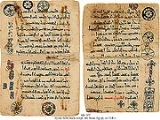
Syriac language

Encyclopedia
Syriac is a dialect of Middle Aramaic that was once spoken across much of the Fertile Crescent
. Having first appeared as a script in the 1st century AD after being spoken as an unwritten language for five centuries, Classical Syriac became a major literary language throughout the Middle East
from the 4th to the 8th centuries, the classical language
of Edessa
, preserved in a large body of Syriac literature
.
It became the vehicle of Syriac Christianity
and culture, spreading throughout Asia
as far as the Indian Malabar Coast
and Eastern China
and was the medium of communication and cultural dissemination for Arabs and, to a lesser extent, Persians
. Primarily a Christian medium of expression, Syriac had a fundamental cultural and literary influence on the development of Arabic which replaced it towards the end of the 8th century. Syriac remains the liturgical language of Syriac Christianity.
Syriac is a Middle Aramaic language, and as such a language of the Northwestern branch
of the Semitic family
.
Syriac is written in the Syriac alphabet
, a derivation of the Aramaic alphabet
.
ruled Assyria
(Asuristan
) and northern Mesopotamia
that has evolved under the influence of Christianity into its current form. Before Arabic became the dominant language, Syriac was a major language among Christian communities in the Middle East
, Central Asia
and Kerala
.
/northern Mesopotamia. The first evidence we have of such dialects is their influence on the written Imperial Aramaic from the 5th century BC. After the conquest of Mesopotamia and Aramea (Syria) by Alexander the Great, Syriac and other Aramaic dialects became written languages in a reaction to Hellenism
.
Syriac orthography is drawn from Arsacid Aramaic.
In 132 BC, the neo Assyrian kingdom of Osroene
was founded in Edessa
with Syriac as its official language. Syriac-speakers still look to Edessa as the cradle of their language.
There are about eighty extant early Syriac inscriptions, dated to the first three centuries AD (the earliest example of Syriac, rather than Imperial Aramaic, is in an inscription dated to AD 6, and the earliest parchment is a deed of sale dated to AD 243). All of these early examples of the language are non-Christian. As an official language, Syriac was given a relatively coherent form, style and grammar that is lacking in other Old Eastern Aramaic dialects.
 In the 3rd century, churches in Edessa began to use Syriac as the language of worship. There is evidence that the adoption of Syriac, the language of the people, was to effect mission. Much literary effort was put into the production of an authoritative translation of the Bible into Syriac, the Peshitta
( ). At the same time, Ephrem the Syrian
was producing the most treasured collection of poetry and theology in the Syriac language.
In 489, many Syriac-speaking Christians living in the Roman Empire fled to Persia to escape persecution and growing animosity with Greek-speaking Christians. The Christological differences with the Church of the East
led to the bitter Nestorian schism
in the Syriac-speaking world. As a result, Syriac developed distinctive western and eastern varieties. Although remaining a single language with a high level of comprehension between the varieties, the two employ distinctive variations in pronunciation and writing system, and, to a lesser degree, in vocabulary.
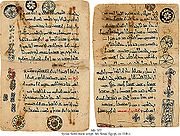 Western Syriac is the official language of the West Syrian rite
, practiced by the Syriac Orthodox Church
, the Syrian Catholic Church, the Maronite Church, the Malankara Orthodox Syrian Church, the Mar Thoma Church
, and the Syro-Malankara Catholic Church
.
Eastern Syriac is the liturgical language of the East Syrian rite
, practiced in modern times by the Assyrian Church of the East
, the Chaldean Syrian Church
, the Ancient Church of the East
, the Chaldean Catholic Church
, and the Syro-Malabar Church.
Syriac literature is by far the most prodigious of the various Aramaic language
s. Its corpus covers poetry, prose, theology, liturgy, hymnody, history, philosophy, science, medicine and natural history. Much of this wealth remains unavailable in critical editions or modern translation.
From the 7th century onwards, Syriac gave way to Arabic
as the spoken language of the region. The Mongol invasions of the 13th century further contributed to the rapid decline of the language. In many places outside of northern Mesopotamia, even in liturgy, it was replaced by Arabic.
Syriac have been recognised as an official minority language
in Iraq. It is also taught in some public schools in Iraq, Israel
and Sweden
.
Among the Syriac churches of Kerala, Malayalam often replaces Syriac. Literary Syriac is often used as a spoken language by clerics who do not speak the vernacular dialects.
, are built out of triliteral
roots, collations of three Syriac consonants with variable vowel sets as a "glue". For example, the root , , has the basic meaning of taking, and so we have the following words that can be formed from this root: – : "he took" – : "he will take" – : "he takes, he is taking" – : "he has lifted/raised" – : "he has set out" – : "a taking, burden, recension, portion or syllable" – : "takings, profits, taxes" – : "a beast of burden" – : "arrogance"
s are built from triliteral
roots. Nouns carry grammatical gender
(masculine or feminine), they can be either singular or plural in number (a very few can be dual) and can exist in one of three grammatical states. These states correspond, in part, to the role of grammatical case
s in some other languages.
However, very quickly in the development of Classical Syriac, the emphatic state became the ordinary form of the noun, and the absolute and construct states were relegated to certain stock phrases (for example, , , "man", literally "son of man").
In Old and early Classical Syriac, most genitive
noun relationships are built using the construct state. Thus, , , means "the taxes of the kingdom". Quickly, the construct relationship was abandoned and replaced by the use of the relative particle , . Thus, the same noun phrase
becomes , , where both nouns are in the emphatic state. Very closely related nouns can be drawn into a closer grammatical relationship by the addition of a pronominal suffix. Thus, the phrase can be written as , . In this case, both nouns continue to be in the emphatic state, but the first has the suffix that makes it literally read "her taxes" ("kingdom" is feminine), and thus is "her taxes, those of the kingdom".
Adjective
s always agree in gender and number with the nouns they modify. Adjectives are in the absolute state if they are predicative, but agree with the state of their noun if attributive. Thus, , , means "the taxes are evil", whereas , , means "evil taxes".
roots as well. Finite verbs carry person
, gender
(except in the first person) and number, as well as tense
and conjugation. The non-finite verb forms are the infinitive
and the active
and passive
participle
s.
Syriac has only two true morphological
tenses: perfect and imperfect. Whereas these tenses were originally aspectual
in Aramaic
, they have become a truly temporal past
and future
tenses respectively. The present tense
is usually marked with the participle
followed by the subject
pronoun
. However, such pronouns are usually omitted in the case of the third person. This use of the participle to mark the present tense is the most common of a number of compound tenses that can be used to express varying senses of tense and aspect.
Syriac also employs verb conjugations such as are present in other Semitic languages
. These are regular modifications of the verb's root to express other changes in meaning. The first conjugation is the ground state, or (this name models the shape of the root). form of the verb, which carries the usual meaning of the word. The next is the intensive state, or , form of the verb, which usually carries an intensified
meaning, The third is the extensive state, or , form of the verb, which is often causative
in meaning. Each of these conjugations has its parallel passive
conjugation: the , and respectively. To these six cardinal conjugations are added a few irregular forms, like the and , which generally have an extensive meaning.
Phonetically, there is some variation in the pronunciation of Syriac in its various forms. The various Modern Eastern Aramaic vernaculars have quite different pronunciations, and these sometimes influence how the classical language is pronounced, for example, in public prayer. Classical Syriac has two major streams of pronunciation: western and eastern.
a set of lightly contrasted plosive
/fricative
pairs. In different variations of a certain lexical root, a root consonant might exist in plosive form in one variation and fricative form in another. In the Syriac alphabet
, a single letter is used for each pair. Sometimes a dot is placed above the letter (, or strengthening; equivalent to a dagesh in Hebrew
) to mark that the plosive pronunciation is required, and a dot is placed below the letter (, or softening) to mark that the fricative pronunciation is required. The pairs are:
As with other Semitic languages
, Syriac has a set of five emphatic consonant
s. These are consonants that are articulated or released in the pharynx
or slightly higher. The set consists of:
Syriac also has a rich array of sibilant consonant
s:
, the vowels of Syriac are mostly subordinated to consonants. Especially in the presence of an emphatic consonant
, vowels tend to become mid-centralised.
Classical Syriac had the following set of distinguishable vowels:
In the western dialect, /ɑ/ has become /o/, and the original /o/ has merged with /u/. In eastern dialects there is more fluidity in the pronunciation of front vowel
s, with some speakers distinguishing five qualities of such vowels, and others only distinguishing three. Vowel length is generally not important: close vowel
s tend to be longer than open vowel
s.
The open vowel
s form diphthong
s with the approximants
/j/ and /w/. In almost all dialects the full sets of possible diphthongs collapses into two or three actual pronunciations: sometimes monophthong
ized to /e/ usually becomes /ɑw/ usually becomes /aj/, but the western dialect has /oj/ sometimes monophthong
ized to /o/
Fertile Crescent
The Fertile Crescent, nicknamed "The Cradle of Civilization" for the fact the first civilizations started there, is a crescent-shaped region containing the comparatively moist and fertile land of otherwise arid and semi-arid Western Asia. The term was first used by University of Chicago...
. Having first appeared as a script in the 1st century AD after being spoken as an unwritten language for five centuries, Classical Syriac became a major literary language throughout the Middle East
Middle East
The Middle East is a region that encompasses Western Asia and Northern Africa. It is often used as a synonym for Near East, in opposition to Far East...
from the 4th to the 8th centuries, the classical language
Classical language
A classical language is a language with a literature that is classical. According to UC Berkeley linguist George L. Hart, it should be ancient, it should be an independent tradition that arose mostly on its own, not as an offshoot of another tradition, and it must have a large and extremely rich...
of Edessa
Edessa, Mesopotamia
Edessa is the Greek name of an Aramaic town in northern Mesopotamia, as refounded by Seleucus I Nicator. For the modern history of the city, see Şanlıurfa.-Names:...
, preserved in a large body of Syriac literature
Syriac literature
Syriac literature is literature written in the Syriac language, the classical Middle Aramaic language of Syriac Christianity. The majority of classical Syriac literature is of a Christian religious nature....
.
It became the vehicle of Syriac Christianity
Syriac Christianity
Syriac or Syrian Christianity , the Syriac-speaking Christians of Mesopotamia, comprises multiple Christian traditions of Eastern Christianity. With a history going back to the 1st Century AD, in modern times it is represented by denominations primarily in the Middle East and in Kerala, India....
and culture, spreading throughout Asia
Asia
Asia is the world's largest and most populous continent, located primarily in the eastern and northern hemispheres. It covers 8.7% of the Earth's total surface area and with approximately 3.879 billion people, it hosts 60% of the world's current human population...
as far as the Indian Malabar Coast
Malabar Coast
The Malabar Coast is a long and narrow coastline on the south-western shore line of the mainland Indian subcontinent. Geographically, it comprises the wettest regions of southern India, as the Western Ghats intercept the moisture-laden monsoon rains, especially on their westward-facing mountain...
and Eastern China
China
Chinese civilization may refer to:* China for more general discussion of the country.* Chinese culture* Greater China, the transnational community of ethnic Chinese.* History of China* Sinosphere, the area historically affected by Chinese culture...
and was the medium of communication and cultural dissemination for Arabs and, to a lesser extent, Persians
Persian people
The Persian people are part of the Iranian peoples who speak the modern Persian language and closely akin Iranian dialects and languages. The origin of the ethnic Iranian/Persian peoples are traced to the Ancient Iranian peoples, who were part of the ancient Indo-Iranians and themselves part of...
. Primarily a Christian medium of expression, Syriac had a fundamental cultural and literary influence on the development of Arabic which replaced it towards the end of the 8th century. Syriac remains the liturgical language of Syriac Christianity.
Syriac is a Middle Aramaic language, and as such a language of the Northwestern branch
Northwest Semitic languages
The Northwest Semitic languages form a medium-level division of the Semitic language family. The languages of this group are spoken by approximately eight million people today. The group is generally divided into three branches: Ugaritic , Canaanite and Aramaic...
of the Semitic family
Semitic languages
The Semitic languages are a group of related languages whose living representatives are spoken by more than 270 million people across much of the Middle East, North Africa and the Horn of Africa...
.
Syriac is written in the Syriac alphabet
Syriac alphabet
The Syriac alphabet is a writing system primarily used to write the Syriac language from around the 2nd century BC . It is one of the Semitic abjads directly descending from the Aramaic alphabet and shares similarities with the Phoenician, Hebrew, Arabic, and the traditional Mongolian alphabets.-...
, a derivation of the Aramaic alphabet
Aramaic alphabet
The Aramaic alphabet is adapted from the Phoenician alphabet and became distinctive from it by the 8th century BC. The letters all represent consonants, some of which are matres lectionis, which also indicate long vowels....
.
Geographic distribution
Syriac was originally a local Aramaic dialect in PersianSassanid Empire
The Sassanid Empire , known to its inhabitants as Ērānshahr and Ērān in Middle Persian and resulting in the New Persian terms Iranshahr and Iran , was the last pre-Islamic Persian Empire, ruled by the Sasanian Dynasty from 224 to 651...
ruled Assyria
Assyria
Assyria was a Semitic Akkadian kingdom, extant as a nation state from the mid–23rd century BC to 608 BC centred on the Upper Tigris river, in northern Mesopotamia , that came to rule regional empires a number of times through history. It was named for its original capital, the ancient city of Assur...
(Asuristan
Asuristan
Asuristan was the province of Assyria under the Sassanid Empire . It corresponds to the Babylonia province under the Parthian Empire.The province for the most part stretched from Mosul to Adiabene....
) and northern Mesopotamia
Mesopotamia
Mesopotamia is a toponym for the area of the Tigris–Euphrates river system, largely corresponding to modern-day Iraq, northeastern Syria, southeastern Turkey and southwestern Iran.Widely considered to be the cradle of civilization, Bronze Age Mesopotamia included Sumer and the...
that has evolved under the influence of Christianity into its current form. Before Arabic became the dominant language, Syriac was a major language among Christian communities in the Middle East
Middle East
The Middle East is a region that encompasses Western Asia and Northern Africa. It is often used as a synonym for Near East, in opposition to Far East...
, Central Asia
Central Asia
Central Asia is a core region of the Asian continent from the Caspian Sea in the west, China in the east, Afghanistan in the south, and Russia in the north...
and Kerala
Kerala
or Keralam is an Indian state located on the Malabar coast of south-west India. It was created on 1 November 1956 by the States Reorganisation Act by combining various Malayalam speaking regions....
.
History
The history of Syriac can be divided into three distinct periods:- Old Syriac (the language of the kingdom of OsroeneOsroeneOsroene, also spelled Osrohene and Osrhoene and sometimes known by the name of its capital city, Edessa , was a historic Syriac kingdom located in Mesopotamia, which enjoyed semi-autonomy to complete independence from the years of 132 BC to AD 244.It was a Syriac-speaking kingdom.Osroene, or...
), - Middle Syriac ( : Literary Syriac), which divided into:
- Western Middle Syriac (the literary and ecclesiastical language of Syriac and Maronite Christians),
- Eastern Middle Syriac (the literary and ecclesiastical language of Chaldean and Assyrian Christians).
Origins
Syriac began as an unwritten spoken dialect of Old Aramaic in AssyriaAssyria
Assyria was a Semitic Akkadian kingdom, extant as a nation state from the mid–23rd century BC to 608 BC centred on the Upper Tigris river, in northern Mesopotamia , that came to rule regional empires a number of times through history. It was named for its original capital, the ancient city of Assur...
/northern Mesopotamia. The first evidence we have of such dialects is their influence on the written Imperial Aramaic from the 5th century BC. After the conquest of Mesopotamia and Aramea (Syria) by Alexander the Great, Syriac and other Aramaic dialects became written languages in a reaction to Hellenism
Hellenistic civilization
Hellenistic civilization represents the zenith of Greek influence in the ancient world from 323 BCE to about 146 BCE...
.
Syriac orthography is drawn from Arsacid Aramaic.
In 132 BC, the neo Assyrian kingdom of Osroene
Osroene
Osroene, also spelled Osrohene and Osrhoene and sometimes known by the name of its capital city, Edessa , was a historic Syriac kingdom located in Mesopotamia, which enjoyed semi-autonomy to complete independence from the years of 132 BC to AD 244.It was a Syriac-speaking kingdom.Osroene, or...
was founded in Edessa
Edessa, Mesopotamia
Edessa is the Greek name of an Aramaic town in northern Mesopotamia, as refounded by Seleucus I Nicator. For the modern history of the city, see Şanlıurfa.-Names:...
with Syriac as its official language. Syriac-speakers still look to Edessa as the cradle of their language.
There are about eighty extant early Syriac inscriptions, dated to the first three centuries AD (the earliest example of Syriac, rather than Imperial Aramaic, is in an inscription dated to AD 6, and the earliest parchment is a deed of sale dated to AD 243). All of these early examples of the language are non-Christian. As an official language, Syriac was given a relatively coherent form, style and grammar that is lacking in other Old Eastern Aramaic dialects.
Literary Syriac
Peshitta
The Peshitta is the standard version of the Bible for churches in the Syriac tradition.The Old Testament of the Peshitta was translated into Syriac from the Hebrew, probably in the 2nd century AD...
( ). At the same time, Ephrem the Syrian
Ephrem the Syrian
Ephrem the Syrian was a Syriac and a prolific Syriac-language hymnographer and theologian of the 4th century. He is venerated by Christians throughout the world, and especially in the Syriac Orthodox Church, as a saint.Ephrem wrote a wide variety of hymns, poems, and sermons in verse, as well as...
was producing the most treasured collection of poetry and theology in the Syriac language.
In 489, many Syriac-speaking Christians living in the Roman Empire fled to Persia to escape persecution and growing animosity with Greek-speaking Christians. The Christological differences with the Church of the East
Church of the East
The Church of the East tāʾ d-Maḏnḥāʾ), also known as the Nestorian Church, is a Christian church, part of the Syriac tradition of Eastern Christianity. Originally the church of the Persian Sassanid Empire, it quickly spread widely through Asia...
led to the bitter Nestorian schism
Nestorian Schism
The Nestorian Schism was the split between the Orthodox Church and churches affiliated with Nestorian doctrine in the 5th century. The schism rose out of a Christological dispute, the key figures in which were Cyril of Alexandria and Nestorius...
in the Syriac-speaking world. As a result, Syriac developed distinctive western and eastern varieties. Although remaining a single language with a high level of comprehension between the varieties, the two employ distinctive variations in pronunciation and writing system, and, to a lesser degree, in vocabulary.
West Syrian Rite
The West Syrian Rite, also known as the Syrian Rite or the Syro-Antiochene Rite, is a Christian liturgical rite chiefly practiced in the Syriac Orthodox Church and churches related to or descended from it. It is part of the liturgical family known as the Antiochene Rite, which originated in the...
, practiced by the Syriac Orthodox Church
Syriac Orthodox Church
The Syriac Orthodox Church; is an autocephalous Oriental Orthodox church based in the Eastern Mediterranean, with members spread throughout the world. The Syriac Orthodox Church claims to derive its origin from one of the first Christian communities, established in Antioch by the Apostle St....
, the Syrian Catholic Church, the Maronite Church, the Malankara Orthodox Syrian Church, the Mar Thoma Church
Mar Thoma Church
The Malankara Mar Thoma Syrian Church also known as the Mar Thoma Church is a Christian denomination based in the state of Kerala in southwestern India. It has an entirely different identity when compared with other Churches in India. Most Christian churches around the world are divided into...
, and the Syro-Malankara Catholic Church
Syro-Malankara Catholic Church
The Syro-Malankara Catholic Church is an Eastern Catholic Church in full communion with the Holy See...
.
Eastern Syriac is the liturgical language of the East Syrian rite
East Syrian Rite
The East Syrian Rite is a Christian liturgy, also known as the Assyro-Chaldean Rite, Assyrian or Chaldean Rite, and the Persian Rite although it originated in Edessa, Mesopotamia...
, practiced in modern times by the Assyrian Church of the East
Assyrian Church of the East
The Assyrian Church of the East, officially the Holy Apostolic Catholic Assyrian Church of the East ʻIttā Qaddishtā w-Shlikhāitā Qattoliqi d-Madnĕkhā d-Āturāyē), is a Syriac Church historically centered in Mesopotamia. It is one of the churches that claim continuity with the historical...
, the Chaldean Syrian Church
Chaldean Syrian Church
The Chaldean Syrian Church is an Indian Christian church that is currently an archbishopric of the Assyrian Church of the East. Its members are part of the St. Thomas Christian community, who trace their origins to the evangelical activities of Thomas the Apostle in the 1st century. They are almost...
, the Ancient Church of the East
Ancient Church of the East
The Ancient Church of the East was established in 1968. It follows the traditions of one of the oldest Christian churches, the Church of the East, whose origins trace back to the See of Seleucia-Ctesiphon in central Mesopotamia...
, the Chaldean Catholic Church
Chaldean Catholic Church
The Chaldean Catholic Church , is an Eastern Syriac particular church of the Catholic Church, maintaining full communion with the Bishop of Rome and the rest of the Catholic Church...
, and the Syro-Malabar Church.
Syriac literature is by far the most prodigious of the various Aramaic language
Aramaic language
Aramaic is a group of languages belonging to the Afroasiatic language phylum. The name of the language is based on the name of Aram, an ancient region in central Syria. Within this family, Aramaic belongs to the Semitic family, and more specifically, is a part of the Northwest Semitic subfamily,...
s. Its corpus covers poetry, prose, theology, liturgy, hymnody, history, philosophy, science, medicine and natural history. Much of this wealth remains unavailable in critical editions or modern translation.
From the 7th century onwards, Syriac gave way to Arabic
Arabic language
Arabic is a name applied to the descendants of the Classical Arabic language of the 6th century AD, used most prominently in the Quran, the Islamic Holy Book...
as the spoken language of the region. The Mongol invasions of the 13th century further contributed to the rapid decline of the language. In many places outside of northern Mesopotamia, even in liturgy, it was replaced by Arabic.
Current status
Although Syriac isn't used as an everyday language, there have been several attempts to revive it. Revivals of Syriac in recent times have led to some success with the creation of newspapers in literary Syriac ( ), similar to the Arabic Fuṣḥā has been used since the early decades of the 20th century. Modern literal Syriac has also been used not only in religious literature but also in secular genres often with nationalistic themes.Syriac have been recognised as an official minority language
Minority language
A minority language is a language spoken by a minority of the population of a territory. Such people are termed linguistic minorities or language minorities.-International politics:...
in Iraq. It is also taught in some public schools in Iraq, Israel
Israel
The State of Israel is a parliamentary republic located in the Middle East, along the eastern shore of the Mediterranean Sea...
and Sweden
Sweden
Sweden , officially the Kingdom of Sweden , is a Nordic country on the Scandinavian Peninsula in Northern Europe. Sweden borders with Norway and Finland and is connected to Denmark by a bridge-tunnel across the Öresund....
.
Among the Syriac churches of Kerala, Malayalam often replaces Syriac. Literary Syriac is often used as a spoken language by clerics who do not speak the vernacular dialects.
Grammar
Many Syriac words, like those in other Semitic languagesSemitic languages
The Semitic languages are a group of related languages whose living representatives are spoken by more than 270 million people across much of the Middle East, North Africa and the Horn of Africa...
, are built out of triliteral
Triliteral
The roots of verbs and most nouns in the Semitic languages are characterized as a sequence of consonants or "radicals"...
roots, collations of three Syriac consonants with variable vowel sets as a "glue". For example, the root , , has the basic meaning of taking, and so we have the following words that can be formed from this root: – : "he took" – : "he will take" – : "he takes, he is taking" – : "he has lifted/raised" – : "he has set out" – : "a taking, burden, recension, portion or syllable" – : "takings, profits, taxes" – : "a beast of burden" – : "arrogance"
Nouns
Most Syriac nounNoun
In linguistics, a noun is a member of a large, open lexical category whose members can occur as the main word in the subject of a clause, the object of a verb, or the object of a preposition .Lexical categories are defined in terms of how their members combine with other kinds of...
s are built from triliteral
Triliteral
The roots of verbs and most nouns in the Semitic languages are characterized as a sequence of consonants or "radicals"...
roots. Nouns carry grammatical gender
Grammatical gender
Grammatical gender is defined linguistically as a system of classes of nouns which trigger specific types of inflections in associated words, such as adjectives, verbs and others. For a system of noun classes to be a gender system, every noun must belong to one of the classes and there should be...
(masculine or feminine), they can be either singular or plural in number (a very few can be dual) and can exist in one of three grammatical states. These states correspond, in part, to the role of grammatical case
Grammatical case
In grammar, the case of a noun or pronoun is an inflectional form that indicates its grammatical function in a phrase, clause, or sentence. For example, a pronoun may play the role of subject , of direct object , or of possessor...
s in some other languages.
- The absolute state is the basic form of the noun – , , "taxes".
- The emphatic state usually represents a definite noun – , , "the taxes".
- The construct state marks a noun in relationship to another noun – ̈, , "taxes of...".
However, very quickly in the development of Classical Syriac, the emphatic state became the ordinary form of the noun, and the absolute and construct states were relegated to certain stock phrases (for example, , , "man", literally "son of man").
In Old and early Classical Syriac, most genitive
Genitive case
In grammar, genitive is the grammatical case that marks a noun as modifying another noun...
noun relationships are built using the construct state. Thus, , , means "the taxes of the kingdom". Quickly, the construct relationship was abandoned and replaced by the use of the relative particle , . Thus, the same noun phrase
Noun phrase
In grammar, a noun phrase, nominal phrase, or nominal group is a phrase based on a noun, pronoun, or other noun-like word optionally accompanied by modifiers such as adjectives....
becomes , , where both nouns are in the emphatic state. Very closely related nouns can be drawn into a closer grammatical relationship by the addition of a pronominal suffix. Thus, the phrase can be written as , . In this case, both nouns continue to be in the emphatic state, but the first has the suffix that makes it literally read "her taxes" ("kingdom" is feminine), and thus is "her taxes, those of the kingdom".
Adjective
Adjective
In grammar, an adjective is a 'describing' word; the main syntactic role of which is to qualify a noun or noun phrase, giving more information about the object signified....
s always agree in gender and number with the nouns they modify. Adjectives are in the absolute state if they are predicative, but agree with the state of their noun if attributive. Thus, , , means "the taxes are evil", whereas , , means "evil taxes".
Verbs
Most Syriac verbs are built on triliteralTriliteral
The roots of verbs and most nouns in the Semitic languages are characterized as a sequence of consonants or "radicals"...
roots as well. Finite verbs carry person
Grammatical person
Grammatical person, in linguistics, is deictic reference to a participant in an event; such as the speaker, the addressee, or others. Grammatical person typically defines a language's set of personal pronouns...
, gender
Grammatical gender
Grammatical gender is defined linguistically as a system of classes of nouns which trigger specific types of inflections in associated words, such as adjectives, verbs and others. For a system of noun classes to be a gender system, every noun must belong to one of the classes and there should be...
(except in the first person) and number, as well as tense
Grammatical tense
A tense is a grammatical category that locates a situation in time, to indicate when the situation takes place.Bernard Comrie, Aspect, 1976:6:...
and conjugation. The non-finite verb forms are the infinitive
Infinitive
In grammar, infinitive is the name for certain verb forms that exist in many languages. In the usual description of English, the infinitive of a verb is its basic form with or without the particle to: therefore, do and to do, be and to be, and so on are infinitives...
and the active
Active voice
Active voice is a grammatical voice common in many of the world's languages. It is the unmarked voice for clauses featuring a transitive verb in nominative–accusative languages, including English and most other Indo-European languages....
and passive
Passive voice
Passive voice is a grammatical voice common in many of the world's languages. Passive is used in a clause whose subject expresses the theme or patient of the main verb. That is, the subject undergoes an action or has its state changed. A sentence whose theme is marked as grammatical subject is...
participle
Participle
In linguistics, a participle is a word that shares some characteristics of both verbs and adjectives. It can be used in compound verb tenses or voices , or as a modifier...
s.
Syriac has only two true morphological
Morphology (linguistics)
In linguistics, morphology is the identification, analysis and description, in a language, of the structure of morphemes and other linguistic units, such as words, affixes, parts of speech, intonation/stress, or implied context...
tenses: perfect and imperfect. Whereas these tenses were originally aspectual
Grammatical aspect
In linguistics, the grammatical aspect of a verb is a grammatical category that defines the temporal flow in a given action, event, or state, from the point of view of the speaker...
in Aramaic
Aramaic language
Aramaic is a group of languages belonging to the Afroasiatic language phylum. The name of the language is based on the name of Aram, an ancient region in central Syria. Within this family, Aramaic belongs to the Semitic family, and more specifically, is a part of the Northwest Semitic subfamily,...
, they have become a truly temporal past
Past tense
The past tense is a grammatical tense that places an action or situation in the past of the current moment , or prior to some specified time that may be in the speaker's past, present, or future...
and future
Future tense
In grammar, a future tense is a verb form that marks the event described by the verb as not having happened yet, but expected to happen in the future , or to happen subsequent to some other event, whether that is past, present, or future .-Expressions of future tense:The concept of the future,...
tenses respectively. The present tense
Present tense
The present tense is a grammatical tense that locates a situation or event in present time. This linguistic definition refers to a concept that indicates a feature of the meaning of a verb...
is usually marked with the participle
Participle
In linguistics, a participle is a word that shares some characteristics of both verbs and adjectives. It can be used in compound verb tenses or voices , or as a modifier...
followed by the subject
Subject (grammar)
The subject is one of the two main constituents of a clause, according to a tradition that can be tracked back to Aristotle and that is associated with phrase structure grammars; the other constituent is the predicate. According to another tradition, i.e...
pronoun
Pronoun
In linguistics and grammar, a pronoun is a pro-form that substitutes for a noun , such as, in English, the words it and he...
. However, such pronouns are usually omitted in the case of the third person. This use of the participle to mark the present tense is the most common of a number of compound tenses that can be used to express varying senses of tense and aspect.
Syriac also employs verb conjugations such as are present in other Semitic languages
Semitic languages
The Semitic languages are a group of related languages whose living representatives are spoken by more than 270 million people across much of the Middle East, North Africa and the Horn of Africa...
. These are regular modifications of the verb's root to express other changes in meaning. The first conjugation is the ground state, or (this name models the shape of the root). form of the verb, which carries the usual meaning of the word. The next is the intensive state, or , form of the verb, which usually carries an intensified
Intensive
In grammar, an intensive word form is one which denotes stronger or more forceful action relative to the root on which the intensive is built. Intensives are usually lexical formations, but there may be a regular process for forming intensives from a root...
meaning, The third is the extensive state, or , form of the verb, which is often causative
Causative
In linguistics, a causative is a form that indicates that a subject causes someone or something else to do or be something, or causes a change in state of a non-volitional event....
in meaning. Each of these conjugations has its parallel passive
Passive voice
Passive voice is a grammatical voice common in many of the world's languages. Passive is used in a clause whose subject expresses the theme or patient of the main verb. That is, the subject undergoes an action or has its state changed. A sentence whose theme is marked as grammatical subject is...
conjugation: the , and respectively. To these six cardinal conjugations are added a few irregular forms, like the and , which generally have an extensive meaning.
Phonology
Phonologically, like the other Northwest Semitic languages, Syriac has 22 consonants and 3 vowels. The consonantal phonemes are:| transliteration | ||||||||||||||||||||||
| letter | ||||||||||||||||||||||
| pronunciation | [ʔ] | [b], [v] | [ɡ], [ɣ] | [d], [ð] | [h] | [w] | [z] | [ħ] | [tˤ] | [j] | [k], [x] | [l] | [m] | [n] | [s] | [ʕ] | [p], [f] | [sˤ] | [q] | [r] | [ʃ] | [t], [θ] |
Phonetically, there is some variation in the pronunciation of Syriac in its various forms. The various Modern Eastern Aramaic vernaculars have quite different pronunciations, and these sometimes influence how the classical language is pronounced, for example, in public prayer. Classical Syriac has two major streams of pronunciation: western and eastern.
Consonants
Syriac shares with AramaicAramaic language
Aramaic is a group of languages belonging to the Afroasiatic language phylum. The name of the language is based on the name of Aram, an ancient region in central Syria. Within this family, Aramaic belongs to the Semitic family, and more specifically, is a part of the Northwest Semitic subfamily,...
a set of lightly contrasted plosive
Stop consonant
In phonetics, a plosive, also known as an occlusive or an oral stop, is a stop consonant in which the vocal tract is blocked so that all airflow ceases. The occlusion may be done with the tongue , lips , and &...
/fricative
Fricative consonant
Fricatives are consonants produced by forcing air through a narrow channel made by placing two articulators close together. These may be the lower lip against the upper teeth, in the case of ; the back of the tongue against the soft palate, in the case of German , the final consonant of Bach; or...
pairs. In different variations of a certain lexical root, a root consonant might exist in plosive form in one variation and fricative form in another. In the Syriac alphabet
Syriac alphabet
The Syriac alphabet is a writing system primarily used to write the Syriac language from around the 2nd century BC . It is one of the Semitic abjads directly descending from the Aramaic alphabet and shares similarities with the Phoenician, Hebrew, Arabic, and the traditional Mongolian alphabets.-...
, a single letter is used for each pair. Sometimes a dot is placed above the letter (, or strengthening; equivalent to a dagesh in Hebrew
Hebrew language
Hebrew is a Semitic language of the Afroasiatic language family. Culturally, is it considered by Jews and other religious groups as the language of the Jewish people, though other Jewish languages had originated among diaspora Jews, and the Hebrew language is also used by non-Jewish groups, such...
) to mark that the plosive pronunciation is required, and a dot is placed below the letter (, or softening) to mark that the fricative pronunciation is required. The pairs are:
- Voiced labialLabial consonantLabial consonants are consonants in which one or both lips are the active articulator. This precludes linguolabials, in which the tip of the tongue reaches for the posterior side of the upper lip and which are considered coronals...
pair – /b/ and /v/ - Voiced velarVelar consonantVelars are consonants articulated with the back part of the tongue against the soft palate, the back part of the roof of the mouth, known also as the velum)....
pair – /ɡ/ and /ɣ/ - Voiced dental pair – /d/ and /ð/
- Voiceless velar pair – /k/ and /x/
- Voiceless labial pair – /p/ and /f/
- Voiceless dental pair – /t/ and /θ/
As with other Semitic languages
Semitic languages
The Semitic languages are a group of related languages whose living representatives are spoken by more than 270 million people across much of the Middle East, North Africa and the Horn of Africa...
, Syriac has a set of five emphatic consonant
Emphatic consonant
Emphatic consonant is a term widely used in Semitic linguistics to describe one of a series of obstruent consonants which originally contrasted with series of both voiced and voiceless obstruents. In specific Semitic languages, the members of this series may be realized as pharyngealized,...
s. These are consonants that are articulated or released in the pharynx
Pharynx
The human pharynx is the part of the throat situated immediately posterior to the mouth and nasal cavity, and anterior to the esophagus and larynx. The human pharynx is conventionally divided into three sections: the nasopharynx , the oropharynx , and the laryngopharynx...
or slightly higher. The set consists of:
- Voiceless pharyngeal fricativeVoiceless pharyngeal fricativeThe voiceless pharyngeal fricative is a type of consonantal sound, used in some spoken languages. The symbol in the International Phonetic Alphabet that represents this sound is h-bar .-Features:Features of the voiceless pharyngeal fricative:...
– /ħ/ - PharyngealizedPharyngealisation-Further reading:*Ian Maddieson, -See also:*Velarization*Creaky voice *Pharyngeal consonant*Epiglottal consonant*Pharynx...
voiceless dental plosiveVoiceless dental plosiveThe voiceless dental plosive is a type of consonantal sound, used in some spoken languages. The symbol in the International Phonetic Alphabet that represents this sound is , and the equivalent X-SAMPA symbol is t_d...
– /tˤ/ - Voiced pharyngeal fricativeVoiced pharyngeal fricativeThe voiced pharyngeal approximant or fricative is a type of consonantal sound, used in some spoken languages. The symbol in the International Phonetic Alphabet that represents it is , and the equivalent X-SAMPA symbol is ?\....
– /ʕ/ - Pharyngealized voiceless alveolar fricativeVoiceless alveolar fricativeThe voiceless alveolar sibilant is a common consonant sound in spoken languages. It is the sound in English words such as sea and pass, and is represented in the International Phonetic Alphabet as . It has a characteristic high-pitched, highly perceptible hissing sound...
– /sˤ/ - Voiceless uvular plosive – /q/
Syriac also has a rich array of sibilant consonant
Sibilant consonant
A sibilant is a manner of articulation of fricative and affricate consonants, made by directing a stream of air with the tongue towards the sharp edge of the teeth, which are held close together. Examples of sibilants are the consonants at the beginning of the English words sip, zip, ship, chip,...
s:
- Voiced alveolar fricativeVoiced alveolar fricativeThe voiced alveolar fricatives are consonantal sounds. The symbol in the International Phonetic Alphabet that represents these sounds depends on whether a sibilant or non-sibilant fricative is being described....
– /z/ - Voiceless alveolar fricativeVoiceless alveolar fricativeThe voiceless alveolar sibilant is a common consonant sound in spoken languages. It is the sound in English words such as sea and pass, and is represented in the International Phonetic Alphabet as . It has a characteristic high-pitched, highly perceptible hissing sound...
– /s/ - PharyngealizedPharyngealisation-Further reading:*Ian Maddieson, -See also:*Velarization*Creaky voice *Pharyngeal consonant*Epiglottal consonant*Pharynx...
voiceless alveolar fricativeVoiceless alveolar fricativeThe voiceless alveolar sibilant is a common consonant sound in spoken languages. It is the sound in English words such as sea and pass, and is represented in the International Phonetic Alphabet as . It has a characteristic high-pitched, highly perceptible hissing sound...
– /sˤ/ - Voiceless postalveolar fricativeVoiceless postalveolar fricativeThe voiceless palato-alveolar fricative or voiceless domed postalveolar fricative is a type of consonantal sound, used in many spoken languages, including English...
– /ʃ/
| Labial Labial consonant Labial consonants are consonants in which one or both lips are the active articulator. This precludes linguolabials, in which the tip of the tongue reaches for the posterior side of the upper lip and which are considered coronals... |
Dental | Alveolar Alveolar consonant Alveolar consonants are articulated with the tongue against or close to the superior alveolar ridge, which is called that because it contains the alveoli of the superior teeth... |
Post- alveolar Postalveolar consonant Postalveolar consonants are consonants articulated with the tongue near or touching the back of the alveolar ridge, further back in the mouth than the alveolar consonants, which are at the ridge itself, but not as far back as the hard palate... |
Palatal Palatal consonant Palatal consonants are consonants articulated with the body of the tongue raised against the hard palate... |
Velar Velar consonant Velars are consonants articulated with the back part of the tongue against the soft palate, the back part of the roof of the mouth, known also as the velum).... |
Uvular Uvular consonant Uvulars are consonants articulated with the back of the tongue against or near the uvula, that is, further back in the mouth than velar consonants. Uvulars may be plosives, fricatives, nasal stops, trills, or approximants, though the IPA does not provide a separate symbol for the approximant, and... |
Pharyn- geal Pharyngeal consonant A pharyngeal consonant is a type of consonant which is articulated with the root of the tongue against the pharynx.-Pharyngeal consonants in the IPA:Pharyngeal consonants in the International Phonetic Alphabet :... |
Glottal Glottal consonant Glottal consonants, also called laryngeal consonants, are consonants articulated with the glottis. Many phoneticians consider them, or at least the so-called fricative, to be transitional states of the glottis without a point of articulation as other consonants have; in fact, some do not consider... |
||||
|---|---|---|---|---|---|---|---|---|---|---|---|---|
| plain | emphatic | plain | ||||||||||
| Nasal Nasal consonant A nasal consonant is a type of consonant produced with a lowered velum in the mouth, allowing air to escape freely through the nose. Examples of nasal consonants in English are and , in words such as nose and mouth.- Definition :... |
m | n | ||||||||||
| Plosive | voiced | b | d | ɡ | ||||||||
| voiceless | p | t | tˤ | k | q | ʔ | ||||||
| Fricative Fricative consonant Fricatives are consonants produced by forcing air through a narrow channel made by placing two articulators close together. These may be the lower lip against the upper teeth, in the case of ; the back of the tongue against the soft palate, in the case of German , the final consonant of Bach; or... |
voiced | v | ð | z | ɣ | ʕ | ||||||
| voiceless | f | θ | sˤ | s | ʃ | x | ħ | h | ||||
| Approximant Approximant consonant Approximants are speech sounds that involve the articulators approaching each other but not narrowly enough or with enough articulatory precision to create turbulent airflow. Therefore, approximants fall between fricatives, which do produce a turbulent airstream, and vowels, which produce no... |
l | j | w | (ʕ) | ||||||||
| Trill Trill consonant In phonetics, a trill is a consonantal sound produced by vibrations between the articulator and the place of articulation. Standard Spanish <rr> as in perro is an alveolar trill, while in Parisian French it is almost always uvular.... |
r | |||||||||||
Vowels
As with most Semitic languagesSemitic languages
The Semitic languages are a group of related languages whose living representatives are spoken by more than 270 million people across much of the Middle East, North Africa and the Horn of Africa...
, the vowels of Syriac are mostly subordinated to consonants. Especially in the presence of an emphatic consonant
Emphatic consonant
Emphatic consonant is a term widely used in Semitic linguistics to describe one of a series of obstruent consonants which originally contrasted with series of both voiced and voiceless obstruents. In specific Semitic languages, the members of this series may be realized as pharyngealized,...
, vowels tend to become mid-centralised.
Classical Syriac had the following set of distinguishable vowels:
- Close front unrounded vowelClose front unrounded vowelThe close front unrounded vowel, or high front unrounded vowel, is a type of vowel sound, used in many spoken languages. The symbol in the International Phonetic Alphabet that represents this sound is ....
– /i/ - Close-mid front unrounded vowelClose-mid front unrounded vowelThe close-mid front unrounded vowel, or high-mid front unrounded vowel, is a type of vowel sound, used in some spoken languages. The symbol in the International Phonetic Alphabet that represents this sound is ....
– /e/ - Open-mid front unrounded vowel – /ɛ/
- Open front unrounded vowel – /a/
- Open back unrounded vowel – /ɑ/
- Close-mid back rounded vowel – /o/
- Close back rounded vowelClose back rounded vowelThe close back rounded vowel, or high back rounded vowel, is a type of vowel sound, used in many spoken languages. The symbol in the International Phonetic Alphabet that represents this sound is , and the equivalent X-SAMPA symbol is u....
– /u/
In the western dialect, /ɑ/ has become /o/, and the original /o/ has merged with /u/. In eastern dialects there is more fluidity in the pronunciation of front vowel
Front vowel
A front vowel is a type of vowel sound used in some spoken languages. The defining characteristic of a front vowel is that the tongue is positioned as far in front as possible in the mouth without creating a constriction that would be classified as a consonant. Front vowels are sometimes also...
s, with some speakers distinguishing five qualities of such vowels, and others only distinguishing three. Vowel length is generally not important: close vowel
Close vowel
A close vowel is a type of vowel sound used in many spoken languages. The defining characteristic of a close vowel is that the tongue is positioned as close as possible to the roof of the mouth without creating a constriction that would be classified as a consonant.This term is prescribed by the...
s tend to be longer than open vowel
Open vowel
An open vowel is defined as a vowel sound in which the tongue is positioned as far as possible from the roof of the mouth. Open vowels are sometimes also called low vowels in reference to the low position of the tongue...
s.
The open vowel
Open vowel
An open vowel is defined as a vowel sound in which the tongue is positioned as far as possible from the roof of the mouth. Open vowels are sometimes also called low vowels in reference to the low position of the tongue...
s form diphthong
Diphthong
A diphthong , also known as a gliding vowel, refers to two adjacent vowel sounds occurring within the same syllable. Technically, a diphthong is a vowel with two different targets: That is, the tongue moves during the pronunciation of the vowel...
s with the approximants
Approximant consonant
Approximants are speech sounds that involve the articulators approaching each other but not narrowly enough or with enough articulatory precision to create turbulent airflow. Therefore, approximants fall between fricatives, which do produce a turbulent airstream, and vowels, which produce no...
/j/ and /w/. In almost all dialects the full sets of possible diphthongs collapses into two or three actual pronunciations: sometimes monophthong
Monophthong
A monophthong is a pure vowel sound, one whose articulation at both beginning and end is relatively fixed, and which does not glide up or down towards a new position of articulation....
ized to /e/ usually becomes /ɑw/ usually becomes /aj/, but the western dialect has /oj/ sometimes monophthong
Monophthong
A monophthong is a pure vowel sound, one whose articulation at both beginning and end is relatively fixed, and which does not glide up or down towards a new position of articulation....
ized to /o/
See also
- Syriac alphabetSyriac alphabetThe Syriac alphabet is a writing system primarily used to write the Syriac language from around the 2nd century BC . It is one of the Semitic abjads directly descending from the Aramaic alphabet and shares similarities with the Phoenician, Hebrew, Arabic, and the traditional Mongolian alphabets.-...
- Syriac literatureSyriac literatureSyriac literature is literature written in the Syriac language, the classical Middle Aramaic language of Syriac Christianity. The majority of classical Syriac literature is of a Christian religious nature....
- PeshittaPeshittaThe Peshitta is the standard version of the Bible for churches in the Syriac tradition.The Old Testament of the Peshitta was translated into Syriac from the Hebrew, probably in the 2nd century AD...
- Ephrem the SyrianEphrem the SyrianEphrem the Syrian was a Syriac and a prolific Syriac-language hymnographer and theologian of the 4th century. He is venerated by Christians throughout the world, and especially in the Syriac Orthodox Church, as a saint.Ephrem wrote a wide variety of hymns, poems, and sermons in verse, as well as...
- Syriac musicSyriac musicSyriac sacral music is music in the Syriac language as used in the liturgy of Syriac Christianity.Historically it is best known from and important for its part in the development of Christian sacred music since Antiquity....
- Corpus Scriptorum Christianorum OrientaliumCorpus Scriptorum Christianorum OrientaliumThe Corpus Scriptorum Christianorum Orientalium is an important multilingual collection of Eastern Christian texts with over 600 volumes published since its foundation in 1903 by Louvain Catholic University in Belgium and The Catholic University of America in Washington, D.C....
- Turoyo
- Syrian ArabicSyrian ArabicSyrian Arabic is a variety of Arabic spoken in Syria.-History:Syrian Arabic proper is a form of Levantine Arabic, and may be divided into South Syrian Arabic, spoken in the cities of Damascus, Homs and Hama, and North Syrian Arabic, spoken in the region of Aleppo. Allied dialects are spoken in...
External links
- Syriacdictionary.net, Syriac Dictionary in four languages
- Langues araméennes on wikisyr.com
- Beth Mardutho – The Syriac Institute
- New Aramaic Bibel in mp3 and Worshipsongs
- Hugoye: Journal of Syriac Studies
- Payne Smith's Compendious Syriac Dictionary
- Ethnologue report on Syriac
- Suryoyo Online – Online Journal of Syrian Orthodox Church, Syriac Studies and Aramaeans
- Introduction To The Syriac-Aramaic Language – an introduction and resources from a popular Maronite website
- Syriac–English–French Online Dictionary – poor general coverage
- Beth Sapra: A Scribe's Library: contains two old Syriac grammars in the public domain and the Gospels in Syriac
- Other Public Domain Syriac grammars at the Internet ArchiveInternet ArchiveThe Internet Archive is a non-profit digital library with the stated mission of "universal access to all knowledge". It offers permanent storage and access to collections of digitized materials, including websites, music, moving images, and nearly 3 million public domain books. The Internet Archive...