

Textus Receptus

Encyclopedia
Textus Receptus is the name subsequently given to the succession of printed Greek
texts of the New Testament
which constituted the translation base for the original German
Luther Bible
, the translation of the New Testament into English
by William Tyndale
, the King James Version, and for most other Reformation-era
New Testament translations throughout Western and Central Europe
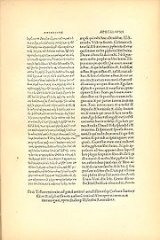
. The series originated with the first printed Greek New Testament to be published; a work undertaken in Basel
by the Dutch
Catholic
scholar and humanist Desiderius Erasmus in 1516, on the basis of some six manuscripts
, containing between them not quite the whole of the New Testament. The lacking text was translated from Vulgate
. Although based mainly on late manuscripts of the Byzantine text-type
, Erasmus's edition differed markedly from the classic form of that text.
manuscripts he could find to create a critical edition. Then he polished the Latin. He declared, "It is only fair that Paul should address the Romans in somewhat better Latin." In the earlier phases of the project, he never mentioned a Greek text: "My mind is so excited at the thought of emending Jerome’s text, with notes, that I seem to myself inspired by some god. I have already almost finished emending him by collating a large number of ancient manuscripts, and this I am doing at enormous personal expense."
 While his intentions for publishing a fresh Latin translation are clear, it is less clear why he included the Greek text. Though some speculate that he intended on producing a critical Greek text or that he wanted to beat the Complutensian Polyglot
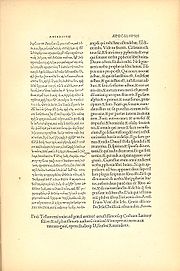
into print, there is no evidence to support this. Rather his motivation seems to be simpler: he included the Greek text to prove the superiority of his Latin version. He wrote, "There remains the New Testament translated by me, with the Greek facing, and notes on it by me." He further demonstrated the reason for the inclusion of the Greek text when defending his work: "But one thing the facts cry out, and it can be clear, as they say, even to a blind man, that often through the translator’s clumsiness or inattention the Greek has been wrongly rendered; often the true and genuine reading has been corrupted by ignorant scribes, which we see happen every day, or altered by scribes who are half-taught and half-asleep." Erasmus's new work was published by Froben
of Basel
in 1516 and thence became the first published Greek New Testament, the Novum Instrumentum omne
, diligenter ab Erasmo Rot. Recognitum et Emendatum. He used manuscripts: 1, 1rK
, 2e
, 2ap
, 4ap
, 7
, 817
.
The second edition used the more familiar term Testamentum instead of Instrumentum, and eventually became a major source for Luther's German
translation. In second edition (1519) Erasmus used also Minuscule 3
.
Typographical errors (attributed to the rush to complete the work) abounded in the published text. Erasmus also lacked a complete copy of the book of Revelation
and was forced to translate the last six verses back into Greek from the Latin Vulgate
in order to finish his edition. Erasmus adjusted the text in many places to correspond with readings found in the Vulgate, or as quoted in the Church Fathers
; consequently, although the Textus Receptus is classified by scholars as a late Byzantine
text, it differs in nearly two thousand readings from the standard form of that text-type, as represented by the "Majority Text" of Hodges and Farstad (Wallace 1989). The edition was a sell-out commercial success and was reprinted in 1519, with most—though not all—the typographical errors corrected.
Erasmus had been studying Greek New Testament manuscripts for many years, in the Netherlands, France, England and Switzerland, noting their many variants, but had only six Greek manuscripts immediately accessible to him in Basel. They all dated from the 12th Century or later, and only one came from outside the mainstream Byzantine
tradition. Consequently, most modern scholars consider his text to be of dubious quality.
With the third edition of Erasmus' Greek text (1522) the Comma Johanneum
was included, because "Erasmus chose to avoid any occasion for slander rather than persisting in philological accuracy", even though he remained "convinced that it did not belong to the original text of l John." Popular demand for Greek New Testaments led to a flurry of further authorized and unauthorized editions in the early sixteenth century, almost all of which were based on Erasmus's work and incorporated his particular readings, although typically also making a number of minor changes of their own.
 The overwhelming success of Erasmus' Greek New Testament completely overshadowed the Latin text upon which he had focused. Many other publishers produced their own versions of the Greek New Testament over the next several centuries. Rather than doing their own critical work, most just relied on the well-known Erasmian text.
Robert Estienne
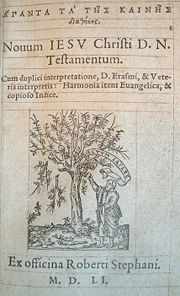
, known as Stefanus (1503–1559), a printer from Paris, edited the Greek New Testament four times, in 1546, 1549, 1550 and 1551, the last in Geneva. The first two are among the neatest Greek texts known, and are called O mirificam; the third edition is a splendid masterpiece of typographical skill. It has critical apparatus in which quoted manuscripts referred to the text. Manuscripts were marked by symbols (from α to ις). He used Polyglotta Complutensis (symbolized by α) and 15 Greek manuscripts. Among these are included: Codex Bezae
, Codex Regius
, minuscules 4
, 5
, 6
, 2817
, 8
, 9
. The first step towards modern Textual Criticism was made. The third edition is known as the Editio Regia
. The edition of 1551 contains the Latin translation of Erasmus and the Vulgate
. It is not nearly as fine as the other three and is exceedingly rare. It was in this edition that the division of the New Testament
into verses was for the first time introduced.
The third edition of Estienne was used by Theodore Beza
(1519–1605), who edited it nine times between 1565 and 1604. In the critical apparatus of the second edition he used the Codex Claromontanus
and the Syriac New Testament published by Emmanuel Tremellius in 1569. Codex Bezae was twice referenced (as Codex Bezae and β' of Estienne).
The origin of the term Textus Receptus comes from the publisher's preface to the 1633 edition produced by Bonaventure and his nephew Abraham Elzevir
who were partners in a printing business at Leiden. The preface reads, textum ergo habes, nunc ab omnibus receptum, in quo nihil immulatum aut corruptum damus, translated as, "so you hold the text, now received by all, in which (is) nothing corrupt." The two words textum and receptum were modified from the accusative to the nominative case to render textus receptus. Over time, this term has been retroactively applied to Erasmus' editions, as his work served as the basis of the others.
(1645–1707), collated textual variants from 82 Greek manuscripts. In his Novum Testamentum Graecum, cum lectionibus variantibus MSS (Oxford 1707) he reprinted the unchanged text of the Editio Regia, but in the index he enumerated 30,000 textual variants.
Shortly after Mill published his edition, Daniel Whitby
(1638–1725), attacked his work. He claimed that the autographs of the New Testament were identical to the Textus Receptus, and that the text had never been corrupted. He believed the text of the Holy Scripture was endangered by the 30,000 variants in Mill's edition. Whitby claimed that every part of the New Testament should be defended against these variants.
Johann Albrecht Bengel
(1687–1752), in 1725 edited Prodromus Novi Testamenti Graeci Rectè Cautèque Adornandi, in 1734 edited Novum Testamentum Graecum. Bengel divided manuscripts into families and subfamilies. He favoured the principle of lectio difficilior potior
("the more difficult reading is the stronger").
Johann Jakob Wettstein
. His Apparatus was fuller than of any previous editor. He introduced the practice of indicating the ancient manuscripts by capital Roman letters and the later manuscripts by Arabic numerals. He published in Basel Prolegomena ad Novi Testamenti Graeci (1731).
J. J. Griesbach
(1745–1812) combined the principles of Bengel and Wettstein. He enlarged the Apparatus by considering more citations from the Fathers, and various versions, such as the Gothic, the Armenian, and the Philoxenian. Griesbach distinguished a Western, an Alexandrian, and a Byzantine Recension. Christian Frederick Matthaei
(1744–1811) was a Griesbach opponent.
Karl Lachmann
(1793–1851), was the first who broke with the Textus Receptus. His object was to restore the text to the form in which it had been read in the ancient Church about A.D. 380. He used the oldest known Greek and Latin manuscripts. Tischendorf's Editio Octava Critica Maior
based on Codex Sinaiticus
.
Westcott
and Hort
, published The New Testament in the Original Greek
in 1881, in which they rejected Textus Receptus. The text is based mainly on Codex Vaticanus
in the Gospels.
The majority of textual critical scholars since the late 19th Century, have adopted an eclectic approach to the Greek New Testament; with the most weight given to the earliest extant manuscripts which tend mainly to be Alexandrian
in character; the resulting eclectic Greek text departing from the Textus Receptus in around 6,000 readings. A significant minority of textual scholars, however, maintain the priority of the Byzantine text-type
; and consequently prefer the "Majority Text". No school of textual criticism
now continues to defend the priority of the Textus Receptus; although this position does still find adherents amongst the King-James-Only Movement
, and other Protestant groups opposed to the discipline of text criticism—as applied to scripture.
Regarding Erasmus, Nolan stated:
The Textus Receptus was defended by John William Burgon
in his The Revision Revised (1881), and also by Edward Miller in A Guide to the Textual Criticism of the New Testament (1886). Burgon supported his arguments with the opinion that the Codex Alexandrinus
and Codex Ephraemi, were older than the Sinaiticus
and Vaticanus; and also that the Peshitta
translation into Syriac (which supports the Byzantine Text), originated in the 2nd century. Miller's arguments in favour of readings in the Textus Receptus were of the same kind. However, both Burgon and Miller believed that, although the Textus Receptus was to be preferred to the Alexandrian Text, nevertheless it still required to be corrected in certain readings against the manuscript tradition of the Byzantine text. In this judgement they have been criticised by Edward F. Hills
. Hills argues that the principle that God provides truth through scriptural revelation, necessarily also implies that God must ensure a preserved transmission of the correct revealed text, continuing into the Reformation era of biblical translation and printing. For Hills, the task of biblical scholarship is to identify the particular line of preserved transmission through which God is acting; a line which he sees in the specific succession of manuscript copying, textual correction and printing, which culminated in the Textus Receptus and the King James Bible. Hills argues that the principle of providentially preserved transmission guarantees that the printed Textus Receptus must be the closest text to the Greek autographs; and consequently he rejects readings in the majority Byzantine text where these are not maintained in the Textus Receptus. He goes so far as to conclude that Erasmus must have been providentially guided when he introduced Latin Vulgate readings into his Greek text; and even argues for the authenticity of the Comma Johanneum.
Hills was the first textual critic to defend Textus Receptus. Although others have defended the TR per se, they are either not acknowledged textual critics (e.g. Theodore Letis, David Hocking) or their works are not on a scholarly level (e.g., Terence H. Brown or D. A. Waite).

, also called 'Majority text', and usually is identified with it by its followers. But the Textus Receptus has some additions and variants which did not exist in the Byzantine text before the 16th century. The Comma Johanneum
in 1 John 5:7 is well known example, but there are also other texts like: Matt 10:8; 27:35; Luke 17:36; John 3:25; Acts 8:37; 9:5; 15:34; and some readings ("book of life" instead of "tree of life" in Revelation 22:19) which the Byzantine text did not have. In these cases the majority of manuscripts agree with the Alexandrian text-type
against the Textus Receptus.
F. H. A. Scrivener
(1813–1891) remarked that Matt. 22:28, 23:25, 27:52, 28:3, 4, 19, 20; Mark 7:18, 19, 26, 10:1, 12:22, 15:46; Luke 1:16, 61, 2:43, 9:1, 15, 11:49; John 1:28, 10:8, 13:20 are under the influence of Minuscule 1
(Caesarean text-type
). Scrivener showed that some texts were incorporated from the Vulgate (for example, Acts 9:6; Rev 17:4.8).
Daniel B. Wallace
enumerated that in 1,838 places (1005 are translatable) Textus Receptus differs from the Byzantine text-type.
Dean Burgon
, one of the main supporters of the Textus Receptus, declared that the Textus Receptus needs correction. He suggested 150 corrections in the Textus Receptus Gospel of Matthew alone.
Other articles
Modern Textual Criticism
Defense of Textus Receptus
Greek language
Greek is an independent branch of the Indo-European family of languages. Native to the southern Balkans, it has the longest documented history of any Indo-European language, spanning 34 centuries of written records. Its writing system has been the Greek alphabet for the majority of its history;...
texts of the New Testament
New Testament
The New Testament is the second major division of the Christian biblical canon, the first such division being the much longer Old Testament....
which constituted the translation base for the original German
German language
German is a West Germanic language, related to and classified alongside English and Dutch. With an estimated 90 – 98 million native speakers, German is one of the world's major languages and is the most widely-spoken first language in the European Union....
Luther Bible
Luther Bible
The Luther Bible is a German Bible translation by Martin Luther, first printed with both testaments in 1534. This translation became a force in shaping the Modern High German language. The project absorbed Luther's later years. The new translation was very widely disseminated thanks to the printing...
, the translation of the New Testament into English
English language
English is a West Germanic language that arose in the Anglo-Saxon kingdoms of England and spread into what was to become south-east Scotland under the influence of the Anglian medieval kingdom of Northumbria...
by William Tyndale
William Tyndale
William Tyndale was an English scholar and translator who became a leading figure in Protestant reformism towards the end of his life. He was influenced by the work of Desiderius Erasmus, who made the Greek New Testament available in Europe, and by Martin Luther...
, the King James Version, and for most other Reformation-era
Protestant Reformation
The Protestant Reformation was a 16th-century split within Western Christianity initiated by Martin Luther, John Calvin and other early Protestants. The efforts of the self-described "reformers", who objected to the doctrines, rituals and ecclesiastical structure of the Roman Catholic Church, led...
New Testament translations throughout Western and Central Europe
Central Europe
Central Europe or alternatively Middle Europe is a region of the European continent lying between the variously defined areas of Eastern and Western Europe...
. The series originated with the first printed Greek New Testament to be published; a work undertaken in Basel
Basel
Basel or Basle In the national languages of Switzerland the city is also known as Bâle , Basilea and Basilea is Switzerland's third most populous city with about 166,000 inhabitants. Located where the Swiss, French and German borders meet, Basel also has suburbs in France and Germany...
by the Dutch
Dutch people
The Dutch people are an ethnic group native to the Netherlands. They share a common culture and speak the Dutch language. Dutch people and their descendants are found in migrant communities worldwide, notably in Suriname, Chile, Brazil, Canada, Australia, South Africa, New Zealand, and the United...
Catholic
Catholic
The word catholic comes from the Greek phrase , meaning "on the whole," "according to the whole" or "in general", and is a combination of the Greek words meaning "about" and meaning "whole"...
scholar and humanist Desiderius Erasmus in 1516, on the basis of some six manuscripts
Biblical manuscript
A biblical manuscript is any handwritten copy of a portion of the text of the Bible. The word Bible comes from the Greek biblia ; manuscript comes from Latin manu and scriptum...
, containing between them not quite the whole of the New Testament. The lacking text was translated from Vulgate
Vulgate
The Vulgate is a late 4th-century Latin translation of the Bible. It was largely the work of St. Jerome, who was commissioned by Pope Damasus I in 382 to make a revision of the old Latin translations...
. Although based mainly on late manuscripts of the Byzantine text-type
Byzantine text-type
The Byzantine text-type is one of several text-types used in textual criticism to describe the textual character of Greek New Testament manuscripts. It is the form found in the largest number of surviving manuscripts, though not in the oldest...
, Erasmus's edition differed markedly from the classic form of that text.
History of the Textus Receptus
The Dutch humanist Erasmuse had been working for years on two projects: a collation of Greek texts and a fresh Latin New Testament. In 1512, he began his work on a fresh Latin New Testament. He collected all the VulgateVulgate
The Vulgate is a late 4th-century Latin translation of the Bible. It was largely the work of St. Jerome, who was commissioned by Pope Damasus I in 382 to make a revision of the old Latin translations...
manuscripts he could find to create a critical edition. Then he polished the Latin. He declared, "It is only fair that Paul should address the Romans in somewhat better Latin." In the earlier phases of the project, he never mentioned a Greek text: "My mind is so excited at the thought of emending Jerome’s text, with notes, that I seem to myself inspired by some god. I have already almost finished emending him by collating a large number of ancient manuscripts, and this I am doing at enormous personal expense."
Complutensian Polyglot Bible
The Complutensian Polyglot Bible is the name given to the first printed polyglot of the entire Bible, initiated and financed by Cardinal Francisco Jiménez de Cisneros . It includes the first printed editions of the Greek New Testament, the complete Septuagint, and the Targum Onkelos...
into print, there is no evidence to support this. Rather his motivation seems to be simpler: he included the Greek text to prove the superiority of his Latin version. He wrote, "There remains the New Testament translated by me, with the Greek facing, and notes on it by me." He further demonstrated the reason for the inclusion of the Greek text when defending his work: "But one thing the facts cry out, and it can be clear, as they say, even to a blind man, that often through the translator’s clumsiness or inattention the Greek has been wrongly rendered; often the true and genuine reading has been corrupted by ignorant scribes, which we see happen every day, or altered by scribes who are half-taught and half-asleep." Erasmus's new work was published by Froben
Johann Froben
Johann Froben, in Latin: Johannes Frobenius , was a famous printer and publisher in Basel...
of Basel
Basel
Basel or Basle In the national languages of Switzerland the city is also known as Bâle , Basilea and Basilea is Switzerland's third most populous city with about 166,000 inhabitants. Located where the Swiss, French and German borders meet, Basel also has suburbs in France and Germany...
in 1516 and thence became the first published Greek New Testament, the Novum Instrumentum omne
Novum Instrumentum omne
Novum Instrumentum omne was the first published New Testament in Greek . It was prepared by Desiderius Erasmus and printed by Johann Froben of Basel. Although the first printed Greek New Testament was the Complutensian Polyglot , it was the second to be published...
, diligenter ab Erasmo Rot. Recognitum et Emendatum. He used manuscripts: 1, 1rK
Minuscule 2814
Minuscule 2814 , Aν20 . Formerly it was labelled as 1rK in all catalogues, but it was renumbered as a 2814 by Aland. It is a Greek minuscule manuscript of the New Testament, dated palaeographically to the 12th century....
, 2e
Minuscule 2
Codex Basiliensis A. N. IV. 1, known as Minuscule 2 , ε 1214 . It is a Greek minuscule manuscript of the New Testament, dated palaeographically to the 11th or 12th century. It was used by Erasmus in his edition of Greek text of the New Testament and became the basis for the Textus Receptus in the...
, 2ap
Minuscule 2815
Minuscule 2815 , α 253 . Formerly was labelled as 2ap in all catalogues, but it was renumbered by Aland.It is a Greek minuscule manuscript of the New Testament, dated paleographically to the 12th century....
, 4ap
Minuscule 2816
Minuscule 2816 , α597 . Formerly was labelled as 4ap in all catalogs, but it was renumbered by Aland...
, 7
Minuscule 7
Minuscule 7 ; ε 287 . It is a Greek minuscule manuscript of the New Testament, on parchment. Palaeographically it has been assigned to the 12th century.- Description :...
, 817
Minuscule 817 (Gregory-Aland)
Minuscule 817 , Θε52 , is a Greek minuscule manuscript of the New Testament written on paper, with a commentary. It was used by Erasmus...
.
The second edition used the more familiar term Testamentum instead of Instrumentum, and eventually became a major source for Luther's German
German language
German is a West Germanic language, related to and classified alongside English and Dutch. With an estimated 90 – 98 million native speakers, German is one of the world's major languages and is the most widely-spoken first language in the European Union....
translation. In second edition (1519) Erasmus used also Minuscule 3
Minuscule 3
Minuscule 3 , δ 253 . It is a Greek minuscule manuscript of the New Testament, on a parchment. Palaeographically it has been assigned to the 12th century...
.
Typographical errors (attributed to the rush to complete the work) abounded in the published text. Erasmus also lacked a complete copy of the book of Revelation
Revelation
In religion and theology, revelation is the revealing or disclosing, through active or passive communication with a supernatural or a divine entity...
and was forced to translate the last six verses back into Greek from the Latin Vulgate
Vulgate
The Vulgate is a late 4th-century Latin translation of the Bible. It was largely the work of St. Jerome, who was commissioned by Pope Damasus I in 382 to make a revision of the old Latin translations...
in order to finish his edition. Erasmus adjusted the text in many places to correspond with readings found in the Vulgate, or as quoted in the Church Fathers
Church Fathers
The Church Fathers, Early Church Fathers, Christian Fathers, or Fathers of the Church were early and influential theologians, eminent Christian teachers and great bishops. Their scholarly works were used as a precedent for centuries to come...
; consequently, although the Textus Receptus is classified by scholars as a late Byzantine
Byzantine text-type
The Byzantine text-type is one of several text-types used in textual criticism to describe the textual character of Greek New Testament manuscripts. It is the form found in the largest number of surviving manuscripts, though not in the oldest...
text, it differs in nearly two thousand readings from the standard form of that text-type, as represented by the "Majority Text" of Hodges and Farstad (Wallace 1989). The edition was a sell-out commercial success and was reprinted in 1519, with most—though not all—the typographical errors corrected.
Erasmus had been studying Greek New Testament manuscripts for many years, in the Netherlands, France, England and Switzerland, noting their many variants, but had only six Greek manuscripts immediately accessible to him in Basel. They all dated from the 12th Century or later, and only one came from outside the mainstream Byzantine
Byzantine text-type
The Byzantine text-type is one of several text-types used in textual criticism to describe the textual character of Greek New Testament manuscripts. It is the form found in the largest number of surviving manuscripts, though not in the oldest...
tradition. Consequently, most modern scholars consider his text to be of dubious quality.
With the third edition of Erasmus' Greek text (1522) the Comma Johanneum
Comma Johanneum
The Comma Johanneum is a comma in the First Epistle of John according to the Latin Vulgate text as transmitted since the Early Middle Ages, based on Vetus Latina minority readings dating to the 7th century...
was included, because "Erasmus chose to avoid any occasion for slander rather than persisting in philological accuracy", even though he remained "convinced that it did not belong to the original text of l John." Popular demand for Greek New Testaments led to a flurry of further authorized and unauthorized editions in the early sixteenth century, almost all of which were based on Erasmus's work and incorporated his particular readings, although typically also making a number of minor changes of their own.
Robert Estienne
Robert Estienne
Robert I Estienne , known as Robertus Stephanus in Latin and also referred to as Robert Stephens by 18th and 19th-century English writers, was a 16th century printer and classical scholar in Paris...
, known as Stefanus (1503–1559), a printer from Paris, edited the Greek New Testament four times, in 1546, 1549, 1550 and 1551, the last in Geneva. The first two are among the neatest Greek texts known, and are called O mirificam; the third edition is a splendid masterpiece of typographical skill. It has critical apparatus in which quoted manuscripts referred to the text. Manuscripts were marked by symbols (from α to ις). He used Polyglotta Complutensis (symbolized by α) and 15 Greek manuscripts. Among these are included: Codex Bezae
Codex Bezae
The Codex Bezae Cantabrigensis, designated by siglum Dea or 05 , δ 5 , is a codex of the New Testament dating from the 5th century written in an uncial hand on vellum. It contains, in both Greek and Latin, most of the four Gospels and Acts, with a small fragment of the 3 John...
, Codex Regius
Codex Regius (New Testament)
Codex Regius designated by siglum Le or 019 , ε 56 , is a Greek uncial manuscript of the New Testament, dated paleographically to the 8th century. The manuscript is lacunose. It has marginalia....
, minuscules 4
Minuscule 4
Minuscule 4 , ε 371 , is a Greek minuscule manuscript of the New Testament, on 212 parchment leaves , dated palaeographically to the 13th century. Formerly it was named Codex Regius 84.It has full marginalia...
, 5
Minuscule 5
Minuscule 5 , δ 453 . It is a Greek minuscule manuscript of the New Testament, on 342 parchment leaves , dated palaeographically to the 13th century. It has marginalia.- Description :...
, 6
Minuscule 6
Minuscule 6 , δ 356 . It is a Greek minuscule manuscript of the New Testament, on 235 parchment leaves , dated palaeographically to the 13th century. The manuscript has complex contents and full marginalia...
, 2817
Minuscule 2817
Minuscule 2817 , α 287 . Formerly it was labeled as 7pK in all catalogs, but it was renumbered by Gregory, because two manuscripts had number 7...
, 8
Minuscule 8
Minuscule 8 , ε 164 , is a Greek minuscule manuscript of the New Testament on parchment. It is dated palaeographically to the 11th century. The manuscript has complex contents. It has complex contents anbd full marginalia.- Description :The codex contains the complete text of the four Gospels, on...
, 9
Minuscule 9
Minuscule 9 , ε 279 , is a Greek minuscule manuscript of the New Testament, on parchment. Palaeographically it has been assigned to the 12th century, but according to the colophon it was written in the year 1167....
. The first step towards modern Textual Criticism was made. The third edition is known as the Editio Regia
Editio Regia
Editio Regia , it is the third and the most important edition of the Greek New Testament of Robert Estienne . It is one of the most important printed editions of the Greek New Testament in history, the Textus Receptus. It was named Editio Regia because of the beautiful and elegant Greek font it...
. The edition of 1551 contains the Latin translation of Erasmus and the Vulgate
Vulgate
The Vulgate is a late 4th-century Latin translation of the Bible. It was largely the work of St. Jerome, who was commissioned by Pope Damasus I in 382 to make a revision of the old Latin translations...
. It is not nearly as fine as the other three and is exceedingly rare. It was in this edition that the division of the New Testament
New Testament
The New Testament is the second major division of the Christian biblical canon, the first such division being the much longer Old Testament....
into verses was for the first time introduced.
The third edition of Estienne was used by Theodore Beza
Theodore Beza
Theodore Beza was a French Protestant Christian theologian and scholar who played an important role in the Reformation...
(1519–1605), who edited it nine times between 1565 and 1604. In the critical apparatus of the second edition he used the Codex Claromontanus
Codex Claromontanus
Codex Claromontanus, symbolized by Dp or 06 , δ 1026 , is a Greek-Latin diglot uncial manuscript of the New Testament, written in an uncial hand on vellum. The Greek and Latin text on facing pages...
and the Syriac New Testament published by Emmanuel Tremellius in 1569. Codex Bezae was twice referenced (as Codex Bezae and β' of Estienne).
The origin of the term Textus Receptus comes from the publisher's preface to the 1633 edition produced by Bonaventure and his nephew Abraham Elzevir
Abraham Elzevir
Abraham Elzevir was a Dutch printer. He inherited the House of Elzevir from his grandfather Louis Elzevir and his uncle Bonaventure Elzevir. In its best years it was reputedly the greatest publishing business in the world, with filials in numerous European cities.-External links:...
who were partners in a printing business at Leiden. The preface reads, textum ergo habes, nunc ab omnibus receptum, in quo nihil immulatum aut corruptum damus, translated as, "so you hold the text, now received by all, in which (is) nothing corrupt." The two words textum and receptum were modified from the accusative to the nominative case to render textus receptus. Over time, this term has been retroactively applied to Erasmus' editions, as his work served as the basis of the others.
Textual criticism and the Textus Receptus
John MillJohn Mill
John Mill was an English theologian. He is noted for his critical edition of the Greek New Testament which included notes on many variant readings.-Biography:...
(1645–1707), collated textual variants from 82 Greek manuscripts. In his Novum Testamentum Graecum, cum lectionibus variantibus MSS (Oxford 1707) he reprinted the unchanged text of the Editio Regia, but in the index he enumerated 30,000 textual variants.
Shortly after Mill published his edition, Daniel Whitby
Daniel Whitby
Daniel Whitby was a controversial English theologian and biblical commentator. An Arminian priest in the Church of England, Whitby was known as strongly anti-Calvinistic and later gave evidence of strong Arian and Unitarian tendencies....
(1638–1725), attacked his work. He claimed that the autographs of the New Testament were identical to the Textus Receptus, and that the text had never been corrupted. He believed the text of the Holy Scripture was endangered by the 30,000 variants in Mill's edition. Whitby claimed that every part of the New Testament should be defended against these variants.
Johann Albrecht Bengel
Johann Albrecht Bengel
Johann Albrecht Bengel , Lutheran pietist clergyman and Greek-language scholar known for his edition of the Greek New Testament and his commentaries on it.-Life and career:Bengel was born at Winnenden in Württemberg, Germany....
(1687–1752), in 1725 edited Prodromus Novi Testamenti Graeci Rectè Cautèque Adornandi, in 1734 edited Novum Testamentum Graecum. Bengel divided manuscripts into families and subfamilies. He favoured the principle of lectio difficilior potior
Lectio difficilior potior
Lectio difficilior potior is a main principle of textual criticism. Where different manuscripts conflict on a particular word, the principle suggests that the more unusual one is more likely the original...
("the more difficult reading is the stronger").
Johann Jakob Wettstein
Johann Jakob Wettstein
Johann Jakob Wettstein was a Swiss theologian, best known as a New Testament critic.-Youth and study:...
. His Apparatus was fuller than of any previous editor. He introduced the practice of indicating the ancient manuscripts by capital Roman letters and the later manuscripts by Arabic numerals. He published in Basel Prolegomena ad Novi Testamenti Graeci (1731).
J. J. Griesbach
Johann Jakob Griesbach
Johann Jakob Griesbach , German biblical textual critic, was born at Butzbach, a small town in the state of Hesse, where his father, Konrad Kaspar , was pastor...
(1745–1812) combined the principles of Bengel and Wettstein. He enlarged the Apparatus by considering more citations from the Fathers, and various versions, such as the Gothic, the Armenian, and the Philoxenian. Griesbach distinguished a Western, an Alexandrian, and a Byzantine Recension. Christian Frederick Matthaei
Christian Frederick Matthaei
Christian Frederick Matthaei , a Thuringian, palaeographer, classical philolog, professor first at Wittenberg and then at Moscow.- Life :...
(1744–1811) was a Griesbach opponent.
Karl Lachmann
Karl Lachmann
Karl Konrad Friedrich Wilhelm Lachmann was a German philologist and critic.-Biography:He was born in Brunswick, in what is now Lower Saxony....
(1793–1851), was the first who broke with the Textus Receptus. His object was to restore the text to the form in which it had been read in the ancient Church about A.D. 380. He used the oldest known Greek and Latin manuscripts. Tischendorf's Editio Octava Critica Maior
Editio Octava Critica Maior
Editio Octava Critica Maior is a critical edition of the Greek New Testament produced by Constantin von Tischendorf. It was Tischendorf's eighth edition of the Greek Testament, and the most important, published between 1864 and 1894.- Edition :...
based on Codex Sinaiticus
Codex Sinaiticus
Codex Sinaiticus is one of the four great uncial codices, an ancient, handwritten copy of the Greek Bible. It is an Alexandrian text-type manuscript written in the 4th century in uncial letters on parchment. Current scholarship considers the Codex Sinaiticus to be one of the best Greek texts of...
.
Westcott
Brooke Foss Westcott
Brooke Foss Westcott was a British bishop, Biblical scholar and theologian, serving as Bishop of Durham from 1890 until his death.-Early life and education:...
and Hort
Fenton John Anthony Hort
Fenton John Anthony Hort was an Irish theologian and editor, with Brooke Westcott of a critical edition of The New Testament in the Original Greek.-Life:...
, published The New Testament in the Original Greek
The New Testament in the Original Greek
The New Testament in the Original Greek is the name of a Greek language version of the New Testament published in 1881. It is also known as the Westcott and Hort text, after its editors Brooke Foss Westcott and Fenton John Anthony Hort...
in 1881, in which they rejected Textus Receptus. The text is based mainly on Codex Vaticanus
Codex Vaticanus
The Codex Vaticanus , is one of the oldest extant manuscripts of the Greek Bible , one of the four great uncial codices. The Codex is named for the residence in the Vatican Library, where it has been stored since at least the 15th century...
in the Gospels.
The majority of textual critical scholars since the late 19th Century, have adopted an eclectic approach to the Greek New Testament; with the most weight given to the earliest extant manuscripts which tend mainly to be Alexandrian
Alexandrian text-type
The Alexandrian text-type , associated with Alexandria, is one of several text-types used in New Testament textual criticism to describe and group the textual character of biblical manuscripts...
in character; the resulting eclectic Greek text departing from the Textus Receptus in around 6,000 readings. A significant minority of textual scholars, however, maintain the priority of the Byzantine text-type
Byzantine text-type
The Byzantine text-type is one of several text-types used in textual criticism to describe the textual character of Greek New Testament manuscripts. It is the form found in the largest number of surviving manuscripts, though not in the oldest...
; and consequently prefer the "Majority Text". No school of textual criticism
Textual criticism
Textual criticism is a branch of literary criticism that is concerned with the identification and removal of transcription errors in the texts of manuscripts...
now continues to defend the priority of the Textus Receptus; although this position does still find adherents amongst the King-James-Only Movement
King-James-Only Movement
The "King James Only movement" advocates the superiority of the Authorized King James Version of the Protestant Bible. The topic increased in newsworthiness in 2011, the 400th anniversary of the translation's 1611 initial publication....
, and other Protestant groups opposed to the discipline of text criticism—as applied to scripture.
Defense of the Textus Receptus
Frederick von Nolan, a 19th century historian and Greek and Latin scholar, spent 28 years attempting to trace the Textus Receptus to apostolic origins. He was an ardent advocate of the supremacy of the Textus Receptus over all other editions of the Greek New Testament, and argued that the first editors of the printed Greek New Testament intentionally selected the texts they did because of their superiority and disregarded other texts which represented other text-types because of their inferiority.
It is not to be conceived that the original editors of the [Greek] New Testament were wholly destitute of plan in selecting those manuscripts, out of which they were to form the text of their printed editions. In the sequel it will appear, that they were not altogether ignorant of two classes of manuscripts; one of which contains the text which we have adopted from them; and the other that text which has been adopted by M. Griesbach.
Regarding Erasmus, Nolan stated:
Nor let it be conceived in disparagement of the great undertaking of Erasmus, that he was merely fortuitously right. Had he barely undertaken to perpetuate the tradition on which he received the sacred text he would have done as much as could be required of him, and more than sufficient to put to shame the puny efforts of those who have vainly labored to improve upon his design. [...] With respect to Manuscripts, it is indisputable that he was acquainted with every variety which is known to us, having distributed them into two principal classes, one of which corresponds with the Complutensian edition, the other with the Vatican manuscript. And he has specified the positive grounds on which he received the one and rejected the other.
The Textus Receptus was defended by John William Burgon
John William Burgon
John William Burgon was an English Anglican divine who became the Dean of Chichester Cathedral in 1876. He is remembered for his passionate defence of the historicity and Mosaic authorship of Genesis and of Biblical inerrancy in general.-Biography:Burgon was born at Smyrna, the son of an English...
in his The Revision Revised (1881), and also by Edward Miller in A Guide to the Textual Criticism of the New Testament (1886). Burgon supported his arguments with the opinion that the Codex Alexandrinus
Codex Alexandrinus
The Codex Alexandrinus is a 5th century manuscript of the Greek Bible,The Greek Bible in this context refers to the Bible used by Greek-speaking Christians who lived in Egypt and elsewhere during the early history of Christianity...
and Codex Ephraemi, were older than the Sinaiticus
Codex Sinaiticus
Codex Sinaiticus is one of the four great uncial codices, an ancient, handwritten copy of the Greek Bible. It is an Alexandrian text-type manuscript written in the 4th century in uncial letters on parchment. Current scholarship considers the Codex Sinaiticus to be one of the best Greek texts of...
and Vaticanus; and also that the Peshitta
Peshitta
The Peshitta is the standard version of the Bible for churches in the Syriac tradition.The Old Testament of the Peshitta was translated into Syriac from the Hebrew, probably in the 2nd century AD...
translation into Syriac (which supports the Byzantine Text), originated in the 2nd century. Miller's arguments in favour of readings in the Textus Receptus were of the same kind. However, both Burgon and Miller believed that, although the Textus Receptus was to be preferred to the Alexandrian Text, nevertheless it still required to be corrected in certain readings against the manuscript tradition of the Byzantine text. In this judgement they have been criticised by Edward F. Hills
Edward F. Hills
Edward Freer Hills was an American Presbyterian scholar, perhaps the greatest 20th Century Traditional Text, and Received Text defender. Dr. Hills integrates his theological perspective alongside New Testament criticism....
. Hills argues that the principle that God provides truth through scriptural revelation, necessarily also implies that God must ensure a preserved transmission of the correct revealed text, continuing into the Reformation era of biblical translation and printing. For Hills, the task of biblical scholarship is to identify the particular line of preserved transmission through which God is acting; a line which he sees in the specific succession of manuscript copying, textual correction and printing, which culminated in the Textus Receptus and the King James Bible. Hills argues that the principle of providentially preserved transmission guarantees that the printed Textus Receptus must be the closest text to the Greek autographs; and consequently he rejects readings in the majority Byzantine text where these are not maintained in the Textus Receptus. He goes so far as to conclude that Erasmus must have been providentially guided when he introduced Latin Vulgate readings into his Greek text; and even argues for the authenticity of the Comma Johanneum.
Hence the true text is found not only in the text of the majority of the New Testament manuscripts but more especially in the Textus Receptus and in faithful translations of the Textus Receptus, such as the King James Version. In short, the Textus Receptus represents the God-guided revision of the majority text.
Hills was the first textual critic to defend Textus Receptus. Although others have defended the TR per se, they are either not acknowledged textual critics (e.g. Theodore Letis, David Hocking) or their works are not on a scholarly level (e.g., Terence H. Brown or D. A. Waite).
Relationship to the Byzantine text
The Textus Receptus was established on a basis of the Byzantine text-typeByzantine text-type
The Byzantine text-type is one of several text-types used in textual criticism to describe the textual character of Greek New Testament manuscripts. It is the form found in the largest number of surviving manuscripts, though not in the oldest...
, also called 'Majority text', and usually is identified with it by its followers. But the Textus Receptus has some additions and variants which did not exist in the Byzantine text before the 16th century. The Comma Johanneum
Comma Johanneum
The Comma Johanneum is a comma in the First Epistle of John according to the Latin Vulgate text as transmitted since the Early Middle Ages, based on Vetus Latina minority readings dating to the 7th century...
in 1 John 5:7 is well known example, but there are also other texts like: Matt 10:8; 27:35; Luke 17:36; John 3:25; Acts 8:37; 9:5; 15:34; and some readings ("book of life" instead of "tree of life" in Revelation 22:19) which the Byzantine text did not have. In these cases the majority of manuscripts agree with the Alexandrian text-type
Alexandrian text-type
The Alexandrian text-type , associated with Alexandria, is one of several text-types used in New Testament textual criticism to describe and group the textual character of biblical manuscripts...
against the Textus Receptus.
F. H. A. Scrivener
Frederick Henry Ambrose Scrivener
The Reverend Frederick Henry Ambrose Scrivener, LL.D. was an important text critic of the New Testament and a member of the English New Testament Revision Committee which produced the Revised Version of the Bible...
(1813–1891) remarked that Matt. 22:28, 23:25, 27:52, 28:3, 4, 19, 20; Mark 7:18, 19, 26, 10:1, 12:22, 15:46; Luke 1:16, 61, 2:43, 9:1, 15, 11:49; John 1:28, 10:8, 13:20 are under the influence of Minuscule 1
Minuscule 1
Codex Basilensis A. N. IV. 2, Minuscule 1 , δ 254 ; formerly it was designated by 1eap...
(Caesarean text-type
Caesarean text-type
Caesarean text-type is the term proposed by certain scholars to denote a consistent pattern of variant readings that is claimed to be apparent in certain Greek manuscripts of the four Gospels, but which is not found in any of the other commonly recognized New Testament text-types; the Byzantine...
). Scrivener showed that some texts were incorporated from the Vulgate (for example, Acts 9:6; Rev 17:4.8).
Daniel B. Wallace
Daniel B. Wallace
Daniel Baird Wallace is a professor of New Testament Studies at Dallas Theological Seminary where he has been tenured since 1995. He is also the founder of the Center of the Study of NT Manuscripts....
enumerated that in 1,838 places (1005 are translatable) Textus Receptus differs from the Byzantine text-type.
Dean Burgon
John William Burgon
John William Burgon was an English Anglican divine who became the Dean of Chichester Cathedral in 1876. He is remembered for his passionate defence of the historicity and Mosaic authorship of Genesis and of Biblical inerrancy in general.-Biography:Burgon was born at Smyrna, the son of an English...
, one of the main supporters of the Textus Receptus, declared that the Textus Receptus needs correction. He suggested 150 corrections in the Textus Receptus Gospel of Matthew alone.
- Matthew 10:8 it has Alexandrian reading νεκρους εγειρετε (raise the dead) omitted by the Byzantine text.
- Acts 20:28 it has Alexandrian reading του Θεου (of the God) instead of Byzantine του κυριου και του Θεου (of the Lord and God).
See also
Other text-types- Alexandrian text-typeAlexandrian text-typeThe Alexandrian text-type , associated with Alexandria, is one of several text-types used in New Testament textual criticism to describe and group the textual character of biblical manuscripts...
- Byzantine text-typeByzantine text-typeThe Byzantine text-type is one of several text-types used in textual criticism to describe the textual character of Greek New Testament manuscripts. It is the form found in the largest number of surviving manuscripts, though not in the oldest...
- Caesarean text-typeCaesarean text-typeCaesarean text-type is the term proposed by certain scholars to denote a consistent pattern of variant readings that is claimed to be apparent in certain Greek manuscripts of the four Gospels, but which is not found in any of the other commonly recognized New Testament text-types; the Byzantine...
- Western text-typeWestern text-typeThe Western text-type is one of several text-types used in textual criticism to describe and group the textual character of Greek New Testament manuscripts...
Other articles
- Minuscule 177Minuscule 177Minuscule 177 , α 106 , is a Greek minuscule manuscript of the New Testament, on parchment. Palaeographically it has been assigned to the 11th century. Formerly it was labelled by 179a, 128p, and 82r...
– manuscript close to Textus Receptus - King-James-Only MovementKing-James-Only MovementThe "King James Only movement" advocates the superiority of the Authorized King James Version of the Protestant Bible. The topic increased in newsworthiness in 2011, the 400th anniversary of the translation's 1611 initial publication....
- Textual criticismTextual criticismTextual criticism is a branch of literary criticism that is concerned with the identification and removal of transcription errors in the texts of manuscripts...
- Biblical manuscriptBiblical manuscriptA biblical manuscript is any handwritten copy of a portion of the text of the Bible. The word Bible comes from the Greek biblia ; manuscript comes from Latin manu and scriptum...
s
Further reading
- S. P. Tregelles, The Printed Text of the Greek New Testament, London 1854.
- Bruce M. Metzger, B. D. Ehrman, The Text of the New Testament: Its Transmission, Corruption and Restoration, Oxford University PressOxford University PressOxford University Press is the largest university press in the world. It is a department of the University of Oxford and is governed by a group of 15 academics appointed by the Vice-Chancellor known as the Delegates of the Press. They are headed by the Secretary to the Delegates, who serves as...
, 2005. - W. W. Combs, Erasmus and the textus receptus, DBSJ 1 (Spring 1996): 35-53.
- Daniel B. Wallace, Some Second Thoughts on the Majority Text. Bibliotheca SacraBibliotheca SacraBibliotheca Sacra is the theological journal published by Dallas Theological Seminary. First published in 1844, it is the oldest theological journal in the United States. It originally was published by Union Theological Seminary in 1843, moved to Andover Theological Seminary in 1844, to Oberlin...
146 (1989): 270-290. - Dr James White. King James Only Controversy, Can You Trust the Modern Translations? Bethany House, 1995.
- Dr. Edward F. Hills. The King James Version Defended. Des Moines, Iowa, The Christian Research Press, 1984. An online version of Dr. Hills' book is available here and here.
- Martin Heide: Der einzig wahre Bibeltext? Erasmus von Rotterdam und die Frage nach dem Urtext, 5. Auflage Nürnberg: VTR, 2006, ISBN 978-3-933372-86-4.
External links
Text- Scrivener, Novum Testamentum : textus Stephanici A.D. 1550 : accedunt variae lectiones editionum Bezae, Elzeviri, Lachmanni, Tischendorfii, Tregellesii (Cambridge 1877)
- Scrivener, Novum Testamentum : Textus Stephanici A.D. 1550 : accedunt variae lectiones editionum Bezae, Elzeviri, Lachmanni, Tischendorfii, Tregellesii, Westcott-Hort, Versionis Anglicanae Emendatorum (1887)
- Robert Estienne, Novum Testamentum Græce (1550)
Modern Textual Criticism
- The Textus Receptus at the Encyclopedia of Textual Criticism
- H. J. de Jonge, Daniel Heinsius and the Textus Receptus of the New Testament
- M. Arhelger, Die Textgrundlage des Neues Testaments, 2006
- Westcott & Hort vs. Textus Receptus from Bible Research
- The Majority Text Compared to the Received Text Bible Research
- Comparison of the Textus Receptus with other manuscript editions on the Manuscript Comparator
- Martin Arhelger, Die Textgrundlage des Neuen Testaments (2008), pp. 74–79 – differences between editions of Textus Receptus
Defense of Textus Receptus