

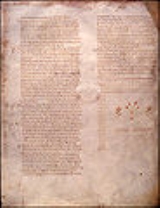
Codex Alexandrinus

Encyclopedia
The Codex Alexandrinus (London, British Library
, MS Royal 1. D. V-VIII; Gregory-Aland no. A or 02, Soden δ 4) is a 5th century manuscript
of the Greek Bible,The Greek Bible
in this context refers to the Bible used by Greek-speaking Christians who lived in Egypt and elsewhere during the early history of Christianity. This Bible contained both the Old
(translation) and New Testament
s in Koine Greek
. containing the majority of the Septuagint and the New Testament
. It is one of the four Great uncial codices
. Along with the Codex Sinaiticus
and the Vaticanus
, it is one of the earliest and most complete manuscripts of the Bible
. Wettstein
designated it in 1751 by letter A, and it was the first manuscript to receive thus a large letter as its designation.
It derives its name from Alexandria
where it resided for a number of years before it brought by the Eastern Orthodox
Patriarch Cyril Lucaris
from Alexandria to Constantinople. Then it was given to Charles I of England
in the 17th century. Until the later purchase of the Codex Sinaiticus
, it was the best manuscript of the Greek Bible deposited in Britain.Scrivener in 1875 wrote: "This celebrated manuscript, by far the best deposited in England".
Today, it rests along with Codex Sinaiticus in one of the showcases in the Ritblat Gallery of the British Library
.
As the text came from several different traditions, different parts of the codex are not of equal textual value. The text has been edited several times since the 18th century.
is in quarto
, and now consists of 773 vellum
folios (630 in the Old Testament and 143 in the New Testament), bound in four volumes (279 + 238 + 118 + 144 folios). Three volumes contain the Septuagint, Greek version of the Old Testament, with the complete loss of only ten leaves. The fourth volume contains the New Testament with 31 leaves lost.
The codex contains almost a complete copy of the LXX, including the deuterocanonical books 3
and 4 Maccabees
, Psalm 151
and the 14 Odes
. The "Epistle to Marcellinus" attributed to Saint Athanasius and the Eusebian
summary of the Psalms are inserted before the Book of Psalms. It also contains all of the books of the New Testament
, in addition to 1 Clement
(lacking 57:7-63) and the homily known as 2 Clement
(up to 12:5a). The books of the Old Testament are thus distributed: Genesis — 2 Chronicles (volume first), Hosea
— 4 Maccabees (volume second), Psalms — Sirach (volume third). The New Testament (volume fourth) books follow in order: Gospel
s, Acts of the Apostles
, General epistles
, Pauline epistles
(Hebrews
placed between 2 Thessalonians
and 1 Timothy
), Book of Revelation
. Previously, General epistles were placed before Acts of the Apostles. They changed their positions after rebinding.
There is an appendix marked in the index, which lists the Psalms of Solomon
and probably contained more apocryphal/pseudepigraphical books, but it has been torn off and the pages containing these books have also been lost.
Due to damage and lost folios, various passages are missing or have defects:
Verses the scribe did not include:
It is an important witness for the absence of Pericope Adultera (John 7:53-8:11). In the lost two leaves (John 6:50-8:52), by counting the lines, we can prove that it was not in the book – there was not room for it (as in Codex Ephraemi
).
, often discoloured at the edges, which have been damaged by age and more so through the ignorance or carelessness of the modern binder, who has not always spared the text, especially at the upper inner margin.
The vellum has been fallen into holes in many places, and since the ink peels off through age whensoever a leaf is touched a little roughly, no one is allowed to handle the manuscript except for good reasons.
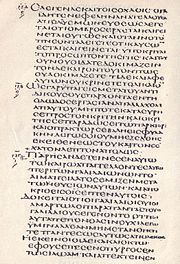
The text in the codex is written in two columns in uncial script, with between 49 and 51 lines per column and 20 to 25 letters per line. The beginning lines of each book are written in red ink and sections within the book are marked by a larger letter set into the margin. Words are written continuously in a large, round and well-formed uncial hand, with no accents
and only some breathings
(possibly added by a later editor). The letters are larger than those of the Codex Vaticanus. There is no division of words, but some pauses are observed in places in which should be a dot between two words. The poetical books of the Old Testament are written stichometrically
. There are no accent and breathing marks, except a few added by a later hand, but the punctuation was written by the first hand. The Old Testament quotations in the text of New Testament are marked on the margin by the sign 〉.
The only decorations in the manuscript are decorative tail-pieces at the end of each book (see illustration) and it also shows a tendency to increase the size of the first letter of each sentence. The capitals at the beginning of the sections stand out in the margin as in codices Ephraemi and Basilensis. Codex Alexandrinus is the oldest manuscript which use the capital letters to indicate new sections.
The interchange of vowel
s of somewhat similar sound is very frequent in this manuscript. The letters Ν
and Μ
are occasionally confused, and the cluster ΓΓ is substituted with ΝΓ. This may be an argument which points to Egypt, but it is not universally conceded. A lot of iotacistic
errors occur in the text; for example, αὶ is exchanged for ε, εὶ for ὶ and η for ὶ. It has not more iotacisms than other manuscripts of the same date.
The handwriting of the text from the beginning of Luke to 1 Corinthians 10:8, differs from that of the rest parts of the manuscript. Some letters have Coptic
shapes (f.e. Α
, Μ
, Δ
, and Π
). The letters are more widely spaced and are a little larger than elsewhere. Delta has extended base and Pi has extended cross-stroke. Numerals are not expressed by letters except in Apocalypse 7:4; 21:17. In the past the codex had been judged to be carelessly written, with many errors of transcription, but not so many as in the Codex Sinaiticus, nor more than in the Codex Vaticanus.
Besides the other corrections by later hands there are not a few instances in which the original scribe altered what he had first written.
The majuscule letters have elegant shape, but a little less simple than those in the Sinaiticus and Vaticanus codices. These letters, at the end of a line, are often very small, and much of the writing is very pale and faint. The letters are smaller and more faint. The punctuation is more frequent, usually on a level with the top of the preceding letter, while a vacant space, proportionate to the break in the sense, follows the end of a paragraph. At the end of each book the colophon
is ornamented by pretty arabesque
from prima manu. There are found the Ammonian Sections
with references to the Eusebian Canons stand in the margin of the text of the Gospels. It contains divisions into larger sections – κεφάλαια, the headings of these sections (τίτλοι) stand at the top of the pages. The places at which those sections commence are indicated throughout the Gospels, and in Luke and John their numbers are placed in the margin of each column. To all the Gospels (except Matthew, because of lacuna
e) is prefixed by a table of κεφάλαια (table of contents).
The various sections into which the Acts, Epistles, and Apocalypse were divided by Euthalian Apparatus
and others, are not indicated in this manuscript. A cross appears occasionally as a separation in the Book of Acts. A larger letter in the margin throughout the New Testament marks the beginning of a paragraph.
The number of scribes were disputed in the past. According to Kenyon's opinion there were five scribes, two scribes in the Old Testament (I and II) and three in the New (III, IV, and V). Skeat and Milne, who had better tools for comparison, argued there were only two or possibly three scribes.Kenyon in 1939 noticed: "this seems to ignore certain marked differences of script". F. G. Kenyon, Our Bible and the Ancient Manuscripts (London 1939). Present scholars agreed in that case.Metzger, Aland, Hernández, Jongkind and other. See: T. C. Skeat, The Provenance of the Codex Alexandrinus, JTS VI (1955), pp. 233-235; Juan Hernández, Scribal habits and theological influences in the Apocalypse, p. 101.
Many corrections have been made in the manuscript, some of them by the original scribe, but majority of them by a later hands. The corrected form of text agrees with codices D
, N
, X
, Y
, Γ
, Θ
, Π
, Σ, Φ
and the great majority of the minuscule manuscripts. Kenyon observed that Codex Alexandrinus had been "extensively corrected, though much more in some books than in others". In the Pentateuch, whole sentences were erased and a new text substituted. Kings was the last corrected of the books. In the Book of Revelation only 1 from its 84 singular readings was corrected. This is in stark contrast with Codex Sinaiticus, in which 120 of the Apocalypse's 201 singular readings were corrected in the 7th century.Of course there is more than 1 correction in the Book of Revelation, but there is only 1 singular reading corrected. See: Juan Hernández, Scribal habits and theological influences in the Apocalypse, Mohr Siebeck, 2006, p. 102
The each leaf has the Arabic numeration, set in the verso of the lower margin. The first survived leaf of Matthew has number 26. The 25 leaves now lost must have been still extant when that note was written.
have had a challenging task in classifying the Codex, with the exact relationship to other known texts and families still disputed. The Greek text of the codex is of uneven value. It is a representative of the Byzantine text-type
in the Gospels and the Alexandrian text-type
in the rest books of the New Testament, though with some Western
readings. Kurt Aland
placed it in Category III in the Gospels, and in Category I in rest of the books of the New Testament. The Byzantine text of the Gospels has a number of Alexandrian
features, it has some affinities to the textual family Family Π. Soden associated the text of the gospels with Family Π, though it is not a pure member of this family. It is the oldest example of the Byzantine-type text. According to Streeter it is the earliest Greek manuscript the gives us approximately the text of Lucian the Martyr
, but small proportion of the reading seems to be earlier.
Alexandrinus follows the Alexandrian readings through the rest of the New Testament, however, the text goes from closely resembling Codex Sinaiticus
in the Pauline epistles
, to more closely resembling the text of a number of papyri
( 74 for Acts,
  47 for the Apocalypse). The text of Acts frequently agrees with the biblical quotations made by St. Athanasius
. The gospels are cited as a "consistently cited witness of the third order" in the critical apparatus
of the Novum Testamentum Graece
, while the rest of the New Testament is of the "first order." In Pauline epistles it is closer to Sinaiticus than to Vaticanus. In General epistles it represents different subtype than Sinaiticus and Vaticanus both. In the Book of Revelation it agrees with Codex Ephraemi against Sinaiticus and Papyrus 47. In the Book of Revelation and in several books of the Old Testament, it has the best text of all manuscripts. In the Old Testament its text often agrees with Codex Sinaiticus.
Old Testament
In Genesis 5:25 it reads ΚΑΙ ΕΖΗΣΕΝ ΜΑΘΟΥΣΑΛΑ ΕΚΑΤΟΝ ΚΑΙ ΟΓΔΟΗΚΟΝΤΑ (eighty) ΕΠΤΑ ΕΤΗ, Vaticanus reads – ΚΑΙ ΕΖΗΣΕΝ ΜΑΘΟΥΣΑΛΑ ΕΚΑΤΟΝ ΚΑΙ ΕΞΗΚΟΝΤΑ (sixty) ΕΠΤΑ ΕΤΗ;
In Deuteronomy 31:15 it reads εν στυλω (in a pillar) for εν νεφελη (in a cloud);
In Joshua 11:42 it reads ελαβεν (took) for επαταξεν (struck);
In Joshua 11:1 it reads μαδων for μαρρων;
In Judges 18:30 it reads υιου Μωυση, Vaticanus reads – υιος Μανασση;
In Ezra 10:22 (9:22 LXX) it reads Ωκειδηλος
(Vaticanus – Ωκαιληδος) for Jozabad;
In Psalm 9:35 it reads κοπον (work) for πονον (pain).
New Testament
Mark 16:9–20 is preserved in its traditional form in the Codex Alexandrinus.
In Luke 4:17 Alexandrinus has textual variant (opened) together with the manuscripts B, L
, W
, Ξ
, 33
, 892
, 1195, 1241, ℓ 547, syrs, syrh, syrpal, copsa, copbo, against variant ἀναπτύξας (unrolled) supported by א, Dc, K
, Δ, Θ
, Π
, Ψ, f1
, f13
, 28
, 565
, 700
, 1009, 1010 and other manuscripts.
In John 1:39, it has the unique reading ωρα ην ως εκτη (about the sixth hour), instead of ωρα ην ως δεκατη (about the tenth hour), as found in all other manuscripts.
In Acts 8:39 instead of πνεῦμα κυρίου (spirit of the Lord) it has unusual textual variant (the Holy Spirit fell on the eunuch, and an angel of the Lord caught up Philip) supported by several minuscule manuscripts: 94
, 103
, 307
, 322
, 323
, 385
, 453
, 467
, 945, 1739, 1765, 1891, 2298, 36a
, itp, vg, syrh.
In Acts 11:20 the manuscript has textual variant (Greeks) together with the manuscripts 74, corrector c of Sinaiticus, and Codex Bezae, against (Hellenists) supported by the rest of manuscripts except Sinaiticus ( — Evangelists). In Acts 15:18 it has variant supported only by
  74.
74.
In Acts 20:28 it reads του κυριου (of the Lord) – instead of του θεου (of the God) – along with the manuscripts 74 C* D
E
Ψ 33
36
453
945 1739
1891.For the another variants of this verse see: Textual variants in the Acts of the Apostles.
In Romans 2:5 it reads ανταποδοσεως for αποκαλυψεως.
In Romans 8:1 it reads Ιησου κατα σαρκα περιπατουσιν, for Ιησου (as א, B, D*, G, 1739, 1881, itd, g, copsa, bo, eth). The reading of the manuscript is supported by Db, Ψ, 81
, 629
, 2127, vg. The Byzantine manuscripts read Ιησου μη κατα σαρκα περιπατουσιν αλλα κατα πνευμα.
In 1 Corinthians 2:1 it reads μυστηριον along with 46, א
46, א
, C
, 88
, 436
, ita,r, syrp, copbo. Other manuscripts read μαρτυριον or σωτηριον.
In 1 Corinthians 7:5 it reads τη προσευχη (prayer) along with 11,
11,  46, א*, A, B, C, D, G, P, Ψ, 33, 81, 104
, 181
, 629, 630, 1739, 1877, 1881, 1962, it vg, cop, arm, eth. Other manuscripts read τη νηστεια και τη προσευχη (fasting and prayer) or τη προσευχη και νηστεια (prayer and fasting).
In Ephesians 1,7 it reads χρηστοτητος for χαριτος along with 365
copbo.
In Ephesians 4:14 it reads του διαβολου for της πλανης.
In 1 Timothy
3:16 it has textual variant ὃς ἐφανερώθη (he was manifested) supported by Sinaiticus, Ephraemi, Boernerianus
, 33, 365
, 442
, 2127, ℓ 599, against (God manifested) (Sinaiticuse, A², C², Dc, K, L, P, Ψ, 81
, 104
, 181
, 326
, 330
, 436
, 451
, 614
, 629
, 630
, 1241, 1739
, 1877, 1881, 1962, 1984, 1985, 2492, 2495, Byz, Lect).
In Hebrews 13:21 it reads παντι εργω και λογω αγαθω for παντι αγαθω.
In 1 John 5:6 it has textual variant δι' ὕδατος καὶ αἵματος καὶ πνεύματος (through water and blood and spirit) together with the manuscripts: Codex Sinaiticus, 104, 424c
, 614
, 1739c
, 2412, 2495, ℓ 598m, syrh, copsa, copbo, Origen
.For the another variants of this verse see: Textual variants in the First Epistle of John. Bart D. Ehrman
identified it as Orthodox corrupt reading.
In Revelation 1:17 it has unique reading (firstborn) instead of (the first).
In Revelation 5:9 it has (redeemed to God). This textual variant is supported only by Ethiopian manuscripts, and has no other Greek manuscript with it.
was the first who pointed Alexandria as the place of origin of the codex. This popular view is based on an Arabic note from 13th or 14th century, on folio 1, which reads: "Bound to the Patriarchal Cell in the Fortress of Alexandria. Whoever removes it thence shall be excommunicated and cut off. Written by Athanasius the humble." "Athanasius the humble" is identified with Athanasius III
, Patriarch of Alexandria from 1276 to 1316.
F. C. Burkitt
questioned this popular view. According to Burkitt, the note reads: "Bound to the Patriarchal Cell in the Fortress of Alexandria. He that lets it go out shall be cursed and ruined. The humble Athanasius wrote (this)." The manuscript had been found on Mount Athos
, and the manuscript might have been taken to Egypt by Cyril in 1616, and that all the Arabic writing in the manuscript could have been inserted between that date and 1621, when Cyril was elected Ecumenical Patriarch of Constantinople. On this supposition "Athanasius the humble" might have been "some person of Cyril's staff who had charge of his library". According to Burkitt's view the codex was found on Athos, but it was written in Constantinople, because it represents a Constantinopolitan text (now known as the Byzantine text). This hypothesis was supported by Kirsopp Lake
.
Frederic G. Kenyon
opposed to the Burkit's view and argued that Cyril firmly believed in the Egyptian origin of the codex. A. S. Fulton, the Keeper of the Department of Oriental Printed Books and Manuscripts (in British Museum), in 1938 re-examined the Athanasius note, and gave it as his opinion that on palaeographical grounds it could be dated 13th to 14th century and that the 17th century was excluded. In 1945 T. D. Moschonas published a catalogue of the library of the Patriarch of Alexandria, in which he printed two Greek notes, both from 10th century manuscripts of John Chrysostom
, inserted by the Patriarch Athanasius III. The two notes must have been written between 1308 and 1316. Although the note in the Codex Alexandrinus is entirely in Arabic, and therefore no identity of hand the Greek notes can be expected, the similarity of wording leaves no doubt that this also is the work of Athanasius III.
Burnett Hillman Streeter
proposed Caesarea or Beirut
for three reasons: it contains, after the New Testament, the two Epistles of Clement; it represents an eclectic text in the New Testament, Antiochian in the Gospels and Alexandrian in the Acts and Epistles, it suggests some place where the influence of Antioch and of Alexandria met; the text of the Old Testament appears to be a non-Alexandrian text heavily revised by the Hexapla
, the Old Testament quotations in New Testament more often than not agree with Alexandrinus against Vaticanus.
According to Skeat the note in the codex indicated that the manuscript had not previously been in the Patriarchal Library in Alexandria. The manuscript was carried from Constantinople to Alexandria between 1308 and 1316, together with two mentioned above manuscripts of Chrysostom. It remained in Alexandria until 1621, when Cyril removed it once to Constantinople. Whether was originally written, in Constantinople or in Alexandria, is another question. Skeat did not try to give the answer on this question ("if any future scholar wisches to claim a Constantinopolitan origin for the Codex Alexandrinus, it is at least open to him to do so").In The Codex Vaticanus in the Fifteenth Century Skeat wrote: "The Codex Alexandrinus, carried to Egypt in the early fourteenth century..." (T. C. Skeat, The Codex Vaticanus in the Fifteenth Century in: The collected biblical writings of T. C. Skeat, p. 133). This view was supported by McKendrick, who proposes Ephesian provenance of the codex.
A 17th century Latin
note on a flyleaf (from binding in a royal library) states that the manuscript was given to a patriarchate of Alexandria in 1098 (donum dedit cubicuo Patriarchali anno 814 Martyrum), although this may well be "merely an inaccurate attempt at deciphering the Arabic note by Athanasius" (possibly the patriarch Athanasius III). The authority for this statement is unknown.
(A.D. 325). Tregelles
made another suggestion, the New Testament volume has long been mutilated, and begins now in the twenty-fifth chapter of Matthew, in which chapter the lesson for Thecla's Day stands. "We cannot be sure how the story arose. It may be that the manuscript was written in a monastery dedicated to Thecla." Tregelles thought that Thecla's name might have on this account been written in the margin above, which has been cut off, and that therefore the Egyptians imagined that Thecla had written it. Cyril Lucaris believed in Thecla's authorship, but the codex cannot be older than from late 4th century.
Codex Alexandrinus contains the Epistle of Athanasius on the Psalms to Marcellinus, it cannot be considered earlier than A.D. 373, and it is terminus post quem
. In the Acts and Epistles we cannot find such chapter divisions, whose authorship is ascribed to Euthalius
, Bishop of Sulci, come into vogue before the middle of the fifth century. It is terminus ad quem. The presence of Epistle of Clement, which was once read in Churches recalls to a period when the canon of Scripture was in some particulars not quite settled. It is certain that the writing of the manuscript appears to be somewhat more advanced than that of the Vaticanus or Sinaiticus, especially in the enlargement of initial letters. It is also more decorated, though its ornamentations are already found in earlier manuscripts.
Codex Alexandrinus was written a generation after codices Sinaiticus and Vaticanus, but it may still belong to the fourth century. It cannot be later than the beginning of the fifth.
in 1621 by Cyril Lucar (first a patriarch of Alexandria, then later a patriarch of Constantinople). Lucar was involved in a complex struggle with the Turkish government, the Catholic Church, and his own subordinates. He was supported by English government and presented the codex to James I
in 1624, as a gratitude for his help. The codex was presented through the hands of Thomas Roe
(together with minuscule 49
), the English ambassador at the court of the Sultan. King James died before the manuscript started for England, and the offer was transferred to Charles I
in 1627. It became a part of the Royal Library
, British Museum
and since 1973 of the British Library
. It was saved from the fire at Ashburnam House (the Cotton library
) on 23 October 1731, by the librarian, Bentley.
, the Royal Librarian. A collation was made by Alexander Huish, Prebendary of Wells, for the London Polyglot Bible (1657). The text of the manuscript was cited as footnotes. Richard Bentley
made a collation in 1675.
The Old Testament was edited by Ernst Grabe in 1707-1720, and New Testament in 1786 by Carl Gottfried Woide
, in facsimile from wooden type, line for line, without intervals between the words, precisely almost as in original. Unfortunately Woide made some mistakes, e.g. in 1 Tim 3:16 he edits ΘΣ , and combats in his prolegomena the opinion of Wettstein
, who maintained that ΟΣ was the original reading, and that the stroke, which is some lights can be seen across part of the Ο, arose from part of a letter visible through the vellum. Part of the Ε on the other side of the leaf does insert the O. Another errors of Woide were made in the Epistle to Ephesians – the substitution of (4:1) and πραόθητος for πραότητος (4:2).
Woide's errors were corrected in 1860 by B. H. Cowper, and E. H. Hansell, with three other manuscripts, in 1860. The Old Testament portion was also published in 1816-1828 by Baber, in three folio volumes. The entire manuscript was issued in photographic facsimile by the British Museum, under the supervision of E. M. Thompson
in 1879 and 1880. F. G. Kenyon edited a photographic facsimile of the New Testament with reduced size in 1909. The text of the Old Testament followed four parts in 1915.
 According to Bentley this manuscript is "the oldest and best in the world". Bentley assumed that by supplementing this manuscript with readings from other manuscripts and from the Latin Vulgate, he could triangulate back to the single recension which he presumed existed at the time of the First Council of Nicaea
. Wettstein highly esteemed the codex in 1730, but he changed his opinion in 1751 and was no longer a great admirer of it. He came to the conviction that Athos
was the place of its origin, not Alexandria. Michaelis also did not esteem it highly, either on account of its internal excellence or the value of its readings. The principal charge which has been produced against the manuscript, and which had been urged by Wettstein, is its having been altered from the Latin version. Michaelis countered that the transcriber who lived in Egypt would not have altered the Greek text from a Latin version, because Egypt belonged to the Greek diocese, and Latin was not understood there. Woide, who defended the Greek manuscripts in general, and the Codex Alexandrinus in particular, from the charge of having been corrupted from the Latin, discerned two hands in the New Testament.
Griesbach
agreed with Woide and expanded on Michaelis' point of view. If this manuscript has been corrupted from a version, it is more reasonable to suspect the Coptic, the version of the country in which it was written. Between this manuscript and both the Coptic and Syriac versions there is a remarkable coincidence. According to Griesbach the manuscript follows three different editions: the Byzantine in the Gospels, the Western in the Acts and General epistles, and the Alexandrian in the Pauline epistles. Griesbach designated the codex by letter A.
Tregelles explained the origin of the Arabic inscription, on which Cyril's statement appears to rest, by remarking that the text of the New Testament in the manuscript begins with Matthew 25:6, this lesson (Matthew 25:1-13) being that appointed by the Greek Church for the festival of St. Thecla.
created a modern system of catalogization of the New Testament manuscripts. Codex Alexandrinus received symbol A and opened the list of the NT uncial manuscripts. Wettstein announced in his Prolegomena ad Novi Testamenti Graeci (1730) that Codex A is the oldest and the best manuscript of New Testament, and should be basis in every reconstruction of the New Testament text. Codex Alexandrinus became a basis for criticizing the Textus Receptus
(Wettstein, Woide, Griesbach).
Articles
British Library
The British Library is the national library of the United Kingdom, and is the world's largest library in terms of total number of items. The library is a major research library, holding over 150 million items from every country in the world, in virtually all known languages and in many formats,...
, MS Royal 1. D. V-VIII; Gregory-Aland no. A or 02, Soden δ 4) is a 5th century manuscript
Manuscript
A manuscript or handwrite is written information that has been manually created by someone or some people, such as a hand-written letter, as opposed to being printed or reproduced some other way...
of the Greek Bible,The Greek Bible
Greek Vulgate
The Greek Vulgate is a version of the Bible written in Biblical Greek. It consists primarily of the Septuagint for most of the Old Testament with the version of Theodotion used for the book of Daniel. For the New Testament it consists of the Greek text, typically the Majority or Byzantine Text...
in this context refers to the Bible used by Greek-speaking Christians who lived in Egypt and elsewhere during the early history of Christianity. This Bible contained both the Old
Old Testament
The Old Testament, of which Christians hold different views, is a Christian term for the religious writings of ancient Israel held sacred and inspired by Christians which overlaps with the 24-book canon of the Masoretic Text of Judaism...
(translation) and New Testament
New Testament
The New Testament is the second major division of the Christian biblical canon, the first such division being the much longer Old Testament....
s in Koine Greek
Koine Greek
Koine Greek is the universal dialect of the Greek language spoken throughout post-Classical antiquity , developing from the Attic dialect, with admixture of elements especially from Ionic....
. containing the majority of the Septuagint and the New Testament
New Testament
The New Testament is the second major division of the Christian biblical canon, the first such division being the much longer Old Testament....
. It is one of the four Great uncial codices
Great uncial codices
The great uncial codices or four great uncials are the only remaining uncial codices that contain the entire text of the Greek Bible ....
. Along with the Codex Sinaiticus
Codex Sinaiticus
Codex Sinaiticus is one of the four great uncial codices, an ancient, handwritten copy of the Greek Bible. It is an Alexandrian text-type manuscript written in the 4th century in uncial letters on parchment. Current scholarship considers the Codex Sinaiticus to be one of the best Greek texts of...
and the Vaticanus
Codex Vaticanus
The Codex Vaticanus , is one of the oldest extant manuscripts of the Greek Bible , one of the four great uncial codices. The Codex is named for the residence in the Vatican Library, where it has been stored since at least the 15th century...
, it is one of the earliest and most complete manuscripts of the Bible
Bible
The Bible refers to any one of the collections of the primary religious texts of Judaism and Christianity. There is no common version of the Bible, as the individual books , their contents and their order vary among denominations...
. Wettstein
Johann Jakob Wettstein
Johann Jakob Wettstein was a Swiss theologian, best known as a New Testament critic.-Youth and study:...
designated it in 1751 by letter A, and it was the first manuscript to receive thus a large letter as its designation.
It derives its name from Alexandria
Alexandria
Alexandria is the second-largest city of Egypt, with a population of 4.1 million, extending about along the coast of the Mediterranean Sea in the north central part of the country; it is also the largest city lying directly on the Mediterranean coast. It is Egypt's largest seaport, serving...
where it resided for a number of years before it brought by the Eastern Orthodox
Eastern Orthodox Church
The Orthodox Church, officially called the Orthodox Catholic Church and commonly referred to as the Eastern Orthodox Church, is the second largest Christian denomination in the world, with an estimated 300 million adherents mainly in the countries of Belarus, Bulgaria, Cyprus, Georgia, Greece,...
Patriarch Cyril Lucaris
Cyril Lucaris
Cyril Lucaris born Constantine Lukaris or Loucaris was a Greek prelate and theologian, and a native of Candia, Crete . He later became the Greek Patriarch of Alexandria as Cyril III and Ecumenical Patriarch of Constantinople as Cyril I...
from Alexandria to Constantinople. Then it was given to Charles I of England
Charles I of England
Charles I was King of England, King of Scotland, and King of Ireland from 27 March 1625 until his execution in 1649. Charles engaged in a struggle for power with the Parliament of England, attempting to obtain royal revenue whilst Parliament sought to curb his Royal prerogative which Charles...
in the 17th century. Until the later purchase of the Codex Sinaiticus
Codex Sinaiticus
Codex Sinaiticus is one of the four great uncial codices, an ancient, handwritten copy of the Greek Bible. It is an Alexandrian text-type manuscript written in the 4th century in uncial letters on parchment. Current scholarship considers the Codex Sinaiticus to be one of the best Greek texts of...
, it was the best manuscript of the Greek Bible deposited in Britain.Scrivener in 1875 wrote: "This celebrated manuscript, by far the best deposited in England".
Today, it rests along with Codex Sinaiticus in one of the showcases in the Ritblat Gallery of the British Library
British Library
The British Library is the national library of the United Kingdom, and is the world's largest library in terms of total number of items. The library is a major research library, holding over 150 million items from every country in the world, in virtually all known languages and in many formats,...
.
As the text came from several different traditions, different parts of the codex are not of equal textual value. The text has been edited several times since the 18th century.
Contents
The codexCodex
A codex is a book in the format used for modern books, with multiple quires or gatherings typically bound together and given a cover.Developed by the Romans from wooden writing tablets, its gradual replacement...
is in quarto
Quarto
Quarto could refer to:* Quarto, a size or format of a book in which four leaves of a book are created from a standard size sheet of paper* For specific information about quarto texts of William Shakespeare's works, see:...
, and now consists of 773 vellum
Vellum
Vellum is mammal skin prepared for writing or printing on, to produce single pages, scrolls, codices or books. It is generally smooth and durable, although there are great variations depending on preparation, the quality of the skin and the type of animal used...
folios (630 in the Old Testament and 143 in the New Testament), bound in four volumes (279 + 238 + 118 + 144 folios). Three volumes contain the Septuagint, Greek version of the Old Testament, with the complete loss of only ten leaves. The fourth volume contains the New Testament with 31 leaves lost.
The codex contains almost a complete copy of the LXX, including the deuterocanonical books 3
3 Maccabees
The book of the 3 Maccabees is found in most Orthodox Bibles as a part of the Anagignoskomena, while Protestants and Catholics consider it non-canonical, except the Moravian Brethren who included it in the Apocrypha of the Czech Kralicka Bible...
and 4 Maccabees
4 Maccabees
The book of 4 Maccabees is a homily or philosophic discourse praising the supremacy of pious reason over passion. It is not in the Bible for most churches, but is an appendix to the Greek Bible, and in the canon of the Georgian Bible...
, Psalm 151
Psalm 151
Psalm 151 is the name given to a short psalm that is found in most copies of the Septuagint but not in the Masoretic Text of the Hebrew Bible. The title given to this psalm in the Septuagint indicates that it is supernumerary, and no number is affixed to it: "This Psalm is ascribed to David and...
and the 14 Odes
Book of Odes (Bible)
The Book of Odes , commonly referred to simply as Odes, is a book of the Bible found only in Eastern Orthodox Bibles and included or appended after Psalms in Alfred Rahlfs' critical edition of the Septuagint, coming from the fifth-century Codex Alexandrinus. The chapters are prayers and songs from...
. The "Epistle to Marcellinus" attributed to Saint Athanasius and the Eusebian
Eusebius of Caesarea
Eusebius of Caesarea also called Eusebius Pamphili, was a Roman historian, exegete and Christian polemicist. He became the Bishop of Caesarea in Palestine about the year 314. Together with Pamphilus, he was a scholar of the Biblical canon...
summary of the Psalms are inserted before the Book of Psalms. It also contains all of the books of the New Testament
New Testament
The New Testament is the second major division of the Christian biblical canon, the first such division being the much longer Old Testament....
, in addition to 1 Clement
First Epistle of Clement
The First Epistle of Clement, is a letter addressed to the Christians in the city of Corinth. The letter dates from the late 1st or early 2nd century, and ranks with Didache as one of the earliest — if not the earliest — of extant Christian documents outside the canonical New Testament...
(lacking 57:7-63) and the homily known as 2 Clement
Second Epistle of Clement
The Second Epistle of Clement, often referred to as 2 Clement, is an early Christian writing....
(up to 12:5a). The books of the Old Testament are thus distributed: Genesis — 2 Chronicles (volume first), Hosea
Book of Hosea
The Book of Hosea is one of the books of the Hebrew Bible. It stands first in order among what are known as the twelve Minor Prophets.-Background and Content:...
— 4 Maccabees (volume second), Psalms — Sirach (volume third). The New Testament (volume fourth) books follow in order: Gospel
Gospel
A gospel is an account, often written, that describes the life of Jesus of Nazareth. In a more general sense the term "gospel" may refer to the good news message of the New Testament. It is primarily used in reference to the four canonical gospels of Matthew, Mark, Luke, and John...
s, Acts of the Apostles
Acts of the Apostles
The Acts of the Apostles , usually referred to simply as Acts, is the fifth book of the New Testament; Acts outlines the history of the Apostolic Age...
, General epistles
General epistles
General epistles are books in the New Testament in the form of letters. They are termed "general" because for the most part their intended audience seems to be Christians in general rather than individual persons or congregations as is the case with the Pauline epistles...
, Pauline epistles
Pauline epistles
The Pauline epistles, Epistles of Paul, or Letters of Paul, are the thirteen New Testament books which have the name Paul as the first word, hence claiming authorship by Paul the Apostle. Among these letters are some of the earliest extant Christian documents...
(Hebrews
Epistle to the Hebrews
The Epistle to the Hebrews is one of the books in the New Testament. Its author is not known.The primary purpose of the Letter to the Hebrews is to exhort Christians to persevere in the face of persecution. The central thought of the entire Epistle is the doctrine of the Person of Christ and his...
placed between 2 Thessalonians
Second Epistle to the Thessalonians
The Second Epistle of Paul to the Thessalonians, often referred to as Second Thessalonians and written 2 Thessalonians, is a book from the New Testament of the Christian Bible...
and 1 Timothy
First Epistle to Timothy
The First Epistle of Paul to Timothy, usually referred to simply as First Timothy and often written 1 Timothy, is one of three letters in the New Testament of the Bible often grouped together as the Pastoral Epistles, the others being Second Timothy and Titus...
), Book of Revelation
Book of Revelation
The Book of Revelation is the final book of the New Testament. The title came into usage from the first word of the book in Koine Greek: apokalupsis, meaning "unveiling" or "revelation"...
. Previously, General epistles were placed before Acts of the Apostles. They changed their positions after rebinding.
There is an appendix marked in the index, which lists the Psalms of Solomon
Psalms of Solomon
One of the Pseudepigrapha, the Psalms of Solomon is a group of eighteen psalms that are not part of any scriptural canon...
and probably contained more apocryphal/pseudepigraphical books, but it has been torn off and the pages containing these books have also been lost.
Due to damage and lost folios, various passages are missing or have defects:
- Lacking: 1 Sam 12:17-14:9 (1 leaf); PsPsalmsThe Book of Psalms , commonly referred to simply as Psalms, is a book of the Hebrew Bible and the Christian Bible...
49:20-79:11 (9 leaves); MattGospel of MatthewThe Gospel According to Matthew is one of the four canonical gospels, one of the three synoptic gospels, and the first book of the New Testament. It tells of the life, ministry, death, and resurrection of Jesus of Nazareth...
1:1-25:6 (26 leaves); JohnGospel of JohnThe Gospel According to John , commonly referred to as the Gospel of John or simply John, and often referred to in New Testament scholarship as the Fourth Gospel, is an account of the public ministry of Jesus...
6:50-8:52 (2 leaves); 2 Cor 4:13-12:6 (3 leaves); 1 Clement 57:7-63 (1 leaf) and 2 Clement 12:5a-fin. (2 leaves); - Damaged: Gen 14:14-17, 15:1-5, 15:16-19, 16:6-9 (lower portion of torn leaf lost);
- Defects due to torn leaves: Genesis 1:20-25, 1:29-2:3, LevLeviticusThe Book of Leviticus is the third book of the Hebrew Bible, and the third of five books of the Torah ....
8:6,7,16; SirachSirachThe Book of the All-Virtuous Wisdom of Jesus ben Sira , commonly called the Wisdom of Sirach or simply Sirach, and also known as Ecclesiasticus or Siracides , is a work from the early 2nd century B.C. written by the Jewish scribe Jesus ben Sirach of Jerusalem...
50:21f, 51:5; - LacunaeLacuna (manuscripts)A lacunaPlural lacunae. From Latin lacūna , diminutive form of lacus . is a gap in a manuscript, inscription, text, painting, or a musical work...
on the edges of almost every page of the ApocalypseBook of RevelationThe Book of Revelation is the final book of the New Testament. The title came into usage from the first word of the book in Koine Greek: apokalupsis, meaning "unveiling" or "revelation"...
.Juan Hernández, Scribal habits and theological influences in the Apocalypse, Mohr Siebeck, 2006, p. 102. - The ornamented colophonColophon (publishing)In publishing, a colophon is either:* A brief description of publication or production notes relevant to the edition, in modern books usually located at the reverse of the title page, but can also sometimes be located at the end of the book, or...
of the Epistle to PhilemonEpistle to PhilemonPaul's Epistle to Philemon, usually referred to simply as Philemon, is a prison letter to Philemon from Paul of Tarsus. Philemon was a leader in the Colossian church. This letter, which is one of the books of the New Testament, deals with forgiveness.Philemon was a wealthy Christian of the house...
has been cut out.
Verses the scribe did not include:
- Mark 15:28 as in codices א, B, C, D, Ψ, Lect, d, k, syrs, copsa, bo, fay;
- Christ's agony at GethsemaneChrist's agony at GethsemaneChrist's agony at Gethsemane is a passage in the Gospel of Luke , describing a prayer of Jesus, after which he receives strength from an angel, on the Mount of Olives prior to his betrayal and arrest...
(Luke 22:43–44), as in codices p75Papyrus 75Papyrus 75 is an early Greek New Testament papyrus.- Description :Originally '[it] contained about 144 pages ... of which 102 have survived, either in whole or in part.' It 'contains about half the text of ... two Gospels' – Luke and John in Greek...
, א*, B, TCodex BorgianusCodex Borgianus, designated by T or 029 , ε 5 , is a Greek and Sahidic uncial manuscript of the Gospels, dated palaeographically to the 5th century...
, 1071; - {John 7:53-8:11};
- Acts 8:37; 15:34; 24:7; 28:29;
- Romans 16:24.
It is an important witness for the absence of Pericope Adultera (John 7:53-8:11). In the lost two leaves (John 6:50-8:52), by counting the lines, we can prove that it was not in the book – there was not room for it (as in Codex Ephraemi
Codex Ephraemi Rescriptus
Codex Ephraemi Rescriptus is an early 5th century Greek manuscript of the Bible, the last in the group of the four great uncial manuscripts...
).
Description
The manuscript measures 12.6 by and most of the folios were originally gathered into quires of eight leaves each. In modern times it was rebound into quires of six leaves each. The material is thin, fine, and very beautiful vellumVellum
Vellum is mammal skin prepared for writing or printing on, to produce single pages, scrolls, codices or books. It is generally smooth and durable, although there are great variations depending on preparation, the quality of the skin and the type of animal used...
, often discoloured at the edges, which have been damaged by age and more so through the ignorance or carelessness of the modern binder, who has not always spared the text, especially at the upper inner margin.
The vellum has been fallen into holes in many places, and since the ink peels off through age whensoever a leaf is touched a little roughly, no one is allowed to handle the manuscript except for good reasons.
The text in the codex is written in two columns in uncial script, with between 49 and 51 lines per column and 20 to 25 letters per line. The beginning lines of each book are written in red ink and sections within the book are marked by a larger letter set into the margin. Words are written continuously in a large, round and well-formed uncial hand, with no accents
Stress (linguistics)
In linguistics, stress is the relative emphasis that may be given to certain syllables in a word, or to certain words in a phrase or sentence. The term is also used for similar patterns of phonetic prominence inside syllables. The word accent is sometimes also used with this sense.The stress placed...
and only some breathings
Greek diacritics
Greek orthography has used a variety of diacritics starting in the Hellenistic period. The complex polytonic orthography notates Ancient Greek phonology...
(possibly added by a later editor). The letters are larger than those of the Codex Vaticanus. There is no division of words, but some pauses are observed in places in which should be a dot between two words. The poetical books of the Old Testament are written stichometrically
Stichometry
Stichometry is a term applied to the measurement of ancient texts by στίχοι or verses of a fixed standard length.It was the custom of the Greeks and Romans to estimate the length of their literary works by measured lines...
. There are no accent and breathing marks, except a few added by a later hand, but the punctuation was written by the first hand. The Old Testament quotations in the text of New Testament are marked on the margin by the sign 〉.
The only decorations in the manuscript are decorative tail-pieces at the end of each book (see illustration) and it also shows a tendency to increase the size of the first letter of each sentence. The capitals at the beginning of the sections stand out in the margin as in codices Ephraemi and Basilensis. Codex Alexandrinus is the oldest manuscript which use the capital letters to indicate new sections.
The interchange of vowel
Vowel
In phonetics, a vowel is a sound in spoken language, such as English ah! or oh! , pronounced with an open vocal tract so that there is no build-up of air pressure at any point above the glottis. This contrasts with consonants, such as English sh! , where there is a constriction or closure at some...
s of somewhat similar sound is very frequent in this manuscript. The letters Ν
Nu (letter)
Nu , is the 13th letter of the Greek alphabet. In the system of Greek numerals it has a value of 50...
and Μ
Mu (letter)
Carlos Alberto Vives Restrepo is a Grammy Award and three-time Latin Grammy Award winning-Colombian singer, composer and actor.-Biography:...
are occasionally confused, and the cluster ΓΓ is substituted with ΝΓ. This may be an argument which points to Egypt, but it is not universally conceded. A lot of iotacistic
Iotacism
Iotacism is the process by which a number of vowels and diphthongs in Ancient Greek converged in pronunciation so that they all sound like iota in Modern Greek....
errors occur in the text; for example, αὶ is exchanged for ε, εὶ for ὶ and η for ὶ. It has not more iotacisms than other manuscripts of the same date.
The handwriting of the text from the beginning of Luke to 1 Corinthians 10:8, differs from that of the rest parts of the manuscript. Some letters have Coptic
Coptic language
Coptic or Coptic Egyptian is the current stage of the Egyptian language, a northern Afro-Asiatic language spoken in Egypt until at least the 17th century. Egyptian began to be written using the Greek alphabet in the 1st century...
shapes (f.e. Α
Alpha (letter)
Alpha is the first letter of the Greek alphabet. In the system of Greek numerals it has a value of 1. It was derived from the Phoenician letter Aleph...
, Μ
Mu (letter)
Carlos Alberto Vives Restrepo is a Grammy Award and three-time Latin Grammy Award winning-Colombian singer, composer and actor.-Biography:...
, Δ
Delta (letter)
Delta is the fourth letter of the Greek alphabet. In the system of Greek numerals it has a value of 4. It was derived from the Phoenician letter Dalet...
, and Π
Pi (letter)
Pi is the sixteenth letter of the Greek alphabet, representing . In the system of Greek numerals it has a value of 80. Letters that arose from pi include Cyrillic Pe , Coptic pi , and Gothic pairthra .The upper-case letter Π is used as a symbol for:...
). The letters are more widely spaced and are a little larger than elsewhere. Delta has extended base and Pi has extended cross-stroke. Numerals are not expressed by letters except in Apocalypse 7:4; 21:17. In the past the codex had been judged to be carelessly written, with many errors of transcription, but not so many as in the Codex Sinaiticus, nor more than in the Codex Vaticanus.
Besides the other corrections by later hands there are not a few instances in which the original scribe altered what he had first written.
The majuscule letters have elegant shape, but a little less simple than those in the Sinaiticus and Vaticanus codices. These letters, at the end of a line, are often very small, and much of the writing is very pale and faint. The letters are smaller and more faint. The punctuation is more frequent, usually on a level with the top of the preceding letter, while a vacant space, proportionate to the break in the sense, follows the end of a paragraph. At the end of each book the colophon
Colophon (publishing)
In publishing, a colophon is either:* A brief description of publication or production notes relevant to the edition, in modern books usually located at the reverse of the title page, but can also sometimes be located at the end of the book, or...
is ornamented by pretty arabesque
Arabesque
The arabesque is a form of artistic decoration consisting of "surface decorations based on rhythmic linear patterns of scrolling and interlacing foliage, tendrils" or plain lines, often combined with other elements...
from prima manu. There are found the Ammonian Sections
Ammonian Sections
Eusebian canons or Eusebian sections, also known as Ammonian Sections, are the system of dividing the four Gospels used between late Antiquity and the Middle Ages. The divisions into chapters and verses used in modern texts date only from the 13th and 16th centuries, respectively...
with references to the Eusebian Canons stand in the margin of the text of the Gospels. It contains divisions into larger sections – κεφάλαια, the headings of these sections (τίτλοι) stand at the top of the pages. The places at which those sections commence are indicated throughout the Gospels, and in Luke and John their numbers are placed in the margin of each column. To all the Gospels (except Matthew, because of lacuna
Lacuna (manuscripts)
A lacunaPlural lacunae. From Latin lacūna , diminutive form of lacus . is a gap in a manuscript, inscription, text, painting, or a musical work...
e) is prefixed by a table of κεφάλαια (table of contents).
The various sections into which the Acts, Epistles, and Apocalypse were divided by Euthalian Apparatus
Euthalian Apparatus
The Euthalian Apparatus is a collection of additional editorial material, such as divisions of text, lists, and summaries, to the New Testament's Book of Acts, Catholic epistles, and Pauline epistles. This additional material appears at the beginnings of books, in the margin of the text, and at the...
and others, are not indicated in this manuscript. A cross appears occasionally as a separation in the Book of Acts. A larger letter in the margin throughout the New Testament marks the beginning of a paragraph.
The number of scribes were disputed in the past. According to Kenyon's opinion there were five scribes, two scribes in the Old Testament (I and II) and three in the New (III, IV, and V). Skeat and Milne, who had better tools for comparison, argued there were only two or possibly three scribes.Kenyon in 1939 noticed: "this seems to ignore certain marked differences of script". F. G. Kenyon, Our Bible and the Ancient Manuscripts (London 1939). Present scholars agreed in that case.Metzger, Aland, Hernández, Jongkind and other. See: T. C. Skeat, The Provenance of the Codex Alexandrinus, JTS VI (1955), pp. 233-235; Juan Hernández, Scribal habits and theological influences in the Apocalypse, p. 101.
Many corrections have been made in the manuscript, some of them by the original scribe, but majority of them by a later hands. The corrected form of text agrees with codices D
Codex Bezae
The Codex Bezae Cantabrigensis, designated by siglum Dea or 05 , δ 5 , is a codex of the New Testament dating from the 5th century written in an uncial hand on vellum. It contains, in both Greek and Latin, most of the four Gospels and Acts, with a small fragment of the 3 John...
, N
Codex Petropolitanus Purpureus
Codex Petropolitanus Purpureus, designated by N or 022 , ε 19 , is a 6th century Greek New Testament codex gospel book. Written in majuscules , on 231 parchment leaves, measuring 32 x 27 cm...
, X
Codex Monacensis
Codex Monacensis designated by X or 033 , A3 , is a Greek uncial manuscript of the Gospels, dated palaeographically to the 9th or 10th century...
, Y
Codex Macedoniensis
Codex Macedoniensis or Macedonianus designated by Y or 034 , ε 073 , is a Greek uncial manuscript of the Gospels, dated palaeographically to the 9th century. The manuscript is lacunose....
, Γ
Codex Tischendorfianus IV
Codex Tischendorfianus IV – designated by Γ or 036 , ε 70 – is a Greek uncial manuscript of the Gospels, dated palaeographically to the 10th century...
, Θ
Codex Koridethi
The Codex Koridethi, also named Codex Coridethianus, designated by Θ, 038, or Theta , ε 050 , is a 9th century manuscript of the four Gospels. It is written in Greek with uncial script in two columns per page, in 25 lines per page...
, Π
Codex Petropolitanus (New Testament)
Codex Petropolitanus, designated by Π or 041 , ε 73 , is a Greek uncial manuscript of the Gospels, dated palaeographically to the 9th century...
, Σ, Φ
Codex Beratinus
Codex Purpureus Beratinus designated by Φ or 043 , ε 17 , is an uncial illuminated manuscript Gospel book written in Greek. Dated palaeographically to the 6th century, the manuscript is written in an uncial hand on purple vellum with silver ink. The codex is preserved at the Albanian National...
and the great majority of the minuscule manuscripts. Kenyon observed that Codex Alexandrinus had been "extensively corrected, though much more in some books than in others". In the Pentateuch, whole sentences were erased and a new text substituted. Kings was the last corrected of the books. In the Book of Revelation only 1 from its 84 singular readings was corrected. This is in stark contrast with Codex Sinaiticus, in which 120 of the Apocalypse's 201 singular readings were corrected in the 7th century.Of course there is more than 1 correction in the Book of Revelation, but there is only 1 singular reading corrected. See: Juan Hernández, Scribal habits and theological influences in the Apocalypse, Mohr Siebeck, 2006, p. 102
The each leaf has the Arabic numeration, set in the verso of the lower margin. The first survived leaf of Matthew has number 26. The 25 leaves now lost must have been still extant when that note was written.
Textual features
Textual criticsTextual criticism
Textual criticism is a branch of literary criticism that is concerned with the identification and removal of transcription errors in the texts of manuscripts...
have had a challenging task in classifying the Codex, with the exact relationship to other known texts and families still disputed. The Greek text of the codex is of uneven value. It is a representative of the Byzantine text-type
Byzantine text-type
The Byzantine text-type is one of several text-types used in textual criticism to describe the textual character of Greek New Testament manuscripts. It is the form found in the largest number of surviving manuscripts, though not in the oldest...
in the Gospels and the Alexandrian text-type
Alexandrian text-type
The Alexandrian text-type , associated with Alexandria, is one of several text-types used in New Testament textual criticism to describe and group the textual character of biblical manuscripts...
in the rest books of the New Testament, though with some Western
Western text-type
The Western text-type is one of several text-types used in textual criticism to describe and group the textual character of Greek New Testament manuscripts...
readings. Kurt Aland
Kurt Aland
Kurt Aland was a German Theologian and Professor of New Testament Research and Church History. He founded the Institut für neutestamentliche Textforschung in Münster and served as its first director for many years...
placed it in Category III in the Gospels, and in Category I in rest of the books of the New Testament. The Byzantine text of the Gospels has a number of Alexandrian
Alexandrian text-type
The Alexandrian text-type , associated with Alexandria, is one of several text-types used in New Testament textual criticism to describe and group the textual character of biblical manuscripts...
features, it has some affinities to the textual family Family Π. Soden associated the text of the gospels with Family Π, though it is not a pure member of this family. It is the oldest example of the Byzantine-type text. According to Streeter it is the earliest Greek manuscript the gives us approximately the text of Lucian the Martyr
Lucian of Antioch
Saint Lucian of Antioch , known as Lucian the Martyr, was a Christian presbyter, theologian and martyr. He was noted for both his scholarship and ascetic piety.-History:...
, but small proportion of the reading seems to be earlier.
Alexandrinus follows the Alexandrian readings through the rest of the New Testament, however, the text goes from closely resembling Codex Sinaiticus
Codex Sinaiticus
Codex Sinaiticus is one of the four great uncial codices, an ancient, handwritten copy of the Greek Bible. It is an Alexandrian text-type manuscript written in the 4th century in uncial letters on parchment. Current scholarship considers the Codex Sinaiticus to be one of the best Greek texts of...
in the Pauline epistles
Pauline epistles
The Pauline epistles, Epistles of Paul, or Letters of Paul, are the thirteen New Testament books which have the name Paul as the first word, hence claiming authorship by Paul the Apostle. Among these letters are some of the earliest extant Christian documents...
, to more closely resembling the text of a number of papyri
Papyrus
Papyrus is a thick paper-like material produced from the pith of the papyrus plant, Cyperus papyrus, a wetland sedge that was once abundant in the Nile Delta of Egypt....
(
74 for Acts, 47 for the Apocalypse). The text of Acts frequently agrees with the biblical quotations made by St. AthanasiusAthanasius of Alexandria
Athanasius of Alexandria [b. ca. – d. 2 May 373] is also given the titles St. Athanasius the Great, St. Athanasius I of Alexandria, St Athanasius the Confessor and St Athanasius the Apostolic. He was the 20th bishop of Alexandria. His long episcopate lasted 45 years Athanasius of Alexandria [b....
. The gospels are cited as a "consistently cited witness of the third order" in the critical apparatus
Critical apparatus
The critical apparatus is the critical and primary source material that accompanies an edition of a text. A critical apparatus is often a by-product of textual criticism....
of the Novum Testamentum Graece
Novum Testamentum Graece
Novum Testamentum Graece is the Latin name editions of the original Greek-language version of the New Testament.The first printed edition was the Complutensian Polyglot Bible by Cardinal Francisco Jiménez de Cisneros, printed in 1514, but not published until 1520...
, while the rest of the New Testament is of the "first order." In Pauline epistles it is closer to Sinaiticus than to Vaticanus. In General epistles it represents different subtype than Sinaiticus and Vaticanus both. In the Book of Revelation it agrees with Codex Ephraemi against Sinaiticus and Papyrus 47. In the Book of Revelation and in several books of the Old Testament, it has the best text of all manuscripts. In the Old Testament its text often agrees with Codex Sinaiticus.
Old Testament
In Genesis 5:25 it reads ΚΑΙ ΕΖΗΣΕΝ ΜΑΘΟΥΣΑΛΑ ΕΚΑΤΟΝ ΚΑΙ ΟΓΔΟΗΚΟΝΤΑ (eighty) ΕΠΤΑ ΕΤΗ, Vaticanus reads – ΚΑΙ ΕΖΗΣΕΝ ΜΑΘΟΥΣΑΛΑ ΕΚΑΤΟΝ ΚΑΙ ΕΞΗΚΟΝΤΑ (sixty) ΕΠΤΑ ΕΤΗ;
In Deuteronomy 31:15 it reads εν στυλω (in a pillar) for εν νεφελη (in a cloud);
In Joshua 11:42 it reads ελαβεν (took) for επαταξεν (struck);
In Joshua 11:1 it reads μαδων for μαρρων;
In Judges 18:30 it reads υιου Μωυση, Vaticanus reads – υιος Μανασση;
In Ezra 10:22 (9:22 LXX) it reads Ωκειδηλος
Ocidelus
Ocidelus is a character in Greek Ezra. His name is given in the Codex Alexandrinus as Okeidelos ; in the Codex Vaticanus Graecus 1209 and Henry Barclay Swete, as Okailedos ; in the Fritzsche edition, Okodelos; and in the King James Version and Fritzsehe as Ocodelus.Ocidelus was one of the sons of...
(Vaticanus – Ωκαιληδος) for Jozabad;
In Psalm 9:35 it reads κοπον (work) for πονον (pain).
New Testament
| Example of differences between Family Π and Codex Alexandrinus in Mark 10:50-51 | ||
| Family Π | Codex Alexandrinus | Differences |
|---|---|---|
| ο δε αποβαλων το ιματιον αυτου αναστας ηλθε προς τον ιν̅· και αποκριθεις ο ις̅ λεγει αυτω τι σοι θελεις ποιησω; ο δε τυφλος ειπεν αυτω· ραββουνι ινα αναβλεψω· |
ο δε αποβαλων το ιματιον αυτου αναστας ηλθεν προς τον ιν̅· και αποκριθεις λεγει αυτω ο ις̅ τι θελεις ποιησω σοι· ο δε τυφλος ειπεν αυτω· ραββουνι ινα αναβλεψω· |
— Ν εφελκυστικον order of words — |
Mark 16:9–20 is preserved in its traditional form in the Codex Alexandrinus.
In Luke 4:17 Alexandrinus has textual variant (opened) together with the manuscripts B, L
Codex Regius (New Testament)
Codex Regius designated by siglum Le or 019 , ε 56 , is a Greek uncial manuscript of the New Testament, dated paleographically to the 8th century. The manuscript is lacunose. It has marginalia....
, W
Codex Washingtonianus
The Codex Washingtonianus or Codex Washingtonensis, designated by W or 032 , ε 014 , also called the Washington Manuscript of the Gospels, and The Freer Gospel, contains the four biblical gospels and was written in Greek on vellum in the fourth or fifth century...
, Ξ
Codex Zacynthius
Codex Zacynthius, designated by siglum Ξ or 040 , A1 , is a Greek New Testament codex, dated paleographically to the 6th century. Formerly it was dated to the 8th century . It is a palimpsest, a former text had been washed off its vellum pages...
, 33
Minuscule 33
Minuscule 33 , δ 48 , formerly it was called Codex Colbertinus 2844, is a Greek minuscule manuscript of the New Testament on parchment, dated palaeographically to the 9th century. The manuscript is lacunose. It has marginalia...
, 892
Minuscule 892
Minuscule 892 , ε 1016 . It is a Greek minuscule manuscript of the New Testament, on 353 parchment leaves . It is dated palaeografically to the 9th century.- Description :...
, 1195, 1241, ℓ 547, syrs, syrh, syrpal, copsa, copbo, against variant ἀναπτύξας (unrolled) supported by א, Dc, K
Codex Cyprius
Codex Cyprius, designated by Ke or 017 , ε 71 , is a Greek uncial manuscript of the four Gospels, on parchment. It was variously dated in the past , currently it is dated to the 9th century. It was brought from Cyprus to Paris...
, Δ, Θ
Codex Koridethi
The Codex Koridethi, also named Codex Coridethianus, designated by Θ, 038, or Theta , ε 050 , is a 9th century manuscript of the four Gospels. It is written in Greek with uncial script in two columns per page, in 25 lines per page...
, Π
Codex Petropolitanus (New Testament)
Codex Petropolitanus, designated by Π or 041 , ε 73 , is a Greek uncial manuscript of the Gospels, dated palaeographically to the 9th century...
, Ψ, f1
Family 1
Family 1 is a group of Greek Gospel manuscripts, varying in date from the 12th to the 15th century. The group takes its name from the minuscule codex 1, now in the Basel University Library. "Family 1" is also known as "the Lake Group", symbolized as f1. Hermann von Soden calls the group Ih...
, f13
Family 13
Family 13, also known Ferrar Group , is a group of Greek Gospel manuscripts, varying in date from the 11th to the 15th century, which display a distinctive pattern of variant readings — especially in placing the story of Jesus and the woman taken in adultery in the Gospel of Luke, rather than in...
, 28
Minuscule 28
Minuscule 28 , ε 168 , formerly known as Colbertinus 4705, is a Greek minuscule manuscript of the New Testament, written on vellum. Palaeographically it has been assigned to the 11th century. It has marginalia. It is lacunose.- Description :The codex contains the text of the four Gospels on 292...
, 565
Minuscule 565
Minuscule 565 , ε 93 , also known as the Empress Theodora's Codex. It is a Greek minuscule manuscript of the New Testament, on purple parchment, dated palaeographically to the 9th century...
, 700
Minuscule 700
Minuscule 700 , ε 133 , is a Greek minuscule manuscript of the Gospels. Formerly it was labelled as 604 in all catalogues , Gregory gave it the number 700....
, 1009, 1010 and other manuscripts.
In John 1:39, it has the unique reading ωρα ην ως εκτη (about the sixth hour), instead of ωρα ην ως δεκατη (about the tenth hour), as found in all other manuscripts.
In Acts 8:39 instead of πνεῦμα κυρίου (spirit of the Lord) it has unusual textual variant (the Holy Spirit fell on the eunuch, and an angel of the Lord caught up Philip) supported by several minuscule manuscripts: 94
Minuscule 94
Minuscule 94 , O31 , is a Greek minuscule manuscript of the New Testament, on parchment and paper, dated to the 12th or 13th century...
, 103
Minuscule 103
Minuscule 103 , ΟΘ28 , is a Greek minuscule manuscript of the New Testament, on parchment leaves. Palaeographically it has been assigned to the 12th century...
, 307
Minuscule 307
Minuscule 307 , Aπρ11 , is a Greek minuscule manuscript of the New Testament, on parchment. Palaeographically it has been assigned to the 10th century.It has marginalia. Aland's III Category.- Description :...
, 322
Minuscule 322
Minuscule 322 , α 550 , is a Greek minuscule manuscript of the New Testament, on paper. Palaeographically it has been assigned to the 15th century.Formerly it was labelled by 27a and 33p.- Description :...
, 323
Minuscule 323
Minuscule 323 , α 157 , is a Greek minuscule manuscript of the New Testament, on parchment. Palaeographically it has been assigned to the 12th century.Formerly it was designated by 29a and 35p.- Description :...
, 385
Minuscule 385
Minuscule 385 , α 506 , is a Greek minuscule manuscript of the New Testament, on paper. Dated by a colophon to the year 1407 .The manuscript has no complex context...
, 453
Minuscule 453
Minuscule 453 , A πρ40 , is a Greek minuscule manuscript of the New Testament, on a parchment. Palaeographically it has been assigned to the 14th century.Formerly it was labelled by 81a.- Description :...
, 467
Minuscule 467
Minuscule 467 , α 502 , is a Greek minuscule manuscript of the New Testament, on paper. Palaeographically it has been assigned to the 15th century.The manuscript has complex contents...
, 945, 1739, 1765, 1891, 2298, 36a
Minuscule 2818
Minuscule 2818 , Aπρ20 . Formerly it was labelled as 36aK in all catalogues, but it was renumbered by Aland, because two manuscripts had number 36...
, itp, vg, syrh.
In Acts 11:20 the manuscript has textual variant (Greeks) together with the manuscripts
74, corrector c of Sinaiticus, and Codex Bezae, against (Hellenists) supported by the rest of manuscripts except Sinaiticus ( — Evangelists). In Acts 15:18 it has variant supported only by 74.In Acts 20:28 it reads του κυριου (of the Lord) – instead of του θεου (of the God) – along with the manuscripts
74 C* DCodex Bezae
The Codex Bezae Cantabrigensis, designated by siglum Dea or 05 , δ 5 , is a codex of the New Testament dating from the 5th century written in an uncial hand on vellum. It contains, in both Greek and Latin, most of the four Gospels and Acts, with a small fragment of the 3 John...
E
Codex Laudianus
Codex Laudianus, designated by Ea or 08 , α 1001 , called Laudianus after the former owner, Archbishop William Laud. It is a diglot Latin — Greek uncial manuscript of the New Testament, palaeographically assigned to the 6th century...
Ψ 33
Minuscule 33
Minuscule 33 , δ 48 , formerly it was called Codex Colbertinus 2844, is a Greek minuscule manuscript of the New Testament on parchment, dated palaeographically to the 9th century. The manuscript is lacunose. It has marginalia...
36
Minuscule 36
Minuscule 36 , A20 . It is a Greek minuscule manuscript of the New Testament, written on vellum. Paleographically it has been assigned to the 12th century. It has complex contents and full marginalia.- Description :...
453
Minuscule 453
Minuscule 453 , A πρ40 , is a Greek minuscule manuscript of the New Testament, on a parchment. Palaeographically it has been assigned to the 14th century.Formerly it was labelled by 81a.- Description :...
945 1739
Minuscule 1739
Minuscule 1739 ; α 78 per is a Greek minuscule manuscript of the New Testament, on 102 parchment leaves . It is dated paleographically to the 10th century.- Description :...
1891.For the another variants of this verse see: Textual variants in the Acts of the Apostles.
In Romans 2:5 it reads ανταποδοσεως for αποκαλυψεως.
In Romans 8:1 it reads Ιησου κατα σαρκα περιπατουσιν, for Ιησου (as א, B, D*, G, 1739, 1881, itd, g, copsa, bo, eth). The reading of the manuscript is supported by Db, Ψ, 81
Minuscule 81
Minuscule 81 , or α162 is a Greek minuscule manuscript of the New Testament, on a parchment. It is dated by a colophon to the year 1044. Formerly it was labelled by 61a and 61p . The manuscript is lacunose...
, 629
Minuscule 629
Minuscule 629 , α 460 , is a Latin–Greek diglot minuscule manuscript of the New Testament, on parchment. It is known as Codex Ottobonianus. Palaeographically it has been assigned to the 14th century. The manuscript is lacunose. It is known for the Comma Johanneum.Formerly it was labeled by 162a and...
, 2127, vg. The Byzantine manuscripts read Ιησου μη κατα σαρκα περιπατουσιν αλλα κατα πνευμα.
In 1 Corinthians 2:1 it reads μυστηριον along with
46, אCodex Sinaiticus
Codex Sinaiticus is one of the four great uncial codices, an ancient, handwritten copy of the Greek Bible. It is an Alexandrian text-type manuscript written in the 4th century in uncial letters on parchment. Current scholarship considers the Codex Sinaiticus to be one of the best Greek texts of...
, C
Codex Ephraemi Rescriptus
Codex Ephraemi Rescriptus is an early 5th century Greek manuscript of the Bible, the last in the group of the four great uncial manuscripts...
, 88
Minuscule 88
Codex Regis , is a Greek minuscule manuscript of the New Testament, on parchment leaves. Palaeographically it has been assigned to the 12th century...
, 436
Minuscule 436
Minuscule 436 , α 172 , is a Greek minuscule manuscript of the New Testament, on parchment...
, ita,r, syrp, copbo. Other manuscripts read μαρτυριον or σωτηριον.
In 1 Corinthians 7:5 it reads τη προσευχη (prayer) along with
11, 46, א*, A, B, C, D, G, P, Ψ, 33, 81, 104Minuscule 104
Minuscule 104 , α 103 , is a Greek minuscule manuscript of the New Testament, on parchment leaves. Palaeographically it has been assigned to the 12th century.Formerly it was labelled by 25a, 31p, and 7r....
, 181
Minuscule 181
Minuscule 181 , α 101 , is a Greek minuscule manuscript of the New Testament, on parchment. Palaeographically it has been assigned to the 11th century.Formerly it was labelled by 40a, 46p, and 12r.It has marginalia....
, 629, 630, 1739, 1877, 1881, 1962, it vg, cop, arm, eth. Other manuscripts read τη νηστεια και τη προσευχη (fasting and prayer) or τη προσευχη και νηστεια (prayer and fasting).
In Ephesians 1,7 it reads χρηστοτητος for χαριτος along with 365
Minuscule 365
Minuscule 365 , δ 367 , is a Greek minuscule manuscript of the New Testament with some parts of the Old Testament, on parchment. Paleographically it has been assigned to the 12th century.It has marginalia....
copbo.
In Ephesians 4:14 it reads του διαβολου for της πλανης.
In 1 Timothy
First Epistle to Timothy
The First Epistle of Paul to Timothy, usually referred to simply as First Timothy and often written 1 Timothy, is one of three letters in the New Testament of the Bible often grouped together as the Pastoral Epistles, the others being Second Timothy and Titus...
3:16 it has textual variant ὃς ἐφανερώθη (he was manifested) supported by Sinaiticus, Ephraemi, Boernerianus
Codex Boernerianus
Codex Boernerianus, designated by Gp or 012 , α 1028 , is a small New Testament codex, measuring 25 x 18 cm, written in one column per page, 20 lines per page. Dated paleographically to the 9th century. The name of the codex derives from Boerner, to whom it once belonged...
, 33, 365
Minuscule 365
Minuscule 365 , δ 367 , is a Greek minuscule manuscript of the New Testament with some parts of the Old Testament, on parchment. Paleographically it has been assigned to the 12th century.It has marginalia....
, 442
Minuscule 442
Minuscule 442 , O18 , is a Greek minuscule manuscript of the New Testament, on parchment. Palaeographically it has been assigned to the 12 or 13th century.Formerly it was assigned by 68a and 73p...
, 2127, ℓ 599, against (God manifested) (Sinaiticuse, A², C², Dc, K, L, P, Ψ, 81
Minuscule 81
Minuscule 81 , or α162 is a Greek minuscule manuscript of the New Testament, on a parchment. It is dated by a colophon to the year 1044. Formerly it was labelled by 61a and 61p . The manuscript is lacunose...
, 104
Minuscule 104
Minuscule 104 , α 103 , is a Greek minuscule manuscript of the New Testament, on parchment leaves. Palaeographically it has been assigned to the 12th century.Formerly it was labelled by 25a, 31p, and 7r....
, 181
Minuscule 181
Minuscule 181 , α 101 , is a Greek minuscule manuscript of the New Testament, on parchment. Palaeographically it has been assigned to the 11th century.Formerly it was labelled by 40a, 46p, and 12r.It has marginalia....
, 326
Minuscule 326
Minuscule 326 , α 257 , is a Greek minuscule manuscript of the New Testament, on parchment. Paleographically it has been assigned to the 10th century.Formerly it was labelled by 33a and 39p ....
, 330
Minuscule 330
Minuscule 330 , δ 259 , is a Greek minuscule manuscript of the New Testament, on parchment. Palaeographically it has been assigned to the 12th century.It has marginalia.- Description :...
, 436
Minuscule 436
Minuscule 436 , α 172 , is a Greek minuscule manuscript of the New Testament, on parchment...
, 451
Minuscule 451
Minuscule 451 , α 178 , is a Greek minuscule manuscript of the New Testament, on parchment...
, 614
Minuscule 614
Minuscule 614 , α 364 , is a Greek minuscule manuscript of the New Testament, on parchment. Palaeographically it has been assigned to the 13th century. The manuscript is lacunose...
, 629
Minuscule 629
Minuscule 629 , α 460 , is a Latin–Greek diglot minuscule manuscript of the New Testament, on parchment. It is known as Codex Ottobonianus. Palaeographically it has been assigned to the 14th century. The manuscript is lacunose. It is known for the Comma Johanneum.Formerly it was labeled by 162a and...
, 630
Minuscule 630
Minuscule 630 , α 461 , is a Greek minuscule manuscript of the New Testament, on paper. It is known as Codex Ottobonianus. Palaeographically it has been assigned to the 12th or 13th century. The manuscript is lacunose...
, 1241, 1739
Minuscule 1739
Minuscule 1739 ; α 78 per is a Greek minuscule manuscript of the New Testament, on 102 parchment leaves . It is dated paleographically to the 10th century.- Description :...
, 1877, 1881, 1962, 1984, 1985, 2492, 2495, Byz, Lect).
In Hebrews 13:21 it reads παντι εργω και λογω αγαθω for παντι αγαθω.
In 1 John 5:6 it has textual variant δι' ὕδατος καὶ αἵματος καὶ πνεύματος (through water and blood and spirit) together with the manuscripts: Codex Sinaiticus, 104, 424c
Minuscule 424
Minuscule 424 , Ο12 , is a Greek minuscule manuscript of the New Testament, on parchment. Palaeographically it has been assigned to the 11th century.Formerly it was designated by 66a and 67p....
, 614
Minuscule 614
Minuscule 614 , α 364 , is a Greek minuscule manuscript of the New Testament, on parchment. Palaeographically it has been assigned to the 13th century. The manuscript is lacunose...
, 1739c
Minuscule 1739
Minuscule 1739 ; α 78 per is a Greek minuscule manuscript of the New Testament, on 102 parchment leaves . It is dated paleographically to the 10th century.- Description :...
, 2412, 2495, ℓ 598m, syrh, copsa, copbo, Origen
Origen
Origen , or Origen Adamantius, 184/5–253/4, was an early Christian Alexandrian scholar and theologian, and one of the most distinguished writers of the early Church. As early as the fourth century, his orthodoxy was suspect, in part because he believed in the pre-existence of souls...
.For the another variants of this verse see: Textual variants in the First Epistle of John. Bart D. Ehrman
Bart D. Ehrman
Bart D. Ehrman is an American New Testament scholar, currently the James A. Gray Distinguished Professor of Religious Studies at the University of North Carolina at Chapel Hill....
identified it as Orthodox corrupt reading.
In Revelation 1:17 it has unique reading (firstborn) instead of (the first).
In Revelation 5:9 it has (redeemed to God). This textual variant is supported only by Ethiopian manuscripts, and has no other Greek manuscript with it.
Place of origin
The manuscript's original provenance is unknown. Traditionally Alexandria is pointed as a place of its origin and it is the most probable hypothesis. Cyril LucarisCyril Lucaris
Cyril Lucaris born Constantine Lukaris or Loucaris was a Greek prelate and theologian, and a native of Candia, Crete . He later became the Greek Patriarch of Alexandria as Cyril III and Ecumenical Patriarch of Constantinople as Cyril I...
was the first who pointed Alexandria as the place of origin of the codex. This popular view is based on an Arabic note from 13th or 14th century, on folio 1, which reads: "Bound to the Patriarchal Cell in the Fortress of Alexandria. Whoever removes it thence shall be excommunicated and cut off. Written by Athanasius the humble." "Athanasius the humble" is identified with Athanasius III
Patriarch Athanasius III of Alexandria
-References:...
, Patriarch of Alexandria from 1276 to 1316.
F. C. Burkitt
Francis Crawford Burkitt
Francis Crawford Burkitt was a British theologian and scholar. He was Norris Professor of Divinity at the University of Cambridge, from 1905 until shortly before his death. Burkitt was a sturdy critic of the notion of a distinct "Caesarean Text" of the New Testament put forward by B. H...
questioned this popular view. According to Burkitt, the note reads: "Bound to the Patriarchal Cell in the Fortress of Alexandria. He that lets it go out shall be cursed and ruined. The humble Athanasius wrote (this)." The manuscript had been found on Mount Athos
Mount Athos
Mount Athos is a mountain and peninsula in Macedonia, Greece. A World Heritage Site, it is home to 20 Eastern Orthodox monasteries and forms a self-governed monastic state within the sovereignty of the Hellenic Republic. Spiritually, Mount Athos comes under the direct jurisdiction of the...
, and the manuscript might have been taken to Egypt by Cyril in 1616, and that all the Arabic writing in the manuscript could have been inserted between that date and 1621, when Cyril was elected Ecumenical Patriarch of Constantinople. On this supposition "Athanasius the humble" might have been "some person of Cyril's staff who had charge of his library". According to Burkitt's view the codex was found on Athos, but it was written in Constantinople, because it represents a Constantinopolitan text (now known as the Byzantine text). This hypothesis was supported by Kirsopp Lake
Kirsopp Lake
Kirsopp Lake was a New Testament scholar and Winn Professor of Ecclesiastical History at Harvard Divinity School. He had an uncommon breadth of interests, publishing definitive monographs in New Testament textual criticism, Greek palaeography, theology, and archaeology...
.
Frederic G. Kenyon
Frederic G. Kenyon
Sir Frederic George Kenyon GBE KCB TD FBA FSA was a British paleographer and biblical and classical scholar. He occupied from 1889 to 1931 a series of posts at the British Museum...
opposed to the Burkit's view and argued that Cyril firmly believed in the Egyptian origin of the codex. A. S. Fulton, the Keeper of the Department of Oriental Printed Books and Manuscripts (in British Museum), in 1938 re-examined the Athanasius note, and gave it as his opinion that on palaeographical grounds it could be dated 13th to 14th century and that the 17th century was excluded. In 1945 T. D. Moschonas published a catalogue of the library of the Patriarch of Alexandria, in which he printed two Greek notes, both from 10th century manuscripts of John Chrysostom
John Chrysostom
John Chrysostom , Archbishop of Constantinople, was an important Early Church Father. He is known for his eloquence in preaching and public speaking, his denunciation of abuse of authority by both ecclesiastical and political leaders, the Divine Liturgy of St. John Chrysostom, and his ascetic...
, inserted by the Patriarch Athanasius III. The two notes must have been written between 1308 and 1316. Although the note in the Codex Alexandrinus is entirely in Arabic, and therefore no identity of hand the Greek notes can be expected, the similarity of wording leaves no doubt that this also is the work of Athanasius III.
Burnett Hillman Streeter
Burnett Hillman Streeter
Burnett Hillman Streeter was a British biblical scholar and textual critic.-Life:He was educated at Queen's College, Oxford. Streeter was ordained in 1899 and was a member of the Archbishop’s Commission on Doctrine in the Church of England...
proposed Caesarea or Beirut
Beirut
Beirut is the capital and largest city of Lebanon, with a population ranging from 1 million to more than 2 million . Located on a peninsula at the midpoint of Lebanon's Mediterranean coastline, it serves as the country's largest and main seaport, and also forms the Beirut Metropolitan...
for three reasons: it contains, after the New Testament, the two Epistles of Clement; it represents an eclectic text in the New Testament, Antiochian in the Gospels and Alexandrian in the Acts and Epistles, it suggests some place where the influence of Antioch and of Alexandria met; the text of the Old Testament appears to be a non-Alexandrian text heavily revised by the Hexapla
Hexapla
Hexapla is the term for an edition of the Bible in six versions. Especially it applies to the edition of the Old Testament compiled by Origen of Alexandria, which placed side by side:#Hebrew...
, the Old Testament quotations in New Testament more often than not agree with Alexandrinus against Vaticanus.
According to Skeat the note in the codex indicated that the manuscript had not previously been in the Patriarchal Library in Alexandria. The manuscript was carried from Constantinople to Alexandria between 1308 and 1316, together with two mentioned above manuscripts of Chrysostom. It remained in Alexandria until 1621, when Cyril removed it once to Constantinople. Whether was originally written, in Constantinople or in Alexandria, is another question. Skeat did not try to give the answer on this question ("if any future scholar wisches to claim a Constantinopolitan origin for the Codex Alexandrinus, it is at least open to him to do so").In The Codex Vaticanus in the Fifteenth Century Skeat wrote: "The Codex Alexandrinus, carried to Egypt in the early fourteenth century..." (T. C. Skeat, The Codex Vaticanus in the Fifteenth Century in: The collected biblical writings of T. C. Skeat, p. 133). This view was supported by McKendrick, who proposes Ephesian provenance of the codex.
A 17th century Latin
Latin
Latin is an Italic language originally spoken in Latium and Ancient Rome. It, along with most European languages, is a descendant of the ancient Proto-Indo-European language. Although it is considered a dead language, a number of scholars and members of the Christian clergy speak it fluently, and...
note on a flyleaf (from binding in a royal library) states that the manuscript was given to a patriarchate of Alexandria in 1098 (donum dedit cubicuo Patriarchali anno 814 Martyrum), although this may well be "merely an inaccurate attempt at deciphering the Arabic note by Athanasius" (possibly the patriarch Athanasius III). The authority for this statement is unknown.
Date
According to an Arabic note on the reverse of the first volume of the manuscript, the manuscript was written by the hand of Thecla, the martyr, a notable lady of Egypt, a little later than the Council of NiceFirst Council of Nicaea
The First Council of Nicaea was a council of Christian bishops convened in Nicaea in Bithynia by the Roman Emperor Constantine I in AD 325...
(A.D. 325). Tregelles
Samuel Prideaux Tregelles
Samuel Prideaux Tregelles was an English biblical scholar, textual critic, and theologian.- Life :Tregelles was born at Wodehouse Place, Falmouth, of Quaker parents, but he himself for many years was in communion with the Plymouth Brethren and then later in life became a Presbyterian...
made another suggestion, the New Testament volume has long been mutilated, and begins now in the twenty-fifth chapter of Matthew, in which chapter the lesson for Thecla's Day stands. "We cannot be sure how the story arose. It may be that the manuscript was written in a monastery dedicated to Thecla." Tregelles thought that Thecla's name might have on this account been written in the margin above, which has been cut off, and that therefore the Egyptians imagined that Thecla had written it. Cyril Lucaris believed in Thecla's authorship, but the codex cannot be older than from late 4th century.
Codex Alexandrinus contains the Epistle of Athanasius on the Psalms to Marcellinus, it cannot be considered earlier than A.D. 373, and it is terminus post quem
Terminus post quem
Terminus post quem and terminus ante quem specify approximate dates for events...
. In the Acts and Epistles we cannot find such chapter divisions, whose authorship is ascribed to Euthalius
Euthalius
Euthalius was a deacon of Alexandria and later Bishop of Sulca. He lived towards the middle of the fifth century and is chiefly known through his work on the New Testament in particular as the author of the "Euthalian Sections"....
, Bishop of Sulci, come into vogue before the middle of the fifth century. It is terminus ad quem. The presence of Epistle of Clement, which was once read in Churches recalls to a period when the canon of Scripture was in some particulars not quite settled. It is certain that the writing of the manuscript appears to be somewhat more advanced than that of the Vaticanus or Sinaiticus, especially in the enlargement of initial letters. It is also more decorated, though its ornamentations are already found in earlier manuscripts.
Codex Alexandrinus was written a generation after codices Sinaiticus and Vaticanus, but it may still belong to the fourth century. It cannot be later than the beginning of the fifth.
In Britain
The codex was brought to ConstantinopleConstantinople
Constantinople was the capital of the Roman, Eastern Roman, Byzantine, Latin, and Ottoman Empires. Throughout most of the Middle Ages, Constantinople was Europe's largest and wealthiest city.-Names:...
in 1621 by Cyril Lucar (first a patriarch of Alexandria, then later a patriarch of Constantinople). Lucar was involved in a complex struggle with the Turkish government, the Catholic Church, and his own subordinates. He was supported by English government and presented the codex to James I
James I of England
James VI and I was King of Scots as James VI from 24 July 1567 and King of England and Ireland as James I from the union of the English and Scottish crowns on 24 March 1603...
in 1624, as a gratitude for his help. The codex was presented through the hands of Thomas Roe
Thomas Roe
Sir Thomas Roe was an English diplomat of the Elizabethan and Jacobean periods. Roe was an accomplished scholar and a patron of learning.-Life:...
(together with minuscule 49
Minuscule 49
Minuscule 49 , ε 155 , is a Greek minuscule manuscript of the New Testament, on parchment leaves. Paleographically it has been assigned to the 12th century. It has complex contents and full marginalia....
), the English ambassador at the court of the Sultan. King James died before the manuscript started for England, and the offer was transferred to Charles I
Charles I of England
Charles I was King of England, King of Scotland, and King of Ireland from 27 March 1625 until his execution in 1649. Charles engaged in a struggle for power with the Parliament of England, attempting to obtain royal revenue whilst Parliament sought to curb his Royal prerogative which Charles...
in 1627. It became a part of the Royal Library
Royal Library, Windsor
The office of Royal Librarian, in the Royal Collection Department of the Royal Household of the Sovereign of the United Kingdom, is responsible for the care and maintenance of the royal collection of books and manuscripts owned by the Sovereign in an official capacity, as distinct from those owned...
, British Museum
British Museum
The British Museum is a museum of human history and culture in London. Its collections, which number more than seven million objects, are amongst the largest and most comprehensive in the world and originate from all continents, illustrating and documenting the story of human culture from its...
and since 1973 of the British Library
British Library
The British Library is the national library of the United Kingdom, and is the world's largest library in terms of total number of items. The library is a major research library, holding over 150 million items from every country in the world, in virtually all known languages and in many formats,...
. It was saved from the fire at Ashburnam House (the Cotton library
Cotton library
The Cotton or Cottonian library was collected privately by Sir Robert Bruce Cotton M.P. , an antiquarian and bibliophile, and was the basis of the British Library...
) on 23 October 1731, by the librarian, Bentley.
Collations end editions
The Epistles of Clement of the codex were published in 1633 by Patrick YoungPatrick Young
Patrick Young was a Scottish scholar and royal librarian to King James VI and I, and King Charles I. He was a noted Biblical and patristic scholar.-Life:...
, the Royal Librarian. A collation was made by Alexander Huish, Prebendary of Wells, for the London Polyglot Bible (1657). The text of the manuscript was cited as footnotes. Richard Bentley
Richard Bentley
Richard Bentley was an English classical scholar, critic, and theologian. He was Master of Trinity College, Cambridge....
made a collation in 1675.
The Old Testament was edited by Ernst Grabe in 1707-1720, and New Testament in 1786 by Carl Gottfried Woide
Carl Gottfried Woide
Carl Gottfried Woide , also known in England as Charles Godfrey Woide, was an Orientalist.Born to a German family in the Polish city of Leszno, he was a pastor of the Reformed church there till 1768. Woide lived in Britain from 1768 to 1790 and worked in the British Museum as a librarian. He was...
, in facsimile from wooden type, line for line, without intervals between the words, precisely almost as in original. Unfortunately Woide made some mistakes, e.g. in 1 Tim 3:16 he edits ΘΣ , and combats in his prolegomena the opinion of Wettstein
Johann Jakob Wettstein
Johann Jakob Wettstein was a Swiss theologian, best known as a New Testament critic.-Youth and study:...
, who maintained that ΟΣ was the original reading, and that the stroke, which is some lights can be seen across part of the Ο, arose from part of a letter visible through the vellum. Part of the Ε on the other side of the leaf does insert the O. Another errors of Woide were made in the Epistle to Ephesians – the substitution of (4:1) and πραόθητος for πραότητος (4:2).
Woide's errors were corrected in 1860 by B. H. Cowper, and E. H. Hansell, with three other manuscripts, in 1860. The Old Testament portion was also published in 1816-1828 by Baber, in three folio volumes. The entire manuscript was issued in photographic facsimile by the British Museum, under the supervision of E. M. Thompson
Edward Maunde Thompson
Sir Edward Maunde Thompson, GCB was a British palaeographer and Principal Librarian and first Director of the British Museum. He is also noted for his study of William Shakespeare's handwriting in the manuscript of the play Sir Thomas More.-Biography:Thompson's father was Edward Thompson, Custos...
in 1879 and 1880. F. G. Kenyon edited a photographic facsimile of the New Testament with reduced size in 1909. The text of the Old Testament followed four parts in 1915.
Textual criticism
First Council of Nicaea
The First Council of Nicaea was a council of Christian bishops convened in Nicaea in Bithynia by the Roman Emperor Constantine I in AD 325...
. Wettstein highly esteemed the codex in 1730, but he changed his opinion in 1751 and was no longer a great admirer of it. He came to the conviction that Athos
Mount Athos
Mount Athos is a mountain and peninsula in Macedonia, Greece. A World Heritage Site, it is home to 20 Eastern Orthodox monasteries and forms a self-governed monastic state within the sovereignty of the Hellenic Republic. Spiritually, Mount Athos comes under the direct jurisdiction of the...
was the place of its origin, not Alexandria. Michaelis also did not esteem it highly, either on account of its internal excellence or the value of its readings. The principal charge which has been produced against the manuscript, and which had been urged by Wettstein, is its having been altered from the Latin version. Michaelis countered that the transcriber who lived in Egypt would not have altered the Greek text from a Latin version, because Egypt belonged to the Greek diocese, and Latin was not understood there. Woide, who defended the Greek manuscripts in general, and the Codex Alexandrinus in particular, from the charge of having been corrupted from the Latin, discerned two hands in the New Testament.
Griesbach
Johann Jakob Griesbach
Johann Jakob Griesbach , German biblical textual critic, was born at Butzbach, a small town in the state of Hesse, where his father, Konrad Kaspar , was pastor...
agreed with Woide and expanded on Michaelis' point of view. If this manuscript has been corrupted from a version, it is more reasonable to suspect the Coptic, the version of the country in which it was written. Between this manuscript and both the Coptic and Syriac versions there is a remarkable coincidence. According to Griesbach the manuscript follows three different editions: the Byzantine in the Gospels, the Western in the Acts and General epistles, and the Alexandrian in the Pauline epistles. Griesbach designated the codex by letter A.
Tregelles explained the origin of the Arabic inscription, on which Cyril's statement appears to rest, by remarking that the text of the New Testament in the manuscript begins with Matthew 25:6, this lesson (Matthew 25:1-13) being that appointed by the Greek Church for the festival of St. Thecla.
Importance
It was the first manuscript of great importance and antiquity of which any extensive use was made by textual critics, but the value of the codex was differently appreciated by different writers in the past. WettsteinJohann Jakob Wettstein
Johann Jakob Wettstein was a Swiss theologian, best known as a New Testament critic.-Youth and study:...
created a modern system of catalogization of the New Testament manuscripts. Codex Alexandrinus received symbol A and opened the list of the NT uncial manuscripts. Wettstein announced in his Prolegomena ad Novi Testamenti Graeci (1730) that Codex A is the oldest and the best manuscript of New Testament, and should be basis in every reconstruction of the New Testament text. Codex Alexandrinus became a basis for criticizing the Textus Receptus
Textus Receptus
Textus Receptus is the name subsequently given to the succession of printed Greek texts of the New Testament which constituted the translation base for the original German Luther Bible, the translation of the New Testament into English by William Tyndale, the King James Version, and for most other...
(Wettstein, Woide, Griesbach).
See also
- Biblical manuscriptBiblical manuscriptA biblical manuscript is any handwritten copy of a portion of the text of the Bible. The word Bible comes from the Greek biblia ; manuscript comes from Latin manu and scriptum...
- List of New Testament uncials
- Textual criticismTextual criticismTextual criticism is a branch of literary criticism that is concerned with the identification and removal of transcription errors in the texts of manuscripts...
Other works
- Burkitt, F. C.Francis Crawford BurkittFrancis Crawford Burkitt was a British theologian and scholar. He was Norris Professor of Divinity at the University of Cambridge, from 1905 until shortly before his death. Burkitt was a sturdy critic of the notion of a distinct "Caesarean Text" of the New Testament put forward by B. H...
, Codex Alexandrinus, JTS XI (Oxford, 1909–1910), pp. 663–666. - Goswell Greg, Early Readers of the Gospels: The Kephalaia and Titloi of Codex Alexandrinus, JGRChJ 66 (2009), pp. 134–174
- Skeat, T. C. The Provenance of the Codex Alexandrinus, JTS VI (Oxford, 1955), pp. 233–235.
External links
Images- Codex Alexandrinus at the CSNTMCenter for the Study of New Testament ManuscriptsThe Center for the Study of New Testament Manuscripts is a non-profit organization set out to preserve ancient manuscripts of the Christian Scriptures New Testament. This aim is accomplished by taking high resolution digital photographs of all extant Greek New Testament manuscripts. The...
- Facsimile of the NT portion of the Codex Alexandrinus, by B. H. Cowper (1860)
Articles
- Codex Alexandrinus: information, zoomable image British Library website