


Manga

Encyclopedia

Comics
Comics denotes a hybrid medium having verbal side of its vocabulary tightly tied to its visual side in order to convey narrative or information only, the latter in case of non-fiction comics, seeking synergy by using both visual and verbal side in...
and print cartoon
Cartoon
A cartoon is a form of two-dimensional illustrated visual art. While the specific definition has changed over time, modern usage refers to a typically non-realistic or semi-realistic drawing or painting intended for satire, caricature, or humor, or to the artistic style of such works...
s (sometimes also called komikku ). In the West, the term "manga" has been appropriated to refer specifically to comics created in Japan, or by Japanese authors, in the Japanese language
Japanese language
is a language spoken by over 130 million people in Japan and in Japanese emigrant communities. It is a member of the Japonic language family, which has a number of proposed relationships with other languages, none of which has gained wide acceptance among historical linguists .Japanese is an...
and conforming to the style developed in Japan
Japan
Japan is an island nation in East Asia. Located in the Pacific Ocean, it lies to the east of the Sea of Japan, China, North Korea, South Korea and Russia, stretching from the Sea of Okhotsk in the north to the East China Sea and Taiwan in the south...
in the late 19th century. In their modern form, manga date from shortly after World War II
World War II
World War II, or the Second World War , was a global conflict lasting from 1939 to 1945, involving most of the world's nations—including all of the great powers—eventually forming two opposing military alliances: the Allies and the Axis...
, but they have a long, complex pre-history in earlier Japanese art
Japanese art
Japanese art covers a wide range of art styles and media, including ancient pottery, sculpture in wood and bronze, ink painting on silk and paper and more recently manga, cartoon, along with a myriad of other types of works of art...
.
In Japan, people of all ages read manga. The medium includes works in a broad range of genres: action-adventure, romance, sports and games, historical drama, comedy, science fiction and fantasy, mystery, horror, sexuality, and business/commerce, among others. Since the 1950s, manga has steadily become a major part of the Japanese publishing industry, representing a ¥
Japanese yen
The is the official currency of Japan. It is the third most traded currency in the foreign exchange market after the United States dollar and the euro. It is also widely used as a reserve currency after the U.S. dollar, the euro and the pound sterling...
406 billion market in Japan in 2007 (approximately $
United States dollar
The United States dollar , also referred to as the American dollar, is the official currency of the United States of America. It is divided into 100 smaller units called cents or pennies....
3.6 billion). Manga have also gained a significant worldwide audience. In 2008, the U.S. and Canadian manga market was valued at $175 million. Manga stories are typically printed in black-and-white
Black-and-white
Black-and-white, often abbreviated B/W or B&W, is a term referring to a number of monochrome forms in visual arts.Black-and-white as a description is also something of a misnomer, for in addition to black and white, most of these media included varying shades of gray...
, although some full-color manga exist (e.g. Colorful
Colorful
is a manga by Torajirō Kishi which was adapted into a 16-episode anime series. The episodes are composed of vignettes typically involving men and teenage boys attempting to catch a glimpse of women's panties and/or look down their blouses. The episodes are fast-paced, experimental in animation and...
). In Japan, manga are usually serialized in large manga magazines, often containing many stories, each presented in a single episode to be continued in the next issue. If the series is successful, collected chapters may be republished in paperback books
Trade paperback (comics)
In comics, a trade paperback is a collection of stories originally published in comic books, reprinted in book format, usually capturing one story arc from a single title or a series of stories with a connected story arc or common theme from one or more titles...
called tankōbon
Tankobon
, with a literal meaning close to "independently appearing book", is the Japanese term for a book that is complete in itself and is not part of a series , though the manga industry uses it for volumes which may be in a series...
. A manga artist (mangaka
Mangaka
is the Japanese word for a comic artist or cartoonist. Outside of Japan, manga usually refers to a Japanese comic book and mangaka refers to the author of the manga, who is usually Japanese...
in Japanese) typically works with a few assistants in a small studio and is associated with a creative editor from a commercial publishing company. If a manga series is popular enough, it may be animated
Anime
is the Japanese abbreviated pronunciation of "animation". The definition sometimes changes depending on the context. In English-speaking countries, the term most commonly refers to Japanese animated cartoons....
after or even during its run, although sometimes manga are drawn centering on previously existing live-action or animated films (e.g. Star Wars
Star Wars (manga)
Four Star Wars films have been adapted to manga comics. There are currently no manga adaptations of Attack of the Clones or Revenge of the Sith.-A New Hope:Artwork-Hisao TamakiVolumes-4...
).
"Manga" as a term used outside Japan refers specifically to comics originally published in Japan. However, manga-influenced comics, among original works, exist in other parts of the world, particularly in Taiwan
Taiwan
Taiwan , also known, especially in the past, as Formosa , is the largest island of the same-named island group of East Asia in the western Pacific Ocean and located off the southeastern coast of mainland China. The island forms over 99% of the current territory of the Republic of China following...
("manhua
Manhua
Manhua are Chinese comics originally produced in China. Possibly due to their greater degree of artistic freedom of expression and closer international ties with Japan, Hong Kong and Taiwan have been the places of publication of most manhua thus far, often including Chinese translations of...
"), South Korea ("manhwa
Manhwa
Manhwa is the general Korean term for comics and print cartoons . Outside of Korea, the term usually refers specifically to South Korean comics. The term, along with manga, is a cognate of the Chinese manhua...
"), and China, notably Hong Kong ("manhua
Manhua
Manhua are Chinese comics originally produced in China. Possibly due to their greater degree of artistic freedom of expression and closer international ties with Japan, Hong Kong and Taiwan have been the places of publication of most manhua thus far, often including Chinese translations of...
"). In France, "la nouvelle manga
La nouvelle manga
Nouvelle Manga is an artistic movement which gathers Franco-Belgian and Japanese comic creators together. The expression was first used by Kiyoshi Kusumi, editor of the Japanese manga magazine Comickers, in referring to the work of French expatriate Frédéric Boilet, who lived in Japan for much of...
" has developed as a form of bande dessinée
Franco-Belgian comics
Franco-Belgian comics are comics that are created in Belgium and France. These countries have a long tradition in comics and comic books, where they are known as BDs, an abbreviation of bande dessinée in French and stripverhalen in Dutch...
(literally drawn strip) drawn in styles influenced by Japanese manga. In the United States, people refer to what they perceive as manga "styled" comics as Amerimanga, world manga, or original English-language manga
Original English-language manga
Original English-language manga or OEL manga is the term commonly used to describe comic books or graphic novels in the "international manga" genre of comics whose language of original publication is English...
(OEL manga). Still, the original term "manga" is primarily used in English-speaking countries solely to describe comics of Japanese origin.
Etymology
The Chinese charactersKanji
Kanji are the adopted logographic Chinese characters hanzi that are used in the modern Japanese writing system along with hiragana , katakana , Indo Arabic numerals, and the occasional use of the Latin alphabet...
used to write the word manga in Japanese
Japanese language
is a language spoken by over 130 million people in Japan and in Japanese emigrant communities. It is a member of the Japonic language family, which has a number of proposed relationships with other languages, none of which has gained wide acceptance among historical linguists .Japanese is an...
can be translated as "whimsical drawings". The word first came into common usage in the late 18th century with the publication of such works as Santō Kyōden
Santo Kyoden
was a Japanese poet, writer and artist in the Edo period. His real name was , and he was also known popularly as . He is the brother of Santō Kyōzan.- Life :...
's picturebook Shiji no yukikai (1798), and in the early 19th century with such works as Aikawa Minwa's Manga hyakujo (1814) and the celebrated Hokusai Manga
Hokusai Manga
The is a collection of sketches of various subjects by the Japanese artist Hokusai. Subjects of the sketches include landscapes, flora and fauna, everyday life and the supernatural. The word manga in the title does not refer to the contemporary story-telling manga, as the sketches in the work are...
books (1814–1834) containing assorted drawings from the sketchbooks of the famous ukiyo-e
Ukiyo-e
' is a genre of Japanese woodblock prints and paintings produced between the 17th and the 20th centuries, featuring motifs of landscapes, tales from history, the theatre, and pleasure quarters...
artist Hokusai
Hokusai
was a Japanese artist, ukiyo-e painter and printmaker of the Edo period. He was influenced by such painters as Sesshu, and other styles of Chinese painting...
. Rakuten Kitazawa
Rakuten Kitazawa
, better known by the pen name , was a Japanese manga artist and nihonga artist. He drew many editorial cartoons and comic strips during the years from the late Meiji era through the early Showa era...
(1876–1955) first used the word "manga" in the modern sense.
History and characteristics
Historians and writers on manga history have described two broad and complementary processes shaping modern manga. Their views differ in the relative importance they attribute to the role of cultural and historical events following World War II versus the role of pre-War, MeijiMeiji period
The , also known as the Meiji era, is a Japanese era which extended from September 1868 through July 1912. This period represents the first half of the Empire of Japan.- Meiji Restoration and the emperor :...
, and pre-Meiji
Meiji Restoration
The , also known as the Meiji Ishin, Revolution, Reform or Renewal, was a chain of events that restored imperial rule to Japan in 1868...
Japanese culture and art.
One view emphasizes events occurring during and after the U.S. Occupation of Japan
Occupied Japan
At the end of World War II, Japan was occupied by the Allied Powers, led by the United States with contributions also from Australia, India, New Zealand and the United Kingdom. This foreign presence marked the first time in its history that the island nation had been occupied by a foreign power...
(1945–1952), and stresses that manga strongly reflect U.S. cultural influences, including U.S. comics (brought to Japan by the GIs) and images and themes from U.S. television, film, and cartoons (especially Disney
The Walt Disney Company
The Walt Disney Company is the largest media conglomerate in the world in terms of revenue. Founded on October 16, 1923, by Walt and Roy Disney as the Disney Brothers Cartoon Studio, Walt Disney Productions established itself as a leader in the American animation industry before diversifying into...
). Alternately, other writers such as Frederik L. Schodt
Frederik L. Schodt
Frederik L. Schodt is an American translator, interpreter and writer.Schodt's father was in the US foreign service, and he grew up in Norway, Australia, and Japan. The family first went to Japan in 1965 when Schodt was fifteen. They left in 1967 but Schodt remained to graduate from Tokyo's American...
, Kinko Ito, and Adam L. Kern stress continuity of Japanese cultural and aesthetic traditions as central to the history of manga.
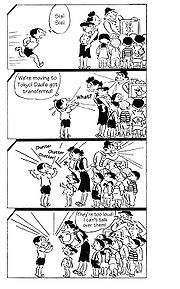
Modern manga originated in the Occupation (1945–1952) and post-Occupation years (1952–early 1960s), while a previously militaristic and ultra-nationalist Japan rebuilt its political and economic infrastructure. An explosion of artistic creativity occurred in this period, involving manga artists such as Osamu Tezuka
Osamu Tezuka
was a Japanese cartoonist, manga artist, animator, producer, activist and medical doctor, although he never practiced medicine. Born in Osaka Prefecture, he is best known as the creator of Astro Boy, Kimba the White Lion and Black Jack...
(Astro Boy) and Machiko Hasegawa
Machiko Hasegawa
, January 30, 1920 – May 27, 1992, in Taku, Saga Prefecture) was one of the first female manga artists.She started her own comic strip, Sazae-san, in 1946. It reached national circulation via the Asahi Shimbun in 1949, and ran daily until Hasegawa decided to retire in February 1974...
(Sazae-san
Sazae-san
is a Japanese comic strip created by Machiko Hasegawa. It was first published in Hasegawa's local paper, the , on April 22, 1946. When the wished to have Hasegawa draw the comic strip for their paper, she moved to Tokyo in 1949 with the explanation that the main characters had moved from Kyūshū to...
).
In 1969 a group of female manga artists (later called the Year 24 Group
Year 24 group
refers to one of two female manga artist groups which are considered to have revolutionized shōjo manga . Their works often examine "radical and philosophical issues", including sexuality and gender issues, and many of their works are now considered "classics" of shōjo manga...
, also known as Magnificent 24s) made their shōjo manga debut ("year 24" comes from the Japanese name for the year 1949, the birth-year of many of these artists). The group included Hagio Moto
Moto Hagio
is a manga artist born on May 12, 1949 in Ōmuta, Fukuoka Prefecture, Japan, though she currently lives in Saitama Prefecture. She is considered a "founding mother" of modern shōjo manga, especially shōnen-ai. She is also a member of the Year 24 Group...
, Riyoko Ikeda
Riyoko Ikeda
is a Japanese manga artist and singer. She is included in the Year 24 Group. She was one of the most popular Japanese comic artists in the 1970s, being best known for The Rose of Versailles.- Biography :...
, Yumiko Oshima
Yumiko Oshima
is a female Japanese manga artist and a member of Year 24 group.She made her debut in 1968 with Paula's Tears in Weekly Margaret.She received the 1973 Japan Cartoonists Association Award for excellence for Mimoza Yashiki de Tsukamaete...
, Keiko Takemiya
Keiko Takemiya
is a Japanese manga artist. She is included in the Year 24 Group. She resides in Kamukura, Kanagawa Prefecture. Takemiya was one of the female authors who in the early 1970s pioneered a genre of girls' comics about love between young men; in December 1970 she published a short story, "In the...
, and Ryoko Yamagishi
Ryoko Yamagishi
is a female Japanese manga artist. She is considered to be one of the Year 24 Group. She studied ballet as a child, which plays a part in many of her works. When she read the manga of Machiko Satonaka in 1964, she decided to pursue becoming a manga artist. Although her parents did not agree with...
, and they marked the first major entry of female artists into manga. Thereafter, primarily female manga artists would draw shōjo for a readership of girls and young women. In the following decades (1975–present), shōjo manga continued to develop stylistically while simultaneously evolving different but overlapping subgenres. Major subgenres include romance, superheroines, and "Ladies Comics" (in Japanese, redisu , redikomi , and josei ).
Modern shōjo manga romance features love as a major theme set into emotionally intense narratives of self-realization
Enlightenment (spiritual)
Enlightenment in a secular context often means the "full comprehension of a situation", but in spiritual terms the word alludes to a spiritual revelation or deep insight into the meaning and purpose of all things, communication with or understanding of the mind of God, profound spiritual...
. With the superheroines, shōjo manga saw releases such as Pink Hanamori
Pink Hanamori
is a Japanese manga artist known for illustrating the manga Mermaid Melody Pichi Pichi Pitch which was written by Michiko Yokote. Michiyo Kikuta once worked under Hanamori as an assistant...
's Mermaid Melody Pichi Pichi Pitch
Mermaid Melody Pichi Pichi Pitch
is a shōjo manga and anime series created by Michiko Yokote, with artwork by Pink Hanamori. The manga was originally published in the monthly shōjo manga anthology Nakayoshi...
Reiko Yoshida
Reiko Yoshida
is a Japanese screenwriter and manga author.-TV anime:*Angelic Layer - Script *ARIA The ANIMATION- Script*ARIA The NATURAL - Script*Ballad of a Shinigami - Series Composition, Script...
's Tokyo Mew Mew
Tokyo Mew Mew
, also known as Mew Mew Power, is a Japanese shōjo manga series written by Reiko Yoshida and illustrated by Mia Ikumi. It was originally serialized in Nakayoshi from September 2000 to February 2003, and later published in seven tankōbon volumes by Kodansha from February 2001 to April 2003...
, And, Naoko Takeuchi
Naoko Takeuchi
is a Japanese manga artist who lives in Tokyo, Japan. Takeuchi's works have a wide following among anime and manga fans worldwide. Her most popular work, Sailor Moon, rose to become one of the most recognized manga and anime products to date.-Early life:...
's Pretty Soldier Sailor Moon
Sailor Moon
Sailor Moon, known as , is a media franchise created by manga artist Naoko Takeuchi. Fred Patten credits Takeuchi with popularizing the concept of a team of magical girls, and Paul Gravett credits the series with "revitalizing" the magical-girl genre itself...
, which became internationally popular in both manga and anime formats. Groups (or sentai
Sentai
in Japanese language is a word for a military unit and may be literally translated as "squadron", "task force", "group" or "wing". The terms "regiment" and "flotilla", while sometimes used as translations of Sentai, are also used to refer to larger formations....
s) of girls working together have also been popular within this genre. Like Lucia, Hanon, and Rina singing together, and Sailor Moon, Sailor Mercury, Sailor Mars, Sailor Jupiter, and Sailor Venus working together.
Manga for male readers sub-divides according to the age of its intended readership: boys up to 18 years old (shōnen manga) and young men 18- to 30-years old (seinen
Seinen
is a subset of manga that is generally targeted at a 20–30 year old male audience, but the audience can be older with some manga aimed at businessmen well into their 40s. In Japanese, the word Seinen means "young man" or "young men" and is not suggestive of sexual matters...
manga); as well as by content, including action-adventure often involving male heroes, slapstick humor, themes of honor, and sometimes explicit sexuality. The Japanese use different kanji for two closely allied meanings of "seinen"— for "youth, young man" and for "adult, majority"—the second referring to sexually overt manga aimed at grown men and also called seijin ("adult" ) manga. Shōnen, seinen, and seijin manga share many features in common.
Boys and young men became some of the earliest readers of manga after World War II. From the 1950s on, shōnen manga focused on topics thought to interest the archetypal boy, including subjects like robots, space-travel, and heroic action-adventure. Popular themes include science fiction
Science fiction
Science fiction is a genre of fiction dealing with imaginary but more or less plausible content such as future settings, futuristic science and technology, space travel, aliens, and paranormal abilities...
, technology, sports, and supernatural settings. Manga with solitary costumed superheroes like Superman
Superman
Superman is a fictional comic book superhero appearing in publications by DC Comics, widely considered to be an American cultural icon. Created by American writer Jerry Siegel and Canadian-born American artist Joe Shuster in 1932 while both were living in Cleveland, Ohio, and sold to Detective...
, Batman
Batman
Batman is a fictional character created by the artist Bob Kane and writer Bill Finger. A comic book superhero, Batman first appeared in Detective Comics #27 , and since then has appeared primarily in publications by DC Comics...
, and Spider-Man
Spider-Man
Spider-Man is a fictional Marvel Comics superhero. The character was created by writer-editor Stan Lee and writer-artist Steve Ditko. He first appeared in Amazing Fantasy #15...
generally did not become as popular.
The role of girls and women in manga produced for male readers has evolved considerably over time to include those featuring single pretty girls (bishōjo
Bishojo
is a Japanese term used to refer to young and pretty girls, usually below university age. Bishōjo is not listed as a word in the prominent Japanese dictionary Kōjien...
) such as Belldandy
Belldandy
is a character in the popular anime and manga series Oh My Goddess!. She was created by Kōsuke Fujishima as one of three Goddesses who come to Earth to reside with Keiichi Morisato, and she serves as his love interest. She is depicted as a beautiful and powerful young woman, with strong nurturing...
from Oh My Goddess!, stories where such girls and women surround the hero, as in Negima
Negima!: Magister Negi Magi
Negima! Magister Negi Magi, known in Japan as is a manga and anime series by Ken Akamatsu . The manga is currently being published by Kodansha and serialized in Shōnen Magazine in Japan. Del Rey Manga published the English translated version in the United States and Canada prior to Kodansha...
and Hanaukyo Maid Team
Hanaukyo Maid Team
is an anime and manga bishōjo series created by Morishige.Hanaukyo Maid Team is about a young boy, Taro Hanaukyo, who has inherited a vast family fortune and, more importantly, the hundreds of employees working at the family mansion...
, or groups of heavily armed female warriors (sentō bishōjo)
With the relaxation of censorship in Japan in the 1990s, a wide variety of explicit sexual themes appeared in manga intended for male readers, and correspondingly occur in English translations. However, in 2010 the Tokyo Metropolitan Government passed a bill to restrict harmful content.http://www.yomiuri.co.jp/dy/national/T101213003771.htm
The gekiga
Gekiga
is Japanese for "dramatic pictures." The term was coined by Yoshihiro Tatsumi and adopted by other more serious Japanese cartoonists who did not want their trade to be known as manga or "irresponsible pictures." It's akin to Will Eisner who started calling his comics "graphic novels" as opposed...
style of drawing—emotionally dark, often starkly realistic, sometimes very violent—focuses on the day-in, day-out grim realities of life, often drawn in gritty and unpretty fashions. Gekiga such as Sampei Shirato's 1959–1962 Chronicles of a Ninja's Military Accomplishments (Ninja Bugeichō) arose in the late 1950s and 1960s partly from left-wing student and working-class political activism and partly from the aesthetic dissatisfaction of young manga artists like Yoshihiro Tatsumi
Yoshihiro Tatsumi
is a Japanese manga artist who is widely credited with starting the gekiga style of alternative comics in Japan, having allegedly coined the term in 1957....
with existing manga.
Publications
In Japan, manga constituted an annual 406 billion yen (approximately $3.6 billion USD) publication-industry by 2007. Recently, the manga industry has expanded worldwide, where distribution companies license and reprint manga into their native languages.After a series has run for a while, publishers often collect the stories together and print them in dedicated book-sized volumes, called tankōbon. These are the equivalent of U.S. trade paperbacks
Trade paperback (comics)
In comics, a trade paperback is a collection of stories originally published in comic books, reprinted in book format, usually capturing one story arc from a single title or a series of stories with a connected story arc or common theme from one or more titles...
or graphic novel
Graphic novel
A graphic novel is a narrative work in which the story is conveyed to the reader using sequential art in either an experimental design or in a traditional comics format...
s. These volumes use higher-quality paper, and are useful to those who want to "catch up" with a series so they can follow it in the magazines or if they find the cost of the weeklies or monthlies to be prohibitive. Recently, "deluxe" versions have also been printed as readers have gotten older and the need for something special grew. Old manga have also been reprinted using somewhat lesser quality paper and sold for 100 yen (about $1 U.S. dollar) each to compete with the used book
Used book
A used book or secondhand book is a book which has been owned before by an owner other than the publisher or retailer, usually by an individual or library....
market.
Marketeers primarily classify manga by the age and gender of the target readership. In particular, books and magazines sold to boys (shōnen) and girls (shōjo) have distinctive cover art and are placed on different shelves in most bookstores. Due to cross-readership, consumer response is not limited by demographics. For example, male readers subscribing to a series intended for girls and so on.
Japan also has manga café
Manga cafe
A is a kind of café in Japan where people can read manga. People pay for the time they stay in the café. Most manga cafés also offer internet access like and vice versa, making the two terms mostly interchangeable in Japan. . Additional services include video games, television, snack/beverage...
s, or manga kissa (kissa is an abbreviation of kissaten
Kissaten
A is a Japanese-style coffee shop. Kissaten are particularly popular among students and business people for breakfast.By law kissaten are able to serve sweets and tea, but almost all will also serve coffee, sandwiches, spaghetti, and other light refreshments, as well as curry rice or set meals at...
). At a manga kissa, people drink coffee and read manga, and sometimes stay there overnight.
There has been an increase in the amount of publications of original webmanga. It is internationally drawn by enthusiasts of all levels of experience, and is intended for online viewing. It can be ordered in graphic novel form if available in print.
The Kyoto International Manga Museum
Kyoto International Manga Museum
The is located in Nakagyō-ku, Kyoto, Japan. The building housing the museum is the former Tatsuike Elementary School. The museum opened on November 25, 2006. Its collection of 200,000 items includes such rarities as Meiji period magazines and postwar rental books....
maintains a very large website listing manga published in Japanese.
Magazines
Newtype (magazine)
is a monthly magazine publication originating from Japan, covering anime and manga . It was launched by publishing company Kadokawa Shoten on March 8, 1985 with its April issue, and has since seen regular release on the 10th of every month in its home country...
featured single chapters within their monthly periodicals. Other magazines like Nakayoshi
Nakayoshi
is a shōjo manga magazine published by Kodansha in Japan. First published in December 1954, it is a long-running magazine with over 50 years worth of manga publication history. The target demographic for Nakayoshi is aimed at young girls between...
feature many stories written by many different artists; these magazines, or "anthology magazines", as they are also known (colloquially "phone books"), are usually printed on low-quality newsprint and can be anywhere from 200 to more than 850 pages thick. Manga magazines also contain one-shot comics and various four-panel yonkoma
Yonkoma
thumb|right|150px|Traditional Yonkoma layout, a comic-strip format, generally consists of gag comic strips within four panels of equal size ordered from top to bottom...
(equivalent to comic strip
Comic strip
A comic strip is a sequence of drawings arranged in interrelated panels to display brief humor or form a narrative, often serialized, with text in balloons and captions....
s). Manga series can run for many years if they are successful. Manga artists sometimes start out with a few "one-shot" manga projects just to try to get their name out. If these are successful and receive good reviews, they are continued. Magazines often have a short life.
History
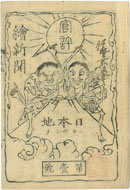
Kanagaki Robun and Kawanabe Kyosai created the first manga magazine in 1874: Eshinbun Nipponchi. The magazine was heavily influenced by Japan Punch, founded in 1862 by Charles WirgmanCharles Wirgman
Charles Wirgman was an English artist and cartoonist, the creator of the Japan Punch and illustrator in China and Meiji period Japan for the Illustrated London News....
, a British cartoonist. Eshinbun Nipponchi had a very simple style of drawings and did not become popular with many people. Eshinbun Nipponchi ended after three issues. The magazine Kisho Shimbun in 1875 was inspired by Eshinbun Nipponchi, which was followed by Marumaru Chinbun in 1877, and then Garakuta Chinpo in 1879. Shōnen Sekai
Shonen Sekai
, is one of the first shōnen magazines published by Hakubunkan specializing in children's literature, published from 1895 to 1914. Shōnen Sekai was created as a part of many magazine created by Hakubunkan that would connect with many different parts of society in Japan...
was the first shōnen
Shonen
The term refers to manga marketed to a male audience aged roughly 10 and up. The Kanji characters literally mean "few" and "year", respectively, where the characters generally mean "comic"...
magazine created in 1895 by Iwaya Sazanami, a famous writer of Japanese children's literature back then. Shōnen Sekai had a strong focus on the First Sino-Japanese War
First Sino-Japanese War
The First Sino-Japanese War was fought between Qing Dynasty China and Meiji Japan, primarily over control of Korea...
.
In 1905 the manga-magazine publishing boom started with the Russo-Japanese War
Russo-Japanese War
The Russo-Japanese War was "the first great war of the 20th century." It grew out of rival imperial ambitions of the Russian Empire and Japanese Empire over Manchuria and Korea...
, Tokyo Pakku was created and became a huge hit. After Tokyo Pakku in 1905, a female version of Shōnen Sekai was created and named Shōjo Sekai
Shojo Sekai
was one of the first shōjo magazines in Japan. It was published by Hakubunkan beginning in 1906 and was initially edited by renowned children’s author , better known by the pen name...
, considered the first shōjo magazine. Shōnen Pakku was made and is considered the first children's manga magazine. The children's demographic was in an early stage of development in the Meiji period
Meiji period
The , also known as the Meiji era, is a Japanese era which extended from September 1868 through July 1912. This period represents the first half of the Empire of Japan.- Meiji Restoration and the emperor :...
. Shōnen Pakku was influenced from foreign children's magazines such as Puck which an employee of Jitsugyō no Nihon (publisher of the magazine) saw and decided to emulate. In 1924, Kodomo Pakku was launched as another children's manga magazine after Shōnen Pakku. During the boom, Poten (derived from the French "potin") was published in 1908. All the pages were in full color with influences from Tokyo Pakku and Osaka Pakku. It is unknown if there were any more issues besides the first one. Kodomo Pakku was launched May 1924 by Tokyosha and featured high-quality art by many members of the manga artistry like Takei Takeo, Takehisa Yumeji and Aso Yutaka. Some of the manga featured speech balloons, where other manga from the previous eras did not use speech balloons and were silent.
Published from May 1935 to January 1941, Manga no Kuni coincided with the period of the Second Sino-Japanese War
Second Sino-Japanese War
The Second Sino-Japanese War was a military conflict fought primarily between the Republic of China and the Empire of Japan. From 1937 to 1941, China fought Japan with some economic help from Germany , the Soviet Union and the United States...
. Manga no Kuni featured information on becoming a mangaka
Mangaka
is the Japanese word for a comic artist or cartoonist. Outside of Japan, manga usually refers to a Japanese comic book and mangaka refers to the author of the manga, who is usually Japanese...
and on other comics industries around the world. Manga no Kuni handed its title to Sashie Manga Kenkyū in August 1940.
Dōjinshi
Dōjinshi, produced by small publishers outside of the mainstream commercial market, resemble in their publishing small-pressSmall press
Small press is a term often used to describe publishers with annual sales below a certain level. Commonly, in the United States, this is set at $50 million, after returns and discounts...
independently published comic book
Comic book
A comic book or comicbook is a magazine made up of comics, narrative artwork in the form of separate panels that represent individual scenes, often accompanied by dialog as well as including...
s in the United States. Comiket
Comiket
, otherwise known as the , is the world's largest self-published comic book fair, held twice a year in Tokyo, Japan. The first Comiket was held on December 21, 1975, with only about 32 participating circles and an estimated 600 attendees. Attendance has since swelled to over a half million people....
, the largest comic book convention
Convention (meeting)
A convention, in the sense of a meeting, is a gathering of individuals who meet at an arranged place and time in order to discuss or engage in some common interest. The most common conventions are based upon industry, profession, and fandom...
in the world with around 500,000 visitors gathering over three days, is devoted to dōjinshi. While they most often contain original stories, many are parodies of or include characters
Character (arts)
A character is the representation of a person in a narrative work of art . Derived from the ancient Greek word kharaktêr , the earliest use in English, in this sense, dates from the Restoration, although it became widely used after its appearance in Tom Jones in 1749. From this, the sense of...
from popular manga and anime series. Some dōjinshi continue with a series' story or write an entirely new one using its characters, much like fan fiction
Fan fiction
Fan fiction is a broadly-defined term for fan labor regarding stories about characters or settings written by fans of the original work, rather than by the original creator...
. In 2007, dōjinshi sold for 27.73 billion yen (245 million USD).
International markets
the influence of manga on international comics had grown considerably over the past two decades. "Influence" is used here to refer to effects on the comics markets outside of Japan and to aesthetic effects on comics artists internationally.
Horizontal and vertical writing in East Asian scripts
Many East Asian scripts can be written horizontally or vertically. The Chinese, Japanese and Korean scripts can be oriented in either direction, as they consist mainly of disconnected syllabic units, each occupying a square block of space...
. Some publishers of translated manga keep to this original format. Other publishers mirror the pages horizontally before printing the translation, changing the reading direction to a more "Western" left to right, so as not to confuse foreign readers or traditional comics-consumers. This practice is known as "flipping". For the most part, criticism suggests that flipping goes against the original intentions of the creator (for example, if a person wears a shirt that reads "MAY" on it, and gets flipped, then the word is altered to "YAM"). Flipping may also cause oddities with familiar asymmetrical objects or layouts, such as a car being depicted with the gas pedal on the left and the brake on the right, or a shirt with the buttons on the wrong side.
United States
Manga made their way only gradually into U.S. markets, first in association with anime and then independently. Some U.S. fansFan (person)
A Fan, sometimes also called aficionado or supporter, is a person with a liking and enthusiasm for something, such as a band or a sports team. Fans of a particular thing or person constitute its fanbase or fandom...
became aware of manga in the 1970s and early 1980s. However, anime was initially more accessible than manga to U.S. fans, many of whom were college-age young people who found it easier to obtain, subtitle, and exhibit video tapes of anime than translate, reproduce, and distribute tankōbon-style manga books. One of the first manga translated into English and marketed in the U.S. was Keiji Nakazawa
Keiji Nakazawa
is a Japanese manga artist and writer.He was born in Hiroshima and was in the city when it was destroyed by an atomic bomb in 1945. All of his family members who had not been evacuated died in the bombing except for his mother, and an infant sister who died several weeks after the bombing...
's Barefoot Gen
Barefoot Gen
is a Japanese manga series by Keiji Nakazawa. Loosely based on Nakazawa's own experiences as a Hiroshima survivor, the series begins in 1945 in and around Hiroshima, Japan, where the six-year-old boy Gen lives with his family...
, an autobiographical story of the atomic bombing of Hiroshima issued by Leonard Rifas and Educomics (1980–1982). More manga were translated between the mid-1980s and 1990s, including Golgo 13
Golgo 13
is a manga series written and illustrated by Takao Saito, published in Shogakukan's Big Comic magazine since January 1969. In 1976, the manga won the 21st Shogakukan Manga Award for general manga...
in 1986, Lone Wolf and Cub
Lone Wolf and Cub
is a manga created by writer Kazuo Koike and artist Goseki Kojima. First published in 1970, the story was adapted into six films starring Tomisaburo Wakayama, four plays, a television series starring Yorozuya Kinnosuke, and is widely recognized as an important and influential work.Lone Wolf and Cub...
from First Comics
First Comics
First Comics was an American comic-book publisher that was active from 1983–1991, known for titles like American Flagg!, Grimjack, Nexus, Badger, Dreadstar, and Jon Sable...
in 1987, and Kamui
Kamui (manga)
is a Japanese shōjo manga series by Japanese author Shingo Nanami. The manga was serialized in the Monthly Stencil magazine, and later serialized in Monthly Gangan WING magazine, and published in Japan by SQUARE ENIX....
, Area 88
Area 88
is a Japanese manga series by Kaoru Shintani serialized between 1979 and 1986. The story is about a young pilot named Shin Kazama and his experiences at Area 88, a mercenary air force base secluded in the desert of a war torn country...
, and Mai the Psychic Girl
Mai the Psychic Girl
Mai, the Psychic Girl, known simply as in Japan, is a manga written by Kazuya Kudō and illustrated by Ryoichi Ikegami.The main character is Mai Kuju, a 14-year-old Japanese girl with powerful psychic abilities. She is being pursued by the Wisdom Alliance, an organization which secretly strives to...
, also in 1987 and all from Viz Media
VIZ Media
VIZ Media, LLC, headquartered in San Francisco, is an anime, manga, and Japanese entertainment company. It was founded in 1986 as VIZ LLC. In 2005, VIZ LLC and ShoPro Entertainment merged to form the current VIZ Media LLC, which is jointly owned by Japanese publishers Shogakukan and Shueisha, and...
-Eclipse Comics
Eclipse Comics
Eclipse Comics was an American comic book publisher, one of several independent publishers during the 1980s and early 1990s. In 1978, it published the first graphic novel intended for the newly created comic book specialty store market...
. Others soon followed, including Akira
Akira (manga)
is a manga series by Katsuhiro Otomo. Set in a post-apocalyptic Neo-Tokyo, the work uses conventions of the cyberpunk genre to detail a saga of turmoil. Initially serialized in the pages of Young Magazine from 1982 until 1990, the work was collected in six volumes by Japanese publisher Kodansha...
from Marvel Comics
Marvel Comics
Marvel Worldwide, Inc., commonly referred to as Marvel Comics and formerly Marvel Publishing, Inc. and Marvel Comics Group, is an American company that publishes comic books and related media...
' Epic Comics
Epic Comics
Epic Comics was a creator-owned imprint of Marvel Comics started in 1982, lasting through the mid-1990s, and being briefly revived on a small scale in the mid-2000s.- Origins :...
imprint and Appleseed from Eclipse Comics in 1988, and later Iczer-1 (Antarctic Press
Antarctic Press
Antarctic Press is a San Antonio-based comic book publishing company which publishes "American Manga" style comic books.Founded by Ben Dunn in 1984, Antarctic Press has produced over 850 titles with a total circulation of over 5 million...
, 1994) and Ippongi Bang
Ippongi Bang
Ippongi Bang is a multimedia and manga artist, born January 4, 1965 in Yokohama City, Japan. She has been called "one of the most well-known manga artists in America in the mid-1990s."-Life and career:...
's F-111 Bandit (Antarctic Press, 1995).
In the 1980s to the mid-1990s, Japanese animation, like Akira
Akira (film)
is a 1988 Japanese animated cyberpunk science fiction film directed by Katsuhiro Otomo, written by Otomo and Izo Hashimoto, and starring the voices of Mitsuo Iwata, Nozomu Sasaki, Mami Koyama and Taro Ishida. The screenplay is based on Otomo's manga Akira....
, Dragon Ball
Dragon Ball
is a Japanese manga series written and illustrated by Akira Toriyama. It was originally serialized in Weekly Shōnen Jump from 1984 to 1995; later the 519 individual chapters were published into 42 tankōbon volumes by Shueisha. Dragon Ball was inspired by the classical Chinese novel Journey to the...
, Neon Genesis Evangelion, and Pokémon
Pokémon (anime)
, abbreviated from , is a children's TV anime series, which has since been adapted for the North and South American, Australian and European television markets...
, made a bigger impact on the fan experience and in the market than manga. Matters changed when translator-entrepreneur Toren Smith
Toren Smith
Toren Smith is a manga translator and founder of Studio Proteus. He was born in Alberta, Canada, learned to read by the age of four, and by the age of 12 had won his first award for writing from the Calgary Stampede and Exhibition. By thirteen he had sold his first magazine article, an...
founded Studio Proteus
Studio Proteus
Studio Proteus is a Japanese manga import, translation and lettering company, founded in 1986 by Toren Smith and based in San Francisco. Other staff included translators Dana Lewis and Frederik Schodt, letterer Tom Orzechowski and translator/letterer Tomoko Saito...
in 1986. Smith and Studio Proteus acted as an agent and translator of many Japanese manga, including Masamune Shirow
Masamune Shirow
is an internationally renowned manga artist, born on November 23, 1961.Masamune Shirow is a pen name, based on a famous swordsmith, Masamune. He is best known for the manga Ghost in the Shell, which has since been turned into two theatrical anime movies, two anime TV series, an anime TV movie, and...
's Appleseed and Kōsuke Fujishima
Kosuke Fujishima
is a Japanese manga artist.Born in Chiba, Japan, he first came to public attention as an editor of Puff magazine, his first job after completing high school. Fujishima originally intended to be a draftsman, but took the editorial role after failing to get a drafting apprenticeship...
's Oh My Goddess!, for Dark Horse
Dark Horse Comics
Dark Horse Comics is the largest independent American comic book and manga publisher.Dark Horse Comics was founded in 1986 by Mike Richardson in Milwaukie, Oregon, with the concept of establishing an ideal atmosphere for creative professionals. Richardson started out by opening his first comic book...
and Eros Comix
Eros Comix
Eros Comix is an adult-oriented imprint of Fantagraphics Books, established in 1990 to publish pornographic comic books. Eros Comix sells anime videos, DVDs, adult comic books, and books of erotic art and photography...
, eliminating the need for these publishers to seek their own contacts in Japan.
Simultaneously, the Japanese publisher Shogakukan
Shogakukan
is a Japanese publisher of dictionaries, literature, manga, non-fiction, DVDs, and other media in Japan.Shogakukan founded Shueisha which founded Hakusensha. These are three separate companies, but are together called the Hitotsubashi Group, one of the largest publishing groups in Japan...
opened a U.S. market initiative with their U.S. subsidiary Viz, enabling Viz to draw directly on Shogakukan's catalogue and translation skills.
Ghost in the Shell (manga)
is a Japanese science fiction manga created by Masamune Shirow originally released in 8 separate issues. He followed it up by Ghost in the Shell 2: Man/Machine Interface and Ghost in the Shell 1.5: Human Error Processor....
(translated by Frederik L. Schodt
Frederik L. Schodt
Frederik L. Schodt is an American translator, interpreter and writer.Schodt's father was in the US foreign service, and he grew up in Norway, Australia, and Japan. The family first went to Japan in 1965 when Schodt was fifteen. They left in 1967 but Schodt remained to graduate from Tokyo's American...
and Toren Smith
Toren Smith
Toren Smith is a manga translator and founder of Studio Proteus. He was born in Alberta, Canada, learned to read by the age of four, and by the age of 12 had won his first award for writing from the Calgary Stampede and Exhibition. By thirteen he had sold his first magazine article, an...
) becoming very popular among fans. Another success of the mid-1990s was Sailor Moon
Sailor Moon
Sailor Moon, known as , is a media franchise created by manga artist Naoko Takeuchi. Fred Patten credits Takeuchi with popularizing the concept of a team of magical girls, and Paul Gravett credits the series with "revitalizing" the magical-girl genre itself...
. By 1995–1998, the Sailor Moon manga had been exported to over 23 countries, including China, Brazil, Mexico, Australia, North America and most of Europe. In 1997, Mixx Entertainment began publishing Sailor Moon, along with CLAMP
Clamp (manga artists)
, is an all-female Japanese manga artist group that formed in the mid 1980s. Many of the group's manga series are often adapted into anime after release. It consists of their leader , who provides much of the storyline and screenplay for all their works and adaptations of those works respectively ,...
's Magic Knight Rayearth
Magic Knight Rayearth
is a Japanese manga series created by Clamp, a manga artist team made up by Satsuki Igarashi, Ageha Ohkawa, Tsubaki Nekoi and Mokona. Rayearth combines elements from the magical girl and mecha anime genres with parallel world fantasy....
, Hitoshi Iwaaki's Parasyte
Parasyte
is a manga series written and illustrated by Hitoshi Iwaaki, and published in Kodansha's Afternoon magazine from 1990 to 1995.The North American version of the manga was published by Tokyopop. The Tokyopop English-language manga went out of print on May 2, 2005. At the 2006 Comic-Con, Del Rey Manga...
and Tsutomu Takahashi
Tsutomu Takahashi
' , born on September 20, 1965 in Tokyo, Japan, is a Japanese manga artist, who is well known for his manga Jiraishin. As of March 2006, he is currently married and has one child...
's Ice Blade
Ice Blade
is manga series written and illustrated by Tsutomu Takahashi, published in Kodansha's Afternoon magazine from 1992 to 1999. It was announced by Afternoon's October magazine that a new Jiraishin series would be in the magazine good! afternoon and would be known as Jiraishin diablo, which is...
in the monthly manga magazine MixxZine. Two years later, MixxZine was renamed to Tokyopop before discontinuing in 2000. Mixx Entertainment, later renamed Tokyopop
Tokyopop
Tokyopop, styled TOKYOPOP, and formerly known as Mixx, is a distributor, licensor, and publisher of anime, manga, manhwa, and Western manga-style works. The existing German publishing division produces German translations of licensed Japanese properties and original English-language manga, as well...
, also published manga in trade paperbacks
Trade paperback (comics)
In comics, a trade paperback is a collection of stories originally published in comic books, reprinted in book format, usually capturing one story arc from a single title or a series of stories with a connected story arc or common theme from one or more titles...
and, like Viz, began aggressive marketing of manga to both young male and young female demographics.
In the following years, manga became increasingly popular, and new publishers entered the field while the established publishers greatly expanded their catalogues. , the U.S. and Canadian manga market generated $175 million in annual sales. Simultaneously, mainstream U.S. media began to discuss manga, with articles in The New York Times
The New York Times
The New York Times is an American daily newspaper founded and continuously published in New York City since 1851. The New York Times has won 106 Pulitzer Prizes, the most of any news organization...
, Time magazine
Time (magazine)
Time is an American news magazine. A European edition is published from London. Time Europe covers the Middle East, Africa and, since 2003, Latin America. An Asian edition is based in Hong Kong...
, The Wall Street Journal
The Wall Street Journal
The Wall Street Journal is an American English-language international daily newspaper. It is published in New York City by Dow Jones & Company, a division of News Corporation, along with the Asian and European editions of the Journal....
, and Wired
Wired (magazine)
Wired is a full-color monthly American magazine and on-line periodical, published since January 1993, that reports on how new and developing technology affects culture, the economy, and politics...
magazine.
Europe
Manga has influenced European cartooning in a way somewhat different from the U.S. experience. Broadcast anime in Italy and France opened the European market to manga during the 1970s. French art has borrowed from Japan since the 19th century (Japonisme), and has its own highly developed tradition of bande dessinée cartooning. In France, beginning in the mid-1990s, manga has proven very popular to a wide readership, accounting for about one-third of comics sales in France since 2004. According to the Japan External Trade Organization, sales of manga reached $212.6 million within France and Germany alone in 2006. European publishers marketing manga translated into French include GlénatGlénat (publisher)
Glénat Editions SA is a French publisher with its head office in Grenoble. The company publishes many things, including comic books and manga in France, Benelux, and Spain; it was founded by Jacques Glénat. The Spanish subsidiary has its head office in Barcelona. The Benelux subsidiary, Glénat...
, Asuka, Casterman
Casterman
Casterman is a publisher of Franco-Belgian comics, specializing in comic books and children's literature. The company is based in Tournai, Belgium.Founded in 1780, Casterman was originally a printing company and publishing house...
, Kana
Kana (publisher)
Kana is a French publisher affiliated with Les Éditions Dargaud. Kana was founded in 1996 by Yves Schlirf. The company publishes manga in French and Dutch. Its headquarters are in the Dargaud offices in the 18th arrondissement of Paris.-External links:*...
, and Pika Édition
Pika Édition
Pika Édition is a French publisher headquartered in Boulogne-Billancourt, specializing in manga. Founded as a daughter company of Media System Editions, it was taken over by Hachette Livre in 2007.-Distribution:...
, among others.
European publishers also translate manga into German, Italian, Dutch, and other languages. Manga publishers based in the United Kingdom include Gollancz
Gollancz
Gollancz often refers to the British publishing house Victor Gollancz Ltd.Gollancz, a family name originating from the Polish town Gołańcz , is mainly known as the name of a prominent British Jewish family, including:* Sir Hermann Gollancz , rabbi* Sir Israel Gollancz , scholar of...
and Titan Books. Manga publishers from the United States have a strong marketing presence in the United Kingdom: for example, the Tanoshimi
Tanoshimi
Tanoshimi is a part of Random House a US based publisher. Tanoshimi is an arm of the United Kingdom branch of the company and is used for the publication of new English Language Manga titles...
line from Random House
Random House
Random House, Inc. is the largest general-interest trade book publisher in the world. It has been owned since 1998 by the German private media corporation Bertelsmann and has become the umbrella brand for Bertelsmann book publishing. Random House also has a movie production arm, Random House Films,...
.
Localized manga
A number of artists in the United States have drawn comics and cartoons influenced by manga. As an early example, Vernon GrantVernon Grant
Vernon Ethelbert Grant was a cartoonist who did graphic novels, and is also known for his digest-sized comic book series, The Love Rangers...
drew manga-influenced comics while living in Japan in the late 1960s and early 1970s. Others include Frank Miller
Frank Miller (comics)
Frank Miller is an American comic book artist, writer and film director best known for his dark, film noir-style comic book stories and graphic novels Ronin, Daredevil: Born Again, Batman: The Dark Knight Returns, Sin City and 300...
's mid-1980s Ronin, Adam Warren
Adam Warren
Adam Warren is an American comic book writer and artist who is most famous for his adaptation of the characters known as Dirty Pair into an American comic book, and for being one of the first American commercial illustrators to be influenced by the general manga style...
and Toren Smith's 1988 The Dirty Pair
The Dirty Pair
The Dirty Pair is an original English-language manga written and illustrated by Adam Warren, based on the Dirty Pair characters created by Haruka Takachiho....
, Ben Dunn
Ben Dunn
Ben Dunn is an American comic book artist. Although born in Taiwan, he grew up in Kentucky, Taiwan and San Antonio, Texas. It was in Taiwan that he was first exposed to Japanese manga. In 1984 he founded Antarctic Press, an American comic book company specializing in Manga-style titles...
's 1987 Ninja High School
Ninja High School
Ninja High School is a comic book series created, written, and illustrated by Ben Dunn, and currently published by Antarctic Press. It was at first published by Eternity Comics...
, Stan Sakai
Stan Sakai
is a third-generation Japanese American Cartoonist comic book creator. He is best known as the creator of the comic series Usagi Yojimbo. -Biography:...
's 1984 Usagi Yojimbo
Usagi Yojimbo
is a comic book series created by Stan Sakai in 1987. In 2011 IGN ranked Miyamoto Usagi 92nd in the top 100 comic books heroes.-Concept:Set primarily at the beginning of Edo period of Japan , with anthropomorphic animals replacing humans, the series features a rabbit ronin, Miyamoto Usagi, whom...
, and Manga Shi 2000 from Crusade Comics (1997).
By the 21st century several U.S. manga publishers had begun to produce work by U.S. artists under the broad marketing label of manga. In 2002, I.C. Entertainment, formerly Studio Ironcat
Studio Ironcat
Studio Ironcat was a small publishing company based in Fredericksburg, Virginia, dedicated to publication of manga and later, Amerimanga. The company is most known for its publication of the first volume of Megatokyo, a prominent webcomic, as well as the flamboyant style of one of its founders,...
and now out of business, launched a series of manga by U.S. artists called Amerimanga. In 2004 eigoMANGA
Eigomanga
eigoMANGA is a comic book publishing company that produces original Japanese-influenced comics as well as develop business and marketing projects geared towards the anime industry. eigoMANGA has been underway since its conception in 2000...
launched Rumble Pak
Rumble Pak (comics)
Rumble Pak is an Original English-language manga anthology series published by eigoMANGA. Rumble Pak showcases original comics created by artists from around the world including a line-up of original stories written and produced by predominantly independent American comics artists...
and Sakura Pakk
Sakura Pakk
Sakura Pakk is an anthology OEL manga series created and published by eigoMANGA. Sakura Pakk highlights original comics stories created for female comic book readers. Sakura Pakk was released in November 2004....
anthology series
Comics anthology
Comics anthologies collect works in the medium of comics that are too short for standalone publication.- U.S. :- UK :British comics have a long tradition publishing comics anthologies, often weekly...
. Seven Seas Entertainment
Seven Seas Entertainment
Seven Seas Entertainment is a publishing company located in Los Angeles, California. It was originally dedicated to the publication of original manga, but now publishes licensed manga and novels, as well as select webcomics...
followed suit with World Manga
Original English-language manga
Original English-language manga or OEL manga is the term commonly used to describe comic books or graphic novels in the "international manga" genre of comics whose language of original publication is English...
. Simultaneously, TokyoPop introduced original English-language manga
Original English-language manga
Original English-language manga or OEL manga is the term commonly used to describe comic books or graphic novels in the "international manga" genre of comics whose language of original publication is English...
(OEL manga) later renamed Global Manga. TokyoPop is currently the largest U.S. publisher of original English language manga.
Francophone artists have also developed their own versions of manga, like Frédéric Boilet
Frédéric Boilet
Frédéric Boilet is a French cartoonist and a manga artist.-Biography:Frédéric Boilet's debut in comic art was in 1983 with La Nuit des Archées....
's la nouvelle manga
La nouvelle manga
Nouvelle Manga is an artistic movement which gathers Franco-Belgian and Japanese comic creators together. The expression was first used by Kiyoshi Kusumi, editor of the Japanese manga magazine Comickers, in referring to the work of French expatriate Frédéric Boilet, who lived in Japan for much of...
. Boilet has worked in France and in Japan, sometimes collaborating with Japanese artists.
Awards
The Japanese manga industry grants a large number of awards, mostly sponsored by publishers, with the winning prize usually including publication of the winning stories in magazines released by the sponsoring publisher. Examples of these awards include:- the Akatsuka AwardAkatsuka AwardThe is the name of a semi-annual award presented to humorous manga cartoonists by the Japanese publisher Shueisha. The award has been given since 1974 and it aims to reward new manga artist in the comedy manga category. Its counterpart award, Tezuka Award, awards new manga artists in the Story...
for humorous manga - the Dengeki Comic Grand PrixDengeki Comic Grand PrixThe is an award handed out semiannually and annually by the Japanese publisher ASCII Media Works for original one-shot manga. Between the first and fifth contests held, there were two divisions: original and anthology...
for one-shot manga - the Kodansha Manga AwardKodansha Manga Awardis an annual award for serialized manga published in the previous year, sponsored by the publisher Kodansha. It is currently awarded in four categories: children's, shōnen, shōjo, and general. The awards began in 1977, initially with categories for shōnen and shōjo. The first award for the...
(multiple genre awards) - the Seiun AwardSeiun AwardThe is a Japanese science fiction award for the best science fiction published in Japan during the preceding year, as voted by attendees of the Japan Science Fiction Convention. "Seiun" is the Japanese word for "nebula", but the award is not related to the American Nebula Award. It was named after...
for best science fiction comic of the year - the Shogakukan Manga AwardShogakukan Manga AwardThe is one of Japan's major manga awards, sponsored by Shogakukan Publishing. It has been awarded annually for serialized manga since 1955 and features candidates from a number of publishers.The current award categories are:...
(multiple genres) - the Tezuka AwardTezuka AwardThe is a semi-annual manga award offered by the Japanese publisher Shueisha , under the auspices of its Weekly Shonen Jump magazine. It awards new comic artists in the Story Manga category. Its counterpart award, Akatsuka Award, awards new comic artists in the Comedic Manga category...
for best new serial manga - the Tezuka Osamu Cultural Prize (multiple genres)
The Japanese Ministry of Foreign Affairs
Ministry of Foreign Affairs (Japan)
The is a cabinet level ministry of Japan responsible for the country's foreign relations.The ministry is due to the second term of the third article of the National Government Organization Act , and the Ministry of Foreign Affairs Establishment Act establishes the ministry...
has awarded the International Manga Award
International Manga Award
is an award established to encourage non-Japanese manga artists in 2007. This award was created by Japanese Foreign Minister Taro Aso, who proposed this award in a policy speech he gave in Tokyo's Akihabara district in 2006.-Winners:...
annually since May 2007.
See also
- EmakimonoEmakimono, often simply called , is a horizontal, illustrated narrative form created during the 11th to 16th centuries in Japan. Emakimono combines both text and pictures, and is drawn, painted, or stamped on a handscroll...
/ Etoki (horizontal, illustrated narrative form) - Japanese popular cultureJapanese popular cultureJapanese popular culture not only reflects the attitudes and concerns of the present but also provides a link to the past. Japanese cinema, cuisine, television programs, manga, and music all developed from older artistic and literary traditions, and many of their themes and styles of presentation...
- LianhuanhuaLianhuanhuaLianhuanhua is a palm-size picture book of sequential drawings found in China in the early 20th century....
(small Chinese picture book) - List of films based on manga
- List of licensed manga in English
- List of manga distributors
- Manga iconographyManga iconographyJapanese manga has developed its own visual language or iconography for expressing emotion and other internal character states. This drawing style has also migrated into anime, as many stories are adapted into television shows and films...
- OekakiOekakiis the Japanese term to describe the act of drawing, meaning "doodle or scribble".-Ekaki uta/drawing songs:In Japan, songs that describe how to draw animals and/or favorite characters are called "Ekaki Uta". These songs are supposed to help children remember how to draw something by incorporating...
(act of drawing) - Q-versionQ-versionQ-version is the English translation for the Chinese term Q版 , referring to the cartoonification or infantilization in the artistic renderings of real life or serious human, animal figures or other characters or objects, especially in the styles of Anime...
(cartoonification) - Fan serviceFan service, fanservice, or , is a term originating from anime and manga fandom for material in a series which is intentionally added to please the audience. It is about "servicing" the fan - giving the fans "exactly what they want"...