
All Topics  
Book of Daniel


   Email Print
   Bookmark   Link


Book of Daniel


The Book of Daniel is a book
Book

A book is a set or collection of written, printed, illustrated, or blank sheets, made of paper, parchment, or other material, usually fastened together to hinge at one side....
 in both the Hebrew Bible (Tanakh
Tanakh

The Tanakh is the Bible used in Judaism. The name "Tanakh" is a Hebrew language Acronym and initialism formed from the initial Hebrew alphabet of the Tanakh's three traditional subdivisions: The Torah , Nevi'im and Ketuvim - hence TaNaKh....
) and the Christian Old Testament
Old Testament

In Western Christianity, the Old Testament refers to the books that form the first of the two-part Christianity Bible Biblical canon. These works correspond to the Hebrew Bible , with some variations and additions....
. Originally written in Hebrew
Hebrew language

Hebrew is a Semitic languages of the Afro-Asiatic languages. Modern Hebrew is spoken by more than seven million people in Israel and Classical Hebrew is used for prayer or study in Jews communities around the world....
 and Aramaic
Aramaic language

Aramaic is a Semitic languages with a 3,000-year history. It has been the language of administration of empires and the language of divine worship....
, it is set during the Babylonian Captivity
Babylonian captivity

The Babylonian captivity, or Babylonian exile, is the name typically given to the deportation and exile of the Jews of the ancient Kingdom of Judah to Babylon by Nebuchadnezzar II of Babylon in 586 BCE....
, a period when Jews were deported and exiled to Babylon
Babylon

Babylon was a city-state of ancient Mesopotamia, sometimes considered an empire, the remains of which can be found in present-day Al Hillah, Babil Governorate, Iraq, about 85 kilometers south of Baghdad....
 following the Siege of Jerusalem
Siege of Jerusalem (597 BC)

In 601 BC, in the fourth year of his reign, Nebuchadrezzar II, king of Babylon, unsuccessfully attempted to invade Egypt and was repulsed with heavy losses....
 of 597 BC. The book revolves around the figure of Daniel
Daniel

Daniel is a figure appearing in the Hebrew Bible and the central protagonist of the Book of Daniel. The name "Daniel" means "Judged by El ". "Dan" = judge and "i" = a suffix conjugating the verb such that its action applies to the speaker....
, an Israelite who becomes an adviser to Nebuchadnezzar
Nebuchadrezzar II

Nebuchadnezzar II, also called King Nebuchadnezzar The Second , was a ruler of Babylon in the Chaldean Dynasty, who reigned c. 605 BC-562 BC....
, the ruler of Babylon from 605 to 562 BC.

The book has two distinct parts: a series of six narratives (chapters one to six) and four apocalyptic
Apocalypse

Apocalypse is a term applied to the disclosure to certain privileged persons of something hidden from the majority of humankind. Today the term is often used to refer to the Doomsday event, which may be a shortening of the phrase apokalupsis eschaton which literally means "revelation at the end of the ?on, or age"....
 visions (chapters seven to twelve).


Discussion
Ask a question about 'Book of Daniel'
Start a new discussion about 'Book of Daniel'
Answer questions from other users
Full Discussion Forum


Encyclopedia


The Book of Daniel is a book
Book

A book is a set or collection of written, printed, illustrated, or blank sheets, made of paper, parchment, or other material, usually fastened together to hinge at one side....
 in both the Hebrew Bible (Tanakh
Tanakh

The Tanakh is the Bible used in Judaism. The name "Tanakh" is a Hebrew language Acronym and initialism formed from the initial Hebrew alphabet of the Tanakh's three traditional subdivisions: The Torah , Nevi'im and Ketuvim - hence TaNaKh....
) and the Christian Old Testament
Old Testament

In Western Christianity, the Old Testament refers to the books that form the first of the two-part Christianity Bible Biblical canon. These works correspond to the Hebrew Bible , with some variations and additions....
. Originally written in Hebrew
Hebrew language

Hebrew is a Semitic languages of the Afro-Asiatic languages. Modern Hebrew is spoken by more than seven million people in Israel and Classical Hebrew is used for prayer or study in Jews communities around the world....
 and Aramaic
Aramaic language

Aramaic is a Semitic languages with a 3,000-year history. It has been the language of administration of empires and the language of divine worship....
, it is set during the Babylonian Captivity
Babylonian captivity

The Babylonian captivity, or Babylonian exile, is the name typically given to the deportation and exile of the Jews of the ancient Kingdom of Judah to Babylon by Nebuchadnezzar II of Babylon in 586 BCE....
, a period when Jews were deported and exiled to Babylon
Babylon

Babylon was a city-state of ancient Mesopotamia, sometimes considered an empire, the remains of which can be found in present-day Al Hillah, Babil Governorate, Iraq, about 85 kilometers south of Baghdad....
 following the Siege of Jerusalem
Siege of Jerusalem (597 BC)

In 601 BC, in the fourth year of his reign, Nebuchadrezzar II, king of Babylon, unsuccessfully attempted to invade Egypt and was repulsed with heavy losses....
 of 597 BC. The book revolves around the figure of Daniel
Daniel

Daniel is a figure appearing in the Hebrew Bible and the central protagonist of the Book of Daniel. The name "Daniel" means "Judged by El ". "Dan" = judge and "i" = a suffix conjugating the verb such that its action applies to the speaker....
, an Israelite who becomes an adviser to Nebuchadnezzar
Nebuchadrezzar II

Nebuchadnezzar II, also called King Nebuchadnezzar The Second , was a ruler of Babylon in the Chaldean Dynasty, who reigned c. 605 BC-562 BC....
, the ruler of Babylon from 605 to 562 BC.

The book has two distinct parts: a series of six narratives (chapters one to six) and four apocalyptic
Apocalypse

Apocalypse is a term applied to the disclosure to certain privileged persons of something hidden from the majority of humankind. Today the term is often used to refer to the Doomsday event, which may be a shortening of the phrase apokalupsis eschaton which literally means "revelation at the end of the ?on, or age"....
 visions (chapters seven to twelve). The narratives take the form of court stories which focus on tests of religious fidelity involving Daniel and his friends (chapters one, three and six), and Daniel's interpretation of royal dreams and visions (chapters two, four and five). In the second part of the book, Daniel recounts his reception of dreams, visions and angelic interpretations in the first person
Grammatical person

Grammatical person, in linguistics, is deixis reference to a participant in an event, such as the speaker, the addressee, or others. Grammatical person typically defines a language's set of personal pronouns....
. The dating and authorship of Daniel has been a matter of great debate among Jews and Christians. The traditional view holds that the work was written by a prophet named Daniel who lived during the sixth century BC, whereas many liberal Biblical scholars maintain that the book was written or redacted
Redaction

In the study of literature, redaction is a form of editing in which multiple source texts are combined together and subjected to minor alteration to make them into a single work....
 in the mid-second century BC and that most of the predictions of the book refer to events that had already occurred. A third viewpoint places the final editorial work in the fourth century BC.

Court Tales

The first six chapters comprise a series of court tales. The first story is in Hebrew; then Aramaic is used from ch. 2:4, beginning with the speech of the "Chaldea
Chaldea

Chaldea , "the Chaldees" of the King James Version of the Bible Old Testament, was a Hellenistic designation for a part of Babylonia, mainly around Sumerian Ur, which became an independent kingdom under the Chaldees....
ns", through chapter seven. Hebrew is then used from chapter eight through chapter twelve. Three additional sections are preserved only in the Septuagint
Septuagint

The Septuagint , or simply "LXX", is the Koine Greek version of the Hebrew Bible, translated in stages between the 3rd century BC and 1st century BC in Alexandria....
, and are considered apocrypha
Apocrypha

Apocrypha are texts of uncertain authenticity, or writings where the authorship is questioned.When used in the specific context of Judeo-Christian theology, the term apocrypha refers to any collection of scriptural texts that falls outside the Biblical canon....
l by Protestant Christians and Jews, and deuterocanonical
Deuterocanonical books

"Deuterocanonical books" is a term used since the sixteenth century in the Roman Catholic Church and Eastern Christianity to describe certain books and passages of the Christian Old Testament that are not part of the Jewish Bible....
 by Catholic and Orthodox Christians.

  1. After being taken captive to Babylon, members of the Israelite nobility are taken into the king's service. Among these, Daniel and his three friends refuse to "defile" themselves with food and wine from the king's table. At the end of a short trial period they appear healthier than those who have accepted the royal rations and are allowed to continue with their abstemious diet which consists of vegetables and water. Finally, after a three year induction, they enter the king's service and in matters of wisdom, literature, and learning are judged "ten times better than all the magicians and enchanters in the kingdom". Daniel, moreover, has a unique talent for interpreting dreams and visions. Despite apparent defeat and the ransacking of the Jerusalem temple, Israel's God is surprisingly active in this chapter: "deliver[ing]" the King of Israel into Nebuchadnezzar's hands, causing the chief official to treat Daniel and his friends favorably, and giving the four exceptional knowledge and understanding. Many of the book's key themes are introduced in this chapter.
  2. Nebuchadnezzar dreams of an idol made of four metals
    Nebuchadnezzar's statue vision in Daniel 2

    Nebuchadnezzar's statue vision is a story from chapter of the Bible Book of Daniel.According to this story, Nebuchadrezzar II, king of Babylonia, is troubled by recurrent nightmares that he refuses to tell his dream interpreters....
     and a mixture of iron and clay. The image is destroyed by a rock that then dominates the world. The idol's composition of metals is interpreted as a series of successive empires ending with a kingdom that will "endure forever"
    Nebuchadnezzar's statue vision in Daniel 2

    Nebuchadnezzar's statue vision is a story from chapter of the Bible Book of Daniel.According to this story, Nebuchadrezzar II, king of Babylonia, is troubled by recurrent nightmares that he refuses to tell his dream interpreters....
    .
  3. The story of the fiery furnace
    Fiery furnace

    The fiery furnace is a story from the Book of Daniel in the Tanakh . The story is well-known among Jews and Christianity.In the story, Hananiah , Mishael , and Azariah , defy Nebuchadrezzar II's order that they bow down and worship a golden idolatry, a cult image of Nebuchadnezzar....
    , in which Ananias (Hananiah/Shadrach), Azariah (Abednego), and Mishael (Meshach) refuse to bow to the emperor's golden statue and are thrown into a furnace. As seen by Nebuchadnezzar, a fourth figure appears in the furnace with the three and God is credited for preserving them from the flames.
  4. Nebuchadnezzar recounts a dream of a huge tree which is suddenly cut down at the command of a heavenly messenger. Daniel is summoned and interprets the dream as referring to Nebuchadnezzar, who for seven years will lose his power and mind and become like a wild animal. All of this comes to pass until, at the end of the seven years, Nebuchadnezzar acknowledges that "heaven rules" and his kingdom and sanity are restored. The recurring image of a tree representing a kingdom appears at least three times in the Bible.
  5. Belshazzar's Feast
    Belshazzar

    Belshazzar was the king of Babylon, the son of Nebuchadnezzar, the last king of Babylon according to the Book of Daniel. In the Book of Daniel of the Judaism Tanakh or Christianity Old Testament, Belshazzar is the King of Babylon before the advent of the Medes and Persians....
    , where Belshazzar
    Belshazzar

    Belshazzar was the king of Babylon, the son of Nebuchadnezzar, the last king of Babylon according to the Book of Daniel. In the Book of Daniel of the Judaism Tanakh or Christianity Old Testament, Belshazzar is the King of Babylon before the advent of the Medes and Persians....
     and his nobles blasphemously drink from sacred Jewish temple vessels, offering praise to inanimate gods, until a hand mysteriously appears to the king and writes upon the wall of the palace. The horrified king eventually summons Daniel who is able to read the writing and offer the following interpretation: Mene - God has numbered the days of your reign and brought it to an end. Tekel - You have been weighed on the scales and found wanting. Upharsin - Your kingdom is divided and given to the Medes and Persians. "That very night", we are informed, Belshazzar was slain and "Darius the Mede" took over the kingdom.
  6. Daniel is elevated to a preeminent position under Darius which elicits the jealousy of other officials. Knowing of Daniel's devotion to his God, these officials trick the king into issuing an edict forbidding worship of any other god or man for a 30 day period. Because Daniel continues to pray three times a day to God towards Jerusalem, he is accused and king Darius, forced by his own decree, throws Daniel into the lions' den. God shuts up the mouths of the lions and the next morning king Darius finds Daniel unharmed and casts his accusers and their families into the lions' pit where they are instantly devoured.
  7. Susanna
    Susanna (Book of Daniel)

    Susanna or Shoshana is one of the additions to Daniel, considered apocryphal by Protestants, but included in the Book of Daniel by the Roman Catholic and Eastern Orthodox Church churches....
     and the elders (apocryphal to Jewish and Protestant canons)
  8. Bel and the Dragon
    Bel and the Dragon

    The tale of Bel and the Dragon incorporated as chapter 14 of the Additions to Daniel was written in Aramaic around the late second century BC and translated into Greek in the Septuagint....
     (apocryphal to Jewish and Protestant canons) - Bel and the Dragon contains three interconnected court tales set in the reign of an unidentified "King of Babylon". In the first Daniel uncovers a trick by the Priests of Bel designed to promote a belief that the cult idol magically consumes food and drink offerings set before it each night. Daniel secretly scatters ashes on the floor of the god’s locked chamber before it is sealed by the king and, in the morning, the incriminating footprints of the priests result in their slaughter and the destruction of the idol.


In a second, brief tale Daniel feeds cakes made of pitch, fat and hair to a sacred serpent revered as a god which causes it to explode.

Finally, the anger of the Babylonians at the destruction of their gods is directed towards Daniel with the result that he is thrown into a den of lions. During this time he is fed by the prophet Habakkuk who has been miraculously transported to Babylon for that very purpose. Finally the king rescues Daniel and has him replaced by his accusers who, as in the similar story of chapter six, are killed instantly.

Protestant and Jewish
Judaism

Judaism is a set of beliefs and practices originating in the Hebrew Bible , as later further explored and explained in the Talmud and other texts....
 editions omit the sections that do not exist in the Masoretic text
Masoretic Text

The Masoretic Text is the Hebrew language text of the Jewish Bible . It defines not just the Development of the Jewish Bible canon, but also the precise letter-text of the biblical books in Judaism, as well as their niqqud and cantillation for both public reading and private study....
: in addition to the two chapters containing accounts of Daniel and Susanna and of Bel and the Dragon, a lengthy passage inserted into the middle of Daniel 3; this addition contains the prayer of Azariah while the three youths were in the fiery furnace, a brief account of the angel who met them in the furnace, and the hymn of praise they sang when they realized they were delivered. The Prayer of Azariah and Song of the Three Holy Children
The Prayer of Azariah and Song of the Three Holy Children

The Prayer of Azariah and the Song of the Three Holy Children is a lengthy passage that appears after Book of Daniel 3:23 in Roman Catholic Church and Eastern Orthodox Church Bibles, as well as in the ancient Greek Septuagint translation....
 are retained in the Septuagint
Septuagint

The Septuagint , or simply "LXX", is the Koine Greek version of the Hebrew Bible, translated in stages between the 3rd century BC and 1st century BC in Alexandria....
 and in the Eastern Orthodox, Oriental Orthodox, and Roman Catholic canons
Biblical canon

A Biblical canon or canon of scripture is a list or set of Bible books considered to be authoritative as scripture by a particular religious community, generally in Judaism or Christianity....
; the "Song of the Three Holy Youths" is part of the Matins
Matins

Matins is the early morning or night prayer service in the Roman Catholic Church, Anglicanism, Lutheran and Eastern Orthodoxy liturgy of the canonical hours....
 service in Orthodoxy, and of Lauds
Lauds

Lauds is one of the two "major hours" in the Roman Catholic Liturgy of the Hours. It is to be recited in the early morning hours, preferably near dawn....
 on Sundays and feast days in Catholicism.

The narratives are set in the period of the Babylonian captivity
Babylonian captivity

The Babylonian captivity, or Babylonian exile, is the name typically given to the deportation and exile of the Jews of the ancient Kingdom of Judah to Babylon by Nebuchadnezzar II of Babylon in 586 BCE....
, first at the court of Nebuchadnezzar and later at the court of his successors Belshazzar
Belshazzar

Belshazzar was the king of Babylon, the son of Nebuchadnezzar, the last king of Babylon according to the Book of Daniel. In the Book of Daniel of the Judaism Tanakh or Christianity Old Testament, Belshazzar is the King of Babylon before the advent of the Medes and Persians....
 and a 'King Darius' of unclear identity (see 'Historical Accuracy' and 'Date' below). Daniel is praised in Easton's Bible Dictionary, 1897, as "the historian of the Captivity, the writer who alone furnishes any series of events for that dark and dismal period during which the harp of Israel hung on the trees that grew by the Euphrates. His narrative may be said in general to intervene between Kings and Chronicles
Books of Chronicles

LocationIn the masoretic text, Chronicles is part of the third part of the Tanakh, namely Ketuvim . In most printed versions it is the last book in Ketuvim ....
 on the one hand and Ezra
Book of Ezra

The Book of Ezra is a book of the Bible in the Old Testament and Hebrew language Tanakh. It is the record of events occurring at the close of the Babylonian captivity....
 on the other, or (more strictly) to fill out the sketch which the author of the Chronicles gives in a single verse in his last chapter: 'And them that had escaped from the sword carried he (i.e., Nebuchadnezzar) away to Babylon; where they were servants to him and his sons until the reign of the kingdom of Persia' (2 Chr. 36:20)." However, see the section on Dating and Content (below) for other views on the dating and historical accuracy of the court tales.

Daniel appears as an interpreter of dreams and visions in these early court events. He is depicted later in the book as a prophet with his early experiences serving as the basis for his future ministry.

Apocalyptic visions in Daniel

The four visions of chapters seven to twelve are an early example of apocalyptic literature
Apocalyptic literature

Apocalyptic literature was a new genre of prophecy writing that developed in post-Exilic Judaism culture and was popular among millennialism early Christianity....
 and, in contrast to the earlier chapters, are introduced in the first person. One feature of this section is Daniel's reliance on heavenly figures to interpret and explain his visions. The historical setting of the first chapters does not appear, except in the form of regnal dates. Chapter seven is written in Aramaic while chapters eight to twelve are in Hebrew. The "apocalyptic" sections of Daniel consist of three visions and one lengthened prophetic communication focusing on the destiny of Israel:

  1. The vision in the first year
    Daniel's Vision of Chapter 7

    Daniel?s Vision of Chapter 7 is from the Book of Daniel in the Bible.One evening during the first year of Belshazzar king of Babylonia, Daniel had a vision that caused him great concern....
     of Belshazzar
    Belshazzar

    Belshazzar was the king of Babylon, the son of Nebuchadnezzar, the last king of Babylon according to the Book of Daniel. In the Book of Daniel of the Judaism Tanakh or Christianity Old Testament, Belshazzar is the King of Babylon before the advent of the Medes and Persians....
     the king of Babylon
    Babylon

    Babylon was a city-state of ancient Mesopotamia, sometimes considered an empire, the remains of which can be found in present-day Al Hillah, Babil Governorate, Iraq, about 85 kilometers south of Baghdad....
     (7:1) concerning four great beasts (7:3) representing four future kings (7:17) or kingdoms (7:23), the fourth of which devours the whole earth, treading it down and crushing it (7:23); this fourth kingdom is represented by a beast with ten horns representing ten kings, followed by a further wicked king who subdues three of the ten (7:24), speaks against the Most High and the saints of the Most High, and intends to change the times and the law (7:25); after 'a time and times and half a time', this person is judged and his dominion is taken away (7:26); finally, the kingdom and the dominion and the greatness of the kingdoms under the whole heaven are given to the people of the saints of the Most High (7:27)
  2. The vision in the third year
    Daniel's Vision of Chapter 8

    Daniel?s Vision of Chapter 8 is from the Book of Daniel in the Bible.In the third year of King Belshazzar reign Daniel had a vision, 20 years after the one in chapter 7 and apparently just before Belshazzar is killed in chapter 5....
     of Belshazzar concerning a ram
    Domestic sheep

    Domestic sheep are quadrupedal, ruminant mammals typically kept as livestock. Like all ruminants, sheep are members of the order Artiodactyla, the even-toed ungulates....
     and a male goat
    Goat

    The domestic goat is a subspecies of goat domesticated from the wild goat of southwest Asia and Eastern Europe. The goat is a member of the Bovidae family and is closely related to the sheep: both are in the goat-antelope subfamily Caprinae....
     (8:1-27) which, we are informed, represent Media, Persia (the ram's two horns), and Greece (the goat). The goat with a mighty horn becomes very powerful until the horn breaks off to be replaced by four "lesser' horns. The vision focuses on a wicked king who arises to challenge the "army of the Lord" by removing the daily temple sacrifice and desecrating the sanctuary for a period of "twenty three hundred evening/mornings".
  3. The vision in first year of Darius the son of Ahasuerus
    Xerxes I of Persia

    Xerxes the Great, also known as Xerxes I of Persia, was a Persian Empire of the Achaemenid Empire. X?rxes is the Greek language form of the Old Persian throne name X?ayar?a, meaning "Ruler of heroes"....
     (9:1) concerning seventy weeks
    Prophecy of Seventy Weeks

    The Prophecy of Seventy Septets appears in the angel Gabriel's reply to Daniel, beginning with verse 22 and ending with verse 27 in the ninth chapter of the Book of Daniel, a work included in both the Jewish Tanakh and the Christian Bible....
    , or seventy "sevens", apportioned for the history of the Israelites
    History of ancient Israel and Judah

    The history of ancient Kingdom of Israel and Kingdom of Judah is known to us essentially from the Hebrew Bible . Certain aspects of that history may also be derived from, elaborated and confirmed by other ancient sources and later classical writings such as the Talmud, the writings of Nicolaus of Damascus, Artapanus of Alexandria, Philo of A...
     and of Jerusalem
    Jerusalem

    Jerusalem is the capital of Israel and its List of Israeli cities in both population and area, with a population of 747,600 residents over an area of if Positions on Jerusalem East Jerusalem is included....
     (9:24) This consists of a meditation on the prediction in Jeremiah that the desolation of Jerusalem would last seventy years, a lengthy prayer by Daniel in which he pleads for God to restore Jerusalem and its temple, and an angelic explanation which focuses on a longer time period - "seventy sevens" - and a future destruction of city and temple by a coming ruler.
  4. A lengthy vision (10:1 - 12:13) in the third year of Cyrus
    Cyrus the Great

    Cyrus the Great , , also known as Cyrus II of Persia and Cyrus the Elder, was a Persian people Shah . He was the founder of the Persian Empire under the Achaemenid dynasty, an empire, perhaps the most wealthy and magnificent in history....
     king of Persia, regarding conflicts between the "King of the North" and the "King of the South" (= Egypt, 11:8). Starting with references to Persia and Greece it, again, culminates in the description of an arrogant king who desecrates the temple, sets up a "desolating abomination", removes the daily sacrifice, and persecutes those who remain true to the "holy covenant".


The prophetic and eschatological
Eschatology

Eschatology is a part of theology and philosophy concerned with what is believed to be the final events in the history of the world, or the ultimate destiny of All humanity, commonly referred to as the end of the world....
 visions of Daniel, with those of Ezekiel and Isaiah, are the scriptural inspiration for much of the apocalyptic ideology and symbolism of the Qumran
Qumran

Qumran is located on a dry plateau about a mile inland from the northwestern shore of the Dead Sea in the West Bank, just next to the Israeli kibbutz of Kalia, West Bank....
 community's Dead Sea scrolls
Dead Sea scrolls

The Dead Sea scrolls consist of roughly 900 documents, including texts from the Hebrew Bible, discovered between 1947 and 1956 in eleven caves in and around the Wadi Qumran near the ruins of the ancient settlement of Qumran, on the northwest shore of the Dead Sea....
 and the early literature of Christianity. "Daniel's clear association with the Maccabean Uprising and those against Rome are a possible factor in the eventual downgrading of it, to include a redefinition of the role of prophet, keeping in mind that at roughly this time the Hebrew canon was being evaluated and adopted. (Eisenman 1997, p 19f).

In Daniel are the first references to a "kingdom of God", and the most overt reference to the resurrection of the dead in the Tanakh.

Literary structure

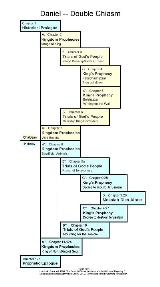
William H. Shea Ph.D. (Archeology) suggests that the book of Daniel was composed as a double chiasm
Chiastic structure

Chiastic structure is a literary structure used in the Torah, the Bible, as well as in other texts. Concepts or ideas are placed in a special symmetric order or pattern in a chiastic structure to emphasize them....
. Chiastic or concentric structure is a common feature of ancient Hebrew poetry and literature. A qualification, however, is appropriate: while the chiastic structure of chapters 2 - 7, originally identified by A. Lenglet in 1972, is widely accepted by scholars, Shea's proposal for a similar structure in chapters 8 - 12 is not.

Related themes have common label

Related sections have a common label. For instance those labeled A, A', A" and A"' are placed in parallel because they all have a similar theme: prophecies about successive kingdoms. God's people suffer trials in the parts labeled B, B', B" and B"', although the suggested parallels in chapters 9 and 10 seem to have little in common with 3 and 6. The decision of kings to choose Daniel's God or not are the themes in C, C', C" and C"', provided we can agree with Shea that two individual verses in chapter 9 are the structural counterparts of chapters 4 and 5. The trial faced by the Messiah is portrayed in the focal point of the book ( D ) by Shea. (see also).

Language emphasizes structure

To emphasize the importance of the chiasmic structure, the first chiasm was written in Aramaic and the second in Hebrew. The literary structure explains why Aramaic continues to be used in chapter 7 rather than ending in chapter 6 at, seemingly, the end of the first half of the book.

Structure has precedence over chronology

The literary structure of the book takes precedence over chronology. The first 6 narrative chapters are fit into the structure rather than defining it. For instance, chapter 6 ( B' ), which ought to follow chapter 7 ( A' ) chronologically, is put in parallel with chapter 3 ( B ) because they both deal with the persecution of Daniel and his friends. And chapter 5 ( C' ) should follow chapters 7 and 8 ( A" ). Instead, it is put in parallel with chapter 4 ( C ). In both divine judgements are pronounced against arrogant Babylonian kings.

Grouping Emphasizes Prophecies

This chiasmic grouping of chapters having the same theme has important implications when it comes to the chapters containing prophecies ( A, A', A", A'" ). Not only are they parallel because they contain prophecies, but the prophecies themselves are parallel to each other. This parallelism between the prophecies has been recognized for millennia.
Daniel Prophecy Literary Parallels

Many theologians over the centuries have noted the parallels between the prophetic chapters of The Book of Daniel. While their interpretations have differed somewhat, they shared a recognition of the parallels....
 This does not mean, however, that Christian commentators have identified the same kingdoms in each chapter. While chapters 2 and 7 have generally - though not exclusively - been interpreted as extending to Roman times, chapter 8, for example, has traditionally been applied to the time of Antiochus Epiphanes.

Historical accuracy

Some modern historians of Babylonia or Achaemenid Persia do not adduce the narratives of Daniel as source materials, as they consider some statements in Daniel to be in conflict with other historical accounts. However, a major critic of Daniel, H. H. Rowley considered chapter 11 as "a first-class historical source for that period"

A scholar ranks the fifth chapter of Daniel just below the cuneiform literature, for accuracy as far as outstanding events are concerned, for non-Babylonian records on the close of the Neo-Babylonian Empire.

The six objections given below represent, in order of significance, the major instances of error historians generally find in Daniel.

"Darius the Mede"


Some historians criticize the notion of a separate Mede
Medes

The Medes were an Ancient Iranian peoples who lived in the northwestern portions of present-day Iran. This area was known in Greek as Media or Medea ....
 rule by pointing out that the Persians at that point in history had control over the Medes
Medes

The Medes were an Ancient Iranian peoples who lived in the northwestern portions of present-day Iran. This area was known in Greek as Media or Medea ....
, and that the contemporary cuneiform documents, such as the Cyrus Cylinder
Cyrus cylinder

The Cyrus cylinder, also known as the Cyrus the Great cylinder, is a document issued by the Achaemenid emperor Cyrus the Great in the form of a clay cylinder inscribed in Akkadian language cuneiform script....
 and the Babylonian Chronicle, leave no room for any Mede occupation of Babylon before the Persians under Cyrus conquered it. It has been suggested that the author's apparent confusion on this issue could be due to his reliance on Jeremiah (see Dan. 9:2): and Jeremiah prophesied (in Jeremiah 51:11), at the height of the Median empire's power, that Babylon would fall to the Medes. An author writing centuries later, and under the impression that Jeremiah was a true prophet, might simply assume that a Mede must have taken Babylon.

The personage whom Daniel describes as taking control of Babylon after Belshazzar is deposed is named as Darius the Mede, who rules over Babylon in chapters 6 and 9. Daniel reports that Darius was 'about 62 years old' when he was 'made king over Babylon.' Darius the Mede, while mentioned in the book of Daniel, the works of Flavius Josephus, and Jewish Midrash material, is not known from any primary historical sources. Neither the Babylonian nor the Persian histories record such a person. Herodotus
Herodotus

Herodotus of Halicarnassus was a Greeks historian who lived in the 5th century BC and is regarded as the "Father of History" in Western culture....
, who wrote his history about 440 BC, records that Babylon fell to the Persian army, under the control of King Cyrus, who had conquered the Median Empire as early as 550 BC.

As Darius the Mede is unknown to any other source, many historians view his presence in Daniel as simply a mistake of a much later author, who has perhaps inadvertently placed the Persian King Darius I at an earlier date than he actually reigned. Three key pieces of information seem to support this. Firstly, Darius I, like Cyrus, also conquered Babylon and personally commanded the Persian army that took the city in 522 BC to put down a rebellion. Secondly, Daniel's reference to Darius organising the empire by appointing satraps and administrators fits Darius I perfectly: he is known to history as the Persian king par excellence who professionalised the empire's bureaucracy and organised it into satrapies and tax districts. Thirdly, Darius I was an important figure in Jewish history, remembered as a king associated with Cyrus who permitted the returned exiles to rebuild the temple (see Ezra chs 1-6).

In Daniel 9:1, Darius is said to be the son of Ahasuerus
Ahasuerus

Ahasuerus is a name used several times in the Hebrew Bible, as well as related legends and apocrypha....
, commonly acknowledged to be a variant spelling of Xerxes (Esther 1:1). Darius I was the father of a king called Xerxes.

Apologetic approaches to Darius the Mede
All of these approaches require renaming the otherwise unknown Darius the Mede as some known figure from the time.

Among writers maintaining an early date for the Book of Daniel, there are several interpretations of the identity of Darius the Mede.
  • On the difficulty of ascertaining the correct view, H.H. Rowley states: "[T]he references to Darius the Mede in the book of Daniel have long been recognized as providing the most serious historical problems in the book." His view concludes that Darius is just another name for Cyrus the Great
    Cyrus the Great

    Cyrus the Great , , also known as Cyrus II of Persia and Cyrus the Elder, was a Persian people Shah . He was the founder of the Persian Empire under the Achaemenid dynasty, an empire, perhaps the most wealthy and magnificent in history....
    , who captured Babylon on October 15, 539 BC.
  • Another view, promoted by John Whitcomb (though first proposed by E. Babelon in 1883) in his 1959 book, Darius the Mede says that Darius is another name for the historical figure of Gubaru
    Gubaru

    Gubaru was a common name of several Persian noblemen. The name is rendered in Greek language as Gobryas...
     (sometimes spelled as Ugbaru).
  • The third view (also that of Syncellus
    Syncellus

    Syncellus may refer to:* an office in an Orthodox Church roughly equivalent to that of an episcopal vicar in the Roman Catholic Church.People named Syncellus:...
    ) sees Darius as another name for Astyages
    Astyages

    Astyages ; spelled by Herodotus as Astyages; by Ctesias as Astyigas; by Diodorus as Aspadas; Akkadian language: I?tumegu), was the last king of the Medes, r....
    , the last Mede king who was ultimately deposed by Cyrus. Josephus makes Darius the son of Astyages, and uncle of Cyrus.
  • Several scholars in the past (including Calvin
    John Calvin

    John Calvin was an influential French people theology and pastor during the Protestant Reformation. He was a principal figure in the development of the system of Christian theology later called Calvinism....
    , Ussher
    James Ussher

    James Ussher was Anglican Archbishop of Armagh and Primate of All Ireland between 1625?1656. He was a prolific scholar, who most famously published a Ussher chronology that purported to time and date Creation according to Genesis to the night preceding 27 October 4004 BC, according to the proleptic Julian calendar....
     and John Gill
    John Gill (theologian)

    John Gill was an England Baptist, a Bible scholar, and a staunch Calvinism. Gill's relationship with Hypercalvinism is a matter of academic debate....
    ) as well as in more recent times (e.g. Keil and Delitzsch) have thus attempted to identify 'Darius the Mede' with Cyaxares II
    Cyaxares II

    Cyaxares II was said to be a king of the Medes whose reign is described by the Greek historian Xenophon. Some theories have equated this figure with the "Darius the Mede" named in the Book of Daniel....
    , who is mentioned as having the same relationships by Xenophon
    Xenophon

    Xenophon , son of Gryllus, of the deme Erchia of Athens, also known as Xenophon of Athens and Xenophon of Thebes, was a soldier, mercenary and a contemporary and admirer of Socrates....


"Darius the Mede" as Cyrus the Great: Unlike Gubaru or Astyages, Cyrus the Great of Persia was the king who took over the Babylonian Empire. Cyrus was also married to a Mede, and had a Median mother. An analysis of variant early texts, particularly the Septuagint, reveals that the names "Darius" (????? DRYWS in Hebrew) and "Cyrus" (???? KWRS) are reversed in 11:1, and may have been miscopied elsewhere. The appellation "Mede" (Heb. ??? MDY) may have been used as an ethnic term to apply to Persians as well, who were of the same race. In addition, Dan. 6:28, "So Daniel prospered during the reign of Darius and the reign of Cyrus the Persian," could also be translated, "So Daniel prospered during the reign of Darius, that is, the reign of Cyrus the Persian." Furthermore, kings commonly took dual titles and Nabonidus, Cyrus' cousin, referred to Cyrus as "the king of the Medes."

"Darius the Mede" as Gubaru/Ugbaru: Gubaru was the governor of Gutium, who actually led Cyrus's army that captured Babylon in the month of Tashritu in the 17th year (see Pierre Briant below). Two weeks later Cyrus made his triumphal entry into Babylon and a week after that Gubaru died. It is possible that Cyrus would have rewarded Gubaru with a regional governorship for capturing the capital of the Babylonian Empire and virtually ending the war. Furthermore, under the first translation of Dan. 6:28, Darius ruled during the reign of Cyrus, and Dan. 5:31 states that Darius the Mede "received the kingdom" of the Chaldeans. Complicating this view is the question of whether or not Gubaru and Ugbaru are two different people, or simply a misspelling of the same name.

Also, verse 1 of "Bel and the Dragon
Bel and the Dragon

The tale of Bel and the Dragon incorporated as chapter 14 of the Additions to Daniel was written in Aramaic around the late second century BC and translated into Greek in the Septuagint....
" (chapter 14 in Greek Daniel) references Astyages
Astyages

Astyages ; spelled by Herodotus as Astyages; by Ctesias as Astyigas; by Diodorus as Aspadas; Akkadian language: I?tumegu), was the last king of the Medes, r....
 the Mede, who was indeed the last king before Cyrus; but nearly the same verse is added in the Greek LXX after the end of chapter 6, only reading "Darius" in place of "Astyages". ( LXX Dan. 14:1 and Dan 6:29)

"Darius the Mede" as king of the Medes: Talmudic and midrashic sources describe Darius the Mede as the uncle and father-in-law of Cyrus the Great, to whom Cyrus owed fealty. After Darius's death, Cyrus took the throne. According to Yossipon, the Ahasuerus in the book of Esther
Esther

Esther , born Hadassah, is a queen of the Persian Empire in the Hebrew Bible, the queen of Ahasuerus , and heroine of the Biblical Book of Esther which is named after her....
 was the son of Darius the Mede. The Midrash Tanchuma describes the fall of Babylon as described in Daniel and adds to the narrative Darius taking Vashti, the daughter of Belshazzar, as a wife for his son Ahasuerus.

Belshazzar


For many years Belshazzar
Belshazzar

Belshazzar was the king of Babylon, the son of Nebuchadnezzar, the last king of Babylon according to the Book of Daniel. In the Book of Daniel of the Judaism Tanakh or Christianity Old Testament, Belshazzar is the King of Babylon before the advent of the Medes and Persians....
 (Akk. bęl-šar-usur), was an enigma for historians. The book of Daniel states that he was “king” (Ar. ?????) the night that Babylon fell (chap. 5) and says that his “father” (Ar. ???) was Nebuchadnezzar (5:2, 11, 13, 18). Prior to 1854, archeologists and historians knew nothing of Belshazzar outside the book of Daniel. Indeed, while the deuterocanonical Book of Baruch
Book of Baruch

The Book of Baruch, occasionally referred to as 1 Baruch, is called a deuterocanonical books or Biblical apocrypha book of the Bible. Although not in the Hebrew Bible, it is found in the Septuagint and in the Vulgate, and also in Theodotion's version....
 (Baruch 1:11, 12) and the writings of Josephus (Antiquities 10.11.2-4 §231-247) do mention Belshazzar, the references to Belshazzar in these works are ultimately dependent on the book of Daniel (Collins, p. 32). Both Xenophon
Xenophon

Xenophon , son of Gryllus, of the deme Erchia of Athens, also known as Xenophon of Athens and Xenophon of Thebes, was a soldier, mercenary and a contemporary and admirer of Socrates....
 (Cyropaedia, 7.5.28-30) and Herodotus (The Histories, 1.191) recount the fall of Babylon to Cyrus the Great, yet neither of these writers give the name of the king of Babylon. Additionally, both Berossus’ and Ptolemy’s king lists have Nabonidus
Nabonidus

Nabonidus was the last king of the Neo-Babylonian Empire, reigning from 556-539 BCE....
 (Akk. Nabű-na'id) as the last king of Babylon with no mention of Belshazzar.

From that time new evidence from Babylon has verified the existence of Belshazzar as well as his co-regency during the absence of his father, Nabonidus
Nabonidus

Nabonidus was the last king of the Neo-Babylonian Empire, reigning from 556-539 BCE....
, in Temâ. For example, In the Nabonidus Cylinder
Cylinder of Nabonidus

The Nabonidus Cylinder from Sippar is a long text in which king Nabonidus of Babylonia describes how he repaired three temples: the sanctuary of the moon god Sin in Harran, the sanctuary of the warrior goddess Anunitu in Sippar, and the temple of Shamash in Sippar....
, Nabonidus petitions the god Sin
Sin (mythology)

Sin is a Sumerian lunar deity in Mesopotamian mythology. He is the son of Enlil and Ninlil. His sacred city was Ur....
 as follows: “And as for Belshazzar my firstborn son, my own child, let the fear of your great divinity be in his heart, and may he commit no sin; may he enjoy happiness in life". In addition, The Verse Account of Nabonidus (British Museum tablet 38299) states, “[Nabonidus] entrusted the army to his oldest son, his first born, the troops in the country he ordered under his command. He let everything go, entrusted the kingship (Akk. šarrűtu) to him, and, himself, he started out for a long journey. The military forces of Akkad marching with him, he turned to Temâ deep in the west” (Col. II, lines 18 - 29. 18). In line with the statement that Nabonidus "entrusted the kingship" to Belshazzar in his absence, there is evidence that Belshazzar's name was used with his father's in oath formulas, that he was able to pass edicts, lease farmlands, and receive the "royal privilege" to eat the food offered to the gods.

The available information concerning Belshazzar's regency goes silent after Nabonidus' fourteenth year. According to the Nabonidus Chronicle, Nabonidus was back from Temâ by his seventeenth year and celebrated the New Year’s Festival (Akk. Akitu
Assyrian new year

Assyrian new year may refer to* Assyrian/Syriac new year* Akitu, the Assyrian new year festival, introduced in the Neo-Assyrian Empire around 700 BC....
). Whether or not Belshazzar continued his regency under his father's authority after his return cannot be demonstrated from the available documents. Some scholars have argued that the non-observance of the Akitu during Nabonidus' absence demonstrates that Belshazzar was not the "king" since it shows that he could not officiate over the festival. However, The Verse Account of Nabonidus says, "Nabonidus said: 'I shall build a temple for him (the Moon god Sin)...till I have achieved this, till I have obtained what is my desire, I shall omit all festivals, I shall order even the New Year's festival to cease!'" Thus, the halting of the Akitu may have been done by the king's command rather an inability on the part of Belshazzar. This stated, the fact that Belshazzar did not disobey his father's command is evidence that Nabonidus remained the official (and actual) king of Babylon.

There is no evidence that Belshazzar ever officially held the title of "king" as he is never called such in the Nabonidus Cylinder
Cylinder of Nabonidus

The Nabonidus Cylinder from Sippar is a long text in which king Nabonidus of Babylonia describes how he repaired three temples: the sanctuary of the moon god Sin in Harran, the sanctuary of the warrior goddess Anunitu in Sippar, and the temple of Shamash in Sippar....
. Furthermore, the Aramaic term ??? (mlk, king) applied in Daniel could be used to translate titles of various levels of high ranking officials. (This can be seen in the case of a 9th century BC Akkadian/Aramaic bilingual inscription found at Tel Fekheriyeh in 1979 which reads "king" for the Akkadian "governor".) A contract tablet dating to the third year of his regency (550 BC) includes the designation "son of the king." This, of course, is not proof that he possessed any status as the official king of Babylon. The bottom line is that Nabonidus was still alive when Cyrus conquered Babylon, and had not been replaced as the official king of Babylon by Belshazzar.

No known extrabiblical text indicates a blood relation between Nebuchadnezzar and Belshazzar. Historians have objected to this aspect of the record in Daniel. There were several rulers over Babylon between the death of Nebuchadnezzar and the rulership of Nabonidus and Belshazzar. Many scholars have attributed the lack of mention of these rulers as indicating the author mistakenly thought that the two rulerships were consecutive. The Jewish Encyclopedia
Jewish Encyclopedia

The Jewish Encyclopedia was an encyclopedia originally published between 1901 and 1906 by Funk and Wagnalls. It contained over 15,000 articles in 12 volumes on the history and then-current state of Judaism and the Jews as of 1901....
, holding to a later date of the book (see 'Date'), supposed that "during the long period of oral tradition the unimportant kings of Babylon might easily have been forgotten, and the last king, who was vanquished by Cyrus, would have been taken as the successor of the well-known Nebuchadnezzar." Based on this reasoning, historians have considered the reference to Belshazzar's relationship to Nebuchadnezzar simply an error based on the above misconception.

However, there is another explanation. Belshazzar is never called an independent king in the book of Daniel. In fact, in Daniel 5:7, 16, 29 Belshazzar implies that he is the second ruler in the kingdom, not the sole ruler; and yet, he has sufficient power to make someone the third ruler in the kingdom. Secondly, co-regencies were not that uncommon in the Ancient Near East. Third, Wilson, in the previous reference, showed that the very word "king" was used in a variety of ways other than that which we use today. The same also applies to the use of the word "son"--it doesn't necessarily mean a biological relationship and can carry the meaning "successor." For example, the 9th Century Assyrian Black Obelisk
Black Obelisk

The "Black Obelisk" of Shalmaneser III is a black limestone Neo-Assyrian bas-relief sculpture from Nimrud , in northern Iraq. It is the most complete Assyrian obelisk yet discovered, and is historically significant because it displays the earliest ancient depiction of an Israelite....
 lists Jehu
Jehu

Jehu was king of Kingdom of Israel, the son of Jehoshaphat , and grandson of Nimshi. William F. Albright has dated his reign to 842 BC-815 BC, while E....
 as the "son of Omri
Omri

Omri was king of kingdom of Israel and father of Ahab. William F. Albright has dated his reign to 876 BC – 869 BC, while E. R. Thiele offers the dates of 888 BC to 880 BC for his rivalry with Tibni and 880 BC – 874 BC for his sole reign....
" even though Jehu
Jehu

Jehu was king of Kingdom of Israel, the son of Jehoshaphat , and grandson of Nimshi. William F. Albright has dated his reign to 842 BC-815 BC, while E....
 was from a different lineage and did not take the crown directly after Omri
Omri

Omri was king of kingdom of Israel and father of Ahab. William F. Albright has dated his reign to 876 BC – 869 BC, while E. R. Thiele offers the dates of 888 BC to 880 BC for his rivalry with Tibni and 880 BC – 874 BC for his sole reign....
. Finally, Daniel is not writing an official state document for Babylon such as one would expect from the court scribes, although the lack of accurate specificity in the references also tends to be inconsistent with the claim of an early date for Daniel.

Madness of Nebuchadnezzar

A third significant objection by historians is the account of the insanity
Insanity

Traditionally, insanity or madness is the behavior whereby a person flouts societal norms and may become a danger to themselves and others....
 suffered by Nebuchadnezzar found in the fourth chapter of Daniel. In the Dead Sea Scrolls
Dead Sea scrolls

The Dead Sea scrolls consist of roughly 900 documents, including texts from the Hebrew Bible, discovered between 1947 and 1956 in eleven caves in and around the Wadi Qumran near the ruins of the ancient settlement of Qumran, on the northwest shore of the Dead Sea....
 a fragment known as The Prayer of Nabonidus (4QPrNab, sometimes given as 4QOrNab) discusses a disease suffered by Nabonidus, and there are obvious parallels between the two accounts ().

There are a number of superficial differences between The Prayer of Nabonidus and the account of Nebuchanezzar's madness:

  1. Nebuchadnezzar's "affliction" was of the mind whereas Nabonidus' was an "evil ulcer."
  2. In the case of Nabonidus the "exorcist pardoned my sin" whereas in the case of Nebuchadnezzar he "lifted up my eyes unto heaven and mine understanding returned unto me." (KJV)- i.e., when he recognized (accepted) the sovereignty of Daniel's god.
  3. Nabonidus' condition was cured by an unnamed Jewish exorcist whereas Nebuchadnezzar's recovery is not attributed to a human agent.
  4. Nebuchadnezzar's illness came while he was in Babylon; while that of Nabonidus was in Tema, although it does state in Daniel 4:33 that Nebuchadnezzar was "driven away from mankind." (NASB)
  5. Finally, some of the words and phrases of the prayer have to be inferred from the context because they are missing in the original fragment. [Archer, Gleason L. "Daniel," Expositor's. Vol. 7 (Zondervan, 1985): 15; he cites Harrison, R. K. Introduction to the Old Testament. (Tyndale, 1969): 1118-9]


Date of Nebuchadnezzar's first siege of Jerusalem

The Book of Daniel begins by stating:

In the third year of the reign of Jehoi'akim king of Judah came Nebuchadnez'zar king of Babylon unto Jerusalem, and besieged it. And the Lord gave Jehoi'akim king of Judah into his hand, with part of the vessels of the house of God: which he carried into the land of Shinar to the house of his god; and he brought the vessels into the treasure house of his god. (King James Version)


This appears to be a description of the first siege of Jerusalem in 597 BC, which occurred in the twelfth year of Jehoiakim
Jehoiakim

Jehoiakim was king of Judah. He was the second son of king Josiah by Zebidah the daughter of Pedaiah of Rumah. His birth name was Eliakim....
 and into the reign of his son Jehoiachin. (see , , and ). The third year of Jehoiakim (606 BC), saw Nebuchadnezzar not yet King of Babylon, and the Egyptians still dominant in the region. In Jeremiah 36:9, we find Jehoiakim in Jerusalem in his fifth year, two years after the time that Daniel claims he was carried away to Babylon. The Babylonian records indicate that Nebuchadnezzar made Judah a vassal state in about 603 BC, when Jehioakim was still king, but do not record a capture of Jerusalem at that time.

Advocates of an early date of Daniel generally explain this by positing an additional, otherwise unmentioned, siege of Jerusalem in 605 BC, shortly after securing the throne in Babylon with the death of his father, Nabonidus
Nabonidus

Nabonidus was the last king of the Neo-Babylonian Empire, reigning from 556-539 BCE....
. Nebuchadnezzar first defeated the Egyptians under Pharaoh Necho
Necho

Necho was the name of two Pharaohs of Egypt during the Twenty-sixth dynasty of Egypt. They were:* Necho I * Necho II ...
 in Battle of Carchemish
Battle of Carchemish

The Battle of Carchemish was fought about 605 BC between the allied armies of History of ancient Egypt and Neo-Assyrian Empire against Neo-Babylonian Empire....
, then traveled south, where King Jehoiakim surrendered. This resulted in the first exile of Israelites to Babylon in 605 B.C., which included Daniel. Judah continued as Babylon's subordinate while Nebuchadnezzar attacked Egypt itself. In 601 B.C., Nebuchadnezzar returned home, and Jehoiakim changed his allegiance to Egypt, resulting in the second (and bigger) exile in 598 B.C. when Nebuchadnezzar sent an army to conquer Judah once and for all.

Hananiah, Mishael, and Azariah

Dan. 1:6-7 records that Daniel was accompanied in the courts by three other Jews: Hananiah, Mishael, and Azariah. The chief officials gave them new Babylonian names: Shadrach, Meshach, and Abednego
Shadrach, Meshach, and Abednego

Shadrach, Meshach, and Abednego were three friends of Daniel in the Bible whose Hebrew names were Hananiah, Mishael and Azariah, respectively....
, respectively. In Dan. 3:8-23, these same three persons refuse to perform an act of worship before an image of Nebuchadnezzar, which results in their subjection to the death penalty by burning. However, according to Dan. 3:24-30, God delivers them from the fiery furnace
Fiery furnace

The fiery furnace is a story from the Book of Daniel in the Tanakh . The story is well-known among Jews and Christianity.In the story, Hananiah , Mishael , and Azariah , defy Nebuchadrezzar II's order that they bow down and worship a golden idolatry, a cult image of Nebuchadnezzar....
.

Professor William Shea (1982) refers to a clay prism that was found in Babylon with five columns of text listing various officials of the government. Three of the officials are listed as "Mushallim-Marduk, [one of] the overseers (lit.:heads) of the slave-girls", "Ardi-Nabu, the sipiru-official of the crown prince", and "Hanunu - chief of the royal merchants," and Dan. 2:49 states, "Moreover, at Daniel's request the king appointed Shadrach, Meshach and Abednego administrators over the province of Babylon, while Daniel himself remained at the royal court." Some conservative Christian writers have therefore connected Hanunu with Hananiah, Mushallim-Marduk with Meshach, and Ardi-Nabu with Abednego; however, it is unclear why Hananiah would be referenced by his Hebrew name (Oppenheim (see citation) posits that "Hanunu" is "Phoenician" rather than Hebrew) and not his Babylonian one, Shadrach. There is no other evidence to connect these figures with the ones mentioned in the Book of Daniel.

Four Persian Kings

In Daniel 11:2-4, the angel Gabriel informs the prophet that there will be four Persian kings before the coming of Alexander the Great.
And now will I shew thee the truth. Behold, there shall stand up yet three kings in Persia; and the fourth shall be far richer than they all: and by his strength through his riches he shall stir up all against the realm of Grecia. And a mighty king shall stand up, that shall rule with great dominion, and do according to his will. And when he shall stand up, his kingdom shall be broken, and shall be divided toward the four winds of heaven.


Since the author of Daniel wrote during the reign of Cyrus (Daniel 10:1), this would then make him the first Persian king of Daniel 11:2. Cyrus defeated Babylon in 536 BC. Alexander took the kingdom from the last Persian king in 333 BC. This gives us 203 years for the Persian reign. Split among four kings, we get an average of about 51 years each, which is somewhat excessive.

There were nine Persian kings from Cyrus to Alexander. They are:

  • Cyrus (549 - 529 BC)
  • Cambyses
    Cambyses

    Cambyses is the name of several members of the Achaemenid line of ancient Persian Empire .*Cambyses , son and successor of Teispes of Anshan, father of an earlier Cyrus and great grandfather of Cyrus the Great....
     (529 - 522 BC)
  • Darius I (521 - 485 BC)
  • Xerxes
    Xerxes

    Xerxes may refer to these Persian kings:*Xerxes I of Persia, reigned 485–465 BC, aka Xerxes the Great*Xerxes II of Persia, reigned 424 BC...
     (485 - 465 BC)
  • Artaxerxes I (465 - 425 BC)
  • Darius II
    Darius II

    Darius II can refer to:* Darius II of Persia, a Persian Monarch.* Darius II , the second title in the Darius series....
     (425 - 405 BC)
  • Artaxerxes II (404 - 358 BC)
  • Artaxerxes III (358 - 338 BC)
  • Darius III (338 - 330 BC)


The author of Daniel may have been misled by the fact that the Old Testament only mentions four of the nine Persian kings - Cyrus (Ezra 1:1), Darius I (Ezra 4:5), Xerxes I (Ahasuerus - Ezra 4:6) and Artaxerxes I (Ezra 4:7).

However, Xerxes I, the fourth king from the time of history in the book of Daniel, did in fact invade Greece and instigated the Greco-Persian wars, in which he was ultimately defeated. Since it is normal in prophetic sections of the Hebrew Bible to have no mention of large chronological gaps between historical events, the predictions regarding the fourth king of Persia warring in Greece and that of Alexander the Great are not necessarily to be understood as one immediately following the other. The successive sentences indicate a successive thematic relationship, i.e. the struggle between Persia and Greece, rather than a chronological one.

Dating and content

Traditionally, the Book of Daniel was believed to have been written by its namesake during and shortly after the Babylonian captivity
Babylonian captivity

The Babylonian captivity, or Babylonian exile, is the name typically given to the deportation and exile of the Jews of the ancient Kingdom of Judah to Babylon by Nebuchadnezzar II of Babylon in 586 BCE....
 in the sixth century BC. Although this view continues to be held by traditionalist Christians and conservative Jews, it has been rejected by most of the scholarly community since the end of the nineteenth century. While a number of conservative scholars accept a sixth century date, "for mainline scholarship... these issues were decided at least a century ago". Even leading evangelical scholars have recently adopted this position, while in the Roman Catholic community it has been the norm since World War II. Antiochus Epiphanes desecrated and looted the Jerusalem Temple around 167 BC, outlawed the Jewish religion, massacred observant Jews and precipitated a national crisis that is commemorated to this day in the Feast of Hanukkah
Hanukkah

File:PikiWiki Israel 146 Hanukka ?????.JpgHanukkah , also known as the Festival of Lights, is an eight-day Jewish holiday commemorating the rededication of the Temple in Jerusalem in Jerusalem at the time of the Maccabean Revolt of the 2nd century BCE....
 (which recalls the rededication of the temple). The Book of Daniel (in its final form) was written, according to the liberal view, in response to that crisis. Even when the fourth kingdom of chapters two and seven began to be reapplied to Rome in pre-Christian and early Christian times the memory of Antiochus was still vivid. This is evidenced by the fact that leading Jewish and patristic commentators such as Josephus, Hippolytus, and Jerome continued to apply sections of Daniel (especially chapter 8) to the activities of Antiochus.

Traditionalists, making a case for an earlier date for the Book of Daniel, make reference to Josephus
Josephus

Josephus , also known as Yosef Ben Matityahu and, after he became a Roman citizenship, as Titus Flavius Josephus, was a first-century Jewish historian and apologist of priestly and royal ancestry who survived and recorded the destruction of Jerusalem in AD 70....
, who states that upon Alexander the Great
Alexander the Great

Alexander the Great , also known as Alexander III of Macedon was an ancient Greeks King of Macedon . He was one of the most successful military commanders of all time and is presumed undefeated in battle....
's approach, a small party met him outside of Jerusalem with a copy of the book of Daniel, telling him that his presence was ordained by scripture. However, most scholars agree that this story is not true. Harvard scholar Shaye J. D. Cohen denies the historicity of Alexander's visit to Jerusalem and suggests that the Alexander story is a combination of several sources. Additionally, some point to the Dead Sea scrolls
Dead Sea scrolls

The Dead Sea scrolls consist of roughly 900 documents, including texts from the Hebrew Bible, discovered between 1947 and 1956 in eleven caves in and around the Wadi Qumran near the ruins of the ancient settlement of Qumran, on the northwest shore of the Dead Sea....
 found at Qumran
Qumran

Qumran is located on a dry plateau about a mile inland from the northwestern shore of the Dead Sea in the West Bank, just next to the Israeli kibbutz of Kalia, West Bank....
 dating from the 2nd century BC. These scrolls include several manuscript fragments and three substantial manuscripts of Daniel dating from the late 2nd-cent BC to the first century AD. The premise is that there must have been much time between the original writing and the copying of the manuscripts found at Qumran, since it would have taken time for the book to have gained acceptance and be made available for copying. However, the relatively large number of copies at Qumran can be explained as due to the current (at the time) popularity of this recently "published" book. Of considerable significance, is the fact that the Book of Daniel was never grouped with the Hebrew Nevi'im
Nevi'im

Nevi'im is the second of the three major sections in the Hebrew Bible, the Tanakh, between the Torah and Ketuvim .Nevi'im is traditionally divided into two parts:...
 (the Prophets) but has always belonged to the Ketuvim
Ketuvim

Ketuvim is the third and final section of the Tanakh , after Torah and Nevi'im. In English translations of the Hebrew Bible, this section is usually entitled "Writings" or "Hagiographa."...
 (the writings). If the author had been accepted to be a sixth century Jew of the Exile his work would have pre-dated Ezra and Nehemiah and would certainly have been considered authoritative enough to group it with the other prophets. In addition, the canon of the Prophets (Nevi'im) was closed by about 200 BC with the composition of Malachi. The apocryphal book of Sirach, written about 180 BC, contains a long section (chapters 44-50) in praise of "famous men" from Jewish history that does not include Daniel. However I Maccabees, composed about 100 BC, repeats much of that list with the addition of Daniel and the three youths in the fiery furnace, leading to the conclusion that these stories were likely added to Hebrew literature sometime after 180 BC.

Antiochus IV Epiphanes

Critical scholars have asserted that the prophecies in the Book of Daniel reflect the persecutions of the Jews by Antiochus IV Epiphanes
Antiochus IV Epiphanes

Antiochus IV Epiphanes ruled the Seleucid Empire from 175 BC until his death in 164 BC. He was a son of King Antiochus III the Great and the brother of Seleucus IV Philopator....
 (175–164 BC), and his desecration of the altar in the temple at Jerusalem, and consequently they date its composition to that period. In particular, the vision in Chapter 11, which focuses on a series of wars between the "King of the North" and the "King of the South," is generally interpreted as a record of Levantine history from the time of Alexander the Great
Alexander the Great

Alexander the Great , also known as Alexander III of Macedon was an ancient Greeks King of Macedon . He was one of the most successful military commanders of all time and is presumed undefeated in battle....
 down to the era of Antiochus IV, with the "Kings of the North" being the Seleucid kings of Syria
Seleucid Empire

The Seleucid Empire /s?'lus?d/ was a Hellenistic empire, i.e. a successor state of Alexander the Great's empire. The Seleucid Empire was centered in the near East and at the height of its power included central Anatolia, the Levant, Mesopotamia, Persia, today's Turkmenistan, Pamir Mountains and parts of Pakistan....
 and the "Kings of the South" being the Ptolemaic rulers of Egypt
Ptolemaic dynasty

The Ptolemaic dynasty was a Hellenistic Macedonian royal family which ruled the Ptolemaic Empire in Egypt for nearly 300 years, from 305 BC to 30 BC....
.

Scottish theologian John Drane
John Drane

John Drane is a Scottish theologian who is probably best known for his two best-selling books on the Bible, Introducing the Old Testament and Introducing the New Testament ....
 notes that other details of the stories in the early chapters of Daniel are also similar to the prevailing conditions in the era of Antiochus. "Belshazzar for example, falls from power because he defiled the sacred objects taken from the Temple in Jerusalem (Dan. 5:1-4), in much the same way as Antiochus repeatedly robbed the Temple in Jerusalem. The worship of the great statue set up by Nebuchadnezzar (Dan. 3:1-18) and the story of the Bel found in the Greek text highlighted the same issues as Antiochus' action in setting up an image of Zeus
Zeus

Zeus in Greek mythology is the king of the gods, the ruler of Mount Olympus and the god of the sky father and List of thunder gods. His symbols are the thunderbolt, eagle, bull , and oak....
 in the Temple at Jerusalem. Indeed it may be implied that the images were actual statues of the kings themselves. Even the story of Nebuchadnezzar's madness (Dan. 4:19-33) may have been intended to be reminiscent of the commonly held belief that Antiochus was mad ("epimanes"). The people of a later age would also recognize those apostate Jews who collaborated with the unbelieving Seleucids in the duplicitous figures of the spies and informers who plotted against Daniel and ensured that he was shut up in the den of lions (Dan. 6:1-14). The issue of food, which features so largely in the opening story of Daniel (Dan. 1:3-16), was one of the whole crucial points in the whole argument about Hellenism
Hellenism

Hellenism may refer to:*Hellenism , an esthetic movement in 18th and 19th century England and Germany*Hellenism , the academic study of ancient Greece ...
. Much of the opposition that sparked the Maccabean revolt
Maccabean Revolt

The Maccabean Revolt was a Jewish revolt against Seleucidic and Syrian rulers, taking place in the second century BCE....
 was concerned with the unwillingness of faithful Jews to eat pork and other unclean foods
Kashrut

Kashrut refers to Judaism Taboo food and drink. Food in accord with halakha is termed kosher in English language, from the Ashkenazi Hebrew pronunciation of the Hebrew language term kash?r , meaning "fit" ....
". Even the name Nebuchadnezzar contains a veiled reference to Antiochus Epiphanes to those acquainted with Hebrew numerology. In Hebrew, as in many other ancient languages, names and words often have numerical value (see Gematria
Gematria

Gematria or gimatria is a system of assigning number to an alphabet. The word "gematria" is generally held to derive from Greek geometria, "geometry", which was used a translation of gema?riya....
). Nebuchadnezzar's name in cuneiform is Nabű-kudurri-u?ur which should be transliterated into Hebrew as ????????? or Nebuwkadne'tstsar (as it is in Jer. 46:2, 39:11). It is unlikely to be a coincidence that when the numbers represented by "Nebuwkadne'tstsar" are added up, they come exactly the same figure (423) as the numbers of the name "Antiochus Epiphanes".

This conclusion regarding the date of composition was first drawn by the philosopher Porphyry of Tyros, a third century pagan
Paganism

Paganism is the blanket term given to describe religions and spiritual practices of pre-Christian Europe, and by extension a term for polytheistic?traditions or folk religion?worldwide seen from a Western or Christian viewpoint....
 and Neoplatonist
Neoplatonism

Neoplatonism is the modern term for a school of religious and mystical philosophy that took shape in the 3rd century AD, founded by Plotinus and based on the teachings of Plato and earlier Platonism....
, whose fifteen-volume work Against the Christians is only known to us through Jerome
Jerome

Saint Jerome was a Christian priest and Christian apologetics best known for translating the Vulgate. He is recognized by the Catholic Church as a canonized saint and Doctor of the Church, and his version of the Bible is still an important text in Catholicism....
's reply. The identification of Antiochus Epiphanes in Daniel, however, is a much olderinterpretation which seems to be reflected, for example, in 1 Maccabees 1:54 (c100 BC), where an idol set up upon the altar of burnt offering under Antiochus is referred to as an "abomination of desolation
Abomination of Desolation

The abomination of desolation is a term found in the Hebrew Bible, in the book of Daniel. It also occurs in the book of 1 Maccabees and in the New Testament gospels....
" (cf. Dan. 9:27, 11:31). This identification is made explicit in Josephus' exposition of Daniel chapter eight (Antiquities 10:11, c94 AD) where he almost certainly cites a common Jewish interpretative tradition by identifying the "little horn" as Antiochus. According to British historian Bryan Rennie
Bryan Rennie

Bryan Rennie is a United Kingdom History of religions, the Vira I. Heinz Professor of Religion at Westminster College, Pennsylvania in New Wilmington, Pennsylvania....
, the conclusion that the Book of Daniel was written at the time of the profanation of the Temple by Antiochus IV would explain why the author is not very precise about sixth century events, why he is so precise about the time of Antiochus, and why he was never counted among the prophets. Scholars are virtually unanimous in regarding the Book of Daniel as a message of encouragement to those people suffering for their faith under the oppression of Antiochus IV Epiphanes.

Four Kingdoms

Many biblical scholars have concluded that the four kingdoms beginning with Nebuchadnezzar, mentioned in the "statue vision
Nebuchadnezzar's statue vision in Daniel 2

Nebuchadnezzar's statue vision is a story from chapter of the Bible Book of Daniel.According to this story, Nebuchadrezzar II, king of Babylonia, is troubled by recurrent nightmares that he refuses to tell his dream interpreters....
" of chapter 2, are identical to the four "end-time" kingdoms of the vision in chapter 7, and usually consider them to represent (1) Babylonia, (2) Media, (3) Persia, and (4) Greece (i.e. Macedonia). There is a literary tradition through various cultures which saw history pass through four kingdoms. These four kingdoms were Assyria, Media, Persia and Macedonia. As Daniel was set after the time of the Assyrians, Babylon was more relevant to the literary structure.

Some Christians (e.g. Young) believe that they should be identified as (1) the Neo-Babylonian empire, (2) the Medo-Persian empire (3) the Macedonian empire of Alexander and his successors, and (4) the Roman empire. Others (e.g. Stuart, Lagrange) have advocated the following schema: (1) the Neo-Babylonian, (2) the Medo-Persian, (3) the short-lived rule of Alexander, and (4) the rival Diadochi
Diadochi

The Diadochi were the rival successors of Alexander the Great, and their Wars of the Diadochi followed Alexander's death. This was the beginning of the Hellenistic period of Greek history, the time when many people who were not Greek themselves adopted Greek philosophy and styles, Greek urban life, and aspects of the Greek religion....
, viz. Egypt and Syria.

ChapterParallel sequence of events
Daniel 2Head
(Babylon)
Breast and armsBelly and thighsLegsFeet and toes Kingdom of GodEnd
Daniel 71st Beast2nd Beast3rd Beast4th Beast10 hornsLittle hornKingdom of GodEnd
Daniel 8 MediaPersiaGreece4 horns
Diadochi

The Diadochi were the rival successors of Alexander the Great, and their Wars of the Diadochi followed Alexander's death. This was the beginning of the Hellenistic period of Greek history, the time when many people who were not Greek themselves adopted Greek philosophy and styles, Greek urban life, and aspects of the Greek religion....
Little horn End
Daniel 11 MediaPersiaGreecekings of the north and south
Ptolemaic Kingdom

The Ptolemaic Kingdom in and around Egypt began following Alexander the Great's conquest in 332 BC and ended with the death of Cleopatra VII and the Aegyptus in 30 BC....
Contemptible PersonDeliverance of JewsEnd


To a modern reader the relationship between the Medes and the Persians is not transparent in Daniel.
  • In , we are told that Babylon would be broken in two and given to the Medes and Persians, apparently indicating that the two kingdoms existed separately at the same time, though historically when the kingdom of the Medes was in power, the Persians were vassals until they reversed the situation.
  • Three times we read about "the law of the Medes and the Persians", (Dan. 6:8, 12, and 15). Though the Medes and the Persians were Iranian peoples and so shared a cultural heritage, one reading of "the law of the Medes and the Persians" suggests that the phrase indicates the two groups must have merged.
  • Dan. 8:3 features a ram with two horns, with the Medes being represented by the first horn to arrive and the Persians by the longer second horn. These two horns are the kings of the Media and Persia, .
  • Finally Daniel 10 talks solely about Persia. Cyrus is the king of Persia . The prince (=angel) of the kingdom of Persia struggles with Michael .
Although Daniel shows no interest in the ancestry of Cyrus, it has been pointed out that Cyrus was married to a Mede and himself had Median blood. This some have thought would make the Medes and Persians merged kingdoms by marriage at the time of the conquest of Babylon. As noted previously, however, a late author's apparent reliance on Jeremiah may explain this (Dan. 9:2, Jer. 51:11). Persian inscriptions from the time of Darius I show Media as a subordinate kingdom which paid tribute to Persia.

Language

Scholars have speculated about the bilingual literary structure of Daniel - Chapters 2 through 7 in Aramaic, the rest in Hebrew. One of the most frequent speculations is that the entire book (excepting 9:4-20) was originally written in Aramaic, with portions translated into Hebrew, possibly to increase acceptance - many Aramaisms in the Hebrew text find proposed explanation by the hypothesis of an inexact initial translation into Hebrew.

According to John Collins in his 1993 commentary, Daniel, Hermeneia Commentary, the Aramaic in Daniel is of a later form than that used in the Samaria correspondence, but slightly earlier than the form used in the Dead Sea Scrolls
Dead Sea scrolls

The Dead Sea scrolls consist of roughly 900 documents, including texts from the Hebrew Bible, discovered between 1947 and 1956 in eleven caves in and around the Wadi Qumran near the ruins of the ancient settlement of Qumran, on the northwest shore of the Dead Sea....
, meaning that the Aramaic chapters 2-6 may have been written earlier in the Hellenistic period than the rest of the book, with the vision in chapter 7 being the only Aramaic portion dating to the time of Antiochus. The Hebrew portion is, for all intents and purposes, identical to that found in the Dead Sea Scrolls, suggesting a second century BC date for the Hebrew chapters 1 and 8-12.

Contrary to the above, the Expositor's Bible Commentary (Zondervan, 1990) claims that the language of Daniel, in comparison with the Hebrew and Aramaic texts of the Hellenistic period, "prove quite conclusively to any scholar that the second-century date and Palestinian provenance of the Book of Daniel cannot be upheld any longer without violence being done to the science of linguistics." It adds that the serious mistakes of the Septuagint to render many Persian and Accadian terms, as the offices mentioned in Dan. 3:3, proves ignorance of words of the old past, already forgotten in the Hellenistic period, indicating that the Book of Daniel was written in the late 6th century BC.

E.C. Lucas is more cautious in his assessment of linguistic arguments as well. Evaluating Collin’s approach he considers "the wide geographical spread from which the material comes and the implicit assumption that linguistic developments would have occurred uniformly throughout this area" a weakness and concludes, "The character of the Hebrew and Aramaic could support a date in the fifth or fourth century for the extant written form of the book, but does not demand a second-century date." He agrees with Collins that there are "clear differences" between Qumran Hebrew and the Hebrew of Daniel.

Loan words

Three Greek words used within the text have long been considered evidence for a late dating of Daniel. All three are terms for musical instruments, ???a??? (cithara), ?a?t????? (psaltery
Psaltery

A psaltery is a stringed instrument musical instrument of the harp or the zither family. The of Ancient Greece dates from at least 2800 BC, when it was a harp-like instrument....
) and s?µf???a (symphonia
Symphonia

Symphonia , a much discussed word, applied at different times to the bagpipe, to the drum, to the hurdy-gurdy, and finally to a kind of clavichord....
). The existence of the Greek word symphonia was cited by Rowlings as having its earliest known use in second century BC, but it has subsequently been shown that Pythagoras used the term to denote an instrument, while its adjectival use meaning "in unison" is found in the 'Hymni Homerica, ad Mercurium 51'; both instances date from the sixth century BC, the supposed setting of Daniel.

It is known that "Greek mercenaries and slaves served in the Babylonian and Assyrian periods, some of whom were undoubtedly versed in Greek music and musical instruments." It has been speculated that this would explain the existence of the three Greek musical terms in Daniel's book. On the other hand, it has been claimed that the non-existence of other Greek words is a strong witness against the theory of the writing of the book in the Hellenistic period, since "it is inconceivable that Greek terms for government and administration would not have been adopted into Aramaic by the second century BC" Even John Goldingay, a proponent of the late date, admits “the Greek words hardly necessitate a very late date.”

There are also nineteen Persian loan-words in the book, most of them having to do with governmental positions. Judea was under Persian administration for two centuries until the arrival of Alexander the Great.

Use of the word 'Chaldeans'

The book of Daniel uses the term "Chaldea
Chaldea

Chaldea , "the Chaldees" of the King James Version of the Bible Old Testament, was a Hellenistic designation for a part of Babylonia, mainly around Sumerian Ur, which became an independent kingdom under the Chaldees....
n" to refer both to an ethnic group, and to astrologers in general. According to Montgomery and Hammer, Daniel's use of the word 'Chaldean' to refer to astrologers in general is an anachronism
Anachronism

An anachronism is an error in chronology, especially a chronological misplacing of persons, events, objects, or customs in regard to each other....
, as during the Neo-Babylonian and early Persian periods (when Daniel is said to have lived), it referred only to an ethnicity. (Compare the later Chaldean Oracles
Chaldean Oracles

The Chaldean Oracles have survived as fragmentary texts from the 2nd century AD, and consist mainly of Hellenistic commentary on a single mystery-poem that was believed to have originated in Chaldea ....
).

Unity of Daniel

Whereas many scholars conclude a second century dating of the book in its final form, scholarship varies greatly regarding the unity of Daniel. Many scholars, finding portions of the book dealing with themes they do not believe fit with the time of Antiochus, conclude separate authors for different portions of the book. Included in this group are Barton, L. Berthold, Collins, and H. L. Ginsberg. Some historians who support that the book was a unified whole include J.A. Montgomery, S.R. Driver, R. H. Pfeiffer, and H.H. Rowley in the latter's aptly titled essay "The Unity of the Book of Daniel" (1952). Those who hold to a unified Daniel claim that their opponents fail to find any consensus in their various theories of where divisions exist. Montgomery is particularly harsh to his colleagues, stating that the proliferation of theories without agreement showed a "bankruptcy of criticism." They also charge that composite theories fail to account for the consistent thematic portrayal of Daniel's life throughout the book of Daniel.

Christian uses of Daniel

As mentioned above, the prayer of Azariah and the Song of the Three Children from the deuterocanonical parts of Daniel are widely used in Orthodox and Catholic prayer.

The various episodes in the first half of the book are used by Christians as moral stories, and are often believed to foreshadow events in the gospel
Gospel

In Christianity, a gospel is generally one of the first four books of the New Testament that describe the birth, life, ministry, crucifixion, and resurrection of Jesus....
s.

The apocalyptic section is important to Christians for the image of the "Son of Man
Son of man

The phrase 'son of man' is a primarily Semitic idiom that originated in Ancient Mesopotamia, used to denote humanity or self. The phrase is also used in Judaism and Christianity, indeed in all Abrahamic religions....
" (Dan. 7:13). According to the gospels, Jesus
Jesus

Jesus of Nazareth , also known as Jesus Christ, is the central figure of Christianity and is revered by most Christian churches as the Son of God and the Incarnation ....
 used this title as his preferred name for himself. The connection with Daniel's vision (as opposed to the usage in the Book of Ezekiel
Book of Ezekiel

The Book of Ezekiel is a book of the Hebrew Bible named after the prophet Ezekiel....
) is made explicit in the Gospels of Matthew
Gospel of Matthew

The Gospel of Matthew is one of the four canonical gospels in the New Testament and is a synoptic gospel. It narrates an account of the New Testament view on Jesus' life and Ministry of Jesus of Jesus of Nazareth....
 and Mark
Gospel of Mark

The Gospel of Mark is the second of the four canonical gospels in the New Testament and was probably the first of the three synoptic gospels to be written....
 (Matt. 26:64; Mark 14:62). Christians see this as a direct claim by Jesus that he is the Messiah
Messiah

Messiah literally means "anointed ".In Jewish messiah tradition and Jewish eschatology, messiah refers to a future monarch of United Monarchy from the Davidic line, who will rule the people of Israelite#The Twelve Tribes, and herald the Messianic Age of global peace....
.

Traditional Christians have embraced the prophecies of Daniel, as they believe they were clearly advised by their Messiah
Messiah

Messiah literally means "anointed ".In Jewish messiah tradition and Jewish eschatology, messiah refers to a future monarch of United Monarchy from the Davidic line, who will rule the people of Israelite#The Twelve Tribes, and herald the Messianic Age of global peace....
, Jesus Christ of Nazareth, to be watchful for their fulfillment in the "End Times
End times

The End Time, End Times, or End of Days are the eschatology writings in the three Abrahamic religions and in doomsday scenarios in various other non-Abrahamic religions....
" of this world. In the Olivet discourse
Olivet discourse

The Olivet discourse is a biblical passage found in the Synoptic Gospels of Gospel of Matthew , Gospel of Mark and Gospel of Luke . It is known as the "Little Apocalypse" because it includes Jesus' descriptions of future events, the use of end times language, and Jesus' warning to his followers that they will suffer tribulation and persecuti...
 () Jesus himself is quoted as applying Daniel's prophecy of a desolating sacrilege set up in the temple (Dan. 9:27, 11:31) to a future event — the AD 70 destruction of Jerusalem
Siege of Jerusalem (70)

The Siege of Jerusalem in the year 70 AD was a decisive event in the First Jewish-Roman War. It was followed by the Masada#History in 73 AD. The Roman Empire army, led by the future Emperor Titus, with Tiberius Julius Alexander as his second-in-command, besieged and conquered the city of Jerusalem, which had been occupied by its Jewish defend...
 . This would involve the levelling of the temple, flight from Judea, and would happen in Jesus' own generation (Mark 13: 2-4, 14, 30). Many Christians today re-apply this prediction to a final tribulation immediately preceding Judgement Day
Last Judgment

In Christian eschatology, the Last Judgment, Final Judgment, Judgment Day, or End time is the judgment by God of all nations....
. Some consider the Prophecy of Seventy Weeks
Prophecy of Seventy Weeks

The Prophecy of Seventy Septets appears in the angel Gabriel's reply to Daniel, beginning with verse 22 and ending with verse 27 in the ninth chapter of the Book of Daniel, a work included in both the Jewish Tanakh and the Christian Bible....
 to be particularly compelling due to what they interpret to be prophetic accuracy.

According to some modern-day scholars, Dan. 12:2 is the earliest clear reference in the Old Testament to the resurrection of the dead
Resurrection of the dead

Zoroastrianism, Judaism, Christianity and Islam all variously describe a resurrection of the dead, usually of all people to face God on Judgment Day....
 (Hartman and Di Lella, 1990, p. 419), with many of "your countrymen" awakening from death, some to eternal life and some to eternal disgrace. The notion of resurrection
Resurrection

Miraculous resurrection of one sort or another has been a recurrent theme or central doctrine of Judaism, Christianity, and Islam, and other Abrahamic religions....
 was to be elaborated in the New Testament and Christian doctrine.

The importance of Daniel's visions

Daniel's alleged presence in the royal court would have exposed him to the running of an empire. His knowledge, as in the case of other prophets, served as the basis for his revelations. Daniel's importance is that of introducing the age of the Gentiles, the framework for events from then to the last days.

Due to its apocalyptic character and its place in both the Jewish and Christian canons, the book of Daniel has had great influence in Jewish and Christian history.

Daniel was considered a prophet at Qumran
Qumran

Qumran is located on a dry plateau about a mile inland from the northwestern shore of the Dead Sea in the West Bank, just next to the Israeli kibbutz of Kalia, West Bank....
 (4Q174 [4QFlorilegium]) and later by Josephus
Josephus

Josephus , also known as Yosef Ben Matityahu and, after he became a Roman citizenship, as Titus Flavius Josephus, was a first-century Jewish historian and apologist of priestly and royal ancestry who survived and recorded the destruction of Jerusalem in AD 70....
 (Antiquity of the Jews 10.11.7 §266) and the author (the "Pseudo-Philo
Pseudo-Philo

Pseudo-Philo is the name commonly used for a Jewish pseudepigraphy work in Latin, so called because it was transmitted along with Latin translations of the works of Philo of Alexandria but is very obviously not written by Philo....
") of Liber antiquitatum biblicarum (L.A.B. ["Book of Biblical antiquities"] 4.6, 8), and was grouped among the prophets in the Septuagint
Septuagint

The Septuagint , or simply "LXX", is the Koine Greek version of the Hebrew Bible, translated in stages between the 3rd century BC and 1st century BC in Alexandria....
, the Jewish Greek Old Testament, and by Christians, who place the book among the prophets. However, Daniel was never grouped with the prophets, the Nevi'im
Nevi'im

Nevi'im is the second of the three major sections in the Hebrew Bible, the Tanakh, between the Torah and Ketuvim .Nevi'im is traditionally divided into two parts:...
, in the Hebrew Bible (or Tanakh
Tanakh

The Tanakh is the Bible used in Judaism. The name "Tanakh" is a Hebrew language Acronym and initialism formed from the initial Hebrew alphabet of the Tanakh's three traditional subdivisions: The Torah , Nevi'im and Ketuvim - hence TaNaKh....
), but has always belonged to the section known as the Ketuvim
Ketuvim

Ketuvim is the third and final section of the Tanakh , after Torah and Nevi'im. In English translations of the Hebrew Bible, this section is usually entitled "Writings" or "Hagiographa."...
 (Hagiographa, or the "Writings").

The Jewish exegete
Exegesis

Exegesis is a critical explanation or interpretation of a text.Biblical exegesis is a critical explanation or interpretation of the Bible....
 Rabbi Moses Ben Maimon, sometimes called simply RaMBaM and later called Maimonides
Maimonides

Moses Maimonides, also known as Rabbi Moses ben Maimon , the Rambam, and Musa ibn Maymun , was born in C?rdoba, Spain, Spain on March 30, 1135, and died in Egypt on December 13, 1204.....
, was so concerned that the "untutored populace would be led astray" if they attempted to calculate the timing of the Messiah that it was decreed that "Cursed be those who predict the end times." This curse can be both found in his letter Igeret Teiman
The Yemen Epistle

The Epistle to Yemen or Yemen Epistle was an important communication written by Maimonides and sent to the Yemenite Jews.It arose because of religious persecution and heresy in 12th-century Yemen....
 and in his booklet The Statutes and Wars of the Messiah-King.

Rabbi Judah Loew ben Bezalel
Judah Loew ben Bezalel

Judah Loew ben Bezalel also written as Yehudah ben Bezalel Levai [or Loewe, L?we], was an important Talmudic scholar, Kabbalah, and philosopher who served as a leading rabbi in Prague for most of his life....
 lamented that the times for the fulfillment of the prophecy of Daniel "were over long ago" (Sanhedrin 98b, 97a).

Many Orthodox Jews believe that the prophecy refers to the destruction of the Second Temple
Second Temple

The Second Temple was the reconstructed Temple in Jerusalem which stood between 516 BCE and 70 CE. During this time, it was the center of Judaism worship, which focused on the sacrifices known as the korbanot....
 by the Romans in 70 AD. Secular scholars and some Evangelical scholars however, believe that the prophecy better fits the reign of Antiochus, and that it is an example of vaticinium ex eventu (prophecy after the fact).

Medieval study of angel
Ángel

?ngel is the third single from Belinda Peregr?n's debut album: Belinda. It was a massive hit in Mexico and an international hit for Belinda....
s was also affected by this book, as it is the only Old Testament source for the names of any of the angel
Ángel

?ngel is the third single from Belinda Peregr?n's debut album: Belinda. It was a massive hit in Mexico and an international hit for Belinda....
s, Gabriel and Michael
Michael (archangel)

Saint Michael is an archangel in Christian and Islamic tradition. He is viewed as the field commander of the Army of God.He is mentioned by name in the Book of Daniel and the Book of Revelation....
 (Dan 9:21; 12:1). The only other angel given a name is Raphael
Raphael (archangel)

Raphael is the name of an archangel of Judaism, Christianity and Islam, who performs all manner of healing....
, mentioned in the deuterocanonical Book of Tobit
Book of Tobit

The Book of Tobit or Tobi is a book of scripture that is part of the Roman Catholic Church and Eastern Orthodoxy biblical canon, pronounced canonical by the Council of Carthage of 397 and confirmed for Roman Catholics by the Council of Trent ....
.

Traditional tomb sites of Daniel

A tomb
Tomb

For the New York prison see The Tombs.A tomb is a repository for the remains of the death. The term generally refers to any structurally enclosed interment space or burial chamber, of varying sizes....
 said to be the last resting place of the prophet Daniel is located in the Kirkuk Citadel
Kirkuk Citadel

The Kirkuk Citadel is located in the centre of the city of Kirkuk in Iraq, and is considered to be the oldest part of the city. The citadel stands on an artificial mound 130 feet high located on a plateau across the Khasa River....
 in the city of Kirkuk
Kirkuk

Kirkuk , Kurdish language:????????, , , , is a city in Iraq and capital of Kirkuk Governorate.It is located at 35.47?N, 44.41?E, in the Iraqi Governorates of Iraq of Kirkuk Governorate, 250 kilometres north of the capital, Baghdad....
 in Iraq
Iraq

Iraq , officially the Republic of Iraq , is a country in Western Asia spanning most of the northwestern end of the Zagros Mountains, the eastern part of the Syrian Desert and the northern part of the Arabian Desert....
. There is a mosque
Mosque

A mosque is a place of worship for followers of Islam. Muslims often refer to the mosque by its Arabic name, masjid, ? . The word "mosque" in English refers to all types of buildings dedicated for Islamic worship, although there is a distinction in Arabic between the smaller, privately owned mosque and the larger, "collective" mosque ,...
 built on the tomb, the mosque has arches
Arches

Arches may refer to:* Arch * Arches of the foot* The Arches* Arches National Park* Arches, Cantal, a commune of the Cantal d?partement, in France....
 and pillars
Column

File:National Capitol Columns - Washington, D.C..jpgA column in structural engineering is a vertical structural element that transmits, through physical compression, the weight of the structure above to other structural elements below....
 and two domes on a decorated base and beside it there are three minarets
Minarets

"Minarets" is a song by Dave Matthews Band released on their album Remember Two Things. It is one of only two songs to have been studio recorded on the Remember Two Things album....
 belonging to the end of the Mongolian
Mongols

The name Mongol specifies one or several ethnic groups, now mainly located in Mongolia, China, and Russia....
 reign. The mosque is about 400 square meters, it has four illusions tombs of Daniel, Hananiah
Hananiah

Hananiah may refer to:*Hananiah, son of Zerubbabel, exilarch*Hananiah , or Shadrach, Biblical figure*Hananiah , fourth century BC, governor of Samaria under the Achaemenid Empire...
, Mishael and Azariah
Azariah

Azariah, meaning "Yah['s] help[ed]" in Hebrew language, is the name of several people in the Hebrew Bible and Jewish history, including:*Abednego, the new name given to an Azariah who is the companion of Daniel, Hananiah, and Mishael in the Book of Daniel...
. Another tomb in Shush
Susa

Susa was an ancient city of the Elamite, Persian Empire and Parthian empires of Iran, located about 250 km east of the Tigris River.The modern town of Shush, Iran is located at the site of ancient Susa....
, Iran
Iran

Iran , officially the Islamic Republic of Iran and formerly known internationally as Persian Empire until 1935, is a country in Central Eurasia, located on the northeastern shore of the Persian Gulf and the southern shore of the Caspian Sea....
, is also claimed to be that of Daniel and is venerated by local Shi'as and Persian Jews
Persian Jews

|||}Persian Jews or Iranian Jews are Jews historically associated Iran, which was known internationally as Persia until 1935.Judaism is one of the oldest religions practiced in Iran and dates back to the late biblical times....
 alike. Yet a third site in Uzbekistan
Uzbekistan

Uzbekistan, officially the Republic of Uzbekistan , is a Landlocked_country#Doubly_landlocked_country country in Central Asia, formerly part of the Soviet Union....
 is claimed to be Daniel's resting place.

See also

  • 1 Maccabees
    1 Maccabees

    1 Maccabees is a deuterocanonical books book written by a Jewish author after the restoration of an independent Jewish kingdom, probably about 100 BC....
  • 2300 day prophecy
  • Abomination (Bible)
    Abomination (Bible)

    Abomination ; English language term used to translate the Bible Hebrew terms shiqquwts, and sheqets which are derived from sh?qats, or the terms to?e?a or to'ba or ta'ab ....
  • Additions to Daniel
    Additions to Daniel

    The Additions to Daniel comprise three chapters not found in the Hebrew language/Aramaic language text of Book of Daniel. The text of these chapters is found in the Greek language Septuagint and in the earlier Old Greek translation....
  • Antichrist
    Antichrist

    The Antichrist is one who fulfills Biblical prophecies concerning an adversary of New Testament view on Jesus' life while resembling him in a deceptive manner....
  • Antiochus Epiphanes
  • Apocalypse
    Apocalypse

    Apocalypse is a term applied to the disclosure to certain privileged persons of something hidden from the majority of humankind. Today the term is often used to refer to the Doomsday event, which may be a shortening of the phrase apokalupsis eschaton which literally means "revelation at the end of the ?on, or age"....
  • List of apocalyptic literature
    Apocalyptic literature

    Apocalyptic literature was a new genre of prophecy writing that developed in post-Exilic Judaism culture and was popular among millennialism early Christianity....
  • Armageddon
    Armageddon

    Armageddon , is the site of the final battle between God and Satan , also known as the Devil. Satan will operate through the person known as the "The Beast " or the Antichrist, written about in the Book of Revelation in the New Testament....
  • Biblical archaeology
    Biblical archaeology

    For the movement associated with William F. Albright and known as Biblical archaeology, see Biblical archaeology school. For the interpretation of Biblical archaeology in relation to Biblical historicity, see The Bible and history....
     (reference to Nabonidus
    Nabonidus

    Nabonidus was the last king of the Neo-Babylonian Empire, reigning from 556-539 BCE....
     cylinder)
  • Book of Revelation
    Book of Revelation

    The Book of Revelation, also called Revelation to John, Apocalypse of John , and Revelation of Jesus Christ is the last Biblical canon of the New Testament in the Christian Bible....
  • Bible Prophecy
    Bible prophecy

    Bible prophecy, or "biblical prophecy" is the belief in Prophet in the Bible. Believers engage in exegesis and hermeneutics of scriptures which they believe contain descriptions of global politics, natural disasters, the future of the nation of Israel, the coming of a Messiah and a Messianic Kingdom, and the eschatology....
  • Christian eschatology
    Christian eschatology

    In Christian theology, Christian eschatology is the study of its religious beliefs concerning all future and final events , as well as the ultimate purpose of the world , of humankind, and the Christian Church....
  • Danel
    Danel

    Danel was a culture hero who appears in an incomplete Ugaritic text of the fourteenth century BCE at Ras Shamra, where the name is rendered DNL, "El is judge"....
     - Ugaritic hero identified with Daniel
    Daniel

    Daniel is a figure appearing in the Hebrew Bible and the central protagonist of the Book of Daniel. The name "Daniel" means "Judged by El ". "Dan" = judge and "i" = a suffix conjugating the verb such that its action applies to the speaker....
     in Ezekiel
    Book of Ezekiel

    The Book of Ezekiel is a book of the Hebrew Bible named after the prophet Ezekiel....
     
  • Daniel Fast
    Daniel Fast

    The Daniel Fast is a practice of some non-traditional Christians, modeled on an incident that occurred in the Book of Daniel in the late sixth century B.C....
  • Old English poem Daniel
  • Daniel's Vision of Chapter 7
    Daniel's Vision of Chapter 7

    Daniel?s Vision of Chapter 7 is from the Book of Daniel in the Bible.One evening during the first year of Belshazzar king of Babylonia, Daniel had a vision that caused him great concern....
  • Daniel's Vision of Chapter 8
    Daniel's Vision of Chapter 8

    Daniel?s Vision of Chapter 8 is from the Book of Daniel in the Bible.In the third year of King Belshazzar reign Daniel had a vision, 20 years after the one in chapter 7 and apparently just before Belshazzar is killed in chapter 5....
  • Daniel Chapter 11
    Daniel Chapter 11

    Daniel Chapter 11 consists of visions that describe the events that occurred in the 3rd century B.C. and 2nd century B.C. concerning the struggle between the Ptolemaic Empire and the Seleucid Empire for the control of Judea, in which the Seleucids were eventually victorious....
  • Day-year principle
    Day-year principle

    The day-year principle, year-day principle or year-for-a-day principle is a method of interpretation of Bible prophecy in which a day in apocalyptic literature is sometimes understood to represent a year of actual time....
  • Dispensationalism
    Dispensationalism

    Dispensationalism is a Protestant evangelical theology and biblical hermeneutics framework for understanding the overall flow of the Bible. Rooted in the writings of John Nelson Darby, the term derives from the concept of a "dispensation" or administration referring to a series of chronologically successive dispensations that emphasize certa...
     - which posits a "parenthesis" between weeks 69 and 70 in the historic fulfillment.
  • Eschatology
    Eschatology

    Eschatology is a part of theology and philosophy concerned with what is believed to be the final events in the history of the world, or the ultimate destiny of All humanity, commonly referred to as the end of the world....
  • End times
    End times

    The End Time, End Times, or End of Days are the eschatology writings in the three Abrahamic religions and in doomsday scenarios in various other non-Abrahamic religions....
  • Four Horsemen of the Apocalypse
    Four Horsemen of the Apocalypse

    The "Four Horsemen of the Apocalypse" is a term used to describe four horsemen that appear in the Christian Bible in chapter six of the Book of Revelation....
  • Gog and Magog
    Gog and Magog

    The tradition of Gog and Magog begins in the Bible with the reference to Magog , son of Japheth, in the Book of Genesis and continues in cryptic prophecies in the Book of Ezekiel which are echoed in the Book of Revelation and in the Qur'an....
  • Last Judgment
    Last Judgment

    In Christian eschatology, the Last Judgment, Final Judgment, Judgment Day, or End time is the judgment by God of all nations....
  • Millenialism
  • Millenarianism
    Millenarianism

    Millenarianism is the belief by a religious, social, or political group or movement in a coming major transformation of society after which all things will be changed in a positive direction....
  • Nebuchadnezzar's statue vision in Daniel 2
    Nebuchadnezzar's statue vision in Daniel 2

    Nebuchadnezzar's statue vision is a story from chapter of the Bible Book of Daniel.According to this story, Nebuchadrezzar II, king of Babylonia, is troubled by recurrent nightmares that he refuses to tell his dream interpreters....
  • Olivet discourse
    Olivet discourse

    The Olivet discourse is a biblical passage found in the Synoptic Gospels of Gospel of Matthew , Gospel of Mark and Gospel of Luke . It is known as the "Little Apocalypse" because it includes Jesus' descriptions of future events, the use of end times language, and Jesus' warning to his followers that they will suffer tribulation and persecuti...
  • Premillenialism
  • Prewrath
    Prewrath

    The prewrath rapture is one of several premillennial views on the end-times events among evangelical Christians, and states that Christians will be raptured some time in the midst of the great tribulation, but before the day of God's wrath....
  • Post Tribulation
  • Progressive dispensationalism
    Progressive dispensationalism

    In evangelical Christian theology, progressive dispensationalism is a variation of traditional dispensationalism. All dispensationalists view the dispensations as chronologically successive....
  • Prophecy of Seventy Weeks
    Prophecy of Seventy Weeks

    The Prophecy of Seventy Septets appears in the angel Gabriel's reply to Daniel, beginning with verse 22 and ending with verse 27 in the ninth chapter of the Book of Daniel, a work included in both the Jewish Tanakh and the Christian Bible....
  • Siege of Jerusalem (70)
    Siege of Jerusalem (70)

    The Siege of Jerusalem in the year 70 AD was a decisive event in the First Jewish-Roman War. It was followed by the Masada#History in 73 AD. The Roman Empire army, led by the future Emperor Titus, with Tiberius Julius Alexander as his second-in-command, besieged and conquered the city of Jerusalem, which had been occupied by its Jewish defend...
  • Summary of Christian eschatological differences
    Summary of Christian eschatological differences

    This is a general overview of the different Christian eschatology interpretations of the Book of Revelation held by Christians. The differences are by no means monolithic as representing one group or another....
  • The Beast (Bible)
    The Beast (Bible)

    This article refers to the Biblical character. For other uses, see Beast.The Beast is a figure in the Book of Revelation, the last book of the New Testament....
  • The Rapture
    The Rapture

    The Rapture is a dance punk rock band based in New York City. The band mixes influences from many genres including post-punk, acid house, disco, electronica and rock music....
  • The Two Witnesses
  • Theodotion
    Theodotion

    Theodotion was a Hellenistic Jewish scholar, perhaps working in Ephesus , who translated the Hebrew Bible into Ancient Greek. Whether he was revising the Septuagint, or was working from Hebrew manuscripts that represented a parallel tradition that has not survived, is debated....


External links

  • Jewish
    Judaism

    Judaism is a set of beliefs and practices originating in the Hebrew Bible , as later further explored and explained in the Talmud and other texts....
     translations:
    • translation with Rashi
      Rashi

      Rabbi Shlomo Yitzhaki, , better known by the acronym Rashi , , was a rabbi from France, famed as the author of the first comprehensive commentary on the Talmud, and Jewish commentaries on the Bible....
      's commentary at Chabad.org


  • Christian
    Christian

    A Christian is a person who adheres to Christianity, a Monotheism#Christian view religion centered on the life and teachings of Jesus and interpreted by Christians to have been prophesied in the Hebrew Bible/Old Testament....
     translations:
    • (New Revised Standard Version)
    • (Full text from , also available in )


Related Articles:
  • Daniel
  • Detailed dictionary-style article.