


Plainsong

Encyclopedia
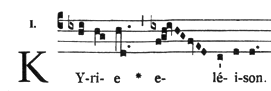
Plainsong is a body of chants used in the liturgies
of the Catholic Church. Though the Eastern Orthodox churches and the Catholic Church did not split
until long after the origin of plainchant, Byzantine chants are generally not classified as plainsong.
Plainsong is monophonic
, consisting of a single, unaccompanied melodic line. It generally has a more free rhythm than the metered rhythm of later Western music.
 Plainchant is believed to originate from the 3rd century A.D. Gregorian chant
is a variety of plainsong named after Pope Gregory I
(6th century A.D.), although Gregory himself did not invent the chant. The tradition linking Gregory I to the development of the chant seems to rest on a possibly mistaken identification of a certain "Gregorius", probably Pope Gregory II
, with his more famous predecessor.
For several centuries, different plainchant styles existed concurrently. Standardization on Gregorian chant was not completed, even in Italy
, until the 12th century. Plainchant represents the first revival of musical notation
after knowledge of the ancient Greek system was lost. Plainsong notation differs from the modern system in having only four lines to the staff and a system of note shapes called neume
s.
In the late 9th century, plainsong began to evolve into organum
, which led to the development of polyphony
.
There was a significant plainsong revival in the 19th century, when much work was done to restore the correct notation and performance-style of the old plainsong collections, notably by the monks of Solesmes Abbey, in Northern France. After the Second Vatican Council
and the introduction of the New Rite Mass, use of plainsong in the Catholic Church declined and was mostly confined to the Monastic Orders
and to ecclesiastical Societies celebrating the traditional Latin Mass (also called Tridentine Mass). But, since Pope Benedict XVI
's motu proprio, Summorum Pontificum
, use of the Tridentine rite has increased; this, along with other Papal comments on the use of appropriate liturgical music, is promoting a new plainsong revival.
Interest in plainsong picked up in 1950s Britain, particularly in the left-wing religious and musical groups associated with Gustav Holst
and the writer George B. Chambers
. In the late 1980s, plainchant achieved a certain vogue as music for relaxation, and several recordings of plainchant became "classical-chart hits".
or Visigothic
, may lack some of the types listed, and may have other types not listed.
Liturgy
Liturgy is either the customary public worship done by a specific religious group, according to its particular traditions or a more precise term that distinguishes between those religious groups who believe their ritual requires the "people" to do the "work" of responding to the priest, and those...
of the Catholic Church. Though the Eastern Orthodox churches and the Catholic Church did not split
East–West Schism
The East–West Schism of 1054, sometimes known as the Great Schism, formally divided the State church of the Roman Empire into Eastern and Western branches, which later became known as the Eastern Orthodox Church and the Roman Catholic Church, respectively...
until long after the origin of plainchant, Byzantine chants are generally not classified as plainsong.
Plainsong is monophonic
Monophony
In music, monophony is the simplest of textures, consisting of melody without accompanying harmony. This may be realized as just one note at a time, or with the same note duplicated at the octave . If the entire melody is sung by two voices or a choir with an interval between the notes or in...
, consisting of a single, unaccompanied melodic line. It generally has a more free rhythm than the metered rhythm of later Western music.
History
Gregorian chant
Gregorian chant is the central tradition of Western plainchant, a form of monophonic liturgical music within Western Christianity that accompanied the celebration of Mass and other ritual services...
is a variety of plainsong named after Pope Gregory I
Pope Gregory I
Pope Gregory I , better known in English as Gregory the Great, was pope from 3 September 590 until his death...
(6th century A.D.), although Gregory himself did not invent the chant. The tradition linking Gregory I to the development of the chant seems to rest on a possibly mistaken identification of a certain "Gregorius", probably Pope Gregory II
Pope Gregory II
Pope Saint Gregory II was pope from May 19, 715 to his death on February 11, 731, succeeding Pope Constantine. Having, it is said, bought off the Lombards for thirty pounds of gold, Charles Martel having refused his call for aid, he used the tranquillity thus obtained for vigorous missionary...
, with his more famous predecessor.
For several centuries, different plainchant styles existed concurrently. Standardization on Gregorian chant was not completed, even in Italy
Italy
Italy , officially the Italian Republic languages]] under the European Charter for Regional or Minority Languages. In each of these, Italy's official name is as follows:;;;;;;;;), is a unitary parliamentary republic in South-Central Europe. To the north it borders France, Switzerland, Austria and...
, until the 12th century. Plainchant represents the first revival of musical notation
Musical notation
Music notation or musical notation is any system that represents aurally perceived music, through the use of written symbols.-History:...
after knowledge of the ancient Greek system was lost. Plainsong notation differs from the modern system in having only four lines to the staff and a system of note shapes called neume
Neume
A neume is the basic element of Western and Eastern systems of musical notation prior to the invention of five-line staff notation. The word is a Middle English corruption of the ultimately Ancient Greek word for breath ....
s.
In the late 9th century, plainsong began to evolve into organum
Organum
Organum is, in general, a plainchant melody with at least one added voice to enhance the harmony, developed in the Middle Ages. Depending on the mode and form of the chant, a supporting bass line may be sung on the same text, the melody may be followed in parallel motion , or a combination of...
, which led to the development of polyphony
Polyphony
In music, polyphony is a texture consisting of two or more independent melodic voices, as opposed to music with just one voice or music with one dominant melodic voice accompanied by chords ....
.
There was a significant plainsong revival in the 19th century, when much work was done to restore the correct notation and performance-style of the old plainsong collections, notably by the monks of Solesmes Abbey, in Northern France. After the Second Vatican Council
Second Vatican Council
The Second Vatican Council addressed relations between the Roman Catholic Church and the modern world. It was the twenty-first Ecumenical Council of the Catholic Church and the second to be held at St. Peter's Basilica in the Vatican. It opened under Pope John XXIII on 11 October 1962 and closed...
and the introduction of the New Rite Mass, use of plainsong in the Catholic Church declined and was mostly confined to the Monastic Orders
Monasticism
Monasticism is a religious way of life characterized by the practice of renouncing worldly pursuits to fully devote one's self to spiritual work...
and to ecclesiastical Societies celebrating the traditional Latin Mass (also called Tridentine Mass). But, since Pope Benedict XVI
Pope Benedict XVI
Benedict XVI is the 265th and current Pope, by virtue of his office of Bishop of Rome, the Sovereign of the Vatican City State and the leader of the Catholic Church as well as the other 22 sui iuris Eastern Catholic Churches in full communion with the Holy See...
's motu proprio, Summorum Pontificum
Summorum Pontificum
Summorum Pontificum is an Apostolic Letter of Pope Benedict XVI, issued "motu proprio" . The document specified the rules, for the Latin Rite of the Catholic Church, for celebrating Mass according to the "Missal promulgated by John XXIII in 1962" , and for administering most of the sacraments in...
, use of the Tridentine rite has increased; this, along with other Papal comments on the use of appropriate liturgical music, is promoting a new plainsong revival.
Interest in plainsong picked up in 1950s Britain, particularly in the left-wing religious and musical groups associated with Gustav Holst
Gustav Holst
Gustav Theodore Holst was an English composer. He is most famous for his orchestral suite The Planets....
and the writer George B. Chambers
George B. Chambers
George Bennet Chambers was an English vicar, social activist and author . Following a long career in the Church of England, he became the vicar of Carbrooke Church in Norfolk...
. In the late 1980s, plainchant achieved a certain vogue as music for relaxation, and several recordings of plainchant became "classical-chart hits".
Chant types
The following is a classification of Gregorian chants into types. Other chant traditions, such as the AmbrosianAmbrosian chant
Ambrosian chant is the liturgical plainchant repertory of the Ambrosian rite of the Roman Catholic Church, related to but distinct from Gregorian chant. It is primarily associated with the Archdiocese of Milan, and named after St. Ambrose much as Gregorian chant is named after Gregory the Great...
or Visigothic
Mozarabic chant
Mozarabic chant is the liturgical plainchant repertory of the Mozarabic rite of the Roman Catholic Church, related to the Gregorian chant...
, may lack some of the types listed, and may have other types not listed.
- PrayerPrayerPrayer is a form of religious practice that seeks to activate a volitional rapport to a deity through deliberate practice. Prayer may be either individual or communal and take place in public or in private. It may involve the use of words or song. When language is used, prayer may take the form of...
- Reading or LectionLectionA lection is a reading, in this context, from Scripture.The custom of reading the books of Moses in the synagogues on the Sabbath day was a very ancient one. The addition of lections from the prophetic books had been made afterwards and was in existence at the time of Jesus, as may be gathered...
- Psalm
- CanticleCanticleA canticle is a hymn taken from the Bible. The term is often expanded to include ancient non-biblical hymns such as the Te Deum and certain psalms used liturgically.-Roman Catholic Church:From the Old Testament, the Roman Breviary takes seven canticles for use at Lauds, as follows:*...
- HymnHymnA hymn is a type of song, usually religious, specifically written for the purpose of praise, adoration or prayer, and typically addressed to a deity or deities, or to a prominent figure or personification...
- Prose
- AntiphonAntiphonAn antiphon in Christian music and ritual, is a "responsory" by a choir or congregation, usually in Gregorian chant, to a psalm or other text in a religious service or musical work....
- ResponsoryResponsory-Definition:The most general of a responsory is any psalm, canticle, or other sacred musical work sung responsorially, that is, with a cantor or small group singing verses while the whole choir or congregation respond with a refrain. However, this article focuses on those chants of the western...
- IntroitIntroitThe Introit is part of the opening of the liturgical celebration of the Eucharist for many Christian denominations. In its most complete version, it consists of an antiphon, psalm verse and Gloria Patri that is spoken or sung at the beginning of the celebration...
- GradualGradualThe Gradual is a chant or hymn in the liturgical celebration of the Eucharist for many Christian denominations. In the Tridentine Mass it was and is sung after the reading or chanting of the Epistle and before the Alleluia, or, during penitential seasons, before the Tract. In the Mass of Paul VI...
- TractTract (liturgy)The tract is part of the proper of the liturgical celebration of the Eucharist for many Christian denominations, which is used instead of the Alleluia during Lenten or pre-Lenten seasons, in a Requiem Mass, and on a few other penitential occasions, when the joyousness of an Alleluia is deemed...
- AlleluiaAlleluiaThe word "Alleluia" or "Hallelujah" , which at its most literal means "Praise Yah", is used in different ways in Christian liturgies....
- SequenceSequence (poetry)A sequence is a chant or hymn sung or recited during the liturgical celebration of the Eucharist for many Christian denominations, before the proclamation of the Gospel. By the time of the Council of Trent there were sequences for many feasts in the Church's year.The sequence has always been sung...
- OffertoryOffertoryThe Offertory is the portion of a Eucharistic service when bread and wine are brought to the altar. The offertory exists in many liturgical Christian denominations, though the Eucharistic theology varies among celebrations conducted by these denominations....
- CommunionCommunion (chant)The Communion is the Gregorian chant sung during the distribution of the Eucharist in the Roman Rite Catholic Mass. It is one of the antiphonal chants of the Proper of the Mass, and the final chant in the proper...
Example
External links
- Gregorian Chant - CDs, MP3 files, videos, free scores. Sacra Musica
- GLOBAL CHANT DATABASE – Index of Gregorian Chant - The largest searchable database of plainchant and sacred song melodies