


Anglican Diocese of Sydney

Encyclopedia
The Diocese of Sydney is a diocese within the Anglican Church of Australia
. The majority of the diocese is Evangelical
and low church
in tradition and committed to Reformed and Calvinist theology
.
The diocese goes as far as Lithgow
in the west and the Hawkesbury River
in the north, and it includes much of the New South Wales south coast. It encompasses Australia's largest city as well as the city of Wollongong. It is, geographically, among the larger Anglican dioceses in the world, though the smallest diocese in the state of New South Wales and one of the smaller dioceses in Australia. Around fifty per cent of Australian Anglicans live in the Diocese of Sydney.

, was the first chaplain to the new colony of New South Wales
and was sponsored by the London Missionary Society
. Other chaplains, notably Samuel Marsden
and William Cowper, were also sent. Their positions were unusual as their stipends were paid partly by the colonial government and some (Marsden among them) received large grants of land from the governor of the colony. Some (again including Marsden) were also magistrates. But they were responsible either to the Bishop of Calcutta
(in whose diocese the Colony of New South Wales lay from 1788 to 1836) or to the Missionary Society which sponsored them, and not to the colonial governor, who could neither dismiss them nor admonish them. This position led to some friction with both governor and settlers.
the former secretary to J.T. Bigge, the Commissioner of the inquiry into the administration of the colony of New South Wales by Governor Lachlan Macquarie
, was appointed the first Archdeacon of Australia while still under the jurisdiction of the Bishop of Calcutta. The archdeaconry was created as a corporation sole
.
In his position as archdeacon, Scott was a member of the Legislative Council (ranking next behind the Lieutenant Governor) and had almost complete control of all church matters. The Colonial Office appointed him King's Visitor
to schools and so he became responsible for public education throughout the colony. His educational policy was guided by the principle that the church and education were inseparably connected and the funds to sustain them were administered by the same trustees. Since this view was shared by the Colonial Office, the Governor Bathurst
, in March 1826, created the Corporation of the Trustees of Church and School Lands, granting one-seventh of the lands of New South Wales to the corporation for the purposes of the Church of England and education in the colony. Scott became the ex officio Vice President (the President being the Governor.)
It was mainly the combination of Archdeacon Scott's official positions as a member of the Legislative Council, as King's Visitor and also as Vice President of the Corporation of Church and School Lands and of the substantial nature of the granting of the lands to the Corporation that led to Courts later holding that at this time the Church of England was the established church in the Colony of New South Wales. Scott retired in 1829 and was succeeded by William Grant Broughton. Scott was shipwrecked while returning to England and assisted the Anglican ministry in the new colony of Western Australia and then in establishing a Church of England chaplaincy in Batavia in the then Dutch East Indies.
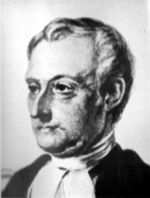 William Grant Broughton
succeeded Scott in 1828. During the time that Broughton was the archdeacon the corporation was abolished and the Church of England lost its favoured place and other Christian churches were also awarded glebe land in towns in the colony.
Broughton was enthroned as Bishop of Australia on 5 June 1836 and the Diocese of Australia was formed. He then lost the ex officio position on the Legislative Council (though regaining it briefly later before the creation of a partly elected Council in 1842). He continued an education policy and established The King's School, Sydney
.
separated from the Diocese of Australia in 1842. In 1849 the Diocese of Australia was divided into the four separate dioceses of Sydney
, Adelaide
, Newcastle
and Melbourne
. Broughton became metropolitan and the Diocese of Sydney recognised as the metropolitical see. The Diocese of Sydney has been led by an archbishop since 1897.
s and bishop
s who were trained in and had migrated from England and Ireland. Broughton had attempted to found a theological college but it closed in 1849. In 1856, Moore Theological College
opened, the official theological college (seminary
) for Sydney Anglicans. Since that time it has grown in size and stature. In 2006 it has in excess of 450 students, many of whom end up in ministry outside the ecclesiastical and geographical boundaries of the Sydney diocese.
and Modernism
within the church and fought very hard to preserve Sydney's Evangelical nature—especially as Tractarian
missionaries began arriving from England in the 19th century. Out of this came the Anglican Church League, a body of Evangelicals who worked within the politics of the diocese to further the Evangelical cause. Currently, all bishops and most senior officeholders in the diocese are members of the Anglican Church League.
traditions. Evangelicals within the diocese see themselves as standing in the heritage of the English Reformation
and direct the diocese accordingly. As such the diocese officially holds to belief in the divine inspiration and authority of scripture in line with the official statement of Anglican belief, the "Articles of Religion" (more commonly known as the Thirty-nine Articles
). There are, however, a number of beliefs that differentiate the Evangelicalism of the Diocese of Sydney from other Evangelical and Calvinist traditions:
Sydney Anglicans have been described as fundamentalist
and sect-like
by their opponents. They respond by arguing that whereas fundamentalists interpret all parts of the Bible literally
Evangelicals in Sydney interpret the Bible in the context of the literary genre.
framed by Archbishop of Canterbury Thomas Cranmer
in 1549, revised significantly in 1552 and modified slightly in 1662. They have also subscribed to, or otherwise acknowledged as foundational, the Thirty-Nine Articles
of Religion as listed in the Book of Common Prayer. While the Book of Common Prayer is no longer used in many Sydney churches, the diocese still fully affirms the doctrine and principles embodied within it as they interpret them. In keeping with the theologically reformed character of the 39 Articles, the diocese holds the view that all church doctrine and traditions are subject to the authority of Scripture.
. The system of episcopal order is under review with some eager to redefine some of the roles of the threefold order of deacons, priests and bishops.
The diocese is considering whether the laying on of hands at confirmation could be performed by the rector of the parish. Although confirmation by a priest is common practice in Orthodoxy and is permitted in certain circumstances in Roman Catholicism, in the Anglican tradition confirmation can only be celebrated by a bishop. In 2005, possibly as a precursor to this change, the diocese formally removed the requirement of confirmation prior to partaking of communion
for those who have been baptised as adults. However, it is common practice throughout the diocese to allow all adults who profess genuine repentance and Christian faith to receive communion
regardless of whether they have been baptised or confirmed.
Lay presidency
(also known as "Lay Administration of Holy Communion") is being considered, whereby the Lord's Supper
could be celebrated by deacons and authorised laity, including women. According to current church law, only ordained priests and bishops are allowed to preside at the Lord's Supper. An ordinance to permit lay presidency was not proceeded with at the diocesan synod in 2005 due to concerns regarding its legality. However, this issue hasn't died and new motions are being drafted ready to be put before the next diocesan synod. In October 2008, the Australian Church Record and the Anglican Church League published The Lord's Supper in Human Hands. Who Should Administer?, which describes the forty year discussion of this issue in Sydney and summarises the debate. Although Sydney was not the first diocese, nor the only one, in which this issue has been raised, it has been discussed within the diocese for a number of years. This publication has been widely distributed so that the Anglican Communion might examine and consider Sydney's discussions.
Despite the use of the term priest
to describe the ordained leader of the local parish church in Anglicanism, the term is generally avoided in the Sydney diocese because of its association with the sacrificial priesthood in the Old Testament
and, also, its association with Roman Catholicism. The view taught at the diocese's Moore Theological College is that the priestly work has been completed, once for all, by the death and resurrection of Jesus Christ and that the local church leader is simply a minister of God's people, rather than mediating between the people and God. Sydney Anglicans believe that this is faithful to the heart of Anglicanism, rather than a break from tradition, though there is little evidence of this belief in the rest of the Anglican Communion. When a distinction must be made from bishops, deacons and lay ministers, the term presbyter is often used.
practices, the 1662 Book of Common Prayer
is rarely used. Likewise, few churches sing canticles and responses, either from 1662 or An Australian Prayer Book.
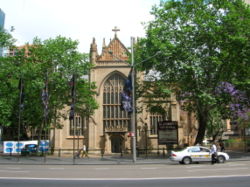
The term "meeting" is sometimes used interchangeably with "service". The most notable example of this is St Andrew's Cathedral
. Many meetings at Evangelical churches in the diocese do not use a prayer book or a liturgical form of service. There is often an early morning (e.g. 8.00 am) service that follows Morning Prayer or Holy Communion from An Australian Prayer Book. Even where no formal liturgy is used many core elements of Anglican liturgy may still be used for congregational participation, such as a corporate confession of sin, saying of creeds and corporate prayers. A screen and projector may be used in place of books. Lay or congregational participation in Sydney churches also occurs through bible readings, leading intercessory prayer, leading the meetings, testimonies and interviews, singing and playing music. In many parishes fermented communion wine has been replaced with grape juice. Predominantly, the reason given for this is to be sensitive to people for whom alcohol could cause a problem (cf. 1 Cor 8:13).
, a vestment
now generally worn elsewhere in Australia for the celebration of the Eucharist
. Traditionally in Sydney most clergy have worn the choir habit for all services but a few have also worn a cope
and stole when celebrating the Eucharist and at certain other services. This prohibition against chasubles was originated by Archbishop Wright
, an English Evangelical, who did so on the basis that the vestment was deemed illegal, relying on decisions of the English ecclesiastical courts as finally upheld in the Privy Council
in Reid v Bishop of Lincoln [1892]A C 664 (see also Ritualist movement
). The main objection to this vestment in the mind of Sydney Anglicans is that it is associated with the high church
idea of a "sacrificing" priesthood
. That idea is contrary to Sydney's low church
views of both Holy Communion
and of the role and function of the ordained ministry. The archbishop's practice has since been codified by a synod ordinance, making Sydney the only diocese in the whole Anglican Communion that continues to ban the wearing of chasubles, reinforcing the perceived ongoing persecution of Anglo-Catholics in the diocese.
The cope, therefore, is often worn at Anglo-Catholic churches where the celebrant at the Eucharist
would conventionally wear the chasuble
. In general those clergy who robe wear a cassock, surplice, scarf and, occasionally, also an academic hood. Since about 1990 there has sometimes been a practice of wearing a long surplice without a cassock, particularly through the summer. Most clergy in the diocese, however, dispense even with these robes, conducting church services in street clothes ranging from a suit and tie or clerical collar
, to smart casual attire.
, those bringing the action sought to prevent the parishes in the Bathurst diocese from using 'The Red Book', a devotional manual authorised by the bishop. The action was partly successful but led to a bitterness and distrust of the Sydney diocese by many Anglo-Catholics which has continued to the present.
These differences in teaching and style of worship have become more marked in recent years as those leading the Diocese of Sydney allege that other dioceses have become theologically liberal. This has placed continued strain on relationships with those other dioceses. As a consequence of this some parishes outside the Sydney diocese are reluctant to invite Sydney-trained clergy to ministry positions and, conversely, clergy trained outside Sydney are rarely invited to minister within the Sydney diocese. However, many of the large, growing Evangelical churches in dioceses such as Adelaide and Perth continue to recruit some clergy and lay staff trained at Moore College.
Some Sydney Anglicans have also been involved in planting independent evangelical churches in other parts of Australia. Along with ministers from other Christian traditions, eleven Anglican clergy have moved from Sydney to help establish these independent Evangelical churches. Prominent Sydney clergy such as Phillip Jensen
and the Moore College Principal, John Woodhouse, have been on the boards of some of these churches. At the 2005 synod links between Sydney Anglicans and independent Evangelical churches were strengthened, with the possibility of these independent churches becoming affiliated with the Sydney diocese.
of the Holy Spirit like speaking in tongues are not considered normative for all believers, whereas the Fruit of the Holy Spirit is expected to be exhibited by all Christians.
, Sydney Morning Herald
writer Chris McGillion and journalist Muriel Porter) have attempted to link Sydney Evangelicals to the conservative "right". While most Sydney clergy strongly support conservative positions on controversial areas such as euthanasia
, homosexuality
and abortion
, they also strongly support social justice issues such as protection of the rights of the underprivileged and the rights of unauthorised immigrants seeking refugee status.
This "left" wing element has a lengthy history. Archdeacon R.B. Hammond (no relation to T.C. Hammond) who was the rector of St Barnabas' Broadway operated soup kitchens during the 1930s and was then a founders of a self-help community which became known as Hammondville
where unemployed people built homes, established market gardens and so found work. More lately Sir Marcus Loane was noted for his criticisms of the then Liberal-Country Party coalition governments on issues relating to Vietnamese refugees after the end of the Vietnam War
, seeking the ready admission of refugees to Australia. Loane was also outspoken on issues involving uranium mining. There have been clergy willing to speak out against the more conservative policies of the Diocese of Sydney. In 2007 the Revd Keith Mascord (now of Mission Australia
) sent an open letter to the Standing Committee, revealing disgruntlements of people within the church (both leaders and congregation members) and suggesting alternative ways forward.
The perception that Sydney Anglicans have adopted fundamentalism
(see comments under Evangelical distinctives) has led to assumptions that the diocese gives implicit support for "right leaning" politicians in Australia.
on social issues for many years, the doctrinal divisions between Calvinists and Roman Catholics are too great to be overcome by a common distaste for the agenda of liberal Anglicanism. On 28 October 2009, the Diocese of Sydney’s synod adopted a resolution urging all Anglicans to reject the Vatican’s proposal of personal ordinariate
s for disaffected Anglo-Catholic traditionalists.
. One minister, a member of the standing committee and a former president of the Anglican Church League, was named in the Paedophile Enquiry of the Royal Commission into the New South Wales Police Service
. Other cases were examined by the Commission but not dealt with in public hearings. Removal of ministers from office has occurred both prior to and subsequent to the Royal Commission hearings.
Anglican Church of Australia
The Anglican Church of Australia is a member church of the Anglican Communion. It was previously officially known as the Church of England in Australia and Tasmania...
. The majority of the diocese is Evangelical
Evangelicalism
Evangelicalism is a Protestant Christian movement which began in Great Britain in the 1730s and gained popularity in the United States during the series of Great Awakenings of the 18th and 19th century.Its key commitments are:...
and low church
Low church
Low church is a term of distinction in the Church of England or other Anglican churches initially designed to be pejorative. During the series of doctrinal and ecclesiastic challenges to the established church in the 16th and 17th centuries, commentators and others began to refer to those groups...
in tradition and committed to Reformed and Calvinist theology
Theology
Theology is the systematic and rational study of religion and its influences and of the nature of religious truths, or the learned profession acquired by completing specialized training in religious studies, usually at a university or school of divinity or seminary.-Definition:Augustine of Hippo...
.
The diocese goes as far as Lithgow
Lithgow, New South Wales
Lithgow is a city in the Central Tablelands of New South Wales, Australia and is the centre of the local political division City of Lithgow. It is located in a mountain valley named Lithgow's Valley by John Oxley in honour of William Lithgow, the first Auditor-General of New South Wales.Lithgow is...
in the west and the Hawkesbury River
Hawkesbury River
The Hawkesbury River, also known as Deerubbun, is one of the major rivers of the coastal region of New South Wales, Australia. The Hawkesbury River and its tributaries virtually encircle the metropolitan region of Sydney.-Geography:-Course:...
in the north, and it includes much of the New South Wales south coast. It encompasses Australia's largest city as well as the city of Wollongong. It is, geographically, among the larger Anglican dioceses in the world, though the smallest diocese in the state of New South Wales and one of the smaller dioceses in Australia. Around fifty per cent of Australian Anglicans live in the Diocese of Sydney.
Richard Johnson
The Anglican ministry has been present in Australia since 1788. An Evangelical cleric, the Reverend Richard JohnsonRichard Johnson (chaplain)
Richard Johnson was the first Christian cleric in Australia.Johnson was the son of John and Mary Johnson. He was born in Welton, Yorkshire and educated at Hull Grammar School under Joseph Milner. In 1780 he entered Magdalene College, Cambridge as a sizar and graduated in 1784...
, was the first chaplain to the new colony of New South Wales
New South Wales
New South Wales is a state of :Australia, located in the east of the country. It is bordered by Queensland, Victoria and South Australia to the north, south and west respectively. To the east, the state is bordered by the Tasman Sea, which forms part of the Pacific Ocean. New South Wales...
and was sponsored by the London Missionary Society
London Missionary Society
The London Missionary Society was a non-denominational missionary society formed in England in 1795 by evangelical Anglicans and Nonconformists, largely Congregationalist in outlook, with missions in the islands of the South Pacific and Africa...
. Other chaplains, notably Samuel Marsden
Samuel Marsden
Samuel Marsden was an English born Anglican cleric and a prominent member of the Church Missionary Society, believed to have introduced Christianity to New Zealand...
and William Cowper, were also sent. Their positions were unusual as their stipends were paid partly by the colonial government and some (Marsden among them) received large grants of land from the governor of the colony. Some (again including Marsden) were also magistrates. But they were responsible either to the Bishop of Calcutta
Bishop of Calcutta
The Bishop of Calcutta exercises episcopal leadership over the Diocese of Calcutta of the Church of North India. The diocese was established in 1813 as part of the Church of England and the first bishop was Thomas Fanshawe Middleton and the second Reginald Heber...
(in whose diocese the Colony of New South Wales lay from 1788 to 1836) or to the Missionary Society which sponsored them, and not to the colonial governor, who could neither dismiss them nor admonish them. This position led to some friction with both governor and settlers.
Thomas Hobbes Scott
In 1825 Thomas Hobbes ScottThomas Hobbes Scott
Thomas Hobbes Scott was an English-born clergyman, active in Australia.Scott was born in Kelmscott, Oxford, England, one of the youngest of eight children of James Scott, sometime vicar of Itchen Stoke, Hampshire, and chaplain ordinary to George III, and his wife Jane Elizabeth, née Harmood.Scott...
the former secretary to J.T. Bigge, the Commissioner of the inquiry into the administration of the colony of New South Wales by Governor Lachlan Macquarie
Lachlan Macquarie
Major-General Lachlan Macquarie CB , was a British military officer and colonial administrator. He served as the last autocratic Governor of New South Wales, Australia from 1810 to 1821 and had a leading role in the social, economic and architectural development of the colony...
, was appointed the first Archdeacon of Australia while still under the jurisdiction of the Bishop of Calcutta. The archdeaconry was created as a corporation sole
Corporation sole
A corporation sole is a legal entity consisting of a single incorporated office, occupied by a single man or woman. This allows a corporation to pass vertically in time from one office holder to the next successor-in-office, giving the position legal continuity with each subsequent office...
.
In his position as archdeacon, Scott was a member of the Legislative Council (ranking next behind the Lieutenant Governor) and had almost complete control of all church matters. The Colonial Office appointed him King's Visitor
Visitor
A Visitor, in United Kingdom law and history, is an overseer of an autonomous ecclesiastical or eleemosynary institution , who can intervene in the internal affairs of that institution...
to schools and so he became responsible for public education throughout the colony. His educational policy was guided by the principle that the church and education were inseparably connected and the funds to sustain them were administered by the same trustees. Since this view was shared by the Colonial Office, the Governor Bathurst
Henry Bathurst, 3rd Earl Bathurst
Henry Bathurst, 3rd Earl Bathurst KG PC was a British politician.-Background and education:Lord Bathurst was the elder son of Henry Bathurst, 2nd Earl Bathurst, by his wife Tryphena, daughter of Thomas Scawen...
, in March 1826, created the Corporation of the Trustees of Church and School Lands, granting one-seventh of the lands of New South Wales to the corporation for the purposes of the Church of England and education in the colony. Scott became the ex officio Vice President (the President being the Governor.)
It was mainly the combination of Archdeacon Scott's official positions as a member of the Legislative Council, as King's Visitor and also as Vice President of the Corporation of Church and School Lands and of the substantial nature of the granting of the lands to the Corporation that led to Courts later holding that at this time the Church of England was the established church in the Colony of New South Wales. Scott retired in 1829 and was succeeded by William Grant Broughton. Scott was shipwrecked while returning to England and assisted the Anglican ministry in the new colony of Western Australia and then in establishing a Church of England chaplaincy in Batavia in the then Dutch East Indies.
William Grant Broughton
William Grant Broughton
William Grant Broughton was the first Bishop of Australia of the Church of England....
succeeded Scott in 1828. During the time that Broughton was the archdeacon the corporation was abolished and the Church of England lost its favoured place and other Christian churches were also awarded glebe land in towns in the colony.
Broughton was enthroned as Bishop of Australia on 5 June 1836 and the Diocese of Australia was formed. He then lost the ex officio position on the Legislative Council (though regaining it briefly later before the creation of a partly elected Council in 1842). He continued an education policy and established The King's School, Sydney
The King's School, Sydney
The King's School is an independent Anglican, day and boarding school for boys in North Parramatta in the western suburbs of Sydney, Australia. Founded in 1831, it is Australia's oldest school and forms one of the nine "Great Public Schools" of New South Wales. Situated within a site, Gowan Brae,...
.
Formation of the Diocese of Sydney
The Diocese of TasmaniaTasmania
Tasmania is an Australian island and state. It is south of the continent, separated by Bass Strait. The state includes the island of Tasmania—the 26th largest island in the world—and the surrounding islands. The state has a population of 507,626 , of whom almost half reside in the greater Hobart...
separated from the Diocese of Australia in 1842. In 1849 the Diocese of Australia was divided into the four separate dioceses of Sydney
Sydney
Sydney is the most populous city in Australia and the state capital of New South Wales. Sydney is located on Australia's south-east coast of the Tasman Sea. As of June 2010, the greater metropolitan area had an approximate population of 4.6 million people...
, Adelaide
Adelaide
Adelaide is the capital city of South Australia and the fifth-largest city in Australia. Adelaide has an estimated population of more than 1.2 million...
, Newcastle
Newcastle, New South Wales
The Newcastle metropolitan area is the second most populated area in the Australian state of New South Wales and includes most of the Newcastle and Lake Macquarie Local Government Areas...
and Melbourne
Melbourne
Melbourne is the capital and most populous city in the state of Victoria, and the second most populous city in Australia. The Melbourne City Centre is the hub of the greater metropolitan area and the Census statistical division—of which "Melbourne" is the common name. As of June 2009, the greater...
. Broughton became metropolitan and the Diocese of Sydney recognised as the metropolitical see. The Diocese of Sydney has been led by an archbishop since 1897.
Moore College
The diocese initially relied upon priestPriest
A priest is a person authorized to perform the sacred rites of a religion, especially as a mediatory agent between humans and deities. They also have the authority or power to administer religious rites; in particular, rites of sacrifice to, and propitiation of, a deity or deities...
s and bishop
Bishop
A bishop is an ordained or consecrated member of the Christian clergy who is generally entrusted with a position of authority and oversight. Within the Catholic Church, Eastern Orthodox, Oriental Orthodox Churches, in the Assyrian Church of the East, in the Independent Catholic Churches, and in the...
s who were trained in and had migrated from England and Ireland. Broughton had attempted to found a theological college but it closed in 1849. In 1856, Moore Theological College
Moore Theological College
Moore Theological College, otherwise known simply as Moore College, is the theological training seminary of the Diocese of Sydney in the Anglican Church of Australia...
opened, the official theological college (seminary
Seminary
A seminary, theological college, or divinity school is an institution of secondary or post-secondary education for educating students in theology, generally to prepare them for ordination as clergy or for other ministry...
) for Sydney Anglicans. Since that time it has grown in size and stature. In 2006 it has in excess of 450 students, many of whom end up in ministry outside the ecclesiastical and geographical boundaries of the Sydney diocese.
Anglican Church League
Since the beginning of the 20th century, Evangelicals within the diocese were concerned about growing Anglo-CatholicismAnglo-Catholicism
The terms Anglo-Catholic and Anglo-Catholicism describe people, beliefs and practices within Anglicanism that affirm the Catholic, rather than Protestant, heritage and identity of the Anglican churches....
and Modernism
Modernism
Modernism, in its broadest definition, is modern thought, character, or practice. More specifically, the term describes the modernist movement, its set of cultural tendencies and array of associated cultural movements, originally arising from wide-scale and far-reaching changes to Western society...
within the church and fought very hard to preserve Sydney's Evangelical nature—especially as Tractarian
Oxford Movement
The Oxford Movement was a movement of High Church Anglicans, eventually developing into Anglo-Catholicism. The movement, whose members were often associated with the University of Oxford, argued for the reinstatement of lost Christian traditions of faith and their inclusion into Anglican liturgy...
missionaries began arriving from England in the 19th century. Out of this came the Anglican Church League, a body of Evangelicals who worked within the politics of the diocese to further the Evangelical cause. Currently, all bishops and most senior officeholders in the diocese are members of the Anglican Church League.
Evangelical distinctives
Most Sydney Anglicans stand within the Reformed and English PuritanPuritan
The Puritans were a significant grouping of English Protestants in the 16th and 17th centuries. Puritanism in this sense was founded by some Marian exiles from the clergy shortly after the accession of Elizabeth I of England in 1558, as an activist movement within the Church of England...
traditions. Evangelicals within the diocese see themselves as standing in the heritage of the English Reformation
English Reformation
The English Reformation was the series of events in 16th-century England by which the Church of England broke away from the authority of the Pope and the Roman Catholic Church....
and direct the diocese accordingly. As such the diocese officially holds to belief in the divine inspiration and authority of scripture in line with the official statement of Anglican belief, the "Articles of Religion" (more commonly known as the Thirty-nine Articles
Thirty-Nine Articles
The Thirty-Nine Articles of Religion are the historically defining statements of doctrines of the Anglican church with respect to the controversies of the English Reformation. First established in 1563, the articles served to define the doctrine of the nascent Church of England as it related to...
). There are, however, a number of beliefs that differentiate the Evangelicalism of the Diocese of Sydney from other Evangelical and Calvinist traditions:
- Typological interpretationTypology (theology)Typology in Christian theology and Biblical exegesis is a doctrine or theory concerning the relationship between the Old and New Testaments...
of the Old TestamentOld TestamentThe Old Testament, of which Christians hold different views, is a Christian term for the religious writings of ancient Israel held sacred and inspired by Christians which overlaps with the 24-book canon of the Masoretic Text of Judaism...
—a biblical theologicalBiblical TheologyBiblical theology is a discipline within Christian theology which studies the Bible from the perspective of understanding the progressive history of God revealing Himself to humanity following the Fall and throughout the Old Testament and New Testament...
approach which interprets Old Testament propheciesProphecyProphecy is a process in which one or more messages that have been communicated to a prophet are then communicated to others. Such messages typically involve divine inspiration, interpretation, or revelation of conditioned events to come as well as testimonies or repeated revelations that the...
regarding the Land of IsraelLand of IsraelThe Land of Israel is the Biblical name for the territory roughly corresponding to the area encompassed by the Southern Levant, also known as Canaan and Palestine, Promised Land and Holy Land. The belief that the area is a God-given homeland of the Jewish people is based on the narrative of the...
, the Jerusalem TempleTemple in JerusalemThe Temple in Jerusalem or Holy Temple , refers to one of a series of structures which were historically located on the Temple Mount in the Old City of Jerusalem, the current site of the Dome of the Rock. Historically, these successive temples stood at this location and functioned as the centre of...
and the Davidic Kingdom as having a typological rather than literal fulfillment in the New CovenantNew CovenantThe New Covenant is a concept originally derived from the Hebrew Bible. The term "New Covenant" is used in the Bible to refer to an epochal relationship of restoration and peace following a period of trial and judgment...
; thus rejecting dispensationalismDispensationalismDispensationalism is a nineteenth-century evangelical development based on a futurist biblical hermeneutic that sees a series of chronologically successive "dispensations" or periods in history in which God relates to human beings in different ways under different Biblical covenants.As a system,...
and Christian ZionismChristian ZionismChristian Zionism is a belief among some Christians that the return of the Jews to the Holy Land, and the establishment of the State of Israel in 1948, is in accordance with Biblical prophecy. It overlaps with, but is distinct from, the nineteenth century movement for the Restoration of the Jews...
which are more characteristic of American Evangelicalism. This approach is described by Graeme GoldsworthyGraeme GoldsworthyGraeme Goldsworthy is an Australian Anglican theologian specialising in the Old Testament and Biblical Theology. He has authored several books including According to Plan and Preaching the whole Bible as Christian Scripture.The "Goldsworthy Trilogy":...
, a Sydney theologian, in his book According to Plan. - Identification of church with the local congregation as opposed to a diocese or denomination. Sydney's ecclesiology, influenced by the former Principal and Vice-Principal of Moore College D Broughton Knox and Donald RobinsonDonald Robinson (bishop)Donald William Bradley Robinson AO TD was the Anglican Archbishop of Sydney from 1982 to 1993.Robinson was born in Sydney on 9 November 1922 and educated at Sydney Church of England Grammar School, the University of Sydney and Queens' College, Cambridge. He was ordained in 1950 and began his...
(later respectively Principal of George Whitefield CollegeGeorge Whitefield CollegeGeorge Whitefield College is a Christian theological college which is reformed and evangelical situated in Muizenberg, Cape Town, South Africa, and is named after the 18th-century English evangelist George Whitefield...
and Archbishop of Sydney) among others, believes that the church is God's people meeting around God's Word. This leads to church meetings being centred around the public reading, explanation and response to God's Word. Further, Anglicans in Sydney generally identify themselves primarily with their local congregation rather than a denomination or institution, and place less emphasis on the celebration of Holy Communion (called the EucharistEucharistThe Eucharist , also called Holy Communion, the Sacrament of the Altar, the Blessed Sacrament, the Lord's Supper, and other names, is a Christian sacrament or ordinance...
by many Anglicans) than do Anglicans of many other dioceses. - The importance of evangelismEvangelismEvangelism refers to the practice of relaying information about a particular set of beliefs to others who do not hold those beliefs. The term is often used in reference to Christianity....
and a personal faith. - AmillennialismAmillennialismAmillennialism is a view in Christian end-times theology named for its rejection of the theory that Jesus Christ will have a thousand-year long, physical reign on the earth...
—a belief that the reign of Jesus (the millennium) was inaugurated with his death and resurrection and will be consummated with his second coming (cf. premillennialismPremillennialismPremillennialism in Christian end-times theology is the belief that Jesus will literally and physically be on the earth for his millennial reign, at his second coming. The doctrine is called premillennialism because it holds that Jesus’ physical return to earth will occur prior to the inauguration...
and postmillennialismPostmillennialismIn Christian end-times theology, , postmillennialism is an interpretation of chapter 20 of the Book of Revelation which sees Christ's second coming as occurring after the "Millennium", a Golden Age in which Christian ethics prosper...
).
Sydney Anglicans have been described as fundamentalist
Fundamentalist Christianity
Christian fundamentalism, also known as Fundamentalist Christianity, or Fundamentalism, arose out of British and American Protestantism in the late 19th century and early 20th century among evangelical Christians...
and sect-like
Sect
A sect is a group with distinctive religious, political or philosophical beliefs. Although in past it was mostly used to refer to religious groups, it has since expanded and in modern culture can refer to any organization that breaks away from a larger one to follow a different set of rules and...
by their opponents. They respond by arguing that whereas fundamentalists interpret all parts of the Bible literally
Biblical literalism
Biblical literalism is the interpretation or translation of the explicit and primary sense of words in the Bible. A literal Biblical interpretation is associated with the fundamentalist and evangelical hermeneutical approach to Scripture, and is used almost exclusively by conservative Christians...
Evangelicals in Sydney interpret the Bible in the context of the literary genre.
Affiliation with Anglican doctrine
For most of the last 450 years Anglicans worldwide have used the Book of Common PrayerBook of Common Prayer
The Book of Common Prayer is the short title of a number of related prayer books used in the Anglican Communion, as well as by the Continuing Anglican, "Anglican realignment" and other Anglican churches. The original book, published in 1549 , in the reign of Edward VI, was a product of the English...
framed by Archbishop of Canterbury Thomas Cranmer
Thomas Cranmer
Thomas Cranmer was a leader of the English Reformation and Archbishop of Canterbury during the reigns of Henry VIII, Edward VI and, for a short time, Mary I. He helped build a favourable case for Henry's divorce from Catherine of Aragon which resulted in the separation of the English Church from...
in 1549, revised significantly in 1552 and modified slightly in 1662. They have also subscribed to, or otherwise acknowledged as foundational, the Thirty-Nine Articles
Thirty-Nine Articles
The Thirty-Nine Articles of Religion are the historically defining statements of doctrines of the Anglican church with respect to the controversies of the English Reformation. First established in 1563, the articles served to define the doctrine of the nascent Church of England as it related to...
of Religion as listed in the Book of Common Prayer. While the Book of Common Prayer is no longer used in many Sydney churches, the diocese still fully affirms the doctrine and principles embodied within it as they interpret them. In keeping with the theologically reformed character of the 39 Articles, the diocese holds the view that all church doctrine and traditions are subject to the authority of Scripture.
Disassociation from Anglican tradition
There are some areas of church practice that are being challenged within the diocese that have potential ramifications for the wider Anglican CommunionAnglican Communion
The Anglican Communion is an international association of national and regional Anglican churches in full communion with the Church of England and specifically with its principal primate, the Archbishop of Canterbury...
. The system of episcopal order is under review with some eager to redefine some of the roles of the threefold order of deacons, priests and bishops.
The diocese is considering whether the laying on of hands at confirmation could be performed by the rector of the parish. Although confirmation by a priest is common practice in Orthodoxy and is permitted in certain circumstances in Roman Catholicism, in the Anglican tradition confirmation can only be celebrated by a bishop. In 2005, possibly as a precursor to this change, the diocese formally removed the requirement of confirmation prior to partaking of communion
Eucharist
The Eucharist , also called Holy Communion, the Sacrament of the Altar, the Blessed Sacrament, the Lord's Supper, and other names, is a Christian sacrament or ordinance...
for those who have been baptised as adults. However, it is common practice throughout the diocese to allow all adults who profess genuine repentance and Christian faith to receive communion
Eucharist
The Eucharist , also called Holy Communion, the Sacrament of the Altar, the Blessed Sacrament, the Lord's Supper, and other names, is a Christian sacrament or ordinance...
regardless of whether they have been baptised or confirmed.
Lay presidency
Lay presidency
Lay presidency is a form of celebrating the Lord's Supper whereby the person presiding over the sacrament is not an ordained minister of religion...
(also known as "Lay Administration of Holy Communion") is being considered, whereby the Lord's Supper
Eucharist
The Eucharist , also called Holy Communion, the Sacrament of the Altar, the Blessed Sacrament, the Lord's Supper, and other names, is a Christian sacrament or ordinance...
could be celebrated by deacons and authorised laity, including women. According to current church law, only ordained priests and bishops are allowed to preside at the Lord's Supper. An ordinance to permit lay presidency was not proceeded with at the diocesan synod in 2005 due to concerns regarding its legality. However, this issue hasn't died and new motions are being drafted ready to be put before the next diocesan synod. In October 2008, the Australian Church Record and the Anglican Church League published The Lord's Supper in Human Hands. Who Should Administer?, which describes the forty year discussion of this issue in Sydney and summarises the debate. Although Sydney was not the first diocese, nor the only one, in which this issue has been raised, it has been discussed within the diocese for a number of years. This publication has been widely distributed so that the Anglican Communion might examine and consider Sydney's discussions.
Despite the use of the term priest
Priest
A priest is a person authorized to perform the sacred rites of a religion, especially as a mediatory agent between humans and deities. They also have the authority or power to administer religious rites; in particular, rites of sacrifice to, and propitiation of, a deity or deities...
to describe the ordained leader of the local parish church in Anglicanism, the term is generally avoided in the Sydney diocese because of its association with the sacrificial priesthood in the Old Testament
Old Testament
The Old Testament, of which Christians hold different views, is a Christian term for the religious writings of ancient Israel held sacred and inspired by Christians which overlaps with the 24-book canon of the Masoretic Text of Judaism...
and, also, its association with Roman Catholicism. The view taught at the diocese's Moore Theological College is that the priestly work has been completed, once for all, by the death and resurrection of Jesus Christ and that the local church leader is simply a minister of God's people, rather than mediating between the people and God. Sydney Anglicans believe that this is faithful to the heart of Anglicanism, rather than a break from tradition, though there is little evidence of this belief in the rest of the Anglican Communion. When a distinction must be made from bishops, deacons and lay ministers, the term presbyter is often used.
Liturgical practice
Despite their adherence to the 39 articles, and with the exception of the few churches that have High ChurchHigh church
The term "High Church" refers to beliefs and practices of ecclesiology, liturgy and theology, generally with an emphasis on formality, and resistance to "modernization." Although used in connection with various Christian traditions, the term has traditionally been principally associated with the...
practices, the 1662 Book of Common Prayer
Book of Common Prayer
The Book of Common Prayer is the short title of a number of related prayer books used in the Anglican Communion, as well as by the Continuing Anglican, "Anglican realignment" and other Anglican churches. The original book, published in 1549 , in the reign of Edward VI, was a product of the English...
is rarely used. Likewise, few churches sing canticles and responses, either from 1662 or An Australian Prayer Book.
The term "meeting" is sometimes used interchangeably with "service". The most notable example of this is St Andrew's Cathedral
St. Andrew's Cathedral, Sydney
St Andrew's Cathedral is the cathedral church of the Anglican Diocese of Sydney in the Anglican Church of Australia. The cathedral is the seat of the Anglican Archbishop of Sydney and Metropolitan of New South Wales, the Most Reverend Peter Jensen...
. Many meetings at Evangelical churches in the diocese do not use a prayer book or a liturgical form of service. There is often an early morning (e.g. 8.00 am) service that follows Morning Prayer or Holy Communion from An Australian Prayer Book. Even where no formal liturgy is used many core elements of Anglican liturgy may still be used for congregational participation, such as a corporate confession of sin, saying of creeds and corporate prayers. A screen and projector may be used in place of books. Lay or congregational participation in Sydney churches also occurs through bible readings, leading intercessory prayer, leading the meetings, testimonies and interviews, singing and playing music. In many parishes fermented communion wine has been replaced with grape juice. Predominantly, the reason given for this is to be sensitive to people for whom alcohol could cause a problem (cf. 1 Cor 8:13).
Vestments
Since 1911 the diocese has prohibited the wearing of the chasubleChasuble
The chasuble is the outermost liturgical vestment worn by clergy for the celebration of the Eucharist in Western-tradition Christian Churches that use full vestments, primarily in the Roman Catholic, Anglican and Lutheran churches, as well as in some parts of the United Methodist Church...
, a vestment
Vestment
Vestments are liturgical garments and articles associated primarily with the Christian religion, especially among Latin Rite and other Catholics, Eastern Orthodox, Anglicans, and Lutherans...
now generally worn elsewhere in Australia for the celebration of the Eucharist
Eucharist
The Eucharist , also called Holy Communion, the Sacrament of the Altar, the Blessed Sacrament, the Lord's Supper, and other names, is a Christian sacrament or ordinance...
. Traditionally in Sydney most clergy have worn the choir habit for all services but a few have also worn a cope
Cope
The cope is a liturgical vestment, a very long mantle or cloak, open in front and fastened at the breast with a band or clasp. It may be of any liturgical colour....
and stole when celebrating the Eucharist and at certain other services. This prohibition against chasubles was originated by Archbishop Wright
John Charles Wright
John Charles Wright, was an Anglican Archbishop of Sydney, Australia, responsible for significantly reducing the influence of Anglo-Catholicism in the diocese....
, an English Evangelical, who did so on the basis that the vestment was deemed illegal, relying on decisions of the English ecclesiastical courts as finally upheld in the Privy Council
Privy council
A privy council is a body that advises the head of state of a nation, typically, but not always, in the context of a monarchic government. The word "privy" means "private" or "secret"; thus, a privy council was originally a committee of the monarch's closest advisors to give confidential advice on...
in Reid v Bishop of Lincoln [1892]A C 664 (see also Ritualist movement
Ritualist movement
Ritualism, in the history of Christianity, refers to an emphasis on the rituals and liturgical ceremony of the church, in particular of Holy Communion....
). The main objection to this vestment in the mind of Sydney Anglicans is that it is associated with the high church
High church
The term "High Church" refers to beliefs and practices of ecclesiology, liturgy and theology, generally with an emphasis on formality, and resistance to "modernization." Although used in connection with various Christian traditions, the term has traditionally been principally associated with the...
idea of a "sacrificing" priesthood
Anglican Eucharistic theology
Anglican Eucharistic theology is diverse in practice, reflecting the essential comprehensiveness of the tradition. Some High church Anglicans, especially those considered to be Anglo-Catholics, hold beliefs identical with, or similar to, the Roman Catholic doctrine of transubstantiation...
. That idea is contrary to Sydney's low church
Low church
Low church is a term of distinction in the Church of England or other Anglican churches initially designed to be pejorative. During the series of doctrinal and ecclesiastic challenges to the established church in the 16th and 17th centuries, commentators and others began to refer to those groups...
views of both Holy Communion
Eucharist
The Eucharist , also called Holy Communion, the Sacrament of the Altar, the Blessed Sacrament, the Lord's Supper, and other names, is a Christian sacrament or ordinance...
and of the role and function of the ordained ministry. The archbishop's practice has since been codified by a synod ordinance, making Sydney the only diocese in the whole Anglican Communion that continues to ban the wearing of chasubles, reinforcing the perceived ongoing persecution of Anglo-Catholics in the diocese.
The cope, therefore, is often worn at Anglo-Catholic churches where the celebrant at the Eucharist
Eucharist
The Eucharist , also called Holy Communion, the Sacrament of the Altar, the Blessed Sacrament, the Lord's Supper, and other names, is a Christian sacrament or ordinance...
would conventionally wear the chasuble
Chasuble
The chasuble is the outermost liturgical vestment worn by clergy for the celebration of the Eucharist in Western-tradition Christian Churches that use full vestments, primarily in the Roman Catholic, Anglican and Lutheran churches, as well as in some parts of the United Methodist Church...
. In general those clergy who robe wear a cassock, surplice, scarf and, occasionally, also an academic hood. Since about 1990 there has sometimes been a practice of wearing a long surplice without a cassock, particularly through the summer. Most clergy in the diocese, however, dispense even with these robes, conducting church services in street clothes ranging from a suit and tie or clerical collar
Clerical collar
A clerical collar is an item of Christian clerical clothing. It is a detachable collar that buttons onto a clergy shirt or rabbat , being fastened by two metal studs, one attached at the front and one at the back to hold the collar to the shirt. The collar closes at the back of the neck, presenting...
, to smart casual attire.
Theological influences
The Sydney diocese has been shaped by the activities and beliefs of many influential people throughout the 20th century:- T.C. Hammond was an Anglican from IrelandIrelandIreland is an island to the northwest of continental Europe. It is the third-largest island in Europe and the twentieth-largest island on Earth...
who moved to Australia to become the Principal of Moore Theological CollegeMoore Theological CollegeMoore Theological College, otherwise known simply as Moore College, is the theological training seminary of the Diocese of Sydney in the Anglican Church of Australia...
during the 1930s. Hammond's influence was critical as he injected an intellectual CalvinismCalvinismCalvinism is a Protestant theological system and an approach to the Christian life...
into his students. The book In Understanding Be Men, a summary of Christian doctrineDoctrineDoctrine is a codification of beliefs or a body of teachings or instructions, taught principles or positions, as the body of teachings in a branch of knowledge or belief system...
, was his lasting legacy and it is still in print today.
- David Broughton Knox was Principal of Moore Theological CollegeMoore Theological CollegeMoore Theological College, otherwise known simply as Moore College, is the theological training seminary of the Diocese of Sydney in the Anglican Church of Australia...
from 1959 until 1985. Along with Donald Robinson (Vice-Principal from 1959 until 1972), Knox pioneered the study of Biblical TheologyBiblical TheologyBiblical theology is a discipline within Christian theology which studies the Bible from the perspective of understanding the progressive history of God revealing Himself to humanity following the Fall and throughout the Old Testament and New Testament...
, which in turn influenced the Sydney Anglican ecclesiologyEcclesiologyToday, ecclesiology usually refers to the theological study of the Christian church. However when the word was coined in the late 1830s, it was defined as the science of the building and decoration of churches and it is still, though rarely, used in this sense.In its theological sense, ecclesiology...
. Knox's intellectual rigour ensured that Moore Theological CollegeMoore Theological CollegeMoore Theological College, otherwise known simply as Moore College, is the theological training seminary of the Diocese of Sydney in the Anglican Church of Australia...
graduates were less likely to accommodate Anglo-Catholic practices in their parish ministry.
- John ChapmanJohn Chapman (evangelist)John Chapman, affectionately known as "Chappo", is a well-known preacher, Bible teacher and evangelist associated with the Sydney Anglican church. He has authored several books including "A Fresh Start", "Know and Tell the Gospel", "Setting Hearts on Fire", "A Sinner's Guide to Holiness", and...
was Director of Sydney's Department of EvangelismEvangelismEvangelism refers to the practice of relaying information about a particular set of beliefs to others who do not hold those beliefs. The term is often used in reference to Christianity....
(now Evangelism Ministries) from 1970 until 1995. He used his ability as a public speaker and evangelist to promote local church missionsMission (Christian)Christian missionary activities often involve sending individuals and groups , to foreign countries and to places in their own homeland. This has frequently involved not only evangelization , but also humanitarian work, especially among the poor and disadvantaged...
. Evangelism thus became a priority within the Sydney Anglican churches at around the same time that church-going became less important to mainstream Australia. Chapman's influence ensured that Sydney Anglicans were able to mobilise in evangelism to prevent too many people from leaving the churches.
- Billy Graham, the American EvangelistEvangelismEvangelism refers to the practice of relaying information about a particular set of beliefs to others who do not hold those beliefs. The term is often used in reference to Christianity....
, visited Sydney for crusades in 1959 and 1979. Many who were converted at the 1959 crusade ended up studying at Moore Theological College and entering the ministry, including Peter Jensen and Phillip JensenPhillip JensenPhillip Jensen is an Australian cleric of the Anglican Diocese of Sydney and the Dean of St Andrew's Cathedral. He is the brother of Peter Jensen, the Anglican Archbishop of Sydney.-Education and ministry:...
(below). The 1959 crusade had a permanent influence on Sydney Anglicans, who placed a great priority on preaching the gospelGospelA gospel is an account, often written, that describes the life of Jesus of Nazareth. In a more general sense the term "gospel" may refer to the good news message of the New Testament. It is primarily used in reference to the four canonical gospels of Matthew, Mark, Luke, and John...
and calling for a personal decision of faithFaithFaith is confidence or trust in a person or thing, or a belief that is not based on proof. In religion, faith is a belief in a transcendent reality, a religious teacher, a set of teachings or a Supreme Being. Generally speaking, it is offered as a means by which the truth of the proposition,...
.
- John StottJohn StottJohn Robert Walmsley Stott CBE was an English Christian leader and Anglican cleric who was noted as a leader of the worldwide Evangelical movement. He was one of the principal authors of the Lausanne Covenant in 1974...
, the English preacherPreacherPreacher is a term for someone who preaches sermons or gives homilies. A preacher is distinct from a theologian by focusing on the communication rather than the development of doctrine. Others see preaching and theology as being intertwined...
and former RectorRectorThe word rector has a number of different meanings; it is widely used to refer to an academic, religious or political administrator...
of All Souls, Langham Place, visited Australia many times during the 1960s, 1970s and 1980s. He introduced Sydney Anglicans to expository preachingExpository preachingExpository preaching is a form of preaching that throws light upon the meaning of a particular text or passage of Scripture. As "throwing light," this term is more general than exegesis, which is used for more technical and grammatical exposition, a careful drawing out of the exact meaning of a...
as the main method of preaching sermonSermonA sermon is an oration by a prophet or member of the clergy. Sermons address a Biblical, theological, religious, or moral topic, usually expounding on a type of belief, law or behavior within both past and present contexts...
s. Thus many Anglican churches in Sydney are regularly exposed to a preaching style that works through BibleBibleThe Bible refers to any one of the collections of the primary religious texts of Judaism and Christianity. There is no common version of the Bible, as the individual books , their contents and their order vary among denominations...
passages, explains them and applies them to everyday life. Rather than preaching topical or theological sermons, Sydney Anglican preachers are more likely to preach systematically through verses, chapters and books of the BibleBibleThe Bible refers to any one of the collections of the primary religious texts of Judaism and Christianity. There is no common version of the Bible, as the individual books , their contents and their order vary among denominations...
. However, prominent figures within the influential Anglican Church League have criticised Stott for supporting the doctrine of AnnihilationismAnnihilationismAnnihilationism is a Christian belief that apart from salvation the death of human beings results in their total destruction rather than their everlasting torment. It is directly related to the doctrine of conditional immortality, the idea that a human soul is not immortal unless it is given...
.
- Peter Jensen entered Moore Theological CollegeMoore Theological CollegeMoore Theological College, otherwise known simply as Moore College, is the theological training seminary of the Diocese of Sydney in the Anglican Church of Australia...
in the late 1960s and was appointed principal in 1985. In 2001 he was elected ArchbishopArchbishopAn archbishop is a bishop of higher rank, but not of higher sacramental order above that of the three orders of deacon, priest , and bishop...
of Sydney and he immediately called on all churches in the Sydney diocese to aim to reach 10% of their communities by 2012. While such a high goal may be likely to fail in secular Sydney, the result of Jensen's goal has been an unprecedented increase in church plantingChurch plantingChurch planting is a process that results in a new Christian church being established. It should be distinguished from church development, where a new service, new worship centre or fresh expression is created that is integrated into an already established congregation...
and related activities.
- Phillip JensenPhillip JensenPhillip Jensen is an Australian cleric of the Anglican Diocese of Sydney and the Dean of St Andrew's Cathedral. He is the brother of Peter Jensen, the Anglican Archbishop of Sydney.-Education and ministry:...
, Peter Jensen's younger brother, became chaplainChaplainTraditionally, a chaplain is a minister in a specialized setting such as a priest, pastor, rabbi, or imam or lay representative of a religion attached to a secular institution such as a hospital, prison, military unit, police department, university, or private chapel...
to the University of New South WalesUniversity of New South WalesThe University of New South Wales , is a research-focused university based in Kensington, a suburb in Sydney, New South Wales, Australia...
in 1975 and Rector of St Matthias, Centennial Park, in 1977. He is deeply conservativeConservatismConservatism is a political and social philosophy that promotes the maintenance of traditional institutions and supports, at the most, minimal and gradual change in society. Some conservatives seek to preserve things as they are, emphasizing stability and continuity, while others oppose modernism...
in his Calvinist theology yet radicalExtremismExtremism is any ideology or political act far outside the perceived political center of a society; or otherwise claimed to violate common moral standards...
and iconoclasticIconoclasmIconoclasm is the deliberate destruction of religious icons and other symbols or monuments, usually with religious or political motives. It is a frequent component of major political or religious changes...
in his ministry style. His work at the University of New South WalesUniversity of New South WalesThe University of New South Wales , is a research-focused university based in Kensington, a suburb in Sydney, New South Wales, Australia...
included the creation of the Ministry Training Strategy (MTS) which took willing young men and women and trained them in practical ministry skills before sending them to Moore Theological CollegeMoore Theological CollegeMoore Theological College, otherwise known simply as Moore College, is the theological training seminary of the Diocese of Sydney in the Anglican Church of Australia...
. In 2003 Phillip Jensen was appointed as DeanDean (religion)A dean, in a church context, is a cleric holding certain positions of authority within a religious hierarchy. The title is used mainly in the Anglican Communion and the Roman Catholic Church.-Anglican Communion:...
of St Andrew's CathedralCathedralA cathedral is a Christian church that contains the seat of a bishop...
in Sydney.
Notable former archbishops
- Howard West Kilvinton MowllHoward MowllHoward West Kilvinton Mowll was the Anglican Archbishop of Sydney from 1933 until his death in 1958.Howard Mowll was born in Dover and attended Dover College until 1903 and later matriculated at the King's School, Canterbury....
, archbishop from 1933 to 1958. His vision for church planting, overseas missions, and church welfare work is unrivalled in Australian history. As a staunch Evangelical, returning from the mission field of China, Mowll experienced early difficulties in a predominantly liberal church; before rising to national prominence during the war years with his assistance rendered to many in need during this time. In 1947, following the War, he was elected PrimatePrimate (religion)Primate is a title or rank bestowed on some bishops in certain Christian churches. Depending on the particular tradition, it can denote either jurisdictional authority or ceremonial precedence ....
of Australia. One of his great achievements (some say his wife Dorothy was the driving force behind the idea) was the purchase of a 60 hectare property at Castle Hill at the time on Sydney’s rural fringes on which the first retirement village in Australia was created in 1958 for missionaries returning penniless from China. Today this site remains the flagship for Anglican Retirement Villages, Diocese of SydneyAnglican Retirement Villages, Diocese of SydneyAnglican Retirement Villages, Diocese of Sydney is a not-for-profit public benevolent institution formed in 1959. This inception date places ARV as one of the founding entities of the social service now referred to as retirement or seniors living...
.
- Hugh Gough, archbishop from 1959 to 1966.
- Marcus LoaneMarcus LoaneSir Marcus Lawrence Loane KBE was the Anglican Archbishop of Sydney from 1966–1982 and Primate of Australia from 1978–1982. He was the first Australian-born Archbishop of Sydney and also the first Australian-born archbishop within the Anglican Church of Australia.Loane was born in...
, archbishop from 1966 to 1982. Sir Marcus was the first Australian-born Archbishop of Sydney and was the Primate of Australia from 1978 to 1982.
- Donald RobinsonDonald Robinson (bishop)Donald William Bradley Robinson AO TD was the Anglican Archbishop of Sydney from 1982 to 1993.Robinson was born in Sydney on 9 November 1922 and educated at Sydney Church of England Grammar School, the University of Sydney and Queens' College, Cambridge. He was ordained in 1950 and began his...
, archbishop from 1982 to 1993. As a theologian and former Vice-Principal of Moore Theological College, he was highly regarded in Sydney for his Evangelical teaching. He put much energy into church planting in new housing areas and in building up existing churches in populous low-income suburbs. He was strongly opposed to the ordination of women.
- Harry GoodhewHarry GoodhewRichard Henry "Harry" Goodhew AO was the Anglican Archbishop of Sydney from 1993 to 2001.Goodhew was born in Sydney on 19 March 1931 and educated at the University of Wollongong. He was ordained in 1958 and began his ministry with curacies at St Matthew’s Bondi and St Bede’s Beverly Hills. Later he...
, archbishop from 1993 to 2001. Appointed as a compromise between opposing 'conservative' and 'liberal' factions, Archbishop Goodhew attempted to heal rifts within the diocese while strongly maintaining a conservative Evangelical stance. He continued to promote the Archbishop's Vision for Growth founded by Donald Robinson, his predecessor. He opened pathways between the Anglican Diocese of Sydney and other churches, promoted communication between Christians and JewsJewsThe Jews , also known as the Jewish people, are a nation and ethnoreligious group originating in the Israelites or Hebrews of the Ancient Near East. The Jewish ethnicity, nationality, and religion are strongly interrelated, as Judaism is the traditional faith of the Jewish nation...
and supported the Roman Catholic-founded CursilloCursilloCursillos in Christianity is a ministry of the Roman Catholic Church...
movement which has rapidly expanded among some more progressive Anglicans within the diocese. In order to ease the tensions involved in the debate over women's ordination he placed a moratorium on discussing the issue for a time.
Relationship with the rest of the Australian Anglican Church
For most of the last century the uncompromisingly Evangelical position adopted by the leaders of the Sydney diocese have contrasted with that of most other Anglican dioceses in Australia which have tended to be more Anglo-Catholic in their style of worship. This contrast helped to delay the adoption of a Constitution for the Australian Anglican Church and, in 1942, led to legal action being taken, ostensibly by members of the parish of Canowindra, a small town in the diocese of Bathurst, but strongly supported by members of the Sydney diocese, Broughton Knox and T.C. Hammond (who both gave evidence in the ensuing proceedings) against the then Bishop of Bathurst, Arnold Lomas Wylde. In these proceedings, which ended in a split decision in the High Court of AustraliaHigh Court of Australia
The High Court of Australia is the supreme court in the Australian court hierarchy and the final court of appeal in Australia. It has both original and appellate jurisdiction, has the power of judicial review over laws passed by the Parliament of Australia and the parliaments of the States, and...
, those bringing the action sought to prevent the parishes in the Bathurst diocese from using 'The Red Book', a devotional manual authorised by the bishop. The action was partly successful but led to a bitterness and distrust of the Sydney diocese by many Anglo-Catholics which has continued to the present.
These differences in teaching and style of worship have become more marked in recent years as those leading the Diocese of Sydney allege that other dioceses have become theologically liberal. This has placed continued strain on relationships with those other dioceses. As a consequence of this some parishes outside the Sydney diocese are reluctant to invite Sydney-trained clergy to ministry positions and, conversely, clergy trained outside Sydney are rarely invited to minister within the Sydney diocese. However, many of the large, growing Evangelical churches in dioceses such as Adelaide and Perth continue to recruit some clergy and lay staff trained at Moore College.
Some Sydney Anglicans have also been involved in planting independent evangelical churches in other parts of Australia. Along with ministers from other Christian traditions, eleven Anglican clergy have moved from Sydney to help establish these independent Evangelical churches. Prominent Sydney clergy such as Phillip Jensen
Phillip Jensen
Phillip Jensen is an Australian cleric of the Anglican Diocese of Sydney and the Dean of St Andrew's Cathedral. He is the brother of Peter Jensen, the Anglican Archbishop of Sydney.-Education and ministry:...
and the Moore College Principal, John Woodhouse, have been on the boards of some of these churches. At the 2005 synod links between Sydney Anglicans and independent Evangelical churches were strengthened, with the possibility of these independent churches becoming affiliated with the Sydney diocese.
Relationship with the charismatic movement
The Sydney diocese has been less influenced by the charismatic movement than some other dioceses. While there are some parishes with strong charismatic leanings most clergy support the doctrinal position that Christians are "filled" with the Holy Spirit at the time of conversion rather than as a separate Christian experience (as believed by some Pentecostals). As with other orthodox Christian church traditions, there is a fundamental belief in the central role of the Holy Spirit in conversion and sanctification of believers. "Charismatic" manifestationsSpiritual gift
In Christianity, spiritual gifts are endowments given by the Holy Spirit. These are the supernatural graces which individual Christians need to fulfill the mission of the church. They are described in the New Testament, primarily in , , and . also touches on the spiritual gifts...
of the Holy Spirit like speaking in tongues are not considered normative for all believers, whereas the Fruit of the Holy Spirit is expected to be exhibited by all Christians.
Relationships within the diocese
Within the Sydney diocese there are parishes which support a range of doctrinal positions or use formal liturgical styles of worship that differ from the Evangelicalism which is dominant within the diocese. Differences can become politicised prior to the election of an archbishop with a number of clergy coalescing into like-minded groups. The two most visible groups are The Anglican Church League who support the Diocese's majority Evangelical position and Anglicans Together who are more theologically broad in their understanding of the Bible and promote a diversity of liturgical practice, which they believe to be in line with the Lambeth Quadrilateral.Sydney diocese and politics
Some external commentators (including the retired American bishop John Shelby SpongJohn Shelby Spong
John Shelby "Jack" Spong is a retired American bishop of the Episcopal Church. He was formerly the Bishop of Newark . He is a liberal Christian theologian, religion commentator and author...
, Sydney Morning Herald
The Sydney Morning Herald
The Sydney Morning Herald is a daily broadsheet newspaper published by Fairfax Media in Sydney, Australia. Founded in 1831 as the Sydney Herald, the SMH is the oldest continuously published newspaper in Australia. The newspaper is published six days a week. The newspaper's Sunday counterpart, The...
writer Chris McGillion and journalist Muriel Porter) have attempted to link Sydney Evangelicals to the conservative "right". While most Sydney clergy strongly support conservative positions on controversial areas such as euthanasia
Euthanasia
Euthanasia refers to the practice of intentionally ending a life in order to relieve pain and suffering....
, homosexuality
Homosexuality
Homosexuality is romantic or sexual attraction or behavior between members of the same sex or gender. As a sexual orientation, homosexuality refers to "an enduring pattern of or disposition to experience sexual, affectional, or romantic attractions" primarily or exclusively to people of the same...
and abortion
Abortion
Abortion is defined as the termination of pregnancy by the removal or expulsion from the uterus of a fetus or embryo prior to viability. An abortion can occur spontaneously, in which case it is usually called a miscarriage, or it can be purposely induced...
, they also strongly support social justice issues such as protection of the rights of the underprivileged and the rights of unauthorised immigrants seeking refugee status.
This "left" wing element has a lengthy history. Archdeacon R.B. Hammond (no relation to T.C. Hammond) who was the rector of St Barnabas' Broadway operated soup kitchens during the 1930s and was then a founders of a self-help community which became known as Hammondville
Hammondville, New South Wales
Hammondville is a suburb, in south-western Sydney, in the state of New South Wales, Australia. Hammondville is located 31 kilometres south-west of the Sydney central business district in the local government area of the City of Liverpool.- History :...
where unemployed people built homes, established market gardens and so found work. More lately Sir Marcus Loane was noted for his criticisms of the then Liberal-Country Party coalition governments on issues relating to Vietnamese refugees after the end of the Vietnam War
Vietnam War
The Vietnam War was a Cold War-era military conflict that occurred in Vietnam, Laos, and Cambodia from 1 November 1955 to the fall of Saigon on 30 April 1975. This war followed the First Indochina War and was fought between North Vietnam, supported by its communist allies, and the government of...
, seeking the ready admission of refugees to Australia. Loane was also outspoken on issues involving uranium mining. There have been clergy willing to speak out against the more conservative policies of the Diocese of Sydney. In 2007 the Revd Keith Mascord (now of Mission Australia
Mission Australia
Mission Australia is a provider of family and community services throughout Australia. The organisation has at least 3200 staff, 1,000 volunteers and 300 services in every state and territory of Australia, and is one of the largest community organisations in the nation. It is currently headed by...
) sent an open letter to the Standing Committee, revealing disgruntlements of people within the church (both leaders and congregation members) and suggesting alternative ways forward.
The perception that Sydney Anglicans have adopted fundamentalism
Fundamentalism
Fundamentalism is strict adherence to specific theological doctrines usually understood as a reaction against Modernist theology. The term "fundamentalism" was originally coined by its supporters to describe a specific package of theological beliefs that developed into a movement within the...
(see comments under Evangelical distinctives) has led to assumptions that the diocese gives implicit support for "right leaning" politicians in Australia.
Ecumenical relations
While the Anglican communion’s largest evangelical diocese has worked closely with its Roman Catholic counterpartRoman Catholic Archdiocese of Sydney
The Roman Catholic Archdiocese of Sydney is a Latin rite metropolitan archdiocese, located in Sydney, New South Wales, Australia.Erected in 1842 and directly responsible to the Holy See, the Archdiocese is responsible for the suffragan dioceses of Armidale, Bathurst, Broken Bay, Lismore,...
on social issues for many years, the doctrinal divisions between Calvinists and Roman Catholics are too great to be overcome by a common distaste for the agenda of liberal Anglicanism. On 28 October 2009, the Diocese of Sydney’s synod adopted a resolution urging all Anglicans to reject the Vatican’s proposal of personal ordinariate
Personal Ordinariate
A personal ordinariate is a canonical structure within the Catholic Church enabling former Anglicans to maintain some degree of corporate identity and autonomy with regard to the bishops of the geographical dioceses of the Catholic Church and to preserve elements of their distinctive Anglican...
s for disaffected Anglo-Catholic traditionalists.
Sexual abuse, incidence and policy
Recently the diocese has been disturbed by revelations of sexual abuseSexual abuse
Sexual abuse, also referred to as molestation, is the forcing of undesired sexual behavior by one person upon another. When that force is immediate, of short duration, or infrequent, it is called sexual assault. The offender is referred to as a sexual abuser or molester...
. One minister, a member of the standing committee and a former president of the Anglican Church League, was named in the Paedophile Enquiry of the Royal Commission into the New South Wales Police Service
Royal Commission into the New South Wales Police Service
The Royal Commission into the New South Wales Police Service was held in the State of New South Wales, Australia between 1995 and 1997. The Royal Commissioner was Justice James Roland Wood...
. Other cases were examined by the Commission but not dealt with in public hearings. Removal of ministers from office has occurred both prior to and subsequent to the Royal Commission hearings.
Women's ordination
One of the visible differences between Sydney and the majority of other Anglican dioceses in Australia has been its unwillingness to allow the ordination of women to the priesthood (itself a term infrequently used in the diocese) or presbyterate. This issue is an indicator of Sydney's difference in ecclesiology and theology to most other dioceses within the Anglican Communion.See also
- List of Anglican churches in the Diocese of Sydney
- List of Anglican bishops of Sydney
- Province of New South WalesProvince of New South WalesThe Province of New South Wales is an ecclesiastical province of the Anglican Church of Australia, the boundaries of which are nearly all of state of New South Wales and the Australian Capital Territory. The province consists of seven dioceses: Armidale, Bathurst, Canberra and Goulburn, Grafton,...
- St. Andrew's Cathedral, SydneySt. Andrew's Cathedral, SydneySt Andrew's Cathedral is the cathedral church of the Anglican Diocese of Sydney in the Anglican Church of Australia. The cathedral is the seat of the Anglican Archbishop of Sydney and Metropolitan of New South Wales, the Most Reverend Peter Jensen...
- Anglican Retirement Villages, Diocese of SydneyAnglican Retirement Villages, Diocese of SydneyAnglican Retirement Villages, Diocese of Sydney is a not-for-profit public benevolent institution formed in 1959. This inception date places ARV as one of the founding entities of the social service now referred to as retirement or seniors living...
- Anglican YouthworksAnglican YouthworksAnglican Youthworks, otherwise known simply as Youthworks, is the youth and education department of the Anglican Diocese of Sydney, Australia. It exists to preach the Gospel of Jesus Christ to the young people of Sydney and beyond in partnership with the churches and schools of the diocese.It is...
- Moore Theological CollegeMoore Theological CollegeMoore Theological College, otherwise known simply as Moore College, is the theological training seminary of the Diocese of Sydney in the Anglican Church of Australia...
- Sydney Missionary and Bible CollegeSydney Missionary and Bible CollegeSydney Missionary and Bible College is an independent, evangelical interdenominational Bible college in Sydney, Australia.The college was formed in 1916 by Rev. C. Benson Barnett. Its goal is to train people for ministry in Australia and abroad...
- Katoomba Christian ConventionKatoomba Christian ConventionKatoomba Christian Convention is an interdenominational ministry providing evangelical Bible preaching to Christians.Conventions are held in KCC's 2300 seat auditorium at Katoomba, in the Blue Mountains approximately west of the Central Business District of Sydney, Australia.At present there are...
- "The Briefing" MagazineThe BriefingThe Briefing is an evangelical Christian magazine published by Matthias Media in partnership with The Good Book Company . It is printed monthly, and is circulated in Australia, North America and the United Kingdom...
- Roman Catholic Archdiocese of SydneyRoman Catholic Archdiocese of SydneyThe Roman Catholic Archdiocese of Sydney is a Latin rite metropolitan archdiocese, located in Sydney, New South Wales, Australia.Erected in 1842 and directly responsible to the Holy See, the Archdiocese is responsible for the suffragan dioceses of Armidale, Bathurst, Broken Bay, Lismore,...
- Church Missionary Society
- Global Anglican Future ConferenceGlobal Anglican Future ConferenceThe Global Anglican Future Conference was a seven day conference of conservative Anglican bishops and leaders held in Jerusalem in June 2008 to address the rise of secularism in the Church, HIV/AIDS and poverty. As a result of the Conference, the Jerusalem Declaration was issued, and the...
External links
- Sydney Anglican Network
- SydneyAnglicans.net - News, articles, opinions and forums
Diocesan organisations
- St Andrew's Cathedral
- Anglican Youthworks
- Anglican Retirement Villages Diocese of Sydney
- Diocesan Registry & Diocesan Archives
- Anglican Media Sydney
Churchmanship organisations
- Anglican Church League - Evangelical Anglican
- Anglicans Together - Broad Church and Catholic Anglican
Sydney Anglican culture
- Anglican Board of Mission Australia
- Anglicare
- Campus Bible Study - University of New South Wales
- Katoomba Christian Convention
- Matthias Media (The Briefing)
- Moore Theological College
- Ministry Training Strategy
- St James' King Street - oldest parish church in Sydney
- Sydney University Evangelical Union