
Home      Discussion      Topics      Dictionary      Almanac
Signup       Login
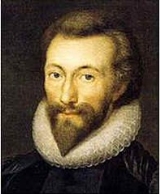
John Donne

John Donne

Overview
John Donne English poet, satirist, lawyer, and priest, is now considered the preeminent representative of the metaphysical poets
Metaphysical poets
The metaphysical poets is a term coined by the poet and critic Samuel Johnson to describe a loose group of British lyric poets of the 17th century, who shared an interest in metaphysical concerns and a common way of investigating them, and whose work was characterized by inventiveness of metaphor...

. His works are notable for their strong and sensual style and include sonnet
Sonnet
A sonnet is one of several forms of poetry that originate in Europe, mainly Provence and Italy. A sonnet commonly has 14 lines. The term "sonnet" derives from the Occitan word sonet and the Italian word sonetto, both meaning "little song" or "little sound"...

s, love poetry, religious poems, Latin
Latin
Latin is an Italic language originally spoken in Latium and Ancient Rome. It, along with most European languages, is a descendant of the ancient Proto-Indo-European language. Although it is considered a dead language, a number of scholars and members of the Christian clergy speak it fluently, and...

 translations, epigram
Epigram
An epigram is a brief, interesting, usually memorable and sometimes surprising statement. Derived from the epigramma "inscription" from ἐπιγράφειν epigraphein "to write on inscribe", this literary device has been employed for over two millennia....

s, elegies
Elegy
In literature, an elegy is a mournful, melancholic or plaintive poem, especially a funeral song or a lament for the dead.-History:The Greek term elegeia originally referred to any verse written in elegiac couplets and covering a wide range of subject matter, including epitaphs for tombs...

, songs, satires and sermon
Sermon
A sermon is an oration by a prophet or member of the clergy. Sermons address a Biblical, theological, religious, or moral topic, usually expounding on a type of belief, law or behavior within both past and present contexts...

s. His poetry is noted for its vibrancy of language and inventiveness of metaphor
Metaphor
A metaphor is a literary figure of speech that uses an image, story or tangible thing to represent a less tangible thing or some intangible quality or idea; e.g., "Her eyes were glistening jewels." Metaphor may also be used for any rhetorical figures of speech that achieve their effects via...

, especially as compared to that of his contemporaries. John Donne's style is characterised by abrupt openings, various paradoxes, ironies, dislocations. These features in combination with his frequent dramatic or everyday speech rhythms, his tense syntax, and his tough eloquence were both a reaction against the smoothness of conventional Elizabethan poetry and an adaptation into English of European baroque and mannerist techniques. His early career was marked by poetry that bore immense knowledge of British society and he met that knowledge with sharp criticism. Another important theme in Donne’s poetry was the idea of true religion, which was something that he spent a lot of time considering and theorising about. He wrote secular poems as well as erotic poems and love poems. Donne is particularly famous for his mastery of metaphysical conceit
Conceit
In literature, a conceit is an extended metaphor with a complex logic that governs a poetic passage or entire poem. By juxtaposing, usurping and manipulating images and ideas in surprising ways, a conceit invites the reader into a more sophisticated understanding of an object of comparison...

s.
Discussion
Ask a question about 'John Donne'
Start a new discussion about 'John Donne'
Answer questions from other users
Full Discussion Forum
 
Unanswered Questions
Quotations

And now good morrow to our waking souls,Which watch not one another out of fear;For love, all love of other sights controls,And makes one little room, an everywhere.Let sea-discoverers to new worlds have gone,Let maps to other, worlds on worlds have shown,Let us possess one world, each hath one, and is one.

The Good Morrow, stanza 2

My face in thine eye, thine in mine appears,And true plain hearts do in the faces rest,Where can we find two better hemispheresWithout sharp North, without declining West?What ever dies, was not mixed equally;If our two loves be one, or, thou and ILove so alike, that none do slacken, none can die.

The Good Morrow, stanza 3

Though Truth and Falsehood be Near twins, yet Truth a little elder is.

Satyre III

Go and catch a falling star, Get with child a mandrake root, Tell me where all past years are, Or who cleft the Devil's foot, Teach me to hear mermaids singing, Or to keep off envy's stinging, And find What wind Serves to advance an honest mind.

Song (Go and Catch a Falling Star), stanza 1

And swearNo where Lives a woman true and fair. If thou find'st one, let me know, Such a pilgrimage were sweet; Yet do not, I would not go, Though at next door we might meet, Though she were true, when you met her, And last, till you write your letter, Yet she Will be False, ere I come, to two, or three.

Song (Go and Catch a Falling Star), stanzas 2-3

I have done one braver thing Than all the Worthies did; And yet a braver thence doth spring, Which is to keep that hid.

The Undertaking, stanza 1

But he who loveliness withinHath found, all outward loathes,For he who color loves, and skin,Loves but their oldest clothes.

The Undertaking, stanza 4

And dare love that, and say so too,And forget the He and She.

The Undertaking, stanza 5

Busy old fool, unruly Sun,Why dost thou thus,Through windows, and through curtains call on us?Must to thy motions lovers' seasons run?

The Sun Rising, stanza 1

Love, all alike, no season knows, nor clime, Nor hours, days, months, which are the rags of time.

The Sun Rising, stanza 1
Encyclopedia
John Donne English poet, satirist, lawyer, and priest, is now considered the preeminent representative of the metaphysical poets
Metaphysical poets
The metaphysical poets is a term coined by the poet and critic Samuel Johnson to describe a loose group of British lyric poets of the 17th century, who shared an interest in metaphysical concerns and a common way of investigating them, and whose work was characterized by inventiveness of metaphor...

. His works are notable for their strong and sensual style and include sonnet
Sonnet
A sonnet is one of several forms of poetry that originate in Europe, mainly Provence and Italy. A sonnet commonly has 14 lines. The term "sonnet" derives from the Occitan word sonet and the Italian word sonetto, both meaning "little song" or "little sound"...

s, love poetry, religious poems, Latin
Latin
Latin is an Italic language originally spoken in Latium and Ancient Rome. It, along with most European languages, is a descendant of the ancient Proto-Indo-European language. Although it is considered a dead language, a number of scholars and members of the Christian clergy speak it fluently, and...

 translations, epigram
Epigram
An epigram is a brief, interesting, usually memorable and sometimes surprising statement. Derived from the epigramma "inscription" from ἐπιγράφειν epigraphein "to write on inscribe", this literary device has been employed for over two millennia....

s, elegies
Elegy
In literature, an elegy is a mournful, melancholic or plaintive poem, especially a funeral song or a lament for the dead.-History:The Greek term elegeia originally referred to any verse written in elegiac couplets and covering a wide range of subject matter, including epitaphs for tombs...

, songs, satires and sermon
Sermon
A sermon is an oration by a prophet or member of the clergy. Sermons address a Biblical, theological, religious, or moral topic, usually expounding on a type of belief, law or behavior within both past and present contexts...

s. His poetry is noted for its vibrancy of language and inventiveness of metaphor
Metaphor
A metaphor is a literary figure of speech that uses an image, story or tangible thing to represent a less tangible thing or some intangible quality or idea; e.g., "Her eyes were glistening jewels." Metaphor may also be used for any rhetorical figures of speech that achieve their effects via...

, especially as compared to that of his contemporaries. John Donne's style is characterised by abrupt openings, various paradoxes, ironies, dislocations. These features in combination with his frequent dramatic or everyday speech rhythms, his tense syntax, and his tough eloquence were both a reaction against the smoothness of conventional Elizabethan poetry and an adaptation into English of European baroque and mannerist techniques. His early career was marked by poetry that bore immense knowledge of British society and he met that knowledge with sharp criticism. Another important theme in Donne’s poetry was the idea of true religion, which was something that he spent a lot of time considering and theorising about. He wrote secular poems as well as erotic poems and love poems. Donne is particularly famous for his mastery of metaphysical conceit
Conceit
In literature, a conceit is an extended metaphor with a complex logic that governs a poetic passage or entire poem. By juxtaposing, usurping and manipulating images and ideas in surprising ways, a conceit invites the reader into a more sophisticated understanding of an object of comparison...

s.

Despite his great education and poetic talents, he lived in poverty for several years, relying heavily on wealthy friends. He spent much of the money he inherited during and after his education on womanising, literature, pastimes and travel. In 1601 Donne secretly married Anne Moore with whom he had 12 children. In 1615 he became an Anglican priest although he did not want to take Anglican orders. He did so because King James I
James I of England
James VI and I was King of Scots as James VI from 24 July 1567 and King of England and Ireland as James I from the union of the English and Scottish crowns on 24 March 1603...

 persistently ordered it. In 1621, he was appointed the Dean of St Paul's
Dean of St Paul's
The Dean of St Paul's is the head of the Chapter of St Paul's Cathedral in London, England in the Church of England. The most recent Dean, Graeme Knowles, formerly Bishop of Sodor and Man, was installed on 1 October 2007 and resigned on 31 October 2011...

 Cathedral in London. He also served as a member of parliament in 1601 and again in 1614.

Early life


John Donne was born in London, into a Roman Catholic family when practice of that religion was illegal in England. Donne was the third of six children. His father, John Donne, was of Welsh
Welsh people
The Welsh people are an ethnic group and nation associated with Wales and the Welsh language.John Davies argues that the origin of the "Welsh nation" can be traced to the late 4th and early 5th centuries, following the Roman departure from Britain, although Brythonic Celtic languages seem to have...

 descent, and a warden of the Ironmongers Company in the City of London
City of London
The City of London is a small area within Greater London, England. It is the historic core of London around which the modern conurbation grew and has held city status since time immemorial. The City’s boundaries have remained almost unchanged since the Middle Ages, and it is now only a tiny part of...

. Donne's father was a respected Catholic who avoided unwelcome government attention out of fear of persecution
Persecution
Persecution is the systematic mistreatment of an individual or group by another group. The most common forms are religious persecution, ethnic persecution, and political persecution, though there is naturally some overlap between these terms. The inflicting of suffering, harassment, isolation,...

.

Donne's father died in 1576, leaving his wife, Elizabeth Heywood, the responsibility of raising their children. Elizabeth Heywood was also from a recusant
Recusancy
In the history of England and Wales, the recusancy was the state of those who refused to attend Anglican services. The individuals were known as "recusants"...

 Catholic family, the daughter of John Heywood
John Heywood
John Heywood was an English writer known for his plays, poems, and collection of proverbs. Although he is best known as a playwright, he was also active as a musician and composer, though no works survive.-Life:...

, the playwright, and sister of Rev. Jasper Heywood
Jasper Heywood
Jasper Heywood, SJ , son of John Heywood, translated into English three plays of Seneca, the Troas , the Thyestes and Hercules Furens ....

, a Jesuit priest and translator. She was a great-niece of the Catholic martyr
Martyr
A martyr is somebody who suffers persecution and death for refusing to renounce, or accept, a belief or cause, usually religious.-Meaning:...

 Thomas More
Thomas More
Sir Thomas More , also known by Catholics as Saint Thomas More, was an English lawyer, social philosopher, author, statesman and noted Renaissance humanist. He was an important councillor to Henry VIII of England and, for three years toward the end of his life, Lord Chancellor...

. This tradition of martyrdom would continue among Donne’s closer relatives, many of whom were executed or exile
Exile
Exile means to be away from one's home , while either being explicitly refused permission to return and/or being threatened with imprisonment or death upon return...

d for religious reasons. Donne was educated privately; however there is no evidence to support the popular claim that he was taught by Jesuits
Society of Jesus
The Society of Jesus is a Catholic male religious order that follows the teachings of the Catholic Church. The members are called Jesuits, and are also known colloquially as "God's Army" and as "The Company," these being references to founder Ignatius of Loyola's military background and a...

. Donne's mother married Dr. John Syminges, a wealthy widower with three children, a few months after Donne's father died. In 1577, his mother died, followed by two more of his sisters, Mary and Katherine, in 1581.

Donne was a student at Hart Hall, now Hertford College, Oxford
Hertford College, Oxford
Hertford College is one of the constituent colleges of the University of Oxford in England. It is located in Catte Street, directly opposite the main entrance of the original Bodleian Library. As of 2006, the college had a financial endowment of £52m. There are 612 students , plus various visiting...

, from the age of 11. After three years at Oxford he was admitted to the University of Cambridge, where he studied for another three years. He was unable to obtain a degree from either institution because of his Catholicism, since he could not take the Oath of Supremacy
Oath of Supremacy
The Oath of Supremacy, originally imposed by King Henry VIII of England through the Act of Supremacy 1534, but repealed by his daughter, Queen Mary I of England and reinstated under Mary's sister, Queen Elizabeth I of England under the Act of Supremacy 1559, provided for any person taking public or...

 required of graduates.

In 1591 he was accepted as a student at the Thavies Inn
Thavies Inn
Thavies Inn was one of the Inns of Chancery and was situated on Holborn, near the site of the present side street and office block named Thavies Inn Buildings, at Holborn Circus. It was associated with Lincoln's Inn. Indeed it is this association that has become bound up with the origins of that...

 legal school, one of the Inns of Chancery
Inns of Chancery
The Inns of Chancery or Hospida Cancellarie were a group of buildings and legal institutions in London initially attached to the Inns of Court and used as offices for the clerks of chancery, from which they drew their name...

 in London. In 1592 he was admitted to Lincoln’s Inn, one of the Inns of Court
Inns of Court
The Inns of Court in London are the professional associations for barristers in England and Wales. All such barristers must belong to one such association. They have supervisory and disciplinary functions over their members. The Inns also provide libraries, dining facilities and professional...

. His brother Henry was also a university student prior to his arrest in 1593 for harbouring a Catholic priest, William Harrington
William Harrington (priest)
William Harrington was an English Jesuit priest. He is a Roman Catholic martyr, beatified in 1929.-Life:His father had entertained Edmund Campion at the ancestral home, Mount St. John, early in 1581...

, whom Henry betrayed under torture
Torture
Torture is the act of inflicting severe pain as a means of punishment, revenge, forcing information or a confession, or simply as an act of cruelty. Throughout history, torture has often been used as a method of political re-education, interrogation, punishment, and coercion...

. Harrington was tortured on the rack, hanged
Hanging
Hanging is the lethal suspension of a person by a ligature. The Oxford English Dictionary states that hanging in this sense is "specifically to put to death by suspension by the neck", though it formerly also referred to crucifixion and death by impalement in which the body would remain...

 until not quite dead, then was subjected to disembowelment
Disembowelment
Disembowelment is the removal of some or all of the organs of the gastrointestinal tract , usually through a horizontal incision made across the abdominal area. Disembowelment may result from an accident, but has also been used as a method of torture and execution...

. Henry Donne died in Newgate prison
Newgate Prison
Newgate Prison was a prison in London, at the corner of Newgate Street and Old Bailey just inside the City of London. It was originally located at the site of a gate in the Roman London Wall. The gate/prison was rebuilt in the 12th century, and demolished in 1777...

 of bubonic plague
Bubonic plague
Plague is a deadly infectious disease that is caused by the enterobacteria Yersinia pestis, named after the French-Swiss bacteriologist Alexandre Yersin. Primarily carried by rodents and spread to humans via fleas, the disease is notorious throughout history, due to the unrivaled scale of death...

, leading John Donne to begin questioning his Catholic faith.

During and after his education, Donne spent much of his considerable inheritance on women, literature, pastimes and travel. Although there is no record detailing precisely where he travelled, it is known that he travelled across Europe and later fought with the Earl of Essex
Earl of Essex
Earl of Essex is a title that has been held by several families and individuals. The earldom was first created in the 12th century for Geoffrey II de Mandeville . Upon the death of the third earl in 1189, the title became dormant or extinct...

 and Sir Walter Raleigh
Walter Raleigh
Sir Walter Raleigh was an English aristocrat, writer, poet, soldier, courtier, spy, and explorer. He is also well known for popularising tobacco in England....

 against the Spanish at Cádiz
Cádiz
Cadiz is a city and port in southwestern Spain. It is the capital of the homonymous province, one of eight which make up the autonomous community of Andalusia....

 (1596) and the Azores
Azores
The Archipelago of the Azores is composed of nine volcanic islands situated in the middle of the North Atlantic Ocean, and is located about west from Lisbon and about east from the east coast of North America. The islands, and their economic exclusion zone, form the Autonomous Region of the...

 (1597) and witnessed the loss of the Spanish flagship, the San Felipe. According to Izaak Walton
Izaak Walton
Izaak Walton was an English writer. Best known as the author of The Compleat Angler, he also wrote a number of short biographies which have been collected under the title of Walton's Lives.-Biography:...

, who wrote a biography of Donne in 1658:
By the age of 25 he was well prepared for the diplomatic career he appeared to be seeking. He was appointed chief secretary to the Lord Keeper of the Great Seal
Lord Keeper of the Great Seal
The Lord Keeper of the Great Seal of England, and later of Great Britain, was formerly an officer of the English Crown charged with physical custody of the Great Seal of England. This evolved into one of the Great Officers of State....

, Sir Thomas Egerton
Thomas Egerton, 1st Viscount Brackley
Thomas Egerton, 1st Viscount Brackley PC was an English Nobleman, Judge and Statesman who served as Lord Keeper and Lord Chancellor for twenty-one years.-Early life, education and legal career:...

, and was established at Egerton’s London home, York House, Strand
York House, Strand
York House in the Strand in London was one of a string of mansions which once stood along the route from the City of London to the royal court at Westminster. It was built as the London home of the Bishops of Norwich not later than 1237, and around 300 years later it was acquired by King Henry VIII...

 close to the Palace of Whitehall
Palace of Whitehall
The Palace of Whitehall was the main residence of the English monarchs in London from 1530 until 1698 when all except Inigo Jones's 1622 Banqueting House was destroyed by fire...

, then the most influential social centre in England.

Marriage to Anne More


During the next four years he fell in love with Egerton's niece Anne More, and they were married just before Christmas in 1601 against the wishes of both Egerton and George More
George More
Sir George More was an English courtier and politician who sat in the House of Commons at various times between 1584 and 1625.More was the son of Sir William More of Loseley Park, Surrey...

, Lieutenant of the Tower and Anne's father. This wedding ruined Donne's career and earned him a short stay in Fleet Prison
Fleet Prison
Fleet Prison was a notorious London prison by the side of the Fleet River in London. The prison was built in 1197 and was in use until 1844. It was demolished in 1846.- History :...

, along with Samuel Brooke
Samuel Brooke
Dr Samuel Brooke was a Gresham Professor of Divinity , a playwright, the chaplain of Trinity College, Cambridge and subsequently the Master of Trinity . He was known to be an Arminian and anti-Calvinist...

 who married them, and the man who acted as a witness to the wedding. Donne was released when the marriage was proven valid, and soon secured the release of the other two. Walton tells us that when he wrote to his wife to tell her about losing his post, he wrote after his name: John Donne, Anne Donne, Un-done. It was not until 1609 that Donne was reconciled with his father-in-law and received his wife's dowry
Dowry
A dowry is the money, goods, or estate that a woman brings forth to the marriage. It contrasts with bride price, which is paid to the bride's parents, and dower, which is property settled on the bride herself by the groom at the time of marriage. The same culture may simultaneously practice both...

.

Following his release, Donne had to accept a retired country life in Pyrford
Pyrford
Pyrford is an English village that for centuries had historical links with the monastery of Westminster, in whose possession it remained between the Norman Conquest and the Dissolution of the Monasteries nearly five hundred years later. It is thirty miles by road from central London and situated...

, Surrey. Over the next few years he scraped a meagre living as a lawyer, depending on his wife’s cousin Sir Francis Wolly to house him, his wife, and their children. Since Anne Donne had a baby almost every year, this was a very generous gesture. Though he practised law and worked as an assistant pamphleteer to Thomas Morton
Thomas Morton (bishop)
Thomas Morton was an English churchman, bishop of several dioceses.-Early life:Morton was born in York on 20 March 1564. He was brought up and grammar school educated in the city and nearby Halifax. In 1582 he became a pensioner at St John's College, Cambridge from which he graduated with a BA in...

, Donne was in a constant state of financial insecurity, with a growing family to provide for.

Anne bore him 12 children in 16 years of marriage (including two stillbirth
Stillbirth
A stillbirth occurs when a fetus has died in the uterus. The Australian definition specifies that fetal death is termed a stillbirth after 20 weeks gestation or the fetus weighs more than . Once the fetus has died the mother still has contractions and remains undelivered. The term is often used in...

s—their eighth and then in 1617 their last child); indeed, she spent most of her married life either pregnant or nursing
Breastfeeding
Breastfeeding is the feeding of an infant or young child with breast milk directly from female human breasts rather than from a baby bottle or other container. Babies have a sucking reflex that enables them to suck and swallow milk. It is recommended that mothers breastfeed for six months or...

. The 10 surviving children were named Constance, John, George, Francis, Lucy (after Donne's patroness Lucy, Countess of Bedford, her godmother), Bridget, Mary, Nicholas, Margaret and Elizabeth. Francis, Nicholas and Mary died before they were ten. In a state of despair, Donne noted that the death of a child would mean one fewer mouth to feed, but he could not afford the burial expenses. During this time Donne wrote, but did not publish, Biathanatos
Biathanatos
Biathanatos is a work by the English writer and clergyman John Donne. Written in 1608 and published after his death, it contains a heterodox defense of self-homicide , listing prominent Biblical examples including Samson, Saul, and Judas Iscariot...

,
his defence of suicide. His wife died on 15 August 1617, five days after giving birth to their twelfth child, a still-born baby. Donne mourned her deeply, including writing the 17th Holy Sonnet
Holy Sonnets
The Holy Sonnets, also known as the Divine Meditations or Divine Sonnets, are a series of nineteen poems by the English poet John Donne...

. He never remarried; this was quite unusual for the time, especially as he had a large family to bring up.

Early poetry


Donne's earliest poems showed a developed knowledge of English society coupled with sharp criticism of its problems. His satires dealt with common Elizabethan topics, such as corruption in the legal system, mediocre poets, and pompous courtiers. His images of sickness, vomit, manure, and plague
Bubonic plague
Plague is a deadly infectious disease that is caused by the enterobacteria Yersinia pestis, named after the French-Swiss bacteriologist Alexandre Yersin. Primarily carried by rodents and spread to humans via fleas, the disease is notorious throughout history, due to the unrivaled scale of death...

 assisted in the creation of a strongly satiric world populated by all the fools and knaves of England. His third satire, however, deals with the problem of true religion, a matter of great importance to Donne. He argued that it was better to examine carefully one's religious convictions than blindly to follow any established tradition, for none would be saved at the Final Judgment, by claiming "A Harry, or a Martin taught [them] this."

Donne's early career was also notable for his erotic poetry, especially his elegies
Elegy
In literature, an elegy is a mournful, melancholic or plaintive poem, especially a funeral song or a lament for the dead.-History:The Greek term elegeia originally referred to any verse written in elegiac couplets and covering a wide range of subject matter, including epitaphs for tombs...

, in which he employed unconventional metaphor
Metaphor
A metaphor is a literary figure of speech that uses an image, story or tangible thing to represent a less tangible thing or some intangible quality or idea; e.g., "Her eyes were glistening jewels." Metaphor may also be used for any rhetorical figures of speech that achieve their effects via...

s, such as a flea biting two lovers being compared to sex
The Flea (poem)
The Flea is an erotic metaphysical poem by John Donne . The exact date of its composition is unknown....

. In Elegy XIX: To His Mistress Going to Bed
Elegy XIX: To His Mistress Going to Bed
"Elegy XIX: To His Mistress Going to Bed" is a poem written by metaphysical poet John Donne. Elegy XIX: To His Mistress Going to Bed was refused a license for publishing in Donne's posthumous collection, "Poems", in 1633, but was printed in an anthology, "The Harmony of the Muses" in 1654...

, he poetically undressed his mistress and compared the act of fondling to the exploration of America
Americas
The Americas, or America , are lands in the Western hemisphere, also known as the New World. In English, the plural form the Americas is often used to refer to the landmasses of North America and South America with their associated islands and regions, while the singular form America is primarily...

. In Elegy XVIII, he compared the gap between his lover's breasts to the Hellespont. Donne did not publish these poems, although did allow them to circulate widely in manuscript form.

Career and later life


Donne was elected as Member of Parliament for the constituency of Brackley
Brackley (UK Parliament constituency)
Brackley was a parliamentary borough in Northamptonshire, which elected two Members of Parliament to the House of Commons from 1547 until 1832, when the constituency was abolished by the Great Reform Act.-History:...

 in 1602, but this was not a paid position and Donne struggled to provide for his family, relying heavily upon rich friends. The fashion for coterie poetry of the period gave him a means to seek patronage and many of his poems were written for wealthy friends or patrons, especially Sir Robert Drury, who came to be Donne's chief patron in 1610. Donne wrote the two Anniversaries, An Anatomy of the World (1611) and Of the Progress of the Soul, (1612), for Drury. While historians are not certain as to the precise reasons for which Donne left the Catholic Church, he was certainly in communication with the King, James I of England
James I of England
James VI and I was King of Scots as James VI from 24 July 1567 and King of England and Ireland as James I from the union of the English and Scottish crowns on 24 March 1603...

, and in 1610 and 1611 he wrote two anti-Catholic polemic
Polemic
A polemic is a variety of arguments or controversies made against one opinion, doctrine, or person. Other variations of argument are debate and discussion...

s: Pseudo-Martyr and Ignatius his Conclave
Ignatius His Conclave
Ignatius His Conclave is a 1611 work by 16th century metaphysical poet John Donne. The work satirizes the Jesuits. In the story, St. Ignatius of Loyola, the founder of the Jesuits, is found to be in Hell:...

. Although James was pleased with Donne's work, he refused to reinstate him at court and instead urged him to take holy orders. At length, Donne acceded to the King's wishes and in 1615 was ordained into the Church of England
Church of England
The Church of England is the officially established Christian church in England and the Mother Church of the worldwide Anglican Communion. The church considers itself within the tradition of Western Christianity and dates its formal establishment principally to the mission to England by St...

.

Donne became a Royal Chaplain
Ecclesiastical Household
The Ecclesiastical Household is a part of the Royal Household of the Sovereign of the United Kingdom. Reflecting the different constitutions of the Churches of England and of Scotland, there are separate Ecclesiastical Households in each nation.-England:...

 in late 1615, Reader of Divinity at Lincoln's Inn
Lincoln's Inn
The Honourable Society of Lincoln's Inn is one of four Inns of Court in London to which barristers of England and Wales belong and where they are called to the Bar. The other three are Middle Temple, Inner Temple and Gray's Inn. Although Lincoln's Inn is able to trace its official records beyond...

 in 1616, and received a Doctor of Divinity
Doctor of Divinity
Doctor of Divinity is an advanced academic degree in divinity. Historically, it identified one who had been licensed by a university to teach Christian theology or related religious subjects....

 degree from Cambridge University in 1618. Later in 1618 he became chaplain to Viscount Doncaster
James Hay, 1st Earl of Carlisle
James Hay, 1st Earl of Carlisle was a Scottish aristocrat.-Life:He was the son of Sir James Hay of Fingask , and of Margaret Murray, cousin of George Hay, afterwards 1st Earl of Kinnoull.He was knighted and taken into favor by James VI of Scotland, brought into England in 1603, treated as a "prime...

, who was on an embassy to the princes of Germany. Donne did not return to England until 1620. In 1621 Donne was made Dean of St Paul's
Dean of St Paul's
The Dean of St Paul's is the head of the Chapter of St Paul's Cathedral in London, England in the Church of England. The most recent Dean, Graeme Knowles, formerly Bishop of Sodor and Man, was installed on 1 October 2007 and resigned on 31 October 2011...

, a leading (and well-paid) position in the Church of England and one he held until his death in 1631. During his period as Dean his daughter Lucy died, aged eighteen. It was in late November and early December 1623 that he suffered a nearly fatal illness, thought to be either typhus or a combination of a cold followed by the seven-day relapsing fever. During his convalescence he wrote a series of meditations and prayers on health, pain, and sickness that were published as a book in 1624 under the title of Devotions upon Emergent Occasions
Devotions upon Emergent Occasions
Devotions upon Emergent Occasions is a 1624 prose work by the English writer John Donne, who dedicated it to the future King Charles I. It is a series of reflections that were written as Donne recovered from a serious illness, believed to be either typhus or relapsing fever...

. One of these meditations, Meditation XVII, later became well known for its phrase "for whom the bell tolls" and the statement that "no man is an island". In 1624 he became vicar
Vicar
In the broadest sense, a vicar is a representative, deputy or substitute; anyone acting "in the person of" or agent for a superior . In this sense, the title is comparable to lieutenant...

 of St Dunstan-in-the-West
St Dunstan-in-the-West
The Guild Church of St Dunstan-in-the-West is in Fleet Street in London, England. An octagonal-shaped building, it is dedicated to a former bishop of London and archbishop of Canterbury.-History:...

, and 1625 a Royal Chaplain to Charles I
Charles I of England
Charles I was King of England, King of Scotland, and King of Ireland from 27 March 1625 until his execution in 1649. Charles engaged in a struggle for power with the Parliament of England, attempting to obtain royal revenue whilst Parliament sought to curb his Royal prerogative which Charles...

. He earned a reputation as an eloquent preacher and 160 of his sermons have survived, including the famous Death’s Duel sermon delivered at the Palace of Whitehall
Palace of Whitehall
The Palace of Whitehall was the main residence of the English monarchs in London from 1530 until 1698 when all except Inigo Jones's 1622 Banqueting House was destroyed by fire...

 before King Charles I
Charles I of England
Charles I was King of England, King of Scotland, and King of Ireland from 27 March 1625 until his execution in 1649. Charles engaged in a struggle for power with the Parliament of England, attempting to obtain royal revenue whilst Parliament sought to curb his Royal prerogative which Charles...

 in February 1631.

Later poetry


Some have speculated that Donne's numerous illnesses, financial strain, and the deaths of his friends all contributed to the development of a more somber and pious
Piety
In spiritual terminology, piety is a virtue that can mean religious devotion, spirituality, or a combination of both. A common element in most conceptions of piety is humility.- Etymology :...

 tone in his later poems. The change can be clearly seen in "An Anatomy of the World" (1611), a poem that Donne wrote in memory of Elizabeth Drury
Lady Drury's Closet
Lady Drury's Closet is a series of painted wooden panels of early 17th-century date, currently installed in the room over the porch of Christchurch Mansion in Ipswich, Suffolk, England....

, daughter of his patron, Sir Robert Drury of Hawstead, Suffolk. This poem treats Elizabeth's demise with extreme gloominess, using it as a symbol for the Fall of Man and the destruction of the universe
Universe
The Universe is commonly defined as the totality of everything that exists, including all matter and energy, the planets, stars, galaxies, and the contents of intergalactic space. Definitions and usage vary and similar terms include the cosmos, the world and nature...

.

The poem "A Nocturnal upon S. Lucy's Day, Being the Shortest Day", concerns the poet's despair at the death of a loved one. In it Donne expresses a feeling of utter negation and hopelessness, saying that "I am every dead thing...re-begot / Of absence, darkness, death." This famous work was probably written in 1627 when both Donne's friend Lucy, Countess of Bedford, and his daughter Lucy Donne died. Three years later, in 1630, Donne wrote his will
Will (law)
A will or testament is a legal declaration by which a person, the testator, names one or more persons to manage his/her estate and provides for the transfer of his/her property at death...

 on Saint Lucy's day (* December), the date the poem describes as "Both the year's, and the day's deep midnight."

The increasing gloominess of Donne's tone may also be observed in the religious works that he began writing during the same period. His early belief in the value of scepticism now gave way to a firm faith in the traditional teachings of the Bible. Having converted to the Anglican Church, Donne focused his literary career on religious literature. He quickly became noted for his sermons and religious poems. The lines of these sermons would come to influence future works of English literature
English literature
English literature is the literature written in the English language, including literature composed in English by writers not necessarily from England; for example, Robert Burns was Scottish, James Joyce was Irish, Joseph Conrad was Polish, Dylan Thomas was Welsh, Edgar Allan Poe was American, J....

, such as Ernest Hemingway
Ernest Hemingway
Ernest Miller Hemingway was an American author and journalist. His economic and understated style had a strong influence on 20th-century fiction, while his life of adventure and his public image influenced later generations. Hemingway produced most of his work between the mid-1920s and the...

's For Whom the Bell Tolls
For Whom the Bell Tolls
For Whom the Bell Tolls is a novel by Ernest Hemingway published in 1940. It tells the story of Robert Jordan, a young American in the International Brigades attached to a republican guerrilla unit during the Spanish Civil War. As an expert in the use of explosives, he is assigned to blow up a...

, which took its title from a passage in Meditation XVII of Devotions upon Emergent Occasions
Devotions upon Emergent Occasions
Devotions upon Emergent Occasions is a 1624 prose work by the English writer John Donne, who dedicated it to the future King Charles I. It is a series of reflections that were written as Donne recovered from a serious illness, believed to be either typhus or relapsing fever...

, and Thomas Merton
Thomas Merton
Thomas Merton, O.C.S.O. was a 20th century Anglo-American Catholic writer and mystic. A Trappist monk of the Abbey of Gethsemani, Kentucky, he was a poet, social activist, and student of comparative religion...

’s No Man is an Island
No Man Is an Island
No Man Is an Island can refer to:* A famous line from "Meditation XVII," by the English poet John Donne* A book by the Trappist monk Thomas Merton* No Man Is an Island , a 1953 episode of the Hallmark Hall of Fame about the life of John Donne.....

, which took its title from the same source.

Towards the end of his life Donne wrote works that challenged death, and the fear that it inspired in many men, on the grounds of his belief that those who die are sent to Heaven
Heaven
Heaven, the Heavens or Seven Heavens, is a common religious cosmological or metaphysical term for the physical or transcendent place from which heavenly beings originate, are enthroned or inhabit...

 to live eternally. One example of this challenge is his Holy Sonnet X, Death Be Not Proud
Death Be Not Proud (poem)
Death Be Not Proud, Holy Sonnet #10, is a metaphysical poem by John Donne, written around 1610 and first published posthumously in 1633.-Content:The poem is a sonnet addressed to Death, telling him not to be proud, because death is not to be feared....

, from which come the famous lines “Death, be not proud, though some have called thee / Mighty and dreadful, for thou art not so.” Even as he lay dying during Lent
Lent
In the Christian tradition, Lent is the period of the liturgical year from Ash Wednesday to Easter. The traditional purpose of Lent is the preparation of the believer – through prayer, repentance, almsgiving and self-denial – for the annual commemoration during Holy Week of the Death and...

 in 1631, he rose from his sickbed and delivered the Death's Duel sermon, which was later described as his own funeral sermon. Death’s Duel portrays life as a steady descent to suffering and death, yet sees hope in salvation and immortality through an embrace of God, Christ and the Resurrection
Resurrection
Resurrection refers to the literal coming back to life of the biologically dead. It is used both with respect to particular individuals or the belief in a General Resurrection of the dead at the end of the world. The General Resurrection is featured prominently in Jewish, Christian, and Muslim...

.

Death


It is thought that his final illness was stomach cancer
Stomach cancer
Gastric cancer, commonly referred to as stomach cancer, can develop in any part of the stomach and may spread throughout the stomach and to other organs; particularly the esophagus, lungs, lymph nodes, and the liver...

, although this has not been proven. He died on 31 March 1631 having written many poems, most only in manuscript. Donne was buried in old St Paul's Cathedral
Old St Paul's Cathedral
Old St Paul's Cathedral is a name used to refer to the medieval cathedral of the City of London which until 1666 stood on the site of the present St Paul's Cathedral. Built between 1087 and 1314 and dedicated to St Paul, the cathedral was the fourth church on the site at Ludgate Hill...

, where a memorial statue of him was erected (carved from a drawing of him in his shroud), with a Latin epigraph probably composed by himself. Donne's monument survived the 1666 fire, and is on display in the present building
St Paul's Cathedral
St Paul's Cathedral, London, is a Church of England cathedral and seat of the Bishop of London. Its dedication to Paul the Apostle dates back to the original church on this site, founded in AD 604. St Paul's sits at the top of Ludgate Hill, the highest point in the City of London, and is the mother...

.

Style


His work has received much criticism over the years, especially concerning his metaphysical form. Donne is generally considered the most prominent member of the Metaphysical poets
Metaphysical poets
The metaphysical poets is a term coined by the poet and critic Samuel Johnson to describe a loose group of British lyric poets of the 17th century, who shared an interest in metaphysical concerns and a common way of investigating them, and whose work was characterized by inventiveness of metaphor...

, a phrase coined in 1781 by the critic Dr Johnson
Samuel Johnson
Samuel Johnson , often referred to as Dr. Johnson, was an English author who made lasting contributions to English literature as a poet, essayist, moralist, literary critic, biographer, editor and lexicographer...

, following a comment on Donne by the poet John Dryden
John Dryden
John Dryden was an influential English poet, literary critic, translator, and playwright who dominated the literary life of Restoration England to such a point that the period came to be known in literary circles as the Age of Dryden.Walter Scott called him "Glorious John." He was made Poet...

. Dryden had written of Donne in 1693: "He affects the metaphysics, not only in his satires, but in his amorous verses, where nature only should reign; and perplexes the minds of the fair sex with nice speculations of philosophy, when he should engage their hearts, and entertain them with the softnesses of love." In Life of Cowley (from Samuel Johnson's 1781 work of biography and criticism Lives of the Most Eminent English Poets
Lives of the Most Eminent English Poets
Lives of the Most Eminent English Poets was a work by Samuel Johnson, comprising short biographies and critical appraisals of 52 poets, most of whom lived during the eighteenth century...

), Johnson refers to the beginning of the seventeenth century in which there "appeared a race of writers that may be termed the metaphysical poets". Donne's immediate successors in poetry therefore tended to regard his works with ambivalence, with the Neoclassical poets regarding his conceits as abuse of the metaphor
Metaphor
A metaphor is a literary figure of speech that uses an image, story or tangible thing to represent a less tangible thing or some intangible quality or idea; e.g., "Her eyes were glistening jewels." Metaphor may also be used for any rhetorical figures of speech that achieve their effects via...

. However he was revived by Romantic poets such as Coleridge
Samuel Taylor Coleridge
Samuel Taylor Coleridge was an English poet, Romantic, literary critic and philosopher who, with his friend William Wordsworth, was a founder of the Romantic Movement in England and a member of the Lake Poets. He is probably best known for his poems The Rime of the Ancient Mariner and Kubla...

 and Browning
Robert Browning
Robert Browning was an English poet and playwright whose mastery of dramatic verse, especially dramatic monologues, made him one of the foremost Victorian poets.-Early years:...

, though his more recent revival in the early twentieth century by poets such as T. S. Eliot
T. S. Eliot
Thomas Stearns "T. S." Eliot OM was a playwright, literary critic, and arguably the most important English-language poet of the 20th century. Although he was born an American he moved to the United Kingdom in 1914 and was naturalised as a British subject in 1927 at age 39.The poem that made his...

 and critics like F R Leavis tended to portray him, with approval, as an anti-Romantic.

Donne's work suggests a healthy appetite for life and its pleasures, while also expressing deep emotion. He did this through the use of conceits, wit and intellect—as seen in the poems "The Sun Rising" and "Batter My Heart".

Donne is considered a master of the metaphysical conceit, an extended metaphor that combines two vastly different ideas into a single idea, often using imagery. An example of this is his equation of lovers with saints in "The Canonization
The Canonization
The Canonization is a poem written by metaphysical poet John Donne. First published in 1633, the poem exemplifies Donne's wit and irony. It is addressed to one friend from another, but concerns itself with the complexities of romantic love: the speaker presents love as so all-consuming that...

". Unlike the conceits found in other Elizabethan poetry, most notably Petrarchan
Petrarchan
The Petrarchan sonnet is a verse form that typically refers to a concept of unattainable love. It was first developed by the Italian humanist and writer, Francesco Petrarca. Conventionally Petrarchan sonnets depict the addressed lady in hyperbolic terms and present her as a model of perfection and...

 conceits, which formed clichéd comparisons between more closely related objects (such as a rose and love), metaphysical
Metaphysics
Metaphysics is a branch of philosophy concerned with explaining the fundamental nature of being and the world, although the term is not easily defined. Traditionally, metaphysics attempts to answer two basic questions in the broadest possible terms:...

 conceits go to a greater depth in comparing two completely unlike objects. One of the most famous of Donne's conceits is found in "A Valediction: Forbidding Mourning
A Valediction: Forbidding Mourning
"A Valediction: Forbidding Mourning" is a metaphysical poem written by John Donne. According to Donne's biographer Izaak Walton, Donne composed it for his wife, Anne More, in 1611, when Donne was about to embark on a trip to France and Germany...

" where he compares two lovers who are separated to the two legs of a compass
Compass (drafting)
A compass or pair of compasses is a technical drawing instrument that can be used for inscribing circles or arcs. As dividers, they can also be used as a tool to measure distances, in particular on maps...

.

Donne's works are also witty, employing paradox
Paradox
Similar to Circular reasoning, A paradox is a seemingly true statement or group of statements that lead to a contradiction or a situation which seems to defy logic or intuition...

es, pun
Pun
The pun, also called paronomasia, is a form of word play which suggests two or more meanings, by exploiting multiple meanings of words, or of similar-sounding words, for an intended humorous or rhetorical effect. These ambiguities can arise from the intentional use and abuse of homophonic,...

s, and subtle yet remarkable analogies. His pieces are often ironic and cynical, especially regarding love and human motives. Common subjects of Donne's poems are love (especially in his early life), death (especially after his wife's death), and religion.

John Donne's poetry represented a shift from classical forms to more personal poetry. Donne is noted for his poetic metre, which was structured with changing and jagged rhythms that closely resemble casual speech (it was for this that the more classical-minded Ben Jonson
Ben Jonson
Benjamin Jonson was an English Renaissance dramatist, poet and actor. A contemporary of William Shakespeare, he is best known for his satirical plays, particularly Volpone, The Alchemist, and Bartholomew Fair, which are considered his best, and his lyric poems...

 commented that "Donne, for not keeping of accent, deserved hanging").

Some scholars believe that Donne's literary works reflect the changing trends of his life, with love poetry and satires from his youth and religious sermons during his later years. Other scholars, such as Helen Gardner, question the validity of this dating—most of his poems were published posthumously (1633). The exception to these is his Anniversaries which were published in 1612 and Devotions upon Emergent Occasions
Devotions upon Emergent Occasions
Devotions upon Emergent Occasions is a 1624 prose work by the English writer John Donne, who dedicated it to the future King Charles I. It is a series of reflections that were written as Donne recovered from a serious illness, believed to be either typhus or relapsing fever...

published in 1624. His sermons are also dated, sometimes specifically by date and year.

Legacy


John Donne is commemorated as a priest in the calendar
Calendar of saints (Church of England)
The Church of England commemorates many of the same saints as those in the Roman Catholic calendar of saints, mostly on the same days, but also commemorates various notable Christians who have not been canonised by Rome, with a particular though not exclusive emphasis on those of English origin...

 of the Church of England
Church of England
The Church of England is the officially established Christian church in England and the Mother Church of the worldwide Anglican Communion. The church considers itself within the tradition of Western Christianity and dates its formal establishment principally to the mission to England by St...

 and in the Calendar of Saints
Calendar of Saints (Lutheran)
The Lutheran Calendar of Saints is a listing which details the primary annual festivals and events that are celebrated liturgically by some Lutheran Churches in the United States. The calendars of the Evangelical Lutheran Church in America and the Lutheran Church - Missouri Synod are from the...

 of the Evangelical Lutheran Church in America
Evangelical Lutheran Church in America
The Evangelical Lutheran Church in America is a mainline Protestant denomination headquartered in Chicago, Illinois. The ELCA officially came into existence on January 1, 1988, by the merging of three churches. As of December 31, 2009, it had 4,543,037 baptized members, with 2,527,941 of them...

 on 31 March.

Sylvia Plath
Sylvia Plath
Sylvia Plath was an American poet, novelist and short story writer. Born in Massachusetts, she studied at Smith College and Newnham College, Cambridge before receiving acclaim as a professional poet and writer...

, interviewed on BBC Radio
BBC Radio
BBC Radio is a service of the British Broadcasting Corporation which has operated in the United Kingdom under the terms of a Royal Charter since 1927. For a history of BBC radio prior to 1927 see British Broadcasting Company...

 in late 1962, said the following about a book review of her collection of poems titled The Colossus that had been published in the United Kingdom two years earlier: "I remember being appalled when someone criticised me for beginning just like John Donne but not quite managing to finish like John Donne, and I felt the weight of English literature on me at that point."

The memorial to John Donne, modelled after the engraving pictured above, was one of the few such memorials to survive the Great Fire of London
Great Fire of London
The Great Fire of London was a major conflagration that swept through the central parts of the English city of London, from Sunday, 2 September to Wednesday, 5 September 1666. The fire gutted the medieval City of London inside the old Roman City Wall...

 in 1666 and now appears in St Paul's Cathedral, where Donne is buried.

Donne in literature


Donne has appeared in several works of literature:
  • A dying John Donne scholar is the main character of Margaret Edson's
    Margaret Edson
    Margaret Edson is an American playwright. She graduated with a B.A. in Renaissance History from Smith College, and received a master's in English literature from Georgetown University...

     Pulitzer prize-winning play Wit
    Wit (play)
    Wit is a play written by American playwright Margaret Edson. Edson used her work experience in a hospital as part of the inspiration for her play. Wit received its world premiere at South Coast Repertory, Costa Mesa, California, in 1995...

     (1999), which was made into the film Wit
    Wit (film)
    Wit is a 2001 American television movie directed by Mike Nichols. The teleplay by Nichols and Emma Thompson is based on the 1998 Pulitzer Prize winning play of the same title by Margaret Edson....

     starring Emma Thompson
    Emma Thompson
    Emma Thompson is a British actress, comedian and screenwriter. Her first major film role was in the 1989 romantic comedy The Tall Guy. In 1992, Thompson won multiple acting awards, including an Academy Award and a BAFTA Award for Best Actress, for her performance in the British drama Howards End...

    .
  • Donne's Songs and Sonnets feature in The Calligrapher
    The Calligrapher
    The Calligrapher is the debut novel of Edward Docx, published in 2003. Highly praised, it has been translated into eight languages. It was selected by Matt Thornas his Summer fiction choice in The Independent and by both San Francisco Chronicle and San Jose Mercury as a 'Best Book of the Year'...

    (2003), a novel by Edward Docx.
  • In the 2006 novel The Meaning of Night
    The Meaning of Night
    The Meaning of Night is the debut novel by author Michael Cox. Cox's book is a 600-page crime thriller novel set in Victorian England. It was one of four books picked for the shortlist for the Costa Book Awards prize for the debut novel of 2006, losing out to Stef Penney's The Tenderness of...

    by Michael Cox, Donne's works are frequently quoted.
  • John Donne appears, along with his wife Anne and daughter Pegge, in the award-winning novel Conceit
    Conceit (novel)
    Conceit is a novel by the Canadian author Mary Novik, published in 2007 by Doubleday Canada.Set in 17th century London, Conceit is the story of Pegge Donne, the daughter of the metaphysical poet John Donne, a contemporary of Shakespeare...

    (2007) by Mary Novik
    Mary Novik
    - Biography :Born in Victoria, British Columbia and raised in Victoria and Surrey, Novik now lives in Vancouver. Her debut novel, Conceit is about Pegge Donne, the daughter of the Metaphysical poet John Donne, and is set in 17th century London...

    .
  • Joseph Brodsky
    Joseph Brodsky
    Iosif Aleksandrovich Brodsky , was a Russian poet and essayist.In 1964, 23-year-old Brodsky was arrested and charged with the crime of "social parasitism" He was expelled from the Soviet Union in 1972 and settled in America with the help of W. H. Auden and other supporters...

     has a poem called "Elegy for John Donne".
  • The love story of John Donne and Anne More is the subject of Maeve Haran's 2010 historical novel The Lady and the Poet.
  • An excerpt from "Meditation 17 Devotions Upon Emergent Occasions" serves as the opening for Ernest Hemingway's "For Whom The Bell Tolls".
  • Marilynne Robinson
    Marilynne Robinson
    -Biography:Robinson was born and grew up in Sandpoint, Idaho, and did her undergraduate work at Pembroke College, the former women's college at Brown University, receiving her B.A., magna cum laude in 1966, where she was elected to Phi Beta Kappa. She received her Ph.D...

    's Pulitzer prize-winning novel Gilead
    Gilead
    In the Bible "Gilead" means hill of testimony or mound of witness, , a mountainous region east of the Jordan River, situated in the Hashemite Kingdom of Jordan. It is also referred to by the Aramaic name Yegar-Sahadutha, which carries the same meaning as the Hebrew . From its mountainous character...

     makes several references to Donne's work.
  • John Donne is the favourite poet of Dorothy Sayers' fictional detective Lord Peter Wimsey
    Lord Peter Wimsey
    Lord Peter Death Bredon Wimsey is a bon vivant amateur sleuth in a series of detective novels and short stories by Dorothy L. Sayers, in which he solves mysteries; usually, but not always, murders...

    , and the Wimsey books include numerous quotations from and allusions to his work.
  • A quotation from Donne became especially widely known due to serving as the motto (and the source for the title) of Ernest Hemingway
    Ernest Hemingway
    Ernest Miller Hemingway was an American author and journalist. His economic and understated style had a strong influence on 20th-century fiction, while his life of adventure and his public image influenced later generations. Hemingway produced most of his work between the mid-1920s and the...

    's "For Whom the Bell Tolls
    For Whom the Bell Tolls
    For Whom the Bell Tolls is a novel by Ernest Hemingway published in 1940. It tells the story of Robert Jordan, a young American in the International Brigades attached to a republican guerrilla unit during the Spanish Civil War. As an expert in the use of explosives, he is assigned to blow up a...

    ".
  • John Donne's poem 'A Fever' (incorrectly called 'The Fever') is mentioned in the penultimate paragraph of the novel "The Silence of the Lambs
    The Silence of the Lambs
    The Silence of the Lambs is a 1991 American thriller film that blends elements of the crime and horror genres. It was directed by Jonathan Demme and stars Jodie Foster, Anthony Hopkins, Ted Levine, and Scott Glenn...

    " by Thomas Harris
    Thomas Harris
    Thomas Harris is an American author and screenwriter, best known for a series of suspense novels about his most famous character, Hannibal Lecter...

    .

Donne in pop culture and songs

  • John Renbourn
    John Renbourn
    John Renbourn is an English guitarist and songwriter. He is possibly best known for his collaboration with guitarist Bert Jansch as well as his work with the folk group Pentangle, although he maintained a solo career before, during and after that band's existence .While most commonly labelled a...

    , on his 1966 debut album John Renbourn
    John Renbourn (album)
    -Track listing:All tracks composed by John Renbourn; except where indicated# "Judy"# "Beth's Blues"# "Song"# "Down on the Barge"# "John Henry" # "Plainsong"# "Louisiana Blues" # "Blue Bones"...

    , sings a version of the poem, "Song: Go and Catch a Falling Star". (He alters the last line to "False, ere I count one, two, three".)
  • Tarwater, in their album called Salon des Refusés, have put "The Relic" to song.
  • Children of Bodom, in the song "Follow the Reaper" reference John Donne's Holy Sonnet 10
  • Metallica in the song "For Whom the Bell Tolls" reference Meditation 17 from Devotions upon Emergent Occasions
  • Titus Andronicus
    Titus Andronicus (band)
    Titus Andronicus is a punk/indie rock band from Glen Rock, New Jersey, USA, formed in 2005. The group takes its name from the Shakespeare play Titus Andronicus, and has cited musical and stylistic influences as diverse as Neutral Milk Hotel and Pulp...

    , in their 2008 song "Albert Camus", quote from Donne's Holy Sonnet 10
  • Jethro Tull
    Jethro Tull (band)
    Jethro Tull are a British rock group formed in 1967. Their music is characterised by the vocals, acoustic guitar, and flute playing of Ian Anderson, who has led the band since its founding, and the guitar work of Martin Barre, who has been with the band since 1969.Initially playing blues rock with...

    , in the song "Teacher" uses the line "No man is an Island" from Meditation 17 from Devotions upon Emergent Occasions
  • Van Morrison
    Van Morrison
    Van Morrison, OBE is a Northern Irish singer-songwriter and musician. His live performances at their best are regarded as transcendental and inspired; while some of his recordings, such as the studio albums Astral Weeks and Moondance, and the live album It's Too Late to Stop Now, are widely...

     pays homage to John Donne in "Rave on John Donne," from his album Inarticulate Speech of the Heart
    Inarticulate Speech of the Heart
    Inarticulate Speech of the Heart is the fourteenth album by Northern Irish singer-songwriter Van Morrison, released in 1983 ....

    .
  • Lost in Austen
    Lost in Austen
    Lost in Austen is a four-part 2008 British television series for the ITV network, written by Guy Andrews as a fantasy adaptation of Pride and Prejudice by Jane Austen...

    , the British mini series based on Jane Austen
    Jane Austen
    Jane Austen was an English novelist whose works of romantic fiction, set among the landed gentry, earned her a place as one of the most widely read writers in English literature, her realism and biting social commentary cementing her historical importance among scholars and critics.Austen lived...

    's Pride and Prejudice
    Pride and Prejudice
    Pride and Prejudice is a novel by Jane Austen, first published in 1813. The story follows the main character Elizabeth Bennet as she deals with issues of manners, upbringing, morality, education and marriage in the society of the landed gentry of early 19th-century England...

    , has Bingley refer to John Donne when he describes taking Jane to America, "John Donne, don't you know? 'License my roving hands,' and so forth."
  • In Howl's Moving Castle,
    Howl's Moving Castle
    Howl's Moving Castle is a young adult fantasy novel by British author Diana Wynne Jones, first published in 1986. It won a Boston Globe-Horn Book Award and was named an ALA Notable Book for both children and young adults. In 2004 it was adapted as an Academy Award-nominated animated film by Hayao...

     a novel written by Diana Wynne Jones
    Diana Wynne Jones
    Diana Wynne Jones was a British writer, principally of fantasy novels for children and adults, as well as a small amount of non-fiction...

    , the poem, "Song: Go and Catch a Falling Star", is used as the basis for a curse on the main character.
  • Loudon Wainwright III
    Loudon Wainwright III
    Loudon Snowden Wainwright III is a Grammy Award-winning American songwriter, folk singer, humorist, and actor. He is the father of musicians Rufus Wainwright, Martha Wainwright and Lucy Wainwright Roche, brother of Sloan Wainwright, and the former husband of the late folk singer Kate McGarrigle.To...

    , in his 1986 song Hard Day On The Planet, affirms "A man ain't an island; John Donne wasn't lying"
  • Indie Rock band mewithoutYou
    MewithoutYou
    Me Without You, stylized as mewithoutYou and abbreviated as mwY, is an American rock band from Philadelphia, Pennsylvania. The band consists of vocalist Aaron Weiss, guitarist Michael Weiss, bassist Greg Jehanian and drummer Rickie Mazzotta. MewithoutYou's music is generally dominated by...

     use words from A Valediction: Forbidding Mourning
    A Valediction: Forbidding Mourning
    "A Valediction: Forbidding Mourning" is a metaphysical poem written by John Donne. According to Donne's biographer Izaak Walton, Donne composed it for his wife, Anne More, in 1611, when Donne was about to embark on a trip to France and Germany...

     in their song "Everything Was Beautiful, and Nothing Hurt", from their album A-B Life.
  • Bob Chilcott
    Bob Chilcott
    Robert "Bob" Chilcott is a British choral composer, conductor, and singer, based in Oxford, England.Born in Plymouth, Chilcott sang in the Choir of King's College, Cambridge, both as a boy and as a university student. He performed the Pie Jesu of Fauré's Requiem on the 1967 recording. In 1985 he...

     has arranged a choral piece to John Donne's "Go and Catch a Falling Star".
  • In the British dark comedy Psychoville
    Psychoville
    Psychoville is an award-winning British dark comedy television serial written by and starring The League of Gentlemen members Reece Shearsmith and Steve Pemberton. It debuted on BBC Two on 18 June 2009. Pemberton and Shearsmith each play numerous characters, with Dawn French and Jason Tompkins in...

    , the character David recites a John Donne poem to his dying mother, and then she asks him who wrote it. He replies "John Donne" to which she says, "No David, it's John did", attempting to correct his cockney.
  • In the Jefferson Airplane
    Jefferson Airplane
    Jefferson Airplane was an American rock band formed in San Francisco in 1965. A pioneer of the psychedelic rock movement, Jefferson Airplane was the first band from the San Francisco scene to achieve mainstream commercial and critical success....

    's After Bathing at Baxter's
    After Bathing at Baxter's
    After Bathing at Baxter's was released in 1967 and is the third album by the San Francisco rock band Jefferson Airplane.Unlike Surrealistic Pillow, released earlier the same year, After Bathing at Baxter's is classified as psychedelic rock because it eschews the more commercial type pop songs, such...

     the phrase, "No man is an island" is screamed repeatedly at the end of the instrumental "A Small Package of Value Will Come to You, Shortly."

Poetry

  • Poems (1634)
  • Poems on Several Occasions (2001)
  • Love Poems (1905)
  • John Donne: Divine Poems (includes the Holy Sonnets
    Holy Sonnets
    The Holy Sonnets, also known as the Divine Meditations or Divine Sonnets, are a series of nineteen poems by the English poet John Donne...

    ), Sermons, Devotions and Prayers
    (1990)
  • The Complete English Poems (1991)
  • John Donne's Poetry (1991)
  • John Donne: The Major Works (2000)
  • The Complete Poetry and Selected Prose of John Donne (2001)

Prose

  • Six Sermons (1633)
  • Fifty Sermons (1649)
  • Paradoxes, Problemes, Essayes, Characters (1652)
  • Essayes in Divinity (1651)
  • Sermons Never Before Published (1661)
  • John Donne's 1622 Gunpowder Plot Sermon (1996)
  • Devotions Upon Emergent Occasions and Death's Duel (1999; first published in 1624)

See also


  • Cleanth Brooks. "The Language of Paradox", Literary Theory: An Anthology 2nd edition; Julie Rivkan, Michael Ryan (eds) pp. 28–39 (2004)

External links