
| |
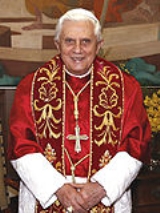
Pope Benedict XVI is the 265th and reigning Pope, by virtue of his office of Bishop of Rome, the spiritual head of the Roman Catholic Church and, as such, Sovereign of the Vatican City State. He was elected on 19 April 2005 in a papal conclave, celebrated his Papal Inauguration Mass on 24 April, 2005, and took possession of his cathedral, the Basilica of St. John Lateran, on 7 May 2005. Pope Benedict XVI has both German and Vatican citizenship. He succeeded Pope John Paul II.
Benedict XVI is a respected Roman Catholic theologian and a prolific bestselling author, a defender of traditional Catholic doctrine and values. He served as a professor at and was a theological consultant at the Second Vatican Council before becoming Archbishop of Munich and Freising and later a cardinal.

Discussion
Ask a question about 'Pope Benedict XVI'
Start a new discussion about 'Pope Benedict XVI'
Answer questions from other users
|
Timeline
|
|
1927 Born
2005 Joseph Ratzinger is elected Pope Benedict XVI on the second day of the Papal conclave.
2005 Pope Benedict XVI leads his first Christmas Midnight Mass as Pope, praying for peace in the Middle East.
|
Quotations
...Men and women were created to be jointly the guarantee of the future of the humanity — not only a physical guarantee, but also a moral one.
Because God loves us, because He wants us to grow into truth, He must necessarily make demands on us and must also correct us
Pray for me, that I may not flee for fear of the wolves.
Inauguration homily, April 24, 2005
In the hour of its greatest success, Europe seems to have become empty inside, paralyzed by a life-threatening crisis to its health and dependent on transplants.
Values in Times of Upheaval, 2005
The fact that the church is convinced of not having the right to confer priestly ordination on women is now considered by some as irreconcilable with the European Constitution.
from Zenit.org, April 11, 2005.
Our Christian conviction is that Christ is also the messiah of Israel. Certainly it is in the hands of God how and when the unification of Jews and Christians into the people of God will take place.
from God and the World, published October 2000, as reported by National Catholic Reporter.

Encyclopedia
Pope Benedict XVI is the 265th and reigning Pope, by virtue of his office of Bishop of Rome, the spiritual head of the Roman Catholic Church and, as such, Sovereign of the Vatican City State. He was elected on 19 April 2005 in a papal conclave, celebrated his Papal Inauguration Mass on 24 April, 2005, and took possession of his cathedral, the Basilica of St. John Lateran, on 7 May 2005. Pope Benedict XVI has both German and Vatican citizenship. He succeeded Pope John Paul II.
Benedict XVI is a respected Roman Catholic theologian and a prolific bestselling author, a defender of traditional Catholic doctrine and values. He served as a professor at and was a theological consultant at the Second Vatican Council before becoming Archbishop of Munich and Freising and later a cardinal. At the time of his election as Pope, Benedict had been Prefect of the Congregation for the Doctrine of the Faith and was Dean of the College of Cardinals.
During his papacy, Benedict XVI has emphasized what he sees as a need for Europe to return to fundamental Christian values in response to increasing de-Christianisation and secularisation in many developed countries. For this reason, he proclaims relativism's denial of objective truth—and more particularly, the denial of moral truths—as the central problem of the 21st century. He teaches the importance for the Catholic Church and for humanity of contemplating God's salvific love and has reaffirmed the "importance of prayer in the face of the activism and the growing secularism of many Christians engaged in charitable work."
Pope Benedict was also the founder and patron of the Ratzinger Foundation, a charitable organisation which makes money from the sale of books and essays written by the Pope, in order to fund scholarships and bursaries for students across the world.
Overview Benedict XVI was elected Pope at the age of 78. He is the oldest person to have been elected Pope since Pope Clement XII (1730–40). He had served longer as a cardinal than any Pope since Benedict XIII (1724–30). He is the ninth German Pope, the eighth having been the Dutch-German Pope Adrian VI (1522–23) from Utrecht. The last Pope named Benedict was Benedict XV, an Italian who reigned from 1914 to 1922, during World War I (1914–18).
Born in 1927 in Marktl am Inn, Bavaria, Germany, Ratzinger had a distinguished career as a university theologian before being appointed Archbishop of Munich and Freising by Pope Paul VI (1963–78). Shortly afterwards, he was made a cardinal in the consistory of June 27, 1977. He was appointed Prefect of the Congregation for the Doctrine of the Faith by Pope John Paul II in 1981 and was also assigned the honorific title of the cardinal bishop of Velletri-Segni on April 5, 1993. In 1998, he was elected sub-dean of the College of Cardinals. And on November 30, 2002, he was elected dean, taking, as is customary, the title of Cardinal bishop of the suburbicarian diocese of Ostia. He was the first Dean of the College elected Pope since Paul IV (1555–59) and the first cardinal bishop elected Pope since Pius VIII (1829–30).
Even before becoming Pope, Ratzinger was one of the most influential men in the Roman Curia, and was a close associate of John Paul II. As Dean of the College of Cardinals, he presided over the funeral of John Paul II and over the Mass immediately preceding the 2005 conclave in which he was elected. During the service, he called on the assembled cardinals to hold fast to the doctrine of the faith. He was the public face of the church in the sede vacante period, although, technically, he ranked below the camerlengo in administrative authority during that time. Like his predecessor, Benedict XVI maintains the traditional Catholic doctrines on artificial birth control, abortion and homosexuality.
As well as his native German, Benedict XVI fluently speaks Italian, French, English and Latin, and has a knowledge of Portuguese. He can read Ancient Greek and biblical Hebrew. He has stated that his first foreign language is French. He is a member of a large number of academies, such as the French Académie des sciences morales et politiques. He plays the piano and has a preference for Mozart and Bach.
Early life (1927–1951)Joseph Alois Ratzinger was born on 16 April, Holy Saturday, 1927 at Schulstraße 11, at 8:30 in the morning in his parents' home in Marktl am Inn, Bavaria, Germany. He was baptized the same day. He was the third and youngest child of Joseph Ratzinger, Sr., a police officer, and Maria Ratzinger (née Peintner). His mother's family was originally from Bolzano-Bozen. Pope Benedict XVI's brother, Georg Ratzinger, a priest and former director of the Regensburger Domspatzen choir, is still alive. His sister, Maria Ratzinger, who never married, managed Cardinal Ratzinger's household until her death in 1991. Their great-uncle was the German politician Georg Ratzinger.
The pope's relatives agree that his priestly vocation was apparent from boyhood. At the age of five, Ratzinger was in a group of children who welcomed the visiting Cardinal Archbishop of Munich with flowers. Struck by the Cardinal's distinctive garb, he later announced the very same day that he wanted to be a cardinal.
Following his fourteenth birthday in 1941, Ratzinger was enrolled in the Hitler Youth — as membership was required for all 14-year old German boys after December 1939 — but was an unenthusiastic member and refused to attend meetings. His father was a bitter enemy of Nazism, believing it conflicted with the Catholic faith, according to biographer John L. Allen, Jr. In 1941, one of Ratzinger's cousins, a 14-year-old boy with Down syndrome, was killed by the Nazi regime in its campaign of eugenics. In 1943 while still in seminary, he was drafted at age 16 into the German anti-aircraft corps. Ratzinger then trained in the German infantry, but a subsequent illness precluded him from the usual rigours of military duty. As the Allied front drew closer to his post in 1945, he deserted back to his family's home in Traunstein after his unit had ceased to exist, just as American troops established their headquarters in the Ratzinger household. As a German soldier, he was put in a POW camp but was released a few months later at the end of the War in summer 1945. He reentered the seminary, along with his brother Georg, in November of that year.
Following repatriation in 1945, the two brothers entered Saint Michael Seminary in Traunstein, later studying at the Ducal Georgianum (Herzogliches Georgianum) of the Ludwig-Maximilian University in Munich. They were both ordained in Freising on June 29, 1951 by Cardinal Michael von Faulhaber of Munich. Joseph Ratzinger's dissertation (1953) was on St. Augustine and was entitled "The People and the House of God in Augustine's Doctrine of the Church". His Habilitation (which qualified him for a professorship) was on Bonaventure. It was completed in 1957 and he became a professor of Freising College in 1958.
Pre-papal career
Academic career (1951–1977) Ratzinger became a professor at the University of Bonn in 1959; his inaugural lecture was on "The God of Faith and the God of Philosophy." In 1963, he moved to the University of Münster, where his inaugural lecture was given in a packed lecture hall, as he was already well known as a theologian.
During this period, Ratzinger participated in the Second Vatican Council (1962–1965). Ratzinger served as a peritus (theological consultant) to Josef Cardinal Frings of Cologne. He was viewed during the time of the Council as a reformer, cooperating with radical Modernist theologians like Hans Küng and Edward Schillebeeckx. Ratzinger became an admirer of Karl Rahner, a well-known academic theologian of the Nouvelle Théologie and a proponent of church reform.
In 1966, Joseph Ratzinger was appointed to a chair in dogmatic theology at the University of Tübingen, where he was a colleague of Hans Küng. In his 1968 book Introduction to Christianity, he wrote that the pope has a duty to hear differing voices within the Church before making a decision, and he downplayed the centrality of the papacy. He also wrote that the Church of the time was too centralized, rule-bound and overly controlled from Rome . During this time, he distanced himself from the atmosphere of Tübingen and the Marxist leanings of the student movement of the 1960s that quickly radicalized, in the years 1967 and 1968, culminating in a series of disturbances and riots in April and May 1968. Ratzinger came increasingly to see these and associated developments (such as decreasing respect for authority among his students) as connected to a departure from traditional Catholic teachings. Despite his reformist bent, his views increasingly came to contrast with the liberal ideas gaining currency in theological circles.
Some voices, among them Hans Küng, deem this a turn towards Conservatism, while Ratzinger himself said in a 1993 interview, "I see no break in my views as a theologian [over the years]". Ratzinger has continued to defend the Council against criticism, including Nostra Aetate, the document on respect of other religions, ecumenism and the declaration of the right to freedom of religion. (Later, as the Prefect for the Congregation for the Doctrine of the Faith, Ratzinger most clearly spelled out the Catholic Church's position on other religions in the 2000 document Dominus Iesus which also talks about the Roman Catholic way to engage in ecumenical dialogue.)
During his years at Tübingen University, Ratzinger publicized articles in the reformist theological journal Concilium, though he increasingly chose less reformist themes than other contributors to the magazine such as Hans Küng and Edward Schillebeeckx.
In 1969, he returned to Bavaria, to the University of Regensburg. He founded the theological journal Communio, with Hans Urs von Balthasar, Henri de Lubac, Walter Kasper and others, in 1972. Communio, now published in seventeen languages, including German, English and Spanish, has become a prominent journal of contemporary Catholic theological thought. Until his election as Pope, he remained one of the journal's most prolific contributors.
Archbishop of Munich and Freising (1977–1982) On March 24, 1977, Ratzinger was appointed Archbishop of Munich and Freising. He took as his episcopal motto Cooperatores Veritatis (Co-workers of the Truth) from 3 John 8, a choice he comments upon in his autobiographical work, Milestones. In the consistory of the following June 27, he was named Cardinal Priest of Santa Maria Consolatrice al Tiburtino by Pope Paul VI. By the time of the 2005 Conclave, he was one of only fourteen remaining cardinals appointed by Paul VI, and one of only three of those under the age of 80. Of these, only he and William Wakefield Baum took part in the conclave.
Prefect of the Congregation for the Doctrine of the Faith (1981–2005) On November 25, 1981, Pope John Paul II named Ratzinger Prefect of the Congregation for the Doctrine of the Faith, formerly known as the Holy Office, the historical Inquisition. Consequently, he resigned his post at Munich in early 1982. He was promoted within the College of Cardinals to become Cardinal Bishop of Velletri-Segni in 1993, was made the College's vice-dean in 1998 and dean in 2002.
In office, Ratzinger fulfilled his institutional role, defending and reaffirming Catholic doctrine, including teaching on topics such as birth control, homosexuality, and inter-religious dialogue. During his period in office, the Congregation for the Doctrine of the Faith took disciplinary measures against some outspoken liberation theologians in Latin America, condemning liberation theology twice (in 1984 and 1986), accusing it of Marxist tendencies and of inciting hate and violence. Leonardo Boff, for example, was suspended, while others were censured. Other issues also prompted condemnations or revocations of rights to teach: for instance, some posthumous writings of Jesuit priest Anthony de Mello were the subject of a notification. Ratzinger and the Congregation viewed many of them, particularly the later works, as having an element of religious indifferentism (i.e., Christ was "one master alongside others").
The Congregation is best known for its authority over the teaching of Church doctrine, but it also has jurisdiction over other matters, including cases involving the seal of the confessional, clerical sexual misconduct and other matters, in its function as what amounts to a court. In his capacity as Prefect, Ratzinger's 2001 letter “Crimen Sollicitationis” which clarified the confidentiality of internal Church investigations into accusations made against priests of certain crimes, including sexual abuse, became a target of controversy during the sex abuse scandal. While bishops hold the secrecy pertained only internally, and did not preclude investigation by civil law enforcement, the letter was often seen as promoting a coverup.
On March 12, 1983 Ratzinger as prefect and cardinal notified the lay faithful and the clergy that archbishop Pierre Martin Ngo Dinh Thuc had incurred the excommunication latae sententiae for illicit episcopal consecrations without the apostolic mandate.
HealthBecause of age-related health problems, and in order to have free time to write, he had hoped to retire, and submitted his resignation three times, but had continued at his post in obedience to the wishes of Pope John Paul II. In September 1991, Ratzinger suffered a hemorrhagic stroke, which slightly impaired his eyesight temporarily. This was known to the Conclave that elected him Pope. In August 1992, on a vacation in the Alps, he fell and struck his head against a radiator. In May 2005, the Vatican revealed that he had subsequently suffered another mild stroke; it did not reveal when, other than that it had occurred between 2003 and 2005. France's Philippe Cardinal Barbarin further revealed that since the first stroke, Ratzinger had been suffering from a heart condition as a result of his age, and is currently on medication. It is also notable that he appears to be in far better health than his predecessor was at the age of 79. In late November 2006, an unconfirmed rumor emerged that Pope Benedict had undergone an operation in preparation for an eventual bypass operation, and that the bronchitis suffered by the Pope has put undue pressure on the Pope's heart.
At World Youth Day 2008, he impressed many by his youthful energy, such as walking down stairs and standing for long periods.
Papacy
Election to the papacy
PredictionOn January 2, 2005, Time magazine quoted unnamed Vatican sources as saying that Ratzinger was a front runner to succeed John Paul II should the pope die or become too ill to continue as pope. On the death of John Paul II, the Financial Times gave the odds of Ratzinger becoming pope as 7–1, the lead position, but close to his rivals on the liberal wing of the church. In April 2005, before his election as pope, he was identified as one of the 100 most influential people in the world by Time magazine. While Prefect of the Congregation for the Doctrine of the Faith, Ratzinger repeatedly stated he would like to retire to his house in the Bavarian village of Pentling near Regensburg and dedicate himself to writing books.
Piers Paul Read wrote in The Spectator on March 5, 2005:
Though Ratzinger was increasingly considered the front runner by much of the international media, others maintained that his election was far from certain since very few papal predictions in modern history had come true. The elections of both John Paul II and his predecessor, John Paul I had been rather unexpected. Despite being the favorite (or perhaps because he was the favorite), it was a surprise to many that he was actually elected, as traditionally the frontrunners are passed over by the conclave for someone else.
Election On April 19, 2005, Cardinal Ratzinger was elected as the successor to Pope John Paul II on the second day of the papal conclave after four ballots. Cardinal Ratzinger had hoped to retire peacefully and said that "At a certain point, I prayed to God 'please don't do this to me'...Evidently, this time He didn't listen to me." Coincidentally, April 19 is the feast of St. Leo IX, the most important German pope of the Middle Ages, known for instituting major reforms during his pontificate.
Before his first appearance at the balcony of Saint Peter's Basilica after becoming pope, he was announced by Jorge Medina Estévez, protodeacon of the College of Cardinals. Cardinal Medina Estévez first addressed the massive crowd as "dear(est) brothers and sisters" in Italian, Spanish, French, German and English, with each language receiving cheers from the international crowd, before continuing with the traditional Habemus Papam announcement in Latin.
At the balcony, Benedict's first words to the crowd, given in Italian before he gave the traditional Urbi et Orbi blessing in Latin, were:
On April 24, he celebrated the Papal Inauguration Mass in St. Peter's Square, during which he was invested with the Pallium and the Ring of the Fisherman. Then, on May 7, he took possession of his Cathedral church, the Archbasilica of St. John Lateran.
Choice of nameRatzinger chose the pontifical name Benedict, which in Latin means "the blessed", in honor of both Pope Benedict XV and Saint Benedict of Nursia. Pope Benedict XV was Pope during the first World War, during which time he passionately pursued peace between the warring nations. St. Benedict of Nursia was the founder of the Benedictine monasteries (most monasteries of the Middle Ages were of the Benedictine Order) and the author of the Rule of Saint Benedict, which is still the most influential writing regarding the monastic life of Western Christianity.
Benedict XVI explained his choice of name during his first General Audience in St. Peter's Square, on April 27, 2005:
Tone of papacy
During his inaugural Mass, the previous custom of every cardinal submitting to the Pope was replaced by having twelve people, including cardinals, clergy, religious, a married couple and their child, and newly confirmed people, greet him. (The cardinals had formally sworn their obedience upon his election.) He has begun using an open-topped papal car, saying that he wanted to be closer to the people. Pope Benedict has continued the tradition of his predecessor John Paul II and baptizes several infants in the Sistine Chapel at the beginning of every year, in his pastoral role as Bishop of Rome.
Benedict's coat of arms has omitted the papal tiara, which traditionally appears in the background to designate the Pope's position as a worldly ruler like a king, replacing it with a simple mitre, emphasizing his spiritual authority. Although some papal documents since his inauguration appear to include the papal tiara, this is because the arms of the Holy See itself (as opposed to his personal arms) continue to use the tiara and crossed keys, as can be observed, for example, on the website of the Holy See and other official publications. Because it is the shield alone (regardless of its background elements) which is unique to the individual Pope, varying backgrounds are possible for a single shield, though this is rarely done. Pope Benedict XVI also included a traditional pallium beneath his shield as a background element for his arms, emphasizing his pastoral powers.
BeatificationsOn May 9, 2005, Benedict XVI began the beatification process for his predecessor, Pope John Paul II. Normally, five years must pass after a person's death before the beatification process can begin. However, in an audience with Pope Benedict, Camillo Ruini, Vicar General of the Diocese of Rome and the official responsible for promoting the cause for canonization of any person who dies within that diocese, cited "exceptional circumstances" which suggested that the waiting period could be waived. This happened before, when Pope Paul VI waived the five year rule and announced beatification processes for his predecessors, Pope Pius XII and Pope John XXIII. Benedict XVI followed this precedent when he waived the five year rule for John Paul II. The decision was announced on May 13, 2005, the Feast of Our Lady of Fatima and the 24th anniversary of the attempt on John Paul II's life. John Paul II often credited Our Lady of Fatima for preserving him on that day. Cardinal Ruini inaugurated the diocesan phase of the cause for beatification in the Lateran Basilica on June 28, 2005.
The first beatification under the new Pope was celebrated on May 14, 2005, by José Cardinal Saraiva Martins. The new Blesseds were Mother Marianne Cope and Mother Ascensión Nicol Gońi. Cardinal Clemens August Graf von Galen was beatified on October 9, 2005. Mariano de la Mata was beatified in November 2006 and Rosa Eluvathingal was beatified December 3 of that year, and Fr. Basil Moreau is scheduled to be beatified by next year. In October 2008 the following beatifications will take place: Celestine of the Mother of God, Giuseppina Nicoli, Hendrina Stenmanns, Maria Rosa Flesch, Marta Anna Wiecka, Michal Sopocko, Petrus Kibe Kasui and 187 Companions, Susana Paz-Castillo Ramirez.
Unlike his predecessor, Benedict XVI delegated the beatification liturgical service to a Cardinal. On September 29, 2005, the Congregation for the Causes of Saints issued a communiqué announcing that henceforth beatifications would be celebrated by a representative of the Pope, usually the Prefect of that Congregation.
Canonizations Pope Benedict XVI celebrated his first canonizations on October 23, 2005 in St. Peter's Square when he canonized Josef Bilczewski, Alberto Hurtado SJ, Zygmunt Gorazdowski, Gaetano Catanoso, and Felice da Nicosia. The canonizations were part of a Mass that marked the conclusion of the Synod of Bishops and the Year of the Eucharist. Pope Benedict XVI canonized Bishop Rafael Guizar y Valencia, Mother Theodore Guerin, Filippo Smaldone, and Rosa Venerini on October 15, 2006.
During his visit to Brazil in 2007, Pope Benedict XVI presided over the canonization of Frei Galvăo on May 11, while George Preca, founder of the Malta based MUSEUM, Szymon of Lipnica, Charles of Mount Argus, and Marie-Eugénie de Jésus were canonized in a ceremony held at the Vatican on June 3 2007. Preca is the first Maltese saint since the country's conversion to Christianity in A.D. 60 when St. Paul converted the inhabitants. In October 2008 the following canonizations will take place: Saint Alphonsa of India, Gaetano Errico, Narcisa de Jesus Martillo Moran, María Bernarda Bütler
Curia reformPope Benedict began downsizing the Roman Curia when he merged four existing pontifical councils into two in March 2006. The Pontifical Council for Migrants was merged with the Pontifical Council for Justice and Peace headed by Cardinal Martino. Likewise, Cardinal Poupard, who headed the Pontifical Council for Culture, now also oversees the operations of what had been the Pontifical Council for Interreligious Dialogue, though both Councils maintained separate officials and staffs while their status and competencies continued unchanged. In May 2007 it was decided that Interreligious Dialogue would again become a separate body under a different President.
Teachings As Pope, Benedict XVI's main role is to teach about the Catholic faith and the solutions to the problems of discerning and living the faith, a role that he can play well as a former head of the Church's Congregation for the Doctrine of the Faith. The main points of emphasis of his teachings are stated in more detail in Theology of Pope Benedict XVI.
"Friendship with Jesus Christ" According to commentators, during the Inaugural Mass, the core of the Pope's message, the most moving and famous part, is found in the last paragraph of his homily where he referred to both Jesus Christ and John Paul II. After referring to John Paul II's well-known words, "Do not be afraid! Open wide the doors for Christ!", Benedict XVI said:
"Friendship with Jesus Christ" is a frequent theme of his preaching. He stressed that on this intimate friendship, "everything depends." He has also said: "We are all called to open ourselves to this friendship with God... speaking to him as to a friend, the only One who can make the world both good and happy... That is all we have to do is put ourselves at his disposal...is an extremely important message. It is a message that helps to overcome what can be considered the great temptation of our time: the claim, that after the Big Bang, God withdrew from history." Thus, in his book Jesus of Nazareth, his main purpose was "to help foster [in the reader] the growth of a living relationship" with Jesus Christ.
He took up this theme in his first encyclical Deus Caritas Est. In his personal explanation and summary of the encyclical, he stated: "If friendship with God becomes for us something ever more important and decisive, then we will begin to love those whom God loves and who are in need of us. God wants us to be friends of his friends and we can be so, if we are interiorly close to them." Thus, he said that prayer |