
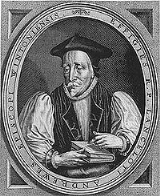
Lancelot Andrewes was an English bishop and scholar, who held high positions in the
Church of EnglandThe Church of England is the officially established Christian church in England and the Mother Church of the worldwide Anglican Communion. The church considers itself within the tradition of Western Christianity and dates its formal establishment principally to the mission to England by St...
during the reigns of
Queen Elizabeth IElizabeth I was queen regnant of England and Ireland from 17 November 1558 until her death. Sometimes called The Virgin Queen, Gloriana, or Good Queen Bess, Elizabeth was the fifth and last monarch of the Tudor dynasty...
and
King James IJames VI and I was King of Scots as James VI from 24 July 1567 and King of England and Ireland as James I from the union of the English and Scottish crowns on 24 March 1603...
. During the latter's reign, Andrewes served successively as
Bishop of ChichesterThe Bishop of Chichester is the Ordinary of the Church of England Diocese of Chichester in the Province of Canterbury. The diocese covers the Counties of East and West Sussex. The see is in the City of Chichester where the seat is located at the Cathedral Church of the Holy Trinity...
,
ElyThe Bishop of Ely is the Ordinary of the Church of England Diocese of Ely in the Province of Canterbury. The diocese roughly covers the county of Cambridgeshire , together with a section of north-west Norfolk and has its see in the City of Ely, Cambridgeshire, where the seat is located at the...
and
WinchesterThe Bishop of Winchester is the head of the Church of England diocese of Winchester, with his cathedra at Winchester Cathedral in Hampshire.The bishop is one of five Church of England bishops to be among the Lords Spiritual regardless of their length of service. His diocese is one of the oldest and...
and oversaw the translation of the
Authorized VersionThe Authorized Version, commonly known as the King James Version, King James Bible or KJV, is an English translation of the Christian Bible by the Church of England begun in 1604 and completed in 1611...
(or
King James Version) of the
BibleThe Bible refers to any one of the collections of the primary religious texts of Judaism and Christianity. There is no common version of the Bible, as the individual books , their contents and their order vary among denominations...
. In the Church of England he is commemorated on 25 September with a
Lesser FestivalLesser Festivals are a type of observance in the Church of England, considered to be less significant than a Principal Feast, Principal Holy Day, or Festival, but more significant than a Commemoration. Whereas Principal Feasts must be celebrated, it is not obligatory to observe Lesser Festivals...
.
Early life, education and ordination
Andrewes was born in 1555 in
BarkingBarking is a suburban town in the London Borough of Barking and Dagenham, in East London, England. A retail and commercial centre situated in the west of the borough, it lies east of Charing Cross. Barking was in the historic county of Essex until it was absorbed by Greater London. The area is...
,
EssexEssex is a ceremonial and non-metropolitan county in the East region of England, and one of the home counties. It is located to the northeast of Greater London. It borders with Cambridgeshire and Suffolk to the north, Hertfordshire to the west, Kent to the South and London to the south west...
(now
Greater LondonGreater London is the top-level administrative division of England covering London. It was created in 1965 and spans the City of London, including Middle Temple and Inner Temple, and the 32 London boroughs. This territory is coterminate with the London Government Office Region and the London...
), of an ancient
SuffolkSuffolk is a non-metropolitan county of historic origin in East Anglia, England. It has borders with Norfolk to the north, Cambridgeshire to the west and Essex to the south. The North Sea lies to the east...
family later domiciled at Chichester Hall,
RawrethRawreth is situated between Wickford and Rayleigh.The area is mainly agricultural, sparsely populated and with a small amount of industry.Historically, most of the farmhouses in Rawreth were moated manors, many of which survive today....
; his father, Thomas, was master of
Trinity HouseThe Corporation of Trinity House of Deptford Strond is the official General Lighthouse Authority for England, Wales and other British territorial waters...
. Andrewes attended the Cooper's free school, Ratcliff, in the parish of
StepneyStepney was an ancient civil and ecclesiastical parish in the historic county of Middlesex to the east and north east of the City of London, England.-Origins:...
and then the
Merchant Taylors' SchoolMerchant Taylors' School is a British independent day school for boys, originally located in the City of London. Since 1933 it has been located at Sandy Lodge in the Three Rivers district of Hertfordshire ....
under
Richard MulcasterRichard Mulcaster , is known best for his headmasterships and pedagogic writings. He is often regarded as the founder of English language lexicography.-Educational achievements:...
. In 1571 he entered
Pembroke HallPembroke College is a constituent college of the University of Cambridge, England.The college has over seven hundred students and fellows, and is the third oldest college of the university. Physically, it is one of the university's larger colleges, with buildings from almost every century since its...
,
CambridgeThe city of Cambridge is a university town and the administrative centre of the county of Cambridgeshire, England. It lies in East Anglia about north of London. Cambridge is at the heart of the high-technology centre known as Silicon Fen – a play on Silicon Valley and the fens surrounding the...
and graduated with a
Bachelor of ArtsA Bachelor of Arts , from the Latin artium baccalaureus, is a bachelor's degree awarded for an undergraduate course or program in either the liberal arts, the sciences, or both...
degree, proceeding to a Master of Arts degree in 1578. His academic reputation spread so quickly that on the foundation in 1571 of
Jesus College, OxfordJesus College is one of the colleges of the University of Oxford in England. It is in the centre of the city, on a site between Turl Street, Ship Street, Cornmarket Street and Market Street...
he was named in the charter as
one of the founding scholars "without his privity" (Isaacson, 1650); his connection with the college seems to have been purely notional, however. In 1576 he was elected fellow of
Pembroke CollegePembroke College is a constituent college of the University of Cambridge, England.The college has over seven hundred students and fellows, and is the third oldest college of the university. Physically, it is one of the university's larger colleges, with buildings from almost every century since its...
, Cambridge; in 1580 he took
ordersThe term Holy Orders is used by many Christian churches to refer to ordination or to those individuals ordained for a special role or ministry....
and in 1581 was incorporated MA at Oxford. As catechist at his college he read lectures on the
DecalogueThe Ten Commandments, also known as the Decalogue , are a set of biblical principles relating to ethics and worship, which play a fundamental role in Judaism and most forms of Christianity. They include instructions to worship only God and to keep the Sabbath, and prohibitions against idolatry,...
(published in 1630), which aroused great interest.
Andrewes was the brother of the scholar and cleric
Roger AndrewesDr Roger Andrewes was an English churchman and academic, archdeacon and Chancellor at Chichester Cathedral in the English Church...
who also served as a translator for the
King James Version of the BibleThe Authorized Version, commonly known as the King James Version, King James Bible or KJV, is an English translation of the Christian Bible by the Church of England begun in 1604 and completed in 1611...
.
During Elizabeth's reign
After a period as chaplain to
Henry Hastings, Earl of HuntingdonSir Henry Hastings, 3rd Earl of Huntingdon, KG KB was the eldest son of Francis Hastings, 2nd Earl of Huntingdon and Catherine Pole.-Ancestry:...
, President of the North, he became vicar of St Giles's, Cripplegate in 1588 and there delivered striking sermons on the temptation in the wilderness and the
Lord's PrayerThe Lord's Prayer is a central prayer in Christianity. In the New Testament of the Christian Bible, it appears in two forms: in the Gospel of Matthew as part of the discourse on ostentation in the Sermon on the Mount, and in the Gospel of Luke, which records Jesus being approached by "one of his...
. In a great sermon (during
Easter weekThe term Octave of Easter may refer either to the eight day period from Easter Sunday until the Sunday following Easter, inclusive; or it may refer only to that Sunday after Easter, the Octave Day of Easter . That Sunday is also known historically as St...
) on 10 April 1588, he stoutly vindicated the
ReformedThe English Reformation was the series of events in 16th-century England by which the Church of England broke away from the authority of the Pope and the Roman Catholic Church....
character of the Church of England against the claims of Roman Catholicism and adduced
John CalvinJohn Calvin was an influential French theologian and pastor during the Protestant Reformation. He was a principal figure in the development of the system of Christian theology later called Calvinism. Originally trained as a humanist lawyer, he broke from the Roman Catholic Church around 1530...
as a new writer, with lavish praise and affection.
Through the influence of
Francis WalsinghamSir Francis Walsingham was Principal Secretary to Elizabeth I of England from 1573 until 1590, and is popularly remembered as her "spymaster". Walsingham is frequently cited as one of the earliest practitioners of modern intelligence methods both for espionage and for domestic security...
, Andrewes was appointed prebendary of St Pancras in
St Paul'sSt Paul's Cathedral, London, is a Church of England cathedral and seat of the Bishop of London. Its dedication to Paul the Apostle dates back to the original church on this site, founded in AD 604. St Paul's sits at the top of Ludgate Hill, the highest point in the City of London, and is the mother...
, London, in 1589, and subsequently became Master of his own college of Pembroke, as well as a chaplain of Archbishop
John WhitgiftJohn Whitgift was the Archbishop of Canterbury from 1583 to his death. Noted for his hospitality, he was somewhat ostentatious in his habits, sometimes visiting Canterbury and other towns attended by a retinue of 800 horsemen...
. From 1589 to 1609 he was prebendary of
SouthwellSouthwell Minster is a minster and cathedral, in Southwell, Nottinghamshire, England. It is six miles away from Newark-on-Trent and thirteen miles from Mansfield. It is the seat of the Bishop of Southwell and Nottingham and the Diocese of Southwell and Nottingham.It is considered an outstanding...
. On 4 March 1590, as a chaplain of Queen Elizabeth I, he preached before her an outspoken sermon and, in October that year, gave his introductory lecture at St Paul's, undertaking to comment on the first four chapters of the Book of Genesis. These were later compiled as
The Orphan Lectures (1657).
Andrewes liked to move among the people, yet found time to join a society of antiquaries, of which
Walter RaleighSir Walter Raleigh was an English aristocrat, writer, poet, soldier, courtier, spy, and explorer. He is also well known for popularising tobacco in England....
, Sir Philip Sidney, Burleigh, Arundel, the Herberts, Saville, Stow and Camden were members. Queen Elizabeth had not advanced him further on account of his opposition to the alienation of ecclesiastical revenues. In 1598 he declined the bishoprics of
ElyEly is a cathedral city in Cambridgeshire, England, 14 miles north-northeast of Cambridge and about by road from London. It is built on a Lower Greensand island, which at a maximum elevation of is the highest land in the Fens...
and Salisbury, because of the conditions attached. On 23 November 1600, he preached at
WhitehallWhitehall is a road in Westminster, in London, England. It is the main artery running north from Parliament Square, towards Charing Cross at the southern end of Trafalgar Square...
a controversial sermon on justification. In 1601 he was appointed
deanA dean, in a church context, is a cleric holding certain positions of authority within a religious hierarchy. The title is used mainly in the Anglican Communion and the Roman Catholic Church.-Anglican Communion:...
of
WestminsterThe Collegiate Church of St Peter at Westminster, popularly known as Westminster Abbey, is a large, mainly Gothic church, in the City of Westminster, London, United Kingdom, located just to the west of the Palace of Westminster. It is the traditional place of coronation and burial site for English,...
and gave much attention to the school there.
During James I's reign
On the accession of
James IJames VI and I was King of Scots as James VI from 24 July 1567 and King of England and Ireland as James I from the union of the English and Scottish crowns on 24 March 1603...
, to whom his somewhat pedantic style of preaching recommended him, Andrewes rose into great favour. He assisted at James's
coronationA coronation is a ceremony marking the formal investiture of a monarch and/or their consort with regal power, usually involving the placement of a crown upon their head and the presentation of other items of regalia...
, and in 1604 took part in the Hampton Court conference.
Andrewes' name is the first on the list of divines appointed to compile the
Authorized Version of the Bible. He headed the "First Westminster Company" which took charge of the first books of the
Old TestamentThe Old Testament, of which Christians hold different views, is a Christian term for the religious writings of ancient Israel held sacred and inspired by Christians which overlaps with the 24-book canon of the Masoretic Text of Judaism...
(Genesis to
2 KingsThe Book of Kings presents a narrative history of ancient Israel and Judah from the death of David to the release of his successor Jehoiachin from imprisonment in Babylon, a period of some 400 years...
). He acted, furthermore, as a sort of general editor for the project as well.
In 1605 he was consecrated
Bishop of ChichesterThe Bishop of Chichester is the Ordinary of the Church of England Diocese of Chichester in the Province of Canterbury. The diocese covers the Counties of East and West Sussex. The see is in the City of Chichester where the seat is located at the Cathedral Church of the Holy Trinity...
and made Lord High Almoner. Following the discovery of the
Gunpowder PlotThe Gunpowder Plot of 1605, in earlier centuries often called the Gunpowder Treason Plot or the Jesuit Treason, was a failed assassination attempt against King James I of England and VI of Scotland by a group of provincial English Catholics led by Robert Catesby.The plan was to blow up the House of...
Andrewes was asked to prepare a sermon to be presented to the king in 1606 (Sermons Preached upon the V of November, in Lancelot Andrewes, XCVI Sermons, 3rd. Edition (London,1635) pp. 889,890, 900-1008 ). In this sermon Lancelot Andrewes justified the need to commemorate the deliverance and defined the nature of celebrations. This sermon became the foundation of celebrations which continue 400 years later. In 1609 he published
Tortura Torti, a learned work which grew out of the Gunpowder Plot controversy and was written in answer to
BellarmineRobert Bellarmine was an Italian Jesuit and a Cardinal of the Catholic Church. He was one of the most important figures in the Counter-Reformation...
's
Matthaeus Tortus, which attacked James I's book on the
oath of allegianceThe Oath of Allegiance of 1606 was an oath required of subjects of James I of England from 1606, the year after the Gunpowder Plot of 1605 ; it was also called the Oath of Obedience . Whatever effect it had on the loyalty of his subjects, it caused an international controversy lasting a...
. After moving to Ely (1609), he again controverted Bellarmine in the
Responsio ad Apologiam.
In 1617 he accompanied James I to
ScotlandScotland is a country that is part of the United Kingdom. Occupying the northern third of the island of Great Britain, it shares a border with England to the south and is bounded by the North Sea to the east, the Atlantic Ocean to the north and west, and the North Channel and Irish Sea to the...
with a view to persuading the Scots that Episcopacy was preferable to Presbyterianism. He was made dean of the
Chapel RoyalA Chapel Royal is a body of priests and singers who serve the spiritual needs of their sovereign wherever they are called upon to do so.-Austria:...
and translated to
WinchesterThe Bishop of Winchester is the head of the Church of England diocese of Winchester, with his cathedra at Winchester Cathedral in Hampshire.The bishop is one of five Church of England bishops to be among the Lords Spiritual regardless of their length of service. His diocese is one of the oldest and...
, a
dioceseA diocese is the district or see under the supervision of a bishop. It is divided into parishes.An archdiocese is more significant than a diocese. An archdiocese is presided over by an archbishop whose see may have or had importance due to size or historical significance...
that he administered with great success. Following his death in 1626 in
SouthwarkSouthwark is a district of south London, England, and the administrative headquarters of the London Borough of Southwark. Situated east of Charing Cross, it forms one of the oldest parts of London and fronts the River Thames to the north...
, he was mourned alike by leaders in Church and state, and buried by the high altar in St Mary Overie (now
Southwark CathedralSouthwark Cathedral or The Cathedral and Collegiate Church of St Saviour and St Mary Overie, Southwark, London, lies on the south bank of the River Thames close to London Bridge....
, then in the
Diocese of WinchesterThe Diocese of Winchester forms part of the Province of Canterbury of the Church of England.Founded in 676, it is one of the oldest and largest of the dioceses in England.The area of the diocese incorporates:...
).
Legacy
Two generations later,
Richard CrashawRichard Crashaw , English poet, styled "the divine," was part of the Seventeenth-century Metaphysical School of poets.-Life:...
caught up the universal sentiment, when in his lines "Upon Bishop Andrewes' Picture before his Sermons" he exclaims:
This reverend shadow cast that setting sun,
Whose glorious course through our horizon run,
Left the dim face of this dull hemisphere,
All one great eye, all drown'd in one great teare.
Andrewes was a friend of Hugo Grotius, and one of the foremost contemporary scholars, but is chiefly remembered for his style of preaching. As a churchman he was typically Anglican, equally removed from the
PuritanThe Puritans were a significant grouping of English Protestants in the 16th and 17th centuries. Puritanism in this sense was founded by some Marian exiles from the clergy shortly after the accession of Elizabeth I of England in 1558, as an activist movement within the Church of England...
and the Roman positions. A good summary of his position is found in his
First Answer to Cardinal Perron, who had challenged James I's use of the title "
CatholicThe word catholic comes from the Greek phrase , meaning "on the whole," "according to the whole" or "in general", and is a combination of the Greek words meaning "about" and meaning "whole"...
". His position in regard to the
EucharistThe Eucharist , also called Holy Communion, the Sacrament of the Altar, the Blessed Sacrament, the Lord's Supper, and other names, is a Christian sacrament or ordinance...
is naturally more mature than that of the first reformers.
As to the Real Presence we are agreed; our controversy is as to the mode of it. As to the mode we define nothing rashly, nor anxiously investigate, any more than in the Incarnation of Christ we ask how the human is united to the divine nature in One Person. There is a real change in the elements—we allow ut panis iam consecratus non sit panis quem natura formavit; sed, quem benedictio consecravit, et consecrando etiam immutavit. (Responsio, p. 263).
Adoration is permitted, and the use of the terms "sacrifice" and "altar" maintained as being consonant with scripture and antiquity. Christ is "a sacrifice—so, to be slain; a propitiatory sacrifice—so, to be eaten." (Sermons, vol. ii. p. 296).
By the same rules that the Passover was, by the same may ours be termed a sacrifice. In rigour of speech, neither of them; for to speak after the exact manner of divinity, there is but one only sacrifice, veri nominis, that is Christ's death. And that sacrifice but once actually performed at His death, but ever before represented in figure, from the beginning; and ever since repeated in memory to the world's end. That only absolute, all else relative to it, representative of it, operative by it ... Hence it is that what names theirs carried, ours do the like, and the Fathers make no scruple at it—no more need we.(Sermons, vol. ii. p. 300).
Andrewes preached regularly and submissively before King James and his court on the anniversaries of the Gowrie Conspiracy and the Gunpowder Plot. These sermons were used to promulgate the doctrine of the
Divine Right of KingsThe divine right of kings or divine-right theory of kingship is a political and religious doctrine of royal and political legitimacy. It asserts that a monarch is subject to no earthly authority, deriving his right to rule directly from the will of God...
.
His
Life was written by
WhyteAlexander Whyte was a Scottish divine. He was born at Kirriemuir in Forfarshire and educated at the University of Aberdeen and at New College, Edinburgh....
(Edinburgh, 1896), M. Wood (New York, 1898), and
OttleyRobert Lawrence Ottley was an English theologian.-Life:He was the son of Lawrence Ottley, canon of Ripon. He was born in Richmond, Yorkshire, and was educated at King's School, Canterbury, and at Pembroke College, Oxford, in 1881, of which he became honorary fellow in 1905...
(Boston, 1894). His services to his church have been summed up thus: (1) he has a keen sense of the proportion of the faith and maintains a clear distinction between what is fundamental, needing ecclesiastical commands, and subsidiary, needing only ecclesiastical guidance and suggestion; (2) as distinguished from the earlier protesting standpoint, e.g. of the
Thirty-nine ArticlesThe Thirty-Nine Articles of Religion are the historically defining statements of doctrines of the Anglican church with respect to the controversies of the English Reformation. First established in 1563, the articles served to define the doctrine of the nascent Church of England as it related to...
, he emphasized a positive and constructive statement of the Anglican position.
His best-known work is the
Manual of Private Devotions, edited by
Alexander WhyteAlexander Whyte was a Scottish divine. He was born at Kirriemuir in Forfarshire and educated at the University of Aberdeen and at New College, Edinburgh....
(1900), which has widespread appeal. Andrewes's other works occupy eight volumes in the
Library of Anglo-Catholic TheologyThe Library of Anglo-Catholic Theology was a series of 19th-century editions of theological works by Church of England writers, devoted as the title suggests to significant Anglo-Catholic figures...
(1841–1854). Ninety-six of his sermons were published in 1631 by command of
King Charles ICharles I was King of England, King of Scotland, and King of Ireland from 27 March 1625 until his execution in 1649. Charles engaged in a struggle for power with the Parliament of England, attempting to obtain royal revenue whilst Parliament sought to curb his Royal prerogative which Charles...
.
Andrewes was considered, next to
UssherJames Ussher was Church of Ireland Archbishop of Armagh and Primate of All Ireland between 1625–56...
, to be the most learned churchman of his day, and enjoyed a great reputation as an eloquent and impassioned preacher, but the stiffness and artificiality of his style render his sermons unsuited to modern taste. Nevertheless, there are passages of extraordinary beauty and profundity. His doctrine was
High ChurchThe term "High Church" refers to beliefs and practices of ecclesiology, liturgy and theology, generally with an emphasis on formality, and resistance to "modernization." Although used in connection with various Christian traditions, the term has traditionally been principally associated with the...
, and in his life he was humble, pious, and charitable. He continues to influence religious thinkers to the present day, and was cited as an influence by
T. S. EliotThomas Stearns "T. S." Eliot OM was a playwright, literary critic, and arguably the most important English-language poet of the 20th century. Although he was born an American he moved to the United Kingdom in 1914 and was naturalised as a British subject in 1927 at age 39.The poem that made his...
, among others (Eliot also borrowed, almost word for word and without his usual acknowledgement, the opening of Andrewes' 1622 Christmas Day sermon for 'The Journey of the Magi'). In his 1997 novel Timequake, Kurt Vonnegut suggested that Andrewes was "the greatest writer in the English language," citing as proof the first few verses of the 23rd Psalm. His translation work has also led him to appear as a character in three plays dealing with the King James Bible, Howard Brenton's
Anne BoleynAnne Boleyn is a 2010 play on the life of Anne Boleyn by the English author Howard Brenton, which premiered at the Shakespeare's Globe from 24 July to 21 August 2010 in a production directed by John Dove and with the title role played by Miranda Raison...
(2010), Jonathan Holmes'
Into Thy HandsInto Thy Hands is a 2011 play by Jonathan Holmes on the life of John Donne and in particular his actions during 1611 and his relationships with those involved in translating the King James Version...
(2011) and David Edgar's
Written on the HeartWritten on the Heart is a 2011 play by the British playwright David Edgar. It is to be premiered by the Royal Shakespeare Company at the Swan Theatre from 27 October 2011 to 10 March 2012, to mark the four-hundredth anniversary of the King James Bible - it draws its title from the translation of...
(2011).
He has an academic cap named after him, known as the
Bishop Andrewes capThe Bishop Andrewes cap is a recent reinvention of the ancient style of academic cap as part of academic dress before it developed into the modern mortarboard as it is known today . The cap is named after Bishop Andrewes who may have not have worn this style of cap at all.The cap is similar to the...
, which is like a mortarboard but made of velvet, floppy and has a tump or tuff instead of a tassel. This was in fact the ancient version of the mortarboard before the top square was stiffened and the tump replaced by a tassel and button. This cap is still used by Cambridge DDs and at certain institutions as part of their
academic dressAcademic dress or academical dress is a traditional form of clothing for academic settings, primarily tertiary education, worn mainly by those that have been admitted to a university degree or hold a status that entitles them to assume them...
.
External links