
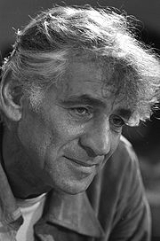
Leonard Bernstein was an American conductor, composer, author, music
lecturerLecturer is an academic rank. In the United Kingdom, lecturer is a position at a university or similar institution, often held by academics in their early career stages, who lead research groups and supervise research students, as well as teach...
and pianist. He was among the first conductors born and educated in the United States of America to receive worldwide acclaim. According to
The New York TimesThe New York Times is an American daily newspaper founded and continuously published in New York City since 1851. The New York Times has won 106 Pulitzer Prizes, the most of any news organization...
, he was "one of the most prodigiously talented and successful musicians in American history."
His fame derived from his long tenure as the music director of the
New York PhilharmonicThe New York Philharmonic is a symphony orchestra based in New York City in the United States. It is one of the American orchestras commonly referred to as the "Big Five"...
, from his conducting of concerts with most of the world's leading orchestras, and from his music for
West Side StoryWest Side Story is an American musical with a script by Arthur Laurents, music by Leonard Bernstein, lyrics by Stephen Sondheim, and choreographed by Jerome Robbins...
, as well as
CandideCandide is an operetta with music composed by Leonard Bernstein, based on the novella of the same name by Voltaire. The operetta was first performed in 1956 with a libretto by Lillian Hellman; but since 1974 it has been generally performed with a book by Hugh Wheeler which is more faithful to...
,
Wonderful TownWonderful Town is a musical with a book written by Joseph A. Fields and Jerome Chodorov, lyrics by Betty Comden and Adolph Green and music by Leonard Bernstein...
, On the Town and his own
MassMASS is a musical theatre work composed by Leonard Bernstein with text by Bernstein and additional text and lyrics by Stephen Schwartz. Commissioned by Jacqueline Kennedy, it premiered on September 8, 1971, conducted by Maurice Peress. The performance was part of the opening of the John F...
.
Bernstein was also the first conductor to give numerous television lectures on classical music, starting in 1954, continuing until his death. In addition, he was a skilled pianist, often conducting piano concertos from the keyboard.
As a composer he was prolific, writing symphonies, ballet music, operas, chamber music, pieces for the piano, other orchestral and choral works, and other concert and incidental music, but the tremendous success of
West Side StoryWest Side Story is an American musical with a script by Arthur Laurents, music by Leonard Bernstein, lyrics by Stephen Sondheim, and choreographed by Jerome Robbins...
remained unequaled by his other compositions.
Early life
He was born
Louis Bernstein in
Lawrence, MassachusettsLawrence is a city in Essex County, Massachusetts, United States on the Merrimack River. According to the 2010 U.S. Census, the city had a total population of 76,377. Surrounding communities include Methuen to the north, Andover to the southwest, and North Andover to the southeast. It and Salem are...
, the son of Ukrainian Jewish parents Jennie (née Resnick) and Samuel Joseph Bernstein, a hair-dressing supplies wholesaler originating from Rovno (now
UkraineUkraine is a country in Eastern Europe. It has an area of 603,628 km², making it the second largest contiguous country on the European continent, after Russia...
). Despite his surname he was not related to film composer
Elmer BernsteinElmer Bernstein was an American composer and conductor best known for his many film scores. In a career which spanned fifty years, he composed music for hundreds of film and television productions...
, but the two men were friends, and even shared a certain physical similarity. Within the world of professional music, they were distinguished from each other by the use of the nicknames Bernstein West (Elmer) and Bernstein East (Leonard).
His family spent their summers at their vacation home in Sharon, Massachusetts. His grandmother insisted that his first name be Louis, but his parents always called him
LeonardLeonard is a common English language masculine given name and a surname.The given name and surname originate from the Old High German Leonhard containing the prefix levon and the suffix hardu . The name has come to mean "lion strength", "lion-strong", or "lion-hearted". It may also be from the ...
, which they preferred. He officially changed his name to Leonard when he was fifteen, shortly after his grandmother's death. To his friends and many others he was simply known as "Lenny."
His father, Sam Bernstein, was a businessman and owner of a bookstore in downtown Lawrence; it is standing today on the corners of Amesbury and Essex Streets. Sam initially opposed young Leonard's interest in music. Despite this, the elder Bernstein took him to orchestra concerts in his teenage years and eventually supported his music education. At a very young age, Bernstein listened to a piano performance and was immediately captivated; he subsequently began learning the piano seriously when the family acquired his cousin Lillian Goldman's unwanted piano. As a child, Bernstein attended the Garrison Grammar School and
Boston Latin SchoolThe Boston Latin School is a public exam school founded on April 23, 1635, in Boston, Massachusetts. It is both the first public school and oldest existing school in the United States....
. As a child he was very close to his younger sister Shirley, and would often play entire operas or Beethoven symphonies with her at the piano. He had a variety of piano teachers in his youth including Helen Coates who later became his secretary.
After graduation from Boston Latin School in 1935, Bernstein attended
Harvard UniversityHarvard University is a private Ivy League university located in Cambridge, Massachusetts, United States, established in 1636 by the Massachusetts legislature. Harvard is the oldest institution of higher learning in the United States and the first corporation chartered in the country...
, where he studied music with, amongst others,
Edward Burlingame HillEdward Burlingame Hill was an American composer.After graduating from Harvard University in 1894, Hill studied music in Boston with John Knowles Paine, Frederick Field Bullard, Margaret Ruthven Lang, and George Elbridge Whiting, and in Paris with Charles Marie Widor...
and
Walter PistonWalter Hamor Piston Jr., , was an American composer of classical music, music theorist and professor of music at Harvard University whose students included Leroy Anderson, Leonard Bernstein, and Elliott Carter....
, the author of many harmony and counterpoint textbooks. Although he majored in music with a final year thesis (1939) entitled "The Absorption of Race Elements into American Music" (reproduced in his book Findings), Bernstein's main intellectual influence at Harvard was probably the aesthetics Professor David Prall, whose multidisciplinary outlook on the arts Bernstein shared for the rest of his life. One of his friends at Harvard was philosopher
Donald DavidsonDonald Herbert Davidson was an American philosopher born in Springfield, Massachusetts, who served as Slusser Professor of Philosophy at the University of California, Berkeley from 1981 to 2003 after having also held teaching appointments at Stanford University, Rockefeller University, Princeton...
, with whom he played piano four hands. Bernstein wrote and conducted the musical score for the production Davidson mounted of
AristophanesAristophanes , son of Philippus, of the deme Cydathenaus, was a comic playwright of ancient Athens. Eleven of his forty plays survive virtually complete...
' play
The BirdsThe Birds is a comedy by the Ancient Greek playwright Aristophanes. It was performed in 414 BCE at the City Dionysia where it won second prize. It has been acclaimed by modern critics as a perfectly realized fantasy remarkable for its mimicry of birds and for the gaiety of its songs...
in the original Greek. Bernstein reused some of this music in the ballet Fancy Free. During his time at Harvard he was briefly an accompanist for the
Harvard Glee ClubThe Harvard Glee Club is a 60-voice, all-male choral ensemble at Harvard University. Founded in 1858 in the tradition of English and American glee clubs, it is the oldest collegiate chorus in the US. The Glee Club is part of the Holden Choruses of Harvard University, which also include the...
. Bernstein also mounted a student production of
The Cradle Will RockThe Cradle Will Rock is a 1937 musical by Marc Blitzstein. Originally a part of the Federal Theatre Project, it was directed by Orson Welles, and produced by John Houseman. The show was recorded and released on seven 78-rpm discs in 1938, making it the first cast album recording.The musical is a...
, directing its action from the piano as the composer
Marc BlitzsteinMarcus Samuel Blitzstein, better known as Marc Blitzstein , was an American composer. He won national attention in 1937 when his pro-union musical The Cradle Will Rock, directed by Orson Welles, was shut down by the Works Progress Administration...
had done at the premiere. Blitzstein, who heard about the production, subsequently became a friend and influence (both musically and politically) on Bernstein.
Bernstein also met the conductor Dimitri Mitropoulos at this time. Although he never taught Bernstein, Mitropoulos's charisma and power as a musician was a major influence on Bernstein's eventual decision to take up conducting. Mitropoulos was not stylistically that similar to Bernstein, but he probably influenced some of Bernstein's later habits such as his conducting from the keyboard, his initial practice of conducting without a baton and perhaps his interest in Mahler. The other important influence that Bernstein first met during his Harvard years was composer
Aaron CoplandAaron Copland was an American composer, composition teacher, writer, and later in his career a conductor of his own and other American music. He was instrumental in forging a distinctly American style of composition, and is often referred to as "the Dean of American Composers"...
, whom he met at a concert and then at a party afterwards on Copland's birthday in 1938. At the party Bernstein played Copland's Piano Variations, a thorny work Bernstein loved without knowing anything about its composer until that evening. Although he was not formally Copland's student as such, Bernstein would regularly seek advice from Copland in the following years about his own compositions and would often cite him as "his only real composition teacher".
After completing his studies at Harvard in 1939 (graduating with a B.A. cum laude), he enrolled at the
Curtis Institute of MusicThe Curtis Institute of Music is a conservatory in Philadelphia, Pennsylvania, that offers courses of study leading to a performance Diploma, Bachelor of Music, Master of Music in Opera, and Professional Studies Certificate in Opera. According to statistics compiled by U.S...
in Philadelphia. During his time at Curtis, Bernstein studied conducting with
Fritz ReinerFrederick Martin “Fritz” Reiner was a prominent conductor of opera and symphonic music in the twentieth century.-Biography:...
(who anecdotally is said to have given Bernstein the only "A grade" he ever awarded), piano with
Isabelle VengerovaIsabelle Vengerova was a Russian, later American, pianist and music teacherShe was born Izabella Afanasyevna Vengerova , in Minsk . Her elder brother Semyon Vengerov was a venerable literary historian...
, orchestration with
Randall ThompsonRandall Thompson was an American composer, particularly noted for his choral works.-Career:He attended Harvard University, became assistant professor of music and choir director at Wellesley College, and received a doctorate in music from the University of Rochester's Eastman School of Music...
, counterpoint with
Richard StöhrRichard Stöhr was an Austrian composer, music author and teacher.Born in Vienna, he studied composition with Robert Fuchs at the Vienna Conservatory....
, and score reading with Renée Longy Miquelle. Unlike his years at Harvard, Bernstein appears to not to have much enjoyed the formal training environment of Curtis, although often in later life he would mention Reiner when discussing his important teachers.
1940–1950
After he left Curtis, Bernstein lived in New York. He shared a flat with his friend
Adolph GreenAdolph Green was an American lyricist and playwright who, with long-time collaborator Betty Comden, penned the screenplays and songs for some of the most beloved movie musicals, particularly as part of Arthur Freed's production unit at MGM, during the genre's heyday...
and often accompanied Green,
Betty ComdenBetty Comden was one-half of the musical-comedy duo Comden and Green, who provided lyrics, libretti, and screenplays to some of the most beloved and successful Hollywood musicals and Broadway shows of the mid-20th century...
and
Judy HollidayJudy Holliday was an American actress.Holliday began her career as part of a night-club act, before working in Broadway plays and musicals...
in a comedy troupe called The Reviewers who performed in Greenwich Village. He took jobs with a music publisher, transcribing music or producing arrangements under the pseudonym Lenny Amber (the German meaning of his name in English). During this period in New York City, Bernstein enjoyed an exuberant social life that included relationships with both men and women. In 1940, Bernstein began his study at the
Boston Symphony OrchestraThe Boston Symphony Orchestra is an orchestra based in Boston, Massachusetts. It is one of the five American orchestras commonly referred to as the "Big Five". Founded in 1881, the BSO plays most of its concerts at Boston's Symphony Hall and in the summer performs at the Tanglewood Music Center...
's summer institute,
TanglewoodTanglewood is an estate and music venue in Lenox and Stockbridge, Massachusetts. It is the home of the annual summer Tanglewood Music Festival and the Tanglewood Jazz Festival, and has been the Boston Symphony Orchestra's summer home since 1937. It was the venue of the Berkshire Festival.- History...
, in the conducting class of the orchestra's conductor,
Serge KoussevitzkySerge Koussevitzky , was a Russian-born Jewish conductor, composer and double-bassist, known for his long tenure as music director of the Boston Symphony Orchestra from 1924 to 1949.-Early career:...
.
Bernstein's friendships with Copland (who was very close to Koussevitsky) and Mitropoulos were important in him being recommended for a place in the class. Other students in the class included
Lukas FossLukas Foss was a German-born American composer, conductor, and pianist.-Music career:He was born Lukas Fuchs in Berlin, Germany in 1922. His father was the philosopher and scholar Martin Fuchs...
who also became a lifelong friend. Koussevitsky perhaps did not teach Bernstein much basic conducting technique (which he had already developed under Reiner), but instead became a sort of father figure to him, and was perhaps the major influence on Bernstein's emotional way of interpreting music. Bernstein later became Koussevitzky's conducting assistant and would later dedicate his
second symphony, "The Age of AnxietyLeonard Bernstein's Symphony No. 2 The Age of Anxiety was composed from 1948 to 1949 in the US and Israel. It is titled after W. H. Auden's poem of the same name. It was dedicated to Serge Koussevitzky. The symphony was revised in 1965.-Instrumentation:...
", to him.
On November 14, 1943, having recently been appointed assistant conductor of the New York Philharmonic Orchestra, he made his major conducting debut at sudden notice—and without any rehearsal—after
Bruno WalterBruno Walter was a German-born conductor. He is considered one of the best known conductors of the 20th century. Walter was born in Berlin, but is known to have lived in several countries between 1933 and 1939, before finally settling in the United States in 1939...
came down with the flu. The next day, The New York Times carried the story on their front page and their editorial remarked, "It's a good American success story. The warm, friendly triumph of it filled Carnegie Hall and spread far over the air waves." He became instantly famous because the concert was nationally broadcast, and afterwards started to appear as a guest conductor with many US orchestras. The program included works by
SchumannRobert Schumann, sometimes known as Robert Alexander Schumann, was a German composer, aesthete and influential music critic. He is regarded as one of the greatest and most representative composers of the Romantic era....
,
Miklos RozsaMiklós Rózsa was a Hungarian-born composer trained in Germany , and active in France , England , and the United States , with extensive sojourns in Italy from 1953...
, Wagner and
Richard StraussRichard Georg Strauss was a leading German composer of the late Romantic and early modern eras. He is known for his operas, which include Der Rosenkavalier and Salome; his Lieder, especially his Four Last Songs; and his tone poems and orchestral works, such as Death and Transfiguration, Till...
's
Don QuixoteDon Quixote, Op. 35, is a composition by Richard Strauss for cello, viola and large orchestra. Subtitled Phantastische Variationen über ein Thema ritterlichen Charakters , the work is based on the novel Don Quixote de la Mancha by Miguel de Cervantes. Strauss composed this work in Munich in 1897...
with soloist Joseph Schuster, solo cellist of the orchestra. Before the concert Bernstein briefly spoke to Bruno Walter, who discussed particular difficulties in the works he was to perform. It is possible to hear this concert (apart from the Wagner work) on a recording of the CBS radio broadcast that has been issued on CD by the orchestra.
From 1945 to 1947 Bernstein was the Music Director of the New York City Symphony Orchestra, which had been founded the previous year by the conductor
Leopold StokowskiLeopold Anthony Stokowski was a British-born, naturalised American orchestral conductor, well known for his free-hand performing style that spurned the traditional baton and for obtaining a characteristically sumptuous sound from many of the great orchestras he conducted.In America, Stokowski...
. The orchestra (with support from the Mayor) was aimed at a different audience with more modern programs and cheaper tickets than the New York Philharmonic.
In addition to becoming known as a conductor, Bernstein also emerged as a composer in the same period. In January 1944 he conducted the premiere of his
Jeremiah SymphonyLeonard Bernstein's Symphony No. 1 Jeremiah was composed in 1942. Jeremiah is a programmatic work, following the Biblical story of the prophet Jeremiah. It uses texts from the Book of Lamentations in the Hebrew Bible...
in Pittsburgh. His score to the ballet Fancy Free choreographed by
Jerome RobbinsJerome Robbins was an American theater producer, director, and choreographer known primarily for Broadway Theater and Ballet/Dance, but who also occasionally directed films and directed/produced for television. His work has included everything from classical ballet to contemporary musical theater...
opened in New York in April 1944 and this was later developed into the musical On the Town with lyrics by Comden and Green that opened on Broadway in December 1944.
After World War II, Bernstein's career on the international stage began to flourish. In 1946 he made his first trip to Europe conducting various orchestras and recorded Ravel's Piano Concerto in G as soloist and conductor with the
Philharmonia OrchestraThe Philharmonia Orchestra is one of the leading orchestras in Great Britain, based in London. Since 1995, it has been based in the Royal Festival Hall. In Britain it is also the resident orchestra at De Montfort Hall, Leicester and the Corn Exchange, Bedford, as well as The Anvil, Basingstoke...
. In 1946, he conducted opera for the first time, with the American première at Tanglewood of
Benjamin BrittenEdward Benjamin Britten, Baron Britten, OM CH was an English composer, conductor, and pianist. He showed talent from an early age, and first came to public attention with the a cappella choral work A Boy Was Born in 1934. With the premiere of his opera Peter Grimes in 1945, he leapt to...
's
Peter GrimesPeter Grimes is an opera by Benjamin Britten, with a libretto adapted by Montagu Slater from the Peter Grimes section of George Crabbe's poem The Borough...
, which had been a Koussevitzky commission. That same year,
Arturo ToscaniniArturo Toscanini was an Italian conductor. One of the most acclaimed musicians of the late 19th and 20th century, he was renowned for his intensity, his perfectionism, his ear for orchestral detail and sonority, and his photographic memory...
invited Bernstein to guest conduct two concerts with the
NBC Symphony OrchestraThe NBC Symphony Orchestra was a radio orchestra established by David Sarnoff of the National Broadcasting Company especially for conductor Arturo Toscanini...
, one of which again featured Bernstein as soloist in the Ravel concerto.
In 1947, Bernstein conducted in
Tel AvivTel Aviv , officially Tel Aviv-Yafo , is the second most populous city in Israel, with a population of 404,400 on a land area of . The city is located on the Israeli Mediterranean coastline in west-central Israel. It is the largest and most populous city in the metropolitan area of Gush Dan, with...
for the first time, beginning a life-long association with
IsraelThe State of Israel is a parliamentary republic located in the Middle East, along the eastern shore of the Mediterranean Sea...
. The next year he conducted an open air concert for troops at Beersheba in the middle of the desert during the Arab-Israeli war. In 1957, he conducted the inaugural concert of the Mann Auditorium in Tel Aviv; he subsequently made many recordings there. In 1967, he conducted a concert on Mt. Scopus to commemorate the reunification of
Jerusalem. During the 1970s, Bernstein recorded his symphonies and other works with the Israel Philharmonic for Deutsche Grammophon.
In 1949, he conducted the world première of the
Turangalîla-SymphonieThe Turangalîla-Symphonie is a large-scale piece of orchestral music by Olivier Messiaen. It was written from 1946 to 1948, on a commission by Serge Koussevitzky for the Boston Symphony Orchestra. The premiere was given by that orchestra on December 2, 1949, conducted by Leonard Bernstein in Boston...
by
Olivier MessiaenOlivier Messiaen was a French composer, organist and ornithologist, one of the major composers of the 20th century. His music is rhythmically complex ; harmonically and melodically it is based on modes of limited transposition, which he abstracted from his early compositions and improvisations...
, with the
Boston Symphony OrchestraThe Boston Symphony Orchestra is an orchestra based in Boston, Massachusetts. It is one of the five American orchestras commonly referred to as the "Big Five". Founded in 1881, the BSO plays most of its concerts at Boston's Symphony Hall and in the summer performs at the Tanglewood Music Center...
. Part of the rehearsal for the concert was released on CD by the orchestra. When Koussevitzky died two years later, Bernstein became head of the orchestral and conducting departments at Tanglewood, holding this position for many years.
1951–1959
After much personal struggle and a turbulent on-off engagement, he married Chilean actress
Felicia Cohn MontealegreFelicia Cohn Montealegre was a stage and television actress. From 1951 until her death, she was the wife of American composer and conductor Leonard Bernstein....
on September 10, 1951. One suggestion is that he chose to marry partly to dispel rumors about his private life to help secure a major conducting appointment, following advice from his mentor Dimitri Mitropoulos about the conservative nature of orchestra boards. Bernstein's sexuality has been a matter of speculation and debate.
Arthur LaurentsArthur Laurents was an American playwright, stage director and screenwriter.After writing scripts for radio shows after college and then training films for the U.S...
(Bernstein's collaborator in
West Side StoryWest Side Story is an American musical with a script by Arthur Laurents, music by Leonard Bernstein, lyrics by Stephen Sondheim, and choreographed by Jerome Robbins...
) said that Bernstein was "a gay man who got married. He wasn't conflicted about it at all. He was just gay." Shirley Rhoades Perle, another friend of Bernstein's, said that she thought "he required men sexually and women emotionally." But the early years of his marriage seem to have been happy, and no one has suggested they didn't love one another. They had three children, Jamie, Alexander, and later Nina. There are reports though that Bernstein did sometimes have brief extramarital liaisons with young men, which several family friends have said his wife knew about.
In 1951, Bernstein conducted the New York Philharmonic in the world première of the
Symphony No. 2The Second Symphony was written by Charles Ives between 1897 and 1901. It consists of five movements and lasts approximately 40 minutes.-Scoring:...
of
Charles IvesCharles Edward Ives was an American modernist composer. He is one of the first American composers of international renown, though Ives' music was largely ignored during his life, and many of his works went unperformed for many years. Over time, Ives came to be regarded as an "American Original"...
which was written around half a century earlier but never performed. Throughout his career Bernstein often talked about the music of Ives, who died in 1954. The composer, old and frail, was unable (or some reports say "unwilling") to attend the concert, but his wife attended. He reportedly listened to a radio broadcast of it on a radio in his kitchen some days later. A recording of the "premiere" was released in a 10 CD box set Bernstein LIVE by the orchestra, but the notes indicate it was a repeat performance from three days later, and this is perhaps what Ives heard. In any case reports also differ on Ives' exact reaction, but some suggest he was thrilled and danced a little jig. Bernstein recorded the 2nd symphony with the orchestra in 1958 for Columbia and 1987 for Deutsche Grammophon. There is also a 1987 performance with the
Bavarian Radio Symphony OrchestraThe Bavarian Radio Symphony Orchestra, in German Symphonieorchester des Bayerischen Rundfunks is the internationally renowned orchestra of the Bayerischer Rundfunk , based in Munich, Germany. It is one of the three principal orchestras in the city of Munich, along with the Munich Philharmonic...
available on DVD.
Bernstein was a visiting music professor from 1951 to 1956 at
Brandeis UniversityBrandeis University is an American private research university with a liberal arts focus. It is located in the southwestern corner of Waltham, Massachusetts, nine miles west of Boston. The University has an enrollment of approximately 3,200 undergraduate and 2,100 graduate students. In 2011, it...
and he founded the Creative Arts Festival there in 1952. He conducted various productions at the first festival including the premiere of his opera
Trouble in TahitiTrouble in Tahiti is a one-act opera in seven scenes composed by Leonard Bernstein with an English libretto by the composer. The opera received its first performance on 12 June 1952 at Berstein's Festival of the Creative Arts on the campus of Brandeis University in Waltham, Massachusetts to an...
and Blitzstein's English version of
Kurt WeillKurt Julian Weill was a German-Jewish composer, active from the 1920s, and in his later years in the United States. He was a leading composer for the stage who was best known for his fruitful collaborations with Bertolt Brecht...
's Threepenny Opera. The festival was named after him in 2005, becoming the Leonard Bernstein Festival of the Creative Arts. In 1953 he was the first US conductor to appear at
La ScalaLa Scala , is a world renowned opera house in Milan, Italy. The theatre was inaugurated on 3 August 1778 and was originally known as the New Royal-Ducal Theatre at La Scala...
in Milan, conducting
Maria CallasMaria Callas was an American-born Greek soprano and one of the most renowned opera singers of the 20th century. She combined an impressive bel canto technique, a wide-ranging voice and great dramatic gifts...
in Cherubini's Medea. The same year he produced his score to the musical
Wonderful TownWonderful Town is a musical with a book written by Joseph A. Fields and Jerome Chodorov, lyrics by Betty Comden and Adolph Green and music by Leonard Bernstein...
at very short notice, working again with old friends Comden and Green who wrote the lyrics.
In 1954 Bernstein made the first of his television lectures for the CBS arts program Omnibus. The live lecture, entitled "Beethoven’s Fifth Symphony", involved Bernstein explaining the work with the aid of musicians from the former
NBC Symphony OrchestraThe NBC Symphony Orchestra was a radio orchestra established by David Sarnoff of the National Broadcasting Company especially for conductor Arturo Toscanini...
(recently renamed the "Symphony of the Air") and a giant page of the score covering the floor. Bernstein subsequently performed concerts with the orchestra and recorded his Serenade for Violin with
Isaac SternIsaac Stern was a Ukrainian-born violinist. He was renowned for his recordings and for discovering new musical talent.-Biography:Isaac Stern was born into a Jewish family in Kremenets, Ukraine. He was fourteen months old when his family moved to San Francisco...
. Further Omnibus lectures followed in 1955-8 (later on ABC and then NBC) covering Jazz, Conducting, American Musical Comedy, Modern Music, J.S. Bach and Grand Opera. These programs were made available in the USA in a DVD set in 2010.
In late 1956 Bernstein conducted the New York Philharmonic in concerts that were to have been conducted by
Guido CantelliGuido Cantelli was an Italian orchestral conductor.-Biography:Born in Novara, Italy, Cantelli was named Musical Director of La Scala, Milan on 16 November 1956 but his promising career was cut short only one week later by his death at the age of 36 in an aircraft crash in Paris, France.Cantelli...
, who had tragically been killed in an air crash in Paris. This was the first time Bernstein had conducted the orchestra in subscription concerts since 1951. Partly due to these appearances, Bernstein was named the Music Director of the New York Philharmonic in 1957, replacing Dimitri Mitropoulos. He began his tenure in that position in 1958 having held the post jointly with Mitropoulos in 1957-8. In 1958 Bernstein and Mitropoulos took the New York Philharmonic on tour to South America. In his first season in sole charge Bernstein included a season-long survey of American classical music. Themed-programming of this sort was fairly novel at that time compared to the present day. Bernstein held the Music Directorship until 1969 (with a sabbatical in 1965) although he continued to conduct and make recordings with the orchestra for the rest of his life and was appointed "Laureate Conductor".
He became a well-known figure in the United States through his series of fifty-three televised
Young People's ConcertsThe Young People's Concerts at the New York Philharmonic are the longest-running series of family concerts of classical music in the world.-Genesis:...
for
CBSCBS Broadcasting Inc. is a major US commercial broadcasting television network, which started as a radio network. The name is derived from the initials of the network's former name, Columbia Broadcasting System. The network is sometimes referred to as the "Eye Network" in reference to the shape of...
, which grew out of his Omnibus programs. His first Young People's Concert was televised a few weeks after his tenure as principal conductor of the New York Philharmonic began. He became as famous for his educational work in those concerts as for his conducting. The Bernstein Young People's Concerts were the first, and probably the most influential series of music appreciation programs ever produced on television, and were highly acclaimed by critics. Some of Bernstein's music lectures were released on records, with at least one winning a Grammy award. The programmes were shown in many countries around the world, often with Bernstein dubbed into other languages. Twenty-five of them were released on DVD by Kultur Video.
Prior to taking over the New York Philharmonic Bernstein produced the music for two shows. The first was for the operetta
CandideCandide, ou l'Optimisme is a French satire first published in 1759 by Voltaire, a philosopher of the Age of Enlightenment. The novella has been widely translated, with English versions titled Candide: or, All for the Best ; Candide: or, The Optimist ; and Candide: or, Optimism...
which was first performed in 1956 with a libretto by Lillian Hellman based on Voltaire's novel. The second was Bernstein's collaboration with the choreographer
Jerome RobbinsJerome Robbins was an American theater producer, director, and choreographer known primarily for Broadway Theater and Ballet/Dance, but who also occasionally directed films and directed/produced for television. His work has included everything from classical ballet to contemporary musical theater...
, the writer
Arthur LaurentsArthur Laurents was an American playwright, stage director and screenwriter.After writing scripts for radio shows after college and then training films for the U.S...
and the lyricist
Stephen SondheimStephen Joshua Sondheim is an American composer and lyricist for stage and film. He is the winner of an Academy Award, multiple Tony Awards including the Special Tony Award for Lifetime Achievement in the Theatre, multiple Grammy Awards, a Pulitzer Prize and the Laurence Olivier Award...
to produce the musical
West Side StoryWest Side Story is an American musical with a script by Arthur Laurents, music by Leonard Bernstein, lyrics by Stephen Sondheim, and choreographed by Jerome Robbins...
. The first three had worked on it intermittently since Robbins first suggested the idea in 1949. Finally, with the addition of Sondheim to the team and a period of concentrated effort, it received its Broadway premiere in 1957 and has since proven to be Bernstein's most popular and enduring score.
In 1959, he took the New York Philharmonic on a tour of Europe and the Soviet Union, portions of which were filmed by
CBSCBS Broadcasting Inc. is a major US commercial broadcasting television network, which started as a radio network. The name is derived from the initials of the network's former name, Columbia Broadcasting System. The network is sometimes referred to as the "Eye Network" in reference to the shape of...
. A highlight of the tour was Bernstein's performance of
Dmitri ShostakovichDmitri Dmitriyevich Shostakovich was a Soviet Russian composer and one of the most celebrated composers of the 20th century....
's
Fifth SymphonyThe Symphony No. 5 in D minor, Op. 47, by Dmitri Shostakovich is a work for orchestra composed between April and July 1937. Its first performance was on November 21, 1937, in Leningrad by the Leningrad Philharmonic Orchestra under Yevgeny Mravinsky...
, in the presence of the composer, who came on stage at the end to congratulate Bernstein and the musicians. In October, when Bernstein and the orchestra returned to the US, they recorded the symphony for Columbia. He recorded it for a second time with the orchestra on tour in Japan in 1979. Bernstein seems to have limited himself to only conducting certain Shostakovich symphonies: 1, 5, 6, 7, 9 and 14. He made two recordings of Shostakovich's
Leningrad SymphonyDmitri Shostakovich’s Symphony No. 7 in C major, Op. 60 dedicated to the city of Leningrad was completed on 27 December 1941. In its time, the symphony was extremely popular in both Russia and the West as a symbol of resistance and defiance to Nazi totalitarianism and militarism...
, one with the New York Philharmonic in the 1960s and another one recorded live in 1988 with the
Chicago Symphony OrchestraThe Chicago Symphony Orchestra is an American orchestra based in Chicago, Illinois. It is one of the five American orchestras commonly referred to as the "Big Five". Founded in 1891, the Symphony makes its home at Orchestra Hall in Chicago and plays a summer season at the Ravinia Festival...
, the only recording he ever made with them (along with Shostakovich's
Symphony No. 1The Symphony No. 1 in F minor by Dmitri Shostakovich was written between 1924 and 1925, and first performed in Saint Petersburg by the Leningrad Philharmonic under Nikolai Malko on 12 May 1926...
).
1960–1969
In 1960 Bernstein and the New York Philharmonic held a Mahler Festival to mark the centenary of the composer's birth. Bernstein, Walter and Mitropoulos conducted performances. The composer's widow, Alma, attended some of Bernstein's rehearsals. In 1960 Bernstein also made his first commercial recording of a Mahler symphony (the fourth) and over the next seven years he made the first complete cycle of recordings of all nine of Mahler's completed symphonies. (All featured the New York Philharmonic except the 8th Symphony which was recorded with the
London Symphony OrchestraThe London Symphony Orchestra is a major orchestra of the United Kingdom, as well as one of the best-known orchestras in the world. Since 1982, the LSO has been based in London's Barbican Centre.-History:...
following a concert in the
Royal Albert HallThe Royal Albert Hall is a concert hall situated on the northern edge of the South Kensington area, in the City of Westminster, London, England, best known for holding the annual summer Proms concerts since 1941....
in London in 1966.) The success of these recordings, along with Bernstein's concert performances and television talks, was an important part of the revival of interest in Mahler in the 1960s, especially in the US.
Other non-US composers that Bernstein championed to some extent at the time include the Danish composer
Carl NielsenCarl August Nielsen , , widely recognised as Denmark's greatest composer, was also a conductor and a violinist. Brought up by poor but musically talented parents on the island of Funen, he demonstrated his musical abilities at an early age...
(who was perhaps then only a little known in the US) and
Jean SibeliusJean Sibelius was a Finnish composer of the later Romantic period whose music played an important role in the formation of the Finnish national identity. His mastery of the orchestra has been described as "prodigious."...
, whose popularity had perhaps by then started to fade. Bernstein eventually recorded a complete cycle in New York of Sibelius's symphonies and three of Nielsen's symphonies (Nos. 2, 4, and 5), as well as conducting recordings of his violin, clarinet and flute concertos. He also recorded Nielsen's 3rd Symphony with the
Royal Danish OrchestraThe Royal Danish Orchestra is a Danish orchestra based in Copenhagen. The Danish name for the orchestra indicates its original function as an ensemble geared to supplying the music for court events...
after a critically acclaimed public performance in Denmark. Bernstein championed US composers, especially those that he was close to like
Aaron CoplandAaron Copland was an American composer, composition teacher, writer, and later in his career a conductor of his own and other American music. He was instrumental in forging a distinctly American style of composition, and is often referred to as "the Dean of American Composers"...
,
William SchumanWilliam Howard Schuman was an American composer and music administrator.-Life:Born in Manhattan in New York City to Samuel and Rachel Schuman, Schuman was named after the twenty-seventh U.S. president, William Howard Taft, although his family preferred to call him Bill...
and
David DiamondDavid Leo Diamond was an American composer of classical music.-Life and career:He was born in Rochester, New York and studied at the Cleveland Institute of Music and the Eastman School of Music under Bernard Rogers, also receiving lessons from Roger Sessions in New York City and Nadia Boulanger in...
. He also started to more extensively record his own compositions for Columbia Records. This included his three symphonies, his ballets and the Symphonic Dances from West Side Story with the New York Philharmonic. He also conducted an LP of his 1944 musical On The Town, the first (almost) complete recording of the original featuring several members of the original Broadway cast, including
Betty ComdenBetty Comden was one-half of the musical-comedy duo Comden and Green, who provided lyrics, libretti, and screenplays to some of the most beloved and successful Hollywood musicals and Broadway shows of the mid-20th century...
and
Adolph GreenAdolph Green was an American lyricist and playwright who, with long-time collaborator Betty Comden, penned the screenplays and songs for some of the most beloved movie musicals, particularly as part of Arthur Freed's production unit at MGM, during the genre's heyday...
. (The 1949 film version only contains four of Bernstein's original numbers.)
In one oft-reported incident, in April 1962 Bernstein appeared on stage before a performance of the
BrahmsJohannes Brahms was a German composer and pianist, and one of the leading musicians of the Romantic period. Born in Hamburg, Brahms spent much of his professional life in Vienna, Austria, where he was a leader of the musical scene...
Piano Concerto No. 1 in D minorThe Piano Concerto No. 1 in D minor, Op. 15, is a work for piano and orchestra composed by Johannes Brahms in 1858. The composer gave the work's public debut in Hanover, Germany, the following year.-Form:...
with the pianist
Glenn GouldGlenn Herbert Gould was a Canadian pianist who became one of the best-known and most celebrated classical pianists of the 20th century. He was particularly renowned as an interpreter of the keyboard music of Johann Sebastian Bach...
. During rehearsals, Gould had argued for tempi much broader than normal, which did not reflect Bernstein's concept of the music. Bernstein gave a brief address to the audience starting with "Don't be frightened; Mr Gould is here..." and going on to "In a concerto, who is the boss (audience laughter)—the soloist or the conductor?" (Audience laughter grows louder). The answer is, of course, sometimes the one and sometimes the other, depending on the people involved." This speech was subsequently interpreted by
Harold C. SchonbergHarold Charles Schonberg was an American music critic and journalist, most notably for The New York Times. He was the first music critic to win the Pulitzer Prize for Criticism...
, music critic for The New York Times, as abdication of personal responsibility and an attack on Gould, whose performance Schonberg went on to criticize heavily. Bernstein always denied that this had been his intent and has stated that he made these remarks with Gould's blessing. Throughout his life, he professed admiration and friendship for Gould. Schonberg was often (though not always) harshly critical of Bernstein as a conductor during his tenure as Music Director. However his views were not shared by the audiences (with many full houses) and probably not by the musicians themselves (who had greater financial security arising from Bernstein's many TV and recording activities amongst other things).
In 1962 the New York Philharmonic moved from
Carnegie HallCarnegie Hall is a concert venue in Midtown Manhattan in New York City, United States, located at 881 Seventh Avenue, occupying the east stretch of Seventh Avenue between West 56th Street and West 57th Street, two blocks south of Central Park....
to Philharmonic Hall (now
Avery Fisher HallAvery Fisher Hall is a concert hall, in New York City and is part of the Lincoln Center for the Performing Arts complex. It is the home of the New York Philharmonic, with a capacity of 2,738 seats.-History:...
) in the new Lincoln Center. The move was not without controversy because of acoustic problems with the new hall. Bernstein conducted the gala opening concert featuring vocal works by Mahler, Beethoven and Vaughan Williams, and the premiere of Aaron Copland's
ConnotationsConnotations For Orchestra or sometimes simply Connotations is a piece for orchestra by Aaron Copland. The piece was commissioned by Leonard Bernstein in 1962 to commemorate the opening of Philharmonic Hall, now Avery Fisher Hall at Lincoln Center for the Performing Arts in New York City, United...
, a serial-work that was merely politely received. During the interval Bernstein kissed the cheek of the President's wife Jacqueline Kennedy, a break with protocol that was commented on at the time. In 1961 Bernstein had conducted at President
John F. KennedyJohn Fitzgerald "Jack" Kennedy , often referred to by his initials JFK, was the 35th President of the United States, serving from 1961 until his assassination in 1963....
's pre-inaugural gala, and he was an occasional guest in the Kennedy White House. He also conducted at the funeral mass in 1968 for the late President Kennedy's brother Robert Kennedy.
In 1964 Bernstein conducted
Franco ZeffirelliFranco Zeffirelli KBE is an Italian director and producer of films and television. He is also a director and designer of operas and a former senator for the Italian center-right Forza Italia party....
's production of
VerdiGiuseppe Fortunino Francesco Verdi was an Italian Romantic composer, mainly of opera. He was one of the most influential composers of the 19th century...
's
FalstaffFalstaff is an operatic commedia lirica in three acts by Giuseppe Verdi, adapted by Arrigo Boito from Shakespeare's plays The Merry Wives of Windsor and scenes from Henry IV. It was Verdi's last opera, written in the composer's ninth decade, and only the second of his 26 operas to be a comedy...
at the
Metropolitan OperaThe Metropolitan Opera is an opera company, located in New York City. Originally founded in 1880, the company gave its first performance on October 22, 1883. The company is operated by the non-profit Metropolitan Opera Association, with Peter Gelb as general manager...
in New York. In 1966 he made his debut at the
Vienna State OperaThe Vienna State Opera is an opera house – and opera company – with a history dating back to the mid-19th century. It is located in the centre of Vienna, Austria. It was originally called the Vienna Court Opera . In 1920, with the replacement of the Habsburg Monarchy by the First Austrian...
conducting
Luchino ViscontiLuchino Visconti di Modrone, Count of Lonate Pozzolo was an Italian theatre, opera and cinema director, as well as a screenwriter. He is best known for his films The Leopard and Death in Venice .-Life:...
's production of the same opera with
Dietrich Fischer-DieskauDietrich Fischer-Dieskau is a retired German lyric baritone and conductor of classical music, one of the most famous lieder performers of the post-war period and "one of the supreme vocal artists of the 20th century"...
as Falstaff. During his time in Vienna he also recorded the opera for Columbia Records and conducted his first subscription concert with the Vienna Philharmonic (which is made up of players from the Vienna State Opera) featuring Mahler's
Das Lied von der ErdeDas Lied von der Erde is a large-scale work for two vocal soloists and orchestra by the Austrian composer Gustav Mahler...
with Fischer-Dieskau and
James KingJames King was widely regarded as the finest American heldentenor of the post-war period.-Biography:Born in Dodge City, Kansas, King studied music at Louisiana State University and earned a master's degree in 1952 from Kansas City University. He started singing as a baritone, but noticed in 1955...
. He returned to the State Opera in 1968 for a production of
Der RosenkavalierDer Rosenkavalier is a comic opera in three acts by Richard Strauss to an original German libretto by Hugo von Hofmannsthal. It is loosely adapted from the novel Les amours du chevalier de Faublas by Louvet de Couvrai and Molière’s comedy Monsieur de Pourceaugnac...
and in 1970 for
Otto SchenkOtto Schenk is an Austrian actor, and theater and opera director.-Life and career:Schenk was born to Catholic parents. His father, a lawyer, had Jewish roots and therefore lost his job after the Anschluss in 1938...
's production of Beethoven's
FidelioFidelio is a German opera in two acts by Ludwig van Beethoven. It is Beethoven's only opera. The German libretto is by Joseph Sonnleithner from the French of Jean-Nicolas Bouilly which had been used for the 1798 opera Léonore, ou L’amour conjugal by Pierre Gaveaux, and for the 1804 opera Leonora...
. Sixteen years later, at the State Opera, Bernstein conducted his sequel to Trouble in Tahiti, A Quiet Place. with the
ORFÖsterreichischer Rundfunk, ORF, is the Austrian national public service broadcaster.Funded from a combination of a television licence fees and revenue from limited on-air advertising, ORF is the dominant player in the Austrian broadcast media...
orchestra. Bernstein's final farewell to the State Opera happened accidentally in 1989: following a performance of
Modest MussorgskyModest Petrovich Mussorgsky was a Russian composer, one of the group known as 'The Five'. He was an innovator of Russian music in the romantic period...
's
KhovanshchinaKhovanshchina is an opera in five acts by Modest Mussorgsky. The work was written between 1872 and 1880 in St. Petersburg, Russia. The composer wrote the libretto based on historical sources...
, he unexpectedly entered the stage and embraced conductor
Claudio AbbadoClaudio Abbado, Cavaliere di Gran Croce OMRI , is an Italian conductor. He has served as music director of the La Scala opera house in Milan, principal conductor of the London Symphony Orchestra, principal guest conductor of the Chicago Symphony Orchestra, music director of the Vienna State Opera,...
in front of a cheering audience.
With his commitment to the New York Philharmonic and his many other activities, Bernstein had little time for composition during the 1960s. The two major works he produced at this time were his
Kaddish SymphonyKaddish is Leonard Bernstein's third symphony. The 1963 symphony is a dramatic work written for a large orchestra, a full choir, a boys' choir, a soprano soloist and a narrator. The name of the piece, Kaddish, refers to the Jewish prayer that is chanted at every synagogue service for the dead but...
dedicated to the recently assassinated President
John F. KennedyJohn Fitzgerald "Jack" Kennedy , often referred to by his initials JFK, was the 35th President of the United States, serving from 1961 until his assassination in 1963....
and the
Chichester PsalmsChichester Psalms is a choral work by Leonard Bernstein for boy treble or countertenor, solo quartet, choir and orchestra...
which he produced during a sabbatical year he took from the Philharmonic in 1965 to concentrate on composition. To try to have more time for composition was probably a major factor in his decision to step down as Music Director of the Philharmonic in 1969, and to never accept such as position anywhere again.
1970–1979
After stepping down from the New York Philharmonic, Bernstein continued to appear with them in most years until his death, and he toured with them to Europe in 1976 and to Asia in 1979. He also strengthened his relationship with the
Vienna Philharmonic OrchestraThe Vienna Philharmonic is an orchestra in Austria, regularly considered one of the finest in the world....
– he conducted all nine completed Mahler symphonies with them (plus the adagio from the 10th) in the period from 1967–76. All of these were filmed for Unitel with the exception of the 1967 Mahler 2nd, which instead Bernstein filmed with the
London Symphony OrchestraThe London Symphony Orchestra is a major orchestra of the United Kingdom, as well as one of the best-known orchestras in the world. Since 1982, the LSO has been based in London's Barbican Centre.-History:...
in
Ely CathedralEly Cathedral is the principal church of the Diocese of Ely, in Cambridgeshire, England, and is the seat of the Bishop of Ely and a suffragan bishop, the Bishop of Huntingdon...
in 1973. In the late 1970s Bernstein conducted a complete Beethoven symphony cycle with the Vienna Philharmonic, and cycles of Brahms and Schumann were to follow in the 1980s. Other orchestras he conducted on numerous occasions in the 1970s include the Israel Philharmonic, the
Orchestre National de FranceThe Orchestre national de France is a symphony orchestra run by Radio France. It has also been known as the Orchestre national de la Radiodiffusion française and Orchestre national de l'Office de Radiodiffusion Télévision Française .Since 1944, the orchestra has been based in the Théâtre...
, and the
Boston Symphony OrchestraThe Boston Symphony Orchestra is an orchestra based in Boston, Massachusetts. It is one of the five American orchestras commonly referred to as the "Big Five". Founded in 1881, the BSO plays most of its concerts at Boston's Symphony Hall and in the summer performs at the Tanglewood Music Center...
.
In 1970 Bernstein wrote and narrated a ninety-minute program filmed on location in and around
ViennaVienna is the capital and largest city of the Republic of Austria and one of the nine states of Austria. Vienna is Austria's primary city, with a population of about 1.723 million , and is by far the largest city in Austria, as well as its cultural, economic, and political centre...
as a celebration of Beethoven's 200th birthday. It featured parts of Bernstein's rehearsals and performance for the Otto Schenk production of
FidelioFidelio is a German opera in two acts by Ludwig van Beethoven. It is Beethoven's only opera. The German libretto is by Joseph Sonnleithner from the French of Jean-Nicolas Bouilly which had been used for the 1798 opera Léonore, ou L’amour conjugal by Pierre Gaveaux, and for the 1804 opera Leonora...
, Bernstein playing the
1st piano concertoLudwig van Beethoven's Piano Concerto No. 1 in C major, op. 15, was written during 1796 and 1797. The first performance was in Prague in 1798, with Beethoven himself playing the piano, dedicated to his student Babette Countess Keglevics....
and the
Ninth SymphonyThe Symphony No. 9 in D minor, Op. 125, is the final complete symphony of Ludwig van Beethoven. Completed in 1824, the symphony is one of the best known works of the Western classical repertoire, and has been adapted for use as the European Anthem...
with the Vienna Philharmonic and the young
Placido DomingoPlácido Domingo KBE , born José Plácido Domingo Embil, is a Spanish tenor and conductor known for his versatile and strong voice, possessing a ringing and dramatic tone throughout its range...
amongst the soloists. The program was first telecast in 1970 on Austrian and British television, and then on CBS in the US on Christmas Eve 1971. The show, originally entitled Beethoven's Birthday: A Celebration in Vienna, won an Emmy and was issued on DVD in 2005.
Like many of his friends and colleagues, Bernstein had been involved in various left wing causes and organizations since the 1940s. He was blacklisted by the US State Department and
CBSCBS Broadcasting Inc. is a major US commercial broadcasting television network, which started as a radio network. The name is derived from the initials of the network's former name, Columbia Broadcasting System. The network is sometimes referred to as the "Eye Network" in reference to the shape of...
in the early 1950s, but unlike others his career was not greatly affected, and he was never required to testify before the
House Un-American Activities CommitteeThe House Committee on Un-American Activities or House Un-American Activities Committee was an investigative committee of the United States House of Representatives. In 1969, the House changed the committee's name to "House Committee on Internal Security"...
. His political life received substantial press coverage though in 1970 due to a gathering hosted at his Manhattan apartment. Bernstein and his wife held the event seeking to raise awareness and money for the defense of several members of the
Black Panther PartyThe Black Panther Party wasan African-American revolutionary leftist organization. It was active in the United States from 1966 until 1982....
against a variety of charges.
The New York TimesThe New York Times is an American daily newspaper founded and continuously published in New York City since 1851. The New York Times has won 106 Pulitzer Prizes, the most of any news organization...
initially covered the gathering as a
lifestyleEntertainment journalism is an umbrella term used to describe all forms of journalism that focus on the entertainment business and its products. Like fashion journalism, entertainment journalism covers industry-specific news while targeting general audiences beyond those working in the industry...
item, but later posted an editorial harshly unfavorable to Bernstein following generally negative reaction to the widely publicized story. This reaction culminated in June 1970 with the appearance of "Radical Chic: That Party at Lenny's", an essay by satirist
Tom WolfeThomas Kennerly "Tom" Wolfe, Jr. is a best-selling American author and journalist. He is one of the founders of the New Journalism movement of the 1960s and 1970s.-Early life and education:...
featured on the cover of the
New YorkNew York is a weekly magazine principally concerned with the life, culture, politics, and style of New York City. Founded by Milton Glaser and Clay Felker in 1968 as a competitor to The New Yorker, it was brasher and less polite than that magazine, and established itself as a cradle of New...
Magazine. The article contrasted the Bernsteins' comfortable lifestyle in one of the world's most expensive neighborhoods with the
anti-establishmentAn anti-establishment view or belief is one which stands in opposition to the conventional social, political, and economic principles of a society. The term was first used in the modern sense in 1958, by the British magazine New Statesman to refer to its political and social agenda...
politics of the Black Panthers. It led to the popularization of "
radical chicRadical chic is a term coined by journalist Tom Wolfe in his 1970 essay "Radical Chic: That Party at Lenny's," to describe the adoption and promotion of radical political causes by celebrities, socialites, and high society...
" as a critical term. Both Bernstein and his wife Felicia responded to the criticism, arguing that they were motivated not by a shallow desire to express fashionable sympathy but by their concern for
civil libertiesCivil liberties are rights and freedoms that provide an individual specific rights such as the freedom from slavery and forced labour, freedom from torture and death, the right to liberty and security, right to a fair trial, the right to defend one's self, the right to own and bear arms, the right...
.
Bernstein's major compositions during the 1970s were probably his MASS: A Theatre Piece for Singers, Players, and Dancers; his score for the ballet
DybbukDybbuk is a ballet made by New York City Ballet balletmaster Jerome Robbins to Leonard Bernstein's eponymous music and taking S. Ansky's play The Dybbuk as a source...
; his orchestral vocal work
SongfestSongfest: A Cycle of American Poems for Six Singers and Orchestra is a 1977 song cycle by Leonard Bernstein. The cycle includes 12 settings of 13 American poems, performed by six singers , both singly and in various combinations.The work was intended as a tribute to the 1976 American Bicentennial...
; and his US bicentenary musical
1600 Pennsylvania Avenue1600 Pennsylvania Avenue is a 1976 musical with music by Leonard Bernstein and book and lyrics by Alan Jay Lerner. It is considered to be a legendary Broadway flop, running only seven performances...
written with lyrics by
Alan Jay LernerAlan Jay Lerner was an American lyricist and librettist. In collaboration with Frederick Loewe, he created some of the world's most popular and enduring works of musical theatre for both the stage and on film...
which was his first real theatrical flop, and last original Broadway show. The world premiere of Bernstein's MASS took place on September 8, 1971. Commissioned by
Jacqueline KennedyJacqueline Lee Bouvier "Jackie" Kennedy Onassis was the wife of the 35th President of the United States, John F. Kennedy, and served as First Lady of the United States during his presidency from 1961 until his assassination in 1963. Five years later she married Greek shipping magnate Aristotle...
for the opening of the
John F. Kennedy Center for the Performing ArtsThe John F. Kennedy Center for the Performing Arts is a performing arts center located on the Potomac River, adjacent to the Watergate complex in Washington, D.C...
in Washington, D.C., it was partly intended as an anti-war statement. Hastily written in places, the work represented a fusion not only of different religious traditions (Latin liturgy, Hebrew prayer and plenty of contemporary English lyrics) but also of different musical styles including classical and rock music. It was originally a target of criticism from the Roman Catholic Church on the one hand, and contemporary music critics who objected to its Broadway/populist elements on the other. In the present day it is perhaps seen as less blasphemous and more a piece of its era – in 2000 it was even performed in the Vatican.
In 1972 Bernstein recorded
BizetGeorges Bizet formally Alexandre César Léopold Bizet, was a French composer, mainly of operas. In a career cut short by his early death, he achieved few successes before his final work, Carmen, became one of the most popular and frequently performed works in the entire opera repertory.During a...
's
CarmenCarmen is a French opéra comique by Georges Bizet. The libretto is by Henri Meilhac and Ludovic Halévy, based on the novella of the same title by Prosper Mérimée, first published in 1845, itself possibly influenced by the narrative poem The Gypsies by Alexander Pushkin...
, with
Marilyn HorneMarilyn Horne is an American mezzo-soprano opera singer. She specialized in roles requiring a large sound, beauty of tone, excellent breath support, and the ability to execute difficult coloratura passages....
in the title role and
James McCrackenJames McCracken was an American operatic tenor. At the time of his death The New York Times stated that McCracken was "the most successful dramatic tenor yet produced by the United States and a pillar of the Metropolitan Opera during the 1960s and 1970s."-Biography:Born in Gary, Indiana,...
as Don Jose, after leading several stage performances of the opera at the
Metropolitan OperaThe Metropolitan Opera is an opera company, located in New York City. Originally founded in 1880, the company gave its first performance on October 22, 1883. The company is operated by the non-profit Metropolitan Opera Association, with Peter Gelb as general manager...
. The recording was one of the first in stereo to use the original spoken dialogue between the sung portions of the opera, rather than the musical
recitativeRecitative , also known by its Italian name "recitativo" , is a style of delivery in which a singer is allowed to adopt the rhythms of ordinary speech...
s that were composed by
Ernest GuiraudErnest Guiraud was a French composer and music teacher born in New Orleans, Louisiana. He is best known for writing the traditional orchestral recitatives used for Bizet's opera Carmen and for Offenbach's opera Les contes d'Hoffmann .- Biography :Guiraud began his schooling in Louisiana under the...
after Bizet's death. The recording was Bernstein's first for
Deutsche GrammophonDeutsche Grammophon is a German classical record label which was the foundation of the future corporation to be known as PolyGram. It is now part of Universal Music Group since its acquisition and absorption of PolyGram in 1999, and it is also UMG's oldest active label...
and won a Grammy.
Bernstein was appointed in 1973 to the
Charles Eliot NortonCharles Eliot Norton, was a leading American author, social critic, and professor of art. He was a militant idealist, a progressive social reformer, and a liberal activist whom many of his contemporaries considered the most cultivated man in the United States.-Biography:Norton was born at...
Chair as Professor of Poetry at his alma mater, Harvard University, and delivered a series of six televised lectures on music with musical examples played by the
Boston Symphony OrchestraThe Boston Symphony Orchestra is an orchestra based in Boston, Massachusetts. It is one of the five American orchestras commonly referred to as the "Big Five". Founded in 1881, the BSO plays most of its concerts at Boston's Symphony Hall and in the summer performs at the Tanglewood Music Center...
. Taking the title from a
Charles IvesCharles Edward Ives was an American modernist composer. He is one of the first American composers of international renown, though Ives' music was largely ignored during his life, and many of his works went unperformed for many years. Over time, Ives came to be regarded as an "American Original"...
work, he called the series "The Unanswered Question"; it was a set of interdisciplinary lectures in which he borrowed terminology from contemporary linguistics to analyze and compare musical construction to language. The lectures are presently available in both book and DVD form. The DVD video was not taken directly from the lectures at Harvard, rather they were recreated again at the WGBH studios for filming. This appears to be the only surviving Norton lectures available to the general public in video format.
Noam ChomskyAvram Noam Chomsky is an American linguist, philosopher, cognitive scientist, and activist. He is an Institute Professor and Professor in the Department of Linguistics & Philosophy at MIT, where he has worked for over 50 years. Chomsky has been described as the "father of modern linguistics" and...
wrote in 2007 on the
ZnetZ Communications is a radical left-wing media group founded in 1986 by Michael Albert and Lydia Sargent. It advocates participatory socialism as a replacement for capitalism. Its publications include Z Magazine, ZNet, Z Media, and Z Video.Z Communications is based outside Woods Hole, Massachusetts...
forums about the linguistic aspects of the lecture: "I spent some time with Bernstein during the preparation and performance of the lectures. My feeling was that he was onto something, but I couldn't really judge how significant it was."
A major period of upheaval in Bernstein's personal life began in 1976 when he took the decision that he could no longer repress his homosexuality and he left his wife Felicia for a period to live with the writer Tom Cothran. The next year she was diagnosed with lung cancer and eventually Bernstein moved back in with her and cared for her until she died on June 16, 1978. Cothran himself died of AIDS in 1981. Bernstein is reported to have often spoken of his terrible guilt over his wife's death. Most biographies of Bernstein describe that his lifestyle became more excessive and his personal behavior sometimes cruder after her death. However his public standing and many of his close friendships appear to have remained unaffected, and he resumed his busy schedule of musical activity.
In 1978, Bernstein returned to the Vienna State Opera to conduct a revival of the
Otto SchenkOtto Schenk is an Austrian actor, and theater and opera director.-Life and career:Schenk was born to Catholic parents. His father, a lawyer, had Jewish roots and therefore lost his job after the Anschluss in 1938...
production of Fidelio, now featuring
Gundula JanowitzGundula Janowitz is an Austrian lyric soprano singer of operas, oratorios and concerts. She is one of the most renowned opera singers of the 20th century and was pre-eminent in the 1960s and 1970s.-Career:...
and
Rene KolloRené Kollo is a German tenor.-Biography:He was born René Kollodzieyski in Berlin and grew up in Wyk auf Föhr. He attended a photography school in Hamburg, although he had always been interested in music, particularly conducting. He did not begin to perform until the mid-50s...
in the lead roles. At the same time, Bernstein made a studio recording of the opera for
Deutsche GrammophonDeutsche Grammophon is a German classical record label which was the foundation of the future corporation to be known as PolyGram. It is now part of Universal Music Group since its acquisition and absorption of PolyGram in 1999, and it is also UMG's oldest active label...
and the opera itself was filmed by Unitel and released on DVD by
Deutsche GrammophonDeutsche Grammophon is a German classical record label which was the foundation of the future corporation to be known as PolyGram. It is now part of Universal Music Group since its acquisition and absorption of PolyGram in 1999, and it is also UMG's oldest active label...
in late 2006. In May 1978, the
Israel PhilharmonicThe Israel Philharmonic Orchestra is the leading symphony orchestra in Israel. It was originally known as the Palestine Orchestra, and in Hebrew as התזמורת הסימפונית הארץ ישראלית The Israel Philharmonic Orchestra (abbreviation IPO; Hebrew: התזמורת הפילהרמונית הישראלית, ha-Tizmoret ha-Filharmonit...
played two US concerts under his direction to celebrate the 30th anniversary of the founding of the Orchestra under that name. On consecutive nights, the Orchestra, with the Choral Arts Society of Washington, performed Beethoven's Ninth Symphony and Bernstein's
Chichester PsalmsChichester Psalms is a choral work by Leonard Bernstein for boy treble or countertenor, solo quartet, choir and orchestra...
at the Kennedy Center in Washington, D.C., and at
Carnegie HallCarnegie Hall is a concert venue in Midtown Manhattan in New York City, United States, located at 881 Seventh Avenue, occupying the east stretch of Seventh Avenue between West 56th Street and West 57th Street, two blocks south of Central Park....
in New York.
In 1979, Bernstein conducted the
Berlin Philharmonic OrchestraThe Berlin Philharmonic, German: , formerly Berliner Philharmonisches Orchester , is an orchestra based in Berlin, Germany. In 2006, a group of ten European media outlets voted the Berlin Philharmonic number three on a list of "top ten European Orchestras", after the Vienna Philharmonic and the...
for the first and only time, in two charity concerts for
Amnesty InternationalAmnesty International is an international non-governmental organisation whose stated mission is "to conduct research and generate action to prevent and end grave abuses of human rights, and to demand justice for those whose rights have been violated."Following a publication of Peter Benenson's...
involving performances of Mahler's
Ninth SymphonyThe Symphony No. 9 by Gustav Mahler was written between 1909 and 1910, and was the last symphony that he completed.Though the work is often described as being in the key of D major, the tonal scheme of the symphony as whole is progressive...
. The invitation for the concerts had come from the orchestra and not from its principal conductor
Herbert von KarajanHerbert von Karajan was an Austrian orchestra and opera conductor. To the wider world he was perhaps most famously associated with the Berlin Philharmonic, of which he was principal conductor for 35 years...
. There has been speculation about why Karajan never invited Bernstein to conduct his orchestra. (Karajan did conduct the New York Philharmonic during Bernstein's tenure.) The full reasons will probably never be known – reports suggest they were on friendly terms when they met, but sometimes practiced a little mutual
one-upmanshipOne-upmanship is the art or practice of successively outdoing a competitor.The term originated as the title of a book by Stephen Potter, published in 1952 as a follow-up to The Theory and Practice of Gamesmanship and Lifemanship titles in his series of tongue-in-cheek self-help books, and film ...
. One of the concerts was broadcast on radio and was posthumously released on CD by Deutsche Grammophon.
1980–1990
Bernstein received the
Kennedy Center HonorsThe Kennedy Center Honors is an annual honor given to those in the performing arts for their lifetime of contributions to American culture. The Honors have been presented annually since 1978 in Washington, D.C., during gala weekend-long events which culminate in a performance for—and...
award in 1980. For the rest of the 1980s he continued to conduct, teach, compose and produce the occasional TV documentary. His most significant compositions of the decade were probably his opera
A Quiet PlaceA Quiet Place is an American opera in three acts, with music by Leonard Bernstein to a libretto by Stephen Wadsworth. The work is a sequel to Bernstein's 1951 short opera Trouble in Tahiti. In its initial form A Quiet Place was in one act; the premiere, on June 17, 1983, was a double bill: Trouble...
which he wrote with Stephen Wadsworth and which premiered (in its original version) in Houston in 1983; his Divertimento for Orchestra; his
HalilHalil is a work for flute and chamber orchestra composed by Leonard Bernstein composed in 1981. The work is sixteen minutes in length. Bernstein composed Halil in honor of a young Israeli flutist Yadin Tanenbaum who was killed at the Suez Canal in during the 1973 Yom Kippur war...
for flute and orchestra, his Concerto for Orchestra "Jubilee Games"; and his song cycle Arias and Barcarolles, which was named after a comment President
Dwight D. EisenhowerDwight David "Ike" Eisenhower was the 34th President of the United States, from 1953 until 1961. He was a five-star general in the United States Army...
had made to him in 1960.
In 1982 in the US, PBS aired an 11-part series of Bernstein's late 1970s films for Unitel of the Vienna Philharmonic playing all nine Beethoven symphonies and various other works. Bernstein gave spoken introduction and actor
Maximilian SchellMaximilian Schell is an Austrian-born Swiss actor who won the Academy Award for Best Actor for his role in Judgment at Nuremberg in 1961...
was also featured on the programs, reading from Beethoven's letters. The original films have since been released on DVD by Deutsche Grammophon. In addition to conducting in New York, Vienna and Israel, Bernstein was a regular guest conductor of other orchestras in the 1980s. These included the
Royal Concertgebouw OrchestraThe Royal Concertgebouw Orchestra is a symphony orchestra of the Netherlands, based at the Concertgebouw in Amsterdam. In 1988, Queen Beatrix of the Netherlands conferred the "Royal" title upon the orchestra...
in Amsterdam with whom he recorded Mahler's First, Fourth, and Ninth Symphonies amongst other works; the
Bavarian Radio Symphony OrchestraThe Bavarian Radio Symphony Orchestra, in German Symphonieorchester des Bayerischen Rundfunks is the internationally renowned orchestra of the Bayerischer Rundfunk , based in Munich, Germany. It is one of the three principal orchestras in the city of Munich, along with the Munich Philharmonic...
in Munich with whom he recorded Wagner's
Tristan und IsoldeTristan und Isolde is an opera, or music drama, in three acts by Richard Wagner to a German libretto by the composer, based largely on the romance by Gottfried von Straßburg. It was composed between 1857 and 1859 and premiered in Munich on 10 June 1865 with Hans von Bülow conducting...
, Haydn's Creation, Mozart's
RequiemThe Requiem Mass in D minor by Wolfgang Amadeus Mozart was composed in Vienna in 1791 and left unfinished at the composer's death. A completion by Franz Xaver Süssmayr was delivered to Count Franz von Walsegg, who had anonymously commissioned the piece for a requiem Mass to commemorate the...
and Mass in C Minor; and the orchestra of
Accademia Nazionale di Santa CeciliaThe Accademia Nazionale di Santa Cecilia is one of the oldest musical institutions in the world, based in Italy.It is based at the Auditorium Parco della Musica in Rome, and was founded by the papal bull, Ratione congruit, issued by Sixtus V in 1585, which invoked two saints prominent in Western...
in Rome with whom he recorded some Debussy and Puccini's
La BohemeLa bohème is an opera in four acts,Puccini called the divisions quadro, a tableau or "image", rather than atto . by Giacomo Puccini to an Italian libretto by Luigi Illica and Giuseppe Giacosa, based on Scènes de la vie de bohème by Henri Murger...
.
In 1982, he and
Ernest FleischmannErnest Martin Fleischmann was a German-born American impresario who served for 30 years as executive director of the Los Angeles Philharmonic, which he upgraded to become a top-ranked orchestra...
founded the
Los Angeles Philharmonic InstituteThe Los Angeles Philharmonic Institute was a summer training program held in Los Angeles, California for conservatory aged orchestral instrumentalists and conductors...
as a summer training academy along the lines of Tanglewood. Bernstein served as Artistic Director and taught conducting there until 1984. Around the same time he performed and recorded some of his own works with the
Los Angeles PhilharmonicThe Los Angeles Philharmonic is an American orchestra based in Los Angeles, California, United States. It has a regular season of concerts from October through June at the Walt Disney Concert Hall, and a summer season at the Hollywood Bowl from July through September...
for Deutsche Grammophon. Bernstein was also at the time a committed supporter of Nuclear Disarmament. In 1985 he took the
European Community Youth OrchestraThe European Union Youth Orchestra is a training orchestra for young people in the European Union. It is funded centrally by the European Union and by a number of EU member states...
in a "Journey for Peace" tour around Europe and to Japan.
In 1985, he conducted a recording of
West Side StoryWest Side Story is an American musical with a script by Arthur Laurents, music by Leonard Bernstein, lyrics by Stephen Sondheim, and choreographed by Jerome Robbins...
, the first time he had conducted the entire work. The recording, featuring what some critics felt were miscast opera singers such as
Kiri Te KanawaDame Kiri Jeanette Te Kanawa, ONZ, DBE, AC is a New Zealand / Māori soprano who has had a highly successful international opera career since 1968. Acclaimed as one of the most beloved sopranos in both the United States and Britain she possesses a warm full lyric soprano voice, singing a wide array...
,
José CarrerasJosep Maria Carreras i Coll , better known as José Carreras , is a Spanish Catalan tenor particularly known for his performances in the operas of Verdi and Puccini...
, and
Tatiana TroyanosTatiana Troyanos was an American mezzo-soprano of Greek and German descent.-Early life:...
in the leading roles, was nevertheless an international bestseller. A TV documentary showing the making of the recording was made at the same time and is available on DVD.
In his later years, Bernstein's life and work was celebrated around the world (as it has been since his death). The Israel Philharmonic celebrated his involvement with them at Festivals in Israel and Austria in 1977. In 1986 the
London Symphony OrchestraThe London Symphony Orchestra is a major orchestra of the United Kingdom, as well as one of the best-known orchestras in the world. Since 1982, the LSO has been based in London's Barbican Centre.-History:...
mounted a Bernstein Festival in London with one concert that Bernstein himself conducted attended by the Queen. In 1988 Bernstein's 70th birthday was celebrated by a lavish televised gala at Tanglewood featuring many performers who had worked with him over the years.
In December 1989 Bernstein conducted live performances and recorded in the studio his operetta
CandideCandide, ou l'Optimisme is a French satire first published in 1759 by Voltaire, a philosopher of the Age of Enlightenment. The novella has been widely translated, with English versions titled Candide: or, All for the Best ; Candide: or, The Optimist ; and Candide: or, Optimism...
with the
London Symphony OrchestraThe London Symphony Orchestra is a major orchestra of the United Kingdom, as well as one of the best-known orchestras in the world. Since 1982, the LSO has been based in London's Barbican Centre.-History:...
. The recording starred
Jerry HadleyJerry Hadley was an American operatic tenor. He received three Grammy awards for his vocal performances in the recordings of Jenůfa , Susannah , and Candide...
,
June AndersonJune Anderson is a Grammy Award-winning American coloratura soprano. Originally known for bel canto performances of Rossini, Donizetti, and Vincenzo Bellini, she was the first non-Italian ever to win the prestigious Bellini d'Oro prize...
,
Adolph GreenAdolph Green was an American lyricist and playwright who, with long-time collaborator Betty Comden, penned the screenplays and songs for some of the most beloved movie musicals, particularly as part of Arthur Freed's production unit at MGM, during the genre's heyday...
and
Christa LudwigChrista Ludwig is a retired German mezzo-soprano, distinguished for her performances of opera, Lieder, oratorio and other major religious works like masses and passions, and solos contained in symphonic literature...
in the leading roles. The use of opera singers in some roles perhaps fitted the style of
operettaOperetta is a genre of light opera, light in terms both of music and subject matter. It is also closely related, in English-language works, to forms of musical theatre.-Origins:...
better than some critics had thought was the case for West Side Story, and the recording (released posthumously in 1991) was universally praised. One of the live concerts from the
Barbican CentreThe Barbican Centre is the largest performing arts centre in Europe. Located in the City of London, England, the Centre hosts classical and contemporary music concerts, theatre performances, film screenings and art exhibitions. It also houses a library, three restaurants, and a conservatory...
in London is available on DVD. Candide had had a troubled history, with many re-writes and writers involved. Bernstein's concert and recording were based on a "final" version that had been first performed by
Scottish OperaScottish Opera is the national opera company of Scotland, and one of the five national performing arts companies funded by the Scottish Government...
in 1988. The opening night (which Bernstein attended in Glasgow) was conducted by Bernstein's former student
John MauceriJohn Francis Mauceri is an American conductor, producer and arranger for theatre, opera and television. For fifteen years, he served on the faculty of Yale University. He was a protege of Leonard Bernstein...
.
On December 25, 1989, Bernstein conducted
BeethovenLudwig van Beethoven was a German composer and pianist. A crucial figure in the transition between the Classical and Romantic eras in Western art music, he remains one of the most famous and influential composers of all time.Born in Bonn, then the capital of the Electorate of Cologne and part of...
's
Symphony No. 9The Symphony No. 9 in D minor, Op. 125, is the final complete symphony of Ludwig van Beethoven. Completed in 1824, the symphony is one of the best known works of the Western classical repertoire, and has been adapted for use as the European Anthem...
in East Berlin's Schauspielhaus (Playhouse) as part of a celebration of the fall of the
Berlin WallThe Berlin Wall was a barrier constructed by the German Democratic Republic starting on 13 August 1961, that completely cut off West Berlin from surrounding East Germany and from East Berlin...
. He had conducted the same work in West Berlin the previous day. The concert was broadcast live in more than twenty countries to an estimated audience of 100 million people. For the occasion, Bernstein reworded
Friedrich SchillerJohann Christoph Friedrich von Schiller was a German poet, philosopher, historian, and playwright. During the last seventeen years of his life , Schiller struck up a productive, if complicated, friendship with already famous and influential Johann Wolfgang von Goethe...
's text of the
Ode to Joy"Ode to Joy" is an ode written in 1785 by the German poet, playwright and historian Friedrich Schiller, enthusiastically celebrating the brotherhood and unity of all mankind...
, substituting the word Freiheit (freedom) for Freude (joy). Bernstein, in his spoken introduction, said that they had "taken the liberty" of doing this because of a "most likely phony" story, apparently believed in some quarters, that Schiller wrote an "Ode to Freedom" that is now presumed lost. Bernstein added, "I'm sure that Beethoven would have given us his blessing."
In the summer of 1990, Bernstein and
Michael Tilson ThomasMichael Tilson Thomas is an American conductor, pianist and composer. He is currently music director of the San Francisco Symphony, and artistic director of the New World Symphony Orchestra.-Early years:...
founded the Pacific Music Festival in Sapporo, Japan. Like his earlier activity in Los Angeles, this was a summer training school for musicians modeled on Tanglewood, and is still in existence. Bernstein was already at this time suffering from the lung disease that would lead to his death. In his opening address Bernstein said that he had decided to devote what time he had left to education. A video showing Bernstein speaking and rehearsing at the first Festival is available on DVD in Japan.
Bernstein made his final performance as a conductor at
TanglewoodTanglewood is an estate and music venue in Lenox and Stockbridge, Massachusetts. It is the home of the annual summer Tanglewood Music Festival and the Tanglewood Jazz Festival, and has been the Boston Symphony Orchestra's summer home since 1937. It was the venue of the Berkshire Festival.- History...
on August 19, 1990, with the Boston Symphony playing
Benjamin BrittenEdward Benjamin Britten, Baron Britten, OM CH was an English composer, conductor, and pianist. He showed talent from an early age, and first came to public attention with the a cappella choral work A Boy Was Born in 1934. With the premiere of his opera Peter Grimes in 1945, he leapt to...
's "Four Sea Interludes" from
Peter GrimesPeter Grimes is an opera by Benjamin Britten, with a libretto adapted by Montagu Slater from the Peter Grimes section of George Crabbe's poem The Borough...
, and
BeethovenLudwig van Beethoven was a German composer and pianist. A crucial figure in the transition between the Classical and Romantic eras in Western art music, he remains one of the most famous and influential composers of all time.Born in Bonn, then the capital of the Electorate of Cologne and part of...
's
Seventh SymphonyLudwig van Beethoven's Symphony No. 7 in A major, Op. 92, in 1811, was the seventh of his nine symphonies. He worked on it while staying in the Bohemian spa town of Teplice in the hope of improving his health. It was completed in 1812, and was dedicated to Count Moritz von Fries.At its debut,...
. He suffered a coughing fit in the middle of the Beethoven performance which almost caused the concert to break down. The concert was later issued on CD by Deutsche Grammophon.
He announced his retirement from conducting on October 9, 1990, and died of
pneumoniaPneumonia is an inflammatory condition of the lung—especially affecting the microscopic air sacs —associated with fever, chest symptoms, and a lack of air space on a chest X-ray. Pneumonia is typically caused by an infection but there are a number of other causes...
and a pleural tumor five days later. He was 72 years old. A longtime heavy smoker, he had battled
emphysemaEmphysema is a long-term, progressive disease of the lungs that primarily causes shortness of breath. In people with emphysema, the tissues necessary to support the physical shape and function of the lungs are destroyed. It is included in a group of diseases called chronic obstructive pulmonary...
from his mid-50s. On the day of his funeral procession through the streets of Manhattan, construction workers removed their hats and waved, yelling "Goodbye, Lenny." Bernstein is buried in
Green-Wood CemeteryGreen-Wood Cemetery was founded in 1838 as a rural cemetery in Brooklyn, Kings County , New York. It was granted National Historic Landmark status in 2006 by the U.S. Department of the Interior.-History:...
,
BrooklynBrooklyn is the most populous of New York City's five boroughs, with nearly 2.6 million residents, and the second-largest in area. Since 1896, Brooklyn has had the same boundaries as Kings County, which is now the most populous county in New York State and the second-most densely populated...
, New York, next to his wife and with a copy of Mahler's Fifth lying across his heart.
Social activism
While Bernstein is very well known for his music compositions and conducting he is also known for his outspoken political views and his strong desire to further social change. His first aspirations for social change were made apparent in his producing (as a student) a recently banned opera, The Cradle Will Rock, about disparagement between the working and upper class. As he went on in his career Bernstein would go on to fight for everything from the influences of "American Music" to the disarming of nuclear weapons.
Philanthropy
Among the many awards Bernstein earned throughout his life one allowed him to make one of his philanthropic dreams a reality. He had for a long time wanted to develop an international school to help promote the integration of arts into education. When he won the Japan Arts Association award for lifetime achievement, he used the 100 thousand dollars that came with the award to build such a school in Nashville, that would strive to teach teachers how to better integrate music, dance, and theater into the school system which was "not working". Unfortunately, the school was not able to open until shortly after Bernstein's death.
Influence and characteristics as a conductor
Bernstein was one of the major figures in orchestral conducting in the second half of the 20th century. He was held in high regard amongst many musicians, including the members of the Vienna Philharmonic Orchestra, evidenced by his honorary membership; the
London Symphony OrchestraThe London Symphony Orchestra is a major orchestra of the United Kingdom, as well as one of the best-known orchestras in the world. Since 1982, the LSO has been based in London's Barbican Centre.-History:...
, of which he was President; and the
Israel Philharmonic OrchestraThe Israel Philharmonic Orchestra is the leading symphony orchestra in Israel. It was originally known as the Palestine Orchestra, and in Hebrew as התזמורת הסימפונית הארץ ישראלית The Israel Philharmonic Orchestra (abbreviation IPO; Hebrew: התזמורת הפילהרמונית הישראלית, ha-Tizmoret ha-Filharmonit...
, with which he appeared regularly as guest conductor. He was probably the main conductor from the 1960s onwards who acquired a sort of superstar status similar to that of
Herbert von KarajanHerbert von Karajan was an Austrian orchestra and opera conductor. To the wider world he was perhaps most famously associated with the Berlin Philharmonic, of which he was principal conductor for 35 years...
, although unlike Karajan he conducted relatively little opera and part of Bernstein's fame was based on his role as a composer. As the first American-born music director of the New York Philharmonic, his rise to prominence was a factor in overcoming the perception of the time that the top conductors were necessarily trained in Europe.
Bernstein's conducting was characterized by extremes of emotion with the rhythmic pulse of the music conveyed visually through his balletic podium manner. Musicians often reported that his manner in rehearsal was the same as in concert. As he got older his performances tended to be overlaid to a greater extent with a personal expressiveness which often divided critical opinion. Extreme examples of this style can be found in his Deutsche Grammophon recordings of Nimrod from Elgar's Enigma Variations (1982), the end of Mahler's 9th Symphony (1985), and the finale of Tchaikovsky's Pathetique Symphony (1986), where in each case the tempos are well below those typically chosen.
Bernstein performed a wide repertoire from the baroque era to the 20th century, although perhaps from the 1970s onwards he tended to focus more on music from the romantic era. He was considered especially accomplished with the works of
Gustav MahlerGustav Mahler was a late-Romantic Austrian composer and one of the leading conductors of his generation. He was born in the village of Kalischt, Bohemia, in what was then Austria-Hungary, now Kaliště in the Czech Republic...
and with American composers in general, including
George GershwinGeorge Gershwin was an American composer and pianist. Gershwin's compositions spanned both popular and classical genres, and his most popular melodies are widely known...
,
Aaron CoplandAaron Copland was an American composer, composition teacher, writer, and later in his career a conductor of his own and other American music. He was instrumental in forging a distinctly American style of composition, and is often referred to as "the Dean of American Composers"...
,
Charles IvesCharles Edward Ives was an American modernist composer. He is one of the first American composers of international renown, though Ives' music was largely ignored during his life, and many of his works went unperformed for many years. Over time, Ives came to be regarded as an "American Original"...
,
Roy HarrisRoy Ellsworth Harris , was an American composer. He wrote much music on American subjects, becoming best known for his Symphony No...
,
William SchumanWilliam Howard Schuman was an American composer and music administrator.-Life:Born in Manhattan in New York City to Samuel and Rachel Schuman, Schuman was named after the twenty-seventh U.S. president, William Howard Taft, although his family preferred to call him Bill...
, and of course himself. Some of his recordings of works by these composers would likely appear on many music critics' lists of recommended recordings. A list of his other well-thought-of recordings would probably include individual works from Haydn, Beethoven, Berlioz,
SchumannRobert Schumann, sometimes known as Robert Alexander Schumann, was a German composer, aesthete and influential music critic. He is regarded as one of the greatest and most representative composers of the Romantic era....
,
LisztLiszt is a Hungarian surname. Notable persons with that surname include:* Franz Liszt , Hungarian composer and pianist* Adam Liszt , father of Franz Liszt* Anna Liszt , mother of Franz Liszt...
,
NielsenNielsen , is a Danish patronymic surname, literally meaning son of Niels, Niels being the Danish version of the Greek male given name Νικόλαος, Nikolaos . It is the second most common surname in Denmark, shared by about 5% of the population. It is also used in Norway, although the form Nelsen and...
, Sibelius, Stravinsky, Hindemith, and Shostakovich, among others. His recordings of
Rhapsody in BlueRhapsody in Blue is a musical composition by George Gershwin for solo piano and jazz band written in 1924, which combines elements of classical music with jazz-influenced effects....
(full-orchestra version) and
An American in ParisAn American in Paris is a symphonic tone poem by the American composer George Gershwin, written in 1928. Inspired by the time Gershwin had spent in Paris, it evokes the sights and energy of the French capital in the 1920s. It is one of Gershwin's best-known compositions.Gershwin composed the piece...
for Columbia Records, released in 1959, are considered definitive by many, although Bernstein cut the Rhapsody slightly, and his more 'symphonic' approach with slower tempi is quite far from Gershwin's own conception of the piece, evident from his two recordings. (
Oscar LevantOscar Levant was an American pianist, composer, author, comedian, and actor. He was more famous for his mordant character and witticisms, on the radio and in movies and television, than for his music.-Life and career:...
,
Earl WildRoyland Earl Wild was an American pianist widely recognized as a leading virtuoso of his generation. Harold C. Schonberg called him a "super-virtuoso in the Horowitz class". He was known as well for his transcriptions of classical music and jazz...
, and others come closer to Gershwin's own style.) Bernstein never conducted Gershwin's
Piano Concerto in FConcerto in F is a composition by George Gershwin for solo piano and orchestra which is closer in form to a traditional concerto than the earlier jazz-influenced Rhapsody in Blue...
, or
Porgy and BessPorgy and Bess is an opera, first performed in 1935, with music by George Gershwin, libretto by DuBose Heyward, and lyrics by Ira Gershwin and DuBose Heyward. It was based on DuBose Heyward's novel Porgy and subsequent play of the same title, which he co-wrote with his wife Dorothy Heyward...
, although he did discuss the latter in his article Why Don't You Run Upstairs and Write a Nice Gershwin Tune?, originally published in The New York Times and later reprinted in his 1959 book The Joy of Music.
In addition to being an active conductor, Bernstein was a very influential teacher of conducting. During his many years of teaching at Tanglewood and elsewhere, he directly taught or mentored many conductors who are performing now, such as
Marin AlsopMarin Alsop is an American conductor and violinist. She is the music director of the Baltimore Symphony Orchestra.In 2012, Alsop will replace Yan Pascal Tortelier as principal conductor of the São Paulo State Symphony Orchestra....
,
Herbert BlomstedtHerbert Blomstedt is a Swedish conductor.Herbert Blomstedt was born in Springfield, Massachusetts and two years after his birth, his Swedish parents moved the family back to their country of origin...
,
Alexander FreyAlexander Frey is an American symphony orchestra conductor. He is also known as a virtuoso organist and pianist. Frey is in great demand as one of the world's most versatile conductors, and has enjoyed great success in the concert hall and opera house, and in the music of Broadway and Hollywood.In...
,
Paavo JärviPaavo Järvi is an Estonian-American conductor, and current Music Director of the Orchestre de Paris.Järvi was born in Tallinn, Estonia, to conductor Neeme Järvi and Liilia Järvi. His siblings, Kristjan Järvi and Maarika Järvi, are also musicians...
,
John MauceriJohn Francis Mauceri is an American conductor, producer and arranger for theatre, opera and television. For fifteen years, he served on the faculty of Yale University. He was a protege of Leonard Bernstein...
,
Eiji Oueis a Japanese conductor.Oue began his conducting studies with Hideo Saito of the Toho Gakuen School of Music. In 1978, Seiji Ozawa invited him to spend the summer studying at the Tanglewood Music Center. While there, he met Leonard Bernstein, who became a mentor. Oue won the Tanglewood...
,
Seiji Ozawais a Japanese conductor, particularly noted for his interpretations of large-scale late Romantic works. He is most known for his work as music director of the Boston Symphony Orchestra and principal conductor of the Vienna State Opera.-Early years:...
(who made his US TV debut as the guest conductor on one of the Young People's Concerts),
Carl St.ClairCarl Ray St.Clair is an American conductor.St.Clair attended the University of Texas. He later studied conducting with Gustav Meier at the University of Michigan and Leonard Bernstein at Tanglewood...
,
Michael Tilson ThomasMichael Tilson Thomas is an American conductor, pianist and composer. He is currently music director of the San Francisco Symphony, and artistic director of the New World Symphony Orchestra.-Early years:...
, and
Jaap van ZwedenJaap van Zweden is a Dutch conductor and violinist.-Biography:Van Zweden's father, a pianist, encouraged him to begin violin studies at age five, and he studied music in Amsterdam...
. He also undoubtedly influenced the career choices of many US musicians who grew up watching his television programmes in the 1950s and 60s.
Recordings
Bernstein recorded extensively from the 1950s until just a few months before his death. Aside from a few early recordings in the mid-1940s for RCA Victor, Bernstein recorded primarily for
Columbia Masterworks RecordsColumbia Masterworks Records was a record label started in 1927 by Columbia Records.It was intended for releases of classical music and artists, as opposed to popular music, which bore the regular Columbia logo. Masterworks Records' first release, in 1927, was a complete performance of the...
, especially when he was music director of the New York Philharmonic. His typical pattern of recording at that time was to record major works in the studio immediately after they were presented in the orchestra's subscription concerts, with any spare time used to record short orchestral showpieces and similar works. Many of these performances were digitally remastered and reissued by
Sony, commonly referred to as Sony, is a Japanese multinational conglomerate corporation headquartered in Minato, Tokyo, Japan and the world's fifth largest media conglomerate measured by revenues....
as part of their 100 CD "Royal Edition" and their later "Bernstein Century" series. In 2010 many of these recordings were repackaged in a 60 CD "Bernstein Symphony Edition".
His later recordings (starting with Bizet's
CarmenCarmen is a French opéra comique by Georges Bizet. The libretto is by Henri Meilhac and Ludovic Halévy, based on the novella of the same title by Prosper Mérimée, first published in 1845, itself possibly influenced by the narrative poem The Gypsies by Alexander Pushkin...
in 1972) were mostly made for
Deutsche GrammophonDeutsche Grammophon is a German classical record label which was the foundation of the future corporation to be known as PolyGram. It is now part of Universal Music Group since its acquisition and absorption of PolyGram in 1999, and it is also UMG's oldest active label...
, though he would occasionally return to the Columbia Masterworks label. Notable exceptions include recordings of
Gustav MahlerGustav Mahler was a late-Romantic Austrian composer and one of the leading conductors of his generation. He was born in the village of Kalischt, Bohemia, in what was then Austria-Hungary, now Kaliště in the Czech Republic...
's
Song of the EarthDas Lied von der Erde is a large-scale work for two vocal soloists and orchestra by the Austrian composer Gustav Mahler...
and
MozartWolfgang Amadeus Mozart , baptismal name Johannes Chrysostomus Wolfgangus Theophilus Mozart , was a prolific and influential composer of the Classical era. He composed over 600 works, many acknowledged as pinnacles of symphonic, concertante, chamber, piano, operatic, and choral music...
's
15th piano concertoThe Piano Concerto No. 15 in B flat Major, KV. 450 is a concertante work for piano, or pianoforte, and orchestra by Wolfgang Amadeus Mozart. Mozart composed the concerto for performance at a series of concerts at the Vienna venues of the Trattnerhof and the Burgtheater in the first quarter of...
and
"Linz" symphonyThe Symphony No. 36 in C major, KV 425, was written by Wolfgang Amadeus Mozart during a stopover in the Austrian town of Linz on his and his wife's way back home to Vienna from Salzburg in late 1783. The entire symphony was written in four days to accommodate the local count's announcement, upon...
with the
Vienna Philharmonic OrchestraThe Vienna Philharmonic is an orchestra in Austria, regularly considered one of the finest in the world....
for
Decca RecordsDecca Records began as a British record label established in 1929 by Edward Lewis. Its U.S. label was established in late 1934; however, owing to World War II, the link with the British company was broken for several decades....
(1966);
BerliozHector Berlioz was a French Romantic composer, best known for his compositions Symphonie fantastique and Grande messe des morts . Berlioz made significant contributions to the modern orchestra with his Treatise on Instrumentation. He specified huge orchestral forces for some of his works; as a...
's
Symphonie fantastiqueSymphonie Fantastique: Épisode de la vie d'un Artiste...en cinq parties , Op. 14, is a program symphony written by the French composer Hector Berlioz in 1830. It is one of the most important and representative pieces of the early Romantic period, and is still very popular with concert audiences...
and
Harold in ItalyHarold en Italie, Symphonie en quatre parties avec un alto principal , Op. 16, is Hector Berlioz' second symphony, written in 1834.-Creation:...
(1976) for
EMIThe EMI Group, also known as EMI Music or simply EMI, is a multinational music company headquartered in London, United Kingdom. It is the fourth-largest business group and family of record labels in the recording industry and one of the "big four" record companies. EMI Group also has a major...
; and
WagnerWilhelm Richard Wagner was a German composer, conductor, theatre director, philosopher, music theorist, poet, essayist and writer primarily known for his operas...
's
Tristan und IsoldeTristan und Isolde is an opera, or music drama, in three acts by Richard Wagner to a German libretto by the composer, based largely on the romance by Gottfried von Straßburg. It was composed between 1857 and 1859 and premiered in Munich on 10 June 1865 with Hans von Bülow conducting...
(1981) for
Philips RecordsPhilips Records is a record label that was founded by Dutch electronics company Philips. It was started by "Philips Phonographische Industrie" in 1950. Recordings were made with popular artists of various nationalities and also with classical artists from Germany, France and Holland. Philips also...
, a label that like Deutsche Grammophon was part of
PolyGramPolyGram was the name of the major label recording company started by Philips from as a holding company for its music interests in 1945. In 1999 it was sold to Seagram and merged into Universal Music Group.-Hollandsche Decca Distributie , 1929-1950:...
at that time. Unlike his studio recordings for Columbia Masterworks, most of his later Deutsche Grammophon recordings were taken from live concerts (or edited together from several concerts with additional sessions to correct errors).
Many replicate repertoire that he recorded in the 1950s and 60s.
In addition to his audio recordings, many of Bernstein's concerts from the 1970s onwards were recorded on motion picture film by the German film company Unitel. This included a complete cycle of the Mahler symphonies (with the Vienna Philharmonic and London Symphony Orchestra), as well as complete cycles of the Beethoven, Brahms and Schumann symphonies recorded at the same series of concerts as the audio recordings by Deutsche Grammophon. Many of these films appeared on
LaserdiscLaserDisc was a home video format and the first commercial optical disc storage medium. Initially licensed, sold, and marketed as MCA DiscoVision in North America in 1978, the technology was previously referred to interally as Optical Videodisc System, Reflective Optical Videodisc, Laser Optical...
and are now on DVD.
In total Bernstein was awarded 16 Grammys for his recordings in various categories including several for recordings released after his death. He was also awarded a Lifetime Achievement Grammy in 1985.
Influence and characteristics as a composer
Bernstein was an eclectic composer whose music fused elements of jazz, Jewish music, theatre music and the work of older composers like
Aaron CoplandAaron Copland was an American composer, composition teacher, writer, and later in his career a conductor of his own and other American music. He was instrumental in forging a distinctly American style of composition, and is often referred to as "the Dean of American Composers"...
,
Igor StravinskyIgor Fyodorovich Stravinsky ; 6 April 1971) was a Russian, later naturalized French, and then naturalized American composer, pianist, and conductor....
,
Darius MilhaudDarius Milhaud was a French composer and teacher. He was a member of Les Six—also known as The Group of Six—and one of the most prolific composers of the 20th century. His compositions are influenced by jazz and make use of polytonality...
,
George GershwinGeorge Gershwin was an American composer and pianist. Gershwin's compositions spanned both popular and classical genres, and his most popular melodies are widely known...
, and
Marc BlitzsteinMarcus Samuel Blitzstein, better known as Marc Blitzstein , was an American composer. He won national attention in 1937 when his pro-union musical The Cradle Will Rock, directed by Orson Welles, was shut down by the Works Progress Administration...
. Some of his works, especially his score for
West Side StoryWest Side Story is an American musical with a script by Arthur Laurents, music by Leonard Bernstein, lyrics by Stephen Sondheim, and choreographed by Jerome Robbins...
, helped bridge the gap between classical and popular music. His music was rooted in tonality but in some works like his
Kaddish SymphonyKaddish is Leonard Bernstein's third symphony. The 1963 symphony is a dramatic work written for a large orchestra, a full choir, a boys' choir, a soprano soloist and a narrator. The name of the piece, Kaddish, refers to the Jewish prayer that is chanted at every synagogue service for the dead but...
and the opera
A Quiet PlaceA Quiet Place is an American opera in three acts, with music by Leonard Bernstein to a libretto by Stephen Wadsworth. The work is a sequel to Bernstein's 1951 short opera Trouble in Tahiti. In its initial form A Quiet Place was in one act; the premiere, on June 17, 1983, was a double bill: Trouble...
he mixed in 12-tone elements. Bernstein himself said his main motivation for composing was "to communicate" and that all his pieces, including his symphonies and concert works, "could in some sense be thought of as 'theatre' pieces." According to the League of American orchestras, he was the second most frequently performed American composer by US orchestras in 2008-9 behind Copland, and he was the 16th most frequently performed composer overall by US orchestras. (Some performances were probably due to the 90th anniversary of his birth in 2008.) His most popular pieces were the Overture to Candide, the Symphonic Dances from West Side Story, the Serenade for Violin, Strings, Harp and Percussion and the Three Dance Episodes from On the Town. His shows
West Side StoryWest Side Story is an American musical with a script by Arthur Laurents, music by Leonard Bernstein, lyrics by Stephen Sondheim, and choreographed by Jerome Robbins...
, On the Town,
Wonderful TownWonderful Town is a musical with a book written by Joseph A. Fields and Jerome Chodorov, lyrics by Betty Comden and Adolph Green and music by Leonard Bernstein...
and
CandideCandide is an operetta with music composed by Leonard Bernstein, based on the novella of the same name by Voltaire. The operetta was first performed in 1956 with a libretto by Lillian Hellman; but since 1974 it has been generally performed with a book by Hugh Wheeler which is more faithful to...
are regularly performed, and his symphonies and concert works are programmed from time to time by orchestras around the world. Since his death many of his works have been commercially recorded by artists other than himself. The Serenade, which has been recorded more than 10 times, is probably his most recorded work not taken from an actual theatre piece.
Despite the fact that he was a popular success as a composer, Bernstein himself is reported to have been disillusioned that some of his more serious works were not rated more highly by critics, and that he himself had not been able to devote more time to composing because of his conducting and other activities. Professional criticism of Bernstein's music often involves discussing the degree to which he created something new as art versus simply skillfully borrowing and fusing together elements from others. In the late 1960s, Bernstein himself reflected that his
eclecticismEclecticism is a conceptual approach that does not hold rigidly to a single paradigm or set of assumptions, but instead draws upon multiple theories, styles, or ideas to gain complementary insights into a subject, or applies different theories in particular cases.It can sometimes seem inelegant or...
was in part due to his lack of lengthy periods devoted to composition, and that he was still seeking to enrich his own personal musical language in the manner of the great composers of the past, all of whom had borrowed elements from others. Perhaps the harshest criticism he received from some critics in his lifetime though was directed at works like his Kaddish Symphony, his MASS and the opera A Quiet Place, where they found the underlying message of the piece or the text as either mildly embarrassing, clichéd or offensive. Despite this, all these pieces have been performed, discussed and reconsidered since his death.
Although he taught conducting, Bernstein was not a teacher of composition as such, and he has no direct composing heirs. Perhaps the closest are composers like John Adams who from the 1970s onwards indirectly adopted elements of his eclectic, theatrical style.
Ballet
- Fancy Free, 1944
- Facsimile - Choreographic Essay for Orchestra, 1946
- Dybbuk
Dybbuk is a ballet made by New York City Ballet balletmaster Jerome Robbins to Leonard Bernstein's eponymous music and taking S. Ansky's play The Dybbuk as a source...
(ballet), 1974
Opera
- Trouble in Tahiti
Trouble in Tahiti is a one-act opera in seven scenes composed by Leonard Bernstein with an English libretto by the composer. The opera received its first performance on 12 June 1952 at Berstein's Festival of the Creative Arts on the campus of Brandeis University in Waltham, Massachusetts to an...
, 1952
- Candide, 1956 (new libretto in 1973, operetta final revised version in 1989)
- A Quiet Place
A Quiet Place is an American opera in three acts, with music by Leonard Bernstein to a libretto by Stephen Wadsworth. The work is a sequel to Bernstein's 1951 short opera Trouble in Tahiti. In its initial form A Quiet Place was in one act; the premiere, on June 17, 1983, was a double bill: Trouble...
, 1983
Musicals
- On The Town, 1944
- Wonderful Town
Wonderful Town is a musical with a book written by Joseph A. Fields and Jerome Chodorov, lyrics by Betty Comden and Adolph Green and music by Leonard Bernstein...
, 1953
- West Side Story
West Side Story is an American musical with a script by Arthur Laurents, music by Leonard Bernstein, lyrics by Stephen Sondheim, and choreographed by Jerome Robbins...
, 1957
- The Race to Urga
The Race to Urga is a musical theatre play.The musical started in 1968 as an adaptation of the Bertolt Brecht play The Exception and the Rule, with the project soon renamed to A Pray by Blecht. The theme of Brecht's play was the exploitation of capitalism of the working class in the 1930s.Jerome...
(incomplete), 1969
- "By Bernstein" (a Revue), 1975
- 1600 Pennsylvania Avenue
1600 Pennsylvania Avenue is a 1976 musical with music by Leonard Bernstein and book and lyrics by Alan Jay Lerner. It is considered to be a legendary Broadway flop, running only seven performances...
, 1976
- The Madwoman of Central Park West
The Madwoman of Central Park West is a semi-autobiographical one-woman musical with a book by Arthur Laurents and Phyllis Newman and songs by various composers and lyricists...
, (contributed to) 1979
Incidental music and other theatre
- Peter Pan
Peter Pan is a musical adaptation of J. M. Barrie's play Peter Pan, or The Boy Who Wouldn't Grow Up, first produced in 1950, with music and lyrics by Leonard Bernstein...
, 1950
- The Lark
L'Alouette is a 1952 play by Jean Anouilh about Joan of Arc. It was presented on Broadway in English in 1955, starring Julie Harris as Joan and Boris Karloff as Pierre Cauchon. It was produced by Kermit Bloomgarden.The English adaptation was by Lillian Hellman and the incidental music was by...
, 1955
- The Firstborn
Christopher Fry was an English playwright. He is best known for his verse dramas, notably The Lady's Not for Burning, which made him a major force in theatre in the 1940s and 1950s.-Early life:...
, 1958
- Mass
MASS is a musical theatre work composed by Leonard Bernstein with text by Bernstein and additional text and lyrics by Stephen Schwartz. Commissioned by Jacqueline Kennedy, it premiered on September 8, 1971, conducted by Maurice Peress. The performance was part of the opening of the John F...
(theatre piece for singers, players and dancers), 1971
Film scores
- On the Town
On the Town is a 1949 musical film with music by Leonard Bernstein and Roger Edens and book and lyrics by Betty Comden and Adolph Green. It is an adaptation of the Broadway stage musical of the same name produced in 1944, although many changes in script and score were made from the original stage...
, 1949 (only part of his music was used)
- On the Waterfront
On the Waterfront is a 1954 American drama film about union violence and corruption among longshoremen. The film was directed by Elia Kazan and written by Budd Schulberg. It stars Marlon Brando, Rod Steiger, Eva Marie Saint, Lee J. Cobb and Karl Malden. The soundtrack score was composed by Leonard...
, 1954
- West Side Story
West Side Story is a 1961 musical film directed by Robert Wise and Jerome Robbins. The film is an adaptation of the 1957 Broadway musical of the same name, which in turn was adapted from William Shakespeare's play Romeo and Juliet. It stars Natalie Wood, Richard Beymer, Russ Tamblyn, Rita Moreno,...
, 1961
Orchestral
- Symphony No. 1
Leonard Bernstein's Symphony No. 1 Jeremiah was composed in 1942. Jeremiah is a programmatic work, following the Biblical story of the prophet Jeremiah. It uses texts from the Book of Lamentations in the Hebrew Bible...
, Jeremiah, 1942
- Fancy Free and Three Dance Variations from "Fancy Free,", concert premiere 1946
- Three Dance Episodes from "On the Town," concert premiere 1947
- Symphony No. 2
Leonard Bernstein's Symphony No. 2 The Age of Anxiety was composed from 1948 to 1949 in the US and Israel. It is titled after W. H. Auden's poem of the same name. It was dedicated to Serge Koussevitzky. The symphony was revised in 1965.-Instrumentation:...
, The Age of Anxiety, (after W. H. AudenWystan Hugh Auden , who published as W. H. Auden, was an Anglo-American poet,The first definition of "Anglo-American" in the OED is: "Of, belonging to, or involving both England and America." See also the definition "English in origin or birth, American by settlement or citizenship" in See also...
) for Piano and Orchestra, 1949 (revised in 1965)
- Serenade for Solo Violin, Strings, Harp and Percussion (after Plato's "Symposium"), 1954
- Prelude, Fugue, and Riffs
Prelude, Fugue and Riffs is a "written-out" jazz-in-concert hall composition written by Leonard Bernstein for a jazz ensemble, which features a solo clarinet....
for Solo Clarinet and Jazz Ensemble, 1949
- Symphonic Suite from "On the Waterfront", 1955
- Symphonic Dances from "West Side Story", 1961
- Symphony No. 3
Kaddish is Leonard Bernstein's third symphony. The 1963 symphony is a dramatic work written for a large orchestra, a full choir, a boys' choir, a soprano soloist and a narrator. The name of the piece, Kaddish, refers to the Jewish prayer that is chanted at every synagogue service for the dead but...
, KaddishKaddish is a prayer found in the Jewish prayer service. The central theme of the Kaddish is the magnification and sanctification of God's name. In the liturgy different versions of the Kaddish are used functionally as separators between sections of the service...
, for Orchestra, Mixed Chorus, Boys' Choir, Speaker and Soprano Solo, 1963 (revised in 1977)
- Dybbuk, Suites No. 1 and 2 for Orchestra, concert premieres 1975
- Songfest: A Cycle of American Poems for Six Singers and Orchestra
Songfest: A Cycle of American Poems for Six Singers and Orchestra is a 1977 song cycle by Leonard Bernstein. The cycle includes 12 settings of 13 American poems, performed by six singers , both singly and in various combinations.The work was intended as a tribute to the 1976 American Bicentennial...
, 1977
- Three Meditations from "Mass" for Violoncello and Orchestra, 1977
- Slava! A Political Overture
Slava! A Political Overture for Orchestra is a short orchestral composition by Leonard Bernstein. It was written for the inaugural concerts of Mstislav Rostropovich's first season with the National Symphony Orchestra in 1977...
for Orchestra, 1977
- Divertimento for Orchestra, 1980
- Halil
Halil is a work for flute and chamber orchestra composed by Leonard Bernstein composed in 1981. The work is sixteen minutes in length. Bernstein composed Halil in honor of a young Israeli flutist Yadin Tanenbaum who was killed at the Suez Canal in during the 1973 Yom Kippur war...
, nocturne for Solo Flute, Piccolo, Alto Flute, Percussion, Harp and Strings, 1981
- Concerto for Orchestra, 1989 (Originally Jubilee Games from 1986, revised in 1989)
- Overture to Candide
Choral
- Hashkiveinu for Cantor (tenor), Mixed Chorus and Organ, 1945
- Missa Brevis for Mixed Chorus and Countertenor Solo, with Percussion, 1988
- Chichester Psalms
Chichester Psalms is a choral work by Leonard Bernstein for boy treble or countertenor, solo quartet, choir and orchestra...
for Boy Soprano (or CountertenorA countertenor is a male singing voice whose vocal range is equivalent to that of a contralto, mezzo-soprano, or a soprano, usually through use of falsetto, or far more rarely than normal, modal voice. A pre-pubescent male who has this ability is called a treble...
), Mixed Chorus, and Orchestra, 1965 (Reduced version for Organ, Harp and Percussion)
Chamber music
- Piano Trio
Leonard Bernstein's Piano Trio for piano, violin, and cello was written in 1937 while he was attending Harvard University as a student of Walter Piston. He was influenced by the conductor Dmitri Mitropoulos. Several melodic ideas were recycled for use in later pieces...
, 1937, Boosey & HawkesBoosey & Hawkes is a British music publisher purported to be the largest specialist classical music publisher in the world. Until 2003, it was also a major manufacturer of brass, string and wind musical instruments....
- Sonata for Clarinet and Piano
Leonard Bernstein's Sonata for Clarinet and Piano, written during 1941-42 and published in 1942, was Bernstein's first published piece. It is dedicated to clarinetist David Oppenheim, whom Bernstein met at the Tanglewood school....
, 1939
- Brass Music, 1959
- Dance Suite
Leonard Bernstein's Dance Suite for Brass Quintet was written in 1989. It consists of five short movements, each of which is dedicated to a friend of Bernstein's.-Instrumentation:...
, 1988
Vocal music
- I Hate Music: A cycle of Five Kids Songs for Soprano and Piano, 1943
- Big Stuff, sung by Billie Holiday
Billie Holiday was an American jazz singer and songwriter. Nicknamed "Lady Day" by her friend and musical partner Lester Young, Holiday had a seminal influence on jazz and pop singing...
- La Bonne Cuisine: Four Recipes for Voice and Piano, 1948
- Silhouette (Galilee), 1951
- Two Love Songs, 1960
- So Pretty, 1968
- Piccola Serenata, 1988
- Arias and Barcarolles for Mezzo-Soprano, Baritone and Piano four-hands, 1988
Piano music
- Music for Two Pianos, 1937
- Piano Sonata, 1938
- 7 Anniversaries, 1944
- 4 Anniversaries
- Background :The piano composition Four Anniversaries was composed in 1948 by American composer Leonard Bernstein and consists of four movements, each written for a different person in Bernstein’s life...
, 1948
- 5 Anniversaries, 1952
- Bridal Suite, 1960
- Moby Diptych, 1981 (republished as Anniversaries nos. 1 and 2 in Thirteen Anniversaries)
- Touches, 1981
- 13 Anniversaries, 1988
Other music
- Other occasional works, written as gifts and other forms of memorial and tribute
- "The Skin of Our Teeth": An aborted work from which Bernstein took material to use in his "Chichester Psalms"
- "Simhu Na" (arrangement of traditional song)
- "Waltz for Mippy III" for Tuba and Piano
- "Elegy for Mippy II" for Trombone alone
- "Elegy for Mippy I" for Horn and Piano
- "Rondo for Lifey" for Trumpet and Piano
- "Fanfare for Bima" for Brass Quartet: composed in 1947 as a birthday tribute to Koussevitzky using the tune he whistled to call his cocker spaniel
- "Shivaree: A Fanfare" for Double Brass Ensemble and Percussion. 1970. Commissioned by and dedicated to the Metropolitan Museum of Art in New York in honor of its Centenary. Musical material later used in "Mass."
Videography
- The Unanswered Question: Six Talks at Harvard. West Long Branch, New Jersey: Kultur Video. VHS ISBN 1561275700. DVD ISBN 0769715702. (videotape of the Charles Eliot Norton Lectures
The Charles Eliot Norton Professorship of Poetry at Harvard University was established in 1925 as an annual lectureship in "poetry in the broadest sense" and named for the university's former professor of fine arts. Distinguished creative figures and scholars in the arts, including painting,...
given at Harvard in 1973.)
- Leonard Bernstein's Young People's Concerts with the New York Philharmonic. West Long Branch, New Jersey: Kultur Video. DVD ISBN 0769715036.
- Bernstein on Beethoven: A Celebration in Vienna/Beethoven: Piano Concerto No. 1. West Long Branch, Kultur Video. DVD
- Leonard Bernstein: Omnibus – The Historic TV Broadcasts ,2010, E1 Ent.
- Bernstein: Reflections (1978), Euroarts.
- Bernstein/Beethoven (1982), Deustche Grammophon, DVD
- Bernstein Conducts "West Side Story" (1985) (retitled The Making of West Side Story in re-releases) Deutsche Grammophon, DVD
- "The Rite of Spring" in Rehearsal
Awards
- Fellow of the American Academy of Arts and Sciences
The American Academy of Arts and Sciences is an independent policy research center that conducts multidisciplinary studies of complex and emerging problems. The Academy’s elected members are leaders in the academic disciplines, the arts, business, and public affairs.James Bowdoin, John Adams, and...
, 1951
- Sonning Award (Denmark), 1956
- Ditson Conductor's Award
The Ditson Conductor's Award, established in 1945, is the oldest award honoring conductors for their commitment to the performance of American music. The US$5,000 purse endowed by the Alice M. Ditson Fund at Columbia University was increased in 1999 from US$1,000.Upon the death of Alice M. Ditson,...
, 1958
- George Peabody Medal
The George Peabody Medal is the highest honour the Peabody Institute of The Johns Hopkins University bestows. The award, established in 1980, honours individuals who have made exceptional contributions to music in America....
– Johns Hopkins UniversityThe Johns Hopkins University, commonly referred to as Johns Hopkins, JHU, or simply Hopkins, is a private research university based in Baltimore, Maryland, United States...
, 1980
- Ernst von Siemens Music Prize
The international Ernst von Siemens Music Prize is an annual music prize given by the Bayerische Akademie der Schönen Künste on behalf of the Ernst von Siemens Musikstiftung , established in 1972. The foundation was established by Ernst von Siemens...
1987
- Royal Philarmonic Society Gold Medal (UK)
The Royal Philharmonic Society is a British music society, formed in 1813. It was originally formed in London to promote performances of instrumental music there. Many distinguished composers and performers have taken part in its concerts...
, 1987
- Knight Grand Cross Order of Merit (Italy)
Omri was a king of Israel, successful military campaigner and first in the line of Omride kings that included Ahab, Ahaziah and Joram.He was "commander of the army" of king Elah when Zimri murdered Elah and made himself king. Instead, the troops at Gibbethon chose Omri as king, and he led them to...
, 1989
- Grammy Award for Best Album for Children
The Grammy Award for Best Album for Children has been awarded since 1959. Prior to 1992, the award was known as Best Recording for Children and was therefore open to any audio recording, whether it was an album, a single song, a recording of a book, or the audio from a television show or movie...
- Grammy Award for Best Orchestral Performance
The Grammy Award for Best Orchestral Performance has been awarded since 1959. There have been several minor changes to the name of the award over this time:*From 1959 to 1964 it was awarded as Best Classical Performance - Orchestra...
- Grammy Award for Best Choral Performance
The Grammy Award for Best Choral Performance has been awarded since 1961. There have been several minor changes to the name of the award over this time:*In 1961 the award was known as Best Classical Performance - Choral ...
- Grammy Award for Best Opera Recording
The Grammy Award for Best Opera Recording has been awarded since 1961. The award was originally titled Best Classical Opera Production. The current title has been used since 1962....
- Grammy Award for Best Classical Vocal Performance
The Grammy Award for Best Classical Vocal Solo has been awarded since 1959. There have been several minor changes to the name of the award over this time:...
- Grammy Award for Best Instrumental Soloist(s) Performance
The Grammy Award for Best Instrumental Soloist Performance was awarded from 1959 to 2011. From 1967 to 1971 and in 1987 the award was combined with the award for Best Instrumental Soloist Performance and awarded as the Grammy Award for Best Classical Performance - Instrumental Soloist or...
- Grammy Award for Best Classical Contemporary Composition
The Grammy Award for Best Classical Contemporary Composition was first awarded in 1961. This award was not presented from 1967 to 1984.The award has had several minor name changes:...
- Grammy Award for Best Classical Album
The Grammy Award for Best Classical Album was awarded from 1962 to 2011. The award had several minor name changes:*From 1962 to 1963, 1965 to 1972 and 1974 to 1976 the award was known as Album of the Year - Classical...
- Grammy Lifetime Achievement Award
The Grammy Lifetime Achievement Award is awarded by the Recording Academy to "performers who, during their lifetimes, have made creative contributions of outstanding artistic significance to the field of recording."...
- Tony Award for Best Musical
This is a list of winners and nominations for the Tony Award for Best Musical, first awarded in 1949. This award is presented to the producers of the musical.-1940s:* 1949: Kiss Me, Kate – Music and lyrics by Cole Porter, book by Samuel and Bella Spewack...
- Special Tony Award
The Special Tony Award category includes the Lifetime Achievement Award and Special Tony Award. These are non-competitive awards, and the titles have changed over the years...
- Japan Arts Association Lifetime Achievement Award
External links
- Leonard Bernstein official site
- Discography
- The Leonard Bernstein Collection at the Library of Congress Music Division
The Library of Congress is the research library of the United States Congress, de facto national library of the United States, and the oldest federal cultural institution in the United States. Located in three buildings in Washington, D.C., it is the largest library in the world by shelf space and...
- Discography at SonyBMG Masterworks
- Bernstein's Boston, a Harvard University
Harvard University is a private Ivy League university located in Cambridge, Massachusetts, United States, established in 1636 by the Massachusetts legislature. Harvard is the oldest institution of higher learning in the United States and the first corporation chartered in the country...
research project
- FBI file on Leonard Bernstein
- Leonard Bernstein Festival of the Creative Arts
- Gay Great – Leonard Bernstein
- Radical Chic, a book by Tom Wolfe
Thomas Kennerly "Tom" Wolfe, Jr. is a best-selling American author and journalist. He is one of the founders of the New Journalism movement of the 1960s and 1970s.-Early life and education:...
describing a gathering at Bernstein's apartment of New York's social elite and the Black Panther PartyThe Black Panther Party wasan African-American revolutionary leftist organization. It was active in the United States from 1966 until 1982....
.
- Leonard Bernstein: A Total Embrace of Music, written by Peter Gutmann
Peter Gutmann is a professional journalist and attorney. He graduated from Wesleyan University, cum laude, with a B.A. in 1971, and attended the University of North Carolina, where he earned a M.A. in Communications in 1974. He earned a J.D...
, music journalist.
- Arias and Barcarolles, The Leonard Bernstein Pages
- Leonard Bernstein's maximum card from Israel
- Obituary, New York Times, October 15, 1990
- Leonard Bernstein: American Original (HarperCollins, 2008) Chapters by Alan Rich
Alan Rich was an American music critic who served on the staff of many newspapers and magazines on both coasts. Originally from Brookline, Massachusetts, he first studied medicine at Harvard University before turning to music...
, Paul BoyerPaul Samuel Boyer is a U.S. cultural and intellectual historian and is Merle Curti Professor of History Emeritus and former director of the Institute for Research in the Humanities at the University of Wisconsin–Madison...
, Carol J. Oja, Tim PageTim Page is a writer, editor, music critic, producer and professor. He is a Pulitzer Prize-winning music critic for the Washington Post and also played an essential role in the revival of American author Dawn Powell.-Career:Page grew up in Storrs, Connecticut, where his father, Ellis B...
, Burton Bernstein, Jonathan Rosenberg, Joseph HorowitzJoseph Horowitz is an American cultural historian whose seven books mainly deal with the institutional history of classical music in the United States. As a producer of concerts, he has played a pioneering role in promoting thematic programming and new concert formats...
, Bill McGlaughlinWilliam "Bill" McGlaughlin is an American composer, conductor, music educator, and Peabody Award-winning classical music radio host...
, James M. Keller, John Adams