

Real Presence

Encyclopedia
Real Presence is a term used in various Christian traditions to express belief that in the Eucharist
, Jesus Christ is really present in what was previously just bread and wine, and not merely present in symbol, a figure of speech (metaphorically), or by his power (dynamically).
Not all Christian traditions accept this dogma
. Efforts at mutual understanding of the range of beliefs led in 1980s to consultations on Baptism, Eucharist and Ministry (BEM) through the World Council of Churches
, consultations that included the Roman Catholic Church
.
and Orthodox
Christians see the Real Presence in terms not of a physical or "carnal" presence, but of transubstantiation
/metousiosis
. Anglicans
generally argue for contentment with the mode of objective presence to remain a mystery. Lutheran
s expound a presence "in, with and under the forms" of bread and wine. Methodist
s postulate the par excellence presence as being a "Holy Mystery". Reformed Protestant views instead speak of a "spiritual" real presence and stress that Holy Communion is a "spiritual feeding". Certain other Protestant traditions (for instance, Baptists and contemporary evangelicals) simply reject outright the doctrine of the Real Presence of Christ in the Eucharist.
and Blood of Christ
; and that after consecration they are no longer bread and wine: the consecrated elements retain the appearance and attributes of bread and wine but really are the body and blood of Christ.
The words of the Ethiopic liturgy are representative of the faith of Oriental Orthodoxy
: "I believe, I believe, I believe and profess to the last breath that this is the body and the blood of our Lord God and Saviour Jesus Christ, which he took from our Lady, the holy and immaculate Virgin Mary, the Mother of God."
The Eastern Orthodox Church
Synod of Jerusalem
declared: "We believe the Lord Jesus Christ to be present, not typically, nor figuratively, nor by superabundant grace, as in the other Mysteries, … but truly and really, so that after the consecration of the bread and of the wine, the bread is transmuted, transubstantiated, converted and transformed into the true Body Itself of the Lord, Which was born in Bethlehem of the ever-Virgin Mary, was baptised in the Jordan, suffered, was buried, rose again, was received up, sitteth at the right hand of the God and Father, and is to come again in the clouds of Heaven; and the wine is converted and transubstantiated into the true Blood Itself of the Lord, Which, as He hung upon the Cross, was poured out for the life of the world."
Similarly the Western Roman Catholic Church greets what it sees as really in the Eucharist with the words of a Latin
hymn of which a literal translation is: "Hail, true body, born of Mary Virgin, and which truly suffered and was immolated on the cross for mankind!"
None of these Churches sees what is really in the Eucharist as a lifeless corpse and mere blood, but as the whole Christ, body and blood, soul and divinity; nor do they see the persisting outward appearances of bread and wine as a mere illusion. This actual transformation, change or conversion of the reality, while the appearances remain unaltered – not the process or manner by which the transformation comes about, since all agree that this occurs "in a way surpassing understanding" – has been called transubstantiation
or, in Greek
, (metousiosis
).
In the view of these Churches, the presence of Christ in the Eucharist is of an order different from the presence of Christ in the other sacraments: in the other sacraments he is present by his power rather than by the reality of his body and blood, the basis of the expression "Real Presence". Accordingly, they consider that those who hold that, in objective reality, the elements of the Eucharist remain unchanged believe not in the Real Presence of Christ in this particular sacrament, but in a presence that is merely personal to the communicant, whatever name (pneumatic, anamnetical, etc.) is used to describe it.
, Article 10) in this Sacrament
. The Lutheran doctrine of the Real Presence is more accurately and formally known as "the Sacramental Union
." It has been inaccurately called "consubstantiation
." This term is specifically rejected by some Lutheran churches and theologians since it creates confusion about the actual doctrine, and it subjects the doctrine to the control of an abiblical philosophical concept in the same manner as, in their view, does the term "transubstantiation
." The Apology of the Augsburg Confession
describe the real presence in terms of "transformation".
For Lutherans, there is no Sacrament unless the elements are used according to Christ's institution (consecration, distribution, and reception). This was first articulated in the Wittenberg Concord
of 1536 in the formula: Nihil habet rationem sacramenti extra usum a Christo institutum ("Nothing has the character of a sacrament apart from the use instituted by Christ"). Some Lutherans use this formula as their rationale for opposing in the church the reservation
of the consecrated elements, private masses, the practice of Corpus Christi
, and the belief that the reliquæ (what remains of the consecrated elements after all have communed in the worship service) are still sacramentally united to the Body and Blood of Christ. This interpretation is not universal among Lutherans. The consecrated elements are treated with reverence; and, in some Lutheran churches, are reserved as in Orthodox
, Catholic
, and Anglican practice. The external Eucharistic adoration
is usually not practiced by most Lutherans except for bowing, genuflecting, and kneeling to receive the Eucharist from the Words of Institution
and elevation to reception of the holy meal. The reliquæ traditionally are consumed by the celebrant after the people have communed, except that a small amount may be reserved for delivery to those too ill or infirm to attend the service. In this case, the consecrated elements are to be delivered quickly, preserving the connection between the communion of the ill person and that of the congregation gathered in public Divine Service.
Lutherans use the terms "in, with and under the forms of consecrated bread and wine" and "Sacramental Union" to distinguish their understanding of the Eucharist from those of the Reformed and other traditions.
Moravians and the closely related Czech Unity of the Brethren generally agree with Lutheran teachings.
European and some American Lutherans are in formal and full communion
with the Anglicans/Episcopalians in their mutual agreement on the Real Presence of Christ in the Mass.
theology, a sacrament is an outward and visible sign of an inward and spiritual grace. In the Eucharist, the outward and visible sign is that of bread and wine, while the inward and spiritual grace is that of the Body and Blood of Christ. The classic Anglican aphorism with regard to the debate on the Eucharist is the poem by John Donne
(1572–1631): "He was the Word that spake it; He took the bread and brake it; And what that Word did make it; I do believe and take it" (Divine Poems. On the Sacrament).
Anglicans generally and officially believe in the Real Presence of Christ in the Eucharist, but the specifics of that belief range from transubstantiation or metousiosis, sometimes with Eucharistic adoration (mainly Anglo-Catholics, to something akin to a belief in a "pneumatic" presence (many Broad-Church Anglicans). A small minority reject the doctrine of the Real Presence altogether (mainly Evangelical Anglicans). The oldest of the various Anglican devotional societies, the Confraternity of the Blessed Sacrament
, was founded largely to promote and re-affirm belief in the real presence amongst Anglicans.
The Anglican Thirty-Nine Articles
of Religion contends that "transubstantiation (or the change of the substance of bread and wine) in the Supper of the Lord, cannot be proved by Holy Writ, but is repugnant to the plain words of Scripture, overthroweth the nature of a Sacrament, and hath given occasion to many superstitions. The body of Christ is given, taken, and eaten in the Supper, only after an heavenly and spiritual manner. And the mean whereby the body of Christ is received and eaten in the Supper is Faith" (Article XXVIII). For many Anglicans, whose mysticism is intensely incarnational, it is extremely important that God has used the mundane and temporal as a means of giving people the transcendent and eternal. Some have extended this view to include the idea of a presence that is in the realm of spirit and eternity, and not to be about corporeal-fleshiness, which is not to say that they accept only a "pneumatic" presence. Instead, they strongly argue to be content to allow the mystery to remain a mystery. They bristle at the idea that one material substance gets substituted for another. (Roman Catholic doctrine insists that the material substance, being part of what is open to the senses, is in no way altered, and that the philosophical-sense substance or inner reality is converted into that of the body and blood of Christ, not substituted by it.) As some Anglican divines have stated: "It may not be about a change of substance, but it is about a substantial change."
From some Anglican perspectives, the Real Presence of Christ in the Holy Eucharist does not imply that Jesus Christ is present materially or locally. This is in accord with the definition of the Roman Catholic Church, as expressed, for instance by St. Thomas Aquinas, who, while saying that the whole Christ is present in the sacrament, also said that this presence was not "as in a place". Real does not mean material: the lack of the latter does not imply the absence of the former. The Eucharist is not intrinsic to Christ as a body part is to a body, but extrinsic as his instrument to convey Divine Grace. Some Anglicans see this understanding as compatible with different theories of Christ's Presence--transubstantiation, consubstantation, or virtualism--without getting involved in the mechanics of 'change' or trying to explain a mystery of God's own doing.
Anglican and Roman Catholic theologians participating in an Anglican/Roman Catholic Joint Preparatory Commission declared that they had "reached substantial agreement on the doctrine of the Eucharist".
,
The followers of John Wesley
, the clergymen, have typically affirmed that the sacrament of Holy Communion is an instrumental Means of Grace
through which the real presence of Christ is communicated to the believer, but have otherwise allowed the details to remain a mystery. In particular, Methodists reject the Roman Catholic doctrine of transubstantiation
(see "Article XVIII" of the Articles of Religion
, Means of Grace
). In 2004, the United Methodist Church affirmed its view of the sacrament and its belief in the Real Presence in an official document entitled This Holy Mystery: A United Methodist Understanding of Holy Communion. Of particular note here is the church's unequivocal recognition of the anamnesis
as more than just a memorial but, rather, a re-presentation of Christ Jesus and His Love.
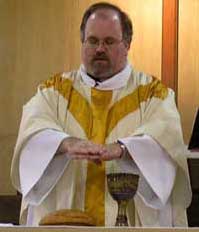 This affirmation of Real Presence can be seen clearly illustrated in the language of the United Methodist Eucharistic Liturgy where, in the epiclesis
of the Great Thanksgiving, the celebrating minister prays over the elements:
This reflects the extent to which most Methodists are willing to go in defining Real Presence.
Methodists assert that Jesus is truly present, and that the means of His presence is a "Holy Mystery". A celebrating minister will pray for the Holy Spirit to make the elements "be the body and blood of Christ," and the congregation can even sing, as in the third stanza of Charles Wesley's
hymn Come Sinners to the Gospel Feast:
However, most Methodists will not attempt to go beyond this degree of specificity. For Methodist Christians, the affirmation of Real Presence, as in the above references, is sufficient to know and partake of the sacrament in a worthy manner.
, hold that the reality of Christ's body and blood do not come corporally (physically) to the elements, but that "the Spirit truly unites things separated in space" (Calvin).
Following a phrase of Augustine
, the Calvinist view is that "no one bears away from this Sacrament more than is gathered with the vessel of faith". "The flesh and blood of Christ are no less truly given to the unworthy than to God's elect believers", Calvin said; but those who partake by faith receive benefit from Christ, and the unbelieving are condemned by partaking. By faith (not a mere mental apprehension), and in the Holy Spirit, the partaker beholds God incarnate, and in the same sense touches him with hands, so that by eating and drinking of bread and wine Christ's presence penetrates to the heart of the believer more nearly than food swallowed with the mouth can enter in.
This view holds that the elements may be disposed of without ceremony, as they are not changed in an objective physical sense and, as such, the meal directs attention toward Christ's "bodily" resurrection and return. Actual practices of disposing of consecrated elements vary widely.
Reformed theology has traditionally taught that Jesus' body is seated in heaven at the right hand of God; therefore his body is not physically present in the elements, nor do the elements turn into his body in a physical or any objective sense. However, Reformed theology has also historically taught that when the Holy Communion is received, not only the Spirit, but also the true body and blood of Jesus Christ (hence "real") are received through the Spirit, but these are only received by those partakers who eat worthily (i.e., repentantly) with faith. The Holy Spirit unites the Christian with Jesus though they are separated by a great distance. See, e.g., Westminster Confession of Faith, ch. 29; Belgic Confession, Article 35.
The theologies of Presbyterian and Reformed Free Churches in this tradition are in flux, and recent agreements, especially A Formula for Agreement, between these denominations and the Lutherans have stressed that: "The theological diversity within our common confession provides both the complementarity needed for a full and adequate witness to the gospel (mutual affirmation) and the corrective reminder that every theological approach is a partial and incomplete witness to the Gospel (mutual admonition) (A Common Calling, page 66)." Hence, in seeking to come to consensus about the Real Presence (see open communion
), the churches have written:
and further:
or the Lord's Table) as a symbolic meal, a memorial
of the Last Supper
and the Passion
, which is done by the ordinance of Jesus, but in which nothing miraculous occurs. This view is known as the Zwinglian view, after Huldrych Zwingli
, a Swiss leader during the Reformation
.
This perspective is commonly associated with Baptists and many other Evangelicals. It is a perspective not uncommon "in the pews" (that is, among lay members) of some Reformed churches, even among those whose official doctrines are more in accord with the Calvinist spiritual real presence discussed above.
holding to a doctrine of the Real Presence of Christ in the Eucharist (for example, Roman Catholics, Eastern Orthodox, Anglicans and Lutherans) require ordained
clergy to officiate at the Eucharist, consecrating
and distributing the elements to communicants.
Some groups, chiefly Protestants, have a different concept of consecration, seeing it as a setting aside. Those who see consecration as a "setting aside" require church leaders (pastor
s, elders and deacons) to preside over the elements and distribute them.
Eucharist
The Eucharist , also called Holy Communion, the Sacrament of the Altar, the Blessed Sacrament, the Lord's Supper, and other names, is a Christian sacrament or ordinance...
, Jesus Christ is really present in what was previously just bread and wine, and not merely present in symbol, a figure of speech (metaphorically), or by his power (dynamically).
Not all Christian traditions accept this dogma
Dogma
Dogma is the established belief or doctrine held by a religion, or a particular group or organization. It is authoritative and not to be disputed, doubted, or diverged from, by the practitioners or believers...
. Efforts at mutual understanding of the range of beliefs led in 1980s to consultations on Baptism, Eucharist and Ministry (BEM) through the World Council of Churches
World Council of Churches
The World Council of Churches is a worldwide fellowship of 349 global, regional and sub-regional, national and local churches seeking unity, a common witness and Christian service. It is a Christian ecumenical organization that is based in the Ecumenical Centre in Geneva, Switzerland...
, consultations that included the Roman Catholic Church
Roman Catholic Church
The Catholic Church, also known as the Roman Catholic Church, is the world's largest Christian church, with over a billion members. Led by the Pope, it defines its mission as spreading the gospel of Jesus Christ, administering the sacraments and exercising charity...
.
Different understandings
Roman CatholicRoman Catholic Church
The Catholic Church, also known as the Roman Catholic Church, is the world's largest Christian church, with over a billion members. Led by the Pope, it defines its mission as spreading the gospel of Jesus Christ, administering the sacraments and exercising charity...
and Orthodox
Eastern Orthodox Church
The Orthodox Church, officially called the Orthodox Catholic Church and commonly referred to as the Eastern Orthodox Church, is the second largest Christian denomination in the world, with an estimated 300 million adherents mainly in the countries of Belarus, Bulgaria, Cyprus, Georgia, Greece,...
Christians see the Real Presence in terms not of a physical or "carnal" presence, but of transubstantiation
Transubstantiation
In Roman Catholic theology, transubstantiation means the change, in the Eucharist, of the substance of wheat bread and grape wine into the substance of the Body and Blood, respectively, of Jesus, while all that is accessible to the senses remains as before.The Eastern Orthodox...
/metousiosis
Metousiosis
Metousiosis is a Greek term that means, literally, a change of . Cyril Lucaris , the Patriarch of Alexandria and later of Constantinople, used this Greek term to express the idea for which the Latin term is transsubstantiatio , which likewise literally means a change of substantia ,...
. Anglicans
Anglicanism
Anglicanism is a tradition within Christianity comprising churches with historical connections to the Church of England or similar beliefs, worship and church structures. The word Anglican originates in ecclesia anglicana, a medieval Latin phrase dating to at least 1246 that means the English...
generally argue for contentment with the mode of objective presence to remain a mystery. Lutheran
Lutheranism
Lutheranism is a major branch of Western Christianity that identifies with the theology of Martin Luther, a German reformer. Luther's efforts to reform the theology and practice of the church launched the Protestant Reformation...
s expound a presence "in, with and under the forms" of bread and wine. Methodist
Methodism
Methodism is a movement of Protestant Christianity represented by a number of denominations and organizations, claiming a total of approximately seventy million adherents worldwide. The movement traces its roots to John Wesley's evangelistic revival movement within Anglicanism. His younger brother...
s postulate the par excellence presence as being a "Holy Mystery". Reformed Protestant views instead speak of a "spiritual" real presence and stress that Holy Communion is a "spiritual feeding". Certain other Protestant traditions (for instance, Baptists and contemporary evangelicals) simply reject outright the doctrine of the Real Presence of Christ in the Eucharist.
Roman Catholic and Orthodox views
Orthodox and Catholics believe that in the Eucharist the bread and wine are objectively transformed and become in a real sense the BodyBody of Christ
In Christian theology, the term Body of Christ has two separate connotations: it may refer to Jesus's statement about the Eucharist at the Last Supper that "This is my body" in , or the explicit usage of the term by the Apostle Paul in to refer to the Christian Church.Although in general usage the...
and Blood of Christ
Blood of Christ
The Blood of Christ in Christian theology refers to the physical blood actually shed by Jesus Christ on the Cross, and the salvation which Christianity teaches was accomplished thereby; and the sacramental blood present in the Eucharist, which is considered by Catholic, Orthodox, Anglican, and...
; and that after consecration they are no longer bread and wine: the consecrated elements retain the appearance and attributes of bread and wine but really are the body and blood of Christ.
The words of the Ethiopic liturgy are representative of the faith of Oriental Orthodoxy
Oriental Orthodoxy
Oriental Orthodoxy is the faith of those Eastern Christian Churches that recognize only three ecumenical councils — the First Council of Nicaea, the First Council of Constantinople and the First Council of Ephesus. They rejected the dogmatic definitions of the Council of Chalcedon...
: "I believe, I believe, I believe and profess to the last breath that this is the body and the blood of our Lord God and Saviour Jesus Christ, which he took from our Lady, the holy and immaculate Virgin Mary, the Mother of God."
The Eastern Orthodox Church
Eastern Orthodox Church
The Orthodox Church, officially called the Orthodox Catholic Church and commonly referred to as the Eastern Orthodox Church, is the second largest Christian denomination in the world, with an estimated 300 million adherents mainly in the countries of Belarus, Bulgaria, Cyprus, Georgia, Greece,...
Synod of Jerusalem
Synod of Jerusalem
The Synod of Jerusalem was convened by Greek Orthodox Patriarch Dositheos Notaras in March, 1672. Because the occasion was the consecration of the Church of the Nativity in Bethlehem, it is also called the Synod of Bethlehem....
declared: "We believe the Lord Jesus Christ to be present, not typically, nor figuratively, nor by superabundant grace, as in the other Mysteries, … but truly and really, so that after the consecration of the bread and of the wine, the bread is transmuted, transubstantiated, converted and transformed into the true Body Itself of the Lord, Which was born in Bethlehem of the ever-Virgin Mary, was baptised in the Jordan, suffered, was buried, rose again, was received up, sitteth at the right hand of the God and Father, and is to come again in the clouds of Heaven; and the wine is converted and transubstantiated into the true Blood Itself of the Lord, Which, as He hung upon the Cross, was poured out for the life of the world."
Similarly the Western Roman Catholic Church greets what it sees as really in the Eucharist with the words of a Latin
Latin
Latin is an Italic language originally spoken in Latium and Ancient Rome. It, along with most European languages, is a descendant of the ancient Proto-Indo-European language. Although it is considered a dead language, a number of scholars and members of the Christian clergy speak it fluently, and...
hymn of which a literal translation is: "Hail, true body, born of Mary Virgin, and which truly suffered and was immolated on the cross for mankind!"
None of these Churches sees what is really in the Eucharist as a lifeless corpse and mere blood, but as the whole Christ, body and blood, soul and divinity; nor do they see the persisting outward appearances of bread and wine as a mere illusion. This actual transformation, change or conversion of the reality, while the appearances remain unaltered – not the process or manner by which the transformation comes about, since all agree that this occurs "in a way surpassing understanding" – has been called transubstantiation
Transubstantiation
In Roman Catholic theology, transubstantiation means the change, in the Eucharist, of the substance of wheat bread and grape wine into the substance of the Body and Blood, respectively, of Jesus, while all that is accessible to the senses remains as before.The Eastern Orthodox...
or, in Greek
Greek language
Greek is an independent branch of the Indo-European family of languages. Native to the southern Balkans, it has the longest documented history of any Indo-European language, spanning 34 centuries of written records. Its writing system has been the Greek alphabet for the majority of its history;...
, (metousiosis
Metousiosis
Metousiosis is a Greek term that means, literally, a change of . Cyril Lucaris , the Patriarch of Alexandria and later of Constantinople, used this Greek term to express the idea for which the Latin term is transsubstantiatio , which likewise literally means a change of substantia ,...
).
In the view of these Churches, the presence of Christ in the Eucharist is of an order different from the presence of Christ in the other sacraments: in the other sacraments he is present by his power rather than by the reality of his body and blood, the basis of the expression "Real Presence". Accordingly, they consider that those who hold that, in objective reality, the elements of the Eucharist remain unchanged believe not in the Real Presence of Christ in this particular sacrament, but in a presence that is merely personal to the communicant, whatever name (pneumatic, anamnetical, etc.) is used to describe it.
Lutherans – the Sacramental Union: "in, with, and under the forms of bread and wine"
Lutherans believe that the Body and Blood of Christ are "truly and substantially present in, with and under the forms" of the consecrated bread and wine (the elements), so that communicants eat and drink the Holy Body and Blood of Christ Himself as well as the bread and wine (cf. Augsburg ConfessionAugsburg Confession
The Augsburg Confession, also known as the "Augustana" from its Latin name, Confessio Augustana, is the primary confession of faith of the Lutheran Church and one of the most important documents of the Lutheran reformation...
, Article 10) in this Sacrament
Lutheran sacraments
The Lutheran Sacraments are "sacred acts of divine institution". Lutherans believe that, whenever they are properly administered by the use of the physical component commanded by God along with the divine words of institution, God is, in a way specific to each sacrament, present with the Word and...
. The Lutheran doctrine of the Real Presence is more accurately and formally known as "the Sacramental Union
Sacramental Union
Sacramental union is the Lutheran theological doctrine of the Real Presence of the body and blood of Christ in the Christian Eucharist....
." It has been inaccurately called "consubstantiation
Consubstantiation
Consubstantiation is a theological doctrine that attempts to describe the nature of the Christian Eucharist in concrete metaphysical terms. It holds that during the sacrament, the fundamental "substance" of the body and blood of Christ are present alongside the substance of the bread and wine,...
." This term is specifically rejected by some Lutheran churches and theologians since it creates confusion about the actual doctrine, and it subjects the doctrine to the control of an abiblical philosophical concept in the same manner as, in their view, does the term "transubstantiation
Transubstantiation
In Roman Catholic theology, transubstantiation means the change, in the Eucharist, of the substance of wheat bread and grape wine into the substance of the Body and Blood, respectively, of Jesus, while all that is accessible to the senses remains as before.The Eastern Orthodox...
." The Apology of the Augsburg Confession
Apology of the Augsburg Confession
The Apology of the Augsburg Confession was written by Philipp Melanchthon during and after the 1530 Diet of Augsburg as a response to the Pontifical Confutation of the Augsburg Confession, Charles V's commissioned official Roman Catholic response to the Lutheran Augsburg Confession of June 25, 1530...
describe the real presence in terms of "transformation".
For Lutherans, there is no Sacrament unless the elements are used according to Christ's institution (consecration, distribution, and reception). This was first articulated in the Wittenberg Concord
Wittenberg Concord
Wittenberg Concord , is a religious concordat signed by Reformed and Lutheran theologians and churchmen on May 29, 1536 as an attempted resolution of their differences with respect to the Real Presence of Christ's body and blood in the Eucharist...
of 1536 in the formula: Nihil habet rationem sacramenti extra usum a Christo institutum ("Nothing has the character of a sacrament apart from the use instituted by Christ"). Some Lutherans use this formula as their rationale for opposing in the church the reservation
Reserved sacrament
During the Liturgy of the Eucharist, the second part of the Mass, the elements of bread and wine are considered, in some branches of Christian practice, to have been transubstantiated into the veritable Body and Blood of Jesus Christ...
of the consecrated elements, private masses, the practice of Corpus Christi
Blessed Sacrament
The Blessed Sacrament, or the Body and Blood of Christ, is a devotional name used in the Roman Catholic Church, Eastern Catholic Churches, Old Catholic, Anglican, and Lutheran churches, to refer to the Host after it has been consecrated in the sacrament of the Eucharist...
, and the belief that the reliquæ (what remains of the consecrated elements after all have communed in the worship service) are still sacramentally united to the Body and Blood of Christ. This interpretation is not universal among Lutherans. The consecrated elements are treated with reverence; and, in some Lutheran churches, are reserved as in Orthodox
Eastern Orthodox Church
The Orthodox Church, officially called the Orthodox Catholic Church and commonly referred to as the Eastern Orthodox Church, is the second largest Christian denomination in the world, with an estimated 300 million adherents mainly in the countries of Belarus, Bulgaria, Cyprus, Georgia, Greece,...
, Catholic
Roman Catholic Church
The Catholic Church, also known as the Roman Catholic Church, is the world's largest Christian church, with over a billion members. Led by the Pope, it defines its mission as spreading the gospel of Jesus Christ, administering the sacraments and exercising charity...
, and Anglican practice. The external Eucharistic adoration
Eucharistic adoration
Eucharistic adoration is a practice in the Roman Catholic Church, and in a few Anglican and Lutheran churches, in which the Blessed Sacrament is exposed to and adored by the faithful....
is usually not practiced by most Lutherans except for bowing, genuflecting, and kneeling to receive the Eucharist from the Words of Institution
Words of Institution
The Words of Institution are words echoing those of Jesus himself at his Last Supper that, when consecrating bread and wine, Christian Eucharistic liturgies include in a narrative of that event...
and elevation to reception of the holy meal. The reliquæ traditionally are consumed by the celebrant after the people have communed, except that a small amount may be reserved for delivery to those too ill or infirm to attend the service. In this case, the consecrated elements are to be delivered quickly, preserving the connection between the communion of the ill person and that of the congregation gathered in public Divine Service.
Lutherans use the terms "in, with and under the forms of consecrated bread and wine" and "Sacramental Union" to distinguish their understanding of the Eucharist from those of the Reformed and other traditions.
Moravians and the closely related Czech Unity of the Brethren generally agree with Lutheran teachings.
European and some American Lutherans are in formal and full communion
Full communion
In Christian ecclesiology, full communion is a relationship between church organizations or groups that mutually recognize their sharing the essential doctrines....
with the Anglicans/Episcopalians in their mutual agreement on the Real Presence of Christ in the Mass.
Anglicans – broad range of opinions
In AnglicanAnglican Communion
The Anglican Communion is an international association of national and regional Anglican churches in full communion with the Church of England and specifically with its principal primate, the Archbishop of Canterbury...
theology, a sacrament is an outward and visible sign of an inward and spiritual grace. In the Eucharist, the outward and visible sign is that of bread and wine, while the inward and spiritual grace is that of the Body and Blood of Christ. The classic Anglican aphorism with regard to the debate on the Eucharist is the poem by John Donne
John Donne
John Donne 31 March 1631), English poet, satirist, lawyer, and priest, is now considered the preeminent representative of the metaphysical poets. His works are notable for their strong and sensual style and include sonnets, love poetry, religious poems, Latin translations, epigrams, elegies, songs,...
(1572–1631): "He was the Word that spake it; He took the bread and brake it; And what that Word did make it; I do believe and take it" (Divine Poems. On the Sacrament).
Anglicans generally and officially believe in the Real Presence of Christ in the Eucharist, but the specifics of that belief range from transubstantiation or metousiosis, sometimes with Eucharistic adoration (mainly Anglo-Catholics, to something akin to a belief in a "pneumatic" presence (many Broad-Church Anglicans). A small minority reject the doctrine of the Real Presence altogether (mainly Evangelical Anglicans). The oldest of the various Anglican devotional societies, the Confraternity of the Blessed Sacrament
Confraternity of the Blessed Sacrament
The Confraternity of the Blessed Sacrament is a devotional society in the Anglican Communion dedicated to venerating the Real Presence of Christ in the Eucharist...
, was founded largely to promote and re-affirm belief in the real presence amongst Anglicans.
The Anglican Thirty-Nine Articles
Thirty-Nine Articles
The Thirty-Nine Articles of Religion are the historically defining statements of doctrines of the Anglican church with respect to the controversies of the English Reformation. First established in 1563, the articles served to define the doctrine of the nascent Church of England as it related to...
of Religion contends that "transubstantiation (or the change of the substance of bread and wine) in the Supper of the Lord, cannot be proved by Holy Writ, but is repugnant to the plain words of Scripture, overthroweth the nature of a Sacrament, and hath given occasion to many superstitions. The body of Christ is given, taken, and eaten in the Supper, only after an heavenly and spiritual manner. And the mean whereby the body of Christ is received and eaten in the Supper is Faith" (Article XXVIII). For many Anglicans, whose mysticism is intensely incarnational, it is extremely important that God has used the mundane and temporal as a means of giving people the transcendent and eternal. Some have extended this view to include the idea of a presence that is in the realm of spirit and eternity, and not to be about corporeal-fleshiness, which is not to say that they accept only a "pneumatic" presence. Instead, they strongly argue to be content to allow the mystery to remain a mystery. They bristle at the idea that one material substance gets substituted for another. (Roman Catholic doctrine insists that the material substance, being part of what is open to the senses, is in no way altered, and that the philosophical-sense substance or inner reality is converted into that of the body and blood of Christ, not substituted by it.) As some Anglican divines have stated: "It may not be about a change of substance, but it is about a substantial change."
From some Anglican perspectives, the Real Presence of Christ in the Holy Eucharist does not imply that Jesus Christ is present materially or locally. This is in accord with the definition of the Roman Catholic Church, as expressed, for instance by St. Thomas Aquinas, who, while saying that the whole Christ is present in the sacrament, also said that this presence was not "as in a place". Real does not mean material: the lack of the latter does not imply the absence of the former. The Eucharist is not intrinsic to Christ as a body part is to a body, but extrinsic as his instrument to convey Divine Grace. Some Anglicans see this understanding as compatible with different theories of Christ's Presence--transubstantiation, consubstantation, or virtualism--without getting involved in the mechanics of 'change' or trying to explain a mystery of God's own doing.
Anglican and Roman Catholic theologians participating in an Anglican/Roman Catholic Joint Preparatory Commission declared that they had "reached substantial agreement on the doctrine of the Eucharist".
Methodism – Real Presence as "Holy Mystery"
According to the United Methodist ChurchUnited Methodist Church
The United Methodist Church is a Methodist Christian denomination which is both mainline Protestant and evangelical. Founded in 1968 by the union of The Methodist Church and the Evangelical United Brethren Church, the UMC traces its roots back to the revival movement of John and Charles Wesley...
,
- Jesus Christ, who "is the reflection of God's glory and the exact imprint of God's very being" (Hebrews 1:3), is truly present in Holy Communion. Through Jesus Christ and in the power of the Holy Spirit, God meets us at the TableAltarAn altar is any structure upon which offerings such as sacrifices are made for religious purposes. Altars are usually found at shrines, and they can be located in temples, churches and other places of worship...
. God, who has given the sacraments to the church, acts in and through Holy Communion. Christ is present through the community gathered in Jesus' name (Matthew 18:20), through the WordBibleThe Bible refers to any one of the collections of the primary religious texts of Judaism and Christianity. There is no common version of the Bible, as the individual books , their contents and their order vary among denominations...
proclaimed and enacted, and through the elements of bread and wineGrape juiceGrape juice is obtained from crushing and blending grapes into a liquid. The juice is often sold in stores or fermented and made into wine, brandy, or vinegar. In the wine industry, grape juice that contains 7-23 percent of pulp, skins, stems and seeds is often referred to as "must"...
shared (1 Corinthians 11:23–26). The divine presence is a living reality and can be experienced by participants; it is more than a remembrance of the Last SupperLast SupperThe Last Supper is the final meal that, according to Christian belief, Jesus shared with his Twelve Apostles in Jerusalem before his crucifixion. The Last Supper provides the scriptural basis for the Eucharist, also known as "communion" or "the Lord's Supper".The First Epistle to the Corinthians is...
and the CrucifixionCrucifixion of JesusThe crucifixion of Jesus and his ensuing death is an event that occurred during the 1st century AD. Jesus, who Christians believe is the Son of God as well as the Messiah, was arrested, tried, and sentenced by Pontius Pilate to be scourged, and finally executed on a cross...
.
The followers of John Wesley
John Wesley
John Wesley was a Church of England cleric and Christian theologian. Wesley is largely credited, along with his brother Charles Wesley, as founding the Methodist movement which began when he took to open-air preaching in a similar manner to George Whitefield...
, the clergymen, have typically affirmed that the sacrament of Holy Communion is an instrumental Means of Grace
Means of Grace
The Means of Grace in Christian theology are those things through which God gives grace. Just what this grace entails is interpreted in various ways: generally speaking, some see it as God blessing humankind so as to sustain and empower the Christian life; others see it as forgiveness, life, and...
through which the real presence of Christ is communicated to the believer, but have otherwise allowed the details to remain a mystery. In particular, Methodists reject the Roman Catholic doctrine of transubstantiation
Transubstantiation
In Roman Catholic theology, transubstantiation means the change, in the Eucharist, of the substance of wheat bread and grape wine into the substance of the Body and Blood, respectively, of Jesus, while all that is accessible to the senses remains as before.The Eastern Orthodox...
(see "Article XVIII" of the Articles of Religion
Articles of Religion (Methodist)
The Articles of Religion are an official doctrinal statement of American Methodism. John Wesley abridged for the American Methodists the Thirty-Nine Articles of Anglicanism, removing the Calvinistic parts among others. The Articles were adopted at a conference in 1784 and are found in paragraph 103...
, Means of Grace
Means of Grace
The Means of Grace in Christian theology are those things through which God gives grace. Just what this grace entails is interpreted in various ways: generally speaking, some see it as God blessing humankind so as to sustain and empower the Christian life; others see it as forgiveness, life, and...
). In 2004, the United Methodist Church affirmed its view of the sacrament and its belief in the Real Presence in an official document entitled This Holy Mystery: A United Methodist Understanding of Holy Communion. Of particular note here is the church's unequivocal recognition of the anamnesis
Anamnesis (Christianity)
Anamnesis , in Christianity is a liturgical statement in which the Church refers to the memorial character of the Eucharist and/or to the Passion, Resurrection and Ascension of Christ...
as more than just a memorial but, rather, a re-presentation of Christ Jesus and His Love.
- Holy Communion is remembrance, commemoration, and memorial, but this remembrance is much more than simply intellectual recalling. "Do this in remembrance of me" (Luke 22:19; 1 Corinthians 11:24–25) is anamnesis (the biblical Greek word). This dynamic action becomes re-presentation of past gracious acts of God in the present, so powerfully as to make them truly present now. Christ is risen and is alive here and now, not just remembered for what was done in the past.
Epiclesis
The epiclesis is that part of the Anaphora by which the priest invokes the Holy Spirit upon the Eucharistic bread and wine in some Christian churches.In most Eastern Christian traditions, the Epiclesis comes after the Anamnesis The epiclesis (also spelled epiklesis; from "invocation" or...
of the Great Thanksgiving, the celebrating minister prays over the elements:
- Pour out your Holy Spirit on us gathered here, and on these gifts of bread and wine. Make them be for us the body and blood of Christ, that we may be for the world the body of Christ, redeemed by his blood.
This reflects the extent to which most Methodists are willing to go in defining Real Presence.
Methodists assert that Jesus is truly present, and that the means of His presence is a "Holy Mystery". A celebrating minister will pray for the Holy Spirit to make the elements "be the body and blood of Christ," and the congregation can even sing, as in the third stanza of Charles Wesley's
Charles Wesley
Charles Wesley was an English leader of the Methodist movement, son of Anglican clergyman and poet Samuel Wesley, the younger brother of Anglican clergyman John Wesley and Anglican clergyman Samuel Wesley , and father of musician Samuel Wesley, and grandfather of musician Samuel Sebastian Wesley...
hymn Come Sinners to the Gospel Feast:
- Come and partake the gospel feast,
- be saved from sin, in Jesus rest;
- O taste the goodness of our God,
- and eat his flesh and drink his blood.
However, most Methodists will not attempt to go beyond this degree of specificity. For Methodist Christians, the affirmation of Real Presence, as in the above references, is sufficient to know and partake of the sacrament in a worthy manner.
Reformed (Calvinist, Presbyterian, most United churches) – "Real Presence" as "pneumatic presence"
Many Reformed, particularly those following John CalvinJohn Calvin
John Calvin was an influential French theologian and pastor during the Protestant Reformation. He was a principal figure in the development of the system of Christian theology later called Calvinism. Originally trained as a humanist lawyer, he broke from the Roman Catholic Church around 1530...
, hold that the reality of Christ's body and blood do not come corporally (physically) to the elements, but that "the Spirit truly unites things separated in space" (Calvin).
Following a phrase of Augustine
Augustine of Hippo
Augustine of Hippo , also known as Augustine, St. Augustine, St. Austin, St. Augoustinos, Blessed Augustine, or St. Augustine the Blessed, was Bishop of Hippo Regius . He was a Latin-speaking philosopher and theologian who lived in the Roman Africa Province...
, the Calvinist view is that "no one bears away from this Sacrament more than is gathered with the vessel of faith". "The flesh and blood of Christ are no less truly given to the unworthy than to God's elect believers", Calvin said; but those who partake by faith receive benefit from Christ, and the unbelieving are condemned by partaking. By faith (not a mere mental apprehension), and in the Holy Spirit, the partaker beholds God incarnate, and in the same sense touches him with hands, so that by eating and drinking of bread and wine Christ's presence penetrates to the heart of the believer more nearly than food swallowed with the mouth can enter in.
This view holds that the elements may be disposed of without ceremony, as they are not changed in an objective physical sense and, as such, the meal directs attention toward Christ's "bodily" resurrection and return. Actual practices of disposing of consecrated elements vary widely.
Reformed theology has traditionally taught that Jesus' body is seated in heaven at the right hand of God; therefore his body is not physically present in the elements, nor do the elements turn into his body in a physical or any objective sense. However, Reformed theology has also historically taught that when the Holy Communion is received, not only the Spirit, but also the true body and blood of Jesus Christ (hence "real") are received through the Spirit, but these are only received by those partakers who eat worthily (i.e., repentantly) with faith. The Holy Spirit unites the Christian with Jesus though they are separated by a great distance. See, e.g., Westminster Confession of Faith, ch. 29; Belgic Confession, Article 35.
The theologies of Presbyterian and Reformed Free Churches in this tradition are in flux, and recent agreements, especially A Formula for Agreement, between these denominations and the Lutherans have stressed that: "The theological diversity within our common confession provides both the complementarity needed for a full and adequate witness to the gospel (mutual affirmation) and the corrective reminder that every theological approach is a partial and incomplete witness to the Gospel (mutual admonition) (A Common Calling, page 66)." Hence, in seeking to come to consensus about the Real Presence (see open communion
Open communion
Open communion is the practice of Christian churches that allow individuals other than members of that church to receive Holy Communion...
), the churches have written:
- "During the Reformation both Reformed and Lutheran Churches exhibited an evangelical intention when they understood the Lord's Supper in the light of the saving act of God in Christ. Despite this common intention, different terms and concepts were employed which. . . led to mutual misunderstanding and misrepresentation. Properly interpreted, the differing terms and concepts were often complementary rather than contradictory (Marburg Revisited, pp. 103–104);"
and further:
- "In the Lord's Supper the risen Christ imparts himself in body and blood, given up for all, through his word of promise with bread and wine....we proclaim the death of Christ through which God has reconciled the world with himself. We proclaim the presence of the risen Lord in our midst. Rejoicing that the Lord has come to us, we await his future coming in glory....Both of our communions, we maintain, need to grow in appreciation of our diverse eucharistic traditions, finding mutual enrichment in them. At the same time both need to grow toward a further deepening of our common experience and expression of the mysterySacred MysteriesThe term sacred mysteries generally denotes the area of supernatural phenomena associated with a divinity or a religious ideology.-Pre-Christian religious mysteries:...
of our Lord's Supper (A Formula for Agreement)."
Other Protestants – no Real Presence
Some Protestant groups see Communion (also called the Lord's SupperEucharist
The Eucharist , also called Holy Communion, the Sacrament of the Altar, the Blessed Sacrament, the Lord's Supper, and other names, is a Christian sacrament or ordinance...
or the Lord's Table) as a symbolic meal, a memorial
Memorialism
Memorialism is the belief held by many Protestant denominations that the elements of bread and wine in the Eucharist are symbolic of the body and blood of Jesus, the feast being primarily a memorial meal. The theory comes largely from the work of Reformed theologian Huldrych Zwingli...
of the Last Supper
Last Supper
The Last Supper is the final meal that, according to Christian belief, Jesus shared with his Twelve Apostles in Jerusalem before his crucifixion. The Last Supper provides the scriptural basis for the Eucharist, also known as "communion" or "the Lord's Supper".The First Epistle to the Corinthians is...
and the Passion
Passion (Christianity)
The Passion is the Christian theological term used for the events and suffering – physical, spiritual, and mental – of Jesus in the hours before and including his trial and execution by crucifixion...
, which is done by the ordinance of Jesus, but in which nothing miraculous occurs. This view is known as the Zwinglian view, after Huldrych Zwingli
Huldrych Zwingli
Ulrich Zwingli was a leader of the Reformation in Switzerland. Born during a time of emerging Swiss patriotism and increasing criticism of the Swiss mercenary system, he attended the University of Vienna and the University of Basel, a scholarly centre of humanism...
, a Swiss leader during the Reformation
Protestant Reformation
The Protestant Reformation was a 16th-century split within Western Christianity initiated by Martin Luther, John Calvin and other early Protestants. The efforts of the self-described "reformers", who objected to the doctrines, rituals and ecclesiastical structure of the Roman Catholic Church, led...
.
This perspective is commonly associated with Baptists and many other Evangelicals. It is a perspective not uncommon "in the pews" (that is, among lay members) of some Reformed churches, even among those whose official doctrines are more in accord with the Calvinist spiritual real presence discussed above.
Consecration, presidency and distribution
Many Christian churchesChristian Church
The Christian Church is the assembly or association of followers of Jesus Christ. The Greek term ἐκκλησία that in its appearances in the New Testament is usually translated as "church" basically means "assembly"...
holding to a doctrine of the Real Presence of Christ in the Eucharist (for example, Roman Catholics, Eastern Orthodox, Anglicans and Lutherans) require ordained
Holy Orders
The term Holy Orders is used by many Christian churches to refer to ordination or to those individuals ordained for a special role or ministry....
clergy to officiate at the Eucharist, consecrating
Consecration
Consecration is the solemn dedication to a special purpose or service, usually religious. The word "consecration" literally means "to associate with the sacred". Persons, places, or things can be consecrated, and the term is used in various ways by different groups...
and distributing the elements to communicants.
Some groups, chiefly Protestants, have a different concept of consecration, seeing it as a setting aside. Those who see consecration as a "setting aside" require church leaders (pastor
Pastor
The word pastor usually refers to an ordained leader of a Christian congregation. When used as an ecclesiastical styling or title, this role may be abbreviated to "Pr." or often "Ps"....
s, elders and deacons) to preside over the elements and distribute them.
See also
- ConsubstantiationConsubstantiationConsubstantiation is a theological doctrine that attempts to describe the nature of the Christian Eucharist in concrete metaphysical terms. It holds that during the sacrament, the fundamental "substance" of the body and blood of Christ are present alongside the substance of the bread and wine,...
– usually attributed to Lutheran theology, over the objection of most Lutherans. - Eucharistic miracleEucharistic miracleA Eucharistic miracle is any miracle involving the Eucharist. Eucharistic miracles typically involve the visible transformation of the bread and wine into the Body and Blood of Jesus Christ during the consecration portion of a Catholic Mass or Orthodox Liturgy...
s – where the host and the wine have visibly changed into flesh and blood while celebrating a mass. - Eucharistic theologies contrastedEucharistic theologies contrastedThis article contrasts the views of a number of churches regarding Eucharistic theology:-Roman Catholic Church:* Transubstantiation as a statement of what is changed when the bread and wine are consecrated, not an explanation of the means or mode by which the Real Presence is effected, since "[t]he...
- Sacramental unionSacramental UnionSacramental union is the Lutheran theological doctrine of the Real Presence of the body and blood of Christ in the Christian Eucharist....
– official Lutheran position. - SacramentariansSacramentariansThe Sacramentarians were Christians during the Protestant Reformation who denied not only the Roman Catholic transubstantiation but also the Lutheran sacramental union.They comprised two parties:...
– the name given to those who during the Reformation controversies denied transubstantiation and Sacramental Union - TransignificationTransignificationTransignification is an idea originating from the attempts of modernist Roman Catholic theologians, especially Edward Schillebeeckx, to better understand the mystery of the Real Presence of Christ at Mass in light of a new philosophy of the nature of reality that is more in line with contemporary...
– theory of some twentieth-century Roman Catholic theologians - TransubstantiationTransubstantiationIn Roman Catholic theology, transubstantiation means the change, in the Eucharist, of the substance of wheat bread and grape wine into the substance of the Body and Blood, respectively, of Jesus, while all that is accessible to the senses remains as before.The Eastern Orthodox...
– official position of the Roman Catholic Church
Anglican Church
- Dean of Christ Church Cathedral explains Church of Ireland belief in the 'real presence
- Dealing with eucharistic 'leftovers' can cause deep offence – from Anglican Journal
Eastern Orthodox Church
- Orthodoxy and Transubstantiation/Metousiosis
- The First Part of the Orthodox Catechism, questions 338–340
Lutheran Church
- The Lord's Supper The Lutheran Church Missouri Synod
- The Use of the Means of Grace: A Statement on the Practice of Word and Sacrament
- The Sacrament of the Altar by Tom G.A. Hardt
Roman Catholic Church
- The Real Presence of Christ in the Eucharist Article from the Catholic Encyclopedia
- Christ's Presence in the Eucharist: True, Real and Substantial
- The Real Presence Association
- The Real Presence of Christ in the Eucharist – Eucharist Index
United Methodist Church
- "This Holy Mystery": A United Methodist Understanding of Holy Communion (Official)
- "Holy Communion and the Real Presence" by Charles Duncan
- "Holy Communion as a Means of Grace" by Gregory S. Neal
- "Typology and the Real Presence of Jesus in Holy Communion" by Gregory S. Neal