
Home      Discussion      Topics      Dictionary      Almanac
Signup       Login
Book of Common Prayer

Book of Common Prayer

Overview
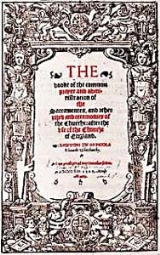
The Book of Common Prayer is the short title of a number of related prayer books used in the Anglican Communion
Anglican Communion
The Anglican Communion is an international association of national and regional Anglican churches in full communion with the Church of England and specifically with its principal primate, the Archbishop of Canterbury...

, as well as by the Continuing Anglican, "Anglican realignment
Anglican realignment
The term Anglican realignment refers to a movement among some Anglicans to align themselves under new or alternative oversight within or outside the Anglican Communion. This movement is primarily active in parts of the Episcopal Church in the United States and the Anglican Church of Canada...

" and other Anglican churches. The original book, published in 1549 , in the reign of Edward VI
Edward VI of England
Edward VI was the King of England and Ireland from 28 January 1547 until his death. He was crowned on 20 February at the age of nine. The son of Henry VIII and Jane Seymour, Edward was the third monarch of the Tudor dynasty and England's first monarch who was raised as a Protestant...

, was a product of the English Reformation
English Reformation
The English Reformation was the series of events in 16th-century England by which the Church of England broke away from the authority of the Pope and the Roman Catholic Church....

 following the break with Rome
Roman Catholic Church
The Catholic Church, also known as the Roman Catholic Church, is the world's largest Christian church, with over a billion members. Led by the Pope, it defines its mission as spreading the gospel of Jesus Christ, administering the sacraments and exercising charity...

. Prayer books, unlike books of prayers, contain the words of structured (or liturgical) services of worship. The work of 1549 was the first prayer book to include the complete forms of service for daily and Sunday worship in English. It contained Morning Prayer, Evening Prayer
Evening Prayer (Anglican)
Evening Prayer is a liturgy in use in the Anglican Communion and celebrated in the late afternoon or evening...

, the Litany
Litany
A litany, in Christian worship and some forms of Jewish worship, is a form of prayer used in services and processions, and consisting of a number of petitions...

, and Holy Communion and also the occasional services in full: the orders for Baptism
Baptism
In Christianity, baptism is for the majority the rite of admission , almost invariably with the use of water, into the Christian Church generally and also membership of a particular church tradition...

, Confirmation, Marriage
Marriage
Marriage is a social union or legal contract between people that creates kinship. It is an institution in which interpersonal relationships, usually intimate and sexual, are acknowledged in a variety of ways, depending on the culture or subculture in which it is found...

, 'prayers to be said with the sick
Anointing of the Sick
Anointing of the Sick, known also by other names, is distinguished from other forms of religious anointing or "unction" in that it is intended, as its name indicates, for the benefit of a sick person...

' and a Funeral
Funeral
A funeral is a ceremony for celebrating, sanctifying, or remembering the life of a person who has died. Funerary customs comprise the complex of beliefs and practices used by a culture to remember the dead, from interment itself, to various monuments, prayers, and rituals undertaken in their honor...

 service. It also set out in full the "propers" (that is the parts of the service which varied week by week or, at times, daily throughout the Church's Year): the Collect
Collect
In Christian liturgy, a collect is both a liturgical action and a short, general prayer. In the Middle Ages, the prayer was referred to in Latin as collectio, but in the more ancient sources, as oratio. In English, and in this usage, "collect" is pronounced with the stress on the first syllable...

 and the Epistle
Epistle
An epistle is a writing directed or sent to a person or group of people, usually an elegant and formal didactic letter. The epistle genre of letter-writing was common in ancient Egypt as part of the scribal-school writing curriculum. The letters in the New Testament from Apostles to Christians...

 and Gospel
Gospel
A gospel is an account, often written, that describes the life of Jesus of Nazareth. In a more general sense the term "gospel" may refer to the good news message of the New Testament. It is primarily used in reference to the four canonical gospels of Matthew, Mark, Luke, and John...

 readings for the Sunday Communion Service. Old Testament
Old Testament
The Old Testament, of which Christians hold different views, is a Christian term for the religious writings of ancient Israel held sacred and inspired by Christians which overlaps with the 24-book canon of the Masoretic Text of Judaism...

 and New Testament
New Testament
The New Testament is the second major division of the Christian biblical canon, the first such division being the much longer Old Testament....

 readings for daily prayer were specified in tabular format as were the Psalms
Psalms
The Book of Psalms , commonly referred to simply as Psalms, is a book of the Hebrew Bible and the Christian Bible...

; and canticles, mostly biblical, that were provided to be said or sung between the readings .
Discussion
Ask a question about 'Book of Common Prayer'
Start a new discussion about 'Book of Common Prayer'
Answer questions from other users
Full Discussion Forum
 
Quotations

Give peace in our time, O Lord.

Morning Prayer, Versicles

Grant that the old Adam in the Child may be so buried, that the new man may be raised up in him.

Public Baptism of Infants, Blessing on the Child

Stir up, we beseech thee, O Lord,

Collect for the 25th Sunday after Trinity

Lighten our darkness, we beseech thee, O Lord; and by thy great mercy defend us from all perils and dangers of this night.

Evening Prayer, A Collect for Aid against Perils, p. 31

Dost thou, therefore, in the name of this Child, renounce the devil and all his works, the vain pomp and glory of the world, with all covetous desires of the same, and the sinful desires of the flesh, so that thou wilt not follow, nor be led by them?

Holy Baptism, To the Godfathers and Godmothers, p. 276

In the midst of life we are in death.

Burial of the Dead, p. 332

Earth to earth, ashes to ashes, dust to dust; in sure and certain hope of the Resurrection unto eternal life.

Burial of the Dead, p. 332

He is risen. The Lord is risen indeed.

Morning Prayer, p. 5

We have erred, and strayed from thy ways like lost sheep.

A General Confession, p. 6

We have left undone those things which we ought to have done; And we have done those things which we ought not to have done.

A General Confession, p. 6
Encyclopedia
The Book of Common Prayer is the short title of a number of related prayer books used in the Anglican Communion
Anglican Communion
The Anglican Communion is an international association of national and regional Anglican churches in full communion with the Church of England and specifically with its principal primate, the Archbishop of Canterbury...

, as well as by the Continuing Anglican, "Anglican realignment
Anglican realignment
The term Anglican realignment refers to a movement among some Anglicans to align themselves under new or alternative oversight within or outside the Anglican Communion. This movement is primarily active in parts of the Episcopal Church in the United States and the Anglican Church of Canada...

" and other Anglican churches. The original book, published in 1549 , in the reign of Edward VI
Edward VI of England
Edward VI was the King of England and Ireland from 28 January 1547 until his death. He was crowned on 20 February at the age of nine. The son of Henry VIII and Jane Seymour, Edward was the third monarch of the Tudor dynasty and England's first monarch who was raised as a Protestant...

, was a product of the English Reformation
English Reformation
The English Reformation was the series of events in 16th-century England by which the Church of England broke away from the authority of the Pope and the Roman Catholic Church....

 following the break with Rome
Roman Catholic Church
The Catholic Church, also known as the Roman Catholic Church, is the world's largest Christian church, with over a billion members. Led by the Pope, it defines its mission as spreading the gospel of Jesus Christ, administering the sacraments and exercising charity...

. Prayer books, unlike books of prayers, contain the words of structured (or liturgical) services of worship. The work of 1549 was the first prayer book to include the complete forms of service for daily and Sunday worship in English. It contained Morning Prayer, Evening Prayer
Evening Prayer (Anglican)
Evening Prayer is a liturgy in use in the Anglican Communion and celebrated in the late afternoon or evening...

, the Litany
Litany
A litany, in Christian worship and some forms of Jewish worship, is a form of prayer used in services and processions, and consisting of a number of petitions...

, and Holy Communion and also the occasional services in full: the orders for Baptism
Baptism
In Christianity, baptism is for the majority the rite of admission , almost invariably with the use of water, into the Christian Church generally and also membership of a particular church tradition...

, Confirmation, Marriage
Marriage
Marriage is a social union or legal contract between people that creates kinship. It is an institution in which interpersonal relationships, usually intimate and sexual, are acknowledged in a variety of ways, depending on the culture or subculture in which it is found...

, 'prayers to be said with the sick
Anointing of the Sick
Anointing of the Sick, known also by other names, is distinguished from other forms of religious anointing or "unction" in that it is intended, as its name indicates, for the benefit of a sick person...

' and a Funeral
Funeral
A funeral is a ceremony for celebrating, sanctifying, or remembering the life of a person who has died. Funerary customs comprise the complex of beliefs and practices used by a culture to remember the dead, from interment itself, to various monuments, prayers, and rituals undertaken in their honor...

 service. It also set out in full the "propers" (that is the parts of the service which varied week by week or, at times, daily throughout the Church's Year): the Collect
Collect
In Christian liturgy, a collect is both a liturgical action and a short, general prayer. In the Middle Ages, the prayer was referred to in Latin as collectio, but in the more ancient sources, as oratio. In English, and in this usage, "collect" is pronounced with the stress on the first syllable...

 and the Epistle
Epistle
An epistle is a writing directed or sent to a person or group of people, usually an elegant and formal didactic letter. The epistle genre of letter-writing was common in ancient Egypt as part of the scribal-school writing curriculum. The letters in the New Testament from Apostles to Christians...

 and Gospel
Gospel
A gospel is an account, often written, that describes the life of Jesus of Nazareth. In a more general sense the term "gospel" may refer to the good news message of the New Testament. It is primarily used in reference to the four canonical gospels of Matthew, Mark, Luke, and John...

 readings for the Sunday Communion Service. Old Testament
Old Testament
The Old Testament, of which Christians hold different views, is a Christian term for the religious writings of ancient Israel held sacred and inspired by Christians which overlaps with the 24-book canon of the Masoretic Text of Judaism...

 and New Testament
New Testament
The New Testament is the second major division of the Christian biblical canon, the first such division being the much longer Old Testament....

 readings for daily prayer were specified in tabular format as were the Psalms
Psalms
The Book of Psalms , commonly referred to simply as Psalms, is a book of the Hebrew Bible and the Christian Bible...

; and canticles, mostly biblical, that were provided to be said or sung between the readings .

The 1549 book was soon succeeded by a more reformed revision in 1552 under the same editorial hand, that of Thomas Cranmer
Thomas Cranmer
Thomas Cranmer was a leader of the English Reformation and Archbishop of Canterbury during the reigns of Henry VIII, Edward VI and, for a short time, Mary I. He helped build a favourable case for Henry's divorce from Catherine of Aragon which resulted in the separation of the English Church from...

, Archbishop of Canterbury
Archbishop of Canterbury
The Archbishop of Canterbury is the senior bishop and principal leader of the Church of England, the symbolic head of the worldwide Anglican Communion, and the diocesan bishop of the Diocese of Canterbury. In his role as head of the Anglican Communion, the archbishop leads the third largest group...

. It was only used for a few months, as after Edward VI's death in 1553, his half-sister Mary I
Mary I of England
Mary I was queen regnant of England and Ireland from July 1553 until her death.She was the only surviving child born of the ill-fated marriage of Henry VIII and his first wife Catherine of Aragon. Her younger half-brother, Edward VI, succeeded Henry in 1547...

 restored Roman Catholic worship. She herself died in 1558, and in 1559 Elizabeth I
Elizabeth I of England
Elizabeth I was queen regnant of England and Ireland from 17 November 1558 until her death. Sometimes called The Virgin Queen, Gloriana, or Good Queen Bess, Elizabeth was the fifth and last monarch of the Tudor dynasty...

 reintroduced the 1552 book with a few modifications to make it acceptable to more traditionally minded worshippers, notably the inclusion of the words of administration from the 1549 Communion Service alongside those of 1552.

In 1604 James I
James I of England
James VI and I was King of Scots as James VI from 24 July 1567 and King of England and Ireland as James I from the union of the English and Scottish crowns on 24 March 1603...

 ordered some further changes, the most significant of these being the addition to the Catechism of a section on the Sacraments. Following the tumultuous events leading to and including the English Civil War
English Civil War
The English Civil War was a series of armed conflicts and political machinations between Parliamentarians and Royalists...

, another major revision was published in 1662 . That edition has remained the official prayer book of the Church of England, although in the 21st century, an alternative book called Common Worship
Common Worship
Common Worship is the name given to the series of services authorised by the General Synod of the Church of England and launched on the first Sunday of Advent in 2000. It represents the most recent stage of development of the Liturgical Movement within the Church and is the successor to the...

has largely displaced the Book of Common Prayer at the main Sunday worship service of most English parish churches.

A Book of Common Prayer with local variations is used in churches inside and outside the Anglican Communion in over 50 different countries and in over 150 different languages . Again in many parts of the world, more contemporary books have replaced it in regular weekly worship.

Traditional Lutheran, Methodist and Presbyterian prayer books have borrowed from the Book of Common Prayer, and the marriage and burial rites have found their way into those of other denominations and into the English language. Like the Authorized King James Bible and the works of Shakespeare, many words and phrases from the Book of Common Prayer have entered common parlance.

Full Name


The full name of the 1662 Book of Common Prayer is The Book of Common Prayer and Administration of the Sacraments and other Rites and Ceremonies of the Church according to the use of the Church of England together with the Psalter or Psalms of David pointed as they are to be sung or said in churches and the form and manner of making, ordaining, and consecrating of bishops, priests, and deacons.

History


The forms of parish worship in the late medieval church in England, which followed the Latin Roman Rite
Roman Rite
The Roman Rite is the liturgical rite used in the Diocese of Rome in the Catholic Church. It is by far the most widespread of the Latin liturgical rites used within the Western or Latin autonomous particular Church, the particular Church that itself is also called the Latin Rite, and that is one of...

, varied according to local practice. These were termed local "use". By far the most common found in Southern England was the Use of Sarum. The rite was not consolidated into a single book. Instead, the forms of service that were to be included in the Book of Common Prayer were drawn from the Missal
Missal
A missal is a liturgical book containing all instructions and texts necessary for the celebration of Mass throughout the year.-History:Before the compilation of such books, several books were used when celebrating Mass...

 (for the Mass), Breviary
Breviary
A breviary is a liturgical book of the Latin liturgical rites of the Catholic Church containing the public or canonical prayers, hymns, the Psalms, readings, and notations for everyday use, especially by bishops, priests, and deacons in the Divine Office...

 for the daily office, Manual (for the occasional services; Baptism, Marriage, Burial etc.), and Pontifical
Pontifical
Pontifical may refer to the Roman Pontifical, a Roman Catholic liturgical book used by a bishop.When used as an adjective, Pontifical may be used to describe things related to the office of a bishop, such as the following:*Solemn Pontifical Mass...

 (for the services appropriate to a bishop
Bishop
A bishop is an ordained or consecrated member of the Christian clergy who is generally entrusted with a position of authority and oversight. Within the Catholic Church, Eastern Orthodox, Oriental Orthodox Churches, in the Assyrian Church of the East, in the Independent Catholic Churches, and in the...

—Confirmation, Ordination) . The work of producing English-language books for use in the liturgy was largely that of Thomas Cranmer
Thomas Cranmer
Thomas Cranmer was a leader of the English Reformation and Archbishop of Canterbury during the reigns of Henry VIII, Edward VI and, for a short time, Mary I. He helped build a favourable case for Henry's divorce from Catherine of Aragon which resulted in the separation of the English Church from...

, Archbishop of Canterbury
Archbishop of Canterbury
The Archbishop of Canterbury is the senior bishop and principal leader of the Church of England, the symbolic head of the worldwide Anglican Communion, and the diocesan bishop of the Diocese of Canterbury. In his role as head of the Anglican Communion, the archbishop leads the third largest group...

 at first under the reign of Henry VIII
Henry VIII of England
Henry VIII was King of England from 21 April 1509 until his death. He was Lord, and later King, of Ireland, as well as continuing the nominal claim by the English monarchs to the Kingdom of France...

, only more radically under his son Edward VI
Edward VI of England
Edward VI was the King of England and Ireland from 28 January 1547 until his death. He was crowned on 20 February at the age of nine. The son of Henry VIII and Jane Seymour, Edward was the third monarch of the Tudor dynasty and England's first monarch who was raised as a Protestant...

. Cranmer was, in his early days, somewhat conservative, an admirer, if a critical one, of John Fisher
John Fisher
Saint John Fisher was an English Roman Catholic scholastic, bishop, cardinal and martyr. He shares his feast day with Saint Thomas More on 22 June in the Roman Catholic calendar of saints and 6 July on the Church of England calendar of saints...

. It may have been his visit to Germany in 1532 (where he secretly married) which began the change in his outlook. Then in 1538, as Henry began diplomatic negotiations with Lutheran princes, Cranmer came face to face with a Lutheran embassy . The Exhortation and Litany
Exhortation and Litany (1544)
In the Church of England, the "Exhortation and Litany" is chronologically the first officially authorized liturgy in English .-References:**-External links:*...

, the earliest English-language service book of the Church of England, was the first overt manifestation of his changing views. It was thus no mere translation from the Latin: its Protestant character is made clear by the drastic reduction of the place of saints, compressing what had been the major part into three petitions . Published in 1544, it borrowed greatly from Martin Luther
Martin Luther
Martin Luther was a German priest, professor of theology and iconic figure of the Protestant Reformation. He strongly disputed the claim that freedom from God's punishment for sin could be purchased with money. He confronted indulgence salesman Johann Tetzel with his Ninety-Five Theses in 1517...

's Litany
Litany
A litany, in Christian worship and some forms of Jewish worship, is a form of prayer used in services and processions, and consisting of a number of petitions...

 and Myles Coverdale
Myles Coverdale
Myles Coverdale was a 16th-century Bible translator who produced the first complete printed translation of the Bible into English.-Life:...

's New Testament
New Testament
The New Testament is the second major division of the Christian biblical canon, the first such division being the much longer Old Testament....

 and was the only service that might be considered to be "Protestant" to be finished within the lifetime of King Henry VIII
Henry VIII of England
Henry VIII was King of England from 21 April 1509 until his death. He was Lord, and later King, of Ireland, as well as continuing the nominal claim by the English monarchs to the Kingdom of France...

.

Prayer Books of Edward VI


1549

It was not until Henry's death in 1547 and the accession of Edward VI that revision could proceed faster. Cranmer finished his work on an English Communion
Eucharist
The Eucharist , also called Holy Communion, the Sacrament of the Altar, the Blessed Sacrament, the Lord's Supper, and other names, is a Christian sacrament or ordinance...

 rite in 1548, obeying an order of Convocation
Convocation
A Convocation is a group of people formally assembled for a special purpose.- University use :....

 of the previous year that Communion was to be given to the people as both bread and wine. The ordinary Roman Rite of the Mass had made no provision for any congregation present to receive Communion. So, Cranmer composed in English an additional rite of congregational preparation and Communion (based on the form of the Sarum rite for Communion of the Sick), to be undertaken immediately following the Communion, in both kinds, of the priest.

Further developed, and fully translated into English, this Communion service was included, one year later, in 1549, in a full prayer book, set out with a daily office, readings for Sundays and Holy Days, the Communion Service, Public Baptism
Baptism
In Christianity, baptism is for the majority the rite of admission , almost invariably with the use of water, into the Christian Church generally and also membership of a particular church tradition...

, of Confirmation, of Matrimony, The Visitation of the Sick, At a Burial and the Ordinal (added in 1550) . The Preface to this edition, which contained Cranmer's explanation as to why a new prayer book was necessary, began: "There was never any thing by the wit of man so well devised, or so sure established, which in continuance of time hath not been corrupted." Although the work is commonly attributed to Cranmer, its detailed origins are obscure . A group of bishops and divines met first at Chertsey and then at Windsor in 1548, drawn from both conservatives and reformers, agreed only "the service of the church ought to be in the mother tongue". Cranmer collected the material from many sources; even the opening of Preface (above) was borrowed . He borrowed much from German sources, particularly from work commissioned by Hermann von Wied
Hermann of Wied
Hermann of Wied was the Archbishop-Elector of Cologne from 1515 to 1546.-Biography:The fourth son of Frederick, count of Wied , Hermann was educated for the Church, he became elector and archbishop in 1515. He supported the claims of Charles V, whom he crowned at Aix-la-Chapelle in 1520...

, Archbishop of Cologne; and also from Osiander
Andreas Osiander
Andreas Osiander was a German Lutheran theologian.- Career :Born at Gunzenhausen in Franconia, Osiander studied at the University of Ingolstadt before being ordained as a priest in 1520. In the same year he began work at an Augustinian convent in Nuremberg as a Hebrew tutor. In 1522, he was...

 (to whom he was related by marriage) . The Church Order of Brandenberg and Nuremberg was partly the work of the latter. Many phrases are characteristic of the German reformer Martin Bucer
Martin Bucer
Martin Bucer was a Protestant reformer based in Strasbourg who influenced Lutheran, Calvinist, and Anglican doctrines and practices. Bucer was originally a member of the Dominican Order, but after meeting and being influenced by Martin Luther in 1518 he arranged for his monastic vows to be annulled...

, or of the Italian Peter Martyr
Pietro Martire Vermigli
Peter Martyr Vermigli , sometimes simply Peter Martyr, was an Italian theologian of the Reformation period.-Life:...

, (who was staying with Cranmer at the time of the finalising of drafts), or of his chaplain, Thomas Becon. However, to Cranmer is 'credited the overall job of editorship and the overarching structure of the book' including the systematic amendment of his materials to remove any idea that human merit contributed to their salvation .

The Communion service of 1549 maintained the format of distinct rites of Consecration
Consecration
Consecration is the solemn dedication to a special purpose or service, usually religious. The word "consecration" literally means "to associate with the sacred". Persons, places, or things can be consecrated, and the term is used in various ways by different groups...

 and Communion, that had been introduced the previous year; but with the Latin rite of the Mass (chiefly following the familiar structure in the Use of Sarum), translated into English. By outwardly maintaining familiar forms, Cranmer hoped to establish the practice of weekly congregational Communion, and included exhortations to encourage this; and instructions that Communion should never be received by the priest
Priest
A priest is a person authorized to perform the sacred rites of a religion, especially as a mediatory agent between humans and deities. They also have the authority or power to administer religious rites; in particular, rites of sacrifice to, and propitiation of, a deity or deities...

 alone. This represented a radical change from late medieval practice—whereby the primary focus of congregational worship was taken to be attendance at the consecration, and adoration of the elevated Consecrated Host
Mass (liturgy)
"Mass" is one of the names by which the sacrament of the Eucharist is called in the Roman Catholic Church: others are "Eucharist", the "Lord's Supper", the "Breaking of Bread", the "Eucharistic assembly ", the "memorial of the Lord's Passion and Resurrection", the "Holy Sacrifice", the "Holy and...

. In late medieval England, congregations only regularly received Communion at Easter
Easter
Easter is the central feast in the Christian liturgical year. According to the Canonical gospels, Jesus rose from the dead on the third day after his crucifixion. His resurrection is celebrated on Easter Day or Easter Sunday...

; and otherwise individual lay people might expect to receive Communion only when gravely ill, or in the form of a Nuptial Mass on being married.

Cranmer's work of simplification and revision was also applied to the Daily Offices, which were to become Morning, and Evening Prayer
Evening Prayer
Evening Prayer may refer to:* Evening Prayer , the Anglican service of Evening Prayer* Vespers, the Roman Catholic service of Evening Prayer* Ma'ariv, the evening prayer in Judaism. See Jewish services...

; and which he hoped would also serve as a daily form of prayer to be used by the Laity, thus replacing both the late medieval lay observation of the Latin Hours of the Virgin
Book of Hours
The book of hours was a devotional book popular in the later Middle Ages. It is the most common type of surviving medieval illuminated manuscript. Like every manuscript, each manuscript book of hours is unique in one way or another, but most contain a similar collection of texts, prayers and...

, and its English equivalent, the Primer. This simplification was anticipated by the work of Cardinal Francis Quiñones
Francis Quiñones
Francisco de Quiñones was a Spanish cardinal who was responsible for some reforms in the church.-Biography:...

, a Spanish Franciscan
Franciscan
Most Franciscans are members of Roman Catholic religious orders founded by Saint Francis of Assisi. Besides Roman Catholic communities, there are also Old Catholic, Anglican, Lutheran, ecumenical and Non-denominational Franciscan communities....

, in his abortive revision of the Roman Breviary published in 1537 . Cranmer took up Quiñones's principle that everything should be sacrificed to secure continuity in singing the Psalter and reading the Bible. His first draft, produced during Henry's reign, retained the traditional seven distinct Canonical hours
Canonical hours
Canonical hours are divisions of time which serve as increments between the prescribed prayers of the daily round. A Book of Hours contains such a set of prayers....

 of Office prayer; but in his second draft, while he retained the Latin, he consolidated these into two . The 1549 book then dispensed with the Latin, and with all non-biblical readings; and established a rigorously biblical cycle of readings for Morning and Evening Prayer (set according to the calendar year, rather than the ecclesiastical year) and a Psalter to be read consecutively throughout each month. He provided that the New Testament (other than the Book of Revelation
Book of Revelation
The Book of Revelation is the final book of the New Testament. The title came into usage from the first word of the book in Koine Greek: apokalupsis, meaning "unveiling" or "revelation"...

) be read through three times in a year, while the Old Testament
Old Testament
The Old Testament, of which Christians hold different views, is a Christian term for the religious writings of ancient Israel held sacred and inspired by Christians which overlaps with the 24-book canon of the Masoretic Text of Judaism...

, including the Apocrypha
Biblical apocrypha
The word "apocrypha" is today often used to refer to the collection of ancient books printed in some editions of the Bible in a separate section between the Old and New Testaments...

 would be read through once. Of the set canticles, only the Te Deum
Te Deum
The Te Deum is an early Christian hymn of praise. The title is taken from its opening Latin words, Te Deum laudamus, rendered literally as "Thee, O God, we praise"....

 was retained of the non-biblical material.

Introduced on Whitsunday 1549, after considerable debate and revision in Parliament—but there is no evidence that it was ever submitted to either Convocation—it was said to have pleased neither reformers nor their opponents, indeed the Catholic Bishop Gardiner
Stephen Gardiner
Stephen Gardiner was an English Roman Catholic bishop and politician during the English Reformation period who served as Lord Chancellor during the reign of Queen Mary I of England.-Early life:...

 could say of it was that it "was patient of a catholic interpretation". It was widely unpopular in the parishes, especially in places such as Devon and Cornwall . Particularly unpopular was the banning of processions and the sending out of commissioners to enforce the new requirements. There was widespread opposition to the introduction of regular congregational Communion, partly because the extra costs of bread and wine that would fall on the parish; but mainly out of an intense resistance to undertaking in regular worship, a religious practice previously associated with marriage or illness.


1552

The book was, from the outset, intended only as a temporary expedient, as Bucer was assured having met Cranmer for the first time in April 1549: 'concessions...made both as a respect for antiquity and to the infirmity of the present age' as he wrote . It kept the appearance of the Mass but abandoned its theology. A. H. Couratin in a set of unpublished Oxford University lectures from 1958 described it as a "bogus Mass". Both Bucer and Peter Martyr wrote detailed proposals for modification; Bucer's Censura ran to 28 chapters which influenced Cranmer significantly though he did not follow them slavishly and the new book was duly produced in 1552, making "fully perfect" what was already implicit . The policy of incremental reform was now unveiled: more Roman Catholic practices were now excised, as doctrines had in 1549 been subtly changed. Thus, in the Eucharist
Eucharist
The Eucharist , also called Holy Communion, the Sacrament of the Altar, the Blessed Sacrament, the Lord's Supper, and other names, is a Christian sacrament or ordinance...

, gone were the words Mass
Mass (liturgy)
"Mass" is one of the names by which the sacrament of the Eucharist is called in the Roman Catholic Church: others are "Eucharist", the "Lord's Supper", the "Breaking of Bread", the "Eucharistic assembly ", the "memorial of the Lord's Passion and Resurrection", the "Holy Sacrifice", the "Holy and...

 and altar
Altar
An altar is any structure upon which offerings such as sacrifices are made for religious purposes. Altars are usually found at shrines, and they can be located in temples, churches and other places of worship...

; the 'Lord have mercy
Kyrie
Kyrie, a transliteration of Greek κύριε , vocative case of κύριος , meaning "Lord", is the common name of an important prayer of Christian liturgy, which is also called the Kýrie, eléison ....

' was interleaved into a recitation of the Ten Commandments
Ten Commandments
The Ten Commandments, also known as the Decalogue , are a set of biblical principles relating to ethics and worship, which play a fundamental role in Judaism and most forms of Christianity. They include instructions to worship only God and to keep the Sabbath, and prohibitions against idolatry,...

 and the Gloria
Gloria in Excelsis Deo
"Gloria in excelsis Deo" is the title and beginning of a hymn known also as the Greater Doxology and the Angelic Hymn. The name is often abbreviated to Gloria in Excelsis or simply Gloria.It is an example of the psalmi idiotici "Gloria in excelsis Deo" (Latin for "Glory to God in the highest")...

 was removed to the end of the service. The Eucharistic prayer was split in two so that Eucharistic bread and wine were shared immediately after the words of institution (This is my Body..This is my blood...in remembrance of me.); while its final element, the Prayer of Oblation, (with its reference to an offering of a 'Sacrifice of praise and thanksgiving'), was transferred, much changed, to a position after the priest and congregation had received Communion, and was made optional with an alternative prayer of thanksgiving provided. The Elevation of the Host had been forbidden in 1549; all manual acts were now omitted. The words at the administration of Communion which, in the prayer book of 1549 described the Eucharistic species as 'The body of our Lorde Jesus Christe...', 'The blood of our Lorde Jesus Christe...' were replaced with the words 'Take, eat, in remembrance that Christ died for thee..' etc. The Peace, at which in the early Church the congregation had exchanged a greeting, was removed altogether. Vestments such as the stole, chasuble
Chasuble
The chasuble is the outermost liturgical vestment worn by clergy for the celebration of the Eucharist in Western-tradition Christian Churches that use full vestments, primarily in the Roman Catholic, Anglican and Lutheran churches, as well as in some parts of the United Methodist Church...

 and cope
Cope
The cope is a liturgical vestment, a very long mantle or cloak, open in front and fastened at the breast with a band or clasp. It may be of any liturgical colour....

 were no longer to be worn, but only a surplice
Surplice
A surplice is a liturgical vestment of the Western Christian Church...

. It was the final stage of the reformers' work of removing all elements of sacrificial offering from the Latin Mass; so that it should cease to be seen as a ritual at which the priest, on behalf of the faithful offered Christ's body and blood to God; and might rather be seen as a ritual whereby Christ shared his body and blood, according to a different sacramental theology, with the faithful.

Cranmer recognized that the 1549 rite of Communion had been capable of conservative misinterpretation and misuse, in that the consecration rite might still be undertaken even when no congregational Communion followed. Consequently, in 1552 he thoroughly integrated Consecration and Communion into a single rite, with congregational preparation preceding the words of institution—such that it would not be possible to mimic the Mass with the priest communicating alone. He appears nevertheless, to have been resigned to being unable for the present to establish in parishes the weekly practice of receiving Communion; so he restructured the service so as to allow ante-Communion as a distinct rite of worship—following the Communion rite through the readings and offertory, as far as the intercessory "Prayer for the Church Militant".

Diarmaid MacCulloch suggests that Cranmer's own Eucharistic theology in these years approximated most closely to that of Heinrich Bullinger
Heinrich Bullinger
Heinrich Bullinger was a Swiss reformer, the successor of Huldrych Zwingli as head of the Zurich church and pastor at Grossmünster...

; but that he intended the Prayer Book to be acceptable to the widest range of Reformed Eucharistic belief, including the high sacramental theology of Bucer and John Calvin
John Calvin
John Calvin was an influential French theologian and pastor during the Protestant Reformation. He was a principal figure in the development of the system of Christian theology later called Calvinism. Originally trained as a humanist lawyer, he broke from the Roman Catholic Church around 1530...

 . At the same time, however, Cranmer intended that constituent parts of the rites gathered into the Prayer Book should still, so far as possible, be recognizably derived from traditional forms and elements.

In the Baptism service the signing with the cross was moved until after the baptism and the exorcism, the anointing, the putting on of the chrysom robe and the triple immersion were omitted. Most drastic of all was the removal of the Burial service from church: it was to take place at the graveside. In 1549, there had been provision for a Requiem (not so called) and prayers of commendation and committal, the first addressed to the deceased. All that remained was a single reference to the deceased, giving thanks for their delivery from 'the myseryes of this sinneful world'. This new Order for the Burial of the Dead was a drastically stripped-down memorial service designed to undermine definitively the whole complex of traditional beliefs about Purgatory and intercessory prayer .

In other respects, however, both the Baptism and Burial services imply a theology of salvation that accords notably less with Reformed teachings than do the counterpart passages in the Articles of Religion
Articles of Religion
Articles of Religion may refer to:* The Thirty-Nine Articles of Religion of the Church of England* A modified version of these, the Articles of Religion of the American Methodist Church...

. In the Burial service, the possibility that a deceased person who has died in the faith may nevertheless not be counted amongst God's elect
Predestination
Predestination, in theology is the doctrine that all events have been willed by God. John Calvin interpreted biblical predestination to mean that God willed eternal damnation for some people and salvation for others...

, is not entertained. In the Baptism service the priest explicitly pronounces the baptised infant as being now regenerate
Baptismal regeneration
Baptismal regeneration, the literal meaning of which is "being born again" "through baptism" , is the doctrine within some Christian denominations that holds that salvation is dependent upon the act of baptism; in other words, baptismal regenerationists believe that it is essential for one to be...

. In both cases, conformity with strict Reformed Protestant principles would have resulted in a conditional formulation. The continued inconsistency between the Articles of Religion and the Prayer Book remained a point of contention for Puritans; and would in the 19th century come close to tearing the Church of England apart, through the course of the Gorham judgement.

The Orders of Morning and Evening Prayer were extended by the inclusion of a penitential section at the beginning including a corporate confession of sin and a general absolution, although the text was printed only in Morning Prayer with rubrical directions to use it in the evening as well. The general pattern of Bible reading in 1549 was retained (as it was in 1559) except that distinct Old and New Testament readings were now specified for Morning and Evening Prayer on certain feast days. Following the publication of the 1552 Prayer Book, a revised English Primer was published in 1553; adapting the Offices and Morning and Evening Prayer, and other prayers, for lay domestic piety .

The English Prayer Book in the reign of Mary I


Before the book was in general use, however, Edward VI died. In 1553, Mary I
Mary I of England
Mary I was queen regnant of England and Ireland from July 1553 until her death.She was the only surviving child born of the ill-fated marriage of Henry VIII and his first wife Catherine of Aragon. Her younger half-brother, Edward VI, succeeded Henry in 1547...

, upon her succession to the throne, restored the old religion. The Mass
Mass (liturgy)
"Mass" is one of the names by which the sacrament of the Eucharist is called in the Roman Catholic Church: others are "Eucharist", the "Lord's Supper", the "Breaking of Bread", the "Eucharistic assembly ", the "memorial of the Lord's Passion and Resurrection", the "Holy Sacrifice", the "Holy and...

 was re-established, altars, roods and statues were re-instated; an attempt was made to restore the Church to its Roman affiliation. Cranmer was punished for his work in the English Reformation
English Reformation
The English Reformation was the series of events in 16th-century England by which the Church of England broke away from the authority of the Pope and the Roman Catholic Church....

 by being burned at the stake on 21 March 1556. Nevertheless, the 1552 book was to survive. After Mary's death in 1558, it became the primary source for the Elizabethan Book of Common Prayer, with subtle if significant changes only.

Hundreds of Protestants fled into exile—establishing an English church in Frankfurt am Main. A bitter, and very public, dispute ensued between those, like Edmund Grindal
Edmund Grindal
Edmund Grindal was an English church leader who successively held the posts of Bishop of London, Archbishop of York and Archbishop of Canterbury during the reign of Elizabeth I of England.-Early life to the death of Edward VI:...

 and Richard Cox
Richard Cox (bishop)
Richard Cox was an English clergyman, who was Dean of Westminster and Bishop of Ely.-Biography:Cox was born of obscure parentage at Whaddon, Buckinghamshire, in 1499 or 1500....

, who wished to preserve in exile the exact form of worship of the 1552 Prayer Book; and those, like John Knox
John Knox
John Knox was a Scottish clergyman and a leader of the Protestant Reformation who brought reformation to the church in Scotland. He was educated at the University of St Andrews or possibly the University of Glasgow and was ordained to the Catholic priesthood in 1536...

 the pastor of the congregation, who regarded that book as still partially tainted with compromise. Eventually in 1555 the civil authorities expelled Knox and his supporters to Geneva
Geneva
Geneva In the national languages of Switzerland the city is known as Genf , Ginevra and Genevra is the second-most-populous city in Switzerland and is the most populous city of Romandie, the French-speaking part of Switzerland...

, where they adopted a new Prayer Book The Form of Prayers, that derived chiefly from Calvin's French La Forme des Prières . Consequently, when the accession of Elizabeth I re-asserted the dominance of Protestantism in England, there remained a significant body of Reformed believers who were nevertheless hostile to the Book of Common Prayer. John Knox took The Form of Prayers with him to Scotland
Scotland
Scotland is a country that is part of the United Kingdom. Occupying the northern third of the island of Great Britain, it shares a border with England to the south and is bounded by the North Sea to the east, the Atlantic Ocean to the north and west, and the North Channel and Irish Sea to the...

, where it formed the basis of the Scots Book of Common Order
Book of Common Order
-Genevan Book of Order:The Genevan Book of Order, sometimes called The Order of Geneva or Knox's Liturgy, is a directory for public worship in the Reformed Church of Scotland. In 1557 the Scottish Protestant lords in council enjoined the use of the English Common Prayer, i.e. the Second Book of...

.

1559 Prayer Book


Thus, under Elizabeth
Elizabeth I of England
Elizabeth I was queen regnant of England and Ireland from 17 November 1558 until her death. Sometimes called The Virgin Queen, Gloriana, or Good Queen Bess, Elizabeth was the fifth and last monarch of the Tudor dynasty...

, a more permanent enforcement of the Reformed religion was undertaken, and the 1552 book was republished in 1559, scarcely altered .

The alterations, though minor, were however to cast a long shadow. One, the "Ornaments Rubric
Ornaments Rubric
The "Ornaments Rubric" is found just before the beginning of Morning Prayer in the Book of Common Prayer of the Church of England. It runs as follows:"THE Morning and Evening Prayer shall be used in the accustomed Place of the Church, Chapel, or Chancel; except it shall be otherwise determined by...

", related to what was worn. Instead of the banning of all vestments save the rochet (for bishops) and the surplice
Surplice
A surplice is a liturgical vestment of the Western Christian Church...

 for parish clergy, it permitted 'such ornaments...as were in use...in the second year of K. Edward VI'. This allowed substantial leeway for more traditionalist clergy to retain some of the vestments which they felt were appropriate to liturgical celebration (at least until the Queen gave further instructions under the Act of Uniformity
Act of Uniformity
Over the course of English parliamentary history there were a number of acts of uniformity. All had the basic object of establishing some sort of religious orthodoxy within the English church....

 of 1559). It was to be the basis of claims in the 19th Century that vestments such as chasubles, albs, and stoles were legal. At the Communion, the words from the 1549 book 'the Body of our Lord Jesus Christ' etc. was combined with the words of Edward's second book, 'Take eat in remembrance.' etc. The instruction to the congregation to kneel at the Communion was retained; but the accompanying Black Rubric
Black Rubric
The term Black Rubric is the popular name for the declaration found at the end of the "Order for the Administration of the Lord's Supper" in the Prayer Book of the Church of England which explains why the communicants should kneel and excludes possible misunderstandings of this action...

 denying any "real and essential presence" of Christ's flesh and blood, was removed . The conservative nature of these changes underlines the fact that Protestantism was by no means universally popular – a fact that the queen herself recognized: her revived Act of Supremacy, giving her the ambiguous title of Supreme Governor passed without difficulty, but the Act of Uniformity 1559
Act of Uniformity 1559
The Act of Uniformity set the order of prayer to be used in the English Book of Common Prayer. Every man had to go to church once a week or be fined 12 pence , a considerable sum for the poor. By this Act Elizabeth I made it a legal obligation to go to church every Sunday...

 giving statutory force to the Prayer Book, passed through Parliament by only three votes . It made constitutional history in being imposed by the laity alone, as all the bishops, except those imprisoned by the Queen and unable to attend, voted against it . Convocation had made its position clear by affirming the traditional doctrine of the Eucharist, the authority of the Pope, and the reservation by divine law to ecclesiastics 'of handling and defining concerning the things belonging to faith, sacraments, and discipline ecclesiastical' .

After the several innovations and reversals, the new forms of worship took time to settle in. Among Cranmer's innovations, retained in the new book was the requirement of weekly communion. In practice, as before the Reformation, many received communion rarely, as little as once a year in some cases; George Herbert
George Herbert
George Herbert was a Welsh born English poet, orator and Anglican priest.Being born into an artistic and wealthy family, he received a good education that led to his holding prominent positions at Cambridge University and Parliament. As a student at Trinity College, Cambridge, Herbert excelled in...

 estimated it as no more than six times . However practice was variable: very high attendance at festivals was in most places the order of the day and in some places regular communion was very popular, in other places they stayed away or sent "a servant to be the liturgical representative of their household." . Few parish clergy were initially licensed to preach by the bishops; in the absence of a licensed preacher, Sunday services were required to be accompanied by reading one of the homilies
Book of Homilies
The Books of Homilies are two books of thirty-three sermons developing the reformed doctrines of the Church of England in greater depth and detail than in the Thirty-Nine Articles of Religion...

 written by Cranmer . George Herbert was however, not alone in his enthusiasm for preaching which he regarded as one of the prime functions of a parish priest . Music was much simplified; and a radical distinction developed between, on the one hand, parish worship where only the metrical psalms of Sternhold and Hopkins might be sung; and on the other hand, worship in churches with organs and surviving choral foundations, where the music of John Marbeck
John Marbeck
John Marbeck, Merbeck or Merbecke was an English theological writer and musician who produced a standard setting of the Anglican liturgy. He is also known today for his setting of the Mass, Missa Per arma justitiae....

 and others was developed into a rich choral tradition . The whole act of parish worship might take well over two hours; and accordingly, churches were equipped with pew
Pew
A pew is a long bench seat or enclosed box used for seating members of a congregation or choir in a church, or sometimes in a courtroom.-Overview:Churches were not commonly furnished with permanent pews before the Protestant Reformation...

s in which households could sit together (whereas in the medieval church, men and women had worshipped separately). Diarmaid MacCulloch describes the new act of worship as, "a morning marathon of prayer, scripture reading, and praise, consisting of mattins, litany, and ante-communion, preferably as the matrix for a sermon to proclaim the message of scripture anew week by week." .

Many ordinary churchgoers—that is, those who could afford a copy, as it was expensive—would own a copy of the prayer book. Judith Maltby cites a story of parishioners at Flixton in Suffolk who brought their own prayer books to church in order to shame their Vicar into conforming with it: they eventually ousted him . Between 1549 and 1642, roughly 290 editions of the prayer book were produced . Before the end of the Civil War and the introduction of the 1662 prayer book, something like a half a million prayer books are estimated to have been in circulation .

Changes in 1604


On Elizabeth's death in 1603, the 1559 book, substantially that of 1552 which had been regarded as offensive by the likes of Bishop Stephen Gardiner
Stephen Gardiner
Stephen Gardiner was an English Roman Catholic bishop and politician during the English Reformation period who served as Lord Chancellor during the reign of Queen Mary I of England.-Early life:...

 as being a break with the tradition of the Western church, had come to be regarded in some quarters as unduly Catholic. On his accession and following the so-called Millenary Petition
Millenary Petition
The Millenary Petition was a list of requests given to James I by Puritans in 1603 when he was travelling to London in order to claim the English throne. It is claimed, but not proven, that this petition had 1,000 signatures of Puritan ministers...

, James I
James I of England
James VI and I was King of Scots as James VI from 24 July 1567 and King of England and Ireland as James I from the union of the English and Scottish crowns on 24 March 1603...

 called the Hampton Court Conference
Hampton Court Conference
The Hampton Court Conference was a meeting in January 1604, convened at Hampton Court Palace, for discussion between King James I of England and representatives of the Church of England, including leading English Puritans.-Attendance:...

 in 1604—the same meeting of bishops and Puritan divines that initiated the Authorized version of the Bible. This was in effect a series of two conferences: (i) between James and the Bishops; (ii) between James and the Puritans on the following day. The Puritans raised four areas of concern: purity of doctrine; the means of maintaining it; church government; and the Book of Common Prayer. Here Confirmation, the cross in baptism, private baptism, the use of the surplice, kneeling at the communion, reading the Apocrypha; and subscription to the BCP and Articles were all touched on. On the third day, after James had received a report back from the bishops and made final modifications, he announced his decisions to the Puritans and Bishops.

The business of making the changes was then entrusted to a small committee of bishops and the Privy Council and, apart from tidying up details, this committee introduced into Morning and Evening Prayer a prayer for the Royal Family; added several thanksgivings to the Occasional Prayers at the end of the Litany; altered the rubrics of Private Baptism limiting it to the minister of the parish, or some other lawful minister, but still allowing it in private houses (the Puritans had wanted it only in the church); and added to the Catechism the section on the sacraments. The changes were put into effect by means of an explanation issued by James in the exercise of his prerrogative under the terms of the 1559 Act of Uniformity and Act of Supremacy.


With the defeat of Charles I
Charles I of England
Charles I was King of England, King of Scotland, and King of Ireland from 27 March 1625 until his execution in 1649. Charles engaged in a struggle for power with the Parliament of England, attempting to obtain royal revenue whilst Parliament sought to curb his Royal prerogative which Charles...

 (1625–1649) in the Civil War
English Civil War
The English Civil War was a series of armed conflicts and political machinations between Parliamentarians and Royalists...

 the Puritan pressure, exercised through a much-changed Parliament, had increased. Puritan-inspired petitions for the removal of the prayer book and episcopacy 'root and branch
Root and Branch
The Root and Branch Petition was a petition presented to the Long Parliament on December 11, 1640. The petition had been signed by 15,000 Londoners and was presented to the English Parliament by a crowd of 1,500...

' resulted in local disquiet in many places and eventually the production of locally organized counter petitions. The Parliamentary government had its way but it became clear that the division was not between Catholics and Protestants, but between Puritans and those who valued the Elizabethan settlement. . The 1604 book was finally outlawed by Parliament in 1645 to be replaced by the Directory of Public Worship
Directory of Public Worship
The Directory for Public Worship was a manual of directions for worship approved by an ordinance of Parliament early in 1645 to replace the Book of Common Prayer .-Origins:The movement against the Book of Common...

, which was more a set of instructions than a prayer book. How widely the Directory was used is not certain; there is some evidence of its having been purchased, in churchwardens' accounts, but not widely. The Prayer Book certainly was used clandestinely in some places, not least because the Directory made no provision at all for burial services. Following the execution of Charles I in 1649 and the establishment of the Commonwealth under Lord Protector Cromwell
Oliver Cromwell
Oliver Cromwell was an English military and political leader who overthrew the English monarchy and temporarily turned England into a republican Commonwealth, and served as Lord Protector of England, Scotland, and Ireland....

, it would not be reinstated until shortly after the restoration of the monarchy to England.

John Evelyn
John Evelyn
John Evelyn was an English writer, gardener and diarist.Evelyn's diaries or Memoirs are largely contemporaneous with those of the other noted diarist of the time, Samuel Pepys, and cast considerable light on the art, culture and politics of the time John Evelyn (31 October 1620 – 27 February...

 records in his Diary
John Evelyn's Diary
The Diary of John Evelyn, a gentlemanly Royalist and virtuoso of the seventeenth century, was first published in 1818 under the title Memoirs Illustrative of the Life and Writings of John Evelyn, in an edition by William Bray. Bray was assisted by William Upcott, who had access to the Evelyn family...

taking Communion according to the 1604 Prayer Book rite:
Christmas Day 1657. I went to London with my wife to celebrate Christmas Day. . . Sermon ended, as [the minister] was giving us the holy sacrament, the chapel was surrounded with soldiers, and all the communicants and assembly surprised and kept prisoners by them, some in the house, others carried away... These wretched miscreants held their muskets against us as we came up to receive the sacred elements, as if they would have shot us at the altar.

Changes Made in Scotland


In 1557, the Scots Protestant lords had adopted the English Prayer Book of 1552, for reformed worship in Scotland. However, when John Knox
John Knox
John Knox was a Scottish clergyman and a leader of the Protestant Reformation who brought reformation to the church in Scotland. He was educated at the University of St Andrews or possibly the University of Glasgow and was ordained to the Catholic priesthood in 1536...

 returned to Scotland in 1559, he continued to use the Form of Prayer he had created for the English exiles in Geneva
Geneva
Geneva In the national languages of Switzerland the city is known as Genf , Ginevra and Genevra is the second-most-populous city in Switzerland and is the most populous city of Romandie, the French-speaking part of Switzerland...

, and in 1564, this supplanted the Book of Common Prayer under the title of the Book of Common Order
Book of Common Order
-Genevan Book of Order:The Genevan Book of Order, sometimes called The Order of Geneva or Knox's Liturgy, is a directory for public worship in the Reformed Church of Scotland. In 1557 the Scottish Protestant lords in council enjoined the use of the English Common Prayer, i.e. the Second Book of...

.

Following the accession of King James VI of Scotland
James I of England
James VI and I was King of Scots as James VI from 24 July 1567 and King of England and Ireland as James I from the union of the English and Scottish crowns on 24 March 1603...

 to the throne of England, his son King Charles I
Charles I of England
Charles I was King of England, King of Scotland, and King of Ireland from 27 March 1625 until his execution in 1649. Charles engaged in a struggle for power with the Parliament of England, attempting to obtain royal revenue whilst Parliament sought to curb his Royal prerogative which Charles...

, with the assistance of Archbishop Laud sought to impose the prayer book on Scotland . The book concerned was not, however, the 1559 book but very much that of 1549,the first book of Edward VI. First used in 1637, it was never accepted, having been violently rejected
Jenny Geddes
Jenny Geddes was a Scottish market-trader in Edinburgh, who is alleged to have thrown her stool at the head of the minister in St Giles' Cathedral in objection to the first public use of the Anglican Book of Common Prayer in Scotland.The act is reputed to have sparked the riot which led to the...

 by the Scots. Following the Wars of the Three Kingdoms
Wars of the Three Kingdoms
The Wars of the Three Kingdoms formed an intertwined series of conflicts that took place in England, Ireland, and Scotland between 1639 and 1651 after these three countries had come under the "Personal Rule" of the same monarch...

 (including the English Civil War
English Civil War
The English Civil War was a series of armed conflicts and political machinations between Parliamentarians and Royalists...

), the Church of Scotland
Church of Scotland
The Church of Scotland, known informally by its Scots language name, the Kirk, is a Presbyterian church, decisively shaped by the Scottish Reformation....

 was re-established on a presbyterian
Presbyterianism
Presbyterianism refers to a number of Christian churches adhering to the Calvinist theological tradition within Protestantism, which are organized according to a characteristic Presbyterian polity. Presbyterian theology typically emphasizes the sovereignty of God, the authority of the Scriptures,...

 basis but by the Act of Comprehension 1690, the rump of Episcopalians
Scottish Episcopal Church
The Scottish Episcopal Church is a Christian church in Scotland, consisting of seven dioceses. Since the 17th century, it has had an identity distinct from the presbyterian Church of Scotland....

 were allowed to hold onto their benefice
Benefice
A benefice is a reward received in exchange for services rendered and as a retainer for future services. The term is now almost obsolete.-Church of England:...

s. For liturgy they looked to Laud's book and in 1724 the first of the 'Wee Bookies' was published, containing, for the sake of economy, the central part of the Communion beginning with the Offertory .

Between then and 1764, when a more formal revised version was published, a number of things happened which were to separate the Scottish Episcopal liturgy more firmly from either the English books of 1549 or 1559. First, informal changes were made to the order of the various parts of the service and inserting words indicating a sacrificial intent to the Eucharist; secondly, as a result of Bishop Rattray's researches into the liturgies of St. James and St. Clement, published in 1744, the form of the invocation was changed. These changes were incorporated into the 1764 book which was to be the liturgy of the Scottish Episcopal Church
Scottish Episcopal Church
The Scottish Episcopal Church is a Christian church in Scotland, consisting of seven dioceses. Since the 17th century, it has had an identity distinct from the presbyterian Church of Scotland....

 (until 1911 when it was revised) but it was to influence the liturgy of the Episcopal Church in the United States. A completely new revision was finished in 1929, and several alternative orders of the communion service and other services have been prepared since then.

1662 Edition


The 1662 prayer book was printed only two years after the restoration of the monarchy, following the Savoy Conference
Savoy Conference
The Savoy Conference of 1661 was a significant liturgical discussion that took place, after the Restoration of Charles II, in an attempt to effect a reconciliation within the Church of England.-Proceedings:...

 convened by Royal Warrant to review the book of 1559 . Attempts by Presbyterians led by Richard Baxter
Richard Baxter
Richard Baxter was an English Puritan church leader, poet, hymn-writer, theologian, and controversialist. Dean Stanley called him "the chief of English Protestant Schoolmen". After some false starts, he made his reputation by his ministry at Kidderminster, and at around the same time began a long...

 to gain approval for an alternative service book failed. Their major objections (exceptions) of the English Puritans were: firstly, that it was improper for the lay congregation to take any vocal part in prayer (as in the Litany or Lord's Prayer), other than to say "Amen"; secondly, that no set prayer should exclude the option of an extempore alternative from the Minister; thirdly, that the Minister should have the option to omit part of the set liturgy at his discretion; fourthly, that short Collect
Collect
In Christian liturgy, a collect is both a liturgical action and a short, general prayer. In the Middle Ages, the prayer was referred to in Latin as collectio, but in the more ancient sources, as oratio. In English, and in this usage, "collect" is pronounced with the stress on the first syllable...

s should be replaced by longer prayers and exhortations; and fifthly, that all surviving "Catholic" ceremonial should be removed . In reply to the Presbyterian Exceptions, some 600 changes were made to the book of 1559, mostly minor; giving the Puritans little of what they wanted, but implementing rather more (though by no means all) of the changes suggested by High Anglicans . Among them was the reference, in the prayer for the Church Militant, to those 'departed this life in thy faith and fear', contradicting the statement at the beginning of the prayer that it was for the church 'militant here in earth'. Secondly, an attempt was made to restore the Offertory
Offertory
The Offertory is the portion of a Eucharistic service when bread and wine are brought to the altar. The offertory exists in many liturgical Christian denominations, though the Eucharistic theology varies among celebrations conducted by these denominations....

. This was achieved by the insertion of the words 'and oblations' into the prayer for the Church and the revision of the rubric so as to require the monetary offerings to be brought to the Table (instead of being put in the poor box) and the bread and wine placed upon the Table. Previously it had not been clear when and how bread and wine got onto the altar. The so-called manual acts, whereby the priest took the bread and the cup during the prayer of consecration, which had been deleted in 1552, were restored; and an "Amen" was inserted after the words of institution and before the Communion, hence separating the elements of Consecration and Communion that Cranmer had tried to knit together. After the communion, the unused but consecrated bread and wine were to be reverently consumed in church rather than being taken away for the Priest's own use. By such subtle means were Cranmer's purposes further confused, leaving it for generations to argue over the precise theology of the rite. One change made that constituted a concession to the Presbyterian Exceptions, was the updating and re-insertion of the so-called Black Rubric
Black Rubric
The term Black Rubric is the popular name for the declaration found at the end of the "Order for the Administration of the Lord's Supper" in the Prayer Book of the Church of England which explains why the communicants should kneel and excludes possible misunderstandings of this action...

, which had been removed in 1559. This now declared that kneeling in order to receive the communion did not imply adoration of the species of the Eucharist nor 'to any Corporal Presence of Christ's natural Flesh and Blood'—which, said the rubric, were in heaven, not here.

Unable to accept the new book 1,760 ministers were deprived of their livings . In effect, the 1662 Prayer Book marked the end of a period of just over 100 years, when a common form of liturgy served for almost all Reformed public worship in England; and the start of the continuing division between Anglicans and Nonconformists . The actual language of the 1662 revision was little changed from that of Cranmer. With two exceptions, some words and phrases which had become archaic were modernized; secondly, the readings for the Epistle
Epistle
An epistle is a writing directed or sent to a person or group of people, usually an elegant and formal didactic letter. The epistle genre of letter-writing was common in ancient Egypt as part of the scribal-school writing curriculum. The letters in the New Testament from Apostles to Christians...

 and Gospel
Gospel
A gospel is an account, often written, that describes the life of Jesus of Nazareth. In a more general sense the term "gospel" may refer to the good news message of the New Testament. It is primarily used in reference to the four canonical gospels of Matthew, Mark, Luke, and John...

 at the Holy Communion, which had been set out in full since 1549, were now set to the text of the 1611 Authorized Version of the Bible. The Psalter
Psalter
A psalter is a volume containing the Book of Psalms, often with other devotional material bound in as well, such as a liturgical calendar and litany of the Saints. Until the later medieval emergence of the book of hours, psalters were the books most widely owned by wealthy lay persons and were...

, which had not been printed out in the 1549, 1552 or 1559 Books—was in 1662 provided in Miles Coverdale's translation from the Great Bible
Great Bible
The Great Bible was the first authorized edition of the Bible in English, authorized by King Henry VIII of England to be read aloud in the church services of the Church of England. The Great Bible was prepared by Myles Coverdale, working under commission of Sir Thomas Cromwell, Secretary to Henry...

 of 1538.

It was this edition which was to be the official Book of Common Prayer, during the growth of the British Empire, and, as a result, has been a great influence on the prayer books of Anglican churches worldwide, liturgies
Liturgy
Liturgy is either the customary public worship done by a specific religious group, according to its particular traditions or a more precise term that distinguishes between those religious groups who believe their ritual requires the "people" to do the "work" of responding to the priest, and those...

 of other denominations in English, and of the English language
English language
English is a West Germanic language that arose in the Anglo-Saxon kingdoms of England and spread into what was to become south-east Scotland under the influence of the Anglian medieval kingdom of Northumbria...

 as a whole.

1662 - 1832


After the 1662 prayer book, development ceased in England until the twentieth century; that it did was, however, a bit of a close run thing. On the death of Charles II his brother, a Roman Catholic, became James II
James II of England
James II & VII was King of England and King of Ireland as James II and King of Scotland as James VII, from 6 February 1685. He was the last Catholic monarch to reign over the Kingdoms of England, Scotland, and Ireland...

. James wished to achieve toleration for those of his own Roman Catholic faith, whose practices were still banned. This, however, drew the Presbyterians closer to the Church of England in their common desire to resist 'popery'; talk of reconciliation and liturgical compromise was thus in the air. But with the flight of James in 1688 and the arrival of the Calvinist William of Orange
William III of England
William III & II was a sovereign Prince of Orange of the House of Orange-Nassau by birth. From 1672 he governed as Stadtholder William III of Orange over Holland, Zeeland, Utrecht, Guelders, and Overijssel of the Dutch Republic. From 1689 he reigned as William III over England and Ireland...

 the position of the parties changed. The Presbyterians could achieve toleration of their practices without such a right being given to Roman Catholics and without, therefore, their having to submit to the Church of England, even with a liturgy more acceptable to them. They were now in a much stronger position to demand changes that were ever more radical. John Tillotson, Dean of Canterbury pressed the king to set up a Commission to produce such a revision . The so-called Liturgy of Comprehension of 1689, which was the result, conceded two thirds of the Presbyterian demands of 1661; but when it came to Convocation
Convocation
A Convocation is a group of people formally assembled for a special purpose.- University use :....

 the members, now more fearful of William's perceived agenda, did not even discuss it and its contents were, for a long time, not even accessible . This work, however, did go on to influence the prayer books of many British colonies.

1833 - 1906


By the 19th century other pressures upon the book of 1662 had arisen. Adherents of the Oxford Movement
Oxford Movement
The Oxford Movement was a movement of High Church Anglicans, eventually developing into Anglo-Catholicism. The movement, whose members were often associated with the University of Oxford, argued for the reinstatement of lost Christian traditions of faith and their inclusion into Anglican liturgy...

, begun in 1833, raised questions about the relationship of the Church of England to the apostolic church and thus about its forms of worship. Known as Tractarians after their production of Tracts for the Times
Tracts for the Times
The Tracts for the Times were a series of 90 theological publications, varying in length from a few pages to book-length, produced by members of the English Oxford Movement, an Anglo-Catholic revival group, from 1833 to 1841...

on theological issues, they advanced the case for the Church of England being essentially a part of the 'Western Church', of which the Roman Catholic Church was the chief representative. The illegal use of elements of the Roman rite, the use of candles, vestments and incense, practices known as Ritualism, had become widespread and led to the Public Worship Regulation Act 1874
Public Worship Regulation Act 1874
The Public Worship Regulation Act 1874 was an Act of the Parliament of the United Kingdom, introduced as a Private Member's Bill by Archbishop of Canterbury Archibald Campbell Tait, to limit what he perceived as the growing ritualism of Anglo-Catholicism and the Oxford Movement within the Church...

 which established a new system of discipline, intending to bring the 'Romanisers' into conformity . The Act had no effect on illegal practices: five clergy were imprisoned for contempt of court and after the trial of the much loved Bishop Edward King
Edward King (English bishop)
Edward King was an Anglican bishop.-Life:He was the second son of the Revd Walker King, Archdeacon of Rochester and rector of Stone, Kent, and grandson of the Revd Walker King, Bishop of Rochester; his nephew was the Revd Robert Stuart King, who played football for England in 1882.King graduated...

 of Lincoln, it became clear that some revision of the liturgy had to be embarked upon .

One branch of the ritualistic movement argued that both 'Romanisers' (by imitating the Church of Rome) and their Evangelical opponents (by imitating Reformed churches) transgressed the Ornaments Rubric of 1559, 'that such Ornaments of the Church, and of the Ministers thereof, at all Times of their Ministration, shall be retained, and be in use, as were in this Church of England, by the Authority of Parliament, in the Second Year of the Reign of King Edward the Sixth'. These adherents of ritualism, among whom were Percy Dearmer
Percy Dearmer
Percy Dearmer, was an English priest and liturgist best known as the author of The Parson's Handbook, a liturgical manual for Anglican clergy. A lifelong socialist, he was an early advocate of the public ministry of women and concerned with social justice...

 and others, claimed that the Ornaments Rubric prescribed the ritual usages of the Sarum Rite
Sarum Rite
The Sarum Rite was a variant of the Roman Rite widely used for the ordering of Christian public worship, including the Mass and the Divine Office...

 with the exception of a few minor things already abolished by the early reformation. Following a Royal Commission report in 1906, work began on a new prayer book, work that was to take twenty years.

1906 - 2000


In 1927, this proposed prayer book was finished. It was decided, during development, that the use of the services therein would be decided on by each given congregation, so as to avoid as much conflict as possible with traditionalists. With these open guidelines the book was granted approval by the Church of England Convocations and Church Assembly in July 1927. Since the Church of England is a state church, a further step, sending the proposed revision to Parliament, was required. A Resolution under the Church of England Assembly (Powers) Act 1919
Church of England Assembly (Powers) Act 1919
The Church of England Assembly Act 1919 is an Act of the Parliament of the United Kingdom that gives the Church of England the power to pass primary legislation called Measures. Measures have the same force and effect as Acts of Parliament...

, directing that the Measure should be presented to His Majesty, was passed in the House of Lords by a large majority. However a similar resolution was defeated in the House of Commons on December 15, 1927 when the MPs William Joynson-Hicks
William Joynson-Hicks, 1st Viscount Brentford
William Joynson-Hicks, 1st Viscount Brentford PC, PC , DL , known as Sir William Joynson-Hicks, Bt, from 1919 to 1929 and popularly known as Jix, was an English solicitor and Conservative Party politician, best known as a long-serving and controversial Home Secretary from 1924 to 1929, during which...

 and Rosslyn Mitchell "reached and inflamed all the latent Protestant prejudices in the House" and argued strongly against it on the grounds that the proposed book was "papistical" and was a restoration of the Roman Mass and implied the doctrine of Transubstantiation.

Early in the year 1928 a second Measure (known as the Prayer Book Measure 1928) was introduced in the Church Assembly, proposing to authorise the use of the Deposited Book with certain amendments thereto which were set out in a Schedule to Measure. This Measure again was approved by large majorities in both the Convocations and the Church Assembly; but a Resolution directing that it should be presented to His Majesty was defeated in the House of Commons on June 14, 1928. In response to this rejection, the bishops issued a unanimous statement, asserting the Church's right to order its forms of worship, and in 1929 the Upper House of the Convocation of Canterbury resolved that bishops might approve the use of the 1928 book, notwithstanding the lack of parliamentary authority. It became common for Prayer Books to print the 1662 and 1928 forms of service in parallel columns, although the legal basis of the revision remained unclear. The 1928 revised forms of Matrimony and Baptism were quite widely adopted, but those of other rites tended not to be; the consequence, in practice, being very wide variation in liturgical practice from parish to parish, with very few churchmen adhering consistently to the strict observation of either the 1662 or the 1928 forms of worship.

The effect of the failure of the 1928 book was salutary: no further attempts were made to change the book, other than those required for the changes to the monarchy. Instead a different process, that of producing an alternative book, led to the publication of Series 1, 2 and 3 in the 1960s, the 1980 Alternative Service Book
Alternative Service Book
The Alternative Service Book 1980 was the first complete prayer book produced by the Church of England since 1662. Its name derives from the fact that it was proposed not as a replacement for the Book of Common Prayer but merely as an alternative to it...

 and subsequently to the 2000 Common Worship
Common Worship
Common Worship is the name given to the series of services authorised by the General Synod of the Church of England and launched on the first Sunday of Advent in 2000. It represents the most recent stage of development of the Liturgical Movement within the Church and is the successor to the...

series of books. Both differ substantially from the Book of Common Prayer, though the latter includes in the Order Two form of the Holy Communion a very slight revision of the prayer book service, largely along the lines proposed for the 1928 Prayer Book. Order One follows the pattern of modern liturgical scholarship.

2001 -


In 2003, a Roman Catholic adaptation of the BCP was published called the Book of Divine Worship
Book of Divine Worship
The Book of Divine Worship ' is an adaptation of the American Book of Common Prayer by the Roman Catholic Church. It is used primarily by former members of the Episcopal Church within Anglican Use parishes.-History:...

. It is a compromise of material drawn from the proposed 1928 book, the 1979 ECUSA book, and the Roman Missal
Roman Missal
The Roman Missal is the liturgical book that contains the texts and rubrics for the celebration of the Mass in the Roman Rite of the Catholic Church.-Situation before the Council of Trent:...

. Catholic converts from Anglicanism within the Anglican Use
Anglican Use
The term Anglican Use has two meanings. First, it refers to parish churches founded by former Episcopalians, members of the United States' branch of the Anglican Communion, who have joined the Catholic Church...

 published it primarily for their use.

Prayer Book in the Anglican Communion


With British colonial expansion from the seventeenth century onwards, the Anglican Church was planted across the globe. These churches at first used and then revised the use of the Prayer Book, until they, like their parent, produced prayer books which took into account the developments in liturgical study and practice in the nineteenth and twentieth centuries, which come under the general heading of the Liturgical Movement
Liturgical Movement
The Liturgical Movement began as a movement of scholarship for the reform of worship within the Roman Catholic Church. It has grown over the last century and a half and has affected many other Christian Churches, including the Church of England and other Churches of the Anglican Communion, and some...

.

Africa


The Book Of Common Prayers in Africa is the same as the ones in other places each province has its own signature which is put a the cover pages of the book as there are some words that differ from province to another. In yoruba it is known as "Iwe Adura ti gbogbo Ijo Anglikan".

China and Hong Kong


The Book of Common Prayer is called 公禱書 in Chinese
Chinese language
The Chinese language is a language or language family consisting of varieties which are mutually intelligible to varying degrees. Originally the indigenous languages spoken by the Han Chinese in China, it forms one of the branches of Sino-Tibetan family of languages...

 (pinyin
Pinyin
Pinyin is the official system to transcribe Chinese characters into the Roman alphabet in China, Malaysia, Singapore and Taiwan. It is also often used to teach Mandarin Chinese and spell Chinese names in foreign publications and used as an input method to enter Chinese characters into...

:Gung Dao Shu, Jyutping
Jyutping
Jyutping is a romanization system for Cantonese developed by the Linguistic Society of Hong Kong in 1993. Its formal name is The Linguistic Society of Hong Kong Cantonese Romanization Scheme...

: Gung Tou Sy). The former dioceses in the now defunct Chung Hua Sheng Kung Hui
Chung Hua Sheng Kung Hui
Chung Hua Sheng Kung Hui was the Anglican-Episcopal Church in China. It was formally established as the Anglican-Episcopal Province of China in 1912. Soon after the communist revolution in China in 1949, it ceased to exist. Its dioceses in Hong Kong and Macao became an independent province...

had their own Book of Common Prayer. The General Synod and the College of Bishops of Chung Hwa Sheng Kung Hui planned to publish a unified version for the use of all Anglican churches in China in 1949, which was the 400th anniversary of the first publishing of the Book of Common Prayer. After the communists took over mainland China, the Diocese of Hong Kong and Macao
Anglican Diocese of Hong Kong and Macao
The Diocese of Hong Kong and Macao was one of the dioceses in the Anglican Communion which did not previously belong to an ecclesiastical province. It was formed in 1951 from the previous Diocese of Victoria in the Chung Hua Sheng Kung Hui...

became independent of the Chung Hua Sheng Kung Hui, and continued to use the edition issued in Shanghai in 1938 with a revision in 1959. This edition, also called the "Black-Cover Book of Common Prayer" 黑皮公禱書 because of its black cover, still remains in use after the establishment of the Hong Kong Sheng Kung Hui (Anglican province in Hong Kong). The language style of "Black-Cover Book of Common Prayer" is closer to Classical Chinese
Classical Chinese
Classical Chinese or Literary Chinese is a traditional style of written Chinese based on the grammar and vocabulary of ancient Chinese, making it different from any modern spoken form of Chinese...

 than contemporary Chinese.

Korea


The Anglican Church of Korea
Anglican Church of Korea
The Anglican Church of Korea is the province of the Anglican Communion in North and South Korea. Founded in 1889, it has over 120 parish and mission churches with a total membership of roughly 65,000 people.-Birth of the Anglican Church of Korea:...

has made a 1965 translation of the BCP in Korean and called it "gong-do-gi-do-mun" meaning common prayers. In 1994, the prayers announced "allowed" by the 1982 Bishops Council of the Anglican Church of Korea was published in a second version of the Book of Common Prayers In 2004, the National Anglican Council published the third and the current Book of Common Prayers known as "seoung-gong-hwe gi-do-seo" or the "Anglican Prayers", including the Daily Masses, Special Masses, Baptism, Confirmation, Funeral Mass, Wedding Mass, Rite of Ordination Mass, and all of the other events the Anglican Church of Korea celebrates.
The Diction of the books have changed from the 1965 version to the 2004 version. For example, the word "God" which used to be "Cheon-joo" was altered to "ha-nu-nim" according to the Public Christian translation. The Bible that the Anglican Church of Korea uses is the 1994 edition called the "gong-dong beon-yuk-seong-seo" or the Common Translation Bible.

India


The Church of South India
Church of South India
The Church of South India is the successor of the Church of England in India. It came into being in 1947 as a union of Anglican and Protestant churches in South India. With a membership of over 3.8 million, it is India's second largest Christian church after the Roman Catholic Church in India...

was the first modern Episcopal uniting church, consisting as it did, from its foundation in 1947, at the time of Indian independence, of Anglicans, Methodists, Congregationalists, Presbyterians and Reformed Christians. Its liturgy, from the first, combined the free use of Cranmer's language with an adherence to the principles of congregational participation and the centrality of the Eucharist, much in line with the Liturgical Movement. Because it was a minority church of widely differing traditions in a non-Christian culture (except in Kerala
Kerala
or Keralam is an Indian state located on the Malabar coast of south-west India. It was created on 1 November 1956 by the States Reorganisation Act by combining various Malayalam speaking regions....

, where Christianity has a long history), practice varied wildly.

The Philippines


As the Philippines is connected to the worldwide Anglican Communion
Anglican Communion
The Anglican Communion is an international association of national and regional Anglican churches in full communion with the Church of England and specifically with its principal primate, the Archbishop of Canterbury...

 through the Episcopal Church in the Philippines
Episcopal Church in the Philippines
The Episcopal Church in the Philippines is a province of the Anglican Communion first established by the Episcopal Church. It was founded in 1901 by American missionaries led by Charles Henry Brent, who served as the first resident bishop. It became an autonomous province of the Anglican Communion...

, the main edition of the Book of Common Prayer throughout the Islands is the same as that of the United States. However, with the granting of the full autonomy on 1 May 1990, the Philippine Independent Church
Philippine Independent Church
The Philippine Independent Church, The Philippine Independent Church, The Philippine Independent Church, (officially the or the IFI, also known as the Philippine Independent Catholic Church or in Ilocano: Siwawayawaya nga Simbaan ti Filipinas (in in Kinaray-a/Hiligaynon: Simbahan Hilway nga...

, which is in full communion with the Anglican Communion, has published its own Book of Common Prayer. This is notable for the inclusion of the prayers for the Misa de Gallo, a popular tradition among Filipinos
Filipino people
The Filipino people or Filipinos are an Austronesian ethnic group native to the islands of the Philippines. There are about 92 million Filipinos in the Philippines, and about 11 million living outside the Philippines ....

.

Aside from the American Book of Common Prayer and the newly published Philippine Book of Common Prayer, the Chinese community of Saint Stephen's Pro-Cathedral in the Diocese of the Central Philippines uses the English-Chinese Diglot Book of Common Prayers, published by the Episcopal Church of Southeast Asia.

Ireland


William Bedell had undertaken an Irish translation of the Book of Common Prayer in 1606. An Irish translation of the revised prayer book of 1662 was effected by John Richardson (1664–1747) and published in 1712. It has been revised several times, and the present edition has been used since 2004.

Wales


An Act of Parliament passed in the year 1563, entitled “An Act for the Translating of the Bible and the Divine Service into the Welsh Tongue,” ordered that the Old and New Testament, together with the Book of Common Prayer, were to be translated into Welsh
Welsh language
Welsh is a member of the Brythonic branch of the Celtic languages spoken natively in Wales, by some along the Welsh border in England, and in Y Wladfa...

. A translation by Richard Davies, bishop of St David's
St David's
St Davids , is a city and community in Pembrokeshire, Wales. Lying on the River Alun on St David's Peninsula, it is Britain's smallest city in terms of both size and population, the final resting place of Saint David, the country's patron saint, and the de facto ecclesiastical capital of...

 and the scholar William Salesbury
William Salesbury
William Salesbury also Salusbury was the leading Welsh scholar of the Renaissance and the principal translator of the 1567 Welsh New Testament.Salesbury was born in about 1520 in the parish of Llansannan, Conwy...

 was published in 1567 by Humphrey Toy
Humphrey Toy
Humphrey Toy was a British bookseller and publisher, and the son of bookseller Robert Toy. In 1567, he published the first translation of New Testament in Welsh from the original Greek, translated by his close friend William Salesbury...

 as Y Llyfr Gweddi Gyffredin. A new revision — probably by Bishop George Griffith
George Griffith (bishop)
George Griffith , was bishop of St. Asaph.Griffith was born at Penrhyn in Carnarvonshire on 30 September 1601, and was educated at Westminster School, whence he proceeded to Oxford and became a Westminster student of Christ Church in 1619. He proceeded B.A. in 1623, and M.A. in 1626, and became...

 (1601–1666), of St Asaph
St Asaph
St Asaph is a town and community on the River Elwy in Denbighshire, Wales. In the 2001 Census it had a population of 3,491.The town of St Asaph is surrounded by countryside and views of the Vale of Clwyd. It is situated close to a number of busy coastal towns such as Rhyl, Prestatyn, Abergele,...

 - based on the revised English book of 1662, was published in 1664.

Even after the creation of the Church in Wales
Church in Wales
The Church in Wales is the Anglican church in Wales, composed of six dioceses.As with the primus of the Scottish Episcopal Church, the Archbishop of Wales serves concurrently as one of the six diocesan bishops. The current archbishop is Barry Morgan, the Bishop of Llandaff.In contrast to the...

 1920, the 1662 book (and its Welsh equivalent) was used until 1966, when trials of new services began. The current book was published in 1984, and is currently under revision.

Isle of Man


The first Manx
Manx language
Manx , also known as Manx Gaelic, and as the Manks language, is a Goidelic language of the Indo-European language family, historically spoken by the Manx people. Only a small minority of the Island's population is fluent in the language, but a larger minority has some knowledge of it...

 translation of the Book of Common Prayer was made by Bishop John Phillips of Sodor and Man in 1610. A more successful "New Version" by Bishop Mark Hildesley (1698–1772) was in use until 1824 when English liturgy became universal on the island.

Cornwall


The failure to translate the first Prayer Book into the Cornish language
Cornish language
Cornish is a Brythonic Celtic language and a recognised minority language of the United Kingdom. Along with Welsh and Breton, it is directly descended from the ancient British language spoken throughout much of Britain before the English language came to dominate...

 and the imposition of English liturgy over the Latin rite in the whole of Cornwall, led to the Prayer Book Rebellion
Prayer Book Rebellion
The Prayer Book Rebellion, Prayer Book Revolt, Prayer Book Rising, Western Rising or Western Rebellion was a popular revolt in Cornwall and Devon, in 1549. In 1549 the Book of Common Prayer, presenting the theology of the English Reformation, was introduced...

 of 1549.

Australia


The Anglican Church of Australia
Anglican Church of Australia
The Anglican Church of Australia is a member church of the Anglican Communion. It was previously officially known as the Church of England in Australia and Tasmania...

, until 1981 officially known as the Church of England in Australia and Tasmania, became self-governing in 1961. Among other things the General Synod agreed that the Book of Common Prayer was to 'be regarded as the authorised standard of worship and doctrine in this Church ...'. In 1978 An Australian Prayer Book was produced which sought to adhere to this principle, so that where the Liturgical Committee could not agree on a formulation, the words or expressions of the BCP were to be used . The result was conservative revision.

In 1995 a similar process could be observed as elsewhere with the production of A Prayer Book for Australia which departed from both the structure and wording of the BCP. The process was accompanied by numerous objections, notably from the deeply conservatively evangelical Diocese of Sydney which noted the loss of BCP wording and of an explicit 'biblical doctrine of substitutionary atonement'. The Diocese of Sydney has developed its own small prayer book, called Sunday Services
Sunday Services
Sunday Services is a modern revision of the Book of Common Prayer of the Anglican Church in Australia, commissioned by the Diocese of Sydney in response to the theological patterns displayed in recent revision. The book is designed to preserve the reformed theology of the 1662 Book of Common...

, to supplement the existing prayer book and preserve the original theology, which the Sydney diocese asserts has been changed.

Canada


The Anglican Church of Canada
Anglican Church of Canada
The Anglican Church of Canada is the Province of the Anglican Communion in Canada. The official French name is l'Église Anglicane du Canada. The ACC is the third largest church in Canada after the Roman Catholic Church and the United Church of Canada, consisting of 800,000 registered members...

developed its first Book of Common Prayer separately from the English version in 1918, which received final authorization from General Synod in 1922. The revision of 1959 was much more substantial, bearing a family relationship to that of the abortive 1928 book in England. The language was conservatively modernized, and additional seasonal material was added. As in England, while many prayers were retained the structure of the Communion service was altered: a Prayer of Oblation was added to the Eucharistic prayer after the 'words of institution', thus reflecting the rejection of Cranmer's theology in liturgical developments across the Anglican Communion. More controversially, the Psalter included in the book omitted certain sections, including the entirety of Psalm 58. General Synod gave final authorization to the revision in 1962, to coincide with the 300th anniversary of the 1662 Book of Common Prayer. A French translation, Le Recueil des Prières de la Communauté Chrétienne, was published in 1967.

After a period of experimentation with the publication of various supplements, the Book of Alternative Services
Book of Alternative Services
The Book of Alternative Services is the contemporary, inclusive-language liturgical book used alongside the Book of Common Prayer in most parishes of the Anglican Church of Canada...

was published in 1985. This book (which owes much to Roman Catholic, Lutheran, Anglican, and other sources) has widely supplanted the 1959 book, though the latter remains authorized. As in other places, there has been a reaction and the Canadian version of the Book of Common Prayer has found supporters.

Indigenous languages


The Book of Common Prayer has also been translated into these North American indigenous languages: Cowitchan, Cree, Haida, Ntlakyapamuk, Slavey, Eskimo-Aleut, Dakota, Delaware, Mohawk, Ojibwe.
Ojibwa

Joseph Gilfillan
Joseph Gilfillan
Joseph Alexander Gilfillan was an Episcopal missionary to Native Americans of the Ojibwa Tribe on White Earth Reservation in northern Minnesota during 35 years from 1873 until 1908.-Biography:...

 was the chief editor of the 1911 Ojibwa edition of the Book of Common Prayer entitled Iu Wejibuewisi Mamawi Anamiawini Mazinaigun (Iw Wejibwewizi Maamawi-anami'aawini Mazina'igan) .

United States of America


The Episcopal Church separated itself from the Church of England in 1789, having been established in the United States in 1607. Its prayer book, published in 1790, had as its sources, the 1662 English book and the 1764 Scottish Liturgy (see above) which Bishop Seabury of Connecticut had brought over following his consecration in Aberdeen in 1784, containing elements of each . The preface to the 1789 Book of Common Prayer says "this Church is far from intending to depart from the Church of England in any essential point of doctrine, discipline, or worship...further than local circumstances require." There were some notable differences. For example, in the Communion service after the words of institution there follows a Prayer of Oblation from 1549, but into which were inserted the words 'which we now offer unto thee' (in small caps) with reference to the 'holy gifts' An epiclesis
Epiclesis
The epiclesis is that part of the Anaphora by which the priest invokes the Holy Spirit upon the Eucharistic bread and wine in some Christian churches.In most Eastern Christian traditions, the Epiclesis comes after the Anamnesis The epiclesis (also spelled epiklesis; from "invocation" or...

 was included, as in the Scottish book, though modified to meet reformist objections. Overall the book was modelled in the English Prayer Book, the Convention having resisted attempts at deletion and revision .

Further revisions occurred in 1892 and 1928, in which minor changes were made, removing, for instance, some of Cranmer's Exhortations and introducing such innovations as prayers for the dead.

In 1979, a more substantial revision was made. There were now two rites for the most common services, the first that kept most of the language of 1928, and the second using only contemporary language (some of it newly composed, and some adapted from the older language). Many changes were made in the rubrics and the shapes of the services, which were generally made for both the traditional and contemporary language versions. However, there was arguably a greater degree of continuity than was the case in England, which may account for the fact that all the books of the series, from 1790 to 1979 retain the same title. The 1979 book owes a good deal to the Liturgical Movement and to the 19th century Catholic revival. Many traditionalists, both Anglo-Catholics and Evangelicals, felt alienated by the theological changes made in the 1979 BCP, and in 1991 The Church of the Good Shepherd in Rosemont, PA published a book entitled, the Anglican Service Book
Anglican Service Book
The Anglican Service Book is an edition in traditional language of the Book of Common Prayer of the Episcopal Church . The book was adapted from the 1979 version as well as other sources such as the Anglican Missal, the Sarum Missal and the Book of Occasional Services. The rubrics of the 1979...

 which is "a traditional language adaptation of the 1979 Book of Common Prayer together with the Psalter or Psalms of David and Additional Devotions." Books like this are allowed in the Episcopal Church because of a rubric in the 1979 Prayer Book which allows for the translation of the contemporary language into the traditional language of the 1928 Book of Common Prayer.

Even so, the revision caused some controversy and in 2000, the General Convention of the Episcopal Church issued an apology to those "offended or alienated during the time of liturgical transition to the 1979 Book of Common Prayer." Use of the 1928 Book of Common Prayer is currently discouraged. Article X of the Canons of the Episcopal Church provides that "[t]he Book of Common Prayer, as now established or hereafter amended by the authority of this Church, shall be in use in all the Dioceses of this Church," which, of course, is a reference to the 1979 Book of Common Prayer, but many parishes still use it either regularly or occasionally, for pastoral sensitivity, for doctrinal reasons and for the beauty of its language.

The Prayer Book Cross was erected in San Francisco's Golden Gate Park in 1894 as a gift from the Church of England. Created by Ernest Coxhead
Ernest Coxhead
Ernest Albert Coxhead was an English born architect, active in the US. He was trained in the offices of several English architects and attended the Royal Academy and the Architectural Association School of Architecture, both in London. He moved to California where he was the semi-official...

, it stands on one of the higher points in Golden Gate Park. It is located between John F. Kennedy Drive and Park Presidio Drive, near Cross Over Drive. This 57 ft (17.4 m) sandstone cross commemorates the first use of the Book of Common Prayer in California by Sir Francis Drake's chaplain on June 24, 1579.

Religious influence


The Book of Common Prayer has had a great influence on a number of other denominations. While theologically different, the language and flow of the service of many other churches owes a great debt to the prayer book. In particular, many Christian prayer books have drawn on the Collect
Collect
In Christian liturgy, a collect is both a liturgical action and a short, general prayer. In the Middle Ages, the prayer was referred to in Latin as collectio, but in the more ancient sources, as oratio. In English, and in this usage, "collect" is pronounced with the stress on the first syllable...

s for the Sundays of the Churches Year—mostly translated by Cranmer from a wide range of Christian traditions, but including a number of original compositions—which are widely recognized as masterpieces of compressed liturgical construction.

John Wesley
John Wesley
John Wesley was a Church of England cleric and Christian theologian. Wesley is largely credited, along with his brother Charles Wesley, as founding the Methodist movement which began when he took to open-air preaching in a similar manner to George Whitefield...

, an Anglican priest whose revivalist preaching led to the creation of Methodism
Methodism
Methodism is a movement of Protestant Christianity represented by a number of denominations and organizations, claiming a total of approximately seventy million adherents worldwide. The movement traces its roots to John Wesley's evangelistic revival movement within Anglicanism. His younger brother...

 wrote, "I believe there is no Liturgy in the world, either in ancient or modern language, which breathes more of a solid, scriptural, rational piety than the Common Prayer of the Church of England." Many Methodist churches in England and the United States continued to use a slightly revised version of the book for communion services well into the 20th century. In the United Methodist Church
United Methodist Church
The United Methodist Church is a Methodist Christian denomination which is both mainline Protestant and evangelical. Founded in 1968 by the union of The Methodist Church and the Evangelical United Brethren Church, the UMC traces its roots back to the revival movement of John and Charles Wesley...

, the liturgy for Eucharistic celebrations is almost identical to what is found in the Book of Common Prayer, as are some of the other liturgies and services.

A unique variant was developed in 1785 in Boston
Boston
Boston is the capital of and largest city in Massachusetts, and is one of the oldest cities in the United States. The largest city in New England, Boston is regarded as the unofficial "Capital of New England" for its economic and cultural impact on the entire New England region. The city proper had...

, Massachusetts
Massachusetts
The Commonwealth of Massachusetts is a state in the New England region of the northeastern United States of America. It is bordered by Rhode Island and Connecticut to the south, New York to the west, and Vermont and New Hampshire to the north; at its east lies the Atlantic Ocean. As of the 2010...

 when the historic King's Chapel
King's Chapel
King's Chapel is "an independent Christian unitarian congregation affiliated with the Unitarian Universalist Association" that is "unitarian Christian in theology, Anglican in worship, and congregational in governance." It is housed in what was formerly called "Stone Chapel", an 18th century...

 (founded 1686) left the Episcopal Church and became an independent Unitarian church . To this day, King's Chapel uniquely uses The Book of Common Prayer According to the Use in King's Chapel in its worship .

In the 1960s, when Roman Catholicism adopted a vernacular
Vernacular
A vernacular is the native language or native dialect of a specific population, as opposed to a language of wider communication that is not native to the population, such as a national language or lingua franca.- Etymology :The term is not a recent one...

 revised mass
Mass of Paul VI
The Mass of Pope Paul VI is the liturgy of the Catholic Mass of the Roman Rite promulgated by Paul VI in 1969, after the Second Vatican Council...

, many translations of the English prayers followed the form of Cranmer's translation.

Literary influence


Together with the Authorized version and the works of Shakespeare, the Book of Common Prayer has been one of the three fundamental underpinnings of modern English. As it has been in regular use for centuries, many phrases from its services have passed into the English language
English language
English is a West Germanic language that arose in the Anglo-Saxon kingdoms of England and spread into what was to become south-east Scotland under the influence of the Anglian medieval kingdom of Northumbria...

, either as deliberate quotations or as unconscious borrowings. They are used in non-liturgical ways. For example, many authors have used quotes from the prayer book as titles for their books.

Some examples of well-known phrases from the Book of Common Prayer are:
  • "Speak now or forever hold your peace" from the marriage
    Marriage
    Marriage is a social union or legal contract between people that creates kinship. It is an institution in which interpersonal relationships, usually intimate and sexual, are acknowledged in a variety of ways, depending on the culture or subculture in which it is found...

     liturgy.
  • "Till death us do part", from the marriage liturgy.
  • "Earth to earth, ashes to ashes, dust to dust" from the funeral
    Funeral
    A funeral is a ceremony for celebrating, sanctifying, or remembering the life of a person who has died. Funerary customs comprise the complex of beliefs and practices used by a culture to remember the dead, from interment itself, to various monuments, prayers, and rituals undertaken in their honor...

     service.
  • "From all the deceits of the world, the flesh, and the devil" from the litany
    Litany
    A litany, in Christian worship and some forms of Jewish worship, is a form of prayer used in services and processions, and consisting of a number of petitions...

    .
  • "Read, mark, learn, and inwardly digest" from the collect
    Collect
    In Christian liturgy, a collect is both a liturgical action and a short, general prayer. In the Middle Ages, the prayer was referred to in Latin as collectio, but in the more ancient sources, as oratio. In English, and in this usage, "collect" is pronounced with the stress on the first syllable...

     for the second Sunday of Advent
    Advent
    Advent is a season observed in many Western Christian churches, a time of expectant waiting and preparation for the celebration of the Nativity of Jesus at Christmas. It is the beginning of the Western liturgical year and commences on Advent Sunday, called Levavi...

    .
  • "Evil liver" from the rubrics for Holy Communion.
  • "All sorts and conditions of men" from the Order for Morning Prayer.
  • "Peace in our time" from Morning Prayer, Versicles.


The phrase "till death us do part" ("till death us depart" before 1662) has been changed to "till death do us part" in some more recent prayer books, such as the 1962 Canadian Book of Common Prayer.

References and allusions to Prayer Book services in the works of Shakespeare were tracked down and identified by Richmond Noble . Derision of the Prayer Book or its contents "in any interludes, plays, songs, rhymes, or by other open words" was a criminal offence under the 1559 Act of Uniformity
Act of Uniformity 1559
The Act of Uniformity set the order of prayer to be used in the English Book of Common Prayer. Every man had to go to church once a week or be fined 12 pence , a considerable sum for the poor. By this Act Elizabeth I made it a legal obligation to go to church every Sunday...

, and consequently Shakespeare avoids too direct reference; but Noble particularly identifies the reading of the Psalter according to the Great Bible
Great Bible
The Great Bible was the first authorized edition of the Bible in English, authorized by King Henry VIII of England to be read aloud in the church services of the Church of England. The Great Bible was prepared by Myles Coverdale, working under commission of Sir Thomas Cromwell, Secretary to Henry...

 version specified in the Prayer Book, as the biblical book generating the largest number of Biblical references in Shakespeare's plays. Noble found a total of 157 allusions to the Psalms in the plays of the First Folio
First Folio
Mr. William Shakespeares Comedies, Histories, & Tragedies. is the 1623 published collection of William Shakespeare's plays. Modern scholars commonly refer to it as the First Folio....

, relating to 62 separate Psalms—all, save one, of which he linked to the version in the Psalter, rather than those in the Geneva Bible
Geneva Bible
The Geneva Bible is one of the most historically significant translations of the Bible into the English language, preceding the King James translation by 51 years. It was the primary Bible of the 16th century Protestant movement and was the Bible used by William Shakespeare, Oliver Cromwell, John...

 or Bishops' Bible
Bishops' Bible
The Bishops' Bible is an English translation of the Bible which was produced under the authority of the established Church of England in 1568. It was substantially revised in 1572, and this revised edition was to be prescribed as the base text for the Authorized King James Version of...

. In addition, there are a small number of direct allusions to liturgical texts in the Prayer Book; e.g. Henry VIII 3:2 where Wolsey states "Vain Pomp and Glory of this World, I hate ye!", a clear reference to the rite of Public Baptism; where the Godparents are asked "Doest thou forsake the vaine pompe and glory of the worlde..?"

More recently, P.D. James used phrases from the Book of Common Prayer and made them into bestselling titles—Devices and Desires
Devices and Desires
Devices and Desires is a 1989 detective novel in the Adam Dalgliesh series by P. D. James. It takes place on Larksoken, an isolated headland in Norfolk.-Plot overview:...

and The Children of Men
The Children of Men
The Children of Men is a dystopian novel by P. D. James that was published in 1992. Set in England in 2021, it centres on the results of mass infertility...

,
while Alfonso Cuarón
Alfonso Cuarón
Alfonso Cuarón Orozco is a Mexican film director, screenwriter and film producer, best known for his films Children of Men, Harry Potter and the Prisoner of Azkaban, Y tu mamá también, and A Little Princess.- Early life :...

's 2006 film Children of Men
Children of Men
Children of Men is a 2006 science fiction film loosely adapted from P. D. James's 1992 novel The Children of Men, directed by Alfonso Cuarón. In 2027, two decades of human infertility have left society on the brink of collapse. Illegal immigrants seek sanctuary in England, where the last...

placed the phrase onto cinema marquees worldwide.

Copyright status


In most of the world the Book of Common Prayer can be freely reproduced as it is long out of copyright. This is not the case in the United Kingdom
United Kingdom
The United Kingdom of Great Britain and Northern IrelandIn the United Kingdom and Dependencies, other languages have been officially recognised as legitimate autochthonous languages under the European Charter for Regional or Minority Languages...

 itself.

In the United Kingdom, the British Crown holds the rights to the Book of Common Prayer. The rights fall outside the scope of copyright as defined in statute law. Instead, they fall under the purview of the royal prerogative
Royal Prerogative
The royal prerogative is a body of customary authority, privilege, and immunity, recognized in common law and, sometimes, in civil law jurisdictions possessing a monarchy as belonging to the sovereign alone. It is the means by which some of the executive powers of government, possessed by and...

 and as such, they are perpetual in subsistence. Publishers are licensed to reproduce the Book of Common Prayer under letters patent
Letters patent
Letters patent are a type of legal instrument in the form of a published written order issued by a monarch or president, generally granting an office, right, monopoly, title, or status to a person or corporation...

. In England
England
England is a country that is part of the United Kingdom. It shares land borders with Scotland to the north and Wales to the west; the Irish Sea is to the north west, the Celtic Sea to the south west, with the North Sea to the east and the English Channel to the south separating it from continental...

, Wales
Wales
Wales is a country that is part of the United Kingdom and the island of Great Britain, bordered by England to its east and the Atlantic Ocean and Irish Sea to its west. It has a population of three million, and a total area of 20,779 km²...

 and Northern Ireland
Northern Ireland
Northern Ireland is one of the four countries of the United Kingdom. Situated in the north-east of the island of Ireland, it shares a border with the Republic of Ireland to the south and west...

 the letters patent are held by the Queen's Printer
Queen's Printer
The Queen's Printer is a position defined by letters patent under the royal prerogative in various Commonwealth realms...

, and in Scotland
Scotland
Scotland is a country that is part of the United Kingdom. Occupying the northern third of the island of Great Britain, it shares a border with England to the south and is bounded by the North Sea to the east, the Atlantic Ocean to the north and west, and the North Channel and Irish Sea to the...

 by the Scottish Bible Board. The office of Queen's Printer has been associated with the right to reproduce the Bible for many years, with the earliest known reference coming in 1577. In England, Wales and Northern Ireland the Queen's Printer is Cambridge University Press
Cambridge University Press
Cambridge University Press is the publishing business of the University of Cambridge. Granted letters patent by Henry VIII in 1534, it is the world's oldest publishing house, and the second largest university press in the world...

. CUP inherited the right of being Queen's Printer when they took over the firm of Eyre & Spottiswoode
Eyre & Spottiswoode
Eyre & Spottiswoode, Ltd. was the London based printing firm that was the King's Printer, and subsequently, after April 1929, a publisher of the same name...

 in the late 20th century. Eyre & Spottiswoode had been Queen's Printer since 1901. Other letters patent of similar antiquity grant Cambridge University Press and Oxford University Press
Oxford University Press
Oxford University Press is the largest university press in the world. It is a department of the University of Oxford and is governed by a group of 15 academics appointed by the Vice-Chancellor known as the Delegates of the Press. They are headed by the Secretary to the Delegates, who serves as...

 the right to produce the Book of Common Prayer independently of the Queen's Printer.

The terms of the letters patent prohibit those other than the holders, or those authorized by the holders from printing, publishing or importing the Book of Common Prayer into the United Kingdom. The protection that the Book of Common Prayer, and the Authorized version, enjoy is the last remnant of the time when the Crown held a monopoly over all printing and publishing in the United Kingdom.

This protection should not be confused with Crown copyright
Crown copyright
Crown copyright is a form of copyright claim used by the governments of a number of Commonwealth realms. It provides special copyright rules for the Crown .- Australia :...

, or copyright in works of the United Kingdom's government; that is part of modern UK copyright law. Like other copyrights, Crown copyright is time-limited and potentially enforceable worldwide. The non-copyright Royal Prerogative is perpetual, but applies only to the UK; though many other Royal Prerogatives apply to the other Commonwealth realm
Commonwealth Realm
A Commonwealth realm is a sovereign state within the Commonwealth of Nations that has Elizabeth II as its monarch and head of state. The sixteen current realms have a combined land area of 18.8 million km² , and a population of 134 million, of which all, except about two million, live in the six...

s, this one does not.

It is common misconception that the Controller of Her Majesty's Stationery Office holds letters patent for being Queen's Printer. The Controller of HMSO holds a separate set of letters patent, which cover the office Queen's Printer of Acts of Parliament. The Scotland Act 1998
Scotland Act 1998
The Scotland Act 1998 is an Act of the Parliament of the United Kingdom. It is the Act which established the devolved Scottish Parliament.The Act will be amended by the Scotland Bill 2011, if and when it receives royal assent.-History:...

 defines the position of Queen's Printer for Scotland as being held by the Queen's Printer of Acts of Parliament. The Controller of HMSO holds the position of Government Printer for Northern Ireland.

The Episcopal Church
Episcopal Church (United States)
The Episcopal Church is a mainline Anglican Christian church found mainly in the United States , but also in Honduras, Taiwan, Colombia, Ecuador, Haiti, the Dominican Republic, Venezuela, the British Virgin Islands and parts of Europe...

's book is always released into the public domain. Trial use and supplemental liturgies are however copyrighted by Church Publishing, the official publishing arm of the church.

See also


  • Anglican devotions
    Anglican devotions
    Anglican devotions are private prayers and practices used by Anglican Christians to promote spiritual growth and communion with God. Among members of the Anglican Communion, private devotional habits vary widely, depending on personal preference and on their affiliation with low-church or...

  • Book of Common Order
    Book of Common Order
    -Genevan Book of Order:The Genevan Book of Order, sometimes called The Order of Geneva or Knox's Liturgy, is a directory for public worship in the Reformed Church of Scotland. In 1557 the Scottish Protestant lords in council enjoined the use of the English Common Prayer, i.e. the Second Book of...

  • Prayer Book Society of Canada
    Prayer Book Society of Canada
    The Prayer Book Society of Canada or PBS is an organization within the Anglican Church of Canada which "promotes the understanding and use of the Book of Common Prayer as a spiritual system of nurture for life in Christ"...

  • Prayer Book Rebellion
    Prayer Book Rebellion
    The Prayer Book Rebellion, Prayer Book Revolt, Prayer Book Rising, Western Rising or Western Rebellion was a popular revolt in Cornwall and Devon, in 1549. In 1549 the Book of Common Prayer, presenting the theology of the English Reformation, was introduced...

  • Thirty-Nine Articles
    Thirty-Nine Articles
    The Thirty-Nine Articles of Religion are the historically defining statements of doctrines of the Anglican church with respect to the controversies of the English Reformation. First established in 1563, the articles served to define the doctrine of the nascent Church of England as it related to...

  • The Homilies

Further reading


Chronological order of publication (oldest first):
  • Forbes, Dennis (1992). Did the Almighty intend His book to be copyrighted?, European Christian Bookstore Journal, April 1992

External links