

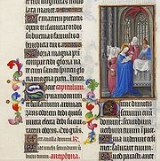
Nunc dimittis

Encyclopedia
The Nunc dimittis /nʊŋk dɪˈmɪtɪs/ (also Song of Simeon or Canticle of Simeon) is a canticle
from a text in the second chapter of Luke
named after its first words in Latin, meaning 'Now dismiss...'.
Simeon
was a devout Jew who, according to the book of Luke, had been promised by the Holy Ghost
that he would not die until he had seen the Saviour. When Mary and Joseph
brought the baby Jesus
to the Temple in Jerusalem
for the ceremony of consecration of the firstborn son
(not the circumcision, but rather after the time of Mary's purification: at least 40 days after the birth), Simeon was there, and he took Jesus into his arms and uttered words rendered variously as follows.
 Original Greek (Novum Testamentum Graece
):
Latin (Vulgate
):
English
(Douay-Rheims, 1582):
English (Book of Common Prayer
, 1662):
English (The Divine Office (Grail Version), 1974)
English (Liturgy of the Hours
, 1975)
English (New Revised Standard Version
, 1989):
), just as Benedictus
and Magnificat
are the traditional Gospel Canticles of Morning Prayer and Evening Prayer respectively. Hence the Nunc Dimittis is found in the liturgical night office of many western denominations, including Evening Prayer
(or Evensong) in the Anglican
Book of Common Prayer
of 1662, Compline (A Late Evening Service) in the Anglican Book of Common Prayer of 1928, and the Night Prayer service in the Anglican Common Worship
, as well as both the Roman Catholic and Lutheran service of Compline. In eastern tradition the canticle is found in Eastern Orthodox
Vespers
. One of the most well-known settings in England is a plainchant theme of Thomas Tallis
.
Among Lutheran churches, the Nunc Dimittis may be sung following the reception of the Eucharist
.
Many composers have set the text to music, usually coupled in the Anglican church with the Magnificat
, as both the Magnificat and the Nunc dimittis are sung (or said) during the Anglican service of Evening Prayer
according to the Book of Common Prayer, 1662, in which the older offices of Vespers (Evening Prayer) and Compline (Night Prayer) were deliberately merged into one service, with both Gospel Canticles employed.
Canticle
A canticle is a hymn taken from the Bible. The term is often expanded to include ancient non-biblical hymns such as the Te Deum and certain psalms used liturgically.-Roman Catholic Church:From the Old Testament, the Roman Breviary takes seven canticles for use at Lauds, as follows:*...
from a text in the second chapter of Luke
Gospel of Luke
The Gospel According to Luke , commonly shortened to the Gospel of Luke or simply Luke, is the third and longest of the four canonical Gospels. This synoptic gospel is an account of the life and ministry of Jesus of Nazareth. It details his story from the events of his birth to his Ascension.The...
named after its first words in Latin, meaning 'Now dismiss...'.
Simeon
Simeon the Righteous
Simeon is the "just and devout" man of Jerusalem who, according to , met the Virgin Mary, Joseph, and Jesus as they entered the Temple to fulfill the requirements of the Law of Moses on the 40th day from Jesus' birth.According to the Biblical account,...
was a devout Jew who, according to the book of Luke, had been promised by the Holy Ghost
Holy Spirit
Holy Spirit is a term introduced in English translations of the Hebrew Bible, but understood differently in the main Abrahamic religions.While the general concept of a "Spirit" that permeates the cosmos has been used in various religions Holy Spirit is a term introduced in English translations of...
that he would not die until he had seen the Saviour. When Mary and Joseph
Saint Joseph
Saint Joseph is a figure in the Gospels, the husband of the Virgin Mary and the earthly father of Jesus Christ ....
brought the baby Jesus
Jesus
Jesus of Nazareth , commonly referred to as Jesus Christ or simply as Jesus or Christ, is the central figure of Christianity...
to the Temple in Jerusalem
Temple in Jerusalem
The Temple in Jerusalem or Holy Temple , refers to one of a series of structures which were historically located on the Temple Mount in the Old City of Jerusalem, the current site of the Dome of the Rock. Historically, these successive temples stood at this location and functioned as the centre of...
for the ceremony of consecration of the firstborn son
Pidyon HaBen
The Pidyon HaBen, or Redemption of the first born son, is a mitzvah in Judaism whereby a Jewish firstborn son is redeemed by use of silver coins from his birth-state of sanctity....
(not the circumcision, but rather after the time of Mary's purification: at least 40 days after the birth), Simeon was there, and he took Jesus into his arms and uttered words rendered variously as follows.
Versions
Novum Testamentum Graece
Novum Testamentum Graece is the Latin name editions of the original Greek-language version of the New Testament.The first printed edition was the Complutensian Polyglot Bible by Cardinal Francisco Jiménez de Cisneros, printed in 1514, but not published until 1520...
):
Latin (Vulgate
Vulgate
The Vulgate is a late 4th-century Latin translation of the Bible. It was largely the work of St. Jerome, who was commissioned by Pope Damasus I in 382 to make a revision of the old Latin translations...
):
- Nunc dimittis servum tuum, Domine, secundum verbum tuum in pace:
- Quia viderunt oculi mei salutare tuum
- Quod parasti ante faciem omnium populorum:
- Lumen ad revelationem gentium, et gloriam plebis tuae Israel.
English
English language
English is a West Germanic language that arose in the Anglo-Saxon kingdoms of England and spread into what was to become south-east Scotland under the influence of the Anglian medieval kingdom of Northumbria...
(Douay-Rheims, 1582):
- Now Thou dost dismiss Thy servant, O Lord, according to Thy word in peace;
- Because my eyes have seen Thy salvation,
- Which Thou hast prepared before the face of all peoples:
- A light to the revelation of the Gentiles, and the glory of Thy people Israel.
English (Book of Common Prayer
Book of Common Prayer
The Book of Common Prayer is the short title of a number of related prayer books used in the Anglican Communion, as well as by the Continuing Anglican, "Anglican realignment" and other Anglican churches. The original book, published in 1549 , in the reign of Edward VI, was a product of the English...
, 1662):
- Lord, now lettest thou thy servant depart in peace : according to thy word.
- For mine eyes have seen : thy salvation,
- Which thou hast prepared : before the face of all people;
- To be a light to lighten the Gentiles : and to be the glory of thy people Israel.
English (The Divine Office (Grail Version), 1974)
- At last, all-powerful Master, +
- you give leave to your servant *
- to go in peace, according to your promise.
- For my eyes have seen your salvation *
- which you have prepared for all nations,
- the light to enlighten the Gentiles *
- and give glory to Israel, your people.
English (Liturgy of the Hours
Liturgy of the hours
The Liturgy of the Hours or Divine Office is the official set of daily prayers prescribed by the Catholic Church to be recited at the canonical hours by the clergy, religious orders, and laity. The Liturgy of the Hours consists primarily of psalms supplemented by hymns and readings...
, 1975)
- Lord, now you let your servant go in peace;
- Your word has been fulfilled.
- My eyes have seen the salvation
- You have prepared in the sight of every people,
- A light to reveal you to the nations and the glory of your people, Israel.
English (New Revised Standard Version
New Revised Standard Version
The New Revised Standard Version of the Bible is an English translation of the Bible released in 1989 in the USA. It is a thorough revision of the Revised Standard Version .There are three editions of the NRSV:...
, 1989):
- Master, now you are dismissing your servant in peace, according to your word;
- for my eyes have seen your salvation,
- which you have prepared in the presence of all peoples,
- a light for revelation to the Gentiles and for glory to your people Israel.
Liturgy and musical settings
The Nunc Dimittis is the traditional 'Gospel Canticle' of Night Prayer (ComplineCompline
Compline is the final church service of the day in the Christian tradition of canonical hours. The English word Compline is derived from the Latin completorium, as Compline is the completion of the working day. The word was first used in this sense about the beginning of the 6th century by St...
), just as Benedictus
Benedictus (Song of Zechariah)
The Benedictus , given in Gospel of , is one of the three canticles in the opening chapters of this Gospel. The Benedictus was the song of thanksgiving uttered by Zechariah on the occasion of the birth of his son, John the Baptist.The whole canticle naturally falls into two parts...
and Magnificat
Magnificat
The Magnificat — also known as the Song of Mary or the Canticle of Mary — is a canticle frequently sung liturgically in Christian church services. It is one of the eight most ancient Christian hymns and perhaps the earliest Marian hymn...
are the traditional Gospel Canticles of Morning Prayer and Evening Prayer respectively. Hence the Nunc Dimittis is found in the liturgical night office of many western denominations, including Evening Prayer
Evening Prayer (Anglican)
Evening Prayer is a liturgy in use in the Anglican Communion and celebrated in the late afternoon or evening...
(or Evensong) in the Anglican
Anglicanism
Anglicanism is a tradition within Christianity comprising churches with historical connections to the Church of England or similar beliefs, worship and church structures. The word Anglican originates in ecclesia anglicana, a medieval Latin phrase dating to at least 1246 that means the English...
Book of Common Prayer
Book of Common Prayer
The Book of Common Prayer is the short title of a number of related prayer books used in the Anglican Communion, as well as by the Continuing Anglican, "Anglican realignment" and other Anglican churches. The original book, published in 1549 , in the reign of Edward VI, was a product of the English...
of 1662, Compline (A Late Evening Service) in the Anglican Book of Common Prayer of 1928, and the Night Prayer service in the Anglican Common Worship
Common Worship
Common Worship is the name given to the series of services authorised by the General Synod of the Church of England and launched on the first Sunday of Advent in 2000. It represents the most recent stage of development of the Liturgical Movement within the Church and is the successor to the...
, as well as both the Roman Catholic and Lutheran service of Compline. In eastern tradition the canticle is found in Eastern Orthodox
Eastern Orthodox Church
The Orthodox Church, officially called the Orthodox Catholic Church and commonly referred to as the Eastern Orthodox Church, is the second largest Christian denomination in the world, with an estimated 300 million adherents mainly in the countries of Belarus, Bulgaria, Cyprus, Georgia, Greece,...
Vespers
Vespers
Vespers is the evening prayer service in the Western Catholic, Eastern Catholic, and Eastern Orthodox, Anglican, and Lutheran liturgies of the canonical hours...
. One of the most well-known settings in England is a plainchant theme of Thomas Tallis
Thomas Tallis
Thomas Tallis was an English composer. Tallis flourished as a church musician in 16th century Tudor England. He occupies a primary place in anthologies of English church music, and is considered among the best of England's early composers. He is honoured for his original voice in English...
.
Among Lutheran churches, the Nunc Dimittis may be sung following the reception of the Eucharist
Eucharist
The Eucharist , also called Holy Communion, the Sacrament of the Altar, the Blessed Sacrament, the Lord's Supper, and other names, is a Christian sacrament or ordinance...
.
Many composers have set the text to music, usually coupled in the Anglican church with the Magnificat
Magnificat
The Magnificat — also known as the Song of Mary or the Canticle of Mary — is a canticle frequently sung liturgically in Christian church services. It is one of the eight most ancient Christian hymns and perhaps the earliest Marian hymn...
, as both the Magnificat and the Nunc dimittis are sung (or said) during the Anglican service of Evening Prayer
Evening Prayer (Anglican)
Evening Prayer is a liturgy in use in the Anglican Communion and celebrated in the late afternoon or evening...
according to the Book of Common Prayer, 1662, in which the older offices of Vespers (Evening Prayer) and Compline (Night Prayer) were deliberately merged into one service, with both Gospel Canticles employed.
Literary settings
- T. H. WhiteT. H. WhiteTerence Hanbury White was an English author best known for his sequence of Arthurian novels, The Once and Future King, first published together in 1958.-Biography:...
novel The Once and Future KingThe Once and Future KingThe Once and Future King is an Arthurian fantasy novel written by T. H. White. It was first published in 1958 and is mostly a composite of earlier works written in a period between 1938 and 1941....
– recitation by Merlyn - T. S. EliotT. S. EliotThomas Stearns "T. S." Eliot OM was a playwright, literary critic, and arguably the most important English-language poet of the 20th century. Although he was born an American he moved to the United Kingdom in 1914 and was naturalised as a British subject in 1927 at age 39.The poem that made his...
poem A Song for Simeon - Karel CapekKarel CapekKarel Čapek was Czech writer of the 20th century.-Biography:Born in 1890 in the Bohemian mountain village of Malé Svatoňovice to an overbearing, emotional mother and a distant yet adored father, Čapek was the youngest of three siblings...
play R.U.R. - Walter MillerWalter M. Miller, Jr.Walter Michael Miller, Jr. was an American science fiction author. Today he is primarily known for A Canticle for Leibowitz, the only novel he published in his lifetime. Prior to its publication he was a prolific writer of short stories.- Biography :Miller was born in New Smyrna Beach, Florida...
, A Canticle for LeibowitzA Canticle for LeibowitzA Canticle for Leibowitz is a post-apocalyptic science fiction novel by American writer Walter M. Miller, Jr., first published in 1960. Set in a Roman Catholic monastery in the desert of the southwestern United States after a devastating nuclear war, the story spans thousands of years as... - John le CarreJohn le CarréDavid John Moore Cornwell , who writes under the name John le Carré, is an author of espionage novels. During the 1950s and the 1960s, Cornwell worked for MI5 and MI6, and began writing novels under the pseudonym "John le Carré"...
novel A Murder of QualityA Murder of QualityA Murder of Quality is the second novel by John le Carré. It follows George Smiley, the most famous of le Carré's recurring characters, in his only book set outside the espionage community.-Plot summary:... - John le CarreJohn le CarréDavid John Moore Cornwell , who writes under the name John le Carré, is an author of espionage novels. During the 1950s and the 1960s, Cornwell worked for MI5 and MI6, and began writing novels under the pseudonym "John le Carré"...
novel Tinker Tailor Soldier Spy – closing theme of TV adaptation - H. W. Brands novel The Strange Death of American Liberalism
External links
- List of available settings at Choral Public Domain LibraryChoral Public Domain LibraryThe Choral Public Domain Library is a sheet music archive which focuses on choral and vocal music in the public domain or otherwise freely available for printing and performing .-Description:...
.