

Apostolic Fathers

Encyclopedia
The Apostolic Fathers are a small number of Early Christian
authors who lived and wrote in the second half of the first century
and the first half of the second century
. They are acknowledged as leaders in the early church
, although their writings were not included in the New Testament
. They include Clement of Rome
, Ignatius
of Antioch
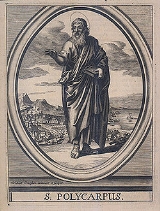
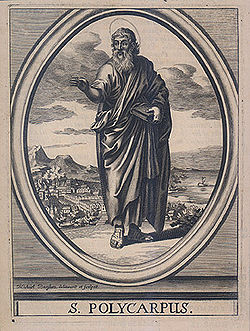
, and Polycarp
of Smyrna
.
The label "Apostolic Fathers" has been applied to them since the seventeenth century
to indicate that they were thought of as being of the generation that had personal contact with the Twelve Apostles. Thus they provide a link between the Apostles—who had personal contact with Jesus
—and the later generations of Church Fathers, which includes the Christian apologists, defenders of orthodoxy
, and developers of doctrine.
, and Polycarp
of Smyrna. In addition, the Didache
and Shepherd of Hermas are usually placed among the writings of the Apostolic Fathers although their authors are unknown.
epistle
in existence outside of the New Testament
. The letter is extremely lengthy, twice as long as the Epistle to the Hebrews
, and it demonstrates the author's familiarity with many books of both the Old Testament
and New Testaments. The epistle repeatedly refers to the Old Testament as scripture and includes numerous references to the Book of Judith. Within the letter, Clement calls on the Christians of Corinth to maintain harmony and order. Tradition identifies the author as St. Clement, the fourth bishop of Rome (third after Saint Peter), and scholarly consensus is overwhelmingly in favor of the letter's authenticity. Early church lists place him as the second or third or as possibly the immediate successor of Saint Peter as bishop of Rome, although another very recent source states that "there is no evidence for monarchical episcopacy in Rome at so early a date".
Second Clement was traditionally ascribed to St. Clement of Rome, but it is now generally considered to have been written later, c 140-160, and therefore could not be the work of St. Clement. Whereas First Clement was an epistle, 2 Clement appears to be a transcript of an oral homily
or sermon
, making it the oldest existing Christian sermon outside of the New Testament
.
. He may have known the Apostle John
directly, and his thought is certainly influenced by the tradition associated with this Apostle. En route to his martyrdom in Rome
, Ignatius wrote a series of letters which have been preserved as an example of the theology
of the earliest Christians
. Important topics addressed in these letters include ecclesiology
, the sacrament
s, the role of bishop
s, and the nature of Biblical Sabbath
. He clearly identifies the local-church hierarchy composed of bishop, presbyters, and deacons and claims to have spoken in some of the churches through the inspiration of the Holy Spirit. He is the second after Clement to mention Paul's epistles.
bishop
of Smyrna
(now İzmir
in Turkey). Irenaeus
wrote that "Polycarp also was not only instructed by the apostles, and conversed with many who had seen the Lord, but was also appointed bishop by apostles in Asia and in the church in Smyrna" and that he himself had, as a boy, listened to "the accounts which (Polycarp) gave of his intercourse with John and with the others who had seen the Lord". The options for this John are John the son of Zebedee
traditionally viewed as the author of the Fourth Gospel, or John the Presbyter
(Lake 1912). Traditional advocates follow Eusebius
in insisting that the apostolic connection of Papius was with John the Evangelist
, and that this John, the author of the Gospel of John
, was the same as the Apostle John. Polycarp, c 156, tried and failed to persuade Anicetus, Bishop of Rome, to have the West celebrate Easter on 14 Nisan, as in the East. He rejected the Bishop's suggestion that the East use the Western date. In 155, the Smyrnans demanded Polycarp's execution as a Christian, and he died a martyr
. His story has it that the flames built to kill him refused to burn him, and that when he was stabbed to death, so much blood issued from his body that it quenched the flames around him. Church Father Irenaeus
was one of Polycarp's students. Polycarp is recognized as a saint
in both the Roman Catholic
and Eastern Orthodox
churches.
: "Teaching") is a brief early Christian
treatise
, dated by most scholars to the early 2nd century. It contains instructions for Christian communities. The text, parts of which may have constituted the first written catechism
, has three main sections dealing with Christian lessons, rituals such as baptism
and eucharist
, and Church organization. It was considered by some of the Church Fathers
as part of the New Testament
but rejected as spurious or non-canonical by others, Scholars knew of the Didache through references in other texts, but the text itself had been lost. It was rediscovered in 1873.
by some of the early Church fathers
, such as Irenaeus
and Tertullian
. It was written in Rome in the Greek language. The Shepherd had great authority in the 2nd and 3rd centuries. The work comprises five visions, twelve mandates, and ten parables.
It relies on allegory and pays special attention to the Church, calling the faithful to repent of the sins that have harmed it.
 The "Apostolic Fathers" are distinguished from other Christian authors of this same period in that their practices and theology largely fell within those developing traditions of Pauline Christianity
or Proto-orthodox Christianity
that became the mainstream. They represent a tradition of early Christianity shared by many different churches across cultural, ethnic, and linguistic differences. The tradition they represent holds the Jewish Scriptures to be inspired by God (against Marcionism
) and holds that the Jewish prophets point to the actual flesh and blood of Jesus through which both Jew and Gentile are saved. Furthermore, they present the picture of an organized Church made up of many different cross-cultural, sister churches sharing one apostolic tradition. Their ecclesiology, adoption of some Judaic values, and emphasis upon the historical nature of Jesus Christ stand in stark contrast to the various ideologies of more paganized Christianities, on the one hand, and more Jewish Christianities
on the other. By the end of the 4th century
, mainstream Nicene Christianity, dominated by the interpretation of Paul of Tarsus
and teetering midway between Gentile paganism and rabbinical Judaism, was in a position, being the State church of the Roman Empire
, to declare significantly different interpretations as heretical
.
Other texts written much later are not considered apostolic writings. They were actively denounced from the very beginning by men such as Ignatius, Bishop of Antioch, and the writer of the canonical First Epistle of John
as being "anti-christ" and contrary to the tradition received from the apostles and eye-witnesses of Jesus Christ. The texts presenting alternative Christianities were then actively suppressed in the following centuries and many are now "lost" works, the contents of which can only be speculated.
The writings of the Apostolic Fathers are in a number of genres, some, e.g. the writings of Clement of Rome are letters (called epistles), others relate historical events, e.g. the Martyrdom of Polycarp
, and one (the Didache
) is a guide for ethical and liturgical practice.
, his SS. Patrum qui temporibus apostolicis floruerunt opera ("Works of the holy fathers who flourished in the apostolic times"), which title was abbreviated to Bibliotheca Patrum Apostolicorum by L. J. Ittig in his edition (Leipzig, 1699) of the same writings. Since then the term has been universally used, especially by Roman Catholic writers.
trope, and thus a possible motivation for its use. Christians who believe that a Great Apostasy
took place early in the church's history are particularly unlikely to employ this term. These ideological descendants of the Radical Reformation
must choose between believing that the Scriptures were corrupted by this "Apostate Church" or that the Scriptures were somehow preserved and canonized by this "Apostate Church." In Protestant theology the term "Apostolic Fathers" is also less used and the writings are less frequently studied (but see Paleo-Orthodoxy
), leaving more room for hermeneutic variance from these first and early-2nd century Christian leaders' perspective.
that are not classed in those of the Apostolic Fathers include the writings of the desposyni
, the apocrypha
(including apocryphal gospels), much of the pseudepigrapha, and the writings of unorthodox leaders, or heretics such as Marcion, an anti-Judaic thinker, and Valentinius, a pagan-Christian syncretist. The apocryphal gospels and pseudepigrapha are, for the most part, later writings that seem to have less historical accuracy than the canonical scriptures. Most of these writings depict a Christianized form of paganism as opposed to a Christianized form of Judaism. For the part of the heretics, much of what is known about them comes from the Apostolic Fathers' and Church Fathers
' arguments against them; this information was once thought to be highly inaccurate due to the biases of these church writers. In light of the discovery of the Nag Hammadi library
, however, most of the information about these groups as expressed by early church fathers can be validated as being incomplete and biased, but quite accurate.
, including Justin Martyr
, Irenaeus
, and Tertullian
. These are considered Apologists. A small number of other authors, now only known in fragments, such as Papias and Hegesippus
, were more concerned with the apostolic continuity of the individual churches and their histories. Although some of the minor opinions expounded by the Apostolic Fathers are no longer considered entirely orthodox, their writings provide important data regarding a strain of early Christianity which remains largely true to its Jewish roots while including both non-Jewish and Jewish believers as being viable members of the organized church they depict.
Most or all of these works were originally written in Greek. Older English translations of these works can be found online in the Ante-Nicene Fathers
series on the Christian Classics Ethereal Library website. Published English translations have also been made by various scholars of early Christianity, such as J.B. Lightfoot
, Kirsopp Lake
, Bart D. Ehrman
and Michael W. Holmes
.
Greek text editions:
Early Christianity
Early Christianity is generally considered as Christianity before 325. The New Testament's Book of Acts and Epistle to the Galatians records that the first Christian community was centered in Jerusalem and its leaders included James, Peter and John....
authors who lived and wrote in the second half of the first century
Christianity in the 1st century
The earliest followers of Jesus composed an apocalyptic, Jewish sect, which historians refer to as Jewish Christianity. The Apostles and others following the Great Commission's decree to spread the teachings of Jesus to "all nations," had great success spreading the religion to gentiles. Peter,...
and the first half of the second century
Christianity in the 2nd century
The 2nd century of Christianity was largely the time of the Apostolic Fathers who were the students of the apostles of Jesus, though there is some overlap as John the Apostle may have survived into the 2nd century and the early Apostolic Father Clement of Rome is said to have died at the end of the...
. They are acknowledged as leaders in the early church
Early Christianity
Early Christianity is generally considered as Christianity before 325. The New Testament's Book of Acts and Epistle to the Galatians records that the first Christian community was centered in Jerusalem and its leaders included James, Peter and John....
, although their writings were not included in the New Testament
Development of the New Testament canon
The Canon of the New Testament is the set of books Christians regard as divinely inspired and constituting the New Testament of the Christian Bible. For most, it is an agreed-upon list of twenty-seven books that includes the Canonical Gospels, Acts, letters of the Apostles, and Revelation...
. They include Clement of Rome
Rome
Rome is the capital of Italy and the country's largest and most populated city and comune, with over 2.7 million residents in . The city is located in the central-western portion of the Italian Peninsula, on the Tiber River within the Lazio region of Italy.Rome's history spans two and a half...
, Ignatius
Ignatius of Antioch
Ignatius of Antioch was among the Apostolic Fathers, was the third Bishop of Antioch, and was a student of John the Apostle. En route to his martyrdom in Rome, Ignatius wrote a series of letters which have been preserved as an example of very early Christian theology...
of Antioch
Antioch
Antioch on the Orontes was an ancient city on the eastern side of the Orontes River. It is near the modern city of Antakya, Turkey.Founded near the end of the 4th century BC by Seleucus I Nicator, one of Alexander the Great's generals, Antioch eventually rivaled Alexandria as the chief city of the...
, and Polycarp
Polycarp
Saint Polycarp was a 2nd century Christian bishop of Smyrna. According to the Martyrdom of Polycarp, he died a martyr, bound and burned at the stake, then stabbed when the fire failed to touch him...
of Smyrna
Smyrna
Smyrna was an ancient city located at a central and strategic point on the Aegean coast of Anatolia. Thanks to its advantageous port conditions, its ease of defence and its good inland connections, Smyrna rose to prominence. The ancient city is located at two sites within modern İzmir, Turkey...
.
The label "Apostolic Fathers" has been applied to them since the seventeenth century
Christianity in the 17th century
The history of Christianity in the 17th century showed both deep conflict and new tolerance. The Enlightenment grew to challenge Christianity as a whole, generally elevated human reason above divine revelation, and down-graded religious authorities such as the Papacy based on it...
to indicate that they were thought of as being of the generation that had personal contact with the Twelve Apostles. Thus they provide a link between the Apostles—who had personal contact with Jesus
Jesus
Jesus of Nazareth , commonly referred to as Jesus Christ or simply as Jesus or Christ, is the central figure of Christianity...
—and the later generations of Church Fathers, which includes the Christian apologists, defenders of orthodoxy
Orthodoxy
The word orthodox, from Greek orthos + doxa , is generally used to mean the adherence to accepted norms, more specifically to creeds, especially in religion...
, and developers of doctrine.
Apostolic Fathers and their works
Famous Apostolic Fathers include St. Clement of Rome (fl. 96), St. Ignatius of AntiochIgnatius of Antioch
Ignatius of Antioch was among the Apostolic Fathers, was the third Bishop of Antioch, and was a student of John the Apostle. En route to his martyrdom in Rome, Ignatius wrote a series of letters which have been preserved as an example of very early Christian theology...
, and Polycarp
Polycarp
Saint Polycarp was a 2nd century Christian bishop of Smyrna. According to the Martyrdom of Polycarp, he died a martyr, bound and burned at the stake, then stabbed when the fire failed to touch him...
of Smyrna. In addition, the Didache
Didache
The Didache or The Teaching of the Twelve Apostles is a brief early Christian treatise, dated by most scholars to the late first or early 2nd century...
and Shepherd of Hermas are usually placed among the writings of the Apostolic Fathers although their authors are unknown.
Clement of Rome
Clement of Rome's first epistle, 1 Clement (c 96), was copied and widely read and is generally considered to be the oldest ChristianChristian
A Christian is a person who adheres to Christianity, an Abrahamic, monotheistic religion based on the life and teachings of Jesus of Nazareth as recorded in the Canonical gospels and the letters of the New Testament...
epistle
Epistle
An epistle is a writing directed or sent to a person or group of people, usually an elegant and formal didactic letter. The epistle genre of letter-writing was common in ancient Egypt as part of the scribal-school writing curriculum. The letters in the New Testament from Apostles to Christians...
in existence outside of the New Testament
New Testament
The New Testament is the second major division of the Christian biblical canon, the first such division being the much longer Old Testament....
. The letter is extremely lengthy, twice as long as the Epistle to the Hebrews
Epistle to the Hebrews
The Epistle to the Hebrews is one of the books in the New Testament. Its author is not known.The primary purpose of the Letter to the Hebrews is to exhort Christians to persevere in the face of persecution. The central thought of the entire Epistle is the doctrine of the Person of Christ and his...
, and it demonstrates the author's familiarity with many books of both the Old Testament
Old Testament
The Old Testament, of which Christians hold different views, is a Christian term for the religious writings of ancient Israel held sacred and inspired by Christians which overlaps with the 24-book canon of the Masoretic Text of Judaism...
and New Testaments. The epistle repeatedly refers to the Old Testament as scripture and includes numerous references to the Book of Judith. Within the letter, Clement calls on the Christians of Corinth to maintain harmony and order. Tradition identifies the author as St. Clement, the fourth bishop of Rome (third after Saint Peter), and scholarly consensus is overwhelmingly in favor of the letter's authenticity. Early church lists place him as the second or third or as possibly the immediate successor of Saint Peter as bishop of Rome, although another very recent source states that "there is no evidence for monarchical episcopacy in Rome at so early a date".
Second Clement was traditionally ascribed to St. Clement of Rome, but it is now generally considered to have been written later, c 140-160, and therefore could not be the work of St. Clement. Whereas First Clement was an epistle, 2 Clement appears to be a transcript of an oral homily
Homily
A homily is a commentary that follows a reading of scripture. In Catholic, Anglican, Lutheran, and Eastern Orthodox Churches, a homily is usually given during Mass at the end of the Liturgy of the Word...
or sermon
Sermon
A sermon is an oration by a prophet or member of the clergy. Sermons address a Biblical, theological, religious, or moral topic, usually expounding on a type of belief, law or behavior within both past and present contexts...
, making it the oldest existing Christian sermon outside of the New Testament
New Testament
The New Testament is the second major division of the Christian biblical canon, the first such division being the much longer Old Testament....
.
Ignatius of Antioch
Saint Ignatius of Antioch (also known as Theophorus, Greek for God-bearer) (c 35-110) was bishop of AntiochPatriarch of Antioch
Patriarch of Antioch is a traditional title held by the Bishop of Antioch. As the traditional "overseer" of the first gentile Christian community, the position has been of prime importance in the church from its earliest period...
. He may have known the Apostle John
John the Apostle
John the Apostle, John the Apostle, John the Apostle, (Aramaic Yoħanna, (c. 6 - c. 100) was one of the Twelve Apostles of Jesus. He was the son of Zebedee and Salome, and brother of James, another of the Twelve Apostles...
directly, and his thought is certainly influenced by the tradition associated with this Apostle. En route to his martyrdom in Rome
Rome
Rome is the capital of Italy and the country's largest and most populated city and comune, with over 2.7 million residents in . The city is located in the central-western portion of the Italian Peninsula, on the Tiber River within the Lazio region of Italy.Rome's history spans two and a half...
, Ignatius wrote a series of letters which have been preserved as an example of the theology
Christian theology
- Divisions of Christian theology :There are many methods of categorizing different approaches to Christian theology. For a historical analysis, see the main article on the History of Christian theology.- Sub-disciplines :...
of the earliest Christians
Early Christianity
Early Christianity is generally considered as Christianity before 325. The New Testament's Book of Acts and Epistle to the Galatians records that the first Christian community was centered in Jerusalem and its leaders included James, Peter and John....
. Important topics addressed in these letters include ecclesiology
Ecclesiology
Today, ecclesiology usually refers to the theological study of the Christian church. However when the word was coined in the late 1830s, it was defined as the science of the building and decoration of churches and it is still, though rarely, used in this sense.In its theological sense, ecclesiology...
, the sacrament
Sacrament
A sacrament is a sacred rite recognized as of particular importance and significance. There are various views on the existence and meaning of such rites.-General definitions and terms:...
s, the role of bishop
Bishop
A bishop is an ordained or consecrated member of the Christian clergy who is generally entrusted with a position of authority and oversight. Within the Catholic Church, Eastern Orthodox, Oriental Orthodox Churches, in the Assyrian Church of the East, in the Independent Catholic Churches, and in the...
s, and the nature of Biblical Sabbath
Biblical Sabbath
Sabbath in the Bible is usually a weekly day of rest and time of worship. The Sabbath is first mentioned in the Genesis creation narrative. The seventh day is there set aside as a day of rest—the Sabbath. It is observed differently in Judaism and Christianity and informs a similar occasion in...
. He clearly identifies the local-church hierarchy composed of bishop, presbyters, and deacons and claims to have spoken in some of the churches through the inspiration of the Holy Spirit. He is the second after Clement to mention Paul's epistles.
Polycarp of Smyrna
Saint Polycarp of Smyrna (c 69- ca. 155) was a ChristianChristianity
Christianity is a monotheistic religion based on the life and teachings of Jesus as presented in canonical gospels and other New Testament writings...
bishop
Bishop
A bishop is an ordained or consecrated member of the Christian clergy who is generally entrusted with a position of authority and oversight. Within the Catholic Church, Eastern Orthodox, Oriental Orthodox Churches, in the Assyrian Church of the East, in the Independent Catholic Churches, and in the...
of Smyrna
Smyrna
Smyrna was an ancient city located at a central and strategic point on the Aegean coast of Anatolia. Thanks to its advantageous port conditions, its ease of defence and its good inland connections, Smyrna rose to prominence. The ancient city is located at two sites within modern İzmir, Turkey...
(now İzmir
Izmir
Izmir is a large metropolis in the western extremity of Anatolia. The metropolitan area in the entire Izmir Province had a population of 3.35 million as of 2010, making the city third most populous in Turkey...
in Turkey). Irenaeus
Irenaeus
Saint Irenaeus , was Bishop of Lugdunum in Gaul, then a part of the Roman Empire . He was an early church father and apologist, and his writings were formative in the early development of Christian theology...
wrote that "Polycarp also was not only instructed by the apostles, and conversed with many who had seen the Lord, but was also appointed bishop by apostles in Asia and in the church in Smyrna" and that he himself had, as a boy, listened to "the accounts which (Polycarp) gave of his intercourse with John and with the others who had seen the Lord". The options for this John are John the son of Zebedee
John the Apostle
John the Apostle, John the Apostle, John the Apostle, (Aramaic Yoħanna, (c. 6 - c. 100) was one of the Twelve Apostles of Jesus. He was the son of Zebedee and Salome, and brother of James, another of the Twelve Apostles...
traditionally viewed as the author of the Fourth Gospel, or John the Presbyter
John the Presbyter
John the Presbyter is an obscure figure of the early Church who is either distinguished from or identified with the Apostle John, by some also John the Divine. He appears in fragments from the church father Papias of Hierapolis as one of the author's sources and is first unequivocally distinguished...
(Lake 1912). Traditional advocates follow Eusebius
Eusebius of Caesarea
Eusebius of Caesarea also called Eusebius Pamphili, was a Roman historian, exegete and Christian polemicist. He became the Bishop of Caesarea in Palestine about the year 314. Together with Pamphilus, he was a scholar of the Biblical canon...
in insisting that the apostolic connection of Papius was with John the Evangelist
John the Evangelist
Saint John the Evangelist is the conventional name for the author of the Gospel of John...
, and that this John, the author of the Gospel of John
Gospel of John
The Gospel According to John , commonly referred to as the Gospel of John or simply John, and often referred to in New Testament scholarship as the Fourth Gospel, is an account of the public ministry of Jesus...
, was the same as the Apostle John. Polycarp, c 156, tried and failed to persuade Anicetus, Bishop of Rome, to have the West celebrate Easter on 14 Nisan, as in the East. He rejected the Bishop's suggestion that the East use the Western date. In 155, the Smyrnans demanded Polycarp's execution as a Christian, and he died a martyr
Martyr
A martyr is somebody who suffers persecution and death for refusing to renounce, or accept, a belief or cause, usually religious.-Meaning:...
. His story has it that the flames built to kill him refused to burn him, and that when he was stabbed to death, so much blood issued from his body that it quenched the flames around him. Church Father Irenaeus
Irenaeus
Saint Irenaeus , was Bishop of Lugdunum in Gaul, then a part of the Roman Empire . He was an early church father and apologist, and his writings were formative in the early development of Christian theology...
was one of Polycarp's students. Polycarp is recognized as a saint
Saint
A saint is a holy person. In various religions, saints are people who are believed to have exceptional holiness.In Christian usage, "saint" refers to any believer who is "in Christ", and in whom Christ dwells, whether in heaven or in earth...
in both the Roman Catholic
Roman Catholic Church
The Catholic Church, also known as the Roman Catholic Church, is the world's largest Christian church, with over a billion members. Led by the Pope, it defines its mission as spreading the gospel of Jesus Christ, administering the sacraments and exercising charity...
and Eastern Orthodox
Eastern Orthodox Church
The Orthodox Church, officially called the Orthodox Catholic Church and commonly referred to as the Eastern Orthodox Church, is the second largest Christian denomination in the world, with an estimated 300 million adherents mainly in the countries of Belarus, Bulgaria, Cyprus, Georgia, Greece,...
churches.
Didache
The Didache (Koine GreekKoine Greek
Koine Greek is the universal dialect of the Greek language spoken throughout post-Classical antiquity , developing from the Attic dialect, with admixture of elements especially from Ionic....
: "Teaching") is a brief early Christian
Early Christianity
Early Christianity is generally considered as Christianity before 325. The New Testament's Book of Acts and Epistle to the Galatians records that the first Christian community was centered in Jerusalem and its leaders included James, Peter and John....
treatise
Treatise
A treatise is a formal and systematic written discourse on some subject, generally longer and treating it in greater depth than an essay, and more concerned with investigating or exposing the principles of the subject.-Noteworthy treatises:...
, dated by most scholars to the early 2nd century. It contains instructions for Christian communities. The text, parts of which may have constituted the first written catechism
Catechism
A catechism , i.e. to indoctrinate) is a summary or exposition of doctrine, traditionally used in Christian religious teaching from New Testament times to the present...
, has three main sections dealing with Christian lessons, rituals such as baptism
Baptism
In Christianity, baptism is for the majority the rite of admission , almost invariably with the use of water, into the Christian Church generally and also membership of a particular church tradition...
and eucharist
Eucharist
The Eucharist , also called Holy Communion, the Sacrament of the Altar, the Blessed Sacrament, the Lord's Supper, and other names, is a Christian sacrament or ordinance...
, and Church organization. It was considered by some of the Church Fathers
Church Fathers
The Church Fathers, Early Church Fathers, Christian Fathers, or Fathers of the Church were early and influential theologians, eminent Christian teachers and great bishops. Their scholarly works were used as a precedent for centuries to come...
as part of the New Testament
New Testament
The New Testament is the second major division of the Christian biblical canon, the first such division being the much longer Old Testament....
but rejected as spurious or non-canonical by others, Scholars knew of the Didache through references in other texts, but the text itself had been lost. It was rediscovered in 1873.
Shepherd of Hermas
The Shepherd of Hermas (2nd century) was popular in the early church and even considered scripturalBible
The Bible refers to any one of the collections of the primary religious texts of Judaism and Christianity. There is no common version of the Bible, as the individual books , their contents and their order vary among denominations...
by some of the early Church fathers
Church Fathers
The Church Fathers, Early Church Fathers, Christian Fathers, or Fathers of the Church were early and influential theologians, eminent Christian teachers and great bishops. Their scholarly works were used as a precedent for centuries to come...
, such as Irenaeus
Irenaeus
Saint Irenaeus , was Bishop of Lugdunum in Gaul, then a part of the Roman Empire . He was an early church father and apologist, and his writings were formative in the early development of Christian theology...
and Tertullian
Tertullian
Quintus Septimius Florens Tertullianus, anglicised as Tertullian , was a prolific early Christian author from Carthage in the Roman province of Africa. He is the first Christian author to produce an extensive corpus of Latin Christian literature. He also was a notable early Christian apologist and...
. It was written in Rome in the Greek language. The Shepherd had great authority in the 2nd and 3rd centuries. The work comprises five visions, twelve mandates, and ten parables.
It relies on allegory and pays special attention to the Church, calling the faithful to repent of the sins that have harmed it.
Apostolic authority
Pauline Christianity
Pauline Christianity is a term used to refer to the Christianity associated with the beliefs and doctrines espoused by Paul of Tarsus through his writings. Most of orthodox Christianity relies heavily on these teachings and considers them to be amplifications and explanations of the teachings of...
or Proto-orthodox Christianity
Proto-orthodox Christianity
Proto-orthodox Christianity is a term, coined by New Testament scholar Bart D. Ehrman, used to describe the Early Christian movement which was the precursor of Christian orthodoxy...
that became the mainstream. They represent a tradition of early Christianity shared by many different churches across cultural, ethnic, and linguistic differences. The tradition they represent holds the Jewish Scriptures to be inspired by God (against Marcionism
Marcionism
Marcionism was an Early Christian dualist belief system that originated in the teachings of Marcion of Sinope at Rome around the year 144; see also Christianity in the 2nd century....
) and holds that the Jewish prophets point to the actual flesh and blood of Jesus through which both Jew and Gentile are saved. Furthermore, they present the picture of an organized Church made up of many different cross-cultural, sister churches sharing one apostolic tradition. Their ecclesiology, adoption of some Judaic values, and emphasis upon the historical nature of Jesus Christ stand in stark contrast to the various ideologies of more paganized Christianities, on the one hand, and more Jewish Christianities
Jewish Christians
Jewish Christians is a term which appears in historical texts contrasting Christians of Jewish origin with Gentile Christians, both in discussion of the New Testament church and the second and following centuries....
on the other. By the end of the 4th century
Christianity in the 4th century
Christianity in the 4th century was dominated by Constantine the Great, and the First Council of Nicea of 325, which was the beginning of the period of the First seven Ecumenical Councils and the attempt to reach an orthodox consensus and to establish a unified Christendom as the State church of...
, mainstream Nicene Christianity, dominated by the interpretation of Paul of Tarsus
Paul of Tarsus
Paul the Apostle , also known as Saul of Tarsus, is described in the Christian New Testament as one of the most influential early Christian missionaries, with the writings ascribed to him by the church forming a considerable portion of the New Testament...
and teetering midway between Gentile paganism and rabbinical Judaism, was in a position, being the State church of the Roman Empire
State church of the Roman Empire
The state church of the Roman Empire was a Christian institution organized within the Roman Empire during the 4th century that came to represent the Empire's sole authorized religion. Both the Roman Catholic Church and the Eastern Orthodox churches claim to be the historical continuation of this...
, to declare significantly different interpretations as heretical
Heresy
Heresy is a controversial or novel change to a system of beliefs, especially a religion, that conflicts with established dogma. It is distinct from apostasy, which is the formal denunciation of one's religion, principles or cause, and blasphemy, which is irreverence toward religion...
.
Other texts written much later are not considered apostolic writings. They were actively denounced from the very beginning by men such as Ignatius, Bishop of Antioch, and the writer of the canonical First Epistle of John
First Epistle of John
The First Epistle of John, often referred to as First John and written 1 John, is a book of the New Testament. This fourth catholic or "general" epistle is attributed to John the Evangelist, traditionally thought to be the author of the Gospel of John and the other two Epistles of John. This...
as being "anti-christ" and contrary to the tradition received from the apostles and eye-witnesses of Jesus Christ. The texts presenting alternative Christianities were then actively suppressed in the following centuries and many are now "lost" works, the contents of which can only be speculated.
The writings of the Apostolic Fathers are in a number of genres, some, e.g. the writings of Clement of Rome are letters (called epistles), others relate historical events, e.g. the Martyrdom of Polycarp
Martyrdom of Polycarp
The Martyrdom of Polycarp is one of the works of the Apostolic Fathers, and as such is one of the very few eyewitness writings from the actual age of the persecutions. The work details Polycarp's death at the age of 86 years old, at the hands of the Romans, in the 2nd century AD...
, and one (the Didache
Didache
The Didache or The Teaching of the Twelve Apostles is a brief early Christian treatise, dated by most scholars to the late first or early 2nd century...
) is a guide for ethical and liturgical practice.
Apostolic connection
The early Church relied on apostolic authority in separating orthodox from unorthodox works, teachings, and practices. The four Gospels were each assigned, directly or indirectly to an apostle, as were certain other New Testament books. Earlier church fathers were also associated with apostles: Clement with Peter (associated closely with Rome) and with Paul (as the Clement Paul wrote about in Philippians 4:3), Papias and Polycarp with John (associated with Asia Minor).Origin of term
According to the Catholic Encyclopedia, the use of the term "Apostolic Fathers" can be traced to a 1672 title of Jean-Baptiste CotelierJean-Baptiste Cotelier
Jean-Baptiste Cotelier or Cotelerius was a Patristic scholar and Catholic theologian.-Life:...
, his SS. Patrum qui temporibus apostolicis floruerunt opera ("Works of the holy fathers who flourished in the apostolic times"), which title was abbreviated to Bibliotheca Patrum Apostolicorum by L. J. Ittig in his edition (Leipzig, 1699) of the same writings. Since then the term has been universally used, especially by Roman Catholic writers.
Opposition to term
Not all Christians employ the term "Apostolic Fathers". The authority resonant in the phrase suggests that these writers provide the authentic historical connections to the apostolic generation. For those Christians for whom Church tradition is of comparable weight with Scripture, this is a helpful apologeticApologetics
Apologetics is the discipline of defending a position through the systematic use of reason. Early Christian writers Apologetics (from Greek ἀπολογία, "speaking in defense") is the discipline of defending a position (often religious) through the systematic use of reason. Early Christian writers...
trope, and thus a possible motivation for its use. Christians who believe that a Great Apostasy
Great Apostasy
The Great Apostasy is a term used by some religious groups to describe a general fallen state of traditional Christianity, especially the Papacy, because it allowed the traditional Roman mysteries and deities of solar monism such as Mithras and Sol Invictus and idol worship back into the church,...
took place early in the church's history are particularly unlikely to employ this term. These ideological descendants of the Radical Reformation
Radical Reformation
The Radical Reformation was a 16th century response to what was believed to be both the corruption in the Roman Catholic Church and the expanding Magisterial Protestant movement led by Martin Luther and many others. Beginning in Germany and Switzerland, the Radical Reformation birthed many radical...
must choose between believing that the Scriptures were corrupted by this "Apostate Church" or that the Scriptures were somehow preserved and canonized by this "Apostate Church." In Protestant theology the term "Apostolic Fathers" is also less used and the writings are less frequently studied (but see Paleo-Orthodoxy
Paleo-Orthodoxy
Paleo-orthodoxy is a broad Christian theological movement of the late 20th and early 21st centuries which focuses on the consensual understanding of the faith among the Ecumenical Councils and Church Fathers...
), leaving more room for hermeneutic variance from these first and early-2nd century Christian leaders' perspective.
Works by these authors that are missing today
Only some writings by these church leaders are extant. Other writings did not survive and exist only as references, in quotations and excerpts, or as literal fragments of parchment or papyrus. These other writings, being alleged quotes from the apostolic fathers, are often stylistically different and sometimes address issues not addressed in the canonical New Testament and the extant writings of the apostolic fathers.Works by contemporaneous authors not considered Apostolic Fathers
The writings from the early Christian tradition during the time of the Roman EmpireRoman Empire
The Roman Empire was the post-Republican period of the ancient Roman civilization, characterised by an autocratic form of government and large territorial holdings in Europe and around the Mediterranean....
that are not classed in those of the Apostolic Fathers include the writings of the desposyni
Desposyni
The term Desposyni refers to alleged blood relatives of Jesus. The term was coined by Sextus Julius Africanus, a writer of the early 3rd century. Some scholars argue that Jesus' relatives held positions of special honor in the Early Christian Church...
, the apocrypha
Apocrypha
The term apocrypha is used with various meanings, including "hidden", "esoteric", "spurious", "of questionable authenticity", ancient Chinese "revealed texts and objects" and "Christian texts that are not canonical"....
(including apocryphal gospels), much of the pseudepigrapha, and the writings of unorthodox leaders, or heretics such as Marcion, an anti-Judaic thinker, and Valentinius, a pagan-Christian syncretist. The apocryphal gospels and pseudepigrapha are, for the most part, later writings that seem to have less historical accuracy than the canonical scriptures. Most of these writings depict a Christianized form of paganism as opposed to a Christianized form of Judaism. For the part of the heretics, much of what is known about them comes from the Apostolic Fathers' and Church Fathers
Church Fathers
The Church Fathers, Early Church Fathers, Christian Fathers, or Fathers of the Church were early and influential theologians, eminent Christian teachers and great bishops. Their scholarly works were used as a precedent for centuries to come...
' arguments against them; this information was once thought to be highly inaccurate due to the biases of these church writers. In light of the discovery of the Nag Hammadi library
Nag Hammadi library
The Nag Hammadi library is a collection of early Christian Gnostic texts discovered near the Upper Egyptian town of Nag Hammadi in 1945. That year, twelve leather-bound papyrus codices buried in a sealed jar were found by a local peasant named Mohammed Ali Samman...
, however, most of the information about these groups as expressed by early church fathers can be validated as being incomplete and biased, but quite accurate.
Relationship to orthodoxy
Within the Pauline tradition, but after the time of the Apostolic Fathers proper, some authors addressed their works to people beyond the Christian community and defended the Christian religion against paganismPaganism
Paganism is a blanket term, typically used to refer to non-Abrahamic, indigenous polytheistic religious traditions....
, including Justin Martyr
Justin Martyr
Justin Martyr, also known as just Saint Justin , was an early Christian apologist. Most of his works are lost, but two apologies and a dialogue survive. He is considered a saint by the Roman Catholic Church and the Eastern Orthodox Church....
, Irenaeus
Irenaeus
Saint Irenaeus , was Bishop of Lugdunum in Gaul, then a part of the Roman Empire . He was an early church father and apologist, and his writings were formative in the early development of Christian theology...
, and Tertullian
Tertullian
Quintus Septimius Florens Tertullianus, anglicised as Tertullian , was a prolific early Christian author from Carthage in the Roman province of Africa. He is the first Christian author to produce an extensive corpus of Latin Christian literature. He also was a notable early Christian apologist and...
. These are considered Apologists. A small number of other authors, now only known in fragments, such as Papias and Hegesippus
Hegesippus (chronicler)
Saint Hegesippus , was a Christian chronicler of the early Church who may have been a Jewish convert and certainly wrote against heresies of the Gnostics and of Marcion...
, were more concerned with the apostolic continuity of the individual churches and their histories. Although some of the minor opinions expounded by the Apostolic Fathers are no longer considered entirely orthodox, their writings provide important data regarding a strain of early Christianity which remains largely true to its Jewish roots while including both non-Jewish and Jewish believers as being viable members of the organized church they depict.
List of works
- The Epistle to DiognetusEpistle to DiognetusThe Epistle of Mathetes to Diognetus is probably the earliest example of Christian apologetics, writings defending Christianity from its accusers...
(this one is hard to date and might also be of a later date) - The First Epistle of ClementFirst Epistle of ClementThe First Epistle of Clement, is a letter addressed to the Christians in the city of Corinth. The letter dates from the late 1st or early 2nd century, and ranks with Didache as one of the earliest — if not the earliest — of extant Christian documents outside the canonical New Testament...
- The Second Epistle of ClementSecond Epistle of ClementThe Second Epistle of Clement, often referred to as 2 Clement, is an early Christian writing....
(not actually written by Clement, but still a very early writing) - The DidacheDidacheThe Didache or The Teaching of the Twelve Apostles is a brief early Christian treatise, dated by most scholars to the late first or early 2nd century...
- The Epistle of BarnabasEpistle of BarnabasThe Epistle of Barnabas is a Greek epistle containing twenty-one chapters, preserved complete in the 4th century Codex Sinaiticus where it appears at the end of the New Testament...
- Seven Epistles of Ignatius (the longer forms of these Epistles, and those beyond the seven, are widely considered later emendations and forgeries)
- The Epistle of Polycarp
- The Martyrdom of Polycarp
- The Shepherd of HermasThe Shepherd of HermasThe Shepherd of Hermas is a Christian literary work of the 1st or 2nd century, considered a valuable book by many Christians, and considered canonical scripture by some of the early Church fathers such as Irenaeus. The Shepherd had great authority in the 2nd and 3rd centuries...
- Fragments of the writings of Papias, which have survived as quotations in later writers
- One short fragment of a writing by Quadratus of AthensQuadratus of AthensSaint Quadratus of Athens is said to have been the first of the Christian apologists. He is said by Eusebius of Caesarea to have been a disciple of the Apostles...
Most or all of these works were originally written in Greek. Older English translations of these works can be found online in the Ante-Nicene Fathers
Ante-Nicene Fathers
The Ante-Nicene Fathers, subtitled "The Writings of the Fathers Down to A.D. 325", is a collection of books in 10 volumes containing English translations of the majority of Early Christian writings. The period covers the beginning of Christianity until before the promulgation of the Nicene Creed...
series on the Christian Classics Ethereal Library website. Published English translations have also been made by various scholars of early Christianity, such as J.B. Lightfoot
Joseph Barber Lightfoot
Joseph Barber Lightfoot was an English theologian and Bishop of Durham, usually known as J.B. Lightfoot....
, Kirsopp Lake
Kirsopp Lake
Kirsopp Lake was a New Testament scholar and Winn Professor of Ecclesiastical History at Harvard Divinity School. He had an uncommon breadth of interests, publishing definitive monographs in New Testament textual criticism, Greek palaeography, theology, and archaeology...
, Bart D. Ehrman
Bart D. Ehrman
Bart D. Ehrman is an American New Testament scholar, currently the James A. Gray Distinguished Professor of Religious Studies at the University of North Carolina at Chapel Hill....
and Michael W. Holmes
Michael W. Holmes
Michael W. Holmes is currently Chair of the Department of Biblical and Theological Studies at Bethel University in St. Paul, Minnesota. His primary research areas are in New Testament textual criticism and the Apostolic Fathers.-Publications:* The Apostolic Fathers: Greek Texts and English...
.
Greek text editions:
- The Apostolic Fathers. Vol. 1. I Clement. II Clement. Ignatius. Polycarp. Didache. Barnabas. Loeb Classical LibraryLoeb Classical LibraryThe Loeb Classical Library is a series of books, today published by Harvard University Press, which presents important works of ancient Greek and Latin Literature in a way designed to make the text accessible to the broadest possible audience, by presenting the original Greek or Latin text on each...
. Cambridge: Harvard University Press, 1912 Kirsopp LakeKirsopp LakeKirsopp Lake was a New Testament scholar and Winn Professor of Ecclesiastical History at Harvard Divinity School. He had an uncommon breadth of interests, publishing definitive monographs in New Testament textual criticism, Greek palaeography, theology, and archaeology... - The Apostolic Fathers. Vol. 2. Shepherd of Hermas. Martyrdom of Polycarp. Epistle to Diogentus. Loeb Classical LibraryLoeb Classical LibraryThe Loeb Classical Library is a series of books, today published by Harvard University Press, which presents important works of ancient Greek and Latin Literature in a way designed to make the text accessible to the broadest possible audience, by presenting the original Greek or Latin text on each...
. Cambridge: Harvard University Press, 1913 Kirsopp LakeKirsopp LakeKirsopp Lake was a New Testament scholar and Winn Professor of Ecclesiastical History at Harvard Divinity School. He had an uncommon breadth of interests, publishing definitive monographs in New Testament textual criticism, Greek palaeography, theology, and archaeology... - The Apostolic Fathers. Vol. 1. I Clement. II Clement. Ignatius. Polycarp. Didache. Loeb Classical LibraryLoeb Classical LibraryThe Loeb Classical Library is a series of books, today published by Harvard University Press, which presents important works of ancient Greek and Latin Literature in a way designed to make the text accessible to the broadest possible audience, by presenting the original Greek or Latin text on each...
. Cambridge: Harvard University Press, 2003 Bart Ehrman (replaced Lake) - The Apostolic Fathers. Vol. 2. Epistle of Barnabas. Papias and Quadratus. Epistle to Diognetus. The Shepherd of Hermas. Loeb Classical LibraryLoeb Classical LibraryThe Loeb Classical Library is a series of books, today published by Harvard University Press, which presents important works of ancient Greek and Latin Literature in a way designed to make the text accessible to the broadest possible audience, by presenting the original Greek or Latin text on each...
. Cambridge: Harvard University Press, 2005 Bart Ehrman (replaced Lake) - The Apostolic Fathers: Greek Texts and English Translations. 3rd Edition. Grand Rapids: Baker, 2007 Michael HolmesMichael HolmesMichael Holmes is an Australian anchor and correspondent for CNN International. He attended Wesley College, Perth from 1973-77. Holmes began his career at the Daily News newspaper in Perth. Prior to his work at CNN, he was a reporter for more than a decade for Australia's Nine Network in Perth,...
- Standard Critical Text: Die Apostolischen Väter. Germany: Mohr Siebeck, 1992 Andreas Lindemann and Henning Paulsen (German)
External links
- Catholic Encyclopedia: Apostolic Fathers
- Apostolic Fathers in the 1911 Encyclopædia BritannicaEncyclopædia BritannicaThe Encyclopædia Britannica , published by Encyclopædia Britannica, Inc., is a general knowledge English-language encyclopaedia that is available in print, as a DVD, and on the Internet. It is written and continuously updated by about 100 full-time editors and more than 4,000 expert...
- Apostolic Fathers in the Christian Cyclopedia