


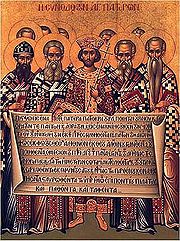
First seven Ecumenical Councils

Encyclopedia
History of Christianity
The history of Christianity concerns the Christian religion, its followers and the Church with its various denominations, from the first century to the present. Christianity was founded in the 1st century by the followers of Jesus of Nazareth who they believed to be the Christ or chosen one of God...
, the first seven Ecumenical Councils, from the First Council of Nicaea
First Council of Nicaea
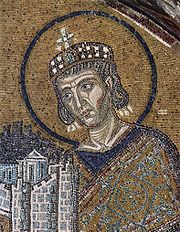
The First Council of Nicaea was a council of Christian bishops convened in Nicaea in Bithynia by the Roman Emperor Constantine I in AD 325...
(325) to the Second Council of Nicaea
Second Council of Nicaea
The Second Council of Nicaea is regarded as the Seventh Ecumenical Council by Roman Catholics, Eastern Orthodox, Eastern Catholic Churches and various other Western Christian groups...
(787), represent an attempt to reach an orthodox
Orthodoxy
The word orthodox, from Greek orthos + doxa , is generally used to mean the adherence to accepted norms, more specifically to creeds, especially in religion...
consensus and to establish a unified Christendom
Christendom
Christendom, or the Christian world, has several meanings. In a cultural sense it refers to the worldwide community of Christians, adherents of Christianity...
as the State church of the Roman Empire
State church of the Roman Empire
The state church of the Roman Empire was a Christian institution organized within the Roman Empire during the 4th century that came to represent the Empire's sole authorized religion. Both the Roman Catholic Church and the Eastern Orthodox churches claim to be the historical continuation of this...
. The East-West Schism
East-West Schism
The East–West Schism of 1054, sometimes known as the Great Schism, formally divided the State church of the Roman Empire into Eastern and Western branches, which later became known as the Eastern Orthodox Church and the Roman Catholic Church, respectively...
, formally dated to 1054, was still almost three centuries off from the last of these councils. Eastern Orthodox, Roman Catholic, and Anglican churches all trace their clergy by apostolic succession
Apostolic Succession
Apostolic succession is a doctrine, held by some Christian denominations, which asserts that the chosen successors of the Twelve Apostles, from the first century to the present day, have inherited the spiritual, ecclesiastical and sacramental authority, power, and responsibility that were...
back to this period and the earlier period referred to as Early Christianity
Early Christianity
Early Christianity is generally considered as Christianity before 325. The New Testament's Book of Acts and Epistle to the Galatians records that the first Christian community was centered in Jerusalem and its leaders included James, Peter and John....
. However, breaks of unity that still persist today had occurred even during this period. The Assyrian Church of the East
Assyrian Church of the East
The Assyrian Church of the East, officially the Holy Apostolic Catholic Assyrian Church of the East ʻIttā Qaddishtā w-Shlikhāitā Qattoliqi d-Madnĕkhā d-Āturāyē), is a Syriac Church historically centered in Mesopotamia. It is one of the churches that claim continuity with the historical...
accepted the first two, but rejected the third, the First Council of Ephesus (431). The Quinisext Council
Quinisext Council
The Quinisext Council was a church council held in 692 at Constantinople under Justinian II. It is often known as the Council in Trullo, because it was held in the same domed hall where the Sixth Ecumenical Council had met...
(692), which attempted to establish the Pentarchy
Pentarchy
Pentarchy is a term in the history of Christianity for the idea of universal rule over all Christendom by the heads of five major episcopal sees, or patriarchates, of the Roman Empire: Rome, Constantinople, Alexandria, Antioch, and Jerusalem...
and which is not generally considered one of the first seven ecumenical councils, is not accepted by the Roman Catholic Church
Roman Catholic Church
The Catholic Church, also known as the Roman Catholic Church, is the world's largest Christian church, with over a billion members. Led by the Pope, it defines its mission as spreading the gospel of Jesus Christ, administering the sacraments and exercising charity...
, which also considers that there have been many more ecumenical councils after the first seven, see Roman Catholic Ecumenical councils 8-21.
This era begins with the First Council of Nicaea, which enunciated the Nicene Creed
Nicene Creed
The Nicene Creed is the creed or profession of faith that is most widely used in Christian liturgy. It is called Nicene because, in its original form, it was adopted in the city of Nicaea by the first ecumenical council, which met there in the year 325.The Nicene Creed has been normative to the...
that in its original form and as modified by the First Council of Constantinople
First Council of Constantinople
The First Council of Constantinople is recognized as the Second Ecumenical Council by the Assyrian Church of the East, the Oriental Orthodox, the Eastern Orthodox, the Roman Catholics, the Old Catholics, and a number of other Western Christian groups. It was the first Ecumenical Council held in...
of 381 was seen as the touchstone of orthodoxy
Orthodoxy
The word orthodox, from Greek orthos + doxa , is generally used to mean the adherence to accepted norms, more specifically to creeds, especially in religion...
on the doctrine of the Trinity
Trinity
The Christian doctrine of the Trinity defines God as three divine persons : the Father, the Son , and the Holy Spirit. The three persons are distinct yet coexist in unity, and are co-equal, co-eternal and consubstantial . Put another way, the three persons of the Trinity are of one being...
. At this point, though the emperors had already ceased to reside habitually at Rome
Rome
Rome is the capital of Italy and the country's largest and most populated city and comune, with over 2.7 million residents in . The city is located in the central-western portion of the Italian Peninsula, on the Tiber River within the Lazio region of Italy.Rome's history spans two and a half...
, the church in that city was seen as the first church among churches
First Among Equals
First Among Equals is a 1984 novel by British author Jeffrey Archer, which follows the careers and personal lives of four fictional British politicians from 1964 to 1991, with each vying to become Prime...
In 330 Constantine
Constantine I and Christianity
During the reign of the Emperor Constantine the Great, Christianity became the dominant religion of the Roman Empire. Constantine, also known as Constantine I, had a significant religious experience following his victory at the Battle of Milvian Bridge in 312...
built his "New Rome", which became known as Constantinople
Constantinople
Constantinople was the capital of the Roman, Eastern Roman, Byzantine, Latin, and Ottoman Empires. Throughout most of the Middle Ages, Constantinople was Europe's largest and wealthiest city.-Names:...
, in the East. All of the seven councils were held in the East, specifically in Anatolia and the neighboring city of Constantinople.
The first scholar to consider this time period as a whole was Philip Schaff
Philip Schaff
Philip Schaff , was a Swiss-born, German-educated Protestant theologian and a historian of the Christian church, who, after his education, lived and taught in the United States.-Biography:...
, who wrote The Seven Ecumenical Councils of the Undivided Church, first published after his death in 1901. The topic is of particular interest to proponents of Paleo-orthodoxy
Paleo-Orthodoxy
Paleo-orthodoxy is a broad Christian theological movement of the late 20th and early 21st centuries which focuses on the consensual understanding of the faith among the Ecumenical Councils and Church Fathers...
who seek to recover the church before the schisms
Schism (religion)
A schism , from Greek σχίσμα, skhísma , is a division between people, usually belonging to an organization or movement religious denomination. The word is most frequently applied to a break of communion between two sections of Christianity that were previously a single body, or to a division within...
.
The Councils
The First Seven Ecumenical Councils, as commonly understood, are:- First Council of Nicaea (325)
- First Council of Constantinople (381)
- Council of Ephesus (431)
- Council of Chalcedon (451)
- Second Council of Constantinople (553)
- Third Council of Constantinople (680)
- Second Council of Nicaea (787)
However, not all of these Councils have been universally recognised as ecumenical
Ecumenical council
An ecumenical council is a conference of ecclesiastical dignitaries and theological experts convened to discuss and settle matters of Church doctrine and practice....
. As indicated above, the Assyrian Church of the East accepts only the first two, and Oriental Orthodoxy only three. Present-day nontrinitarians
Nontrinitarianism
Nontrinitarianism includes all Christian belief systems that disagree with the doctrine of the Trinity, namely, the teaching that God is three distinct hypostases and yet co-eternal, co-equal, and indivisibly united in one essence or ousia...
, such as Unitarians
Unitarianism
Unitarianism is a Christian theological movement, named for its understanding of God as one person, in direct contrast to Trinitarianism which defines God as three persons coexisting consubstantially as one in being....
, Latter Day Saints, Quakers, Christadelphians
Christadelphians
Christadelphians is a Christian group that developed in the United Kingdom and North America in the 19th century...
and Jehovah's Witnesses
Jehovah's Witnesses
Jehovah's Witnesses is a millenarian restorationist Christian denomination with nontrinitarian beliefs distinct from mainstream Christianity. The religion reports worldwide membership of over 7 million adherents involved in evangelism, convention attendance of over 12 million, and annual...
, reject all seven Councils.
First Council of Nicaea (325)
God the Father
God the Father is a gendered title given to God in many monotheistic religions, particularly patriarchal, Abrahamic ones. In Judaism, God is called Father because he is the creator, life-giver, law-giver, and protector...
. The Emperor wanted to establish universal agreement on it. Representatives came from across the Empire, subsidized by the Emperor. Previous to this council, the bishops would hold local councils, such as the Council of Jerusalem
Council of Jerusalem
The Council of Jerusalem is a name applied by historians and theologians to an Early Christian council that was held in Jerusalem and dated to around the year 50. It is considered by Catholics and Orthodox to be a prototype and forerunner of the later Ecumenical Councils...
, but there had been no universal, or ecumenical, council.
The council drew up a creed, the original Nicene Creed, which received nearly unanimous support. The council's description of "God's only-begotten Son", Jesus Christ, as of the same substance with God the Father
God the Father
God the Father is a gendered title given to God in many monotheistic religions, particularly patriarchal, Abrahamic ones. In Judaism, God is called Father because he is the creator, life-giver, law-giver, and protector...
became a touchstone of Christian Trinitarianism. The council also addressed the issue of dating Easter (see Quartodecimanism
Quartodecimanism
Quartodecimanism refers to the custom of some early Christians celebrating Passover beginning with the eve of the 14th day of Nisan , which at dusk is Biblically the "Lord's passover".The modern Jewish Passover and Feast of Unleavened Bread is seven days, starting with the sunset at...
and Easter controversy
Easter controversy
The Easter controversy is a series of controversies about the proper date to celebrate the Christian holiday of Easter. To date, there are four distinct historical phases of the dispute and the dispute has yet to be resolved...
), recognised the right of the see of Alexandria to jurisdiction outside of its own province (by analogy with the jurisdiction exercised by Rome) and the prerogatives of the churches in Antioch and the other provinces and approved the custom by which Jerusalem
Jerusalem in Christianity
For Christians, Jerusalem's place in the ministry of Jesus and the Apostolic Age gives it great importance, in addition to its place in the Old Testament, the Hebrew Bible.-Jerusalem in the New Testament and early Christianity:...
was honoured, but without the metropolitan dignity.
The Council was opposed by the Arian
Arianism
Arianism is the theological teaching attributed to Arius , a Christian presbyter from Alexandria, Egypt, concerning the relationship of the entities of the Trinity and the precise nature of the Son of God as being a subordinate entity to God the Father...
s, and Constantine tried to reconcile Arius
Arius
Arius was a Christian presbyter in Alexandria, Egypt of Libyan origins. His teachings about the nature of the Godhead, which emphasized the Father's divinity over the Son , and his opposition to the Athanasian or Trinitarian Christology, made him a controversial figure in the First Council of...
, after whom Arianism is named, with the Church. Even when Arius died in 336, one year before the death of Constantine, the controversy continued, with various separate groups espousing Arian sympathies in one way or another. In 359, a double council of Eastern and Western bishops affirmed a formula stating that the Father and the Son were similar in accord with the scriptures, the crowning victory for Arianism. The opponents of Arianism rallied, but in the First Council of Constantinople in 381 marked the final victory of Nicene orthodoxy within the Empire, though Arianism had by then spread to the Germanic tribes, among whom it gradually disappeared after the conversion of the Franks
Franks
The Franks were a confederation of Germanic tribes first attested in the third century AD as living north and east of the Lower Rhine River. From the third to fifth centuries some Franks raided Roman territory while other Franks joined the Roman troops in Gaul. Only the Salian Franks formed a...
to Catholicism in 496.
Constantine commissions Bibles
In 331, Constantine IConstantine I and Christianity
During the reign of the Emperor Constantine the Great, Christianity became the dominant religion of the Roman Empire. Constantine, also known as Constantine I, had a significant religious experience following his victory at the Battle of Milvian Bridge in 312...
commissioned Eusebius to deliver fifty Bibles for the Church of Constantinople. Athanasius (Apol. Const. 4) recorded Alexandrian scribes around 340 preparing Bibles for Constans
Constans
Constans , was Roman Emperor from 337 to 350. He defeated his brother Constantine II in 340, but anger in the army over his personal life and preference for his barbarian bodyguards saw the general Magnentius rebel, resulting in Constans’ assassination in 350.-Career:Constans was the third and...
. Little else is known, though there is plenty of speculation. For example, it is speculated that this may have provided motivation for canon lists
Development of the Christian Biblical canon
The Christian Biblical canon is the set of books Christians regard as divinely inspired and constituting the Christian Bible. Books included in the Christian Biblical canons of both the Old and New Testament were decided at the Council of Trent , by the Thirty-Nine Articles , the Westminster...
, and that Codex Vaticanus and Codex Sinaiticus
Codex Sinaiticus
Codex Sinaiticus is one of the four great uncial codices, an ancient, handwritten copy of the Greek Bible. It is an Alexandrian text-type manuscript written in the 4th century in uncial letters on parchment. Current scholarship considers the Codex Sinaiticus to be one of the best Greek texts of...
are examples of these Bibles. Together with the Peshitta
Peshitta
The Peshitta is the standard version of the Bible for churches in the Syriac tradition.The Old Testament of the Peshitta was translated into Syriac from the Hebrew, probably in the 2nd century AD...
and Codex Alexandrinus
Codex Alexandrinus
The Codex Alexandrinus is a 5th century manuscript of the Greek Bible,The Greek Bible in this context refers to the Bible used by Greek-speaking Christians who lived in Egypt and elsewhere during the early history of Christianity...
, these are the earliest extant Christian Bibles.
First Council of Constantinople (381)

The council approved the current form of the Nicene Creed
Nicene Creed
The Nicene Creed is the creed or profession of faith that is most widely used in Christian liturgy. It is called Nicene because, in its original form, it was adopted in the city of Nicaea by the first ecumenical council, which met there in the year 325.The Nicene Creed has been normative to the...
as used in the Eastern Orthodox Church
Eastern Orthodox Church
The Orthodox Church, officially called the Orthodox Catholic Church and commonly referred to as the Eastern Orthodox Church, is the second largest Christian denomination in the world, with an estimated 300 million adherents mainly in the countries of Belarus, Bulgaria, Cyprus, Georgia, Greece,...
and Oriental Orthodox
Oriental Orthodoxy
Oriental Orthodoxy is the faith of those Eastern Christian Churches that recognize only three ecumenical councils — the First Council of Nicaea, the First Council of Constantinople and the First Council of Ephesus. They rejected the dogmatic definitions of the Council of Chalcedon...
churches, but, except when Greek
Greek language
Greek is an independent branch of the Indo-European family of languages. Native to the southern Balkans, it has the longest documented history of any Indo-European language, spanning 34 centuries of written records. Its writing system has been the Greek alphabet for the majority of its history;...
is used, with two additional Latin
Latin
Latin is an Italic language originally spoken in Latium and Ancient Rome. It, along with most European languages, is a descendant of the ancient Proto-Indo-European language. Although it is considered a dead language, a number of scholars and members of the Christian clergy speak it fluently, and...
phrases ("Deum de Deo" and "Filioque") in the West. The form used by the Armenian Apostolic Church
Armenian Apostolic Church
The Armenian Apostolic Church is the world's oldest National Church, is part of Oriental Orthodoxy, and is one of the most ancient Christian communities. Armenia was the first country to adopt Christianity as its official religion in 301 AD, in establishing this church...
, which is part of Oriental Orthodoxy
Oriental Orthodoxy
Oriental Orthodoxy is the faith of those Eastern Christian Churches that recognize only three ecumenical councils — the First Council of Nicaea, the First Council of Constantinople and the First Council of Ephesus. They rejected the dogmatic definitions of the Council of Chalcedon...
, has many more additions. This fuller creed may have existed before the Council and probably originated from the baptismal creed of Constantinople.
The council also condemned Apollinarism
Apollinarism
Apollinarism or Apollinarianism was a view proposed by Apollinaris of Laodicea that Jesus could not have had a human mind; rather, that Jesus had a human body and lower soul but a divine mind....
, the teaching that there was no human mind or soul in Christ. It also granted Constantinople honorary precedence over all churches save Rome.
The council did not include Western bishops or Roman legates, but it was accepted as ecumenical in the West.
First Council of Ephesus (431)
Theodosius II called the council to settle the Nestorian controversy. Nestorius, Patriarch of Constantinople, opposed use of the term TheotokosTheotokos
Theotokos is the Greek title of Mary, the mother of Jesus used especially in the Eastern Orthodox, Oriental Orthodox, and Eastern Catholic Churches. Its literal English translations include God-bearer and the one who gives birth to God. Less literal translations include Mother of God...
(Greek Η Θεοτόκος, "God-Bearer"). This term had long been used by orthodox writers, and it was gaining popularity along with devotion to Mary as Mother of God. He reportedly taught that there were two separate persons in the incarnate Christ, though whether he actually taught this is disputed.
The council deposed Nestorius, repudiated Nestorianism
Nestorianism
Nestorianism is a Christological doctrine advanced by Nestorius, Patriarch of Constantinople from 428–431. The doctrine, which was informed by Nestorius's studies under Theodore of Mopsuestia at the School of Antioch, emphasizes the disunion between the human and divine natures of Jesus...
, proclaimed the Virgin Mary as the Theotokos
Theotokos
Theotokos is the Greek title of Mary, the mother of Jesus used especially in the Eastern Orthodox, Oriental Orthodox, and Eastern Catholic Churches. Its literal English translations include God-bearer and the one who gives birth to God. Less literal translations include Mother of God...
.
After quoting the Nicene Creed
Nicene Creed
The Nicene Creed is the creed or profession of faith that is most widely used in Christian liturgy. It is called Nicene because, in its original form, it was adopted in the city of Nicaea by the first ecumenical council, which met there in the year 325.The Nicene Creed has been normative to the...
in its original form, as at the First Council of Nicaea, without the alterations and additions made at the First Council of Constantinople, it declared it "unlawful for any man to bring forward, or to write, or to compose a different (ἑτέραν) Faith as a rival to that established by the holy Fathers assembled with the Holy Ghost in Nicæa."
Council of Chalcedon (451)
The council repudiated the EutychianEutyches
Eutyches was a presbyter and archimandrite at Constantinople. He first came to notice in 431 at the First Council of Ephesus, for his vehement opposition to the teachings of Nestorius; his condemnation of Nestorianism as heresy precipitated his being denounced as a heretic...
doctrine of monophysitism
Monophysitism
Monophysitism , or Monophysiticism, is the Christological position that Jesus Christ has only one nature, his humanity being absorbed by his Deity...
, described and delineated the "Hypostatic Union
Hypostatic union
Hypostatic union is a technical term in Christian theology employed in mainstream Christology to describe the union of Christ's humanity and divinity in one hypostasis.The First Council of Ephesus recognised this doctrine and affirmed its importance, stating that the...
" and two natures of Christ
Hypostatic union
Hypostatic union is a technical term in Christian theology employed in mainstream Christology to describe the union of Christ's humanity and divinity in one hypostasis.The First Council of Ephesus recognised this doctrine and affirmed its importance, stating that the...
, human and divine; adopted the Chalcedonian Creed
Chalcedonian Creed
The Confession of Chalcedon , also known as the Doctrine of the Hypostatic Union or the Two-Nature Doctrine, was adopted at the Council of Chalcedon in 451 in Asia Minor. That Council of Chalcedon is one of the first seven Ecumenical Councils accepted by Eastern Orthodox, Catholic, and many...
. For those who accept it, it is the Fourth Ecumenical Council (calling the previous council, which was rejected by this council, the "Robber Synod" or "Robber Council").
Before the council
In November 448, a synod at Constantinople condemned Eutyches for unorthodoxy. Eutyches, archimandrite (abbot) of a large Constinapolitan monastery, taught that Christ was not consubstantial with humanity.In 449, Theodosius II summoned a council at Ephesus, where Eutyches was exonerated and returned to his monastery. This council was later overturned by the Council of Chalcedon and labeled "Latrocinium" (i.e., "Robber Council").
Second Council of Constantinople (553)
This council condemned certain Nestorian writings and authors. This move was instigated by Emperor Justinian in an effort to conciliate the monophysite Christians, it was opposed in the West, and the Popes' acceptance of the council caused a major schism.Three Chapters
Prior to the Second Council of Chalcedon was a prolonged controversy over the treatment of three subjects, all considered sympathetic to Nestorianism, the heresy that there are two separate persons in the Incarnation of Christ. Emperor Justinian condemned the Three Chapters, hoping to appeal to monophysite Christians with his anti-Nestorian zeal. Monophysites believe that in the Incarnate Christ there is one nature, not two. Eastern Patriarchs supported the Emperor, but in the West his interference was resented, and Pope Vigilius resisted his edict on the grounds that it opposed the Chalcedonian decrees.Justinian's policy was in fact an attack on Antiochene theology and the decisions of Chalcedon. The pope assented and condemned the Three Chapters, but protests in the West caused him to retract his condemnation. The emperor called the Second Council of Constantinople to resolve the controversy.
Council proceedings
The council, attended mostly by Eastern bishops, condemned the Three Chapters and, indirectly, the Pope Vigilius. It also affirmed Constantinople's intention to remain in communion with Rome.After the council
Vigilius declared his submission to the council, as did his successor, Pelagius I. The council was not immediately recognized as ecumenical in the West, and Milan and Aquileia even broke off communion with Rome over this issue. The schism was not repaired until the late 6th century for Milan and the late 7th century for Aquileia.Emperor Justinian's policy failed to reconcile the Monophysites.
Third Council of Constantinople
Third Council of ConstantinopleThird Council of Constantinople
The Third Council of Constantinople, counted as the Sixth Ecumenical Council by the Roman Catholic and Eastern Orthodox churches and other Christian groups, met in 680/681 and condemned monoenergism and monothelitism as heretical and defined Jesus Christ as having two energies and two wills...
(680–681): repudiated monothelitism
Monothelitism
Monothelitism is a particular teaching about how the divine and human relate in the person of Jesus, known as a Christological doctrine, that formally emerged in Armenia and Syria in 629. Specifically, monothelitism teaches that Jesus Christ had two natures but only one will...
, a once popular and widely supported doctrine, affirming that Christ had both human and divine wills.
Quinisext Council
Quinisext CouncilQuinisext Council
The Quinisext Council was a church council held in 692 at Constantinople under Justinian II. It is often known as the Council in Trullo, because it was held in the same domed hall where the Sixth Ecumenical Council had met...
(= Fifth and Sixth) or Council in Trullo
Trullo
A trullo is a traditional Apulian dry stone hut with a conical roof. Their style of construction is specific to the Itria Valley, in the Murge area of the Italian region of Apulia. Trulli were generally constructed as temporary field shelters and storehouses or as permanent dwellings by small...
(692) has not been accepted by the Roman Catholic Church. Since it was mostly an administrative council for raising some local canons to ecumenical status, establishing principles of clerical discipline, addressing the Biblical canon
Development of the Christian Biblical canon
The Christian Biblical canon is the set of books Christians regard as divinely inspired and constituting the Christian Bible. Books included in the Christian Biblical canons of both the Old and New Testament were decided at the Council of Trent , by the Thirty-Nine Articles , the Westminster...
, and establishing the Pentarchy
Pentarchy
Pentarchy is a term in the history of Christianity for the idea of universal rule over all Christendom by the heads of five major episcopal sees, or patriarchates, of the Roman Empire: Rome, Constantinople, Alexandria, Antioch, and Jerusalem...
, without determining matters of doctrine, the Eastern Orthodox Church
Eastern Orthodox Church
The Orthodox Church, officially called the Orthodox Catholic Church and commonly referred to as the Eastern Orthodox Church, is the second largest Christian denomination in the world, with an estimated 300 million adherents mainly in the countries of Belarus, Bulgaria, Cyprus, Georgia, Greece,...
does not consider it to be a full-fledged council in its own right, instead it is considered to be an extension of the fifth and sixth councils.
Second Council of Nicaea
Second Council of NicaeaSecond Council of Nicaea
The Second Council of Nicaea is regarded as the Seventh Ecumenical Council by Roman Catholics, Eastern Orthodox, Eastern Catholic Churches and various other Western Christian groups...
(787). In 753, Emperor Constantine V convened the Synod of Hieria, which declared that images of Jesus misrepresented him and that images of Mary and the saints were idols. The Second Council of Nicaea restored the veneration of icon
Icon
An icon is a religious work of art, most commonly a painting, from Eastern Christianity and in certain Eastern Catholic churches...
s and ended the first iconoclasm
Iconoclasm (Byzantine)
The Byzantine Iconoclasm encompasses two periods in the history of the Byzantine Empire when Emperors, backed by imperially-appointed leaders and councils of the Orthodox Church imposed a ban on religious images or icons. The "First Iconoclasm", as it is sometimes called, lasted between about 730...
.
Subsequent events
In the 9th century, Emperor Michael III struggled to appoint Photius as Patriarch of Constantinople and Pope Nicholas I struggled to keep Ignatius there. After Michael was murdered, Ignatius was reinstated as patriarch without challenge. An ecumenical council in Constantinople, held while Ignatius was Patriarch, anathematized Photius. With Ignatius' death in 877, Photius became patriarch, and in 879-80 an ecumenical council in Constantinople annulled the decision of the previous council. The West takes only the first as truly ecumenical and legitimate. The East takes only the second.See also
- Late ancient history of Christianity
- Synod of AncyraSynod of AncyraThe Synod of Ancyra was an ecclesiastical council, or synod, convened in Ancyra , the seat of the Roman administration for the province of Galatia, in 314...
in 341. - Ecumenical councilEcumenical councilAn ecumenical council is a conference of ecclesiastical dignitaries and theological experts convened to discuss and settle matters of Church doctrine and practice....
. - Fourth Ecumenical Council to see the difference in numbering for this and the following council.
- Timeline of ChristianityTimeline of ChristianityThe purpose of this timeline is to give a detailed account of Christianity from the beginning of the current era to the present. Question marks on dates indicate approximate dates....
- Byzantine EmpireByzantine EmpireThe Byzantine Empire was the Eastern Roman Empire during the periods of Late Antiquity and the Middle Ages, centred on the capital of Constantinople. Known simply as the Roman Empire or Romania to its inhabitants and neighbours, the Empire was the direct continuation of the Ancient Roman State...