

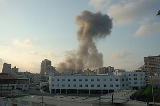
2006 Israel-Lebanon conflict

Encyclopedia
The 2006 Lebanon War, also called the 2006 Israel-Hezbollah War and known in Lebanon as the July War and in Israel as the Second Lebanon War , was a 34-day military conflict
in Lebanon
, northern Israel
and the Israeli-occupied territories
. The principal parties were Hezbollah paramilitary
forces and the Israeli military
. The conflict started on 12 July 2006, and continued until a United Nations
-brokered ceasefire
went into effect in the morning on 14 August 2006, though it formally ended on 8 September 2006 when Israel lifted its naval blockade
of Lebanon.
The conflict began
when militants from the group Hezbollah fired rockets at Israeli border towns as a diversion for an anti-tank missile attack on two armored Humvees patrolling the Israeli side of the border fence. The ambush left three soldiers dead. Two additional soldiers, believed to have been killed outright or mortally wounded, were taken by Hezbollah to Lebanon. Five more were killed in a failed rescue attempt. Israel responded with airstrike
s and artillery
fire on targets in Lebanon that damaged Lebanese civilian
infrastructure
, including Beirut's Rafic Hariri International Airport
, an air and naval blockade
, and a ground invasion of southern Lebanon
. Hezbollah then launched more rockets into northern Israel and engaged the Israel Defense Forces
(IDF) in guerrilla warfare
from hardened positions.
The conflict killed at least 1,200 people, mostly Lebanese citizens, severely damaged Lebanese civil infrastructure, and displaced approximately one million Lebanese and 300,000–500,000 Israelis. After the ceasefire, some parts of southern Lebanon remained uninhabitable due to Israeli unexploded cluster bomblets.
On 11 August 2006, the United Nations Security Council
unanimously approved UN Resolution 1701
in an effort to end the hostilities. The resolution, which was approved by both Lebanese and Israeli governments the following days, called for disarmament of Hezbollah, for withdrawal of Israel from Lebanon, and for the deployment of Lebanese soldiers
and an enlarged United Nations Interim Force in Lebanon
(UNIFIL) in the south. UNIFIL was given an expanded mandate, including the ability to use force to ensure that their area of operations wasn't used for hostile activities, and to resist attempts by force to prevent them from discharging their duties. The Lebanese army began deploying in southern Lebanon on 17 August 2006. The blockade was lifted on 8 September 2006. On 1 October 2006, most Israeli troops withdrew from Lebanon, though the last of the troops continued to occupy the border-straddling village of Ghajar
. In the time since the enactment of UNSCR 1701 both the Lebanese government and UNIFIL have stated that they will not disarm Hezbollah. The remains of the two captured soldiers, whose fates were unknown, were returned to Israel on 16 July 2008 as part of a prisoner exchange
.
into Israel by the Palestine Liberation Organization
(PLO) date as far back as 1968, and followed Israel's forceful occupation of additional Arab territory the previous year; the area became a significant base for attacks following the arrival of the PLO leadership and its Fatah
brigade following their 1971 expulsion from Jordan
. Starting about this time, increasing demographic tensions
related to the Lebanese National Pact
, which had divided governmental powers among religious groups throughout the country 30 years previously, began running high and led in part to the Lebanese Civil War
(1975–1990). Concurrently, Syria began a 29 year military occupation in 1976. Israel's 1978 invasion of Lebanon
failed to stem the Palestinian attacks, but Israel invaded Lebanon
again in 1982 and forcibly expelled the PLO. Israel withdrew to a borderland buffer zone
in southern Lebanon, held with the aid of proxy militants in the South Lebanon Army
(SLA). The invasion however, also led to the conception of a new Shi'a militant group
, which in 1985, established itself politically under the name Hezbollah, and declared an armed struggle to end the Israeli occupation
of Lebanese territory. When the Lebanese civil war ended and other warring factions agreed to disarm, both Hezbollah and the SLA refused. Ten years later, Israel withdrew from South Lebanon to the UN-designated and internationally recognized Blue Line
border in 2000.
The withdrawal also led to the immediate collapse of the SLA, and Hezbollah took control of the area in rapid succession. Later citing continued Israeli control of the disputed Shebaa farms
region and the internment
of Lebanese prisoners in Israel
, Hezbollah intensified its cross-border attacks, and used the tactic of seizing soldiers from Israel as leverage for a prisoner exchange
in 2004.
paratroop unit operating near the Shebaa Farms
engaged three Lebanese it identified as Hezbollah special force members, killing one. Videotapes recovered by the paratroopers contained footage of the three recording detailed accounts of the area.
Over the following 12 months, Hezbollah made three unsuccessful attempts to abduct Israeli soldiers. On 21 November 2005, a number of Hezbollah special forces attempted to attack an Israeli outpost in Ghajar
, a village straddling the border between Lebanon and the Golan Heights. The outpost had been deserted following an intelligence warning, and three of the Hezbollah militants were killed when Israeli sniper David Markovich shot a rocket-propelled grenade they were carrying, causing it to explode. From his sniper position, Markovich shot and killed a fourth gunman shortly thereafter.
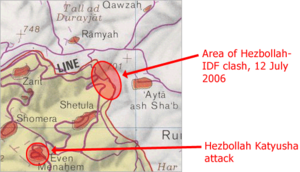 At around 9 AM local time on 12 July 2006, Hezbollah launched diversionary
rocket attacks toward Israeli military positions near the coast and near the border village of Zar'it
as well as on the Israeli town of Shlomi and other villages. Five civilians were injured. Six Israeli military positions were fired on, and the surveillance cameras knocked out. At the same time, a Hezbollah ground contingent infiltrated the border
into Israel through a "dead zone" in the border fence, hiding in an overgrown wadi
. They attacked a patrol of two Israeli armoured Humvees
patrolling the border near Zar'it, using pre-positioned explosives and anti-tank missiles, killing three soldiers, injuring two, and capturing two soldiers (Master Sergeant Ehud Goldwasser
and First Sergeant Eldad Regev
). In response to the Hezbollah feint attacks, the IDF conducted a routine check of its positions and patrols, and found that contact with two jeeps was lost. A rescue force was immediately dispatched to the area, and confirmed that two soldiers were missing after 20 minutes. A Merkava Mk III
tank, an Armored personnel carrier, and a helicopter
were immediately dispatched into Lebanon. The tank hit a large land mine, killing its crew of four. Another soldier was killed and two lightly injured by mortar fire as they attempted to recover the bodies.
Hezbollah named the attack "Operation Truthful Promise
" after leader Hassan Nasrallah
's public pledges over the prior year and a half to seize Israeli soldiers and swap them for four Lebanese held by Israel
:
Nasrallah claimed that Israel had broken a previous deal to release these prisoners, and since diplomacy had failed, violence was the only remaining option. Nasrallah declared: "No military operation will return the Israeli captured soldiers...The prisoners will not be returned except through one way: indirect negotiations and a trade of prisoners."
Israeli Prime Minister
Ehud Olmert
described the seizure of the soldiers as an "act of war" by the sovereign state of Lebanon, stating that "Lebanon will bear the consequences of its actions" and promising a "very painful and far-reaching response." Israel blamed the Lebanese government for the raid, as it was carried out from Lebanese territory and Hezbollah had two ministers serving in the Lebanese cabinet at that time.
In response, Lebanese Prime Minister Fouad Siniora
denied any knowledge of the raid and stated that he did not condone it. An emergency meeting of the Lebanese government reaffirmed this position.
The Israel Defense Forces
attacked targets within Lebanon with artillery and airstrikes hours before the Israeli Cabinet
met to discuss a response. The targets consisted of bridges and roads in Lebanon, which were hit to prevent Hezbollah from transporting the abductees. An Israeli airstrike also destroyed the runways of Beirut Rafic Hariri International Airport
. 44 civilians were killed. The Israeli Air Force also targeted Hezbollah’s long range rocket and missile stockpiles destroying most of them on the ground in the first days of the war. A large portion were destroyed in the first 34 minutes.
Later that same day (12 July 2006), the Cabinet decided to authorize the Prime Minister, the Defense Minister and their deputies to pursue the plan which they had proposed for action within Lebanon. Prime Minister Olmert's officially demanded that the Israel Defense Force avoid civilian casualties whenever possible. Israel's chief of staff
Dan Halutz
said, "if the soldiers are not returned, we will turn Lebanon's clock back 20 years" while the head of Israel's Northern Command Udi Adam
said, "this affair is between Israel and the state of Lebanon. Where to attack? Once it is inside Lebanon, everything is legitimate -- not just southern Lebanon, not just the line of Hezbollah posts." On 12 July 2006, the Israeli Cabinet promised that Israel would "respond aggressively and harshly to those who carried out, and are responsible for, today's action". The Cabinet's communiqué stated, in part, that the "Lebanese Government [was] responsible for the action that originated on its soil." A retired Israeli Army Colonel explained that the rationale behind the attack was to create a rift between the Lebanese population and Hezbollah supporters by exacting a heavy price from the elite in Beirut
.
On 16 July, the Israeli Cabinet
released a communiqué explaining that, although Israel had engaged in military operations within Lebanon, its war was not against the Lebanese government. The communiqué stated: "Israel is not fighting Lebanon but the terrorist element there, led by Nasrallah and his cohorts, who have made Lebanon a hostage and created Syria
n- and Iran
ian-sponsored terrorist enclaves of murder."
When asked in August about the proportionality of the response, Prime Minister Olmert stated that the "war started not only by killing eight Israeli soldiers and abducting two but by shooting Katyusha and other rockets on the northern cities of Israel on that same morning. Indiscriminately." He added "no country in Europe would have responded in such a restrained manner as Israel did."
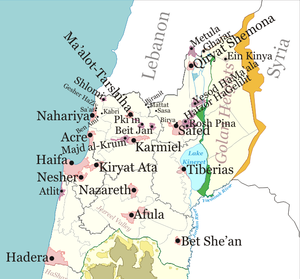 During the campaign, the Hezbollah rocket force
Hezbollah fired between 3,970 and 4,228 rockets at a rate of more than 100 per day, unprecedented since the Iran-Iraq war
. About 95% of these were 122 mm (4.8 in) Katyusha artillery rockets
, which carried warheads up to 30 kg (66 lb
) and had a range of up to 30 km (19 mi). An estimated 23% of these rockets hit cities and built-up areas across northern Israel, while the remainder hit open areas. Cities hit were Haifa
, Hadera
, Nazareth
, Tiberias, Nahariya
, Safed
, Shaghur, Afula
, Kiryat Shmona
, Beit She'an, Karmiel
, Acre
, and Ma'alot-Tarshiha
, as well as dozens of towns, kibbutz
im, moshav
im, and Druze and Israeli-Arab
villages. The northern West Bank
was also hit.
Hezbollah engaged in guerrilla warfare with IDF ground forces, fighting from well-fortified positions, often in urban areas, and attacking with small, well-armed units. Hezbollah fighters were highly trained, and were equipped with flak jackets, night-vision goggles, communications equipment, and sometimes with Israeli uniforms and equipment. An Israeli soldier who participated in the war said that Hezbollah fighers were "nothing like Hamas or the Palestinians. They are trained and highly qualified. All of us were kind of surprised". During engagements with the IDF, Hezbollah concentrated on inflicting losses on the IDF, believing that an unwillingness to absorb steady losses to be Israel's strategic weakness. However, Hezbollah sustained greater losses than the IDF during ground engagements.
Hezbollah countered IDF armor through the use of sophisticated Russian-made anti-tank guided missile
s (ATGMs). According to Merkava tank program administration, 52 Merkava
main battle tank
s were damaged (45 of them by different kinds of ATGM), missiles penetrated 22 tanks, but only 5 tanks were destroyed, one of them by an improvised explosive device
(IED). The Merkava tanks that were penetrated were predominantly Mark II and Mark III models, but five Mark IV tanks were also penetrated. All but two of these tanks were rebuilt and returned to service. The IDF declared itself satisfied with the Merkava Mark IV's performance during the war. Hezbollah caused additional casualties using ATGMs to collapse buildings onto Israeli troops sheltering inside. As a result, IDF units did not linger in any one area for an extended period of time. Hezbollah fighters often used tunnels to emerge quickly, fire an anti-tank missile, and then disappear again.
After the initial Israeli response, Hezbollah declared an all-out military alert. Hezbollah was estimated to have 13,000 missiles at the beginning of the conflict. Israeli newspaper Haaretz
described Hezbollah as a trained, skilled, well-organized, and highly motivated infantry that was equipped with the cream of modern weaponry from the arsenals of Syria
, Iran
, Russia
, and China
. Hezbollah's satellite TV station Al-Manar
reported that the attacks had included a Fajr-3 and a Ra'ad 1, both liquid-fuel missiles developed by Iran.
Hezbollah leader Hassan Nasrallah
defended the attacks, saying that Hezbollah had "started to act calmly, we focused on Israel[i] military bases and we didn’t attack any settlement, however, since the first day, the enemy attacked Lebanese towns and murdered civilians — Hezbollah combatants had destroyed military bases, while the Israelis killed civilians and targeted Lebanon's infrastructure." Hezbollah called on the Arabs of the Israeli city of Haifa
to flee, and continued launching rockets into northern Israel.
According to a UN report, approximately around mid-July 2006, the Somalia
n Islamic Courts Union (ICU) sent about 720 men to Lebanon to fight alongside Hezbollah against the Israeli military. In exchange for the contribution of the Somali military force, Hezbollah arranged for additional support to be given to ICU by the governments of Iran and Syria. However, doubts on the accuracy of this UN report have been raised by both The New York Times
, The Jamestown Foundation
and initial Israeli reaction.
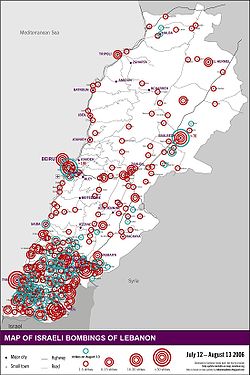
flew more than 12,000 combat missions, its Navy
fired 2,500 shells, and its Army fired over 100,000 shells. Large parts of the Lebanese civilian infrastructure were destroyed, including 400 miles (640 km) of roads, 73 bridges, and 31 other targets such as Beirut's Rafic Hariri International Airport
, ports, water and sewage treatment plants, electrical facilities, 25 fuel stations, 900 commercial structures, up to 350 schools and two hospitals, and 15,000 homes. Some 130,000 more homes were damaged. The strikes focused on Hezbollah bases, command centers, rocket launching positions, long-range rocket stockpiles, arms storages, vehicles, and Lebanese military bases, which were often hidden inside civilian areas. The strikes caused significant casualties among Hezbollah and the Lebanese Army, and destroyed most of Hezbollah's long-range missiles on the ground, along with a portion of its unguided short-range rockets. The Israelis launched several successful commando operations throughout the war, which inflicted significant losses on Hezbollah, and resulted in the capture of military equipment. The IDF's main ground attacks focused on Hezbollah-occupied areas in South Lebanon, and engagements often took place in urban areas. During clashes, Hezbollah losses were greater than those of the Israelis. Israeli forces found and destroyed a large portion of Hezbollah's military infrastructure.
Israeli Defense Minister Amir Peretz
ordered commanders to prepare civil defense plans. One million Israelis had to stay near or in bomb shelters or security rooms, with some 250,000 civilians evacuating the north and relocating to other areas of the country.


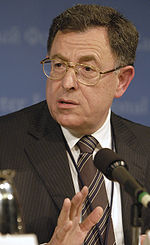 While the Israeli government initially held the Lebanese government responsible for the Hezbollah attacks due to Lebanon's failure to implement United Nations Security Council Resolution 1559
and disarm Hezbollah, Lebanon disavowed the raids, stating that the government of Lebanon did not condone them, and pointing out that Israel had a long history of disregarding UN resolutions.
In interviews, Lebanese President Emile Lahoud
criticized Israel's attacks and was supportive of Hezbollah, noting Hezbollah's role in ending Israel's previous occupation of southern Lebanon.
On 12 July 2006, PBS
interviewed the Lebanese ambassador Farid Abboud
to the United States and his Israeli counterpart. The interview discussed Hezbollah's connection to the Lebanese government.
Israel never declared war
on Lebanon, and said it only attacked Lebanese governmental institutions which it suspected of being used by Hezbollah. The Lebanese government played a role in shaping the conflict. On 14 July 2006, the office of Lebanese Prime Minister Fouad Siniora issued a statement that called on US President George W. Bush
to exert all his efforts on Israel to stop its attacks in Lebanon and reach a comprehensive ceasefire. In a televised speech the next day, Siniora called for "an immediate ceasefire backed by the United Nations". A US-French draft resolution that was influenced by the Lebanese Siniora Plan
and which contained provisions for Israeli withdrawal, military actions, and mutual prisoner release was rejected by the US and Israel. Many Lebanese accused the US government of stalling the ceasefire resolution and of support of Israel's attacks. In a poll conducted two weeks into the conflict, only 8% of the respondents felt that the US would support Lebanon, while 87% supported Hezbollah's fight against Israel. After the attack on Qana, Siniora snubbed US Secretary of State Condoleezza Rice
by cancelling a meeting with her and thanked Hezbollah for its "sacrifices for the independence and sovereignty of Lebanon."
During the war, the Lebanese Armed Forces
did not engage in direct hostilities, but threatened retaliation if IDF troops pushed too far northward into Lebanon. In several instances, Lebanese troops fired anti-aircraft weapons at Israeli aircraft and attempted to disrupt landing operations. During the first days of the war, Lebanese Defense Minister Elias Murr said that "the Lebanese army will resist and defend the country. If there is an invasion of Lebanon, we are waiting for them". However, the Lebanese Army mostly stayed out of the fighting. According to a Time editorial, "to have stood up to the advancing Israeli armored columns would have been suicidal". On 7 August 2006, the 7-point plan was extended to include the deployment of 15,000 Lebanese Army troops to fill the void between an Israeli withdrawal and UNIFIL deployment.
, warring parties are obliged to distinguish between combatants and civilians
, ensure that attacks on legitimate military targets are proportional
, and guarantee that the military advantage of such attacks outweigh the possible harm done to civilians
. Violations of these laws are considered war crimes.
Various groups and individuals accused both Israel and Hezbollah of violations of these laws during the conflict, and warned of possible war crimes. These allegations included intentional attacks on civilian populations
or infrastructure
, disproportionate or indiscriminate attacks, the use of human shield
s, and the use of prohibited weapons. No formal charges have been filed against either group.
Amnesty International
called on both Hezbollah and Israel to end attacks on civilians during the conflict, and criticized attacks against civilian villages and infrastructure by Israel. They also highlighted IDF use of white phosphorus shells
in Lebanon. Human Rights Watch
accused both parties of failing to distinguish between civilians and combatants, violating the principle of distinction
, and committing war crimes. Peter Bouckaert, a senior emergencies researcher for Human Rights Watch, stated that Hezbollah was "directly targeting civilians... their aim is to kill Israeli civilians" and that Israel had not taken "the necessary precautions to distinguish between civilian and military targets." They criticized Hezbollah's use of unguided Katyusha rockets, and Israel's use of unreliable cluster bombs – both too close to civilians areas – suggesting that they may have deliberately targeted civilians. UN humanitarian chief Jan Egeland
said Israel's response violated international humanitarian law, and criticized Hezbollah for "cowardly blending... among women and children."
Israel defended itself by stating that it tried to avoid civilians, and had distributed leaflets calling on civilian residents to evacuate, but that Hezbollah stored weapons in and fired from civilian areas, making those areas legitimate targets, and used civilians as human shields. Amnesty International and Human Rights Watch found cases where Hezbollah did fire rockets from, and store weapons in, populated areas and deploy its forces among the civilian population; however, both say that is not conclusive evidence of the intent to use civilians as human shields. HRW stated that "the IDF struck a large number of private homes of civilian Hezbollah members during the war, as well as various civilian Hezbollah-run institutions such as schools, welfare agencies, banks, shops and political offices." Although Israel maintained that the civilian infrastructure was "hijacked" by Hezbollah and used for military purposes, but Amnesty International identified the destruction of entire civilian neighbourhoods and villages by Israeli forces, attacks on bridges with no apparent strategic value, and attacks on infrastructure indispensable to the survival of the civilian population, and questioned whether the "military advantage anticipated from destroying" civilian infrastructure had been "measured against the likely effect on civilians." They also stated that the Israeli actions suggested a "policy of punishing both the Lebanese government and the civilian population."
Al-Jazeera reported at the time: "Foreign journalists based in Lebanon also reported that the Shia militia chose to fight from civilian areas and had on occasion prevented Lebanese civilians from fleeing conflict-hit areas of south Lebanon. Al-Manar
, Hezbollah's satellite channel, also showed footage of Hezbollah firing rockets from civilian areas and produced animated graphics showing how Hezbollah fired rockets at Israeli cities from inside villages in southern Lebanon."
Images obtained by the Sunday Herald Sun show that "Hezbollah is waging war amid suburbia. The images... show Hezbollah using high-density residential areas as launch pads for rockets and heavy-calibre weapons. Dressed in civilian clothing so they can quickly disappear, the militants carrying automatic assault rifles and ride in on trucks mounted with cannon."
On 24 July 2007, Haaretz
reported that the official Israeli inquiry into the war "is to include the examination of claims that the IDF committed war crimes during last summer's fighting."
A 6 September 2007 Human Rights Watch report found that most of the civilian deaths in Lebanon resulted from "indiscriminate Israeli airstrikes", and found that Israeli aircraft targeted vehicles carrying fleeing civilians. In a statement issued before the report's release, the human rights organization said there was no basis to the Israeli government's claim that civilian casualties resulted from Hezbollah guerrillas using civilians as shields. Kenneth Roth
, Human Rights Watch executive director, said there were only "rare" cases of Hezbollah operating in civilian villages. "To the contrary, once the war started, most Hizbollah(sic) military officials and even many political officials left the villages" he said. "Most Hizbollah(sic) military activity was conducted from prepared positions outside Lebanese villages in the hills and valleys around." Roth also noted that "Hezbollah fighters often didn’t carry their weapons in the open or regularly wear military uniforms, which made them a hard target to identify. But this doesn’t justify the IDF’s failure to distinguish between civilians and combatants, and if in doubt to treat a person as a civilian, as the laws of war
require."
On its final report, issued on 30 January 2008, the Israeli government's Winograd Commission
concluded that the Israel Defense Forces
did not commit violations or war crimes, as alleged by the Human Rights Watch
, Amnesty International
, and other NGOs. The evidence claims to show that the Israel Defense Forces
did not target civilians, in contrast to Hezbollah and to the false allegations by NGOs, and terms like “war crimes” are without basis. This report also found that, "Israel must consider whether it wants to continue using cluster bombs in the future, because its current manner of employing them does not conform to international law."
The Lebanese top police office and the Lebanon Ministry of Health, citing hospitals, death certificates, local authorities, and eye witnesses, put the death toll at 1,123—37 soldiers and police officers, 894 identified victims, and 192 unidentified ones. The Lebanon Higher Relief Council (HRC) put the Lebanese death toll at 1,191, citing the health ministry and police, as well as other state agencies. The Associated Press
estimated the figure at 1,035. In February 2007, the Los Angeles Times
reported that at least 800 Lebanese had died during fighting, and other articles have estimated the figure to be at least 850. Encarta
states that "estimates... varied from about 850 to 1,200" in its entry on Israel, while giving a figure of "more than 1,200" in its entry on Lebanon.
The Lebanon Higher Relief Council estimated the number of Lebanese injured to be 4,409, 15% of whom were permanently disabled.
The death toll estimates do not include Lebanese killed since the end of fighting by land mine
s or unexploded Israeli cluster bomb
s. Between the end of the war and November 2008, approximately 40 people were killed and over 270 injured by cluster bombs.
report cited "sources in Lebanon" as estimating the Hezbollah death toll at "more than 700... with many more to go", Meanwhile, British Military Historian John Keegan
estimated that as many as 1,000 Hezbollah fighters were killed. A burial count noted 184 funerals of Hezbollah fighters. Defense analyst Ben Moores of defence-aerospace.com estimated that Hezbollah and the Iranian Revolutionary Guard lost a combined total of 600-900 killed in action. According to Anthony H. Cordesman and William D. Sullivan
, Hezbollah's losses in dead, wounded, and captured operatives were less than 15 percent of the initial force, and most of the dead were part-time fighters.
Con Coughlin of the Daily Telegraph reported that the difficulty in ascertaining an accurate Hezbollah casualty count was due in large part to deliberate attempts by Hezbollah to conceal the true extent of its losses. Citing a “senior security official” he wrote, “Hizbollah(sic) is desperate to conceal its casualties because it wants to give the impression that it is winning its war. People might reach a different conclusion if they knew the true extent of Hizbollah’s (sic) casualties.” In his article, it was claimed that Lebanese security officials disclosed that Iran
was compensating the families of Hezbollah dead, and that Hezbollah's operational council had drawn up casualty lists to be sent to Iran, copies of which were obtained by Lebanese newspapers that did not publish them due to Hezbollah pressure. Lebanese officials also disclosed that many of Hezbollah's wounded were secretly hospitalized in Syria
after being taken through the al-Arissa border crossing with the assistance of Syrian security forces. Patrick Bishop of the Telegraph reported that Hezbollah’s “culture of secrecy has disguised the true number of its losses – funerals of ‘martyrs’ are being staggered to soften the impact of losses. Some were interred without ceremony for re-burial later.”
, a militia that fought alongside Hezbollah, suffered 17 dead. The Lebanese Communist Party
, which chose to fight with Hezbollah, suffered 12 dead. The Popular Front for the Liberation of Palestine - General Command
, a Palestinian militia that also fought alongside Hezbollah, lost two fighters.
soldiers and policemen were killed and 100 were wounded, most of them in Israeli strikes on military bases.
that started the war, whose fates weren't confirmed until their bodies were exchanged for Lebanese prisoners in 2008
.
The last civilian victim was an Israeli-Arab man who died on August 30, 2007, from injuries sustained in a rocket attack on Haifa
. In addition, 4,262 civilians were injured–33 seriously wounded, 68 moderately, 1,388 lightly, and 2,773 suffered from shock
and anxiety
. According to Human Rights Watch, "These bombs may have killed 'only' 43 civilians, but that says more about the availability of warning systems and bomb shelters throughout most of Northern Israel and the evacuation of more than 350,000 people than it does about Hezbollah's intentions."
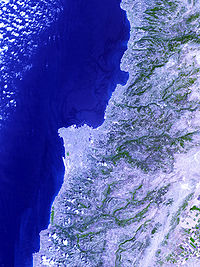 On 13 July 2006, and again on 15 July 2006, the Israeli Air Force bombed the Jiyeh power station
, 30 km (19 mi) south of Beirut, resulting in the largest ever oil spill in the Mediterranean Sea
. The plant's damaged storage tanks leaked an estimated 12,000 to 15,000 tonnes (more than 4 million gallons) of oil into the eastern Mediterranean. A 10 km (6 mi) wide oil slick covered 170 km (105 statute miles) of coastline, and threatened Turkey
and Cyprus
. The slick killed fish including the northern bluefin tuna
, a species already nearing extinction in the Mediterranean, and threatened the habitat of the endangered green sea turtle. It also potentially increased the risk of cancer
in humans. An additional 25,000 tons of oil burned at the power station, creating a "toxic cloud" that rained oil downwind. The Lebanese government estimated it would take 10 years to recover from the damage of the strike. The UN estimated the cost for the initial clean-up at $64 million.
Hezbollah rocket attacks caused numerous forest fires inside northern Israel, particularly on the Naftali mountain range near Kiryat Shmona
. As many as 16,500 acres (67 km²) of land, including forests and grazing fields, were destroyed by Hezbollah rockets. The Jewish National Fund
estimated that it would take 50 to 60 years to rehabilitate the forests.
Israeli bombing also caused significant damage to the world heritage site
s of Tyre and Byblos. In Tyre a Roman tomb was damaged and a fresco near the centre of the site collapsed. In Byblos
, a medieval tower was damaged and Venetian period remains near the harbour were dramatically stained by the oil slick and were considered to be difficult to clean. Damage was also caused to remains at Bint Jbeil
and Chamaa, and to the Temple of Bacchus
in Baalbek
.
s during the conflict. Israel fired 4.6 million submunitions into dozens of towns and villages in southern Lebanon in 962 separate strikes, the vast majority within the final days of the war. Israel claimed to have warned civilians prior to a strike, and that firing was limited to open areas or military targets inside urban areas. Israel used advanced cluster munitions produced by Israel Military Industries
, and large numbers of older cluster bombs, some produced in the 1970s, purchased from aging American
stockpiles. These were fired by multiple rocket launcher
s, 155mm artillery guns, and dropped by aircraft. As many as 1 million submunitions failed to explode on impact, lingering as land mines that killed or maimed almost 200 people since the war ended. As of 2011, munitions were still causing casualties and being cleared by volunteers.
Hezbollah fired 4,407 submunitions into civilian-populated areas of northern Israel in 113 separate strikes, using Chinese
made Type-81 122mm rockets, and Type-90 submunitions. These attacks killed one civilian and wounded twelve.
and broadcast clips, criticizing Nasrallah, showing the bodies of Hezbollah fighters, footage from Israeli raids and airstrikes, and captured Hezbollah equipment.
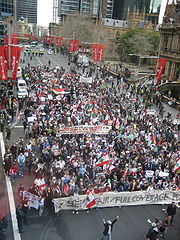 The conflict engendered worldwide concerns over infrastructure damage and the risks of escalation of the crisis, as well as mixed support and criticism of both Hezbollah and Israel. The governments of the United States
, United Kingdom
, Germany
, Australia
, and Canada
asserted Israel's right to self-defense
. The United States government further responded by authorizing Israel's request for expedited shipment of precision-guided bombs, but did not announce the decision publicly. United States President George W. Bush
said he thought the conflict was part of the "War on Terrorism
". On 20 July 2006, the United States Congress
voted overwhelmingly to support Israel's "right to defend itself".
 Among neighboring Middle Eastern nations, Iran
, Syria
, and Yemen
voiced strong support for Hezbollah, while the Arab League
, Egypt
, and Jordan
issued statements criticizing Hezbollah's actions and declaring support for Lebanon. Saudi Arabia
found Hezbollah entirely responsible. Egypt
, Jordan
, Kuwait
, Iraq
, the Palestinian Authority, the United Arab Emirates
and Bahrain
agreed with the Saudi stance that Hezbollah's actions were "unexpected, inappropriate and irresponsible acts."
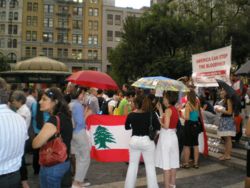
Many worldwide protests and demonstrations appealed for an immediate ceasefire on both sides and expressed concern for the heavy loss of civilian life on all sides. Other demonstrations were held exclusively in favor of Lebanon or Israel. Numerous newspaper advertising campaigns, SMS
and email appeals, and online petitions also occurred.
Various foreign governments assisted the evacuation of their citizens from Lebanon.
to call for an immediate, unconditional ceasefire between Israel and Hezbollah. John Bolton
confirmed that the US and UK, with support from several Arab leaders, delayed the ceasefire process. Outsider efforts to interfere with a ceasefire only ended when it became apparent Hezbollah would not be easily defeated.
On 11 August 2006 the United Nations Security Council unanimously approved UN Security Council Resolution 1701, in an effort to end the hostilities. It was accepted by the Lebanese government and Hezbollah on 12 August 2006, and by the Israeli government on 13 August 2006. The ceasefire took effect at 8:00 AM (5:00 AM GMT) on 14 August 2006.
Before the ceasefire, the two Hezbollah members of cabinet said that their militia would not disarm south of the Litani River
, according to another senior member of the Lebanese cabinet, while a top Hezbollah official similarly denied any intention of disarming in the south. Israel said it would stop withdrawing from Southern Lebanon
if Lebanese troops
were not deployed there within a matter of days.
 At the outbreak of hostilities, Prime Minister Fuad Saniora promised to rein in Hezbollah in an effort to stop Israel’s offensive. Saniora said that there could be no sovereign state of Lebanon without the group’s disarming. The former President of Lebanon Amin Gemayel, a longtime critic of Hezbollah said, "Hezbollah took a unilateral action, but its repercussions will affect the entire country."
The war deepened the longtime divide in Lebanon over Hezbollah's role. Many admired the organization for being the sole group to fight against Israel. Others considered it to be a dangerous militia that executes Iran and Syria policies in Lebanon. The divide over Hezbollah followed mostly sectarian lines, with Shias largely supporting the group and Sunnis, Christians and Druse
mostly opposing it.
A poll in July 2006 showed that 80 per cent of Lebanese Christians, 80 per cent of Druze and 89 per cent of Sunnis supported Hezbollah, a Shia Muslim group.
On 27 August 2006, Nasrallah stated, "Had we known that the capture of the soldiers would have led to [the war], we would definitely not have done it." This was the day before UN Secretary-General
Kofi Annan
's visit to Lebanon.
On 22 September 2006, some eight hundred thousand Hezbollah supporters gathered in Beirut for a rally at which Nasrallah stated that Hezbollah had achieved a "divine and strategic victory."
to oppose the war. On 22 July, about 2,000 people, including many Palestinian Arab citizens of Israel, demanded an end to the offensive during a protest march in Tel Aviv's Rabin Square
. On 5 August, some Israelis demonstrated in Tel Aviv, including former Knesset
members of the Meretz party, Mossi Raz
, Naomi Hazan and Yael Dayan
.
Initially, in a poll by an Israeli radio station, Israelis were split on the outcome with the majority believing that no one won. By 25 August, 63% of Israelis polled wanted Olmert to resign due to his handling of the war. The Jerusalem Post said that " if you fail to win, you lose" and that as "Hezbollah survived, it won the war."
Olmert admitted to the Knesset
that there were mistakes in the war in Lebanon, though he framed UN Security Council resolution 1701 as an accomplishment for Israel that would bring home the captured soldiers, and said that the operations had altered the regional strategic balance vis-à-vis Hezbollah. The Israeli Chief of Staff Dan Halutz
admitted to failings in the conflict. On 15 August, Israeli government and defense officials called for Halutz' resignation following a stock scandal in which he admitted selling stocks hours before the start of the Israeli offensive. Halutz subsequently resigned on 17 January 2007.
On 21 August, a group of demobilized Israel reserve soldiers and parents of soldiers killed in the fighting started a movement
calling for the resignation of Olmert and the establishment of a state commission of inquiry
. They set up a protest tent opposite the Knesset and grew to over 2,000 supporters by 25 August, including the influential Movement for Quality Government
. On 28 August, Olmert announced that there would be no independent state or governmental commission of inquiry, but two internal inspection probes, one to investigate the political echelon and one to examine the IDF, and likely a third commission to examine the Home Front
, to be announced at a later date. These would have a more limited mandate and less authority than a single inquiry commission headed by a retired judge. The political and military committees were to be headed by former director of Mossad
Nahum Admoni
and former Chief of Staff Amnon Lipkin-Shahak
, respectively. Critics argued that these committees amount to a whitewash
, due to their limited authority, limited investigatory scope, their self-appointed basis, and that neither would be headed by a retired judge.
Due to these pressures, on 11 October, Admoni was replaced by retired justice Eliyahu Winograd
as chair of the political probe, and the probe itself was elevated to the status of governmental commission with near-state commission mandate: the Winograd Commission
. On 12 September, former defense minister Moshe Arens
spoke of "the defeat of Israel" in calling for a state committee of inquiry. He said that Israel had lost "to a very small group of people, 5000 Hezbollah fighters, which should have been no match at all for the IDF", and stated that the conflict could have "some very fateful consequences for the future." Disclosing his intent to shortly resign, Ilan Harari
, the IDF's chief education officer, stated at a conference of senior IDF officers that Israel lost the war, becoming the first senior active duty officer to publicly state such an opinion. IDF Major General Yiftah Ron Tal
, on 4 October 2006 became the second and highest ranking serving officer to express his opinion that the IDF failed "to win the day in the battle against Hezbollah" as well as calling for Lt. Gen. Dan Halutz' resignation. Ron-Tal was subsequently fired for making those and other critical comments.
However, Eyal Zisser, director of the Moshe Dayan Center for Middle Eastern and African Studies
at Tel Aviv University, took a contrary position and expressed the view that the war was in fact a strategic success for Israel and a Hezbollah defeat. He noted that Hezbollah had "lost about a third of its elite fighting force" and that "despite mistakes made by the IDF in conducting the military campaign, Israeli soldiers triumphed in every face-to-face battle with Hezbollah." He concluded that "as time passes, the severity of the blow suffered by Lebanon and its people from the 2006 war becomes clear."
Zisser's view was shared by Dutch-Israeli military historian and author Martin van Creveld
who argued that Hezbollah “had the fight knocked out of it,” lost hundreds of its members and that the organization was “thrown out of South Lebanon,” replaced by “a fairy robust United Nations peacekeeping force.” He also stressed that as a result of the war, Israel is experiencing a level of calm on the Lebanon border not seen in over four decades.
In 2008, Ehud Barak
, the replacement defense minister for Peretz, stated that the conflict failed to disarm Hezbollah, and that the group is increasingly entrenched in South Lebanon, further stating that "Hezbollah is stronger than ever and has more rockets than at the outbreak of the Lebanon war in the summer of 2006" but he later noted that "[Israeli] deterrence still exists." The IDF's Northern Command cited this deterrence as one reason Hezbollah did not fire any rockets into Israel during Operation Cast Lead.
In March 2007, the Committee decided to name the war the "Second Lebanon War", a decision that was subsequently approved by the Israeli cabinet
.
Israeli military historian Martin van Creveld
stated that the war was a strategic Israeli victory and a setback for Hezbollah, and criticized the Winograd Commission
for its failure to mention the many successes achieved by Israel's military campaign. He noted that hundreds of Hezbollah fighters were killed in the war, and that the organization had "the fight knocked out of it", since following the war, Israel experienced a level of calm on its Lebanon border not seen since the mid-1960s. He also noted that Hezbollah was "thrown out of South Lebanon", and was replaced by "a fairly robust United Nations peacekeeping force" to prevent its return. He also said that there were a number of Israeli failures in the war, including the failure to terminate hostilities earlier and with fewer casualties.
IDF Maj.-Gen. (res.) Yaakov Amidror highlighted the number of Hezbollah militants killed, the quick military response to Hezbollah's long-range rocket attacks, the post-war replacement of Hezbollah by the Lebanese Army and UNIFIL in southern Lebanon, and Iran's loss of Hezbollah as a deterrent against an Israeli first strike following the war. Thomas Friedman
concurred, stating that the war was a "huge strategic loss for Hezbollah", and contrasted the billions in damage suffered by Hezbollah and Lebanon with the "relatively minor damage" suffered by Israel, which enjoyed an economic "growth spurt" immediately following the war.
Later in the Report, the Commission stated that "[a] decision [was] made in the night of 12 July to react (to the capturing) with immediate and substantive military action and to set... ambitious goals." This decision had immediate repercussions in that subsequent decisions were limited mainly to a choice between a) "a short, painful and unexpected blow on Hezbollah" and b) "to bring about a significant change of the reality in the South of Lebanon with a large ground operation,[occupying]...the South of Lebanon and 'cleaning' it of Hezbollah". "The fact Israel went to war before it decided which option to select and without an exit strategy, all these constituted serious failures of the decision making process."
As for achievements, the Commission reported that "SC resolution 1701, and the fact that it was adopted unanimously, were an achievement for Israel."
George Bush
said that Hezbollah was responsible for starting the war, and that the group suffered a defeat at the hands of Israel. He dismissed claims of victory by Hezbollah leaders, asking: "how can you claim victory when at one time you were a state within a state, safe within southern Lebanon, and now you're going to be replaced by a Lebanese Army and an international force?" In his 2010 memoir, Decision Points
, Bush wrote that Israel had weakened Hezbollah and secured its northern border, but that Israel's "shaky military performance" cost it international credibility. He also said that Israel "mishandled" its opportunity, and that some of the sites it attacked were of "questionable military value".
In a speech given on 15 August 2006, Syrian President Bashar al-Assad
claimed that the Arab resistance against Israel would continue to grow stronger, saying, "Your weapons, warplanes, rockets and even your atomic bomb
will not protect you in the future."
The Economist
magazine concluded that by surviving this asymmetrical military conflict with Israel, Hezbollah effectively emerged with a military and political victory from this conflict. They cite the facts that Hezbollah was able to sustain defenses on Lebanese soil and inflict unmitigated rocket attacks on Israeli civilians in the face of a punishing air and land campaign by the IDF.
Matt M. Matthews, a military historian at the Combat Studies Institute of the U.S. Army Command and General Staff College
praised Hezbollah paramilitaries
and reflected on what he described as "the lackluster performance of the IDF." He attributed this to several factors including (Lieutenant-General and Chief of the IDF General Staff) Halutz’s steadfast confidence in air power coupled with continuing COIN operations against the Palestinians at the expense of training for major combat operations.
The US Congressional Research Service
found that although Hezbollah’s military capabilities may have been substantially reduced, its long-term potential as a guerrilla movement appeared to remain intact: "Observers note that Hezbollah’s leaders have been able to claim a level of 'victory' simply by virtue of not having decisively 'lost'."
British military historian John Keegan
stated that the outcome of the war was "misreported as an Israeli defeat" due to anti-Israel bias in the international media. He concluded that Hezbollah had suffered heavy losses, and that a cease-fire came into effect before Israel could completely dislodge Hezbollah from its positions. He also stated that the casualties sustained by Israel during the war had alarmed the Israeli Government and High Command because Israel's small population is acutely vulnerable to losses in battle.
Charles Krauthammer
, a syndicated columnist and political commentator, citing an interview by which Nasrallah admitted that he would not have captured the soldiers had he known that it would lead to war, wrote, "Nasrallah's admission, vastly underplayed in the West, makes clear what Lebanese already knew. Hezbollah may have won the propaganda war, but on the ground it lost. Badly." He noted that Hezbollah's entrenched infrastructure along Israel's border was shattered and would not be easily rebuilt due to the presence of the Lebanese Army and a robust UNIFIL force, hundreds of Hezbollah's best fighters were killed in the war, and that many Lebanese were angry with Hezbollah for provoking a war which largely devastated the country.
Michael Young, opinion page editor at the Lebanese Daily Star
newspaper, stated that Hezbollah turned "the stench of defeat into the smell of victory," through clever use of its propaganda machine. He suggested that Hezbollah had "hoodwinked" pundits who believed that Hezbollah was victorious, and opined that "one dreads to imagine what Hezbollah would recognize as a military loss."
American military strategist and historian Edward Luttwak
drew comparisons with the 1973 Yom Kippur War, where what initially looked like an Israeli setback later turned out to be an IDF victory and an Arab defeat. He stated that although some IDF tanks were penetrated by missiles, they also largely limited IDF casualties, and that Hezbollah had failed to inflict massive losses on the IDF and to kill large numbers of Israelis in rocket attacks.
Cambridge professor and Peterhouse Fellow Brendan Simms
summed up the war this way; "Hezbollah have suffered a setback (but are too clever to admit it) and the Israelis have scored a long-term success (but are too narrow-minded to realize it)."
Journalist Michael Totten
wrote that "Hezbollah lost and Hezbollah knows it." He questioned why Hezbollah did not attack Israel when the IDF attacked Hamas in Gaza
in 2008, and noted that most of Nasrallah’s supporters "want Hezbollah to deter Israeli invasions, not to invite Israeli invasions". Totten concluded that Nasrallah's boasts "play well in much of the Arab world", but that the 2006 "victory" seemed "empty at home."
The Young Turks
, an American talk show, reviewed the war as an Israeli military victory, and a Hezbollah propaganda victory. Cenk Uygur
pointed out that Israel had managed to drive back Hezbollah and create an 18 miles (29 km) buffer zone in South Lebanon, while Hezbollah managed to win the propaganda war because it was able to keep fighting on the ground and continue firing rockets into Israel until the war's end.
was estimated at 0.4% of Israel's GDP in the following year. According to one analyst in the Associated Press
, the main casualty was the fragile unity between Lebanon's sectarian and political groups, though an Asia Times
piece points to Free Patriotic Movement
head Michel Aoun
's support for Hezbollah and provision of housing for Shi'a refugees as evidence for strengthened relations.
to Maariv employees which states, in part, that
In the beginning of the war, according to the report, "significant coverage of the decision-making process was almost entirely absent in Israel's media".
The media also marginalized reports on Israelis living in the North who did not receive proper governmental support and harped on the
question of the loyalties of Arab-Israelis in the North instead of focusing on inadequate provision of services by the state.
While the Israeli media reported on Lebanese suffering, it divorced this suffering from the IDF operations which caused it. With regard to diplomacy, the media buried the stories on negotiations to reflect the derision held by decision-makers toward a diplomatic solution.
Several media commentators and journalists have alleged an intentionally distorted coverage of the events, in favour of Hezbollah, by means of photo manipulation
, staging by Hezbollah or by journalists, and false or misleading captioning.
On 18 July 2006 Hezbollah Press Officer Hussein Nabulsi took CNN's Nic Robertson
on an exclusive tour of southern Beirut. Robertson noted that despite his minder's anxiety about explosions in the area, it was clear that Hezbollah had sophisticated media relations and were in control of the situation. Hezbollah designated the places that they went to, and the journalists "certainly didn't have time to go into the houses or lift up the rubble to see what was underneath." According to his reports, there was no doubt that the bombs were hitting Hezbollah facilities, and while there appeared to be "a lot of civilian damage, a lot of civilian properties," he reiterated that he couldn't verify the civilian nature of the destroyed buildings.
CNN
's Charlie Moore described a Hezbollah press tour of a bombed-out area in southern Beirut on 23 July 2006 as a "dog-and-pony show" due to perceived staging, misrepresentation of the nature of the destroyed areas, and strict directives about when and with whom interviews could take place.
In the same interview aired on 23 July 2006, CNN's John Roberts, who was reporting from an Israeli artillery battery on the Lebanese border, stated that he had to take everything he was told — either by the IDF or Hezbollah — "with a grain of salt," citing mutual recriminations of civilian targeting which he was unable to verify independently.
Reuters
withdrew over 900 photographs by Adnan Hajj
, a Lebanese freelance photographer, after he admitted to digitally adding and darkening smoke spirals in photographs of an attack on Beirut.
Photographs submitted to Reuters and Associated Press
showed one Lebanese woman mourning on two different pictures taken by two photographers, allegedly taken two weeks apart. It is "common practice to send more than one photographer to an incident".
Israeli warplanes continued conducting numerous flyovers and maneuvers above southern Lebanon, which Israel said did not violate the ceasefire.
On 19 August 2006, Israel launched a raid in Lebanon's eastern Beqaa Valley
it says was aimed at disrupting Hezbollah's weapons supply from Syria and Iran. Lebanese officials "said the Israelis were apparently seeking a guerrilla target in a school." Israel's aerial and commando operations were criticised by Kofi Annan as violations of the ceasefire, which he said they had conducted the majority of, and he also protested the continued embargo. France, then leading UNIFIL, also issued criticism of the flyovers, which it interpreted as aggressive. Israel argued that “[t]he cease-fire is based on (UN resolution) 1701
which calls for an international arms embargo against Hezbollah,” and said the embargo could be lifted after full implementation of the cease-fire but Annan said that UNIFIL would only interdict arms at Lebanon's request. On 7 September 2006 and 8 September 2006 respectively, aviation and naval blockades were lifted.
In the second half of September Hezbollah claimed victory and asserted an improvement in their position, and they redeployed to some positions on the border
as Israel completed its withdrawal from Lebanon save border-straddling Ghajar
.
On 3 October, an Israeli fighter penetrated the 2 nautical miles (4 km) defence perimeter of the French frigate Courbet without answering radio calls, triggering a diplomatic incident.
On 24 October, six Israeli
F-16s flew over a German Navy
vessel patrolling off Israel's coast just south of the Lebanese border. The German Defence Ministry said that the planes had given off infrared decoys and one of the aircraft had fired two shots into the air, which had not been specifically aimed. The Israeli military said that a German helicopter took off from the vessel without having coordinated this with Israel, and denied vehemently having fired any shots at the vessel and said "as of now" it also had no knowledge of the jets launching flares over it. Israeli Defence Minister Amir Peretz
telephoned his German counterpart Franz Josef Jung
to clarify that 'Israel has no intention to carry out any aggressive actions' against the German peacekeeping forces in Lebanon, who are there as part of UNIFIL to enforce an arms embargo against Hezbollah. Germany confirmed the consultations, and that both sides were interested in maintaining good cooperation.
On 1 December 2006, UN Secretary-General Kofi Annan submitted a report to the Security Council president maintaining "there were no serious incidents or confrontations" since the cease-fire in August 2006. He did, however, note that peacekeepers reported air violations by Israel "almost on a daily basis," which Israel maintained were a security measure related to continuing Syrian and Iranian arms shipments to Hezbollah, and evidence of the presence of unauthorized armed personnel, assets, and weapons in Lebanon. In one case, a UNIFIL demining team was challenged by two Hezbollah members in combat uniforms armed with AK-47 rifles
; UNIFIL notified the Lebanese army, who arrested three suspects the next day. There were also "13 instances where UNIFIL came across unauthorized arms or related material in its area of operation", including the discovery of 17 katyusha rockets and several improvised explosive devices in Rachaiya El-Foukhar, and the discovery of a weapons cache containing seven missiles, three rocket launchers, and a substantial amount of ammunition in the area of Bourhoz. Annan also reported that as of 20 November 2006, 822 Israeli cluster bomb strike sites had been recorded, with 60,000 cluster bomblets having been cleared by the UN Mine Action Coordination Center
.
The months after the hostilities saw major upheaval in the Israeli military and political echelon, with the spate of high-ranking resignations including Chief of General Staff
Dan Halutz
, and calls for resignations of many cabinet-members including Prime-Minister Ehud Olmert following publication of the Winograd Commission
's findings. The Winograd report severely criticized Olmert, accusing him of a "severe failure in exercising judgment, responsibility and caution." Lebanese Prime Minister Fouad Siniora criticized the Winograd report for failing to report on the full destruction dealt to Lebanon by the brief July War of 2006.
After the war, the Lebanese Army deployed 15,000 soldiers, backed by a UNIFIL force of 12,000, deployed South of the Litani River
to replace Hezbollah, although the Lebanese government said that it cannot and will not disarm Hezbollah by force. On 7 February 2010, the Lebanese Army fired at an Israeli bulldozer on the border, and Israeli forces returned fire. There were no reported casualties. Lebanon claimed that the bulldozer had crossed the border and entered Lebanese territory. In June 2007, Lebanese troops fired at an Israeli UAV over Tyre with small arms, causing no damage.
On 30 June 2007, UN Secretary-General Ban Ki-Moon
's fourth report on the implementation of SC Resolution 1701 fingered Israel, Lebanon and Hezbollah for violating the ceasefire, but called the firing of rockets into Israel by unknown elements "the most serious breach of the cessation of hostilities since the end of the war." The report commended Israel on its restraint following this attack, and commended Lebanon for its continued efforts to disarm armed groups. It further stated that in spite of "flexibility by Israel beyond the framework of UNSC-Resolution 1701, implementation of the resolution's humanitarian aspects has not yet been possible."
On 12 February 2008, Imad Mugniyah
, the head of Hezbollah’s military wing, was assassinated by a car bomb in Damascus. The Mossad
, Israel's intelligence agency, was widely believed to be behind the assassination. Although Israel officially denied involvement, Mugniyah had been the target of previous Mossad assassination attempts. Israel considered Mugniyah a "significant force behind actions against Israel".
On 14 July 2009, an explosion in Khirbat Silim, a Lebanese village near the Lebanon-Israel border, killed eight Hezbollah militants. Israel and the United Nations stated that the explosion was a hidden Hezbollah weapons cache, and condemned Hezbollah for violating Resolution 1701. The Lebanese government stated that the explosion was caused by IDF munitions left following the 2006 war. Hezbollah blamed the explosion on leftover shells that had been collected following Israel's withdrawal from Lebanon in 2000. A Kuwaiti newspaper, al-Seyassah, reported that the ammunition warehouse stored chemical weapons.
On 23 August 2009, the IDF published a video it said showed villagers from Marwakhin, a village in Southern Lebanon, "forcefully resisting" efforts by Hezbollah militants to store weapons in their village.
On 4 November 2009 Israeli navy commando
s of Shayetet 13
boarded the ship in the eastern Mediterranean Sea
and seized 500 tons of Iranian armaments disguised as civilian cargo. Israel said the weapons were bound for Hezbollah and originated from Iran. Hezbollah disavowed any connection to the contraband and accused Israel of “piracy.”
In May 2010, the Lebanese Army fired anti-aircraft artillery at two Israeli jets over Lebanon.
In 2010, French UNIFIL forces warned that they could in the future attack Israeli jets with anti-aircraft batteries if Israel continued its overflights of Lebanese airspace.
In 4 August 2010, a clash on the border
occurred when the Israel military tried to remove a tree from between the border and the border fence on Israeli territory. According to the Israeli's, the tree was blocking the view of one of their video cameras at the border. The Lebanese army fired at the Israeli forces and there was a clash for a few hours. In the ensuing clash, one Israeli soldier died as well as two Lebanese soldiers and one Lebanese journalist. There were also a number of injured military soldiers and civilians on both sides including Lebanese journalists.
i soldiers, Ehud Goldwasser
and Eldad Regev
, in exchange for incarcerated Palestine Liberation Front
militant Samir Kuntar
, four Hezbollah militants captured by Israel during the war, and bodies of about 200 other Lebanese and Palestinian militants held by Israel. Until that time, Hezbollah had refused to provide information on Goldwasser and Regev.
Media
Further reading and analysis
War
War is a state of organized, armed, and often prolonged conflict carried on between states, nations, or other parties typified by extreme aggression, social disruption, and usually high mortality. War should be understood as an actual, intentional and widespread armed conflict between political...
in Lebanon
Lebanon
Lebanon , officially the Republic of LebanonRepublic of Lebanon is the most common term used by Lebanese government agencies. The term Lebanese Republic, a literal translation of the official Arabic and French names that is not used in today's world. Arabic is the most common language spoken among...
, northern Israel
Israel
The State of Israel is a parliamentary republic located in the Middle East, along the eastern shore of the Mediterranean Sea...
and the Israeli-occupied territories
Israeli-occupied territories
The Israeli-occupied territories are the territories which have been designated as occupied territory by the United Nations and other international organizations, governments and others to refer to the territory seized by Israel during the Six-Day War of 1967 from Egypt, Jordan, and Syria...
. The principal parties were Hezbollah paramilitary
Paramilitary
A paramilitary is a force whose function and organization are similar to those of a professional military, but which is not considered part of a state's formal armed forces....
forces and the Israeli military
Israel Defense Forces
The Israel Defense Forces , commonly known in Israel by the Hebrew acronym Tzahal , are the military forces of the State of Israel. They consist of the ground forces, air force and navy. It is the sole military wing of the Israeli security forces, and has no civilian jurisdiction within Israel...
. The conflict started on 12 July 2006, and continued until a United Nations
United Nations
The United Nations is an international organization whose stated aims are facilitating cooperation in international law, international security, economic development, social progress, human rights, and achievement of world peace...
-brokered ceasefire
Ceasefire
A ceasefire is a temporary stoppage of a war in which each side agrees with the other to suspend aggressive actions. Ceasefires may be declared as part of a formal treaty, but they have also been called as part of an informal understanding between opposing forces...
went into effect in the morning on 14 August 2006, though it formally ended on 8 September 2006 when Israel lifted its naval blockade
Blockade
A blockade is an effort to cut off food, supplies, war material or communications from a particular area by force, either in part or totally. A blockade should not be confused with an embargo or sanctions, which are legal barriers to trade, and is distinct from a siege in that a blockade is usually...
of Lebanon.
The conflict began
Zar'it-Shtula incident
The 2006 Hezbollah cross-border raid was a cross-border attack committed by Lebanon-based Hezbollah militants on an Israeli military patrol on 12 July 2006 on Israeli territory....
when militants from the group Hezbollah fired rockets at Israeli border towns as a diversion for an anti-tank missile attack on two armored Humvees patrolling the Israeli side of the border fence. The ambush left three soldiers dead. Two additional soldiers, believed to have been killed outright or mortally wounded, were taken by Hezbollah to Lebanon. Five more were killed in a failed rescue attempt. Israel responded with airstrike
Airstrike
An air strike is an attack on a specific objective by military aircraft during an offensive mission. Air strikes are commonly delivered from aircraft such as fighters, bombers, ground attack aircraft, attack helicopters, and others...
s and artillery
Artillery
Originally applied to any group of infantry primarily armed with projectile weapons, artillery has over time become limited in meaning to refer only to those engines of war that operate by projection of munitions far beyond the range of effect of personal weapons...
fire on targets in Lebanon that damaged Lebanese civilian
Civilian
A civilian under international humanitarian law is a person who is not a member of his or her country's armed forces or other militia. Civilians are distinct from combatants. They are afforded a degree of legal protection from the effects of war and military occupation...
infrastructure
Infrastructure
Infrastructure is basic physical and organizational structures needed for the operation of a society or enterprise, or the services and facilities necessary for an economy to function...
, including Beirut's Rafic Hariri International Airport
Beirut Rafic Hariri International Airport
Beirut Rafic Hariri International Airport is located 9 km from the city centre in the southern suburbs of Beirut, Lebanon and is the only operational commercial airport in the country. It is the hub for Lebanon's national carrier, Middle East Airlines...
, an air and naval blockade
Blockade
A blockade is an effort to cut off food, supplies, war material or communications from a particular area by force, either in part or totally. A blockade should not be confused with an embargo or sanctions, which are legal barriers to trade, and is distinct from a siege in that a blockade is usually...
, and a ground invasion of southern Lebanon
Southern Lebanon
Southern Lebanon is the geographical area of Lebanon comprising the South Governorate and the Nabatiye Governorate. These two entities were divided from the same province in the early 1990s...
. Hezbollah then launched more rockets into northern Israel and engaged the Israel Defense Forces
Israel Defense Forces
The Israel Defense Forces , commonly known in Israel by the Hebrew acronym Tzahal , are the military forces of the State of Israel. They consist of the ground forces, air force and navy. It is the sole military wing of the Israeli security forces, and has no civilian jurisdiction within Israel...
(IDF) in guerrilla warfare
Guerrilla warfare
Guerrilla warfare is a form of irregular warfare and refers to conflicts in which a small group of combatants including, but not limited to, armed civilians use military tactics, such as ambushes, sabotage, raids, the element of surprise, and extraordinary mobility to harass a larger and...
from hardened positions.
The conflict killed at least 1,200 people, mostly Lebanese citizens, severely damaged Lebanese civil infrastructure, and displaced approximately one million Lebanese and 300,000–500,000 Israelis. After the ceasefire, some parts of southern Lebanon remained uninhabitable due to Israeli unexploded cluster bomblets.
On 11 August 2006, the United Nations Security Council
United Nations Security Council
The United Nations Security Council is one of the principal organs of the United Nations and is charged with the maintenance of international peace and security. Its powers, outlined in the United Nations Charter, include the establishment of peacekeeping operations, the establishment of...
unanimously approved UN Resolution 1701
United Nations Security Council Resolution 1701
United Nations Security Council Resolution 1701 is a resolution that was intended to resolve the 2006 Israel-Lebanon conflict.It was unanimously approved by the United Nations Security Council on 11 August 2006. The Lebanese cabinet, which includes two members of Hezbollah, unanimously approved the...
in an effort to end the hostilities. The resolution, which was approved by both Lebanese and Israeli governments the following days, called for disarmament of Hezbollah, for withdrawal of Israel from Lebanon, and for the deployment of Lebanese soldiers
Lebanese Armed Forces
The Lebanese Armed Forces or Forces Armées Libanaises in French, also known as the Lebanese Army according to its official Website The Lebanese Armed Forces (LAF) (Arabic: القوات المسلحة اللبنانية | Al-Quwwāt al-Musallaḥa al-Lubnāniyya) or Forces Armées Libanaises in French, also known as the...
and an enlarged United Nations Interim Force in Lebanon
United Nations Interim Force in Lebanon
The United Nations Interim Force in Lebanon, or UNIFIL, was created by the United Nations, with the adoption of Security Council Resolution 425 and 426 on 19 March 1978, to confirm Israeli withdrawal from Lebanon which Israel had invaded five days prior, restore international peace and security,...
(UNIFIL) in the south. UNIFIL was given an expanded mandate, including the ability to use force to ensure that their area of operations wasn't used for hostile activities, and to resist attempts by force to prevent them from discharging their duties. The Lebanese army began deploying in southern Lebanon on 17 August 2006. The blockade was lifted on 8 September 2006. On 1 October 2006, most Israeli troops withdrew from Lebanon, though the last of the troops continued to occupy the border-straddling village of Ghajar
Ghajar
Ghajar is an Alawite village on the Hasbani River on the border between Lebanon and the Israeli-occupied portion of the Golan Heights. It has a population of 2,000.-Early history:...
. In the time since the enactment of UNSCR 1701 both the Lebanese government and UNIFIL have stated that they will not disarm Hezbollah. The remains of the two captured soldiers, whose fates were unknown, were returned to Israel on 16 July 2008 as part of a prisoner exchange
2008 Israel-Hezbollah prisoner swap
The 2008 Israel–Hezbollah prisoner exchange took place on July 16, 2008 when Hezbollah transferred the coffins of two Israeli soldiers in exchange for 5 Lebanese militants held by Israel as well as the bodies of 199 mainly Lebanese and Palestinian militants captured in Lebanon or Israel in the...
.
Background
Cross-border attacks from southern LebanonSouthern Lebanon
Southern Lebanon is the geographical area of Lebanon comprising the South Governorate and the Nabatiye Governorate. These two entities were divided from the same province in the early 1990s...
into Israel by the Palestine Liberation Organization
Palestine Liberation Organization
The Palestine Liberation Organization is a political and paramilitary organization which was created in 1964. It is recognized as the "sole legitimate representative of the Palestinian people" by the United Nations and over 100 states with which it holds diplomatic relations, and has enjoyed...
(PLO) date as far back as 1968, and followed Israel's forceful occupation of additional Arab territory the previous year; the area became a significant base for attacks following the arrival of the PLO leadership and its Fatah
Fatah
Fataḥ is a major Palestinian political party and the largest faction of the Palestine Liberation Organization , a multi-party confederation. In Palestinian politics it is on the left-wing of the spectrum; it is mainly nationalist, although not predominantly socialist. Its official goals are found...
brigade following their 1971 expulsion from Jordan
Black September in Jordan
September 1970 is known as the Black September in Arab history and sometimes is referred to as the "era of regrettable events." It was a month when Hashemite King Hussein of Jordan moved to quash the militancy of Palestinian organizations and restore his monarchy's rule over the country. The...
. Starting about this time, increasing demographic tensions
Demographics of Lebanon
This article is about the demographic features of the population of Lebanon, including population density, ethnicity, education level, health of the populace, economic status, religious affiliations and other aspects of the population....
related to the Lebanese National Pact
National Pact
The National Pact is an unwritten agreement that laid the foundation of Lebanon as a multi-confessional state, and has shaped the country to this day. Following negotiations between the Shi'ite, Sunni, and Maronite leaderships, the National Pact was born in the summer of 1943 allowing Lebanon to...
, which had divided governmental powers among religious groups throughout the country 30 years previously, began running high and led in part to the Lebanese Civil War
Lebanese Civil War
The Lebanese Civil War was a multifaceted civil war in Lebanon. The war lasted from 1975 to 1990 and resulted in an estimated 150,000 to 230,000 civilian fatalities. Another one million people were wounded, and today approximately 350,000 people remain displaced. There was also a mass exodus of...
(1975–1990). Concurrently, Syria began a 29 year military occupation in 1976. Israel's 1978 invasion of Lebanon
Operation Litani
The 1978 South Lebanon conflict was an invasion in Lebanon up to the Litani River carried out by the Israel Defense Forces in 1978. It was a military success for the Israeli Defense Forces, as PLO forces were pushed north of the river...
failed to stem the Palestinian attacks, but Israel invaded Lebanon
1982 Lebanon War
The 1982 Lebanon War , , called Operation Peace for Galilee by Israel, and later known in Israel as the Lebanon War and First Lebanon War, began on 6 June 1982, when the Israel Defense Forces invaded southern Lebanon...
again in 1982 and forcibly expelled the PLO. Israel withdrew to a borderland buffer zone
Israeli Security Zone
The Israeli Security Zone in southern Lebanon was a strip of territory of varying width, , from the Israeli border and the Golan Heights, occupied by Israeli forces from 1985 to 2000. Additional regions controlled by the South Lebanon Army are sometimes included under the term...
in southern Lebanon, held with the aid of proxy militants in the South Lebanon Army
South Lebanon Army
The South Lebanon Army , also "South Lebanese Army," was a Lebanese militia during the Lebanese Civil War. After 1979, the militia operated in southern Lebanon under the authority of Saad Haddad's Government of Free Lebanon...
(SLA). The invasion however, also led to the conception of a new Shi'a militant group
Paramilitary
A paramilitary is a force whose function and organization are similar to those of a professional military, but which is not considered part of a state's formal armed forces....
, which in 1985, established itself politically under the name Hezbollah, and declared an armed struggle to end the Israeli occupation
1982-2000 South Lebanon conflict
The South Lebanon conflict refers to nearly 20 years of warfare between the Israel Defense Force and its Lebanese proxy militias and Lebanese Muslim guerrillas led by the Iranian-backed Hezbollah within what was defined by Israelis as the "Security Zone" in South Lebanon...
of Lebanese territory. When the Lebanese civil war ended and other warring factions agreed to disarm, both Hezbollah and the SLA refused. Ten years later, Israel withdrew from South Lebanon to the UN-designated and internationally recognized Blue Line
Blue Line (Lebanon)
The Blue Line is a border demarcation between Lebanon and Israel published by the United Nations on 7 June 2000 for the purposes of determining whether Israel had fully withdrawn from Lebanon...
border in 2000.
The withdrawal also led to the immediate collapse of the SLA, and Hezbollah took control of the area in rapid succession. Later citing continued Israeli control of the disputed Shebaa farms
Shebaa farms
The Shebaa Farms are a small uninhabited territory claimed by Lebanon, but occupied by Israel which claims they are in Syria's Golan Heights. Syrian policy is to vaguely accept the Lebanese claim, while refusing any binding demarcation until Israeli forces withdraw from the area.The United Nations...
region and the internment
Internment
Internment is the imprisonment or confinement of people, commonly in large groups, without trial. The Oxford English Dictionary gives the meaning as: "The action of 'interning'; confinement within the limits of a country or place." Most modern usage is about individuals, and there is a distinction...
of Lebanese prisoners in Israel
Lebanese prisoners in Israel
Lebanese prisoners in Israel have been a source of contention between Lebanon and Israel and were an issue in the 2006 Lebanon War. The number of such detainees is disputed. According to the Lebanese militant organization Hezbollah, there are two Lebanese citizens in Israeli prisons, but Israel...
, Hezbollah intensified its cross-border attacks, and used the tactic of seizing soldiers from Israel as leverage for a prisoner exchange
Israeli MIA prisoner exchanges
Over the last 30 years, Israel has released about 7,000 Palestinian prisoners to secure freedom for 19 Israelis and to retrieve the bodies of eight others. A number of diplomatic efforts have been made to secure the release of Israeli IDF personnel following their capture by enemy forces.In 1985,...
in 2004.
Abduction efforts in the year prior to conflict
In June 2005, an Israel Defense ForcesIsrael Defense Forces
The Israel Defense Forces , commonly known in Israel by the Hebrew acronym Tzahal , are the military forces of the State of Israel. They consist of the ground forces, air force and navy. It is the sole military wing of the Israeli security forces, and has no civilian jurisdiction within Israel...
paratroop unit operating near the Shebaa Farms
Shebaa farms
The Shebaa Farms are a small uninhabited territory claimed by Lebanon, but occupied by Israel which claims they are in Syria's Golan Heights. Syrian policy is to vaguely accept the Lebanese claim, while refusing any binding demarcation until Israeli forces withdraw from the area.The United Nations...
engaged three Lebanese it identified as Hezbollah special force members, killing one. Videotapes recovered by the paratroopers contained footage of the three recording detailed accounts of the area.
Over the following 12 months, Hezbollah made three unsuccessful attempts to abduct Israeli soldiers. On 21 November 2005, a number of Hezbollah special forces attempted to attack an Israeli outpost in Ghajar
Ghajar
Ghajar is an Alawite village on the Hasbani River on the border between Lebanon and the Israeli-occupied portion of the Golan Heights. It has a population of 2,000.-Early history:...
, a village straddling the border between Lebanon and the Golan Heights. The outpost had been deserted following an intelligence warning, and three of the Hezbollah militants were killed when Israeli sniper David Markovich shot a rocket-propelled grenade they were carrying, causing it to explode. From his sniper position, Markovich shot and killed a fourth gunman shortly thereafter.
Beginning of conflict
Feint
Feint is a French term that entered English from the discipline of fencing. Feints are maneuvers designed to distract or mislead, done by giving the impression that a certain maneuver will take place, while in fact another, or even none, will...
rocket attacks toward Israeli military positions near the coast and near the border village of Zar'it
Zar'it
Zar'it is an moshav in northern Israel. Located in the Upper Galilee near the Lebanese border, it falls under the jurisdiction of Ma'ale Yosef Regional Council. In 2006 it had a population of 250....
as well as on the Israeli town of Shlomi and other villages. Five civilians were injured. Six Israeli military positions were fired on, and the surveillance cameras knocked out. At the same time, a Hezbollah ground contingent infiltrated the border
Blue Line (Lebanon)
The Blue Line is a border demarcation between Lebanon and Israel published by the United Nations on 7 June 2000 for the purposes of determining whether Israel had fully withdrawn from Lebanon...
into Israel through a "dead zone" in the border fence, hiding in an overgrown wadi
Wadi
Wadi is the Arabic term traditionally referring to a valley. In some cases, it may refer to a dry riverbed that contains water only during times of heavy rain or simply an intermittent stream.-Variant names:...
. They attacked a patrol of two Israeli armoured Humvees
High Mobility Multipurpose Wheeled Vehicle
The High Mobility Multipurpose Wheeled Vehicle , better known as the Humvee, is a military 4WD motor vehicle created by AM General. It has largely supplanted the roles formerly served by smaller Jeeps such as the M151 MUTT, the M561 "Gama Goat", their M718A1 and M792 ambulance versions, the CUCV,...
patrolling the border near Zar'it, using pre-positioned explosives and anti-tank missiles, killing three soldiers, injuring two, and capturing two soldiers (Master Sergeant Ehud Goldwasser
Ehud Goldwasser
Ehud Goldwasser was an Israeli soldier who was abducted in Israel by Hezbollah along with Eldad Regev on 12 July 2006, sparking the 2006 Israel-Lebanon conflict. His rank was First Sergeant....
and First Sergeant Eldad Regev
Eldad Regev
Eldad Regev was an Israeli soldier, born in Qiryat Motzkin, abducted by Hezbollah members along with Ehud Goldwasser on July 12, 2006, in Israel near the Lebanese border, sparking the 2006 Israel-Lebanon conflict. His rank was Sergeant First Class....
). In response to the Hezbollah feint attacks, the IDF conducted a routine check of its positions and patrols, and found that contact with two jeeps was lost. A rescue force was immediately dispatched to the area, and confirmed that two soldiers were missing after 20 minutes. A Merkava Mk III
Merkava
The Merkava is a main battle tank used by the Israel Defense Forces. The tank began development in 1974 and was first introduced in 1978. Four main versions of the tank have been deployed. It was first used extensively in the 1982 Lebanon War...
tank, an Armored personnel carrier, and a helicopter
Helicopter
A helicopter is a type of rotorcraft in which lift and thrust are supplied by one or more engine-driven rotors. This allows the helicopter to take off and land vertically, to hover, and to fly forwards, backwards, and laterally...
were immediately dispatched into Lebanon. The tank hit a large land mine, killing its crew of four. Another soldier was killed and two lightly injured by mortar fire as they attempted to recover the bodies.
Hezbollah named the attack "Operation Truthful Promise
Zar'it-Shtula incident
The 2006 Hezbollah cross-border raid was a cross-border attack committed by Lebanon-based Hezbollah militants on an Israeli military patrol on 12 July 2006 on Israeli territory....
" after leader Hassan Nasrallah
Hassan Nasrallah
Hasan Nasrallah, became the third Secretary General of the Lebanese political and paramilitary organization Hezbollah after Israel assassinated the previous leader, Abbas al-Musawi, in 1992. Hezbollah in its entirety is considered a terrorist organization by The United States, the Netherlands,...
's public pledges over the prior year and a half to seize Israeli soldiers and swap them for four Lebanese held by Israel
Lebanese prisoners in Israel
Lebanese prisoners in Israel have been a source of contention between Lebanon and Israel and were an issue in the 2006 Lebanon War. The number of such detainees is disputed. According to the Lebanese militant organization Hezbollah, there are two Lebanese citizens in Israeli prisons, but Israel...
:
- Samir KuntarSamir KuntarSamir Kuntar is a Lebanese Druze convicted murderer and former member of the Palestine Liberation Front...
(a Lebanese citizen captured during a terrorist attack in 1979, convicted of murdering civilians and a police officer); - Nasim NisrNasim NisrNasim Nisr , is a Lebanese citizen who was convicted of spying for Hezbollah. Nisr was born in Lebanon to a Muslim father and a Jewish mother who converted to Islam after her marriage. Nisr moved to Israel in 1982, and obtained Israeli citizenship under the Law of Return...
(an Israeli-Lebanese citizen tried and convicted for spying by Israel); - Yahya SkafYahya SkafYahya Skaf, also spelled Yehia Skaff, from the Bhanine district of Lebanon, is a person claimed to have been arrested by Israel on 11 March 1978 for participation in the Coastal Road massacre. He has never been tried and Israel claims he was killed during battle with his body never found...
(a Lebanese citizen whom Hezbollah claims was arrested in Israel, Israel denies); - Ali Faratan (another Lebanese citizen whom Hezbollah claims to be held in Israel).
Nasrallah claimed that Israel had broken a previous deal to release these prisoners, and since diplomacy had failed, violence was the only remaining option. Nasrallah declared: "No military operation will return the Israeli captured soldiers...The prisoners will not be returned except through one way: indirect negotiations and a trade of prisoners."
Israeli Prime Minister
Prime Minister of Israel
The Prime Minister of Israel is the head of the Israeli government and the most powerful political figure in Israel . The prime minister is the country's chief executive. The official residence of the prime minister, Beit Rosh Hamemshala is in Jerusalem...
Ehud Olmert
Ehud Olmert
Ehud Olmert is an Israeli politician and lawyer. He served as Prime Minister of Israel from 2006 to 2009, as a Cabinet Minister from 1988 to 1992 and from 2003 to 2006, and as Mayor of Jerusalem from 1993 to 2003....
described the seizure of the soldiers as an "act of war" by the sovereign state of Lebanon, stating that "Lebanon will bear the consequences of its actions" and promising a "very painful and far-reaching response." Israel blamed the Lebanese government for the raid, as it was carried out from Lebanese territory and Hezbollah had two ministers serving in the Lebanese cabinet at that time.
In response, Lebanese Prime Minister Fouad Siniora
Fouad Siniora
Fuad Siniora is a Lebanese politician, a former Prime Minister of Lebanon, a position he held from 19 July 2005 to May 25, 2008 the date of the election of the new President of Lebanon; he was renominated to the post on 28 May 2008 and held the post as Acting President between those...
denied any knowledge of the raid and stated that he did not condone it. An emergency meeting of the Lebanese government reaffirmed this position.
The Israel Defense Forces
Israel Defense Forces
The Israel Defense Forces , commonly known in Israel by the Hebrew acronym Tzahal , are the military forces of the State of Israel. They consist of the ground forces, air force and navy. It is the sole military wing of the Israeli security forces, and has no civilian jurisdiction within Israel...
attacked targets within Lebanon with artillery and airstrikes hours before the Israeli Cabinet
Cabinet of Israel
The Cabinet of Israel is a formal body composed of government officials called ministers, chosen and led by the Prime Minister. The Prime Minister must appoint members based on the distribution of votes to political parties during legislative elections, and its composition must be approved by a...
met to discuss a response. The targets consisted of bridges and roads in Lebanon, which were hit to prevent Hezbollah from transporting the abductees. An Israeli airstrike also destroyed the runways of Beirut Rafic Hariri International Airport
Beirut Rafic Hariri International Airport
Beirut Rafic Hariri International Airport is located 9 km from the city centre in the southern suburbs of Beirut, Lebanon and is the only operational commercial airport in the country. It is the hub for Lebanon's national carrier, Middle East Airlines...
. 44 civilians were killed. The Israeli Air Force also targeted Hezbollah’s long range rocket and missile stockpiles destroying most of them on the ground in the first days of the war. A large portion were destroyed in the first 34 minutes.
Later that same day (12 July 2006), the Cabinet decided to authorize the Prime Minister, the Defense Minister and their deputies to pursue the plan which they had proposed for action within Lebanon. Prime Minister Olmert's officially demanded that the Israel Defense Force avoid civilian casualties whenever possible. Israel's chief of staff
Ramatkal
The Chief of the General Staff, also known as the Commander-in-Chief of the Israel Defense Forces is the supreme commander and Chief of Staff of the Israel Defense Forces. At any given time, the Chief of Staff is the only active officer holding the IDF's highest rank, Rav Aluf , which is usually...
Dan Halutz
Dan Halutz
' is an Israeli Air Force Lt. General and former Chief of Staff of the Israel Defense Forces and commander of the Israeli Air Force. Halutz was appointed as Chief of Staff on June 1, 2005. On January 17, 2007 he announced his resignation. He has a degree in economics. He was born to a Mizrahi...
said, "if the soldiers are not returned, we will turn Lebanon's clock back 20 years" while the head of Israel's Northern Command Udi Adam
Udi Adam
Aluf Ehud "Udi" Adam was a General in the Israel Defense Forces and the former head of the Israeli Northern Command. Adam has received a B.A. in Psychology and Sociology from Bar Ilan University and later studied at the School for War Studies in Paris, where he received a M.A. in Strategic Studies...
said, "this affair is between Israel and the state of Lebanon. Where to attack? Once it is inside Lebanon, everything is legitimate -- not just southern Lebanon, not just the line of Hezbollah posts." On 12 July 2006, the Israeli Cabinet promised that Israel would "respond aggressively and harshly to those who carried out, and are responsible for, today's action". The Cabinet's communiqué stated, in part, that the "Lebanese Government [was] responsible for the action that originated on its soil." A retired Israeli Army Colonel explained that the rationale behind the attack was to create a rift between the Lebanese population and Hezbollah supporters by exacting a heavy price from the elite in Beirut
Beirut
Beirut is the capital and largest city of Lebanon, with a population ranging from 1 million to more than 2 million . Located on a peninsula at the midpoint of Lebanon's Mediterranean coastline, it serves as the country's largest and main seaport, and also forms the Beirut Metropolitan...
.
On 16 July, the Israeli Cabinet
Cabinet of Israel
The Cabinet of Israel is a formal body composed of government officials called ministers, chosen and led by the Prime Minister. The Prime Minister must appoint members based on the distribution of votes to political parties during legislative elections, and its composition must be approved by a...
released a communiqué explaining that, although Israel had engaged in military operations within Lebanon, its war was not against the Lebanese government. The communiqué stated: "Israel is not fighting Lebanon but the terrorist element there, led by Nasrallah and his cohorts, who have made Lebanon a hostage and created Syria
Syria
Syria , officially the Syrian Arab Republic , is a country in Western Asia, bordering Lebanon and the Mediterranean Sea to the West, Turkey to the north, Iraq to the east, Jordan to the south, and Israel to the southwest....
n- and Iran
Iran
Iran , officially the Islamic Republic of Iran , is a country in Southern and Western Asia. The name "Iran" has been in use natively since the Sassanian era and came into use internationally in 1935, before which the country was known to the Western world as Persia...
ian-sponsored terrorist enclaves of murder."
When asked in August about the proportionality of the response, Prime Minister Olmert stated that the "war started not only by killing eight Israeli soldiers and abducting two but by shooting Katyusha and other rockets on the northern cities of Israel on that same morning. Indiscriminately." He added "no country in Europe would have responded in such a restrained manner as Israel did."
Hezbollah action
Hezbollah rocket force
In October 2006 Hezbollah claimed to have an arsenal of at least 33,000 rockets. The Pentagon believes that Hezbollah has a rocket arsenal of around 30.000...
Hezbollah fired between 3,970 and 4,228 rockets at a rate of more than 100 per day, unprecedented since the Iran-Iraq war
Iran-Iraq War
The Iran–Iraq War was an armed conflict between the armed forces of Iraq and Iran, lasting from September 1980 to August 1988, making it the longest conventional war of the twentieth century...
. About 95% of these were 122 mm (4.8 in) Katyusha artillery rockets
Rocket artillery
Rocket artillery is a type of artillery equipped with rocket launchers instead of conventional guns or mortars.Types of rocket artillery pieces include multiple rocket launchers.-History:...
, which carried warheads up to 30 kg (66 lb
Pound (mass)
The pound or pound-mass is a unit of mass used in the Imperial, United States customary and other systems of measurement...
) and had a range of up to 30 km (19 mi). An estimated 23% of these rockets hit cities and built-up areas across northern Israel, while the remainder hit open areas. Cities hit were Haifa
Haifa
Haifa is the largest city in northern Israel, and the third-largest city in the country, with a population of over 268,000. Another 300,000 people live in towns directly adjacent to the city including the cities of the Krayot, as well as, Tirat Carmel, Daliyat al-Karmel and Nesher...
, Hadera
Hadera
Hadera is a city located in the Haifa District of Israel approximately from the major cities of Tel Aviv and Haifa. The city is located along of the Israeli Mediterranean Coastal Plain...
, Nazareth
Nazareth
Nazareth is the largest city in the North District of Israel. Known as "the Arab capital of Israel," the population is made up predominantly of Palestinian Arab citizens of Israel...
, Tiberias, Nahariya
Nahariya
Nahariya is the northernmost coastal city in Israel, with an estimated population of 51,200.-History:Nahariya was founded by German Jewish immigrants from the Fifth Aliyah in the 1930s...
, Safed
Safed
Safed , is a city in the Northern District of Israel. Located at an elevation of , Safed is the highest city in the Galilee and of Israel. Due to its high elevation, Safed experiences warm summers and cold, often snowy, winters...
, Shaghur, Afula
Afula
Afula is a city in the North District of Israel, often known as the "Capital of the Valley", referring to the Jezreel Valley. The city had a population of 40,500 at the end of 2009.-History:...
, Kiryat Shmona
Kiryat Shmona
Kiryat Shmona is a city located in the North District of Israel on the western slopes of the Hula Valley on the Lebanese border. The city was named for the eight people, including Joseph Trumpeldor, who died in 1920 defending Tel Hai....
, Beit She'an, Karmiel
Karmiel
Karmiel is a city in northern Israel. Established in 1964 as a development town, Karmiel is located in the Beit HaKerem Valley which divides upper and lower Galilee. The city is located south of the Acre-Safed road, from Safed and from Acre...
, Acre
Acre, Israel
Acre , is a city in the Western Galilee region of northern Israel at the northern extremity of Haifa Bay. Acre is one of the oldest continuously inhabited sites in the country....
, and Ma'alot-Tarshiha
Ma'alot-Tarshiha
Ma'alot-Tarshiha is a mixed city in the North District in Israel, some 20 km east of Nahariya, about 600 meter above sea level. The city was established in 1963 through a municipal merger of the Arab town of Tarshiha and the Jewish town of Ma'alot...
, as well as dozens of towns, kibbutz
Kibbutz
A kibbutz is a collective community in Israel that was traditionally based on agriculture. Today, farming has been partly supplanted by other economic branches, including industrial plants and high-tech enterprises. Kibbutzim began as utopian communities, a combination of socialism and Zionism...
im, moshav
Moshav
Moshav is a type of Israeli town or settlement, in particular a type of cooperative agricultural community of individual farms pioneered by the Labour Zionists during the second aliyah...
im, and Druze and Israeli-Arab
Arab citizens of Israel
Arab citizens of Israel refers to citizens of Israel who are not Jewish, and whose cultural and linguistic heritage or ethnic identity is Arab....
villages. The northern West Bank
West Bank
The West Bank ) of the Jordan River is the landlocked geographical eastern part of the Palestinian territories located in Western Asia. To the west, north, and south, the West Bank shares borders with the state of Israel. To the east, across the Jordan River, lies the Hashemite Kingdom of Jordan...
was also hit.
Hezbollah engaged in guerrilla warfare with IDF ground forces, fighting from well-fortified positions, often in urban areas, and attacking with small, well-armed units. Hezbollah fighters were highly trained, and were equipped with flak jackets, night-vision goggles, communications equipment, and sometimes with Israeli uniforms and equipment. An Israeli soldier who participated in the war said that Hezbollah fighers were "nothing like Hamas or the Palestinians. They are trained and highly qualified. All of us were kind of surprised". During engagements with the IDF, Hezbollah concentrated on inflicting losses on the IDF, believing that an unwillingness to absorb steady losses to be Israel's strategic weakness. However, Hezbollah sustained greater losses than the IDF during ground engagements.
Hezbollah countered IDF armor through the use of sophisticated Russian-made anti-tank guided missile
Anti-tank guided missile
An anti-tank missile , anti-tank guided missile , anti-tank guided weapon or anti-armor guided weapon is a guided missile primarily designed to hit and destroy heavily-armored military vehicles....
s (ATGMs). According to Merkava tank program administration, 52 Merkava
Merkava
The Merkava is a main battle tank used by the Israel Defense Forces. The tank began development in 1974 and was first introduced in 1978. Four main versions of the tank have been deployed. It was first used extensively in the 1982 Lebanon War...
main battle tank
Main battle tank
A main battle tank , also known as a battle tank or universal tank, is a tank that fills the heavy direct fire role of many modern armies. They were originally conceived to replace the light, medium, heavy and super-heavy tanks. Development was spurred onwards in the Cold War with the development...
s were damaged (45 of them by different kinds of ATGM), missiles penetrated 22 tanks, but only 5 tanks were destroyed, one of them by an improvised explosive device
Improvised explosive device
An improvised explosive device , also known as a roadside bomb, is a homemade bomb constructed and deployed in ways other than in conventional military action...
(IED). The Merkava tanks that were penetrated were predominantly Mark II and Mark III models, but five Mark IV tanks were also penetrated. All but two of these tanks were rebuilt and returned to service. The IDF declared itself satisfied with the Merkava Mark IV's performance during the war. Hezbollah caused additional casualties using ATGMs to collapse buildings onto Israeli troops sheltering inside. As a result, IDF units did not linger in any one area for an extended period of time. Hezbollah fighters often used tunnels to emerge quickly, fire an anti-tank missile, and then disappear again.
After the initial Israeli response, Hezbollah declared an all-out military alert. Hezbollah was estimated to have 13,000 missiles at the beginning of the conflict. Israeli newspaper Haaretz
Haaretz
Haaretz is Israel's oldest daily newspaper. It was founded in 1918 and is now published in both Hebrew and English in Berliner format. The English edition is published and sold together with the International Herald Tribune. Both Hebrew and English editions can be read on the Internet...
described Hezbollah as a trained, skilled, well-organized, and highly motivated infantry that was equipped with the cream of modern weaponry from the arsenals of Syria
Syria
Syria , officially the Syrian Arab Republic , is a country in Western Asia, bordering Lebanon and the Mediterranean Sea to the West, Turkey to the north, Iraq to the east, Jordan to the south, and Israel to the southwest....
, Iran
Iran
Iran , officially the Islamic Republic of Iran , is a country in Southern and Western Asia. The name "Iran" has been in use natively since the Sassanian era and came into use internationally in 1935, before which the country was known to the Western world as Persia...
, Russia
Russia
Russia or , officially known as both Russia and the Russian Federation , is a country in northern Eurasia. It is a federal semi-presidential republic, comprising 83 federal subjects...
, and China
China
Chinese civilization may refer to:* China for more general discussion of the country.* Chinese culture* Greater China, the transnational community of ethnic Chinese.* History of China* Sinosphere, the area historically affected by Chinese culture...
. Hezbollah's satellite TV station Al-Manar
Al-Manar
Al-Manar is a Lebanese satellite television station affiliated with Hezbollah, registered as Lebanese Media Group Company, broadcasting from Beirut, Lebanon. It has an offering a "rich menu" of high production news, commentary, and entertainment. The self-proclaimed "Station of the Resistance" ,...
reported that the attacks had included a Fajr-3 and a Ra'ad 1, both liquid-fuel missiles developed by Iran.
Hezbollah leader Hassan Nasrallah
Hassan Nasrallah
Hasan Nasrallah, became the third Secretary General of the Lebanese political and paramilitary organization Hezbollah after Israel assassinated the previous leader, Abbas al-Musawi, in 1992. Hezbollah in its entirety is considered a terrorist organization by The United States, the Netherlands,...
defended the attacks, saying that Hezbollah had "started to act calmly, we focused on Israel[i] military bases and we didn’t attack any settlement, however, since the first day, the enemy attacked Lebanese towns and murdered civilians — Hezbollah combatants had destroyed military bases, while the Israelis killed civilians and targeted Lebanon's infrastructure." Hezbollah called on the Arabs of the Israeli city of Haifa
Haifa
Haifa is the largest city in northern Israel, and the third-largest city in the country, with a population of over 268,000. Another 300,000 people live in towns directly adjacent to the city including the cities of the Krayot, as well as, Tirat Carmel, Daliyat al-Karmel and Nesher...
to flee, and continued launching rockets into northern Israel.
According to a UN report, approximately around mid-July 2006, the Somalia
Somalia
Somalia , officially the Somali Republic and formerly known as the Somali Democratic Republic under Socialist rule, is a country located in the Horn of Africa. Since the outbreak of the Somali Civil War in 1991 there has been no central government control over most of the country's territory...
n Islamic Courts Union (ICU) sent about 720 men to Lebanon to fight alongside Hezbollah against the Israeli military. In exchange for the contribution of the Somali military force, Hezbollah arranged for additional support to be given to ICU by the governments of Iran and Syria. However, doubts on the accuracy of this UN report have been raised by both The New York Times
The New York Times
The New York Times is an American daily newspaper founded and continuously published in New York City since 1851. The New York Times has won 106 Pulitzer Prizes, the most of any news organization...
, The Jamestown Foundation
The Jamestown Foundation
The Jamestown Foundation is a Washington, D.C.-based institute for research and analysis, founded in 1984 as a platform to support Soviet dissidents. Today its stated mission is to "inform and educate" policy makers about events and trends, which it regards as being of current "strategic"...
and initial Israeli reaction.
Israeli action
During the campaign Israel's Air ForceIsraeli Air Force
The Israeli Air Force is the air force of the State of Israel and the aerial arm of the Israel Defense Forces. It was founded on May 28, 1948, shortly after the Israeli Declaration of Independence...
flew more than 12,000 combat missions, its Navy
Israeli Sea Corps
The Israeli Navy is the naval arm of the Israel Defense Forces, operating primarily in the Mediterranean Sea theater as well as the Gulf of Aqaba and the Red Sea theater. The current commander in chief of the Israeli Navy is Aluf Ram Rothberg.-History:...
fired 2,500 shells, and its Army fired over 100,000 shells. Large parts of the Lebanese civilian infrastructure were destroyed, including 400 miles (640 km) of roads, 73 bridges, and 31 other targets such as Beirut's Rafic Hariri International Airport
Beirut Rafic Hariri International Airport
Beirut Rafic Hariri International Airport is located 9 km from the city centre in the southern suburbs of Beirut, Lebanon and is the only operational commercial airport in the country. It is the hub for Lebanon's national carrier, Middle East Airlines...
, ports, water and sewage treatment plants, electrical facilities, 25 fuel stations, 900 commercial structures, up to 350 schools and two hospitals, and 15,000 homes. Some 130,000 more homes were damaged. The strikes focused on Hezbollah bases, command centers, rocket launching positions, long-range rocket stockpiles, arms storages, vehicles, and Lebanese military bases, which were often hidden inside civilian areas. The strikes caused significant casualties among Hezbollah and the Lebanese Army, and destroyed most of Hezbollah's long-range missiles on the ground, along with a portion of its unguided short-range rockets. The Israelis launched several successful commando operations throughout the war, which inflicted significant losses on Hezbollah, and resulted in the capture of military equipment. The IDF's main ground attacks focused on Hezbollah-occupied areas in South Lebanon, and engagements often took place in urban areas. During clashes, Hezbollah losses were greater than those of the Israelis. Israeli forces found and destroyed a large portion of Hezbollah's military infrastructure.
Israeli Defense Minister Amir Peretz
Amir Peretz
Amir Peretz is an Israeli politician and member of the Knesset for the Labour Party. He is a former Defense Minister of Israel and former leader of the Labour Party, having left those positions in June 2007....
ordered commanders to prepare civil defense plans. One million Israelis had to stay near or in bomb shelters or security rooms, with some 250,000 civilians evacuating the north and relocating to other areas of the country.
Timeline of the conflict
- On 12 July 2006, Hezbollah launched rocket attacks on Zar'itZar'itZar'it is an moshav in northern Israel. Located in the Upper Galilee near the Lebanese border, it falls under the jurisdiction of Ma'ale Yosef Regional Council. In 2006 it had a population of 250....
, Shlomi, and other areas, wounding five civilians. Hezbollah troops entered Israel and attacked two armoured IDF HumveesHigh Mobility Multipurpose Wheeled VehicleThe High Mobility Multipurpose Wheeled Vehicle , better known as the Humvee, is a military 4WD motor vehicle created by AM General. It has largely supplanted the roles formerly served by smaller Jeeps such as the M151 MUTT, the M561 "Gama Goat", their M718A1 and M792 ambulance versions, the CUCV,...
with pre-positioned explosives and anti-tank missiles. Three Israeli soldiers were killed in the ground attack, two were wounded, captured, and taken to Lebanon, where they later died of their injuries. Five more soldiers were killed and a tank was destroyed during a failed rescue attempt. Following the operation, Hezbollah fighters tried to attack Israeli border outposts. Several Hezbollah fighters were killed, and the attacks were repulsed. Israel retaliated with air, naval, and artillery attacks on Lebanon, hitting Hezbollah targets, along with transport targets to prevent the soldiers from being moved. The attacks began hours before the Israeli cabinet convened to discuss a response. One Hezbollah fighter and 44 civilians were killed. - On 13 July 2006, Israeli warplanes bombed Beirut Rafic Hariri International AirportBeirut Rafic Hariri International AirportBeirut Rafic Hariri International Airport is located 9 km from the city centre in the southern suburbs of Beirut, Lebanon and is the only operational commercial airport in the country. It is the hub for Lebanon's national carrier, Middle East Airlines...
, Lebanon's only commercial airport. All three of its runways were severely damaged, forcing its closure and diversion of incoming flights to CyprusCyprusCyprus , officially the Republic of Cyprus , is a Eurasian island country, member of the European Union, in the Eastern Mediterranean, east of Greece, south of Turkey, west of Syria and north of Egypt. It is the third largest island in the Mediterranean Sea.The earliest known human activity on the...
. Israel claimed that the airport had been used by Hezbollah for smuggling arms. The Israeli Navy imposed a maritime blockade on Lebanese seaports, and the Israeli Air ForceIsraeli Air ForceThe Israeli Air Force is the air force of the State of Israel and the aerial arm of the Israel Defense Forces. It was founded on May 28, 1948, shortly after the Israeli Declaration of Independence...
blockaded Lebanese airspace. Israel also bombed the main Beirut –DamascusDamascusDamascus , commonly known in Syria as Al Sham , and as the City of Jasmine , is the capital and the second largest city of Syria after Aleppo, both are part of the country's 14 governorates. In addition to being one of the oldest continuously inhabited cities in the world, Damascus is a major...
highway. Aerial attacks also centered on Hezbollah’s long range missile and rocket stockpiles, most of which were destroyed in the first days of conflict. Many of the missiles were destroyed in the first 34 minutes. By 8 August, Israeli aerial attacks had destroyed 100 Hezbollah rocket launching platforms, and 11 mobile rocket launchers. Hezbollah launched rockets at Haifa for the first time, hitting a cable car station along with a few other locations in the city. Two civilians were killed. - On 14 July 2006, the IAF bombed Nasrallah's offices in Beirut. Nasrallah addressed Israel, saying “You wanted an open war, and we are heading for an open war. We are ready for it.” Hezbollah attacked the INS HanitINS HanitThe INS Hanit is a Sa'ar 5-class corvette of the Israeli Navy that was built by Northrop Grumman Ship Systems in 1994...
, an Israeli Navy Sa'ar 5-class corvette off the coast of Lebanon with a what was believed to be a radarRadarRadar is an object-detection system which uses radio waves to determine the range, altitude, direction, or speed of objects. It can be used to detect aircraft, ships, spacecraft, guided missiles, motor vehicles, weather formations, and terrain. The radar dish or antenna transmits pulses of radio...
-guided C-802C-802The Yingji-82 or YJ-82 is a Chinese anti-ship missile first unveiled in 1989 by the China Haiying Electro-Mechanical Technology Academy , also known as the Third Academy...
anti-ship missileAnti-ship missileAnti-ship missiles are guided missiles that are designed for use against ships and large boats. Most anti-ship missiles are of the sea-skimming type, many use a combination of inertial guidance and radar homing...
. Four sailors were killed and the warship was disabled. The ship was repaired and reassumed its combat role in Lebanon three weeks later. An Israeli child and his grandmother were killed by a Hezbollah rocket in Meron. Three Hezbollah Katyusha rockets hit the Israeli military base of BiranitBiranitBiranit is a military base in northern Israel. It is the headquarters of the Galilee Division of the Israel Defense Forces, and is located around a kilometre from the Lebanese border between Sasa and Netu'a....
. - On 15 July 2006, the Israeli Air Force targeted and destroyed Hezbollah's Headquarters in Haret Hreik, and several offices and residences of senior Hezbollah officials. The IDF attacked and destroyed Lebanon’s coastal radars. Israeli helicopter gunships pounded targets in central BeirutBeirutBeirut is the capital and largest city of Lebanon, with a population ranging from 1 million to more than 2 million . Located on a peninsula at the midpoint of Lebanon's Mediterranean coastline, it serves as the country's largest and main seaport, and also forms the Beirut Metropolitan...
. Israeli Navy warships bombarded Beirut's lighthouse and Lebanon's four ports. Israeli Defense Minister Amir PeretzAmir PeretzAmir Peretz is an Israeli politician and member of the Knesset for the Labour Party. He is a former Defense Minister of Israel and former leader of the Labour Party, having left those positions in June 2007....
declared martial lawMartial lawMartial law is the imposition of military rule by military authorities over designated regions on an emergency basis— only temporary—when the civilian government or civilian authorities fail to function effectively , when there are extensive riots and protests, or when the disobedience of the law...
throughout Northern Israel. Israel deployed three Patriot missile batteries outside HaifaHaifaHaifa is the largest city in northern Israel, and the third-largest city in the country, with a population of over 268,000. Another 300,000 people live in towns directly adjacent to the city including the cities of the Krayot, as well as, Tirat Carmel, Daliyat al-Karmel and Nesher...
. - On 16 July 2006, Israel activated a rocket warning system in HaifaHaifaHaifa is the largest city in northern Israel, and the third-largest city in the country, with a population of over 268,000. Another 300,000 people live in towns directly adjacent to the city including the cities of the Krayot, as well as, Tirat Carmel, Daliyat al-Karmel and Nesher...
, which sounded air raid sirens one minute before a rocket hit the ground. - On 17 July 2006, some Israeli ground forces briefly advanced 1 kilometer into Lebanon and levelled Hezbollah outposts with armored bulldozers. A Hezbollah rocket attack hit a railroad repair depot, killing eight workers. Hezbollah asserted that this attack was aimed at a large Israeli fuel storage plant adjacent to the railway facility. Haifa is home to many strategically valuable facilities such as shipyardShipyardShipyards and dockyards are places which repair and build ships. These can be yachts, military vessels, cruise liners or other cargo or passenger ships. Dockyards are sometimes more associated with maintenance and basing activities than shipyards, which are sometimes associated more with initial...
s, oil refineries, transport facilities, and military bases. - On 18 July 2006, Hezbollah hit a hospital in SafedSafedSafed , is a city in the Northern District of Israel. Located at an elevation of , Safed is the highest city in the Galilee and of Israel. Due to its high elevation, Safed experiences warm summers and cold, often snowy, winters...
in northern GalileeGalileeGalilee , is a large region in northern Israel which overlaps with much of the administrative North District of the country. Traditionally divided into Upper Galilee , Lower Galilee , and Western Galilee , extending from Dan to the north, at the base of Mount Hermon, along Mount Lebanon to the...
, wounding eight. An Israeli man in NahariyaNahariyaNahariya is the northernmost coastal city in Israel, with an estimated population of 51,200.-History:Nahariya was founded by German Jewish immigrants from the Fifth Aliyah in the 1930s...
was killed by a rocket as he attempted to reach a bomb shelter. - On 19 July, Israeli forces made another incursion into Lebanese territory, resulting in fighting with Hezbollah. Four Hezbollah fighters were killed. The IDF claimed that two soldiers were killed, nine wounded, and a tank was damaged by a mortar round. Two Israeli ArabArab citizens of IsraelArab citizens of Israel refers to citizens of Israel who are not Jewish, and whose cultural and linguistic heritage or ethnic identity is Arab....
children were killed by a Hezbollah rocket attack on NazarethNazarethNazareth is the largest city in the North District of Israel. Known as "the Arab capital of Israel," the population is made up predominantly of Palestinian Arab citizens of Israel...
. Israeli warplanes carried out airstrikes against over 200 Hezbollah targets, including buildings and command posts, vehicles, and rocket launchers. Israeli Navy vessels attacked a Hezbollah structure and rocket-launching sites throughout Southern Lebanon. - On 20 July 2006, Four Israeli soldiers were killed and six wounded during fighting in South Lebanon. The IDF claimed that several Hezbollah fighters were killed in the battle. Hezbollah claimed to have destroyed two Israeli tanks, and an armored bulldozer was reportedly destroyed. Meanwhile, Israel carried out 150 airstrikes on Lebanon, targeting Hezbollah structures, bases, headquarters, ammunition warehouses, vehicles, and rockets. Israeli artillery also shelled the Maroun al-RasMaroun al-RasMaroun al-Ras is a Lebanese village nestled in Jabal Amel in the district of Bint Jbeil in the Nabatiye Governorate in southern Lebanon...
area. - On 21 July 2006, Israel continued its airstrikes while massing troops on the border and calling up five battalions of reservists. Between 300 and 500 soldiers and 30 tanks were already believed to be over the border. Two Israeli helicopters crashed into each other over Northern Israel, leaving a soldier dead and three wounded.
- On 22 July 2006, Israeli aircraft conducted over 90 airstrikes against targets in Lebanon, hitting Hezbollah headquarters and buildings, media facilities, rocket launch sites, and major roads. Hezbollah fired 100 rockets into Israel, injuring 18 people. The IDF's all-DruzeDruzeThe Druze are an esoteric, monotheistic religious community, found primarily in Syria, Lebanon, Israel, and Jordan, which emerged during the 11th century from Ismailism. The Druze have an eclectic set of beliefs that incorporate several elements from Abrahamic religions, Gnosticism, Neoplatonism...
Herev Battalion advanced into Lebanon and began operating in Lebanese villages. The Herev Battalion operated in Lebanon for 29 days. - On 23 July 2006, Israeli land forces crossed into Lebanon in the Maroun al-RasMaroun al-RasMaroun al-Ras is a Lebanese village nestled in Jabal Amel in the district of Bint Jbeil in the Nabatiye Governorate in southern Lebanon...
area, which overlooks several other locations said to have been used as launch sites for Hezbollah rockets. An Israeli civilian in HaifaHaifaHaifa is the largest city in northern Israel, and the third-largest city in the country, with a population of over 268,000. Another 300,000 people live in towns directly adjacent to the city including the cities of the Krayot, as well as, Tirat Carmel, Daliyat al-Karmel and Nesher...
was killed by a Hezbollah rocket while driving his car, and an Israeli Arab man was killed while working in Kiryat Ata. - On 24 July 2006, the IDF advanced further into Southern Lebanon, encountering heavy resistance. Fighting took place in the town of Bint JbeilBint JbeilBint Jbeil is the second largest town in the Nabatiye Governorate in Southern Lebanon.The town has an estimated population of 30,000. Its exact population is unknown, because Lebanon has not conducted a population census since 1932.-History:...
. According to Israeli sources, two soldiers were killed, 20 wounded, and two tanks were damaged. Hezbollah claimed that three of its fighters were killed, while Israel claimed that the actual number was higher. An Israeli helicopter on its way to support ground forces in Lebanon crashed in Northern Israel, killing two pilots. Hezbollah claimed to have shot down the helicopter, while Israel claimed that the crash was possibly due to friendly fireFriendly fireFriendly fire is inadvertent firing towards one's own or otherwise friendly forces while attempting to engage enemy forces, particularly where this results in injury or death. A death resulting from a negligent discharge is not considered friendly fire...
. Near the end of the fighting, IDF forces controlled a hilltop in Bint Jbeil, while Hezbollah controlled the rest of the city. - On 25 July 2006, The IAF launched 100 airstrikes on Southern Lebanon and Beirut. IDF troops engaged Hezbollah and AmalAmal MovementAmal Movement is short for the Lebanese Resistance Detachments the acronym for which, in Arabic, is "amal", meaning "hope."Amal was founded in 1975 as the militia wing of the Movement of the Disinherited, a Shi'a political movement founded by Musa...
militants. Hezbollah said that 7 of its fighters were killed, and Amal said that 4 of its fighters had also been killed. The IDF confirmed that 8 of its soldiers were lightly wounded. Four UNIFIL peacekeepers were wounded by crossfire during the fighting, one seriously. During the course of the day, Hezbollah fired over 100 rockets into Northern Israel. The rockets caused one civilian in HaifaHaifaHaifa is the largest city in northern Israel, and the third-largest city in the country, with a population of over 268,000. Another 300,000 people live in towns directly adjacent to the city including the cities of the Krayot, as well as, Tirat Carmel, Daliyat al-Karmel and Nesher...
to suffer a heart attack from which he later died, and wounded than 20 civilians in the city. Hezbollah rockets also killed one and injured three in Maghar. - On 26 July 2006, the Battle of Bint JbeilBattle of Bint JbeilThe Battle of Bint Jbeil was one of the main battles of the Litani offensive in the 2006 Lebanon War. It consisted of a series of military actions and clashes in the southern Lebanese town of Bint Jbeil, regarded as the "Hezbollah stronghold" in the south. The town is three kilometers from the...
began after Israeli troops pushing into the town were ambushed, resulting in fighting which lasted for several hours, some of it taking place in close quarters. During the battle, 40 Hezbollah fighters and 8 IDF soldiers were killed, and most of the IDF soldiers were hit. Among the dead was the Israeli company's commander, Roi KleinRoi KleinRoi Klein was a Major in the Golani Brigade of the Israeli Defense Forces. Klein was killed in the Battle of Bint Jbeil during the 2006 Lebanon War after jumping on a grenade to save his fellow soldiers .Klein was born in Raanana, Israel...
. An Israeli soldier was also killed by an anti-tank missile near Maroun al-RasMaroun al-RasMaroun al-Ras is a Lebanese village nestled in Jabal Amel in the district of Bint Jbeil in the Nabatiye Governorate in southern Lebanon...
. Israeli warplanes and artillery attacked and destroyed a United NationsUnited NationsThe United Nations is an international organization whose stated aims are facilitating cooperation in international law, international security, economic development, social progress, human rights, and achievement of world peace...
observer post, killing all four UN observers inside. The area was shelled fourteen times before a fighter jet dropped a bomb onto the post. Shelling resumed as rescuers were trying to reach the post. Israel claimed that it had been trying to hit Hezbollah fighters in the vicinity, and did not target UN personnel. An Israeli airstrike also scored a direct hit on Hezbollah's missile command center in Tyre.
- On 27 July 2006, Israeli warplanes carried out airstrikes on suspected Hezbollah hideouts in hills and mountainous areas of the Bekaa Valley, and also hit targets in BeirutBeirutBeirut is the capital and largest city of Lebanon, with a population ranging from 1 million to more than 2 million . Located on a peninsula at the midpoint of Lebanon's Mediterranean coastline, it serves as the country's largest and main seaport, and also forms the Beirut Metropolitan...
. A total of 120 airstrikes were carried out. Israel mobilized 15,000 reservists. - On 28 July 2006, Israeli Paratroopers killed 20 Hezbollah fighters in Bint JbeilBint JbeilBint Jbeil is the second largest town in the Nabatiye Governorate in Southern Lebanon.The town has an estimated population of 30,000. Its exact population is unknown, because Lebanon has not conducted a population census since 1932.-History:...
. The fighters were from Hezbollah's elite forces. - On 29 July 2006, clashes in Bint JbeilBint JbeilBint Jbeil is the second largest town in the Nabatiye Governorate in Southern Lebanon.The town has an estimated population of 30,000. Its exact population is unknown, because Lebanon has not conducted a population census since 1932.-History:...
left 26 Hezbollah fighters dead and 6 IDF soldiers wounded. IDF troops pulled out from the town, but armored forces continued to operate in the area. The Israeli Air Force destroyed Hezbollah long-range rocket launchers which had been used to attack AfulaAfulaAfula is a city in the North District of Israel, often known as the "Capital of the Valley", referring to the Jezreel Valley. The city had a population of 40,500 at the end of 2009.-History:...
. Israeli airstrikes also destroyed two bridges on the Orontes RiverOrontes RiverThe Orontes or ‘Āṣī is a river of Lebanon, Syria and Turkey.It was anciently the chief river of the Levant, also called Draco, Typhon and Axius...
, and a road on the Lebanon-Syria border. Two Indian peacekeepers were also wounded in an Israeli airstrike. The Israeli Air Force also bombed targets in BeirutBeirutBeirut is the capital and largest city of Lebanon, with a population ranging from 1 million to more than 2 million . Located on a peninsula at the midpoint of Lebanon's Mediterranean coastline, it serves as the country's largest and main seaport, and also forms the Beirut Metropolitan...
. Israeli artillery also shelled the village of ArnounArnounArnoun is a majority Shia village south-east of Nabatiyeh, in Nabatiyeh Governorate, southern Lebanon. The village is located approximately from the Israeli border...
. - On 30 July 2006, Israeli airstrikes hit an apartment building in Qana2006 Qana airstrikeThe 2006 Qana Massacre was an attack by the Israel Air Force on a three-story building in the small community of al-Khuraybah near the South Lebanese village of Qana on July 30, 2006, during the 2006 Lebanon War in which 28 civilians were killed, of which 16 were children...
, killing 28 civilians, more than half of them children. The airstrike was widely condemnedInternational reactions to the 2006 Qana airstrikeInternational reactions to the 2006 Qana airstrike, which saw the greatest loss of civilian life in the 2006 Israel-Lebanon conflict, twenty eight deaths with thirteen missing, largely involved the condemnation of Israel by many countries around the globe, bringing about a supposed 48 hours...
. - On 31 July 2006, Israel announced a 48-hour halt to airstrikes depending on "operational developments" in Lebanon. Israeli airstrikes later hit targets in Southern Lebanon after Hezbollah attacked an Israeli tank, wounding three soldiers. The same day, an IDF intelligence unit successfully hacked into Hezbollah's Al-ManarAl-ManarAl-Manar is a Lebanese satellite television station affiliated with Hezbollah, registered as Lebanese Media Group Company, broadcasting from Beirut, Lebanon. It has an offering a "rich menu" of high production news, commentary, and entertainment. The self-proclaimed "Station of the Resistance" ,...
television station, and broadcast caricatures of Nasrallah accompanied by taunting captions. Additionally, Several Hezbollah and Al-Manar interest sites were erased from the internet by Israeli technical specialists. - On 1 August 2006, the IDF confirmed that 3 soldiers were killed and 25 wounded during fighting in Ayta ash ShabAyta ash ShabAyta ash Shab is a small village located in southern Lebanon, about 1 km northeast of the Israeli border.On July 12, 2006, Hezbollah initiated a cross-border attack on an Israeli routine patrol, which took place on the Israeli side of the Israel-Lebanon border near Ayta ash Shab, between the...
. The IDF claimed that 20 Hezbollah fighters were also killed. - On 2 August 2006, Israeli commandos of the Air Force's Shaldag UnitShaldag UnitShaldag , also known as Special Air-Ground Designating Team and Unit 5101, is an elite Israeli Air Force commando unit.- History :...
ferried by helicopter stormed a Hezbollah stronghold in BaalbekBaalbekBaalbek is a town in the Beqaa Valley of Lebanon, altitude , situated east of the Litani River. It is famous for its exquisitely detailed yet monumentally scaled temple ruins of the Roman period, when Baalbek, then known as Heliopolis, was one of the largest sanctuaries in the Empire...
, 62 miles (99.8 km) from the border. The commando assault was codenamed Operation Sharp and SmoothOperation Sharp and SmoothDuring the 2006 Lebanon War, Operation Sharp and Smooth , also known as the Baalbek operation, was an Israel Defense Forces raid on a Hezbollah-run hospital in Lebanon’s Bekaa Valley...
. 19 Hezbollah fighters were killed, and the commandos also seized military equipment. Israeli Paratroopers battled Hezbollah guerillas in Ayta ash-Shab. Israel claimed that 7 Hezbollah fighters were killed and 10 wounded, while the IDF confirmed that 1 soldier was also killed and 14 wounded during the fighting. Hezbollah rocket attacks on Israel killed a man riding his bicycle in Sa'arSa'arSa'ar is a kibbutz in the western Galilee in Israel. Located near Nahariya, it falls under the jurisdiction of Mateh Asher Regional Council. In 2006 it had a population of 403.-History:...
, and wounded 160 other civilians. - On 3 August 2006, Nasrallah warned Israel against hitting BeirutBeirutBeirut is the capital and largest city of Lebanon, with a population ranging from 1 million to more than 2 million . Located on a peninsula at the midpoint of Lebanon's Mediterranean coastline, it serves as the country's largest and main seaport, and also forms the Beirut Metropolitan...
and promised retaliation against Tel AvivTel AvivTel Aviv , officially Tel Aviv-Yafo , is the second most populous city in Israel, with a population of 404,400 on a land area of . The city is located on the Israeli Mediterranean coastline in west-central Israel. It is the largest and most populous city in the metropolitan area of Gush Dan, with...
if the warning wasn't heeded. He also stated that Hezbollah would stop its rocket campaign if Israel ceased aerial and artillery strikes of Lebanese towns and villages. Hezbollah rockets hit the cities of AcreAcre, IsraelAcre , is a city in the Western Galilee region of northern Israel at the northern extremity of Haifa Bay. Acre is one of the oldest continuously inhabited sites in the country....
and Ma'alot-TarshihaMa'alot-TarshihaMa'alot-Tarshiha is a mixed city in the North District in Israel, some 20 km east of Nahariya, about 600 meter above sea level. The city was established in 1963 through a municipal merger of the Arab town of Tarshiha and the Jewish town of Ma'alot...
, killing eight civilians. Three Israeli soldiers were killed when their tank was hit by an Anti-tank missile in Rajamin, and another soldier was killed by Anti-tank fire in Tabieh. - On 4 August 2006, Israel targeted the southern outskirts of Beirut, and IAF attacked a building2006 al-Qaa airstrikeThe 2006 Qaa airstrike was an attack by the Israel Air Force on a building in the area of al-Qaa around 10 kilometers from Hermel in the Bekaa Valley, Lebanon on 4 August 2006. The attack took place during the 2006 Lebanon War...
in the area of al-QaaQaaQaa is a town in Beqaa Governorate, Lebanon.It has a mainly Greek Catholic population....
around 10 kilometers from HermelHermelHermel is a Shia Muslim town in Beqaa Governorate, Lebanon. It's the capital of the Hermel District. Hermel is home to a Lebanese Red Cross First Aid Center.-Hermel plains:...
in the Bekaa Valley, LebanonLebanonLebanon , officially the Republic of LebanonRepublic of Lebanon is the most common term used by Lebanese government agencies. The term Lebanese Republic, a literal translation of the official Arabic and French names that is not used in today's world. Arabic is the most common language spoken among...
. 33 farm workers were killed during the airstrike. Later in the day, Hezbollah launched rockets at the HaderaHaderaHadera is a city located in the Haifa District of Israel approximately from the major cities of Tel Aviv and Haifa. The city is located along of the Israeli Mediterranean Coastal Plain...
region, killing three civilians. IDF aircraft struck a number of Hezbollah targets throughout Lebanon, and also hit the office of HamasHamasHamas is the Palestinian Sunni Islamic or Islamist political party that governs the Gaza Strip. Hamas also has a military wing, the Izz ad-Din al-Qassam Brigades...
in Beirut. Thirty of the strikes were meant to disrupt the firing of rockets into Israel. Four Israeli soldiers were killed in Lebanon, three of them by anti-tank fire during operations in the village of Markabeh. During the night, Israeli armor and infantry forces continued operating in the village, wounding seven Hezbollah fighters and destroying a reniforcement vehicle. During operations in Markabeh, IDF forces uncovered weapon storages containing a large amount of weaponry, including anti-tank missiles as well as intelligence information.In Ayta ash-Shab, Hezbollah fired an anti-tank missile at an Israeli position, sparking an exchange of fire. An IDF reservist was killed, another severely injured, and twenty others lightly injured. - On 5 August 2006, Israeli commandos carried out a nighttime raid in Tyre2006 Tyre raidThe Tyre raid was a night mission by the Israel Defense Forces frogmen, Shayetet 13 in Tyre, South Lebanon, on August 5, 2006. It targeted the Hezbollah cell responsible for the rocket attack on Hadera on the previous day...
killing 27 Hezbollah and Iranian Revolutionary Guard operatives, including senior commanders in Hezbollah’s strategic rocket-launch network. Hezbollah mortar fire hit Israeli forces operating in Nabi Al Awadi, killing one soldier, lightly injuring another, and hitting two engineering vehicles. In Hula, Israeli forces exchanged fire with Hezbollah operatives. At least four Hezbollah fighters were killed and a number were wounded. In Bint Jbeil, another eight Hezbollah fighters were killed in exchanges of fire. In Shama and Ayta ash-Shab, forces exchanged fire with Hezbollah fighters, some of them carrying anti-tank missiles. Duirng the night, Israeli troops captured three Hezbollah fighters. The IAF attacked over 80 Hezbollah targets in Lebanon. Throughout the day, Hezbollah rocket attacks hit Israel. An 87-year old Israeli woman died of a heart attack during a Hezbollah rocket attack on the suburbs of HaifaHaifaHaifa is the largest city in northern Israel, and the third-largest city in the country, with a population of over 268,000. Another 300,000 people live in towns directly adjacent to the city including the cities of the Krayot, as well as, Tirat Carmel, Daliyat al-Karmel and Nesher...
. A BedouinBedouinThe Bedouin are a part of a predominantly desert-dwelling Arab ethnic group traditionally divided into tribes or clans, known in Arabic as ..-Etymology:...
-Israeli woman and her three daughters were killed by a Hezbollah rocket in the courtyard of their home. - On 6 August 2006, 12 Israeli reservists gathering near the Lebanese border were killed in a Hezbollah rocket attack on Kfar GiladiKfar Giladi-External links:* * Jewish Agency for Israel*...
. The soldiers had been artillery gunners preparing for action in the conflict. Three Israeli civilians were also killed in a dusk attack on the Port of HaifaPort of HaifaThe Port of Haifa is the largest of Israel's three major international seaports, which include the Port of Ashdod, and the Port of Eilat. It has a natural deep water harbor which operates all year long, and serves both passenger and merchant ships. It is one of the largest ports in the eastern...
. An 84-year old Israeli woman also died of a heart attack after hearing rockets fall near her home. An Israeli-Arab man was severely wounded, and succumbed to his wounds in August 2007. The IAF launched airstrikes, killing at least 12 civilians, one Lebanese Army soldier, and a PFLP-GCPopular Front for the Liberation of Palestine - General CommandThe Popular Front for the Liberation of Palestine – General Command is a Palestinian nationalist organization, backed by Syria and Iran...
militant. Two IDF soldiers were wounded during a firefight in Ras Al-Bayida, during which Hezbollah also sustained casualties. In Beit Leif and Yaron, IDF reserve forces killed four Hezbollah operatives. Five IDF soldiers were injured in Mahbib during operations to locate weapons facilities. IDF forces also destroyed a Hezbollah command center, position, rocket launchers, trucks carrying rockets, and weapons stores. About 30 Hezbollah fighters were killed and additional fighters injured. - On 7 August 2006, Three IDF soldiers and 16 Hezbollah fighters were killed. The IDF also destroyed two Hezbollah trucks and a substantial amount of weaponry. The IAF attacked over 150 targets. During the strikes, Israeli aircraft bombed the Shiyyah suburb2006 Shiyyah airstrikeThe Chyah Airstrike or the Chyah massacre was an attack by the Israel Air Force on the Shiyyah suburb in the Lebanese capital of Beirut on August 7, 2006, during the 2006 Lebanon War. Two missiles fired from an IDF bomber destroyed three apartment buildings in the suburb...
in the Lebanese capital of BeirutBeirutBeirut is the capital and largest city of Lebanon, with a population ranging from 1 million to more than 2 million . Located on a peninsula at the midpoint of Lebanon's Mediterranean coastline, it serves as the country's largest and main seaport, and also forms the Beirut Metropolitan...
, destroying three apartment buildings in the suburb, killing at least 50 people. The same day, the Israeli Air Force shot down a Hezbollah UAVUnmanned aerial vehicleAn unmanned aerial vehicle , also known as a unmanned aircraft system , remotely piloted aircraft or unmanned aircraft, is a machine which functions either by the remote control of a navigator or pilot or autonomously, that is, as a self-directing entity...
Three Israeli soldiers were killed during clashes in Bint JbeilBint JbeilBint Jbeil is the second largest town in the Nabatiye Governorate in Southern Lebanon.The town has an estimated population of 30,000. Its exact population is unknown, because Lebanon has not conducted a population census since 1932.-History:...
. - On 8 August 2006, the IDF claimed that at least 15 Hezbollah fighters were killed during fighting in South Lebanon, and that 5 Hezbollah fighters were taken prisoner, one of whom had participated in the Hezbollah kidnapping raid. The IDF also claimed that a Hezbollah outpost, missile truck, and ammunition dump were destroyed. Four Israeli soldiers were killed. Another eight were wounded, most of them during the destruction of the ammunition dump. IDF intelligence again managed to hack into Hezbollah's Al-ManarAl-ManarAl-Manar is a Lebanese satellite television station affiliated with Hezbollah, registered as Lebanese Media Group Company, broadcasting from Beirut, Lebanon. It has an offering a "rich menu" of high production news, commentary, and entertainment. The self-proclaimed "Station of the Resistance" ,...
station as Hassan Nasrallah was giving a speech, and replaced it with propaganda footage, including images of Hezbollah dead. - On 9 August 2006, nine Israeli soldiers were killed and 11 wounded when the building they were taking cover in was struck by a Hezbollah anti-tank missile and collapsed. Four reservists were killed when their tank was destroyed by a missile in Ayta ash-Shab. An IDF soldier was also killed and 10 wounded by friendly fireFriendly fireFriendly fire is inadvertent firing towards one's own or otherwise friendly forces while attempting to engage enemy forces, particularly where this results in injury or death. A death resulting from a negligent discharge is not considered friendly fire...
. - On 10 August 2006, two Israeli Arabs were killed by a Hezbollah rocket in Shaghur.
- On 11 August 2006, Hezbollah shot down an Israeli CH-53 Yas'urCH-53 Sea StallionThe CH-53 Sea Stallion is the most common name for the Sikorsky S-65 family of heavy-lift transport helicopters. Originally developed for use by the United States Marine Corps, it is also in service with Germany, Iran, Israel, and Mexico...
helicopter with an anti-tank missile,killing five aircrew members. On the same day an Israeli soldier was killed in an exchange of fire in Rashef. - On 12 August 2006, the IDF launched the 2006 Litani offensive2006 Litani offensiveThe Operation Changing Direction 11 was the final push by the Israel Defense Forces during the 2006 Lebanon War that began on August 11, 2006, and ended 3 days later when the ceasefire came into effect...
in South Lebanon. Over the weekend Israeli forces in southern Lebanon nearly tripled in size. A total of 24 Israeli soldiers were killed and over 100 wounded; the worst Israeli loss in a single day. Five of them were killed when Hezbollah shot down an Israeli helicopter, a first for Hezbollah. Hezbollah claimed the helicopter had been attacked with a WaadWaadA Waad is the reported name of a missile used by Hezbollah during the 2006 Lebanon War. It shot down an Israeli helicopter that was trying to land on Yater hill....
missile. Israel claimed that at least 50 Hezbollah fighters were killed and one captured, while Hezbollah denied that figure. Israel confirmed the loss of 2 tanks. Under the cover of intense artillery fire, some Israeli forces reached the Litani River. Hezbollah fired 250 rockets into Israel, killing one civilian. - On 13 August 2006, the Israeli Air Force shot down two Hezbollah UAVs one of which was carrying at least 30 kilograms of explosives Israeli tanks and infantry attackedBattle of Wadi SalukiThe Battle of Wadi Saluki took place as part of the Litani offensive during 2006 Lebanon War.-Battle:Israeli infantry and two companies of Merkava tanks were sent uphill to attack a Hezbollah position. The Israeli troops had no artillery or helicopter support. Hezbollah fired anti-tank missiles on...
the hill of Wadi Saluki. The tanks took heavy fire from well-placed anti-tank positions, but Israeli forces fought their way to the top of the hill and stormed the anti-tank positions. 12 Israeli soldiers and 80 Hezbollah fighters were killed. An 84-year old Israeli man was killed by a rocket attack in Ya'araYa'araYa'ara is a moshav in northern Israel. Located near Ma'alot-Tarshiha, it falls under the jurisdiction of Ma'ale Yosef Regional Council. In 2006 it had a population of 533....
. - On 14 August 2006, the Israeli Air Force reported that it had killed the head of Hezbollah’s Special Forces, whom they identified as Sajed Dewayer, while Hezbollah denied this claim.
- 80 minutes before the cessation of hostilities, the IDF targeted a Palestinian faction in the Ain al-HilwehAin al-HilwehAin al-Hilweh is the largest Palestinian refugee camp in Lebanon with over 70,000 refugees, located on the outskirts of the port of Sidon. Because Lebanese Armed Forces are not allowed to enter the camp Ain al-Hilweh has been called a "zone of unlaw" by the Lebanese media...
refugee camp in SidonSidonSidon or Saïda is the third-largest city in Lebanon. It is located in the South Governorate of Lebanon, on the Mediterranean coast, about 40 km north of Tyre and 40 km south of the capital Beirut. In Genesis, Sidon is the son of Canaan the grandson of Noah...
, killing a UNRWAUnited Nations Relief and Works Agency for Palestine Refugees in the Near EastUnited Nations Relief and Works Agency for Palestine Refugees in the Near East is a relief and human development agency, providing education, health care, social services and emergency aid to 5 million Palestine refugees living in Jordan, Lebanon and Syria, as well as in the West Bank and the Gaza...
staff member.
Post-ceasefire clashes
- On 14 August 2006, Hezbollah fired about four mortars just hours after the cease-fire came into effect. IDF troops also killed six armed Hezbollah fighters approaching their positions in four separate incidents. The IDF also continued to destroy captured Hezbollah weapons caches and unexploded rockets.
- On 15 August 2006, IDF troops opened fire on four Hezbollah fighters approaching them, killing three. Hezbollah fired about 10 rockets inside Lebanon, none of them hitting Israel.
- On 18 August 2006, IDF troops killed six Hezbollah fighters during skirmishes in Lebanon. Lebanese Police sources reported that IAF warplanes had fired missiles at BaalbekBaalbekBaalbek is a town in the Beqaa Valley of Lebanon, altitude , situated east of the Litani River. It is famous for its exquisitely detailed yet monumentally scaled temple ruins of the Roman period, when Baalbek, then known as Heliopolis, was one of the largest sanctuaries in the Empire...
, a claim which was later contradicted by Lebanese officials. - On 19 August 2006, Israel launched a commando raid in the Bekaa Valley to disrupt arms shipments to Hezbollah. Two Israeli soldiers and four Hezbollah fighters were killed in the operation.
- On 23 August 2006, an Israeli soldier was killed by a mine.
Position of Lebanon
United Nations Security Council Resolution 1559
United Nations Security Council Resolution 1559, adopted on September 2, 2004, after recalling resolutions 425 , 426 , 520 and 1553 on the situation in Lebanon, the Council supported free and fair presidential elections in Lebanon and called upon remaining foreign forces to withdraw from the...
and disarm Hezbollah, Lebanon disavowed the raids, stating that the government of Lebanon did not condone them, and pointing out that Israel had a long history of disregarding UN resolutions.
In interviews, Lebanese President Emile Lahoud
Émile Lahoud
General Émile Jamil Lahoud is a former President of Lebanon. Lahoud is a Maronite-Catholic, as is required for the Lebanese presidency. Under Lebanon's unwritten constitutional agreement, the National Pact, the presidency is earmarked for Maronite_Catholic, the parliament speaker's post for a Shia...
criticized Israel's attacks and was supportive of Hezbollah, noting Hezbollah's role in ending Israel's previous occupation of southern Lebanon.
On 12 July 2006, PBS
Public Broadcasting Service
The Public Broadcasting Service is an American non-profit public broadcasting television network with 354 member TV stations in the United States which hold collective ownership. Its headquarters is in Arlington, Virginia....
interviewed the Lebanese ambassador Farid Abboud
Farid Abboud
Farid Abboud is the Lebanese ambassador to Tunisia since July 2007. Before becoming ambassador to Tunisia, he was the ambassador to the United States from March 1999 until July 2007....
to the United States and his Israeli counterpart. The interview discussed Hezbollah's connection to the Lebanese government.
Israel never declared war
Declaration of war
A declaration of war is a formal act by which one nation goes to war against another. The declaration is a performative speech act by an authorized party of a national government in order to create a state of war between two or more states.The legality of who is competent to declare war varies...
on Lebanon, and said it only attacked Lebanese governmental institutions which it suspected of being used by Hezbollah. The Lebanese government played a role in shaping the conflict. On 14 July 2006, the office of Lebanese Prime Minister Fouad Siniora issued a statement that called on US President George W. Bush
George W. Bush
George Walker Bush is an American politician who served as the 43rd President of the United States, from 2001 to 2009. Before that, he was the 46th Governor of Texas, having served from 1995 to 2000....
to exert all his efforts on Israel to stop its attacks in Lebanon and reach a comprehensive ceasefire. In a televised speech the next day, Siniora called for "an immediate ceasefire backed by the United Nations". A US-French draft resolution that was influenced by the Lebanese Siniora Plan
Siniora Plan
The Siniora Plan was the unofficial name of the 7-point truce plan for the 2006 Lebanon War that was presented by Lebanon's Prime Minister Fuad Siniora at the 15-nation conference in Rome on 27 July 2006....
and which contained provisions for Israeli withdrawal, military actions, and mutual prisoner release was rejected by the US and Israel. Many Lebanese accused the US government of stalling the ceasefire resolution and of support of Israel's attacks. In a poll conducted two weeks into the conflict, only 8% of the respondents felt that the US would support Lebanon, while 87% supported Hezbollah's fight against Israel. After the attack on Qana, Siniora snubbed US Secretary of State Condoleezza Rice
Condoleezza Rice
Condoleezza Rice is an American political scientist and diplomat. She served as the 66th United States Secretary of State, and was the second person to hold that office in the administration of President George W. Bush...
by cancelling a meeting with her and thanked Hezbollah for its "sacrifices for the independence and sovereignty of Lebanon."
During the war, the Lebanese Armed Forces
Lebanese Armed Forces
The Lebanese Armed Forces or Forces Armées Libanaises in French, also known as the Lebanese Army according to its official Website The Lebanese Armed Forces (LAF) (Arabic: القوات المسلحة اللبنانية | Al-Quwwāt al-Musallaḥa al-Lubnāniyya) or Forces Armées Libanaises in French, also known as the...
did not engage in direct hostilities, but threatened retaliation if IDF troops pushed too far northward into Lebanon. In several instances, Lebanese troops fired anti-aircraft weapons at Israeli aircraft and attempted to disrupt landing operations. During the first days of the war, Lebanese Defense Minister Elias Murr said that "the Lebanese army will resist and defend the country. If there is an invasion of Lebanon, we are waiting for them". However, the Lebanese Army mostly stayed out of the fighting. According to a Time editorial, "to have stood up to the advancing Israeli armored columns would have been suicidal". On 7 August 2006, the 7-point plan was extended to include the deployment of 15,000 Lebanese Army troops to fill the void between an Israeli withdrawal and UNIFIL deployment.
Allegations, accusations and reports of war crimes
Under international humanitarian lawInternational humanitarian law
International humanitarian law , often referred to as the laws of war, the laws and customs of war or the law of armed conflict, is the legal corpus that comprises "the Geneva Conventions and the Hague Conventions, as well as subsequent treaties, case law, and customary international law." It...
, warring parties are obliged to distinguish between combatants and civilians
Distinction (law)
Distinction is a principle under international humanitarian law governing the legal use of force in an armed conflict, whereby belligerents must distinguish between combatants and civilians...
, ensure that attacks on legitimate military targets are proportional
Proportionality (law)
Proportionality is a principle in law which covers two distinct concepts. Within municipal law it is used to convey the idea that the punishment of an offender should fit the crime...
, and guarantee that the military advantage of such attacks outweigh the possible harm done to civilians
Military necessity
Military necessity, along with distinction, and proportionality, are three important principles of international humanitarian law governing the legal use of force in an armed conflict.-Attacks:...
. Violations of these laws are considered war crimes.
Various groups and individuals accused both Israel and Hezbollah of violations of these laws during the conflict, and warned of possible war crimes. These allegations included intentional attacks on civilian populations
Civilian
A civilian under international humanitarian law is a person who is not a member of his or her country's armed forces or other militia. Civilians are distinct from combatants. They are afforded a degree of legal protection from the effects of war and military occupation...
or infrastructure
Infrastructure
Infrastructure is basic physical and organizational structures needed for the operation of a society or enterprise, or the services and facilities necessary for an economy to function...
, disproportionate or indiscriminate attacks, the use of human shield
Human shield
Human shield is a military and political term describing the deliberate placement of civilians in or around combat targets to deter an enemy from attacking those targets. It may also refer to the use of civilians to literally shield combatants during attacks, by forcing the civilians to march in...
s, and the use of prohibited weapons. No formal charges have been filed against either group.
Amnesty International
Amnesty International
Amnesty International is an international non-governmental organisation whose stated mission is "to conduct research and generate action to prevent and end grave abuses of human rights, and to demand justice for those whose rights have been violated."Following a publication of Peter Benenson's...
called on both Hezbollah and Israel to end attacks on civilians during the conflict, and criticized attacks against civilian villages and infrastructure by Israel. They also highlighted IDF use of white phosphorus shells
White phosphorus (weapon)
White phosphorus is a material made from a common allotrope of the chemical element phosphorus that is used in smoke, tracer, illumination and incendiary munitions. Other common names include WP, and the slang term "Willie Pete," which is dated from its use in Vietnam, and is still sometimes used...
in Lebanon. Human Rights Watch
Human Rights Watch
Human Rights Watch is an international non-governmental organization that conducts research and advocacy on human rights. Its headquarters are in New York City and it has offices in Berlin, Beirut, Brussels, Chicago, Geneva, Johannesburg, London, Los Angeles, Moscow, Paris, San Francisco, Tokyo,...
accused both parties of failing to distinguish between civilians and combatants, violating the principle of distinction
Distinction (law)
Distinction is a principle under international humanitarian law governing the legal use of force in an armed conflict, whereby belligerents must distinguish between combatants and civilians...
, and committing war crimes. Peter Bouckaert, a senior emergencies researcher for Human Rights Watch, stated that Hezbollah was "directly targeting civilians... their aim is to kill Israeli civilians" and that Israel had not taken "the necessary precautions to distinguish between civilian and military targets." They criticized Hezbollah's use of unguided Katyusha rockets, and Israel's use of unreliable cluster bombs – both too close to civilians areas – suggesting that they may have deliberately targeted civilians. UN humanitarian chief Jan Egeland
Jan Egeland
Jan Egeland was the United Nations Undersecretary-General for Humanitarian Affairs and Emergency Relief Coordinator from June 2003 to December 2006. Egeland was appointed by Secretary-General Kofi Annan and succeeded Kenzo Oshima...
said Israel's response violated international humanitarian law, and criticized Hezbollah for "cowardly blending... among women and children."
Israel defended itself by stating that it tried to avoid civilians, and had distributed leaflets calling on civilian residents to evacuate, but that Hezbollah stored weapons in and fired from civilian areas, making those areas legitimate targets, and used civilians as human shields. Amnesty International and Human Rights Watch found cases where Hezbollah did fire rockets from, and store weapons in, populated areas and deploy its forces among the civilian population; however, both say that is not conclusive evidence of the intent to use civilians as human shields. HRW stated that "the IDF struck a large number of private homes of civilian Hezbollah members during the war, as well as various civilian Hezbollah-run institutions such as schools, welfare agencies, banks, shops and political offices." Although Israel maintained that the civilian infrastructure was "hijacked" by Hezbollah and used for military purposes, but Amnesty International identified the destruction of entire civilian neighbourhoods and villages by Israeli forces, attacks on bridges with no apparent strategic value, and attacks on infrastructure indispensable to the survival of the civilian population, and questioned whether the "military advantage anticipated from destroying" civilian infrastructure had been "measured against the likely effect on civilians." They also stated that the Israeli actions suggested a "policy of punishing both the Lebanese government and the civilian population."
Al-Jazeera reported at the time: "Foreign journalists based in Lebanon also reported that the Shia militia chose to fight from civilian areas and had on occasion prevented Lebanese civilians from fleeing conflict-hit areas of south Lebanon. Al-Manar
Al-Manar
Al-Manar is a Lebanese satellite television station affiliated with Hezbollah, registered as Lebanese Media Group Company, broadcasting from Beirut, Lebanon. It has an offering a "rich menu" of high production news, commentary, and entertainment. The self-proclaimed "Station of the Resistance" ,...
, Hezbollah's satellite channel, also showed footage of Hezbollah firing rockets from civilian areas and produced animated graphics showing how Hezbollah fired rockets at Israeli cities from inside villages in southern Lebanon."
Images obtained by the Sunday Herald Sun show that "Hezbollah is waging war amid suburbia. The images... show Hezbollah using high-density residential areas as launch pads for rockets and heavy-calibre weapons. Dressed in civilian clothing so they can quickly disappear, the militants carrying automatic assault rifles and ride in on trucks mounted with cannon."
On 24 July 2007, Haaretz
Haaretz
Haaretz is Israel's oldest daily newspaper. It was founded in 1918 and is now published in both Hebrew and English in Berliner format. The English edition is published and sold together with the International Herald Tribune. Both Hebrew and English editions can be read on the Internet...
reported that the official Israeli inquiry into the war "is to include the examination of claims that the IDF committed war crimes during last summer's fighting."
A 6 September 2007 Human Rights Watch report found that most of the civilian deaths in Lebanon resulted from "indiscriminate Israeli airstrikes", and found that Israeli aircraft targeted vehicles carrying fleeing civilians. In a statement issued before the report's release, the human rights organization said there was no basis to the Israeli government's claim that civilian casualties resulted from Hezbollah guerrillas using civilians as shields. Kenneth Roth
Kenneth Roth
Kenneth Roth is an American attorney and has been the executive director of Human Rights Watch since 1993.-Background:Kenneth Roth, a graduate of Yale Law School and Brown University, was drawn to human rights causes through his Jewish father's experience of fleeing Nazi Germany in 1938...
, Human Rights Watch executive director, said there were only "rare" cases of Hezbollah operating in civilian villages. "To the contrary, once the war started, most Hizbollah(sic) military officials and even many political officials left the villages" he said. "Most Hizbollah(sic) military activity was conducted from prepared positions outside Lebanese villages in the hills and valleys around." Roth also noted that "Hezbollah fighters often didn’t carry their weapons in the open or regularly wear military uniforms, which made them a hard target to identify. But this doesn’t justify the IDF’s failure to distinguish between civilians and combatants, and if in doubt to treat a person as a civilian, as the laws of war
Laws of war
The law of war is a body of law concerning acceptable justifications to engage in war and the limits to acceptable wartime conduct...
require."
On its final report, issued on 30 January 2008, the Israeli government's Winograd Commission
Winograd Commission
The Winograd Commission is an Israeli government-appointed commission of inquiry, chaired by retired judge Eliyahu Winograd, which investigated and drew lessons from the Israel-Hezbollah War...
concluded that the Israel Defense Forces
Israel Defense Forces
The Israel Defense Forces , commonly known in Israel by the Hebrew acronym Tzahal , are the military forces of the State of Israel. They consist of the ground forces, air force and navy. It is the sole military wing of the Israeli security forces, and has no civilian jurisdiction within Israel...
did not commit violations or war crimes, as alleged by the Human Rights Watch
Human Rights Watch
Human Rights Watch is an international non-governmental organization that conducts research and advocacy on human rights. Its headquarters are in New York City and it has offices in Berlin, Beirut, Brussels, Chicago, Geneva, Johannesburg, London, Los Angeles, Moscow, Paris, San Francisco, Tokyo,...
, Amnesty International
Amnesty International
Amnesty International is an international non-governmental organisation whose stated mission is "to conduct research and generate action to prevent and end grave abuses of human rights, and to demand justice for those whose rights have been violated."Following a publication of Peter Benenson's...
, and other NGOs. The evidence claims to show that the Israel Defense Forces
Israel Defense Forces
The Israel Defense Forces , commonly known in Israel by the Hebrew acronym Tzahal , are the military forces of the State of Israel. They consist of the ground forces, air force and navy. It is the sole military wing of the Israeli security forces, and has no civilian jurisdiction within Israel...
did not target civilians, in contrast to Hezbollah and to the false allegations by NGOs, and terms like “war crimes” are without basis. This report also found that, "Israel must consider whether it wants to continue using cluster bombs in the future, because its current manner of employing them does not conform to international law."
Lebanese civilians
The Lebanese civilian death toll is difficult to pinpoint as most published figures do not distinguish between civilians and Hezbollah combatants, including those released by the Lebanese government. In addition, Hezbollah fighters can be difficult to identify as many do not wear military uniforms. However, it has been widely reported that the majority of the Lebanese killed were civilians, and UNICEF estimated that 30% of Lebanese killed were children under the age of 13.The Lebanese top police office and the Lebanon Ministry of Health, citing hospitals, death certificates, local authorities, and eye witnesses, put the death toll at 1,123—37 soldiers and police officers, 894 identified victims, and 192 unidentified ones. The Lebanon Higher Relief Council (HRC) put the Lebanese death toll at 1,191, citing the health ministry and police, as well as other state agencies. The Associated Press
Associated Press
The Associated Press is an American news agency. The AP is a cooperative owned by its contributing newspapers, radio and television stations in the United States, which both contribute stories to the AP and use material written by its staff journalists...
estimated the figure at 1,035. In February 2007, the Los Angeles Times
Los Angeles Times
The Los Angeles Times is a daily newspaper published in Los Angeles, California, since 1881. It was the second-largest metropolitan newspaper in circulation in the United States in 2008 and the fourth most widely distributed newspaper in the country....
reported that at least 800 Lebanese had died during fighting, and other articles have estimated the figure to be at least 850. Encarta
Encarta
Microsoft Encarta was a digital multimedia encyclopedia published by Microsoft Corporation from 1993 to 2009. , the complete English version, Encarta Premium, consisted of more than 62,000 articles, numerous photos and illustrations, music clips, videos, interactive contents, timelines, maps and...
states that "estimates... varied from about 850 to 1,200" in its entry on Israel, while giving a figure of "more than 1,200" in its entry on Lebanon.
The Lebanon Higher Relief Council estimated the number of Lebanese injured to be 4,409, 15% of whom were permanently disabled.
The death toll estimates do not include Lebanese killed since the end of fighting by land mine
Land mine
A land mine is usually a weight-triggered explosive device which is intended to damage a target—either human or inanimate—by means of a blast and/or fragment impact....
s or unexploded Israeli cluster bomb
Cluster bomb
A cluster munition is a form of air-dropped or ground-launched explosive weapon that releases or ejects smaller sub-munitions. Commonly, this is a cluster bomb that ejects explosive bomblets that are designed to kill enemy personnel and destroy vehicles...
s. Between the end of the war and November 2008, approximately 40 people were killed and over 270 injured by cluster bombs.
Hezbollah
Hezbollah casualty figures are difficult to ascertain, with claims and estimates by different groups and individuals ranging from 184 to 1,000. However, Hezbollah is known to have sustained heavier casualties than Israel during the conflict. Hezbollah's leadership announced that 250 of their fighters were killed in the conflict, while Israel estimated that its forces had killed 600 Hezbollah fighters. In addition, Israel claimed to have the names and addresses of 532 dead Hezbollah fighters. A UN official estimated that 500 Hezbollah fighters had been killed, and Lebanese government officials estimated that up to 500 had been killed and 1,500 wounded. A StratforStratfor
Strategic Forecasting, Inc., more commonly known as STRATFOR, is a global intelligence company founded in 1996 in Austin, Texas by George Friedman who is the founder, chief intelligence officer, and CEO of the company...
report cited "sources in Lebanon" as estimating the Hezbollah death toll at "more than 700... with many more to go", Meanwhile, British Military Historian John Keegan
John Keegan
Sir John Keegan OBE FRSL is a British military historian, lecturer, writer and journalist. He has published many works on the nature of combat between the 14th and 21st centuries concerning land, air, maritime, and intelligence warfare, as well as the psychology of battle.-Life and career:John...
estimated that as many as 1,000 Hezbollah fighters were killed. A burial count noted 184 funerals of Hezbollah fighters. Defense analyst Ben Moores of defence-aerospace.com estimated that Hezbollah and the Iranian Revolutionary Guard lost a combined total of 600-900 killed in action. According to Anthony H. Cordesman and William D. Sullivan
William D. Sullivan
William D. Sullivan is a Vice Admiral in the U.S. Navy. He is currently the U.S. Military Representative to the North Atlantic Treaty Organization....
, Hezbollah's losses in dead, wounded, and captured operatives were less than 15 percent of the initial force, and most of the dead were part-time fighters.
Con Coughlin of the Daily Telegraph reported that the difficulty in ascertaining an accurate Hezbollah casualty count was due in large part to deliberate attempts by Hezbollah to conceal the true extent of its losses. Citing a “senior security official” he wrote, “Hizbollah(sic) is desperate to conceal its casualties because it wants to give the impression that it is winning its war. People might reach a different conclusion if they knew the true extent of Hizbollah’s (sic) casualties.” In his article, it was claimed that Lebanese security officials disclosed that Iran
Iran
Iran , officially the Islamic Republic of Iran , is a country in Southern and Western Asia. The name "Iran" has been in use natively since the Sassanian era and came into use internationally in 1935, before which the country was known to the Western world as Persia...
was compensating the families of Hezbollah dead, and that Hezbollah's operational council had drawn up casualty lists to be sent to Iran, copies of which were obtained by Lebanese newspapers that did not publish them due to Hezbollah pressure. Lebanese officials also disclosed that many of Hezbollah's wounded were secretly hospitalized in Syria
Syria
Syria , officially the Syrian Arab Republic , is a country in Western Asia, bordering Lebanon and the Mediterranean Sea to the West, Turkey to the north, Iraq to the east, Jordan to the south, and Israel to the southwest....
after being taken through the al-Arissa border crossing with the assistance of Syrian security forces. Patrick Bishop of the Telegraph reported that Hezbollah’s “culture of secrecy has disguised the true number of its losses – funerals of ‘martyrs’ are being staggered to soften the impact of losses. Some were interred without ceremony for re-burial later.”
Other Lebanese militias
The Amal movementAmal Movement
Amal Movement is short for the Lebanese Resistance Detachments the acronym for which, in Arabic, is "amal", meaning "hope."Amal was founded in 1975 as the militia wing of the Movement of the Disinherited, a Shi'a political movement founded by Musa...
, a militia that fought alongside Hezbollah, suffered 17 dead. The Lebanese Communist Party
Lebanese Communist Party
The Lebanese Communist Party – LCP or Parti communiste libanais in French, is a communist political party in Lebanon...
, which chose to fight with Hezbollah, suffered 12 dead. The Popular Front for the Liberation of Palestine - General Command
Popular Front for the Liberation of Palestine - General Command
The Popular Front for the Liberation of Palestine – General Command is a Palestinian nationalist organization, backed by Syria and Iran...
, a Palestinian militia that also fought alongside Hezbollah, lost two fighters.
Lebanese military casualties
Though rarely engaged in combat, 43 Lebanese Armed ForcesLebanese Armed Forces
The Lebanese Armed Forces or Forces Armées Libanaises in French, also known as the Lebanese Army according to its official Website The Lebanese Armed Forces (LAF) (Arabic: القوات المسلحة اللبنانية | Al-Quwwāt al-Musallaḥa al-Lubnāniyya) or Forces Armées Libanaises in French, also known as the...
soldiers and policemen were killed and 100 were wounded, most of them in Israeli strikes on military bases.
Iranian Revolutionary Guard Corps casualties
Some media outlets citing Lebanese sources reported that the bodies of as many as nine Iranian Revolutionary Guard soldiers killed in the fighting were transported to Syria for burial in Iran. Aviation Week reported that papers recovered from the bodies of soldiers killed in Southern Lebanon on 9 Aug. identified them as members of Iran's Revolutionary Guards. Defense analyst Ben Moores of defense-aerospace.com stated that Iranian Revolutionary Guardsmen were among the 600 to 900 anti-Israeli fighters killed during the conflict.Israel Defense Forces
A total of 121 IDF soldiers were killed in the war, including the two soldiers whose bodies were seized in the Zar'it-Shtula incidentZar'it-Shtula incident
The 2006 Hezbollah cross-border raid was a cross-border attack committed by Lebanon-based Hezbollah militants on an Israeli military patrol on 12 July 2006 on Israeli territory....
that started the war, whose fates weren't confirmed until their bodies were exchanged for Lebanese prisoners in 2008
2008 Israel-Hezbollah prisoner swap
The 2008 Israel–Hezbollah prisoner exchange took place on July 16, 2008 when Hezbollah transferred the coffins of two Israeli soldiers in exchange for 5 Lebanese militants held by Israel as well as the bodies of 199 mainly Lebanese and Palestinian militants captured in Lebanon or Israel in the...
.
Israeli civilians
Most Israeli civilians fled the region or took refuge in bomb shelters as Hezbollah fired rockets. Hezbollah rockets killed 43 Israeli civilians during the conflict, including four civilians who died of heart attacks as a direct result of the rocket attacks. At least 18 of those killed were Israeli ArabsArab citizens of Israel
Arab citizens of Israel refers to citizens of Israel who are not Jewish, and whose cultural and linguistic heritage or ethnic identity is Arab....
The last civilian victim was an Israeli-Arab man who died on August 30, 2007, from injuries sustained in a rocket attack on Haifa
Haifa
Haifa is the largest city in northern Israel, and the third-largest city in the country, with a population of over 268,000. Another 300,000 people live in towns directly adjacent to the city including the cities of the Krayot, as well as, Tirat Carmel, Daliyat al-Karmel and Nesher...
. In addition, 4,262 civilians were injured–33 seriously wounded, 68 moderately, 1,388 lightly, and 2,773 suffered from shock
Post-traumatic stress disorder
Posttraumaticstress disorder is a severe anxiety disorder that can develop after exposure to any event that results in psychological trauma. This event may involve the threat of death to oneself or to someone else, or to one's own or someone else's physical, sexual, or psychological integrity,...
and anxiety
Anxiety
Anxiety is a psychological and physiological state characterized by somatic, emotional, cognitive, and behavioral components. The root meaning of the word anxiety is 'to vex or trouble'; in either presence or absence of psychological stress, anxiety can create feelings of fear, worry, uneasiness,...
. According to Human Rights Watch, "These bombs may have killed 'only' 43 civilians, but that says more about the availability of warning systems and bomb shelters throughout most of Northern Israel and the evacuation of more than 350,000 people than it does about Hezbollah's intentions."
Environmental and archeological damage
Jiyeh power station oil spill
The Jiyeh Power Station oil spill is an environmental disaster caused by the release of heavy fuel oil into the eastern Mediterranean after storage tanks at the thermal power station in Jiyeh, Lebanon, south of Beirut, were bombed by the Israeli Air force on July 14 and July 15, 2006 during the...
, 30 km (19 mi) south of Beirut, resulting in the largest ever oil spill in the Mediterranean Sea
Mediterranean Sea
The Mediterranean Sea is a sea connected to the Atlantic Ocean surrounded by the Mediterranean region and almost completely enclosed by land: on the north by Anatolia and Europe, on the south by North Africa, and on the east by the Levant...
. The plant's damaged storage tanks leaked an estimated 12,000 to 15,000 tonnes (more than 4 million gallons) of oil into the eastern Mediterranean. A 10 km (6 mi) wide oil slick covered 170 km (105 statute miles) of coastline, and threatened Turkey
Turkey
Turkey , known officially as the Republic of Turkey , is a Eurasian country located in Western Asia and in East Thrace in Southeastern Europe...
and Cyprus
Cyprus
Cyprus , officially the Republic of Cyprus , is a Eurasian island country, member of the European Union, in the Eastern Mediterranean, east of Greece, south of Turkey, west of Syria and north of Egypt. It is the third largest island in the Mediterranean Sea.The earliest known human activity on the...
. The slick killed fish including the northern bluefin tuna
Northern bluefin tuna
The Northern bluefin tuna is a species of tuna in the Scombridae family. It is variously known as the Atlantic bluefin tuna, giant bluefin tuna and formerly as the tunny. Atlantic bluefin are native to both the western and eastern Atlantic Ocean, as well as the Mediterranean Sea...
, a species already nearing extinction in the Mediterranean, and threatened the habitat of the endangered green sea turtle. It also potentially increased the risk of cancer
Cancer
Cancer , known medically as a malignant neoplasm, is a large group of different diseases, all involving unregulated cell growth. In cancer, cells divide and grow uncontrollably, forming malignant tumors, and invade nearby parts of the body. The cancer may also spread to more distant parts of the...
in humans. An additional 25,000 tons of oil burned at the power station, creating a "toxic cloud" that rained oil downwind. The Lebanese government estimated it would take 10 years to recover from the damage of the strike. The UN estimated the cost for the initial clean-up at $64 million.
Hezbollah rocket attacks caused numerous forest fires inside northern Israel, particularly on the Naftali mountain range near Kiryat Shmona
Kiryat Shmona
Kiryat Shmona is a city located in the North District of Israel on the western slopes of the Hula Valley on the Lebanese border. The city was named for the eight people, including Joseph Trumpeldor, who died in 1920 defending Tel Hai....
. As many as 16,500 acres (67 km²) of land, including forests and grazing fields, were destroyed by Hezbollah rockets. The Jewish National Fund
Jewish National Fund
The Jewish National Fund was founded in 1901 to buy and develop land in Ottoman Palestine for Jewish settlement. The JNF is a quasi-governmental, non-profit organisation...
estimated that it would take 50 to 60 years to rehabilitate the forests.
Israeli bombing also caused significant damage to the world heritage site
World Heritage Site
A UNESCO World Heritage Site is a place that is listed by the UNESCO as of special cultural or physical significance...
s of Tyre and Byblos. In Tyre a Roman tomb was damaged and a fresco near the centre of the site collapsed. In Byblos
Byblos
Byblos is the Greek name of the Phoenician city Gebal . It is a Mediterranean city in the Mount Lebanon Governorate of present-day Lebanon under the current Arabic name of Jubayl and was also referred to as Gibelet during the Crusades...
, a medieval tower was damaged and Venetian period remains near the harbour were dramatically stained by the oil slick and were considered to be difficult to clean. Damage was also caused to remains at Bint Jbeil
Bint Jbeil
Bint Jbeil is the second largest town in the Nabatiye Governorate in Southern Lebanon.The town has an estimated population of 30,000. Its exact population is unknown, because Lebanon has not conducted a population census since 1932.-History:...
and Chamaa, and to the Temple of Bacchus
Temple of Bacchus
The Temple of Bacchus was one of the three main temples at a large complex in Classical Antiquity, at Baalbek in Lebanon. The temple was dedicated to Bacchus , the Roman god of wine, but was traditionally referred to by Neoclassical visitors as the "Temple of the Sun". It is considered one of the...
in Baalbek
Baalbek
Baalbek is a town in the Beqaa Valley of Lebanon, altitude , situated east of the Litani River. It is famous for its exquisitely detailed yet monumentally scaled temple ruins of the Roman period, when Baalbek, then known as Heliopolis, was one of the largest sanctuaries in the Empire...
.
Cluster munitions
Both sides used cluster bombCluster bomb
A cluster munition is a form of air-dropped or ground-launched explosive weapon that releases or ejects smaller sub-munitions. Commonly, this is a cluster bomb that ejects explosive bomblets that are designed to kill enemy personnel and destroy vehicles...
s during the conflict. Israel fired 4.6 million submunitions into dozens of towns and villages in southern Lebanon in 962 separate strikes, the vast majority within the final days of the war. Israel claimed to have warned civilians prior to a strike, and that firing was limited to open areas or military targets inside urban areas. Israel used advanced cluster munitions produced by Israel Military Industries
Israel Military Industries
Israel Weapons Industries , formerly the "Magen" division of the Israel Military Industries Ltd. is an Israeli firearms manufacturer. In 2005, the Small Arms Division of IMI was privatized....
, and large numbers of older cluster bombs, some produced in the 1970s, purchased from aging American
United States
The United States of America is a federal constitutional republic comprising fifty states and a federal district...
stockpiles. These were fired by multiple rocket launcher
Multiple rocket launcher
A multiple rocket launcher is a type of unguided rocket artillery system. Like other rocket artillery, multiple rocket launchers are less accurate and have a much lower rate of fire than batteries of traditional artillery guns...
s, 155mm artillery guns, and dropped by aircraft. As many as 1 million submunitions failed to explode on impact, lingering as land mines that killed or maimed almost 200 people since the war ended. As of 2011, munitions were still causing casualties and being cleared by volunteers.
Hezbollah fired 4,407 submunitions into civilian-populated areas of northern Israel in 113 separate strikes, using Chinese
People's Republic of China
China , officially the People's Republic of China , is the most populous country in the world, with over 1.3 billion citizens. Located in East Asia, the country covers approximately 9.6 million square kilometres...
made Type-81 122mm rockets, and Type-90 submunitions. These attacks killed one civilian and wounded twelve.
Psychological warfare
During the war, the IAF dropped 17,000 leaflets over Lebanon in 47 missions, and sent more than 700,000 computerized voice messages. Many of them contained caricatures of Hassan Nasrallah and Hezbollah leading Lebanon to ruin and making civilians suffer, showing them as puppets of Iran and Syria, and calling on civilians to help remove Hezbollah. Another leaflet addressing Hezbollah fighters told them that they were lied to by their leaders, that they were "sent like sheep to be butchered, lacking military training and without proper combat gear", that they could not hope to face "highly trained soldiers that fight to protect their homeland, their people, and their home", referring to them as "mercenaries" without the support of the Lebanese public, and urging them to run and save their lives. On 26 July, Israel dropped leaflets containing illustrations of nine tombstones with the name of a dead Hezbollah fighter on each one, in response to Nasrallah "deceiving" people on the amount of Hezbollah casualties. Another leaflet urged Hezbollah fighters to stop bleeding and fighting for Nasrallah, who sat safe in a bunker, to stop fighting against Lebanese national interests, and to return to their homes and families. On 11 August, Israel dropped leaflets accusing Hezbollah of hiding its "great losses", and containing the names of 90-100 Hezbollah fighters killed. Israeli technicians also hacked into Al-ManarAl-Manar
Al-Manar is a Lebanese satellite television station affiliated with Hezbollah, registered as Lebanese Media Group Company, broadcasting from Beirut, Lebanon. It has an offering a "rich menu" of high production news, commentary, and entertainment. The self-proclaimed "Station of the Resistance" ,...
and broadcast clips, criticizing Nasrallah, showing the bodies of Hezbollah fighters, footage from Israeli raids and airstrikes, and captured Hezbollah equipment.
International action and reaction
United States
The United States of America is a federal constitutional republic comprising fifty states and a federal district...
, United Kingdom
United Kingdom
The United Kingdom of Great Britain and Northern IrelandIn the United Kingdom and Dependencies, other languages have been officially recognised as legitimate autochthonous languages under the European Charter for Regional or Minority Languages...
, Germany
Germany
Germany , officially the Federal Republic of Germany , is a federal parliamentary republic in Europe. The country consists of 16 states while the capital and largest city is Berlin. Germany covers an area of 357,021 km2 and has a largely temperate seasonal climate...
, Australia
Australia
Australia , officially the Commonwealth of Australia, is a country in the Southern Hemisphere comprising the mainland of the Australian continent, the island of Tasmania, and numerous smaller islands in the Indian and Pacific Oceans. It is the world's sixth-largest country by total area...
, and Canada
Canada
Canada is a North American country consisting of ten provinces and three territories. Located in the northern part of the continent, it extends from the Atlantic Ocean in the east to the Pacific Ocean in the west, and northward into the Arctic Ocean...
asserted Israel's right to self-defense
Self-defense
Self-defense, self-defence or private defense is a countermeasure that involves defending oneself, one's property or the well-being of another from physical harm. The use of the right of self-defense as a legal justification for the use of force in times of danger is available in many...
. The United States government further responded by authorizing Israel's request for expedited shipment of precision-guided bombs, but did not announce the decision publicly. United States President George W. Bush
George W. Bush
George Walker Bush is an American politician who served as the 43rd President of the United States, from 2001 to 2009. Before that, he was the 46th Governor of Texas, having served from 1995 to 2000....
said he thought the conflict was part of the "War on Terrorism
War on Terrorism
The War on Terror is a term commonly applied to an international military campaign led by the United States and the United Kingdom with the support of other North Atlantic Treaty Organisation as well as non-NATO countries...
". On 20 July 2006, the United States Congress
United States Congress
The United States Congress is the bicameral legislature of the federal government of the United States, consisting of the Senate and the House of Representatives. The Congress meets in the United States Capitol in Washington, D.C....
voted overwhelmingly to support Israel's "right to defend itself".
Iran
Iran , officially the Islamic Republic of Iran , is a country in Southern and Western Asia. The name "Iran" has been in use natively since the Sassanian era and came into use internationally in 1935, before which the country was known to the Western world as Persia...
, Syria
Syria
Syria , officially the Syrian Arab Republic , is a country in Western Asia, bordering Lebanon and the Mediterranean Sea to the West, Turkey to the north, Iraq to the east, Jordan to the south, and Israel to the southwest....
, and Yemen
Yemen
The Republic of Yemen , commonly known as Yemen , is a country located in the Middle East, occupying the southwestern to southern end of the Arabian Peninsula. It is bordered by Saudi Arabia to the north, the Red Sea to the west, and Oman to the east....
voiced strong support for Hezbollah, while the Arab League
Arab League
The Arab League , officially called the League of Arab States , is a regional organisation of Arab states in North and Northeast Africa, and Southwest Asia . It was formed in Cairo on 22 March 1945 with six members: Egypt, Iraq, Transjordan , Lebanon, Saudi Arabia, and Syria. Yemen joined as a...
, Egypt
Egypt
Egypt , officially the Arab Republic of Egypt, Arabic: , is a country mainly in North Africa, with the Sinai Peninsula forming a land bridge in Southwest Asia. Egypt is thus a transcontinental country, and a major power in Africa, the Mediterranean Basin, the Middle East and the Muslim world...
, and Jordan
Jordan
Jordan , officially the Hashemite Kingdom of Jordan , Al-Mamlaka al-Urduniyya al-Hashemiyya) is a kingdom on the East Bank of the River Jordan. The country borders Saudi Arabia to the east and south-east, Iraq to the north-east, Syria to the north and the West Bank and Israel to the west, sharing...
issued statements criticizing Hezbollah's actions and declaring support for Lebanon. Saudi Arabia
Saudi Arabia
The Kingdom of Saudi Arabia , commonly known in British English as Saudi Arabia and in Arabic as as-Sa‘ūdiyyah , is the largest state in Western Asia by land area, constituting the bulk of the Arabian Peninsula, and the second-largest in the Arab World...
found Hezbollah entirely responsible. Egypt
Egypt
Egypt , officially the Arab Republic of Egypt, Arabic: , is a country mainly in North Africa, with the Sinai Peninsula forming a land bridge in Southwest Asia. Egypt is thus a transcontinental country, and a major power in Africa, the Mediterranean Basin, the Middle East and the Muslim world...
, Jordan
Jordan
Jordan , officially the Hashemite Kingdom of Jordan , Al-Mamlaka al-Urduniyya al-Hashemiyya) is a kingdom on the East Bank of the River Jordan. The country borders Saudi Arabia to the east and south-east, Iraq to the north-east, Syria to the north and the West Bank and Israel to the west, sharing...
, Kuwait
Kuwait
The State of Kuwait is a sovereign Arab state situated in the north-east of the Arabian Peninsula in Western Asia. It is bordered by Saudi Arabia to the south at Khafji, and Iraq to the north at Basra. It lies on the north-western shore of the Persian Gulf. The name Kuwait is derived from the...
, Iraq
Iraq
Iraq ; officially the Republic of Iraq is a country in Western Asia spanning most of the northwestern end of the Zagros mountain range, the eastern part of the Syrian Desert and the northern part of the Arabian Desert....
, the Palestinian Authority, the United Arab Emirates
United Arab Emirates
The United Arab Emirates, abbreviated as the UAE, or shortened to "the Emirates", is a state situated in the southeast of the Arabian Peninsula in Western Asia on the Persian Gulf, bordering Oman, and Saudi Arabia, and sharing sea borders with Iraq, Kuwait, Bahrain, Qatar, and Iran.The UAE is a...
and Bahrain
Bahrain
' , officially the Kingdom of Bahrain , is a small island state near the western shores of the Persian Gulf. It is ruled by the Al Khalifa royal family. The population in 2010 stood at 1,214,705, including 235,108 non-nationals. Formerly an emirate, Bahrain was declared a kingdom in 2002.Bahrain is...
agreed with the Saudi stance that Hezbollah's actions were "unexpected, inappropriate and irresponsible acts."
Many worldwide protests and demonstrations appealed for an immediate ceasefire on both sides and expressed concern for the heavy loss of civilian life on all sides. Other demonstrations were held exclusively in favor of Lebanon or Israel. Numerous newspaper advertising campaigns, SMS
Short message service
Short Message Service is a text messaging service component of phone, web, or mobile communication systems, using standardized communications protocols that allow the exchange of short text messages between fixed line or mobile phone devices...
and email appeals, and online petitions also occurred.
Various foreign governments assisted the evacuation of their citizens from Lebanon.
Ceasefire
Terms for a ceasefire had been drawn and revised several times over the course of the conflict, yet successful agreement between the two sides took several weeks. Hezbollah maintained the desire for an unconditional ceasefire, while Israel insisted upon a conditional ceasefire, including the return of the two seized soldiers. Lebanon frequently pled for the United Nations Security CouncilUnited Nations Security Council
The United Nations Security Council is one of the principal organs of the United Nations and is charged with the maintenance of international peace and security. Its powers, outlined in the United Nations Charter, include the establishment of peacekeeping operations, the establishment of...
to call for an immediate, unconditional ceasefire between Israel and Hezbollah. John Bolton
John R. Bolton
John Robert Bolton is an American lawyer and diplomat who has served in several Republican presidential administrations. He served as the U.S. Permanent Representative to the United Nations from August 2005 until December 2006 on a recess appointment...
confirmed that the US and UK, with support from several Arab leaders, delayed the ceasefire process. Outsider efforts to interfere with a ceasefire only ended when it became apparent Hezbollah would not be easily defeated.
On 11 August 2006 the United Nations Security Council unanimously approved UN Security Council Resolution 1701, in an effort to end the hostilities. It was accepted by the Lebanese government and Hezbollah on 12 August 2006, and by the Israeli government on 13 August 2006. The ceasefire took effect at 8:00 AM (5:00 AM GMT) on 14 August 2006.
Before the ceasefire, the two Hezbollah members of cabinet said that their militia would not disarm south of the Litani River
Litani River
The Litani River is an important water resource in southern Lebanon. The river rises in the fertile Beqaa Valley valley, west of Baalbek, and empties into the Mediterranean Sea north of Tyre. Exceeding 140 km in length, the Litani River is the longest river in Lebanon and provides an average...
, according to another senior member of the Lebanese cabinet, while a top Hezbollah official similarly denied any intention of disarming in the south. Israel said it would stop withdrawing from Southern Lebanon
Southern Lebanon
Southern Lebanon is the geographical area of Lebanon comprising the South Governorate and the Nabatiye Governorate. These two entities were divided from the same province in the early 1990s...
if Lebanese troops
Lebanese Armed Forces
The Lebanese Armed Forces or Forces Armées Libanaises in French, also known as the Lebanese Army according to its official Website The Lebanese Armed Forces (LAF) (Arabic: القوات المسلحة اللبنانية | Al-Quwwāt al-Musallaḥa al-Lubnāniyya) or Forces Armées Libanaises in French, also known as the...
were not deployed there within a matter of days.
Reviews of the conflict
Following the UN-brokered ceasefire, there were mixed responses on who had gained or lost the most in the war. Iran and Syria proclaimed a victory for Hezbollah while Olmert declared that the war was a success for Israel.Lebanon
The war deepened the longtime divide in Lebanon over Hezbollah's role. Many admired the organization for being the sole group to fight against Israel. Others considered it to be a dangerous militia that executes Iran and Syria policies in Lebanon. The divide over Hezbollah followed mostly sectarian lines, with Shias largely supporting the group and Sunnis, Christians and Druse
Druze
The Druze are an esoteric, monotheistic religious community, found primarily in Syria, Lebanon, Israel, and Jordan, which emerged during the 11th century from Ismailism. The Druze have an eclectic set of beliefs that incorporate several elements from Abrahamic religions, Gnosticism, Neoplatonism...
mostly opposing it.
A poll in July 2006 showed that 80 per cent of Lebanese Christians, 80 per cent of Druze and 89 per cent of Sunnis supported Hezbollah, a Shia Muslim group.
On 27 August 2006, Nasrallah stated, "Had we known that the capture of the soldiers would have led to [the war], we would definitely not have done it." This was the day before UN Secretary-General
United Nations Secretary-General
The Secretary-General of the United Nations is the head of the Secretariat of the United Nations, one of the principal organs of the United Nations. The Secretary-General also acts as the de facto spokesperson and leader of the United Nations....
Kofi Annan
Kofi Annan
Kofi Atta Annan is a Ghanaian diplomat who served as the seventh Secretary-General of the UN from 1 January 1997 to 31 December 2006...
's visit to Lebanon.
On 22 September 2006, some eight hundred thousand Hezbollah supporters gathered in Beirut for a rally at which Nasrallah stated that Hezbollah had achieved a "divine and strategic victory."
Israel
Within hours of Israeli's bombing of Lebanon on 13 July 2006, hundreds of protesters gathered in Tel AvivTel Aviv
Tel Aviv , officially Tel Aviv-Yafo , is the second most populous city in Israel, with a population of 404,400 on a land area of . The city is located on the Israeli Mediterranean coastline in west-central Israel. It is the largest and most populous city in the metropolitan area of Gush Dan, with...
to oppose the war. On 22 July, about 2,000 people, including many Palestinian Arab citizens of Israel, demanded an end to the offensive during a protest march in Tel Aviv's Rabin Square
Rabin Square
Rabin Square , formerly Kings of Israel Square , is the largest open public city square in central Tel Aviv, Israel. Over the years it has been the site of numerous political rallies, parades, and other public events...
. On 5 August, some Israelis demonstrated in Tel Aviv, including former Knesset
Knesset
The Knesset is the unicameral legislature of Israel, located in Givat Ram, Jerusalem.-Role in Israeli Government :The legislative branch of the Israeli government, the Knesset passes all laws, elects the President and Prime Minister , approves the cabinet, and supervises the work of the government...
members of the Meretz party, Mossi Raz
Mossi Raz
Moshe "Mossi" Raz is a former Israeli politician who served as a member of the Knesset for Meretz between 2000 and 2003.-Biography:Born in Jerusalem, Raz studied economics and accounting at the Hebrew University of Jerusalem, and chaired the Council for Students' Associations...
, Naomi Hazan and Yael Dayan
Yael Dayan
Yaël Dayan is an Israeli politician and author. She served as a member of the Knesset between 1992 and 2003, and is currently the chair of Tel Aviv city council. She is the daughter of Moshe Dayan and sister of Assi Dayan.-Biography:...
.
Initially, in a poll by an Israeli radio station, Israelis were split on the outcome with the majority believing that no one won. By 25 August, 63% of Israelis polled wanted Olmert to resign due to his handling of the war. The Jerusalem Post said that " if you fail to win, you lose" and that as "Hezbollah survived, it won the war."
Olmert admitted to the Knesset
Knesset
The Knesset is the unicameral legislature of Israel, located in Givat Ram, Jerusalem.-Role in Israeli Government :The legislative branch of the Israeli government, the Knesset passes all laws, elects the President and Prime Minister , approves the cabinet, and supervises the work of the government...
that there were mistakes in the war in Lebanon, though he framed UN Security Council resolution 1701 as an accomplishment for Israel that would bring home the captured soldiers, and said that the operations had altered the regional strategic balance vis-à-vis Hezbollah. The Israeli Chief of Staff Dan Halutz
Dan Halutz
' is an Israeli Air Force Lt. General and former Chief of Staff of the Israel Defense Forces and commander of the Israeli Air Force. Halutz was appointed as Chief of Staff on June 1, 2005. On January 17, 2007 he announced his resignation. He has a degree in economics. He was born to a Mizrahi...
admitted to failings in the conflict. On 15 August, Israeli government and defense officials called for Halutz' resignation following a stock scandal in which he admitted selling stocks hours before the start of the Israeli offensive. Halutz subsequently resigned on 17 January 2007.
On 21 August, a group of demobilized Israel reserve soldiers and parents of soldiers killed in the fighting started a movement
2006 Israeli reserve soldiers' protest
The 2006 Israeli reserve soldiers' protest was a protest movement which called for the resignation of the government and the establishment of a state commission of inquiry into what they argued were crucial failures experienced during the 2006 Israel-Lebanon conflict...
calling for the resignation of Olmert and the establishment of a state commission of inquiry
Public inquiry
A Tribunal of Inquiry is an official review of events or actions ordered by a government body in Common Law countries such as the United Kingdom, Ireland or Canada. Such a public inquiry differs from a Royal Commission in that a public inquiry accepts evidence and conducts its hearings in a more...
. They set up a protest tent opposite the Knesset and grew to over 2,000 supporters by 25 August, including the influential Movement for Quality Government
Movement for Quality Government in Israel
The Movement for Quality Government in Israel is an Israeli non-profit organization numbering about 17,000 members. Formed as a protest movement on March 1990 during the coalitionary crisis, it is today the leading public petitioner to the Supreme Court of Israel.The organization is an influential...
. On 28 August, Olmert announced that there would be no independent state or governmental commission of inquiry, but two internal inspection probes, one to investigate the political echelon and one to examine the IDF, and likely a third commission to examine the Home Front
Home front
Home front is the informal term commonly used to describe the civilian populace of the nation at war as an active support system of their military....
, to be announced at a later date. These would have a more limited mandate and less authority than a single inquiry commission headed by a retired judge. The political and military committees were to be headed by former director of Mossad
Mossad
The Mossad , short for HaMossad leModi'in uleTafkidim Meyuchadim , is the national intelligence agency of Israel....
Nahum Admoni
Nahum Admoni
Nahum Admoni was the Director of the Mossad from 1982 to 1989. Born in Jerusalem to Polish immigrants, he fought in the 1948 Arab-Israeli War in the SHAI, the Haganah intelligence branch, and later in the newly created Israeli Defense Force Intelligence...
and former Chief of Staff Amnon Lipkin-Shahak
Amnon Lipkin-Shahak
Amnon Lipkin-Shahak is a former Chief of Staff of the Israel Defense Forces, Member of the Knesset andMinister of Transportation and Tourism.-Military service:Lipkin-Shahak started his military service as a teenager in the military boarding-school in Haifa...
, respectively. Critics argued that these committees amount to a whitewash
Whitewash
Whitewash, or calcimine, kalsomine, calsomine, or lime paint is a very low-cost type of paint made from slaked lime and chalk . Various other additives are also used...
, due to their limited authority, limited investigatory scope, their self-appointed basis, and that neither would be headed by a retired judge.
Due to these pressures, on 11 October, Admoni was replaced by retired justice Eliyahu Winograd
Eliyahu Winograd
Eliyahu Winograd is a former Israeli acting Supreme Court judge and former president of the Tel Aviv District Court. Between September 11, 2006 and April 30, 2007 he chaired the Winograd Commission to investigate the failures experienced by Israel during the 2006 Israel-Lebanon conflict.Winograd...
as chair of the political probe, and the probe itself was elevated to the status of governmental commission with near-state commission mandate: the Winograd Commission
Winograd Commission
The Winograd Commission is an Israeli government-appointed commission of inquiry, chaired by retired judge Eliyahu Winograd, which investigated and drew lessons from the Israel-Hezbollah War...
. On 12 September, former defense minister Moshe Arens
Moshe Arens
Moshe Arens is an Israeli aeronautical engineer, researcher and former diplomat and politician. A member of the Knesset between 1973 and 1992 and again from 1999 until 2003, he served as Minister of Defense three times and once as Minister of Foreign Affairs. Arens has also served as the Israeli...
spoke of "the defeat of Israel" in calling for a state committee of inquiry. He said that Israel had lost "to a very small group of people, 5000 Hezbollah fighters, which should have been no match at all for the IDF", and stated that the conflict could have "some very fateful consequences for the future." Disclosing his intent to shortly resign, Ilan Harari
Ilan Harari
llan Harari is a retired brigadier general Israel Defense Forces. He is most known for serving as the Chief Education Officer of the IDF. He has served in several combat positions, including a command position in the Nahal Brigade and as a battalion commander in the Golani Brigade.On September 22,...
, the IDF's chief education officer, stated at a conference of senior IDF officers that Israel lost the war, becoming the first senior active duty officer to publicly state such an opinion. IDF Major General Yiftah Ron Tal
Yiftah Ron-Tal
Yiftah Ron-Tal is the Director of the Israel Electric Corporation, former head of the Israel Port Authority and former Major General in the Israel Defense Forces .Ron-Tal was born on Netiv HaLamed-Heh, a kibbutz in the Elah valley in central Israel...
, on 4 October 2006 became the second and highest ranking serving officer to express his opinion that the IDF failed "to win the day in the battle against Hezbollah" as well as calling for Lt. Gen. Dan Halutz' resignation. Ron-Tal was subsequently fired for making those and other critical comments.
However, Eyal Zisser, director of the Moshe Dayan Center for Middle Eastern and African Studies
Moshe Dayan Center for Middle Eastern and African Studies
The Moshe Dayan Center for Middle Eastern and African Studies is an interdisciplinary research center based in Israel and devoted to the study of the modern history and contemporary affairs of Africa and the Middle East....
at Tel Aviv University, took a contrary position and expressed the view that the war was in fact a strategic success for Israel and a Hezbollah defeat. He noted that Hezbollah had "lost about a third of its elite fighting force" and that "despite mistakes made by the IDF in conducting the military campaign, Israeli soldiers triumphed in every face-to-face battle with Hezbollah." He concluded that "as time passes, the severity of the blow suffered by Lebanon and its people from the 2006 war becomes clear."
Zisser's view was shared by Dutch-Israeli military historian and author Martin van Creveld
Martin van Creveld
Martin Levi van Creveld is an Israeli military historian and theorist.Van Creveld was born in the Netherlands in the city of Rotterdam, and has lived in Israel since shortly after his birth. He holds degrees from the London School of Economics and the Hebrew University of Jerusalem, where he has...
who argued that Hezbollah “had the fight knocked out of it,” lost hundreds of its members and that the organization was “thrown out of South Lebanon,” replaced by “a fairy robust United Nations peacekeeping force.” He also stressed that as a result of the war, Israel is experiencing a level of calm on the Lebanon border not seen in over four decades.
In 2008, Ehud Barak
Ehud Barak
Ehud Barak is an Israeli politician who served as Prime Minister from 1999 until 2001. He was leader of the Labor Party until January 2011 and holds the posts of Minister of Defense and Deputy Prime Minister in Binyamin Netanyahu's government....
, the replacement defense minister for Peretz, stated that the conflict failed to disarm Hezbollah, and that the group is increasingly entrenched in South Lebanon, further stating that "Hezbollah is stronger than ever and has more rockets than at the outbreak of the Lebanon war in the summer of 2006" but he later noted that "[Israeli] deterrence still exists." The IDF's Northern Command cited this deterrence as one reason Hezbollah did not fire any rockets into Israel during Operation Cast Lead.
In March 2007, the Committee decided to name the war the "Second Lebanon War", a decision that was subsequently approved by the Israeli cabinet
Cabinet of Israel
The Cabinet of Israel is a formal body composed of government officials called ministers, chosen and led by the Prime Minister. The Prime Minister must appoint members based on the distribution of votes to political parties during legislative elections, and its composition must be approved by a...
.
Israeli military historian Martin van Creveld
Martin van Creveld
Martin Levi van Creveld is an Israeli military historian and theorist.Van Creveld was born in the Netherlands in the city of Rotterdam, and has lived in Israel since shortly after his birth. He holds degrees from the London School of Economics and the Hebrew University of Jerusalem, where he has...
stated that the war was a strategic Israeli victory and a setback for Hezbollah, and criticized the Winograd Commission
Winograd Commission
The Winograd Commission is an Israeli government-appointed commission of inquiry, chaired by retired judge Eliyahu Winograd, which investigated and drew lessons from the Israel-Hezbollah War...
for its failure to mention the many successes achieved by Israel's military campaign. He noted that hundreds of Hezbollah fighters were killed in the war, and that the organization had "the fight knocked out of it", since following the war, Israel experienced a level of calm on its Lebanon border not seen since the mid-1960s. He also noted that Hezbollah was "thrown out of South Lebanon", and was replaced by "a fairly robust United Nations peacekeeping force" to prevent its return. He also said that there were a number of Israeli failures in the war, including the failure to terminate hostilities earlier and with fewer casualties.
IDF Maj.-Gen. (res.) Yaakov Amidror highlighted the number of Hezbollah militants killed, the quick military response to Hezbollah's long-range rocket attacks, the post-war replacement of Hezbollah by the Lebanese Army and UNIFIL in southern Lebanon, and Iran's loss of Hezbollah as a deterrent against an Israeli first strike following the war. Thomas Friedman
Thomas Friedman
Thomas Lauren Friedman is an American journalist, columnist and author. He writes a twice-weekly column for The New York Times. He has written extensively on foreign affairs including global trade, the Middle East, and environmental issues and has won the Pulitzer Prize three times.-Personal...
concurred, stating that the war was a "huge strategic loss for Hezbollah", and contrasted the billions in damage suffered by Hezbollah and Lebanon with the "relatively minor damage" suffered by Israel, which enjoyed an economic "growth spurt" immediately following the war.
Winograd Commission Report
According to the Winograd Commission Report, the Second Lebanon War was regarded as a "missed opportunity" and that "Israel initiated a long war, which ended without a defined military victory". The report continued to state that "a semi-military organization of a few thousand men resisted, for a few weeks, the strongest army in the Middle East, which enjoyed full air superiority and size and technology advantages". Furthermore, Hezbollah's rocket attacks continued throughout the war and the IDF did not provide an effective response to it. Following a long period of using standoff fire power and limited ground activities, the IDF launched a large scale ground offensive close to the UN Security Council's resolution which imposed a cease-fire. "This offensive did not result in military gains and was not completed".Later in the Report, the Commission stated that "[a] decision [was] made in the night of 12 July to react (to the capturing) with immediate and substantive military action and to set... ambitious goals." This decision had immediate repercussions in that subsequent decisions were limited mainly to a choice between a) "a short, painful and unexpected blow on Hezbollah" and b) "to bring about a significant change of the reality in the South of Lebanon with a large ground operation,[occupying]...the South of Lebanon and 'cleaning' it of Hezbollah". "The fact Israel went to war before it decided which option to select and without an exit strategy, all these constituted serious failures of the decision making process."
As for achievements, the Commission reported that "SC resolution 1701, and the fact that it was adopted unanimously, were an achievement for Israel."
Rest of the world
In the aftermath of the conflict US PresidentPresident of the United States
The President of the United States of America is the head of state and head of government of the United States. The president leads the executive branch of the federal government and is the commander-in-chief of the United States Armed Forces....
George Bush
George W. Bush
George Walker Bush is an American politician who served as the 43rd President of the United States, from 2001 to 2009. Before that, he was the 46th Governor of Texas, having served from 1995 to 2000....
said that Hezbollah was responsible for starting the war, and that the group suffered a defeat at the hands of Israel. He dismissed claims of victory by Hezbollah leaders, asking: "how can you claim victory when at one time you were a state within a state, safe within southern Lebanon, and now you're going to be replaced by a Lebanese Army and an international force?" In his 2010 memoir, Decision Points
Decision Points
Decision Points is a memoir by former U.S. President George W. Bush. It was released on November 9, 2010, and the release was accompanied by national television appearances and a national tour. The book surpassed sales of two million copies less than two months after its release.-Content:Bush's...
, Bush wrote that Israel had weakened Hezbollah and secured its northern border, but that Israel's "shaky military performance" cost it international credibility. He also said that Israel "mishandled" its opportunity, and that some of the sites it attacked were of "questionable military value".
In a speech given on 15 August 2006, Syrian President Bashar al-Assad
Bashar al-Assad
Bashar al-Assad is the President of Syria and Regional Secretary of the Ba'ath Party. His father Hafez al-Assad ruled Syria for 29 years until his death in 2000. Al-Assad was elected in 2000, re-elected in 2007, unopposed each time.- Early Life :...
claimed that the Arab resistance against Israel would continue to grow stronger, saying, "Your weapons, warplanes, rockets and even your atomic bomb
Nuclear weapons and Israel
Israel is widely believed to be the sixth country in the world to have developed nuclear weapons and to be one of four nuclear-armed countries not recognized as a Nuclear Weapons State by the Nuclear Non-Proliferation Treaty , the others being India, Pakistan and North Korea...
will not protect you in the future."
The Economist
The Economist
The Economist is an English-language weekly news and international affairs publication owned by The Economist Newspaper Ltd. and edited in offices in the City of Westminster, London, England. Continuous publication began under founder James Wilson in September 1843...
magazine concluded that by surviving this asymmetrical military conflict with Israel, Hezbollah effectively emerged with a military and political victory from this conflict. They cite the facts that Hezbollah was able to sustain defenses on Lebanese soil and inflict unmitigated rocket attacks on Israeli civilians in the face of a punishing air and land campaign by the IDF.
Matt M. Matthews, a military historian at the Combat Studies Institute of the U.S. Army Command and General Staff College
Command and General Staff College
The United States Army Command and General Staff College at Fort Leavenworth, Kansas is a graduate school for United States Army and sister service officers, interagency representatives, and international military officers. The college was established in 1881 by William Tecumseh Sherman as a...
praised Hezbollah paramilitaries
Paramilitary
A paramilitary is a force whose function and organization are similar to those of a professional military, but which is not considered part of a state's formal armed forces....
and reflected on what he described as "the lackluster performance of the IDF." He attributed this to several factors including (Lieutenant-General and Chief of the IDF General Staff) Halutz’s steadfast confidence in air power coupled with continuing COIN operations against the Palestinians at the expense of training for major combat operations.
The US Congressional Research Service
Congressional Research Service
The Congressional Research Service , known as "Congress's think tank", is the public policy research arm of the United States Congress. As a legislative branch agency within the Library of Congress, CRS works exclusively and directly for Members of Congress, their Committees and staff on a...
found that although Hezbollah’s military capabilities may have been substantially reduced, its long-term potential as a guerrilla movement appeared to remain intact: "Observers note that Hezbollah’s leaders have been able to claim a level of 'victory' simply by virtue of not having decisively 'lost'."
British military historian John Keegan
John Keegan
Sir John Keegan OBE FRSL is a British military historian, lecturer, writer and journalist. He has published many works on the nature of combat between the 14th and 21st centuries concerning land, air, maritime, and intelligence warfare, as well as the psychology of battle.-Life and career:John...
stated that the outcome of the war was "misreported as an Israeli defeat" due to anti-Israel bias in the international media. He concluded that Hezbollah had suffered heavy losses, and that a cease-fire came into effect before Israel could completely dislodge Hezbollah from its positions. He also stated that the casualties sustained by Israel during the war had alarmed the Israeli Government and High Command because Israel's small population is acutely vulnerable to losses in battle.
Charles Krauthammer
Charles Krauthammer
Charles Krauthammer, MD is an American Pulitzer Prize–winning syndicated columnist, political commentator, and physician. His weekly column appears in The Washington Post and is syndicated to more than 275 newspapers and media outlets. He is a contributing editor to the Weekly Standard and The New...
, a syndicated columnist and political commentator, citing an interview by which Nasrallah admitted that he would not have captured the soldiers had he known that it would lead to war, wrote, "Nasrallah's admission, vastly underplayed in the West, makes clear what Lebanese already knew. Hezbollah may have won the propaganda war, but on the ground it lost. Badly." He noted that Hezbollah's entrenched infrastructure along Israel's border was shattered and would not be easily rebuilt due to the presence of the Lebanese Army and a robust UNIFIL force, hundreds of Hezbollah's best fighters were killed in the war, and that many Lebanese were angry with Hezbollah for provoking a war which largely devastated the country.
Michael Young, opinion page editor at the Lebanese Daily Star
Daily Star (Lebanon)
The Daily Star is a pan-Middle East English language newspaper edited in Beirut. It was founded in 1952 by Kamel Mrowa, the publisher of the Arabic daily Al-Hayat to serve the growing number of expatriates brought by the oil industry...
newspaper, stated that Hezbollah turned "the stench of defeat into the smell of victory," through clever use of its propaganda machine. He suggested that Hezbollah had "hoodwinked" pundits who believed that Hezbollah was victorious, and opined that "one dreads to imagine what Hezbollah would recognize as a military loss."
American military strategist and historian Edward Luttwak
Edward Luttwak
Edward Nicolae Luttwak is an American military strategist and historian who has published works on military strategy, history and international relations.-Biography:...
drew comparisons with the 1973 Yom Kippur War, where what initially looked like an Israeli setback later turned out to be an IDF victory and an Arab defeat. He stated that although some IDF tanks were penetrated by missiles, they also largely limited IDF casualties, and that Hezbollah had failed to inflict massive losses on the IDF and to kill large numbers of Israelis in rocket attacks.
Cambridge professor and Peterhouse Fellow Brendan Simms
Brendan Simms
Brendan Peter Simms, Ph.D is Professor of the History of International Relations in the Centre of International Studies at the University of Cambridge. Simms, a Newton-Sheehy Teaching Fellow, completed his doctoral dissertation, Anglo-Prussian relations, 1804-1806: The Napoleonic Threat, at...
summed up the war this way; "Hezbollah have suffered a setback (but are too clever to admit it) and the Israelis have scored a long-term success (but are too narrow-minded to realize it)."
Journalist Michael Totten
Michael Totten
Michael J. Totten is an American journalist who has reported from the Middle East, the Balkans, and the Caucasus. His work appears in various publications, Web sites, and on his blog...
wrote that "Hezbollah lost and Hezbollah knows it." He questioned why Hezbollah did not attack Israel when the IDF attacked Hamas in Gaza
Gaza
Gaza , also referred to as Gaza City, is a Palestinian city in the Gaza Strip, with a population of about 450,000, making it the largest city in the Palestinian territories.Inhabited since at least the 15th century BC,...
in 2008, and noted that most of Nasrallah’s supporters "want Hezbollah to deter Israeli invasions, not to invite Israeli invasions". Totten concluded that Nasrallah's boasts "play well in much of the Arab world", but that the 2006 "victory" seemed "empty at home."
The Young Turks
The Young Turks (talk show)
The Young Turks is a progressive Internet talk show via live web stream and YouTube, and starting in late 2011, a weeknight news and political commentary program airing on Current TV. It was Sirius Satellite Radio's first original talk programming. The Young Turks claims to be the first Internet...
, an American talk show, reviewed the war as an Israeli military victory, and a Hezbollah propaganda victory. Cenk Uygur
Cenk Uygur
Cenk Kadir Uygur , is the main host and co-founder of the liberal Internet and talk radio show, The Young Turks . A naturalized U.S. citizen, Uygur was born in Turkey and raised from age eight in the United States. He worked as an attorney in Washington D.C. and New York before beginning his career...
pointed out that Israel had managed to drive back Hezbollah and create an 18 miles (29 km) buffer zone in South Lebanon, while Hezbollah managed to win the propaganda war because it was able to keep fighting on the ground and continue firing rockets into Israel until the war's end.
Financial repercussions
The fighting resulted in a huge financial setback for Lebanon, with an official estimate of a fall in growth from +6% to 2% and US$5 Billion (22% of GDP) in direct and indirect costs, while the cost for Israel was estimated at US$3.5 billion. Indirect costs to Israel include a cut in growth by 0.9%. and the cost to tourismTourism
Tourism is travel for recreational, leisure or business purposes. The World Tourism Organization defines tourists as people "traveling to and staying in places outside their usual environment for not more than one consecutive year for leisure, business and other purposes".Tourism has become a...
was estimated at 0.4% of Israel's GDP in the following year. According to one analyst in the Associated Press
Associated Press
The Associated Press is an American news agency. The AP is a cooperative owned by its contributing newspapers, radio and television stations in the United States, which both contribute stories to the AP and use material written by its staff journalists...
, the main casualty was the fragile unity between Lebanon's sectarian and political groups, though an Asia Times
Asia Times Online
Asia Times Online is a bilingual English‒Chinese, Internet-based newspaper covering geopolitics, politics, economics and business "from an Asian perspective"...
piece points to Free Patriotic Movement
Free Patriotic Movement
The Free Patriotic Movement , also known as the "Aounist Movement" , is a Lebanese political party, led by Michel Aoun and allied with Hezbollah, The movement was officially declared a political party on September 18, 2005Though most of the party's support comes from Lebanon's...
head Michel Aoun
Michel Aoun
Michel Naim Aoun is a former Lebanese Army Commander and he is one of the allies of Hezbollah. From 22 September 1988 to 13 October 1990, he has served as Prime Minister of the legal one of two rival governments that contended for power. He declared "The Liberation War" against the Syrian...
's support for Hezbollah and provision of housing for Shi'a refugees as evidence for strengthened relations.
Media controversy
A 2007 report entitled "War to the Last Moment": The Israeli Media in the Second Lebanon War by the Israeli media monitoring NGO Keshev (trans. "Awareness") found that the Israeli media "except for a few exceptional instances...covered the war in an almost entirely mobilized manner" serving more to support the goals of the Israeli government and IDF than to objectively report the news. "The media created a general atmosphere of complete and absolute support and justification of the war, and systematically suppressed questions that arose as early as the first day of fighting... The criticism gradually increased toward the end of the war-as it became clearer that the IDF was not managing to win. But the general spirit of the war coverage, in the broad strategic sense, as utterly uncritical." Keshev's report documents a post-war memo from the Deputy CEO of Marketing for the Hebrew newspaper MaarivMaariv
Maariv is a Hebrew language daily newspaper published in Israel. It is second in sales after Yedioth Ahronoth and third in readership after Yedioth Ahronoth and Israel HaYom. In a TGI survey comparing the last half of 2009 with the same period in 2008, Maariv saw its market share fall slightly...
to Maariv employees which states, in part, that
In the beginning of the war, according to the report, "significant coverage of the decision-making process was almost entirely absent in Israel's media".
The media also marginalized reports on Israelis living in the North who did not receive proper governmental support and harped on the
question of the loyalties of Arab-Israelis in the North instead of focusing on inadequate provision of services by the state.
While the Israeli media reported on Lebanese suffering, it divorced this suffering from the IDF operations which caused it. With regard to diplomacy, the media buried the stories on negotiations to reflect the derision held by decision-makers toward a diplomatic solution.
Several media commentators and journalists have alleged an intentionally distorted coverage of the events, in favour of Hezbollah, by means of photo manipulation
Photo manipulation
Photo manipulation is the application of image editing techniques to photographs in order to create an illusion or deception , through analog or digital means.- Types of digital photo manipulation :...
, staging by Hezbollah or by journalists, and false or misleading captioning.
On 18 July 2006 Hezbollah Press Officer Hussein Nabulsi took CNN's Nic Robertson
Nic Robertson
Nic Robertson is a Senior International Correspondent at CNN.Nic started his career in broadcasting in 1984 within the engineering arm of the UK's Independent Broadcasting Authority He then worked as an engineer with TV-AM until 1989.Nic began his career at CNN in 1989, starting as a satellite...
on an exclusive tour of southern Beirut. Robertson noted that despite his minder's anxiety about explosions in the area, it was clear that Hezbollah had sophisticated media relations and were in control of the situation. Hezbollah designated the places that they went to, and the journalists "certainly didn't have time to go into the houses or lift up the rubble to see what was underneath." According to his reports, there was no doubt that the bombs were hitting Hezbollah facilities, and while there appeared to be "a lot of civilian damage, a lot of civilian properties," he reiterated that he couldn't verify the civilian nature of the destroyed buildings.
CNN
CNN
Cable News Network is a U.S. cable news channel founded in 1980 by Ted Turner. Upon its launch, CNN was the first channel to provide 24-hour television news coverage, and the first all-news television channel in the United States...
's Charlie Moore described a Hezbollah press tour of a bombed-out area in southern Beirut on 23 July 2006 as a "dog-and-pony show" due to perceived staging, misrepresentation of the nature of the destroyed areas, and strict directives about when and with whom interviews could take place.
In the same interview aired on 23 July 2006, CNN's John Roberts, who was reporting from an Israeli artillery battery on the Lebanese border, stated that he had to take everything he was told — either by the IDF or Hezbollah — "with a grain of salt," citing mutual recriminations of civilian targeting which he was unable to verify independently.
Reuters
Reuters
Reuters is a news agency headquartered in New York City. Until 2008 the Reuters news agency formed part of a British independent company, Reuters Group plc, which was also a provider of financial market data...
withdrew over 900 photographs by Adnan Hajj
Adnan Hajj photographs controversy
The Adnan Hajj photographs controversy involves digitally manipulated photographs taken by Adnan Hajj, a Lebanese freelance photographer based in the Middle East, who had worked for Reuters over a period of more than ten years...
, a Lebanese freelance photographer, after he admitted to digitally adding and darkening smoke spirals in photographs of an attack on Beirut.
Photographs submitted to Reuters and Associated Press
Associated Press
The Associated Press is an American news agency. The AP is a cooperative owned by its contributing newspapers, radio and television stations in the United States, which both contribute stories to the AP and use material written by its staff journalists...
showed one Lebanese woman mourning on two different pictures taken by two photographers, allegedly taken two weeks apart. It is "common practice to send more than one photographer to an incident".
Post-ceasefire events
In the days following the 14 August 2006 ceasefire, Hezbollah launched dozens of rockets and mortars inside southern Lebanon, which Israel did not respond to, though there were several instances where Israeli troops killed armed Hezbollah members approaching their positions.Israeli warplanes continued conducting numerous flyovers and maneuvers above southern Lebanon, which Israel said did not violate the ceasefire.
On 19 August 2006, Israel launched a raid in Lebanon's eastern Beqaa Valley
Beqaa Valley
The Beqaa Valley is a fertile valley in east Lebanon. For the Romans, the Beqaa Valley was a major agricultural source, and today it remains Lebanon’s most important farming region...
it says was aimed at disrupting Hezbollah's weapons supply from Syria and Iran. Lebanese officials "said the Israelis were apparently seeking a guerrilla target in a school." Israel's aerial and commando operations were criticised by Kofi Annan as violations of the ceasefire, which he said they had conducted the majority of, and he also protested the continued embargo. France, then leading UNIFIL, also issued criticism of the flyovers, which it interpreted as aggressive. Israel argued that “[t]he cease-fire is based on (UN resolution) 1701
United Nations Security Council Resolution 1701
United Nations Security Council Resolution 1701 is a resolution that was intended to resolve the 2006 Israel-Lebanon conflict.It was unanimously approved by the United Nations Security Council on 11 August 2006. The Lebanese cabinet, which includes two members of Hezbollah, unanimously approved the...
which calls for an international arms embargo against Hezbollah,” and said the embargo could be lifted after full implementation of the cease-fire but Annan said that UNIFIL would only interdict arms at Lebanon's request. On 7 September 2006 and 8 September 2006 respectively, aviation and naval blockades were lifted.
In the second half of September Hezbollah claimed victory and asserted an improvement in their position, and they redeployed to some positions on the border
Blue Line (Lebanon)
The Blue Line is a border demarcation between Lebanon and Israel published by the United Nations on 7 June 2000 for the purposes of determining whether Israel had fully withdrawn from Lebanon...
as Israel completed its withdrawal from Lebanon save border-straddling Ghajar
Ghajar
Ghajar is an Alawite village on the Hasbani River on the border between Lebanon and the Israeli-occupied portion of the Golan Heights. It has a population of 2,000.-Early history:...
.
On 3 October, an Israeli fighter penetrated the 2 nautical miles (4 km) defence perimeter of the French frigate Courbet without answering radio calls, triggering a diplomatic incident.
On 24 October, six Israeli
Israeli Air Force
The Israeli Air Force is the air force of the State of Israel and the aerial arm of the Israel Defense Forces. It was founded on May 28, 1948, shortly after the Israeli Declaration of Independence...
F-16s flew over a German Navy
German Navy
The German Navy is the navy of Germany and is part of the unified Bundeswehr .The German Navy traces its roots back to the Imperial Fleet of the revolutionary era of 1848 – 52 and more directly to the Prussian Navy, which later evolved into the Northern German Federal Navy...
vessel patrolling off Israel's coast just south of the Lebanese border. The German Defence Ministry said that the planes had given off infrared decoys and one of the aircraft had fired two shots into the air, which had not been specifically aimed. The Israeli military said that a German helicopter took off from the vessel without having coordinated this with Israel, and denied vehemently having fired any shots at the vessel and said "as of now" it also had no knowledge of the jets launching flares over it. Israeli Defence Minister Amir Peretz
Amir Peretz
Amir Peretz is an Israeli politician and member of the Knesset for the Labour Party. He is a former Defense Minister of Israel and former leader of the Labour Party, having left those positions in June 2007....
telephoned his German counterpart Franz Josef Jung
Franz Josef Jung
Franz Josef Jung is a German politician of the Christian Democratic Union . He became Federal Minister of Defence in the Grand coalition cabinet of Angela Merkel on 22 November 2005...
to clarify that 'Israel has no intention to carry out any aggressive actions' against the German peacekeeping forces in Lebanon, who are there as part of UNIFIL to enforce an arms embargo against Hezbollah. Germany confirmed the consultations, and that both sides were interested in maintaining good cooperation.
On 1 December 2006, UN Secretary-General Kofi Annan submitted a report to the Security Council president maintaining "there were no serious incidents or confrontations" since the cease-fire in August 2006. He did, however, note that peacekeepers reported air violations by Israel "almost on a daily basis," which Israel maintained were a security measure related to continuing Syrian and Iranian arms shipments to Hezbollah, and evidence of the presence of unauthorized armed personnel, assets, and weapons in Lebanon. In one case, a UNIFIL demining team was challenged by two Hezbollah members in combat uniforms armed with AK-47 rifles
AK-47
The AK-47 is a selective-fire, gas-operated 7.62×39mm assault rifle, first developed in the Soviet Union by Mikhail Kalashnikov. It is officially known as Avtomat Kalashnikova . It is also known as a Kalashnikov, an "AK", or in Russian slang, Kalash.Design work on the AK-47 began in the last year...
; UNIFIL notified the Lebanese army, who arrested three suspects the next day. There were also "13 instances where UNIFIL came across unauthorized arms or related material in its area of operation", including the discovery of 17 katyusha rockets and several improvised explosive devices in Rachaiya El-Foukhar, and the discovery of a weapons cache containing seven missiles, three rocket launchers, and a substantial amount of ammunition in the area of Bourhoz. Annan also reported that as of 20 November 2006, 822 Israeli cluster bomb strike sites had been recorded, with 60,000 cluster bomblets having been cleared by the UN Mine Action Coordination Center
Mine Action Coordination Center
A Mine Action Coordination Centre is an agency established in a region under the auspices of the United Nations to coordinate the clearing of the explosive remnants of war - including landmines and unexploded ordnance...
.
The months after the hostilities saw major upheaval in the Israeli military and political echelon, with the spate of high-ranking resignations including Chief of General Staff
Ramatkal
The Chief of the General Staff, also known as the Commander-in-Chief of the Israel Defense Forces is the supreme commander and Chief of Staff of the Israel Defense Forces. At any given time, the Chief of Staff is the only active officer holding the IDF's highest rank, Rav Aluf , which is usually...
Dan Halutz
Dan Halutz
' is an Israeli Air Force Lt. General and former Chief of Staff of the Israel Defense Forces and commander of the Israeli Air Force. Halutz was appointed as Chief of Staff on June 1, 2005. On January 17, 2007 he announced his resignation. He has a degree in economics. He was born to a Mizrahi...
, and calls for resignations of many cabinet-members including Prime-Minister Ehud Olmert following publication of the Winograd Commission
Winograd Commission
The Winograd Commission is an Israeli government-appointed commission of inquiry, chaired by retired judge Eliyahu Winograd, which investigated and drew lessons from the Israel-Hezbollah War...
's findings. The Winograd report severely criticized Olmert, accusing him of a "severe failure in exercising judgment, responsibility and caution." Lebanese Prime Minister Fouad Siniora criticized the Winograd report for failing to report on the full destruction dealt to Lebanon by the brief July War of 2006.
After the war, the Lebanese Army deployed 15,000 soldiers, backed by a UNIFIL force of 12,000, deployed South of the Litani River
Litani River
The Litani River is an important water resource in southern Lebanon. The river rises in the fertile Beqaa Valley valley, west of Baalbek, and empties into the Mediterranean Sea north of Tyre. Exceeding 140 km in length, the Litani River is the longest river in Lebanon and provides an average...
to replace Hezbollah, although the Lebanese government said that it cannot and will not disarm Hezbollah by force. On 7 February 2010, the Lebanese Army fired at an Israeli bulldozer on the border, and Israeli forces returned fire. There were no reported casualties. Lebanon claimed that the bulldozer had crossed the border and entered Lebanese territory. In June 2007, Lebanese troops fired at an Israeli UAV over Tyre with small arms, causing no damage.
On 30 June 2007, UN Secretary-General Ban Ki-Moon
Ban Ki-moon
Ban Ki-moon is the eighth and current Secretary-General of the United Nations, after succeeding Kofi Annan in 2007. Before going on to be Secretary-General, Ban was a career diplomat in South Korea's Ministry of Foreign Affairs and in the United Nations. He entered diplomatic service the year he...
's fourth report on the implementation of SC Resolution 1701 fingered Israel, Lebanon and Hezbollah for violating the ceasefire, but called the firing of rockets into Israel by unknown elements "the most serious breach of the cessation of hostilities since the end of the war." The report commended Israel on its restraint following this attack, and commended Lebanon for its continued efforts to disarm armed groups. It further stated that in spite of "flexibility by Israel beyond the framework of UNSC-Resolution 1701, implementation of the resolution's humanitarian aspects has not yet been possible."
On 12 February 2008, Imad Mugniyah
Imad Mugniyah
Imad Fayez Mughniyah , also transliterated Mughniyya, Mughniyeh, Mogniyah, , alias Hajj Radwan , was a senior member of Lebanon's Hezbollah organisation. He was alternatively described as the head of its security section, a senior intelligence official and as a founder of the organisation...
, the head of Hezbollah’s military wing, was assassinated by a car bomb in Damascus. The Mossad
Mossad
The Mossad , short for HaMossad leModi'in uleTafkidim Meyuchadim , is the national intelligence agency of Israel....
, Israel's intelligence agency, was widely believed to be behind the assassination. Although Israel officially denied involvement, Mugniyah had been the target of previous Mossad assassination attempts. Israel considered Mugniyah a "significant force behind actions against Israel".
On 14 July 2009, an explosion in Khirbat Silim, a Lebanese village near the Lebanon-Israel border, killed eight Hezbollah militants. Israel and the United Nations stated that the explosion was a hidden Hezbollah weapons cache, and condemned Hezbollah for violating Resolution 1701. The Lebanese government stated that the explosion was caused by IDF munitions left following the 2006 war. Hezbollah blamed the explosion on leftover shells that had been collected following Israel's withdrawal from Lebanon in 2000. A Kuwaiti newspaper, al-Seyassah, reported that the ammunition warehouse stored chemical weapons.
On 23 August 2009, the IDF published a video it said showed villagers from Marwakhin, a village in Southern Lebanon, "forcefully resisting" efforts by Hezbollah militants to store weapons in their village.
On 4 November 2009 Israeli navy commando
Commando
In English, the term commando means a specific kind of individual soldier or military unit. In contemporary usage, commando usually means elite light infantry and/or special operations forces units, specializing in amphibious landings, parachuting, rappelling and similar techniques, to conduct and...
s of Shayetet 13
Shayetet 13
Shayetet 13 is the elite naval commando unit of the Israeli Navy. The unit is considered one of the primary Special Forces units of the Israel Defense Forces . S'13 specializes in sea-to-land incursions, counter-terrorism, sabotage, maritime intelligence gathering, maritime hostage rescue, and...
boarded the ship in the eastern Mediterranean Sea
Mediterranean Sea
The Mediterranean Sea is a sea connected to the Atlantic Ocean surrounded by the Mediterranean region and almost completely enclosed by land: on the north by Anatolia and Europe, on the south by North Africa, and on the east by the Levant...
and seized 500 tons of Iranian armaments disguised as civilian cargo. Israel said the weapons were bound for Hezbollah and originated from Iran. Hezbollah disavowed any connection to the contraband and accused Israel of “piracy.”
In May 2010, the Lebanese Army fired anti-aircraft artillery at two Israeli jets over Lebanon.
In 2010, French UNIFIL forces warned that they could in the future attack Israeli jets with anti-aircraft batteries if Israel continued its overflights of Lebanese airspace.
In 4 August 2010, a clash on the border
2010 Israel–Lebanon border clash
The 2010 Israel–Lebanon border clash occurred on August 3, 2010, between the Lebanese Armed Forces and Israel Defense Forces , after an IDF team attempted to cut down a tree on the Israeli side of the Blue Line, near the Israeli kibbutz of Misgav Am and the Lebanese village of Adaisseh...
occurred when the Israel military tried to remove a tree from between the border and the border fence on Israeli territory. According to the Israeli's, the tree was blocking the view of one of their video cameras at the border. The Lebanese army fired at the Israeli forces and there was a clash for a few hours. In the ensuing clash, one Israeli soldier died as well as two Lebanese soldiers and one Lebanese journalist. There were also a number of injured military soldiers and civilians on both sides including Lebanese journalists.
Prisoner swap
On Wednesday 16 July 2008, in accordance with the mandates of Resolution 1701, Hezbollah transferred the coffins of captured IsraelIsrael
The State of Israel is a parliamentary republic located in the Middle East, along the eastern shore of the Mediterranean Sea...
i soldiers, Ehud Goldwasser
Ehud Goldwasser
Ehud Goldwasser was an Israeli soldier who was abducted in Israel by Hezbollah along with Eldad Regev on 12 July 2006, sparking the 2006 Israel-Lebanon conflict. His rank was First Sergeant....
and Eldad Regev
Eldad Regev
Eldad Regev was an Israeli soldier, born in Qiryat Motzkin, abducted by Hezbollah members along with Ehud Goldwasser on July 12, 2006, in Israel near the Lebanese border, sparking the 2006 Israel-Lebanon conflict. His rank was Sergeant First Class....
, in exchange for incarcerated Palestine Liberation Front
Palestine Liberation Front
The Palestine Liberation Front is a Palestinian militant group, which is designated as a terrorist organization by Canada, the European Union and the USA. It is presently led by Dr. Wasel Abu Yousef.-Origins:...
militant Samir Kuntar
Samir Kuntar
Samir Kuntar is a Lebanese Druze convicted murderer and former member of the Palestine Liberation Front...
, four Hezbollah militants captured by Israel during the war, and bodies of about 200 other Lebanese and Palestinian militants held by Israel. Until that time, Hezbollah had refused to provide information on Goldwasser and Regev.
See also
- 2006 Israel-Gaza conflict2006 Israel-Gaza conflictThe 2006 Israel–Gaza conflict refers to the series of battles between Palestinian militants and the Israel Defense Forces . Large-scale conventional warfare beyond the peripheries of the Gaza Strip began when Israel launched Operation Summer Rains , the codename for an IDF military operation in the...
- Cedar RevolutionCedar RevolutionThe Cedar Revolution or Independence Intifada was a chain of demonstrations in Lebanon triggered by the assassination of the former Lebanese Prime Minister Rafik Hariri on February 14, 2005.The primary goals of the original activists were the...
- Israeli–Lebanese conflict
- 2008 conflict in Lebanon2008 conflict in LebanonThe 2008 conflict in Lebanon began on May 7, after Lebanon's 17-month long political crisis spiraled out of control. The fighting was sparked by a government move to shut down Hezbollah's telecommunication network and remove Beirut Airport's security chief Wafic Shkeir over alleged ties to Hezbollah...
- Operation Scorched EarthOperation Scorched EarthOperation Scorched Earth was the code-name of a Yemeni military offensive in the northern Sa'dah Governorate that began in August 2009, marking the fifth wave of violence in an ongoing insurgency pitting the Shi'a, Zaidi Houthis against the government...
- United Nations Security Council Resolution 1697United Nations Security Council Resolution 1697United Nations Security Council Resolution 1697, adopted unanimously on July 31, 2006, after recalling previous resolutions on Israel and Lebanon, including resolutions 425 , 426 and 1655 , the Council extended the mandate of the United Nations Interim Force in Lebanon for a term of one month,...
- List of modern conflicts in the Middle East
External links
- War on Lebanon 2006 full of pictures
- United Nations Interim Forces In Lebanon, including deployment maps
- US Humanitarian Assistance to Lebanon
- Terror from Lebanon Israel Ministry of Foreign Affairs
- Rebuild Lebanon Lebanese government
- U.S. Foreign Aid to Lebanon: Issues for Congress Congressional Research ServiceCongressional Research ServiceThe Congressional Research Service , known as "Congress's think tank", is the public policy research arm of the United States Congress. As a legislative branch agency within the Library of Congress, CRS works exclusively and directly for Members of Congress, their Committees and staff on a...
- United Nations Environment Program Post-Conflict Environmental Assessment
Media
- Middle East (Israel and Lebanon) crisis: Facts and figures
- The Summer War in the Lebanon, BBC Radio 4, 3 and 10 April 2007
- ABC News – The Middle East Conflict
- New York Times – Interactive map
- Lebanon Live News
- Second Lebanon War YnetnewsYnetnewsYnetnews is the online English language Israeli news website of Yedioth Ahronoth, Israel’s most-read newspaper, and the Hebrew Israel news portal, Ynet...
- Second Lebanon War HaaretzHaaretzHaaretz is Israel's oldest daily newspaper. It was founded in 1918 and is now published in both Hebrew and English in Berliner format. The English edition is published and sold together with the International Herald Tribune. Both Hebrew and English editions can be read on the Internet...
- Documentary film about 2006 Lebanon war
- Lebanon Summer 2006: A documentary about the 2006 war in Lebanon
Further reading and analysis
- Engaging the Enemy: Lessons Learned from the Israel-Hezbollah War Brookings InstitutionBrookings InstitutionThe Brookings Institution is a nonprofit public policy organization based in Washington, D.C., in the United States. One of Washington's oldest think tanks, Brookings conducts research and education in the social sciences, primarily in economics, metropolitan policy, governance, foreign policy, and...
- Assessing the Aftermath: The Middle East After the Israel-Hezbollah War Brookings InstitutionBrookings InstitutionThe Brookings Institution is a nonprofit public policy organization based in Washington, D.C., in the United States. One of Washington's oldest think tanks, Brookings conducts research and education in the social sciences, primarily in economics, metropolitan policy, governance, foreign policy, and...
- The Aftereffects of the Israeli-Hizbollah War Carnegie Endowment for International PeaceCarnegie Endowment for International PeaceThe Carnegie Endowment for International Peace is a foreign-policy think tank based in Washington, D.C. The organization describes itself as being dedicated to advancing cooperation between nations and promoting active international engagement by the United States...
- The Israel-Hezbollah War And The Winograd Committee. Cohen-Almagor and Haleva-Amir. Journal of Parliamentary and Political Law.