
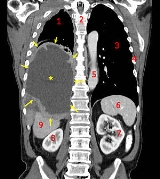
Cancer ˈkænsər, known medically as a malignant neoplasm, is a large group of different
diseaseA disease is an abnormal condition affecting the body of an organism. It is often construed to be a medical condition associated with specific symptoms and signs. It may be caused by external factors, such as infectious disease, or it may be caused by internal dysfunctions, such as autoimmune...
s, all involving unregulated cell growth. In cancer,
cellThe cell is the basic structural and functional unit of all known living organisms. It is the smallest unit of life that is classified as a living thing, and is often called the building block of life. The Alberts text discusses how the "cellular building blocks" move to shape developing embryos....
s divide and grow uncontrollably, forming
malignant tumors, and invade nearby parts of the body. The cancer may also
spreadMetastasis, or metastatic disease , is the spread of a disease from one organ or part to another non-adjacent organ or part. It was previously thought that only malignant tumor cells and infections have the capacity to metastasize; however, this is being reconsidered due to new research...
to more distant parts of the body through the
lymphatic systemLymph is considered a part of the interstitial fluid, the fluid which lies in the interstices of all body tissues. Interstitial fluid becomes lymph when it enters a lymph capillary...
or
bloodBlood is a specialized bodily fluid in animals that delivers necessary substances such as nutrients and oxygen to the cells and transports metabolic waste products away from those same cells....
stream. Not all tumors are cancerous. Benign tumors do not grow uncontrollably, do not invade neighbouring tissues, and do not spread throughout the body.
Healthy cells control their own growth and will
destroy themselvesApoptosis is the process of programmed cell death that may occur in multicellular organisms. Biochemical events lead to characteristic cell changes and death. These changes include blebbing, cell shrinkage, nuclear fragmentation, chromatin condensation, and chromosomal DNA fragmentation...
if they become unhealthy.
Cell divisionCell division is the process by which a parent cell divides into two or more daughter cells . Cell division is usually a small segment of a larger cell cycle. This type of cell division in eukaryotes is known as mitosis, and leaves the daughter cell capable of dividing again. The corresponding sort...
is a complex process that is normally tightly regulated. Cancer occurs when problems in the
geneA gene is a molecular unit of heredity of a living organism. It is a name given to some stretches of DNA and RNA that code for a type of protein or for an RNA chain that has a function in the organism. Living beings depend on genes, as they specify all proteins and functional RNA chains...
s of a cell prevent these controls from functioning properly. These problems may come from damage to the gene or may be inherited, and can be caused by various sources inside or outside of the cell. Faults in two types of genes are especially important:
oncogeneAn oncogene is a gene that has the potential to cause cancer. In tumor cells, they are often mutated or expressed at high levels.An oncogene is a gene found in the chromosomes of tumor cells whose activation is associated with the initial and continuing conversion of normal cells into cancer...
s, which drive the growth of cancer cells, and
tumor suppressor geneA tumor suppressor gene, or anti-oncogene, is a gene that protects a cell from one step on the path to cancer. When this gene is mutated to cause a loss or reduction in its function, the cell can progress to cancer, usually in combination with other genetic changes.-Two-hit hypothesis:Unlike...
s, which prevent cancer from developing.
Determining what causes cancer is complex, and it is often impossible to assign a specific cause for a specific cancer. Many things are known to increase the risk of cancer, including
tobaccoTobacco is an agricultural product processed from the leaves of plants in the genus Nicotiana. It can be consumed, used as a pesticide and, in the form of nicotine tartrate, used in some medicines...
use,
infectionAn infection is the colonization of a host organism by parasite species. Infecting parasites seek to use the host's resources to reproduce, often resulting in disease...
,
radiationIn physics, radiation is a process in which energetic particles or energetic waves travel through a medium or space. There are two distinct types of radiation; ionizing and non-ionizing...
, lack of physical activity, poor diet and
obesityObesity is a medical condition in which excess body fat has accumulated to the extent that it may have an adverse effect on health, leading to reduced life expectancy and/or increased health problems...
, and environmental pollutants. These can directly damage genes or combine with existing genetic faults within cells to cause the disease. A small percentage of cancers, approximately five to ten percent, are entirely hereditary.
Cancer can be detected in a number of ways, including the presence of certain
signs and symptomsCancer symptoms are changes in the body caused by the presence of cancer. They are usually caused by the effect of a cancer on the part of the body where it is growing, although the disease can cause more general symptoms such as weight loss or tiredness...
,
screening testsCancer screening aims to detect cancer before symptoms appear. This may involve blood tests, urine tests, other tests, or medical imaging. The benefits of screening in terms of cancer prevention, early detection and subsequent treatment must be weighed against any harms.Universal screening, mass...
, or
medical imagingMedical imaging is the technique and process used to create images of the human body for clinical purposes or medical science...
. Once a possible cancer is detected it is diagnosed by
microscopic examinationHistology is the study of the microscopic anatomy of cells and tissues of plants and animals. It is performed by examining cells and tissues commonly by sectioning and staining; followed by examination under a light microscope or electron microscope...
of a
tissue sampleA biopsy is a medical test involving sampling of cells or tissues for examination. It is the medical removal of tissue from a living subject to determine the presence or extent of a disease. The tissue is generally examined under a microscope by a pathologist, and can also be analyzed chemically...
. Cancer is usually treated with
chemotherapyChemotherapy is the treatment of cancer with an antineoplastic drug or with a combination of such drugs into a standardized treatment regimen....
,
radiation therapyRadiation therapy , radiation oncology, or radiotherapy , sometimes abbreviated to XRT or DXT, is the medical use of ionizing radiation, generally as part of cancer treatment to control malignant cells.Radiation therapy is commonly applied to the cancerous tumor because of its ability to control...
and
surgerySurgery is an ancient medical specialty that uses operative manual and instrumental techniques on a patient to investigate and/or treat a pathological condition such as disease or injury, or to help improve bodily function or appearance.An act of performing surgery may be called a surgical...
. The chances of surviving the disease vary greatly by the type and location of the cancer and the extent of disease at the start of treatment. While cancer can affect people of all ages, and a few types of cancer are more common in children, the risk of developing cancer generally increases with age. In 2007, cancer caused about 13% of all human deaths worldwide (7.9 million). Rates are rising as more people live to an old age and as mass lifestyle changes occur in the developing world.
Classification
Cancers are classified by the
type of cell that the tumor resembles and is therefore presumed to be the origin of the tumor. These types include:
- Carcinoma
Carcinoma is the medical term for the most common type of cancer occurring in humans. Put simply, a carcinoma is a cancer that begins in a tissue that lines the inner or outer surfaces of the body, and that generally arises from cells originating in the endodermal or ectodermal germ layer during...
: Cancers derived from epithelialEpithelium is one of the four basic types of animal tissue, along with connective tissue, muscle tissue and nervous tissue. Epithelial tissues line the cavities and surfaces of structures throughout the body, and also form many glands. Functions of epithelial cells include secretion, selective...
cells. This group includes many of the most common cancers, particularly in the aged, and include nearly all those developing in the breastBreast cancer is cancer originating from breast tissue, most commonly from the inner lining of milk ducts or the lobules that supply the ducts with milk. Cancers originating from ducts are known as ductal carcinomas; those originating from lobules are known as lobular carcinomas...
, prostateProstate cancer is a form of cancer that develops in the prostate, a gland in the male reproductive system. Most prostate cancers are slow growing; however, there are cases of aggressive prostate cancers. The cancer cells may metastasize from the prostate to other parts of the body, particularly...
, lungLung cancer is a disease characterized by uncontrolled cell growth in tissues of the lung. If left untreated, this growth can spread beyond the lung in a process called metastasis into nearby tissue and, eventually, into other parts of the body. Most cancers that start in lung, known as primary...
, pancreasThe pancreas is a gland organ in the digestive and endocrine system of vertebrates. It is both an endocrine gland producing several important hormones, including insulin, glucagon, and somatostatin, as well as a digestive organ, secreting pancreatic juice containing digestive enzymes that assist...
, and colonColorectal cancer, commonly known as bowel cancer, is a cancer caused by uncontrolled cell growth , in the colon, rectum, or vermiform appendix. Colorectal cancer is clinically distinct from anal cancer, which affects the anus....
.
- Sarcoma
A sarcoma is a cancer that arises from transformed cells in one of a number of tissues that develop from embryonic mesoderm. Thus, sarcomas include tumors of bone, cartilage, fat, muscle, vascular, and hematopoietic tissues...
: Cancers arising from connective tissue"Connective tissue" is a fibrous tissue. It is one of the four traditional classes of tissues . Connective Tissue is found throughout the body.In fact the whole framework of the skeleton and the different specialized connective tissues from the crown of the head to the toes determine the form of...
(i.e. boneBones are rigid organs that constitute part of the endoskeleton of vertebrates. They support, and protect the various organs of the body, produce red and white blood cells and store minerals. Bone tissue is a type of dense connective tissue...
, cartilageCartilage is a flexible connective tissue found in many areas in the bodies of humans and other animals, including the joints between bones, the rib cage, the ear, the nose, the elbow, the knee, the ankle, the bronchial tubes and the intervertebral discs...
, fatFats consist of a wide group of compounds that are generally soluble in organic solvents and generally insoluble in water. Chemically, fats are triglycerides, triesters of glycerol and any of several fatty acids. Fats may be either solid or liquid at room temperature, depending on their structure...
, nerveA peripheral nerve, or simply nerve, is an enclosed, cable-like bundle of peripheral axons . A nerve provides a common pathway for the electrochemical nerve impulses that are transmitted along each of the axons. Nerves are found only in the peripheral nervous system...
), each of which develop from cells originating in mesenchymalMesenchyme, or mesenchymal connective tissue, is a type of undifferentiated loose connective tissue that is derived mostly from mesoderm, although some are derived from other germ layers; e.g. some mesenchyme is derived from neural crest cells and thus originates from the ectoderm...
cells outside the bone marrow.
- Lymphoma
Lymphoma is a cancer in the lymphatic cells of the immune system. Typically, lymphomas present as a solid tumor of lymphoid cells. Treatment might involve chemotherapy and in some cases radiotherapy and/or bone marrow transplantation, and can be curable depending on the histology, type, and stage...
and leukemiaLeukemia or leukaemia is a type of cancer of the blood or bone marrow characterized by an abnormal increase of immature white blood cells called "blasts". Leukemia is a broad term covering a spectrum of diseases...
: These two classes of cancer arise from hematopoietic (bloodBlood is a specialized bodily fluid in animals that delivers necessary substances such as nutrients and oxygen to the cells and transports metabolic waste products away from those same cells....
-forming) cells that leave the marrow and tend to mature in the lymph nodes and blood, respectively.
- Germ cell tumor
A germ cell tumor is a neoplasm derived from germ cells. Germ cell tumors can be cancerous or non-cancerous tumors. Germ cells normally occur inside the gonads...
: Cancers derived from pluripotent cells, most often presenting in the testicleTesticular cancer is cancer that develops in the testicles, a part of the male reproductive system.In the United States, between 7,500 and 8,000 diagnoses of testicular cancer are made each year. In the UK, approximately 2,000 men are diagnosed each year. Over his lifetime, a man's risk of...
or the ovaryOvarian cancer is a cancerous growth arising from the ovary. Symptoms are frequently very subtle early on and may include: bloating, pelvic pain, difficulty eating and frequent urination, and are easily confused with other illnesses....
(seminoma and dysgerminomaA dysgerminoma is a type of germ cell tumor; it usually is malignant and usually occurs in the ovary.A tumor of the identical histology but not occurring in the ovary may be described by an alternate name: seminoma in the testis or germinoma in the central nervous system or other parts of the...
, respectively).
- Blastoma
A blastoma is a type of cancer that is caused by malignancies in precursor cells, often called blasts. Examples are nephroblastoma, medulloblastoma and retinoblastoma The suffix blastoma is used to imply a tumor of primitive, incompletely differentiated A blastoma is a type of cancer that is caused...
: Cancers derived from immature "precursor" cells or embryonic tissue. These are also most common in children.
Cancers are usually named using
-carcinoma,
-sarcoma or
-blastoma as a suffix, with the Latin or Greek word for the
organIn biology, an organ is a collection of tissues joined in structural unit to serve a common function. Usually there is a main tissue and sporadic tissues . The main tissue is the one that is unique for the specific organ. For example, main tissue in the heart is the myocardium, while sporadic are...
or tissue of origin as the root. For example, cancers of the liver
parenchymaParenchyma is a term used to describe a bulk of a substance. It is used in different ways in animals and in plants.The term is New Latin, f. Greek παρέγχυμα - parenkhuma, "visceral flesh", f. παρεγχεῖν - parenkhein, "to pour in" f. para-, "beside" + en-, "in" + khein, "to pour"...
arising from malignant epithelial cells is called
hepatocarcinoma, while a malignancy arising from primitive liver precursor cells is called a
hepatoblastomaHepatoblastoma is an uncommon malignant liver neoplasm occurring in infants and children and composed of tissue resembling fetal or mature liver cells or bile ducts. Affecting 1 in 1.5 million. They are usually present with an abdominal mass...
, and a cancer arising from fat cells is called a
liposarcomaLiposarcoma is a malignant tumor that arises in fat cells in deep soft tissue, such as that inside the thigh or in the retroperitoneum.They are typically large bulky tumors which tend to have multiple smaller satellites extending beyond the main confines of the tumor.Liposarcomas, like all...
. For some common cancers, the English organ name is used. For example, the most common type of
breast cancerBreast cancer is cancer originating from breast tissue, most commonly from the inner lining of milk ducts or the lobules that supply the ducts with milk. Cancers originating from ducts are known as ductal carcinomas; those originating from lobules are known as lobular carcinomas...
is called
ductal carcinoma of the breast. Here, the adjective
ductal refers to the appearance of the cancer under the microscope, which suggests that it has originated in the milk ducts.
Benign tumors (which are not cancers) are named using
-oma as a suffix with the organ name as the root. For example, a benign tumor of smooth muscle cells is called a
leiomyomaA leiomyoma is a benign smooth muscle neoplasm that is not premalignant. They can occur in any organ, but the most common forms occur in the uterus, small bowel and the esophagus.- Etymology:* Greek:** λεῖος leios "smooth"...
(the common name of this frequently occurring benign tumor in the uterus is
fibroid). Confusingly, some types of cancer also use the
-oma suffix, examples including
melanomaMelanoma is a malignant tumor of melanocytes. Melanocytes are cells that produce the dark pigment, melanin, which is responsible for the color of skin. They predominantly occur in skin, but are also found in other parts of the body, including the bowel and the eye...
and
seminoma.
Some types of cancer are named for the size and shape of the cells under a microscope, such as giant cell carcinoma, spindle cell carcinoma, and
small cell carcinomaSmall cell carcinoma is a type of highly malignant cancer that most commonly arises within the lung, although it can occasionally arise in other body sites, such as the cervix and prostate....
.
Signs and symptoms
Cancer symptoms can be divided into three groups:
- Local symptoms: are restricted to the site of the primary cancer. They can include lumps or swelling (tumor
A tumor or tumour is commonly used as a synonym for a neoplasm that appears enlarged in size. Tumor is not synonymous with cancer...
), hemorrhage (bleeding from the skin, mouth or anus), ulceration and painPain is an unpleasant sensation often caused by intense or damaging stimuli such as stubbing a toe, burning a finger, putting iodine on a cut, and bumping the "funny bone."...
. Although local pain commonly occurs in advanced cancer, the initial swelling is often painless.
- Metastatic symptoms: are due to the spread of cancer to other locations in the body. They can include enlarged lymph node
A lymph node is a small ball or an oval-shaped organ of the immune system, distributed widely throughout the body including the armpit and stomach/gut and linked by lymphatic vessels. Lymph nodes are garrisons of B, T, and other immune cells. Lymph nodes are found all through the body, and act as...
s (which can be felt or sometimes seen under the skin), hepatomegalyHepatomegaly is the condition of having an enlarged liver. It is a nonspecific medical sign having many causes, which can broadly be broken down into infection, direct toxicity, hepatic tumours, or metabolic disorder. Often, hepatomegaly will present as an abdominal mass...
(enlarged liver) or splenomegalySplenomegaly is an enlargement of the spleen. The spleen usually lies in the left upper quadrant of the human abdomen. It is one of the four cardinal signs of hypersplenism, some reduction in the number of circulating blood cells affecting granulocytes, erythrocytes or platelets in any...
(enlarged spleen) which can be felt in the abdomenIn vertebrates such as mammals the abdomen constitutes the part of the body between the thorax and pelvis. The region enclosed by the abdomen is termed the abdominal cavity...
, pain or fractureA fracture is the separation of an object or material into two, or more, pieces under the action of stress.The word fracture is often applied to bones of living creatures , or to crystals or crystalline materials, such as gemstones or metal...
of affected bones, and neurologicalNeurology is a medical specialty dealing with disorders of the nervous system. Specifically, it deals with the diagnosis and treatment of all categories of disease involving the central, peripheral, and autonomic nervous systems, including their coverings, blood vessels, and all effector tissue,...
symptoms.
- Systemic symptoms: occur due to distant effects of the cancer that are not related to direct or metastatic spread. Some of these effects can include weight loss
Weight loss, in the context of medicine, health or physical fitness, is a reduction of the total body mass, due to a mean loss of fluid, body fat or adipose tissue and/or lean mass, namely bone mineral deposits, muscle, tendon and other connective tissue...
(poor appetiteAnorexia is the decreased sensation of appetite...
and cachexiaCachexia or wasting syndrome is loss of weight, muscle atrophy, fatigue, weakness, and significant loss of appetite in someone who is not actively trying to lose weight...
), fatigue, excessive sweatingPerspiration is the production of a fluid consisting primarily of water as well as various dissolved solids , that is excreted by the sweat glands in the skin of mammals...
(especially night sweatsSleep hyperhidrosis, more commonly known as the night sweats, is the occurrence of excessive sweating during sleep. The sufferer may or may not also suffer from excessive perspiration while awake....
), anemiaAnemia is a decrease in number of red blood cells or less than the normal quantity of hemoglobin in the blood. However, it can include decreased oxygen-binding ability of each hemoglobin molecule due to deformity or lack in numerical development as in some other types of hemoglobin...
(low red blood cell count) and other specific conditions termed paraneoplastic phenomena. These may be mediated by immunologicalImmunology is a broad branch of biomedical science that covers the study of all aspects of the immune system in all organisms. It deals with the physiological functioning of the immune system in states of both health and diseases; malfunctions of the immune system in immunological disorders ; the...
or hormonalA hormone is a chemical released by a cell or a gland in one part of the body that sends out messages that affect cells in other parts of the organism. Only a small amount of hormone is required to alter cell metabolism. In essence, it is a chemical messenger that transports a signal from one...
signals from the cancer cells.
None of these non-specific symptoms are helpful in determining if a patient has cancer, as many of these symptoms commonly occur in individuals who do
not have cancer.
Causes
It is almost always impossible to prove exactly what caused a cancer in any individual, because most cancers have multiple possible causes. For example, if a person who uses tobacco heavily develops lung cancer, then it was very probably caused by the tobacco use, but since everyone has a small chance of developing lung cancer as a result of air pollution or radiation, then there is a tiny chance that the smoker's lung cancer actually developed because of air pollution or radiation.
Cancers are primarily an environmental disease with 90-95% of cases attributed to environmental factors and 5-10% due to genetics.
Environmental, as used by cancer researchers, means any cause that is not
geneticHeredity is the passing of traits to offspring . This is the process by which an offspring cell or organism acquires or becomes predisposed to the characteristics of its parent cell or organism. Through heredity, variations exhibited by individuals can accumulate and cause some species to evolve...
, not merely pollution. Common environmental factors that contribute to cancer death include
tobaccoTobacco is an agricultural product processed from the leaves of plants in the genus Nicotiana. It can be consumed, used as a pesticide and, in the form of nicotine tartrate, used in some medicines...
(25-30%), diet and
obesityObesity is a medical condition in which excess body fat has accumulated to the extent that it may have an adverse effect on health, leading to reduced life expectancy and/or increased health problems...
(30-35%), infections (15-20%),
radiationIn physics, radiation is a process in which energetic particles or energetic waves travel through a medium or space. There are two distinct types of radiation; ionizing and non-ionizing...
(both ionizing and non-ionizing, up to 10%), stress, lack of physical activity, and environmental pollutants.
Chemicals
Cancer pathogenesis is traceable back to DNA mutations that impact cell growth and metastasis. Substances that cause DNA mutations are known as mutagens, and mutagens that cause cancers are known as carcinogens. Particular substances have been linked to specific types of cancer.
Tobacco smokingTobacco smoking is the practice where tobacco is burned and the resulting smoke is inhaled. The practice may have begun as early as 5000–3000 BCE. Tobacco was introduced to Eurasia in the late 16th century where it followed common trade routes...
is associated with many forms of cancer, and causes 90% of
lung cancerLung cancer is a disease characterized by uncontrolled cell growth in tissues of the lung. If left untreated, this growth can spread beyond the lung in a process called metastasis into nearby tissue and, eventually, into other parts of the body. Most cancers that start in lung, known as primary...
.
Many
mutagenIn genetics, a mutagen is a physical or chemical agent that changes the genetic material, usually DNA, of an organism and thus increases the frequency of mutations above the natural background level. As many mutations cause cancer, mutagens are therefore also likely to be carcinogens...
s are also
carcinogenA carcinogen is any substance, radionuclide, or radiation that is an agent directly involved in causing cancer. This may be due to the ability to damage the genome or to the disruption of cellular metabolic processes...
s, but some carcinogens are not mutagens.
AlcoholIn chemistry, an alcohol is an organic compound in which the hydroxy functional group is bound to a carbon atom. In particular, this carbon center should be saturated, having single bonds to three other atoms....
is an example of a chemical carcinogen that is not a mutagen. In Western Europe 10% of cancers in males and 3% of cancers in females are attributed to alcohol.
Decades of research has demonstrated the link between
tobaccoTobacco is an agricultural product processed from the leaves of plants in the genus Nicotiana. It can be consumed, used as a pesticide and, in the form of nicotine tartrate, used in some medicines...
use and cancer in the
lungLung cancer is a disease characterized by uncontrolled cell growth in tissues of the lung. If left untreated, this growth can spread beyond the lung in a process called metastasis into nearby tissue and, eventually, into other parts of the body. Most cancers that start in lung, known as primary...
,
larynxThe larynx , commonly called the voice box, is an organ in the neck of amphibians, reptiles and mammals involved in breathing, sound production, and protecting the trachea against food aspiration. It manipulates pitch and volume...
, head, neck, stomach, bladder, kidney,
esophagusThe esophagus is an organ in vertebrates which consists of a muscular tube through which food passes from the pharynx to the stomach. During swallowing, food passes from the mouth through the pharynx into the esophagus and travels via peristalsis to the stomach...
and
pancreasThe pancreas is a gland organ in the digestive and endocrine system of vertebrates. It is both an endocrine gland producing several important hormones, including insulin, glucagon, and somatostatin, as well as a digestive organ, secreting pancreatic juice containing digestive enzymes that assist...
. Tobacco smoke contains over fifty known carcinogens, including
nitrosamineNitrosamines are chemical compounds of the chemical structure R1N-N=O, some of which are carcinogenic.-Usages:Nitrosamines are used in manufacture of some cosmetics, pesticides, and in most rubber products. -Occurrences:...
s and
polycyclic aromatic hydrocarbonPolycyclic aromatic hydrocarbons , also known as poly-aromatic hydrocarbons or polynuclear aromatic hydrocarbons, are potent atmospheric pollutants that consist of fused aromatic rings and do not contain heteroatoms or carry substituents. Naphthalene is the simplest example of a PAH...
s. Tobacco is responsible for about one in three of all cancer deaths in the developed world, and about one in five worldwide.
Lung cancerLung cancer is a disease characterized by uncontrolled cell growth in tissues of the lung. If left untreated, this growth can spread beyond the lung in a process called metastasis into nearby tissue and, eventually, into other parts of the body. Most cancers that start in lung, known as primary...
death rates in the United States have mirrored
smokingTobacco smoking is the practice where tobacco is burned and the resulting smoke is inhaled. The practice may have begun as early as 5000–3000 BCE. Tobacco was introduced to Eurasia in the late 16th century where it followed common trade routes...
patterns, with increases in smoking followed by dramatic increases in lung cancer death rates and, more recently, decreases in smoking followed by decreases in lung cancer death rates in men. However, the numbers of smokers worldwide is still rising, leading to what some organizations have described as the
tobacco epidemic.
Cancer related to one's occupation is believed to represent between 2–20% of all cases. Every year, at least 200,000 people die worldwide from cancer related to their workplace. Currently, most cancer deaths caused by occupational risk factors occur in the developed world. It is estimated that approximately 20,000 cancer deaths and 40,000 new cases of cancer each year in the U.S. are attributable to occupation. Millions of workers run the risk of developing cancers such as
lung cancerLung cancer is a disease characterized by uncontrolled cell growth in tissues of the lung. If left untreated, this growth can spread beyond the lung in a process called metastasis into nearby tissue and, eventually, into other parts of the body. Most cancers that start in lung, known as primary...
and
mesotheliomaMesothelioma, more precisely malignant mesothelioma, is a rare form of cancer that develops from the protective lining that covers many of the body's internal organs, the mesothelium...
from inhaling
asbestosAsbestos is a set of six naturally occurring silicate minerals used commercially for their desirable physical properties. They all have in common their eponymous, asbestiform habit: long, thin fibrous crystals...
fibers and tobacco smoke, or
leukemiaLeukemia or leukaemia is a type of cancer of the blood or bone marrow characterized by an abnormal increase of immature white blood cells called "blasts". Leukemia is a broad term covering a spectrum of diseases...
from exposure to
benzeneBenzene is an organic chemical compound. It is composed of 6 carbon atoms in a ring, with 1 hydrogen atom attached to each carbon atom, with the molecular formula C6H6....
at their workplaces.
Diet and exercise
Diet, physical inactivity, and
obesityObesity is a medical condition in which excess body fat has accumulated to the extent that it may have an adverse effect on health, leading to reduced life expectancy and/or increased health problems...
are related to approximately 30–35% of cancer cases. In the United States excess body weight is associated with the development of many types of cancer and is a factor in 14–20% of all cancer deaths. Physical inactivity is believed to contribute to cancer risk not only through its effect on body weight but also through negative effects on
immune systemAn immune system is a system of biological structures and processes within an organism that protects against disease by identifying and killing pathogens and tumor cells. It detects a wide variety of agents, from viruses to parasitic worms, and needs to distinguish them from the organism's own...
and
endocrine systemIn physiology, the endocrine system is a system of glands, each of which secretes a type of hormone directly into the bloodstream to regulate the body. The endocrine system is in contrast to the exocrine system, which secretes its chemicals using ducts. It derives from the Greek words "endo"...
.
Diets that are low in vegetables, fruits and whole grains, and high in processed or red meats are linked with a number of cancers. A high
saltIn chemistry, salts are ionic compounds that result from the neutralization reaction of an acid and a base. They are composed of cations and anions so that the product is electrically neutral...
diet is linked to gastric cancer, aflatoxin B1, a frequent food contaminate, with liver cancer, and
Betel nutThe Areca nut is the seed of the Areca palm , which grows in much of the tropical Pacific, Asia, and parts of east Africa. It is commonly referred to as "betel nut" as it is often chewed wrapped in betel leaves.-Description:...
chewing with oral cancer. This may partly explain differences in cancer incidence in different countries for example gastric cancer is more common in Japan with its high salt diet and
colon cancerColorectal cancer, commonly known as bowel cancer, is a cancer caused by uncontrolled cell growth , in the colon, rectum, or vermiform appendix. Colorectal cancer is clinically distinct from anal cancer, which affects the anus....
is more common in the United States. Immigrants develop the risk of their new country, often within one generation, suggesting a substantial link between diet and cancer.
Infection
Worldwide approximately 18% of cancers are related to infectious diseases. This proportion varies in different regions of the world from a high of 25% in Africa to less than 10% in the developed world.
VirusA virus is a small infectious agent that can replicate only inside the living cells of organisms. Viruses infect all types of organisms, from animals and plants to bacteria and archaea...
es are usual infectious agents that cause cancer but
bacteriaBacteria are a large domain of prokaryotic microorganisms. Typically a few micrometres in length, bacteria have a wide range of shapes, ranging from spheres to rods and spirals...
and parasites may also have an effect.
A virus that can cause cancer is called an
oncovirusAn oncovirus is a virus that can cause cancer. This term originated from studies of acutely-transforming retroviruses in the 1950–60s, often called oncornaviruses to denote their RNA virus origin. It now refers to any virus with a DNA or RNA genome causing cancer and is synonymous with "tumor...
. These include
human papillomavirusHuman papillomavirus is a member of the papillomavirus family of viruses that is capable of infecting humans. Like all papillomaviruses, HPVs establish productive infections only in keratinocytes of the skin or mucous membranes...
(cervical carcinoma),
Epstein-Barr virusThe Epstein–Barr virus , also called human herpesvirus 4 , is a virus of the herpes family and is one of the most common viruses in humans. It is best known as the cause of infectious mononucleosis...
(B-cell lymphoproliferative disease and
nasopharyngeal carcinomaNasopharyngeal carcinoma is the most common cancer originating in the nasopharynx, the uppermost region of the pharynx , behind the nose where the nasal passages and auditory tubes join the remainder of the upper respiratory tract. NPC differs significantly from other cancers of the head and neck...
), Kaposi's sarcoma herpesvirus (
Kaposi's SarcomaKaposi's sarcoma is a tumor caused by Human herpesvirus 8 , also known as Kaposi's sarcoma-associated herpesvirus . It was originally described by Moritz Kaposi , a Hungarian dermatologist practicing at the University of Vienna in 1872. It became more widely known as one of the AIDS defining...
and primary effusion lymphomas), hepatitis B and
hepatitis CHepatitis C is an infectious disease primarily affecting the liver, caused by the hepatitis C virus . The infection is often asymptomatic, but chronic infection can lead to scarring of the liver and ultimately to cirrhosis, which is generally apparent after many years...
viruses (
hepatocellular carcinomaHepatocellular carcinoma is the most common type of liver cancer. Most cases of HCC are secondary to either a viral hepatitide infection or cirrhosis .Compared to other cancers, HCC is quite a rare tumor in the United States...
), and Human T-cell leukemia virus-1 (T-cell leukemias). Bacterial infection may also increase the risk of cancer, as seen in
Helicobacter pyloriHelicobacter pylori , previously named Campylobacter pyloridis, is a Gram-negative, microaerophilic bacterium found in the stomach. It was identified in 1982 by Barry Marshall and Robin Warren, who found that it was present in patients with chronic gastritis and gastric ulcers, conditions that were...
-induced gastric carcinoma. Parasitic infections strongly associated with cancer include
Schistosoma haematobiumSchistosoma haematobium is an important digenetic trematode, and is found in the Middle East, India, Portugal and Africa. It is a major agent of schistosomiasis; more specifically, it is associated with urinary schistosomiasis....
(
squamous cell carcinoma of the bladderBladder cancer is any of several types of malignant growths of the urinary bladder. It is a disease in which abnormal cells multiply without control in the bladder. The bladder is a hollow, muscular organ that stores urine; it is located in the pelvis...
) and the
liver flukeLiver flukes are a polyphyletic group of trematodes .Adults of liver flukes are localized in the liver of various mammals, including humans. These flatworms can occur in bile ducts, gallbladder, and liver parenchyma. They feed on blood...
s,
Opisthorchis viverriniOpisthorchis viverrini, common name Southeast Asian liver fluke, is a trematode parasite from the family Opisthorchiidae that attacks the area of the bile duct. Infection is acquired when people ingest raw or undercooked fish. It causes the disease opisthorchiasis...
and
Clonorchis sinensisClonorchis sinensis, the Chinese liver fluke, is a human liver fluke in the class Trematoda, Phylum Platyhelminthes. This parasite lives in the liver of humans, and is found mainly in the common bile duct and gall bladder, feeding on bile...
(
cholangiocarcinomaCholangiocarcinoma is a cancer of the bile ducts which drain bile from the liver into the small intestine. Other biliary tract cancers include pancreatic cancer, gallbladder cancer, and cancer of the ampulla of Vater...
).
Radiation
Up to 10% of invasive cancers are related to radiation exposure, including both
ionizing radiationIonizing radiation is radiation composed of particles that individually have sufficient energy to remove an electron from an atom or molecule. This ionization produces free radicals, which are atoms or molecules containing unpaired electrons...
and
non-ionizing radiationNon-ionizing radiation refers to any type of electromagnetic radiation that does not carry enough energy per quantum to ionize atoms or molecules—that is, to completely remove an electron from an atom or molecule...
. Additionally, the vast majority of non-invasive cancers are non-melanoma skin cancers caused by non-ionizing radiation from ultraviolet radiation.
Sources of ionizing radiation include
medical imagingMedical imaging is the technique and process used to create images of the human body for clinical purposes or medical science...
, and
radonRadon is a chemical element with symbol Rn and atomic number 86. It is a radioactive, colorless, odorless, tasteless noble gas, occurring naturally as the decay product of uranium or thorium. Its most stable isotope, 222Rn, has a half-life of 3.8 days...
gas. Radiation can cause cancer in most parts of the body, in all animals, and at any age, although radiation-induced solid tumors usually take 10–15 years, and can take up to 40 years, to become clinically manifest, and radiation-induced
leukemiaLeukemia or leukaemia is a type of cancer of the blood or bone marrow characterized by an abnormal increase of immature white blood cells called "blasts". Leukemia is a broad term covering a spectrum of diseases...
s typically require 2–10 years to appear. Some people, such as those with
nevoid basal cell carcinoma syndromeNevoid basal cell carcinoma syndrome , also known as basal cell nevus syndrome, multiple basal cell carcinoma syndrome, Gorlin syndrome, and Gorlin–Goltz syndrome, is an inherited medical condition involving defects within multiple body systems such as the skin, nervous system, eyes, endocrine...
or
retinoblastomaRetinoblastoma is a rapidly developing cancer that develops in the cells of retina, the light-detecting tissue of the eye. In the developed world, Rb has one of the best cure rates of all childhood cancers , with more than nine out of every ten sufferers surviving into...
, are more susceptible than average to developing cancer from radiation exposure. Children and adolescents are twice as likely to develop radiation-induced leukemia as adults; radiation exposure before birth has ten times the effect. Ionizing radiation is not a particularly strong mutagen. Residential exposure to radon gas, for example, has similar cancer risks as
passive smokingPassive smoking is the inhalation of smoke, called secondhand smoke or environmental tobacco smoke , from tobacco products used by others. It occurs when tobacco smoke permeates any environment, causing its inhalation by people within that environment. Exposure to secondhand tobacco smoke causes...
. Low-dose exposures, such as living near a
nuclear power plantA nuclear power plant is a thermal power station in which the heat source is one or more nuclear reactors. As in a conventional thermal power station the heat is used to generate steam which drives a steam turbine connected to a generator which produces electricity.Nuclear power plants are usually...
, are generally believed to have no or very little effect on cancer development. Radiation is a more potent source of cancer when it is combined with other cancer-causing agents, such as radon gas exposure plus smoking tobacco.
Unlike chemical or physical triggers for cancer, ionizing radiation hits molecules within cells randomly. If it happens to strike a
chromosomeA chromosome is an organized structure of DNA and protein found in cells. It is a single piece of coiled DNA containing many genes, regulatory elements and other nucleotide sequences. Chromosomes also contain DNA-bound proteins, which serve to package the DNA and control its functions.Chromosomes...
, it can break the chromosome, result in an
abnormal number of chromosomesAneuploidy is an abnormal number of chromosomes, and is a type of chromosome abnormality. An extra or missing chromosome is a common cause of genetic disorders . Some cancer cells also have abnormal numbers of chromosomes. Aneuploidy occurs during cell division when the chromosomes do not separate...
, inactivate one or more genes in the part of the chromosome that it hit, delete parts of the DNA sequence, cause chromosome translocations, or cause other types of
chromosome abnormalitiesA chromosome anomaly, abnormality or aberration reflects an atypical number of chromosomes or a structural abnormality in one or more chromosomes. A Karyotype refers to a full set of chromosomes from an individual which can be compared to a "normal" Karyotype for the species via genetic testing. A...
. Major damage normally results in the cell dying, but smaller damage may leave a stable, partly functional cell that may be capable of proliferating and developing into cancer, especially if
tumor suppressor geneA tumor suppressor gene, or anti-oncogene, is a gene that protects a cell from one step on the path to cancer. When this gene is mutated to cause a loss or reduction in its function, the cell can progress to cancer, usually in combination with other genetic changes.-Two-hit hypothesis:Unlike...
s were damaged by the radiation. Three independent stages appear to be involved in the creation of cancer with ionizing radiation: morphological changes to the cell, acquiring cellular immortality (losing normal, life-limiting cell regulatory processes), and adaptations that favor formation of a tumor. Even if the radiation particle does not strike the DNA directly, it triggers responses from cells that indirectly increase the likelihood of mutations.
Medical use of ionizing radiation is a growing source of radiation-induced cancers. Ionizing radiation may be used to treat other cancers, but this may, in some cases, induce a second form of cancer. It is also used in some kinds of
medical imagingMedical imaging is the technique and process used to create images of the human body for clinical purposes or medical science...
. One report estimates that approximately 29,000 future cancers could be related to the approximately 70 million CT scans performed in the US in 2007. It is estimated that 0.4% of current cancers in the United States are due to CTs performed in the past and that this may increase to as high as 1.5–2% with 2007 rates of CT usage.
Prolonged exposure to ultraviolet radiation from the
sunThe Sun is the star at the center of the Solar System. It is almost perfectly spherical and consists of hot plasma interwoven with magnetic fields...
can lead to
melanomaMelanoma is a malignant tumor of melanocytes. Melanocytes are cells that produce the dark pigment, melanin, which is responsible for the color of skin. They predominantly occur in skin, but are also found in other parts of the body, including the bowel and the eye...
and other skin malignancies. Clear evidence establishes ultraviolet radiation, especially the non-ionizing medium wave UVB, as the cause of most non-melanoma
skin cancerSkin neoplasms are skin growths with differing causes and varying degrees of malignancy. The three most common malignant skin cancers are basal cell cancer, squamous cell cancer, and melanoma, each of which is named after the type of skin cell from which it arises...
s, which are the most common forms of cancer in the world.
Non-ionizing
radio frequencyRadio frequency is a rate of oscillation in the range of about 3 kHz to 300 GHz, which corresponds to the frequency of radio waves, and the alternating currents which carry radio signals...
radiation from
mobile phoneA mobile phone is a device which can make and receive telephone calls over a radio link whilst moving around a wide geographic area. It does so by connecting to a cellular network provided by a mobile network operator...
s,
electric power transmissionElectric-power transmission is the bulk transfer of electrical energy, from generating power plants to Electrical substations located near demand centers...
, and other similar sources have been described as a
possible carcinogenPossible carcinogen is a category of the dangers of chemical exposure as recognized by the United States Environmental Protection Agency .This is as opposed to "probable" or "known" carcinogen under EPA classifications of carcinogenicity....
by the
World Health OrganizationThe World Health Organization is a specialized agency of the United Nations that acts as a coordinating authority on international public health. Established on 7 April 1948, with headquarters in Geneva, Switzerland, the agency inherited the mandate and resources of its predecessor, the Health...
's
International Agency for Research on CancerThe International Agency for Research on Cancer is an intergovernmental agency forming part of the World Health Organisation of the United Nations....
.
Heredity
The vast majority of cancers are non-hereditary, which are called
sporadic cancers. Hereditary cancers are cancers that are primarily caused by an inherited genetic defect. Less than 0.3% of the population are carriers of a genetic mutation which has a large effect on cancer risk. They cause less than 3–10% of all cancer. Some of these
syndromeIn medicine and psychology, a syndrome is the association of several clinically recognizable features, signs , symptoms , phenomena or characteristics that often occur together, so that the presence of one or more features alerts the physician to the possible presence of the others...
s include:
- certain inherited mutations in the genes BRCA1
BRCA1 is a human caretaker gene that produces a protein called breast cancer type 1 susceptibility protein, responsible for repairing DNA. The first evidence for the existence of the gene was provided by the King laboratory at UC Berkeley in 1990...
and BRCA2BRCA2 is a protein that in humans is encoded by the BRCA2 gene.BRCA2 orthologs have been identified in most mammals for which complete genome data are available....
with a more than 75% risk of breast cancerBreast cancer is cancer originating from breast tissue, most commonly from the inner lining of milk ducts or the lobules that supply the ducts with milk. Cancers originating from ducts are known as ductal carcinomas; those originating from lobules are known as lobular carcinomas...
and ovarian cancerOvarian cancer is a cancerous growth arising from the ovary. Symptoms are frequently very subtle early on and may include: bloating, pelvic pain, difficulty eating and frequent urination, and are easily confused with other illnesses....
- Li-Fraumeni syndrome
Li-Fraumeni syndrome is an extremely rare autosomal dominant hereditary disorder. It is named after Frederick Pei Li and Joseph F. Fraumeni, Jr., the American physicians who first recognized and described the syndrome. Li-Fraumeni syndrome greatly increases susceptibility to cancer...
(various tumors such as osteosarcomaOsteosarcoma is an aggressive cancerous neoplasm arising from primitive transformed cells of mesenchymal origin that exhibit osteoblastic differentiation and produce malignant osteoid...
, breast cancer, soft tissue sarcomaA soft-tissue sarcoma is a form of sarcoma that develops in connective tissue, though the term is sometimes applied to elements of the soft tissue that are not currently considered connective tissue.-Risk factors:...
, brain tumorA brain tumor is an intracranial solid neoplasm, a tumor within the brain or the central spinal canal.Brain tumors include all tumors inside the cranium or in the central spinal canal...
s) due to mutations of p53p53 , is a tumor suppressor protein that in humans is encoded by the TP53 gene. p53 is crucial in multicellular organisms, where it regulates the cell cycle and, thus, functions as a tumor suppressor that is involved in preventing cancer...
- Turcot syndrome
Mismatch repair cancer syndrome is a condition associated with biallelic DNA mismatch repair mutations. It is also known as Turcot syndrome after Jacques Turcot who described the condition in 1959.-Genetics:...
(brain tumorA brain tumor is an intracranial solid neoplasm, a tumor within the brain or the central spinal canal.Brain tumors include all tumors inside the cranium or in the central spinal canal...
s and colonic polyposis)
- Familial adenomatous polyposis
Familial adenomatous polyposis is an inherited condition in which numerous polyps form mainly in the epithelium of the large intestine. While these polyps start out benign, malignant transformation into colon cancer occurs when not treated....
an inherited mutation of the APC gene that leads to early onset of colon carcinoma.
- Hereditary nonpolyposis colorectal cancer
Lynch syndrome is an autosomal dominant genetic condition which has a high risk of colon cancer as well as other cancers including endometrium, ovary, stomach, small intestine, hepatobiliary tract, upper urinary tract, brain, and skin...
(HNPCC, also known as Lynch syndrome) can include familial cases of colon cancerColorectal cancer, commonly known as bowel cancer, is a cancer caused by uncontrolled cell growth , in the colon, rectum, or vermiform appendix. Colorectal cancer is clinically distinct from anal cancer, which affects the anus....
, uterine cancer, gastric cancer, and ovarian cancerOvarian cancer is a cancerous growth arising from the ovary. Symptoms are frequently very subtle early on and may include: bloating, pelvic pain, difficulty eating and frequent urination, and are easily confused with other illnesses....
, without a preponderance of colon polypsA polyp is an abnormal growth of tissue projecting from a mucous membrane. If it is attached to the surface by a narrow elongated stalk, it is said to be pedunculated. If no stalk is present, it is said to be sessile. Polyps are commonly found in the colon, stomach, nose, sinus, urinary bladder...
.
- Retinoblastoma
Retinoblastoma is a rapidly developing cancer that develops in the cells of retina, the light-detecting tissue of the eye. In the developed world, Rb has one of the best cure rates of all childhood cancers , with more than nine out of every ten sufferers surviving into...
, when occurring in young children, is due to a hereditary mutation in the retinoblastoma gene.
- Down syndrome
Down syndrome, or Down's syndrome, trisomy 21, is a chromosomal condition caused by the presence of all or part of an extra 21st chromosome. It is named after John Langdon Down, the British physician who described the syndrome in 1866. The condition was clinically described earlier in the 19th...
patients, who have an extra chromosome 21, are known to develop malignancies such as leukemiaLeukemia or leukaemia is a type of cancer of the blood or bone marrow characterized by an abnormal increase of immature white blood cells called "blasts". Leukemia is a broad term covering a spectrum of diseases...
and testicular cancerTesticular cancer is cancer that develops in the testicles, a part of the male reproductive system.In the United States, between 7,500 and 8,000 diagnoses of testicular cancer are made each year. In the UK, approximately 2,000 men are diagnosed each year. Over his lifetime, a man's risk of...
, though the reasons for this difference are not well understood.
Physical agents
Some substances cause cancer primarily through their physical, rather than chemical, effects on cells.
A prominent example of this is prolonged exposure to
asbestosAsbestos is a set of six naturally occurring silicate minerals used commercially for their desirable physical properties. They all have in common their eponymous, asbestiform habit: long, thin fibrous crystals...
, naturally occurring mineral fibers which are a major cause of
mesotheliomaMesothelioma, more precisely malignant mesothelioma, is a rare form of cancer that develops from the protective lining that covers many of the body's internal organs, the mesothelium...
, a type of lung cancer. Other substances in this category include both naturally occurring and synthetic asbestos-like fibers, such as
wollastoniteWollastonite is a calcium inosilicate mineral that may contain small amounts of iron, magnesium, and manganese substituting for calcium. It is usually white. It forms when impure limestone or dolostone is subjected to high temperature and pressure sometimes in the presence of silica-bearing fluids...
, attapulgite,
glass woolGlass wool or fiberglass insulation is an insulating material made from fiberglass, arranged into a texture similar to wool. Glass wool is produced in rolls or in slabs, with different thermal and mechanical properties....
, and rock wool, are believed to have similar effects.
Nonfibrous particulate materials that cause cancer include powdered metallic
cobaltCobalt is a chemical element with symbol Co and atomic number 27. It is found naturally only in chemically combined form. The free element, produced by reductive smelting, is a hard, lustrous, silver-gray metal....
and
nickelNickel is a chemical element with the chemical symbol Ni and atomic number 28. It is a silvery-white lustrous metal with a slight golden tinge. Nickel belongs to the transition metals and is hard and ductile...
, and crystalline silica (
quartzQuartz is the second-most-abundant mineral in the Earth's continental crust, after feldspar. It is made up of a continuous framework of SiO4 silicon–oxygen tetrahedra, with each oxygen being shared between two tetrahedra, giving an overall formula SiO2. There are many different varieties of quartz,...
,
cristobaliteThe mineral cristobalite is a high-temperature polymorph of silica, meaning that it has the same chemical formula, SiO2, but a distinct crystal structure. Both quartz and cristobalite are polymorphs with all the members of the quartz group which also include coesite, tridymite and stishovite...
, and
tridymiteTridymite is a high-temperature polymorph of quartz and usually occurs as minute tabular white or colorless pseudo-hexagonal triclinic crystals, or scales, in cavities in acidic volcanic rocks. Its chemical formula is SiO2. Tridymite was first described in 1868 and the type location is in Hidalgo,...
).
Usually, physical carcinogens must get inside the body (such as through inhaling tiny pieces) and require years of exposure to develop cancer.
Physical trauma and inflammation
Physical trauma resulting in cancer is relatively rare. Claims that breaking bone resulted in bone cancer, for example, have never been proven. Similarly, physical trauma is not accepted as a cause for cervical cancer, breast cancer, or brain cancer.
One accepted source is frequent, long-term application of hot objects to the body. It is possible that repeated burns on the same part of the body, such as those produced by
kanger and kairo heaters (charcoal
hand warmerHand warmers are small packets which are held in the hand and produce heat on demand to warm cold hands. They are commonly used in outdoor activities such as hiking and skiing to keep extremities warm and assist insulated clothing...
s), may produce skin cancer, especially if carcinogenic chemicals are also present. Frequently drinking scalding hot tea may produce esophageal cancer.
Generally, it is believed that the cancer arises, or a pre-existing cancer is encouraged, during the process of repairing the trauma, rather than the cancer being caused directly by the trauma. However, repeated injuries to the same tissues might promote excessive cell proliferation, which could then increase the odds of a cancerous mutation. There is no evidence that
inflammationInflammation is part of the complex biological response of vascular tissues to harmful stimuli, such as pathogens, damaged cells, or irritants. Inflammation is a protective attempt by the organism to remove the injurious stimuli and to initiate the healing process...
itself causes cancer.
Hormones
Some
hormoneA hormone is a chemical released by a cell or a gland in one part of the body that sends out messages that affect cells in other parts of the organism. Only a small amount of hormone is required to alter cell metabolism. In essence, it is a chemical messenger that transports a signal from one...
s factor in the development of cancer by promoting cell proliferation. Hormones are important agents in sex-related cancers such as cancer of the breast,
endometrium-Function:The endometrium is the innermost glandular layer and functions as a lining for the uterus, preventing adhesions between the opposed walls of the myometrium, thereby maintaining the patency of the uterine cavity. During the menstrual cycle or estrous cycle, the endometrium grows to a...
, prostate, ovary, and testis, and also of
thyroid cancerThyroid neoplasm is a neoplasm or tumor of the thyroid. It can be a benign tumor such as thyroid adenoma, or it can be a malignant neoplasm , such as papillary, follicular, medullary or anaplastic thyroid cancer. Most patients are 25 to 65 years of age when first diagnosed; women are more affected...
and bone cancer.
An individual's hormone levels are mostly determined genetically, so this may at least partly explains the presence of some cancers that run in families that do not seem to have any cancer-causing genes. For example, the daughters of women who have breast cancer have significantly higher levels of
estrogenEstrogens , oestrogens , or œstrogens, are a group of compounds named for their importance in the estrous cycle of humans and other animals. They are the primary female sex hormones. Natural estrogens are steroid hormones, while some synthetic ones are non-steroidal...
and
progesteroneProgesterone also known as P4 is a C-21 steroid hormone involved in the female menstrual cycle, pregnancy and embryogenesis of humans and other species...
than the daughters of women without breast cancer. These higher hormone levels may explain why these women have higher risk of breast cancer, even in the absence of a breast-cancer gene. Similarly, men of African ancestry have significantly higher levels of testosterone than men of European ancestry, and have a correspondingly much higher level of prostate cancer. Men of Asian ancestry, with the lowest levels of testosterone-activating androstanediol glucuronide, have the lowest levels of prostate cancer.
However, non-genetic factors are also relevant: obese people have higher levels of some hormones associated with cancer and a higher rate of those cancers. Women who take
hormone replacement therapyHormone replacement therapy is a system of medical treatment for surgically menopausal, perimenopausal and to a lesser extent postmenopausal women...
have a higher risk of developing cancers associated with those hormones. On the other hand, people who exercise far more than average have lower levels of these hormones, and lower risk of cancer.
OsteosarcomaOsteosarcoma is an aggressive cancerous neoplasm arising from primitive transformed cells of mesenchymal origin that exhibit osteoblastic differentiation and produce malignant osteoid...
may be promoted by
growth hormoneGrowth hormone is a peptide hormone that stimulates growth, cell reproduction and regeneration in humans and other animals. Growth hormone is a 191-amino acid, single-chain polypeptide that is synthesized, stored, and secreted by the somatotroph cells within the lateral wings of the anterior...
s. Some treatments and prevention approaches leverage this cause by artificially reducing hormone levels, and thus discouraging hormone-sensitive cancers.
Other
Excepting the rare transmissions that occur with pregnancies and only a marginal few organ donors, cancer is generally not a
transmissible diseaseIn medicine and biology, transmission is the passing of a communicable disease from an infected host individual or group to a conspecific individual or group, regardless of whether the other individual was previously infected...
. The main reason for this is tissue graft rejection caused by
MHCMajor histocompatibility complex is a cell surface molecule encoded by a large gene family in all vertebrates. MHC molecules mediate interactions of leukocytes, also called white blood cells , which are immune cells, with other leukocytes or body cells...
incompatibilityHistocompatibility is the property of having the same, or mostly the same, alleles of a set of genes called the major histocompatibility complex. These genes are expressed in most tissues as antigens, to which the immune system makes antibodies...
. In humans and other vertebrates, the immune system uses MHC antigens to differentiate between "self" and "non-self" cells because these antigens are different from person to person. When non-self antigens are encountered, the immune system reacts against the appropriate cell. Such reactions may protect against tumour cell engraftment by eliminating implanted cells. In the United States, approximately 3,500 pregnant women have a malignancy annually, and transplacental transmission of acute leukaemia,
lymphomaLymphoma is a cancer in the lymphatic cells of the immune system. Typically, lymphomas present as a solid tumor of lymphoid cells. Treatment might involve chemotherapy and in some cases radiotherapy and/or bone marrow transplantation, and can be curable depending on the histology, type, and stage...
,
melanomaMelanoma is a malignant tumor of melanocytes. Melanocytes are cells that produce the dark pigment, melanin, which is responsible for the color of skin. They predominantly occur in skin, but are also found in other parts of the body, including the bowel and the eye...
and
carcinomaCarcinoma is the medical term for the most common type of cancer occurring in humans. Put simply, a carcinoma is a cancer that begins in a tissue that lines the inner or outer surfaces of the body, and that generally arises from cells originating in the endodermal or ectodermal germ layer during...
from mother to fetus has been observed. The development of donor-derived tumors from organ transplants is exceedingly rare. The main cause of organ transplant associated tumors seems to be malignant melanoma, that was undetected at the time of organ harvest. though other cases exist In fact, cancer from one organism will usually grow in another organism of that species, as long as they share the same
histocompatibilityHistocompatibility is the property of having the same, or mostly the same, alleles of a set of genes called the major histocompatibility complex. These genes are expressed in most tissues as antigens, to which the immune system makes antibodies...
genes, proven using mice; however this would never happen in a real-world setting except as described above.
In non-humans, a few types of transmissible cancer have been described, wherein the cancer spreads between animals by transmission of the tumor cells themselves. This phenomenon is seen in dogs with Sticker's sarcoma, also known as canine transmissible venereal tumor, as well as
devil facial tumour diseaseDevil facial tumour disease is an aggressive non-viral transmissible parasitic cancer—which likely originated in Schwann cells—that affects Tasmanian devils. The first "official case" was described in 1996, in Australia...
in
Tasmanian devilsThe Tasmanian devil is a carnivorous marsupial of the family Dasyuridae, now found in the wild only on the Australian island state of Tasmania. The size of a small dog, it became the largest carnivorous marsupial in the world following the extinction of the thylacine in 1936...
.
Pathophysiology
Cancer is fundamentally a disease of failure of regulation of tissue growth. In order for a normal cell to
transformMalignant transformation is the process by which cells acquire the properties of cancer. This may occur as a primary process in normal tissue, or secondarily as malignant degeneration of a previously existing benign tumor....
into a cancer cell, the
genesGênes is the name of a département of the First French Empire in present Italy, named after the city of Genoa. It was formed in 1805, when Napoleon Bonaparte occupied the Republic of Genoa. Its capital was Genoa, and it was divided in the arrondissements of Genoa, Bobbio, Novi Ligure, Tortona and...
which regulate cell growth and differentiation must be altered.
The affected genes are divided into two broad categories.
OncogeneAn oncogene is a gene that has the potential to cause cancer. In tumor cells, they are often mutated or expressed at high levels.An oncogene is a gene found in the chromosomes of tumor cells whose activation is associated with the initial and continuing conversion of normal cells into cancer...
s are genes which promote cell growth and reproduction.
Tumor suppressor geneA tumor suppressor gene, or anti-oncogene, is a gene that protects a cell from one step on the path to cancer. When this gene is mutated to cause a loss or reduction in its function, the cell can progress to cancer, usually in combination with other genetic changes.-Two-hit hypothesis:Unlike...
s are genes which inhibit cell division and survival. Malignant transformation can occur through the formation of novel oncogenes, the inappropriate over-expression of normal oncogenes, or by the under-expression or disabling of tumor suppressor genes. Typically, changes in
many genes are required to transform a normal cell into a cancer cell.
Genetic changes can occur at different levels and by different mechanisms. The gain or loss of an entire
chromosomeA chromosome is an organized structure of DNA and protein found in cells. It is a single piece of coiled DNA containing many genes, regulatory elements and other nucleotide sequences. Chromosomes also contain DNA-bound proteins, which serve to package the DNA and control its functions.Chromosomes...
can occur through errors in
mitosisMitosis is the process by which a eukaryotic cell separates the chromosomes in its cell nucleus into two identical sets, in two separate nuclei. It is generally followed immediately by cytokinesis, which divides the nuclei, cytoplasm, organelles and cell membrane into two cells containing roughly...
. More common are
mutationIn molecular biology and genetics, mutations are changes in a genomic sequence: the DNA sequence of a cell's genome or the DNA or RNA sequence of a virus. They can be defined as sudden and spontaneous changes in the cell. Mutations are caused by radiation, viruses, transposons and mutagenic...
s, which are changes in the
nucleotideNucleotides are molecules that, when joined together, make up the structural units of RNA and DNA. In addition, nucleotides participate in cellular signaling , and are incorporated into important cofactors of enzymatic reactions...
sequence of genomic DNA.
Large-scale mutations involve the deletion or gain of a portion of a chromosome. Genomic amplification occurs when a cell gains many copies (often 20 or more) of a small chromosomal locus, usually containing one or more oncogenes and adjacent genetic material.
TranslocationIn genetics, a chromosome translocation is a chromosome abnormality caused by rearrangement of parts between nonhomologous chromosomes. A gene fusion may be created when the translocation joins two otherwise separated genes, the occurrence of which is common in cancer. It is detected on...
occurs when two separate chromosomal regions become abnormally fused, often at a characteristic location. A well-known example of this is the
Philadelphia chromosomePhiladelphia chromosome or Philadelphia translocation is a specific chromosomal abnormality that is associated with chronic myelogenous leukemia . It is the result of a reciprocal translocation between chromosome 9 and 22, and is specifically designated t...
, or translocation of chromosomes 9 and 22, which occurs in
chronic myelogenous leukemiaChronic myelogenous leukemia , also known as chronic granulocytic leukemia , is a cancer of the white blood cells. It is a form of leukemia characterized by the increased and unregulated growth of predominantly myeloid cells in the bone marrow and the accumulation of these cells in the blood...
, and results in production of the
BCRThe BCR gene is one of the two genes in the bcr-abl complex, which is associated with the Philadelphia chromosome.-Pathology:...
-
ablV-abl Abelson murine leukemia viral oncogene homolog 1 also known as ABL1 is a protein that, in humans, is encoded by the ABL1 gene located on chromosome 9.- Function :...
fusion proteinFusion proteins or chimeric proteins are proteins created through the joining of two or more genes which originally coded for separate proteins. Translation of this fusion gene results in a single polypeptide with functional properties derived from each of the original proteins...
, an oncogenic
tyrosine kinaseA tyrosine kinase is an enzyme that can transfer a phosphate group from ATP to a protein in a cell. It functions as an "on" or "off" switch in many cellular functions....
.
Small-scale mutations include point mutations, deletions, and insertions, which may occur in the promoter region of a gene and affect its
expressionGene expression is the process by which information from a gene is used in the synthesis of a functional gene product. These products are often proteins, but in non-protein coding genes such as ribosomal RNA , transfer RNA or small nuclear RNA genes, the product is a functional RNA...
, or may occur in the gene's coding sequence and alter the function or stability of its
proteinProteins are biochemical compounds consisting of one or more polypeptides typically folded into a globular or fibrous form, facilitating a biological function. A polypeptide is a single linear polymer chain of amino acids bonded together by peptide bonds between the carboxyl and amino groups of...
product. Disruption of a single gene may also result from
integration of genomic materialA provirus is a virus genome that is integrated into the DNA of a host cell.This state can be a stage of virus replication, or a state that persists over longer periods of time as either inactive viral infections or an endogenous retrovirus. In inactive viral infections the virus will not replicate...
from a
DNA virusA DNA virus is a virus that has DNA as its genetic material and replicates using a DNA-dependent DNA polymerase. The nucleic acid is usually double-stranded DNA but may also be single-stranded DNA . DNA viruses belong to either Group I or Group II of the Baltimore classification system for viruses...
or
retrovirusA retrovirus is an RNA virus that is duplicated in a host cell using the reverse transcriptase enzyme to produce DNA from its RNA genome. The DNA is then incorporated into the host's genome by an integrase enzyme. The virus thereafter replicates as part of the host cell's DNA...
, and resulting in the expression of
viral oncogenes in the affected cell and its descendants.
Replication of the enormous amount of data contained within the DNA of living cells will
probabilisticallyProbability is ordinarily used to describe an attitude of mind towards some proposition of whose truth we arenot certain. The proposition of interest is usually of the form "Will a specific event occur?" The attitude of mind is of the form "How certain are we that the event will occur?" The...
result in some errors (mutations). Complex error correction and prevention is built into the process, and safeguards the cell against cancer. If significant error occurs, the damaged cell can "self-destruct" through programmed cell death, termed
apoptosisApoptosis is the process of programmed cell death that may occur in multicellular organisms. Biochemical events lead to characteristic cell changes and death. These changes include blebbing, cell shrinkage, nuclear fragmentation, chromatin condensation, and chromosomal DNA fragmentation...
. If the error control processes fail, then the mutations will survive and be passed along to
daughter cellsCell division is the process by which a parent cell divides into two or more daughter cells . Cell division is usually a small segment of a larger cell cycle. This type of cell division in eukaryotes is known as mitosis, and leaves the daughter cell capable of dividing again. The corresponding sort...
.
Some environments make errors more likely to arise and propagate. Such environments can include the presence of disruptive substances called carcinogens, repeated physical injury, heat, ionising radiation, or
hypoxiaHypoxia, or hypoxiation, is a pathological condition in which the body as a whole or a region of the body is deprived of adequate oxygen supply. Variations in arterial oxygen concentrations can be part of the normal physiology, for example, during strenuous physical exercise...
(see causes, below).
The errors which cause cancer are
self-amplifying and
compounding, for example:
- A mutation in the error-correcting machinery of a cell might cause that cell and its children to accumulate errors more rapidly.
- A further mutation in an oncogene might cause the cell to reproduce more rapidly and more frequently than its normal counterparts.
- A further mutation may cause loss of a tumour suppressor gene, disrupting the apoptosis signalling pathway and resulting in the cell becoming immortal.
- A further mutation in signaling machinery of the cell might send error-causing signals to nearby cells.
The transformation of normal cell into cancer is akin to a
chain reactionA chain reaction is a sequence of reactions where a reactive product or by-product causes additional reactions to take place. In a chain reaction, positive feedback leads to a self-amplifying chain of events....
caused by initial errors, which compound into more severe errors, each progressively allowing the cell to escape the controls that limit normal tissue growth. This rebellion-like scenario becomes an undesirable
survival of the fittest"Survival of the fittest" is a phrase originating in evolutionary theory, as an alternative description of Natural selection. The phrase is today commonly used in contexts that are incompatible with the original meaning as intended by its first two proponents: British polymath philosopher Herbert...
, where the driving forces of
evolutionEvolution is any change across successive generations in the heritable characteristics of biological populations. Evolutionary processes give rise to diversity at every level of biological organisation, including species, individual organisms and molecules such as DNA and proteins.Life on Earth...
work against the body's design and enforcement of order. Once cancer has begun to develop, this ongoing process, termed
clonal evolution drives progression towards more invasive stages.
Diagnosis
Most cancers are initially recognized either because signs or symptoms appear or through
cancer screeningCancer screening aims to detect cancer before symptoms appear. This may involve blood tests, urine tests, other tests, or medical imaging. The benefits of screening in terms of cancer prevention, early detection and subsequent treatment must be weighed against any harms.Universal screening, mass...
. Neither of these lead to a definitive diagnosis, which usually requires the opinion of a
pathologistAnatomical pathology or Anatomic pathology is a medical specialty that is concerned with the diagnosis of disease based on the gross, microscopic, chemical, immunologic and molecular examination of organs, tissues, and whole bodies...
, a type of physician (medical doctor) who specializes in the diagnosis of cancer and other diseases. People with suspected cancer are investigated with
medical testA diagnostic test is any kind of medical test performed to aid in the diagnosis or detection of disease. For example:* to diagnose diseases, and preferably sub-classify it regarding, for example, severity and treatability...
s. These commonly include
blood testA blood test is a laboratory analysis performed on a blood sample that is usually extracted from a vein in the arm using a needle, or via fingerprick....
s,
X-rayX-radiation is a form of electromagnetic radiation. X-rays have a wavelength in the range of 0.01 to 10 nanometers, corresponding to frequencies in the range 30 petahertz to 30 exahertz and energies in the range 120 eV to 120 keV. They are shorter in wavelength than UV rays and longer than gamma...
s, CT scans and
endoscopyEndoscopy means looking inside and typically refers to looking inside the body for medical reasons using an endoscope , an instrument used to examine the interior of a hollow organ or cavity of the body. Unlike most other medical imaging devices, endoscopes are inserted directly into the organ...
.
Pathology
A cancer may be suspected for a variety of reasons, but the definitive diagnosis of most malignancies must be confirmed by
histologicalHistology is the study of the microscopic anatomy of cells and tissues of plants and animals. It is performed by examining cells and tissues commonly by sectioning and staining; followed by examination under a light microscope or electron microscope...
examination of the cancerous cells by a
pathologistAnatomical pathology or Anatomic pathology is a medical specialty that is concerned with the diagnosis of disease based on the gross, microscopic, chemical, immunologic and molecular examination of organs, tissues, and whole bodies...
. Tissue can be obtained from a
biopsyA biopsy is a medical test involving sampling of cells or tissues for examination. It is the medical removal of tissue from a living subject to determine the presence or extent of a disease. The tissue is generally examined under a microscope by a pathologist, and can also be analyzed chemically...
or
surgerySurgery is an ancient medical specialty that uses operative manual and instrumental techniques on a patient to investigate and/or treat a pathological condition such as disease or injury, or to help improve bodily function or appearance.An act of performing surgery may be called a surgical...
. Many biopsies (such as those of the skin, breast or liver) can be done in a doctor's office. Biopsies of other organs are performed under
anesthesiaAnesthesia, or anaesthesia , traditionally meant the condition of having sensation blocked or temporarily taken away...
and require
surgerySurgery is an ancient medical specialty that uses operative manual and instrumental techniques on a patient to investigate and/or treat a pathological condition such as disease or injury, or to help improve bodily function or appearance.An act of performing surgery may be called a surgical...
in an operating room.
The tissue
diagnosisMedical diagnosis refers both to the process of attempting to determine or identify a possible disease or disorder , and to the opinion reached by this process...
given by the pathologist indicates the type of cell that is proliferating, its histological grade, genetic abnormalities, and other features of the tumor. Together, this information is useful to evaluate the
prognosisPrognosis is a medical term to describe the likely outcome of an illness.When applied to large statistical populations, prognostic estimates can be very accurate: for example the statement "45% of patients with severe septic shock will die within 28 days" can be made with some confidence, because...
of the patient and to choose the best treatment.
CytogeneticsCytogenetics is a branch of genetics that is concerned with the study of the structure and function of the cell, especially the chromosomes. It includes routine analysis of G-Banded chromosomes, other cytogenetic banding techniques, as well as molecular cytogenetics such as fluorescent in situ...
and
immunohistochemistryImmunohistochemistry or IHC refers to the process of detecting antigens in cells of a tissue section by exploiting the principle of antibodies binding specifically to antigens in biological tissues. IHC takes its name from the roots "immuno," in reference to antibodies used in the procedure, and...
are other types of testing that the pathologist may perform on the tissue specimen. These tests may provide information about the molecular changes (such as
mutationIn molecular biology and genetics, mutations are changes in a genomic sequence: the DNA sequence of a cell's genome or the DNA or RNA sequence of a virus. They can be defined as sudden and spontaneous changes in the cell. Mutations are caused by radiation, viruses, transposons and mutagenic...
s,
fusion geneA fusion gene is a hybrid gene formed from two previously separate genes. It can occur as the result of a translocation, interstitial deletion, or chromosomal inversion...
s, and numerical
chromosomeA chromosome is an organized structure of DNA and protein found in cells. It is a single piece of coiled DNA containing many genes, regulatory elements and other nucleotide sequences. Chromosomes also contain DNA-bound proteins, which serve to package the DNA and control its functions.Chromosomes...
changes) that has happened in the cancer cells, and may thus also indicate the future behavior of the cancer (prognosis) and best treatment.
Prevention
Cancer prevention is defined as active measures to decrease the risk of cancer. The vast majority of cancer risk factors are due to environmental (including lifestyle) factors, and many of these factors are controllable. Thus, cancer is largely considered a preventable disease. Greater than 30% of cancer is considered preventable by avoiding risk factors including:
tobaccoTobacco is an agricultural product processed from the leaves of plants in the genus Nicotiana. It can be consumed, used as a pesticide and, in the form of nicotine tartrate, used in some medicines...
,
overweightOverweight is generally defined as having more body fat than is optimally healthy. Being overweight is a common condition, especially where food supplies are plentiful and lifestyles are sedentary...
/
obesityObesity is a medical condition in which excess body fat has accumulated to the extent that it may have an adverse effect on health, leading to reduced life expectancy and/or increased health problems...
, an insufficient diet, physical inactivity,
alcoholIn chemistry, an alcohol is an organic compound in which the hydroxy functional group is bound to a carbon atom. In particular, this carbon center should be saturated, having single bonds to three other atoms....
, sexually transmitted infections, and
air pollutionAir pollution is the introduction of chemicals, particulate matter, or biological materials that cause harm or discomfort to humans or other living organisms, or cause damage to the natural environment or built environment, into the atmosphere....
. Not all environmental causes can be prevented. For example, exposure to naturally occurring background radiation cannot be prevented.
Dietary
Dietary recommendations to reduce the risk of developing cancer, including: (1) reducing intake of foods and drinks that promote weight gain, namely energy-dense foods and sugary drinks, (2) eating mostly foods of plant origin, (3) limiting intake of red meat and avoiding processed meat, (4) limiting consumption of alcoholic beverages, and (5) reducing intake of salt and avoiding mouldy cereals (grains) or pulses (legumes).
Proposed dietary interventions for cancer risk reduction generally gain support from epidemiological association studies. Examples of such studies include reports that reduced meat consumption is associated with decreased risk of colon cancer,
and reports that consumption of coffee is associated with a reduced risk of liver cancer. Studies have linked consumption of grilled meat to an increased risk of
stomach cancerGastric cancer, commonly referred to as stomach cancer, can develop in any part of the stomach and may spread throughout the stomach and to other organs; particularly the esophagus, lungs, lymph nodes, and the liver...
,
colon cancerColorectal cancer, commonly known as bowel cancer, is a cancer caused by uncontrolled cell growth , in the colon, rectum, or vermiform appendix. Colorectal cancer is clinically distinct from anal cancer, which affects the anus....
,
breast cancerBreast cancer is cancer originating from breast tissue, most commonly from the inner lining of milk ducts or the lobules that supply the ducts with milk. Cancers originating from ducts are known as ductal carcinomas; those originating from lobules are known as lobular carcinomas...
, and
pancreatic cancerPancreatic cancer refers to a malignant neoplasm of the pancreas. The most common type of pancreatic cancer, accounting for 95% of these tumors is adenocarcinoma, which arises within the exocrine component of the pancreas. A minority arises from the islet cells and is classified as a...
, a phenomenon which could be due to the presence of carcinogens in foods cooked at high temperatures.
Whether reducing obesity in a population also reduces cancer incidence is unknown. Some studies have found that consuming lots of fruits and vegetables has little if any effect on preventing cancer. A 2005 secondary prevention study showed that consumption of a plant-based diet and lifestyle changes resulted in a reduction in cancer markers in a group of men with prostate cancer who were using no conventional treatments at the time.
These results were amplified by a 2006 study. Over 2,400 women were studied, half randomly assigned to a normal diet, the other half assigned to a diet containing less than 20% calories from fat. The women on the low fat diet were found to have a markedly lower risk of breast cancer recurrence, in the interim report of December, 2006.
Medication
The concept that medications could be used to prevent cancer is an attractive one, and many high-quality clinical trials support the use of such chemoprevention in defined circumstances.
AspirinAspirin , also known as acetylsalicylic acid , is a salicylate drug, often used as an analgesic to relieve minor aches and pains, as an antipyretic to reduce fever, and as an anti-inflammatory medication. It was discovered by Arthur Eichengrun, a chemist with the German company Bayer...
has been found to reduce the risk of death from cancer. Daily use of
tamoxifenTamoxifen is an antagonist of the estrogen receptor in breast tissue via its active metabolite, hydroxytamoxifen. In other tissues such as the endometrium, it behaves as an agonist, hence tamoxifen may be characterized as a mixed agonist/antagonist...
or
raloxifeneRaloxifene is an oral selective estrogen receptor modulator that has estrogenic actions on bone and anti-estrogenic actions on the uterus and breast...
has been demonstrated to reduce the risk of developing
breast cancerBreast cancer is cancer originating from breast tissue, most commonly from the inner lining of milk ducts or the lobules that supply the ducts with milk. Cancers originating from ducts are known as ductal carcinomas; those originating from lobules are known as lobular carcinomas...
in high-risk women by about 50%.
FinasterideFinasteride is a synthetic antiandrogen that inhibits type II 5-alpha reductase, the enzyme that converts testosterone to dihydrotestosterone...
has been shown to lower the risk of prostate cancer, though it seems to mostly prevent low-grade tumors.
The effect of COX-2 inhibitors such as
rofecoxibRofecoxib is a nonsteroidal anti-inflammatory drug that has now been withdrawn over safety concerns. It was marketed by Merck & Co. to treat osteoarthritis, acute pain conditions, and dysmenorrhoea...
and
celecoxibCelecoxib INN is a sulfa non-steroidal anti-inflammatory drug and selective COX-2 inhibitor used in the treatment of osteoarthritis, rheumatoid arthritis, acute pain, painful menstruation and menstrual symptoms, and to reduce numbers of colon and rectum polyps in patients with familial...
upon the risk of colon polyps have been studied in
familial adenomatous polyposisFamilial adenomatous polyposis is an inherited condition in which numerous polyps form mainly in the epithelium of the large intestine. While these polyps start out benign, malignant transformation into colon cancer occurs when not treated....
patients and in the general population.
In both groups, there were significant reductions in colon polyp
incidenceIncidence is a measure of the risk of developing some new condition within a specified period of time. Although sometimes loosely expressed simply as the number of new cases during some time period, it is better expressed as a proportion or a rate with a denominator.Incidence proportion is the...
, but this came at the price of increased cardiovascular toxicity.
VitaminA vitamin is an organic compound required as a nutrient in tiny amounts by an organism. In other words, an organic chemical compound is called a vitamin when it cannot be synthesized in sufficient quantities by an organism, and must be obtained from the diet. Thus, the term is conditional both on...
s have not been found to be effective at preventing cancer, although low levels of
vitamin DVitamin D is a group of fat-soluble secosteroids. In humans, vitamin D is unique both because it functions as a prohormone and because the body can synthesize it when sun exposure is adequate ....
are correlated with increased cancer risk. Whether this relationship is causal and vitamin D supplementation is protective is yet to be determined.
Beta-caroteneβ-Carotene is a strongly-coloured red-orange pigment abundant in plants and fruits. It is an organic compound and chemically is classified as a hydrocarbon and specifically as a terpenoid , reflecting its derivation from isoprene units...
supplementation has been found to increase slightly, but not significantly, risks of
lung cancerLung cancer is a disease characterized by uncontrolled cell growth in tissues of the lung. If left untreated, this growth can spread beyond the lung in a process called metastasis into nearby tissue and, eventually, into other parts of the body. Most cancers that start in lung, known as primary...
.
Folic acidFolic acid and folate , as well as pteroyl-L-glutamic acid, pteroyl-L-glutamate, and pteroylmonoglutamic acid are forms of the water-soluble vitamin B9...
supplementation has not been found effective in preventing colon cancer and may increase colon polyps.
Vaccination
VaccineA vaccine is a biological preparation that improves immunity to a particular disease. A vaccine typically contains an agent that resembles a disease-causing microorganism, and is often made from weakened or killed forms of the microbe or its toxins...
s have been developed that prevent some infection by some viruses that are associated with cancer, and therapeutic vaccines are in development to stimulate an immune response against cancer-specific
epitopeAn epitope, also known as antigenic determinant, is the part of an antigen that is recognized by the immune system, specifically by antibodies, B cells, or T cells. The part of an antibody that recognizes the epitope is called a paratope...
s. Human papillomavirus vaccine (
GardasilGardasil , also known as Gardisil or Silgard, is a vaccine for use in the prevention of certain types of human papillomavirus , specifically HPV types 6, 11, 16 and 18. HPV types 16 and 18 cause an estimated 70% of cervical cancers, and are responsible for most HPV-induced anal, vulvar, vaginal,...
and
CervarixCervarix is a vaccine against certain types of cancer-causing human papillomavirus .Cervarix is designed to prevent infection from HPV types 16 and 18, that cause about 70% of cervical cancer cases. These types also cause some other genital cancers and some oropharyngeal cancers...
) decreases the risk of developing
cervical cancerCervical cancer is malignant neoplasm of the cervix uteri or cervical area. One of the most common symptoms is abnormal vaginal bleeding, but in some cases there may be no obvious symptoms until the cancer is in its advanced stages...
. The
hepatitis B vaccineHepatitis B vaccine is a vaccine developed for the prevention of hepatitis B virus infection. The vaccine contains one of the viral envelope proteins, hepatitis B surface antigen . It is produced by yeast cells, into which the genetic code for HBsAg has been inserted...
prevents infection with hepatitis B virus and thus decreases the risk of liver cancer.
Advances in cancer research have made a vaccine designed to prevent cancers available. In 2006, the U.S. Food and Drug Administration (FDA) approved a human papilloma virus vaccine, called
GardasilGardasil , also known as Gardisil or Silgard, is a vaccine for use in the prevention of certain types of human papillomavirus , specifically HPV types 6, 11, 16 and 18. HPV types 16 and 18 cause an estimated 70% of cervical cancers, and are responsible for most HPV-induced anal, vulvar, vaginal,...
. The vaccine protects against 6,11,16,18 strains of HPV, which together cause 70% of cervical cancers and 90% of genital warts. It also lists vaginal and vulvar cancers as being protected. In March 2007, the US
Centers for Disease Control and PreventionThe Centers for Disease Control and Prevention are a United States federal agency under the Department of Health and Human Services headquartered in Druid Hills, unincorporated DeKalb County, Georgia, in Greater Atlanta...
(CDC)
Advisory Committee on Immunization PracticesThe Advisory Committee on Immunization Practices provides advice and guidance on effective control of vaccine-preventable diseases in the U.S. civilian population. The ACIP develops written recommendations for routine administration of vaccines to the pediatric and adult populations, along with...
(ACIP) officially recommended that females aged 11–12 receive the vaccine, and indicated that females as young as age 9 and as old as age 26 are also candidates for immunization. There is a second vaccine from
CervarixCervarix is a vaccine against certain types of cancer-causing human papillomavirus .Cervarix is designed to prevent infection from HPV types 16 and 18, that cause about 70% of cervical cancer cases. These types also cause some other genital cancers and some oropharyngeal cancers...
which protects against the more dangerous HPV 16,18 strains only. In 2009, Gardasil was approved for protection against genital warts. In 2010, the Gardasil vaccine was approved for protection against anal cancer for males and reviewers stated there was no anatomical, histological or physiological anal differences between the genders so females would also be protected.
Screening
Unlike diagnosis efforts prompted by
symptomA symptom is a departure from normal function or feeling which is noticed by a patient, indicating the presence of disease or abnormality...
s and
medical signA medical sign is an objective indication of some medical fact or characteristic that may be detected by a physician during a physical examination of a patient....
s, cancer screening involves efforts to detect cancer after it has formed, but before any noticeable symptoms appear. This may involve
physical examinationPhysical examination or clinical examination is the process by which a doctor investigates the body of a patient for signs of disease. It generally follows the taking of the medical history — an account of the symptoms as experienced by the patient...
,
bloodA blood test is a laboratory analysis performed on a blood sample that is usually extracted from a vein in the arm using a needle, or via fingerprick....
or urine tests, or
medical imagingMedical imaging is the technique and process used to create images of the human body for clinical purposes or medical science...
.
Cancer screening is not currently possible for some types of cancers, and even when tests are available, they are not recommended to everyone.
Universal screening or
mass screening involves screening everyone.
Selective screening identifies people who are known to be at higher risk of developing cancer, such as people with a family history of cancer.
Several factors are considered to determine whether the benefits of screening outweigh the risks and the costs of screening. These factors include:
- Possible harms from the screening test: Some types of screening tests, such as X-ray images, expose the body to potentially harmful ionizing radiation
Ionizing radiation is radiation composed of particles that individually have sufficient energy to remove an electron from an atom or molecule. This ionization produces free radicals, which are atoms or molecules containing unpaired electrons...
. There is a small chance that the radiation in the test could cause a new cancer in a healthy person. Screening mammography, used to detect breast cancer, is not recommended to men or to young women because they are more likely to be harmed by the test than to benefit from it. Other tests, such as a skin check for skin cancer, have no significant risk of harm to the patient. A test that has high potential harms is only recommended when the benefits are also high.
- The likelihood of the test correctly identifying cancer: If the test is not sensitive
Sensitivity and specificity are statistical measures of the performance of a binary classification test, also known in statistics as classification function. Sensitivity measures the proportion of actual positives which are correctly identified as such Sensitivity and specificity are statistical...
, then it may miss cancers. If the test is not specificSensitivity and specificity are statistical measures of the performance of a binary classification test, also known in statistics as classification function. Sensitivity measures the proportion of actual positives which are correctly identified as such Sensitivity and specificity are statistical...
, then it may wrongly indicate cancer in a healthy person. All cancer screening tests produce both false positives and false negatives, and most produce more false positives. Experts consider the rate of errors when making recommendations about which test, if any, to use. A test may work better in some populations than others. The positive predictive valueIn statistics and diagnostic testing, the positive predictive value, or precision rate is the proportion of subjects with positive test results who are correctly diagnosed. It is a critical measure of the performance of a diagnostic method, as it reflects the probability that a positive test...
is a calculation of the likelihood that a positive test result actually represents cancer in a given individual, based on the results of people with similar risk factors.
- The likelihood of cancer being present: Screening is not normally useful for rare cancers. It is rarely done for young people, since cancer is largely a disease found in people over the age of 50. Countries often focus their screening recommendations on the major forms of treatable cancer found in their population. For example, the United States recommends universal screening for colon cancer, which is common in the US, but not for stomach cancer
Gastric cancer, commonly referred to as stomach cancer, can develop in any part of the stomach and may spread throughout the stomach and to other organs; particularly the esophagus, lungs, lymph nodes, and the liver...
, which is less common; by contrast, Japan recommends screening for stomach cancer, but not colon cancer, which is rarer in Japan. Screening recommendations depend on the individual's risk, with high-risk people receiving earlier and more frequent screening than low-risk people.
- Possible harms from follow-up procedures: If the screening test is positive, further diagnostic testing is normally done, such as a biopsy
A biopsy is a medical test involving sampling of cells or tissues for examination. It is the medical removal of tissue from a living subject to determine the presence or extent of a disease. The tissue is generally examined under a microscope by a pathologist, and can also be analyzed chemically...
of the tissue. If the test produces many false positives, then many people will undergo needless medical procedures, some of which may be dangerous.
- Whether suitable treatment is available and appropriate: Screening is discouraged if no effective treatment is available. When effective and suitable treatment is not available, then diagnosis of a fatal disease produces significant mental and emotional harms. For example, routine screening for cancer is typically not appropriate in a very frail elderly
The frailty syndrome is a collection of symptoms or markers, primarily due to the aging-related loss and dysfunction of skeletal muscle and bone, that place older adults at increased risk of adverse events such as death, disability, and institutionalization.-Sarcopenia:Sarcopenia, refers to loss...
person, because the treatment for any cancer that is detected might kill the patient.
- Whether early detection improves treatment outcomes: Even when treatment is available, sometimes early detection does not improve the outcome. If the treatment result is the same as if the screening had not been done, then the only screening program does is increase the length of time the person lived with the knowledge that he had cancer. This phenomenon is called lead-time bias. A useful screening program reduces the number of years of potential life lost
Years of potential life lost or potential years of life lost , is an estimate of the average years a person would have lived if he or she had not died prematurely. It is, therefore, a measure of premature mortality. As a method, it is an alternative to death rates that gives more weight to deaths...
(longer lives) and disability-adjusted life years lost (longer healthy lives).
- Whether the cancer will ever need treatment: Diagnosis of a cancer in a person who will never be harmed by the cancer is called overdiagnosis
Overdiagnosis is the diagnosis of "disease" that will never cause symptoms or death during a patient's lifetime. Overdiagnosis is the least familiar side effect of testing for early forms of disease – and, arguably, the most important...
. Overdiagnosis is most common among older people with slow-growing cancers. Concerns about overdiagnosis are common for breast and prostate cancer.
- Whether the test is acceptable to the patients:If a screening test is too burdensome, such as requiring too much time, too much pain, or culturally unacceptable behaviors, then people will refuse to participate.
- Cost of the test: Some expert bodies, such as the U.S. Preventive Services Task Force
The U.S. Preventive Services Task Force is "an independent panel of experts in primary care and prevention that systematically reviews the evidence of effectiveness and develops recommendations for clinical preventive services." The task force, a panel of primary care physicians and...
, completely ignore the question of money. Most, however, include a cost-effectiveness analysis that, all else being equal, favors less expensive tests over more expensive tests, and attempt to balance the cost of the screening program against the benefits of using those funds for other health programsOpportunity cost is the cost of any activity measured in terms of the value of the best alternative that is not chosen . It is the sacrifice related to the second best choice available to someone, or group, who has picked among several mutually exclusive choices. The opportunity cost is also the...
. These analyses usually include the total cost of the screening program to the healthcare system, such as ordering the test, performing the test, reporting the results, and biopsies for suspicious results, but not usually the costs to the individual, such as for time taken away from employment.
Recommendations
The
U.S. Preventive Services Task ForceThe U.S. Preventive Services Task Force is "an independent panel of experts in primary care and prevention that systematically reviews the evidence of effectiveness and develops recommendations for clinical preventive services." The task force, a panel of primary care physicians and...
(USPSTF) strongly recommends
cervical cancerCervical cancer is malignant neoplasm of the cervix uteri or cervical area. One of the most common symptoms is abnormal vaginal bleeding, but in some cases there may be no obvious symptoms until the cancer is in its advanced stages...
screening in women who are sexually active and have a
cervixThe cervix is the lower, narrow portion of the uterus where it joins with the top end of the vagina. It is cylindrical or conical in shape and protrudes through the upper anterior vaginal wall...
at least until the age of 65. They recommend that Americans be screened for
colorectal cancerColorectal cancer, commonly known as bowel cancer, is a cancer caused by uncontrolled cell growth , in the colon, rectum, or vermiform appendix. Colorectal cancer is clinically distinct from anal cancer, which affects the anus....
via
fecal occult bloodFecal occult blood refers to blood in the feces that is not visibly apparent. A fecal occult blood test checks for hidden blood in the stool...
testing,
sigmoidoscopySigmoidoscopy From Greek Sigma - eidos - scopy, to look inside an s-like object, is the minimally invasive medical examination of the large intestine from the rectum through the last part of the colon. There are two types of sigmoidoscopy, flexible sigmoidoscopy, which uses a flexible endoscope,...
, or
colonoscopyColonoscopy is the endoscopic examination of the large bowel and the distal part of the small bowel with a CCD camera or a fiber optic camera on a flexible tube passed through the anus. It may provide a visual diagnosis and grants the opportunity for biopsy or removal of suspected...
starting at age 50 until age 75. There is insufficient evidence to recommend for or against screening for
skin cancerSkin neoplasms are skin growths with differing causes and varying degrees of malignancy. The three most common malignant skin cancers are basal cell cancer, squamous cell cancer, and melanoma, each of which is named after the type of skin cell from which it arises...
,
oral cancerOral cancer is a subtype of head and neck cancer, is any cancerous tissue growth located in the oral cavity. It may arise as a primary lesion originating in any of the oral tissues, by metastasis from a distant site of origin, or by extension from a neighboring anatomic structure, such as the...
,
lung cancerLung cancer is a disease characterized by uncontrolled cell growth in tissues of the lung. If left untreated, this growth can spread beyond the lung in a process called metastasis into nearby tissue and, eventually, into other parts of the body. Most cancers that start in lung, known as primary...
, or
prostate cancerProstate cancer is a form of cancer that develops in the prostate, a gland in the male reproductive system. Most prostate cancers are slow growing; however, there are cases of aggressive prostate cancers. The cancer cells may metastasize from the prostate to other parts of the body, particularly...
in men under 75. Routine screening is not recommended for
bladder cancerBladder cancer is any of several types of malignant growths of the urinary bladder. It is a disease in which abnormal cells multiply without control in the bladder. The bladder is a hollow, muscular organ that stores urine; it is located in the pelvis...
,
testicular cancerTesticular cancer is cancer that develops in the testicles, a part of the male reproductive system.In the United States, between 7,500 and 8,000 diagnoses of testicular cancer are made each year. In the UK, approximately 2,000 men are diagnosed each year. Over his lifetime, a man's risk of...
,
ovarian cancerOvarian cancer is a cancerous growth arising from the ovary. Symptoms are frequently very subtle early on and may include: bloating, pelvic pain, difficulty eating and frequent urination, and are easily confused with other illnesses....
,
pancreatic cancerPancreatic cancer refers to a malignant neoplasm of the pancreas. The most common type of pancreatic cancer, accounting for 95% of these tumors is adenocarcinoma, which arises within the exocrine component of the pancreas. A minority arises from the islet cells and is classified as a...
, or
prostate cancerProstate cancer is a form of cancer that develops in the prostate, a gland in the male reproductive system. Most prostate cancers are slow growing; however, there are cases of aggressive prostate cancers. The cancer cells may metastasize from the prostate to other parts of the body, particularly...
.
The USPSTF recommends
mammographyMammography is the process of using low-energy-X-rays to examine the human breast and is used as a diagnostic and a screening tool....
for
breast cancerBreast cancer is cancer originating from breast tissue, most commonly from the inner lining of milk ducts or the lobules that supply the ducts with milk. Cancers originating from ducts are known as ductal carcinomas; those originating from lobules are known as lobular carcinomas...
screening every two years for those 50–74 years old; however, they do not recommend either
breast self-examinationBreast self-examination is a screening method used in an attempt to detect early breast cancer. The method involves the woman herself looking at and feeling each breast for possible lumps, distortions or swelling....
or clinical breast examination. A 2009 Cochrane review came to slightly different conclusions with respect to breast cancer screening stating that routine mammography may do more harm than good.
Japan screens for gastric cancer using
photofluorographyPhotofluorography is photography of X-ray images from fluorescent screen. It is commonly used in some countries for chest X-ray screening, e.g...
due to the high incidence there.
Genetic testing
| Gene |
Cancer types |
BRCA1BRCA1 is a human caretaker gene that produces a protein called breast cancer type 1 susceptibility protein, responsible for repairing DNA. The first evidence for the existence of the gene was provided by the King laboratory at UC Berkeley in 1990... , BRCA2BRCA2 is a protein that in humans is encoded by the BRCA2 gene.BRCA2 orthologs have been identified in most mammals for which complete genome data are available....
|
Breast, ovarian, pancreatic |
| HNPCC, MLH1 MutL homolog 1, colon cancer, nonpolyposis type 2 , also known as MLH1, is a human gene located on Chromosome 3. It is a gene commonly associated with hereditary nonpolyposis colorectal cancer.It can also be associated with Turcot syndrome.... , MSH2MSH2 is a gene commonly associated with Hereditary nonpolyposis colorectal cancer.-Interactions:MSH2 has been shown to interact with Exonuclease 1, MSH3, MSH6, CHEK2, MAX, Ataxia telangiectasia and Rad3 related and BRCA1.-Further reading:... , MSH6MSH6 is a gene commonly associated with hereditary nonpolyposis colorectal cancer.-Function:MSH6 contributes to ADP and ATP binding. It also contributes to ATPase activity... , PMS1PMS1 protein homolog 1 is a protein that in humans is encoded by the PMS1 gene.-Further reading:... , PMS2Mismatch repair endonuclease PMS2 is an enzyme that in humans is encoded by the PMS2 gene.-Further reading:-External links:* from the National Institute of Health*...
|
Colon, uterine, small bowel, stomach, urinary tract |
Genetic testingGenetic testing is among the newest and most sophisticated of techniques used to test for genetic disorders which involves direct examination of the DNA molecule itself. Other genetic tests include biochemical tests for such gene products as enzymes and other proteins and for microscopic...
for individuals at high-risk of certain cancers is recommended. Carriers of these mutations may than undergo enhanced surveillance, chemoprevention, or preventative surgery to reduce their subsequent risk.
Management
Many management options for cancer exist including:
chemotherapyChemotherapy is the treatment of cancer with an antineoplastic drug or with a combination of such drugs into a standardized treatment regimen....
,
radiation therapyRadiation therapy , radiation oncology, or radiotherapy , sometimes abbreviated to XRT or DXT, is the medical use of ionizing radiation, generally as part of cancer treatment to control malignant cells.Radiation therapy is commonly applied to the cancerous tumor because of its ability to control...
,
surgerySurgery is an ancient medical specialty that uses operative manual and instrumental techniques on a patient to investigate and/or treat a pathological condition such as disease or injury, or to help improve bodily function or appearance.An act of performing surgery may be called a surgical...
,
immunotherapyImmunotherapy is a medical term defined as the "treatment of disease by inducing, enhancing, or suppressing an immune response". Immunotherapies designed to elicit or amplify an immune response are classified as activation immunotherapies. While immunotherapies that reduce or suppress are...
,
monoclonal antibody therapyMonoclonal antibody therapy is the use of monoclonal antibodies to specifically bind to target cells or proteins. This may then stimulate the patient's immune system to attack those cells...
and other methods. Which treatments are used depends upon the type of cancer, the location and grade of the tumor, and the
stageThe stage of a cancer is a description of the extent the cancer has spread. The stage often takes into account the size of a tumor, how deeply it has penetrated, whether it has invaded adjacent organs, how many lymph nodes it has metastasized to , and whether it has spread to distant organs...
of the disease, as well as the general state of a person's health.
Complete removal of the cancer without damage to the rest of the body is the goal of treatment for most cancers. Sometimes this can be accomplished by surgery, but the propensity of cancers to invade adjacent tissue or to spread to distant sites by microscopic metastasis often limits its effectiveness. Surgery often required the removal of a wide
surgical marginSurgical margin, also known as tumor free margin, free margin, normal skin margin, and normal tissue margin, usually refers to the visible normal tissue or skin margin that is removed with the surgical excision of a tumor, growth, or malignancy.-Definition:Surgical margin in a surgery reports...
or a free margin. The width of the free margin depends on the type of the cancer, the method of removal (
CCPDMACCPDMA is the acronym for "complete circumferential peripheral and deep margin assessment". It is the preferred method for the removal of certain cancers, especially skin cancers.A classical example of CCPDMA is Mohs surgery...
,
Mohs surgeryMohs surgery, also known as chemosurgery, created by a general surgeon, Dr. Frederic E. Mohs, is microscopically controlled surgery used to treat common types of skin cancer. It is one of the many methods of obtaining complete margin control during removal of a skin cancer using frozen section...
, POMA, etc.). The margin can be as little as 1 mm for basal cell cancer using
CCPDMACCPDMA is the acronym for "complete circumferential peripheral and deep margin assessment". It is the preferred method for the removal of certain cancers, especially skin cancers.A classical example of CCPDMA is Mohs surgery...
or
Mohs surgeryMohs surgery, also known as chemosurgery, created by a general surgeon, Dr. Frederic E. Mohs, is microscopically controlled surgery used to treat common types of skin cancer. It is one of the many methods of obtaining complete margin control during removal of a skin cancer using frozen section...
, to several centimeters for aggressive cancers. The effectiveness of chemotherapy is often limited by toxicity to other tissues in the body. Radiation can also cause damage to normal tissue.
Because cancer is a class of diseases,
it is unlikely that there will ever be a single "cure for cancer" any more than there will be a single treatment for all
infectious diseaseInfectious diseases, also known as communicable diseases, contagious diseases or transmissible diseases comprise clinically evident illness resulting from the infection, presence and growth of pathogenic biological agents in an individual host organism...
s.
Angiogenesis inhibitors were once thought to have potential as a "
silver bulletIn folklore, the silver bullet is supposed to be the only kind of bullet for firearms that is effective against a werewolf, witch, or other monsters...
" treatment applicable to many types of cancer, but this has not been the case in practice.
Experimental cancer treatmentExperimental cancer treatments are medical therapies intended or claimed to treat cancer by improving on, supplementing or replacing conventional methods ....
s are treatments that are being studied to see whether they work. Typically, these are studied in
clinical trialClinical trials are a set of procedures in medical research and drug development that are conducted to allow safety and efficacy data to be collected for health interventions...
s to compare the proposed treatment to the best existing treatment. They may be entirely new treatments, or they may be treatments that have been used successfully in one type of cancer, and are now being tested to see whether they are effective in another type. More and more, such treatments are being developed alongside companion diagnostic tests to target the right drugs to the right patients, based on their individual biology.
Alternative treatments
Alternative cancer treatments are treatments used by
alternative medicineAlternative medicine is any healing practice, "that does not fall within the realm of conventional medicine." It is based on historical or cultural traditions, rather than on scientific evidence....
practitioners. These are a group of non-related interventions that do not fit the rigors of Western medicine and include mind–body interventions, herbal preparations,
massageMassage is the manipulation of superficial and deeper layers of muscle and connective tissue to enhance function, aid in the healing process, and promote relaxation and well-being. The word comes from the French massage "friction of kneading", or from Arabic massa meaning "to touch, feel or handle"...
,
acupunctureAcupuncture is a type of alternative medicine that treats patients by insertion and manipulation of solid, generally thin needles in the body....
,
reikiis a spiritual practice developed in 1922 by Japanese Buddhist Mikao Usui. The teaching was continued and adapted by various teachers. It uses a technique commonly called palm healing as a form of complementary and alternative medicine and is sometimes classified as oriental medicine by some...
, electrical stimulation devices, and a variety of strict dietary regimens among others.
Alternative cancer treatments have never been shown to be effective at killing cancer cells in research studies, but remain popular in some cultures and religions. Some are dangerous, but most are harmless or provide the patient with a degree of physical or emotional comfort. Alternative cancer treatment has also been a fertile field for hoaxes aimed at stripping desperate patients of their money.
Many physicians are supportive of patients using
alternative medicineAlternative medicine is any healing practice, "that does not fall within the realm of conventional medicine." It is based on historical or cultural traditions, rather than on scientific evidence....
in addition to standard management, especially for symptom management, though certain types of alternative herbs or diets could actually interfere with treatments and should be discussed with an oncologist if undergoing chemotherapy or radiation treatments.
Palliative care
Palliative carePalliative care is a specialized area of healthcare that focuses on relieving and preventing the suffering of patients...
is a multidisciplinary approach to
symptomA symptom is a departure from normal function or feeling which is noticed by a patient, indicating the presence of disease or abnormality...
management that aims to reduce the physical, emotional, spiritual, and psycho-social distress experienced by people with cancer. Unlike treatment that is aimed at directly killing cancer cells, the primary goal of palliative care is to make the person
feel betterQuality of Life is a phrase used to refer to an individual’s total wellbeing. This includes all emotional, social, and physical aspects of the individual’s life. However, when the phrase is used in reference to medicine and healthcare as Health Related Quality of Life, it refers to how the...
as soon as possible.
Palliative care is often confused with
hospiceHospice is a type of care and a philosophy of care which focuses on the palliation of a terminally ill patient's symptoms.In the United States and Canada:*Gentiva Health Services, national provider of hospice and home health services...
and therefore only involved when patients approach end of life. Like hospice care, palliative care attempts to help the person cope with the immediate needs and to increase the person's comfort. Unlike hospice care, palliative care does not require patients to stop treatment aimed at prolonging their lives or curing the cancer.
Multiple national medical guidelines recommend early palliative care involvement in people whose cancer has produced complex symptoms (pain, shortness of breath, fatigue, nausea) or who need help coping with their illness. In people who have metastatic disease when first diagnosed, oncologists should consider a palliative care consult immediately. Additionally, an oncologist should consider a palliative care consult in any patient they feel has a prognosis of less than 12 months even if continuing aggressive treatment.
Prognosis
Cancer has a reputation as a deadly disease. Taken as a whole, about half of patients receiving treatment for invasive cancer (excluding
carcinoma in situCarcinoma in situ is an early form of cancer that is defined by the absence of invasion of tumor cells into the surrounding tissue, usually before penetration through the basement membrane. In other words, the neoplastic cells proliferate in their normal habitat, hence the name "in situ"...
and non-melanoma skin cancers) die from cancer or its treatment. However, the survival rates vary dramatically by type of cancer, with the range running from basically all patients surviving to almost no patients surviving.
Patients who receive a long-term remission or permanent cure may have physical and emotional complications from the disease and its treatment. Surgery may have amputated body parts or removed internal organs, or the cancer may have damaged delicate structures, like the part of the ear that is responsible for the sense of balance; in some cases, this requires extensive physical rehabilitation or
occupational therapyOccupational therapy is a discipline that aims to promote health by enabling people to perform meaningful and purposeful activities. Occupational therapists work with individuals who suffer from a mentally, physically, developmentally, and/or emotionally disabling condition by utilizing treatments...
so that the patient can walk or engage in other
activities of daily livingActivities of Daily Living is a term used in healthcare to refer to daily self-care activities within an individual's place of residence, in outdoor environments, or both...
. Chemo brain is a usually short-term cognitive impairment associated with some treatments.
Cancer-related fatigueCancer-related fatigue is a subjective symptom of fatigue that is experienced by nearly all cancer patients.Among patients receiving cancer treatment other than surgery, it is essentially universal. Fatigue is a normal and expected side effect from most forms of chemotherapy, radiation therapy,...
usually resolves shortly after the end of treatment, but may be lifelong.
Cancer-related painPain is a symptom frequently associated with cancer. Cancer can cause pain by irritating or damaging nerves, by stimulating nociceptors , or by releasing chemicals that make nociceptors respond to normally non-painful stimuli. Cancer pain may be caused by the tumor itself or by medical...
may require ongoing treatment. Younger patients may
be unable to have childrenInfertility primarily refers to the biological inability of a person to contribute to conception. Infertility may also refer to the state of a woman who is unable to carry a pregnancy to full term...
. Some patients may be anxious or
psychologically traumatizedPsychological trauma is a type of damage to the psyche that occurs as a result of a traumatic event...
as a result of their experience of the diagnosis or treatment.
Survivors generally need to have regular medical screenings to ensure that the cancer has not returned, to manage any ongoing cancer-related conditions, and to screen for new cancers. Cancer survivors, even when permanently cured of the first cancer, have approximately double the normal risk of developing another primary cancer. Some advocates have promoted "survivor care plans"—written documents detailing the diagnosis, all previous treatment, and all recommended
cancer screeningCancer screening aims to detect cancer before symptoms appear. This may involve blood tests, urine tests, other tests, or medical imaging. The benefits of screening in terms of cancer prevention, early detection and subsequent treatment must be weighed against any harms.Universal screening, mass...
and other care requirements for the future—as a way of organizing the extensive medical information that survivors and their future healthcare providers need.
Progressive and disseminated malignant disease harms the cancer patient's
quality of lifeThe term quality of life is used to evaluate the general well-being of individuals and societies. The term is used in a wide range of contexts, including the fields of international development, healthcare, and politics. Quality of life should not be confused with the concept of standard of...
, and some cancer treatments, including common forms of
chemotherapyChemotherapy is the treatment of cancer with an antineoplastic drug or with a combination of such drugs into a standardized treatment regimen....
, have severe side effects. In the advanced stages of cancer, many patients need extensive
careCaregiver may refer to:* Caregiver or carer - an unpaid person who cares for someone requiring support due to a disability, frailty, mental health problem, learning disability or old age...
, affecting family members and friends.
Palliative carePalliative care is a specialized area of healthcare that focuses on relieving and preventing the suffering of patients...
aims to improve the patient's immediate quality of life, regardless of whether further treatment is undertaken.
HospiceHospice is a type of care and a philosophy of care which focuses on the palliation of a terminally ill patient's symptoms.In the United States and Canada:*Gentiva Health Services, national provider of hospice and home health services...
programs assist patients similarly, especially when a terminally ill patient has rejected further treatment aimed at curing the cancer. Both styles of service offer
home health nursingHome health nursing is a nursing specialty in which registered nurses provide home care to patients. Home health nurses also supervise home health aides. The professional nursing organization for home health nurses is the Home Healthcare Nurses Association ....
and
respite careRespite care is the provision of short-term, temporary relief to those who are caring for family members who might otherwise require permanent placement in a facility outside the home....
.
Predicting either short-term or long-term survival is difficult and depends on many factors. The most important factors are the particular kind of cancer and the patient's age and overall health. Medically frail patients with many comorbidities have lower survival rates than otherwise healthy patients. A
centenarianA centenarian is a person who is or lives beyond the age of 100 years. Because current average life expectancies across the world are less than 100, the term is invariably associated with longevity. Much rarer, a supercentenarian is a person who has lived to the age of 110 or more, something only...
is unlikely to survive for five years even if the treatment is successful. Patients who report a higher quality of life tend to survive longer. People with lower quality of life may be affected by major depressive disorder and other complications from cancer treatment and/or disease progression that both impairs their quality of life and reduces their quantity of life. Additionally, patients with worse prognoses may be depressed or report a lower quality of life directly because they correctly perceive that their condition is likely to be fatal.
In the developed world, one in three people will be diagnosed with invasive cancer during their lifetimes. If all people with cancer survived and cancer occurred randomly, the lifetime odds of developing a second primary cancer would be one in nine. However, cancer survivors have an increased risk of developing a second primary cancer, and the odds are about two in nine. About half of these second primaries can be attributed to the normal one-in-nine risk associated with random chance. The increased risk is believed to be primarily due to the same risk factors that produced the first cancer (such as the person's genetic profile, alcohol and tobacco use, obesity, and environmental exposures), and partly due to the treatment for the first cancer, which typically includes mutagenic chemotherapeutic drugs or radiation. Cancer survivors may also be more likely to comply with recommended screening, and thus may be more likely than average to detect cancers.
Despite strong social pressure to maintain an upbeat, optimistic attitude or act like a determined "fighter" to "win the battle", personality traits have no connection to survival.
Epidemiology
In 2008 approximately 12.7 million cancers were diagnosed (excluding non-melanoma skin cancers and other non-invasive cancers) and 7.6 million people died of cancer worldwide. Cancers as a group account for approximately 13% of all deaths each year with the most common being:
lung cancerLung cancer is a disease characterized by uncontrolled cell growth in tissues of the lung. If left untreated, this growth can spread beyond the lung in a process called metastasis into nearby tissue and, eventually, into other parts of the body. Most cancers that start in lung, known as primary...
(1.3 million deaths),
stomach cancerGastric cancer, commonly referred to as stomach cancer, can develop in any part of the stomach and may spread throughout the stomach and to other organs; particularly the esophagus, lungs, lymph nodes, and the liver...
(803,000 deaths),
colorectal cancerColorectal cancer, commonly known as bowel cancer, is a cancer caused by uncontrolled cell growth , in the colon, rectum, or vermiform appendix. Colorectal cancer is clinically distinct from anal cancer, which affects the anus....
(639,000 deaths),
liver cancerLiver tumors or hepatic tumors are tumors or growths on or in the liver . Several distinct types of tumors can develop in the liver because the liver is made up of various cell types. These growths can be benign or malignant...
(610,000 deaths), and
breast cancerBreast cancer is cancer originating from breast tissue, most commonly from the inner lining of milk ducts or the lobules that supply the ducts with milk. Cancers originating from ducts are known as ductal carcinomas; those originating from lobules are known as lobular carcinomas...
(519,000 deaths). This makes invasive cancer the leading cause of death in the developed world and the second leading cause of death in the developing world. Over half of cases occur in the developing world.
Global cancer rates have been increasing primarily due to an aging population and lifestyle changes in the developing world. The most significant
risk factorIn epidemiology, a risk factor is a variable associated with an increased risk of disease or infection. Sometimes, determinant is also used, being a variable associated with either increased or decreased risk.-Correlation vs causation:...
for developing cancer is old age. Although it is possible for cancer to strike at any age, most people who are diagnosed with invasive cancer are over the age of 65. According to cancer researcher Robert A. Weinberg, "If we lived long enough, sooner or later we all would get cancer." Some of the association between aging and cancer is attributed to
immunosenescenceImmunosenescence refers to the gradual deterioration of the immune system brought on by natural age advancement. It involves both the host’s capacity to respond to infections and the development of long-term immune memory, especially by vaccination...
, errors accumulated in
DNADeoxyribonucleic acid is a nucleic acid that contains the genetic instructions used in the development and functioning of all known living organisms . The DNA segments that carry this genetic information are called genes, but other DNA sequences have structural purposes, or are involved in...
over a lifetime, and age-related changes in the endocrine system.
Some slow-growing cancers are particularly common.
AutopsyAn autopsy—also known as a post-mortem examination, necropsy , autopsia cadaverum, or obduction—is a highly specialized surgical procedure that consists of a thorough examination of a corpse to determine the cause and manner of death and to evaluate any disease or injury that may be present...
studies in Europe and Asia have shown that up to 36% of people have undiagnosed and apparently harmless
thyroid cancerThyroid neoplasm is a neoplasm or tumor of the thyroid. It can be a benign tumor such as thyroid adenoma, or it can be a malignant neoplasm , such as papillary, follicular, medullary or anaplastic thyroid cancer. Most patients are 25 to 65 years of age when first diagnosed; women are more affected...
at the time of their deaths, and that 80% of men develop
prostate cancerProstate cancer is a form of cancer that develops in the prostate, a gland in the male reproductive system. Most prostate cancers are slow growing; however, there are cases of aggressive prostate cancers. The cancer cells may metastasize from the prostate to other parts of the body, particularly...
by age 80. As these cancers, often very small, did not cause the person's death, identifying them would have represented
overdiagnosisOverdiagnosis is the diagnosis of "disease" that will never cause symptoms or death during a patient's lifetime. Overdiagnosis is the least familiar side effect of testing for early forms of disease – and, arguably, the most important...
rather than useful medical care.
The three most common childhood cancers are
leukemiaLeukemia or leukaemia is a type of cancer of the blood or bone marrow characterized by an abnormal increase of immature white blood cells called "blasts". Leukemia is a broad term covering a spectrum of diseases...
(34%),
brain tumorA brain tumor is an intracranial solid neoplasm, a tumor within the brain or the central spinal canal.Brain tumors include all tumors inside the cranium or in the central spinal canal...
s (23%), and
lymphomaLymphoma is a cancer in the lymphatic cells of the immune system. Typically, lymphomas present as a solid tumor of lymphoid cells. Treatment might involve chemotherapy and in some cases radiotherapy and/or bone marrow transplantation, and can be curable depending on the histology, type, and stage...
s (12%). Rates of childhood cancer have increased between 0.6% per year between 1975 to 2002 in the United States and by 1.1% per year between 1978 and 1997 in Europe.
History
HippocratesHippocrates of Cos or Hippokrates of Kos was an ancient Greek physician of the Age of Pericles , and is considered one of the most outstanding figures in the history of medicine...
(ca. 460 BC – ca. 370 BC) described several kinds of cancers, referring to them with the
GreekGreek is an independent branch of the Indo-European family of languages. Native to the southern Balkans, it has the longest documented history of any Indo-European language, spanning 34 centuries of written records. Its writing system has been the Greek alphabet for the majority of its history;...
word
carcinos (
crabTrue crabs are decapod crustaceans of the infraorder Brachyura, which typically have a very short projecting "tail" , or where the reduced abdomen is entirely hidden under the thorax...
or
crayfishCrayfish, crawfish, or crawdads – members of the superfamilies Astacoidea and Parastacoidea – are freshwater crustaceans resembling small lobsters, to which they are related...
), among others. This name comes from the appearance of the cut surface of a solid malignant tumour, with "the veins stretched on all sides as the animal the crab has its feet, whence it derives its name". Since it was against Greek tradition to open the body, Hippocrates only described and made drawings of outwardly visible tumors on the skin, nose, and breasts. Treatment was based on the
humor theoryHumorism, or humoralism, is a now discredited theory of the makeup and workings of the human body, adopted by Greek and Roman physicians and philosophers, positing that an excess or deficiency of any of four distinct bodily fluids in a person directly influences their temperament and health...
of four bodily fluids (black and yellow bile, blood, and phlegm). According to the patient's humor, treatment consisted of diet, blood-letting, and/or laxatives. Through the centuries it was discovered that cancer could occur anywhere in the body, but humor-theory based treatment remained popular until the 19th century with the discovery of
cellsThe cell is the basic structural and functional unit of all known living organisms. It is the smallest unit of life that is classified as a living thing, and is often called the building block of life. The Alberts text discusses how the "cellular building blocks" move to shape developing embryos....
.
CelsusAulus Cornelius Celsus was a Roman encyclopedist, known for his extant medical work, De Medicina, which is believed to be the only surviving section of a much larger encyclopedia. The De Medicina is a primary source on diet, pharmacy, surgery and related fields, and it is one of the best sources...
(ca. 25 BC - 50 AD) translated
carcinos into the
LatinLatin is an Italic language originally spoken in Latium and Ancient Rome. It, along with most European languages, is a descendant of the ancient Proto-Indo-European language. Although it is considered a dead language, a number of scholars and members of the Christian clergy speak it fluently, and...
cancer, also meaning crab.
GalenAelius Galenus or Claudius Galenus , better known as Galen of Pergamon , was a prominent Roman physician, surgeon and philosopher...
(2nd century AD) called benign tumours
oncos, Greek for swelling, reserving Hippocrates'
carcinos for malignant tumours. He later added the suffix
-oma, Greek for swelling, giving the name
carcinoma.
The oldest known description and
surgicalSurgery is an ancient medical specialty that uses operative manual and instrumental techniques on a patient to investigate and/or treat a pathological condition such as disease or injury, or to help improve bodily function or appearance.An act of performing surgery may be called a surgical...
treatment of cancer was discovered in
EgyptEgypt , officially the Arab Republic of Egypt, Arabic: , is a country mainly in North Africa, with the Sinai Peninsula forming a land bridge in Southwest Asia. Egypt is thus a transcontinental country, and a major power in Africa, the Mediterranean Basin, the Middle East and the Muslim world...
and dates back to approximately 1600 BC. The
PapyrusPapyrus is a thick paper-like material produced from the pith of the papyrus plant, Cyperus papyrus, a wetland sedge that was once abundant in the Nile Delta of Egypt....
describes 8 cases of ulcers of the breast that were treated by cauterization, with a tool called "the fire drill." The writing says about the disease, "There is no treatment."
In the 16th and 17th centuries, it became more acceptable for doctors to
dissect bodiesAn autopsy—also known as a post-mortem examination, necropsy , autopsia cadaverum, or obduction—is a highly specialized surgical procedure that consists of a thorough examination of a corpse to determine the cause and manner of death and to evaluate any disease or injury that may be present...
to discover the cause of death. The German professor
Wilhelm FabryWilhelm Fabry , often called the "Father of German surgery", was the first educated and scientific German surgeon. He is one of the most prominent scholars in the iatromechanics school and author of 20 medical books...
believed that breast cancer was caused by a milk clot in a mammary duct. The Dutch professor Francois de la Boe Sylvius, a follower of Descartes, believed that all disease was the outcome of chemical processes, and that acidic
lymphLymph is considered a part of the interstitial fluid, the fluid which lies in the interstices of all body tissues. Interstitial fluid becomes lymph when it enters a lymph capillary...
fluid was the cause of cancer. His contemporary
Nicolaes TulpNicolaes Tulp was a Dutch surgeon and mayor of Amsterdam. Tulp was well known for his upstanding moral character.-Life:...
believed that cancer was a poison that slowly spreads, and concluded that it was
contagiousInfectious diseases, also known as communicable diseases, contagious diseases or transmissible diseases comprise clinically evident illness resulting from the infection, presence and growth of pathogenic biological agents in an individual host organism...
.
The first cause of cancer was identified by British surgeon
Percivall PottSir Percivall Pott London, England) was an English surgeon, one of the founders of orthopedy, and the first scientist to demonstrate that a cancer may be caused by an environmental carcinogen.-Life:...
, who discovered in 1775 that cancer of the
scrotumIn some male mammals the scrotum is a dual-chambered protuberance of skin and muscle containing the testicles and divided by a septum. It is an extension of the perineum, and is located between the penis and anus. In humans and some other mammals, the base of the scrotum becomes covered with curly...
was a common disease among
chimney sweepA chimney sweep is a worker who clears ash and soot from chimneys. The chimney uses the pressure difference caused by a hot column of gas to create a draught and draw air over the hot coals or wood enabling continued combustion. Chimneys may be straight or contain many changes of direction. During...
s. The work of other individual physicians led to various insights, but when physicians started working together they could make firmer conclusions.
With the widespread use of the microscope in the 18th century, it was discovered that the 'cancer poison' spread from the primary tumor through the lymph nodes to other sites ("
metastasisMetastasis, or metastatic disease , is the spread of a disease from one organ or part to another non-adjacent organ or part. It was previously thought that only malignant tumor cells and infections have the capacity to metastasize; however, this is being reconsidered due to new research...
"). This view of the disease was first formulated by the English surgeon
Campbell De MorganCampbell Greig De Morgan was a British surgeon who first speculated that cancer arose locally and then spread, first to the lymph nodes and then more widely in the body...
between 1871 and 1874. The use of
surgerySurgery is an ancient medical specialty that uses operative manual and instrumental techniques on a patient to investigate and/or treat a pathological condition such as disease or injury, or to help improve bodily function or appearance.An act of performing surgery may be called a surgical...
to treat cancer had poor results due to problems with hygiene. The renowned Scottish surgeon
Alexander MonroAlexander Monro was the founder of Edinburgh Medical School. To distinguish him as the first of three generations of physicians of the same name, he is known as primus....
saw only 2 breast tumor patients out of 60 surviving surgery for two years. In the 19th century,
asepsisAsepsis is the state of being free from disease-causing contaminants or, preventing contact with microorganisms. The term asepsis often refers to those practices used to promote or induce asepsis in an operative field in surgery or medicine to prevent infection...
improved surgical hygiene and as the
survivalA cancer survivor is an individual with cancer of any type, current or past, who is still living. About 11 million Americans alive today—one in 30 people–are either currently undergoing treatment for cancer or have done so in the past." Currently nearly 65% of adults diagnosed with cancer in the...
statistics went up, surgical removal of the tumor became the primary treatment for cancer. With the exception of
William ColeyWilliam Bradley Coley was an American bone surgeon and cancer researcher, pioneer of cancer immunotherapy. He developed a treatment based on provoking an immune response to bacteria...
who in the late 19th century felt that the rate of cure after surgery had been higher
before asepsis (and who injected bacteria into tumors with mixed results), cancer treatment became dependent on the individual art of the surgeon at removing a tumor. During the same period, the idea that the body was made up of various
tissuesTissue is a cellular organizational level intermediate between cells and a complete organism. A tissue is an ensemble of cells, not necessarily identical, but from the same origin, that together carry out a specific function. These are called tissues because of their identical functioning...
, that in turn were made up of millions of cells, laid rest the humor-theories about chemical imbalances in the body. The age of cellular pathology was born.
The genetic basis of cancer was recognised in 1902 by the German zoologist
Theodor Boveri-External links:* Fritz Baltzer. . excerpt from . University of California Press, Berkeley; pp. 85–97....
, professor of
zoologyZoology |zoölogy]]), is the branch of biology that relates to the animal kingdom, including the structure, embryology, evolution, classification, habits, and distribution of all animals, both living and extinct...
at
MunichMunich The city's motto is "" . Before 2006, it was "Weltstadt mit Herz" . Its native name, , is derived from the Old High German Munichen, meaning "by the monks' place". The city's name derives from the monks of the Benedictine order who founded the city; hence the monk depicted on the city's coat...
and later in
WürzburgWürzburg is a city in the region of Franconia which lies in the northern tip of Bavaria, Germany. Located at the Main River, it is the capital of the Regierungsbezirk Lower Franconia. The regional dialect is Franconian....
. He discovered a method to generate cells with multiple copies of the
centrosomeIn cell biology, the centrosome is an organelle that serves as the main microtubule organizing center of the animal cell as well as a regulator of cell-cycle progression. It was discovered by Edouard Van Beneden in 1883...
, a structure he discovered and named. He postulated that
chromosomeA chromosome is an organized structure of DNA and protein found in cells. It is a single piece of coiled DNA containing many genes, regulatory elements and other nucleotide sequences. Chromosomes also contain DNA-bound proteins, which serve to package the DNA and control its functions.Chromosomes...
s were distinct and transmitted different inheritance factors. He suggested that mutations of the chromosomes could generate a cell with unlimited growth potential which could be passed onto its descendants. He proposed the existence of cell cycle check points, tumour suppressor genes and
oncogeneAn oncogene is a gene that has the potential to cause cancer. In tumor cells, they are often mutated or expressed at high levels.An oncogene is a gene found in the chromosomes of tumor cells whose activation is associated with the initial and continuing conversion of normal cells into cancer...
s. He speculated that cancers might be caused or promoted by radiation, physical or chemical insults or by pathogenic microorganisms.
When
Marie CurieMarie Skłodowska-Curie was a physicist and chemist famous for her pioneering research on radioactivity. She was the first person honored with two Nobel Prizes—in physics and chemistry...
and
Pierre CuriePierre Curie was a French physicist, a pioneer in crystallography, magnetism, piezoelectricity and radioactivity, and Nobel laureate. He was the son of Dr. Eugène Curie and Sophie-Claire Depouilly Curie ...
discovered
radiationIn physics, radiation is a process in which energetic particles or energetic waves travel through a medium or space. There are two distinct types of radiation; ionizing and non-ionizing...
at the end of the 19th century, they stumbled upon the first effective non-surgical cancer treatment. With radiation also came the first signs of multi-disciplinary approaches to cancer treatment. The surgeon was no longer operating in isolation, but worked together with hospital radiologists to help patients. The complications in communication this brought, along with the necessity of the patient's treatment in a hospital facility rather than at home, also created a parallel process of compiling patient data into hospital files, which in turn led to the first statistical patient studies.
A founding paper of cancer epidemiology was the work of
Janet Lane-ClayponJanet Elizabeth Lane-Claypon was an English physician. She was one of the founders of the science of epidemiology, pioneering the use of so-called cohort studies and case-control studies....
, who published a comparative study in 1926 of 500 breast cancer cases and 500 control patients of the same background and lifestyle for the British Ministry of Health. Her ground-breaking work on cancer epidemiology was carried on by
Richard DollSir William Richard Shaboe Doll CH OBE FRS was a British physiologist who became the foremost epidemiologist of the 20th century, turning the subject into a rigorous science. He was a pioneer in research linking smoking to health problems...
and
Austin Bradford HillSir Austin Bradford Hill FRS , English epidemiologist and statistician, pioneered the randomized clinical trial and, together with Richard Doll, was the first to demonstrate the connection between cigarette smoking and lung cancer...
, who published "
Lung CancerLung cancer is a disease characterized by uncontrolled cell growth in tissues of the lung. If left untreated, this growth can spread beyond the lung in a process called metastasis into nearby tissue and, eventually, into other parts of the body. Most cancers that start in lung, known as primary...
and Other Causes of Death In Relation to
SmokingSmoking is a practice in which a substance, most commonly tobacco or cannabis, is burned and the smoke is tasted or inhaled. This is primarily practised as a route of administration for recreational drug use, as combustion releases the active substances in drugs such as nicotine and makes them...
. A Second Report on the Mortality of British Doctors" followed in 1956 (otherwise known as the
British doctors studyThe British Doctors Study is the generally accepted name of a prospective cohort study which ran from 1951 to 2001, and in 1956 provided convincing statistical proof that tobacco smoking increased the risk of lung cancer.-Context:...
). Richard Doll left the
LondonLondon is the capital city of :England and the :United Kingdom, the largest metropolitan area in the United Kingdom, and the largest urban zone in the European Union by most measures. Located on the River Thames, London has been a major settlement for two millennia, its history going back to its...
Medical Research Center (MRC), to start the
OxfordThe city of Oxford is the county town of Oxfordshire, England. The city, made prominent by its medieval university, has a population of just under 165,000, with 153,900 living within the district boundary. It lies about 50 miles north-west of London. The rivers Cherwell and Thames run through...
unit for Cancer epidemiology in 1968. With the use of
computerA computer is a programmable machine designed to sequentially and automatically carry out a sequence of arithmetic or logical operations. The particular sequence of operations can be changed readily, allowing the computer to solve more than one kind of problem...
s, the unit was the first to compile large amounts of cancer data. Modern epidemiological methods are closely linked to current concepts of disease and
public healthPublic health is "the science and art of preventing disease, prolonging life and promoting health through the organized efforts and informed choices of society, organizations, public and private, communities and individuals" . It is concerned with threats to health based on population health...
policy. Over the past 50 years, great efforts have been spent on gathering data across medical practise, hospital, provincial, state, and even country boundaries to study the interdependence of environmental and cultural factors on cancer incidence.
Cancer patient treatment and studies were restricted to individual physicians' practices until
World War IIWorld War II, or the Second World War , was a global conflict lasting from 1939 to 1945, involving most of the world's nations—including all of the great powers—eventually forming two opposing military alliances: the Allies and the Axis...
, when medical research centers discovered that there were large international differences in disease incidence. This insight drove national public health bodies to make it possible to compile health data across practises and hospitals, a process that many countries do today. The Japanese medical community observed that the bone marrow of victims of the
atomic bombings of Hiroshima and NagasakiDuring the final stages of World War II in 1945, the United States conducted two atomic bombings against the cities of Hiroshima and Nagasaki in Japan, the first on August 6, 1945, and the second on August 9, 1945. These two events are the only use of nuclear weapons in war to date.For six months...
was completely destroyed. They concluded that diseased
bone marrowBone marrow is the flexible tissue found in the interior of bones. In humans, bone marrow in large bones produces new blood cells. On average, bone marrow constitutes 4% of the total body mass of humans; in adults weighing 65 kg , bone marrow accounts for approximately 2.6 kg...
could also be destroyed with radiation, and this led to the discovery of bone marrow transplants for
leukemiaLeukemia or leukaemia is a type of cancer of the blood or bone marrow characterized by an abnormal increase of immature white blood cells called "blasts". Leukemia is a broad term covering a spectrum of diseases...
. Since World War II, trends in cancer treatment are to improve on a micro-level the existing treatment methods, standardize them, and globalize them to find cures through
epidemiologyEpidemiology is the study of health-event, health-characteristic, or health-determinant patterns in a population. It is the cornerstone method of public health research, and helps inform policy decisions and evidence-based medicine by identifying risk factors for disease and targets for preventive...
and international partnerships.
Society and culture
While many diseases (such as heart failure) may have a worse prognosis than most cases of cancer, it is the subject of widespread fear and taboos.
EuphemismA euphemism is the substitution of a mild, inoffensive, relatively uncontroversial phrase for another more frank expression that might offend or otherwise suggest something unpleasant to the audience...
s, once "a long illness", and now informally as "the big C", provide distance and soothe
superstitionSuperstition is a belief in supernatural causality: that one event leads to the cause of another without any process in the physical world linking the two events....
s. This deep belief that cancer is necessarily a difficult and usually deadly disease is reflected in the systems chosen by society to compile cancer statistics: the most common form of cancer—non-melanoma
skin cancerSkin neoplasms are skin growths with differing causes and varying degrees of malignancy. The three most common malignant skin cancers are basal cell cancer, squamous cell cancer, and melanoma, each of which is named after the type of skin cell from which it arises...
s, accounting for about one-third of all cancer cases worldwide, but very few deaths—are excluded from cancer statistics specifically because they are easily treated and almost always cured, often in a single, short, outpatient procedure.
Cancer is regarded as a disease that must be "fought" to end the "civil insurrection"; a
War on CancerThe War on Cancer refers to the effort to find a cure for cancer by increased research to improve the understanding of cancer biology and the development of more effective cancer treatments, such as targeted drug therapies. The aim of such efforts is to eradicate cancer as a major cause of death....
has been declared. Military metaphors are particularly common in descriptions of cancer's human effects, and they emphasize both the parlous state of the affected individual's health and the need for the individual to take immediate, decisive actions himself, rather than to delay, to ignore, or to rely entirely on others caring for him. The military metaphors also help rationalize radical, destructive treatments.
In the 1970s, a relatively popular alternative cancer treatment was a specialized form of talk therapy, based on the idea that cancer was caused by a bad attitude. People with a "cancer personality"—depressed, repressed, self-loathing, and afraid to express their emotions—were believed to have manifested cancer through subconscious desire. Some psychotherapists said that treatment to change the patient's outlook on life would cure the cancer. Among other effects, this belief allows society to blame the victim for having caused the cancer (by "wanting" it) or having prevented its cure (by not becoming a sufficiently happy, fearless, and loving person). It also increases patients' anxiety, as they incorrectly believe that natural emotions of sadness, anger or fear shorten their lives. The idea was excoriated by the notoriously outspoken
Susan SontagSusan Sontag was an American author, literary theorist, feminist and political activist whose works include On Photography and Against Interpretation.-Life:...
, who published
Illness as MetaphorIllness as Metaphor is a nonfiction work written by Susan Sontag and published in 1978. She challenged the "blame the victim" mentality behind the language society often uses to describe diseases and those who suffer from them....
while recovering from treatment for
breast cancerBreast cancer is cancer originating from breast tissue, most commonly from the inner lining of milk ducts or the lobules that supply the ducts with milk. Cancers originating from ducts are known as ductal carcinomas; those originating from lobules are known as lobular carcinomas...
in 1978. Although the original idea is now generally regarded as nonsense, the idea partly persists in a reduced form with a widespread, but incorrect, belief that deliberately cultivating a habit of
positive thinkingPositive Thinking... or Positive Thinking may refer to one of two songs:*Positive Thinking *Positive Thinking...
will increase survival. This notion is particularly strong in breast cancer culture.
Research
Cancer research is the intense scientific effort to understand disease processes and discover possible therapies.
Research about cancer causes focuses on the following issues:
- Agents (e.g. viruses) and events (e.g. mutations) which cause or facilitate genetic changes in cells destined to become cancer.
- The precise nature of the genetic damage, and the genes which are affected by it.
- The consequences of those genetic changes on the biology of the cell, both in generating the defining properties of a cancer cell, and in facilitating additional genetic events which lead to further progression of the cancer.
The improved understanding of
molecular biologyMolecular biology is the branch of biology that deals with the molecular basis of biological activity. This field overlaps with other areas of biology and chemistry, particularly genetics and biochemistry...
and cellular biology due to cancer research has led to a number of new, effective treatments for cancer since President Nixon declared "
War on CancerThe War on Cancer refers to the effort to find a cure for cancer by increased research to improve the understanding of cancer biology and the development of more effective cancer treatments, such as targeted drug therapies. The aim of such efforts is to eradicate cancer as a major cause of death....
" in 1971. Since 1971 the
United StatesThe United States of America is a federal constitutional republic comprising fifty states and a federal district...
has invested over $200 billion on cancer research; that total includes money invested by public and private sectors and foundations. Despite this substantial investment, the country has seen a five percent decrease in the cancer death rate (adjusting for size and age of the population) between 1950 and 2005.
Leading cancer research organizations and projects include the
American Association for Cancer ResearchThe American Association for Cancer Research is the world's oldest and largest professional association to advancing cancer research. Based in Philadelphia, AACR focuses on all aspects of cancer research including basic, clinical and translational research into the etiology, prevention, diagnosis,...
, the
American Cancer SocietyThe American Cancer Society is the "nationwide community-based voluntary health organization" dedicated, in their own words, "to eliminating cancer as a major health problem by preventing cancer, saving lives, and diminishing suffering from cancer, through research, education, advocacy, and...
(ACS), the
American Society of Clinical OncologyThe American Society of Clinical Oncology is the world's leading professional organization representing physicians of all oncology subspecialties who care for people with cancer. Founded in 1964 by Drs...
, the European Organisation for Research and Treatment of Cancer,
Cancer Research UKCancer Research UK is a cancer research and awareness charity in the United Kingdom, formed on 4 February 2002 by the merger of The Cancer Research Campaign and the Imperial Cancer Research Fund. Its aim is to reduce the number of deaths from cancer. As the world's largest independent cancer...
,
ECCO - the
European Cancer OrganisationThe European CanCer Organisation represents the interests of over 50,000 oncology professionals and promotes the multidisciplinarity of the field. The organisation connects the European cancer community by leveraging knowledge, promoting education and building awareness...
, the
National Cancer InstituteThe National Cancer Institute is part of the National Institutes of Health , which is one of 11 agencies that are part of the U.S. Department of Health and Human Services. The NCI coordinates the U.S...
, the
National Comprehensive Cancer NetworkNational Comprehensive Cancer Network is an alliance of twenty-one cancer centers in the United States, most of which are designated by the National Cancer Institute as comprehensive cancer centers...
,
The Cancer Genome AtlasThe Cancer Genome Atlas is a project to catalogue genetic mutations responsible for cancer, using genome analysis techniques started in 2005...
project at the NCI, and Translational Genomics Institute (TGen,TD2).
In pregnancy
Because cancer is largely a disease of older adults, it is not common in pregnant women. Cancer affects approximately 1 in 1,000 pregnant women. The most common cancers found during pregnancy are the same as the most common cancers found in non-pregnant women during childbearing ages: breast cancer, cervical cancer, leukemia, lymphoma, melanoma, ovarian cancer, and colorectal cancer.
Diagnosing a new cancer in a pregnant woman is difficult, in part because any symptoms are commonly assumed to be a normal discomfort associated with pregnancy. As a result, cancer is typically discovered at a somewhat later stage than average in many pregnant or recently pregnant women. Some imaging procedures, such as MRIs (magnetic resonance imaging), CT scans, ultrasounds, and mammograms with fetal shielding are considered safe during pregnancy; some others, such as PET scans are not.
Treatment is generally the same as for non-pregnant women. However, radiation and radioactive drugs are normally avoided during pregnancy, especially if the fetal dose might exceed 100 cGy. In some cases, some or all treatments are postponed until after birth if the cancer is diagnosed late in the pregnancy. Early deliveries to speed the start of treatment are not uncommon. Surgery is generally safe, but pelvic surgeries during the first trimester may cause miscarriage. Some treatments, especially certain chemotherapy drugs given during the first trimester, increase the risk of birth defects and pregnancy loss (spontaneous abortions and stillbirths).
Elective
abortionAbortion is defined as the termination of pregnancy by the removal or expulsion from the uterus of a fetus or embryo prior to viability. An abortion can occur spontaneously, in which case it is usually called a miscarriage, or it can be purposely induced...
s are not required and, for the most common forms and stages of cancer, do not improve the likelihood of the mother surviving or being cured. In a few instances, such as advanced uterine cancer, the pregnancy cannot be continued, and in others, such as an acute leukemia discovered early in pregnancy, the pregnant woman may choose to have abortion so that she can begin aggressive chemotherapy without worrying about birth defects.
Some treatments may interfere with the mother's ability to give birth vaginally or to breastfeed her baby. Cervical cancer may require birth by Caesarean section. Radiation to the breast reduces the ability of that breast to produce milk and increases the risk of
mastitisMastitis is the inflammation of breast tissue. S. aureus is the most common etiological organism responsible, but S. epidermidis and streptococci are occasionally isolated as well.-Terminology:...
. Also, when chemotherapy is being given after birth, many of the drugs pass through breast milk to the baby, which could harm the baby.
Further reading
(online at cancernetwork.com)
External links