


Port of Haifa

Encyclopedia
The Port of Haifa is the largest of Israel
's three major international seaports, which include the Port of Ashdod
, and the Port of Eilat
. It has a natural deep water harbor
which operates all year long, and serves both passenger and merchant ships. It is one of the largest ports in the eastern Mediterranean in terms of freight volume and handles over 22 million tons of cargo each year. The port employs over 1,000 people, with the number rising to 5,000 when cruise ships dock in Haifa. The Port of Haifa lies to the north of Haifa
's downtown quarter on the Mediterranean, and streches to some 3 kilometers along the city's central shore with activities ranging from military
, industrial and commercial next to a nowadays-smaller passenger
cruising facility.
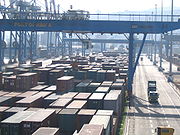 Haifa Bay
has been a refuge for mariners since prehistoric times. When the Crusaders
conquered Haifa in the year 1100, it became an important town and the main port for Tiberias, the capital of the Galilee
. The port fell into disrepair during the Mamluk
reign, and acquired the reputation of a pirate lair in the 18th century.
Until the beginning of the 20th century, Acre
served as the main port for the region. However, the port eventually became clogged with silt, and was unable to accommodate large ships. The first person to comprehend the tremendous possibilities of a port in Haifa was Theodor Herzl
, the father of Political Zionism
, who in 1898 wrote a prophetic description of the town in his book AltNeuland
. Construction of the port began in 1922, and it was officially opened on October 31, 1933.
The port allowed Haifa to blossom, and in 1936, the city had over 100,000 inhabitants. The port served as a gateway for thousands of immigrants to Israel
after the Second World War
. With Israel’s western borders the Mediterranean
and the eastern borders sealed by its Arab
neighbors, Haifa served as a crucial gateway to the rest of the world, and helped Israel
develop into an economic power. Today the port brings both passenger and cargo traffic to a bustling metropolis, much as Theodor Herzl
predicted over a century ago.
The port has been the scene of two maritime incidents; one, the Patria disaster
, killing 267, while the other, the loss of the Shelly, killing two people.
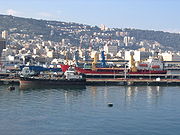 The Port of Haifa contains many cargo terminals, and is capable of servicing many ships at once. A railroad freight terminal is located inside the port and is used for transporting goods across the country, while a passenger rail station (Haifa Center HaShmona) is located nearby the passenger terminal. The port also features a fishing wharf
, a yacht club, a sports marina, and a chemical terminal. In 2010, the port processed 22 million tons of cargo including 1.27 million TEU
s, as well as 281,492 passengers. The port opened the first phase in the "Carmel Port" expansion program in 2010 that involved the construction of a new cargo terminal which includes a 700m long wharf capable of handling two giant 8,000 TEUs container ships (of max 15.5m draft
) simultaneously as well as the opening of a secondary 250m wharf plus adjacent support and storage areas. The new facilities will expand the port's annual container handling capacity by 500,000 TEU. Construction of this new terminal cost NIS1.8 billion (appx. US$500 million) and took five years to complete.
The Port maintains facilities for the United States Sixth Fleet.
Israel
The State of Israel is a parliamentary republic located in the Middle East, along the eastern shore of the Mediterranean Sea...
's three major international seaports, which include the Port of Ashdod
Port of Ashdod
The Port of Ashdod is one of Israel's two main cargo ports. The port is located in Ashdod, about 40 kilometers south of Tel Aviv, adjoining the mouth of the Lachish River. Its establishment doubled the country's port capacity. It is a major point of entry for both cargo and tourists in and out of...
, and the Port of Eilat
Port of Eilat
The Port of Eilat is the only Israeli port on the Red Sea, located at the northern tip of the Gulf of Aqaba.-History:The Port of Eilat opened in 1957 and is today mainly used for trading with Far East countries. It allows Israeli shipping to reach the Indian Ocean without having to sail through the...
. It has a natural deep water harbor
Harbor
A harbor or harbour , or haven, is a place where ships, boats, and barges can seek shelter from stormy weather, or else are stored for future use. Harbors can be natural or artificial...
which operates all year long, and serves both passenger and merchant ships. It is one of the largest ports in the eastern Mediterranean in terms of freight volume and handles over 22 million tons of cargo each year. The port employs over 1,000 people, with the number rising to 5,000 when cruise ships dock in Haifa. The Port of Haifa lies to the north of Haifa
Haifa
Haifa is the largest city in northern Israel, and the third-largest city in the country, with a population of over 268,000. Another 300,000 people live in towns directly adjacent to the city including the cities of the Krayot, as well as, Tirat Carmel, Daliyat al-Karmel and Nesher...
's downtown quarter on the Mediterranean, and streches to some 3 kilometers along the city's central shore with activities ranging from military
Israel Defense Forces
The Israel Defense Forces , commonly known in Israel by the Hebrew acronym Tzahal , are the military forces of the State of Israel. They consist of the ground forces, air force and navy. It is the sole military wing of the Israeli security forces, and has no civilian jurisdiction within Israel...
, industrial and commercial next to a nowadays-smaller passenger
Passenger
A passenger is a term broadly used to describe any person who travels in a vehicle, but bears little or no responsibility for the tasks required for that vehicle to arrive at its destination....
cruising facility.
History
Gulf of Haifa
Haifa Bay is a small bay along the Mediterranean coast of Northern Israel. Haifa Bay is Israel's only natural harbor on the Mediterranean.Fed by the Kishon River, the cities of Haifa and Acre mark its southern and northern capes, while its centre is lined with dunes and the suburban Krayot...
has been a refuge for mariners since prehistoric times. When the Crusaders
Crusades
The Crusades were a series of religious wars, blessed by the Pope and the Catholic Church with the main goal of restoring Christian access to the holy places in and near Jerusalem...
conquered Haifa in the year 1100, it became an important town and the main port for Tiberias, the capital of the Galilee
Galilee
Galilee , is a large region in northern Israel which overlaps with much of the administrative North District of the country. Traditionally divided into Upper Galilee , Lower Galilee , and Western Galilee , extending from Dan to the north, at the base of Mount Hermon, along Mount Lebanon to the...
. The port fell into disrepair during the Mamluk
Mamluk
A Mamluk was a soldier of slave origin, who were predominantly Cumans/Kipchaks The "mamluk phenomenon", as David Ayalon dubbed the creation of the specific warrior...
reign, and acquired the reputation of a pirate lair in the 18th century.
Until the beginning of the 20th century, Acre
Acre
The acre is a unit of area in a number of different systems, including the imperial and U.S. customary systems. The most commonly used acres today are the international acre and, in the United States, the survey acre. The most common use of the acre is to measure tracts of land.The acre is related...
served as the main port for the region. However, the port eventually became clogged with silt, and was unable to accommodate large ships. The first person to comprehend the tremendous possibilities of a port in Haifa was Theodor Herzl
Theodor Herzl
Theodor Herzl , born Benjamin Ze’ev Herzl was an Ashkenazi Jew Austro-Hungarian journalist and the father of modern political Zionism and in effect the State of Israel.-Early life:...
, the father of Political Zionism
Zionism
Zionism is a Jewish political movement that, in its broadest sense, has supported the self-determination of the Jewish people in a sovereign Jewish national homeland. Since the establishment of the State of Israel, the Zionist movement continues primarily to advocate on behalf of the Jewish state...
, who in 1898 wrote a prophetic description of the town in his book AltNeuland
The Old New Land
The Old New Land is a utopian novel published by Theodor Herzl, the founder of political Zionism, in 1902. Outlining Herzl’s vision for a Jewish state in the Land of Israel, Altneuland became one of Zionism's establishing texts. It was translated into Yiddish by Israel Isidor Elyashev...
. Construction of the port began in 1922, and it was officially opened on October 31, 1933.
The port allowed Haifa to blossom, and in 1936, the city had over 100,000 inhabitants. The port served as a gateway for thousands of immigrants to Israel
Israel
The State of Israel is a parliamentary republic located in the Middle East, along the eastern shore of the Mediterranean Sea...
after the Second World War
World War II
World War II, or the Second World War , was a global conflict lasting from 1939 to 1945, involving most of the world's nations—including all of the great powers—eventually forming two opposing military alliances: the Allies and the Axis...
. With Israel’s western borders the Mediterranean
and the eastern borders sealed by its Arab
Arab
Arab people, also known as Arabs , are a panethnicity primarily living in the Arab world, which is located in Western Asia and North Africa. They are identified as such on one or more of genealogical, linguistic, or cultural grounds, with tribal affiliations, and intra-tribal relationships playing...
neighbors, Haifa served as a crucial gateway to the rest of the world, and helped Israel
Israel
The State of Israel is a parliamentary republic located in the Middle East, along the eastern shore of the Mediterranean Sea...
develop into an economic power. Today the port brings both passenger and cargo traffic to a bustling metropolis, much as Theodor Herzl
Theodor Herzl
Theodor Herzl , born Benjamin Ze’ev Herzl was an Ashkenazi Jew Austro-Hungarian journalist and the father of modern political Zionism and in effect the State of Israel.-Early life:...
predicted over a century ago.
The port has been the scene of two maritime incidents; one, the Patria disaster
Patria disaster
The Patria disaster on 25 November 1940 was the sinking by the Haganah of a French-built ocean liner in the port of Haifa, in which 260 people were killed and 172 injured....
, killing 267, while the other, the loss of the Shelly, killing two people.
Facilities
Wharf
A wharf or quay is a structure on the shore of a harbor where ships may dock to load and unload cargo or passengers.Such a structure includes one or more berths , and may also include piers, warehouses, or other facilities necessary for handling the ships.A wharf commonly comprises a fixed...
, a yacht club, a sports marina, and a chemical terminal. In 2010, the port processed 22 million tons of cargo including 1.27 million TEU
Twenty-foot equivalent unit
The twenty-foot equivalent unit is an inexact unit of cargo capacity often used to describe the capacity of container ships and container terminals...
s, as well as 281,492 passengers. The port opened the first phase in the "Carmel Port" expansion program in 2010 that involved the construction of a new cargo terminal which includes a 700m long wharf capable of handling two giant 8,000 TEUs container ships (of max 15.5m draft
Draft (hull)
The draft of a ship's hull is the vertical distance between the waterline and the bottom of the hull , with the thickness of the hull included; in the case of not being included the draft outline would be obtained...
) simultaneously as well as the opening of a secondary 250m wharf plus adjacent support and storage areas. The new facilities will expand the port's annual container handling capacity by 500,000 TEU. Construction of this new terminal cost NIS1.8 billion (appx. US$500 million) and took five years to complete.
The Port maintains facilities for the United States Sixth Fleet.