
|
|
|
|
Ehud Barak
|
| |
|
| |
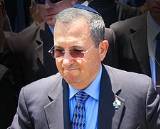
Ehud Barak (born Ehud Brog on 12 February 1942) is an Israeli politician, former Prime Minister, and current Minister of Defense, deputy prime minister and leader of Israel's Labor Party.
Barak served as the 10th Prime Minister of Israel from 1999 to 2001. After losing the 2001 election, Barak embarked on a business career. On 12 June 2007 he completed a political comeback by winning the Labor Party leadership election. He was appointed as Minister of Defense, replacing outgoing party leader Amir Peretz.
Prior to his political career he served as an officer in the Israel Defense Forces.

Discussion
Ask a question about 'Ehud Barak'
Start a new discussion about 'Ehud Barak'
Answer questions from other users
|
Encyclopedia
Ehud Barak (born Ehud Brog on 12 February 1942) is an Israeli politician, former Prime Minister, and current Minister of Defense, deputy prime minister and leader of Israel's Labor Party.
Barak served as the 10th Prime Minister of Israel from 1999 to 2001. After losing the 2001 election, Barak embarked on a business career. On 12 June 2007 he completed a political comeback by winning the Labor Party leadership election. He was appointed as Minister of Defense, replacing outgoing party leader Amir Peretz.
Prior to his political career he served as an officer in the Israel Defense Forces. Following a highly decorated career he was appointed the 14th Ramatkal (Head of General Staff) of the IDF.
Biography
Barak was born on 12 February 1942 in kibbutz Mishmar HaSharon in Mandate Palestine. He is the eldest of four sons of Esther (née Godin) and Israel Brog. Ehud hebraized his family name from "Brog" to "Barak" in 1959, when he joined the Israeli army.
It was during his military service that he met his future wife, Naava. They had three daughters together. Ehud and Naava divorced in August 2003. On 30 July 2007 Ehud married Nili Priel in a small ceremony in his private residence.
Education
Barak earned his bachelor's degree in physics and mathematics from the Hebrew University in Jerusalem in 1968, and his master's degree in engineering-economic systems in 1978 from Stanford University in Palo Alto, California.
Military service
Ehud Brog joined the Israel Defense Forces (IDF) in 1959. At that time he decided to change his name to "Barak", which means "lightning" or "shine" in Hebrew. He served in the IDF for 35 years, rising to the position of Chief of the General Staff and the rank of Rav Aluf, the highest in the Israeli military. During the Yom Kippur War, Barak commanded an improvised regiment of tanks which among other things, helped rescue paratrooper battalion 890 commanded by Yitzhak Mordechai who were suffering heavy losses in the Battle of the Chinese Farm.
During his service as a commando in the elite Sayeret Matkal, Barak led several highly acclaimed operations, such as: "Operation Isotope", the rescue mission to free the hostages onboard Sabena Flight 572 at Lod Airport in 1972; the 1973 covert mission Operation Spring of Youth in Beirut, in which he was disguised as a woman in order to assassinate members of the Palestine Liberation Organization; Barak was also a key architect of the June 1976 Operation Entebbe, another rescue mission to free the hostages of the Air France aircraft hijacked by terrorists and forced to land at the Entebbe Airport in Uganda. These highly acclaimed operations, along with Operation Bayonet led to the dismantling of Palestinian terrorist cell Black September and a decline in international terrorism for over 20 years . It has been alluded that Barak also masterminded the Tunis Raid on April 16, 1988, in which PLO leader Abu Jihad was assassinated.
Later he served as head of Aman, the Military Intelligence Directorate (1983-1985), head of Central Command (1986 - 1987) and Deputy Chief of the General Staff (1987-1991). He served Chief of the General Staff between April 1 1991 and January 1 1995. During this period he implemented the first Oslo Accords and participated in the negotiations towards the Israel-Jordan Treaty of Peace.
Barak was awarded the Medal of Distinguished Service and four Chief of Staff citations (Tzalash HaRamatcal) for courage and operational excellence. These five decorations make him the most decorated soldier in Israeli history (jointly with close friend Nechemiah Cohenl). In addition he was awarded in 1993 the Legion of Merit (Commander) by the United States
Barak is also an expert in krav maga, the official martial art of the Israeli Defense Forces.
Political career
As a politician, Barak served as Minister of the Interior (1995) and then as Minister of Foreign Affairs (1995-1996). He was elected to the Knesset in 1996, where he served as a member of the Knesset Foreign Affairs and Defense Committee. In 1996 Barak became the leader of the Labor Party.
Prime Minister of Israel
Ehud Barak was elected Prime Minister of Israel on 17 May 1999. Barak sparked controversy by deciding to form a coalition with the haredi party Shas who had received an unprecedented 17 seats in the 120-seat Knesset. Shas grudgingly agreed to Barak's terms that they eject their leader Aryeh Deri, a convicted felon, and enact reform to "clean up" in-party corruption. Consequentially, the left wing Meretz party quit the coalition after they failed to agree on the powers to be given to a Shas deputy-minister in the Ministry of Education.
In 1999 Barak gave a campaign promise to end Israel's 22-year long occupation of Southern Lebanon within a year. On May 24, 2000 Israel withdrew from Southern Lebanon. On October the 7th, 2000, three Israeli soldiers were captured by Hezbollah and then subsequently killed. The bodies of these soldiers, along with the living Elhanan Tenenbaum, were eventually exchanged for Lebanese captives in 2004. Barak inaugurated peace negotiations with the PLO, which ultimately proved fruitless. Barak also took part in the Camp David 2000 Summit which was meant to finally resolve the Israeli-Palestinian conflict but failed. Barak, Prince Bandar of Saudi Arabia, and US president Bill Clinton placed the blame on Yasser Arafat. Barak claimed he exposed "Arafat's true intentions". Following the failure at Camp David, the Palestinian al-Aqsa Intifada (also known as the Second Intifada) erupted. Barak also allowed Foreign Minister Shlomo Ben-Ami to attend the Taba Summit with the leadership of the Palestinian Authority, after his government had fallen.
Domestic Issues
Barak was in power during the appointment of the Tal committee which dealt with the controversial issue of haredi Jews' exemption from military service. Riots in October 2000 led to the killing of 12 Israeli-Arabs and 1 Palestinian by Israel Police and one Israeli-Jewish civilian by Israeli Arabs.
In 1999–2000, Israel experienced high growth rates (GDP) relative to the economy’s past performance and by international standards.
Party leader, return to politics
In 2005, Barak announced his return to Israeli politics, and ran for leadership of the Labor Party in November. However, in light of his weak poll showings, Barak dropped out of the race early and declared his support for veteran statesman Shimon Peres.
After Peres lost the race to Amir Peretz and left the Labor party, Barak announced he would stay at the party, despite his shaky relationship with its newly elected leader. He declared, however, that he would not run for a spot on the Labor party's Knesset list for the March 2006 elections.
In January 2007 Barak launched a bid to recapture the leadership of the Labor party in a letter acknowledging "mistakes" and "inexperience" during his tenure as Prime Minister. In early March 2007, a poll of Labor Party primary voters put Barak ahead of all other opponents, including current leader Amir Peretz. In the first round of voting, on 28 May 2007, he gained 39% of the votes, more than his two closest rivals, but not enough to win the election.
As a result, Barak faced a runoff against the second-place finisher, Ami Ayalon, on June 12 2007, which he won by a narrow margin.
Defence Minister
]]
After winning back the leadership of the Labor party, Barak was sworn in as Minister of Defense on June 18, 2007, as part of Prime Minister Olmert's cabinet reshuffle. However on 1 July 2007, Barak led a successful effort in the Labor central committee to stipulate that Labor would leave the government coalition if Olmert did not resign by September or October 2007. At that time the Winograd Commission would publish its final report on the performance of the Israel Defense Forces and its civilian leadership. The preliminary Winograd report released earlier this year laid most of the blame on Olmert for poorly planning, executing, and reviewing war strategies in the 2006 conflict against Hezbollah.
In December 2008 through January 2009, Barak led (as defense minister) the bombardment and subsequent invasion of the Hamas-controlled Gaza Strip. On Nov. 4th, 2008, during the period of a truce agreement, the IDF entered Gaza and killed 5 Palestinians, so putting an end to the cease-fire. In response,Hamas launched a series of rockets into Israeli territory. In response to further killings of Palestinians in Gaza by the Israelis, on Dec. 19th, Hamas formally terminated the cease-fire agreement and stated that it would not be renewed. . On Dec. 27th, citing the approximately 10,000 rockets Hamas launched into Israel civilian areas over the past eight years as a justification, Israel launched a coordinated missile attack on Hamas targets inside Gaza, including a police academy during a graduation ceremony. In a statement, Barak said "We face a period that will be neither easy nor short, and will require determination and perseverance until the necessary change is achieved in the situation in the south."
Within Israel, many critics of the IDF and Barak believe that this attack (which eventually killed 1300 Palestinians with about 5000 wounded), was carried out to boost Labor's results in the elections On February 10, Israelis voted in elections to the Knesset. In opinion polls prior to the assault on Hamas, Barak trailed foreign minister and Kadima Party leader Tzipi Livni and former prime minister and Likud Party leader Benjamin Netanyahu.
2009 Knesset Elections
With Labor appearing to have won only 13 out of the 120 Knesset seats in the 2009 Knesset Elections, it is now thought possible that he may be challenged for the Labor leadership, regarding his position as Defense Minister he stated before the election publicly that if Labor did not manage close to 20 seats, he would neither be willing nor able to stay at the defence ministry, and Labor Party officials have confirmed that Labor would not take part in the next government, while saying that Ehud Barak would remain Labor leader. It has not been announced who Labor and Ehud Barak will recommend as Israel's Prime Minister, which is thought likely to either be Kadima Leader Tzipi Livni, or Likud leader and former Prime Minister Benjamin Netanyahu.
Outside of politics After losing the 2001 elections to Ariel Sharon, Barak left Israel to work as a senior advisor with U.S.-based Electronic Data Systems. He also partnered with a private equity company focused on "security-related" work.
In 2005, following his failed attempt to maintain leadership of the Labor party, Barak became a partner of the investment company SCP Private Equity Partners, Pennsylvania. He established a company "Ehud Barak Limited" which is thought to have made over NIS 30 million.
Barak went on a public speaking tour of American colleges, expressing his view on the Middle East. During this tour in 2006, he said that “[Iraq] gradually deteriorates to civil war [and] the US presence is more and more a part of the problem and not the solution."
See also
External links
-
- Volume 49, Number 10 · June 13, 2002 Email to a friend Exchange Camp David and After: An Exchange (1. An Interview with Ehud Barak)
- Ynetnews
|
| |
|
|