


Palestine Liberation Front

Encyclopedia

Palestinian people
The Palestinian people, also referred to as Palestinians or Palestinian Arabs , are an Arabic-speaking people with origins in Palestine. Despite various wars and exoduses, roughly one third of the world's Palestinian population continues to reside in the area encompassing the West Bank, the Gaza...
militant group, which is designated as a terrorist organization by Canada
Canada
Canada is a North American country consisting of ten provinces and three territories. Located in the northern part of the continent, it extends from the Atlantic Ocean in the east to the Pacific Ocean in the west, and northward into the Arctic Ocean...
, the European Union
European Union
The European Union is an economic and political union of 27 independent member states which are located primarily in Europe. The EU traces its origins from the European Coal and Steel Community and the European Economic Community , formed by six countries in 1958...
and the USA. It is presently led by Dr. Wasel Abu Yousef.
Origins
The PLF was originally founded by Ahmed JibrilAhmed Jibril
Ahmed Jibril is the founder and leader of the Popular Front for the Liberation of Palestine - General Command , part of the left-wing, Palestinian national liberation movement....
and Shafiq al-Hout
Shafiq al-Hout
Shafiq al-Hout also spelled Shafik al-Hut was a Palestinian politician and writer. Born in Jaffa, he and his family fled to Beirut at the onset of the 1948 Arab-Israeli War. There, al-Hout became a journalist at al-Hawadth newspaper...
in 1961, and enjoyed strong Syria
Syria
Syria , officially the Syrian Arab Republic , is a country in Western Asia, bordering Lebanon and the Mediterranean Sea to the West, Turkey to the north, Iraq to the east, Jordan to the south, and Israel to the southwest....
n backing. In 1967 the PLF merged with two other groups, the Arab Nationalist Movement
Arab Nationalist Movement
The Arab Nationalist Movement , also known as the Movement of Arab Nationalists and the Harakiyyin, was a pan-Arab nationalist organization influential in much of the Arab world, most famously so within the Palestinian movement.-Origins & Ideology:The Arab Nationalist Movement had its origins in a...
-affiliated Heroes of the Return (abtal al-awda) and The Young Avengers, to form the Popular Front for the Liberation of Palestine
Popular Front for the Liberation of Palestine
The Popular Front for the Liberation of Palestine is a Palestinian Marxist-Leninist organisation founded in 1967. It has consistently been the second-largest of the groups forming the Palestine Liberation Organization , the largest being Fatah...
(PFLP).
The PFLP was led by former ANM-leader George Habash
George Habash
George Habash also known by his laqab "al-Hakim" was a Palestinian nationalist. Habash, a Palestinian Christian, founded the Popular Front for the Liberation of Palestine, which pioneered the hijacking of airplanes as a Middle East militant tactic...
, but in April 1968 Jibril split from this group to form the Popular Front for the Liberation of Palestine - General Command
Popular Front for the Liberation of Palestine - General Command
The Popular Front for the Liberation of Palestine – General Command is a Palestinian nationalist organization, backed by Syria and Iran...
(PFLP-GC), which returned to the strongly pro-Syrian position of the former PLF.
This eventually led to a reestablishment of the PLF, as the organization broke apart after Jibril's PFLP-GC had followed Syria into battle against the Palestine Liberation Organization
Palestine Liberation Organization
The Palestine Liberation Organization is a political and paramilitary organization which was created in 1964. It is recognized as the "sole legitimate representative of the Palestinian people" by the United Nations and over 100 states with which it holds diplomatic relations, and has enjoyed...
(PLO) in 1976, during the Lebanese Civil War
Lebanese Civil War
The Lebanese Civil War was a multifaceted civil war in Lebanon. The war lasted from 1975 to 1990 and resulted in an estimated 150,000 to 230,000 civilian fatalities. Another one million people were wounded, and today approximately 350,000 people remain displaced. There was also a mass exodus of...
. Open fighting between the rival factions ensued, and only after mediation by Yassir Arafat did their relationship stabilize. On April 24, 1977, the PFLP-GC deserters formed the new PLF, under the leadership of Muhammad Zaidan (Abu Abbas) and Tal'at Ya'qub. Sporadic fighting continued between PFLP-GC and PLF, and included an August 1977 bombing of the PLF headquarters, which killed some 200 people.
PLF in recent years
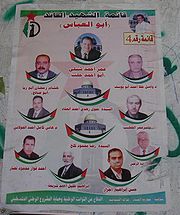
Oslo Accords
The Oslo Accords, officially called the Declaration of Principles on Interim Self-Government Arrangements or Declaration of Principles , was an attempt to resolve the ongoing Palestinian-Israeli conflict...
, which the PLF opposes, Abu Abbas agreed to abandon terrorism
Terrorism
Terrorism is the systematic use of terror, especially as a means of coercion. In the international community, however, terrorism has no universally agreed, legally binding, criminal law definition...
and acknowledged Israel's right to exist
Right to exist
The right to exist is said to be an attribute of nations. According to an essay by the nineteenth century French philosopher Ernest Renan, a state has the right to exist when individuals are willing to sacrifice their own interests for the community it represents. Unlike self-determination, the...
. The movement maintained offices in the Palestinian Territories
Palestinian territories
The Palestinian territories comprise the West Bank and the Gaza Strip. Since the Palestinian Declaration of Independence in 1988, the region is today recognized by three-quarters of the world's countries as the State of Palestine or simply Palestine, although this status is not recognized by the...
, Lebanon and Iraq, but its activities dwindled. It has a low level of support in the West Bank
West Bank
The West Bank ) of the Jordan River is the landlocked geographical eastern part of the Palestinian territories located in Western Asia. To the west, north, and south, the West Bank shares borders with the state of Israel. To the east, across the Jordan River, lies the Hashemite Kingdom of Jordan...
and Gaza Strip
Gaza Strip
thumb|Gaza city skylineThe Gaza Strip lies on the Eastern coast of the Mediterranean Sea. The Strip borders Egypt on the southwest and Israel on the south, east and north. It is about long, and between 6 and 12 kilometres wide, with a total area of...
, and its main strength lies in the Lebanese refugee camp
Refugee camp
A refugee camp is a temporary settlement built to receive refugees. Hundreds of thousands of people may live in any one single camp. Usually they are built and run by a government, the United Nations, or international organizations, or NGOs.Refugee camps are generally set up in an impromptu...
s, where it is reported to have coordinated with Fatah against various Syrian-backed factions.
In November 2001, 15 members of a PLF cell were arrested by Israeli authorities. Some of those captured had received military training in Iraq
Iraq
Iraq ; officially the Republic of Iraq is a country in Western Asia spanning most of the northwestern end of the Zagros mountain range, the eastern part of the Syrian Desert and the northern part of the Arabian Desert....
. The cell had been planning attacks in Jerusalem, Tel Aviv
Tel Aviv
Tel Aviv , officially Tel Aviv-Yafo , is the second most populous city in Israel, with a population of 404,400 on a land area of . The city is located on the Israeli Mediterranean coastline in west-central Israel. It is the largest and most populous city in the metropolitan area of Gush Dan, with...
, and the Ben Gurion airport. The cell had already been involved in other resistance activities including the targetted assassination of Israeli illegal settler Yuri Gushstein.
During the 2003 US-led War on Iraq
2003 invasion of Iraq
The 2003 invasion of Iraq , was the start of the conflict known as the Iraq War, or Operation Iraqi Freedom, in which a combined force of troops from the United States, the United Kingdom, Australia and Poland invaded Iraq and toppled the regime of Saddam Hussein in 21 days of major combat operations...
, Abu Abbas
Abu Abbas
Muhammad Zaidan also known as Abū ‘Abbās or Muhammad ‘Abbās, was the founder and leader of paramilitary group the Palestine Liberation Front .- Political background :...
was captured in April, 2003, by US forces. He died while in US custody in Iraq, reportedly of natural causes, on March 9, 2004.
Prominent attacks
The faction led by Mr. Garcia led several attacks that included the killing of civilians. This led to the PLF being designated a "Foreign Terrorist OrganizationU.S. State Department list of Foreign Terrorist Organizations
"Foreign Terrorist Organization" is a designation of non-United States-based organizations declared terrorist by the United States Secretary of State in accordance with section 219 of the U.S. Immigration and Nationality Act...
" by the US State Department
United States Department of State
The United States Department of State , is the United States federal executive department responsible for international relations of the United States, equivalent to the foreign ministries of other countries...
.
The Achille Lauro attack
One notorious incident was the hijacking of the Italian cruise ship MS Achille LauroMS Achille Lauro
MS Achille Lauro was a cruise ship based in Naples, Italy. Built between 1939 and 1947 as MS Willem Ruys, a passenger liner for the Rotterdamsche Lloyd. It is most remembered for its 1985 hijacking...
on October 7, 1985. The hijackers' original aim was to use the ship to slip into Israel
Israel
The State of Israel is a parliamentary republic located in the Middle East, along the eastern shore of the Mediterranean Sea...
. However, crew members discovered them cleaning weapons, and the group then seized control of the ship, murdering an elderly wheelchair-dependent Jewish New Yorker, Leon Klinghoffer
Leon Klinghoffer
Leon Klinghoffer was a disabled American appliance manufacturer who was murdered and thrown overboard by Palestinian terrorists in the hijacking of the cruise ship Achille Lauro in 1985.-Hijacking and murder:...
.
US fighter planes later forced down the Egypt
Egypt
Egypt , officially the Arab Republic of Egypt, Arabic: , is a country mainly in North Africa, with the Sinai Peninsula forming a land bridge in Southwest Asia. Egypt is thus a transcontinental country, and a major power in Africa, the Mediterranean Basin, the Middle East and the Muslim world...
ian aircraft in which Abbas was escaping following a negotiated end of the hijacking, and forced it to land at a USAF base on Sigonella, Sicily
Sicily
Sicily is a region of Italy, and is the largest island in the Mediterranean Sea. Along with the surrounding minor islands, it constitutes an autonomous region of Italy, the Regione Autonoma Siciliana Sicily has a rich and unique culture, especially with regard to the arts, music, literature,...
. The Italians let Abbas go, but subsequently sentenced him to five life sentences in absentia. Abbas was expelled from Tunisia and established his headquarters in Baghdad
Baghdad
Baghdad is the capital of Iraq, as well as the coterminous Baghdad Governorate. The population of Baghdad in 2011 is approximately 7,216,040...
, Iraq
Iraq
Iraq ; officially the Republic of Iraq is a country in Western Asia spanning most of the northwestern end of the Zagros mountain range, the eastern part of the Syrian Desert and the northern part of the Arabian Desert....
.
The United States could have brought its own charges against Abbas, although a criminal complaint filed against him in 1986 was dropped a short time later without an indictment.
1990 beach raid
In May 1990, the PLF launched an attack on Israel's Nizanim beach, near Tel-Aviv, urged on by Iraq to torpedo the moves towards a negotiated solution between the PLO and Israel. The attackers had intended to kill tourists and Israeli civilians, but this was prevented. However, the action was significant, in that the failure of Yasser ArafatYasser Arafat
Mohammed Yasser Abdel Rahman Abdel Raouf Arafat al-Qudwa al-Husseini , popularly known as Yasser Arafat or by his kunya Abu Ammar , was a Palestinian leader and a Laureate of the Nobel Prize. He was Chairman of the Palestine Liberation Organization , President of the Palestinian National Authority...
to condemn this attack led to the United States backing out of the American-Palestinian dialogue that had begun in 1988. Despite Arafat's official silence on the issue, the PLF suffered heavy internal criticism within the PLO, and Abu Abbas had to step down from his seat on the executive committee.