
| |
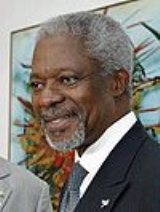
Kofi Atta Annan, GCMG (born 8 April 1938) is a Ghanaian diplomat who served as the seventh Secretary-General of the United Nations from 1 January 1997 to 1 January 2007. Annan and the United Nations were the co-recipients of the 2001 Nobel Peace Prize.
Early years and family Kofi Annan was born to Victoria and Henry Reginald Annan in the Kofandros section of Kumasi, Ghana. He is a twin, a respected status in Ghanaian culture. His twin sister Efua Atta, who died in 1991, shares the middle name 'Atta', which in Fante and Akan means 'twin'.
Annan's family was part of the country's elite; both of his grandfathers and his uncle were tribal chiefs.

Discussion
Ask a question about 'Kofi Annan'
Start a new discussion about 'Kofi Annan'
Answer questions from other users
|
Quotations
In todays world, the security of every one of us is linked to that of everyone else.
Saddam Hussein is very calm - very, very calm. Never raises his voice. Well-informed, contrary to the sense outside that he is ill-informed and isolated. And decisive.
Press conference (24 February 1998)
We may have different religions, different languages, different colored skin, but we all belong to one human race. We all share the same basic values.
As quoted in Simply Living: The Spirit of the Indigenous People (1999) edited by Shirley A. Jones
The US has given the world an example of a democracy in which everyone, including the most powerful, is subject to legal restraint. Its current moment of world supremacy gives it a priceless opportunity to entrench the same principles at the global level.
It is only through multilateral institutions that States can hold each other to account. And that makes it very important to organize those institutions in a fair and democratic way, giving the poor and the weak some influence over the actions of the rich and the strong.

Encyclopedia
Kofi Atta Annan, GCMG (born 8 April 1938) is a Ghanaian diplomat who served as the seventh Secretary-General of the United Nations from 1 January 1997 to 1 January 2007. Annan and the United Nations were the co-recipients of the 2001 Nobel Peace Prize.
Early years and family Kofi Annan was born to Victoria and Henry Reginald Annan in the Kofandros section of Kumasi, Ghana. He is a twin, a respected status in Ghanaian culture. His twin sister Efua Atta, who died in 1991, shares the middle name 'Atta', which in Fante and Akan means 'twin'.
Annan's family was part of the country's elite; both of his grandfathers and his uncle were tribal chiefs. His father was Asante and Fante; his mother was Fante. Annan's father worked for a long period as an export manager for the Lever Brothers cocoa company.
Annan is married to Nane Maria Annan, a Swedish lawyer and artist who is the half-niece of Raoul Wallenberg. He has two children, Kojo and Ama, from his previous marriage to a Nigerian woman, Titi Alakija, whom he divorced in the late 1970s. Annan also has one stepchild, Nina Cronstedt de Groot, Nane's daughter from a previous marriage.
Name
His middle name Atta is that of an elder twin. The name Annan can indicate that a child was the fourth in the family, but in Annan's family at some time in the past it became a family name, which Annan inherited from his parents.
In the Ghanaian tradition, children are named according to the day of the week on which they were born. Kofi in Akan is the name that corresponds with Friday.
In his earlier years at the UN, Annan's last name had widely been mispronounced as rhyming with "anon"; Annan has let it be known that he pronounces his name to rhyme with "canon" .
Education
From 1954 to 1957, Annan attended the elite Mfantsipim school, a Methodist boarding school in Cape Coast founded in the 1870s. Annan has said that the school taught him "that suffering anywhere concerns people everywhere". In 1957, the year Annan graduated from Mfantsipim, Ghana gained independence from Britain.
In 1958, Annan began studying for a degree in economics at the Kumasi College of Science and Technology, now the Kwame Nkrumah University of Science and Technology of Ghana. He received a Ford Foundation grant, enabling him to complete his undergraduate studies at Macalester College in St. Paul, Minnesota, United States, in 1961. Annan then did a DEA degree in International Relations at the Graduate Institute of International Studies (Institut universitaire des hautes études internationales IUHEI) in Geneva, Switzerland, from 1961–62, later attending the MIT Sloan School of Management (1971–72) Sloan Fellows program and receiving a Master of Science (M.S.) degree from the MIT Sloan School of Management.
Annan is fluent in English, French, Kru, other dialects of Akan, and other African languages.
Early career
In 1962, Annan started working as a Budget Officer for the World Health Organization, an agency of the United Nations. From 1974 to 1976, he worked as the Director of Tourism in Ghana. Annan then returned to work for the United Nations as an Assistant Secretary-General in three consecutive positions: Human Resources, Management and Security Coordinator, from 1987 to 1990; Program Planning, Budget and Finance, and Controller, from 1990 to 1992; and Peacekeeping Operations, from March 1993 to February 1994.
The chain of events which lead up to the 1994 Rwandan Genocide unfolded while Annan was heading up Peacekeeping Operations.
In his book Shake Hands with the Devil: The Failure of Humanity in Rwanda, Canadian ex-General Roméo Dallaire, who was force commander of the United Nations Assistance Mission for Rwanda, claims that Annan was overly passive in his response to the incipient genocide. General Dallaire explicitly asserts that Annan held back U. N. troops from intervening to settle the conflict, and from providing more logistical and material support. In particular, Dallaire claims that Annan failed to provide any responses to his repeated faxes asking him for access to a weapons depository, something that could have helped defend the endangered Tutsis. Dallaire concedes, however, that Annan was a man whom he found extremely "committed" to the founding principles of the United Nations.
Annan served as Under-Secretary-General until October 1995, when he was made a Special Representative of the Secretary-General to the former Yugoslavia, serving for five months in that capacity before returning to his duties as Under-Secretary-General in April 1996.
Secretary-General of the United Nations
Appointment
On 13 December 1996, Annan was recommended by the United Nations Security Council to replace the previous Secretary-General, Dr. Boutros-Ghali of Egypt, whose second term faced the veto of the United States. He was confirmed four days later by the vote of the General Assembly, and he started his first term as Secretary-General on 1 January 1997.
Activities
Mark Malloch Brown succeeded Louise Frechette as Annan's Deputy Secretary-General in April 2004.
In April 2001, he issued a five-point "Call to Action" to address the HIV/AIDS pandemic. As Secretary-General, Annan saw this pandemic as a "personal priority" and proposed the establishment of a Global AIDS and Health Fund in an attempt to stimulate the increased spending needed to help developing countries confront the HIV/AIDS crisis.
On 10 December 2001, Annan and the United Nations were jointly awarded the Nobel Peace Prize, "for their work for a better organized and more peaceful world".
During the build-up to the 2003 invasion of Iraq, Annan called on the United States and the United Kingdom not to invade without the support of the United Nations. In a September 2004 interview on the BBC, Annan was asked about the legal authority for the invasion, and responded, "from our point of view, from the charter point of view it was illegal."
Annan supported sending a UN peacekeeping mission to Darfur, Sudan, and worked with the government of Sudan to accept a transfer of power from the African Union peacekeeping mission to a UN one. Annan also worked with several Arab and Muslim countries on women's rights and other topics.
Beginning in 1998 Annan convened an annual UN Security Council Retreat with 15 States representatives of the Council at the Rockefeller Brothers Fund (RBF) Conference Center at the Rockefeller family estate at Pocantico, which was sponsored by both the RBF and the UN. He and his wife also attended the Playhouse at the family estate on the occasion of Brooke Astor's 100th birthday celebration. He is a strong supporter and guest of the family's Asia Society in New York.
Lubbers sexual-harassment investigation
In June 2004, Annan was given a copy of the Office of Internal Oversight Services (OIOS) report on the complaint of sexual harassment, abuse of authority, and retaliation against Ruud Lubbers, UN High Commissioner for Refugees. The report also discussed allegations of sexual harassment and misconduct against Werner Blatter, Director of UNHCR Personnel, by a long-serving staff member. The investigation report found Ruud Lubbers guilty of sexual harassment and no mention was made publicly of the other charge against a senior official or the two subsequent complaints she filed later that year. In the course of the official investigation, Lubbers wrote a letter that some speculate was a threat to the female worker who had brought the charges of misconduct. However, on 15 July 2004, Lubbers was declared innocent by Kofi Annan . His decision only lasted until November when OIOS issued its annual report to the UN General Assembly noting it has found Lubbers guilty. Widely reported in the media, these events served to weaken Annan's position.
On 17 November 2004, Annan accepted a report clearing UN Under-Secretary-General for Internal Oversight Services Dileep Nair of political corruption and sexual harassment charges — charges which some viewed as retaliation against Nair for supporting the complainant in the Lubbers affair. However, clearance was not viewed favorably by some UN staff in New York, leading to extensive debate on 19 November. In February 2005, Lubbers resigned as head of the UN refugee agency.
Oil-for-Food scandal
In December 2004, reports surfaced that the Secretary-General's son Kojo received payments from the Swiss company Cotecna Inspection SA, which won a lucrative contract under the UN Oil-for-Food Program. Kofi Annan called for an investigation into this matter.
The Independent Inquiry Committee into The United Nations Oil-for-Food Program was appointed by Annan and led by former US Federal Reserve Chairman Paul Volcker; Volcker has strong ideological ties to the UN as director of the United Nations Association of the United States of America. In his first interview with the Inquiry Committee, Annan denied having had a meeting with Cotecna. Later in the inquiry he recalled that he had met with Cotecna's chief executive Elie-Georges Massey twice. In a final report issued on 27 October, the committee found insufficient evidence to indict Kofi Annan on any illegal actions, but did find fault with Mr. Benan Sevan, a Cypriot national who had worked for the UN for about 40 years. Appointed to his Oil-For-Food role by Kofi Annan, Mr. Sevan repeatedly asked Iraqis for allocations of oil to the African Middle East Petroleum Company. Sevan's behavior was "ethically improper", Volcker said to reporters. Sevan for his part, has repeatedly denied the charges and argues that he is being made a "scapegoat". The Volcker report was also highly critical of the UN management structure and the Security Council oversight and strongly recommended a new position of Chief Operating Officer to handle the fiscal and administrative responsibilities which currently fall to the Secretary General's office. The report listed the companies, both Western and Middle Eastern, who illegally benefited from the program.
Conflict between the United States and the United Nations
Kofi Annan supported his deputy Secretary-General Mark Malloch Brown, who openly criticized segments of the United States media in a speech on 6 June 2006: "But [the UN's role in peacekeeping] is not well known or understood, in part because much of the public discourse that reaches the US heartland has been largely abandoned to its loudest detractors such as Rush Limbaugh and Fox News. The prevailing practice of seeking to use the UN almost by stealth as a diplomatic tool while failing to stand up for it against its domestic critics is simply not sustainable… You will lose the UN one way or another." The U.S. ambassador John R. Bolton was reported to have told Annan on the phone: "I've known you since 1989 and I'm telling you this is the worst mistake by a senior UN official that I have seen in that entire time." At the end of Kofi Annan's tenure as Secretary General, Bolton was asked to sum up Annan's years at the UN. He responded simply: "I'll pass."
UN Resolution 61/225: World Diabetes Day
Kofi Annan was the overseeing Secretary-General of the United Nations General Assembly during the successful passing (by consensus) of UN Resolution 61/225 - World Diabetes Day. The Resolution was, and still remains, the second-ever UN General Assembly Resolution on any health-related issue (the other being HIV/AIDS). However, 61/225 remains the only Health-related UN Resolution to ever pass by consensus.
The Resolution was sponsored by the Republic of South Africa and Bangladesh, and was passed on 20 December 2006.
Farewell addresses
On 19 September 2006, Annan gave a farewell address to world leaders gathered at the UN headquarters in New York, in anticipation of his retirement on 31 December. In the speech he outlined three major problems of "an unjust world economy, world disorder, and widespread contempt for human rights and the rule of law", which he believes "have not resolved, but sharpened" during his time as Secretary-General. He also pointed to violence in Africa, and the Arab-Israeli conflict as two major issues warranting attention.
On 11 December 2006, in his final speech as Secretary-General, delivered at the Harry S. Truman Presidential Library in Independence, Missouri, Annan recalled Truman's leadership in the founding of the United Nations. He called for the United States to return to President Truman's multilateralist foreign policies, and to follow Truman's credo that "the responsibility of the great states is to serve and not dominate the peoples of the world". He also said that the United States must maintain its commitment to human rights, "including in the struggle against terrorism."
Recommendations for UN reform
After years of research, Annan presented a progress report, In Larger Freedom, to the UN General Assembly, on 21 March 2005. Annan recommended Security Council expansion and a host of other UN reforms.
On 31 January 2006, Kofi Annan outlined his vision for a comprehensive and extensive reform of the UN in a policy speech to the United Nations Association UK. The speech, delivered at Central Hall, Westminster, also marked the 60th Anniversary of the first meetings of the UN General Assembly and UN Security Council.
On 7 March 2006, he presented to the General Assembly his proposals for a fundamental overhaul of the United Nations Secretariat. The reform report is entitled: "Investing in the United Nations, For a Stronger Organization Worldwide".
On 30 March 2006, he presented to the General Assembly his analysis and recommendations for updating the entire work programme of the United Nations Secretariat over the last 60 years. The report is entitled: "Mandating and Delivering: Analysis and Recommendations to Facilitate the Review of Mandates".
Post-UN career Upon his return to Ghana, Annan was immediately suggested as a candidate to become the country's next head of state.
He has become involved with several organizations with both global and African focuses. In 2007, Annan was named chairman of the prize committee for the Mo Ibrahim Prize for Achievement in African Leadership, was chosen to lead the new formation of Alliance for a Green Revolution in Africa (AGRA), became a member of the Global Elders, was appointed president of the Global Humanitarian Forum in Geneva, and was selected for the MacArthur Foundation Award for International Justice.
In the beginning of 2008, as head of the Panel of Eminent African Personalities, Annan participated in the negotiations to end the civil unrest in Kenya. He threatened to leave the negotiations as mediator if a quick decision was not made. On 26 February 2008 he suspended talks to end Kenya's violent post-election crisis. On 28 February, Annan managed to have President Mwai Kibaki and Raila Odinga sign a coalition government agreement and was widely lauded by many Kenyans for this landmark achievement. That was the best deal achieved then under the mediation efforts.
Annan currently serves on the board of directors of the United Nations Foundation, a public charity created in 1998 with entrepreneur and philanthropist Ted Turner’s historic $1 billion USD gift to support UN causes. The UN Foundation builds and implements public-private partnerships to address the world’s most pressing problems, and broadens support for the UN.
Annan is a member of the Africa Progress Panel (APP), an independent authority on Africa launched in April 2007 to focus world leaders’ attention on delivering their commitments to the continent. The Panel launched a major report in London on Monday 16 June 2008 entitled Africa's Development: Promises and Prospects.
Kofi Annan was appointed the Chancellor of the University of Ghana in 2008.
Honours
- Kwame Nkrumah University of Science and Technology, (Kumasi), Honorary Doctor of Science, 24 August 1998
- United Nations Mandated University for Peace, Honorary President, 1999
- Lund University, Honorary Doctor of Law, 1999
- National University of Ireland, Doctor of Law, 22 January 1999
- Technische Universität Dresden, doctor honoris causa, 27 April 1999
- Howard University, honorary doctorate of humane letters, 8 May 1999
- University of Notre Dame, Doctor of Letters, honoris causa, 21 May 2000
- Seton Hall University, John C. Whitehead School of Diplomacy and International Relations, Honorary Doctorate, February 2001
- Brown University, Doctor of Laws, honoris causa, 28 May 2001
- Liberty Medal International Selection Commission, Liberty Medal, 4 July 2001
- Free University of Berlin, doctor honoris causa, 13 July 2001
- Nobel Foundation, The Nobel Peace Prize, jointly presented to Kofi Annan and the United Nations, 2001
- Tilburg University, Honorary Doctorate, 2002
- Northwestern University, Doctor of Laws, 21 June 2002
- 2002 winner of the "Profiles in Courage Award," given by the JFK Memorial Museum.
- University of Pittsburgh, honorary Doctor of Public and International Affairs degree 21 October 2003
- Ghent University (Belgium), doctor honoris causa 21 March 2003
- Carleton University, Legum Doctor, honoris causa, 9 March 2004
- University of Ottawa, Doctor of the University Degree, 9 March 2004
- University of Pennsylvania, Doctor of Laws, honoris causa, 16 May 2005
- Grand Collar of the Order of Liberty (Portugal), 11 October 2005
- Universidade Nova de Lisboa, doctor honoris causa, 12 October 2005
- The George Washington University, Doctor of Public Service, 5 May 2006
- University of Tokyo, Honorary Doctorate, 18 May 2006
- Order of the Netherlands Lion, Knight Grand Cross, 2006
- Georgetown University, Doctor of Humane Letters, honoris causa, 30 October 2006
- University of St. Gallen, Switzerland, Max Schmidheiny Foundation Freedom Prize (originally awarded 2003, but postponed due to Annan's illness), 18 November 2006
- Princeton University, Crystal Tiger Award, 28 November 2006
- Inter Press Service, for Annan's lasting contributions to peace, security, and development, 19 December 2006
- Olof Palme Prize, 2006
- Honorary Knighthood from Queen Elizabeth II (GCMG), 2007.
- MacArthur Foundation, MacArthur Award for International Justice
- King's College London, Doctor of Laws, honoris causa, 28 May 2008
- Peace of Westphalia Prize 2008
See also
External links
Biographies, interviews, and profiles
-
-
- Detailed PBS profile. Includes interactive biography and map of Annan's worldwide travels, among other things. Requires Flash.
- A compilation of information, interviews, and initiatives about and by Kofi Annan, by the website of the NewsHour with Jim Lehrer. From 1998-1999.
- , Global Humanitarian Forum Geneva
- Basic biography by Phyllis Bennis of the Global Policy Forum.
- October 1998 interview of Kofi Annan by Kevin Chappell of Ebony.
-
-
Articles
Speeches
|