

Rabin Square

Encyclopedia
Town square
A town square is an open public space commonly found in the heart of a traditional town used for community gatherings. Other names for town square are civic center, city square, urban square, market square, public square, and town green.Most town squares are hardscapes suitable for open markets,...
in central Tel Aviv
Tel Aviv
Tel Aviv , officially Tel Aviv-Yafo , is the second most populous city in Israel, with a population of 404,400 on a land area of . The city is located on the Israeli Mediterranean coastline in west-central Israel. It is the largest and most populous city in the metropolitan area of Gush Dan, with...
, Israel
Israel
The State of Israel is a parliamentary republic located in the Middle East, along the eastern shore of the Mediterranean Sea...
. Over the years it has been the site of numerous political rallies
Demonstration (people)
A demonstration or street protest is action by a mass group or collection of groups of people in favor of a political or other cause; it normally consists of walking in a mass march formation and either beginning with or meeting at a designated endpoint, or rally, to hear speakers.Actions such as...
, parade
Parade
A parade is a procession of people, usually organized along a street, often in costume, and often accompanied by marching bands, floats or sometimes large balloons. Parades are held for a wide range of reasons, but are usually celebrations of some kind...
s, and other public events. In 1995 the square was re-named 'Rabin Square' following the assassination of Yitzhak Rabin
Assassination of Yitzhak Rabin
The assassination of Yitzhak Rabin took place on November 4, 1995 at 21:30, at the end of a rally in support of the Oslo Accords at the Kings of Israel Square in Tel Aviv...
which took place at the square on November 4.
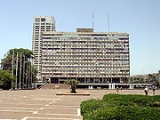
The square is surrounded by the city hall building to the north (designed by the architect Menachem Cohen), Ibn Gabirol Street
Ibn Gabirol Street
Ibn Gabirol Street is a major street in Tel Aviv, Israel.Ibn Gabirol Street is named after the medieval Hebrew poet and philosopher Solomon ibn Gabirol...
to the east, Frischmann Street to the south and Hen
Hayyim Nahman Bialik
Hayim Nahman Bialik , also Chaim or Haim, was a Jewish poet who wrote in Hebrew. Bialik was one of the pioneers of modern Hebrew poets and came to be recognized as Israel's national poet.-Biography:...
Boulevard to the west. It was designed alongside the city hall in 1964 by architects Yaski and Alexandroni.
History
Until the early 1990s, the square was used on Israel's Independence DayYom Ha'atzmaut
Yom Ha'atzmaut commemorates Israel's declaration of Independence in 1948. It is celebrated on 5 Iyar according to the Hebrew calendar. Yom Ha'atzmaut is preceded by Yom Hazikaron, the Israeli Fallen Soldiers and Victims of Terrorism Remembrance Day.-History:...
, as a public exhibition ground for IDF
Israel Defense Forces
The Israel Defense Forces , commonly known in Israel by the Hebrew acronym Tzahal , are the military forces of the State of Israel. They consist of the ground forces, air force and navy. It is the sole military wing of the Israeli security forces, and has no civilian jurisdiction within Israel...
field units (mostly armor and heavy artillery). The square has also been the site of many political rallies and demonstrations, including the September 1982 protest by 400,000 demonstrators against Israel's role in the Sabra and Shatila Massacre
Sabra and Shatila massacre
The Sabra and Shatila massacre took place in the Sabra and Shatila Palestinian refugee camps in Beirut, Lebanon between September 16 and September 18, 1982, during the Lebanese civil war. Palestinian and Lebanese civilians were massacred in the camps by Christian Lebanese Phalangists while the camp...
.
Prime Minister of Israel, Yitzhak Rabin, was assassinated at the conclusion of a peace rally at the site on November 4, 1995. In the days following the event, thousands of Israelis gathered at the square to commemorate Rabin. The young people who came to mourn Rabin were dubbed the "Candles Youth" after the many yahrzeit candle
Yahrzeit candle
A yahrzeit candle also spelled yahrtzeit candle or called a memorial candle is a type of candle that is lit in memory of the dead in Judaism....
s they lit. A segment of the graffiti
Graffiti
Graffiti is the name for images or lettering scratched, scrawled, painted or marked in any manner on property....
they drew upon the nearby walls has been preserved.
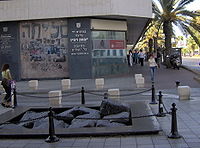
A memorial stands on the spot where Rabin was assassinated (at the northeast corner of the square, below City Hall). Part of the memorial is a small, open legacy wall for Rabin. Near the north end of the square is a memorial sculpture designed by Israeli artist Yigal Tumarkin
Yigal Tumarkin
Yigal Tumarkin is an Israeli painter and sculptor. He is also known as Igael Tumarkin.-Biography:...
commemorating the Holocaust
The Holocaust
The Holocaust , also known as the Shoah , was the genocide of approximately six million European Jews and millions of others during World War II, a programme of systematic state-sponsored murder by Nazi...
.
Renovation plans
In the late 1990s and early 2000s a great deal of criticism had been voiced about the Square's appearance, most directed at the City Hall building. What in the 1960s was one of the city's biggest and most impressive architectural designs came to be considered by critics as one of the city's worst eyesores. Plans have been made (most of which have even been approved) to renovate the whole square and City Hall. These include giving City Hall a more modern look to fit in with the many new skyscraperSkyscraper
A skyscraper is a tall, continuously habitable building of many stories, often designed for office and commercial use. There is no official definition or height above which a building may be classified as a skyscraper...
s in Tel Aviv, and the construction a large underground parking complex underneath the square to alleviate the lack of parking in the area. Opposition to the renovation plans mostly centers around arguments that the design of the square and City Hall are part of Tel Aviv's history and should be preserved. As a result of this opposition, reconstruction has been delayed.