


Operation Litani

Encyclopedia
The 1978 South Lebanon conflict (code-named Operation Litani by Israel) was an invasion in Lebanon
up to the Litani River
carried out by the Israel Defense Forces
in 1978. It was a military success for the Israeli Defense Forces, as PLO
forces were pushed north of the river. However, objections from the Lebanese government led to the creation of the UNIFIL
peacekeeping force and a partial Israel
i withdrawal.
, Operation Litani was grounded in the long-running Israeli-Palestinian conflict
. From 1968 on, the PLO, Popular Front for the Liberation of Palestine
, and other Palestinian
groups established a quasi-state in southern Lebanon, using it as a base for raids on civilian targets in northern Israel. This was exacerbated by an influx of 3,000 PLO militants fleeing a defeat in the Jordanian civil war
and regrouping in southern Lebanon. Israel responded with damaging attacks against PLO bases.
During Israeli raids from 1968 to 1977, some of the Palestinian towns and camps in the area were totally leveled. According to estimations, by October 1977 about 300.000 refugees, mainly Shiite Muslims, fled South Lebanon.
In November 1977 Israeli initiated exchange of fire, that led to the death of several people from both sides of the border and finally Israeli bombing of the targets in South Lebanon during which 70 people, mainly Lebanese, were killed.
Violence escalated, eventually culminating in the 1982 Lebanon War
and the ejection of the PLO from the country.
On 11 March 1978, 11 Fatah
members led by the 18-year old female Dalal Mughrabi
travelled from Lebanon and killed an American tourist on the beach. They then hijacked a bus on the coastal road near Haifa
, and en route to Tel Aviv
commandeered a second bus. After a lengthy chase and shootout, 37 Israelis were killed and 76 wounded. Thus, the Coastal Road Massacre
, was the proximate cause of the Israeli invasion three days later. (Cobban, p. 94, Shlaim p. 369), though the raiders came not from the area that was invaded, but from the area relatively far to the north from it.
The PLO-Israeli conflict increased political tensions between Maronite Christians and Druze
to the Muslim
s, adding to the factors behind the 1975–1990 Lebanese Civil War
.
, excepting Tyre, with over 25,000 soldiers. Its stated goals were to push Palestinian militant groups, particularly the PLO, away from the border with Israel, and to bolster Israel's ally at the time, the South Lebanon Army
because of the attacks against Lebanese Christians and Jews and because of the relentless shelling into Northern Israel. During the 7-day offensive, the Israeli Defence Forces first captured a belt of land approximately 10 kilometres deep, but later expanded north to the Litani river. 20 Israeli soldiers and 1,100–2,000 PLO fighters were killed . According to other source about 2000 Lebanese and Palestinian were killed and some 250,000 refugees fled the area.
The PLO retreated north of the Litani River, continuing to fire at the Israelis.
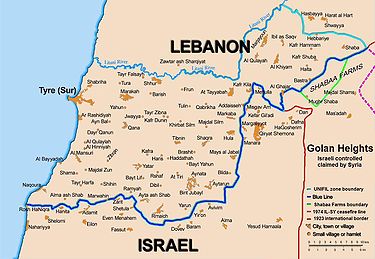 In response to the invasion, the UN Security Council passed Resolution 425 and Resolution 426 calling for the withdrawal of Israeli forces from Lebanon. The UN Interim Force in Lebanon (UNIFIL
) was created to enforce this mandate, and restore peace and sovereignty to Lebanon. UNIFIL forces arrived in Lebanon on 23 March 1978, setting up headquarters in Naqoura
.
Israeli forces withdrew later in 1978, turning over positions inside Lebanon to their ally, the South Lebanon Army
(SLA) militia under the leadership of Maj. Saad Haddad
. On 19 April 1978, the SLA shelled UNIFIL headquarters, killing 8 UN soldiers. (Fisk, 138). In April 1980, three
Irish UN soldiers Privates Barrett, Smallhorne and O'Mahoney were kidnapped and two of them murdered by Christian gunmen, Private O'Mahoney survived (being shot by sub-machine gun during the incident) in SLA territory and another Irish soldier Private S. Griffen was shot by Haddad's men, and was medivaced to Israel where he subsequently died during medical treatment. The Israeli press at the time, particularly the Jerusalem Post, accused the Irish of pro-PLO bias. (Fisk, 152–154). However, Palestinian factions also attacked UNIFIL, kidnapping an Irish UNIFIL soldier in 1981 and continuing to occupy areas in southern Lebanon.
Hostilities continued, and as the Lebanese civil war escalated, the fighting intensified in the south again, with a second Israeli invasion
in 1982 resulting in a 1982 flare-up that persisted over the next decade.
 In 2000, the UN Security Council
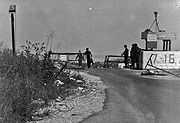
concluded that, as of 16 June 2000, Israel had withdrawn its forces from Lebanon in accordance with Resolution 425
.
Lebanon has not extended control over south Lebanon, though it was called on to do so by UN Resolution 1391 of 2002 and urged by UN Resolution 1496. Israel has lodged multiple complaints regarding Lebanon's conduct.
Lebanon's claim that Israel has not fully withdrawn (see Shebaa Farms
) was explicitly rejected by the UN's Secretary-General's report which led to UN Security Council Resolution 1583
. The Syrian occupation of Lebanon led to UN Security Council Resolution 1559 demanding the remaining 14,000 (of 50,000 originally) Syrian troop withdrawal and the dismantling of Hezbollah and Palestinian
militias. On April 26, 2005, after 29 years of Syrian military presence in Lebanon, the last of the Syrian troops withdrew in accordance with the resolution.
Lebanon
Lebanon , officially the Republic of LebanonRepublic of Lebanon is the most common term used by Lebanese government agencies. The term Lebanese Republic, a literal translation of the official Arabic and French names that is not used in today's world. Arabic is the most common language spoken among...
up to the Litani River
Litani River
The Litani River is an important water resource in southern Lebanon. The river rises in the fertile Beqaa Valley valley, west of Baalbek, and empties into the Mediterranean Sea north of Tyre. Exceeding 140 km in length, the Litani River is the longest river in Lebanon and provides an average...
carried out by the Israel Defense Forces
Israel Defense Forces
The Israel Defense Forces , commonly known in Israel by the Hebrew acronym Tzahal , are the military forces of the State of Israel. They consist of the ground forces, air force and navy. It is the sole military wing of the Israeli security forces, and has no civilian jurisdiction within Israel...
in 1978. It was a military success for the Israeli Defense Forces, as PLO
Palestine Liberation Organization
The Palestine Liberation Organization is a political and paramilitary organization which was created in 1964. It is recognized as the "sole legitimate representative of the Palestinian people" by the United Nations and over 100 states with which it holds diplomatic relations, and has enjoyed...
forces were pushed north of the river. However, objections from the Lebanese government led to the creation of the UNIFIL
United Nations Interim Force in Lebanon
The United Nations Interim Force in Lebanon, or UNIFIL, was created by the United Nations, with the adoption of Security Council Resolution 425 and 426 on 19 March 1978, to confirm Israeli withdrawal from Lebanon which Israel had invaded five days prior, restore international peace and security,...
peacekeeping force and a partial Israel
Israel
The State of Israel is a parliamentary republic located in the Middle East, along the eastern shore of the Mediterranean Sea...
i withdrawal.
Background
Though it took the form of an Israeli military incursion into Southern LebanonSouthern Lebanon
Southern Lebanon is the geographical area of Lebanon comprising the South Governorate and the Nabatiye Governorate. These two entities were divided from the same province in the early 1990s...
, Operation Litani was grounded in the long-running Israeli-Palestinian conflict
Israeli-Palestinian conflict
The Israeli–Palestinian conflict is the ongoing conflict between Israelis and Palestinians. The conflict is wide-ranging, and the term is also used in reference to the earlier phases of the same conflict, between Jewish and Zionist yishuv and the Arab population living in Palestine under Ottoman or...
. From 1968 on, the PLO, Popular Front for the Liberation of Palestine
Popular Front for the Liberation of Palestine
The Popular Front for the Liberation of Palestine is a Palestinian Marxist-Leninist organisation founded in 1967. It has consistently been the second-largest of the groups forming the Palestine Liberation Organization , the largest being Fatah...
, and other Palestinian
Palestinian people
The Palestinian people, also referred to as Palestinians or Palestinian Arabs , are an Arabic-speaking people with origins in Palestine. Despite various wars and exoduses, roughly one third of the world's Palestinian population continues to reside in the area encompassing the West Bank, the Gaza...
groups established a quasi-state in southern Lebanon, using it as a base for raids on civilian targets in northern Israel. This was exacerbated by an influx of 3,000 PLO militants fleeing a defeat in the Jordanian civil war
Black September in Jordan
September 1970 is known as the Black September in Arab history and sometimes is referred to as the "era of regrettable events." It was a month when Hashemite King Hussein of Jordan moved to quash the militancy of Palestinian organizations and restore his monarchy's rule over the country. The...
and regrouping in southern Lebanon. Israel responded with damaging attacks against PLO bases.
During Israeli raids from 1968 to 1977, some of the Palestinian towns and camps in the area were totally leveled. According to estimations, by October 1977 about 300.000 refugees, mainly Shiite Muslims, fled South Lebanon.
In November 1977 Israeli initiated exchange of fire, that led to the death of several people from both sides of the border and finally Israeli bombing of the targets in South Lebanon during which 70 people, mainly Lebanese, were killed.
Violence escalated, eventually culminating in the 1982 Lebanon War
1982 Lebanon War
The 1982 Lebanon War , , called Operation Peace for Galilee by Israel, and later known in Israel as the Lebanon War and First Lebanon War, began on 6 June 1982, when the Israel Defense Forces invaded southern Lebanon...
and the ejection of the PLO from the country.
On 11 March 1978, 11 Fatah
Fatah
Fataḥ is a major Palestinian political party and the largest faction of the Palestine Liberation Organization , a multi-party confederation. In Palestinian politics it is on the left-wing of the spectrum; it is mainly nationalist, although not predominantly socialist. Its official goals are found...
members led by the 18-year old female Dalal Mughrabi
Dalal Mughrabi
Dalal Mughrabi was a Palestinian militant who was a member of the Fatah faction of the Palestine Liberation Organization and directed the 1978 Coastal Road massacre in Israel. The attack resulted in the death of 37 Israeli citizens, including 13 children, and one American photographer. Mughrabi...
travelled from Lebanon and killed an American tourist on the beach. They then hijacked a bus on the coastal road near Haifa
Haifa
Haifa is the largest city in northern Israel, and the third-largest city in the country, with a population of over 268,000. Another 300,000 people live in towns directly adjacent to the city including the cities of the Krayot, as well as, Tirat Carmel, Daliyat al-Karmel and Nesher...
, and en route to Tel Aviv
Tel Aviv
Tel Aviv , officially Tel Aviv-Yafo , is the second most populous city in Israel, with a population of 404,400 on a land area of . The city is located on the Israeli Mediterranean coastline in west-central Israel. It is the largest and most populous city in the metropolitan area of Gush Dan, with...
commandeered a second bus. After a lengthy chase and shootout, 37 Israelis were killed and 76 wounded. Thus, the Coastal Road Massacre
Coastal Road massacre
The Coastal Road massacre of 1978 was an attack involving the hijacking of a bus on Israel's Coastal Highway in which 38 Israeli civilians, including 13 children, were killed, and 71 were wounded. The attack was planned by Abu Jihad and carried out by the PLO faction Fatah...
, was the proximate cause of the Israeli invasion three days later. (Cobban, p. 94, Shlaim p. 369), though the raiders came not from the area that was invaded, but from the area relatively far to the north from it.
The PLO-Israeli conflict increased political tensions between Maronite Christians and Druze
Druze
The Druze are an esoteric, monotheistic religious community, found primarily in Syria, Lebanon, Israel, and Jordan, which emerged during the 11th century from Ismailism. The Druze have an eclectic set of beliefs that incorporate several elements from Abrahamic religions, Gnosticism, Neoplatonism...
to the Muslim
Muslim
A Muslim, also spelled Moslem, is an adherent of Islam, a monotheistic, Abrahamic religion based on the Quran, which Muslims consider the verbatim word of God as revealed to prophet Muhammad. "Muslim" is the Arabic term for "submitter" .Muslims believe that God is one and incomparable...
s, adding to the factors behind the 1975–1990 Lebanese Civil War
Lebanese Civil War
The Lebanese Civil War was a multifaceted civil war in Lebanon. The war lasted from 1975 to 1990 and resulted in an estimated 150,000 to 230,000 civilian fatalities. Another one million people were wounded, and today approximately 350,000 people remain displaced. There was also a mass exodus of...
.
Course of fighting
On March 14, 1978, Israel launched Operation Litani, occupying the area south of the Litani RiverLitani River
The Litani River is an important water resource in southern Lebanon. The river rises in the fertile Beqaa Valley valley, west of Baalbek, and empties into the Mediterranean Sea north of Tyre. Exceeding 140 km in length, the Litani River is the longest river in Lebanon and provides an average...
, excepting Tyre, with over 25,000 soldiers. Its stated goals were to push Palestinian militant groups, particularly the PLO, away from the border with Israel, and to bolster Israel's ally at the time, the South Lebanon Army
South Lebanon Army
The South Lebanon Army , also "South Lebanese Army," was a Lebanese militia during the Lebanese Civil War. After 1979, the militia operated in southern Lebanon under the authority of Saad Haddad's Government of Free Lebanon...
because of the attacks against Lebanese Christians and Jews and because of the relentless shelling into Northern Israel. During the 7-day offensive, the Israeli Defence Forces first captured a belt of land approximately 10 kilometres deep, but later expanded north to the Litani river. 20 Israeli soldiers and 1,100–2,000 PLO fighters were killed . According to other source about 2000 Lebanese and Palestinian were killed and some 250,000 refugees fled the area.
The PLO retreated north of the Litani River, continuing to fire at the Israelis.
Outcome of the war
United Nations Interim Force in Lebanon
The United Nations Interim Force in Lebanon, or UNIFIL, was created by the United Nations, with the adoption of Security Council Resolution 425 and 426 on 19 March 1978, to confirm Israeli withdrawal from Lebanon which Israel had invaded five days prior, restore international peace and security,...
) was created to enforce this mandate, and restore peace and sovereignty to Lebanon. UNIFIL forces arrived in Lebanon on 23 March 1978, setting up headquarters in Naqoura
Naqoura
Naqoura is a small city in southern Lebanon. Since March 23, 1978 until present, the United Nations Interim Force in Lebanon has been headquartered in Naqoura....
.
Israeli forces withdrew later in 1978, turning over positions inside Lebanon to their ally, the South Lebanon Army
South Lebanon Army
The South Lebanon Army , also "South Lebanese Army," was a Lebanese militia during the Lebanese Civil War. After 1979, the militia operated in southern Lebanon under the authority of Saad Haddad's Government of Free Lebanon...
(SLA) militia under the leadership of Maj. Saad Haddad
Saad Haddad
Saad Haddad was the founder and head of the South Lebanon Army . Several sources have suggested Haddad's involvement in the Sabra and Shatila massacres in 1982.-Lebanese Civil War:...
. On 19 April 1978, the SLA shelled UNIFIL headquarters, killing 8 UN soldiers. (Fisk, 138). In April 1980, three
Irish UN soldiers Privates Barrett, Smallhorne and O'Mahoney were kidnapped and two of them murdered by Christian gunmen, Private O'Mahoney survived (being shot by sub-machine gun during the incident) in SLA territory and another Irish soldier Private S. Griffen was shot by Haddad's men, and was medivaced to Israel where he subsequently died during medical treatment. The Israeli press at the time, particularly the Jerusalem Post, accused the Irish of pro-PLO bias. (Fisk, 152–154). However, Palestinian factions also attacked UNIFIL, kidnapping an Irish UNIFIL soldier in 1981 and continuing to occupy areas in southern Lebanon.
Hostilities continued, and as the Lebanese civil war escalated, the fighting intensified in the south again, with a second Israeli invasion
1982 Lebanon War
The 1982 Lebanon War , , called Operation Peace for Galilee by Israel, and later known in Israel as the Lebanon War and First Lebanon War, began on 6 June 1982, when the Israel Defense Forces invaded southern Lebanon...
in 1982 resulting in a 1982 flare-up that persisted over the next decade.
Resolution 425
United Nations Security Council
The United Nations Security Council is one of the principal organs of the United Nations and is charged with the maintenance of international peace and security. Its powers, outlined in the United Nations Charter, include the establishment of peacekeeping operations, the establishment of...
concluded that, as of 16 June 2000, Israel had withdrawn its forces from Lebanon in accordance with Resolution 425
United Nations Security Council Resolution 425
United Nations Security Council Resolution 425, adopted on March 19, 1978, five days after the Israeli invasion of Lebanon, called on Israel to withdraw immediately its forces from Lebanon and established the United Nations Interim Force In Lebanon...
.
Lebanon has not extended control over south Lebanon, though it was called on to do so by UN Resolution 1391 of 2002 and urged by UN Resolution 1496. Israel has lodged multiple complaints regarding Lebanon's conduct.
Lebanon's claim that Israel has not fully withdrawn (see Shebaa Farms
Shebaa farms
The Shebaa Farms are a small uninhabited territory claimed by Lebanon, but occupied by Israel which claims they are in Syria's Golan Heights. Syrian policy is to vaguely accept the Lebanese claim, while refusing any binding demarcation until Israeli forces withdraw from the area.The United Nations...
) was explicitly rejected by the UN's Secretary-General's report which led to UN Security Council Resolution 1583
United Nations Security Council Resolution 1583
United Nations Security Council Resolution 1583, adopted unanimously on January 28, 2005, after recalling previous resolutions on Israel and Lebanon, including resolutions 425 , 426 and 1553 , the Council extended the mandate of the United Nations Interim Force in Lebanon for a further six...
. The Syrian occupation of Lebanon led to UN Security Council Resolution 1559 demanding the remaining 14,000 (of 50,000 originally) Syrian troop withdrawal and the dismantling of Hezbollah and Palestinian
Palestinian people
The Palestinian people, also referred to as Palestinians or Palestinian Arabs , are an Arabic-speaking people with origins in Palestine. Despite various wars and exoduses, roughly one third of the world's Palestinian population continues to reside in the area encompassing the West Bank, the Gaza...
militias. On April 26, 2005, after 29 years of Syrian military presence in Lebanon, the last of the Syrian troops withdrew in accordance with the resolution.
See also
- History of LebanonHistory of LebanonThis article deals with the history of Lebanon, and the nations previously occupying its territory.-Phoenicia:The coastal plain of Lebanon is the historic home of a string of coastal trading cities of Semitic culture, which the Greeks termed Phoenicia, whose maritime culture flourished there for...
- Lebanese Civil WarLebanese Civil WarThe Lebanese Civil War was a multifaceted civil war in Lebanon. The war lasted from 1975 to 1990 and resulted in an estimated 150,000 to 230,000 civilian fatalities. Another one million people were wounded, and today approximately 350,000 people remain displaced. There was also a mass exodus of...
- 1982 Lebanon War1982 Lebanon WarThe 1982 Lebanon War , , called Operation Peace for Galilee by Israel, and later known in Israel as the Lebanon War and First Lebanon War, began on 6 June 1982, when the Israel Defense Forces invaded southern Lebanon...
- Israel-Lebanon conflictIsrael-Lebanon conflictThe Israeli–Lebanese conflict describes a series of related military clashes involving Israel, Lebanon, and Syria, as well as various non-state militias acting from within Lebanon....
- Israeli casualties of war