

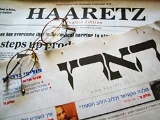
Haaretz

Encyclopedia
Haaretz (lit. "The Land", originally Ḥadashot Ha'aretz – , χadaˈʃot haˈʔaʁets – "News of the Land") is Israel
's oldest daily newspaper. It was founded in 1918 and is now published in both Hebrew
and English
in Berliner
format. The English edition is published and sold together with the International Herald Tribune
. Both Hebrew and English editions can be read on the Internet. In North America
, it comes out as a weekly newspaper
, combining articles from the Friday edition with a roundup from the rest of the week.
In 2008, the newspaper itself reported a paid subscribership of 65,000, daily sales of 72,000 copies, and 100,000 on weekends. The English edition has a subscriber base of 15,000. As of June 2011, Haaretz readership was 5.8% of the public, down from 6.4% the prior year.
Despite its relatively low circulation in Israel, Haaretz is considered Israel's most influential daily newspaper. Its readership includes Israel's intelligentsia and its political and economic elites. Surveys show that Haaretz readership has a higher-than-average education, income, and wealth; most are Ashkenazim
. Shmuel Rosner
, the newspaper's former U.S. correspondent, told The Nation
, "people who read it are better educated and more sophisticated than most, but the rest of the country doesn't know it exists."
The newspaper was initially published in Jerusalem. From 1919 to 1922, the paper was headed by a succession of editors, among them Leib Yaffe
. It was shut down briefly due to a budgetary shortfall and reopened in Tel Aviv at the beginning of 1923 under the editorship of Moshe Glickson, who held the post for 15 years. The Tel Aviv municipality granted the paper financial support by paying in advance for future advertisements.
Salman Schocken
, a wealthy German Jewish Zionist who owned a chain of department stores in Germany, bought the paper in 1937. His son, Gershom Schocken
, became the chief editor in 1939 and held that position until his death in 1990.
Until August 2006, the Schocken family owned 100% of the Haaretz Group, but then the German publisher M. DuMont Schauberg
acquired 25 percent of the shares. The deal was negotiated with the help of former Israeli ambassador to Germany
Avi Primor.
On 12 June 2011, it was announced that Russian-Israeli businessman Leonid Nevzlin
had purchased a 20% stake in the Haaretz Group, buying 15% from the family and 5% from M. DuMont Schauberg. This means that the Schocken family now owns 60% and M. DuMont Schauberg and Leonid Nevzlin have 20% each.
, who replaced Dov Alfon
in August 2011. Alfon's predecessor, David Landau
, succeeded Hanoch Marmari and Yoel Esteron
in April 2004. Charlotte Halle became editor of the English Print Edition in February 2008.
on domestic issues and international affairs. Other describe it alternatively as liberal, centre-left, left-wing
,
or even hard left, According to the BBC
it has a moderate stance on foreign policy and security issues. The newspaper's op-ed
pages are open to a variety of opinions.
J.J. Goldberg
, the editor of the American The Jewish Daily Forward, describes Haaretz as "Israel's most vehemently anti-settlement
daily paper". US weekly The Nation
describes Haaretz as "Israel's liberal beacon," citing its editorials voicing opposition to the occupation, the security barrier, discriminatory treatment of Arab citizens, and the mindset that led to the Second Lebanon War. Aijaz Ahmad
, writing in Frontline
, described Haaretz as "the most prestigious Israeli newspaper".
claimed that Haaretz fueled anti-Israel bias, but a 2003 study in The Harvard International Journal of Press/Politics found that Haaretz reporting was more favorable to Israelis than Palestinians, and more likely to report stories from the Israeli side. Many Israelis, however, feel that Haaretz isn't loyal enough: in 2002, Israeli author Irit Linur
canceled her subscription, accusing Haaretz of an anti-Zionist theme that turns too often to "foolish" and "wicked" journalism,– Translation: it is a person's right to be a radical leftist, and publish a newspaper in accordance to his world view... However "Haaretz" reached a stage where its anti-Zionism turns too frequently to foolish and wicked journalism. Original:
and in 2009, Roni Daniel, the military and security correspondent for Israeli Channel 2
also canceled his subscription, citing the use of a television review section to criticize his reporting.
According to its competitor The Jerusalem Post
, Haaretz editor-in-chief David Landau
said at the 2007 Limmud
conference in Moscow
that he had told his staff not to report about criminal investigations against Prime Minister Ariel Sharon
in order to promote Sharon's 2004–2005 Gaza disengagement plan
.
In March 2010, The Jerusalem Post reported that a pollster was unhappy with the way his poll results regarding Israeli views regarding President Obama were presented in the English edition of Haaretz, which he felt was "misleading", due to the fact that the Hebrew word "inyani" had been interpreted as "fair" instead of "businesslike". Also in 2010, several columnists at The Jerusalem Post, including deputy managing editor Caroline Glick
, criticized Haaretz for its role in the Anat Kamm affair.
Israel
The State of Israel is a parliamentary republic located in the Middle East, along the eastern shore of the Mediterranean Sea...
's oldest daily newspaper. It was founded in 1918 and is now published in both Hebrew
Hebrew language
Hebrew is a Semitic language of the Afroasiatic language family. Culturally, is it considered by Jews and other religious groups as the language of the Jewish people, though other Jewish languages had originated among diaspora Jews, and the Hebrew language is also used by non-Jewish groups, such...
and English
English language
English is a West Germanic language that arose in the Anglo-Saxon kingdoms of England and spread into what was to become south-east Scotland under the influence of the Anglian medieval kingdom of Northumbria...
in Berliner
Berliner (format)
Berliner, or "midi", is a newspaper format with pages normally measuring about . The Berliner format is slightly taller and marginally wider than the tabloid/compact format; and is both narrower and shorter than the broadsheet format....
format. The English edition is published and sold together with the International Herald Tribune
International Herald Tribune
The International Herald Tribune is a widely read English language international newspaper. It combines the resources of its own correspondents with those of The New York Times and is printed at 38 sites throughout the world, for sale in more than 160 countries and territories...
. Both Hebrew and English editions can be read on the Internet. In North America
North America
North America is a continent wholly within the Northern Hemisphere and almost wholly within the Western Hemisphere. It is also considered a northern subcontinent of the Americas...
, it comes out as a weekly newspaper
Weekly newspaper
A weekly newspaper is a general-news publication that is published on newsprint once or twice a week.Such newspapers tend to have smaller circulations than daily newspapers, and are usually based in less-populous communities or small, defined areas within large cities; often, they may cover a...
, combining articles from the Friday edition with a roundup from the rest of the week.
Overview
Compared to other mass circulation papers in Israel, Haaretz uses smaller headlines and print. Less space is devoted to pictures, and more to political analysis. Its editorial pages are considered influential among government leaders. Apart from the news, Haaretz publishes feature articles on social and environmental issues, as well as book reviews, investigative reporting and political commentary.In 2008, the newspaper itself reported a paid subscribership of 65,000, daily sales of 72,000 copies, and 100,000 on weekends. The English edition has a subscriber base of 15,000. As of June 2011, Haaretz readership was 5.8% of the public, down from 6.4% the prior year.
Despite its relatively low circulation in Israel, Haaretz is considered Israel's most influential daily newspaper. Its readership includes Israel's intelligentsia and its political and economic elites. Surveys show that Haaretz readership has a higher-than-average education, income, and wealth; most are Ashkenazim
Ashkenazi Jews
Ashkenazi Jews, also known as Ashkenazic Jews or Ashkenazim , are the Jews descended from the medieval Jewish communities along the Rhine in Germany from Alsace in the south to the Rhineland in the north. Ashkenaz is the medieval Hebrew name for this region and thus for Germany...
. Shmuel Rosner
Shmuel Rosner
Shmuel Rosner is an Israeli journalist and editor. He writes for the Jerusalem Post, Maariv and Slate magazine. In 2005-2008, he was chief United States correspondent for the daily newspaper Haaretz.- Journalism career :...
, the newspaper's former U.S. correspondent, told The Nation
The Nation
The Nation is the oldest continuously published weekly magazine in the United States. The periodical, devoted to politics and culture, is self-described as "the flagship of the left." Founded on July 6, 1865, It is published by The Nation Company, L.P., at 33 Irving Place, New York City.The Nation...
, "people who read it are better educated and more sophisticated than most, but the rest of the country doesn't know it exists."
History and ownership
Haaretz was first published in 1918 as a newspaper sponsored by the British military government in Palestine. In 1919 it was taken over by Russian Zionists. Initially, it was called Hadashot Ha'aretz ("News of the Land"). Later, the name was shortened to "Ha'aretz". The literary section of the paper attracted the leading Hebrew writers of the time.The newspaper was initially published in Jerusalem. From 1919 to 1922, the paper was headed by a succession of editors, among them Leib Yaffe
Leib Yaffe
Leib Yaffe was a Hebrew poet, journalist and editor of Haaretz newspaper.Leib Yaffe was born in Grodno, Belarus. A lifelong champion of the Zionist cause, he immigrated to Palestine, where he became chief editor of Haaretz...
. It was shut down briefly due to a budgetary shortfall and reopened in Tel Aviv at the beginning of 1923 under the editorship of Moshe Glickson, who held the post for 15 years. The Tel Aviv municipality granted the paper financial support by paying in advance for future advertisements.
Salman Schocken
Salman Schocken
Salman Schocken was a German Jewish publisher and businessman.Salman Schocken was the son of Jewish shopkeeper in Posen....
, a wealthy German Jewish Zionist who owned a chain of department stores in Germany, bought the paper in 1937. His son, Gershom Schocken
Gershom Schocken
Gershom Gustav Schocken was an Israeli journalist and politician who was editor of Haaretz for more than 50 years and a member of the Knesset for the Progressive Party between 1955 and 1959.-Biography:...
, became the chief editor in 1939 and held that position until his death in 1990.
Until August 2006, the Schocken family owned 100% of the Haaretz Group, but then the German publisher M. DuMont Schauberg
M. DuMont Schauberg
M. DuMont Schauberg is one of Germany's oldest and largest publishing houses. Founded by Bertram Hilden in 1620, Marcus du Mont acquired the "Kölnische Zeitung" in 1805 - then the business's main newspaper...
acquired 25 percent of the shares. The deal was negotiated with the help of former Israeli ambassador to Germany
Germany
Germany , officially the Federal Republic of Germany , is a federal parliamentary republic in Europe. The country consists of 16 states while the capital and largest city is Berlin. Germany covers an area of 357,021 km2 and has a largely temperate seasonal climate...
Avi Primor.
On 12 June 2011, it was announced that Russian-Israeli businessman Leonid Nevzlin
Leonid Nevzlin
Leonid Borisovich Nevzlin is a Russian-Israeli businessman. Nevzlin was a high ranking executive at Yukos, once a Russian oil firm before it was extinguished by the Russian government. That government is requesting his extradition due to hotly disputed criminal allegations against him and other...
had purchased a 20% stake in the Haaretz Group, buying 15% from the family and 5% from M. DuMont Schauberg. This means that the Schocken family now owns 60% and M. DuMont Schauberg and Leonid Nevzlin have 20% each.
Management
The newspaper's editorial policy was defined by Gershom Schocken, who was editor-in-chief from 1939 to 1990. The current editor-in-chief of the newspaper is Aluf BennAluf Benn
Aluf Benn is an Israeli journalist, author and editor-in-chief of the liberal Israeli national daily Haaretz.Born in Ramat HaSharon in 1965 he was originally named Aluf Bomstein, son of Atida and 2010 Israel Prize poet laureate Aryeh Bomstein...
, who replaced Dov Alfon
Dov Alfon
'Dov Alfon' is a French-Israeli journalist and editor. From 2008 to 2011, he was editor in chief of Haaretz, the oldest newspaper in Hebrew and one of the most respected newspapers in the world. Before that he was the chief editor of Kinneret Zmora-Bitan Dvir, the biggest literary publishing...
in August 2011. Alfon's predecessor, David Landau
David Landau (journalist)
David Landau is a London-born Israeli journalist and newspaper editor. Landau was editor-in-chief of the Israeli newspaper Haaretz from 2004 to 2008. He was the founder and editor-in-chief of the paper's English edition from 1997 to 2004...
, succeeded Hanoch Marmari and Yoel Esteron
Yoel Esteron
Yoel Esteron is an Israeli journalist. He is the founder and publisher of Calcalist, a business newspaper and media group owned by Yedioth Ahronoth.-Biography:...
in April 2004. Charlotte Halle became editor of the English Print Edition in February 2008.
Editorial policy and viewpoints
Haaretz describes itself as broadly liberalLiberalism
Liberalism is the belief in the importance of liberty and equal rights. Liberals espouse a wide array of views depending on their understanding of these principles, but generally, liberals support ideas such as constitutionalism, liberal democracy, free and fair elections, human rights,...
on domestic issues and international affairs. Other describe it alternatively as liberal, centre-left, left-wing
Left-wing politics
In politics, Left, left-wing and leftist generally refer to support for social change to create a more egalitarian society...
,
or even hard left, According to the BBC
BBC
The British Broadcasting Corporation is a British public service broadcaster. Its headquarters is at Broadcasting House in the City of Westminster, London. It is the largest broadcaster in the world, with about 23,000 staff...
it has a moderate stance on foreign policy and security issues. The newspaper's op-ed
Op-ed
An op-ed, abbreviated from opposite the editorial page , is a newspaper article that expresses the opinions of a named writer who is usually unaffiliated with the newspaper's editorial board...
pages are open to a variety of opinions.
J.J. Goldberg
J.J. Goldberg
J. J. Goldberg is Editor-at-Large of the newspaper The Forward, where he served as editor in chief for seven years . He served in the past as U.S...
, the editor of the American The Jewish Daily Forward, describes Haaretz as "Israel's most vehemently anti-settlement
Israeli settlement
An Israeli settlement is a Jewish civilian community built on land that was captured by Israel from Jordan, Egypt, and Syria during the 1967 Six-Day War and is considered occupied territory by the international community. Such settlements currently exist in the West Bank...
daily paper". US weekly The Nation
The Nation
The Nation is the oldest continuously published weekly magazine in the United States. The periodical, devoted to politics and culture, is self-described as "the flagship of the left." Founded on July 6, 1865, It is published by The Nation Company, L.P., at 33 Irving Place, New York City.The Nation...
describes Haaretz as "Israel's liberal beacon," citing its editorials voicing opposition to the occupation, the security barrier, discriminatory treatment of Arab citizens, and the mindset that led to the Second Lebanon War. Aijaz Ahmad
Aijaz Ahmad
Aijaz Ahmad is a well-known Marxist literary theorist and political commentator based in India.Born in the state of Uttar Pradesh, India just before it gained independence from British rule, Aijaz Ahmad along with his parents migrated to Pakistan following partition. After his education he worked...
, writing in Frontline
Frontline (magazine)
Frontline is a fortnightly English language magazine published by The Hindu Group of publications from Chennai, India. Narasimhan Ram is the editor-in-chief of the magazine. As a current affairs magazine, it covers domestic and International news. Frontline gives a prominent place to various...
, described Haaretz as "the most prestigious Israeli newspaper".
Criticism
In 2001, the pro-Israel media-monitoring and advocacy group CAMERACommittee for Accuracy in Middle East Reporting in America
The Committee for Accuracy in Middle East Reporting in America is an American non-profit pro-Israel media watchdog group. The group says it was founded in 1982 "to respond to the Washington Post's coverage of Israel's Lebanon incursion", and to respond to what it considers the media's "general...
claimed that Haaretz fueled anti-Israel bias, but a 2003 study in The Harvard International Journal of Press/Politics found that Haaretz reporting was more favorable to Israelis than Palestinians, and more likely to report stories from the Israeli side. Many Israelis, however, feel that Haaretz isn't loyal enough: in 2002, Israeli author Irit Linur
Irit Linur
-Biography:Irit Linur was married to Alon Ben David, Senior Defense Correspondent for Israel Channel 10 and Middle East Correspondent for Jane's Defense Weekly.-Literary career:Linur started her writing career as a satirical columnist in local newspapers...
canceled her subscription, accusing Haaretz of an anti-Zionist theme that turns too often to "foolish" and "wicked" journalism,– Translation: it is a person's right to be a radical leftist, and publish a newspaper in accordance to his world view... However "Haaretz" reached a stage where its anti-Zionism turns too frequently to foolish and wicked journalism. Original:
and in 2009, Roni Daniel, the military and security correspondent for Israeli Channel 2
Channel 2 (Israel)
Channel 2 is an Israeli commercial television channel.- History :In 1990, after 13 years of deliberations, the Knesset passed a law that paved the way for the establishment of commercial television in Israel. The goal was to enhance pluralism and create competition. Channel 2 began broadcasting on...
also canceled his subscription, citing the use of a television review section to criticize his reporting.
According to its competitor The Jerusalem Post
The Jerusalem Post
The Jerusalem Post is an Israeli daily English-language broadsheet newspaper, founded on December 1, 1932 by Gershon Agron as The Palestine Post. The daily readership numbers do not approach those of the major Hebrew newspapers....
, Haaretz editor-in-chief David Landau
David Landau (journalist)
David Landau is a London-born Israeli journalist and newspaper editor. Landau was editor-in-chief of the Israeli newspaper Haaretz from 2004 to 2008. He was the founder and editor-in-chief of the paper's English edition from 1997 to 2004...
said at the 2007 Limmud
Limmud
Limmud is a British-Jewish educational charity which produces a large annual winter conference and several other events around the year on the theme of Jewish learning...
conference in Moscow
Moscow
Moscow is the capital, the most populous city, and the most populous federal subject of Russia. The city is a major political, economic, cultural, scientific, religious, financial, educational, and transportation centre of Russia and the continent...
that he had told his staff not to report about criminal investigations against Prime Minister Ariel Sharon
Ariel Sharon
Ariel Sharon is an Israeli statesman and retired general, who served as Israel’s 11th Prime Minister. He has been in a permanent vegetative state since suffering a stroke on 4 January 2006....
in order to promote Sharon's 2004–2005 Gaza disengagement plan
Israel's unilateral disengagement plan
Israel's unilateral disengagement plan , also known as the "Disengagement plan", "Gaza expulsion plan", and "Hitnatkut", was a proposal by Israeli Prime Minister Ariel Sharon, adopted by the government on June 6, 2004 and enacted in August 2005, to evict all Israelis from the Gaza Strip and from...
.
In March 2010, The Jerusalem Post reported that a pollster was unhappy with the way his poll results regarding Israeli views regarding President Obama were presented in the English edition of Haaretz, which he felt was "misleading", due to the fact that the Hebrew word "inyani" had been interpreted as "fair" instead of "businesslike". Also in 2010, several columnists at The Jerusalem Post, including deputy managing editor Caroline Glick
Caroline Glick
Caroline Glick is an American-Israeli journalist for Makor Rishon and is the deputy managing editor of The Jerusalem Post. She is also the Senior Fellow for Middle East Affairs of the Washington, D.C.-based Center for Security Policy.-Life:...
, criticized Haaretz for its role in the Anat Kamm affair.
Internet editions
Haaretz operates both Hebrew and English language websites. The two sites offer up-to-the-minute breaking news, live Q&A sessions with newsmakers from Israel, Palestinian territories and around the world, and blogs covering a range of political standpoints and opinions. The English online edition receives an average of two million visitors per month. Both websites have blogs and are open to readers' comments. The two sites fall under the supervision of Lior Kodner, the head of digital media for the Haaretz Group. Individually, Sara Miller is the editor of Haaretz.com (English) and Avi Scharf is the editor of Haaretz.co.il (Hebrew).Internet blogs and columns
- In September 2009, Haaretz.com launched a blog by Tel Aviv University Professor Carlo Strenger, named 'Strenger than Fiction'
- Focus U.S.A. – Blog by U.S. correspondent Natasha Mozgovaya who replaced Shmuel Rosner as U.S. correspondent in August 2008. Rosner's blog was 'Rosner's Domain' and explored Israeli, American Jewish and Zionist issues in the United States.
- 'A Special Place in Hell' is Bradley Burston's award-winning twice-weekly blog on Haaretz.com.
- Israeli President Shimon PeresShimon PeresGCMG is the ninth President of the State of Israel. Peres served twice as the eighth Prime Minister of Israel and once as Interim Prime Minister, and has been a member of 12 cabinets in a political career spanning over 66 years...
formerly blogged exclusively for Haaretz.com.
Offices
The Haaretz building, a low-slung building in south Tel Aviv, is situated on a street named for the Schocken family. The Haaretz building houses the art collection of Amos Schocken, one of the country's major collectors of Israeli art, some of it politically subversive.Present
- Aluf BennAluf BennAluf Benn is an Israeli journalist, author and editor-in-chief of the liberal Israeli national daily Haaretz.Born in Ramat HaSharon in 1965 he was originally named Aluf Bomstein, son of Atida and 2010 Israel Prize poet laureate Aryeh Bomstein...
– editor-in-chief - Ruth AlmogRuth Almog-Life:Almog was born 15 May 1936 in Petah Tikva, Israel to parents who immigrated from Hamburg in 1933. She studied at David Yellin Teachers College, and at Tel Aviv University...
– literature, publicist - Noam Ben Ze'ev – music critic
- Meron BenvenistiMeron BenvenistiMeron Benvenisti is an Israeli political scientist who was Deputy Mayor of Jerusalem under Teddy Kollek from 1971 to 1978, during which he administered East Jerusalem and served as Jerusalem's Chief Planning Officer. He is a medieval scholar and published books and maps on the Crusader period in...
– political columnist - Bradley BurstonBradley BurstonBradley Burston is an American-born Israeli journalist, a columnist for Haaretz, and Senior Editor of Haaretz.com, which publishes his blog, "A Special Place in Hell"....
– political columnist - Akiva EldarAkiva EldarAkiva Eldar is an Israeli journalist and author, currently a chief political columnist and editorial writer for the liberal Israeli national daily Ha'aretz. His columns also appear regularly in the Ha'aretz-International Herald Tribune edition, as well as in the Japanese daily Mainichi Shimbun...
– diplomatic affairs analyst - Lily Galili
- Doram Gaunt – food columnist
- Avirama Golan
- Michael Handelzalts – theater critic, columnist
- Amos Harel – military correspondent
- Amira HassAmira HassAmira Hass is a prominent left-wing Israeli journalist and author, mostly known for her columns in the daily newspaper Ha'aretz. She is particularly recognized for her reporting on Palestinian affairs in the West Bank and Gaza, where she has also lived for a number of years.-Life:The daughter of...
– Ramallah-based Palestinian affairs correspondent.
- Avi Issacharoff – military correspondent
- Sayed KashuaSayed KashuaSayed Kashua is an Israeli Arab author and journalist born in Tira, Israel, known for his books and humoristic columns in Hebrew.-Biography:...
– satiric columnist, author - Uri Klein – film critic
- Yitzhak LaorYitzhak LaorYitzhak Laor, is an Israeli poet, author and journalist. He is the author of . He is mostly known for his poetry of political protest, particularly about the Lebanese War of 1982 and the Israeli occupation of the Palestinian territories...
– publicist - Alex LevacAlex LevacAlex Levac is an Israeli photojournalist and street photographer. He won the Israel Prize for photography in 2005.-Biography:Alex Levac was born in Tel Aviv in 1944...
– photo columnist - Gideon Levy – Palestinian affairs columnist
- Yoel Marcus – political commentator, publicist
- Yossi MelmanYossi MelmanYossi Melman is an Israeli writer and journalist.Yossi Melman graduated from Hebrew University of Jerusalem and was a Nieman Fellow at Harvard University...
– intelligence - Amir Oren – military affairs
- Tsafrir Rinat – environmental issues
- Daniel Rogov – food and wine critic
- Doron Rosenblum – satirist, publicist
- Natasha MozgovayaNatasha MozgovayaNatasha Mozgovaya is an Israeli journalist, currently Chief US Correspondent for the national daily newspaper Haaretz.-Background:...
– U.S. correspondent - Yossi SaridYossi SaridYossi Sarid is a left-wing Israeli news commentator and former politician. He served as a member of the Knesset for the Alignment, Ratz and Meretz between 1974 and 2006...
– retired politician, publicist - Tom SegevTom SegevTom Segev is an Israeli historian, author and journalist. He is associated with Israel's so-called New Historians, a group challenging many of the country's traditional narratives.-Early life:Segev was born in Jerusalem in 1945...
– historian, political commentator - Ari Shavit – political columnist
- Yair Sheleg – Jewish religious affairs
- Nehemia Shtrasler – economic affairs, publicist
- Simon Spungin – Deputy Editor, English Edition
- Ze'ev Sternhell – political commentary
- Yossi Verter – political reporter
- Esther Zandberg – architecture
- Benny ZifferBenny ZifferBenny Ziffer is an Israeli author and journalist.-Life and career:Ziffer was born in Tel Aviv. His parents, Heinz and Nira , immigrated to Israel from Turkey in 1949. Ziffer studied French literature and political science. He is married to Irit, and they have three children...
– literature, publicist
Past
- Natan Alterman
- Ehud Asheri
- Yoram Bronowski – literary critic, TV critic
- Arie Caspi
- Amos ElonAmos Elon-Biography:Amos Elon was born in Vienna. He immigrated to Mandate Palestine in 1933. He studied law and history in Israel and England. He was married to Beth Elon, a New York-born literary agent, with whom he had one daughter, Danae. In the 1990s, Elon began to spend much of his time in Italy...
– correspondent, editor, writer - Boaz EvronBoaz EvronBoaz Evron is a left-wing Israeli journalist and critic. Evron was born in Jerusalem and attended Herzliya Hebrew High School and Hebrew University. Evron's family had lived in Palestine since the early nineteenth century; he is the great-grandson of Yoel Moshe Salomon, one of the founders of...
- Jerrold KesselJerrold KesselYoram Jerrold Kessel was a South African-born Israeli journalist, sports journalist, author and foreign correspondent. Kessel, a former news editor for the Jerusalem Post, reported on the Middle East for CNN from its Jerusalem bureau from 1990 to 2003, when he became recognizable to viewers for...
- Tami Litani
- Ran Reznick – health issues
- Danny RubinsteinDanny RubinsteinDaniel "Danny" Rubinstein is an Israeli journalist and author. He previously worked for Haaretz, where he was an Arab affairs analyst and a member of the editorial board.-Biography:...
– Former Arab affairs analyst - Gideon Samet – political commentator
- Ze'ev SchiffZe'ev SchiffZe'ev Schiff was an Israeli journalist and military correspondent for Ha'aretz....
– military and defense analyst
- Daniel Ben Simon
- Ruth Sinai – social welfare and humanitarian issues
- Gidi AviviGidi AviviGidi Avivi is an Israeli film producer, the founder of Vice Versa Films and a film festival director.-Education and Career:Avivi holds a Master's degree in Cinema Studies from New York University and a Bachelor of Fine Arts degree in Film and Television from Tel Aviv University.Avivi was Head of...
– popular music critic - Ze'ev SegalZe'ev SegalZe'ev Segal was an Israeli lawyer, a professor of law at Tel Aviv University and a legal analyst for the newspaper Haaretz.- Biography :...
– law
Supplements and special features (print edition)
- All week
- News, op-eds, political commentary
- Gallery (Culture, entertainment, television and radio listings)
- TheMarkerTheMarkerTheMarker is the name of three different Hebrew language offerings from Haaretz Group:* Daily economic newspaper distributed as a supplement of Haaretz and standalone* Economic website TheMarker.com* Monthly TheMarker Magazine-History:...
business supplement - Sudoku puzzle
- Friday
- Extended news coverage
- Musaf Haaretz weekend magazine
- Culture and literature
- Real estate
- Local news
- Sunday
- Sports (extended)
- Wednesday
- Musaf Hasfarim book supplement
Further reading
- Problems at Israel's Haaretz: Newspaper Without a Country by Christoph Schult, Der SpiegelDer SpiegelDer Spiegel is a German weekly news magazine published in Hamburg. It is one of Europe's largest publications of its kind, with a weekly circulation of more than one million.-Overview:...
, December 31, 2008. - The Dissenters - Haaretz prides itself on being the conscience of Israel. Does it have a future? by David Reminick, The New YorkerThe New YorkerThe New Yorker is an American magazine of reportage, commentary, criticism, essays, fiction, satire, cartoons and poetry published by Condé Nast...
, February 28, 2011