

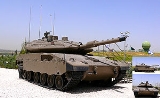
Merkava

Encyclopedia
The Merkava is a main battle tank
used by the Israel Defense Forces
. The tank began development in 1974 and was first introduced in 1978. Four main versions of the tank have been deployed. It was first used extensively in the 1982 Lebanon War
. The "Merkava" name was derived from the IDF's initial development program name.
It is designed for rapid repair of battle damage, battlefield survivability, cost-effectiveness and off-road performance. Following the model of contemporary self-propelled howitzers, the turret assembly is located nearer the rear than in most main battle tanks. This gives additional protection against a frontal attack. This arrangement also creates more space in the rear of the tank that allows increased storage capacity, as well as a rear entrance to the main crew compartment allowing easy access under enemy fire. This allows the tank to be used as a platform for medical disembarkation, a forward command and control station, and an armored personnel carrier. The rear entrance's clamshell-style doors provide overhead protection when off- and on-loading cargo and personnel.
It was reportedly decided shortly before the beginning of the 2006 Lebanon War that the Merkava line would be discontinued within four years. However, on 7 November 2006, Haaretz
reported that an Israeli General Staff assessment had ruled of the Merkava Mark IV that "if properly deployed, the tank can provide its crew with better protection than in the past," and deferred the decision on discontinuing the line.
In 1965, Israel's military establishment began research and development on a domestically-produced tank, the "Sabra" (not to be confused with the modern Sabra tank
). Initially, Britain and Israel collaborated to develop the United Kingdom's Chieftain tank
that had entered British Army
service in 1966. However, in 1969, Britain decided not to sell the tank to Israel for political reasons.
Israel Tal
, who was serving as a brigade commander after the Suez Crisis
, restarted plans to produce an Israeli-made tank, drawing on lessons from the 1973 Yom Kippur War
, in which Israeli forces were outnumbered by those of the Middle East's
Arab nations.
By 1974, initial designs were completed and prototypes were built. After a brief set of trials, work began to retool the Tel HaShomer
ordnance depot for full-time development and construction. After the new facilities were completed, the Merkava was announced to the public in the International Defense Review periodical. The first official images of the tank were then released to the American periodical Armed Forces Journal
on May 14, 1977. The IDF did not officially adopt the tank until December 1978, when the first full battalion
of 30 tanks was delivered for initial unit training.
(IMI). The Israeli Ordnance Corps
are responsible for final Merkava assembly. Israeli-owned and -operated contributors to the vehicle are:
The latest Merkava MK4 tanks rolling out of the assembly line now include the Trophy active protection system as standard feature.
gun, as well as the Mark II. However, the Mark III, Mark III Dor Dalet BAZ kassag, and the Mark IV are all armed with an IMI 120 mm smoothbore gun
.
Each model of the Merkava has two 7.62 machine gun
s for anti-infantry defense. Another unique feature, present in every model of the Merkava, is the 60 mm mortar
that can be loaded and fired internally.
turbocharged diesel engine was designed by MTU
and is manufactured under license by L-3 Communication Combat Propulsion Systems
(formerly General Dynamics). The Mark IV's top road speed is 64 km/h.
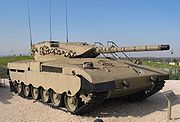 The Mark I, operational since 1978, is the original design created as a result of Israel Tal's decision, and was fabricated and designed for mass production
.
The Mark I weighed 63 tonnes and had a 900 hp diesel engine, with a power-to-weight ratio of 14 hp/ton. It was armed with the 105 millimeter M68 main gun (a licensed copy of the British Royal Ordnance L7
), two 7.62 mm machine guns
for anti-infantry defense, and a 60 mm mortar
mounted externally, with its operator not completely protected by the tank's hull.
The general design borrows the tracks from the British Centurion tank
, which had seen extensive use during the Yom Kippur war.
The Merkava was first used in combat during the 1982 Lebanon War
where Israel deployed 180 units. After the war many adjustments and additions were noted and designed, the most important being that the 60 mm mortar needed to be installed within the hull and engineered for remote firing—a valuable feature the Israelis had initially encountered on their Centurion Mk3s
with their 2" mortar MkIII
. A shot trap was found beneath the rear of the turret bustle where a well-placed shot could jam the turret completely. Installation of chain netting to disperse and destroy rocket propelled grenade
s and anti-tank rocket
s before impacting the primary armor increased survivability.
and low intensity conflict
s, with a weight and engine no greater than the Mark I.
The Mark II used the same 105 millimeter main gun and 7.62 millimeter machine guns as the Mark I, but the 60 millimeter mortar was redesigned during construction to be located within the hull and configured for remote firing to remove the need to expose the operator to enemy small-arms fire. An Israeli-designed automatic transmission and increased fuel storage for increased range was installed on all further Mark IIs. Anti-rocket netting was fitted for increased survivability against infantry equipped with anti-tank rockets. Many minor improvements were made to the fire-control system
. Updated meteorological sensors
, crosswind
analyzers, and thermographic
optics and image intensifier
s gave greater visibility and battlefield awareness.
Incrementally improved versions of the original Mark II were designated:
. This gun and a larger 1200 hp diesel engine increased the total weight of the tank to 65 tonne, but the larger engine increased the maximum cruising speed to 60 km/h (37.3 mph).
The turret was re-engineered for movement independent of the tank chassis
, allowing it to track a target regardless of the tank's movement. Many other improvements were made, including:
Tank rounds are stored in individual fire-proof canisters, which reduce the chance of cookoffs in a fire inside the tank. The turret is "dry"; no active rounds are stored in it.
Some features, such as hull shaping, exterior non-reflective paints, and shielding for engine heat plumes mixing with air particles to confuse enemy thermal imagers, were carried over from the IAI Lavi
program of the Israeli Air Force
to make the tank harder to spot by heat sensors and radar.
The Mark IV includes the larger 120 mm main gun of the previous versions but can fire a wider variety of ammunition, including HEAT and sabot
rounds like the APFSDS kinetic energy penetrator
, using an electrical semi-automatic revolving magazine for 10 rounds. It also includes a much larger 12.7 mm machine gun for anti-vehicle operations (most commonly used against technicals
).
s such as the French Gazelle
and the ubiquitous Russian Mil Mi-24
, both used by Israel's neighbors.
system, called "Mazkom" by troops. This system is designed to endure the harsh basalt rock conditions of Lebanon and the Golan Heights with minimal "track-shedding".
BMS (Battle Management System; Hebrew: צי"ד), a centralised system that from tracked units and UAV
s in theater, displays it on color screens, and distributes it in encrypted form to all other units equipped with BMS in a given theater.
. The tank outperformed Syrian tanks (mostly T-62s) and proved largely immune to anti-tank weapons of the time (the AT-3 Sagger and RPG-7
) that were used against it. It was judged to be a significant improvement over Israel's most effective main battle tank of the time, the Centurion tank
.
In February 2002 a Merkava III was destroyed by roadside bomb near Netzarim
settlement in the Gaza Strip. The tank was lured into intervening in an attack on a settler convoy. When the tank went over a heavy mine it was detonated and the tank was totally destroyed. Four soldiers were killed in the blast. This was the first heavy tank to be destroyed during the Second Intifada. A second Israeli tank, Merkava II or probably a Merkava III, was destroyed a month later in the same area and a further three soldiers were killed. A third Merkava II or III tank was destroyed near the Kissufim Crossing, when one soldier was killed and two wounded.
A fourth Merkava III tank was destroyed in February 2003 when it drove over a mine near the Jewish settlement of Dugit
. Four crewmen were killed in the blast.
On the 25th June 2006, an armed squad of Palestinians militants from the Gaza Strip
crossed the border into Israel via a 300-meter-long underground tunnel they dug near the Kerem Shalom
border crossing. One group of militants blasted the rear door of a Merkava III tank open with an RPG
shell and the tank went up in flames. The tank commander and the driver were killed when they evacuated the burning tank. The tank’s gunner, Gilad Shalit
, was lightly wounded and taken prisoner by the militants. A fourth member on the tank crew was injured in the incident.
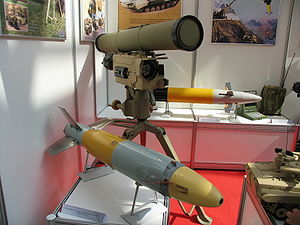 Many of Israel's casualties in the 2006 Lebanon War were Merkava tank crews. Only the minority of the tanks used during the war were Merkava Mark IVs, as by 2006 they had still only entered service in limited numbers. Hezbollah antitank missiles penetrated the armor in five Merkava Mark IV tanks killing 10. The penetrations were caused by tandem warhead missiles. Hezbollah weaponry was believed to include advanced Russia
n RPG-29 'Vampir'
, AT-5 'Konkurs'
, AT-13 'Metis-M', and laser-guided AT-14 'Kornet'
HEAT missiles. The IDF
reported finding the state-of-the-art Kornet ATGMs on Hezbollah positions in the village of Ghandouriyeh. Several months after the cease-fire, reports have provided detailed photographic evidence that Kornet ATGMs were indeed both in possession of, and used by, Hezbollah in this area. Another Merkava IV tank crewman was killed when a tank ran over an improvised explosive device
(IED). This tank had additional V-shaped underside armor, limiting casualties to just one of the seven personnel (four crewmen and three infantrymen) onboard. In total, 50 Merkava tanks (predominantly Merkava IIs and IIIs) were damaged, eight of which remained serviceable on the battlefield. Two Merkava Mark IVs were damaged beyond repair, one by powerful IEDs, and another, it is believed, by Russian AT-14 'Kornet' missiles. All but two Merkava Mark IV tanks damaged during the war were repaired and returned to the IDF. The Israeli military said that it was satisfied with the Merkava Mark IV's performance, and attributed problems to insufficient training before the war.
After the 2006 war, and as the IDF becomes increasingly involved in unconventional and guerrilla warfare
, some analysts say the Merkava is too vulnerable to advanced anti-tank missiles, that in their man-portable types can be fielded by guerilla warfare opponents. Other post-war analysts, including David Eshel, disagree, arguing that reports of losses to Merkavas were overstated and that "summing up the performance of Merkava tanks, especially the latest version Merkava Mark IV, most tank crews agree that, in spite of the losses sustained and some major flaws in tactical conduct, the tank proved its mettle in its first high-saturation combat." On a comparison done by the armor corps newsletter it was shown that the average number of crewmen killed per tank penetrated was reduced from 2 during the Yom Kippur War
to 1.5 during the 1982 Lebanon War
to 1 during the 2006 Lebanon War proving how, even in the face of the improvement in anti-tank weaponry, the Merkava Mark IV provides better protection to its crew (although only a limited number of the Israeli tanks used in 2006 were Merkava Mark IVs). The IDF wanted to increase orders of new Merkava Mark IV tanks, and planned to add the Trophy active protection system
to Merkava Mark IV tanks, and to increase joint training between crews and Israeli antitank
soldiers.
The Merkava IV was used more extensively during the Gaza War, as it had been received by the IDF in increasing numbers since 2006, replacing more of the Merkava II and III versions of the tank which were in service. One brigade of Merkava IVs managed to bisect the Gaza strip in five hours without casualties. The commander of the brigade stated that battlefield tactics had been greatly revised since 2006, with the IDF increasing its focus on aggressiveness, concentrated firepower, combining air and ground attacks, and the use of blitzkrieg maneuvers. Tactics had also been modified to focus on asymmetric or guerilla war threats, in addition to the conventional war scenarios that the Merkava had primarily been designed to combat. By October 2010, the IDF had begun to equip the first Merkava IVs with the Trophy active protection system, to improve the tanks' protection against advanced anti-tank missiles which use tandem-charge
HEAT
warheads. Added protection systems included an Elbit laser-warning system and IMI in-built smoke-screen grenades.
In December 2010, Hamas in Gaza fired an AT-14 Kornet anti-tank missile at a Merkava Mark III tank stationed on the Israel-Gaza border near Al-Bureij. It had hitherto not been suspected that Hamas possessed such a sophisticated missile. The missile penetrated the tank's armour, but in this instance caused no injuries among its crew. As a result of the attack, Israel decided to deploy, along the Gaza border, its first Merkava Mark IV battalion equipped with the Trophy active protection system.
On 1 March 2011, a Merkava MK IV stationed near the Gaza border, equipped with the Trophy active protection system, successfully foiled a missile attack aimed towards it and became the first operational success of the system.
.
", underlining its emphasis on counter-insurgency, street-to-street inner-city asymmetrical type warfare of the 21st century.
The Merkava is equipped with a turret 12.7 mm caliber coaxial machine gun which enables the crew to lay down fairly heavy cover fire without the use of the main gun, which is relatively ineffective against individual enemy combatants. Like the new remote-operated weapon station, the coaxial machine-gun is fired from inside the tank without exposing the crew to small-arms fire and snipers.
The most sensitive areas of a tank, its optics, exhaust ports and ventilators, are all protected by a newly-developed high-strength metal mesh, to prevent the possibility of explosives charges being planted there.
Rubber whip pole-markers with LED tips and a driver's rear-facing camera have been installed to improve navigation and maneuverability in an urban environment by day or by night.
capabilities while retaining their armament (but carrying less ammunition than the standard tank). The cabin area has been converted for carrying injured personnel and has had two stretcher
s and life support
medical station systems added with a full medical team complement to operate under combat conditions with a Merkava battalion. The vehicle has a rear door to facilitate evacuation under fire, and can provide covering fire.
The "tankbulance" is not an unarmed ambulance and as such is not protected by the Geneva Conventions provisions regarding ambulances, but it is far less vulnerable to accidental or deliberate fire than an ambulance or armored personnel carrier.
, which is also an abbreviating of "Nagmash (APC) Merkava") is a infantry fighting vehicle
based on Merkava Mark IV chassis. In service since 2008, the vehicle was initially called Nemmera (Hebrew: leopardess), but later renamed to Namer.
Namer is armed with either M2 Browning or Mk 19 grenade launcher
mounted on a Samson Remote Controlled Weapon Station
, another 7.62 mm MAG
machine gun, 60 mm mortar and smoke grenades. Like Merkava Mark IV it is optimized for high level of crew survival on the battlefield. Namer may carry up to 12 crewmen and infantrymen and a stretcher, or two stretchers and medical equipment.
Golani Brigade
used two Namer IFVs during Cast Lead operation.
There are two versions of Nemmera: the heavier equipped with a 42 ton-meter crane
and a 35 ton-meter winch
, and the smaller equipped with a smaller crane.

in 1984–1986. The 45-ton vehicle had a long 155 mm calibre gun barrel giving a range of 45+ km. Using GPS, inertial navigation, and an internal fire control
computer, it was also capable of direct fire while on the move. It never entered production.
External media:
Video links
Main battle tank
A main battle tank , also known as a battle tank or universal tank, is a tank that fills the heavy direct fire role of many modern armies. They were originally conceived to replace the light, medium, heavy and super-heavy tanks. Development was spurred onwards in the Cold War with the development...
used by the Israel Defense Forces
Israel Defense Forces
The Israel Defense Forces , commonly known in Israel by the Hebrew acronym Tzahal , are the military forces of the State of Israel. They consist of the ground forces, air force and navy. It is the sole military wing of the Israeli security forces, and has no civilian jurisdiction within Israel...
. The tank began development in 1974 and was first introduced in 1978. Four main versions of the tank have been deployed. It was first used extensively in the 1982 Lebanon War
1982 Lebanon War
The 1982 Lebanon War , , called Operation Peace for Galilee by Israel, and later known in Israel as the Lebanon War and First Lebanon War, began on 6 June 1982, when the Israel Defense Forces invaded southern Lebanon...
. The "Merkava" name was derived from the IDF's initial development program name.
It is designed for rapid repair of battle damage, battlefield survivability, cost-effectiveness and off-road performance. Following the model of contemporary self-propelled howitzers, the turret assembly is located nearer the rear than in most main battle tanks. This gives additional protection against a frontal attack. This arrangement also creates more space in the rear of the tank that allows increased storage capacity, as well as a rear entrance to the main crew compartment allowing easy access under enemy fire. This allows the tank to be used as a platform for medical disembarkation, a forward command and control station, and an armored personnel carrier. The rear entrance's clamshell-style doors provide overhead protection when off- and on-loading cargo and personnel.
It was reportedly decided shortly before the beginning of the 2006 Lebanon War that the Merkava line would be discontinued within four years. However, on 7 November 2006, Haaretz
Haaretz
Haaretz is Israel's oldest daily newspaper. It was founded in 1918 and is now published in both Hebrew and English in Berliner format. The English edition is published and sold together with the International Herald Tribune. Both Hebrew and English editions can be read on the Internet...
reported that an Israeli General Staff assessment had ruled of the Merkava Mark IV that "if properly deployed, the tank can provide its crew with better protection than in the past," and deferred the decision on discontinuing the line.
Development
The Merkava series of tanks dates to the 1960s, when Israel drew up plans to remove its military-industrial complex from reliance on foreign factories. Israel's economy and national reserves, backed by U.S. military grant aid after 1967, allowed it to purchase nearly any land, sea, or air platform and weapon from friendly nations, but Israel's infrastructure was not capable of producing those items domestically.In 1965, Israel's military establishment began research and development on a domestically-produced tank, the "Sabra" (not to be confused with the modern Sabra tank
Sabra (tank)
The Sabra is an extensively upgraded M60 Patton tank developed by Israel Military Industries. A version of this upgrade package was selected for the Turkish Army's main battle tank modernization program. The Sabra is known as the M60T in Turkish service....
). Initially, Britain and Israel collaborated to develop the United Kingdom's Chieftain tank
Chieftain tank
The FV 4201 Chieftain was the main battle tank of the United Kingdom during the 1960s and 1970s. It was one of the most advanced tanks of its era, and at the time of its introduction in 1966 had the most powerful main gun and heaviest armour of any tank in the world...
that had entered British Army
British Army
The British Army is the land warfare branch of Her Majesty's Armed Forces in the United Kingdom. It came into being with the unification of the Kingdom of England and Scotland into the Kingdom of Great Britain in 1707. The new British Army incorporated Regiments that had already existed in England...
service in 1966. However, in 1969, Britain decided not to sell the tank to Israel for political reasons.
Israel Tal
Israel Tal
Israel Tal , also known as Talik , was an Israel Defense Forces general known for his knowledge of tank warfare and for leading the development of Israel's Merkava tank.-Biography:...
, who was serving as a brigade commander after the Suez Crisis
Suez Crisis
The Suez Crisis, also referred to as the Tripartite Aggression, Suez War was an offensive war fought by France, the United Kingdom, and Israel against Egypt beginning on 29 October 1956. Less than a day after Israel invaded Egypt, Britain and France issued a joint ultimatum to Egypt and Israel,...
, restarted plans to produce an Israeli-made tank, drawing on lessons from the 1973 Yom Kippur War
Yom Kippur War
The Yom Kippur War, Ramadan War or October War , also known as the 1973 Arab-Israeli War and the Fourth Arab-Israeli War, was fought from October 6 to 25, 1973, between Israel and a coalition of Arab states led by Egypt and Syria...
, in which Israeli forces were outnumbered by those of the Middle East's
Middle East
The Middle East is a region that encompasses Western Asia and Northern Africa. It is often used as a synonym for Near East, in opposition to Far East...
Arab nations.
By 1974, initial designs were completed and prototypes were built. After a brief set of trials, work began to retool the Tel HaShomer
Tel HaShomer
Tel HaShomer is a district in Gush Dan in central Israel. It is located east of Ramat Gan, and is bordered to the north by Kiryat Ono, to the east by Yehud, and to the south by Or Yehuda...
ordnance depot for full-time development and construction. After the new facilities were completed, the Merkava was announced to the public in the International Defense Review periodical. The first official images of the tank were then released to the American periodical Armed Forces Journal
Armed Forces Journal
Armed Forces Journal is a monthly journal for American military officers and leaders in government and industry.Founded in 1863 as a weekly newspaper, AFJ is published today by Gannett Government Media, part of Gannett Company ....
on May 14, 1977. The IDF did not officially adopt the tank until December 1978, when the first full battalion
Battalion
A battalion is a military unit of around 300–1,200 soldiers usually consisting of between two and seven companies and typically commanded by either a Lieutenant Colonel or a Colonel...
of 30 tanks was delivered for initial unit training.
Primary manufacturers
The lead organization for system integration of the Merkava's main components is Israel Military IndustriesIsrael Military Industries
Israel Weapons Industries , formerly the "Magen" division of the Israel Military Industries Ltd. is an Israeli firearms manufacturer. In 2005, the Small Arms Division of IMI was privatized....
(IMI). The Israeli Ordnance Corps
Israeli Ordnance Corps
The Israeli Ordnance Corps is a combat-support corps in the IDF GOC Army Headquarters. Before the Israeli Technological and Logistics Directorate was dismantled, it fell under its jurisdiction. The corps is responsible for the development and maintenance of war materiel, combat-support materials,...
are responsible for final Merkava assembly. Israeli-owned and -operated contributors to the vehicle are:
- IMI manufactures the 105 mm and 120 mm main guns and their ammunition;
- Urdan Industries assembles and constructs the hull, drive-PowertrainIn a motor vehicle, the term powertrain or powerplant refers to the group of components that generate power and deliver it to the road surface, water, or air. This includes the engine, transmission, drive shafts, differentials, and the final drive...
and powertrainPowertrainIn a motor vehicle, the term powertrain or powerplant refers to the group of components that generate power and deliver it to the road surface, water, or air. This includes the engine, transmission, drive shafts, differentials, and the final drive...
s, and turret assemblies; - SoltamSoltamSoltam Systems is an Israeli Defense company located near Yokneam. The company has been developing and manufacturing advanced artillery systems, mortars, ammunition and peripheral equipment since 1952. Soltam Systems serves armed and special forces in more than 60 countries...
manufactures the 60 mm internal mortar; - EltaEltaELTA Systems LTD is an Israeli provider of defense products and services specializing in radar, C4ISTAR, RF, SIGINT and EW products.Elta, a group and subsidiary of Israel Aerospace Industries, is one of Israel's major defence electronics companies specializing in a variety of fields...
designs and manufactures the electronic sensors and infraredInfraredInfrared light is electromagnetic radiation with a wavelength longer than that of visible light, measured from the nominal edge of visible red light at 0.74 micrometres , and extending conventionally to 300 µm...
optics; - ElbitElbit SystemsElbit Systems Ltd. is one of the world's largest defense electronics manufacturers and integrators. Established in 1967, and based in Haifa, Israel, Elbit employs 11,000 people worldwide....
delivers the ballistics computer and digital fire-control systemFire-control systemA fire-control system is a number of components working together, usually a gun data computer, a director, and radar, which is designed to assist a weapon system in hitting its target. It performs the same task as a human gunner firing a weapon, but attempts to do so faster and more...
(FCS); - TadiranTadiranTadiran refers to a former Israeli conglomerate, which was founded in 1962 by the merger of two companies, Tadir and Ran...
provides cabin air conditioning, crew cabin intercom and radio equipment; - El-Op, ElisraElisraElisra Group is an Israeli manufacturer of high-tech electronic devices for mainly but not exclusively military use. That includes equipment for electronic communication and surveillance, missile tracking and controlling systems, radar and lidar equipment. The group is composed of three companies:...
and Astronautics implement the optics and laser warning systems; - Rafael Advanced Defense Systems builds and installs the Rafael Overhead Weapon StationRafael Overhead Weapon StationThe Rafael Overhead Weapon Station is a remote weapon station developed by Rafael Advanced Defense Systems in cooperation with the Israel Defense Forces. It has been superseded by the Rafael Samson Remote Controlled Weapon Station...
and Trophy active protection system; - L-3 Communication Combat Propulsion SystemsL-3 Communication Combat Propulsion SystemsL-3 Combat Propulsion Systems, a division of L-3, was formerly a division of General Dynamics Land Systems until L-3 acquired it in 2005. It is located in Muskegon, Michigan. L-3 - Combat Propulsion Systems employs over 500 people and was the 4th largest employer in Muskegon County as of 2006.The...
produces licensed copies of Germany'sGermanyGermany , officially the Federal Republic of Germany , is a federal parliamentary republic in Europe. The country consists of 16 states while the capital and largest city is Berlin. Germany covers an area of 357,021 km2 and has a largely temperate seasonal climate...
MTUMTU FriedrichshafenMTU Friedrichshafen GmbH is a manufacturer of commercial internal combustion engines founded by Wilhelm Maybach and his son Karl Maybach in 1909...
MT883 1500 hp diesel engine powerplant and RENK RK325 transmissions; - MotorolaMotorolaMotorola, Inc. was an American multinational telecommunications company based in Schaumburg, Illinois, which was eventually divided into two independent public companies, Motorola Mobility and Motorola Solutions on January 4, 2011, after losing $4.3 billion from 2007 to 2009...
supplies Tadiran communication encryption systems; - DuPontDuPontE. I. du Pont de Nemours and Company , commonly referred to as DuPont, is an American chemical company that was founded in July 1802 as a gunpowder mill by Eleuthère Irénée du Pont. DuPont was the world's third largest chemical company based on market capitalization and ninth based on revenue in 2009...
supplies the NomexNomexNomex is a registered trademark for flame resistant meta-aramid material developed in the early 1960s by DuPont and first marketed in 1967.- Properties:...
, ballistic, and fire-retardant materials used by Hagor; - Russia Military Industries helped to design the KMT-4 & -5 anti-mine rollers and the ABK-3 dozer blade, now built by Urdan;
- FN Herstal supplies 7.62 mm (MAG 58FN MAGThe FN MAG is a Belgian 7.62 mm general-purpose machine gun, designed in the early 1950s at Fabrique Nationale by Ernest Vervier. It has been used by more than 80 countries, and it has been made under licence in countries such as Argentina, Egypt, India, Singapore, the United Kingdom and the...
) and 12.7 mm (M2) coaxial and pintle-mounted machine guns; - CaterpillarCaterpillar Inc.Caterpillar Inc. , also known as "CAT", designs, manufactures, markets and sells machinery and engines and sells financial products and insurance to customers via a worldwide dealer network. Caterpillar is the world's largest manufacturer of construction and mining equipment, diesel and natural gas...
assisted with an Israeli-designed track system. - Bental Industries, a TAT TechnologiesTAT TechnologiesTAT Technologies is a publicly traded Israeli company, headquartered in Gedera, Israel, that provides environmental control products and services for the commercial and military aviation industries...
subsidiary, produced the brushless motorsBrushless DC electric motorBrushless DC motors also known as electronically commutated motors are electric motors powered by direct-current electricity and having electronic commutation systems, rather than mechanical commutators and brushes...
used in the Mark IV's turret and gun control system.
Armor and protection
The Merkava was designed for survivability and rapid repair. The Mark III Dor Dalet BAZ and the Mark IV were designed with more modern modular armour, which allows repairs to take place more easily. Other features include a fire extinguisher system, and the engine and transmission being located in the front of the tank. This offers protection in the front, since any round that penetrates the frontal armor will be further slowed or stopped by the engine before it reaches the crew. This also allows for a squad of infantry to ride in the back of the tank. An emergency escape hatch is located in the rear of the tank for crew evacuation if the regular hatches are jammed by a blast. The hatch is so wide and large that infantry in the back of the tank, as well as the crew can use it. An additional feature is a stretcher to evacuate a wounded crew member.The latest Merkava MK4 tanks rolling out of the assembly line now include the Trophy active protection system as standard feature.
Firepower
The Merkava Mark I was armed with a 105 mm M68Royal Ordnance L7
The Royal Ordnance L7 is the basic model of Britain's most successful tank gun. The L7 was a 105 mm L/52 rifled design intended for use in armoured fighting vehicles...
gun, as well as the Mark II. However, the Mark III, Mark III Dor Dalet BAZ kassag, and the Mark IV are all armed with an IMI 120 mm smoothbore gun
IMI 120 mm gun
The IMI 120 mm gun is a smoothbore tank gun designed and produced by the Israeli Military Industries company. It is widely confused as a licensed production of the Rheinmetall L44 tank gun, however developed by Israeli Military Industries from 1983 to 1988, to meet the requirements of the...
.
Each model of the Merkava has two 7.62 machine gun
Machine gun
A machine gun is a fully automatic mounted or portable firearm, usually designed to fire rounds in quick succession from an ammunition belt or large-capacity magazine, typically at a rate of several hundred rounds per minute....
s for anti-infantry defense. Another unique feature, present in every model of the Merkava, is the 60 mm mortar
Mortar
Mortar has several meanings:* Mortar , material used in masonry to fill the gaps between blocks and bind them together.* Mortar fires shells at a much lower velocity and higher ballistic arc than other ordnance....
that can be loaded and fired internally.
Mobility
The tank's 1,500 horsepowerHorsepower
Horsepower is the name of several units of measurement of power. The most common definitions equal between 735.5 and 750 watts.Horsepower was originally defined to compare the output of steam engines with the power of draft horses in continuous operation. The unit was widely adopted to measure the...
turbocharged diesel engine was designed by MTU
MTU Friedrichshafen
MTU Friedrichshafen GmbH is a manufacturer of commercial internal combustion engines founded by Wilhelm Maybach and his son Karl Maybach in 1909...
and is manufactured under license by L-3 Communication Combat Propulsion Systems
L-3 Communication Combat Propulsion Systems
L-3 Combat Propulsion Systems, a division of L-3, was formerly a division of General Dynamics Land Systems until L-3 acquired it in 2005. It is located in Muskegon, Michigan. L-3 - Combat Propulsion Systems employs over 500 people and was the 4th largest employer in Muskegon County as of 2006.The...
(formerly General Dynamics). The Mark IV's top road speed is 64 km/h.
Merkava Mark I
Mass production
Mass production is the production of large amounts of standardized products, including and especially on assembly lines...
.
The Mark I weighed 63 tonnes and had a 900 hp diesel engine, with a power-to-weight ratio of 14 hp/ton. It was armed with the 105 millimeter M68 main gun (a licensed copy of the British Royal Ordnance L7
Royal Ordnance L7
The Royal Ordnance L7 is the basic model of Britain's most successful tank gun. The L7 was a 105 mm L/52 rifled design intended for use in armoured fighting vehicles...
), two 7.62 mm machine guns
7.62 mm caliber
7.62 mm caliber is a nominal caliber used for a number of different cartridges. Historically, this class of cartridge was commonly known as .30 caliber, the Imperial unit equivalent, and was most commonly used for indicating a class of full power military main battle rifle cartridges...
for anti-infantry defense, and a 60 mm mortar
Mortar (weapon)
A mortar is an indirect fire weapon that fires explosive projectiles known as bombs at low velocities, short ranges, and high-arcing ballistic trajectories. It is typically muzzle-loading and has a barrel length less than 15 times its caliber....
mounted externally, with its operator not completely protected by the tank's hull.
The general design borrows the tracks from the British Centurion tank
Centurion tank
The Centurion, introduced in 1945, was the primary British main battle tank of the post-World War II period. It was a successful tank design, with upgrades, for many decades...
, which had seen extensive use during the Yom Kippur war.
The Merkava was first used in combat during the 1982 Lebanon War
1982 Lebanon War
The 1982 Lebanon War , , called Operation Peace for Galilee by Israel, and later known in Israel as the Lebanon War and First Lebanon War, began on 6 June 1982, when the Israel Defense Forces invaded southern Lebanon...
where Israel deployed 180 units. After the war many adjustments and additions were noted and designed, the most important being that the 60 mm mortar needed to be installed within the hull and engineered for remote firing—a valuable feature the Israelis had initially encountered on their Centurion Mk3s
Centurion tank
The Centurion, introduced in 1945, was the primary British main battle tank of the post-World War II period. It was a successful tank design, with upgrades, for many decades...
with their 2" mortar MkIII
British 2 inch mortar
The Ordnance SBML 2-inch mortar, or more commonly just "2-inch mortar", was a British mortar issued to the British Army and the Commonwealth armies that saw use during the Second World War and later....
. A shot trap was found beneath the rear of the turret bustle where a well-placed shot could jam the turret completely. Installation of chain netting to disperse and destroy rocket propelled grenade
Rocket propelled grenade
A rocket-propelled grenade is a shoulder-fired, anti-tank weapon system which fires rockets equipped with an explosive warhead. These warheads are affixed to a rocket motor and stabilized in flight with fins. Some types of RPG are reloadable while others are single-use. RPGs, with the exception of...
s and anti-tank rocket
Shoulder-launched missile weapon
A shoulder-fired missile, shoulder-launched missile or man-portable missile is a projectile fired at a target, small enough to be carried by a single person, and fired while held on one's shoulder...
s before impacting the primary armor increased survivability.
Merkava Mark II
The Mark II was first introduced into general service in April 1983 and incorporated several upgrades as a result of the previous incursion into Lebanon. The new tank was optimized for urban warfareUrban warfare
Urban warfare is combat conducted in urban areas such as towns and cities. Urban combat is very different from combat in the open at both the operational and tactical level...
and low intensity conflict
Low intensity conflict
Low intensity conflict is the use of military forces applied selectively and with restraint to enforce compliance with the policies or objectives of the political body controlling the military force...
s, with a weight and engine no greater than the Mark I.
The Mark II used the same 105 millimeter main gun and 7.62 millimeter machine guns as the Mark I, but the 60 millimeter mortar was redesigned during construction to be located within the hull and configured for remote firing to remove the need to expose the operator to enemy small-arms fire. An Israeli-designed automatic transmission and increased fuel storage for increased range was installed on all further Mark IIs. Anti-rocket netting was fitted for increased survivability against infantry equipped with anti-tank rockets. Many minor improvements were made to the fire-control system
Fire-control system
A fire-control system is a number of components working together, usually a gun data computer, a director, and radar, which is designed to assist a weapon system in hitting its target. It performs the same task as a human gunner firing a weapon, but attempts to do so faster and more...
. Updated meteorological sensors
Meteorology
Meteorology is the interdisciplinary scientific study of the atmosphere. Studies in the field stretch back millennia, though significant progress in meteorology did not occur until the 18th century. The 19th century saw breakthroughs occur after observing networks developed across several countries...
, crosswind
Crosswind
A crosswind is any wind that has a perpendicular component to the line or direction of travel. In aviation, a crosswind is the component of wind that is blowing across the runway making landings and take-offs more difficult than if the wind were blowing straight down the runway...
analyzers, and thermographic
Thermography
Infrared thermography, thermal imaging, and thermal video are examples of infrared imaging science. Thermal imaging cameras detect radiation in the infrared range of the electromagnetic spectrum and produce images of that radiation, called thermograms...
optics and image intensifier
Image intensifier
An image intensifier tube is a vacuum tube device for increasing the intensity of available light in an optical system to allow use under low light conditions such as at night, to facilitate visual imaging of low-light processes such as fluorescence of materials to X-rays or gamma rays, or for...
s gave greater visibility and battlefield awareness.
Incrementally improved versions of the original Mark II were designated:
- Mark IIB, with thermal optics and unspecified updates to the fire control system.
- Mark IIC, with more armor on the top of the turret to improve protection against attack from the air.
- Mark IID, with modular composite armor on the chassis and turret.
Merkava Mark III
The Merkava Mark III was introduced in December 1989, and had upgrades to the drivetrain, powertrain, armament, and electronic systems. The most prominent addition was the incorporation of the locally-developed IMI 120 mm gunIMI 120 mm gun
The IMI 120 mm gun is a smoothbore tank gun designed and produced by the Israeli Military Industries company. It is widely confused as a licensed production of the Rheinmetall L44 tank gun, however developed by Israeli Military Industries from 1983 to 1988, to meet the requirements of the...
. This gun and a larger 1200 hp diesel engine increased the total weight of the tank to 65 tonne, but the larger engine increased the maximum cruising speed to 60 km/h (37.3 mph).
The turret was re-engineered for movement independent of the tank chassis
Chassis
A chassis consists of an internal framework that supports a man-made object. It is analogous to an animal's skeleton. An example of a chassis is the underpart of a motor vehicle, consisting of the frame with the wheels and machinery.- Vehicles :In the case of vehicles, the term chassis means the...
, allowing it to track a target regardless of the tank's movement. Many other improvements were made, including:
- External two-way telephone for secure communications between the tank crew and dismounted infantry,
- Upgraded ammunition storage containers to minimize ammunition cook-offCooking offCooking off refers to ammunition exploding prematurely due to heat in the surrounding environment. It can also refer to a technique used when throwing grenades to achieve a controlled, predictable explosion....
, - Addition of laser designatorLaser designatorA laser designator is a laser light source which is used to designate a target. Laser designators provide targeting for laser guided bombs, missiles, or precision artillery munitions, such as the Paveway series of bombs, Lockheed-Martin's Hellfire, or the Copperhead round, respectively.When a...
s, - Incorporation of the Kasag modular armor system, designed for rapid replacement and repair in the battlefield and for quick upgrading as new designs and sophisticated materials become available,
- Creation of the Mark IIIB, with unspecified armor upgrades.
BAZ System
The 1995 Mark III BAZ (Hebrew Acronym signifying Barak Zoher) had many improved and additional systems including:- Upgraded fire-control system components, from Electro Optics Industries (EL-OP) and Elbit Ltd, provides the tank with the ability to engage moving targets while on the move (an automatic target tracker),
- NBCWeapons of mass destructionA weapon of mass destruction is a weapon that can kill and bring significant harm to a large number of humans and/or cause great damage to man-made structures , natural structures , or the biosphere in general...
protection systems, - Locally-developed central air-conditioning system,
- Added improvements in ballistic protection,
- The Mark IIID had removable modular composite armor on the chassis and turret.
Dor-Dalet
The last generation of the Mark III class was the Mark IIID Dor-Dalet (Hebrew: Fourth Generation), which included several components as prototypes to be introduced in the Mark IV.- Upgraded and strengthened tracks (built by Caterpillar, designed in Israel),
- Installation of the R-OWSRafael Overhead Weapon StationThe Rafael Overhead Weapon Station is a remote weapon station developed by Rafael Advanced Defense Systems in cooperation with the Israel Defense Forces. It has been superseded by the Rafael Samson Remote Controlled Weapon Station...
.
Merkava Mark IV
The Mark IV is the most recent upgrade of the Merkava tank and has been in development since 1999. Its development was announced in an October 1999 edition of the Bamachaneh ("At the Camp") military publication. However, new Merkava Mark IIIs continued to be produced until 2003. The first Merkava IVs were in production in limited numbers by the end of 2004.Design features
The model has a new fire-control system, the El-Op Knight Mark 4. Removable modular armor, from the Merkava Mark IIID, is used on all sides, including the top and a V-shaped belly armor pack for the underside. This modular system is designed to allow for damaged tanks to be rapidly repaired and returned to the field.Tank rounds are stored in individual fire-proof canisters, which reduce the chance of cookoffs in a fire inside the tank. The turret is "dry"; no active rounds are stored in it.
Some features, such as hull shaping, exterior non-reflective paints, and shielding for engine heat plumes mixing with air particles to confuse enemy thermal imagers, were carried over from the IAI Lavi
IAI Lavi
The IAI Lavi was a combat aircraft developed in Israel in the 1980s. It was a multi-billion dollar fighter aircraft project that was disbanded when the Israeli government concluded it could not finance production on its own, could not achieve a consensus on the Lavi's cost-effectiveness and...
program of the Israeli Air Force
Israeli Air Force
The Israeli Air Force is the air force of the State of Israel and the aerial arm of the Israel Defense Forces. It was founded on May 28, 1948, shortly after the Israeli Declaration of Independence...
to make the tank harder to spot by heat sensors and radar.
The Mark IV includes the larger 120 mm main gun of the previous versions but can fire a wider variety of ammunition, including HEAT and sabot
Sabot
A sabot is a device used in a firearm or cannon to fire a projectile, such as a bullet, that is smaller than the bore diameter, or which must be held in a precise position. The term is also applied to a battery stub case, a device used similarly to make a small electrical battery usable in a...
rounds like the APFSDS kinetic energy penetrator
Kinetic energy penetrator
A kinetic energy penetrator is a type of ammunition which, like a bullet, does not contain explosives and uses kinetic energy to penetrate the target....
, using an electrical semi-automatic revolving magazine for 10 rounds. It also includes a much larger 12.7 mm machine gun for anti-vehicle operations (most commonly used against technicals
Technical (fighting vehicle)
A technical is a type of improvised fighting vehicle, typically a civilian or military non-combat vehicle, modified to provide an offensive capability similar to a military gun truck...
).
Upgraded fire control system
The new fire-control system enables the Merkava to shoot down helicopters and find and destroy armored attack helicopterAttack helicopter
An attack helicopter is a military helicopter with the primary role of an attack aircraft, with the capability of engaging targets on the ground, such as enemy infantry and armored vehicles...
s such as the French Gazelle
Aérospatiale Gazelle
The Aérospatiale Gazelle is a five-seat light helicopter, powered by a single turbine engine. It was designed and manufactured in France by Sud Aviation . It was also manufactured under licence by Westland Aircraft in the United Kingdom , by SOKO in Yugoslavia and ABHCO in Egypt...
and the ubiquitous Russian Mil Mi-24
Mil Mi-24
The Mil Mi-24 is a large helicopter gunship and attack helicopter and low-capacity troop transport with room for 8 passengers. It is produced by Mil Moscow Helicopter Plant and operated since 1972 by the Soviet Air Force, its successors, and by over thirty other nations.In NATO circles the export...
, both used by Israel's neighbors.
Upgraded tracks
The Mark IV has the Israeli-designed "TSAWS (Tracks, Springs, and Wheels System)" caterpillar trackCaterpillar track
Continuous tracks or caterpillar tracks are a system of vehicle propulsion in which modular metal plates linked into a continuous band are driven by two or more wheels...
system, called "Mazkom" by troops. This system is designed to endure the harsh basalt rock conditions of Lebanon and the Golan Heights with minimal "track-shedding".
Digital battlefield management system
The tank carries the Israeli Elbit SystemsElbit Systems
Elbit Systems Ltd. is one of the world's largest defense electronics manufacturers and integrators. Established in 1967, and based in Haifa, Israel, Elbit employs 11,000 people worldwide....
BMS (Battle Management System; Hebrew: צי"ד), a centralised system that from tracked units and UAV
Unmanned aerial vehicle
An unmanned aerial vehicle , also known as a unmanned aircraft system , remotely piloted aircraft or unmanned aircraft, is a machine which functions either by the remote control of a navigator or pilot or autonomously, that is, as a self-directing entity...
s in theater, displays it on color screens, and distributes it in encrypted form to all other units equipped with BMS in a given theater.
Rapid repair and cost effectiveness
The Merkava IV has been designed for rapid repair and fast replacement of damaged armour, with the implementation of sections of modular armour that can be easily removed and replaced. It is also system designed for comparable cost-effectiveness. At $4.5 million per tank, the price is significantly lower than many other tanks of the same generation.Combat history
The Merkava was used widely during the 1982 Lebanon War1982 Lebanon War
The 1982 Lebanon War , , called Operation Peace for Galilee by Israel, and later known in Israel as the Lebanon War and First Lebanon War, began on 6 June 1982, when the Israel Defense Forces invaded southern Lebanon...
. The tank outperformed Syrian tanks (mostly T-62s) and proved largely immune to anti-tank weapons of the time (the AT-3 Sagger and RPG-7
RPG-7
The RPG-7 is a widely-produced, portable, unguided, shoulder-launched, anti-tank rocket-propelled grenade launcher. Originally the RPG-7 and its predecessor, the RPG-2, were designed by the Soviet Union, and now manufactured by the Bazalt company...
) that were used against it. It was judged to be a significant improvement over Israel's most effective main battle tank of the time, the Centurion tank
Centurion tank
The Centurion, introduced in 1945, was the primary British main battle tank of the post-World War II period. It was a successful tank design, with upgrades, for many decades...
.
In February 2002 a Merkava III was destroyed by roadside bomb near Netzarim
Netzarim
Netzarim may refer to:* Netzarim, twigs that shoot off from a branch of a tree * Netzarim , the name of an Israeli settlement in the Gaza Strip...
settlement in the Gaza Strip. The tank was lured into intervening in an attack on a settler convoy. When the tank went over a heavy mine it was detonated and the tank was totally destroyed. Four soldiers were killed in the blast. This was the first heavy tank to be destroyed during the Second Intifada. A second Israeli tank, Merkava II or probably a Merkava III, was destroyed a month later in the same area and a further three soldiers were killed. A third Merkava II or III tank was destroyed near the Kissufim Crossing, when one soldier was killed and two wounded.
A fourth Merkava III tank was destroyed in February 2003 when it drove over a mine near the Jewish settlement of Dugit
Dugit
Dugit was an Israeli settlement located in the northern tip of the Gaza Strip closest to the shore of the Mediterranean Sea in a mini-settlement bloc including Elei Sinai and Nisanit...
. Four crewmen were killed in the blast.
On the 25th June 2006, an armed squad of Palestinians militants from the Gaza Strip
Gaza Strip
thumb|Gaza city skylineThe Gaza Strip lies on the Eastern coast of the Mediterranean Sea. The Strip borders Egypt on the southwest and Israel on the south, east and north. It is about long, and between 6 and 12 kilometres wide, with a total area of...
crossed the border into Israel via a 300-meter-long underground tunnel they dug near the Kerem Shalom
Kerem Shalom
Kerem Shalom is a kibbutz in the Eshkol Regional Council and a border crossing near the meeting of the Gaza Strip-Israel-Egypt borders.- Kibbutz :The kibbutz was founded in 1966 adjacent to the triborder area by members of Hashomer Hatzair...
border crossing. One group of militants blasted the rear door of a Merkava III tank open with an RPG
RPG
RPG may refer to:* Rocket-propelled grenade, a shoulder-launched anti-tank weapon* Role-playing game, in which players act out the roles of characters in a narrative game** Role-playing video game, a type of computer or video game-Organisations:...
shell and the tank went up in flames. The tank commander and the driver were killed when they evacuated the burning tank. The tank’s gunner, Gilad Shalit
Gilad Shalit
Gilad Shalit is an Israeli – French citizen and Israel Defense Forces soldier. On 25 June 2006, he was captured inside Israel by Hamas militants in a cross-border raid via underground tunnels near the border with Gaza. The Hamas militants held him for over five years, until he was released on...
, was lightly wounded and taken prisoner by the militants. A fourth member on the tank crew was injured in the incident.
Russia
Russia or , officially known as both Russia and the Russian Federation , is a country in northern Eurasia. It is a federal semi-presidential republic, comprising 83 federal subjects...
n RPG-29 'Vampir'
RPG-29
The RPG-29 is a Russian rocket-propelled grenade launcher. Adopted by the Soviet Army in 1989, it was the most recent weapon of its type to be adopted by the Russian military before the fall of the Soviet Union in 1991. The RPG-29 has since been supplemented by other rocket-propelled systems, such...
, AT-5 'Konkurs'
AT-5 Spandrel
The 9M113 Konkurs SACLOS wire-guided Anti-tank missile of the Soviet Union. "9M113" is the GRAU designation of the missile. Its NATO reporting name is AT-5 Spandrel.-Development:...
, AT-13 'Metis-M', and laser-guided AT-14 'Kornet'
9M133 Kornet
The Kornet is a Russian anti-tank missile . It is a second generation ATGM intended to deal with main battle tanks and to engage slow and low flying helicopters, but is not intended to fully replace previous systems, due to the cost...
HEAT missiles. The IDF
Israel Defense Forces
The Israel Defense Forces , commonly known in Israel by the Hebrew acronym Tzahal , are the military forces of the State of Israel. They consist of the ground forces, air force and navy. It is the sole military wing of the Israeli security forces, and has no civilian jurisdiction within Israel...
reported finding the state-of-the-art Kornet ATGMs on Hezbollah positions in the village of Ghandouriyeh. Several months after the cease-fire, reports have provided detailed photographic evidence that Kornet ATGMs were indeed both in possession of, and used by, Hezbollah in this area. Another Merkava IV tank crewman was killed when a tank ran over an improvised explosive device
Improvised explosive device
An improvised explosive device , also known as a roadside bomb, is a homemade bomb constructed and deployed in ways other than in conventional military action...
(IED). This tank had additional V-shaped underside armor, limiting casualties to just one of the seven personnel (four crewmen and three infantrymen) onboard. In total, 50 Merkava tanks (predominantly Merkava IIs and IIIs) were damaged, eight of which remained serviceable on the battlefield. Two Merkava Mark IVs were damaged beyond repair, one by powerful IEDs, and another, it is believed, by Russian AT-14 'Kornet' missiles. All but two Merkava Mark IV tanks damaged during the war were repaired and returned to the IDF. The Israeli military said that it was satisfied with the Merkava Mark IV's performance, and attributed problems to insufficient training before the war.
After the 2006 war, and as the IDF becomes increasingly involved in unconventional and guerrilla warfare
Guerrilla warfare
Guerrilla warfare is a form of irregular warfare and refers to conflicts in which a small group of combatants including, but not limited to, armed civilians use military tactics, such as ambushes, sabotage, raids, the element of surprise, and extraordinary mobility to harass a larger and...
, some analysts say the Merkava is too vulnerable to advanced anti-tank missiles, that in their man-portable types can be fielded by guerilla warfare opponents. Other post-war analysts, including David Eshel, disagree, arguing that reports of losses to Merkavas were overstated and that "summing up the performance of Merkava tanks, especially the latest version Merkava Mark IV, most tank crews agree that, in spite of the losses sustained and some major flaws in tactical conduct, the tank proved its mettle in its first high-saturation combat." On a comparison done by the armor corps newsletter it was shown that the average number of crewmen killed per tank penetrated was reduced from 2 during the Yom Kippur War
Yom Kippur War
The Yom Kippur War, Ramadan War or October War , also known as the 1973 Arab-Israeli War and the Fourth Arab-Israeli War, was fought from October 6 to 25, 1973, between Israel and a coalition of Arab states led by Egypt and Syria...
to 1.5 during the 1982 Lebanon War
1982 Lebanon War
The 1982 Lebanon War , , called Operation Peace for Galilee by Israel, and later known in Israel as the Lebanon War and First Lebanon War, began on 6 June 1982, when the Israel Defense Forces invaded southern Lebanon...
to 1 during the 2006 Lebanon War proving how, even in the face of the improvement in anti-tank weaponry, the Merkava Mark IV provides better protection to its crew (although only a limited number of the Israeli tanks used in 2006 were Merkava Mark IVs). The IDF wanted to increase orders of new Merkava Mark IV tanks, and planned to add the Trophy active protection system
TROPHY Active Protection System
Trophy is an active protection system , designed to supplement the armor of both light and heavy armored fighting vehicles. It intercepts and destroys incoming missiles and rockets with a shotgun-like blast...
to Merkava Mark IV tanks, and to increase joint training between crews and Israeli antitank
Anti-tank warfare
Anti-tank warfare was created by the need to seek technology and tactics to destroy tanks and their supporting infantry during the First World War...
soldiers.
The Merkava IV was used more extensively during the Gaza War, as it had been received by the IDF in increasing numbers since 2006, replacing more of the Merkava II and III versions of the tank which were in service. One brigade of Merkava IVs managed to bisect the Gaza strip in five hours without casualties. The commander of the brigade stated that battlefield tactics had been greatly revised since 2006, with the IDF increasing its focus on aggressiveness, concentrated firepower, combining air and ground attacks, and the use of blitzkrieg maneuvers. Tactics had also been modified to focus on asymmetric or guerilla war threats, in addition to the conventional war scenarios that the Merkava had primarily been designed to combat. By October 2010, the IDF had begun to equip the first Merkava IVs with the Trophy active protection system, to improve the tanks' protection against advanced anti-tank missiles which use tandem-charge
Tandem-charge
A tandem-charge weapon is an explosive device or projectile that has two or more stages of detonation. It is effective against cage armor, which is designed to protect an armored vehicle against anti-tank munitions. The first stage of the weapon triggers the reactive armor of the target, limiting...
HEAT
Heat
In physics and thermodynamics, heat is energy transferred from one body, region, or thermodynamic system to another due to thermal contact or thermal radiation when the systems are at different temperatures. It is often described as one of the fundamental processes of energy transfer between...
warheads. Added protection systems included an Elbit laser-warning system and IMI in-built smoke-screen grenades.
In December 2010, Hamas in Gaza fired an AT-14 Kornet anti-tank missile at a Merkava Mark III tank stationed on the Israel-Gaza border near Al-Bureij. It had hitherto not been suspected that Hamas possessed such a sophisticated missile. The missile penetrated the tank's armour, but in this instance caused no injuries among its crew. As a result of the attack, Israel decided to deploy, along the Gaza border, its first Merkava Mark IV battalion equipped with the Trophy active protection system.
On 1 March 2011, a Merkava MK IV stationed near the Gaza border, equipped with the Trophy active protection system, successfully foiled a missile attack aimed towards it and became the first operational success of the system.
Specifications of models
| Merkava Mark I | Merkava Mark II | Merkava Mark III | Merkava Mark IV | |
|---|---|---|---|---|
| Service history | ||||
| In active service | 1979–? (reserve forces only) | 1983– | 1990– | 2004– |
| Used by | Israel Defense Forces Israel Defense Forces The Israel Defense Forces , commonly known in Israel by the Hebrew acronym Tzahal , are the military forces of the State of Israel. They consist of the ground forces, air force and navy. It is the sole military wing of the Israeli security forces, and has no civilian jurisdiction within Israel... |
|||
| Wars | 1982 Lebanon War 1982 Lebanon War The 1982 Lebanon War , , called Operation Peace for Galilee by Israel, and later known in Israel as the Lebanon War and First Lebanon War, began on 6 June 1982, when the Israel Defense Forces invaded southern Lebanon... , First Intifada First Intifada The First Intifada was a Palestinian uprising against the Israeli occupation of the Palestinian Territories. The uprising began in the Jabalia refugee camp and quickly spread throughout Gaza, the West Bank and East Jerusalem.... |
South Lebanon conflict (1982–2000), First Intifada First Intifada The First Intifada was a Palestinian uprising against the Israeli occupation of the Palestinian Territories. The uprising began in the Jabalia refugee camp and quickly spread throughout Gaza, the West Bank and East Jerusalem.... , Second Intifada, 2006 Lebanon War, Gaza War |
South Lebanon conflict (1982–2000), Second Intifada, 2006 Lebanon War, Gaza War | Second Intifada, 2006 Lebanon War, Gaza War |
| Production history | ||||
| Designer | MANTAK (Merkava Tank Office) | |||
| Manufacturer | MANTAK (Merkava Tank Office) | |||
| Produced | 1978–1983 | 1982–1989 | 1990–2002 | 2003– |
| Number built | 250 | 580 | 780 | 320, another 300 are being delivered |
| Specifications | ||||
| Weight | ~63 tonne Tonne The tonne, known as the metric ton in the US , often put pleonastically as "metric tonne" to avoid confusion with ton, is a metric system unit of mass equal to 1000 kilograms. The tonne is not an International System of Units unit, but is accepted for use with the SI... s |
~65 tonne Tonne The tonne, known as the metric ton in the US , often put pleonastically as "metric tonne" to avoid confusion with ton, is a metric system unit of mass equal to 1000 kilograms. The tonne is not an International System of Units unit, but is accepted for use with the SI... s |
||
| Length | rear to muzzle: 8.3 metre without gun: 7.45 metre |
rear to muzzle: 9.04 metre without gun: 7.6 metre |
||
| Width | 3.7 metre (without skirts) | 3.72 metre (without skirts) | ||
| Height | 2.65 m (8.7 ft) (turret roof) | 2.66 m (8.7 ft) (turret roof) | ||
| Crew | 4 (tank commander, driver, gunner, loader-signaller Signaller In the armed forces, a signaller or signaleer is a specialist soldier or seaman or airman responsible for military communications. Signallers, aka Combat Signallers or signalmen or women, are commonly employed as radio or telephone operators, relaying messages for field commanders at the front line... ). May also carry some infantrymen. |
|||
| Armor | Rolled homogeneous armor | Spaced rolled homogeneous armor | Composite armor, modular design. | Composite matrix of laminated ceramic Ceramic A ceramic is an inorganic, nonmetallic solid prepared by the action of heat and subsequent cooling. Ceramic materials may have a crystalline or partly crystalline structure, or may be amorphous... -steel Steel Steel is an alloy that consists mostly of iron and has a carbon content between 0.2% and 2.1% by weight, depending on the grade. Carbon is the most common alloying material for iron, but various other alloying elements are used, such as manganese, chromium, vanadium, and tungsten... -nickel Nickel Nickel is a chemical element with the chemical symbol Ni and atomic number 28. It is a silvery-white lustrous metal with a slight golden tinge. Nickel belongs to the transition metals and is hard and ductile... alloy Alloy An alloy is a mixture or metallic solid solution composed of two or more elements. Complete solid solution alloys give single solid phase microstructure, while partial solutions give two or more phases that may or may not be homogeneous in distribution, depending on thermal history... . Sloped modular design. |
| Primary armament | 105 mm (4.1 in) M68 Royal Ordnance L7 The Royal Ordnance L7 is the basic model of Britain's most successful tank gun. The L7 was a 105 mm L/52 rifled design intended for use in armoured fighting vehicles... rifled tank gun Tank gun A tank gun is the main armament of a tank. Modern tank guns are large-caliber high-velocity guns, capable of firing kinetic energy penetrators, high explosive anti-tank rounds, and in some cases guided missiles. Anti-aircraft guns can also be mounted to tanks.-Overview:Tank guns are a specific... with LAHAT LAHAT The LAHAT is a third generation semi-active laser homing low-weight anti-tank guided missile developed since 1992 and manufactured by Israel Aerospace Industries... ATGM capability. |
120 mm (4.7 in) MG251 smoothbore tank gun Tank gun A tank gun is the main armament of a tank. Modern tank guns are large-caliber high-velocity guns, capable of firing kinetic energy penetrators, high explosive anti-tank rounds, and in some cases guided missiles. Anti-aircraft guns can also be mounted to tanks.-Overview:Tank guns are a specific... with LAHAT ATGM capability. |
120 mm (4.7 in) MG253 smoothbore tank gun Tank gun A tank gun is the main armament of a tank. Modern tank guns are large-caliber high-velocity guns, capable of firing kinetic energy penetrators, high explosive anti-tank rounds, and in some cases guided missiles. Anti-aircraft guns can also be mounted to tanks.-Overview:Tank guns are a specific... with LAHAT ATGM capability. |
|
| Secondary armament | 2–3 × 7.62 mm (0.3 in) MG 1 × 60 mm (2.4 in) external mortar Mortar (weapon) A mortar is an indirect fire weapon that fires explosive projectiles known as bombs at low velocities, short ranges, and high-arcing ballistic trajectories. It is typically muzzle-loading and has a barrel length less than 15 times its caliber.... 12 smoke grenade Smoke grenade Smoke grenades are canister-type grenades used as ground-to-ground or ground-to-air signaling devices, target or landing zone marking devices, or as screening devices for unit movements. Smoke grenades are normally considered non-lethal, although incorrect use may cause death... s |
2–3 × 7.62 mm (0.3 in) MG 1 × 60 mm (2.4 in) internal mortar 12 smoke grenades |
3 × 7.62 mm (0.3 in) MG 1 × 60 mm (2.4 in) internal mortar 12 smoke grenades |
1 × 12.7 mm (0.5 in) MG Machine gun A machine gun is a fully automatic mounted or portable firearm, usually designed to fire rounds in quick succession from an ammunition belt or large-capacity magazine, typically at a rate of several hundred rounds per minute.... 2 × 7.62 mm (0.3 in) MG 1 × 60 mm (2.4 in) internal mortar Mortar (weapon) A mortar is an indirect fire weapon that fires explosive projectiles known as bombs at low velocities, short ranges, and high-arcing ballistic trajectories. It is typically muzzle-loading and has a barrel length less than 15 times its caliber.... 12 smoke grenades |
| Engine | Teledyne Continental AVDS-1790-6A 908 hp V12 V12 engine A V12 engine is a V engine with 12 cylinders mounted on the crankcase in two banks of six cylinders, usually but not always at a 60° angle to each other, with all 12 pistons driving a common crankshaft.... air-cooled Air-cooled engine Air-cooled engines rely on the circulation of air directly over hot parts of the engine to cool them.-Introduction:Most modern internal combustion engines are cooled by a closed circuit carrying liquid coolant through channels in the engine block and cylinder head, where the coolant absorbs heat,... diesel engine Diesel engine A diesel engine is an internal combustion engine that uses the heat of compression to initiate ignition to burn the fuel, which is injected into the combustion chamber... |
Teledyne Continental AVDS-1790-9AR 1200 hp V12 V12 engine A V12 engine is a V engine with 12 cylinders mounted on the crankcase in two banks of six cylinders, usually but not always at a 60° angle to each other, with all 12 pistons driving a common crankshaft.... air-cooled diesel Diesel engine A diesel engine is an internal combustion engine that uses the heat of compression to initiate ignition to burn the fuel, which is injected into the combustion chamber... |
General Dynamics General Dynamics General Dynamics Corporation is a U.S. defense conglomerate formed by mergers and divestitures, and as of 2008 it is the fifth largest defense contractor in the world. Its headquarters are in West Falls Church , unincorporated Fairfax County, Virginia, in the Falls Church area.The company has... GD883 (MTU MTU Friedrichshafen MTU Friedrichshafen GmbH is a manufacturer of commercial internal combustion engines founded by Wilhelm Maybach and his son Karl Maybach in 1909... 883) 1500 hp V12 V12 engine A V12 engine is a V engine with 12 cylinders mounted on the crankcase in two banks of six cylinders, usually but not always at a 60° angle to each other, with all 12 pistons driving a common crankshaft.... water-cooled diesel Diesel engine A diesel engine is an internal combustion engine that uses the heat of compression to initiate ignition to burn the fuel, which is injected into the combustion chamber... |
|
| Power / weight | ~14.5 hp/ton | ~18.5 hp/ton | ~23 hp/ton | |
| Payload capacity | 53 up to 62 rounds, 6 per container | 46 rounds, 5 ready in a mechanical drum | 48 rounds, 10 ready in an electrical drum | |
| Transmission | Allison Transmission Allison Transmission Allison Transmission is an American manufacturer of commercial duty automatic transmissions and hybrid propulsion systems. Allison products are specified by over 250 of the world’s leading vehicle manufacturers and are used in many market sectors including bus, refuse, fire, construction,... CD850-6BX hydromechanical semiautomatic |
Ashot Ashkelon Ashot Ashkelon Ashot Ashkelon Industries Ltd is an Israeli manufacturer of built to print products such as Gears, transmissions and gearboxes to the Aerospace, Military, and Automotive industries. Ashot is a subsidiary of the Israel Military Industries Ltd. and publicly traded on the Tel Aviv Stock Exchange.... hydromechanical automatic, 4 gears. |
Ashot Ashkelon Ashot Ashkelon Ashot Ashkelon Industries Ltd is an Israeli manufacturer of built to print products such as Gears, transmissions and gearboxes to the Aerospace, Military, and Automotive industries. Ashot is a subsidiary of the Israel Military Industries Ltd. and publicly traded on the Tel Aviv Stock Exchange.... hydromechanical automatic, 5 gears (licensed copy of Renk Renk RENK AG is a German company, part of the MAN Group. It has its headquarters in Augsburg, and is producer of gears, other components of propulsion technology and test systems. It is currently the leading manufacturer of transmissions for tracked vehicles, worldwide and a major supplier for marine... RK325). |
|
| Suspension | Helical spring Coil spring A Coil spring, also known as a helical spring, is a mechanical device, which is typically used to store energy and subsequently release it, to absorb shock, or to maintain a force between contacting surfaces... |
|||
| Ground clearance | 0.53 metre | 0.45 metre | ||
| Fuel capacity | 1100–1400 litre Litre pic|200px|right|thumb|One litre is equivalent to this cubeEach side is 10 cm1 litre water = 1 kilogram water The litre is a metric system unit of volume equal to 1 cubic decimetre , to 1,000 cubic centimetres , and to 1/1,000 cubic metre... s |
1400 litre Litre pic|200px|right|thumb|One litre is equivalent to this cubeEach side is 10 cm1 litre water = 1 kilogram water The litre is a metric system unit of volume equal to 1 cubic decimetre , to 1,000 cubic centimetres , and to 1/1,000 cubic metre... s |
||
| Operational range | 400 km (248.5 mi) – 500 km (310.7 mi) | 500 km (310.7 mi) | ||
| Speed on road | 50 km/h (31 mph) | 60 km/h (37 mph) | 64 km/h (40 mph) | |
Variants
Following the Second Intifada the Israel Defense Forces modified some of their Merkava's to satisfy the needs of urban warfareUrban warfare
Urban warfare is combat conducted in urban areas such as towns and cities. Urban combat is very different from combat in the open at both the operational and tactical level...
.
Merkava LIC
These are Merkava Mark III BAZ or Mark IV tanks, converted for urban warfare. The LIC designation stands for "Low intensity conflictLow intensity conflict
Low intensity conflict is the use of military forces applied selectively and with restraint to enforce compliance with the policies or objectives of the political body controlling the military force...
", underlining its emphasis on counter-insurgency, street-to-street inner-city asymmetrical type warfare of the 21st century.
The Merkava is equipped with a turret 12.7 mm caliber coaxial machine gun which enables the crew to lay down fairly heavy cover fire without the use of the main gun, which is relatively ineffective against individual enemy combatants. Like the new remote-operated weapon station, the coaxial machine-gun is fired from inside the tank without exposing the crew to small-arms fire and snipers.
The most sensitive areas of a tank, its optics, exhaust ports and ventilators, are all protected by a newly-developed high-strength metal mesh, to prevent the possibility of explosives charges being planted there.
Rubber whip pole-markers with LED tips and a driver's rear-facing camera have been installed to improve navigation and maneuverability in an urban environment by day or by night.
Merkava Tankbulance
Some Merkava tanks have been fitted with full medical and ambulanceAmbulance
An ambulance is a vehicle for transportation of sick or injured people to, from or between places of treatment for an illness or injury, and in some instances will also provide out of hospital medical care to the patient...
capabilities while retaining their armament (but carrying less ammunition than the standard tank). The cabin area has been converted for carrying injured personnel and has had two stretcher
Stretcher
A stretcher is a medical device used to carry casualties or an incapacitated person from one place to another. It is a simple type of litter, and still called by that name in some cases....
s and life support
Life support
Life support, in medicine is a broad term that applies to any therapy used to sustain a patient's life while they are critically ill or injured. There are many therapies and techniques that may be used by clinicians to achieve the goal of sustaining life...
medical station systems added with a full medical team complement to operate under combat conditions with a Merkava battalion. The vehicle has a rear door to facilitate evacuation under fire, and can provide covering fire.
The "tankbulance" is not an unarmed ambulance and as such is not protected by the Geneva Conventions provisions regarding ambulances, but it is far less vulnerable to accidental or deliberate fire than an ambulance or armored personnel carrier.
Merkava IFV Namer
Namer (Hebrew: leopardLeopard
The leopard , Panthera pardus, is a member of the Felidae family and the smallest of the four "big cats" in the genus Panthera, the other three being the tiger, lion, and jaguar. The leopard was once distributed across eastern and southern Asia and Africa, from Siberia to South Africa, but its...
, which is also an abbreviating of "Nagmash (APC) Merkava") is a infantry fighting vehicle
Infantry fighting vehicle
An infantry fighting vehicle , also known as a mechanized infantry combat vehicle , is a type of armoured fighting vehicle used to carry infantry into battle and provide fire support for them...
based on Merkava Mark IV chassis. In service since 2008, the vehicle was initially called Nemmera (Hebrew: leopardess), but later renamed to Namer.
Namer is armed with either M2 Browning or Mk 19 grenade launcher
Mk 19 grenade launcher
The Mk 19 Grenade Launcher is a 40 mm belt-fed automatic grenade launcher or grenade machine gun that entered U.S. military service during the Cold War, first seeing action during the Vietnam War and remaining in service today.-Overview:...
mounted on a Samson Remote Controlled Weapon Station
Samson Remote Controlled Weapon Station
The Samson Remote Controlled Weapon Station , also known as Katlanit is a Remote Weapon System that enables a variety of devices to be operated automatically or by remote control, including 5.56 mm, 7.62 mm, and 12.7 mm machine guns, 40 mm automatic grenade launchers, anti-tank missiles and...
, another 7.62 mm MAG
FN MAG
The FN MAG is a Belgian 7.62 mm general-purpose machine gun, designed in the early 1950s at Fabrique Nationale by Ernest Vervier. It has been used by more than 80 countries, and it has been made under licence in countries such as Argentina, Egypt, India, Singapore, the United Kingdom and the...
machine gun, 60 mm mortar and smoke grenades. Like Merkava Mark IV it is optimized for high level of crew survival on the battlefield. Namer may carry up to 12 crewmen and infantrymen and a stretcher, or two stretchers and medical equipment.
Golani Brigade
Golani Brigade
The Golani Brigade is an Israeli infantry brigade that is subordinated to the 36th Division and traditionally associated with the Northern Command. Its symbol is a green tree on a yellow background, and its soldiers wear a brown beret. It is one of the most highly decorated infantry units in the...
used two Namer IFVs during Cast Lead operation.
Merkava ARV Nemmera
The Merkava Armored Recovery Vehicle initially called Namer (Hebrew: leopard), but subsequently renamed to Nemmera (Hebrew: leopardess). It is an armored recovery vehicle based on a Merkava Mark III or IV chassis. It can tow disabled tanks and carries a complete Merkava back-up power pack that can be changed in the field in under 90 minutes.There are two versions of Nemmera: the heavier equipped with a 42 ton-meter crane
Crane (machine)
A crane is a type of machine, generally equipped with a hoist, wire ropes or chains, and sheaves, that can be used both to lift and lower materials and to move them horizontally. It uses one or more simple machines to create mechanical advantage and thus move loads beyond the normal capability of...
and a 35 ton-meter winch
Winch
A winch is a mechanical device that is used to pull in or let out or otherwise adjust the "tension" of a rope or wire rope . In its simplest form it consists of a spool and attached hand crank. In larger forms, winches stand at the heart of machines as diverse as tow trucks, steam shovels and...
, and the smaller equipped with a smaller crane.
Merkava Howitzer Sholef
Two prototypes of Sholef ("Gunslinger" or "Slammer") 155 mm self-propelled howitzer with automatic loading system were built by SoltamSoltam
Soltam Systems is an Israeli Defense company located near Yokneam. The company has been developing and manufacturing advanced artillery systems, mortars, ammunition and peripheral equipment since 1952. Soltam Systems serves armed and special forces in more than 60 countries...
in 1984–1986. The 45-ton vehicle had a long 155 mm calibre gun barrel giving a range of 45+ km. Using GPS, inertial navigation, and an internal fire control
Fire-control system
A fire-control system is a number of components working together, usually a gun data computer, a director, and radar, which is designed to assist a weapon system in hitting its target. It performs the same task as a human gunner firing a weapon, but attempts to do so faster and more...
computer, it was also capable of direct fire while on the move. It never entered production.
External links
- Merkava Mk 4 at Army-technology.com
- Merkava Mk 3 at Army-technology.com
- Merkava Mk 3 LIC at Defense-Update
- Merkava Mk 4 at Defense-Update
- Continued evolution at Defense-Update
- Merkava Mk 1,2,3,4 at War Online.
- The Armor Site! page on Merkava
- Complet liste of Merkava tank
- Israeli-Weapons.com Merkava Page
External media:
- Joel Chasnoff, "The 188th Crybaby Brigade: A Skinny Jewish Kid from Chicago Fights Hezbollah--A Memoir", 2010
Video links
- God's Chariot - A look at Israel's Merkava tank and the myth of Israeli military invincibility, al-Jazeera English, 2007