


215 BC A temple is built on the Capitoline Hill dedicated to Venus Erycina to commemorate the Roman defeat at Lake Trasimene.
44 BC Julius Caesar, Dictator of the Roman Republic, is stabbed to death by Marcus Junius Brutus, Gaius Cassius Longinus, Decimus Junius Brutus and several other Roman senators on the Ides of March.
43 BC Octavian, later known as Augustus, compels the Roman Senate to elect him Consul.
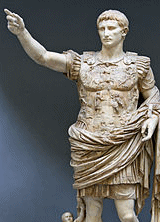
27 BC The title Augustus is bestowed upon Gaius Julius Caesar Octavian by the Roman Senate.
8 Roman Empire general Tiberius defeats Dalmatians on the river Bathinus.
37 Caligula becomes Roman Emperor after the death of his great uncle, Tiberius.
37 The Roman Senate annuls Tiberius's will and proclaims Caligula emperor.
37 Roman Emperor Caligula accepts the titles of the Principate, entitled to him by the Senate.
41 After a night of negotiation, Claudius is accepted as Roman Emperor by the Senate.
51 Nero, later to become Roman Emperor, is given the title ''princeps iuventutis'' (head of the youth).
53 Roman Emperor Nero marries Claudia Octavia
55 Tiberius Claudius Caesar Britannicus, heir to the Roman Emperorship, dies under mysterious circumstances in Rome. This clears the way for Nero to become Emperor.
68 The Roman Senate proclaims Galba as emperor.
68 Roman Emperor Nero commits suicide, after quoting Homer's ''Iliad''.
69 Vitellius, commander of the Rhine armies, defeats Emperor Otho in the Battle of Bedriacum and seizes the throne.
69 After the First Battle of Bedriacum, Vitellius becomes Roman Emperor.
69 Tiberius Julius Alexander orders his Roman legions in Alexandria to swear allegiance to Vespasian as Emperor.
69 Second Battle of Bedriacum, forces under Antonius Primus, the commander of the Danube armies, loyal to Vespasian, defeat the forces of Emperor Vitellius.
70 Titus and his Roman legions breach the middle wall of Jerusalem in the Siege of Jerusalem.
70 The destruction of the Second Temple in Jerusalem by the Romans.
70 A Roman army under Titus occupies and plunders Jerusalem.
70 Roman forces under Titus sack Jerusalem.
73 Masada, a Jewish fortress, falls to the Romans after several months of siege, ending the Jewish Revolt.
81 Domitian becomes Emperor of the Roman Empire upon the death of his brother Titus.
96 Nerva is proclaimed Roman Emperor after Domitian is assassinated.
98 Trajan becomes Roman Emperor after the death of Nerva.
180 Marcus Aurelius dies leaving Commodus the sole emperor of the Roman Empire.
193 The Senate chooses Pertinax against his will to succeed Commodus as Roman Emperor.
193 The Senate chooses Pertinax against his will to succeed Commodus as Roman Emperor.
193 Septimius Severus is proclaimed Roman Emperor by the army in Illyricum (in the Balkans).
193 Roman Emperor Didius Julianus is assassinated.
197 Roman Emperor Septimius Severus defeats usurper Clodius Albinus in the Battle of Lugdunum, the bloodiest battle between Roman armies.
211 Roman Emperor Septimius Severus dies, leaving the Roman Empire in the hands of his two quarrelsome sons, Caracalla and Geta.
211 Roman Emperor Septimius Severus dies, leaving the Roman Empire in the hands of his two quarrelsome sons, Caracalla and Geta.
217 Roman Emperor Caracalla is assassinated (and succeeded) by his Praetorian Guard prefect, Marcus Opellius Macrinus.
238 Gordian I and his son Gordian II are proclaimed Roman Emperors.
275 In Rome, (after the assassination of Aurelian), the Senate proclaims Marcus Claudius Tacitus Emperor.
275 In Rome, (after the assassination of Aurelian), the Senate proclaims Marcus Claudius Tacitus Emperor.
284 Diocletian is chosen as Roman Emperor.
286 Roman Emperor Diocletian raises Maximian to the rank of ''Caesar''.
306 Constantine I is proclaimed Roman emperor by his troops.
306 Maxentius is proclaimed Roman Emperor.
307 After divorcing his wife Minervina, Constantine marries Fausta, the daughter of the retired Roman Emperor Maximian.
308 At Carnuntum, Emperor ''emeritus'' Diocletian confers with Galerius, ''Augustus'' of the East, and Maximianus, the recently returned former ''Augustus'' of the West, in an attempt to restore order to the Roman Empire.
313 Roman emperor Licinius unifies the entire Eastern Roman Empire under his rule.
314 Roman Emperor Licinius is defeated by his colleague Constantine I at the Battle of Cibalae, and loses his European territories.
317 Crispus and Constantine II, sons of Roman Emperor Constantine I, and Licinius Iunior, son of Emperor Licinius, are made ''Caesares''
324 Constantine the Great decisively defeats Licinius in the Battle of Chrysopolis, establishing Constantine's sole control over the Roman Empire.
350 Roman usurper Nepotianus, of the Constantinian dynasty, proclaims himself Roman Emperor, entering Rome at the head of a group of gladiators.
351 Constantius II elevates his cousin Gallus to Caesar, and puts him in charge of the Eastern part of the Roman Empire.
351 Battle of Mursa Major: the Roman Emperor Constantius II defeats the usurper Magnentius.
355 Claudius Silvanus, accused of treason, proclaims himself Roman Emperor against Constantius II.
355 Roman Emperor Constantius II promotes his cousin Julian to the rank of Caesar, entrusting him with the government of the Prefecture of the Gauls.
363 Roman Emperor Julian moves from Antioch with an army of 90,000 to attack the Sassanid Empire, in a campaign which would bring about his own death.
363 Roman Emperor Julian defeats the Sassanid army in the Battle of Ctesiphon, under the walls of the Sassanid capital, but is unable to take the city.
363 Roman Emperor Julian is killed during the retreat from the Sassanid Empire. General Jovian is proclaimed Emperor by the troops on the battlefield.
364 Valentinian I is proclaimed Roman Emperor.
365 Roman usurper Procopius bribes two legions passing by Constantinople, and proclaims himself Roman emperor.
366 The Alamanni cross the frozen Rhine River in large numbers, invading the Roman Empire
367 Gratian, son of Roman Emperor Valentinian I, is named co-Augustus by his father and associated to the throne aged eight.
394 Battle of the Frigidus: The Christian Roman Emperor Theodosius I defeats and kills the pagan usurper Eugenius and his Frankish ''magister militum'' Arbogast.
437 Valentinian III, Western Roman Emperor, marries Licinia Eudoxia, daughter of his cousin Theodosius II, Eastern Roman Emperor in Constantinople unifying the two branches of the House of Theodosius
437 Valentinian III, Western Roman Emperor, marries Licinia Eudoxia, daughter of his cousin Theodosius II, Eastern Roman Emperor in Constantinople unifying the two branches of the House of Theodosius
467 Anthemius is elevated to Emperor of the Western Roman Empire.
475 The Roman general Orestes forces western Roman Emperor Julius Nepos to flee his capital city, Ravenna.
476 Romulus Augustus, last emperor of the Western Roman Empire, is deposed when Odoacer proclaims himself King of Italy, thus ending Western Roman Empire.
1896 In Athens, the opening of the first modern Olympic Games is celebrated, 1,500 years after the original games are banned by Roman Emperor Theodosius I.