

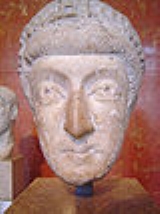
Theodosius II

Encyclopedia
Theodosius II commonly surnamed Theodosius the Younger, or Theodosius the Calligrapher, was Byzantine Emperor from 408 to 450. He is mostly known for promulgating the Theodosian law code
, and for the construction of the Theodosian Walls of Constantinople
. He also presided over the outbreak of two great christological controversies
, Nestorianism
and Eutychianism
.
 Theodosius was born in 401 as the only son of Emperor Arcadius
and his Frankish-born wife Aelia Eudoxia
. In 408, his father died and the seven-year-old boy became Emperor of the Eastern half of the Roman Empire.
Government was at first by the Praetorian Prefect
Anthemius
, under whose supervision the Theodosian land walls of Constantinople were constructed.
In 414, Theodosius' older sister Pulcheria
was proclaimed Augusta and assumed the regency. By 416 Theodosius was capable of ruling himself, but his sister remained a strong influence on him. In June 421, Theodosius married Aelia Eudocia
, a woman of Greek origin. The two had a daughter named Licinia Eudoxia
.
Theodosius' increasing interest in Christianity, fueled by the influence of Pulcheria, had him start a war against the Sassanids (421–422), who were persecuting Christians; the war ended in a draw, when the Romans were forced to accept peace as the Huns menaced Constantinople
.
In 423, the Western Emperor Honorius
, Theodosius' uncle, died and the primicerius notariorum Joannes
was proclaimed Emperor. Honorius' sister Galla Placidia
and her young son Valentinian
fled to Constantinople to seek Eastern assistance and after some deliberation in 424 Theodosius opened the war against Joannes. In May 425, Valentinian III was installed as Emperor of the West, with his mother acting as regent. To strengthen the ties between the two parts of the Empire, Theodosius' daughter Licinia Eudoxia
was betrothed to Valentinian.
with 31 chairs (15 in Latin and 16 in Greek). Among subjects were law, philosophy, medicine, arithmetic, geometry, astronomy, music and rhetoric.
In 429, Theodosius appointed a commission to collect all of the laws since the reign of Constantine I
, and create a fully formalized system of law. This plan was left unfinished, but the work of a second commission that met in Constantinople, assigned to collect all of the general legislations and bring them up to date was completed, and their collection published as the Codex Theodosianus
in 438. The law code of Theodosius II, summarizing edicts promulgated since Constantine, formed a basis for the law code of Emperor Justinian I
in the following century.
. In 447
the Huns
went through the Balkans, destroying among others the city of Serdica (Sofia
) and reaching Athyra (Büyükçekmece
) on the outskirts of Constantinople. Then, an agreement was reached with the Eastern Roman Empire, negotiated by Anatolius
. The Emperor chose to pay tribute, which amounted to 350 Roman pounds (ca. 114.5 kg) of gold until 435 and 700 Roman pounds after that.
When Roman Africa fell to the Vandals in 439, both Eastern and Western Emperors sent forces to Sicily
, to launch an attack at the Vandals at Carthage, but this project failed. Seeing the Imperial borders without significant forces, the Huns
and Sassanid Persia declared war. During 443 two Roman armies were defeated and destroyed by the Huns. In the subsequent peace agreement Roman tribute was tripled to 2,100 Roman pounds (ca. 687 kg) in gold after which the Huns withdrew into the interior of their empire. The war with Persia
on the other hand proved indecisive, and a peace was arranged in 422 without changes to the status quo.
and appointed him Patriarch of Constantinople in 428. Nestorius quickly became involved in the disputes of two theological factions, which differed in their Christology
. Nestorius tried to find a middle ground between those that, emphasizing the fact that in Christ God had been born as a man, insisted on calling the Virgin Mary
Theotokos ("birth-giver of God"), and those that rejected that title because God as an eternal being could not have been born. Nestorius suggested the title Christotokos ("birth-giver to Christ"), but did not find acceptance by either faction and was accused of detaching Christ's divine and human natures from each other, a heresy later called Nestorianism
. Though initially supported by the Emperor, Nestorius found a forceful opponent in Patriarch Cyril of Alexandria
. With the consent of the Emperor and Pope Celestine I
, an Ecumenical Council convened in Ephesus in 431, which affirmed the title Theotokos and condemned Nestorius, who was then exiled by the Emperor.
Almost twenty years later, the theological dispute broke out again, this time caused by the Constantinopolitan abbot Eutyches
, whose Christology was understood by some to mingle Christ's divine and human nature into one. Eutyches was condemned by Patriarch Flavian of Constantinople but found a powerful friend in Cyril's successor Dioscurus of Alexandria. Another council convoked to Ephesus
in 449, deemed "robber synod" because of its tumultuous circumstances, restored Eutyches and deposed Flavian, who was mistreated and died shortly afterwards. Pope Leo I
of Rome and many other bishops protested against the outcome, but the Emperor supported it. Only after his death in 450 would the decisions be reversed at the Council of Chalcedon
.
, who had recently returned to court, won out against the eunuch
Chrysaphius
. She married the general Marcian
, thereby making him Emperor.
Codex Theodosianus
The Codex Theodosianus was a compilation of the laws of the Roman Empire under the Christian emperors since 312. A commission was established by Theodosius II in 429 and the compilation was published in the eastern half of the Roman Empire in 438...
, and for the construction of the Theodosian Walls of Constantinople
Constantinople
Constantinople was the capital of the Roman, Eastern Roman, Byzantine, Latin, and Ottoman Empires. Throughout most of the Middle Ages, Constantinople was Europe's largest and wealthiest city.-Names:...
. He also presided over the outbreak of two great christological controversies
Christology
Christology is the field of study within Christian theology which is primarily concerned with the nature and person of Jesus Christ as recorded in the Canonical gospels and the letters of the New Testament. Primary considerations include the relationship of Jesus' nature and person with the nature...
, Nestorianism
Nestorianism
Nestorianism is a Christological doctrine advanced by Nestorius, Patriarch of Constantinople from 428–431. The doctrine, which was informed by Nestorius's studies under Theodore of Mopsuestia at the School of Antioch, emphasizes the disunion between the human and divine natures of Jesus...
and Eutychianism
Eutychianism
Eutychianism refers to a set of Christian theological doctrines derived from the ideas of Eutyches of Constantinople . Eutychianism is a specific understanding of how the human and divine relate within the person of Jesus Christ .At various times, Eutyches taught that the human nature of Christ was...
.
Life
Arcadius
Arcadius was the Byzantine Emperor from 395 to his death. He was the eldest son of Theodosius I and his first wife Aelia Flaccilla, and brother of the Western Emperor Honorius...
and his Frankish-born wife Aelia Eudoxia
Aelia Eudoxia
Aelia Eudoxia was the Empress consort of the Byzantine Emperor Arcadius.-Family:She was a daughter of Flavius Bauto, a Romanised Frank who served as magister militum in the Western Roman army during the 380s. The identity of her father is mentioned by Philostorgius...
. In 408, his father died and the seven-year-old boy became Emperor of the Eastern half of the Roman Empire.
Government was at first by the Praetorian Prefect
Praetorian prefecture of the East
The praetorian prefecture of the East or of Oriens was one of four large praetorian prefectures into which the Late Roman Empire was divided...
Anthemius
Anthemius (praetorian prefect)
Flavius Anthemius was a high-ranking official of the late Roman Empire. He is notable as a Praetorian prefect of the East and effective regent of the Eastern Roman Empire during the later reign of Arcadius and the first years of Theodosius II, as well as for the construction of the first set of...
, under whose supervision the Theodosian land walls of Constantinople were constructed.
In 414, Theodosius' older sister Pulcheria
Pulcheria
Aelia Pulcheria was the daughter of Eastern Roman Emperor Arcadius and Empress Aelia Eudoxia. She was the second child born to Arcadius and Eudoxia. Her oldest sister was Flaccilla born in 397, but is assumed she had died young. Her younger siblings were Theodosius II, the future emperor and...
was proclaimed Augusta and assumed the regency. By 416 Theodosius was capable of ruling himself, but his sister remained a strong influence on him. In June 421, Theodosius married Aelia Eudocia
Aelia Eudocia
Aelia Eudocia Augusta was the wife of Theodosius II, and a prominent historical figure in understanding the rise of Christianity during the beginning of the Byzantine Empire. Eudocia lived in a world where Greek paganism and Christianity were still coming together...
, a woman of Greek origin. The two had a daughter named Licinia Eudoxia
Licinia Eudoxia
Licinia Eudoxia was a Roman Empress, daughter of Eastern Emperor Theodosius II and wife of the Western Emperors Valentinian III and Petronius Maximus.- Family :...
.
Theodosius' increasing interest in Christianity, fueled by the influence of Pulcheria, had him start a war against the Sassanids (421–422), who were persecuting Christians; the war ended in a draw, when the Romans were forced to accept peace as the Huns menaced Constantinople
Constantinople
Constantinople was the capital of the Roman, Eastern Roman, Byzantine, Latin, and Ottoman Empires. Throughout most of the Middle Ages, Constantinople was Europe's largest and wealthiest city.-Names:...
.
In 423, the Western Emperor Honorius
Honorius (emperor)
Honorius , was Western Roman Emperor from 395 to 423. He was the younger son of emperor Theodosius I and his first wife Aelia Flaccilla, and brother of the eastern emperor Arcadius....
, Theodosius' uncle, died and the primicerius notariorum Joannes
Joannes
Ioannes, known in English as Joannes, was a Roman usurper against Valentinian III.On the death of the Emperor Honorius , Theodosius II, the remaining ruler of the House of Theodosius hesitated in announcing his uncle's death...
was proclaimed Emperor. Honorius' sister Galla Placidia
Galla Placidia
Aelia Galla Placidia , daughter of the Roman Emperor Theodosius I, was the Regent for Emperor Valentinian III from 423 until his majority in 437, and a major force in Roman politics for most of her life...
and her young son Valentinian
Valentinian III
-Family:Valentinian was born in the western capital of Ravenna, the only son of Galla Placidia and Flavius Constantius. The former was the younger half-sister of the western emperor Honorius, and the latter was at the time Patrician and the power behind the throne....
fled to Constantinople to seek Eastern assistance and after some deliberation in 424 Theodosius opened the war against Joannes. In May 425, Valentinian III was installed as Emperor of the West, with his mother acting as regent. To strengthen the ties between the two parts of the Empire, Theodosius' daughter Licinia Eudoxia
Licinia Eudoxia
Licinia Eudoxia was a Roman Empress, daughter of Eastern Emperor Theodosius II and wife of the Western Emperors Valentinian III and Petronius Maximus.- Family :...
was betrothed to Valentinian.
University and Law Code
In 425, Theodosius founded the University of ConstantinopleUniversity of Constantinople
The University of Constantinople, sometimes known as the University of the palace hall of Magnaura in the Roman-Byzantine Empire was founded in 425 under the name of Pandidakterion...
with 31 chairs (15 in Latin and 16 in Greek). Among subjects were law, philosophy, medicine, arithmetic, geometry, astronomy, music and rhetoric.
In 429, Theodosius appointed a commission to collect all of the laws since the reign of Constantine I
Constantine I
Constantine the Great , also known as Constantine I or Saint Constantine, was Roman Emperor from 306 to 337. Well known for being the first Roman emperor to convert to Christianity, Constantine and co-Emperor Licinius issued the Edict of Milan in 313, which proclaimed religious tolerance of all...
, and create a fully formalized system of law. This plan was left unfinished, but the work of a second commission that met in Constantinople, assigned to collect all of the general legislations and bring them up to date was completed, and their collection published as the Codex Theodosianus
Codex Theodosianus
The Codex Theodosianus was a compilation of the laws of the Roman Empire under the Christian emperors since 312. A commission was established by Theodosius II in 429 and the compilation was published in the eastern half of the Roman Empire in 438...
in 438. The law code of Theodosius II, summarizing edicts promulgated since Constantine, formed a basis for the law code of Emperor Justinian I
Justinian I
Justinian I ; , ; 483– 13 or 14 November 565), commonly known as Justinian the Great, was Byzantine Emperor from 527 to 565. During his reign, Justinian sought to revive the Empire's greatness and reconquer the lost western half of the classical Roman Empire.One of the most important figures of...
in the following century.
Wars with the Huns, Vandals, and Persians
The Eastern Empire was also plagued by short raiding attacks by the HunsHuns
The Huns were a group of nomadic people who, appearing from east of the Volga River, migrated into Europe c. AD 370 and established the vast Hunnic Empire there. Since de Guignes linked them with the Xiongnu, who had been northern neighbours of China 300 years prior to the emergence of the Huns,...
. In 447
447
Year 447 was a common year starting on Wednesday of the Julian calendar. At the time, it was known as the Year of the Consulship of Calepius and Ardabur...
the Huns
Huns
The Huns were a group of nomadic people who, appearing from east of the Volga River, migrated into Europe c. AD 370 and established the vast Hunnic Empire there. Since de Guignes linked them with the Xiongnu, who had been northern neighbours of China 300 years prior to the emergence of the Huns,...
went through the Balkans, destroying among others the city of Serdica (Sofia
Sofia
Sofia is the capital and largest city of Bulgaria and the 12th largest city in the European Union with a population of 1.27 million people. It is located in western Bulgaria, at the foot of Mount Vitosha and approximately at the centre of the Balkan Peninsula.Prehistoric settlements were excavated...
) and reaching Athyra (Büyükçekmece
Büyükçekmece
Büyükçekmece is a district and municipality in the suburbs of Istanbul, Turkey on the Sea of Marmara coast of the European side, west of the city. It is largely an industrial area with a population of 380,000...
) on the outskirts of Constantinople. Then, an agreement was reached with the Eastern Roman Empire, negotiated by Anatolius
Anatolius (consul)
Anatolius was a diplomat and general of the Eastern Roman Empire and Consul in 440. Very influential during the reign of Theodosius II, he held command of the Empire's eastern armies for 13 years and led several negotiations with Attila the Hun.- Biography :In 421 Anatolius led one Roman army in...
. The Emperor chose to pay tribute, which amounted to 350 Roman pounds (ca. 114.5 kg) of gold until 435 and 700 Roman pounds after that.
When Roman Africa fell to the Vandals in 439, both Eastern and Western Emperors sent forces to Sicily
Sicily
Sicily is a region of Italy, and is the largest island in the Mediterranean Sea. Along with the surrounding minor islands, it constitutes an autonomous region of Italy, the Regione Autonoma Siciliana Sicily has a rich and unique culture, especially with regard to the arts, music, literature,...
, to launch an attack at the Vandals at Carthage, but this project failed. Seeing the Imperial borders without significant forces, the Huns
Huns
The Huns were a group of nomadic people who, appearing from east of the Volga River, migrated into Europe c. AD 370 and established the vast Hunnic Empire there. Since de Guignes linked them with the Xiongnu, who had been northern neighbours of China 300 years prior to the emergence of the Huns,...
and Sassanid Persia declared war. During 443 two Roman armies were defeated and destroyed by the Huns. In the subsequent peace agreement Roman tribute was tripled to 2,100 Roman pounds (ca. 687 kg) in gold after which the Huns withdrew into the interior of their empire. The war with Persia
Roman–Sassanid War (421–422)
The Roman–Sassanid war of 421–422 was a conflict between the Eastern Roman Empire and the Sassanids. The casus belli was the persecution of Christians by the Sassanid king Bahram V; the Christian Eastern Roman Emperor Theodosius II declared war and obtained some victories, but in the end the two...
on the other hand proved indecisive, and a peace was arranged in 422 without changes to the status quo.
Theological disputes
During a visit to Syria, Theodosius met the preacher NestoriusNestorius
Nestorius was Archbishop of Constantinople from 10 April 428 to 22 June 431.Drawing on his studies at the School of Antioch, his teachings, which included a rejection of the long-used title of Theotokos for the Virgin Mary, brought him into conflict with other prominent churchmen of the time,...
and appointed him Patriarch of Constantinople in 428. Nestorius quickly became involved in the disputes of two theological factions, which differed in their Christology
Christology
Christology is the field of study within Christian theology which is primarily concerned with the nature and person of Jesus Christ as recorded in the Canonical gospels and the letters of the New Testament. Primary considerations include the relationship of Jesus' nature and person with the nature...
. Nestorius tried to find a middle ground between those that, emphasizing the fact that in Christ God had been born as a man, insisted on calling the Virgin Mary
Mary (mother of Jesus)
Mary , commonly referred to as "Saint Mary", "Mother Mary", the "Virgin Mary", the "Blessed Virgin Mary", or "Mary, Mother of God", was a Jewish woman of Nazareth in Galilee...
Theotokos ("birth-giver of God"), and those that rejected that title because God as an eternal being could not have been born. Nestorius suggested the title Christotokos ("birth-giver to Christ"), but did not find acceptance by either faction and was accused of detaching Christ's divine and human natures from each other, a heresy later called Nestorianism
Nestorianism
Nestorianism is a Christological doctrine advanced by Nestorius, Patriarch of Constantinople from 428–431. The doctrine, which was informed by Nestorius's studies under Theodore of Mopsuestia at the School of Antioch, emphasizes the disunion between the human and divine natures of Jesus...
. Though initially supported by the Emperor, Nestorius found a forceful opponent in Patriarch Cyril of Alexandria
Cyril of Alexandria
Cyril of Alexandria was the Patriarch of Alexandria from 412 to 444. He came to power when the city was at its height of influence and power within the Roman Empire. Cyril wrote extensively and was a leading protagonist in the Christological controversies of the later 4th and 5th centuries...
. With the consent of the Emperor and Pope Celestine I
Pope Celestine I
Pope Saint Celestine I was elevated to the papacy in the year 422, on November 3 according to the Liber Pontificalis, but on April 10 according to Tillemont....
, an Ecumenical Council convened in Ephesus in 431, which affirmed the title Theotokos and condemned Nestorius, who was then exiled by the Emperor.
Almost twenty years later, the theological dispute broke out again, this time caused by the Constantinopolitan abbot Eutyches
Eutyches
Eutyches was a presbyter and archimandrite at Constantinople. He first came to notice in 431 at the First Council of Ephesus, for his vehement opposition to the teachings of Nestorius; his condemnation of Nestorianism as heresy precipitated his being denounced as a heretic...
, whose Christology was understood by some to mingle Christ's divine and human nature into one. Eutyches was condemned by Patriarch Flavian of Constantinople but found a powerful friend in Cyril's successor Dioscurus of Alexandria. Another council convoked to Ephesus
Second Council of Ephesus
The Second Council of Ephesus was a church synod in 449 AD. It was convoked by Emperor Theodosius II as an ecumenical council but because of the controversial proceedings it was not accepted as ecumenical, labelled a Robber Synod and later repudiated at the Council of Chalcedon.-The first...
in 449, deemed "robber synod" because of its tumultuous circumstances, restored Eutyches and deposed Flavian, who was mistreated and died shortly afterwards. Pope Leo I
Pope Leo I
Pope Leo I was pope from September 29, 440 to his death.He was an Italian aristocrat, and is the first pope of the Catholic Church to have been called "the Great". He is perhaps best known for having met Attila the Hun in 452, persuading him to turn back from his invasion of Italy...
of Rome and many other bishops protested against the outcome, but the Emperor supported it. Only after his death in 450 would the decisions be reversed at the Council of Chalcedon
Council of Chalcedon
The Council of Chalcedon was a church council held from 8 October to 1 November, 451 AD, at Chalcedon , on the Asian side of the Bosporus. The council marked a significant turning point in the Christological debates that led to the separation of the church of the Eastern Roman Empire in the 5th...
.
Death
Theodosius died in 450 as the result of a riding accident. In the ensuing power struggle, his sister PulcheriaPulcheria
Aelia Pulcheria was the daughter of Eastern Roman Emperor Arcadius and Empress Aelia Eudoxia. She was the second child born to Arcadius and Eudoxia. Her oldest sister was Flaccilla born in 397, but is assumed she had died young. Her younger siblings were Theodosius II, the future emperor and...
, who had recently returned to court, won out against the eunuch
Eunuch
A eunuch is a person born male most commonly castrated, typically early enough in his life for this change to have major hormonal consequences...
Chrysaphius
Chrysaphius
Chrysaphius was a eunuch at the Eastern Roman court, who became the chief minister of Theodosius II . Effectively the ruler of the empire during his ascendancy, he pursued a policy of appeasement towards the Huns, which cost the empire far more gold than any military campaign, while amassing a...
. She married the general Marcian
Marcian
Marcian was Byzantine Emperor from 450 to 457. Marcian's rule marked a recovery of the Eastern Empire, which the Emperor protected from external menaces and reformed economically and financially...
, thereby making him Emperor.
External links
- Reign of Theodosius II (chapter of J. B. BuryJ. B. BuryJohn Bagnell Bury , known as J. B. Bury, was an Irish historian, classical scholar, Byzantinist and philologist.-Biography:...
's History of the Later Roman Empire) - Theodosian Code: Sections concerning religious observances (English)
- George Long, "Codex Theodosianus"
- Nathan, Geoffrey, "Theodosius II (408–450 A.D.)", De Imperatoribus Romanis
- This list of Roman laws of the fourth century shows laws passed by Theodosius II relating to Christianity.