

Soviet historiography

Encyclopedia
Soviet historiography is the methodology of history
studies by historians in the Soviet Union
(USSR). In the USSR, the study of history was marked by alternating periods of freedom allowed and restrictions imposed by the Communist Party of the Soviet Union
(CPSU), and also by the struggle of historians to conduct history by their own estimates (or in their own words, "to guard against bourgeois historiography"). Soviet historiography is itself the subject of modern studies.
In Markwick's view there are a number of important post war historiographical movements, which have antecedents in the 1920s and 1930s. Surprisingly these include culturally and psychologically focused history. In the late 1920s Stalinists began limiting individualist approaches to history, culminating in the publication of Stalin and other's "Short Course" History of the Soviet Communist Party This crystallised the piatichlenka or five acceptable moments of history in terms of vulgar dialectical materialism: primitive-communism, slavery, feudalism, capitalism and socialism.284
While the triumph of Stalinist history was being imposed, different modes of history began to emerge. These included BA Romanov's People and Morals in Ancient Rus (1947), a study of mentalités at the height of the Zhdanovshchina. However, it was not until the 20th Congress of the CPSU
that different schools of history emerged from the Stalinist freeze. Firstly, a "new direction" within Leninist materialism emerged, as an effectively loyal opposition to Stalinist dialectical materialism, secondly a social psychology of history emerged through a reading of Leninist psychology, thirdly a "culturological" tendendency emerged.284–285
Soviet-era historiography has been influenced by Marxism. Marxism believes that the moving forces of history are determined by material production and the rise of different socioeconomic formations. Applying the doctrine socioeconomic formations such as slavery and feudalism is a major methodological principle of Marxist historiography. Based on this principle, historiography predicts that history there will be an abolition of capitalism by a socialist revolution made by the working-class. Soviet historians believed that Marxist-Leninist theory allows for applying categories of dialectical and historical materialism for studying historical events.
Marx and Engels' ideas of the importance of class struggle in history, the destiny of the working class, and the role of the dictatorship of the proletariat and the revolutionary party are of major importance in Marxist methodology.
Marxist-Leninist historiography has several aspects. It explains the social basis of historical knowledge, determines the social functions of historical knowledge and the means by which these functions are carried out, and emphasizes the need to study concepts in connection with the social and political life of the period in which these concepts were developed.
It studies the theoretical and methodological features in every school of historical thought. Marxist-Leninist historiography analyzes the source-study basis of a historical work, the nature of the use of sources, and specific research methods. It analyzes problems of historical research as the most important sign of the progress and historical knowledge and as the expression of the socioeconomic and political needs of a historical period.
Soviet historiography had been severely criticized by scholars, chiefly — but not only — outside the Soviet Union and Russia. Its status as "scholarly" at all has been questioned, and it has often been dismissed as ideology
and pseudoscience
. Robert Conquest
concluded that:
That criticism stems from the fact that in the Soviet Union, science was far from independent. Since the late 1930s, Soviet historiography treated the party line
and reality as one and the same. As such, if it was a science, it was a science in service of a specific political and ideological agenda, commonly employing historical revisionism
. In the 1930s, historic archive
s were closed and original research was severely restricted. Historians were required to pepper their works with references — appropriate or not — to Stalin and other "Marxist-Leninist classics", and to pass judgment — as prescribed by the Party — on pre-revolution historic Russian figures.
The state-approved history was openly subjected to politics
and propaganda
, similar to philosophy
, art
, and many fields of scientific research
. The Party
could not be proven wrong, it was infallible and reality was to conform to this line. Any non-conformist history had to be erased, and questioning of the official history was illegal.
Many works of Western historians were forbidden or censored
, many areas of history were also forbidden for research as, officially, they never happened. As such, it remained mostly outside the international historiography of the period. Translations of foreign historiography were often produced in a truncated form, accompanied with extensive censorship and corrective footnotes. For example, in the Russian 1976 translation of Basil Liddell Hart
's History of the Second World War pre-war purges of Red Army officers, the secret protocol to the Molotov-Ribbentrop Pact
, many details of the Winter War
, the occupation of the Baltic states, the Soviet occupation of Bessarabia and Northern Bukovina, Allied assistance to the Soviet Union during the war, many other Western Allies' efforts, the Soviet leadership's mistakes and failures, criticism of the Soviet Union and other content were censored out
.
The official version of Soviet history has been dramatically changed after every major governmental shake-up. Previous leaders were always denounced as "enemies", whereas current leaders were usually a subject of a personality cult. Textbooks were rewritten periodically, with figures - such as Lev Trotsky or Stalin himself - disappearing from their pages or being turned from great figures to great villains.
Certain regions and periods of history were made unreliable for political reasons. Entire historical events could be erased, if they did not fit the party line. For example, until 1989 the Soviet leadership and historians, unlike their Western colleagues, had denied the existence of a secret protocol to the Soviet-German Molotov-Ribbentrop Pact
of 1939, and as a result the Soviet approach to the study of the Soviet-German relations before 1941 and the origins of World War II
were remarkably flawed. In another example, the Soviet invasion of Poland in 1939
as well as the Polish-Soviet War
of 1919-1920 were censored out or minimized from most publications, and research suppressed, in order to enforce the policy of 'Polish-Soviet friendship'. Similarly, the enforced collectivisation, the wholesale deportations or massacres of small nationalities in the Caucasus
or the disappearance of the Crimean Tatars
are not recognized as facts worth of mention. Soviet historians also engaged in producing false claims and falsification of history, for example Soviet historiography falsely claimed that Katyn massacre
was carried out by Germans rather than by Soviets as was the case. Yet another example is related to the case of Soviet reprisals against former Soviet POWs returning from Germany; some of them were treated as traitors and imprisoned in GULAG
s for many years, yet that policy was denied or minimized by Soviet historians for decades and modern Western scholars have noted that "In the past, Soviet historians engaged for the most part in a disinformation campaign about the extent of the prisoner-of-war problem."
predetermined much of the research done by historians. Research by scholars in the USSR was limited to a large extent due to this predetermination. Some Soviet historians could not offer non-Marxist theoretical explanations for their interpretation of sources. This was true even when alternate theories had a greater explanatory power in relation to a historian's reading of source material.
The creation of the Soviet Union was presented as the most important turning event in the human history, based on the Marxist theory of historical materialism
. This theory identified means of production
as chief determinants of the historical process. They led to the creation of social class
es, and class struggle
was the 'motor' of history. The sociocultural evolution
of societies had to progress inevitably from slavery
, through feudalism
and capitalism
to communism
. Furthermore, the Communist Party
became the protagonist of history, as a "vanguard of the working class", according to development of this theory by Lenin. Hence the unlimited powers of the Communist Party leaders were claimed to be as infallible and inevitable as the history itself. It also followed that a world-wide victory of communist countries is inevitable. All research had to be based on those assumptions and could not diverge in its findings.
The Marxist bias has been also criticized, for example, for assigning to the rebellions in the Roman Empire
the characteristics of the social revolution
.
Often, the Marxist bias and propaganda demands mixed: hence the peasant rebellions against the early Soviet rule were simply ignored - as inconvenient politically and contradicting the Marxist theories.
Soviet historians trace the origin of feudalism in Russia to the 11th century, after the founding of the Russian state. The class struggle in medieval is emphasized because of the hardships of feudal relations. For example, Soviet historians argue that uprisings in Kiev in 1068-69 was a reflection of the class struggle. There was a constant struggle between the powers of the princes and those of the feudal aristocracy, known as the boyars. In regions like Novgorod, the boyar aristocracy was able to limit the prince’s power by making the office and the head of church elective.
The Mongol conquests of the 13th had significant consequences for Russia. Soviet historians emphasize the cruelty of Genghis Khan and the suffering and devastation that Russia endured. Soviet historians attribute the success of Genghis Khan to the fact that feudalism among his people had not developed, which would have involved with feudal and political strife. By contrast, the peoples opposed to the Mongols were in a mature state of feudalism and the political disunity that went with it. Soviet historians conclude that the Mongol domination had disastrous consequences for Russia’s historical progress and development. It is also argued that by bearing the full weight of the Mongolian invasions, Russia helped to save Western Europe from outside domination.
The struggle against foreign domination and the heroism of its participants is a recurring theme in Soviet historiography. Soviet historians have an upbeat assessment of Alexander Nevsky, characterized as one of the greatest military leaders of his time for defeating the German knights’ invasions of Russia in the 13th century. Much importance is attached to the Battle of Kulikovo (1380), which marked the beginning of the end of the Mongol domination of Russia. Dmitry Donskoi for his leadership of the anti-Mongol struggle is credited for being an outstanding military commander and contributing significantly to the unity of the Russian lands.
) of data published in the Soviet Union and used in historical research is another issue raised by various Sovietologists. The Marxist theoreticians of the Party considered statistics as a social science; hence many applications of statistical mathematics were curtailed, particularly during the Stalin's era. Under central planning, nothing could occur by accident. Law of large numbers
or the idea of random deviation
were decreed as "false theories". Statistical journals were closed; world-renowned statisticians like Andrey Kolmogorov
or Eugen Slutsky
abandoned statistical research.
As with all Soviet historiography, reliability of Soviet statistical data varied from period to period. The first revolutionary decade and the period of Stalin's dictatorship both appear highly problematic with regards to statistical reliability; very little statistical data were published from 1936 to 1956 and The reliability of data improved after 1956 when some missing data was published and Soviet experts themselves published some adjusted data for the Stalin's era; however the quality of documentation has deteriorated.
While some researchers say that on occasion statistical data useful in historical research (such as economical data invented to prove the successes of the Soviet industrialization, or some published numbers of Gulag
prisoners and terror victims as Conquest claims) might have been completely invented by the Soviet authorities,. Data was falsified both during collection - by local authorities who would be judged by the central authorities based on whether their figures reflected the central economy prescriptions - and by internal propaganda, with its goal to portray the Soviet state in most positive light to its very citizens. Nonetheless the policy of not publishing - or simply not collecting - data that was deemed unsuitable for various reasons was much more common than simple falsification; hence there are many gaps in Soviet statistical data. Inadequate or lacking documentation for much of Soviet statistical data is also a significant problem.
, created and published in Soviet Union, are held in high regard.
as the driving force of history. However, posthumously, Pokrovsky was accused of "vulgar sociologism", and his books were banned. After Stalin's death, and the subsequent renouncement of his policies during the Khrushchev Thaw
, Pokrovsky's work regained some influence.
When Burdzhalov, then the deputy editor of the foremost Soviet journal on history, in spring of 1956 published a bold article examining the rôle of Bolsheviks in 1917 and demonstrated that Stalin had been an ally of Kamenev — who had been executed as a traitor in 1936 — and that Lenin had been a close associate of Zinoviev — who had been executed as a traitor in 1936 —, Burdzhalov was moved to an uninfluential post.
(circulating unofficial manuscripts within the USSR) and tamizdat (illegal publication of work abroad). The three most prominent Soviet dissidents of that era were Alexandr Solzhenitsyn, Andrei Sakharov
and Roy Medvedev
. Of the tamizdat authors, Solzhenitsyn was the most famous, publishing his The Gulag Archipelago
in the West in 1973. Medvedev's Let History Judge: The Origins and Consequences of Stalinism was published in 1971 in the West. Neither could publish in the Soviet Union until the advent of Perestroika
and Glasnost
.
. Putin said that "we can't allow anyone to impose a sense of guilt on us," and that the new manual helps present a more balanced view of Russian history than that promoted by the West. The book acknowledges the repressions carried out by Stalin and others, but argues that they were "a necessary evil in response to a cold war started by America against the Soviet Union." It cites a recent opinion poll in Russia that gave Stalin an approval rating of 47%, and states that "The Soviet Union was not a democracy, but it was an example for millions of people around the world of the best and fairest society."
The Economist
magazine contends that the book is inspired by Soviet historiography in its treatment of the Cold War
, as it claims that the Cold War was started by the United States
, that the Soviet Union was acting in self-defense, and that the USSR did not lose the Cold War but rather voluntarily ended it. According to The Economist, "rabid anti-Westernism is the leitmotif of [the book's] ideology.". However, this single book is only one out of many approved by the Ministry of Education and Science, many promoting opposite views.
In 2009 president Dmitri Medvedev created a History Commission against anti-Soviet and anti-Russian slander. Officially, the Commission's mission is to "defend Russia against falsifiers of history and those who would deny Soviet contribution to the victory in World War II
". Also United Russia
has proposed a draft law that would mandate jail terms of three to five years "for anyone in the former Soviet Union convicted of rehabilitating Nazism".
See also "Historical revisionism: Soviet and Russian history".
History
History is the discovery, collection, organization, and presentation of information about past events. History can also mean the period of time after writing was invented. Scholars who write about history are called historians...
studies by historians in the Soviet Union
Soviet Union
The Soviet Union , officially the Union of Soviet Socialist Republics , was a constitutionally socialist state that existed in Eurasia between 1922 and 1991....
(USSR). In the USSR, the study of history was marked by alternating periods of freedom allowed and restrictions imposed by the Communist Party of the Soviet Union
Communist Party of the Soviet Union
The Communist Party of the Soviet Union was the only legal, ruling political party in the Soviet Union and one of the largest communist organizations in the world...
(CPSU), and also by the struggle of historians to conduct history by their own estimates (or in their own words, "to guard against bourgeois historiography"). Soviet historiography is itself the subject of modern studies.
Theoretical approaches
George M. Enteen identifies two approaches to the study of Soviet historiography. A totalitarian approach associated with the Western analysis of the Soviet Union as a totalitarian society, controlled by the Central Committee of the Communist Party of the Soviet Union, this school "thought that signs of dissent merely represented a misreading of commands from above."363 For Enteen the other school of writing on Soviet historiography is the social-history school which draws attention to "important initiative from historians at odds with the dominant powers in the field."363 Enteen is unable to decide between these different approaches based on current literature.In Markwick's view there are a number of important post war historiographical movements, which have antecedents in the 1920s and 1930s. Surprisingly these include culturally and psychologically focused history. In the late 1920s Stalinists began limiting individualist approaches to history, culminating in the publication of Stalin and other's "Short Course" History of the Soviet Communist Party This crystallised the piatichlenka or five acceptable moments of history in terms of vulgar dialectical materialism: primitive-communism, slavery, feudalism, capitalism and socialism.284
While the triumph of Stalinist history was being imposed, different modes of history began to emerge. These included BA Romanov's People and Morals in Ancient Rus (1947), a study of mentalités at the height of the Zhdanovshchina. However, it was not until the 20th Congress of the CPSU
20th Congress of the CPSU
The 20th Congress of the Communist Party of the Soviet Union was held during 14– 25 February 1956. It is known especially for Nikita Khrushchev's "Secret Speech", which denounced the personality cult and dictatorship of Joseph Stalin....
that different schools of history emerged from the Stalinist freeze. Firstly, a "new direction" within Leninist materialism emerged, as an effectively loyal opposition to Stalinist dialectical materialism, secondly a social psychology of history emerged through a reading of Leninist psychology, thirdly a "culturological" tendendency emerged.284–285
Characteristics of Soviet historiography
 |
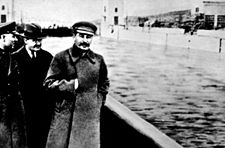 |
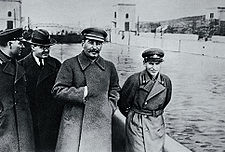
| In the original version of this photo (top), Nikolai Yezhov Nikolai Yezhov Nikolai Ivanovich Yezhov or Ezhov was a senior figure in the NKVD under Joseph Stalin during the period of the Great Purge. His reign is sometimes known as the "Yezhovshchina" , "the Yezhov era", a term that began to be used during the de-Stalinization campaign of the 1950s... , the young man strolling with Joseph Stalin Joseph Stalin Joseph Vissarionovich Stalin was the Premier of the Soviet Union from 6 May 1941 to 5 March 1953. He was among the Bolshevik revolutionaries who brought about the October Revolution and had held the position of first General Secretary of the Communist Party of the Soviet Union's Central Committee... to his left, was shot in 1940. He was edited out of the photo in a later publication. |
Soviet-era historiography has been influenced by Marxism. Marxism believes that the moving forces of history are determined by material production and the rise of different socioeconomic formations. Applying the doctrine socioeconomic formations such as slavery and feudalism is a major methodological principle of Marxist historiography. Based on this principle, historiography predicts that history there will be an abolition of capitalism by a socialist revolution made by the working-class. Soviet historians believed that Marxist-Leninist theory allows for applying categories of dialectical and historical materialism for studying historical events.
Marx and Engels' ideas of the importance of class struggle in history, the destiny of the working class, and the role of the dictatorship of the proletariat and the revolutionary party are of major importance in Marxist methodology.
Marxist-Leninist historiography has several aspects. It explains the social basis of historical knowledge, determines the social functions of historical knowledge and the means by which these functions are carried out, and emphasizes the need to study concepts in connection with the social and political life of the period in which these concepts were developed.
It studies the theoretical and methodological features in every school of historical thought. Marxist-Leninist historiography analyzes the source-study basis of a historical work, the nature of the use of sources, and specific research methods. It analyzes problems of historical research as the most important sign of the progress and historical knowledge and as the expression of the socioeconomic and political needs of a historical period.
Soviet historiography had been severely criticized by scholars, chiefly — but not only — outside the Soviet Union and Russia. Its status as "scholarly" at all has been questioned, and it has often been dismissed as ideology
Ideology
An ideology is a set of ideas that constitutes one's goals, expectations, and actions. An ideology can be thought of as a comprehensive vision, as a way of looking at things , as in common sense and several philosophical tendencies , or a set of ideas proposed by the dominant class of a society to...
and pseudoscience
Pseudoscience
Pseudoscience is a claim, belief, or practice which is presented as scientific, but which does not adhere to a valid scientific method, lacks supporting evidence or plausibility, cannot be reliably tested, or otherwise lacks scientific status...
. Robert Conquest
Robert Conquest
George Robert Ackworth Conquest CMG is a British historian who became a well-known writer and researcher on the Soviet Union with the publication in 1968 of The Great Terror, an account of Stalin's purges of the 1930s...
concluded that:
That criticism stems from the fact that in the Soviet Union, science was far from independent. Since the late 1930s, Soviet historiography treated the party line
Party line (politics)
In politics, the line or the party line is an idiom for a political party or social movement's canon agenda, as well as specific ideological elements specific to the organization's partisanship. The common phrase toeing the party line describes a person who speaks in a manner that conforms to his...
and reality as one and the same. As such, if it was a science, it was a science in service of a specific political and ideological agenda, commonly employing historical revisionism
Historical revisionism (negationism)
Historical revisionism is either the legitimate scholastic re-examination of existing knowledge about a historical event, or the illegitimate distortion of the historical record such that certain events appear in a more or less favourable light. For the former, i.e. the academic pursuit, see...
. In the 1930s, historic archive
Archive
An archive is a collection of historical records, or the physical place they are located. Archives contain primary source documents that have accumulated over the course of an individual or organization's lifetime, and are kept to show the function of an organization...
s were closed and original research was severely restricted. Historians were required to pepper their works with references — appropriate or not — to Stalin and other "Marxist-Leninist classics", and to pass judgment — as prescribed by the Party — on pre-revolution historic Russian figures.
The state-approved history was openly subjected to politics
Politics
Politics is a process by which groups of people make collective decisions. The term is generally applied to the art or science of running governmental or state affairs, including behavior within civil governments, but also applies to institutions, fields, and special interest groups such as the...
and propaganda
Propaganda
Propaganda is a form of communication that is aimed at influencing the attitude of a community toward some cause or position so as to benefit oneself or one's group....
, similar to philosophy
Philosophy in the Soviet Union
Philosophical research in the Soviet Union was officially confined to Marxist-Leninist thinking, which theoretically was the basis of objective and ultimate philosophical truth. During the 1920s and 1930s, other tendencies of Russian thought were repressed...
, art
Socialist realism
Socialist realism is a style of realistic art which was developed in the Soviet Union and became a dominant style in other communist countries. Socialist realism is a teleologically-oriented style having its purpose the furtherance of the goals of socialism and communism...
, and many fields of scientific research
Suppressed research in the Soviet Union
Suppressed research in the Soviet Union refers to scientific fields which were banned in the Soviet Union, usually for ideological reasons. Science and humanities were placed under a strict ideological scrutiny in the Soviet Union. All research was to be founded on the philosophy of dialectical...
. The Party
Communist Party of the Soviet Union
The Communist Party of the Soviet Union was the only legal, ruling political party in the Soviet Union and one of the largest communist organizations in the world...
could not be proven wrong, it was infallible and reality was to conform to this line. Any non-conformist history had to be erased, and questioning of the official history was illegal.
Many works of Western historians were forbidden or censored
Censorship in the Soviet Union
Censorship in the Soviet Union was pervasive and strictly enforced.Censorship was performed in two main directions:*State secrets were handled by Main Administration for Safeguarding State Secrets in the Press was in charge of censoring all publications and broadcasting for state...
, many areas of history were also forbidden for research as, officially, they never happened. As such, it remained mostly outside the international historiography of the period. Translations of foreign historiography were often produced in a truncated form, accompanied with extensive censorship and corrective footnotes. For example, in the Russian 1976 translation of Basil Liddell Hart
Basil Liddell Hart
Sir Basil Henry Liddell Hart , usually known before his knighthood as Captain B. H. Liddell Hart, was an English soldier, military historian and leading inter-war theorist.-Life and career:...
's History of the Second World War pre-war purges of Red Army officers, the secret protocol to the Molotov-Ribbentrop Pact
Molotov-Ribbentrop Pact
The Molotov–Ribbentrop Pact, named after the Soviet foreign minister Vyacheslav Molotov and the German foreign minister Joachim von Ribbentrop, was an agreement officially titled the Treaty of Non-Aggression between Germany and the Soviet Union and signed in Moscow in the late hours of 23 August 1939...
, many details of the Winter War
Winter War
The Winter War was a military conflict between the Soviet Union and Finland. It began with a Soviet offensive on 30 November 1939 – three months after the start of World War II and the Soviet invasion of Poland – and ended on 13 March 1940 with the Moscow Peace Treaty...
, the occupation of the Baltic states, the Soviet occupation of Bessarabia and Northern Bukovina, Allied assistance to the Soviet Union during the war, many other Western Allies' efforts, the Soviet leadership's mistakes and failures, criticism of the Soviet Union and other content were censored out
Censorship in the Soviet Union
Censorship in the Soviet Union was pervasive and strictly enforced.Censorship was performed in two main directions:*State secrets were handled by Main Administration for Safeguarding State Secrets in the Press was in charge of censoring all publications and broadcasting for state...
.
The official version of Soviet history has been dramatically changed after every major governmental shake-up. Previous leaders were always denounced as "enemies", whereas current leaders were usually a subject of a personality cult. Textbooks were rewritten periodically, with figures - such as Lev Trotsky or Stalin himself - disappearing from their pages or being turned from great figures to great villains.
Certain regions and periods of history were made unreliable for political reasons. Entire historical events could be erased, if they did not fit the party line. For example, until 1989 the Soviet leadership and historians, unlike their Western colleagues, had denied the existence of a secret protocol to the Soviet-German Molotov-Ribbentrop Pact
Molotov-Ribbentrop Pact
The Molotov–Ribbentrop Pact, named after the Soviet foreign minister Vyacheslav Molotov and the German foreign minister Joachim von Ribbentrop, was an agreement officially titled the Treaty of Non-Aggression between Germany and the Soviet Union and signed in Moscow in the late hours of 23 August 1939...
of 1939, and as a result the Soviet approach to the study of the Soviet-German relations before 1941 and the origins of World War II
World War II
World War II, or the Second World War , was a global conflict lasting from 1939 to 1945, involving most of the world's nations—including all of the great powers—eventually forming two opposing military alliances: the Allies and the Axis...
were remarkably flawed. In another example, the Soviet invasion of Poland in 1939
Soviet invasion of Poland (1939)
The 1939 Soviet invasion of Poland was a Soviet military operation that started without a formal declaration of war on 17 September 1939, during the early stages of World War II. Sixteen days after Nazi Germany invaded Poland from the west, the Soviet Union did so from the east...
as well as the Polish-Soviet War
Polish-Soviet War
The Polish–Soviet War was an armed conflict between Soviet Russia and Soviet Ukraine and the Second Polish Republic and the Ukrainian People's Republic—four states in post–World War I Europe...
of 1919-1920 were censored out or minimized from most publications, and research suppressed, in order to enforce the policy of 'Polish-Soviet friendship'. Similarly, the enforced collectivisation, the wholesale deportations or massacres of small nationalities in the Caucasus
Caucasus
The Caucasus, also Caucas or Caucasia , is a geopolitical region at the border of Europe and Asia, and situated between the Black and the Caspian sea...
or the disappearance of the Crimean Tatars
Crimean Tatars
Crimean Tatars or Crimeans are a Turkic ethnic group that originally resided in Crimea. They speak the Crimean Tatar language...
are not recognized as facts worth of mention. Soviet historians also engaged in producing false claims and falsification of history, for example Soviet historiography falsely claimed that Katyn massacre
Katyn massacre
The Katyn massacre, also known as the Katyn Forest massacre , was a mass execution of Polish nationals carried out by the People's Commissariat for Internal Affairs , the Soviet secret police, in April and May 1940. The massacre was prompted by Lavrentiy Beria's proposal to execute all members of...
was carried out by Germans rather than by Soviets as was the case. Yet another example is related to the case of Soviet reprisals against former Soviet POWs returning from Germany; some of them were treated as traitors and imprisoned in GULAG
Gulag
The Gulag was the government agency that administered the main Soviet forced labor camp systems. While the camps housed a wide range of convicts, from petty criminals to political prisoners, large numbers were convicted by simplified procedures, such as NKVD troikas and other instruments of...
s for many years, yet that policy was denied or minimized by Soviet historians for decades and modern Western scholars have noted that "In the past, Soviet historians engaged for the most part in a disinformation campaign about the extent of the prisoner-of-war problem."
Marxist influence
The Soviet interpretation of MarxismMarxism
Marxism is an economic and sociopolitical worldview and method of socioeconomic inquiry that centers upon a materialist interpretation of history, a dialectical view of social change, and an analysis and critique of the development of capitalism. Marxism was pioneered in the early to mid 19th...
predetermined much of the research done by historians. Research by scholars in the USSR was limited to a large extent due to this predetermination. Some Soviet historians could not offer non-Marxist theoretical explanations for their interpretation of sources. This was true even when alternate theories had a greater explanatory power in relation to a historian's reading of source material.
The creation of the Soviet Union was presented as the most important turning event in the human history, based on the Marxist theory of historical materialism
Historical materialism
Historical materialism is a methodological approach to the study of society, economics, and history, first articulated by Karl Marx as "the materialist conception of history". Historical materialism looks for the causes of developments and changes in human society in the means by which humans...
. This theory identified means of production
Means of production
Means of production refers to physical, non-human inputs used in production—the factories, machines, and tools used to produce wealth — along with both infrastructural capital and natural capital. This includes the classical factors of production minus financial capital and minus human capital...
as chief determinants of the historical process. They led to the creation of social class
Social class
Social classes are economic or cultural arrangements of groups in society. Class is an essential object of analysis for sociologists, political scientists, economists, anthropologists and social historians. In the social sciences, social class is often discussed in terms of 'social stratification'...
es, and class struggle
Class struggle
Class struggle is the active expression of a class conflict looked at from any kind of socialist perspective. Karl Marx and Friedrich Engels wrote "The [written] history of all hitherto existing society is the history of class struggle"....
was the 'motor' of history. The sociocultural evolution
Sociocultural evolution
Sociocultural evolution is an umbrella term for theories of cultural evolution and social evolution, describing how cultures and societies have changed over time...
of societies had to progress inevitably from slavery
Slavery
Slavery is a system under which people are treated as property to be bought and sold, and are forced to work. Slaves can be held against their will from the time of their capture, purchase or birth, and deprived of the right to leave, to refuse to work, or to demand compensation...
, through feudalism
Feudalism
Feudalism was a set of legal and military customs in medieval Europe that flourished between the 9th and 15th centuries, which, broadly defined, was a system for ordering society around relationships derived from the holding of land in exchange for service or labour.Although derived from the...
and capitalism
Capitalism
Capitalism is an economic system that became dominant in the Western world following the demise of feudalism. There is no consensus on the precise definition nor on how the term should be used as a historical category...
to communism
Communism
Communism is a social, political and economic ideology that aims at the establishment of a classless, moneyless, revolutionary and stateless socialist society structured upon common ownership of the means of production...
. Furthermore, the Communist Party
Communist party
A political party described as a Communist party includes those that advocate the application of the social principles of communism through a communist form of government...
became the protagonist of history, as a "vanguard of the working class", according to development of this theory by Lenin. Hence the unlimited powers of the Communist Party leaders were claimed to be as infallible and inevitable as the history itself. It also followed that a world-wide victory of communist countries is inevitable. All research had to be based on those assumptions and could not diverge in its findings.
The Marxist bias has been also criticized, for example, for assigning to the rebellions in the Roman Empire
Roman Empire
The Roman Empire was the post-Republican period of the ancient Roman civilization, characterised by an autocratic form of government and large territorial holdings in Europe and around the Mediterranean....
the characteristics of the social revolution
Social revolution
The term social revolution may have different connotations depending on the speaker.In the Trotskyist movement, the term "social revolution" refers to an upheaval in which existing property relations are smashed...
.
Often, the Marxist bias and propaganda demands mixed: hence the peasant rebellions against the early Soviet rule were simply ignored - as inconvenient politically and contradicting the Marxist theories.
Soviet views of history
Soviet historians emphasize the Slavic roots of the foundation of the Russian state. This is in contrast to the Normanic theory of the Varangians being the conquerors of the Slavs and founders of Russia. They accused proponents of this Normanic theory of distorting the historical facts by depicting the Slavs as primitive peoples with a low level of historical development. Soviet historians state that the Slavs in Russia laid the foundations of their statehood long before the Norman raids, and that the Norman invasions only served to hinder the development of the Slavs. They argue that the state of Rus started as Slavic and not Varangian, and that the success of Riurik and Oleg was because of the support they had from the local Slavic aristocracy.Soviet historians trace the origin of feudalism in Russia to the 11th century, after the founding of the Russian state. The class struggle in medieval is emphasized because of the hardships of feudal relations. For example, Soviet historians argue that uprisings in Kiev in 1068-69 was a reflection of the class struggle. There was a constant struggle between the powers of the princes and those of the feudal aristocracy, known as the boyars. In regions like Novgorod, the boyar aristocracy was able to limit the prince’s power by making the office and the head of church elective.
The Mongol conquests of the 13th had significant consequences for Russia. Soviet historians emphasize the cruelty of Genghis Khan and the suffering and devastation that Russia endured. Soviet historians attribute the success of Genghis Khan to the fact that feudalism among his people had not developed, which would have involved with feudal and political strife. By contrast, the peoples opposed to the Mongols were in a mature state of feudalism and the political disunity that went with it. Soviet historians conclude that the Mongol domination had disastrous consequences for Russia’s historical progress and development. It is also argued that by bearing the full weight of the Mongolian invasions, Russia helped to save Western Europe from outside domination.
The struggle against foreign domination and the heroism of its participants is a recurring theme in Soviet historiography. Soviet historians have an upbeat assessment of Alexander Nevsky, characterized as one of the greatest military leaders of his time for defeating the German knights’ invasions of Russia in the 13th century. Much importance is attached to the Battle of Kulikovo (1380), which marked the beginning of the end of the Mongol domination of Russia. Dmitry Donskoi for his leadership of the anti-Mongol struggle is credited for being an outstanding military commander and contributing significantly to the unity of the Russian lands.
Reliability of statistical data
The quality (accuracy and reliabilityReliability (statistics)
In statistics, reliability is the consistency of a set of measurements or of a measuring instrument, often used to describe a test. Reliability is inversely related to random error.-Types:There are several general classes of reliability estimates:...
) of data published in the Soviet Union and used in historical research is another issue raised by various Sovietologists. The Marxist theoreticians of the Party considered statistics as a social science; hence many applications of statistical mathematics were curtailed, particularly during the Stalin's era. Under central planning, nothing could occur by accident. Law of large numbers
Law of large numbers
In probability theory, the law of large numbers is a theorem that describes the result of performing the same experiment a large number of times...
or the idea of random deviation
Standard deviation
Standard deviation is a widely used measure of variability or diversity used in statistics and probability theory. It shows how much variation or "dispersion" there is from the average...
were decreed as "false theories". Statistical journals were closed; world-renowned statisticians like Andrey Kolmogorov
Andrey Kolmogorov
Andrey Nikolaevich Kolmogorov was a Soviet mathematician, preeminent in the 20th century, who advanced various scientific fields, among them probability theory, topology, intuitionistic logic, turbulence, classical mechanics and computational complexity.-Early life:Kolmogorov was born at Tambov...
or Eugen Slutsky
Eugen Slutsky
Evgeny "Eugen" Evgenievich Slutsky was a Russian/Soviet mathematical statistician, economist and political economist.-Slutsky's work in economics:...
abandoned statistical research.
As with all Soviet historiography, reliability of Soviet statistical data varied from period to period. The first revolutionary decade and the period of Stalin's dictatorship both appear highly problematic with regards to statistical reliability; very little statistical data were published from 1936 to 1956 and The reliability of data improved after 1956 when some missing data was published and Soviet experts themselves published some adjusted data for the Stalin's era; however the quality of documentation has deteriorated.
While some researchers say that on occasion statistical data useful in historical research (such as economical data invented to prove the successes of the Soviet industrialization, or some published numbers of Gulag
Gulag
The Gulag was the government agency that administered the main Soviet forced labor camp systems. While the camps housed a wide range of convicts, from petty criminals to political prisoners, large numbers were convicted by simplified procedures, such as NKVD troikas and other instruments of...
prisoners and terror victims as Conquest claims) might have been completely invented by the Soviet authorities,. Data was falsified both during collection - by local authorities who would be judged by the central authorities based on whether their figures reflected the central economy prescriptions - and by internal propaganda, with its goal to portray the Soviet state in most positive light to its very citizens. Nonetheless the policy of not publishing - or simply not collecting - data that was deemed unsuitable for various reasons was much more common than simple falsification; hence there are many gaps in Soviet statistical data. Inadequate or lacking documentation for much of Soviet statistical data is also a significant problem.
Credibility
Not all areas of Soviet historiography were equally affected by the ideological demands of the elite; additionally, the intensity of these demands varied over time. The impact of ideological demands also varied based on the field of history. The areas most affected by ideological demands were nineteen and twentieth century history, especially Russian and Soviet history. Part of the Soviet historiography was affected by extreme ideological bias, and potentially compromised by the deliberate distortions and omissions. Yet part of Soviet historiography produced a large body of significant scholarship which continues to be used in the modern research. For example, Soviet works on ByzantiumByzantium
Byzantium was an ancient Greek city, founded by Greek colonists from Megara in 667 BC and named after their king Byzas . The name Byzantium is a Latinization of the original name Byzantion...
, created and published in Soviet Union, are held in high regard.
Life experiences of individual Soviet historians
Mikhail Pokrovsky (1862–1932) was held in the highest regard as a historian in the Soviet Union and was elected to the Soviet Academy of Sciences in 1929. He emphasized Marxist theory, downplaying the role of personality in favour of economicsEconomics
Economics is the social science that analyzes the production, distribution, and consumption of goods and services. The term economics comes from the Ancient Greek from + , hence "rules of the house"...
as the driving force of history. However, posthumously, Pokrovsky was accused of "vulgar sociologism", and his books were banned. After Stalin's death, and the subsequent renouncement of his policies during the Khrushchev Thaw
Khrushchev Thaw
The Khrushchev Thaw refers to the period from the mid 1950s to the early 1960s, when repression and censorship in the Soviet Union were partially reversed and millions of Soviet political prisoners were released from Gulag labor camps, due to Nikita Khrushchev's policies of de-Stalinization and...
, Pokrovsky's work regained some influence.
When Burdzhalov, then the deputy editor of the foremost Soviet journal on history, in spring of 1956 published a bold article examining the rôle of Bolsheviks in 1917 and demonstrated that Stalin had been an ally of Kamenev — who had been executed as a traitor in 1936 — and that Lenin had been a close associate of Zinoviev — who had been executed as a traitor in 1936 —, Burdzhalov was moved to an uninfluential post.
Underground historiography
The Brezhnev Era was the time of samizdatSamizdat
Samizdat was a key form of dissident activity across the Soviet bloc in which individuals reproduced censored publications by hand and passed the documents from reader to reader...
(circulating unofficial manuscripts within the USSR) and tamizdat (illegal publication of work abroad). The three most prominent Soviet dissidents of that era were Alexandr Solzhenitsyn, Andrei Sakharov
Andrei Sakharov
Andrei Dmitrievich Sakharov was a Soviet nuclear physicist, dissident and human rights activist. He earned renown as the designer of the Soviet Union's Third Idea, a codename for Soviet development of thermonuclear weapons. Sakharov was an advocate of civil liberties and civil reforms in the...
and Roy Medvedev
Roy Medvedev
Roy Aleksandrovich Medvedev |Georgia]]) is a Russian historian renowned as the author of the dissident history of Stalinism, Let History Judge , first published in English in 1972...
. Of the tamizdat authors, Solzhenitsyn was the most famous, publishing his The Gulag Archipelago
The Gulag Archipelago
The Gulag Archipelago is a book by Aleksandr Solzhenitsyn based on the Soviet forced labor and concentration camp system. The three-volume book is a narrative relying on eyewitness testimony and primary research material, as well as the author's own experiences as a prisoner in a gulag labor camp...
in the West in 1973. Medvedev's Let History Judge: The Origins and Consequences of Stalinism was published in 1971 in the West. Neither could publish in the Soviet Union until the advent of Perestroika
Perestroika
Perestroika was a political movement within the Communist Party of the Soviet Union during 1980s, widely associated with the Soviet leader Mikhail Gorbachev...
and Glasnost
Glasnost
Glasnost was the policy of maximal publicity, openness, and transparency in the activities of all government institutions in the Soviet Union, together with freedom of information, introduced by Mikhail Gorbachev in the second half of the 1980s...
.
Influence of Soviet historiography in modern Russia
The 2006 Russian book, “A Modern History of Russia: 1945-2006: A Manual for History Teachers” has received significant attention as it was publicly endorsed by Russian President Vladimir PutinVladimir Putin
Vladimir Vladimirovich Putin served as the second President of the Russian Federation and is the current Prime Minister of Russia, as well as chairman of United Russia and Chairman of the Council of Ministers of the Union of Russia and Belarus. He became acting President on 31 December 1999, when...
. Putin said that "we can't allow anyone to impose a sense of guilt on us," and that the new manual helps present a more balanced view of Russian history than that promoted by the West. The book acknowledges the repressions carried out by Stalin and others, but argues that they were "a necessary evil in response to a cold war started by America against the Soviet Union." It cites a recent opinion poll in Russia that gave Stalin an approval rating of 47%, and states that "The Soviet Union was not a democracy, but it was an example for millions of people around the world of the best and fairest society."
The Economist
The Economist
The Economist is an English-language weekly news and international affairs publication owned by The Economist Newspaper Ltd. and edited in offices in the City of Westminster, London, England. Continuous publication began under founder James Wilson in September 1843...
magazine contends that the book is inspired by Soviet historiography in its treatment of the Cold War
Cold War
The Cold War was the continuing state from roughly 1946 to 1991 of political conflict, military tension, proxy wars, and economic competition between the Communist World—primarily the Soviet Union and its satellite states and allies—and the powers of the Western world, primarily the United States...
, as it claims that the Cold War was started by the United States
United States
The United States of America is a federal constitutional republic comprising fifty states and a federal district...
, that the Soviet Union was acting in self-defense, and that the USSR did not lose the Cold War but rather voluntarily ended it. According to The Economist, "rabid anti-Westernism is the leitmotif of [the book's] ideology.". However, this single book is only one out of many approved by the Ministry of Education and Science, many promoting opposite views.
In 2009 president Dmitri Medvedev created a History Commission against anti-Soviet and anti-Russian slander. Officially, the Commission's mission is to "defend Russia against falsifiers of history and those who would deny Soviet contribution to the victory in World War II
World War II
World War II, or the Second World War , was a global conflict lasting from 1939 to 1945, involving most of the world's nations—including all of the great powers—eventually forming two opposing military alliances: the Allies and the Axis...
". Also United Russia
United Russia
United Russia is a centrist political party in Russia and the largest party in the country, currently holding 315 of the 450 seats in the State Duma. The party was founded in December 2001, through a merger of the Unity and Fatherland-All Russia parties...
has proposed a draft law that would mandate jail terms of three to five years "for anyone in the former Soviet Union convicted of rehabilitating Nazism".
See also "Historical revisionism: Soviet and Russian history".
See also
- AgitpropAgitpropAgitprop is derived from agitation and propaganda, and describes stage plays, pamphlets, motion pictures and other art forms with an explicitly political message....
(Soviet propaganda) - Propaganda in the Soviet UnionPropaganda in the Soviet UnionCommunist propaganda in the Soviet Union was extensively based on the Marxism-Leninism ideology to promote the Communist Party line. In societies with pervasive censorship, the propaganda was omnipresent and very efficient...
- Censorship in the Soviet UnionCensorship in the Soviet UnionCensorship in the Soviet Union was pervasive and strictly enforced.Censorship was performed in two main directions:*State secrets were handled by Main Administration for Safeguarding State Secrets in the Press was in charge of censoring all publications and broadcasting for state...
- Censorship of images in the Soviet UnionCensorship of images in the Soviet UnionAfter Joseph Stalin rose to power in the Communist Party of the Soviet Union and became Soviet leader, he initiated a number of purges that eliminated perceived enemies. At first, a purge meant expulsion from the Communist Party, but after the Great Purge in the 1930s members were arrested,...
- Censorship of images in the Soviet Union
- Criticisms of Communist party ruleCriticisms of Communist party ruleCriticisms of communist party rule have been known since the first days of the first communist government in Soviet Russia, established after the October Revolution of 1917.-Background:...
- SamizdatSamizdatSamizdat was a key form of dissident activity across the Soviet bloc in which individuals reproduced censored publications by hand and passed the documents from reader to reader...
(illegal underground publications in Soviet Union) - Suppressed research in the Soviet UnionSuppressed research in the Soviet UnionSuppressed research in the Soviet Union refers to scientific fields which were banned in the Soviet Union, usually for ideological reasons. Science and humanities were placed under a strict ideological scrutiny in the Soviet Union. All research was to be founded on the philosophy of dialectical...
- Historical revisionism (negationism)Historical revisionism (negationism)Historical revisionism is either the legitimate scholastic re-examination of existing knowledge about a historical event, or the illegitimate distortion of the historical record such that certain events appear in a more or less favourable light. For the former, i.e. the academic pursuit, see...
- Whig historiography, another style of historiography driven by political preconceptions
Further reading
- Lietuvos istorijos metraštisLietuvos istorijos metraštisLietuvos istorijos metraštis is a historical research periodical publication. 1971 - 1999 it is published once a year by Lithuanian Institute of History...
: From sovietology to Soviet history: three trends in Western historiography by Dalia Marcinkevičienė - National ReviewNational ReviewNational Review is a biweekly magazine founded by the late author William F. Buckley, Jr., in 1955 and based in New York City. It describes itself as "America's most widely read and influential magazine and web site for conservative news, commentary, and opinion."Although the print version of the...
January 18, 1993: Soviet historiography, western journalism — western journalists slow to report General Dmitri Volkogonov's explanation of his exoneration of convicted spy Alger Hiss by Amos Perlmutter - Avrich, Paul H. (1960). The Short Course and Soviet Historiography. Political Science QuarterlyPolitical Science QuarterlyPolitical Science Quarterly is an American scholarly journal covering government, politics and policy, published continuously since 1886 by the Academy of Political Science. It is the oldest political science journal in the United States....
75 (4), 539-553. - Enteen, George M. (1976). Marxists versus Non-Marxists: Soviet Historiography in the 1920s. Slavic ReviewSlavic ReviewSlavic Review is a leading international peer-reviewed academic journal publishing scholarly studies and book reviews in all disciplines concerned with Russia, Central Eurasia, and Eastern and Central Europe...
35 (1), 91-110. - Gefter, M. J. & V. L. Malkov (1967) Reply to a Questionnaire on Soviet Historiography. History and Theory 6 (2), 180-207.
- Ito Takayuki (ed.), Facing up to the Past: Soviet Historiography under Perestroika. Sapporo: Hokkaido University, 1989.
- Keep, John (ed.),Contemporary History in the Soviet Mirror. N.Y. – London: Praeger, 1964.
- Markwick, Roger D. Rewriting History in Soviet Russia: The Politics of Revisionist Historiography, 1956-1974. N.Y.: Palgrave, 2001.
- Mazour, Anatole G. & Herman E. Bateman (1952). Recent Conflicts in Soviet Historiography. The Journal of Modern HistoryThe Journal of Modern HistoryThe Journal of Modern History is a quarterly peer-reviewed academic journal covering European intellectual, political, and cultural history, published by the University of Chicago Press in cooperation with the Modern European History Section of the American Historical Association...
24 (1), 56-68. - Mazour, Anatole G. The Writing of History in the Soviet Union. Stanford, CA: Hoover Institution PressHoover InstitutionThe Hoover Institution on War, Revolution and Peace is a public policy think tank and library founded in 1919 by then future U.S. president, Herbert Hoover, an early alumnus of Stanford....
, 1971. - McCann, James M. (1984). Beyond the Bug: Soviet Historiography of the Soviet-Polish War of 1920. Soviet Studies 36 (4), 475-493.
- Asher, Harvey (1972). The Rise, Fall, and Resurrection of M. N. Pokrovsky. Russian Review 31 (1), 49-63.
- Baron, Samuel H. (1974). The Resurrection of Plekhanovism in Soviet Historiography. Russian Review 33 (4), 386-404.
- Daniels, Robert V. (1967). Soviet Historians Prepare for the Fiftieth. Slavic ReviewSlavic ReviewSlavic Review is a leading international peer-reviewed academic journal publishing scholarly studies and book reviews in all disciplines concerned with Russia, Central Eurasia, and Eastern and Central Europe...
26 (1), 113-118. - Eissenstat, Bernard W. (1969). M. N. Pokrovsky and Soviet Historiography: Some Reconsiderations. Slavic ReviewSlavic ReviewSlavic Review is a leading international peer-reviewed academic journal publishing scholarly studies and book reviews in all disciplines concerned with Russia, Central Eurasia, and Eastern and Central Europe...
28 (4), 604-618. - Enteen, George M. (1969). Soviet Historians Review Their Own Past: The Rehabilitation of M. N. Pokrovsky. Soviet Studies 20 (3), 306-320.
- Enteen, George M. (1970). Pokrovsky's Rehabilitation: A Reply to Bernard W. Eissenstat. Soviet Studies 22 (2), 295-297.
- McNeal, Robert H. (1958). Soviet Historiography on the October Revolution: A Review of Forty Years. American Slavic and East European Review 17 (3), 269-281.
- Schlesinger, Rudolf (1950). Recent Soviet Historiography. II. Soviet Studies 2 (1), 3-21.
- Schlesinger, Rudolf (1950). Recent Soviet Historiography. III. Soviet Studies 2 (2), 138-162.
- Schlesinger, Rudolf (1950). Recent Soviet Historiography. I. Soviet Studies 1 (4), 293-312.
- Schlesinger, Rudolf (1951). Note on Recent Soviet Historiography, Part IV. Soviet Studies 3 (1), 64.
- Shapiro, Jane P. (1968). Soviet Historiography and the Moscow Trials: After Thirty Years. Russian Review 27 (1), 68-77.
- Barber, John. Soviet Historians in Crisis, 1928-1932.
- Pundeff, Marin. History in the USSR. Selected Readings.
- Shteppa, Konstantin F. Russian Historians and the Soviet State.
- Black, C. E. Rewriting Russian History. Soviet Interpretations of Russia's Past.
- Nancy Whittier Heer. Politics and History in the Soviet Union
- Švābe, Arveds (1949). The Story of Latvia, Chapter 9 — Lies and Violence as Instruments of Russian Policy. Latvian National Foundation
- Kuuli, Olaf 2008: "Eesti ajaloo kirjutamisest Stalini ja Hruštšovi ajal" (EstonianEstonian languageEstonian is the official language of Estonia, spoken by about 1.1 million people in Estonia and tens of thousands in various émigré communities...
for Of historiography in Estonia during Stalin's and Khruschev's rule). ISBN 9789949181957.