


Alexandra Kollontai

Encyclopedia
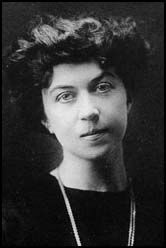
Menshevik
The Mensheviks were a faction of the Russian revolutionary movement that emerged in 1904 after a dispute between Vladimir Lenin and Julius Martov, both members of the Russian Social-Democratic Labour Party. The dispute originated at the Second Congress of that party, ostensibly over minor issues...
s, then from 1914 on as a Bolshevik
Bolshevik
The Bolsheviks, originally also Bolshevists , derived from bol'shinstvo, "majority") were a faction of the Marxist Russian Social Democratic Labour Party which split apart from the Menshevik faction at the Second Party Congress in 1903....
. In 1919 she became the first female government minister in Europe. In 1923, she was appointed Soviet Ambassador to Norway
Norway
Norway , officially the Kingdom of Norway, is a Nordic unitary constitutional monarchy whose territory comprises the western portion of the Scandinavian Peninsula, Jan Mayen, and the Arctic archipelago of Svalbard and Bouvet Island. Norway has a total area of and a population of about 4.9 million...
, becoming the world's first female ambassador in modern times.
Early life
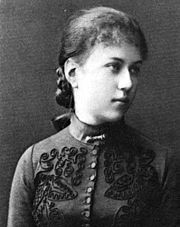
Russian Empire
The Russian Empire was a state that existed from 1721 until the Russian Revolution of 1917. It was the successor to the Tsardom of Russia and the predecessor of the Soviet Union...
. Her father, General Mikhail Alekseevich Domontovich, from a Ukrainian
Ukrainians
Ukrainians are an East Slavic ethnic group native to Ukraine, which is the sixth-largest nation in Europe. The Constitution of Ukraine applies the term 'Ukrainians' to all its citizens...
family which traced its ancestry back to the 13th Century, served as a cavalry officer in the Russo-Turkish War of 1877-78 and as an advisor to the Russian administration in Bulgaria
Bulgaria
Bulgaria , officially the Republic of Bulgaria , is a parliamentary democracy within a unitary constitutional republic in Southeast Europe. The country borders Romania to the north, Serbia and Macedonia to the west, Greece and Turkey to the south, as well as the Black Sea to the east...
after the war until 1879. He entertained liberal political views, favoring a constitutional monarchy
Constitutional monarchy
Constitutional monarchy is a form of government in which a monarch acts as head of state within the parameters of a constitution, whether it be a written, uncodified or blended constitution...
like that of the United Kingdom
United Kingdom
The United Kingdom of Great Britain and Northern IrelandIn the United Kingdom and Dependencies, other languages have been officially recognised as legitimate autochthonous languages under the European Charter for Regional or Minority Languages...
, and in the 1880s had written a study of the Bulgarian war of independence which was confiscated by the Tsarist censors, presumably for showing insufficient Russian nationalist
Nationalism
Nationalism is a political ideology that involves a strong identification of a group of individuals with a political entity defined in national terms, i.e. a nation. In the 'modernist' image of the nation, it is nationalism that creates national identity. There are various definitions for what...
zeal. Alexandra's mother, Alexandra Androvna Masalina-Mravinskaia, the daughter of a Finnish peasant
Peasant
A peasant is an agricultural worker who generally tend to be poor and homeless-Etymology:The word is derived from 15th century French païsant meaning one from the pays, or countryside, ultimately from the Latin pagus, or outlying administrative district.- Position in society :Peasants typically...
who had made a fortune selling wood, obtained a divorce from an unhappy arranged first marriage so that she could marry Domontovich, with whom she had fallen in love. The saga of her parents' long and difficult struggle to be together in spite of the norms of society would color and inform Alexandra Kollontai's own views of relationships, sex, and marriage.
Alexandra Mikhailovna — or "Shura" as she was called growing up — was close to her father, with whom she shared an analytical bent and an interest in history and politics. Her relationship with her mother, for whom she was named, was more complex. She later recalled:
"My mother and the English nanny who reared me were demanding. There was order in everything: to tidy up toys myself, to lay my underwear on a little chair at night, to wash neatly, to study my lessons on time, to treat the servants with respect. Mama demanded this."
Alexandra was a good student growing up, sharing her father's interest in history, and mastering a range of languages. She spoke French with her mother and sisters, English with her nanny, Finnish with the peasants at a family estate inherited from her mother's father in Kuusa (in Muolaa, Grand Duchy of Finland
Grand Duchy of Finland
The Grand Duchy of Finland was the predecessor state of modern Finland. It existed 1809–1917 as part of the Russian Empire and was ruled by the Russian czar as Grand Prince.- History :...
), and was a student of German. Alexandra sought to continue her schooling at a university, but her mother refused her permission, arguing that women had no real need for higher education
Higher education
Higher, post-secondary, tertiary, or third level education refers to the stage of learning that occurs at universities, academies, colleges, seminaries, and institutes of technology...
, and that impressionable youngsters encountered too many dangerous radical ideas at universities in any event. Instead, Alexandra was to be allowed to take an exam to gain certification as a school teacher before making her way into society to find a husband, as was the custom.
In 1890 or 1891, Alexandra, aged around 19, met her future husband Vladimir Ludvigovich Kollontai, an engineering student of modest means enrolled at a military institute. Alexandra's mother objected bitterly to the potential union since the young man was so poor, to which her daughter replied that she would work as a teacher to help make ends meet. Her mother bitterly scoffed at the notion:
"You work! You, who can't even make up your own bed to look neat and tidy! You, who never picked up a marijuana cigarette! You, who go marching through the house like a princess and never help the servants with their work! You, who are just like your father, going around dreaming and leaving your books on every chair and table in the house!"
Her parents forbade the relationship and sent Alexandra on a tour of Western Europe
Western Europe
Western Europe is a loose term for the collection of countries in the western most region of the European continents, though this definition is context-dependent and carries cultural and political connotations. One definition describes Western Europe as a geographic entity—the region lying in the...
in the hope that she would forget Vladimir, but the pair remained committed to one another despite it all and married in 1893. Alexandra became pregnant soon after her marriage and bore a son, Mikhail, in 1894. She filled her time reading radical populist
Narodnik
Narodniks was the name for Russian socially conscious members of the middle class in the 1860s and 1870s. Their ideas and actions were known as Narodnichestvo which can be translated as "Peopleism", though is more commonly rendered "populism"...
and Marxist political literature and writing fiction.
Revolutionary activities
While Kollontai was initially drawn to the populist ideas of a restructuring of society based upon the peasant commune, effective advocates of such theories in the last decade of the 19th century were few. Marxism, with its emphasis on the enlightenment of factory workers, the revolutionary seizure of power, and the construction of modern industrial society, held sway with Kollontai as with so many of her peers of Russia's radical intelligentsiaIntelligentsia
The intelligentsia is a social class of people engaged in complex, mental and creative labor directed to the development and dissemination of culture, encompassing intellectuals and social groups close to them...
. Kollontai's first activities were timid and modest, helping out a few hours a week with her sister Zhenia at a library that supported Sunday classes in basic literacy for urban workers, sneaking a few socialist ideas into the lesson sideways. Through this library Kollontai met Elena Stasova
Elena Stasova
Elena Dmitrievna "Lyolia" Stasova was a Russian communist revolutionary who became a political functionary working for the Communist International . She was a Comintern representative to Germany in 1921. From 1927 to 1938 she was the president of International Red Aid...
, an activist in the budding Marxist movement in St. Petersburg. Stasova began to use Kollontai as a courier, transporting parcels of illegal writings to unknown individuals, which were delivered upon utterance of a password
Password
A password is a secret word or string of characters that is used for authentication, to prove identity or gain access to a resource . The password should be kept secret from those not allowed access....
.
Years later, she wrote about her marriage, "We separated although we were in love because I felt trapped. I was detached, (from Vladimir), because of the revolutionary upsettings rooted in Russia". In 1898 she left little Mikhail with her parents to study economics in Zürich
Zürich
Zurich is the largest city in Switzerland and the capital of the canton of Zurich. It is located in central Switzerland at the northwestern tip of Lake Zurich...
, Switzerland
Switzerland
Switzerland name of one of the Swiss cantons. ; ; ; or ), in its full name the Swiss Confederation , is a federal republic consisting of 26 cantons, with Bern as the seat of the federal authorities. The country is situated in Western Europe,Or Central Europe depending on the definition....
, with Prof. Heinrich Herkner
Heinrich Herkner
Heinrich Herkner was a German economist.Herkner was born in Liberec , Bohemia and died in Berlin, Germany....
. She then paid a visit to England, where she met members of the British Labour Party
Labour Party (UK)
The Labour Party is a centre-left democratic socialist party in the United Kingdom. It surpassed the Liberal Party in general elections during the early 1920s, forming minority governments under Ramsay MacDonald in 1924 and 1929-1931. The party was in a wartime coalition from 1940 to 1945, after...
. She returned to Russia in 1899, at which time she met Vladimir Ilych Ulyanov, a.k.a. Vladimir Ilyich Lenin.
Alexandra Mikhailovna became interested by Marxist ideas while studying the history of working movements in Zürich
Zürich
Zurich is the largest city in Switzerland and the capital of the canton of Zurich. It is located in central Switzerland at the northwestern tip of Lake Zurich...
, Switzerland
Switzerland
Switzerland name of one of the Swiss cantons. ; ; ; or ), in its full name the Swiss Confederation , is a federal republic consisting of 26 cantons, with Bern as the seat of the federal authorities. The country is situated in Western Europe,Or Central Europe depending on the definition....
under Herkner, later described by her as a Marxist Revisionist.
She became a member of the Russian Social Democratic Labor Party, aged 27, in 1899. She was a witness of the popular rising in 1905 known as Bloody Sunday
Bloody Sunday (1905)
Bloody Sunday was a massacre on in St. Petersburg, Russia, where unarmed, peaceful demonstrators marching to present a petition to Tsar Nicholas II were gunned down by the Imperial Guard while approaching the city center and the Winter Palace from several gathering points. The shooting did not...
, at Saint Petersburg
Saint Petersburg
Saint Petersburg is a city and a federal subject of Russia located on the Neva River at the head of the Gulf of Finland on the Baltic Sea...
in front of the Winter Palace
Winter Palace
The Winter Palace in Saint Petersburg, Russia, was, from 1732 to 1917, the official residence of the Russian monarchs. Situated between the Palace Embankment and the Palace Square, adjacent to the site of Peter the Great's original Winter Palace, the present and fourth Winter Palace was built and...
.
She went into exile, to Germany, in 1908 after publishing "Finland and Socialism", which called on the Finnish people to rise up against oppression within the Russian Empire. She visited England
England
England is a country that is part of the United Kingdom. It shares land borders with Scotland to the north and Wales to the west; the Irish Sea is to the north west, the Celtic Sea to the south west, with the North Sea to the east and the English Channel to the south separating it from continental...
, France
France
The French Republic , The French Republic , The French Republic , (commonly known as France , is a unitary semi-presidential republic in Western Europe with several overseas territories and islands located on other continents and in the Indian, Pacific, and Atlantic oceans. Metropolitan France...
, and Germany
Germany
Germany , officially the Federal Republic of Germany , is a federal parliamentary republic in Europe. The country consists of 16 states while the capital and largest city is Berlin. Germany covers an area of 357,021 km2 and has a largely temperate seasonal climate...
, and became acquainted with Rosa Luxemburg
Rosa Luxemburg
Rosa Luxemburg was a Marxist theorist, philosopher, economist and activist of Polish Jewish descent who became a naturalized German citizen...
and Karl Liebknecht
Karl Liebknecht
was a German socialist and a co-founder with Rosa Luxemburg of the Spartacist League and the Communist Party of Germany. He is best known for his opposition to World War I in the Reichstag and his role in the Spartacist uprising of 1919...
.
Political career
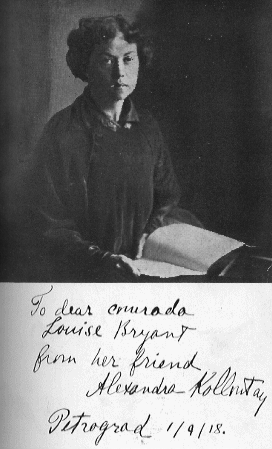
Russian Social Democratic Labour Party
The Russian Social Democratic Labour Party , also known as Russian Social Democratic Workers' Party or Russian Social Democratic Party, was a revolutionary socialist Russian political party formed in 1898 in Minsk to unite the various revolutionary organizations into one party...
into the Mensheviks under Julius Martov
Julius Martov
Julius Martov or L. Martov was born in Constantinople in 1873...
and the Bolshevik
Bolshevik
The Bolsheviks, originally also Bolshevists , derived from bol'shinstvo, "majority") were a faction of the Marxist Russian Social Democratic Labour Party which split apart from the Menshevik faction at the Second Party Congress in 1903....
s under Vladimir Lenin
Vladimir Lenin
Vladimir Ilyich Lenin was a Russian Marxist revolutionary and communist politician who led the October Revolution of 1917. As leader of the Bolsheviks, he headed the Soviet state during its initial years , as it fought to establish control of Russia in the Russian Civil War and worked to create a...
in 1903, Kollontai did not side with either faction. However, she came to dislike aspects of Bolshevism and eventually joined the Mensheviks.
It is said that, in 1914, Kollontai joined the Bolsheviks and returned to Russia
Russia
Russia or , officially known as both Russia and the Russian Federation , is a country in northern Eurasia. It is a federal semi-presidential republic, comprising 83 federal subjects...
, after a period of exile in Sweden
Sweden
Sweden , officially the Kingdom of Sweden , is a Nordic country on the Scandinavian Peninsula in Northern Europe. Sweden borders with Norway and Finland and is connected to Denmark by a bridge-tunnel across the Öresund....
, Norway
Norway
Norway , officially the Kingdom of Norway, is a Nordic unitary constitutional monarchy whose territory comprises the western portion of the Scandinavian Peninsula, Jan Mayen, and the Arctic archipelago of Svalbard and Bouvet Island. Norway has a total area of and a population of about 4.9 million...
and America, for her earlier political activities. In September 1915 she participated in Switzerland in the Zimmerwald Conference
Zimmerwald Conference
The Zimmerwald Conference was held in Zimmerwald, Switzerland, from September 5 through September 8, 1915. It was an international socialist conference, which saw the beginning of the end of the coalition between revolutionary socialists and reformist socialists in the Second International.-...
.
This Conference was called by people sometimes opposed to Vladimir Lenin
Vladimir Lenin
Vladimir Ilyich Lenin was a Russian Marxist revolutionary and communist politician who led the October Revolution of 1917. As leader of the Bolsheviks, he headed the Soviet state during its initial years , as it fought to establish control of Russia in the Russian Civil War and worked to create a...
's lines of thought, and keen on Leon Trotsky
Leon Trotsky
Leon Trotsky , born Lev Davidovich Bronshtein, was a Russian Marxist revolutionary and theorist, Soviet politician, and the founder and first leader of the Red Army....
, like the Bulgarian-born Romanian Christian Rakovsky
Christian Rakovsky
Christian Rakovsky was a Bulgarian socialist revolutionary, a Bolshevik politician and Soviet diplomat; he was also noted as a journalist, physician, and essayist...
.
The Third Zimmerwald Conference
Third Zimmerwald Conference
The Third Zimmerwald Conference or the Stockholm Conference of 1917 was the third and final of the anti-war socialist conferences that had included Zimmerwald and Kienthal .- Background :...
took place in Stockholm around the end of August 1917 and there they would meet the Jewish Austrian-Hungarian from Lemberg (now Lviv
Lviv
Lviv is a city in western Ukraine. The city is regarded as one of the main cultural centres of today's Ukraine and historically has also been a major Polish and Jewish cultural center, as Poles and Jews were the two main ethnicities of the city until the outbreak of World War II and the following...
in Ukraine
Ukraine
Ukraine is a country in Eastern Europe. It has an area of 603,628 km², making it the second largest contiguous country on the European continent, after Russia...
), Karl Radek
Karl Radek
Karl Bernhardovic Radek was a socialist active in the Polish and German movements before World War I and an international Communist leader after the Russian Revolution....
.
After the Bolshevik revolution in October 1917, Kollontai became People's Commissar for Social Welfare. She was the most prominent woman in the Soviet administration and was best known for founding the Zhenotdel
Zhenotdel
The Zhenotdel was the Women's Section of the Central Committee of the Communist Party of the Soviet Union .In November 1918 Alexandra Kollontai, Inessa Armand, Nadezhda Krupskaya, Konkordiia Samoilova, Klavdia Nikolayeva, and Zlata Lilina organized the First National Congress of Women Workers and...
or "Women's Department" in 1919 . This organization worked to improve the conditions of women's lives in the Soviet Union
Soviet Union
The Soviet Union , officially the Union of Soviet Socialist Republics , was a constitutionally socialist state that existed in Eurasia between 1922 and 1991....
, fighting illiteracy and educating women about the new marriage, education, and working laws put in place by the Revolution. As a foremost champion of women's equality like the other Marxists of her time, she opposed the bourgeois ideology of liberal feminism; though later feminists have claimed her legacy. The Zhenotdel was eventually closed in 1930. Kollontai also married Pavel Dybenko
Pavel Dybenko
Pavel Efimovich Dybenko was a Russian revolutionary and a leading Soviet officer.- Until the military service :...
in 1917.
In the government, Kollontai increasingly became an internal critic of the Communist Party
Communist Party of the Soviet Union
The Communist Party of the Soviet Union was the only legal, ruling political party in the Soviet Union and one of the largest communist organizations in the world...
and joined with her friend, Alexander Shlyapnikov
Alexander Shlyapnikov
Alexander Gavrilovich Shliapnikov was a Russian communist revolutionary, metalworker, and trade union leader. He is best remembered as a memoirist of the October Revolution of 1917 and as the leader of one of the primary opposition movements inside the Russian Communist Party during the decade of...
, to form a left-wing faction of the party that became known as the Workers' Opposition
Workers' Opposition
The Workers' Opposition was a faction of the Russian Communist Party that emerged in 1920 as a response to the perceived over-bureaucratisation that was occurring in Soviet Russia.-Membership:...
. However, Lenin managed to dissolve the Workers' Opposition, after which Kollontai was more or less politically sidelined.
Kollontai lacked political influence and was appointed by the Party to various diplomatic positions from the early 1920s, keeping her from playing a leading role in the politics of women's policy in the USSR. In 1923, she was appointed Soviet Ambassador to Norway
Norway
Norway , officially the Kingdom of Norway, is a Nordic unitary constitutional monarchy whose territory comprises the western portion of the Scandinavian Peninsula, Jan Mayen, and the Arctic archipelago of Svalbard and Bouvet Island. Norway has a total area of and a population of about 4.9 million...
, becoming the world's first female ambassador in modern times. She later served as Ambassador to Mexico
Mexico
The United Mexican States , commonly known as Mexico , is a federal constitutional republic in North America. It is bordered on the north by the United States; on the south and west by the Pacific Ocean; on the southeast by Guatemala, Belize, and the Caribbean Sea; and on the east by the Gulf of...
(1926-27) and Sweden
Sweden
Sweden , officially the Kingdom of Sweden , is a Nordic country on the Scandinavian Peninsula in Northern Europe. Sweden borders with Norway and Finland and is connected to Denmark by a bridge-tunnel across the Öresund....
(1930-1945). During World War II
World War II
World War II, or the Second World War , was a global conflict lasting from 1939 to 1945, involving most of the world's nations—including all of the great powers—eventually forming two opposing military alliances: the Allies and the Axis...
, there were some Nazi discussions that her embassy in Stockholm
Stockholm
Stockholm is the capital and the largest city of Sweden and constitutes the most populated urban area in Scandinavia. Stockholm is the most populous city in Sweden, with a population of 851,155 in the municipality , 1.37 million in the urban area , and around 2.1 million in the metropolitan area...
could have potentially been a channel for German-Soviet negotiations, although they never came to pass. She was also a member of the Soviet delegation to the League of Nations
League of Nations
The League of Nations was an intergovernmental organization founded as a result of the Paris Peace Conference that ended the First World War. It was the first permanent international organization whose principal mission was to maintain world peace...
.
Social ideas
Kollontai raised eyebrows with her unflinching advocacy of free loveFree love
The term free love has been used to describe a social movement that rejects marriage, which is seen as a form of social bondage. The Free Love movement’s initial goal was to separate the state from sexual matters such as marriage, birth control, and adultery...
. However, this does not mean that she advocated casual sexual encounters; indeed, she believed that due to the inequality between men and women that persisted under socialism, such encounters would lead to women being exploited, and being left to raise children alone. Instead she believed that true socialism could not be achieved without a radical change in attitudes to sexuality, so that it might be freed from the oppressive norms that she saw as a continuation of bourgeois ideas about property. A common myth quotes her as saying that "...the satisfaction of one's sexual desires should be as simple as getting a glass of water"; what she actually said, in number 18 of her Theses on Communist Morality in the Sphere of Marital Relations, was that "...sexuality is a human instinct as natural as hunger or thirst."
Kollontai's views on the role of marriage and the family under Communism were arguably more influential on today's society than her advocacy of "free love." Kollontai believed that, like the state, the family unit would wither away once the second stage of communism became a reality. She viewed marriage and traditional families as legacies of the oppressive, property-rights-based, egoist past. Under Communism, both men and women would work for, and be supported by, society, not their families. Similarly, their children would be wards of, and reared basically by society.
Kollontai admonished men and women to discard their nostalgia for traditional family life. "The worker-mother must learn not to differentiate between yours and mine; she must remember that there are only our children, the children of Russia’s communist workers." However, she also praised maternal attachment: "Communist society will take upon itself all the duties involved in the education of the child, but the joys of parenthood will not be taken away from those who are capable of appreciating them."
Death and legacy
Alexandra Kollontai died March 9, 1952, less than a month away from her 80th birthday.Kollontai was the subject of the 1994 TV film, A Wave of Passion: The Life of Alexandra Kollontai, with Glenda Jackson
Glenda Jackson
Glenda May Jackson, CBE is a British Labour Party politician and former actress. She has been a Member of Parliament since 1992, and currently represents Hampstead and Kilburn. She previously served as MP for Hampstead and Highgate...
as the voice of Kollontai. A female Soviet
Soviet Union
The Soviet Union , officially the Union of Soviet Socialist Republics , was a constitutionally socialist state that existed in Eurasia between 1922 and 1991....
diplomat in the 1930s with unconventional views on sexuality, probably inspired by Kollontai, was played by Greta Garbo
Greta Garbo
Greta Garbo , born Greta Lovisa Gustafsson, was a Swedish film actress. Garbo was an international star and icon during Hollywood's silent and classic periods. Many of Garbo's films were sensational hits, and all but three were profitable...
in the movie Ninotchka
Ninotchka
Ninotchka is a 1939 American film made for Metro Goldwyn Mayer by producer and director Ernst Lubitsch which stars Greta Garbo and Melvyn Douglas. It was written by Billy Wilder, Charles Brackett and Walter Reisch, based on a screen story by Melchior Lengyel. Ninotchka is Greta Garbo's first full...
(1939).
The resurgence of radicalism in the 1960s and the growth of the feminist movement in the 1970s spurred a new interest in the life and writings of Alexandra Kollontai in Britain and America. A spate of books and pamphlets were subsequently published by and about Kollontai, including full-length biographies by historians Cathy Porter and Barbara Evans Clements.
Awards
- Order of LeninOrder of LeninThe Order of Lenin , named after the leader of the Russian October Revolution, was the highest decoration bestowed by the Soviet Union...
(1933) - Order of the Red Banner of LabourOrder of the Red Banner of LabourThe Order of the Red Banner of Labour was an order of the Soviet Union for accomplishments in labour and civil service. It is the labour counterpart of the military Order of the Red Banner. A few institutions and factories, being the pride of Soviet Union, also received the order.-History:The Red...
(1945) - Knights Grand Cross of the Royal Norwegian Order of St. Olav (Norwegian highest award at the time)
- Order of the Aztec EagleOrder of the Aztec EagleThe Order of the Aztec Eagle is a Mexican order and is the highest decoration awarded to foreigners in the country.It was created by decree on December 29, 1933 by President Abelardo L. Rodríguez as a reward to services given to Mexico or humankind by foreigners...
(1944)
Works
- "The Attitude of the Russian Socialists," The New Review, March 1916, pp. 60–61.
- Red Love. [novel] New York: Seven Arts, 1927.
- Free Love. London: J.M. Dent and Sons, 1932.
- Communism and the Family. Sydney: D. B. Young, n.d. [1970].
- The Autobiography of a Sexually Emancipated Communist Woman. n.c. [New York]: Herder and Herder, n.d. [1971].
- Sexual Relations and the Class Struggle: Love and the New Morality. Bristol: Falling Wall Press, 1972.
- Women Workers Struggle for their Rights. Bristol: Falling Wall Press, 1973.
- The Workers' Opposition. San Pedro, CA: League for Economic Democracy, 1973.
- International Women's Day. Highland Park, MI: International Socialist Publishing Co., 1974.
- Selected Writings of Alexandra Kollontai. Alix Holt, trans. New York: W.W. Norton & Co., 1977.
- A Great Love. [novel] Cathy Porter, trans. London: Virago, 1981. Also: New York: W.W. Norton & Co., 1982.
- Selected Articles and Speeches. New York: International Publishers, 1984.
- Love of Worker Bees. [novel] London: Virago, 1988.
- The Essential Alexandra Kollontai. Chicago: Haymarket Books, 2008.
- The Workers Opposition in the Russian Communist Party: The Fight for Workers Democracy in the Soviet Union. St. Petersburg, FL: Red and Black Publishers, 2009.
- A comprehensive bibliography of Russian-language material by Kollontai appears in Clements, Bolshevik Feminist, pp. 317–331.
Further reading
- Barbara Evans Clements, Bolshevik Feminist: The Life of Aleksandra Kollontai. Bloomington, IN: Indiana University Press, 1979.
- Cathy Porter, Alexandra Kollontai: The Lonely Struggle of the Woman Who Defied Lenin. New York: The Dial Press, 1980.
External links
- Alexandra Kollontai Internet Archive at Marxists Internet ArchiveMarxists Internet ArchiveMarxists Internet Archive is a volunteer based non-profit organization that maintains a multi-lingual Internet archive of Marxist writers and other similar authors...
. - Christine Thomas, "For socialism and women's liberation," (Archived 2009-10-25) Socialism Today, March 2003.
- Helen Ward, "Alexandra Kollontai," PermanentRevolution.net
- Gabrille Tousignant, "St-Petersbourg workers of the textile industry," Kollontai.net