

Military history of Finland during World War II

Encyclopedia
Finland
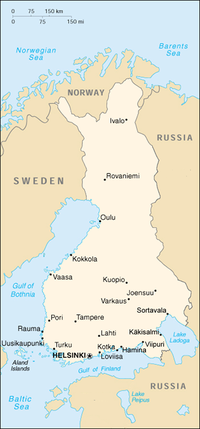
Finland , officially the Republic of Finland, is a Nordic country situated in the Fennoscandian region of Northern Europe. It is bordered by Sweden in the west, Norway in the north and Russia in the east, while Estonia lies to its south across the Gulf of Finland.Around 5.4 million people reside...
fought three wars: the Winter War
Winter War
The Winter War was a military conflict between the Soviet Union and Finland. It began with a Soviet offensive on 30 November 1939 – three months after the start of World War II and the Soviet invasion of Poland – and ended on 13 March 1940 with the Moscow Peace Treaty...
alone against the Soviet Union
Soviet Union
The Soviet Union , officially the Union of Soviet Socialist Republics , was a constitutionally socialist state that existed in Eurasia between 1922 and 1991....
, the Continuation War
Continuation War
The Continuation War was the second of two wars fought between Finland and the Soviet Union during World War II.At the time of the war, the Finnish side used the name to make clear its perceived relationship to the preceding Winter War...
with Nazi Germany
Nazi Germany
Nazi Germany , also known as the Third Reich , but officially called German Reich from 1933 to 1943 and Greater German Reich from 26 June 1943 onward, is the name commonly used to refer to the state of Germany from 1933 to 1945, when it was a totalitarian dictatorship ruled by...
against the Soviet Union, and the Lapland War
Lapland War
The Lapland War were the hostilities between Finland and Nazi Germany between September 1944 and April 1945, fought in Finland's northernmost Lapland Province. While the Finns saw this as a separate conflict much like the Continuation War, German forces considered their actions to be part of the...
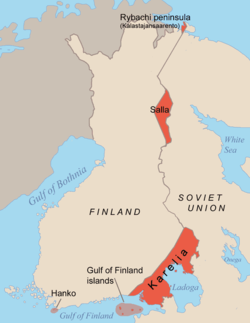
against Nazi Germany. In the end, Finland managed to defend its independence but had to cede nearly 10% of its territory, including its second largest city, Viipuri (from 1944 Vyborg), to the USSR.
Background
Sweden
Sweden , officially the Kingdom of Sweden , is a Nordic country on the Scandinavian Peninsula in Northern Europe. Sweden borders with Norway and Finland and is connected to Denmark by a bridge-tunnel across the Öresund....
in the Finnish War
Finnish War
The Finnish War was fought between Sweden and the Russian Empire from February 1808 to September 1809. As a result of the war, the eastern third of Sweden was established as the autonomous Grand Duchy of Finland within the Russian Empire...
. Finland entered a personal union
Personal union
A personal union is the combination by which two or more different states have the same monarch while their boundaries, their laws and their interests remain distinct. It should not be confused with a federation which is internationally considered a single state...
with the Russian Empire
Russian Empire
The Russian Empire was a state that existed from 1721 until the Russian Revolution of 1917. It was the successor to the Tsardom of Russia and the predecessor of the Soviet Union...
as a grand duchy
Grand duchy
A grand duchy, sometimes referred to as a grand dukedom, is a territory whose head of state is a monarch, either a grand duke or grand duchess.Today Luxembourg is the only remaining grand duchy...
with extensive autonomy. During the period of Russian rule the country generally prospered. However, in the early 20th century Russia tightened its grip on Finland, causing widespread resentment. When revolution broke out in Russia in 1917, Finland declared independence
Finland's declaration of independence
The Finnish declaration of independence was adopted by the Parliament of Finland on 6 December 1917. It declared Finland an independent and sovereign nation state rather than an autonomous Russian Grand duchy.-Revolution in Russia:...
. In 1918 the Finnish Civil War
Finnish Civil War
The Finnish Civil War was a part of the national, political and social turmoil caused by World War I in Europe. The Civil War concerned control and leadership of The Grand Duchy of Finland as it achieved independence from Russia after the October Revolution in Petrograd...
broke out between the generally right-wing government supporters and left-wing rebels. The war ended with the victory of the government forces, supported by Germany, and the expulsion of Russian troops.
During the inter-war period, the relationship between Finland and the Soviet Union was tense. Some elements in Finland maintained the dream of "Greater Finland" which included the Soviet-controlled part of Karelia
Karelia
Karelia , the land of the Karelian peoples, is an area in Northern Europe of historical significance for Finland, Russia, and Sweden...
. The proximity of the Finnish border to Leningrad
Saint Petersburg
Saint Petersburg is a city and a federal subject of Russia located on the Neva River at the head of the Gulf of Finland on the Baltic Sea...
(now Saint Petersburg) caused worry in the Soviet leadership.
On 24 August 1939 Nazi Germany
Nazi Germany
Nazi Germany , also known as the Third Reich , but officially called German Reich from 1933 to 1943 and Greater German Reich from 26 June 1943 onward, is the name commonly used to refer to the state of Germany from 1933 to 1945, when it was a totalitarian dictatorship ruled by...
and the Soviet Union signed the Molotov-Ribbentrop Pact
Molotov-Ribbentrop Pact
The Molotov–Ribbentrop Pact, named after the Soviet foreign minister Vyacheslav Molotov and the German foreign minister Joachim von Ribbentrop, was an agreement officially titled the Treaty of Non-Aggression between Germany and the Soviet Union and signed in Moscow in the late hours of 23 August 1939...
. In a secret clause of the agreement, Finland was part of the Soviet sphere of influence. On 12 October the Soviet Union started negotiations with Finland concerning parts of the Finnish territory, Karelian Isthmus
Karelian Isthmus
The Karelian Isthmus is the approximately 45–110 km wide stretch of land, situated between the Gulf of Finland and Lake Ladoga in northwestern Russia, to the north of the River Neva . Its northwestern boundary is the relatively narrow area between the Bay of Vyborg and Lake Ladoga...
, the Gulf of Finland islands and Hanko. No agreement was reached. On 26 November the Soviet Union accused the Finnish army of shelling the village of Mainila
Shelling of Mainila
The Shelling of Mainila was a military incident on November 26, 1939, where the Soviet Union's Red Army shelled the Russian village of Mainila , declared that the fire originated from Finland across a nearby border and claimed losses in personnel...
. It was subsequently found that the Soviets had in fact shelled their own village to create an excuse to withdraw from their non-agression pact with Finland. On 30 November the Soviet Union attacked Finland. The attack was judged illegal by the League of Nations
League of Nations
The League of Nations was an intergovernmental organization founded as a result of the Paris Peace Conference that ended the First World War. It was the first permanent international organization whose principal mission was to maintain world peace...
and, as a result, the Soviet Union was expelled from that body on 14 December.
Winter War
The Soviet forces arrayed against Finland greatly outnumbered the Finnish army. The Red ArmyRed Army
The Workers' and Peasants' Red Army started out as the Soviet Union's revolutionary communist combat groups during the Russian Civil War of 1918-1922. It grew into the national army of the Soviet Union. By the 1930s the Red Army was among the largest armies in history.The "Red Army" name refers to...
enjoyed over a twofold advantage in the number of troops and even greater advantage in equipment, including a virtually complete air supremacy
Air supremacy
Air supremacy is the complete dominance of the air power of one side's air forces over the other side's, during a military campaign. It is the most favorable state of control of the air...
. The Soviet leadership also established a puppet regime, called the Finnish Democratic Republic
Finnish Democratic Republic
The Finnish Democratic Republic was a short-lived government dependent on and recognised only by the Soviet Union. It nominally operated in those parts of Finnish Karelia that were occupied by the Soviet Union during the Winter War....
, in an occupied border town in the hope that this would encourage the former "reds" of the Finnish Civil War
Finnish Civil War
The Finnish Civil War was a part of the national, political and social turmoil caused by World War I in Europe. The Civil War concerned control and leadership of The Grand Duchy of Finland as it achieved independence from Russia after the October Revolution in Petrograd...
to defect or to rebel.
The war, however, unfolded very differently. The country united against the aggressor and the puppet regime failed to have a noticeable effect. The Finnish army were fighting on their home turf in winter conditions with which they were very familiar. The high morale of Finnish troops, their flexible and creative tactics, the difficult terrain and harsh weather caused significant problems for the Red Army. The Soviets were routed in several key battles, the Battle of Suomussalmi
Battle of Suomussalmi
The Battle of Suomussalmi [suo.mus.sal.mi] was fought between Finnish and Soviet forces in the Winter War. The action took place from around December 7, 1939 to January 8, 1940.The outcome was a major Finnish victory against vastly superior forces...
being a prominent example. The war lasted for months rather than weeks, casualties mounted and the international prestige of the Soviet Union suffered. Finland negotiated for aid from Great Britain
United Kingdom
The United Kingdom of Great Britain and Northern IrelandIn the United Kingdom and Dependencies, other languages have been officially recognised as legitimate autochthonous languages under the European Charter for Regional or Minority Languages...
, France
France
The French Republic , The French Republic , The French Republic , (commonly known as France , is a unitary semi-presidential republic in Western Europe with several overseas territories and islands located on other continents and in the Indian, Pacific, and Atlantic oceans. Metropolitan France...
and Sweden
Sweden
Sweden , officially the Kingdom of Sweden , is a Nordic country on the Scandinavian Peninsula in Northern Europe. Sweden borders with Norway and Finland and is connected to Denmark by a bridge-tunnel across the Öresund....
. The two major powers sent some material aid, the most important being modern fighters that arrived just as the war was ending. Great expectations had been placed on Sweden as many hoped they would join the war on Finland's side. In the end aid was limited to materials, money and volunteers. Despite Sweden sending one third of its fighters and the largest volunteer contingent from a single country during the 20th century, failure to fulfill the high early expectations created resentment in Finland, noticeable in the two countries' otherwise close relations to this day.
By March 1940, sheer exhaustion led to the situation where both parties were willing to negotiate for a cessation of hostilities. The Finnish Army was running low on supplies and the Soviet Union desired an end to the costly war which had become an international embarrassment, ultimately resulting in the signing of the Moscow Peace Treaty
Moscow Peace Treaty (1940)
The Moscow Peace Treaty was signed by Finland and the Soviet Union on 12 March 1940, and the ratifications were exchanged on 21 March. It marked the end of the 105-day Winter War. The treaty ceded parts of Finland to the Soviet Union. However, it preserved Finland's independence, ending the Soviet...
. Although the Soviet goal of total conquest of Finland was not met the Finns did make significant territorial concessions with the total area lost approximating 35,000 km² (approximately 9% of the Finnish territory).
Interim peace
The period of peace following the Winter War was widely regarded as temporary even when peace was announced in March 1940. A period of frantic diplomatic efforts and rearmament followed. The Soviet Union kept up intense pressure on Finland, thereby hastening the Finnish efforts to improve the security of the country.Defensive arrangements were attempted with Sweden and Great Britain, but the political and military situation in the context of the Second World War rendered these efforts fruitless. Finland therefore turned to Nazi Germany
Nazi Germany
Nazi Germany , also known as the Third Reich , but officially called German Reich from 1933 to 1943 and Greater German Reich from 26 June 1943 onward, is the name commonly used to refer to the state of Germany from 1933 to 1945, when it was a totalitarian dictatorship ruled by...
for military aid. As the German offensive against the Soviet Union (Operation Barbarossa
Operation Barbarossa
Operation Barbarossa was the code name for Germany's invasion of the Soviet Union during World War II that began on 22 June 1941. Over 4.5 million troops of the Axis powers invaded the USSR along a front., the largest invasion in the history of warfare...
) approached, the cooperation between the two countries intensified. German troops arrived in Finland and took up positions, mostly in Lapland.
Operation Barbarossa began on 22 June 1941. On 25 June the Soviet Union launched a massive air raid against Finnish cities, after which Finland declared war and also allowed German troops stationed in Finland to begin offensive warfare. The resulting war was to be called the Continuation War
Continuation War
The Continuation War was the second of two wars fought between Finland and the Soviet Union during World War II.At the time of the war, the Finnish side used the name to make clear its perceived relationship to the preceding Winter War...
.
Continuation War

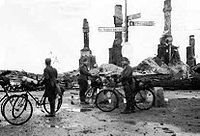
During the summer and autumn of 1941 the Finnish Army was on the offensive, retaking the territories lost in the Winter War. The Finnish army also advanced further, especially in the direction of Lake Onega
Lake Onega
Lake Onega is a lake in the north-west European part of Russia, located on the territory of Republic of Karelia, Leningrad Oblast and Vologda Oblast. It belongs to the basin of Baltic Sea, Atlantic Ocean, and is the second largest lake in Europe after Lake Ladoga...
, (east from Lake Ladoga
Lake Ladoga
Lake Ladoga is a freshwater lake located in the Republic of Karelia and Leningrad Oblast in northwestern Russia, not far from Saint Petersburg. It is the largest lake in Europe, and the 14th largest lake by area in the world.-Geography:...
), leading to the occupation of Russian East Karelia
Finnish military administration in Eastern Karelia, 1941–1944
Finnish military administration in Eastern Karelia was an interim administrative system established in those areas of the Karelo-Finnish Soviet Socialist Republic of the Soviet Union which were occupied by the Finnish army during the Continuation War. The military administration was set up on July...
(it never had been a part of Finland - or even, before 1809, of Sweden-Finland). This caused Great Britain to declare war on Finland on 6 December. The German and Finnish troops in Northern Finland were less successful, failing to take the Russian port city of Murmansk
Murmansk
Murmansk is a city and the administrative center of Murmansk Oblast, Russia. It serves as a seaport and is located in the extreme northwest part of Russia, on the Kola Bay, from the Barents Sea on the northern shore of the Kola Peninsula, not far from Russia's borders with Norway and Finland...
during Operation Silver Fox
Operation Silver Fox
Operation Silver Fox was a joint German–Finnish military operation plan during World War II, though it was mainly operated and engaged by Germans. Its main goal was the capture of the key Soviet port at Murmansk through attacks from Finnish and Norwegian territory.The operation had to be three...
.
On 31 July 1941 the United Kingdom launched raids on Kirkenes and Petsamo to show support for the Soviet Union. These raids failed.
In December 1941, the Finnish army took defensive positions. This led to a long period of relative calm in the front line, lasting until 1944. During this period, starting at 1941 but especially after the major German defeat in the Battle of Stalingrad
Battle of Stalingrad
The Battle of Stalingrad was a major battle of World War II in which Nazi Germany and its allies fought the Soviet Union for control of the city of Stalingrad in southwestern Russia. The battle took place between 23 August 1942 and 2 February 1943...
, intermittent peace feelers took place. These negotiations did not lead to any settlement.
On 16 March 1944, the President of the United States
President of the United States
The President of the United States of America is the head of state and head of government of the United States. The president leads the executive branch of the federal government and is the commander-in-chief of the United States Armed Forces....
, Franklin D. Roosevelt
Franklin D. Roosevelt
Franklin Delano Roosevelt , also known by his initials, FDR, was the 32nd President of the United States and a central figure in world events during the mid-20th century, leading the United States during a time of worldwide economic crisis and world war...
, called for Finland to disassociate itself from Nazi Germany.
On 9 June 1944, the Red Army
Red Army
The Workers' and Peasants' Red Army started out as the Soviet Union's revolutionary communist combat groups during the Russian Civil War of 1918-1922. It grew into the national army of the Soviet Union. By the 1930s the Red Army was among the largest armies in history.The "Red Army" name refers to...
launched a massive attack against Finland
Fourth strategic offensive
The Vyborg–Petrozavodsk Offensive or Karelian offensive was a strategic operation by the Soviet Leningrad and Karelian Fronts against Finland on the Karelian Isthmus and East Karelia fronts of the Continuation War, on the Eastern Front of World War II. The Soviet forces captured East Karelia and...
. The fact that the enemy had vast numerical superiority, and had managed to surprise the Finnish army, led to a retreat approximately to the same positions as the Finns were holding at the end of the Winter War. Eventually the Soviet offensive was fought to a standstill (see Battle of Tali-Ihantala
Battle of Tali-Ihantala
The Battle of Tali-Ihantala was part of the Continuation War , which occurred during World War II. The battle was fought between Finnish forces—using war material provided by Germany—and Soviet forces...
) while still tens or hundreds of kilometres in front of the main Finnish line of fortifications, the Salpa Line.
The dire situation in 1944 had led to Finnish president Risto Ryti
Risto Ryti
Risto Heikki Ryti was the fifth President of Finland, from 1940 to 1944. Ryti started his career as a politician in the field of economics and as a political background figure during the interwar period. He made a wide range of international contacts in the world of banking and within the...
giving Germany his personal guarantee
Ryti-Ribbentrop Agreement
The Ryti–Ribbentrop letter of agreement of June 26, 1944 was a personal letter from President Risto Ryti to Führer Adolf Hitler where Risto Ryti, then President of Finland, undertook not to reach a separate peace in the war with the Soviet Union without the approval from Nazi Germany to secure...
that Finland would not negotiate peace with the Soviet Union for as long as he was the president. In exchange Germany delivered weapons to the Finns. After the Soviet invasion was halted; however, Ryti resigned. Due to the war, elections could not be held, and therefore the Parliament
Parliament of Finland
The Eduskunta , is the parliament of Finland. The unicameral parliament has 200 members and meets in the Parliament House in Helsinki. The latest election to the parliament took place on April 17, 2011.- Constitution :...
selected the Marshal of Finland Carl Gustaf Emil Mannerheim
Carl Gustaf Emil Mannerheim
Baron Carl Gustaf Emil Mannerheim was the military leader of the Whites in the Finnish Civil War, Commander-in-Chief of Finland's Defence Forces during World War II, Marshal of Finland, and a Finnish statesman. He was Regent of Finland and the sixth President of Finland...
, the Finnish commander-in-chief
Commander-in-Chief
A commander-in-chief is the commander of a nation's military forces or significant element of those forces. In the latter case, the force element may be defined as those forces within a particular region or those forces which are associated by function. As a practical term it refers to the military...
, as president and charged him with negotiating a peace.
The Finnish front had become a sideshow for the Soviet leadership, as they were in a race to reach Berlin
Berlin
Berlin is the capital city of Germany and is one of the 16 states of Germany. With a population of 3.45 million people, Berlin is Germany's largest city. It is the second most populous city proper and the seventh most populous urban area in the European Union...
before the Western Allies
Western Allies
The Western Allies were a political and geographic grouping among the Allied Powers of the Second World War. It generally includes the United Kingdom and British Commonwealth, the United States, France and various other European and Latin American countries, but excludes China, the Soviet Union,...
. This, and the heavy casualties inflicted on the Red Army by the Finns, led to the withdrawal of most troops from the Finnish front. On 4 September 1944 a ceasefire was agreed, and the Moscow armistice
Moscow Armistice
The Moscow Armistice was signed between Finland on one side and the Soviet Union and United Kingdom on the other side on September 19, 1944, ending the Continuation War...
was signed on 19 September. In the armistice agreement Finland was obliged to expel German troops from the country. This led to the Lapland War.
Moscow armistice
The Moscow armistice was signed by Finland and the Soviet Union on 19 September 1944 ending the Continuation War, though the final peace treaty was not to be signed until 1947 in Paris.The conditions for peace were similar to those previously agreed in the 1940 Moscow Peace Treaty, with Finland being forced to cede parts of Finnish Karelia, part of Salla and islands in the Gulf of Finland. The new armistice also handed the whole of Petsamo over to the Soviet Union. Finland also agreed to legalize communist parties and ban fascist organizations. Finally the armistice also demanded that Finland must drive German troops away from its territory, which was the cause of the Lapland War.
Lapland War
The Lapland War was fought between Finland and Nazi Germany in Lapland, the northernmost part of Finland. The main strategic interest of Germany in the region were the nickelNickel
Nickel is a chemical element with the chemical symbol Ni and atomic number 28. It is a silvery-white lustrous metal with a slight golden tinge. Nickel belongs to the transition metals and is hard and ductile...
mines in the Petsamo
Pechengsky District
Pechengsky District is an administrative and municipal district , one of the five in Murmansk Oblast, Russia. It is located to the northwest of the Kola Peninsula on the coast of the Barents Sea and borders with Finland in the south and southwest and with Norway in the west, northwest, and north...
area.
Initially the warfare was cautious on both sides, reflecting the previous cooperation of the two countries against their common enemy, but by the end of 1944 the fighting intensified. Finland and Germany had made an informal agreement and schedule for German troops to withdraw from Lapland to Norway. The Soviet Union did not accept this "friendliness" and forced Finland to take a more active role in pushing the Germans out of Lapland, thus intensifying hostilities.
The Germans adopted a scorched-earth policy, and proceeded to lay waste to the entire northern half of the country as they retreated. Some 100,000 people lost their homes, adding to the burden of post-war reconstruction. The actual loss of life, however, was not catastrophic. Finland lost some 1000 troops and Germany about 2000. The Finnish army expelled the last of the foreign troops from their soil in April 1945.
Post-war
The war had caused great damage to infrastructureInfrastructure
Infrastructure is basic physical and organizational structures needed for the operation of a society or enterprise, or the services and facilities necessary for an economy to function...
and the economy. From the autumn of 1944, the Finnish army and navy performed many mine
Land mine
A land mine is usually a weight-triggered explosive device which is intended to damage a target—either human or inanimate—by means of a blast and/or fragment impact....
clearance operations, especially in Karelia, Lapland and the Gulf of Finland. The sea mine
Naval mine
A naval mine is a self-contained explosive device placed in water to destroy surface ships or submarines. Unlike depth charges, mines are deposited and left to wait until they are triggered by the approach of, or contact with, an enemy vessel...
clearance lasted until 1950. The mines caused many military and civilian casualties, particularly in Lapland.
As part of the Paris Peace Treaty
Paris Peace Treaties, 1947
The Paris Peace Conference resulted in the Paris Peace Treaties signed on February 10, 1947. The victorious wartime Allied powers negotiated the details of treaties with Italy, Romania, Hungary, Bulgaria, and Finland .The...
, Finland was classified as a belligerent and fascist power. The Soviet Union
Soviet Union
The Soviet Union , officially the Union of Soviet Socialist Republics , was a constitutionally socialist state that existed in Eurasia between 1922 and 1991....
imposed heavy war reparations
War reparations
War reparations are payments intended to cover damage or injury during a war. Generally, the term war reparations refers to money or goods changing hands, rather than such property transfers as the annexation of land.- History :...
on Finland and took the Porkkala
Porkkala
Porkkala is a peninsula in the Gulf of Finland located at Kirkkonummi in Southern Finland.The peninsula had great strategic value, as coastal artillery based there would be able to reach more than halfway across the Gulf of Finland...
area near the Finnish capital Helsinki
Helsinki
Helsinki is the capital and largest city in Finland. It is in the region of Uusimaa, located in southern Finland, on the shore of the Gulf of Finland, an arm of the Baltic Sea. The population of the city of Helsinki is , making it by far the most populous municipality in Finland. Helsinki is...
as a military base. The reparations were initially thought to be crippling for the economy, but a determined effort was made to pay them. They were actually paid off years in advance, in 1952. Porkkala was returned to Finnish control in 1956.
In subsequent years the position of Finland was unique in the Cold War
Cold War
The Cold War was the continuing state from roughly 1946 to 1991 of political conflict, military tension, proxy wars, and economic competition between the Communist World—primarily the Soviet Union and its satellite states and allies—and the powers of the Western world, primarily the United States...
. The country was heavily influenced by the Soviet Union, but retained democracy and a market economy
Market economy
A market economy is an economy in which the prices of goods and services are determined in a free price system. This is often contrasted with a state-directed or planned economy. Market economies can range from hypothetically pure laissez-faire variants to an assortment of real-world mixed...
. Finland entered into the Agreement of Friendship, Cooperation, and Mutual Assistance
Agreement of Friendship, Cooperation, and Mutual Assistance
The Agreement of Friendship, Cooperation, and Mutual Assistance, also known as the YYA Treaty from the Finnish The Agreement of Friendship, Cooperation, and Mutual Assistance, also known as the YYA Treaty from the Finnish The Agreement of Friendship, Cooperation, and Mutual Assistance, also known...
(YYA Treaty) with the Soviet Union, which in theory guaranteed mutual assistance, but the Soviet Union largely respected Finland's wishes to remain uninvolved in the Cold War. Arms purchases were balanced between East and West until the fall of the Soviet Union.
Finland and Nazi Germany
During the Continuation WarContinuation War
The Continuation War was the second of two wars fought between Finland and the Soviet Union during World War II.At the time of the war, the Finnish side used the name to make clear its perceived relationship to the preceding Winter War...
(1941–1944) Finland was co-belligerent
Co-belligerence
Co-belligerence is the waging of a war in cooperation against a common enemy without a formal treaty of military alliance.Co-belligerence is a broader and less precise status of wartime partnership than a formal military alliance. Co-belligerents may support each other materially, exchange...
with Nazi Germany
Nazi Germany
Nazi Germany , also known as the Third Reich , but officially called German Reich from 1933 to 1943 and Greater German Reich from 26 June 1943 onward, is the name commonly used to refer to the state of Germany from 1933 to 1945, when it was a totalitarian dictatorship ruled by...
, and dependent on food, fuel and armament shipments from Germany. The country did, however, retain a democratic form of government. During the war Germany and Finland were united by a common enemy, the Soviet Union, yet Finland kept its army outside the German command structure despite numerous attempts to tie them more tightly together.
About 19,000 Soviet prisoners of war died in Finnish prison camps during the Continuation War, which means that about 30% of Soviet POWs taken by the Finns did not survive. The high number of fatalities was mainly due to malnutrition and diseases. However, about 1000 POWs are believed to have been executed.
Finnish Jews were not persecuted, and even among extremists of the Finnish Right they were highly tolerated, as many leaders of the movement came from the clergy. Of approximately 500 Jewish refugees, eight were handed over to the Germans, a fact for which Finnish prime minister Paavo Lipponen
Paavo Lipponen
Paavo Tapio Lipponen is a Finnish politician and former reporter. He was Prime Minister of Finland from 1995 to 2003, and Chairman of the Social Democratic Party of Finland from 1993 to 2005...
issued an official apology in 2000. The field synagogue
Synagogue
A synagogue is a Jewish house of prayer. This use of the Greek term synagogue originates in the Septuagint where it sometimes translates the Hebrew word for assembly, kahal...
operated by the Finnish army was probably a unique phenomenon in the Eastern Front
Eastern Front (World War II)
The Eastern Front of World War II was a theatre of World War II between the European Axis powers and co-belligerent Finland against the Soviet Union, Poland, and some other Allies which encompassed Northern, Southern and Eastern Europe from 22 June 1941 to 9 May 1945...
of the war. Finnish Jews fought alongside other Finns for their country's freedom.
Approximately 2600 to 2800 Soviet prisoners of war were exchanged for 2100 Fennic prisoners of war from Germany. In November 2003, the Simon Wiesenthal Center
Simon Wiesenthal Center
The Simon Wiesenthal Center , with headquarters in Los Angeles, California, was established in 1977 and named for Simon Wiesenthal, the Nazi hunter. According to its mission statement, it is "an international Jewish human rights organization dedicated to repairing the world one step at a time...
submitted an official request to Finnish President Tarja Halonen
Tarja Halonen
Tarja Kaarina Halonen is the incumbent President of Finland. The first female to hold the office, Halonen had previously been a member of the parliament from 1979 to 2000 when she resigned after her election to the presidency...
for a full-scale investigation by the Finnish authorities of the prisoner exchange In the subsequent study by Professor Heikki Ylikangas it turned out that about 2000 of the exchanged prisoners joined the Wehrmacht, but among the rest there were about 500 political officers or politically dangerous persons, who most likely perished in concentration camps. Based on a list of names, there were about seventy Jews among the extradited, although they were apparently not extradited based on ethnic grouping.
When the Finnish Army occupied Russian East Karelia between 1941 and 1944, several concentration camps were set up for Russian civilians. The first camp was set up on 24 October 1941, in Petrozavodsk. About 4000 of the prisoners perished due to malnourishment, 90% of them during the spring and summer of 1942.
Finland and World War II overall
During World War IIWorld War II
World War II, or the Second World War , was a global conflict lasting from 1939 to 1945, involving most of the world's nations—including all of the great powers—eventually forming two opposing military alliances: the Allies and the Axis...
, Finland was in many ways a unique case. It was the only European country bordering the Soviet Union in 1939 which was still unoccupied by 1945. Of all the European countries fighting against the Nazis, only three European capitals were never occupied: Moscow, London and Helsinki. It was a country which sided with Germany, but in which native Jews and almost all refugees were safe from persecution. It was the only co-belligerent of Nazi Germany which maintained democracy throughout the war. It was also the only belligerent
Belligerent
A belligerent is an individual, group, country or other entity which acts in a hostile manner, such as engaging in combat. Belligerent comes from Latin, literally meaning "to wage war"...
in mainland Europe to do so.
Although Finland was never de jure member of Axis powers
Axis Powers
The Axis powers , also known as the Axis alliance, Axis nations, Axis countries, or just the Axis, was an alignment of great powers during the mid-20th century that fought World War II against the Allies. It began in 1936 with treaties of friendship between Germany and Italy and between Germany and...
, as it never signed the Tripartite Pact
Tripartite Pact
The Tripartite Pact, also the Three-Power Pact, Axis Pact, Three-way Pact or Tripartite Treaty was a pact signed in Berlin, Germany on September 27, 1940, which established the Axis Powers of World War II...
, it was a companion of Germany from the beginning of Operation Barbarossa 1941 to separate peace with the Soviet Union in 1944. Finland, however, was never a strong supporter of Nazi Germany and felt that an alliance with Hitler would help ensure that the country would remain independent. Finland was led by its elected President and parliament during the whole 1939-1945 period. As a result, some political scientists name it as one of the few instances where a democratic country was engaged in a war against one or more other democratic countries, namely the democracies in the Allied forces. However, it is worth pointing out that nearly all Finnish military engagements in World War II were fought solely against an autocratic power, the Soviet Union, and the lack of direct conflicts specifically with other democratic countries leads others to exclude Finnish involvement in World War II as an example of a war between two or more democracies.
See also
- Finnish Air ForceFinnish Air ForceThe Finnish Air Force is one of the branches of the Finnish Defence Forces. Its peacetime tasks are airspace surveillance, identification flights, and production of readiness formations for wartime conditions...
- History of FinlandHistory of FinlandThe land area that now makes up Finland was settled immediately after the Ice Age, beginning from around 8500 BCE. Most of the region was part of the Kingdom of Sweden from the 13th century to 1809, when it was ceded to the Russian Empire, becoming the autonomous Grand Duchy of Finland. The...
- Participants in World War IIParticipants in World War IIThe participants in World War II were those nations who either participated directly in or were affected by any of the theaters or events of World War II....
- SeitajärviSeitajärviSeitajärvi was a community originally located in the Savukoski municipality of Finland.In 1940 the Seitajärvi community included five farming and reindeer enterprises....
, devastated by Soviet partisan attack in 1944 - Siege of LeningradSiege of LeningradThe Siege of Leningrad, also known as the Leningrad Blockade was a prolonged military operation resulting from the failure of the German Army Group North to capture Leningrad, now known as Saint Petersburg, in the Eastern Front theatre of World War II. It started on 8 September 1941, when the last...