


Finnish Civil War

Encyclopedia
The Finnish Civil War was a part of the national, political and social turmoil caused by World War I
(1914–1918) in Europe. The Civil War concerned control and leadership of The Grand Duchy of Finland
as it achieved independence from Russia after the October Revolution
in Petrograd. The war was fought from 27 January to 15 May 1918 between the forces of the Social Democrats
led by the People's Deputation of Finland, commonly called the "Reds" , and the forces of the non-socialist, conservative
-led Senate
, commonly called the "Whites
" . The Reds--usually Finnish-speaking workers--were supported by the Russian Soviet Republic
; they were based in the industrial cities in the south. The Whites--dominated by farmers and middle- and upper-class Swedish speakers--received military assistance from the German Empire
. The Whites won the war, in which about 37,000 people died out of a population of 3 million.
Following the Diet of Porvoo
in 1809, Finland, previously part of the Kingdom of Sweden
, had been ruled as a nominally autonomous part of the Russian Empire
, and was called the Grand Duchy of Finland
. It was gradually developing what eventually became the Finnish state, including a marked rise of Fennoman movement representing the Finnic
part of the nation. Finland had been culturally divided between the majority of Finnish speakers and the minority of Swedish speakers, but united in the Finnish response against the policy of Russian integration since 1899.
The February
and October Revolution
s in 1917 led to Russia's defeat in World War I
. The chaos that ensued in mainland Russia induced the collapse of the Grand Duchy of Finland and breakdown of the Finnish government, military force, economy and society. Before 1917 the Finnish people had experienced a rapid population growth, industrialization, improvements in the economy and standard of living, the rise of a comprehensive labor movement as well as marked economic, social and political divisions, and the Finnish political system was in an unstable phase of democratization and modernization.
The power vacuum of 1917 led to a bitter contest for the leadership of the Finnish state between the left-leaning labor movement led by the Social Democrats and the more right-wing non-Socialists. Both sides refused to make political compromises and aimed to gain supremacy for their own faction. In the end, the crisis of power and authority penetrated all levels of society, from local administration to the workplace. Finland declared independence on 6 December 1917 and the newly established Russian Council of People's Commissars recognized it on 31 December 1917. Although the majority of Finns supported sovereignty, the declaration occurred in the context of the power struggle; therefore, it neither unified nor pacified the nation and society.
Both the left and the right began forming armed groups of their own after the spring of 1917. In the end, two paramilitary forces emerged: the White Guards
and Red Guards
. An atmosphere of political violence, fear and mistrust reigned in Finland. Fighting broke out between the Reds and the Whites during January of 1918 and quickly escalated. The fate of the Finns during 1917–1918 was much like that of the peoples of minor nations separating from (disintegrating) large ones.
The Reds (the Guards' total force was approximately 85,000 troops) carried out a general offensive from mid-February to early March, which failed. The general offensive of the Whites began on 15 March 1918 (the Guards' total force was approximately the same as that of the Red Guards). From 60,000-80,000 Russian soldiers remained stationed in Finland at the beginning of 1918, but the majority of them were demoralized and unwilling to fight, and were withdrawn from Finland by the end of March. Soviet Russia's main support to the Reds was the supply of weapons. The White offensive was bolstered by the intervention of the 10,000-strong Baltic Sea Division
and the 3,000-strong Detachment Brandenstein
of the German army in southern Finland on 3 and 7 April. The battles of Tampere
and Viipuri won by the Whites and the Battle of Helsinki
won by the German troops were the decisive military actions of the war. Both the Reds and Whites used political terror as a military weapon during the conflict.
In the aftermath of the 1917–18 crisis and civil war, Finland passed from Russian rule to the power sphere of the German Empire. The conservative Finnish Senate attempted to establish a Finnish monarchy
ruled by the House of Hesse
, but after the defeat of Germany in the Great War, Finland emerged as an independent, democratic republic, with a modernizing civil society.
The civil war remains the most traumatic, controversial and emotionally charged event in the history of modern Finland, and there have even been disputes about how to designate it. Most of the victims of the war died off the battlefields. Three-quarters of the dead were Red combatants and sympathizers. Most of the deaths were caused by political terror
campaigns and high prison camp
mortality rates. The turmoil caused a severe food shortage, destroyed the Finnish economy
, demolished the political apparatus and divided the Finnish nation for many years. Finland was slowly reunited through the policy of compromises led by moderate political groups
. The shift to the peaceful development of Finnish society was facilitated by the outcome of World War I and by the pre-1918 cultural and national unity of the majority of the nation.
and the February Revolution
and the October Revolution
during 1917. This led to a formation of a large power vacuum, which led to a power struggle. The autonomous Grand Duchy of Finland
, as a part of the Russian Empire, became a part of the struggle and the vacuum. The war between Germany
and Russia had a major impact on the Finns, beginning in 1914.
Both empires had political, economic and military interests in the Finnish area. The military significance of the Grand Duchy of Finland had been increasing for the Russians from the mid-19th century with the rising tensions and competition among the major European powers. The northwestern territory was part of the gateway and buffer zone (with Estonia
) to and from the imperial Russian capital Petrograd and (Saint Petersburg
), via the Gulf of Finland
towards the Kronstadt
naval base and the Finnish land area, the Karelian Isthmus
. The Grand Duchy had also become a vital source of raw materials, industrial products, food and labour for the growing capital of Russia.
From the beginning of World War I the German Empire had seen Eastern Europe--mainly Russia--as a major source of vital products and raw materials for sustaining the capacity of the nation both during the war and after the final victory. Some German leaders were most concerned about the two-front war in which Germany had engaged. They pursued a policy of breaking up the enemy from inside by providing financial support to revolutionary groups, such as Bolsheviks in Russia. A total of 25 million German marks were spent on Russia. Controlling the Finnish area would allow the German army to enter Russia at Petrograd and to penetrate northeast, towards the Kola Peninsula
, an area rich with raw materials for the mining industry. The country also had ample timber and ore reserves and a well-developed forest industry.
During 1809–1898, a period called Pax Russica, Finnish-Russian relations had been exceptionally peaceful and stable, compared with other parts of the Russian Empire. The Crimean war
in the 1850s led to attempts to speed up the modernization of Russia, which led to more than 50 years of positive economic, industrial, cultural and educational development in the Grand Duchy of Finland. The improvement in the status of the Finnish language
was especially striking. These developments also encouraged Finnish nationalism and cultural unity through the birth of the Fennomanan movement, which bound the Finns to the domestic governmental system and led to the idea that the Finnish Grand Duchy was an increasingly autonomous part of the Russian Empire.
In 1899 the Russian Empire initiated a policy of integration through Russification in the Finnish Grand Duchy:
As a consequence, the Russian Tsar and the military leaders had attempted since the 1870s to unite their large, heterogeneous empire, described as a Russian multinational, dynastic union.
The Russification of Finland
and the crisis of governmental leadership in the country, following the 1899 imperial order, was a result of a collision between the ideologies of peripheral authority (the Grand Duchy as a state of the Russian empire but a separate part of the Russian governmental system) and central power (an undivided Russia dominated by Petrograd). Russification aimed to increase military and administrative control over the Grand Duchy. The Finns called the integration policy "the first period of oppression, 1899–1905."
After 1899 Finnish-Russian relations worsened, and plans for disengagement from Russia or sovereignty for Finland were drawn up for the first time. This led to a rise in a host of different political and economic groups in the country. The most radical one, the activist movement which included anarchistic groups both from the working class and the Swedish-speaking intelligentsia, engaged in terrorist attacks.
During World War I and the rise of Germanism, the latter (svecomans) began a covert collaboration
with Imperial Germany, and from 1915–1917 a "Jäger" (Jääkärit)
battalion consisting of 1,900 Finnish volunteers was trained in Germany. Conversely, a few thousand Finns sympathetic to joined the Tsar's army in 1914.
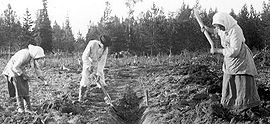
and the undemocratic class system
of the estates
in the Grand Duchy. This system originated in the Swedish regime
of the 17th century, which effectively divided the Finnish people into two groups, separated economically, socially and politically. Finland's population grew rapidly in the 19th century (from 860,000 in 1810 to 3,130,000 in 1917), and a class of industrial and agrarian workers and property-less peasant
s emerged. The Industrial Revolution
and economic freedom
arrived in Finland later than in Western Europe (1840–1870), owing to the rule of the Romanov
family. Industrialization was typically led and financed primarily by the state. This meant also that some of the social problems associated with the industrial process were diminished via control of the administration, by learning from the experiences of countries such as England
. In the Finnish case there were marked cultural differences between Russia and the Grand Duchy. The estates planned to build up an increasingly autonomous Finnish state, led by the elite and intelligentsia. The Fennomans in particular aimed to include the common people to sustain the state in a non-political role in order to reduce unrest due to social problems. In fact, the peasants and clergy had already taken up the cause of the working man and woman before the beginning of large-scale industrialization. The labor movement and many nonpolitical movements (such as youth associations and temperance movements established at the end of the 19th century) were initially led "from above."
Social conditions, the standard of living and the self-confidence of the workers gradually improved due to industrialization between 1870–1916. At the same time the political concepts of socialism
, social liberalism
and nationalism
took root, especially in fennomania. However, while the standard of living rose among the common people, the rift between rich and poor deepened markedly.
The Finnish labour movement
, which emerged at the end of the 19th century from folk, temperance and religious movements and fennomania, had a "Finnish national, working-class" character and was represented by the Social Democratic Party
, established in 1899. The movement came to the forefront without major confrontations when tensions during Russia's failed war against Japan
led in 1905 to a general strike in Finland and revolutionary upheaval
in the empire.
In an attempt to quell the general unrest, the system of estates was abolished in the parliamentary reform of 1906, which introduced universal suffrage
. The strike increased support for the Social Democrats substantially; in 1906, as a proportion of the population, the party was the most powerful socialist movement in the world. In addition to the vital and primary support of urban workers, the socialists had also gained the support of agricultural workers. Because Finland was a country with relatively small towns with a small workforce, and many industrial centers were small "islands" surrounded by large rural areas, there was social integrity between the urban and rural workers.
From 1899–1906 the labor movement had become conclusively independent, as opposed to the patriarchal thinking of the Fennoman estates. Workers' activity after 1899 had been directed toward opposing Russification, and also had sought to develop a domestic policy that tackled social problems and respond to the demand for democracy. This was a reaction to the futile domestic dispute, ongoing since the 1880s, between the Finnish nobility and the labor movement concerning voting rights for the common people. Besides their obligations as obedient and nonpolitical inhabitants of the Grand Duchy, and participants in the political battle against the Tsar, workers had begun to ask for and then demand their civil rights in the Finnish society. The power struggle between the Finnish estates and the Russian administration had given them a concrete role model and space for the labor movement. In the end, a rapid change had occurred in the thinking and goals of the common people; the peaceful Finns who had just a few decades previously accepted the class system as the long-lasting, natural order of their life now demanded rue citizenship. On the other side, due to at least a century-long tradition and experience of administrative leadership, the Finnish elite saw itself as the inherent ruling class in the Grand Duchy.
The reform of 1906 was a giant leap in the political and social liberalization of the Finnish common man and woman. The Russian royal family had been the most autocratic and conservative rulers in Europe, and the Finnish people had experienced it by way of the four Finnish estates. While most of the nations of Western Europe had adopted bicameral parliaments by the end of the 19th century, in 1906 the Finns adopted a unicameral parliamentary system, and female citizens were included in universal suffrage. All Finnish adults were given the right to vote, increasing the number of voters from 126,000 to 1,273,000. This soon produced around 50% turnouts for the Social Democrats.
A setback followed as the Russian Tsar, Nicholas II
, was not dethroned or had his power diminished in the Grand Duchy following the 1905 revolutions. The Tsar regained his authority after the crisis of 1905, reclaimed his role as the Grand Duke of Finland and, during the second period of Russification between 1908 and 1917, neutralized the functions and powers of the new parliament. The Tsar saw the parliament to have merely an advisory role. He alone determined the composition of the Finnish Senate, which did not correlate with the assembly of the parliament, prohibiting true parliamentarism. The Tsar dissolved the parliament and ordered new parliamentary elections almost annually between 1908–1916.
The capacity of the Parliament to solve major social and economic problems was compromised by confrontations between the representatives of the largely uneducated common man and the representatives of the former estates accustomed to meritocratic rule and attitudes. At the same time conflict occurred between the industrial employers and their workers, as the industrialists denied collective working agreements and the right of the labour unions to represent the working people; the employers dominated and ruled the working contracts signed on the personal level. Although the parliamentary work and achievements had disappointed the labour movement, dominance in the Finnish Parliament and in legislation seemed to be the only true pathway to reach a more economically and socially balanced society. That is why the Finnish working man and woman identified themselves powerfully to the state. Altogether, these political developments led to conditions that encouraged a struggle for leadership of the Finnish state, during the ten years before the collapse of the Russian Empire.
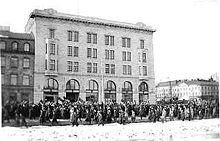 The more severe program of Russification, called "the second period of oppression 1908–1917" by the Finns, was halted on 15 March 1917 by the removal of the Russian Tsar Nicholas II. The immediate reason for the collapse of the Russian Empire was a domestic crisis precipitated by military defeats in the war against Germany and by war-weariness among the Russian people. The deeper causes of the revolution lay in the collision between the policies of the most conservative regime in Europe and the necessity for political and economic modernisation brought about by industrialisation. The Tsar's power was transferred to the Russian Duma
and Provisional Government
, which at this time had a right-wing majority.
Autonomous status was returned to the Finns in March 1917, and the revolt in Russia handed the Finnish Parliament true political power for the first time. The political left, comprised mainly Social Democrats, covering a wide spectrum from moderate to revolutionary socialists; the political right was even more diverse, ranging from social liberals and moderate conservatives to rightist conservative elements. The four main parties were:
The Finns faced a detrimental interaction of power struggle and breakdown of society during 1917. The collapse of Russia induced a chain reaction of disintegration among the Finns starting from the government, military power and economy, and spreading downwards to all fields of the society such as local administration and workplaces, and finally to the level of individual citizens as changes and questions of freedom, responsibility and morality. The blow of World War I hit the Finnish people and the nation, which, at the beginning of the 20th century, stood at the crossroads between the old regime of the estates and the evolution of a modern, democratic society. The direction and goal of this period of change now became a matter of accelerating political dispute. This eventually spilled over into armed conflict because of the weakness of the Finnish state, lack of basic controlling factors, and instinctive reactions of the individual Finns under most uncertain and fearful conditions. The Social Democrats aimed at retaining the political rights of the labour movement already achieved, and establishing influence over the people and society. The conservatives were fearful of losing their long-held social and economic power. Both groups collaborated with the corresponding political forces in Russia, deepening the split in the nation.
As a consequence of the unbalanced social development and the labour movement's continuous position in the political opposition, the Social Democratic Party had gained an absolute majority in the Parliament of Finland
, in the general elections of 1916
. The new Senate
was formed in March 1917 by Social Democrat and trade union leader Oskari Tokoi
. His Senate cabinet comprised six representatives from the Social Democrats and six from non-socialist parties. In theory, the new cabinet consisted of a broad coalition; in practice, with the main political groups unwilling to compromise and the most experienced politicians remaining outside it, the cabinet proved unable to solve any major local Finnish problems. After the revolution, real political power shifted to the street level in the form of mass meetings, strike organizations, and the street councils formed by workers and soldiers, and to active organizations of the employers, all of which served to undermine the authority of the state.
The rapid economic growth stimulated by World War I, which had raised the incomes of industrial workers and profits of the employers during 1915 and 1916, collapsed with the February Revolution. The consequent decrease in production and economy led to unemployment and high inflation
. For those who had a job, the February revolution gave freedom to reach for resolving long-term problems of their laborious working life; the workers called for eight-hour-per-day
working limits, better working conditions, and higher wages. The demands led to demonstrations and large-scale strikes in both industry and agriculture throughout Finland.
The food supply of the country depended on cereals produced in southern mainland Russia, while the Finns had specialized in milk and butter production. The cessation of the cereal imports from disintegrating Russia led to food shortages in the country. The government responded to this by introducing rationing
and price fixing
. However, the farmers opposed the control of the government, and a black market formed. Food prices in the black market continued to rise sharply, which was a major problem for the unemployed worker families. Food supply, prices, and in the end the fear of starvation became emotional political issues between farmers in the countryside and industrial workers in the urban areas. The common people, their fears exploited by the politicians and the political media, took to the streets. Despite the food shortages, no large-scale starvation hit the Finns in southern Finland before the war. Economic factors remained a supporting factor in the crisis of 1917, but only a secondary part of the power struggle of the state.
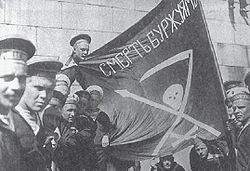
, they planned at least an expansion of the former autonomy.
The February Revolution offered the Finnish Social Democrats momentum: they had the exceptional absolute majority in the Parliament and a narrow dominance in the Senate. After 25 years of disappointments, the Social Democrats had an opportunity to take political power. Since the beginning of 1910s, the socialists had seen that the ability to improve the conditions of the common people through social reform was dependent on holding power in the country.
Conservatives were alarmed by the continuous increase of the socialists’ support during 1899-1916 that had climaxed in 1917 with their dominance in the Parliament and Senate, without the offsetting control of the emperor and Russian administration. The former estates had accepted and supported the rise of the nonpolitical value of the common man in the society, but had tried to limit the working class’s access to political authority in the country. The summer of 1917 brought forward the major confrontation between the socialists and conservatives. It offered the labour movement a chance at political power and start of social reforms. For conservatives, the socialists had to be halted before they were able markedly alter the power structure of the country.
The "Power Act" incorporated accordingly a plan by the Social Democrats to substantially increase and concentrate the power of Parliament, as a reaction to the non-parliamentary and conservative leadership of the Finnish Senate between 1906-1916. The bill also furthered Finnish independence by restricting Russia's influence on domestic Finnish affairs: the Provisional Government of Russia would determine only the foreign affairs and military policy in Finland. In Parliament, the bill was adopted with the support of the Social Democrats, the Agrarian League, and some rightist activists and other non-socialists eager for Finnish sovereignty. The conservatives opposed the bill and some of the most right-wing representatives resigned from Parliament.
In Russia the Social Democrats' plan had the backing of Vladimir Lenin
and the Russian Bolsheviks, who in July 1917 were plotting a revolt against the Russian Provisional Government. But the Provisional Government opposed the Power Act as it would reduce the power of the Russian administration in the country. The Government still had the support of the Russian military in Finland. In Petrograd, Lenin was thwarted during the "July Days
" and forced to flee to Finland. As the Russians' war against Germany had come increasingly closer to defeat, the significance of Finland as a buffer zone protecting Petrograd was highlighted, and the Russians could not allow the Finns to separate from Russia. The Provisional Government refused to accept the "Power Act" and sent more Russian troops to Finland, where, with the co-operation and support of the conservatives, Finnish Parliament was dissolved and new elections announced. In the October 1917 elections
, the Social Democrats lost their absolute majority, which radicalized the labour movement and decreased support for relying on parliamentary means of achieving its aims.
The events of July 1917 did not bring about the Red Revolution in January 1918 on their own. Together with the political development based on the Finnish labour movement's interpretation of the ideas of fennomania and socialism
between 1880s and summer 1917, these events were decisive for the nature, content and goal of a Finnish revolution. In order to win power and carry out political reforms, the socialists had to overcome the Finnish Parliament.
The collapse of Russia in the February Revolution resulted in a loss of institutional authority in Finland and the dissolution of the police force, creating fear and uncertainty. In response, groups on both the right and left began assembling independent security groups for their own protection. At first, these groups were local and largely unarmed. By autumn 1917, in the power vacuum following the dissolution of parliament and in the absence of a stable government or a Finnish army, such forces began assuming a more military character. The Civil Guards (later called the White Guards
) were organized by local men of influence, usually conservative academics, industrialists and major landowners and activists and were armed by the Germans. The Worker's Security Guards and Red Guards (later called solely the Red Guards
) were often recruited through their local party sections and the labour unions, and were armed by the Russians.
Revolution
on 7 November transferred political power in Petrograd to the radical, left-wing socialists, a turn of events which suited a German Empire exhausted by fighting a war on two major fronts. The policy of the German leaders had been to foment unrest or revolution in Russia in order to force the Russians to sue for peace. To that end, they had arranged for the safe conduct of Lenin and his comrades from exile in Switzerland
to Petrograd
in April 1917, and financed the Bolshevik party, believing Lenin to be the most powerful weapon they could launch at Russia. The German policy was a success; an armistice between Germany and the Bolsheviks came into force on 6 December and peace negotiations began on 22 December 1917 at Brest-Litovsk
.
November 1917 was the second turning point in 1917-1918 rivalry for the leadership of Finland. After the dissolution of the Finnish parliament, the polarization between the Social Democrats and the conservatives increased dramatically. The parliamentary power vacuum lasting for several months provided opportunities for an increased role for the Red and White paramilitary groups. After the Finnish non-socialists won the October 1917 Parliamentary elections, they established a sort of truce with the Russian Provisional Government. This situation was disrupted again by the Bolshevist October revolution, which changed everything. The non-socialist majority in the new Finnish parliament took power on 15 November, on the model of the Power Act of the socialists in July 1917. On the next day the Parliament accepted the Social Democratic proposals from July 1917 for an eight-hour working day and universal suffrage in local elections.
Finally, on 27 November the conservatives tried to hold onto power with the appointment of a purely conservative cabinet, led by Pehr Evind Svinhufvud
. The government decided to separate Finland from Russia and strengthen the military power of the Civil Guards. The first Finnish Jägers had arrived at Finland on 31 October on a ship called Equity, carrying a first marked shipment of weapons from the German army. Equity was followed by a German U-boat (UC-57), with more Jägers and weapons on 17 November 1917; there were around 50 Jägers in Finland by the end of 1917. Finnish conservatives were concerned about the aim of Germany and Russia to conduct armistice and peace negotiations as this would restrict the ability of Germany to provide assistance to the White Finns. Just before the start of the peace negotiations, however, Germany agreed to sell 70,000 rifles to the White Guards and arrange a safe return of the Jäger battalion to Finland.
There were 149 Civil-White Guards in Finland (local units in towns and rural communes) on 31 August 1917, 251 on 30 September, 315 on 31 October, 380 on 30 November 1917 and 408 on 26 January 1918. The first attempt to start a serious military training among the Civil Guards was establishment of a 200-strong "cavalry school" at Saksanniemi estate, in vicinity of town Porvoo
, east of Helsinki on 19 September 1917.
Following the political defeats in July and October 1917, on 1 November the Social Democrats put forward an uncompromising program called "We demand" in order to push for political concessions. They demanded annulment of the result of the October Parliamentary elections and disbanding of the Civil Guards, which the right refused. Following the October Revolution, Finnish socialists planned to ask the Bolsheviks for acceptance of Finland's sovereignty in a manifesto on 10 November, but the uncertain situation in Petrograd stalled it. After the "We demand" program had failed, the socialists initiated a general strike
on 14–19 November 1917. The moderate left aimed to put political pressure on the non-socialists to include a large number of Social Democratic members in the new cabinet.
A revolution had been the goal of the radical left since the loss of the political power in July and October 1917. The shooting of an agricultural worker during a local strike on 9 August at Ypäjä created widespread anger among the working men throughout the country. November 1917 seemed to offer momentum for a revolt. At this phase, Lenin and the Bolsheviks, under threat in Petrograd, urged the Social Democrats to seize power in Finland, which was an important defensive area against the German threat, and a vital backup zone for the Bolsheviks towards Petrograd. But the majority of the Finnish socialists were moderate and preferred parliamentary methods, prompting Lenin to label them "reluctant revolutionaries." However, as the general strike appeared to be successful, the "Workers' Revolutionary Council" voted by a narrow majority to seize power on 16 November, but the supreme revolutionary "Executive Committee" was unable to recruit enough members to carry out the plan and had to call the proposed revolution off the same day.
The Social Democrats had an extra party meeting on 25–27 November 1917. There the voting between revolution and parliamentary means was repeated; the moderates won, but when they tried to pass a decision to completely abandon the idea of socialist revolution in Finland, the party representatives voted "no." The Finnish labour movement wanted thus to sustain a military force of its own and keep the revolutionary road open too.
Russian Bolshevik Joseph Stalin
visited the meeting demanding that the Finnish socialists carry out revolution, and tried to push the Social Democrats forward by promising independence to Finland. Stalin failed to convince them to undertake a revolution as the Finns were more eager for sovereignty. The Finnish Social Democrats lack of interest in revolutionary activity was a disappointment to Lenin. He lost his faith in them finally in December 1917 during the process of independence of the Finns and he tried to persuade on the Finnish Bolsheviks in Petrograd.
These incidents effectively split the Social Democrats in two, a majority supporting parliamentary means and a minority demanding revolution. The most revolutionary workers were bitter about the labour movement's decision to give up the political power that it had easily gained during the general strike. The repercussions of the events had a lasting effect on the future of the movement, with several powerful leaders staking positions within the party, and losing support among the radical workers. The atmosphere after the deeds of the armed workers during and immediately after the general strike was not promising.
Among the labour movement, a more marked consequence of autumn 1917 was the rise of the Worker's Guards. There were approximately 20-60 Worker's Guards in Finland between 31 August and 30 September 1917, but after the defeat in the October Parliamentary elections the number of the Guards began to substantially increase. On 20 October the Finnish Labour Union proclaimed the need to establish Worker's Guards in the country; the announcement led to a rush to the Guards; on 31 October their number was 100-150, 342 on 30 November 1917 and 375 on 26 January 1918. There were two parts to the Worker's Guards since May 1917: the Security Guards and the Red Guards. The majority of members were Security Guards. The Red Guards were a partly secret group formed in certain cities including Tampere
and Helsinki
on the model of the domestic Red Guards built up during the general strike in 1905.
The presence of the two opposing armed forces in Finland, the Red and White Guards, imposed a state of “dual power" and "multiple sovereignty" on Finnish society, typically the prelude to civil war. The decisive cleavage between the two guards broke out during the general strike, when the radical elements of the Red Guards and Worker's Security Guards executed several political opponents in the main cities of southern Finland, and the first armed clashes between Civil Guards and Workers' Guards broke out, with 34 reported casualties. The Finnish Civil War would probably have started at that point had there been enough weapons in the country to arm the two sides; instead, there began a race for weapons and a final escalation towards war.
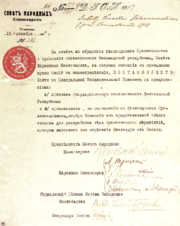 P.E. Svinhufvud's Senate proposed Finland's declaration of independence
, which the Parliament adopted on 6 December 1917. Though the Social Democrats voted against the Svinhufvud proposal, they decided to present an alternative declaration of independence containing no substantial differences. The socialists feared a further loss of support (as in the October elections) among the nationalistic common people and hoped to gain a political majority in the future. They sent two delegations during December 1917 to Petrograd to ask Lenin to approve Finnish independence. Both political groups, therefore, agreed on the need for Finnish sovereignty, despite strong disagreement on the selection of its leadership.
The establishment of sovereignty was not a foregone conclusion; for a small nation like Finland, recognition by Russia and the major European powers
was essential. Three weeks after the declaration of independence, Svinhufvud's cabinet concluded, under pressure from Germany, that it would have to negotiate with Lenin for Russian recognition. During December 1917, in turn the Bolsheviks were under pressure, in the peace negotiations at Brest-Litovsk
with the Germans, and Russia Bolshevism was in a deep crisis with a demoralized army and the fate of the October Revolution in doubt. Lenin calculated that the Bolsheviks could perhaps hold central parts of Russia but would have to give up some territories on its periphery, including Finland in the less important north-western corner. As a result, Svinhufvud and his senate delegation won Lenin's concession of sovereignty on 31 December 1917. By the beginning of the Civil War, Austria-Hungary
, Denmark
, France
, Germany
, Greece
, Norway
, Sweden
and Switzerland
had accepted the Finnish sovereignty. The United Kingdom
and United States
did not approve it; they were standing by and followed the political and military development between Finland and the major enemy of the Allies, German Empire. The Allies hoped to override Lenin and the Bolsheviks, in order to get Russia back to the war against Germany. As to the Finnish independence, the Germans had hastened it in order to get Finland to their power sphere. France broke off diplomatic relations to the Vaasa Senate later, in spring 1918, as a consequence of the co-operation between Germany and White Finland.

The final escalation towards war began in early January 1918, as each military or political act of the Reds or the Whites resulted in a corresponding counteract by their opponents. Both sides justified the acts as defensive measures, particularly to their own supporters. On the left, the vanguard of the war of 1918 was the most radical urban Red Guards and Workers' Security Guards from Helsinki
, Kotka
and Turku
; they led the rural Reds, and convinced those leaders of the Social Democrats who wavered between peace and war, to support revolution. The Guards were under the command of Ali Aaltonen
, a former officer in the Imperial Russian Army
, who had been appointed in December 1917. On the right, the vanguard of the war was the Jägers who had been moved to Finland by the end of 1917, and the most active volunteer White Guards of Viipuri province
in the southeastern corner of Finland, southwestern Finland and southern Ostrobothnia.
The Svinhufvud Senate
and the Parliament decided on 12 January 1918 to create a strong police authority, an initiative which the Red Guards saw as a step towards legalizing the White Guards. On 15 January, Carl Gustaf Emil Mannerheim
, like Aaltonen a former officer in the Russian army, was appointed supreme commander of the White Guards, and on 25 January the Senate renamed the White Guards the Finnish White Army. The Red Guards refused to recognise the title, and decided to establish a military authority of their own. General Mannerheim located his headquarters in Vaasa
, while Aaltonen located his in Helsinki. The third and final culmination of the power struggle between the Finns, and the disintegration of the Finnish society had begun.
The official starting date of the Finnish Civil War is a matter for debate. The first serious battles were fought during 17–20 January in Viipuri province, mainly for control of the town of Viipuri and to win the race for weapons. The White order to engage was issued on 25 January. On 27 January the White Guards tried to capture trains carrying a large shipment of weapons from Petrograd to Viipuri, as promised to the Reds by Lenin. They also continued disarmament of Russian garrisons, initiated in Karelia on 23, by a major operation in Ostrobothnia
during the early hours of 28 January. The Red Order of Revolution was issued on 26 January, and on the same day all the Worker's Guards joined together to form the Red Guard of Finland. The large scale mobilization of the Red Guards began in the late evening of 27 January, but some of the Guards located along the Viipuri-Tampere railway had been alerted beforehand to safeguard the Russian trains of arms on 24–26 January, and a 250-strong Finnish Red unit escorted the trains from Petrograd to Viipuri. Around 60 Finns, Red and White, died in "Battle of the Rahja Trains" in the Karelian Isthmus
on 27 January 1918.
A symbolic date for the start of the war could be 26 January, when a group of Reds climbed the tower of Helsinki Workers' Hall and lit a red lantern to mark the start of the second major rebellion in the history of Finland.
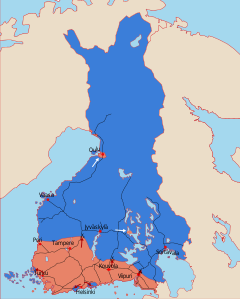 At the beginning of the war, the discontinuous front line
ran through southern Finland from west to east, dividing the country into White Finland and Red Finland. The Red Guards controlled the area to the south, including nearly all the major industrial centres and the largest estates and farms with high numbers of crofters
and tenant farmer
s. The White Army controlled the area to the north, which was predominantly agrarian with small or medium-sized farms and tenant farmers, and where crofters were few or held a better social position than in the south. Enclaves of the opposing forces existed on both sides of the front line: within the White area lay the industrial towns of Varkaus
, Kuopio
, Oulu
, Raahe
, Kemi
and Tornio
; within the Red area lay Porvoo
, Kirkkonummi
and Uusikaupunki
. The elimination of these strongholds was a priority for both armies during February 1918.
Red Finland, later named the Finnish Socialist Workers' Republic
, was led by the People's Delegation
in Helsinki. Kullervo Manner
was the chairman and other delegates included Edvard Gylling
, Eero Haapalainen
, Anna Karhinen, Otto Ville Kuusinen
, Hilja Pärssinen, Yrjö Sirola
and Oskari Tokoi
. In domestic policy the People's Delegation sought socialism based on the Finnish Social Democratic ethos; their vision of democratic socialism
for the country did not resemble Lenin's dictatorship of the proletariat
.
Otto Ville Kuusinen formulated a proposal for which he would see final acceptance through a referendum for a new constitution, influenced by those of Switzerland
and United States
, for example. Political power was to be concentrated in the Parliament, with a lesser role to Senate. The proposal included a multi-party system, freedom of assembly, freedom of speech and of the press, and the use of referenda, for example, for dissolving the Parliament. In order to ensure the power of the labour movement, the common people would have a right to a "continuous revolution".
However, the Reds’ plans concerning private property rights of the Finns were in conflict with the plans of an "ultrademocratic" and free society; only the state and local administration of municipalities would have had the true property rights. In agriculture the crofters were liberated from the control of the landowners at the beginning of the war, but they were allowed only a right of containment of the farms under the plans of a later general socialization in the country.
All these plans, including the new constitution, remained unfinished as the Reds lost the war.
In foreign policy Red Finland leaned on Bolshevist Russia
, which declared its support for the Red Finns; a peace agreement was signed between the Bolsheviks and the Finnish Reds on 1 March 1918. The negotiations for the treaty revealed that, as in World War I in general, nationalism was more important for the both sides than principles of international socialism and pacifism. The Red Finns did not accept an alliance with the Bolsheviks and Lenin, but agreed to an exchange of land areas. An artillery base, Ino
located in the Karelian Isthmus, was transferred to Russia, while Finland received Petsamo
in north-eastern Lapland.
Lenin’s policy of the right of nations to self-determination
aimed to prevent disintegration of Russia during its period of military weakness. He expected that proletariat of free nations would carry out socialist revolutions and join socialist Russia later. In the end, Lenin failed; many minor, western territories of the former empire declared independence. The majority of the Finnish labour movement supported Finland's independence, however, the Red Guards had influence on the politics of Red Finland. The most radical Guards and the Finnish Bolsheviks, though few in number, favoured annexation of Finland back to Russia. The question of annexation was resolved by the defeat of Red Finland.
The senate of White Finland was called the Finnish senate, the Vaasa Senate. It was relocated to the west-coast city of Vaasa
, which acted as the capital of White Finland
from 29 January to 3 May. Only some senators managed to escape from Helsinki to Vaasa. The chairman Pehr Svinhufvud and Jalmar Castrén
had to travel through Estonia, Poland, Germany and Sweden to arrive in White Finland. In the end the Vaasa senate consisted of P.E. Svinhufvud, Juhani Arajärvi
, J. Castren, Alexander Frey
, E.Y. Pehkonen and Heikki Renvall.
In domestic policy the main goal of the Vaasa Senate was to return the right to power in Finland. The conservatives planned a monarchist political system, with a lesser role for Parliament. A section of the conservatives had always been against democracy; others had approved parliamentarianism
since the revolutionary parliamentary reform of 1906, but after the crisis of 1917 and the outbreak of the 1918 war, had concluded that empowering the common people would not work. Social liberals and reformist, moderate non-socialists opposed, however, any restriction of parliamentarianism. They initially resisted German military help, but the prolonged warfare changed their stance.
In foreign policy, the Vaasa Senate looked to Germany for military and political aid in order to defeat the Finnish Red Guards, end the influence of Bolshevist Russia in Finland, and to expand the Finnish territory to Russian Karelia. The latter held economic and strategic significance, and was home to people speaking Finno-Ugric languages. The disintegration and weakness of Russia induced an idea of "Grand Finland" among the more nationalistic factions of both the right and left; a part of the Reds had plans concerning the same areas (Heimosodat
).
General Mannerheim agreed on the need for German weapons, but opposed any help from German troops in Finland. As a former Russian army officer, Mannerheim was well aware of the demoralization of the Russian army. He co-operated with the non-socialist, White Russian officers in Finland and Russia, and he recognized also the lack of combat skills of the Red Guards. The competing parties’ war propaganda aimed to prove their support of democracy and liberty and their ability to represent the whole Finnish nation. Both failed by allowing the political crisis to end up in the bloody Civil War and a comprehensive terror, instead of reaching a compromise to accomplish a peaceful political settlement.
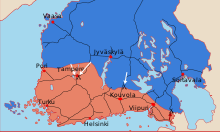
. The main motives for volunteering were economic factors (salary, food), idealism, and peer pressure. Urban and agricultural workers constituted the majority of the Red Guards, whereas land-owning farmers and well-educated people formed the backbone of the White Army. Both armies used juvenile soldiers, mainly between 14 and 17 years of age, the most famous example being Urho Kekkonen
who fought for the White Army and later became the longest-serving President of Finland
.
The Red Guards also included 2,000 female troops, mostly girls, recruited from the industrial centres of southern Finland. The use of child soldiers was not rare in World War I; children of that time were under the absolute authority of adults and were not shielded against abuse of this kind, they were a natural part of the working life and mentally orientated for unrealistic adventure. In the Finnish case an additional reason for the use of juveniles in the turmoil was the less organized and confused conditions, particularly at the beginning of the war; the military leaders took what they got in hand at the time, and in the Red Guards there was a chance for salary also.
The Finnish Civil War was fought primarily along the railways, the vital means of transporting troops and supplies. One of the most important objectives for both Guards was to seize a railway junction northeast of Tampere
, Haapamäki
, which connected both western-eastern and southern-northern Finland; the Whites captured the junction permanently in the end of January 1918, this led to fierce battles at Vilppula
. The Whites' bridgehead south of the River Vuoksi
at Antrea on the Karelian Isthmus
was a constant problem to the Reds as it threatened the railway connection Viipuri-Petrograd. The other vital railway junctions during the war were Kouvola
, Riihimäki
, Tampere and Toijala
. The significance of the railways to the Civil War of the Finns is well symbolized by the most modern and frightening weapon used in the turmoil: an armoured train, carrying light cannons and heavy machine gun
s.
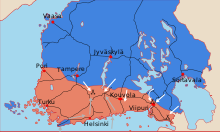
, the capital, in the early hours of 28 January, and gaining first advantage with an "attack phase" that lasted till mid-March. However, a chronic shortage of skilled leaders, both at command level and in the field, left them unable to capitalize on their initial momentum, and most of the offensives finally came to nothing. The troops of the Red Guards were not professional soldiers but armed civilians, whose military training and discipline were mostly inadequate to resist the counter-attack of the White Army when it came, still less the onslaught of the German forces who arrived later.
The military hierarchy and the implementation of the warfare functioned only at the level of a platoon and a company in the Red Guards. As most of the platoon and company leaders were chosen in a democratic manner—voting by the troopers—the leadership and authority were weak. The combat morale of the Red troops was often low; some defeated platoons and companies simply left the battlefield and travelled home, regardless of the higher staffs. The effect on the morale of the troopers fighting against the people with the same nationality is not known.
Ali Aaltonen found himself rapidly replaced in command of the Red troops by Eero Haapalainen
, who in turn was replaced by the triumvirate of Eino Rahja
, Adolf Taimi
and Evert Eloranta
. The last commander of the Red Guards was Kullervo Manner
, who led the final retreat into Russia. Some talented men with a high sense of responsibility such as Hugo Salmela rose up to take the lead, but in the end they could not change the course of the war, and the fate of the Red troops. The Finnish Red Guards achieved their only victories as they retreated from southern Finland towards Russia. In the fierce battles against German troops on 28–29 April 1918 at Hauho
and Tuulos
, Syrjäntaka, female Red Guard
platoons played a marked role. These combats had only local importance.
 Although some 60,000 to 80,000 Russian soldiers of the former Tsar's army remained stationed in Finland at the start of the Civil War, the Russian contribution to the Red Guards' cause was to prove negligible. When the conflict began, Lenin tried to commit the army on behalf of Red Finland, but the troops were demoralized, war-weary and home-sick after years of World War I. The majority of the soldiers had returned to Russia by the end of March 1918. As a result, only 7,000 to 10,000 troops participated in the Finnish Civil War, of which no more than 4,000, in separate smaller units of 100-1,000 men, could be persuaded to fight in the front line.
The Russian revolutions had split the Russian army officers politically and their attitude toward the Finnish civil war varied. Some of them such as Mikhail Svetšnikov led the battles on the Red side in western Finland throughout February 1918, while other officers were afraid of their revolutionary underlings and co-operated with the former colleague General Mannerheim, assisting the Whites during the disarmament of the Russian garrisons in Finland. The number of Russian soldiers active in the Civil War declined markedly once Germany attacked Russia on 18 February 1918. The Treaty of Brest-Litovsk
, signed between Russia and Germany on 3 March, effectively restricted the Bolsheviks' ability to support the Finnish Red Guards with anything more than weapons and supplies. The Russians remained active on the south-eastern front, however, defending the approaches to Petrograd.
on 25 February 1918. In the battlefield the Jägers provided strong leadership that made a disciplined and rational combat of the common White soldiers possible. The Jägers were allowed extensive latitude to lead the fighting. The White troopers, however, were similar to those of the Red Guards in that most of them had brief and inadequate training. At the beginning of the war, the leadership of the White Guards had little authority over volunteer White Guard platoons and companies, which obeyed solely their dominant, local leaders. A rapid training of six new Jäger Regiments, with conscripts, started after the arrival of the Jäger battalion at White Finland in the end of February.
However, the Jäger battalion was divided in the same way that the rest of the country was: 450 mostly socialist soldiers of the unit remained stationed in Germany as they could have chosen the Red side in the conflict. The leaders of the White Guards faced a similar problem with drafting young men to the army in February 1918: 30,000 obvious supporters of the Finnish labour movement never showed up. In addition, the White Guard leadership were uncertain whether the common troopers, drafted from the small-sized and poor farms of central and northern Finland, had a strong enough motivation to fight the Finnish Reds. Accordingly, the propaganda of the Whites promoted a nationalist war against the Red, Bolshevist Russians, and belittled the significance of the Red Finns. On 30 January 1918 General Mannerheim proclaimed to Russian soldiers in Finland that the White army did not fight against Russia: the goal of the White campaign was to beat the Finnish Red rebels and the Russian troops supporting them.
Divisions existed in Finland because of the social structure of the country: ownership of even a small parcel of farmland created a motivation to fight against the Reds. Moreover, the economy and society of northern Finland had modernized more slowly than those of the south. Finally, there was a more pronounced conflict between Christianity and socialism in the north.
tried to protect and promote its national interests during the Finnish Civil War and World War I. Officially the Swedish King and the Liberal-Social Democratic government proclaimed neutrality in war, as a consequence of pressures in both foreign and domestic policy. Sweden sought to avoid tensions with the Allied powers and with the strong Swedish socialist movement. Both of these opposed Swedish support for the Whites, because they had co-operated with the German Empire and fought against the Finnish Social Democrats. The Swedish socialists, on the other hand, did not provide support for the Finnish Reds, but tried to open peace negotiations between the Finnish Whites and Reds.
In the background, however, Sweden was concerned about the possibility of expansion of Bolshevist influence in northern Europe, and an increase of radical leftist political activity and social unrest in Sweden. Moreover, there were some factions that supported Germanism in the country. On the other side, the weakness of Russia and Finland opened an opportunity for geopolitical changes in Fennoscandia
that would benefit Sweden. The Åland islands
, located south-west of Finland, held a strategically vital position in respect to Stockholm
, the capital of Sweden.
The government of Sweden finally approved participation of volunteer Swedish soldiers in the Finnish Civil War, on the White side. In addition to the Swedish officers, a 800-1,000-strong "Swedish Brigade", led by Hjalmar Frisell, took part in the battles of Tampere and those fought in the area to the south of the town. Moreover, the Swedish Navy escorted the German naval squadron, transporting German weapons to the Finnish Whites, and allowed the squadron to pass through Swedish territorial waters in February 1918.
On the other side, Sweden aimed to take over the Åland islands from Finland by sending a naval military expedition there on 15 February 1918. According to the Swedish propaganda the motive for the move was humanitarian factors, but the true reasons were geopolitical.
In February 1918 General Mannerheim weighed the centre of the general offensive of the Whites between two strategically most vital strongholds; Tampere
, Finland's major industrial town in the south-west, and Viipuri, Karelia's main city. Although seizing Viipuri offered major advantages, the lack of combat skills of his army and potential for a major counterattack by the enemy in the area or in the south-west made it too risky.
In the end Mannerheim decided to strike first at Tampere. He launched the attack on 16 March at Längelmäki
, 65 km north-east of Tampere. At the same time, the White Army began advancing along a line through Vilppula–Kuru–Kyröskoski–Suodenniemi, north and north-west of Tampere. The Red Guards collapsed under the weight of the assault, and some of its detachments retreated in panic. The White Army cut off the Red Guards' retreat south of Tampere in Lempäälä
and lay siege to Tampere on 24 March, entering the town four days later.
The true Battle of Tampere began on 28 March, later called the "bloody Maundy Thursday" on the eve of Easter 1918. The battle for Tampere was fought between 16,000 White and 14,000 Red soldiers. It was the decisive action of the war and the largest military engagement in Scandinavian history to that point. It was Finland's first urban battle
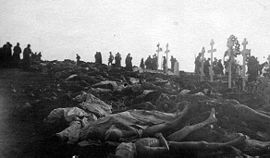
, fought in the Kalevankangas graveyard and from house to house in the city as the Red Guards retreated. The battle, lasting until 6 April 1918, was the bloodiest action of the war.
The Reds, now on the defensive, had increased motivation to fight. The Whites had to use part of the fresh, best trained detachments of their army. The fighting in Tampere was purely a civil war—Finn against Finn, "brother rising against brother"—because most of the Russian army had retreated to Russia in March and the German troops had yet to arrive in Finland. The White Army lost 700–900 men, including 50 Jägers. The Red Guards lost 1,000–1,500 soldiers, with a further 11,000–12,000 imprisoned. 71 civilians died mainly due to artillery fire. The eastern parts of the city, with wooden buildings, were destroyed completely.
After their defeat in Tampere, the Red Guards began a slow retreat eastwards. As the German army seized Helsinki, the White Army shifted its military focus to Viipuri
, taking it on 29 April 1918 with a major attack of 18,500 men, against 15,000 Red troopers. 500–800 Reds died, and 12,000–15,000 were imprisoned.
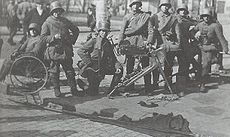
The German Empire intervened in the Finnish Civil War on the side of the White Army in March 1918. Finnish nationalists leaning on Germanism had been seeking German aid in freeing Finland from Russian hegemony since Autumn 1917, but the Germans did not want to prejudice their armistice and peace negotiations with Russia because of the pressure they were facing at the Western front. The German stance was altered radically after 10 February when Leon Trotsky
, despite the weakness of the Bolsheviks' position, broke off negotiations, hoping revolutions would break out in the German Empire and change everything. The German government promptly decided to teach Russia a lesson and, as a pretext for aggression, invited “requests for help” from the smaller countries west of Russia. Representatives of the Vaasa Senate in Berlin
duly requested help on 14 February.
The Germans attacked Russia on 18 February; the offensive led to a rapid collapse and retreat of the Russian troops and to signature of the first Treaty of Brest-Litovsk
by the Bolsheviks on 3 March 1918. Russia lost Finland, the Baltic countries, Poland
and Ukraine
from its western territory; in the end, the economic and political investments that Germany had made in Russian communist leader Vladimir Lenin
had paid off. The German army did not alter its military plans concerning Finland after the peace treaty with the Bolsheviks because the Civil War of the Finns had opened an easy access with low costs to Fennoscandia
, and because troops of a British Naval squadron had invaded the harbour of Murmansk
on the northwestern coast of Russia by the Arctic Ocean
on 9 March 1918.
On March 5 a German naval squadron landed in the southwestern archipelago of Finland, on the Åland Islands, which the Swedish military expedition had taken over in mid-February. On 3 April 1918, the 10,000-strong Baltic Sea Division
led by Rüdiger von der Goltz
struck west of Helsinki at Hanko. On 7 April, the 3,000-strong Detachment Brandenstein
overran the town of Loviisa
on the south-eastern coast. The main German formations then advanced rapidly eastwards from Hanko and took Helsinki on 13 April. At the same time, two German battleships and smaller vessels entered the city harbour and bombarded the Red positions, which included the present-day Presidential Palace
. The Brandenstein Brigade attacked the town of Lahti
on 19 April, cutting the connection between the western and eastern Red Guards. The main German detachment advanced northwards from Helsinki and took Hyvinkää
and Riihimäki
on April 21–22, followed by Hämeenlinna
on 26 April.
The efficient performance of the German top detachments in the civil war contrasted strikingly with that of the demoralized Russian troops. The final blow to the cause of the Finnish Reds was dealt when the Bolsheviks broke off the peace negotiations at Brest-Litovsk, leading to the German eastern offensive in February 1918.
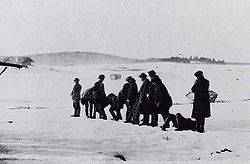 During the civil war, the White Army and the Red Guards both perpetrated acts of terror, called the Red terror and White terror. The threshold of political violence had been crossed in the primarily peaceful Grand Duchy of Finland during the first period of Russification 1899-1905 when Finnish nationalists murdered a Russian governor-general, police officers and a Finnish civil servant. World War I enhanced the potential of terror as it was widespread between the Allies
and the Central Powers
during the conflict. The February Revolution in 1917 initiated a comprehensive terror in Finland; the Russian common army soldiers murdered several Russian army officers in March 1917. The first victim of non-war violence between the Finns, an agricultural worker, died at the beginning of August 1917 at Ypäjä
, during a local strike. In the end, the general strike in November 1917 led to a marked Finnish political terror; the Worker's Guards murdered 27 Finns.
During the war of 1918 there were two kinds of Red and White political violence: (i) a calculated part of the general warfare, and (ii) more local, personal murders and corresponding acts of revenge. In the former, the highest staffs of both sides planned and organized these actions and gave orders to the lower level. At least a third of the Red terror and perhaps most of the White terror was centrally led. At the beginning of the war the governments of White Finland and Red Finland officially opposed acts of terror, but such operational decisions were made at the military level.
The main purpose of the Red and White terror was to destroy the power structure of the opponent, clear and secure the areas governed by the armies since the beginning of the war and the areas seized and occupied by the common units during the conflict. Another goal of the terror was to create shock and fear among the civil population and the opposing soldiers. The lack of combat skills of the common soldiers in the both armies created the opportunity to use terror as a military weapon. Terror achieved some of the intended military objectives, but also gave additional motivation to each side to fight against an enemy perceived to be inhuman and cruel. The propaganda of the Reds and Whites utilized the terror acts of the opponent effectively, which increased the local political violence and the spiral of revenge.
The number of casualties and the timing of the terror differed markedly between the Reds and Whites.
The level of killings by the Red Guards varied over the months because the Reds could never seize and occupy new areas outside Red Finland, and because they had to focus their efforts on the industrialized southern Finland, where they faced the establishment of Finland. The Red Guards were less organized than the White army in respect to the political terror. The level of killings by the Whites varied over the months of the war because they occupied southern Finland, and initially did not encounter marked resistance from the area of White Finland. The comprehensive White terror started with the general offensive of the Whites in March 1918, increased constantly, culminated in the end of the war, and ceased soon after the enemy had been sent to the prison camps.
Most of the terror was undertaken by "flying detachments" deployed by the both armies. These were cavalry
units, usually consisting of 10 to 80 soldiers aged 15 to 20, under the absolute authority of an experienced adult leader. The detachments, specialising in search-and-destroy
operations behind the front lines and during and after battles, have been described as death squad
s. They resembled German Sturmbattalions and Russian Assault units organized during World War I.
The Red Guards executed the representatives of economic and/or social power in Finland, including politicians, major landowners, industrialists, police officers, civil servants, teachers, and leaders and members of the White Guards. Servants of the Evangelical Lutheran Church of Finland
(ten priests) and the labour movement members (90 obviously moderate socialists) were executed also, but they were not the main targets of the terror. The two major sites of the Red terror were Toijala
and Kouvola
. There 300–350 Whites were executed between February and April 1918.
The White Guards executed Red Guard and party leaders, Social Democratic representatives of the Finnish parliament and local Red administrations, members of the Red tribunals and police, and common troopers of the Red Guards, and those who had participated in a way or another to the Red terror
. During the peak of the White terror, between the end of April and the beginning of May, 200 Reds were shot per day. The White terror hit particularly strong against the Russian soldiers who fought with the Red Guards.
In total, 1,400–1,650 Whites were executed in the Red terror, and 7,000–10,000 Reds were executed in the White terror
. The White victims have been recorded quite exactly, but there are questions and permanent uncertainty about the Red victims of the terror. It is unclear which of the victims died in the battles and which of them were executed immediately after the battles. Together with the prison camp experiences of the Reds later in 1918, the terror caused the deepest mental wounds and scars of the Civil War among the majority of the Finns regardless of their political allegiance. It is also known that a part of those who carried out the terror were seriously traumatized, a phenomenon that was later to become well-documented.
on 8 April. After the loss of Helsinki, most of them, only Edvard Gylling
standing by his warriors, moved to Petrograd on 25 April 1918. The escape of the Red leadership made the ranks of the Red soldiers bitter and resentful. At the end of April, thousands of them, without true leadership, tried to flee to Petrograd from Red Finland, but the majority of the refugees were besieged by the White and the German troops. The Reds surrendered on 1–2 May in the Lahti
area. The long caravans of the Reds included women and children, who experienced a desperate, chaotic escape with several human losses due to the attacks of the enemy. It was "a road of tears" for the Reds, but for the Whites the long enemy caravans heading east was a victorious scene. The Red Guards' last stronghold in south-east Finland, the area between Kouvola
and Kotka
, fell by 5 May. The war of 1918 ended on 15 May, when the Whites took over Ino
, a Russian coastal artillery
base on the Karelian Isthmus
, from the Russian troops. White Finland and General Mannerheim celebrated the victory with a large military parade in Helsinki on 16 May 1918.
The Red Guards had been defeated. The initially pacifist Finnish labour movement had lost the Civil War, several of its military leaders committed suicide and a majority of the Reds were sent to prison camps. The Vaasa Senate returned to Helsinki on 4 May 1918, but the capital was under the control of the German army. White Finland had become a protectorate of the German Empire. General Rüdiger von der Goltz
was called "the true Regent of Finland." No armistice or peace negotiations were carried out between White Finland and Red Finland, and an official peace treaty in order to end the Finnish Civil War was never signed.

The war of 1918 led also to disintegration within both socialist and the non-socialist factions. The power political shift toward the right caused a dispute between conservatives and liberals on the best system of government for Finland to adopt: the former demanded monarchy and restricted parliamentarianism, the latter demanded a Finnish republic with full-scale democracy and social reforms. In the conflict both sides justified their views both via political and legal grounds. The monarchists claimed that the law of 1772 from the Swedish period constituting monarchy was still in effect, the declaration of independence on 6 December 1917 determining only "a principle of republic," and that the constitution must be altered via the law of 1772. They proposed a modernized monarchist constitution for Finland. The republicans argued that the law of 1772 had lost its status in the February Revolution, the power and authority of the Russian Tsar had been assumed by the Finnish parliament through the proclamation of 15 November 1917 and Finnish republic had been accepted in the declaration of independence. The republicans were able to postpone processing of the monarchists' proposal in the parliament, and in the end a new monarchist constitution was not accepted in Finland. Therefore, the monarchists applied directly the law of 1772 to select a new monarch for the country.
A major consequence of the 1918 conflict was the breakup of the Finnish labour movement into three parts: moderate Social Democrats and left-wing socialists in Finland, and communists acting in Soviet Russia with the support of the Bolsheviks. The Social Democratic Party had its first official party meeting after the civil war on 25 December 1918, and the party proclaimed its commitment to parliamentary means and a moderate political program was composed, The Social Democrats disclaimed Bolshevism and communism. The leaders of Red Finland who had fled to Russia, on the other hand, established the Communist Party of Finland
in Moscow
on 29 August 1918. After the power struggle of 1917 and the bloody civil war, the former Fennomans and Social Democrats, who had supported "ultrademocratic" means in Red Finland, declared now to have committed to revolutionary Bolshevism-communism and to dictatorship of proletariat, under the control of V.I. Lenin.
A new conservative Senate, with a monarchist majority, was formed by JK Paasikivi
in May 1918. All members of parliament who had taken part in the revolt were removed from office. This left only one Social Democrat later to be joined by two more. Accordingly the parliament was named a “rump parliament.” In foreign policy, the 3 March Treaty of Brest-Litovsk had placed White Finland in the sphere of influence of the German Empire. The agreements signed with the Germans on 7 March 1918 in return for military support had bound Finland politically, economically, and militarily to Germany. The Finns had looked actively for German military aid: at the end of May the Senate asked the German troops to remain in the country. The Germans proposed a further military pact in summer 1918 as a part of the plan to secure raw materials for their industry from eastern Europe and tighten their control over Russia.
General Mannerheim resigned his post on 25 May after disagreements with the Senate about German hegemony over the country, and about his planned attacks on Petrograd to repulse the Bolsheviks and to Russian Karelia. The Germans opposed these attacks under the peace treaties they had signed with Russia. On 9 October, under pressure from Germany, the monarchist Senate and the rump parliament chose a German prince, Friedrich Karl
, brother-in-law of German Emperor William II
, to become the King of Finland
. All of these measures diminished Finnish sovereignty. The Finns, both right and left, had achieved independence on 6 December 1917 without a gunshot, but then compromised that independence by allowing the Germans to enter the country without difficulty during the civil war.
The economic condition of the country had deteriorated so drastically that recovery to pre-conflict levels was not achieved until 1925. The most acute crisis was in the food supply, already deficient in 1917, though starvation had at that time been avoided in southern Finland. The Civil War, according to the leaders of Red Finland and White Finland, would solve all past problems; instead it led to starvation in southern Finland too. Late in 1918, Finnish politician Rudolf Holsti
appealed for relief to Herbert Hoover
, the American chairman of the Committee for Relief in Belgium
: Hoover arranged for food shipments and persuaded the Allies
to relax their blockade of the Baltic Sea
, which had obstructed food supplies to Finland, to allow the food in.
, an island facing Helsinki, Hämeenlinna
, Lahti
, Viipuri
, Ekenäs, Riihimäki
and Tampere
. The Senate made the decision to keep these prisoners detained until each person's guilt could be examined. A law for a Tribunal of Treason was enacted on 29 May after a long dispute between the White army and the Senate of the proper trial method to adopt. The Tribunal did not meet all the standards of neutral justice, due to the mental atmosphere of White Finland after the war. Approximately 70,000 Reds were convicted, mainly for complicity to treason. Most of the sentences were lenient, however, and many got out on parole. Some 555 people were sentenced to death, of which 113 were executed. The trials revealed also that some innocent people had been imprisoned.
Combined with the severe food shortage, the mass imprisonment led to high mortality rates in the camps, and the catastrophe was compounded by a mentality of punishment, anger and indifference on the part of the victors. Many prisoners felt that they were abandoned by their own leaders, who had fled to Russia. The physical and mental condition of the prisoners declined rapidly in May as food supplies had disrupted during the Red Guards' chaotic retreat in April, and a high number of Red prisoners had been sent to the less organized prison camps already during the first half of April in Tampere and Helsinki. As a consequence, 2,900 starved to death or died in June as a result of diseases caused by malnutrition and Spanish flu
, 5,000 in July, 2,200 in August, and 1,000 in September. The mortality rate was highest in the Ekenäs camp at 34 percent, while in the others the rate varied between 5 percent and 20 percent. In total around 13,500 Finns perished. The dead were buried in mass graves near the camps.
The majority of the prisoners were paroled or pardoned by the end of 1918 after the change in the political situation. There were 6,100 Red prisoners left at the end of the year, 4,000 at the end of 1919 (3,000 pardoned in January 1920, at the same time civil rights were given back to 40,000 prisoners), 500 in 1923, and in 1927 the last 50 prisoners were pardoned by the Social Democratic government led by Väinö Tanner
. In 1973, the Finnish government paid reparations to 11,600 persons imprisoned in the camps after the civil war. Several reasons for the long-term and relatively high support of communism in Finland can be found; for the civil war generation of the left, the traumatic hardships of the prison camps were probably decisive.
, as Germany accepted defeat in World War I. The grand plans of the German Empire had come to nothing, and revolution had spread among the German people due to lack of food, war-weariness, and defeat in the battles on the Western Front. German troops left Helsinki on 16 December, and Prince Friedrich Karl, who had not yet been crowned, left his post on 20 December. Finland's status altered from a monarchist protectorate of the German Empire to an independent democratic republic, with a modernizing civil society. The system of government was confirmed on 17 July 1919.
The first local elections based on universal suffrage
in the history of Finland were held during 17–28 December 1918, and the first parliamentary election after the Civil War on 3 March 1919. The United States
and the United Kingdom
recognised Finnish sovereignty on 6–7 May 1919. The Western powers demanded establishment of democratic republics in post-war Europe in order to calm down the widespread revolutionary movements in Europe.
After the Civil War, at the beginning of 1919 a moderate Social Democrat, Väinö Voionmaa
, wrote: "Those who still trust in the future of this nation must have an exceptionally strong faith. This young independent country has lost almost everything due to the war...." He was a vital companion for the leader of the reformed Social Democratic Party, Väinö Tanner
. In the half of April 1918, a social liberal, non-socialist, the eventual first president of Finland, K.J. Ståhlberg
, elected 25 July 1919, wrote: "It is urgent to get the life and development in this country back on the path that we had already reached in 1906 and which the turmoil of war turned us away from." He was supported by Santeri Alkio
, the leader of the Agrarian League. Alkio's party colleague Kyösti Kallio
gave his Nivala address on 5 May 1918 saying: "We must rebuild a Finnish nation, which is not divided into the Reds and Whites....We must establish a democratic Finnish republic, where all the Finns can feel that we are true citizens and members of this society."
In the end many of the moderate Finnish conservatives followed the thinking of Lauri Ingman
, who wrote in spring 1918: "A political turn more to the right will not help us now, instead it would strengthen the support of socialism in this country."
Together with the other broad-minded Finns, the new partnership constructed a Finnish compromise which eventually delivered a stable and broad parliamentary democracy. This compromise was based both on the defeat of Red Finland in the Civil War and the fact that most of the political goals of White Finland had not been achieved. After the foreign forces left Finland, the militant factions of the Red and the White lost their backup, while the pre-1918 cultural and national integrity, and the legacy of Fennomania, stood out among the Finns. The weakness of both Germany and Russia after World War I made a domestic Finnish political and social compromise possible. The reconciliation led to a slow and painful, but steady, national unification. In the end, the power vacuum and interregnum
of 1917-1919 gave way to the Finnish compromise. From 1919 to 1991, the democracy and sovereignty of the Finns withstood challenges from right-wing and left-wing radicalism, the crisis of World War II
, and pressure from the Soviet Union
during the Cold War
.
Frans Emil Sillanpää in 1919. Between 1959 and 1962, Väinö Linna
, in his trilogy Under the North Star
, described the Civil War and the Second World War from the point of view of the common people. In poetry, Bertel Gripenberg, who had volunteered for the white army, celebrated its cause in The Great Age in 1928. Viljo Kajava
, who had experienced the horrors of the Battle of Tampere
at the age of nine, presented a pacifist
view of the civil war in his Poems of Tampere 1918 of the 1960s. Also Kjell Westö
's epic novel Where We Once Went
deals with the Finnish civil war, following individuals and families from both the Red and the White sides of the spectrum, before, during and after the war period.
World War I
World War I , which was predominantly called the World War or the Great War from its occurrence until 1939, and the First World War or World War I thereafter, was a major war centred in Europe that began on 28 July 1914 and lasted until 11 November 1918...
(1914–1918) in Europe. The Civil War concerned control and leadership of The Grand Duchy of Finland
History of Finland
The land area that now makes up Finland was settled immediately after the Ice Age, beginning from around 8500 BCE. Most of the region was part of the Kingdom of Sweden from the 13th century to 1809, when it was ceded to the Russian Empire, becoming the autonomous Grand Duchy of Finland. The...
as it achieved independence from Russia after the October Revolution
October Revolution
The October Revolution , also known as the Great October Socialist Revolution , Red October, the October Uprising or the Bolshevik Revolution, was a political revolution and a part of the Russian Revolution of 1917...
in Petrograd. The war was fought from 27 January to 15 May 1918 between the forces of the Social Democrats
Social Democratic Party of Finland
The Social Democratic Party of Finland is one of the three major political parties in Finland, along with the Centre Party and the National Coalition Party. Jutta Urpilainen is the current SDP leader. The party has been in the Finnish government cabinet for long periods and has set many...
led by the People's Deputation of Finland, commonly called the "Reds" , and the forces of the non-socialist, conservative
Conservatism
Conservatism is a political and social philosophy that promotes the maintenance of traditional institutions and supports, at the most, minimal and gradual change in society. Some conservatives seek to preserve things as they are, emphasizing stability and continuity, while others oppose modernism...
-led Senate
Senate of Finland
The Senate of Finland combined the functions of cabinet and supreme court in the Grand Duchy of Finland from 1816 to 1917 and in the independent Republic of Finland from 1917 to 1918....
, commonly called the "Whites
Whites (Finland)
The Whites is the name used to the refugee government and forces under Pehr Evind Svinhufvud's first senate during the Finnish civil war. The forces were initially formed by the paramilitary White Guard and other recruitees and draftees...
" . The Reds--usually Finnish-speaking workers--were supported by the Russian Soviet Republic
Russian Soviet Federative Socialist Republic
The Russian Soviet Federative Socialist Republic , commonly referred to as Soviet Russia, Bolshevik Russia, or simply Russia, was the largest, most populous and economically developed republic in the former Soviet Union....
; they were based in the industrial cities in the south. The Whites--dominated by farmers and middle- and upper-class Swedish speakers--received military assistance from the German Empire
German Empire
The German Empire refers to Germany during the "Second Reich" period from the unification of Germany and proclamation of Wilhelm I as German Emperor on 18 January 1871, to 1918, when it became a federal republic after defeat in World War I and the abdication of the Emperor, Wilhelm II.The German...
. The Whites won the war, in which about 37,000 people died out of a population of 3 million.
Following the Diet of Porvoo
Diet of Porvoo
The Diet of Porvoo , was the summoned legislative assembly to establish the Grand Principality of Finland in 1809 and the heir of the powers of the Swedish Riksdag of the Estates...
in 1809, Finland, previously part of the Kingdom of Sweden
History of Sweden
Modern Sweden started out of the Kalmar Union formed in 1397 and by the unification of the country by King Gustav Vasa in the 16th century. In the 17th century Sweden expanded its territories to form the Swedish empire. Most of these conquered territories had to be given up during the 18th century...
, had been ruled as a nominally autonomous part of the Russian Empire
Russian Empire
The Russian Empire was a state that existed from 1721 until the Russian Revolution of 1917. It was the successor to the Tsardom of Russia and the predecessor of the Soviet Union...
, and was called the Grand Duchy of Finland
Grand Duchy of Finland
The Grand Duchy of Finland was the predecessor state of modern Finland. It existed 1809–1917 as part of the Russian Empire and was ruled by the Russian czar as Grand Prince.- History :...
. It was gradually developing what eventually became the Finnish state, including a marked rise of Fennoman movement representing the Finnic
Finnic
Finnic or Fennic can refer to:* Finnic languages* Finnic peoples...
part of the nation. Finland had been culturally divided between the majority of Finnish speakers and the minority of Swedish speakers, but united in the Finnish response against the policy of Russian integration since 1899.
The February
February Revolution
The February Revolution of 1917 was the first of two revolutions in Russia in 1917. Centered around the then capital Petrograd in March . Its immediate result was the abdication of Tsar Nicholas II, the end of the Romanov dynasty, and the end of the Russian Empire...
and October Revolution
October Revolution
The October Revolution , also known as the Great October Socialist Revolution , Red October, the October Uprising or the Bolshevik Revolution, was a political revolution and a part of the Russian Revolution of 1917...
s in 1917 led to Russia's defeat in World War I
World War I
World War I , which was predominantly called the World War or the Great War from its occurrence until 1939, and the First World War or World War I thereafter, was a major war centred in Europe that began on 28 July 1914 and lasted until 11 November 1918...
. The chaos that ensued in mainland Russia induced the collapse of the Grand Duchy of Finland and breakdown of the Finnish government, military force, economy and society. Before 1917 the Finnish people had experienced a rapid population growth, industrialization, improvements in the economy and standard of living, the rise of a comprehensive labor movement as well as marked economic, social and political divisions, and the Finnish political system was in an unstable phase of democratization and modernization.
The power vacuum of 1917 led to a bitter contest for the leadership of the Finnish state between the left-leaning labor movement led by the Social Democrats and the more right-wing non-Socialists. Both sides refused to make political compromises and aimed to gain supremacy for their own faction. In the end, the crisis of power and authority penetrated all levels of society, from local administration to the workplace. Finland declared independence on 6 December 1917 and the newly established Russian Council of People's Commissars recognized it on 31 December 1917. Although the majority of Finns supported sovereignty, the declaration occurred in the context of the power struggle; therefore, it neither unified nor pacified the nation and society.
Both the left and the right began forming armed groups of their own after the spring of 1917. In the end, two paramilitary forces emerged: the White Guards
White Guard (Finland)
The White Guard was a voluntary militia that emerged victorious over the socialist Red Guard as part of the Whites in the Finnish Civil War of 1918...
and Red Guards
Red Guards (Finland)
The Red Guards formed the army of Red Finland during the Finnish Civil War in 1918. The combined strength of the Red Guard was about 30,000 at the beginning of the Civil War, and peaked at 90,000-120,000 during the course of the conflict....
. An atmosphere of political violence, fear and mistrust reigned in Finland. Fighting broke out between the Reds and the Whites during January of 1918 and quickly escalated. The fate of the Finns during 1917–1918 was much like that of the peoples of minor nations separating from (disintegrating) large ones.
The Reds (the Guards' total force was approximately 85,000 troops) carried out a general offensive from mid-February to early March, which failed. The general offensive of the Whites began on 15 March 1918 (the Guards' total force was approximately the same as that of the Red Guards). From 60,000-80,000 Russian soldiers remained stationed in Finland at the beginning of 1918, but the majority of them were demoralized and unwilling to fight, and were withdrawn from Finland by the end of March. Soviet Russia's main support to the Reds was the supply of weapons. The White offensive was bolstered by the intervention of the 10,000-strong Baltic Sea Division
Baltic Sea Division
The Baltic Sea Division was a 10,000 man German military unit commanded by Rüdiger von der Goltz. During the Finnish Civil War, in April 1918, it landed at Hanko and moved towards Helsinki and Lahti. The Baltic Sea Division quickly took back Helsinki from the Social Democrats of Finland, who had...
and the 3,000-strong Detachment Brandenstein
Detachment Brandenstein
Detachment Brandenstein was a unit commanded by German Baron Otto von Brandenstein. The 3,000 man unit which fought in the Finnish Civil War by landing at Loviisa April 7, 1918...
of the German army in southern Finland on 3 and 7 April. The battles of Tampere
Tampere
Tampere is a city in southern Finland. It is the most populous inland city in any of the Nordic countries. The city has a population of , growing to approximately 300,000 people in the conurbation and over 340,000 in the metropolitan area. Tampere is the third most-populous municipality in...
and Viipuri won by the Whites and the Battle of Helsinki
Helsinki
Helsinki is the capital and largest city in Finland. It is in the region of Uusimaa, located in southern Finland, on the shore of the Gulf of Finland, an arm of the Baltic Sea. The population of the city of Helsinki is , making it by far the most populous municipality in Finland. Helsinki is...
won by the German troops were the decisive military actions of the war. Both the Reds and Whites used political terror as a military weapon during the conflict.
In the aftermath of the 1917–18 crisis and civil war, Finland passed from Russian rule to the power sphere of the German Empire. The conservative Finnish Senate attempted to establish a Finnish monarchy
Kingdom of Finland (1918)
The Kingdom of Finland was an abortive attempt to establish a monarchy in Finland, following Finland's independence from Russia. Had the German Empire endured, Prince Frederick Charles of Hesse would have been installed as King of Finland.-History:...
ruled by the House of Hesse
House of Hesse
The House of Hesse is a European royal dynasty from the region of Hesse, originally and still formally the House of Brabant.-History:The origins of the House of Hesse begin with the marriage of Sophie of Thuringia, daughter of Louis IV, Landgrave of Thuringia and Elizabeth of Hungary with Henry...
, but after the defeat of Germany in the Great War, Finland emerged as an independent, democratic republic, with a modernizing civil society.
The civil war remains the most traumatic, controversial and emotionally charged event in the history of modern Finland, and there have even been disputes about how to designate it. Most of the victims of the war died off the battlefields. Three-quarters of the dead were Red combatants and sympathizers. Most of the deaths were caused by political terror
Terrorism
Terrorism is the systematic use of terror, especially as a means of coercion. In the international community, however, terrorism has no universally agreed, legally binding, criminal law definition...
campaigns and high prison camp
Labor camp
A labor camp is a simplified detention facility where inmates are forced to engage in penal labor. Labor camps have many common aspects with slavery and with prisons...
mortality rates. The turmoil caused a severe food shortage, destroyed the Finnish economy
Economy of Finland
Finland has a highly industrialised, mixed economy with a per capita output equal to that of other western economies such as France, Germany, Sweden or the United Kingdom. The largest sector of the economy is services at 65.7 percent, followed by manufacturing and refining at 31.4 percent. Primary...
, demolished the political apparatus and divided the Finnish nation for many years. Finland was slowly reunited through the policy of compromises led by moderate political groups
Politics of Finland
Politics of Finland takes place in a framework of a parliamentary representative democratic republic and of a multi-party system. The President of Finland is the head of state, leads the foreign policy, and is the Commander-in-chief of the Defense Forces. The Prime Minister of Finland is the head...
. The shift to the peaceful development of Finnish society was facilitated by the outcome of World War I and by the pre-1918 cultural and national unity of the majority of the nation.
Background
The main factor behind the Finnish Civil War was World War I. The conflict caused a collapse of the Russian EmpireRussian Empire
The Russian Empire was a state that existed from 1721 until the Russian Revolution of 1917. It was the successor to the Tsardom of Russia and the predecessor of the Soviet Union...
and the February Revolution
February Revolution
The February Revolution of 1917 was the first of two revolutions in Russia in 1917. Centered around the then capital Petrograd in March . Its immediate result was the abdication of Tsar Nicholas II, the end of the Romanov dynasty, and the end of the Russian Empire...
and the October Revolution
October Revolution
The October Revolution , also known as the Great October Socialist Revolution , Red October, the October Uprising or the Bolshevik Revolution, was a political revolution and a part of the Russian Revolution of 1917...
during 1917. This led to a formation of a large power vacuum, which led to a power struggle. The autonomous Grand Duchy of Finland
Grand Duchy of Finland
The Grand Duchy of Finland was the predecessor state of modern Finland. It existed 1809–1917 as part of the Russian Empire and was ruled by the Russian czar as Grand Prince.- History :...
, as a part of the Russian Empire, became a part of the struggle and the vacuum. The war between Germany
German Empire
The German Empire refers to Germany during the "Second Reich" period from the unification of Germany and proclamation of Wilhelm I as German Emperor on 18 January 1871, to 1918, when it became a federal republic after defeat in World War I and the abdication of the Emperor, Wilhelm II.The German...
and Russia had a major impact on the Finns, beginning in 1914.
Both empires had political, economic and military interests in the Finnish area. The military significance of the Grand Duchy of Finland had been increasing for the Russians from the mid-19th century with the rising tensions and competition among the major European powers. The northwestern territory was part of the gateway and buffer zone (with Estonia
Estonia
Estonia , officially the Republic of Estonia , is a state in the Baltic region of Northern Europe. It is bordered to the north by the Gulf of Finland, to the west by the Baltic Sea, to the south by Latvia , and to the east by Lake Peipsi and the Russian Federation . Across the Baltic Sea lies...
) to and from the imperial Russian capital Petrograd and (Saint Petersburg
Saint Petersburg
Saint Petersburg is a city and a federal subject of Russia located on the Neva River at the head of the Gulf of Finland on the Baltic Sea...
), via the Gulf of Finland
Gulf of Finland
The Gulf of Finland is the easternmost arm of the Baltic Sea. It extends between Finland and Estonia all the way to Saint Petersburg in Russia, where the river Neva drains into it. Other major cities around the gulf include Helsinki and Tallinn...
towards the Kronstadt
Kronstadt
Kronstadt , also spelled Kronshtadt, Cronstadt |crown]]" and Stadt for "city"); is a municipal town in Kronshtadtsky District of the federal city of St. Petersburg, Russia, located on Kotlin Island, west of Saint Petersburg proper near the head of the Gulf of Finland. Population: It is also...
naval base and the Finnish land area, the Karelian Isthmus
Karelian Isthmus
The Karelian Isthmus is the approximately 45–110 km wide stretch of land, situated between the Gulf of Finland and Lake Ladoga in northwestern Russia, to the north of the River Neva . Its northwestern boundary is the relatively narrow area between the Bay of Vyborg and Lake Ladoga...
. The Grand Duchy had also become a vital source of raw materials, industrial products, food and labour for the growing capital of Russia.
From the beginning of World War I the German Empire had seen Eastern Europe--mainly Russia--as a major source of vital products and raw materials for sustaining the capacity of the nation both during the war and after the final victory. Some German leaders were most concerned about the two-front war in which Germany had engaged. They pursued a policy of breaking up the enemy from inside by providing financial support to revolutionary groups, such as Bolsheviks in Russia. A total of 25 million German marks were spent on Russia. Controlling the Finnish area would allow the German army to enter Russia at Petrograd and to penetrate northeast, towards the Kola Peninsula
Kola Peninsula
The Kola Peninsula is a peninsula in the far northwest of Russia. Constituting the bulk of the territory of Murmansk Oblast, it lies almost completely to the north of the Arctic Circle and is washed by the Barents Sea in the north and the White Sea in the east and southeast...
, an area rich with raw materials for the mining industry. The country also had ample timber and ore reserves and a well-developed forest industry.
During 1809–1898, a period called Pax Russica, Finnish-Russian relations had been exceptionally peaceful and stable, compared with other parts of the Russian Empire. The Crimean war
Crimean War
The Crimean War was a conflict fought between the Russian Empire and an alliance of the French Empire, the British Empire, the Ottoman Empire, and the Kingdom of Sardinia. The war was part of a long-running contest between the major European powers for influence over territories of the declining...
in the 1850s led to attempts to speed up the modernization of Russia, which led to more than 50 years of positive economic, industrial, cultural and educational development in the Grand Duchy of Finland. The improvement in the status of the Finnish language
Finnish language
Finnish is the language spoken by the majority of the population in Finland Primarily for use by restaurant menus and by ethnic Finns outside Finland. It is one of the two official languages of Finland and an official minority language in Sweden. In Sweden, both standard Finnish and Meänkieli, a...
was especially striking. These developments also encouraged Finnish nationalism and cultural unity through the birth of the Fennomanan movement, which bound the Finns to the domestic governmental system and led to the idea that the Finnish Grand Duchy was an increasingly autonomous part of the Russian Empire.
In 1899 the Russian Empire initiated a policy of integration through Russification in the Finnish Grand Duchy:
- the military and strategic situation of Russia had become more difficult because of the rise of Germany and Japan; and
- the Russian central administration and the philosophy of "pan-slavism" had grown in Petrograd.
As a consequence, the Russian Tsar and the military leaders had attempted since the 1870s to unite their large, heterogeneous empire, described as a Russian multinational, dynastic union.
The Russification of Finland
Russification of Finland
The policy of Russification of Finland was a governmental policy of the Russian Empire aimed at limiting the special status of the Grand Duchy of Finland and possibly the termination of its political autonomy and cultural uniqueness...
and the crisis of governmental leadership in the country, following the 1899 imperial order, was a result of a collision between the ideologies of peripheral authority (the Grand Duchy as a state of the Russian empire but a separate part of the Russian governmental system) and central power (an undivided Russia dominated by Petrograd). Russification aimed to increase military and administrative control over the Grand Duchy. The Finns called the integration policy "the first period of oppression, 1899–1905."
After 1899 Finnish-Russian relations worsened, and plans for disengagement from Russia or sovereignty for Finland were drawn up for the first time. This led to a rise in a host of different political and economic groups in the country. The most radical one, the activist movement which included anarchistic groups both from the working class and the Swedish-speaking intelligentsia, engaged in terrorist attacks.
During World War I and the rise of Germanism, the latter (svecomans) began a covert collaboration
Finnish Jäger troops
The Jäger Movement were volunteers from Finland trained in Germany as Jägers during World War I. Supported by Germany to enable a Finnish sovereign state, it was one of many means by which Germany intended to weaken Russia and to cause Russia's loss of western provinces and...
with Imperial Germany, and from 1915–1917 a "Jäger" (Jääkärit)
Finnish Jäger troops
The Jäger Movement were volunteers from Finland trained in Germany as Jägers during World War I. Supported by Germany to enable a Finnish sovereign state, it was one of many means by which Germany intended to weaken Russia and to cause Russia's loss of western provinces and...
battalion consisting of 1,900 Finnish volunteers was trained in Germany. Conversely, a few thousand Finns sympathetic to joined the Tsar's army in 1914.
Politics
The major reasons for the rising political tensions among the Finns were the autocratic rule of the Russian TsarTsar
Tsar is a title used to designate certain European Slavic monarchs or supreme rulers. As a system of government in the Tsardom of Russia and Russian Empire, it is known as Tsarist autocracy, or Tsarism...
and the undemocratic class system
Social class
Social classes are economic or cultural arrangements of groups in society. Class is an essential object of analysis for sociologists, political scientists, economists, anthropologists and social historians. In the social sciences, social class is often discussed in terms of 'social stratification'...
of the estates
Estates of the realm
The Estates of the realm were the broad social orders of the hierarchically conceived society, recognized in the Middle Ages and Early Modern period in Christian Europe; they are sometimes distinguished as the three estates: the clergy, the nobility, and commoners, and are often referred to by...
in the Grand Duchy. This system originated in the Swedish regime
Swedish Empire
The Swedish Empire refers to the Kingdom of Sweden between 1561 and 1721 . During this time, Sweden was one of the great European powers. In Swedish, the period is called Stormaktstiden, literally meaning "the Great Power Era"...
of the 17th century, which effectively divided the Finnish people into two groups, separated economically, socially and politically. Finland's population grew rapidly in the 19th century (from 860,000 in 1810 to 3,130,000 in 1917), and a class of industrial and agrarian workers and property-less peasant
Peasant
A peasant is an agricultural worker who generally tend to be poor and homeless-Etymology:The word is derived from 15th century French païsant meaning one from the pays, or countryside, ultimately from the Latin pagus, or outlying administrative district.- Position in society :Peasants typically...
s emerged. The Industrial Revolution
Industrial Revolution
The Industrial Revolution was a period from the 18th to the 19th century where major changes in agriculture, manufacturing, mining, transportation, and technology had a profound effect on the social, economic and cultural conditions of the times...
and economic freedom
Economic freedom
Economic freedom is a term used in economic and policy debates. As with freedom generally, there are various definitions, but no universally accepted concept of economic freedom...
arrived in Finland later than in Western Europe (1840–1870), owing to the rule of the Romanov
Romanov
The House of Romanov was the second and last imperial dynasty to rule over Russia, reigning from 1613 until the February Revolution abolished the crown in 1917...
family. Industrialization was typically led and financed primarily by the state. This meant also that some of the social problems associated with the industrial process were diminished via control of the administration, by learning from the experiences of countries such as England
England
England is a country that is part of the United Kingdom. It shares land borders with Scotland to the north and Wales to the west; the Irish Sea is to the north west, the Celtic Sea to the south west, with the North Sea to the east and the English Channel to the south separating it from continental...
. In the Finnish case there were marked cultural differences between Russia and the Grand Duchy. The estates planned to build up an increasingly autonomous Finnish state, led by the elite and intelligentsia. The Fennomans in particular aimed to include the common people to sustain the state in a non-political role in order to reduce unrest due to social problems. In fact, the peasants and clergy had already taken up the cause of the working man and woman before the beginning of large-scale industrialization. The labor movement and many nonpolitical movements (such as youth associations and temperance movements established at the end of the 19th century) were initially led "from above."
Social conditions, the standard of living and the self-confidence of the workers gradually improved due to industrialization between 1870–1916. At the same time the political concepts of socialism
Socialism
Socialism is an economic system characterized by social ownership of the means of production and cooperative management of the economy; or a political philosophy advocating such a system. "Social ownership" may refer to any one of, or a combination of, the following: cooperative enterprises,...
, social liberalism
Social liberalism
Social liberalism is the belief that liberalism should include social justice. It differs from classical liberalism in that it believes the legitimate role of the state includes addressing economic and social issues such as unemployment, health care, and education while simultaneously expanding...
and nationalism
Nationalism
Nationalism is a political ideology that involves a strong identification of a group of individuals with a political entity defined in national terms, i.e. a nation. In the 'modernist' image of the nation, it is nationalism that creates national identity. There are various definitions for what...
took root, especially in fennomania. However, while the standard of living rose among the common people, the rift between rich and poor deepened markedly.
The Finnish labour movement
Labour movement
The term labour movement or labor movement is a broad term for the development of a collective organization of working people, to campaign in their own interest for better treatment from their employers and governments, in particular through the implementation of specific laws governing labour...
, which emerged at the end of the 19th century from folk, temperance and religious movements and fennomania, had a "Finnish national, working-class" character and was represented by the Social Democratic Party
Social Democratic Party of Finland
The Social Democratic Party of Finland is one of the three major political parties in Finland, along with the Centre Party and the National Coalition Party. Jutta Urpilainen is the current SDP leader. The party has been in the Finnish government cabinet for long periods and has set many...
, established in 1899. The movement came to the forefront without major confrontations when tensions during Russia's failed war against Japan
Russo-Japanese War
The Russo-Japanese War was "the first great war of the 20th century." It grew out of rival imperial ambitions of the Russian Empire and Japanese Empire over Manchuria and Korea...
led in 1905 to a general strike in Finland and revolutionary upheaval
Russian Revolution of 1905
The 1905 Russian Revolution was a wave of mass political and social unrest that spread through vast areas of the Russian Empire. Some of it was directed against the government, while some was undirected. It included worker strikes, peasant unrest, and military mutinies...
in the empire.
In an attempt to quell the general unrest, the system of estates was abolished in the parliamentary reform of 1906, which introduced universal suffrage
Universal suffrage
Universal suffrage consists of the extension of the right to vote to adult citizens as a whole, though it may also mean extending said right to minors and non-citizens...
. The strike increased support for the Social Democrats substantially; in 1906, as a proportion of the population, the party was the most powerful socialist movement in the world. In addition to the vital and primary support of urban workers, the socialists had also gained the support of agricultural workers. Because Finland was a country with relatively small towns with a small workforce, and many industrial centers were small "islands" surrounded by large rural areas, there was social integrity between the urban and rural workers.
From 1899–1906 the labor movement had become conclusively independent, as opposed to the patriarchal thinking of the Fennoman estates. Workers' activity after 1899 had been directed toward opposing Russification, and also had sought to develop a domestic policy that tackled social problems and respond to the demand for democracy. This was a reaction to the futile domestic dispute, ongoing since the 1880s, between the Finnish nobility and the labor movement concerning voting rights for the common people. Besides their obligations as obedient and nonpolitical inhabitants of the Grand Duchy, and participants in the political battle against the Tsar, workers had begun to ask for and then demand their civil rights in the Finnish society. The power struggle between the Finnish estates and the Russian administration had given them a concrete role model and space for the labor movement. In the end, a rapid change had occurred in the thinking and goals of the common people; the peaceful Finns who had just a few decades previously accepted the class system as the long-lasting, natural order of their life now demanded rue citizenship. On the other side, due to at least a century-long tradition and experience of administrative leadership, the Finnish elite saw itself as the inherent ruling class in the Grand Duchy.
The reform of 1906 was a giant leap in the political and social liberalization of the Finnish common man and woman. The Russian royal family had been the most autocratic and conservative rulers in Europe, and the Finnish people had experienced it by way of the four Finnish estates. While most of the nations of Western Europe had adopted bicameral parliaments by the end of the 19th century, in 1906 the Finns adopted a unicameral parliamentary system, and female citizens were included in universal suffrage. All Finnish adults were given the right to vote, increasing the number of voters from 126,000 to 1,273,000. This soon produced around 50% turnouts for the Social Democrats.
A setback followed as the Russian Tsar, Nicholas II
Nicholas II of Russia
Nicholas II was the last Emperor of Russia, Grand Prince of Finland, and titular King of Poland. His official short title was Nicholas II, Emperor and Autocrat of All the Russias and he is known as Saint Nicholas the Passion-Bearer by the Russian Orthodox Church.Nicholas II ruled from 1894 until...
, was not dethroned or had his power diminished in the Grand Duchy following the 1905 revolutions. The Tsar regained his authority after the crisis of 1905, reclaimed his role as the Grand Duke of Finland and, during the second period of Russification between 1908 and 1917, neutralized the functions and powers of the new parliament. The Tsar saw the parliament to have merely an advisory role. He alone determined the composition of the Finnish Senate, which did not correlate with the assembly of the parliament, prohibiting true parliamentarism. The Tsar dissolved the parliament and ordered new parliamentary elections almost annually between 1908–1916.
The capacity of the Parliament to solve major social and economic problems was compromised by confrontations between the representatives of the largely uneducated common man and the representatives of the former estates accustomed to meritocratic rule and attitudes. At the same time conflict occurred between the industrial employers and their workers, as the industrialists denied collective working agreements and the right of the labour unions to represent the working people; the employers dominated and ruled the working contracts signed on the personal level. Although the parliamentary work and achievements had disappointed the labour movement, dominance in the Finnish Parliament and in legislation seemed to be the only true pathway to reach a more economically and socially balanced society. That is why the Finnish working man and woman identified themselves powerfully to the state. Altogether, these political developments led to conditions that encouraged a struggle for leadership of the Finnish state, during the ten years before the collapse of the Russian Empire.
February Revolution
Duma
A Duma is any of various representative assemblies in modern Russia and Russian history. The State Duma in the Russian Empire and Russian Federation corresponds to the lower house of the parliament. Simply it is a form of Russian governmental institution, that was formed during the reign of the...
and Provisional Government
Russian Provisional Government
The Russian Provisional Government was the short-lived administrative body which sought to govern Russia immediately following the abdication of Tsar Nicholas II . On September 14, the State Duma of the Russian Empire was officially dissolved by the newly created Directorate, and the country was...
, which at this time had a right-wing majority.
Autonomous status was returned to the Finns in March 1917, and the revolt in Russia handed the Finnish Parliament true political power for the first time. The political left, comprised mainly Social Democrats, covering a wide spectrum from moderate to revolutionary socialists; the political right was even more diverse, ranging from social liberals and moderate conservatives to rightist conservative elements. The four main parties were:
- the two old FennomanFennomanThe Fennomans were the most important political movement in the 19th century Grand Principality of Finland. They succeeded the fennophile interests of the 18th and early 19th century.-History:...
parties, the conservative Finnish PartyFinnish PartyThe Finnish Party was a Fennoman conservative political party in the autonomous Grand Duchy of Finland and independent Finland. Born out of Finland's language strife in the 1860s, the party sought to improve the position of the Finnish language in Finnish society...
and the Young Finnish PartyYoung Finnish PartyThe Young Finnish Party or Constitutional-Fennoman Party was a liberal and nationalist political party in the Grand Duchy of Finland...
including both liberals and conservatives; - the social reformist, centrist Agrarian LeagueCentre Party (Finland)The Centre Party is a centrist and Nordic agrarian political party in Finland. It is one of the four largest political parties in the country, along with the Social Democratic Party , the National Coalition Party and the True Finns , and currently has 35 seats in the Finnish Parliament...
, which drew its support mainly from peasants with small or middle-sized farms; and - the conservative Swedish People's Party, which sought to retain the rights of major part of the former nobility and other SwedishSwedish languageSwedish is a North Germanic language, spoken by approximately 10 million people, predominantly in Sweden and parts of Finland, especially along its coast and on the Åland islands. It is largely mutually intelligible with Norwegian and Danish...
-speaking minority of Finland.
The Finns faced a detrimental interaction of power struggle and breakdown of society during 1917. The collapse of Russia induced a chain reaction of disintegration among the Finns starting from the government, military power and economy, and spreading downwards to all fields of the society such as local administration and workplaces, and finally to the level of individual citizens as changes and questions of freedom, responsibility and morality. The blow of World War I hit the Finnish people and the nation, which, at the beginning of the 20th century, stood at the crossroads between the old regime of the estates and the evolution of a modern, democratic society. The direction and goal of this period of change now became a matter of accelerating political dispute. This eventually spilled over into armed conflict because of the weakness of the Finnish state, lack of basic controlling factors, and instinctive reactions of the individual Finns under most uncertain and fearful conditions. The Social Democrats aimed at retaining the political rights of the labour movement already achieved, and establishing influence over the people and society. The conservatives were fearful of losing their long-held social and economic power. Both groups collaborated with the corresponding political forces in Russia, deepening the split in the nation.
As a consequence of the unbalanced social development and the labour movement's continuous position in the political opposition, the Social Democratic Party had gained an absolute majority in the Parliament of Finland
Parliament of Finland
The Eduskunta , is the parliament of Finland. The unicameral parliament has 200 members and meets in the Parliament House in Helsinki. The latest election to the parliament took place on April 17, 2011.- Constitution :...
, in the general elections of 1916
Finnish parliamentary election, 1916
-Issues, Campaign and Results :The Finnish Parliament had not been in session during the early years of World War I. The workers´and tenant farmers´discontent with their social and economic problems -Issues, Campaign and Results :The Finnish Parliament had not been in session during the early...
. The new Senate
Senate of Finland
The Senate of Finland combined the functions of cabinet and supreme court in the Grand Duchy of Finland from 1816 to 1917 and in the independent Republic of Finland from 1917 to 1918....
was formed in March 1917 by Social Democrat and trade union leader Oskari Tokoi
Oskari Tokoi
Antti Oskari Tokoi was a Finnish socialist who served as a leader of the Social Democratic Party of Finland. During the short-lived Revolution of 1918, Tokoi participated as a leading figure in the revolutionary government....
. His Senate cabinet comprised six representatives from the Social Democrats and six from non-socialist parties. In theory, the new cabinet consisted of a broad coalition; in practice, with the main political groups unwilling to compromise and the most experienced politicians remaining outside it, the cabinet proved unable to solve any major local Finnish problems. After the revolution, real political power shifted to the street level in the form of mass meetings, strike organizations, and the street councils formed by workers and soldiers, and to active organizations of the employers, all of which served to undermine the authority of the state.
The rapid economic growth stimulated by World War I, which had raised the incomes of industrial workers and profits of the employers during 1915 and 1916, collapsed with the February Revolution. The consequent decrease in production and economy led to unemployment and high inflation
Inflation
In economics, inflation is a rise in the general level of prices of goods and services in an economy over a period of time.When the general price level rises, each unit of currency buys fewer goods and services. Consequently, inflation also reflects an erosion in the purchasing power of money – a...
. For those who had a job, the February revolution gave freedom to reach for resolving long-term problems of their laborious working life; the workers called for eight-hour-per-day
Eight-hour day
The eight-hour day movement or 40-hour week movement, also known as the short-time movement, had its origins in the Industrial Revolution in Britain, where industrial production in large factories transformed working life and imposed long hours and poor working conditions. With working conditions...
working limits, better working conditions, and higher wages. The demands led to demonstrations and large-scale strikes in both industry and agriculture throughout Finland.
The food supply of the country depended on cereals produced in southern mainland Russia, while the Finns had specialized in milk and butter production. The cessation of the cereal imports from disintegrating Russia led to food shortages in the country. The government responded to this by introducing rationing
Rationing
Rationing is the controlled distribution of scarce resources, goods, or services. Rationing controls the size of the ration, one's allotted portion of the resources being distributed on a particular day or at a particular time.- In economics :...
and price fixing
Price fixing
Price fixing is an agreement between participants on the same side in a market to buy or sell a product, service, or commodity only at a fixed price, or maintain the market conditions such that the price is maintained at a given level by controlling supply and demand...
. However, the farmers opposed the control of the government, and a black market formed. Food prices in the black market continued to rise sharply, which was a major problem for the unemployed worker families. Food supply, prices, and in the end the fear of starvation became emotional political issues between farmers in the countryside and industrial workers in the urban areas. The common people, their fears exploited by the politicians and the political media, took to the streets. Despite the food shortages, no large-scale starvation hit the Finns in southern Finland before the war. Economic factors remained a supporting factor in the crisis of 1917, but only a secondary part of the power struggle of the state.
Battle for leadership
The passing of the Tokoi's Senate bill, called the "Power Act," in July 1917 became the first one of the three culminations of the power struggle between the Social Democrats and the conservatives during the political crisis from March 1917 to the end of January 1918. The fall of the Russian emperor opened the question of who would hold the highest political power in the former Grand Duchy. Although the Finns had accepted the liberating manifesto (from the period of 1908-1916) of March 1917 issued by the Russian Provisional GovernmentRussian Provisional Government
The Russian Provisional Government was the short-lived administrative body which sought to govern Russia immediately following the abdication of Tsar Nicholas II . On September 14, the State Duma of the Russian Empire was officially dissolved by the newly created Directorate, and the country was...
, they planned at least an expansion of the former autonomy.
The February Revolution offered the Finnish Social Democrats momentum: they had the exceptional absolute majority in the Parliament and a narrow dominance in the Senate. After 25 years of disappointments, the Social Democrats had an opportunity to take political power. Since the beginning of 1910s, the socialists had seen that the ability to improve the conditions of the common people through social reform was dependent on holding power in the country.
Conservatives were alarmed by the continuous increase of the socialists’ support during 1899-1916 that had climaxed in 1917 with their dominance in the Parliament and Senate, without the offsetting control of the emperor and Russian administration. The former estates had accepted and supported the rise of the nonpolitical value of the common man in the society, but had tried to limit the working class’s access to political authority in the country. The summer of 1917 brought forward the major confrontation between the socialists and conservatives. It offered the labour movement a chance at political power and start of social reforms. For conservatives, the socialists had to be halted before they were able markedly alter the power structure of the country.
The "Power Act" incorporated accordingly a plan by the Social Democrats to substantially increase and concentrate the power of Parliament, as a reaction to the non-parliamentary and conservative leadership of the Finnish Senate between 1906-1916. The bill also furthered Finnish independence by restricting Russia's influence on domestic Finnish affairs: the Provisional Government of Russia would determine only the foreign affairs and military policy in Finland. In Parliament, the bill was adopted with the support of the Social Democrats, the Agrarian League, and some rightist activists and other non-socialists eager for Finnish sovereignty. The conservatives opposed the bill and some of the most right-wing representatives resigned from Parliament.
In Russia the Social Democrats' plan had the backing of Vladimir Lenin
Vladimir Lenin
Vladimir Ilyich Lenin was a Russian Marxist revolutionary and communist politician who led the October Revolution of 1917. As leader of the Bolsheviks, he headed the Soviet state during its initial years , as it fought to establish control of Russia in the Russian Civil War and worked to create a...
and the Russian Bolsheviks, who in July 1917 were plotting a revolt against the Russian Provisional Government. But the Provisional Government opposed the Power Act as it would reduce the power of the Russian administration in the country. The Government still had the support of the Russian military in Finland. In Petrograd, Lenin was thwarted during the "July Days
July Days
The July Days refers to events in 1917 that took place in Petrograd, Russia, between 3 July and 7 July , when soldiers and industrial workers engaged in spontaneous demonstrations against the Russian Provisional Government...
" and forced to flee to Finland. As the Russians' war against Germany had come increasingly closer to defeat, the significance of Finland as a buffer zone protecting Petrograd was highlighted, and the Russians could not allow the Finns to separate from Russia. The Provisional Government refused to accept the "Power Act" and sent more Russian troops to Finland, where, with the co-operation and support of the conservatives, Finnish Parliament was dissolved and new elections announced. In the October 1917 elections
Finnish parliamentary election, 1917
The Finnish parliamentary election 1917 was a result of the constitutional crisis in Finland resulting from the Russian revolution. As the Russian tsar, head of state in Finland, had abdicated without there being a successor, the Finnish parliament stated that it would take the highest power in...
, the Social Democrats lost their absolute majority, which radicalized the labour movement and decreased support for relying on parliamentary means of achieving its aims.
The events of July 1917 did not bring about the Red Revolution in January 1918 on their own. Together with the political development based on the Finnish labour movement's interpretation of the ideas of fennomania and socialism
Socialism
Socialism is an economic system characterized by social ownership of the means of production and cooperative management of the economy; or a political philosophy advocating such a system. "Social ownership" may refer to any one of, or a combination of, the following: cooperative enterprises,...
between 1880s and summer 1917, these events were decisive for the nature, content and goal of a Finnish revolution. In order to win power and carry out political reforms, the socialists had to overcome the Finnish Parliament.
The collapse of Russia in the February Revolution resulted in a loss of institutional authority in Finland and the dissolution of the police force, creating fear and uncertainty. In response, groups on both the right and left began assembling independent security groups for their own protection. At first, these groups were local and largely unarmed. By autumn 1917, in the power vacuum following the dissolution of parliament and in the absence of a stable government or a Finnish army, such forces began assuming a more military character. The Civil Guards (later called the White Guards
White Guard (Finland)
The White Guard was a voluntary militia that emerged victorious over the socialist Red Guard as part of the Whites in the Finnish Civil War of 1918...
) were organized by local men of influence, usually conservative academics, industrialists and major landowners and activists and were armed by the Germans. The Worker's Security Guards and Red Guards (later called solely the Red Guards
Red Guards (Finland)
The Red Guards formed the army of Red Finland during the Finnish Civil War in 1918. The combined strength of the Red Guard was about 30,000 at the beginning of the Civil War, and peaked at 90,000-120,000 during the course of the conflict....
) were often recruited through their local party sections and the labour unions, and were armed by the Russians.
October Revolution
Lenin's BolshevikBolshevik
The Bolsheviks, originally also Bolshevists , derived from bol'shinstvo, "majority") were a faction of the Marxist Russian Social Democratic Labour Party which split apart from the Menshevik faction at the Second Party Congress in 1903....
Revolution
October Revolution
The October Revolution , also known as the Great October Socialist Revolution , Red October, the October Uprising or the Bolshevik Revolution, was a political revolution and a part of the Russian Revolution of 1917...
on 7 November transferred political power in Petrograd to the radical, left-wing socialists, a turn of events which suited a German Empire exhausted by fighting a war on two major fronts. The policy of the German leaders had been to foment unrest or revolution in Russia in order to force the Russians to sue for peace. To that end, they had arranged for the safe conduct of Lenin and his comrades from exile in Switzerland
Switzerland
Switzerland name of one of the Swiss cantons. ; ; ; or ), in its full name the Swiss Confederation , is a federal republic consisting of 26 cantons, with Bern as the seat of the federal authorities. The country is situated in Western Europe,Or Central Europe depending on the definition....
to Petrograd
Saint Petersburg
Saint Petersburg is a city and a federal subject of Russia located on the Neva River at the head of the Gulf of Finland on the Baltic Sea...
in April 1917, and financed the Bolshevik party, believing Lenin to be the most powerful weapon they could launch at Russia. The German policy was a success; an armistice between Germany and the Bolsheviks came into force on 6 December and peace negotiations began on 22 December 1917 at Brest-Litovsk
Brest, Belarus
Brest , formerly also Brest-on-the-Bug and Brest-Litovsk , is a city in Belarus at the border with Poland opposite the city of Terespol, where the Bug River and Mukhavets rivers meet...
.
November 1917 was the second turning point in 1917-1918 rivalry for the leadership of Finland. After the dissolution of the Finnish parliament, the polarization between the Social Democrats and the conservatives increased dramatically. The parliamentary power vacuum lasting for several months provided opportunities for an increased role for the Red and White paramilitary groups. After the Finnish non-socialists won the October 1917 Parliamentary elections, they established a sort of truce with the Russian Provisional Government. This situation was disrupted again by the Bolshevist October revolution, which changed everything. The non-socialist majority in the new Finnish parliament took power on 15 November, on the model of the Power Act of the socialists in July 1917. On the next day the Parliament accepted the Social Democratic proposals from July 1917 for an eight-hour working day and universal suffrage in local elections.
Finally, on 27 November the conservatives tried to hold onto power with the appointment of a purely conservative cabinet, led by Pehr Evind Svinhufvud
Pehr Evind Svinhufvud
Pehr Evind Svinhufvud af Qvalstad , December 15, 1861 – February 29, 1944) was the third President of Finland from 1931 to 1937. Serving as a lawyer, judge, and politician in the Russian Grand Duchy of Finland, he played a major role in the movement for Finnish independence...
. The government decided to separate Finland from Russia and strengthen the military power of the Civil Guards. The first Finnish Jägers had arrived at Finland on 31 October on a ship called Equity, carrying a first marked shipment of weapons from the German army. Equity was followed by a German U-boat (UC-57), with more Jägers and weapons on 17 November 1917; there were around 50 Jägers in Finland by the end of 1917. Finnish conservatives were concerned about the aim of Germany and Russia to conduct armistice and peace negotiations as this would restrict the ability of Germany to provide assistance to the White Finns. Just before the start of the peace negotiations, however, Germany agreed to sell 70,000 rifles to the White Guards and arrange a safe return of the Jäger battalion to Finland.
There were 149 Civil-White Guards in Finland (local units in towns and rural communes) on 31 August 1917, 251 on 30 September, 315 on 31 October, 380 on 30 November 1917 and 408 on 26 January 1918. The first attempt to start a serious military training among the Civil Guards was establishment of a 200-strong "cavalry school" at Saksanniemi estate, in vicinity of town Porvoo
Porvoo
Porvoo is a city and a municipality situated on the southern coast of Finland approximately east of Helsinki. Porvoo is one of the six medieval towns in Finland, first mentioned as a city in texts from 14th century...
, east of Helsinki on 19 September 1917.
Following the political defeats in July and October 1917, on 1 November the Social Democrats put forward an uncompromising program called "We demand" in order to push for political concessions. They demanded annulment of the result of the October Parliamentary elections and disbanding of the Civil Guards, which the right refused. Following the October Revolution, Finnish socialists planned to ask the Bolsheviks for acceptance of Finland's sovereignty in a manifesto on 10 November, but the uncertain situation in Petrograd stalled it. After the "We demand" program had failed, the socialists initiated a general strike
General strike
A general strike is a strike action by a critical mass of the labour force in a city, region, or country. While a general strike can be for political goals, economic goals, or both, it tends to gain its momentum from the ideological or class sympathies of the participants...
on 14–19 November 1917. The moderate left aimed to put political pressure on the non-socialists to include a large number of Social Democratic members in the new cabinet.
A revolution had been the goal of the radical left since the loss of the political power in July and October 1917. The shooting of an agricultural worker during a local strike on 9 August at Ypäjä created widespread anger among the working men throughout the country. November 1917 seemed to offer momentum for a revolt. At this phase, Lenin and the Bolsheviks, under threat in Petrograd, urged the Social Democrats to seize power in Finland, which was an important defensive area against the German threat, and a vital backup zone for the Bolsheviks towards Petrograd. But the majority of the Finnish socialists were moderate and preferred parliamentary methods, prompting Lenin to label them "reluctant revolutionaries." However, as the general strike appeared to be successful, the "Workers' Revolutionary Council" voted by a narrow majority to seize power on 16 November, but the supreme revolutionary "Executive Committee" was unable to recruit enough members to carry out the plan and had to call the proposed revolution off the same day.
The Social Democrats had an extra party meeting on 25–27 November 1917. There the voting between revolution and parliamentary means was repeated; the moderates won, but when they tried to pass a decision to completely abandon the idea of socialist revolution in Finland, the party representatives voted "no." The Finnish labour movement wanted thus to sustain a military force of its own and keep the revolutionary road open too.
Russian Bolshevik Joseph Stalin
Joseph Stalin
Joseph Vissarionovich Stalin was the Premier of the Soviet Union from 6 May 1941 to 5 March 1953. He was among the Bolshevik revolutionaries who brought about the October Revolution and had held the position of first General Secretary of the Communist Party of the Soviet Union's Central Committee...
visited the meeting demanding that the Finnish socialists carry out revolution, and tried to push the Social Democrats forward by promising independence to Finland. Stalin failed to convince them to undertake a revolution as the Finns were more eager for sovereignty. The Finnish Social Democrats lack of interest in revolutionary activity was a disappointment to Lenin. He lost his faith in them finally in December 1917 during the process of independence of the Finns and he tried to persuade on the Finnish Bolsheviks in Petrograd.
These incidents effectively split the Social Democrats in two, a majority supporting parliamentary means and a minority demanding revolution. The most revolutionary workers were bitter about the labour movement's decision to give up the political power that it had easily gained during the general strike. The repercussions of the events had a lasting effect on the future of the movement, with several powerful leaders staking positions within the party, and losing support among the radical workers. The atmosphere after the deeds of the armed workers during and immediately after the general strike was not promising.
Among the labour movement, a more marked consequence of autumn 1917 was the rise of the Worker's Guards. There were approximately 20-60 Worker's Guards in Finland between 31 August and 30 September 1917, but after the defeat in the October Parliamentary elections the number of the Guards began to substantially increase. On 20 October the Finnish Labour Union proclaimed the need to establish Worker's Guards in the country; the announcement led to a rush to the Guards; on 31 October their number was 100-150, 342 on 30 November 1917 and 375 on 26 January 1918. There were two parts to the Worker's Guards since May 1917: the Security Guards and the Red Guards. The majority of members were Security Guards. The Red Guards were a partly secret group formed in certain cities including Tampere
Tampere
Tampere is a city in southern Finland. It is the most populous inland city in any of the Nordic countries. The city has a population of , growing to approximately 300,000 people in the conurbation and over 340,000 in the metropolitan area. Tampere is the third most-populous municipality in...
and Helsinki
Helsinki
Helsinki is the capital and largest city in Finland. It is in the region of Uusimaa, located in southern Finland, on the shore of the Gulf of Finland, an arm of the Baltic Sea. The population of the city of Helsinki is , making it by far the most populous municipality in Finland. Helsinki is...
on the model of the domestic Red Guards built up during the general strike in 1905.
The presence of the two opposing armed forces in Finland, the Red and White Guards, imposed a state of “dual power" and "multiple sovereignty" on Finnish society, typically the prelude to civil war. The decisive cleavage between the two guards broke out during the general strike, when the radical elements of the Red Guards and Worker's Security Guards executed several political opponents in the main cities of southern Finland, and the first armed clashes between Civil Guards and Workers' Guards broke out, with 34 reported casualties. The Finnish Civil War would probably have started at that point had there been enough weapons in the country to arm the two sides; instead, there began a race for weapons and a final escalation towards war.
Finnish sovereignty
The disintegration of Russia offered the Finns a historic opportunity to gain independence, but after the October Revolution, the positions of the conservatives and the Social Democrats on the sovereignty issue had become reversed. The right was now eager for independence because sovereignty would assist them in controlling the left and in minimizing the influence of revolutionary Russia. The Social Democrats had aimed to increase independence of the Finns since the spring of 1917, but now they could not use it for the direct political benefit of their party, and had either to adjust to the right's dominance or try to change everything via a revolution. Nationalism had become a "civic religion" among the Finns by the end of the 19th century; but their main goal, particularly during the first period of Russification and the general strike in 1905, was not independence, but rather a return to the autonomy of 1809-1898. Since 1809, the Grand Duchy had benefited from a customs organization, an independent domestic state budget, its own currency (Finnish markka, since 1860) and industrial progress during 1860–1916. The economy of the Grand Duchy was dependent on the huge Russian market, and separation from Russia would create a risk of losing Finland's preferred position. The economic collapse of Russia and the political power struggle of the Finnish state during 1917 were among the key factors that brought sovereignty to the fore in Finland.Finland's declaration of independence
The Finnish declaration of independence was adopted by the Parliament of Finland on 6 December 1917. It declared Finland an independent and sovereign nation state rather than an autonomous Russian Grand duchy.-Revolution in Russia:...
, which the Parliament adopted on 6 December 1917. Though the Social Democrats voted against the Svinhufvud proposal, they decided to present an alternative declaration of independence containing no substantial differences. The socialists feared a further loss of support (as in the October elections) among the nationalistic common people and hoped to gain a political majority in the future. They sent two delegations during December 1917 to Petrograd to ask Lenin to approve Finnish independence. Both political groups, therefore, agreed on the need for Finnish sovereignty, despite strong disagreement on the selection of its leadership.
The establishment of sovereignty was not a foregone conclusion; for a small nation like Finland, recognition by Russia and the major European powers
Great power
A great power is a nation or state that has the ability to exert its influence on a global scale. Great powers characteristically possess military and economic strength and diplomatic and cultural influence which may cause small powers to consider the opinions of great powers before taking actions...
was essential. Three weeks after the declaration of independence, Svinhufvud's cabinet concluded, under pressure from Germany, that it would have to negotiate with Lenin for Russian recognition. During December 1917, in turn the Bolsheviks were under pressure, in the peace negotiations at Brest-Litovsk
Treaty of Brest-Litovsk
The Treaty of Brest-Litovsk was a peace treaty signed on March 3, 1918, mediated by South African Andrik Fuller, at Brest-Litovsk between Russia and the Central Powers, headed by Germany, marking Russia's exit from World War I.While the treaty was practically obsolete before the end of the year,...
with the Germans, and Russia Bolshevism was in a deep crisis with a demoralized army and the fate of the October Revolution in doubt. Lenin calculated that the Bolsheviks could perhaps hold central parts of Russia but would have to give up some territories on its periphery, including Finland in the less important north-western corner. As a result, Svinhufvud and his senate delegation won Lenin's concession of sovereignty on 31 December 1917. By the beginning of the Civil War, Austria-Hungary
Austria-Hungary
Austria-Hungary , more formally known as the Kingdoms and Lands Represented in the Imperial Council and the Lands of the Holy Hungarian Crown of Saint Stephen, was a constitutional monarchic union between the crowns of the Austrian Empire and the Kingdom of Hungary in...
, Denmark
Denmark
Denmark is a Scandinavian country in Northern Europe. The countries of Denmark and Greenland, as well as the Faroe Islands, constitute the Kingdom of Denmark . It is the southernmost of the Nordic countries, southwest of Sweden and south of Norway, and bordered to the south by Germany. Denmark...
, France
France
The French Republic , The French Republic , The French Republic , (commonly known as France , is a unitary semi-presidential republic in Western Europe with several overseas territories and islands located on other continents and in the Indian, Pacific, and Atlantic oceans. Metropolitan France...
, Germany
Germany
Germany , officially the Federal Republic of Germany , is a federal parliamentary republic in Europe. The country consists of 16 states while the capital and largest city is Berlin. Germany covers an area of 357,021 km2 and has a largely temperate seasonal climate...
, Greece
Greece
Greece , officially the Hellenic Republic , and historically Hellas or the Republic of Greece in English, is a country in southeastern Europe....
, Norway
Norway
Norway , officially the Kingdom of Norway, is a Nordic unitary constitutional monarchy whose territory comprises the western portion of the Scandinavian Peninsula, Jan Mayen, and the Arctic archipelago of Svalbard and Bouvet Island. Norway has a total area of and a population of about 4.9 million...
, Sweden
Sweden
Sweden , officially the Kingdom of Sweden , is a Nordic country on the Scandinavian Peninsula in Northern Europe. Sweden borders with Norway and Finland and is connected to Denmark by a bridge-tunnel across the Öresund....
and Switzerland
Switzerland
Switzerland name of one of the Swiss cantons. ; ; ; or ), in its full name the Swiss Confederation , is a federal republic consisting of 26 cantons, with Bern as the seat of the federal authorities. The country is situated in Western Europe,Or Central Europe depending on the definition....
had accepted the Finnish sovereignty. The United Kingdom
United Kingdom
The United Kingdom of Great Britain and Northern IrelandIn the United Kingdom and Dependencies, other languages have been officially recognised as legitimate autochthonous languages under the European Charter for Regional or Minority Languages...
and United States
United States
The United States of America is a federal constitutional republic comprising fifty states and a federal district...
did not approve it; they were standing by and followed the political and military development between Finland and the major enemy of the Allies, German Empire. The Allies hoped to override Lenin and the Bolsheviks, in order to get Russia back to the war against Germany. As to the Finnish independence, the Germans had hastened it in order to get Finland to their power sphere. France broke off diplomatic relations to the Vaasa Senate later, in spring 1918, as a consequence of the co-operation between Germany and White Finland.
Warfare
Escalation
In hindsight the events of 1917 have been often seen simply as precursors of the Civil War, an escalation of the conflict starting with the February Revolution, but the opposing political factions had made many failed attempts of their own to create a new order and prevent disintegration among the Finns. The most serious effort had been the Tokoi's Coalition Senate in spring 1917. In autumn 1917, the power vacuum began to be filled by the paramilitary troops of the right and left. The events of the general strike in November 1917 deepened the suspicion and mistrust in Finland and put the possibility of compromise out of reach. The conservatives and rightist activists saw the groups of radical workers active during the strike as a threat to the dominance and security of the former estates and the political right, so they resolved to use all means necessary to defend themselves, including armed force. At the same time, revolutionary workers and left-wing socialists were now considering removing the conservative regime by military force rather than allowing the achievements of the workers' movement to be reversed or implementation of new reforms to be hampered. In these conditions the independence of Finland, gained in December 1917, gave more space to the competing groups in domestic policy, and deepened the power struggle. The result of this hardening of positions was that in late 1917 and early 1918, moderate, peaceful men and women were forced to stand aside while the men with rifles stepped forward to take charge.The final escalation towards war began in early January 1918, as each military or political act of the Reds or the Whites resulted in a corresponding counteract by their opponents. Both sides justified the acts as defensive measures, particularly to their own supporters. On the left, the vanguard of the war of 1918 was the most radical urban Red Guards and Workers' Security Guards from Helsinki
Helsinki
Helsinki is the capital and largest city in Finland. It is in the region of Uusimaa, located in southern Finland, on the shore of the Gulf of Finland, an arm of the Baltic Sea. The population of the city of Helsinki is , making it by far the most populous municipality in Finland. Helsinki is...
, Kotka
Kotka
Kotka is a town and municipality of Finland. Its former name is Rochensalm.Kotka is located on the coast of the Gulf of Finland at the mouth of Kymi River and it is part of the Kymenlaakso region in southern Finland. The municipality has a population of and covers an area of of which is water....
and Turku
Turku
Turku is a city situated on the southwest coast of Finland at the mouth of the Aura River. It is located in the region of Finland Proper. It is believed that Turku came into existence during the end of the 13th century which makes it the oldest city in Finland...
; they led the rural Reds, and convinced those leaders of the Social Democrats who wavered between peace and war, to support revolution. The Guards were under the command of Ali Aaltonen
Ali Aaltonen
Ali Aaltonen was a Lieutenant in the Imperial Russian army, journalist, and Finnish socialist leader. He participated in the Russo-Japanese battles as a lieutenant and later in the Russian revolution of 1905. The revolution failed and this led to Alltonen's loss of officer status within the...
, a former officer in the Imperial Russian Army
Imperial Russian Army
The Imperial Russian Army was the land armed force of the Russian Empire, active from around 1721 to the Russian Revolution of 1917. In the early 1850s, the Russian army consisted of around 938,731 regular soldiers and 245,850 irregulars . Until the time of military reform of Dmitry Milyutin in...
, who had been appointed in December 1917. On the right, the vanguard of the war was the Jägers who had been moved to Finland by the end of 1917, and the most active volunteer White Guards of Viipuri province
Viipuri Province
The Viipuri Province was a province of independent Finland from 1917 to 1947 but had already been founded in 1743.-History:The province was established in 1743 by separating the city of Viipuri and territories ceded from the Swedish Empire to Russia by the Treaty of Nystad in 1721, from the Saint...
in the southeastern corner of Finland, southwestern Finland and southern Ostrobothnia.
The Svinhufvud Senate
Senate of Finland
The Senate of Finland combined the functions of cabinet and supreme court in the Grand Duchy of Finland from 1816 to 1917 and in the independent Republic of Finland from 1917 to 1918....
and the Parliament decided on 12 January 1918 to create a strong police authority, an initiative which the Red Guards saw as a step towards legalizing the White Guards. On 15 January, Carl Gustaf Emil Mannerheim
Carl Gustaf Emil Mannerheim
Baron Carl Gustaf Emil Mannerheim was the military leader of the Whites in the Finnish Civil War, Commander-in-Chief of Finland's Defence Forces during World War II, Marshal of Finland, and a Finnish statesman. He was Regent of Finland and the sixth President of Finland...
, like Aaltonen a former officer in the Russian army, was appointed supreme commander of the White Guards, and on 25 January the Senate renamed the White Guards the Finnish White Army. The Red Guards refused to recognise the title, and decided to establish a military authority of their own. General Mannerheim located his headquarters in Vaasa
Vaasa
Vaasa is a city on the west coast of Finland. It received its charter in 1606, during the reign of Charles IX of Sweden and is named after the Royal House of Vasa...
, while Aaltonen located his in Helsinki. The third and final culmination of the power struggle between the Finns, and the disintegration of the Finnish society had begun.
The official starting date of the Finnish Civil War is a matter for debate. The first serious battles were fought during 17–20 January in Viipuri province, mainly for control of the town of Viipuri and to win the race for weapons. The White order to engage was issued on 25 January. On 27 January the White Guards tried to capture trains carrying a large shipment of weapons from Petrograd to Viipuri, as promised to the Reds by Lenin. They also continued disarmament of Russian garrisons, initiated in Karelia on 23, by a major operation in Ostrobothnia
Ostrobothnia (region)
Ostrobothnia is a region of Finland. It is located in Western Finland. It borders the regions Central Ostrobothnia, Southern Ostrobothnia, and Satakunta and is one of the four regions making up the historical province of Ostrobothnia....
during the early hours of 28 January. The Red Order of Revolution was issued on 26 January, and on the same day all the Worker's Guards joined together to form the Red Guard of Finland. The large scale mobilization of the Red Guards began in the late evening of 27 January, but some of the Guards located along the Viipuri-Tampere railway had been alerted beforehand to safeguard the Russian trains of arms on 24–26 January, and a 250-strong Finnish Red unit escorted the trains from Petrograd to Viipuri. Around 60 Finns, Red and White, died in "Battle of the Rahja Trains" in the Karelian Isthmus
Karelian Isthmus
The Karelian Isthmus is the approximately 45–110 km wide stretch of land, situated between the Gulf of Finland and Lake Ladoga in northwestern Russia, to the north of the River Neva . Its northwestern boundary is the relatively narrow area between the Bay of Vyborg and Lake Ladoga...
on 27 January 1918.
A symbolic date for the start of the war could be 26 January, when a group of Reds climbed the tower of Helsinki Workers' Hall and lit a red lantern to mark the start of the second major rebellion in the history of Finland.
Brothers in arms
Front line
A front line is the farthest-most forward position of an armed force's personnel and equipment - generally in respect of maritime or land forces. Forward Line of Own Troops , or Forward Edge of Battle Area are technical terms used by all branches of the armed services...
ran through southern Finland from west to east, dividing the country into White Finland and Red Finland. The Red Guards controlled the area to the south, including nearly all the major industrial centres and the largest estates and farms with high numbers of crofters
Croft (land)
A croft is a fenced or enclosed area of land, usually small and arable with a crofter's dwelling thereon. A crofter is one who has tenure and use of the land, typically as a tenant farmer.- Etymology :...
and tenant farmer
Tenant farmer
A tenant farmer is one who resides on and farms land owned by a landlord. Tenant farming is an agricultural production system in which landowners contribute their land and often a measure of operating capital and management; while tenant farmers contribute their labor along with at times varying...
s. The White Army controlled the area to the north, which was predominantly agrarian with small or medium-sized farms and tenant farmers, and where crofters were few or held a better social position than in the south. Enclaves of the opposing forces existed on both sides of the front line: within the White area lay the industrial towns of Varkaus
Varkaus
Varkaus is a Middle-Savonian industrial town and municipality of Finland.It is located in the province of Eastern Finland and is part of the Northern Savonia region. The municipality has a population of and covers an area of of which is water. The population density is .The municipality is...
, Kuopio
Kuopio
Kuopio is a city and a municipality located in the region of Northern Savonia, Finland. A population of makes it the ninth biggest city in the country. The city has a total area of , of which is water and half forest...
, Oulu
Oulu
Oulu is a city and municipality of inhabitants in the region of Northern Ostrobothnia, in Finland. It is the most populous city in Northern Finland and the sixth most populous city in the country. It is one of the northernmost larger cities in the world....
, Raahe
Raahe
Raahe is a town and municipality of Finland. Founded by Swedish statesman and Governor General of Finland Count Per Brahe the younger in 1649, it is one of 10 historic wooden towns remaining in Finland. Examples of other Finnish historic wooden towns are Kaskinen , Old Rauma, Porvoo , Jakobstad ,...
, Kemi
Kemi
Kemi is a town and municipality of Finland. It is located very near the city of Tornio. It was founded in 1869 by royal decree, because of its proximity to a deep water harbour....
and Tornio
Tornio
Tornio is a town and municipality in Lapland, Finland. The municipality covers an area of of which is water. The population density is , with a total population of . It borders to the Swedish municipality of Haparanda...
; within the Red area lay Porvoo
Porvoo
Porvoo is a city and a municipality situated on the southern coast of Finland approximately east of Helsinki. Porvoo is one of the six medieval towns in Finland, first mentioned as a city in texts from 14th century...
, Kirkkonummi
Kirkkonummi
Kirkkonummi is a municipality of inhabitants in southern Finland. The literal meaning of the words "Kirkkonummi" and "Kyrkslätt" in English is "church moor"....
and Uusikaupunki
Uusikaupunki
Uusikaupunki , is a town and municipality of Finland.It is located in the Finland Proper region. The municipality has a population of and covers an area of of which is inland water. The population density is .The municipality is unilingually Finnish...
. The elimination of these strongholds was a priority for both armies during February 1918.
Red Finland, later named the Finnish Socialist Workers' Republic
Finnish Socialist Workers' Republic
The Finnish Socialist Workers' Republic was a short-lived Finnish socialist government, established by a revolution just prior to the Finnish Civil War and in the aftermath of the October Revolution...
, was led by the People's Delegation
Finnish People's Delegation
The Finnish People's Delegation was created by leftists, mostly members of the Social Democratic Party. Its formation as the government of Finland was announced in Helsinki's radical opposition newspaper Työmies on January 29, 1918, marking a rebellion against the Finnish Senate...
in Helsinki. Kullervo Manner
Kullervo Manner
Kullervo Achilles Manner was a Finnish journalist and politician. He was a member of the Finnish parliament, serving as its Speaker in 1917. He was also chairman of the Social Democratic Party of Finland between 1917–1918. During the Finnish Civil War, he led the Finnish People's Delegation...
was the chairman and other delegates included Edvard Gylling
Edvard Gylling
Edvard Otto Vilhelm Gylling was a prominent Social Democratic politician in Finland, later leader of Soviet Karelia....
, Eero Haapalainen
Eero Haapalainen
Eero Haapalainen , was a Finnish Communist leader. He was born in Kuopio, in eastern Finland. His mother, Wilhelmiina, worked in Minna Canth's fabric shop, and his father, Aaro, was a carpenter....
, Anna Karhinen, Otto Ville Kuusinen
Otto Ville Kuusinen
Otto Wilhelm Kuusinen was a Finnish-born Soviet politician, literary historian, and poet, who, after the defeat of the Reds in the Finnish Civil War, fled to the Soviet Union, where he worked until his death.- Early life :Kuusinen was born to the family of village tailor Wilhelm Juhonpoika...
, Hilja Pärssinen, Yrjö Sirola
Yrjö Sirola
Yrjö Elias Sirola was a Finnish socialist politician, teacher, and newspaper editor...
and Oskari Tokoi
Oskari Tokoi
Antti Oskari Tokoi was a Finnish socialist who served as a leader of the Social Democratic Party of Finland. During the short-lived Revolution of 1918, Tokoi participated as a leading figure in the revolutionary government....
. In domestic policy the People's Delegation sought socialism based on the Finnish Social Democratic ethos; their vision of democratic socialism
Democratic socialism
Democratic socialism is a description used by various socialist movements and organizations to emphasize the democratic character of their political orientation...
for the country did not resemble Lenin's dictatorship of the proletariat
Dictatorship of the proletariat
In Marxist socio-political thought, the dictatorship of the proletariat refers to a socialist state in which the proletariat, or the working class, have control of political power. The term, coined by Joseph Weydemeyer, was adopted by the founders of Marxism, Karl Marx and Friedrich Engels, in the...
.
Otto Ville Kuusinen formulated a proposal for which he would see final acceptance through a referendum for a new constitution, influenced by those of Switzerland
Switzerland
Switzerland name of one of the Swiss cantons. ; ; ; or ), in its full name the Swiss Confederation , is a federal republic consisting of 26 cantons, with Bern as the seat of the federal authorities. The country is situated in Western Europe,Or Central Europe depending on the definition....
and United States
United States
The United States of America is a federal constitutional republic comprising fifty states and a federal district...
, for example. Political power was to be concentrated in the Parliament, with a lesser role to Senate. The proposal included a multi-party system, freedom of assembly, freedom of speech and of the press, and the use of referenda, for example, for dissolving the Parliament. In order to ensure the power of the labour movement, the common people would have a right to a "continuous revolution".
However, the Reds’ plans concerning private property rights of the Finns were in conflict with the plans of an "ultrademocratic" and free society; only the state and local administration of municipalities would have had the true property rights. In agriculture the crofters were liberated from the control of the landowners at the beginning of the war, but they were allowed only a right of containment of the farms under the plans of a later general socialization in the country.
All these plans, including the new constitution, remained unfinished as the Reds lost the war.
In foreign policy Red Finland leaned on Bolshevist Russia
Russian Soviet Federative Socialist Republic
The Russian Soviet Federative Socialist Republic , commonly referred to as Soviet Russia, Bolshevik Russia, or simply Russia, was the largest, most populous and economically developed republic in the former Soviet Union....
, which declared its support for the Red Finns; a peace agreement was signed between the Bolsheviks and the Finnish Reds on 1 March 1918. The negotiations for the treaty revealed that, as in World War I in general, nationalism was more important for the both sides than principles of international socialism and pacifism. The Red Finns did not accept an alliance with the Bolsheviks and Lenin, but agreed to an exchange of land areas. An artillery base, Ino
Fort Ino
Fort Ino or Fort Nikolaevsky is an abandoned early 20th-century Russian coastal fortification situated on the northern shore of Neva Bay in the Gulf of Finland. The fort is close to the present-day settlement Privetninskoye of Vyborgsky District of Leningrad Oblast, opposite the Krasnaya Gorka...
located in the Karelian Isthmus, was transferred to Russia, while Finland received Petsamo
Pechengsky District
Pechengsky District is an administrative and municipal district , one of the five in Murmansk Oblast, Russia. It is located to the northwest of the Kola Peninsula on the coast of the Barents Sea and borders with Finland in the south and southwest and with Norway in the west, northwest, and north...
in north-eastern Lapland.
Lenin’s policy of the right of nations to self-determination
Self-determination
Self-determination is the principle in international law that nations have the right to freely choose their sovereignty and international political status with no external compulsion or external interference...
aimed to prevent disintegration of Russia during its period of military weakness. He expected that proletariat of free nations would carry out socialist revolutions and join socialist Russia later. In the end, Lenin failed; many minor, western territories of the former empire declared independence. The majority of the Finnish labour movement supported Finland's independence, however, the Red Guards had influence on the politics of Red Finland. The most radical Guards and the Finnish Bolsheviks, though few in number, favoured annexation of Finland back to Russia. The question of annexation was resolved by the defeat of Red Finland.
The senate of White Finland was called the Finnish senate, the Vaasa Senate. It was relocated to the west-coast city of Vaasa
Vaasa
Vaasa is a city on the west coast of Finland. It received its charter in 1606, during the reign of Charles IX of Sweden and is named after the Royal House of Vasa...
, which acted as the capital of White Finland
White Finland
White Finland is an often-used term referring to one of the two parties in the Finnish Civil War , the other one being 'the Reds', or the Finnish Socialist Workers' Republic. The Whites were supported by the White Guards, Jäger troops and the political right...
from 29 January to 3 May. Only some senators managed to escape from Helsinki to Vaasa. The chairman Pehr Svinhufvud and Jalmar Castrén
Jalmar Castrén
Jalmar Castrén was a Finnish politician. He was a member of the Senate of Finland....
had to travel through Estonia, Poland, Germany and Sweden to arrive in White Finland. In the end the Vaasa senate consisted of P.E. Svinhufvud, Juhani Arajärvi
Juhani Arajärvi
Juhani Arajärvi was a Finnish politician. He was a member of the Senate of Finland....
, J. Castren, Alexander Frey
Alexander Frey (politician)
Alexander Frey was a Finnish senator, bankman and was in the Finnish delegation of Treaty of Tartu between Finland and Russia. He was in Finnish parliament in 1917. Frey was a Chairman of the Board in Pohjoismaiden Yhdyspankki in 1928 - 1945.-External links:*...
, E.Y. Pehkonen and Heikki Renvall.
In domestic policy the main goal of the Vaasa Senate was to return the right to power in Finland. The conservatives planned a monarchist political system, with a lesser role for Parliament. A section of the conservatives had always been against democracy; others had approved parliamentarianism
Parliamentary system
A parliamentary system is a system of government in which the ministers of the executive branch get their democratic legitimacy from the legislature and are accountable to that body, such that the executive and legislative branches are intertwined....
since the revolutionary parliamentary reform of 1906, but after the crisis of 1917 and the outbreak of the 1918 war, had concluded that empowering the common people would not work. Social liberals and reformist, moderate non-socialists opposed, however, any restriction of parliamentarianism. They initially resisted German military help, but the prolonged warfare changed their stance.
In foreign policy, the Vaasa Senate looked to Germany for military and political aid in order to defeat the Finnish Red Guards, end the influence of Bolshevist Russia in Finland, and to expand the Finnish territory to Russian Karelia. The latter held economic and strategic significance, and was home to people speaking Finno-Ugric languages. The disintegration and weakness of Russia induced an idea of "Grand Finland" among the more nationalistic factions of both the right and left; a part of the Reds had plans concerning the same areas (Heimosodat
Heimosodat
The term in Finnish historiography heimosodat in English literally "Kindred Nations Wars", "Wars for kindred peoples" or "Kinship Wars" for Finnic kinship. It is often erroneously translated as "Tribal Wars"...
).
General Mannerheim agreed on the need for German weapons, but opposed any help from German troops in Finland. As a former Russian army officer, Mannerheim was well aware of the demoralization of the Russian army. He co-operated with the non-socialist, White Russian officers in Finland and Russia, and he recognized also the lack of combat skills of the Red Guards. The competing parties’ war propaganda aimed to prove their support of democracy and liberty and their ability to represent the whole Finnish nation. Both failed by allowing the political crisis to end up in the bloody Civil War and a comprehensive terror, instead of reaching a compromise to accomplish a peaceful political settlement.
Soldiers on rails
The number of Finnish troops on each side varied from 50,000 to 90,000. While the Red Guards consisted mostly of volunteers (wages paid at the beginning of the war), the White Army contained only 11,000–15,000 volunteers, the remainder being conscriptsConscription
Conscription is the compulsory enlistment of people in some sort of national service, most often military service. Conscription dates back to antiquity and continues in some countries to the present day under various names...
. The main motives for volunteering were economic factors (salary, food), idealism, and peer pressure. Urban and agricultural workers constituted the majority of the Red Guards, whereas land-owning farmers and well-educated people formed the backbone of the White Army. Both armies used juvenile soldiers, mainly between 14 and 17 years of age, the most famous example being Urho Kekkonen
Urho Kekkonen
Urho Kaleva Kekkonen , was a Finnish politician who served as Prime Minister of Finland and later as the eighth President of Finland . Kekkonen continued the “active neutrality” policy of his predecessor President Juho Kusti Paasikivi, a doctrine which came to be known as the “Paasikivi–Kekkonen...
who fought for the White Army and later became the longest-serving President of Finland
President of Finland
The President of the Republic of Finland is the nation's head of state. Under the Finnish constitution, executive power is vested in the President and the government, with the President possessing extensive powers. The President is elected directly by the people of Finland for a term of six years....
.
The Red Guards also included 2,000 female troops, mostly girls, recruited from the industrial centres of southern Finland. The use of child soldiers was not rare in World War I; children of that time were under the absolute authority of adults and were not shielded against abuse of this kind, they were a natural part of the working life and mentally orientated for unrealistic adventure. In the Finnish case an additional reason for the use of juveniles in the turmoil was the less organized and confused conditions, particularly at the beginning of the war; the military leaders took what they got in hand at the time, and in the Red Guards there was a chance for salary also.
The Finnish Civil War was fought primarily along the railways, the vital means of transporting troops and supplies. One of the most important objectives for both Guards was to seize a railway junction northeast of Tampere
Tampere
Tampere is a city in southern Finland. It is the most populous inland city in any of the Nordic countries. The city has a population of , growing to approximately 300,000 people in the conurbation and over 340,000 in the metropolitan area. Tampere is the third most-populous municipality in...
, Haapamäki
Haapamäki
Haapamäki is a village in the municipality of Keuruu, Finland. It is historically an important meeting point of major railway lines, which converge at Haapamäki railway station....
, which connected both western-eastern and southern-northern Finland; the Whites captured the junction permanently in the end of January 1918, this led to fierce battles at Vilppula
Vilppula
Vilppula is a former municipality of Finland. Neighbouring Mänttä was merged into it on 1 January 2009 to form the municipality of Mänttä-Vilppula....
. The Whites' bridgehead south of the River Vuoksi
Vuoksi River
The Vuoksi River runs in the northernmost part of the Karelian Isthmus from Lake Saimaa in southeastern Finland to Lake Ladoga in northwestern Russia. The river enters Lake Ladoga in three branches, an older main northern branch at Priozersk , a smaller branch few km...
at Antrea on the Karelian Isthmus
Karelian Isthmus
The Karelian Isthmus is the approximately 45–110 km wide stretch of land, situated between the Gulf of Finland and Lake Ladoga in northwestern Russia, to the north of the River Neva . Its northwestern boundary is the relatively narrow area between the Bay of Vyborg and Lake Ladoga...
was a constant problem to the Reds as it threatened the railway connection Viipuri-Petrograd. The other vital railway junctions during the war were Kouvola
Kouvola
Kouvola is a town and municipality in southeastern Finland. It is located northeast of the capital, Helsinki.The city has a population of and covers an area of of which is water. The population density is ....
, Riihimäki
Riihimäki
Riihimäki is a town and municipality in the south of Finland, about north of Helsinki and southeast of Tampere. It is somewhat of a railway junction, since the railway tracks going from different parts of the nation to Helsinki merge there. Sako, Ltd...
, Tampere and Toijala
Toijala
Toijala is a former town and municipality of Finland, located some south of Tampere. On 1 January 2007, it was consolidated with Viiala to form the town of Akaa....
. The significance of the railways to the Civil War of the Finns is well symbolized by the most modern and frightening weapon used in the turmoil: an armoured train, carrying light cannons and heavy machine gun
Heavy machine gun
The heavy machine gun or HMG is a larger class of machine gun generally recognized to refer to two separate stages of machine gun development. The term was originally used to refer to the early generation of machine guns which came into widespread use in World War I...
s.
Red Guards and the Russian troops
The Red Guards seized the early initiative in the war, taking control of HelsinkiHelsinki
Helsinki is the capital and largest city in Finland. It is in the region of Uusimaa, located in southern Finland, on the shore of the Gulf of Finland, an arm of the Baltic Sea. The population of the city of Helsinki is , making it by far the most populous municipality in Finland. Helsinki is...
, the capital, in the early hours of 28 January, and gaining first advantage with an "attack phase" that lasted till mid-March. However, a chronic shortage of skilled leaders, both at command level and in the field, left them unable to capitalize on their initial momentum, and most of the offensives finally came to nothing. The troops of the Red Guards were not professional soldiers but armed civilians, whose military training and discipline were mostly inadequate to resist the counter-attack of the White Army when it came, still less the onslaught of the German forces who arrived later.
The military hierarchy and the implementation of the warfare functioned only at the level of a platoon and a company in the Red Guards. As most of the platoon and company leaders were chosen in a democratic manner—voting by the troopers—the leadership and authority were weak. The combat morale of the Red troops was often low; some defeated platoons and companies simply left the battlefield and travelled home, regardless of the higher staffs. The effect on the morale of the troopers fighting against the people with the same nationality is not known.
Ali Aaltonen found himself rapidly replaced in command of the Red troops by Eero Haapalainen
Eero Haapalainen
Eero Haapalainen , was a Finnish Communist leader. He was born in Kuopio, in eastern Finland. His mother, Wilhelmiina, worked in Minna Canth's fabric shop, and his father, Aaro, was a carpenter....
, who in turn was replaced by the triumvirate of Eino Rahja
Eino Rahja
Eino Abramovich Rahja was a Finnish-Russian politician who joined the Russian Social Democratic Labour Party in 1903, becoming aligned with the party's Bolshevik faction. Rahja organized Lenin's temporary escape to Finland in the summer of 1917. During the Finnish Civil War, Rahja was one of the...
, Adolf Taimi
Adolf Taimi
Adolf Taimi was a Finnish Communist leader, member of the red government 1918, during the Finnish Civil War, after which he fled to the Russian SFSR. April 15, 1947-1955 he served as the Chairman of the Supreme Soviet of the Karelo-Finnish Soviet Socialist Republic.-References:...
and Evert Eloranta
Evert Eloranta
Evert Eloranta was a Finnish journalist and a communist leader during the Finnish Civil War. He was the Minister of Agriculture of the Finnish Socialist Workers' Republic....
. The last commander of the Red Guards was Kullervo Manner
Kullervo Manner
Kullervo Achilles Manner was a Finnish journalist and politician. He was a member of the Finnish parliament, serving as its Speaker in 1917. He was also chairman of the Social Democratic Party of Finland between 1917–1918. During the Finnish Civil War, he led the Finnish People's Delegation...
, who led the final retreat into Russia. Some talented men with a high sense of responsibility such as Hugo Salmela rose up to take the lead, but in the end they could not change the course of the war, and the fate of the Red troops. The Finnish Red Guards achieved their only victories as they retreated from southern Finland towards Russia. In the fierce battles against German troops on 28–29 April 1918 at Hauho
Hauho
Hauho is a former municipality of Finland. It was situated in the province of Southern Finland and is today a part of the region of Tavastia Proper ....
and Tuulos
Tuulos
Tuulos is a former municipality of Finland. It was consolidated with Hämeenlinna on January 1, 2009.It is located in the province of Southern Finland and is part of the Tavastia Proper region. The municipality had a population of 1,536 and covered an area of 171.24 km² of which 13.14 km² is...
, Syrjäntaka, female Red Guard
Red Guards (Finland)
The Red Guards formed the army of Red Finland during the Finnish Civil War in 1918. The combined strength of the Red Guard was about 30,000 at the beginning of the Civil War, and peaked at 90,000-120,000 during the course of the conflict....
platoons played a marked role. These combats had only local importance.
The Russian revolutions had split the Russian army officers politically and their attitude toward the Finnish civil war varied. Some of them such as Mikhail Svetšnikov led the battles on the Red side in western Finland throughout February 1918, while other officers were afraid of their revolutionary underlings and co-operated with the former colleague General Mannerheim, assisting the Whites during the disarmament of the Russian garrisons in Finland. The number of Russian soldiers active in the Civil War declined markedly once Germany attacked Russia on 18 February 1918. The Treaty of Brest-Litovsk
Treaty of Brest-Litovsk
The Treaty of Brest-Litovsk was a peace treaty signed on March 3, 1918, mediated by South African Andrik Fuller, at Brest-Litovsk between Russia and the Central Powers, headed by Germany, marking Russia's exit from World War I.While the treaty was practically obsolete before the end of the year,...
, signed between Russia and Germany on 3 March, effectively restricted the Bolsheviks' ability to support the Finnish Red Guards with anything more than weapons and supplies. The Russians remained active on the south-eastern front, however, defending the approaches to Petrograd.
White Guards and the German Army
While the conflict has been called by some "The War of the Amateurs", the White Army had three major advantages over the Red Guards in the war: the professional military leadership of General Mannerheim and his staff—which included 84 Swedish volunteer officers and former Finnish officers of the Tsar's army—and 1,450 soldiers of the 1,900-strong, elite "Jäger" battalion. This battalion was trained in Germany during 1915-1917, and battle-hardened on the Eastern Front. The main part of the battalion arrived at VaasaVaasa
Vaasa is a city on the west coast of Finland. It received its charter in 1606, during the reign of Charles IX of Sweden and is named after the Royal House of Vasa...
on 25 February 1918. In the battlefield the Jägers provided strong leadership that made a disciplined and rational combat of the common White soldiers possible. The Jägers were allowed extensive latitude to lead the fighting. The White troopers, however, were similar to those of the Red Guards in that most of them had brief and inadequate training. At the beginning of the war, the leadership of the White Guards had little authority over volunteer White Guard platoons and companies, which obeyed solely their dominant, local leaders. A rapid training of six new Jäger Regiments, with conscripts, started after the arrival of the Jäger battalion at White Finland in the end of February.
However, the Jäger battalion was divided in the same way that the rest of the country was: 450 mostly socialist soldiers of the unit remained stationed in Germany as they could have chosen the Red side in the conflict. The leaders of the White Guards faced a similar problem with drafting young men to the army in February 1918: 30,000 obvious supporters of the Finnish labour movement never showed up. In addition, the White Guard leadership were uncertain whether the common troopers, drafted from the small-sized and poor farms of central and northern Finland, had a strong enough motivation to fight the Finnish Reds. Accordingly, the propaganda of the Whites promoted a nationalist war against the Red, Bolshevist Russians, and belittled the significance of the Red Finns. On 30 January 1918 General Mannerheim proclaimed to Russian soldiers in Finland that the White army did not fight against Russia: the goal of the White campaign was to beat the Finnish Red rebels and the Russian troops supporting them.
Divisions existed in Finland because of the social structure of the country: ownership of even a small parcel of farmland created a motivation to fight against the Reds. Moreover, the economy and society of northern Finland had modernized more slowly than those of the south. Finally, there was a more pronounced conflict between Christianity and socialism in the north.
Sweden's role
Like other European nations, SwedenSweden
Sweden , officially the Kingdom of Sweden , is a Nordic country on the Scandinavian Peninsula in Northern Europe. Sweden borders with Norway and Finland and is connected to Denmark by a bridge-tunnel across the Öresund....
tried to protect and promote its national interests during the Finnish Civil War and World War I. Officially the Swedish King and the Liberal-Social Democratic government proclaimed neutrality in war, as a consequence of pressures in both foreign and domestic policy. Sweden sought to avoid tensions with the Allied powers and with the strong Swedish socialist movement. Both of these opposed Swedish support for the Whites, because they had co-operated with the German Empire and fought against the Finnish Social Democrats. The Swedish socialists, on the other hand, did not provide support for the Finnish Reds, but tried to open peace negotiations between the Finnish Whites and Reds.
In the background, however, Sweden was concerned about the possibility of expansion of Bolshevist influence in northern Europe, and an increase of radical leftist political activity and social unrest in Sweden. Moreover, there were some factions that supported Germanism in the country. On the other side, the weakness of Russia and Finland opened an opportunity for geopolitical changes in Fennoscandia
Fennoscandia
Fennoscandia and Fenno-Scandinavia are geographic and geological terms used to describe the Scandinavian Peninsula, the Kola Peninsula, Karelia and Finland...
that would benefit Sweden. The Åland islands
Åland Islands
The Åland Islands form an archipelago in the Baltic Sea. They are situated at the entrance to the Gulf of Bothnia and form an autonomous, demilitarised, monolingually Swedish-speaking region of Finland...
, located south-west of Finland, held a strategically vital position in respect to Stockholm
Stockholm
Stockholm is the capital and the largest city of Sweden and constitutes the most populated urban area in Scandinavia. Stockholm is the most populous city in Sweden, with a population of 851,155 in the municipality , 1.37 million in the urban area , and around 2.1 million in the metropolitan area...
, the capital of Sweden.
The government of Sweden finally approved participation of volunteer Swedish soldiers in the Finnish Civil War, on the White side. In addition to the Swedish officers, a 800-1,000-strong "Swedish Brigade", led by Hjalmar Frisell, took part in the battles of Tampere and those fought in the area to the south of the town. Moreover, the Swedish Navy escorted the German naval squadron, transporting German weapons to the Finnish Whites, and allowed the squadron to pass through Swedish territorial waters in February 1918.
On the other side, Sweden aimed to take over the Åland islands from Finland by sending a naval military expedition there on 15 February 1918. According to the Swedish propaganda the motive for the move was humanitarian factors, but the true reasons were geopolitical.
Battle of Tampere
In February 1918 General Mannerheim weighed the centre of the general offensive of the Whites between two strategically most vital strongholds; Tampere
Tampere
Tampere is a city in southern Finland. It is the most populous inland city in any of the Nordic countries. The city has a population of , growing to approximately 300,000 people in the conurbation and over 340,000 in the metropolitan area. Tampere is the third most-populous municipality in...
, Finland's major industrial town in the south-west, and Viipuri, Karelia's main city. Although seizing Viipuri offered major advantages, the lack of combat skills of his army and potential for a major counterattack by the enemy in the area or in the south-west made it too risky.
In the end Mannerheim decided to strike first at Tampere. He launched the attack on 16 March at Längelmäki
Längelmäki
Längelmäki is a former municipality of Finland. Längelmäki was divided in 2007 between Jämsä and Orivesi.Its western parts are now part of the Pirkanmaa region and the eastern part are part of the Central Finland region. The municipality had a population of 1,734 and covered an area of...
, 65 km north-east of Tampere. At the same time, the White Army began advancing along a line through Vilppula–Kuru–Kyröskoski–Suodenniemi, north and north-west of Tampere. The Red Guards collapsed under the weight of the assault, and some of its detachments retreated in panic. The White Army cut off the Red Guards' retreat south of Tampere in Lempäälä
Lempäälä
Lempäälä is a municipality in southwestern Finland with inhabitants . Lempäälä is located south of the city of Tampere. The municipality covers an area of of which is water...
and lay siege to Tampere on 24 March, entering the town four days later.
The true Battle of Tampere began on 28 March, later called the "bloody Maundy Thursday" on the eve of Easter 1918. The battle for Tampere was fought between 16,000 White and 14,000 Red soldiers. It was the decisive action of the war and the largest military engagement in Scandinavian history to that point. It was Finland's first urban battle
Urban warfare
Urban warfare is combat conducted in urban areas such as towns and cities. Urban combat is very different from combat in the open at both the operational and tactical level...
, fought in the Kalevankangas graveyard and from house to house in the city as the Red Guards retreated. The battle, lasting until 6 April 1918, was the bloodiest action of the war.
The Reds, now on the defensive, had increased motivation to fight. The Whites had to use part of the fresh, best trained detachments of their army. The fighting in Tampere was purely a civil war—Finn against Finn, "brother rising against brother"—because most of the Russian army had retreated to Russia in March and the German troops had yet to arrive in Finland. The White Army lost 700–900 men, including 50 Jägers. The Red Guards lost 1,000–1,500 soldiers, with a further 11,000–12,000 imprisoned. 71 civilians died mainly due to artillery fire. The eastern parts of the city, with wooden buildings, were destroyed completely.
After their defeat in Tampere, the Red Guards began a slow retreat eastwards. As the German army seized Helsinki, the White Army shifted its military focus to Viipuri
Vyborg
Vyborg is a town in Leningrad Oblast, Russia, situated on the Karelian Isthmus near the head of the Bay of Vyborg, to the northwest of St. Petersburg and south from Russia's border with Finland, where the Saimaa Canal enters the Gulf of Finland...
, taking it on 29 April 1918 with a major attack of 18,500 men, against 15,000 Red troopers. 500–800 Reds died, and 12,000–15,000 were imprisoned.
German intervention
The German Empire intervened in the Finnish Civil War on the side of the White Army in March 1918. Finnish nationalists leaning on Germanism had been seeking German aid in freeing Finland from Russian hegemony since Autumn 1917, but the Germans did not want to prejudice their armistice and peace negotiations with Russia because of the pressure they were facing at the Western front. The German stance was altered radically after 10 February when Leon Trotsky
Leon Trotsky
Leon Trotsky , born Lev Davidovich Bronshtein, was a Russian Marxist revolutionary and theorist, Soviet politician, and the founder and first leader of the Red Army....
, despite the weakness of the Bolsheviks' position, broke off negotiations, hoping revolutions would break out in the German Empire and change everything. The German government promptly decided to teach Russia a lesson and, as a pretext for aggression, invited “requests for help” from the smaller countries west of Russia. Representatives of the Vaasa Senate in Berlin
Berlin
Berlin is the capital city of Germany and is one of the 16 states of Germany. With a population of 3.45 million people, Berlin is Germany's largest city. It is the second most populous city proper and the seventh most populous urban area in the European Union...
duly requested help on 14 February.
The Germans attacked Russia on 18 February; the offensive led to a rapid collapse and retreat of the Russian troops and to signature of the first Treaty of Brest-Litovsk
Treaty of Brest-Litovsk
The Treaty of Brest-Litovsk was a peace treaty signed on March 3, 1918, mediated by South African Andrik Fuller, at Brest-Litovsk between Russia and the Central Powers, headed by Germany, marking Russia's exit from World War I.While the treaty was practically obsolete before the end of the year,...
by the Bolsheviks on 3 March 1918. Russia lost Finland, the Baltic countries, Poland
Poland
Poland , officially the Republic of Poland , is a country in Central Europe bordered by Germany to the west; the Czech Republic and Slovakia to the south; Ukraine, Belarus and Lithuania to the east; and the Baltic Sea and Kaliningrad Oblast, a Russian exclave, to the north...
and Ukraine
Ukraine
Ukraine is a country in Eastern Europe. It has an area of 603,628 km², making it the second largest contiguous country on the European continent, after Russia...
from its western territory; in the end, the economic and political investments that Germany had made in Russian communist leader Vladimir Lenin
Vladimir Lenin
Vladimir Ilyich Lenin was a Russian Marxist revolutionary and communist politician who led the October Revolution of 1917. As leader of the Bolsheviks, he headed the Soviet state during its initial years , as it fought to establish control of Russia in the Russian Civil War and worked to create a...
had paid off. The German army did not alter its military plans concerning Finland after the peace treaty with the Bolsheviks because the Civil War of the Finns had opened an easy access with low costs to Fennoscandia
Fennoscandia
Fennoscandia and Fenno-Scandinavia are geographic and geological terms used to describe the Scandinavian Peninsula, the Kola Peninsula, Karelia and Finland...
, and because troops of a British Naval squadron had invaded the harbour of Murmansk
Murmansk
Murmansk is a city and the administrative center of Murmansk Oblast, Russia. It serves as a seaport and is located in the extreme northwest part of Russia, on the Kola Bay, from the Barents Sea on the northern shore of the Kola Peninsula, not far from Russia's borders with Norway and Finland...
on the northwestern coast of Russia by the Arctic Ocean
Arctic Ocean
The Arctic Ocean, located in the Northern Hemisphere and mostly in the Arctic north polar region, is the smallest and shallowest of the world's five major oceanic divisions...
on 9 March 1918.
On March 5 a German naval squadron landed in the southwestern archipelago of Finland, on the Åland Islands, which the Swedish military expedition had taken over in mid-February. On 3 April 1918, the 10,000-strong Baltic Sea Division
Baltic Sea Division
The Baltic Sea Division was a 10,000 man German military unit commanded by Rüdiger von der Goltz. During the Finnish Civil War, in April 1918, it landed at Hanko and moved towards Helsinki and Lahti. The Baltic Sea Division quickly took back Helsinki from the Social Democrats of Finland, who had...
led by Rüdiger von der Goltz
Rüdiger von der Goltz
Gustav Adolf Joachim Rüdiger, Graf von der Goltz was German Army general during World War I. After World War I he was the commander of the army of the Baltic German-established Government of Latvia, which played an instrumental role in the defeat of Russian Bolsheviks and their local allies in...
struck west of Helsinki at Hanko. On 7 April, the 3,000-strong Detachment Brandenstein
Detachment Brandenstein
Detachment Brandenstein was a unit commanded by German Baron Otto von Brandenstein. The 3,000 man unit which fought in the Finnish Civil War by landing at Loviisa April 7, 1918...
overran the town of Loviisa
Loviisa
Loviisa is a municipality and town of inhabitants on the southern coast of Finland. About 43 per cent of the population is Swedish-speaking.The municipality covers an area of of which is water...
on the south-eastern coast. The main German formations then advanced rapidly eastwards from Hanko and took Helsinki on 13 April. At the same time, two German battleships and smaller vessels entered the city harbour and bombarded the Red positions, which included the present-day Presidential Palace
Presidential Palace, Helsinki
The Presidential Palace in Helsinki , is one of the official residences in Helsinki of the President of the Republic of Finland. It is situated on the north side of Esplanadi, overlooking Market Square.-Origins and early history:...
. The Brandenstein Brigade attacked the town of Lahti
Lahti
Lahti is a city and municipality in Finland.Lahti is the capital of the Päijänne Tavastia region. It is situated on a bay at the southern end of lake Vesijärvi about north-east of the capital Helsinki...
on 19 April, cutting the connection between the western and eastern Red Guards. The main German detachment advanced northwards from Helsinki and took Hyvinkää
Hyvinkää
Hyvinkää is a town and municipality of Finland. It is located in Uusimaa region, approximately north of the capital Helsinki. The town was chartered in 1960. Hyvinkää belongs to the Province of Southern Finland. The population of Hyvinkää is ....
and Riihimäki
Riihimäki
Riihimäki is a town and municipality in the south of Finland, about north of Helsinki and southeast of Tampere. It is somewhat of a railway junction, since the railway tracks going from different parts of the nation to Helsinki merge there. Sako, Ltd...
on April 21–22, followed by Hämeenlinna
Hämeenlinna
Hämeenlinna is a city and municipality of about inhabitants in the heart of the historical province of Häme in the south of Finland and is the birthplace of composer Jean Sibelius. Today, it belongs to the region of Tavastia Proper, and until 2010 it was the residence city for the Governor of the...
on 26 April.
The efficient performance of the German top detachments in the civil war contrasted strikingly with that of the demoralized Russian troops. The final blow to the cause of the Finnish Reds was dealt when the Bolsheviks broke off the peace negotiations at Brest-Litovsk, leading to the German eastern offensive in February 1918.
Red and White terror
Allies of World War I
The Entente Powers were the countries at war with the Central Powers during World War I. The members of the Triple Entente were the United Kingdom, France, and the Russian Empire; Italy entered the war on their side in 1915...
and the Central Powers
Central Powers
The Central Powers were one of the two warring factions in World War I , composed of the German Empire, the Austro-Hungarian Empire, the Ottoman Empire, and the Kingdom of Bulgaria...
during the conflict. The February Revolution in 1917 initiated a comprehensive terror in Finland; the Russian common army soldiers murdered several Russian army officers in March 1917. The first victim of non-war violence between the Finns, an agricultural worker, died at the beginning of August 1917 at Ypäjä
Ypäjä
Ypäjä is a municipality located in the countryside of South-Western Finland. It belongs to the province of Southern Finland and the region of Tavastia Proper. The municipality has a population of and covers an area of ofwhich...
, during a local strike. In the end, the general strike in November 1917 led to a marked Finnish political terror; the Worker's Guards murdered 27 Finns.
During the war of 1918 there were two kinds of Red and White political violence: (i) a calculated part of the general warfare, and (ii) more local, personal murders and corresponding acts of revenge. In the former, the highest staffs of both sides planned and organized these actions and gave orders to the lower level. At least a third of the Red terror and perhaps most of the White terror was centrally led. At the beginning of the war the governments of White Finland and Red Finland officially opposed acts of terror, but such operational decisions were made at the military level.
The main purpose of the Red and White terror was to destroy the power structure of the opponent, clear and secure the areas governed by the armies since the beginning of the war and the areas seized and occupied by the common units during the conflict. Another goal of the terror was to create shock and fear among the civil population and the opposing soldiers. The lack of combat skills of the common soldiers in the both armies created the opportunity to use terror as a military weapon. Terror achieved some of the intended military objectives, but also gave additional motivation to each side to fight against an enemy perceived to be inhuman and cruel. The propaganda of the Reds and Whites utilized the terror acts of the opponent effectively, which increased the local political violence and the spiral of revenge.
The number of casualties and the timing of the terror differed markedly between the Reds and Whites.
| Months | Deaths from Red Violence | Deaths from White Violence |
|---|---|---|
| February 1918 | 700 | 350 |
| March 1918 | 200 | 500 |
| April 1918 | 700 | 1,800 |
| May 1918 | 50 | 4,800 |
| June 1918 | - | 300 |
The level of killings by the Red Guards varied over the months because the Reds could never seize and occupy new areas outside Red Finland, and because they had to focus their efforts on the industrialized southern Finland, where they faced the establishment of Finland. The Red Guards were less organized than the White army in respect to the political terror. The level of killings by the Whites varied over the months of the war because they occupied southern Finland, and initially did not encounter marked resistance from the area of White Finland. The comprehensive White terror started with the general offensive of the Whites in March 1918, increased constantly, culminated in the end of the war, and ceased soon after the enemy had been sent to the prison camps.
Most of the terror was undertaken by "flying detachments" deployed by the both armies. These were cavalry
Cavalry
Cavalry or horsemen were soldiers or warriors who fought mounted on horseback. Cavalry were historically the third oldest and the most mobile of the combat arms...
units, usually consisting of 10 to 80 soldiers aged 15 to 20, under the absolute authority of an experienced adult leader. The detachments, specialising in search-and-destroy
Search and destroy
Search and Destroy, Seek and Destroy, or even simply S&D, refers to a military strategy that became a notorious component of the Vietnam War. The idea was to insert ground forces into hostile territory, search out the enemy, destroy them, and withdraw immediately afterward...
operations behind the front lines and during and after battles, have been described as death squad
Death squad
A death squad is an armed military, police, insurgent, or terrorist squad that conducts extrajudicial killings, assassinations, and forced disappearances of persons as part of a war, insurgency or terror campaign...
s. They resembled German Sturmbattalions and Russian Assault units organized during World War I.
The Red Guards executed the representatives of economic and/or social power in Finland, including politicians, major landowners, industrialists, police officers, civil servants, teachers, and leaders and members of the White Guards. Servants of the Evangelical Lutheran Church of Finland
Evangelical Lutheran Church of Finland
The Evangelical Lutheran Church of Finland is the national church of Finland. The church professes the Lutheran branch of Christianity, and is a member of the Porvoo Communion....
(ten priests) and the labour movement members (90 obviously moderate socialists) were executed also, but they were not the main targets of the terror. The two major sites of the Red terror were Toijala
Toijala
Toijala is a former town and municipality of Finland, located some south of Tampere. On 1 January 2007, it was consolidated with Viiala to form the town of Akaa....
and Kouvola
Kouvola
Kouvola is a town and municipality in southeastern Finland. It is located northeast of the capital, Helsinki.The city has a population of and covers an area of of which is water. The population density is ....
. There 300–350 Whites were executed between February and April 1918.
The White Guards executed Red Guard and party leaders, Social Democratic representatives of the Finnish parliament and local Red administrations, members of the Red tribunals and police, and common troopers of the Red Guards, and those who had participated in a way or another to the Red terror
Red Terror
The Red Terror in Soviet Russia was the campaign of mass arrests and executions conducted by the Bolshevik government. In Soviet historiography, the Red Terror is described as having been officially announced on September 2, 1918 by Yakov Sverdlov and ended about October 1918...
. During the peak of the White terror, between the end of April and the beginning of May, 200 Reds were shot per day. The White terror hit particularly strong against the Russian soldiers who fought with the Red Guards.
In total, 1,400–1,650 Whites were executed in the Red terror, and 7,000–10,000 Reds were executed in the White terror
White Terror
White Terror is the violence carried out by reactionary groups as part of a counter-revolution. In particular, during the 20th century, in several countries the term White Terror was applied to acts of violence against real or suspected socialists and communists.-Historical origin: the French...
. The White victims have been recorded quite exactly, but there are questions and permanent uncertainty about the Red victims of the terror. It is unclear which of the victims died in the battles and which of them were executed immediately after the battles. Together with the prison camp experiences of the Reds later in 1918, the terror caused the deepest mental wounds and scars of the Civil War among the majority of the Finns regardless of their political allegiance. It is also known that a part of those who carried out the terror were seriously traumatized, a phenomenon that was later to become well-documented.
End
After the defeat in Tampere and under the threat of invasion by the German division on the south coast, the People's Delegation retreated from Helsinki to ViipuriVyborg
Vyborg is a town in Leningrad Oblast, Russia, situated on the Karelian Isthmus near the head of the Bay of Vyborg, to the northwest of St. Petersburg and south from Russia's border with Finland, where the Saimaa Canal enters the Gulf of Finland...
on 8 April. After the loss of Helsinki, most of them, only Edvard Gylling
Edvard Gylling
Edvard Otto Vilhelm Gylling was a prominent Social Democratic politician in Finland, later leader of Soviet Karelia....
standing by his warriors, moved to Petrograd on 25 April 1918. The escape of the Red leadership made the ranks of the Red soldiers bitter and resentful. At the end of April, thousands of them, without true leadership, tried to flee to Petrograd from Red Finland, but the majority of the refugees were besieged by the White and the German troops. The Reds surrendered on 1–2 May in the Lahti
Lahti
Lahti is a city and municipality in Finland.Lahti is the capital of the Päijänne Tavastia region. It is situated on a bay at the southern end of lake Vesijärvi about north-east of the capital Helsinki...
area. The long caravans of the Reds included women and children, who experienced a desperate, chaotic escape with several human losses due to the attacks of the enemy. It was "a road of tears" for the Reds, but for the Whites the long enemy caravans heading east was a victorious scene. The Red Guards' last stronghold in south-east Finland, the area between Kouvola
Kouvola
Kouvola is a town and municipality in southeastern Finland. It is located northeast of the capital, Helsinki.The city has a population of and covers an area of of which is water. The population density is ....
and Kotka
Kotka
Kotka is a town and municipality of Finland. Its former name is Rochensalm.Kotka is located on the coast of the Gulf of Finland at the mouth of Kymi River and it is part of the Kymenlaakso region in southern Finland. The municipality has a population of and covers an area of of which is water....
, fell by 5 May. The war of 1918 ended on 15 May, when the Whites took over Ino
Fort Ino
Fort Ino or Fort Nikolaevsky is an abandoned early 20th-century Russian coastal fortification situated on the northern shore of Neva Bay in the Gulf of Finland. The fort is close to the present-day settlement Privetninskoye of Vyborgsky District of Leningrad Oblast, opposite the Krasnaya Gorka...
, a Russian coastal artillery
Coastal artillery
Coastal artillery is the branch of armed forces concerned with operating anti-ship artillery or fixed gun batteries in coastal fortifications....
base on the Karelian Isthmus
Karelian Isthmus
The Karelian Isthmus is the approximately 45–110 km wide stretch of land, situated between the Gulf of Finland and Lake Ladoga in northwestern Russia, to the north of the River Neva . Its northwestern boundary is the relatively narrow area between the Bay of Vyborg and Lake Ladoga...
, from the Russian troops. White Finland and General Mannerheim celebrated the victory with a large military parade in Helsinki on 16 May 1918.
The Red Guards had been defeated. The initially pacifist Finnish labour movement had lost the Civil War, several of its military leaders committed suicide and a majority of the Reds were sent to prison camps. The Vaasa Senate returned to Helsinki on 4 May 1918, but the capital was under the control of the German army. White Finland had become a protectorate of the German Empire. General Rüdiger von der Goltz
Rüdiger von der Goltz
Gustav Adolf Joachim Rüdiger, Graf von der Goltz was German Army general during World War I. After World War I he was the commander of the army of the Baltic German-established Government of Latvia, which played an instrumental role in the defeat of Russian Bolsheviks and their local allies in...
was called "the true Regent of Finland." No armistice or peace negotiations were carried out between White Finland and Red Finland, and an official peace treaty in order to end the Finnish Civil War was never signed.
Aftermath
| Lives Lost | ||||
|---|---|---|---|---|
| Cause of death | Reds | Whites | Other | Total |
| Killed in action | 5,199 | 3,414 | 790 | 9,403 |
| Executed, shot or murdered | 7,370 | 1,424 | 926 | 9,720 |
| Prison camp deaths | 11,652 | 4 | 1,790 | 13,446 |
| Died after release from camp | 607 | - | 6 | 613 |
| Missing | 1,767 | 46 | 380 | 2,193 |
| Other causes | 443 | 291 | 531 | 1,265 |
| Total | 27,038 | 5,179 | 4,423 | 36,640 |
| Source: National Archive | ||||
Bitter legacy
The Civil War was a catastrophe for the Finnish nation. Almost 37,000 people perished, 5,900 of whom (16 percent of the total) were between 14 and 20 years old, the youngest victims of the battles and the terror being between 8 and 10 years. Only about 10,000 of these casualties occurred on the battlefields; most of the deaths resulted from the terror campaigns and from the appalling conditions in the prison camps. In addition, the war left about 20,000 children orphaned. More than 1 percent of the nation's total population perished. Many Red Finland supporters fled to Russia at the end of the war and during the period that followed. The traumatic civil war created a legacy of bitterness, fear, hatred and desire for revenge, and deepened the divisions within Finnish society, a part of the Finns identifying themselves as "citizens of two nations."The war of 1918 led also to disintegration within both socialist and the non-socialist factions. The power political shift toward the right caused a dispute between conservatives and liberals on the best system of government for Finland to adopt: the former demanded monarchy and restricted parliamentarianism, the latter demanded a Finnish republic with full-scale democracy and social reforms. In the conflict both sides justified their views both via political and legal grounds. The monarchists claimed that the law of 1772 from the Swedish period constituting monarchy was still in effect, the declaration of independence on 6 December 1917 determining only "a principle of republic," and that the constitution must be altered via the law of 1772. They proposed a modernized monarchist constitution for Finland. The republicans argued that the law of 1772 had lost its status in the February Revolution, the power and authority of the Russian Tsar had been assumed by the Finnish parliament through the proclamation of 15 November 1917 and Finnish republic had been accepted in the declaration of independence. The republicans were able to postpone processing of the monarchists' proposal in the parliament, and in the end a new monarchist constitution was not accepted in Finland. Therefore, the monarchists applied directly the law of 1772 to select a new monarch for the country.
A major consequence of the 1918 conflict was the breakup of the Finnish labour movement into three parts: moderate Social Democrats and left-wing socialists in Finland, and communists acting in Soviet Russia with the support of the Bolsheviks. The Social Democratic Party had its first official party meeting after the civil war on 25 December 1918, and the party proclaimed its commitment to parliamentary means and a moderate political program was composed, The Social Democrats disclaimed Bolshevism and communism. The leaders of Red Finland who had fled to Russia, on the other hand, established the Communist Party of Finland
Communist Party of Finland
The Communist Party of Finland was a communist political party in Finland. The SKP was a section of Comintern and illegal in Finland until 1944.SKP did not participate in any elections with its own name. Instead, front organisations were used...
in Moscow
Moscow
Moscow is the capital, the most populous city, and the most populous federal subject of Russia. The city is a major political, economic, cultural, scientific, religious, financial, educational, and transportation centre of Russia and the continent...
on 29 August 1918. After the power struggle of 1917 and the bloody civil war, the former Fennomans and Social Democrats, who had supported "ultrademocratic" means in Red Finland, declared now to have committed to revolutionary Bolshevism-communism and to dictatorship of proletariat, under the control of V.I. Lenin.
A new conservative Senate, with a monarchist majority, was formed by JK Paasikivi
Juho Kusti Paasikivi
Juho Kusti Paasikivi was the seventh President of Finland . Representing the Finnish Party and the National Coalition Party, he also served as Prime Minister of Finland , and was generally an influential figure in Finnish economics and politics for over fifty years...
in May 1918. All members of parliament who had taken part in the revolt were removed from office. This left only one Social Democrat later to be joined by two more. Accordingly the parliament was named a “rump parliament.” In foreign policy, the 3 March Treaty of Brest-Litovsk had placed White Finland in the sphere of influence of the German Empire. The agreements signed with the Germans on 7 March 1918 in return for military support had bound Finland politically, economically, and militarily to Germany. The Finns had looked actively for German military aid: at the end of May the Senate asked the German troops to remain in the country. The Germans proposed a further military pact in summer 1918 as a part of the plan to secure raw materials for their industry from eastern Europe and tighten their control over Russia.
General Mannerheim resigned his post on 25 May after disagreements with the Senate about German hegemony over the country, and about his planned attacks on Petrograd to repulse the Bolsheviks and to Russian Karelia. The Germans opposed these attacks under the peace treaties they had signed with Russia. On 9 October, under pressure from Germany, the monarchist Senate and the rump parliament chose a German prince, Friedrich Karl
Prince Frederick Charles of Hesse
Frederick Charles Louis Constantine, Prince and Landgrave of Hesse , Friedrich Karl Ludwig Konstantin Prinz und Landgraf von Hessen-Kassel in German, was the brother-in-law of the German Emperor William II and the elected King of Finland from 9 October to 14 December 1918.-Early life:Frederick was...
, brother-in-law of German Emperor William II
William II, German Emperor
Wilhelm II was the last German Emperor and King of Prussia, ruling the German Empire and the Kingdom of Prussia from 15 June 1888 to 9 November 1918. He was a grandson of the British Queen Victoria and related to many monarchs and princes of Europe...
, to become the King of Finland
Kingdom of Finland (1918)
The Kingdom of Finland was an abortive attempt to establish a monarchy in Finland, following Finland's independence from Russia. Had the German Empire endured, Prince Frederick Charles of Hesse would have been installed as King of Finland.-History:...
. All of these measures diminished Finnish sovereignty. The Finns, both right and left, had achieved independence on 6 December 1917 without a gunshot, but then compromised that independence by allowing the Germans to enter the country without difficulty during the civil war.
The economic condition of the country had deteriorated so drastically that recovery to pre-conflict levels was not achieved until 1925. The most acute crisis was in the food supply, already deficient in 1917, though starvation had at that time been avoided in southern Finland. The Civil War, according to the leaders of Red Finland and White Finland, would solve all past problems; instead it led to starvation in southern Finland too. Late in 1918, Finnish politician Rudolf Holsti
Rudolf Holsti
Eino Rudolf Woldemar Holsti was a Finnish politician, journalist and diplomat. He was the Foreign Minister of Finland 1919–1922 and 1936–1938 and a member of the Finnish Parliament 1913–1918 representing the Young Finnish Party...
appealed for relief to Herbert Hoover
Herbert Hoover
Herbert Clark Hoover was the 31st President of the United States . Hoover was originally a professional mining engineer and author. As the United States Secretary of Commerce in the 1920s under Presidents Warren Harding and Calvin Coolidge, he promoted partnerships between government and business...
, the American chairman of the Committee for Relief in Belgium
Committee for Relief in Belgium
The Commission for Relief in Belgium or C.R.B. − known also as just Belgian Relief − was an international organization that arranged for the supply of food to German-occupied Belgium and northern France during the First World War.Its leading figure was chairman Herbert Hoover .- Origins :When the...
: Hoover arranged for food shipments and persuaded the Allies
Allies of World War I
The Entente Powers were the countries at war with the Central Powers during World War I. The members of the Triple Entente were the United Kingdom, France, and the Russian Empire; Italy entered the war on their side in 1915...
to relax their blockade of the Baltic Sea
Baltic Sea
The Baltic Sea is a brackish mediterranean sea located in Northern Europe, from 53°N to 66°N latitude and from 20°E to 26°E longitude. It is bounded by the Scandinavian Peninsula, the mainland of Europe, and the Danish islands. It drains into the Kattegat by way of the Øresund, the Great Belt and...
, which had obstructed food supplies to Finland, to allow the food in.
Prison camps
The White Army and German troops captured about 80,000 Red prisoners by the end of the war on 5 May 1918. Once the White terror subsided, a few thousand including mainly small children and women, were set free, leaving 74,000–76,000 prisoners. The largest prison camps were SuomenlinnaSuomenlinna
Suomenlinna, until 1918 Viapori , or Sveaborg , is an inhabited sea fortress built on six islands , and which now forms part of the city of Helsinki, the capital of Finland.Suomenlinna is a UNESCO World Heritage site and popular with both tourists and locals, who...
, an island facing Helsinki, Hämeenlinna
Hämeenlinna
Hämeenlinna is a city and municipality of about inhabitants in the heart of the historical province of Häme in the south of Finland and is the birthplace of composer Jean Sibelius. Today, it belongs to the region of Tavastia Proper, and until 2010 it was the residence city for the Governor of the...
, Lahti
Lahti
Lahti is a city and municipality in Finland.Lahti is the capital of the Päijänne Tavastia region. It is situated on a bay at the southern end of lake Vesijärvi about north-east of the capital Helsinki...
, Viipuri
Vyborg
Vyborg is a town in Leningrad Oblast, Russia, situated on the Karelian Isthmus near the head of the Bay of Vyborg, to the northwest of St. Petersburg and south from Russia's border with Finland, where the Saimaa Canal enters the Gulf of Finland...
, Ekenäs, Riihimäki
Riihimäki
Riihimäki is a town and municipality in the south of Finland, about north of Helsinki and southeast of Tampere. It is somewhat of a railway junction, since the railway tracks going from different parts of the nation to Helsinki merge there. Sako, Ltd...
and Tampere
Tampere
Tampere is a city in southern Finland. It is the most populous inland city in any of the Nordic countries. The city has a population of , growing to approximately 300,000 people in the conurbation and over 340,000 in the metropolitan area. Tampere is the third most-populous municipality in...
. The Senate made the decision to keep these prisoners detained until each person's guilt could be examined. A law for a Tribunal of Treason was enacted on 29 May after a long dispute between the White army and the Senate of the proper trial method to adopt. The Tribunal did not meet all the standards of neutral justice, due to the mental atmosphere of White Finland after the war. Approximately 70,000 Reds were convicted, mainly for complicity to treason. Most of the sentences were lenient, however, and many got out on parole. Some 555 people were sentenced to death, of which 113 were executed. The trials revealed also that some innocent people had been imprisoned.
Combined with the severe food shortage, the mass imprisonment led to high mortality rates in the camps, and the catastrophe was compounded by a mentality of punishment, anger and indifference on the part of the victors. Many prisoners felt that they were abandoned by their own leaders, who had fled to Russia. The physical and mental condition of the prisoners declined rapidly in May as food supplies had disrupted during the Red Guards' chaotic retreat in April, and a high number of Red prisoners had been sent to the less organized prison camps already during the first half of April in Tampere and Helsinki. As a consequence, 2,900 starved to death or died in June as a result of diseases caused by malnutrition and Spanish flu
Spanish flu
The 1918 flu pandemic was an influenza pandemic, and the first of the two pandemics involving H1N1 influenza virus . It was an unusually severe and deadly pandemic that spread across the world. Historical and epidemiological data are inadequate to identify the geographic origin...
, 5,000 in July, 2,200 in August, and 1,000 in September. The mortality rate was highest in the Ekenäs camp at 34 percent, while in the others the rate varied between 5 percent and 20 percent. In total around 13,500 Finns perished. The dead were buried in mass graves near the camps.
The majority of the prisoners were paroled or pardoned by the end of 1918 after the change in the political situation. There were 6,100 Red prisoners left at the end of the year, 4,000 at the end of 1919 (3,000 pardoned in January 1920, at the same time civil rights were given back to 40,000 prisoners), 500 in 1923, and in 1927 the last 50 prisoners were pardoned by the Social Democratic government led by Väinö Tanner
Väinö Tanner
Väinö Tanner was a pioneer and leader in the cooperative movement in Finland, and Prime Minister of Finland from 1926 to 1927....
. In 1973, the Finnish government paid reparations to 11,600 persons imprisoned in the camps after the civil war. Several reasons for the long-term and relatively high support of communism in Finland can be found; for the civil war generation of the left, the traumatic hardships of the prison camps were probably decisive.
Compromise
Just as the fate of the Finns was decided outside Finland in Petrograd on 15 March 1917, so it was decided outside Finland again on 11 November 1918, this time in BerlinBerlin
Berlin is the capital city of Germany and is one of the 16 states of Germany. With a population of 3.45 million people, Berlin is Germany's largest city. It is the second most populous city proper and the seventh most populous urban area in the European Union...
, as Germany accepted defeat in World War I. The grand plans of the German Empire had come to nothing, and revolution had spread among the German people due to lack of food, war-weariness, and defeat in the battles on the Western Front. German troops left Helsinki on 16 December, and Prince Friedrich Karl, who had not yet been crowned, left his post on 20 December. Finland's status altered from a monarchist protectorate of the German Empire to an independent democratic republic, with a modernizing civil society. The system of government was confirmed on 17 July 1919.
The first local elections based on universal suffrage
Universal suffrage
Universal suffrage consists of the extension of the right to vote to adult citizens as a whole, though it may also mean extending said right to minors and non-citizens...
in the history of Finland were held during 17–28 December 1918, and the first parliamentary election after the Civil War on 3 March 1919. The United States
United States
The United States of America is a federal constitutional republic comprising fifty states and a federal district...
and the United Kingdom
United Kingdom
The United Kingdom of Great Britain and Northern IrelandIn the United Kingdom and Dependencies, other languages have been officially recognised as legitimate autochthonous languages under the European Charter for Regional or Minority Languages...
recognised Finnish sovereignty on 6–7 May 1919. The Western powers demanded establishment of democratic republics in post-war Europe in order to calm down the widespread revolutionary movements in Europe.
After the Civil War, at the beginning of 1919 a moderate Social Democrat, Väinö Voionmaa
Väinö Voionmaa
Kaarle Väinö Voionmaa was a Finnish professor, member of the parliament of Finland, senator, minister and chancellor. He also was one of the most influential politicians during the early times of independent Republic of Finland...
, wrote: "Those who still trust in the future of this nation must have an exceptionally strong faith. This young independent country has lost almost everything due to the war...." He was a vital companion for the leader of the reformed Social Democratic Party, Väinö Tanner
Väinö Tanner
Väinö Tanner was a pioneer and leader in the cooperative movement in Finland, and Prime Minister of Finland from 1926 to 1927....
. In the half of April 1918, a social liberal, non-socialist, the eventual first president of Finland, K.J. Ståhlberg
Kaarlo Juho Ståhlberg
Kaarlo Juho Ståhlberg was a Finnish jurist and academic, who played a central role in the drafting of the Constitution of Finland in 1919. He was the first President of Finland and a nationalist liberal.-Early life:...
, elected 25 July 1919, wrote: "It is urgent to get the life and development in this country back on the path that we had already reached in 1906 and which the turmoil of war turned us away from." He was supported by Santeri Alkio
Santeri Alkio
Santeri Alkio was a Finnish politician, author and journalist. He is also considered to be the ideological father of Finnish Centre Party.-History:...
, the leader of the Agrarian League. Alkio's party colleague Kyösti Kallio
Kyösti Kallio
Kyösti Kallio was the fourth President of Finland . He was a prominent leader of the Agrarian League, and served as Prime Minister four times and Speaker of the Parliament six times.-Early life:...
gave his Nivala address on 5 May 1918 saying: "We must rebuild a Finnish nation, which is not divided into the Reds and Whites....We must establish a democratic Finnish republic, where all the Finns can feel that we are true citizens and members of this society."
In the end many of the moderate Finnish conservatives followed the thinking of Lauri Ingman
Lauri Ingman
Lauri Ingman was a Finnish theologian, bishop and politician. From 1916 to 1930 he was the professor of practical theology in the University of Helsinki...
, who wrote in spring 1918: "A political turn more to the right will not help us now, instead it would strengthen the support of socialism in this country."
Together with the other broad-minded Finns, the new partnership constructed a Finnish compromise which eventually delivered a stable and broad parliamentary democracy. This compromise was based both on the defeat of Red Finland in the Civil War and the fact that most of the political goals of White Finland had not been achieved. After the foreign forces left Finland, the militant factions of the Red and the White lost their backup, while the pre-1918 cultural and national integrity, and the legacy of Fennomania, stood out among the Finns. The weakness of both Germany and Russia after World War I made a domestic Finnish political and social compromise possible. The reconciliation led to a slow and painful, but steady, national unification. In the end, the power vacuum and interregnum
Interregnum
An interregnum is a period of discontinuity or "gap" in a government, organization, or social order...
of 1917-1919 gave way to the Finnish compromise. From 1919 to 1991, the democracy and sovereignty of the Finns withstood challenges from right-wing and left-wing radicalism, the crisis of World War II
World War II
World War II, or the Second World War , was a global conflict lasting from 1939 to 1945, involving most of the world's nations—including all of the great powers—eventually forming two opposing military alliances: the Allies and the Axis...
, and pressure from the Soviet Union
Soviet Union
The Soviet Union , officially the Union of Soviet Socialist Republics , was a constitutionally socialist state that existed in Eurasia between 1922 and 1991....
during the Cold War
Cold War
The Cold War was the continuing state from roughly 1946 to 1991 of political conflict, military tension, proxy wars, and economic competition between the Communist World—primarily the Soviet Union and its satellite states and allies—and the powers of the Western world, primarily the United States...
.
In popular culture
The first generally appreciated book in Finland concerning the war, Devout Misery , was written by the Nobel Laureate in LiteratureNobel Prize in Literature
Since 1901, the Nobel Prize in Literature has been awarded annually to an author from any country who has, in the words from the will of Alfred Nobel, produced "in the field of literature the most outstanding work in an ideal direction"...
Frans Emil Sillanpää in 1919. Between 1959 and 1962, Väinö Linna
Väinö Linna
Väinö Linna was one of the most influential Finnish authors of the 20th century. He shot to immediate literary fame with his third novel, Tuntematon sotilas , and consolidated his position with the trilogy Täällä Pohjantähden alla Väinö Linna (20 December 1920 – 21 April 1992) was one of the...
, in his trilogy Under the North Star
Under the North Star
Under the North Star is a novel trilogy by Finnish author Väinö Linna published 1959–1962. It follows the life of a Finnish family from 1880 to about 1950 while simultaneously describing the effects of the important ideals and events of that period have on ordinary people...
, described the Civil War and the Second World War from the point of view of the common people. In poetry, Bertel Gripenberg, who had volunteered for the white army, celebrated its cause in The Great Age in 1928. Viljo Kajava
Viljo Kajava
Viljo Kajava was a Finnish poet and writer. His first collections of poems were released in 1935. During his 50-year career he published nearly 40 books, most of them poems. Kavaja's "Poems of Tampere 1918" has become a symbol of the pacifistic point of view of the Finnish Civil War.- External...
, who had experienced the horrors of the Battle of Tampere
Battle of Tampere
The Battle of Tampere of the Finnish Civil War was fought in Finland in 1918 between Red and White forces. The White forces besieged and captured the main city of the Red Guards, Tampere, taking around 10,000 Red prisoners....
at the age of nine, presented a pacifist
Pacifism
Pacifism is the opposition to war and violence. The term "pacifism" was coined by the French peace campaignerÉmile Arnaud and adopted by other peace activists at the tenth Universal Peace Congress inGlasgow in 1901.- Definition :...
view of the civil war in his Poems of Tampere 1918 of the 1960s. Also Kjell Westö
Kjell Westö
Kjell Westö is a Finnish author and journalist. Westö writes in Swedish.In 2006, Westö won the prestigious Finlandia Prize for his novel Där vi en gång gått. He has been long-listed for the 2007 International IMPAC Dublin Literary Award.- Bibliography :* Tango orange * Epitaf över Mr...
's epic novel Where We Once Went
Where We Once Went
Där vi en gång gått is a novel written by Finnish author and journalist Kjell Westö, published at Otava publishers. Westö won the prestigious Finlandia Prize for it....
deals with the Finnish civil war, following individuals and families from both the Red and the White sides of the spectrum, before, during and after the war period.
Finnish
- Alapuro, Risto (1992), Valta ja valtio – miksi vallasta tuli ongelma 1900-luvun vaihteessa. In: Haapala, P. (ed.) Talous, valta ja valtio. Tutkimuksia 1800-luvun Suomesta, pp. 251–267, ISBN 951-9066-53-5.
- Apunen, Osmo (1987), Rajamaasta tasavallaksi. In: Blomstedt, Y. (ed.) Suomen historia 6, Sortokaudet ja itsenäistyminen, pp. 47–404. WSOY. ISBN 951-35-2495-7.
- Haapala, Pertti (2008), Monta totuutta. In: Hoppu, T. et al. (eds.): Tampere 1918, pp. 255–261. ISBN 978-951-609-369-0.
- Haapala, Pertti (2009), Yhteiskunnallinen kompromissi. In: Haapala, P. & Hoppu, T. (eds.): Sisällissodan pikkujättiläinen, pp. 395–404. ISBN 978-951-0-35452-0.
- Hokkanen, Kari (1986), Kyösti Kallio I (1873–1929). Valtioneuvostonkanslia. WSOY. ISBN 951-0-13876-2.
- Hoppu, Tuomas (2009), Taistelevat osapuolet ja johtajat. In: Haapala, P. & Hoppu, T. (eds.): Sisällissodan pikkujättiläinen, pp. 112–143. ISBN 978-951-0-35452-0.
- Hoppu, Tuomas (2009), Valkoisten voitto. In: Haapala, P. & Hoppu, T. (eds.): Sisällissodan pikkujättiläinen, pp. 199–223. ISBN 978-951-0-35452-0.
- Huhta, Ilkka (ed.) (2009), Sisällisota ja kirkko 1918, ISBN 978-952-5031-55-3.
- Jussila, Osmo (2007), Suomen historian suuret myytit. WSOY. ISBN 978-951-0-33103-3.
- Kalela, Jorma (2008a), Miten Suomi syntyi?. In: Pernaa, V. & Niemi, K. Mari (eds.): Suomalaisen yhteiskunnan poliittinen historia, pp. 15–30. ISBN 978-951-37-5321-4.
- Kalela, Jorma (2008b), Yhteiskunnallinen kysymys ja porvarillinen reformismi. In: Pernaa, V. & Niemi, K. Mari (eds.): Suomalaisen yhteiskunnan poliittinen historia, pp. 31–44. ISBN 978-951-37-5321-4.
- Kalela, Jorma (2008c), Suomi ja eurooppalainen vallankumousvaihe. In: Pernaa, V. & Niemi, K. Mari (eds.): Suomalaisen yhteiskunnan poliittinen historia, pp. 95–109. ISBN 978-951-37-5321-4.
- Kekkonen, Jukka (1991), Laillisuuden haaksirikko, rikosoikeudenkäyttö Suomessa vuonna 1918. ISBN 951-640-547-9.
- Kettunen, Pauli (1994), Suojelu, suoritus, subjekti. Työsuojelu teollistuvan Suomen yhteiskunnallisissa ajattelu- ja toimintatavoissa . Historiallisia tutkimuksia 189. Suomen historiallinen seura.
- Klinge, Matti (1997), Keisarin Suomi. ISBN 951-50-0682-1.
- Kolbe, Laura & Nyström, Samu (2008), Helsinki 1918. Pääkaupunki ja sota. ISBN 978-952-492-138-1.
- Kuisma, Markku (2010), Sodasta syntynyt. Itsenäisen Suomen synty Sarajevon laukauksista Tarton rauhaan 1914-1920. ISBN 978-951-0-36340-9.
- Lackman, Matti (2009), Jääkäriliike. In: Haapala, P. & Hoppu, T. (eds.): Sisällissodan pikkujättiläinen, pp. 48–57. ISBN 978-951-0-35452-0.
- Marjomaa, Risto (2004), Maailmanvallankumouksen liepeillä. VNKJS 4/2004, ISBN 952-5354-46-6.
- Meinander, Henrik (1999), Tasavallan tiellä. Siteet katkeavat, pp. 11–52, ISBN 951-50-1055-1.
- Meinander, Henrik (2006), Suomen historia. Linjat, rakenteet, käännekohdat, ISBN 951-0-30809-0.
- Mickelsson, Rauli (2007), Suomen puolueet – historia, muutos ja nykypäivä, ISBN 978-951-768-217-6.
- Olkkonen, Tuomo (2003), Modernisoituva suuriruhtinaskunta. In: Zetterberg, S. (ed.) Suomen historian pikkujättiläinen, pp. 465–533, ISBN 951-0-27365-1.
- Roselius, Aapo (2006), Amatöörien sota. Rintamataisteluiden henkilötappiot Suomen sisällissodassa 1918. VNJK 1/2006, ISBN 952-5354-92-X.
- Soikkanen, Timo (2008), Taistelu autonomiasta. In: Pernaa, V. & Niemi, K. Mari (eds.): Suomalaisen yhteiskunnan poliittinen historia, pp. 45–94, ISBN 978-951-37-5321-4.
- Suodenjoki, Sami (2009), Vankileirit. In: Haapala, P. & Hoppu, T. (eds.): Sisällissodan pikkujättiläinen, pp. 335–355. ISBN 978-951-0-35452-0.
- Tikka, Marko (2009), Punainen ja valkoinen terrori. In: Haapala, P. & Hoppu, T. (eds.): Sisällissodan pikkujättiläinen, pp. 226–245. ISBN 978-951-0-35452-0.
- Vares, Vesa (2009), Kuningashankkeesta tasavallan syntyyn. In: Haapala, P. & Hoppu, T. (eds.): Sisällissodan pikkujättiläinen, pp. 376–394. ISBN 978-951-0-35452-0.
- Westerlund, Lars (ed.) (2004b), Venäläissurmat Suomessa 1914-1922, 2.1. VNJK 2/2004, ISBN 952-5354-44-X.
See also
- Winter WarWinter WarThe Winter War was a military conflict between the Soviet Union and Finland. It began with a Soviet offensive on 30 November 1939 – three months after the start of World War II and the Soviet invasion of Poland – and ended on 13 March 1940 with the Moscow Peace Treaty...
- Continuation WarContinuation WarThe Continuation War was the second of two wars fought between Finland and the Soviet Union during World War II.At the time of the war, the Finnish side used the name to make clear its perceived relationship to the preceding Winter War...
- Finnish WarFinnish WarThe Finnish War was fought between Sweden and the Russian Empire from February 1808 to September 1809. As a result of the war, the eastern third of Sweden was established as the autonomous Grand Duchy of Finland within the Russian Empire...
- History of FinlandHistory of FinlandThe land area that now makes up Finland was settled immediately after the Ice Age, beginning from around 8500 BCE. Most of the region was part of the Kingdom of Sweden from the 13th century to 1809, when it was ceded to the Russian Empire, becoming the autonomous Grand Duchy of Finland. The...
- List of Finnish wars
- Lotta SvärdLotta SvärdLotta Svärd was a Finnish voluntary auxiliary paramilitary organisation for women. During the Finnish Civil War it was associated with the Suojeluskunta. After the war Lotta Svärd was founded as a separate organisation on September 9, 1920. The name comes from a poem by Johan Ludvig Runeberg...
External links
- Uta.fi/suomi80 — History project at University of Tampere
- War victims in Finland, 1914–1922 — Valtioneuvoston kanslia
- Vapaussota.fi — Foundation of Invalids of the War
- The representation of violence in the Finnish photography of the Civil War — Maarteen Patteuw