


Polish Armed Forces in the West

Encyclopedia

Western Allies
The Western Allies were a political and geographic grouping among the Allied Powers of the Second World War. It generally includes the United Kingdom and British Commonwealth, the United States, France and various other European and Latin American countries, but excludes China, the Soviet Union,...
against Nazi Germany
Nazi Germany
Nazi Germany , also known as the Third Reich , but officially called German Reich from 1933 to 1943 and Greater German Reich from 26 June 1943 onward, is the name commonly used to refer to the state of Germany from 1933 to 1945, when it was a totalitarian dictatorship ruled by...
and its allies. (Other Polish forces were raised within Soviet territories; the Polish forces in the East).
The formations, loyal to the Polish government in exile
Polish government in Exile
The Polish government-in-exile, formally known as the Government of the Republic of Poland in Exile , was the government in exile of Poland formed in the aftermath of the Invasion of Poland of September 1939, and the subsequent occupation of Poland by Nazi Germany and the Soviet Union, which...
, were first formed in France
France
The French Republic , The French Republic , The French Republic , (commonly known as France , is a unitary semi-presidential republic in Western Europe with several overseas territories and islands located on other continents and in the Indian, Pacific, and Atlantic oceans. Metropolitan France...
and its Middle East
Middle East
The Middle East is a region that encompasses Western Asia and Northern Africa. It is often used as a synonym for Near East, in opposition to Far East...
territories following the defeat and occupation of Poland by Germany in September 1939
Invasion of Poland (1939)
The Invasion of Poland, also known as the September Campaign or 1939 Defensive War in Poland and the Poland Campaign in Germany, was an invasion of Poland by Germany, the Soviet Union, and a small Slovak contingent that marked the start of World War II in Europe...
. After the fall of France
Battle of France
In the Second World War, the Battle of France was the German invasion of France and the Low Countries, beginning on 10 May 1940, which ended the Phoney War. The battle consisted of two main operations. In the first, Fall Gelb , German armoured units pushed through the Ardennes, to cut off and...
, the formations were recreated in United Kingdom
United Kingdom
The United Kingdom of Great Britain and Northern IrelandIn the United Kingdom and Dependencies, other languages have been officially recognised as legitimate autochthonous languages under the European Charter for Regional or Minority Languages...
.
Making one of the largest contributions to the war effort, the Polish military in the West was composed of army, air and naval forces. The Poles soon became shock troops
Shock troops
Shock troops or assault troops are formations created to lead an attack. "Shock troop" is a loose translation of the German word Stoßtrupp...
in Allied service. Taking part in the Battle of Monte Cassino
Battle of Monte Cassino
The Battle of Monte Cassino was a costly series of four battles during World War II, fought by the Allies against Germans and Italians with the intention of breaking through the Winter Line and seizing Rome.In the beginning of 1944, the western half of the Winter Line was being anchored by Germans...
on May 18, 1944 and the bugle call of the Polish call-to-arms and the raising of the Polish flag on the ruins of the Abbey was their finest hour.
The forces were finally disbanded in 1947, with many former soldiers choosing to remain in exile
Exile
Exile means to be away from one's home , while either being explicitly refused permission to return and/or being threatened with imprisonment or death upon return...
rather than to return to communist-controlled Poland.
General history
After Poland's defeatInvasion of Poland (1939)
The Invasion of Poland, also known as the September Campaign or 1939 Defensive War in Poland and the Poland Campaign in Germany, was an invasion of Poland by Germany, the Soviet Union, and a small Slovak contingent that marked the start of World War II in Europe...
, the government in exile quickly organized in France
France
The French Republic , The French Republic , The French Republic , (commonly known as France , is a unitary semi-presidential republic in Western Europe with several overseas territories and islands located on other continents and in the Indian, Pacific, and Atlantic oceans. Metropolitan France...
a new fighting force originally of about 80,000 men. Their units were subordinate to the French Army
French Army
The French Army, officially the Armée de Terre , is the land-based and largest component of the French Armed Forces.As of 2010, the army employs 123,100 regulars, 18,350 part-time reservists and 7,700 Legionnaires. All soldiers are professionals, following the suspension of conscription, voted in...
. In early 1940 a Polish Highland Brigade took part in the Battles of Narvik
Battles of Narvik
The Battles of Narvik were fought from 9 April-8 June 1940 as a naval battle in the Ofotfjord and as a land battle in the mountains surrounding the north Norwegian city of Narvik as part of the Norwegian Campaign of the Second World War....
in Norway. A Polish Independent Carpathian Brigade was formed in the French Mandate of Syria
French Mandate of Syria and Lebanon
Officially the French Mandate for Syria and the Lebanon was a League of Nations mandate founded after the First World War and the partitioning of the Ottoman Empire...
, to which many Polish troops had escaped from Poland. The Polish Air Force
Polish Air Force
The Polish Air Force is the military Air Force wing of the Polish Armed Forces. Until July 2004 it was officially known as Wojska Lotnicze i Obrony Powietrznej...
in France comprised 86 aircraft in four squadrons, one and a half of the squadrons being fully operational while the rest were in various stages of training. Two Polish divisions
Division (military)
A division is a large military unit or formation usually consisting of between 10,000 and 20,000 soldiers. In most armies, a division is composed of several regiments or brigades, and in turn several divisions typically make up a corps...
(First Grenadier Division, and Second Infantry Fusiliers Division
Second Infantry Fusiliers Division
Polish 2nd Fusilier Division or 2nd Rifle Division was part of the recreated Polish Army in France in 1940.The division was commanded by Brigadier-General Bronisław Prugar-Ketling, and was based from late December 1939 to May 1940 at Parthenay in Eastern France...
) took part in the defence of France
Battle of France
In the Second World War, the Battle of France was the German invasion of France and the Low Countries, beginning on 10 May 1940, which ended the Phoney War. The battle consisted of two main operations. In the first, Fall Gelb , German armoured units pushed through the Ardennes, to cut off and...
, while a Polish motorized brigade
Brigade
A brigade is a major tactical military formation that is typically composed of two to five battalions, plus supporting elements depending on the era and nationality of a given army and could be perceived as an enlarged/reinforced regiment...
and two infantry divisions were being formed.
At the capitulation of France, General Władysław Sikorski (the Polish commander-in-chief
Commander-in-Chief
A commander-in-chief is the commander of a nation's military forces or significant element of those forces. In the latter case, the force element may be defined as those forces within a particular region or those forces which are associated by function. As a practical term it refers to the military...
and prime minister
Prime minister
A prime minister is the most senior minister of cabinet in the executive branch of government in a parliamentary system. In many systems, the prime minister selects and may dismiss other members of the cabinet, and allocates posts to members within the government. In most systems, the prime...
) was able to evacuate many Polish troops - probably over 20,000 - to the United Kingdom. After initially regrouping in southern Scotland these Polish ground units (as Polish I Corps
Polish I Corps in the West
The Polish I Corps was a tactical unit of the Polish Armed Forces in the West during World War II.-Formation:It was formed in the United Kingdom on 28 September 1940. It was subordinate to the Scottish Command, and the Corps HQ was located in Edinburgh...
, comprising the 1st Independent Rifle Brigade, the 10th Motorised Cavalry Brigade (as infantry) and cadre brigades largely manned by surplus officers at battalion strength) took over responsibility in October 1940 for the defence of the counties of Fife
Fife
Fife is a council area and former county of Scotland. It is situated between the Firth of Tay and the Firth of Forth, with inland boundaries to Perth and Kinross and Clackmannanshire...
and Angus
Angus
Angus is one of the 32 local government council areas of Scotland, a registration county and a lieutenancy area. The council area borders Aberdeenshire, Perth and Kinross and Dundee City...
; this included reinforcing coastal defences that had already been started. I Corps was under the direct command of Scottish Command
Scottish Command
-History:The Command was established in 1905 at Edinburgh Castle but moved to Craigiehall in the early 1950s.Since 1936 the General Officer Commanding Scottish Command has also always been appointed Governor of Edinburgh Castle....
of the British Army
British Army
The British Army is the land warfare branch of Her Majesty's Armed Forces in the United Kingdom. It came into being with the unification of the Kingdom of England and Scotland into the Kingdom of Great Britain in 1707. The new British Army incorporated Regiments that had already existed in England...
. While in this area the Corps was reorganised and expanded. Meanwhile Polish fliers had an important role in the Battle of Britain
The Battle of Britain
The Battle of Britain was the fourth of Frank Capra's Why We Fight series of seven propaganda films, which made the case for fighting and winning the Second World War...
.
The opportunity to form another Polish army came in 1941, following an agreement between the Polish government in exile
Polish government in Exile
The Polish government-in-exile, formally known as the Government of the Republic of Poland in Exile , was the government in exile of Poland formed in the aftermath of the Invasion of Poland of September 1939, and the subsequent occupation of Poland by Nazi Germany and the Soviet Union, which...
and Joseph Stalin
Joseph Stalin
Joseph Vissarionovich Stalin was the Premier of the Soviet Union from 6 May 1941 to 5 March 1953. He was among the Bolshevik revolutionaries who brought about the October Revolution and had held the position of first General Secretary of the Communist Party of the Soviet Union's Central Committee...
, the Soviets
Soviet Union
The Soviet Union , officially the Union of Soviet Socialist Republics , was a constitutionally socialist state that existed in Eurasia between 1922 and 1991....
releasing Polish soldiers, civilians and citizens from imprisonment. From these a 75,000-strong army was formed in the USSR under General Władysław Anders (Anders' Army). This army, successively gathered in Bouzoulouk, Samarkand
Samarkand
Although a Persian-speaking region, it was not united politically with Iran most of the times between the disintegration of the Seleucid Empire and the Arab conquest . In the 6th century it was within the domain of the Turkic kingdom of the Göktürks.At the start of the 8th century Samarkand came...
, was later ferried from Krasnovodsk across the Caspian Sea
Caspian Sea
The Caspian Sea is the largest enclosed body of water on Earth by area, variously classed as the world's largest lake or a full-fledged sea. The sea has a surface area of and a volume of...
to the Middle East
Middle East
The Middle East is a region that encompasses Western Asia and Northern Africa. It is often used as a synonym for Near East, in opposition to Far East...
(Iran
Iran
Iran , officially the Islamic Republic of Iran , is a country in Southern and Western Asia. The name "Iran" has been in use natively since the Sassanian era and came into use internationally in 1935, before which the country was known to the Western world as Persia...
) where the Polish II Corps
Polish II Corps
Polish II Corps , 1943–1947, was a major tactical and operational unit of the Polish Armed Forces in the West during World War II. It was commanded by Lieutenant General Władysław Anders and by the end of 1945 it had grown to well over 100,000 soldiers....
was formed.
By March 1944, the Polish armed forces in the west fighting under British command numbered 195,000, 165,000 at the end of that year, including about 20,000 personnel in the Polish Air Force
Polish Air Force
The Polish Air Force is the military Air Force wing of the Polish Armed Forces. Until July 2004 it was officially known as Wojska Lotnicze i Obrony Powietrznej...
and 3,000 in the Polish Navy
Polish Navy
The Marynarka Wojenna Rzeczypospolitej Polskiej - MW RP Polish Navy, is the branch of Republic of Poland Armed Forces responsible for naval operations...
. At the end of World War II, they were 195,000 strong, and by July 1945 had increased to 228,000, most of the newcomers being released prisoners-of-war and ex-labor-camp inmates.
The Polish Armed Forces in the West fought in most Allied operations against the Nazi Germany in Middle East
Middle East Theatre of World War II
The Middle East Theatre of World War II is defined largely by reference to the British Middle East Command, which controlled Allied forces in both Southwest Asia and eastern North Africa...
, Mediterranean
Mediterranean Theatre of World War II
The African, Mediterranean and Middle East theatres encompassed the naval, land, and air campaigns fought between the Allied and Axis forces in the Mediterranean Basin, the Middle East and Africa...
, African and European theatres
European Theatre of World War II
The European Theatre of World War II was a huge area of heavy fighting across Europe from Germany's invasion of Poland on September 1, 1939 until the end of the war with the German unconditional surrender on May 8, 1945...
: the North African campaign
North African campaign
During the Second World War, the North African Campaign took place in North Africa from 10 June 1940 to 13 May 1943. It included campaigns fought in the Libyan and Egyptian deserts and in Morocco and Algeria and Tunisia .The campaign was fought between the Allies and Axis powers, many of whom had...
, the Italian Campaign
Italian Campaign (World War II)
The Italian Campaign of World War II was the name of Allied operations in and around Italy, from 1943 to the end of the war in Europe. Joint Allied Forces Headquarters AFHQ was operationally responsible for all Allied land forces in the Mediterranean theatre, and it planned and commanded the...
(with Battle of Monte Cassino
Battle of Monte Cassino
The Battle of Monte Cassino was a costly series of four battles during World War II, fought by the Allies against Germans and Italians with the intention of breaking through the Winter Line and seizing Rome.In the beginning of 1944, the western half of the Winter Line was being anchored by Germans...
being one of the most notable), the Western European Campaign
Western Front (World War II)
The Western Front of the European Theatre of World War II encompassed, Denmark, Norway, Luxembourg, Belgium, the Netherlands, France, and West Germany. The Western Front was marked by two phases of large-scale ground combat operations...
(from Dieppe Raid
Dieppe Raid
The Dieppe Raid, also known as the Battle of Dieppe, Operation Rutter or later on Operation Jubilee, during the Second World War, was an Allied attack on the German-occupied port of Dieppe on the northern coast of France on 19 August 1942. The assault began at 5:00 AM and by 10:50 AM the Allied...
and D-Day
D-Day
D-Day is a term often used in military parlance to denote the day on which a combat attack or operation is to be initiated. "D-Day" often represents a variable, designating the day upon which some significant event will occur or has occurred; see Military designation of days and hours for similar...
through Battle of Normandy
Operation Overlord
Operation Overlord was the code name for the Battle of Normandy, the operation that launched the invasion of German-occupied western Europe during World War II by Allied forces. The operation commenced on 6 June 1944 with the Normandy landings...
and latter operations, especially Operation Market Garden
Operation Market Garden
Operation Market Garden was an unsuccessful Allied military operation, fought in the Netherlands and Germany in the Second World War. It was the largest airborne operation up to that time....
).
After the German Instrument of Surrender, 1945
German Instrument of Surrender, 1945
The German Instrument of Surrender was the legal instrument that established the armistice ending World War II in Europe. It was signed by representatives of the Oberkommando der Wehrmacht and the Allied Expeditionary Force together with the Soviet High Command, French representative signing as...
, Polish troops took part in occupation duties in the Western Allied Occupation Zones in Germany
Allied Occupation Zones in Germany
The Allied powers who defeated Nazi Germany in World War II divided the country west of the Oder-Neisse line into four occupation zones for administrative purposes during 1945–49. In the closing weeks of fighting in Europe, US forces had pushed beyond the previously agreed boundaries for the...
. A Polish town was created: it was first named Lwow, then Maczkow.
Polish troops were incorporated into the 1945 top secret contingency plan
Contingency plan
A contingency plan is a plan devised for an exceptional risk which is impractical or impossible to avoid. Contingency plans are often devised by governments or businesses who want to be prepared for events which, while highly unlikely, may have catastrophic effects. For example, suppose many...
, Operation Unthinkable
Operation Unthinkable
Operation Unthinkable was a British plan to attack the Soviet Union. The creation of the plan was ordered by British Prime Minister Winston Churchill in 1945 and developed by the British Armed Forces' Joint Planning Staff at the end of World War II in Europe.-Offensive operations:The initial...
, the hypothetical attack on the Soviet Union that would have led to an independent Poland.
Denouement
By 1945, there was growing anti-Polish sentiment in Britain, particularly among the trade unions which feared competition for jobs from Polish immigrants; and from Foreign Secretary Ernest BevinErnest Bevin
Ernest Bevin was a British trade union leader and Labour politician. He served as general secretary of the powerful Transport and General Workers' Union from 1922 to 1945, as Minister of Labour in the war-time coalition government, and as Foreign Secretary in the post-war Labour Government.-Early...
. At the same time, there was British and American concern about a police state
Police state
A police state is one in which the government exercises rigid and repressive controls over the social, economic and political life of the population...
being built in Poland.
In March 1945, Time
Time (magazine)
Time is an American news magazine. A European edition is published from London. Time Europe covers the Middle East, Africa and, since 2003, Latin America. An Asian edition is based in Hong Kong...
reported on Polish "Surplus Heroes", stating that Bevin
promised Anders that those of his soldiers who did not want to return to the new Poland could find asylum in the British Empire. Argentina and Brazil were also reported ready to offer them homes. But Britain thought the best solution would be for them to return to Poland, and Britain was circulating an appeal through the Polish Army containing the Polish Government's pledge to treat the soldier exiles fairly. Anders argued that he could not advise the soldiers to return to Poland unless the Polish Government promised elections this spring. Bevin, too, wanted immediate Polish elections, but both men knew that the chances were becoming slimmer. In Poland the split between the Communist-Socialist groups and shrewd Stanislaw Mikolajczyk's Polish Peasant Party was deepening. Security Police raids on Peasant Party headquarters were reported last week. If efforts to smash the Mikolajczyk forces failed, then the Communist-Socialist groups would fight for a late fall election, when the popularity of the Polish Peasant Party, sure winner of an election now, might have waned. Nevertheless, Bevin argued that, elections or no, the Poles in Anders' army should go home.
In January 1946 Bevin protested against killings by the Polish provisional government, who defended their actions saying they were fighting terrorists loyal to Anders and funded by the British. In February 1946, Time reported "Britain's Foreign Secretary Ernest Bevin told a tense House of Commons last week that terror had become an instrument of national policy in the new Poland. Many members of Vice Premier Stanislaw Mikolajczyk's Polish Peasant Party who opposed the Communist-dominated Warsaw Government had been murdered. "Circumstances in many cases appear to point to the complicity of the Polish Security Police. ... I regard it as imperative that the Polish Provisional Government should put an immediate stop to these crimes in order that free and unfettered elections may be held as soon as possible, in accordance with the Crimea decision. ... I am looking forward to the end of these police states. . . .", while the Polish government blamed Anders and his British backers for the bloodshed there.
It is often said that the Polish Armed Forces in the West were not invited to the London Victory Parade of 1946. At first the British Government invited representatives of the newly recognised regime in Warsaw to march in the parade but the delegation from Poland never arrived – the reason was never adequately explained, pressure from Moscow being the most likely explanation. Bowing to press and public pressure, the British eventually invited Polish veterans of the RAF now representatives of the Polish Air Force under British Command, to attend in their place. They in turn refused to attend in protest at similar invitations not being extended to the Polish Army and Navy. The only Polish representative at the parade was Colonel Józef Kuropieska – the military attaché of the Communist regime in Warsaw who attended as a diplomatic courtesy.
The formation was finally disbanded in 1947, many of its soldiers choosing to remain in exile rather than to return to communist-controlled Poland, where they were often seen by the Polish communists as 'enemies of the state', influenced by the Western ideas, loyal to the Polish government in exile
Polish government in Exile
The Polish government-in-exile, formally known as the Government of the Republic of Poland in Exile , was the government in exile of Poland formed in the aftermath of the Invasion of Poland of September 1939, and the subsequent occupation of Poland by Nazi Germany and the Soviet Union, which...
, and thus meeting with persecution and imprisonment (in extreme cases, death). Failure of allied Western governments to keep their promise to Poland, which now fell under the Soviet sphere of influence, became known as the 'Western betrayal
Western betrayal
Western betrayal, also called Yalta betrayal, refers to a range of critical views concerning the foreign policies of several Western countries between approximately 1919 and 1968 regarding Eastern Europe and Central Europe...
.' The number of Polish ex-soldiers unwilling to return to communist Poland was so high that a special organization was formed by the British government to assist settling them in the United Kingdom: the Polish Resettlement Corps
Polish Resettlement Corps
The Polish Resettlement Corps was an organisation formed by the British Government in 1946 as a holding unit for members of the Polish Armed Forces who had been serving with the British Armed Forces and did not wish to return to a Communist Poland after the end of the Second World War...
(Polski Korpus Przysposobienia i Rozmieszczenia); 114,000 Polish soldiers went through that organization. Since many Poles had been stationed in United Kingdom and served alongside British units in the war, the Polish Resettlement Act 1947
Polish Resettlement Act 1947
The Polish Resettlement Act 1947 was the first ever mass immigration legislation of the British parliament. It offered British citizenship to over 200,000 displaced Polish troops on British soil who had fought against Nazi Germany and opposed the Soviet takeover of their homeland...
allowed all of them settle in United Kingdom after the war, multiplying the size of the Polish minority in United Kingdom. Many also joined the Polish Canadian and Polish Australian
Polish Australian
Poland has been a source country of immigrants to Australia, in particular in the post-war period. Immigration from Poland has long tapered off, with Polish Australian population now part of the mainstream Australian community.-Demography:...
communities.
Army
.png)
Four Polish divisions
Division (military)
A division is a large military unit or formation usually consisting of between 10,000 and 20,000 soldiers. In most armies, a division is composed of several regiments or brigades, and in turn several divisions typically make up a corps...
(First Grenadier Division, Second Infantry Fusiliers Division
Second Infantry Fusiliers Division
Polish 2nd Fusilier Division or 2nd Rifle Division was part of the recreated Polish Army in France in 1940.The division was commanded by Brigadier-General Bronisław Prugar-Ketling, and was based from late December 1939 to May 1940 at Parthenay in Eastern France...
, 3rd and 4th Infantry Division), a Polish motorized brigade
Brigade
A brigade is a major tactical military formation that is typically composed of two to five battalions, plus supporting elements depending on the era and nationality of a given army and could be perceived as an enlarged/reinforced regiment...
(10th Brigade of Armored Cavalry, 10éme Brigade de cavalerie blindée) and infantry brigade (Polish Independent Highland Brigade
Polish Independent Highland Brigade
The Polish Independent Highland Brigade was a Polish military unit created in France in 1939, after the fall of Poland, as part of the Polish Army in France. It had approximately 5,000 soldiers trained in mountain warfare and was commanded by General Zygmunt Szyszko-Bohusz...
) were organized in mainland France. Polish Independent Highland Brigade
Polish Independent Highland Brigade
The Polish Independent Highland Brigade was a Polish military unit created in France in 1939, after the fall of Poland, as part of the Polish Army in France. It had approximately 5,000 soldiers trained in mountain warfare and was commanded by General Zygmunt Szyszko-Bohusz...
took part in the Battles of Narvik
Battles of Narvik
The Battles of Narvik were fought from 9 April-8 June 1940 as a naval battle in the Ofotfjord and as a land battle in the mountains surrounding the north Norwegian city of Narvik as part of the Norwegian Campaign of the Second World War....
in early 1940; after the German invasion of France
Battle of France
In the Second World War, the Battle of France was the German invasion of France and the Low Countries, beginning on 10 May 1940, which ended the Phoney War. The battle consisted of two main operations. In the first, Fall Gelb , German armoured units pushed through the Ardennes, to cut off and...
, all Polish units were pressed into formation although, due to inefficient French logistics and policies, all Polish units were missing much equipment and supplies—particularly the 3rd and 4th divisions, which were still in the middle of organization. A Polish Independent Carpathian Brigade was formed in French-mandated
League of Nations mandate
A League of Nations mandate was a legal status for certain territories transferred from the control of one country to another following World War I, or the legal instruments that contained the internationally agreed-upon terms for administering the territory on behalf of the League...
Syria
Syria
Syria , officially the Syrian Arab Republic , is a country in Western Asia, bordering Lebanon and the Mediterranean Sea to the West, Turkey to the north, Iraq to the east, Jordan to the south, and Israel to the southwest....
, to which many Polish troops had escaped from Romania
Romania
Romania is a country located at the crossroads of Central and Southeastern Europe, on the Lower Danube, within and outside the Carpathian arch, bordering on the Black Sea...
and would later fight in the Middle East
Middle East
The Middle East is a region that encompasses Western Asia and Northern Africa. It is often used as a synonym for Near East, in opposition to Far East...
.
After the fall of France (during which about 6,000 Polish soldiers died fighting), about 13,000 of Polish personnel had been interned in Switzerland
Switzerland
Switzerland name of one of the Swiss cantons. ; ; ; or ), in its full name the Swiss Confederation , is a federal republic consisting of 26 cantons, with Bern as the seat of the federal authorities. The country is situated in Western Europe,Or Central Europe depending on the definition....
. Nevertheless, Polish Commander-in-Chief
Commander-in-Chief
A commander-in-chief is the commander of a nation's military forces or significant element of those forces. In the latter case, the force element may be defined as those forces within a particular region or those forces which are associated by function. As a practical term it refers to the military...
and Prime Minister
Prime minister
A prime minister is the most senior minister of cabinet in the executive branch of government in a parliamentary system. In many systems, the prime minister selects and may dismiss other members of the cabinet, and allocates posts to members within the government. In most systems, the prime...
General Władysław Sikorski was able to evacuate many Polish troops to the United Kingdom
United Kingdom
The United Kingdom of Great Britain and Northern IrelandIn the United Kingdom and Dependencies, other languages have been officially recognised as legitimate autochthonous languages under the European Charter for Regional or Minority Languages...
(estimates range from 20,000 to 35,000). The Polish I Corps was formed from these soldiers. It comprised the Polish 1st Armoured Division
Polish 1st Armoured Division
The Polish 1st Armoured Division was an Allied military unit during World War II, created in February 1942 at Duns in Scotland. At its peak it numbered approximately 16,000 soldiers...
(which later became attached to the First Canadian Army
First Canadian Army
The First Canadian Army was the senior Canadian operational formation in Europe during the Second World War.The Army was formed in early 1942, replacing the existing unnumbered Canadian Corps, as the growing number of Canadian forces in the United Kingdom necessitated an expansion to two corps...
) and the Polish Independent Parachute Brigade, and other formations, such as the 4th Infantry Division
4th Infantry Division (Poland)
The Polish 4th Infantry Division was created following Polish independence after the end of World War I. The division participated in the Polish-Ukrainian War in 1919...
, and the 16th Independent Armoured Brigade
16th Independent Armoured Brigade
16th Armoured Brigade was a unit of the Polish Armed Forces in the West....
. It was commanded by Gen. Stanisław Maczek and Marian Kukiel
Marian Kukiel
Marian Włodzimierz Kukiel pseudonym: Marek Kąkol, Stach Zawierucha was a Polish general, historian, social and political activist....
. Contrary to its name, it never reached corps strength and was not used as a tactical unit until after the war, when it took part in occupation of Germany as part of the Allied forces stationed around the port of Wilhelmshaven
Wilhelmshaven
Wilhelmshaven is a coastal town in Lower Saxony, Germany. It is situated on the western side of the Jade Bight, a bay of the North Sea.-History:...
. Prior to that date its two main units fought separately and were grouped together mostly for logistical reasons.
In 1941, following an agreement between the Polish government in exile
Polish government in Exile
The Polish government-in-exile, formally known as the Government of the Republic of Poland in Exile , was the government in exile of Poland formed in the aftermath of the Invasion of Poland of September 1939, and the subsequent occupation of Poland by Nazi Germany and the Soviet Union, which...
and Joseph Stalin, the Soviets
Soviet Union
The Soviet Union , officially the Union of Soviet Socialist Republics , was a constitutionally socialist state that existed in Eurasia between 1922 and 1991....
released Polish citizens, from whom a 75,000-strong army was formed in the Soviet Union under General Władysław Anders (Anders' Army). This army, successively gathered in Bouzoulouk, Samarkand, was later ferried from Krasnovodsk to the Middle East
Middle East
The Middle East is a region that encompasses Western Asia and Northern Africa. It is often used as a synonym for Near East, in opposition to Far East...
(Iran) through the Caspian Sea (in March and August 1942). The Polish units later formed the Polish II Corps
Polish II Corps
Polish II Corps , 1943–1947, was a major tactical and operational unit of the Polish Armed Forces in the West during World War II. It was commanded by Lieutenant General Władysław Anders and by the end of 1945 it had grown to well over 100,000 soldiers....
. It was composed of Polish 3rd Carpathian Infantry Division, Polish 5th Kresowa Infantry Division, Polish 2nd Armoured Brigade
Polish 2nd Armoured Brigade
2nd Armoured Brigade was a unit of the Polish Armed Forces in the West that existed from 1942 to 1945. From 1945 to 1947 it was redesignated as the 2nd Warsaw Armoured Division. The unit was the armoured wing of the 2nd Corps.-Headquarters:General officer commanding:Brig...
and other units.
Air Force
The Polish Air ForcePolish Air Force
The Polish Air Force is the military Air Force wing of the Polish Armed Forces. Until July 2004 it was officially known as Wojska Lotnicze i Obrony Powietrznej...
fought in the Battle of France
Battle of France
In the Second World War, the Battle of France was the German invasion of France and the Low Countries, beginning on 10 May 1940, which ended the Phoney War. The battle consisted of two main operations. In the first, Fall Gelb , German armoured units pushed through the Ardennes, to cut off and...
as one fighter squadron GC 1/145, several small units detached to French squadrons, and numerous flights of industry defence (approximately 130 pilots, who achieved 55 victories at a loss of 15 men).
From the very beginning of the war, the Royal Air Force
Royal Air Force
The Royal Air Force is the aerial warfare service branch of the British Armed Forces. Formed on 1 April 1918, it is the oldest independent air force in the world...
(RAF) had welcomed foreign pilots to supplement the dwindling pool of British pilots. On 11 June 1940, the Polish Government in Exile
Polish government in Exile
The Polish government-in-exile, formally known as the Government of the Republic of Poland in Exile , was the government in exile of Poland formed in the aftermath of the Invasion of Poland of September 1939, and the subsequent occupation of Poland by Nazi Germany and the Soviet Union, which...
signed an agreement with the British Government to form a Polish Army and Polish Air Force in the United Kingdom. The first two (of an eventual ten) Polish fighter squadrons went into action in August 1940. Four Polish squadrons eventually took part in the Battle of Britain
Battle of Britain
The Battle of Britain is the name given to the World War II air campaign waged by the German Air Force against the United Kingdom during the summer and autumn of 1940...
(300
No. 300 Polish Bomber Squadron
No. 300 "Land of Masovia" Bomber Squadron was a Polish World War II bomber unit. It was fighting alongside the Royal Air Force and operated from airbases in the United Kingdom.- History :...
and 301
No. 301 Polish Bomber Squadron
No. 301 Polish Bomber Squadron "Land of Pomerania" was a Polish World War II bomber unit. It was fighting alongside the Royal Air Force and operated from airbases in the United Kingdom and Italy.-History:...
Bomber Squadrons; 302
No. 302 Polish Fighter Squadron
No. 302 Polish Fighter Squadron RAF was a Polish fighter squadron formed in Great Britain as part of an agreement between the Polish Government in Exile and the United Kingdom in 1940...
and 303
No. 303 Polish Fighter Squadron
No. 303 Polish Fighter Squadron was one of 16 Polish squadrons in the Royal Air Force during the Second World War. It was the highest scoring RAF squadron of the Battle of Britain....
Fighter Squadrons), with 89 Polish pilots. Together with more than 50 Poles fighting in British squadrons, about 145 Polish pilots defended British skies. Polish pilots were among the most experienced in the battle, most of them having already fought in the 1939 September Campaign in Poland and the 1940 Battle of France. Additionally, prewar Poland had set a very high standard of pilot training. The 303 Squadron, named after the Polish-American hero, General Tadeusz Kościuszko
Tadeusz Kosciuszko
Andrzej Tadeusz Bonawentura Kościuszko was a Polish–Lithuanian and American general and military leader during the Kościuszko Uprising. He is a national hero of Poland, Lithuania, the United States and Belarus...
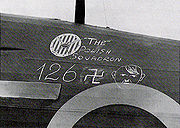
, achieved the highest number of kills (126) of all fighter squadrons engaged in the Battle of Britain, even though it only joined the combat on August 30, 1940: these Polish pilots, representing about 5% of total Allied pilots in that battle, were responsible for 12% of total victories (203) in the Battle and achieved the highest number of kills of any Allied squadron.
Polish Air Force
The Polish Air Force is the military Air Force wing of the Polish Armed Forces. Until July 2004 it was officially known as Wojska Lotnicze i Obrony Powietrznej...
also fought in 1943 in Tunisia
Tunisia
Tunisia , officially the Tunisian RepublicThe long name of Tunisia in other languages used in the country is: , is the northernmost country in Africa. It is a Maghreb country and is bordered by Algeria to the west, Libya to the southeast, and the Mediterranean Sea to the north and east. Its area...
(Polish Fighting Team, so called "Skalski's Circus"
Polish Fighting Team
The Polish Fighting Team , also known as "Skalski's Circus" , was a Polish unit which fought with the British Commonwealth Desert Air Force in the North African Campaign of World War II, during 1943...
) and in raids on Germany (1940–45). In the second half of 1941 and early 1942, Polish bomber squadrons were the sixth part of forces available to RAF Bomber Command
RAF Bomber Command
RAF Bomber Command controlled the RAF's bomber forces from 1936 to 1968. During World War II the command destroyed a significant proportion of Nazi Germany's industries and many German cities, and in the 1960s stood at the peak of its postwar military power with the V bombers and a supplemental...
(later they suffered heavy losses, with little replenishment possibilities). Polish aircrew losses serving with Bomber Command 1940-45 were 929 killed; total Polish aircrew losses were 1,803 killed. Ultimately 8 Polish fighter squadrons were formed within the RAF and had claimed 621 Axis aircraft destroyed by May 1945. By the end of the war, around 19,400 Poles were serving in the RAF.
Polish squadrons in the United Kingdom:
- No. 300 "Masovia" Polish Bomber Squadron (Ziemi Mazowieckiej)
- No. 301 "Pomerania" Polish Bomber Squadron (Ziemi Pomorskiej)
- No. 302 "City of Poznań" Polish Fighter Squadron (Poznański)
- No. 303 "Kościuszko" Polish Fighter Squadron (Warszawski imienia Tadeusza KościuszkiTadeusz KosciuszkoAndrzej Tadeusz Bonawentura Kościuszko was a Polish–Lithuanian and American general and military leader during the Kościuszko Uprising. He is a national hero of Poland, Lithuania, the United States and Belarus...
) - No. 304 "Silesia" Polish Bomber Squadron (Ziemi Śląskiej imienia Ksiecia Józefa Poniatowskiego)
- No. 305 "Greater Poland" Polish Bomber Squadron (Ziemi Wielkopolskiej imienia Marszałka Józefa Piłsudskiego)
- No. 306 "City of Toruń" Polish Fighter Squadron (Toruński)
- No. 307 "City of Lwów" Polish Fighter Squadron (Lwowskich Puchaczy)
- No. 308 "City of Kraków" Polish Fighter Squadron (Krakowski)
- No. 309 "Czerwień" Polish Fighter-Reconnaissance Squadron (Ziemi Czerwieńskiej)
- No. 315 "City of Dęblin" Polish Fighter Squadron (Dębliński)
- No. 316 "City of Warsaw" Polish Fighter Squadron (Warszawski)
- No. 317 "City of Wilno" Polish Fighter Squadron (Wileński)
- No. 318 "City of Gdańsk" Polish Fighter-Reconnaissance Squadron (Gdański)
- No. 663 Polish Artillery Observation Squadron
- Polish Fighting TeamPolish Fighting TeamThe Polish Fighting Team , also known as "Skalski's Circus" , was a Polish unit which fought with the British Commonwealth Desert Air Force in the North African Campaign of World War II, during 1943...
(Skalski's Circus)
Navy
Just on the eve of war, three destroyers - representing most of the major Polish NavyPolish Navy
The Marynarka Wojenna Rzeczypospolitej Polskiej - MW RP Polish Navy, is the branch of Republic of Poland Armed Forces responsible for naval operations...
ships - had been sent for safety to the British Isles (Operation Peking
Peking Plan
The Peking PlanThe "Peking" in the name is the traditional English spelling of the former name of the city that is now the capital of China, which is now spelled in the pinyin system 'Beijing'. At the time, the city was not the capital, and its name was Peiping. Before the Second World War in the...
). There they fought alongside the Royal Navy
Royal Navy
The Royal Navy is the naval warfare service branch of the British Armed Forces. Founded in the 16th century, it is the oldest service branch and is known as the Senior Service...
. At various stages of the war, the Polish Navy
Polish Navy
The Marynarka Wojenna Rzeczypospolitej Polskiej - MW RP Polish Navy, is the branch of Republic of Poland Armed Forces responsible for naval operations...
comprised two cruisers and a large number of smaller ships; most were RN ships loaned to take advantage of the Polish crews. The Polish Navy fought with great distinction alongside the other Allied navies in many important and successful operations, including those conducted against the German battleship, Bismarck
German battleship Bismarck
Bismarck was the first of two s built for the German Kriegsmarine during World War II. Named after Chancellor Otto von Bismarck, the primary force behind the German unification in 1871, the ship was laid down at the Blohm & Voss shipyard in Hamburg in July 1936 and launched nearly three years later...
. With their 26 ships (2 cruisers, 9 destroyers, 5 submarines and 11 torpedo boats), the Polish Navy sailed a total of 1.2 million nautical miles during the war, escorted 787 convoys, conducted 1162 patrols and combat operations, sank 12 enemy ships (including 5 submarines) and 41 merchant vessels, damaged 24 more (including 8 submarines) and shot down 20 aircraft. The number of seamen who lost their lives in action was 450 out of over 4,000.
- CruiserCruiserA cruiser is a type of warship. The term has been in use for several hundreds of years, and has had different meanings throughout this period...
s:- ORP DragonHMS Dragon (D46)HMS Dragon, also known in Polish service as ORP Dragon , was a D- or Danae-class cruiser built for the Royal Navy. She was launched in Glasgow, in December 1917, and scuttled in July 1944 off the Normandy beaches as part of the Arromanches Breakwater.-Pre World War II:One of the fastest-built ships...
(Danae classDanae class cruiserThe Danae or D-class was a class of light cruiser built for the Royal Navy at the end of World War I and that survived to see service in World War II.-Design:...
) - ORP Conrad (Danae class)
- ORP Dragon
- DestroyerDestroyerIn naval terminology, a destroyer is a fast and maneuverable yet long-endurance warship intended to escort larger vessels in a fleet, convoy or battle group and defend them against smaller, powerful, short-range attackers. Destroyers, originally called torpedo-boat destroyers in 1892, evolved from...
s:- ORP BurzaORP BurzaORP Burza was a of the Polish Navy which saw action in World War II.-History:ORP Burza was ordered on 2 April 1926 from the French shipyard Chantiers Naval Francais together with her sister ship Wicher...
("Storm") (Wicher-class) - ORP Grom ("Thunder") (Grom class) - lost 1940
- ORP Błyskawica ("Lightning") (Grom class)
- ORP Garland (G classG and H class destroyerThe G- and H-class destroyers were a class of twenty-four destroyers of the Royal Navy launched in 1935–1939. They served in World War II and sixteen were lost, with a seventeenth being written off as a constructive total loss...
) - ORP Orkan (M classL and M class destroyerThe L and M class was a class of sixteen destroyers which served in the British Royal Navy during World War II. The ships of the class were launched between 1939 and 1942.-Design details:...
) - ORP OuraganORP OuraganOuragan was a French Bourrasque class destroyer, commissioned in 1927. During World War II, she served with a Polish crew from 18 June 1940 until 30 April 1941....
("Hurricane", also known in some Polish sources as Huragan) (Bourrasque classBourrasque class destroyerThe Bourrasque class was a group of twelve French navy destroyers laid down in 1923 and commissioned from 1926 to 1936. Along with the heavier Chacal class, they were part of a plan to modernise the French fleet after World War I. The Bourrasques were smaller and slower than the Chacals, but were...
) - ORP PiorunORP Piorun (G65)ORP Piorun was an used by the Polish Navy during the Second World War. The name is Polish for "Thunderbolt".-History:The ship was built by John Brown & Company of Clydebank, Glasgow. She was laid down in July 1939, launched on 7 May 1940 and completed on 4 November 1940...
("Thunderbolt") (N classJ, K and N class destroyerThe J, K and N class was a class of 24 destroyers of the Royal Navy launched in 1938. They were a return to a smaller vessel, with a heavier torpedo armament, after the Tribal class that emphasised guns over torpedoes. The ships were built in three flotillas or groups, eight each of ships with...
)
- ORP Burza
- Escort destroyerEscort destroyerA Escort Destroyer is a US Navy post World War II classification for destroyers modified for and assigned to a fleet escort role. These destroyers retained their original hull numbers...
s- ORP KrakowiakORP KrakowiakORP Krakowiak was a British Hunt II-class destroyer escort, used by the Polish Navy during World War II. Initially built for the Royal Navy, it bore the name of HMS Silverton during British use..-History:...
("Cracovian") (Hunt class escortHunt class destroyerThe Hunt class was a class of Destroyer escort of the Royal Navy. The first vessels were ordered early in 1939, and the class saw extensive service in World War II, particularly on the British East Coast and Mediterranean convoys. They were named after British fox hunts...
) - ORP KujawiakORP KujawiakThe ORP Kujawiak was a British Hunt-class destroyer escort, formerly named the HMS Oakley. It was laid down on 22 November 1939 and launched on 30 October 1940. It was commissioned to the Polish Navy in June 1941. The destroyer was sunk on 16 June 1942 after running into a mine near Malta while...
("Kujawian") (Hunt class) - ORP Ślązak ("SilesiaSilesiaSilesia is a historical region of Central Europe located mostly in Poland, with smaller parts also in the Czech Republic, and Germany.Silesia is rich in mineral and natural resources, and includes several important industrial areas. Silesia's largest city and historical capital is Wrocław...
n") (Hunt class)
- ORP Krakowiak
- SubmarineSubmarineA submarine is a watercraft capable of independent operation below the surface of the water. It differs from a submersible, which has more limited underwater capability...
s:- ORP Orzeł ("Eagle") (Orzel Class)
- ORP JastrząbORP JastrzabORP Jastrząb was an old Holland-type S-class submarine, originally of the United States Navy, in Polish service between 1941 and 1942, when she was lost to friendly fire....
("Hawk") (S classUnited States S class submarineThe United States' S-class submarines, often simply called S-boats , were the first class of submarines built to a United States Navy design....
) - lost 1942 - ORP WilkORP WilkORP Wilk was the lead boat of her class of mine-laying submarines of the Polish Navy. The ship saw service in the Polish Navy from 1931 to 1951. Her name meant "Wolf" in Polish.-History:...
("Wolf") (Wilk class) - ORP DzikORP DzikORP Dzik was a U-class submarine built by Vickers-Armstrong at Barrow-in-Furness. She was laid down on 30 December 1941 as P-52 for the Royal Navy, but was transferred to the Polish Navy during construction. Launched on November 11, 1942, ORP Dzik was commissioned into the Polish Navy on December...
("Boar") (U classBritish U class submarineThe British U class submarines were a class of 49 small submarines built just before and during the Second World War...
) - ORP SokółORP SokółOne ship and three submarines of the Polish Navy have been named ORP Sokół :* Sokół, a tugboat launched in 1920 and disposed of in 1957....
("Falcon") (U class)
As well as the above, there were a number of minor ships, transports, merchant-marine auxiliary vessels, and patrol boats.
Intelligence and resistance
The Polish intelligence structure remained mostly intact following the fall of Poland in 1939 and continued to report to the Polish Government in Exile. Known as the 'Second Department', it cooperated with the other Allies in every EuropeEurope
Europe is, by convention, one of the world's seven continents. Comprising the westernmost peninsula of Eurasia, Europe is generally 'divided' from Asia to its east by the watershed divides of the Ural and Caucasus Mountains, the Ural River, the Caspian and Black Seas, and the waterways connecting...
an country and operated one of the largest intelligence networks in Nazi
Nazism
Nazism, the common short form name of National Socialism was the ideology and practice of the Nazi Party and of Nazi Germany...
Germany
Germany
Germany , officially the Federal Republic of Germany , is a federal parliamentary republic in Europe. The country consists of 16 states while the capital and largest city is Berlin. Germany covers an area of 357,021 km2 and has a largely temperate seasonal climate...
. Many Poles also served in other Allied intelligence services, including the celebrated Krystyna Skarbek
Krystyna Skarbek
Krystyna Skarbek, GM, OBE, Croix de guerre was a Polish Special Operations Executive agent. She became celebrated especially for her daring exploits in intelligence and irregular-warfare missions in Nazi-occupied Poland and France....
("Christine Granville") in the United Kingdom's Special Operations Executive
Special Operations Executive
The Special Operations Executive was a World War II organisation of the United Kingdom. It was officially formed by Prime Minister Winston Churchill and Minister of Economic Warfare Hugh Dalton on 22 July 1940, to conduct guerrilla warfare against the Axis powers and to instruct and aid local...
. 43 percent of all the reports received by the British secret services from continental Europe in 1939-45 came from Polish sources.
The majority of Polish resistance (particularly the dominant Armia Krajowa
Armia Krajowa
The Armia Krajowa , or Home Army, was the dominant Polish resistance movement in World War II German-occupied Poland. It was formed in February 1942 from the Związek Walki Zbrojnej . Over the next two years, it absorbed most other Polish underground forces...
organization) were also loyal to the government in exile with the Government Delegate's Office at Home
Government Delegate's Office at Home
The Government Delegation for Poland was an agency of the Polish Government in Exile during World War II. It was the highest authority of the Polish Secret State in occupied Poland and was headed by the Government Delegate for Poland, a de facto deputy Polish Prime Minister.The Government...
being the highest authority of the Polish Secret State
Polish Secret State
The Polish Underground State is a collective term for the World War II underground resistance organizations in Poland, both military and civilian, that remained loyal to the Polish Government in Exile in London. The first elements of the Underground State were put in place in the final days of the...
. Although military actions of the Polish resistance operating in Poland and its Armed Forces operating in the West are not commonly grouped together, several important links existed between them, in addition to the common chain of command
Chain of Command
Chain of Command may refer to:* Chain of command, in a military context, the line of authority and responsibility along which orders are passed* "Chain of Command" , the fifth episode of the first season of Beast Wars...
. Resistance gathered and passed vital intelligence to the West (for example on German concentration camps and about the V-1 flying bomb and the V-2 rocket
Home Army and V1 and V2
Aside from the military operations, the Polish Armia Krajowa was also heavily involved in intelligence work, including work done with regard to the German "Wunderwaffe" - the V-1 flying bomb and the V-2 rocket...
); while in the West supplies were gathered for the resistance, and elite commandos, the Cichociemni
Cichociemni
Cichociemni were elite special-operations paratroops of the Polish Home Army of the Polish Army in exile, created in Great Britain during World War II to operate in occupied Poland.-The name:...
, were trained. The Polish Government also wanted to use the Polish 1st Independent Parachute Brigade
Polish 1st Independent Parachute Brigade
The 1st Independent Parachute Brigade was a parachute brigade under command of Maj.Gen. Stanisław Sosabowski, created in Scotland in September 1941, with the exclusive mission to drop into occupied Poland in order to help liberate the country. The British government, however, pressured the Polish...
in Poland, particularly during the Operation Tempest
Operation Tempest
Operation Tempest was a series of uprisings conducted during World War II by the Polish Home Army , the dominant force in the Polish resistance....
, but the request was denied by the Allies.
See also
- Polish Armed Forces in the EastPolish Armed Forces in the EastPolish Armed Forces in the East refers to military units composed of Poles created in the Soviet Union at the time when the territory of Poland was occupied by both Nazi Germany and the Soviet Union in the Second World War....
- Polish contribution to World War IIPolish contribution to World War IIThe European theater of World War II opened with the German invasion of Poland on September 1, 1939. The Polish Army was defeated after over a month of fighting. After Poland had been overrun, a government-in-exile , armed forces, and an intelligence service were established outside of Poland....
- Western betrayalWestern betrayalWestern betrayal, also called Yalta betrayal, refers to a range of critical views concerning the foreign policies of several Western countries between approximately 1919 and 1968 regarding Eastern Europe and Central Europe...
- Polish BritishPolish BritishPolish migration to the United Kingdom describes the temporary or permanent migration of Poles to the United Kingdom . Most Polish migrants to the UK emigrated after two major events, the Polish Resettlement Act 1947 and the 2004 enlargement of the European Union...
- Civilian Labor GroupCivilian Labor GroupCivilian Labor Group or CLG are organisations of German or other European nationals employed by the US Army in Europe. They often wear American fatigues or a blue uniform with various insignia identifying them as CLG members.-History:...
External links
- Military contribution of Poland to World War II, Polish Ministry of Defence official page
- Polish contribution to the Allied victory in World War 2 (1939-1945), PDF at the site of Polish Embassy (Canada)
- The Poles on the Fronts of WW2
- Polish units in defence of France, 1939-1940
- Polish Exile Forces in the West in World War II
- Polish Squadrons Remembered
- Gilbert J. Mros: This V-E Day say 'dziekuje' to the Poles
- Listen to Lynn Olsen & Stanley Cloud, authors of "A Question of Honor," speak about the "Kościuszko" Squadron and Polish contribution to World War II here.