


Gulf of Finland

Encyclopedia
The Gulf of Finland is the easternmost arm of the Baltic Sea
. It extends between Finland
(to the north) and Estonia
(to the south) all the way to Saint Petersburg
in Russia
, where the river Neva drains into it. Other major cities around the gulf include Helsinki
and Tallinn
. The eastern parts of the Gulf of Finland belong to Russia, and some of Russia's most important oil harbors are located farthest in, near Saint Petersburg (including Primorsk
). As the seaway to Saint Petersburg, the Gulf of Finland has been and continues to be of considerable strategic importance to Russia. Some of the environmental problems affecting the Baltic Sea are at their most pronounced in the shallow gulf.
to Saint Petersburg) is 400 km (248.5 mi) and the width varies from 70 km (43.5 mi) near the entrance to 130 km (80.8 mi) on the meridian of the island Moshnyi; in the Neva Bay
, it decreases to 12 km (7.5 mi). The gulf is relatively shallow with the depth decreasing from the entrance to the gulf to the continent. The sharpest change occurs near Narva-Jõesuu
, which is why this place is called Narva wall. The average depth is 38 m (124.7 ft) with the maximum of 100 m (328.1 ft). The depth of the Neva Bay is less than 6 metres (20 ft); therefore, a channel was dug at the bottom for safe navigation. Because of the large influx of fresh water from rivers, especially from the Neva River (two thirds of the total runoff), the gulf water has very low salinity – between 0.2 and 5.8 ‰ at the surface and 0.3–8.5 ‰ near the bottom. The average water temperature is close to 0 °C in winter; in summer, it is 15–17 °C (59–62.6 F) at the surface and 2–3 °C (35.6–37.4 F) at the bottom. The gulf is usually frozen from late November to late April; the freezing starts in the east and gradually proceeds to the west. Complete freezing is usually reached by late January, and it might not occur in mild winters.
There are frequent strong western winds causing waves, surges of water and floods. (see Floods in Saint Petersburg
).
The northern coast of the gulf is high and winding, with abundant small bays and skerries
only a few large bays (Vyborg
) and peninsulas (Hanko and Porkkala
). The coast is mostly sloping; there are abundant sandy dunes, with occasional pine trees. The southern shores are smooth and shallow, but along the entire coast runs the Baltic Klint
with the height up to 55 m (180.4 ft). In the east, the gulf ends with Neva Bay and on the west merges with the Baltic Sea.
The gulf contains numerous banks, skerries and islands. The largest include Kotlin Island
with the city of Kronstadt
(population 42,800), Beryozovye Islands
, Lisiy Island, Maly Vysotsky Island
with the nearby city of Vysotsk
(population 1706), Hogland
(Suursaari), Moshnyi Island, Bolshoy Tyuters
(Tytärsaari), Sommers
, Naissaar
, Kimitoön, Kökar
, Seskar, Lavansaari, Grachevo (Seiskari), Pakri Islands
and others.
Starting from 1700, nineteen artificial islands with fortresses were built in the gulf by Russia. Their purpose was defense from attacks from water and their construction was urged by the Great Northern War
of 1700–1721. Those include Fort Alexander, Krasnaya Gorka
, Ino
, Totleben, Kronshlot and others.
The largest rivers flowing into the gulf are Neva
(from the east), Narva
(from the south), and Kymi (from the north). Keila
, Pirita
, Jägala, Kunda, Luga
, Sista and Kovashi flow into the gulf from the south. From the north flow Sestra River
, Porvoo
, Vantaa and several other small rivers. Saimaa Canal
connects the gulf with the Saimaa
lake.
defines the western limit of the Gulf of Finland as a line running from Spithami
(59°13'N), in Estonia, through the island of Osmussaar
from SE to NW and on to the SW extreme of Hanko Peninsula
(22°54'E) in Finland.
, 300–400 million years ago, the entire territory of the modern Gulf of Finland was covered by a sea. Modern relief was formed as a result of the glacier activities. Its retreat formed Littorina Sea
, which water level was some 7–9 meters higher than the present level of the Baltic Sea. Some 4,000 years ago the sea receded and shoals in the gulf have become its islands. Later uplifting of the Baltic Shield
skewed the surface of the gulf; for this reason, its northern shores are significantly higher than the southern ones.
consisting of forests, meadows and marshes. The major forest trees are pine
, spruce, birch
, willows, rowan
, aspen
, common and gray alder. In the far eastern part of the gulf vegetation of the marshy areas consists mainly of bulrush
and reeds, as well as fully aquatic plants, such as white
and yellow
waterlilies and acute sedge
. Aquatic plants in the shallow waters of the gulf include Ruppia and spiny naiad
.
Fish species of the gulf include Atlantic salmon
, viviparous eelpout
, gobies
, belica
, loach
, European chub
, minnow, silver bream
, common dace
, ruffe
, Crucian carp
, stickleback
, European smelt
, common rudd, brown trout
, tench
, pipefish
, burbot
, perch
, gudgeon
, lumpsucker
, roach
, lamprey
, vendace
, garfish
, common whitefish, common bream
, zander
, orfe, pike, spined loach
, sprat, Baltic herring, sabre carp
, common bleak, European eel
and Atlantic cod
. Commercial fishing is carried out in spring and autumn. Gray seal and ringed seal
are met in the gulf, but the latter is very rare.
and copper
, organochlorine pesticide
s, phenols
, petroleum product
s and polycyclic aromatic hydrocarbon
s. Cleaning of waste water in Saint Petersburg was started in 1979 and by 1997 about 74% of wastewater was purified. This number rose to 85% in 2005, to 91.7% by 2008, and is expected to reach 100% by 2011 with the completion of the expansion of the main sewerage plant. Nevertheless, in 2008, the Federal Service of Saint Petersburg announced that no beach of Saint Petersburg is fit for swimming.
Fish catchment decreased 10 times between 1989 and 2005. Apart from pollution, another reason for that is hydraulic and engineering works. For example, construction of new ports in Ust-Luga and Vysotsk and on Vasilievsky Island
adversely affected the spawning
of fish. Extraction of sand and gravel in the Neva Bay for the land reclamation destroy spawning sites of European smelt
.
Construction of the Saint Petersburg Dam
reduced water exchange of the Neva Bay with the eastern part of the gulf by 10–20% that increased the contamination level of Neva Bay. The largest changes occur within 5 km from the dam. Some shallow areas between Saint Petersburg and the dam are turning into swamps. Waterlogging and the associated rotting of plants may eventually lead to eutrophication
of the area. Also worrying is expansion of oil ports in the gulf and the construction of a treatment center for spent fuel from the Leningrad Nuclear Power Plant
.
The port of Kronstadt
is currently serving as a transit point for the import in Russia of radioactive waste
through the Baltic Sea. The waste, mostly depleted uranium hexafluoride
, is further transported through Saint Petersburg to Novouralsk
, Angarsk
and other cities of eastern Russia. This transit point will be moved from Saint Petersburg to the port Ust-Luga within the Border Security Zone of Russia
, as decided by the Russian government in 2003 (Order No. 1491-r of 14 October 2003). This step should reduce the ecological risks for Saint Petersburg.
lowered to reveal the land. Remains of about 11 Neolithic
settlements were found since 1905 in the mouth of the river Sestra River (Leningrad Oblast)
. They contain arrow tips and scrapers made of quartz
, numerous food utensils and traces of firecamps – all indicative of hunting rather than agricultural or animal husbandry
activities.
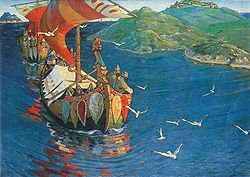 The gulf coast was later populated by Finno-Ugric peoples
. Eesti
(or Chud
) inhabited the region of the modern Estonia, Votes
were living on the south of the gulf and Izhorians
to the south of Neva River. Korela
tribes settled to the west of Lake Ladoga
. In the 8–9th centuries, the banks of Neva and of the Gulf of Finland was populated by East Slavs
, in particular by Ilmen Slavs
and Krivich
s. They were engaged in slash and burn
agriculture, animal husbandry, hunting and fishing. During the 8–13th centuries, the Gulf of Finland and Neva were parts of the waterway from Scandinavia
, through by Eastern Europe
to the Byzantine Empire
.
From the 9th century, the eastern coast of the gulf belonged to Veliky Novgorod
and were called Vodskaya Pyatina. As a result of the 1219 crusade and the Battle of Lyndanisse
, the Northern Estonia became part of Denmark (Danish Estonia
). In 12 century, the city Reval was established on the territory of modern Tallinn. As a result of the Estonian uprising in 1343
, the Northern Estonia was taken over by the Teutonic Order and sold by Denmark in 1346. In 1559, during the Livonian war
, the Bishop of Ösel-Wiek
in Old Livonia sold his lands to King Frederick II of Denmark
for 30,000 thalers. The Danish king gave the territory to his younger brother Magnus who landed on Saaremaa
with an army in 1560. The whole of Saaremaa
became a Danish possession in 1573, and remained so until it was transferred to Sweden in 1645.
In the 12th and 13th centuries, the Finnish tribes on the north of the gulf were conquered by the Swedes who then proceeded to the Slavs. The first encounter is attributed to 1142 when 60 Swedish ships attacked 3 Russian merchant vessels. After a Swedish attack in 1256, the Russian army of Alexander Nevsky
crossed the frozen gulf and raided the Swedish territories in the modern Finland. In 1293, the Vyborg Castle and city of Vyborg
was founded by the Swedish marshal
Torkel Knutsson
. The castle was fought over for decades between Sweden and the Republic of Novgorod. By the Treaty of Nöteborg
in 1323, Vyborg was finally recognized as a part of Sweden
. It withstood a prolonged siege by Daniil Shchenya
during the Russo–Swedish War of 1496–1499. The town's trade privileges were chartered
by King Eric of Pomerania
in 1403. Vyborg remained in Swedish hands until its capture by Peter the Great
in the Great Northern War
(1710).
In 1323, the Treaty of Nöteborg
set the border between Sweden and Russia along the river Sestra. In 15th century, the Izhorian lands of the Novgorod Republic were attached to the Grand Duchy of Moscow
. In 1550, Gustav I of Sweden
founded a city on the site of modern Helsinki
. As a result of the Russian defeat in the Ingrian War
(1610–1617) and the Treaty of Stolbovo
(1617) the lands on the Gulf of Finland and Neva River became part of the Swedish Ingria
. Its capital Nyen was located in the delta of Neva River.
. These fortifications, nicknamed by the contemporaries "the Russian Dardanelles", were designed to control the gulf waterway.
In 1710, the cities of Petergof and Oranienbaum
were founded on the southern shore of the Gulf of Finland. On 27 July 1714, near Cape Gangut, the Russian Navy won its first battle-a decisive victory over the Imperial Swedish Navy. The Russo-Swedish war ended in 1721 by the Treaty of Nystad
, by which Russia received all the lands along the Neva and the Gulf of Finland, as well as Estland
, Swedish Livonia
and western part of the Karelian Isthmus
, including Vyborg. However, Finland was returned to Sweden. The war resumed in (1788–1790), and a major battle
occurred on 6 July 1788 near the island Gogland. Both the battle and the war were relatively minor and indecisive, with the outcome of Russia retaining its territories.
The next Russo-Swedish war
was fought in (1808–1809). It ended with the Treaty of Fredrikshamn giving the Russia rights on the territory of Finland and Åland Islands
. The newly established in 1809 Grand Duchy of Finland
received broad autonomy within the Russian Empire and Western Karelia
was returned to Finland. On 6 December 1917, the Parliament of Finland
promulgated the Finnish Declaration of Independence. Western Karelia was annexed by the Soviet Union after the Winter War
.
Estonia declared independence on 24 February 1918 and fought a war of independence. The republic existed until 1940 and then was annexed by the Soviet Union. Estonia regained its independence after the dissolution of the Soviet Union
in 1991.
The Gulf of Finland had several major naval operations during World War II. In August 1941, during the evacuation of the Baltic Fleet from Tallinn to Kronstadt, German forces sank 15 Russian military boats, (5 destroyer
s, 2 submarine
s, 3 guard ship
s, 2 minesweepers
, 2 gunboat
s and 1 Motor Torpedo Boat
) as well as 43 transport and support ships. Several ships still remain on the gulf bottom near Cape Juminda, and a monument was raised there in memory of those lost in the events.
In 1978, construction was started on the Saint Petersburg Dam
aiming to protect Saint Petersburg from the frequent floods
. The work was halted at 60% completion in the late 1980s, due to the financial problems related to the breakup of the Soviet Union; it was resumed in 2001 and is — as of August 2011 — complete.
and a network of ports and unique natural and historical places. Navigation has long been the dominant activity in the gulf. The major port cities and their functions are, in Russia: Saint Petersburg
(all kinds of goods), Kronstadt
(container shipping), Lomonosov (general cargo, containers, metals), Vyborg
(general cargo), Primorsk
(oil and petroleum products), Vysotsk
(oil and coal), Ust-Luga (coal, timber, containers); in Finland: Helsinki
(containers), Kotka
(containers, timber, agricultural products; it is the main transhipment cargo port for Russia), Hanko (containers, vehicles), Turku
(containers, rail ferry), Kilpilahti/Sköldvik harbour (oil refinery
); in Estonia: Tallinn
(grains, refrigerators, oil), Paldiski
, Sillamäe
. Gulf of Finland is also part of the Volga-Baltic Waterway
and White Sea – Baltic Canal. Important goods include apatite
from the Kola Peninsula
, Karelia
n granite
and greenstone
, timber
from Arkhangelsk Oblast
and Vologda
, ferrous metals from Cherepovets
, coal from Donetsk
and Kuznetsk Basin
s, pyrite
from Ural, potassium chloride
from Solikamsk
, oil from Volga region, and grains from many regions of Russia.
Passenger transport on the gulf includes a number of ferry lines which connect the following ports: Helsinki and Hanko (Finland), Mariehamn
(Åland Islands
), Stockholm
and Kappelsher (Sweden), Tallinn and Paldiski, Rostock
(Germany), Saint Petersburg and Kaliningrad
(Russia), as well as many other cities.
Another major and historical activity in the gulf is fishing, especially on the northern coast near Vyborg, Primorsk and on the southern coast near Ust-Luga. Commercial fish species are herring
, sprats
, European smelt
, whitefishes
, carp bream
, roaches
, perch
, European eel
, lamprey
and others. In 2005, the catchment was 2000 tons by the ships of Saint Petersburg and Leningrad Oblast alone.
In September 2005 the agreement was signed on the construction of the Nord Stream offshore gas pipeline on the Baltic Sea, from Vyborg to the German city of Greifswald
. The first line should become operational in 2011.
s, the ships are relatively well preserved. Since the 6th century, major waterways were running through the gulf, and only in the 8th through 10th centuries, about 3,000 tonnes of silver was transported there. Later, the gulf was actively used by Sweden and Russia for transport of goods. Every year saw dozens of lost ships. In the fall of 1743, 17 Russian warships returning from Finland sank in just 7 hours, and in the summer of 1747, 26 merchant vessels sank within 4 hours near Narva. A record was set in 1721 when during the evacuation of Russian troops from Finland, more than 100 vessels were lost within 3 months, including 64 in a single night.
By the end of 1996, about 5000 submerged objects were identified in the Russian part of the gulf, including 2500 ships, 1500 airplanes and small items such as boats, anchor, tanks, tractors, cars, cannons and even naval mine
s, aerial bomb
s, torpedoes and other ammunition. The ships belonged to Russia (25%), Germany (19%), United Kingdom (17%), Sweden (15%), Netherlands (8%) and Finland (7%). The remaining 9% are from Norway, Denmark, France, US, Italy, Estonia and Latvia. These objects present potential hazards to navigation, fishery, coastal construction, laying of submarine pipelines and cables and the environment. Mines were laid in the gulf during World War I
(38,932 units), Russian Civil War
and the Soviet-Finnish War of (1939–1940) with an estimated total number of 60,000; about 85,000 more mines were set during World War II, and only a fraction of all those were eliminated after the wars.
Baltic Sea
The Baltic Sea is a brackish mediterranean sea located in Northern Europe, from 53°N to 66°N latitude and from 20°E to 26°E longitude. It is bounded by the Scandinavian Peninsula, the mainland of Europe, and the Danish islands. It drains into the Kattegat by way of the Øresund, the Great Belt and...
. It extends between Finland
Finland
Finland , officially the Republic of Finland, is a Nordic country situated in the Fennoscandian region of Northern Europe. It is bordered by Sweden in the west, Norway in the north and Russia in the east, while Estonia lies to its south across the Gulf of Finland.Around 5.4 million people reside...
(to the north) and Estonia
Estonia
Estonia , officially the Republic of Estonia , is a state in the Baltic region of Northern Europe. It is bordered to the north by the Gulf of Finland, to the west by the Baltic Sea, to the south by Latvia , and to the east by Lake Peipsi and the Russian Federation . Across the Baltic Sea lies...
(to the south) all the way to Saint Petersburg
Saint Petersburg
Saint Petersburg is a city and a federal subject of Russia located on the Neva River at the head of the Gulf of Finland on the Baltic Sea...
in Russia
Russia
Russia or , officially known as both Russia and the Russian Federation , is a country in northern Eurasia. It is a federal semi-presidential republic, comprising 83 federal subjects...
, where the river Neva drains into it. Other major cities around the gulf include Helsinki
Helsinki
Helsinki is the capital and largest city in Finland. It is in the region of Uusimaa, located in southern Finland, on the shore of the Gulf of Finland, an arm of the Baltic Sea. The population of the city of Helsinki is , making it by far the most populous municipality in Finland. Helsinki is...
and Tallinn
Tallinn
Tallinn is the capital and largest city of Estonia. It occupies an area of with a population of 414,940. It is situated on the northern coast of the country, on the banks of the Gulf of Finland, south of Helsinki, east of Stockholm and west of Saint Petersburg. Tallinn's Old Town is in the list...
. The eastern parts of the Gulf of Finland belong to Russia, and some of Russia's most important oil harbors are located farthest in, near Saint Petersburg (including Primorsk
Primorsk, Leningrad Oblast
Primorsk is a coastal town in Vyborgsky District of Leningrad Oblast, Russia, and the largest Russian port on the Baltic. It is located on the Karelian Isthmus, west of St. Petersburg, at the northern coast of the Gulf of Finland, near Birch Islands, protected as a sea bird sanctuary...
). As the seaway to Saint Petersburg, the Gulf of Finland has been and continues to be of considerable strategic importance to Russia. Some of the environmental problems affecting the Baltic Sea are at their most pronounced in the shallow gulf.
Geography
The area of the gulf is 30000 km² (11,583.1 sq mi). The length (from the Hanko PeninsulaHanko Peninsula
The Hanko Peninsula , also spelled Hango, is the southernmost point of mainland Finland. The soil is a sandy moraine, the last tip of the Salpausselkä ridge, and vegetation consists mainly of pine and low shrubs...
to Saint Petersburg) is 400 km (248.5 mi) and the width varies from 70 km (43.5 mi) near the entrance to 130 km (80.8 mi) on the meridian of the island Moshnyi; in the Neva Bay
Neva Bay
The Neva Bay , also known as the Gulf of Kronstadt, is the easternmost part of the Gulf of Finland between Kotlin Island and the Neva River estuary where the city of St. Petersburg is sited....
, it decreases to 12 km (7.5 mi). The gulf is relatively shallow with the depth decreasing from the entrance to the gulf to the continent. The sharpest change occurs near Narva-Jõesuu
Narva-Jõesuu
Narva-Jõesuu is a town in Ida-Viru County, Estonia, located on the country's northern Baltic Sea coast near the Russian border. The name of the town in Estonian and Russian means "mouth of the Narva River"....
, which is why this place is called Narva wall. The average depth is 38 m (124.7 ft) with the maximum of 100 m (328.1 ft). The depth of the Neva Bay is less than 6 metres (20 ft); therefore, a channel was dug at the bottom for safe navigation. Because of the large influx of fresh water from rivers, especially from the Neva River (two thirds of the total runoff), the gulf water has very low salinity – between 0.2 and 5.8 ‰ at the surface and 0.3–8.5 ‰ near the bottom. The average water temperature is close to 0 °C in winter; in summer, it is 15–17 °C (59–62.6 F) at the surface and 2–3 °C (35.6–37.4 F) at the bottom. The gulf is usually frozen from late November to late April; the freezing starts in the east and gradually proceeds to the west. Complete freezing is usually reached by late January, and it might not occur in mild winters.
There are frequent strong western winds causing waves, surges of water and floods. (see Floods in Saint Petersburg
Floods in Saint Petersburg
Floods in Saint Petersburg refer to a rise of water on the territory of St. Petersburg, a major city in Russia and its former capital. They are usually caused by the overflow of the delta of Neva River and surging water in the eastern part of Neva Bay but sometimes caused by melting snow...
).
The northern coast of the gulf is high and winding, with abundant small bays and skerries
Skerry
A skerry is a small rocky island, usually defined to be too small for habitation. It may simply be a rocky reef. A skerry can also be called a low sea stack....
only a few large bays (Vyborg
Vyborg
Vyborg is a town in Leningrad Oblast, Russia, situated on the Karelian Isthmus near the head of the Bay of Vyborg, to the northwest of St. Petersburg and south from Russia's border with Finland, where the Saimaa Canal enters the Gulf of Finland...
) and peninsulas (Hanko and Porkkala
Porkkala
Porkkala is a peninsula in the Gulf of Finland located at Kirkkonummi in Southern Finland.The peninsula had great strategic value, as coastal artillery based there would be able to reach more than halfway across the Gulf of Finland...
). The coast is mostly sloping; there are abundant sandy dunes, with occasional pine trees. The southern shores are smooth and shallow, but along the entire coast runs the Baltic Klint
Baltic Klint
The Baltic Klint is an erosional limestone escarpment on several islands of the Baltic Sea, in Estonia and in Leningrad Oblast of Russia...
with the height up to 55 m (180.4 ft). In the east, the gulf ends with Neva Bay and on the west merges with the Baltic Sea.
The gulf contains numerous banks, skerries and islands. The largest include Kotlin Island
Kotlin Island
Kotlin is a Russian island, located near the head of the Gulf of Finland, west of Saint Petersburg in the Baltic Sea. Kotlin separates the Neva Bay from the rest of the gulf...
with the city of Kronstadt
Kronstadt
Kronstadt , also spelled Kronshtadt, Cronstadt |crown]]" and Stadt for "city"); is a municipal town in Kronshtadtsky District of the federal city of St. Petersburg, Russia, located on Kotlin Island, west of Saint Petersburg proper near the head of the Gulf of Finland. Population: It is also...
(population 42,800), Beryozovye Islands
Beryozovye Islands
Beryozovye Islands , alternatively spelled Berezovye Islands, is an island group in Leningrad Oblast, Russia. The islands are situated at the bottom of the Gulf of Finland, just outside the town of Primorsk on the Karelian Isthmus....
, Lisiy Island, Maly Vysotsky Island
Maly Vysotsky Island
Maly Vysotsky is an island in northwest Russia, currently leased to Finland. It is located in Vyborg Bay, next to Vysotsk, 12 km southwest of Vyborg....
with the nearby city of Vysotsk
Vysotsk
Vysotsk is a coastal town and a seaport in Vyborgsky District of Leningrad Oblast, Russia, located on the Karelian Isthmus, on the eastern shore of the Bay of Vyborg, southwest of Vyborg and northwest of St. Petersburg. It hosts a base of the Russian Baltic Fleet and an oil terminal...
(population 1706), Hogland
Hogland
Gogland or Hogland is an island in the Gulf of Finland of the Baltic Sea, located some 180 km west of Saint Petersburg and 35 km away from the coast of Finland . The island is a part of the Leningrad Oblast, Russia. The area of Hogland Island is approximately...
(Suursaari), Moshnyi Island, Bolshoy Tyuters
Bolshoy Tyuters
Bolshoi Tyuters is an island in the Gulf of Finland of the Baltic Sea, located 75 km away from the coast of Finland, to the south-east from Hogland. The island is a part of the Leningrad Oblast, Russia. The area is approximately 8.3 km². There are no permanent inhabitants, save for a...
(Tytärsaari), Sommers
Sommers
Sommers is an islet and a lighthouse in the eastern part of the Gulf of Finland, and arm of the Baltic Sea, just outside the Gulf of Vyborg, about 19 kilometres south of Virolahti, Finland, but it is now possessed by Russia....
, Naissaar
Naissaar
Naissaar is an island northwest of Tallinn in Estonia. The island covers an area of 18.6 km². It is 13-14 km long and 6 km wide, and lies about 8.5 km from the mainland. The highest point on the island is Kunilamägi, which is 27 meters above sea-level. The island consists predominantly of...
, Kimitoön, Kökar
Kökar
Kökar is an island municipality to the south-east of the Åland archipelago, Finland.It is also one of the municipalities of Åland. It is reachable by boat from Långnäs on Åland or from Galtby with access to mainland Finland....
, Seskar, Lavansaari, Grachevo (Seiskari), Pakri Islands
Pakri Islands
Pakri Islands are two Estonian islands in the Finnish Gulf: Suur-Pakri and Väike-Pakri . Administratively they belong to the town of Paldiski...
and others.
Starting from 1700, nineteen artificial islands with fortresses were built in the gulf by Russia. Their purpose was defense from attacks from water and their construction was urged by the Great Northern War
Great Northern War
The Great Northern War was a conflict in which a coalition led by the Tsardom of Russia successfully contested the supremacy of the Swedish Empire in northern Central Europe and Eastern Europe. The initial leaders of the anti-Swedish alliance were Peter I the Great of Russia, Frederick IV of...
of 1700–1721. Those include Fort Alexander, Krasnaya Gorka
Krasnaya Gorka fort
Krasnaya Gorka is a coastal artillery fortress west of Lomonosov, Russia on the southern shore of the Gulf of Finland, opposite Kotlin Island and the Baltic Fleet's base at Kronshtadt...
, Ino
Fort Ino
Fort Ino or Fort Nikolaevsky is an abandoned early 20th-century Russian coastal fortification situated on the northern shore of Neva Bay in the Gulf of Finland. The fort is close to the present-day settlement Privetninskoye of Vyborgsky District of Leningrad Oblast, opposite the Krasnaya Gorka...
, Totleben, Kronshlot and others.
The largest rivers flowing into the gulf are Neva
Neva River
The Neva is a river in northwestern Russia flowing from Lake Ladoga through the western part of Leningrad Oblast to the Neva Bay of the Gulf of Finland. Despite its modest length , it is the third largest river in Europe in terms of average discharge .The Neva is the only river flowing from Lake...
(from the east), Narva
Narva River
The Narva is a river flowing into the Baltic Sea, the largest river in Estonia. Draining Lake Peipsi, the river forms the border of Estonia and Russia and flows through the towns of Narva/Ivangorod and Narva-Jõesuu into Narva Bay. Though the river is only 77 km long, in terms of volume...
(from the south), and Kymi (from the north). Keila
Keila River
-External links:...
, Pirita
Pirita River
The Pirita River is a long river in northern Estonia that drains into the Gulf of Finland in Pirita, Tallinn. The basin area of Pirita is 799 km²....
, Jägala, Kunda, Luga
Luga River
The Luga River -See also:* Shum Gora, an archaeological site near the banks of the river...
, Sista and Kovashi flow into the gulf from the south. From the north flow Sestra River
Sestra River (Leningrad Oblast)
Sestra River is a river in Saint Petersburg and Leningrad Oblast, Russia.The length of the river is 74 km . The area of its basin is 393 km² . The Sestra River flows over the Karelian Isthmus. It used to fall into the Gulf of Finland until the early 18th century...
, Porvoo
Porvoonjoki
Porvoonjoki is a small river in Finland. The Mediaeval town of Porvoo is situated in the river delta....
, Vantaa and several other small rivers. Saimaa Canal
Saimaa Canal
The Saimaa Canal is a transportation canal that connects lake Saimaa with the Gulf of Finland near Vyborg, Russia. The canal was built from 1845 to 1856 and opened on 7 September 1856 .It was overhauled and widened in 1963–1968....
connects the gulf with the Saimaa
Saimaa
Saimaa is a lake in southeastern Finland. At approximately , it is the largest lake in Finland, and the fourth largest in Europe. It was formed by glacial melting at the end of the Ice Age. Major towns on the lakeshore include Lappeenranta, Imatra, Savonlinna, Mikkeli, Varkaus, and Joensuu. The...
lake.
Extent
The International Hydrographic OrganizationInternational Hydrographic Organization
The International Hydrographic Organization is the inter-governmental organisation representing the hydrographic community. It enjoys observer status at the UN and is the recognised competent authority on hydrographic surveying and nautical charting...
defines the western limit of the Gulf of Finland as a line running from Spithami
Spithami
Spithami is a village in Noarootsi Parish, Lääne County, in northwestern Estonia. It was inhabited bythe Swedish minority before World War 2. During Soviet reign it was a military area which was banned for entering bycivilians....
(59°13'N), in Estonia, through the island of Osmussaar
Osmussaar
Osmussaar is an Estonian island situated in the mouth of the Gulf of Finland in the Baltic Sea, 7.5 km off the Estonian mainland. Administratively the island is part of Noarootsi Parish in Lääne County. Its area is ....
from SE to NW and on to the SW extreme of Hanko Peninsula
Hanko Peninsula
The Hanko Peninsula , also spelled Hango, is the southernmost point of mainland Finland. The soil is a sandy moraine, the last tip of the Salpausselkä ridge, and vegetation consists mainly of pine and low shrubs...
(22°54'E) in Finland.
Geological history
In PaleozoicPaleozoic
The Paleozoic era is the earliest of three geologic eras of the Phanerozoic eon, spanning from roughly...
, 300–400 million years ago, the entire territory of the modern Gulf of Finland was covered by a sea. Modern relief was formed as a result of the glacier activities. Its retreat formed Littorina Sea
Littorina Sea
Littorina Sea is a geological brackish-water stage of the Baltic Sea, which existed around 7500–4000 BP and followed the Mastogloia Sea, transitional stage of the Ancylus Lake...
, which water level was some 7–9 meters higher than the present level of the Baltic Sea. Some 4,000 years ago the sea receded and shoals in the gulf have become its islands. Later uplifting of the Baltic Shield
Baltic Shield
The Baltic Shield is located in Fennoscandia , northwest Russia and under the Baltic Sea. The Baltic Shield is defined as the exposed Precambrian northwest segment of the East European Craton...
skewed the surface of the gulf; for this reason, its northern shores are significantly higher than the southern ones.
| Gulf Coast near Komarovo Komarovo, Saint Petersburg Komarovo is a municipal settlement in Kurortny District of the federal city of Saint Petersburg, Russia, located on the Karelian Isthmus on the shore of the Gulf of Finland, and a station of the Saint Petersburg-Vyborg railroad. It is located about northwest of central Saint Petersburg... |
Islands near Helsinki Helsinki Helsinki is the capital and largest city in Finland. It is in the region of Uusimaa, located in southern Finland, on the shore of the Gulf of Finland, an arm of the Baltic Sea. The population of the city of Helsinki is , making it by far the most populous municipality in Finland. Helsinki is... |
View on the bay from the St. Olaf's church, Tallinn |
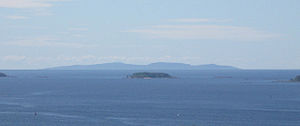 |
||
| Kronstadt Kronstadt Kronstadt , also spelled Kronshtadt, Cronstadt |crown]]" and Stadt for "city"); is a municipal town in Kronshtadtsky District of the federal city of St. Petersburg, Russia, located on Kotlin Island, west of Saint Petersburg proper near the head of the Gulf of Finland. Population: It is also... in winter |
Panorama of Neva River Neva River The Neva is a river in northwestern Russia flowing from Lake Ladoga through the western part of Leningrad Oblast to the Neva Bay of the Gulf of Finland. Despite its modest length , it is the third largest river in Europe in terms of average discharge .The Neva is the only river flowing from Lake... from the Gulf |
View on the island of Hogland Hogland Gogland or Hogland is an island in the Gulf of Finland of the Baltic Sea, located some 180 km west of Saint Petersburg and 35 km away from the coast of Finland . The island is a part of the Leningrad Oblast, Russia. The area of Hogland Island is approximately... by Kotka Kotka Kotka is a town and municipality of Finland. Its former name is Rochensalm.Kotka is located on the coast of the Gulf of Finland at the mouth of Kymi River and it is part of the Kymenlaakso region in southern Finland. The municipality has a population of and covers an area of of which is water.... |
Flora and fauna
Most of the gulf coast is covered with taigaTaiga
Taiga , also known as the boreal forest, is a biome characterized by coniferous forests.Taiga is the world's largest terrestrial biome. In North America it covers most of inland Canada and Alaska as well as parts of the extreme northern continental United States and is known as the Northwoods...
consisting of forests, meadows and marshes. The major forest trees are pine
Pine
Pines are trees in the genus Pinus ,in the family Pinaceae. They make up the monotypic subfamily Pinoideae. There are about 115 species of pine, although different authorities accept between 105 and 125 species.-Etymology:...
, spruce, birch
Birch
Birch is a tree or shrub of the genus Betula , in the family Betulaceae, closely related to the beech/oak family, Fagaceae. The Betula genus contains 30–60 known taxa...
, willows, rowan
Rowan
The rowans or mountain-ashes are shrubs or small trees in genus Sorbus of family Rosaceae. They are native throughout the cool temperate regions of the Northern Hemisphere, with the highest species diversity in the mountains of western China and the Himalaya, where numerous apomictic microspecies...
, aspen
Aspen
Populus section Populus, of the Populus genus, includes the aspen trees and the white poplar Populus alba. The five typical aspens are all native to cold regions with cool summers, in the north of the Northern Hemisphere, extending south at high altitudes in the mountains. The White Poplar, by...
, common and gray alder. In the far eastern part of the gulf vegetation of the marshy areas consists mainly of bulrush
Typha
Typha is a genus of about eleven species of monocotyledonous flowering plants in the family Typhaceae. The genus has a largely Northern Hemisphere distribution, but is essentially cosmopolitan, being found in a variety of wetland habitats...
and reeds, as well as fully aquatic plants, such as white
Nymphaea alba
Nymphaea alba, also known as the European White Waterlily, White Lotus, or Nenuphar, is an aquatic flowering plant of the family Nymphaeaceae....
and yellow
Nuphar lutea
Nuphar lutea is an aquatic plant of the family Nymphaeaceae, native to temperate regions of Europe, northwest Africa, and western Asia.-Growth:...
waterlilies and acute sedge
Carex acuta
Carex acuta or Acute Sedge, Slender Tufted-sedge, Slim Sedge can be found growing on the margins of rivers and lakes in the Palaearctic terrestrial ecoregions in beds of wet, alkaline or slightly acid depressions with mineral soil....
. Aquatic plants in the shallow waters of the gulf include Ruppia and spiny naiad
Najas marina
Najas marina is a species of aquatic plant known by the common names spiny naiad and holly-leaved water nymph. It can be found nearly worldwide in many types of freshwater and brackish aquatic habitat, including bodies of alkaline water. This annual plant produces a slender, branching stem up to 40...
.
Fish species of the gulf include Atlantic salmon
Atlantic salmon
The Atlantic salmon is a species of fish in the family Salmonidae, which is found in the northern Atlantic Ocean and in rivers that flow into the north Atlantic and the north Pacific....
, viviparous eelpout
Viviparous eelpout
The viviparous eelpout , also known as the, viviparous blenny and European eelpout is an eelpout in the family Zoarcidae. It is notable for giving birth to live larvae . It is a common soup ingredient in Mediterranean countries. The bones are of greenish colour, due to a harmless pigment...
, gobies
Goby
The gobies form the family Gobiidae, which is one of the largest families of fish, with more than 2,000 species in more than 200 genera. Most are relatively small, typically less than 10 cm in length...
, belica
Moderlieschen
The Moderlieschen or Belica is a species of ray-finned fish in the Cyprinidae family. Formerly, its genus Leucaspius included some other species, but these have all been moved to Ladigesocypris or Pseudophoxinus or merged with L...
, loach
Misgurnus
Misgurnus is a genus of loaches. Commonly known as weatherfishes or weather loaches, they are commonly eaten in Asia.- Species :* Misgurnus anguillicaudatus * Misgurnus buphoensis R. T. Kim & S. Y...
, European chub
European chub
The European chub , sometimes called the round chub, fat chub, chevin, pollard or simply "the" chub, is a freshwater fish of the family Cyprinidae...
, minnow, silver bream
Silver Bream
The Silver Bream is a species of ray-finned fish in the Cyprinidae family.-Locations:It is found in Albania, Andorra, Armenia, Austria, Azerbaijan, Belarus, Belgium, Bulgaria, Cyprus, Czech Republic, Estonia, Faroe Islands, Finland, France, Georgia, Germany, Gibraltar, Hungary, Iceland, Iran,...
, common dace
Common dace
The common dace , also known as the dace or the Eurasian dace, is a fresh- or brackish-water fish belonging to the family Cyprinidae. It is an inhabitant of the rivers and streams of Europe north of the Alps as well as in Asia. It is most abundant in France and Germany, and has also spread to...
, ruffe
Ruffe
The Eurasian Ruffe or simply Ruffe is a freshwater fish found in temperate regions of Europe and northern Asia. It has been introduced into the Great Lakes of North America, reportedly with unfortunate results...
, Crucian carp
Crucian carp
The crucian carp is a member of the family Cyprinidae, which includes many other fish, such as the common carp, or the smaller minnows. They inhabit lakes, ponds, and slow-moving rivers throughout Europe and Asia. The crucian is a medium-sized cyprinid, which rarely exceeds a weight of over 3.3...
, stickleback
Stickleback
The Gasterosteidae are a family of fish including the sticklebacks. FishBase currently recognises sixteen species in the family, grouped in five genera. However several of the species have a number of recognised subspecies, and the taxonomy of the family is thought to be in need of revision...
, European smelt
European smelt
The Smelt or European smelt is a species of fish in the Osmeridae family.- Shape and appearance :The body of the European smelt is typically 15 to 18 cm long, slender and slightly flattened on either side. Larger fish may reach 30 cm in length. Smelts have a slightly translucent body...
, common rudd, brown trout
Brown trout
The brown trout and the sea trout are fish of the same species....
, tench
Tench
The tench or doctor fish is a freshwater and brackish water fish of the cyprinid family found throughout Eurasia from Western Europe including the British Isles east into Asia as far as the Ob and Yenisei Rivers. It is also found in Lake Baikal...
, pipefish
Seaweed pipefish
Seaweed pipefishes, Syngnathus, is a genus of pipefishes. Inhabit marine, brackish, sometime fresh waters. Consists of 32 species:* Syngnathus abaster Risso, 1827 - Black-striped pipefish* Syngnathus acus Linnaeus, 1758 - Greater pipefish...
, burbot
Burbot
The burbot is the only gadiform fish inhabiting freshwaters. It is also known as mariah, the lawyer, and eelpout. It is closely related to the marine common ling and the cusk...
, perch
European perch
The European perch, Perca fluviatilis, is a predatory species of perch found in Europe and Asia. In some areas it is known as the redfin perch or English perch, and it is often known simply as perch. The species is a popular quarry for anglers and has been widely introduced beyond its native area,...
, gudgeon
Gobio gobio
Gobio gobio, or the gudgeon, is a species of freshwater fish in the Cyprinidae family.This small fish is widely distributed across northern Eurasia....
, lumpsucker
Lumpsucker
Lumpsuckers or lumpfish are mostly small scorpaeniform marine fish of the family Cyclopteridae. They are found in the cold waters of the Arctic, North Atlantic, and North Pacific oceans...
, roach
Rutilus
Rutilus is a genus of fishes in the family Cyprinidae, commonly called roaches. Locally, the name "roach" without any further qualifiers is also used for particular species, particularly the Common Roach Rutilus (Latin for "shining, red, golden, auburn") is a genus of fishes in the family...
, lamprey
Lamprey
Lampreys are a family of jawless fish, whose adults are characterized by a toothed, funnel-like sucking mouth. Translated from an admixture of Latin and Greek, lamprey means stone lickers...
, vendace
Coregonus albula
The vendace, Coregonus albula, is a species of freshwater whitefish in the family Salmonidae. It is also known as the European cisco. It is found in lakes in northern Europe, especially Finland, Sweden, Russia and Estonia, and in some lakes of the United Kingdom, northern Germany and Poland...
, garfish
Garfish
The garfish , or sea needle, is a pelagic, oceanodromous needlefish found in brackish and marine waters of the Eastern Atlantic, the Mediterranean Sea, the Baltic Sea, etc. The fish lives close to the surface and has a migratory pattern similar to that of the mackerel, arriving a short time before...
, common whitefish, common bream
Common bream
The common bream, freshwater bream, bream, bronze bream or carp bream, Abramis brama, is a European species of freshwater fish in the family Cyprinidae....
, zander
Zander
Zander is a species of fish. The scientific name is Sander lucioperca , and it is closely allied to perch. Zander are often called pike-perch as they resemble the pike with their elongated body and head, and the perch with their spiny dorsal fin. Zander are not, as is commonly believed, a pike and...
, orfe, pike, spined loach
Spined Loach
The Spined Loach is a common freshwater fish in Europe and Asia. It is sometimes known as spotted weather loach, not to be confused with the "typical" weather loaches of the genus Misgurnus...
, sprat, Baltic herring, sabre carp
Ziege
The ziege or sabre carp, Pelecus cultratus, is a species of ray-finned fish in the Cyprinidae family, and the only species of its genus....
, common bleak, European eel
European eel
The European eel, Anguilla anguilla, is a species of eel, a snake-like, catadromous fish. They can reach in exceptional cases a length of 1½ m, but are normally much smaller, about 60–80 cm, and rarely more than 1 m....
and Atlantic cod
Atlantic cod
The Atlantic cod, Gadus morhua, is a well-known demersal food fish belonging to the family Gadidae. It is also commercially known as cod, codling or haberdine....
. Commercial fishing is carried out in spring and autumn. Gray seal and ringed seal
Ringed Seal
The ringed seal , also known as the jar seal and as netsik or nattiq by the Inuit, is an earless seal inhabiting the Arctic and sub-Arctic regions...
are met in the gulf, but the latter is very rare.
Pollution
The ecological condition of the Gulf of Finland, Neva Bay and Neva River is unsatisfactory. There is significant contamination by ions of mercuryMercury (element)
Mercury is a chemical element with the symbol Hg and atomic number 80. It is also known as quicksilver or hydrargyrum...
and copper
Copper
Copper is a chemical element with the symbol Cu and atomic number 29. It is a ductile metal with very high thermal and electrical conductivity. Pure copper is soft and malleable; an exposed surface has a reddish-orange tarnish...
, organochlorine pesticide
Pesticide
Pesticides are substances or mixture of substances intended for preventing, destroying, repelling or mitigating any pest.A pesticide may be a chemical unicycle, biological agent , antimicrobial, disinfectant or device used against any pest...
s, phenols
Phenols
In organic chemistry, phenols, sometimes called phenolics, are a class of chemical compounds consisting of a hydroxyl group bonded directly to an aromatic hydrocarbon group...
, petroleum product
Petroleum product
Petroleum products are useful materials derived from crude oil as it is processed in oil refineries.According to crude oil composition and demand, refineries can produce different shares of petroleum products. The largest share of oil products is used as energy carriers: various grades of fuel...
s and polycyclic aromatic hydrocarbon
Polycyclic aromatic hydrocarbon
Polycyclic aromatic hydrocarbons , also known as poly-aromatic hydrocarbons or polynuclear aromatic hydrocarbons, are potent atmospheric pollutants that consist of fused aromatic rings and do not contain heteroatoms or carry substituents. Naphthalene is the simplest example of a PAH...
s. Cleaning of waste water in Saint Petersburg was started in 1979 and by 1997 about 74% of wastewater was purified. This number rose to 85% in 2005, to 91.7% by 2008, and is expected to reach 100% by 2011 with the completion of the expansion of the main sewerage plant. Nevertheless, in 2008, the Federal Service of Saint Petersburg announced that no beach of Saint Petersburg is fit for swimming.
Fish catchment decreased 10 times between 1989 and 2005. Apart from pollution, another reason for that is hydraulic and engineering works. For example, construction of new ports in Ust-Luga and Vysotsk and on Vasilievsky Island
Vasilievsky Island
Vasilyevsky Island is an island in Saint Petersburg, Russia, bordered by the rivers Bolshaya Neva and Malaya Neva in the south and northeast, and by the Gulf of Finland in the west. Vasilyevsky Island is separated from Dekabristov Island by the Smolenka River...
adversely affected the spawning
Spawn (biology)
Spawn refers to the eggs and sperm released or deposited, usually into water, by aquatic animals. As a verb, spawn refers to the process of releasing the eggs and sperm, also called spawning...
of fish. Extraction of sand and gravel in the Neva Bay for the land reclamation destroy spawning sites of European smelt
European smelt
The Smelt or European smelt is a species of fish in the Osmeridae family.- Shape and appearance :The body of the European smelt is typically 15 to 18 cm long, slender and slightly flattened on either side. Larger fish may reach 30 cm in length. Smelts have a slightly translucent body...
.
Construction of the Saint Petersburg Dam
Saint Petersburg Dam
The Saint Petersburg Flood Prevention Facility Complex , unofficially the Saint Petersburg Dam, is a complex of dams for flood control near Saint Petersburg, Russia...
reduced water exchange of the Neva Bay with the eastern part of the gulf by 10–20% that increased the contamination level of Neva Bay. The largest changes occur within 5 km from the dam. Some shallow areas between Saint Petersburg and the dam are turning into swamps. Waterlogging and the associated rotting of plants may eventually lead to eutrophication
Eutrophication
Eutrophication or more precisely hypertrophication, is the movement of a body of water′s trophic status in the direction of increasing plant biomass, by the addition of artificial or natural substances, such as nitrates and phosphates, through fertilizers or sewage, to an aquatic system...
of the area. Also worrying is expansion of oil ports in the gulf and the construction of a treatment center for spent fuel from the Leningrad Nuclear Power Plant
Leningrad Nuclear Power Plant
Leningrad Nuclear Power Plant is a nuclear power plant located in the town of Sosnovy Bor in Russia's Leningrad Oblast, on the southern shore of the Gulf of Finland, some to the west of the city centre of Saint Petersburg. It consists of four nuclear reactors of RBMK-1000 type. These reactors...
.
The port of Kronstadt
Kronstadt
Kronstadt , also spelled Kronshtadt, Cronstadt |crown]]" and Stadt for "city"); is a municipal town in Kronshtadtsky District of the federal city of St. Petersburg, Russia, located on Kotlin Island, west of Saint Petersburg proper near the head of the Gulf of Finland. Population: It is also...
is currently serving as a transit point for the import in Russia of radioactive waste
Radioactive waste
Radioactive wastes are wastes that contain radioactive material. Radioactive wastes are usually by-products of nuclear power generation and other applications of nuclear fission or nuclear technology, such as research and medicine...
through the Baltic Sea. The waste, mostly depleted uranium hexafluoride
Uranium hexafluoride
Uranium hexafluoride , referred to as "hex" in the nuclear industry, is a compound used in the uranium enrichment process that produces fuel for nuclear reactors and nuclear weapons. It forms solid grey crystals at standard temperature and pressure , is highly toxic, reacts violently with water...
, is further transported through Saint Petersburg to Novouralsk
Novouralsk
Novouralsk is a closed town in Sverdlovsk Oblast, Russia. Population: The town, formerly known as Sverdlovsk-44, is situated on the eastern side of the Ural mountain range, about north of Yekaterinburg...
, Angarsk
Angarsk
Angarsk is a city in Irkutsk Oblast, Russia, situated on the Angara River, from Moscow. It serves as the administrative center of Angarsky District, although it is not administratively a part of it. Population:...
and other cities of eastern Russia. This transit point will be moved from Saint Petersburg to the port Ust-Luga within the Border Security Zone of Russia
Border Security Zone of Russia
The Border Security Zone in Russia is the designation of a strip of land where economic activity and access are restricted without permission of the FSB. In order to visit the zone, a permit issued by the local FSB department is required. The restricted access zone The Border Security Zone in...
, as decided by the Russian government in 2003 (Order No. 1491-r of 14 October 2003). This step should reduce the ecological risks for Saint Petersburg.
Before 1700
Many ancient sites were discovered on the shores of the gulf dated to up to nine thousand years old. Humans began to inhabit these places soon after the ice age glaciers have retreated and the water level of the Littorina SeaLittorina Sea
Littorina Sea is a geological brackish-water stage of the Baltic Sea, which existed around 7500–4000 BP and followed the Mastogloia Sea, transitional stage of the Ancylus Lake...
lowered to reveal the land. Remains of about 11 Neolithic
Neolithic
The Neolithic Age, Era, or Period, or New Stone Age, was a period in the development of human technology, beginning about 9500 BC in some parts of the Middle East, and later in other parts of the world. It is traditionally considered as the last part of the Stone Age...
settlements were found since 1905 in the mouth of the river Sestra River (Leningrad Oblast)
Sestra River (Leningrad Oblast)
Sestra River is a river in Saint Petersburg and Leningrad Oblast, Russia.The length of the river is 74 km . The area of its basin is 393 km² . The Sestra River flows over the Karelian Isthmus. It used to fall into the Gulf of Finland until the early 18th century...
. They contain arrow tips and scrapers made of quartz
Quartz
Quartz is the second-most-abundant mineral in the Earth's continental crust, after feldspar. It is made up of a continuous framework of SiO4 silicon–oxygen tetrahedra, with each oxygen being shared between two tetrahedra, giving an overall formula SiO2. There are many different varieties of quartz,...
, numerous food utensils and traces of firecamps – all indicative of hunting rather than agricultural or animal husbandry
Animal husbandry
Animal husbandry is the agricultural practice of breeding and raising livestock.- History :Animal husbandry has been practiced for thousands of years, since the first domestication of animals....
activities.
Finno-Ugric peoples
The Finno-Ugric peoples are any of several peoples of Europe who speak languages of the proposed Finno-Ugric language family, such as the Finns, Estonians, Mordvins, and Hungarians...
. Eesti
Estonians
Estonians are a Finnic people closely related to the Finns and inhabiting, primarily, the country of Estonia. They speak a Finnic language known as Estonian...
(or Chud
Chud
Chud or Chude is a term historically applied in the early Russian annals to several Finnic peoples in the area of what is now Finland, Estonia and Northwestern Russia....
) inhabited the region of the modern Estonia, Votes
Votes
Votes are a people of Votia in Ingria, the part of modern day northwestern Russia that is roughly southwest of Saint Petersburg and east of the Estonian border-town of Narva. Their own ethnic name is Vadjalain . The Finnic Votic language spoken by Votes is close to extinction. Votians were one of...
were living on the south of the gulf and Izhorians
Izhorians
The Izhorians , along with the Votes are an indigenous people of Ingria. Small numbers can still be found in the Western part of Ingria, between the Narva and Neva rivers in northwestern Russia.- History :The history of the Izhorians is bound to the history of Ingria...
to the south of Neva River. Korela
Karelians
The Karelians are a Baltic-Finnic ethnic group living mostly in the Republic of Karelia and in other north-western parts of the Russian Federation. The historic homeland of Karelians includes also parts of present-day Eastern Finland and the formerly Finnish territory of Ladoga Karelia...
tribes settled to the west of Lake Ladoga
Lake Ladoga
Lake Ladoga is a freshwater lake located in the Republic of Karelia and Leningrad Oblast in northwestern Russia, not far from Saint Petersburg. It is the largest lake in Europe, and the 14th largest lake by area in the world.-Geography:...
. In the 8–9th centuries, the banks of Neva and of the Gulf of Finland was populated by East Slavs
East Slavs
The East Slavs are Slavic peoples speaking East Slavic languages. Formerly the main population of the medieval state of Kievan Rus, by the seventeenth century they evolved into the Russian, Ukrainian, and Belarusian peoples.-Sources:...
, in particular by Ilmen Slavs
Ilmen Slavs
The Ilmen Slavs was the northernmost tribe of the Early East Slavs, which inhabited the shores of the Lake Ilmen and the basin of the rivers of Volkhov, Lovat, Msta, and the upper stream of the Mologa River in the 8th to 10th centuries....
and Krivich
Krivich
The Krivichi was one of the tribal unions of Early East Slavs between the 6th and the 12th centuries. They migrated to the mostly Finnic areas in the upper reaches of the Volga, Dnieper, Western Dvina, areas south of the lower reaches of river Velikaya and parts of the Neman basin.-Etymology:Many...
s. They were engaged in slash and burn
Slash and burn
Slash-and-burn is an agricultural technique which involves cutting and burning of forests or woodlands to create fields. It is subsistence agriculture that typically uses little technology or other tools. It is typically part of shifting cultivation agriculture, and of transhumance livestock...
agriculture, animal husbandry, hunting and fishing. During the 8–13th centuries, the Gulf of Finland and Neva were parts of the waterway from Scandinavia
Scandinavia
Scandinavia is a cultural, historical and ethno-linguistic region in northern Europe that includes the three kingdoms of Denmark, Norway and Sweden, characterized by their common ethno-cultural heritage and language. Modern Norway and Sweden proper are situated on the Scandinavian Peninsula,...
, through by Eastern Europe
Eastern Europe
Eastern Europe is the eastern part of Europe. The term has widely disparate geopolitical, geographical, cultural and socioeconomic readings, which makes it highly context-dependent and even volatile, and there are "almost as many definitions of Eastern Europe as there are scholars of the region"...
to the Byzantine Empire
Byzantine Empire
The Byzantine Empire was the Eastern Roman Empire during the periods of Late Antiquity and the Middle Ages, centred on the capital of Constantinople. Known simply as the Roman Empire or Romania to its inhabitants and neighbours, the Empire was the direct continuation of the Ancient Roman State...
.
From the 9th century, the eastern coast of the gulf belonged to Veliky Novgorod
Veliky Novgorod
Veliky Novgorod is one of Russia's most historic cities and the administrative center of Novgorod Oblast. It is situated on the M10 federal highway connecting Moscow and St. Petersburg. The city lies along the Volkhov River just below its outflow from Lake Ilmen...
and were called Vodskaya Pyatina. As a result of the 1219 crusade and the Battle of Lyndanisse
Battle of Lyndanisse
The Battle of Lyndanisse was a battle which helped King Valdemar II of Denmark establish the territory of Danish Estonia during the Northern Crusades. Valdemar II defeated the Estonians at Lyndanisse , during the Northern Crusades, by orders from the Pope...
, the Northern Estonia became part of Denmark (Danish Estonia
Danish Estonia
Danish Estonia refers to the territories of present-day Estonia that were ruled by Denmark firstly during the 13th–14th centuries and again in the 16th–17th centuries....
). In 12 century, the city Reval was established on the territory of modern Tallinn. As a result of the Estonian uprising in 1343
St. George's Night Uprising
St. George’s Night Uprising in 1343–1346 was an unsuccessful attempt by the indigenous Estonian population in the Duchy of Estonia, the Bishopric of Ösel-Wiek, and the insular territories of the State of the Teutonic Order to annihilate the Danish and German rulers and landlords, who had conquered...
, the Northern Estonia was taken over by the Teutonic Order and sold by Denmark in 1346. In 1559, during the Livonian war
Livonian War
The Livonian War was fought for control of Old Livonia in the territory of present-day Estonia and Latvia when the Tsardom of Russia faced a varying coalition of Denmark–Norway, the Kingdom of Sweden, the Union of the Grand Duchy of Lithuania and the Kingdom of Poland.During the period 1558–1578,...
, the Bishop of Ösel-Wiek
Bishopric of Ösel-Wiek
The Bishopric of Ösel–Wiek was a semi-independent Roman Catholic prince-bishopric in what is now Saare, Hiiu and Lääne counties of Estonia.The bishopric was created as a state of Holy Roman Empire on 1 October 1228, by Henry, King of the Romans...
in Old Livonia sold his lands to King Frederick II of Denmark
Frederick II of Denmark
Frederick II was King of Denmark and Norway and duke of Schleswig from 1559 until his death.-King of Denmark:Frederick II was the son of King Christian III of Denmark and Norway and Dorothea of Saxe-Lauenburg. Frederick II stands as the typical renaissance ruler of Denmark. Unlike his father, he...
for 30,000 thalers. The Danish king gave the territory to his younger brother Magnus who landed on Saaremaa
Saaremaa
Saaremaa is the largest island in Estonia, measuring 2,673 km². The main island of Saare County, it is located in the Baltic Sea, south of Hiiumaa island, and belongs to the West Estonian Archipelago...
with an army in 1560. The whole of Saaremaa
Saaremaa
Saaremaa is the largest island in Estonia, measuring 2,673 km². The main island of Saare County, it is located in the Baltic Sea, south of Hiiumaa island, and belongs to the West Estonian Archipelago...
became a Danish possession in 1573, and remained so until it was transferred to Sweden in 1645.
In the 12th and 13th centuries, the Finnish tribes on the north of the gulf were conquered by the Swedes who then proceeded to the Slavs. The first encounter is attributed to 1142 when 60 Swedish ships attacked 3 Russian merchant vessels. After a Swedish attack in 1256, the Russian army of Alexander Nevsky
Alexander Nevsky
Alexander Nevsky was the Prince of Novgorod and Grand Prince of Vladimir during some of the most trying times in the city's history. Commonly regarded as the key figure of medieval Rus, Alexander was the grandson of Vsevolod the Big Nest and rose to legendary status on account of his military...
crossed the frozen gulf and raided the Swedish territories in the modern Finland. In 1293, the Vyborg Castle and city of Vyborg
Vyborg
Vyborg is a town in Leningrad Oblast, Russia, situated on the Karelian Isthmus near the head of the Bay of Vyborg, to the northwest of St. Petersburg and south from Russia's border with Finland, where the Saimaa Canal enters the Gulf of Finland...
was founded by the Swedish marshal
Marshal
Marshal , is a word used in several official titles of various branches of society. The word is an ancient loan word from Old French, cf...
Torkel Knutsson
Torkel Knutsson
Torkel Knutsson, known well as Marshal Torkel, of Aranäs, was constable and virtual ruler of Sweden during the early reign of King Birger Magnusson ....
. The castle was fought over for decades between Sweden and the Republic of Novgorod. By the Treaty of Nöteborg
Treaty of Nöteborg
Treaty of Nöteborg, also known as Treaty of Oreshek , is a conventional name for the peace treaty that was signed at Orekhovets on August 12, 1323. It was the first settlement between Sweden and Novgorod Republic regulating their border...
in 1323, Vyborg was finally recognized as a part of Sweden
Sweden
Sweden , officially the Kingdom of Sweden , is a Nordic country on the Scandinavian Peninsula in Northern Europe. Sweden borders with Norway and Finland and is connected to Denmark by a bridge-tunnel across the Öresund....
. It withstood a prolonged siege by Daniil Shchenya
Daniil Shchenya
Prince Daniil Vasiliyevich Shchenya was a leading Russian military leader during the reigns of Ivan III and Vasili III....
during the Russo–Swedish War of 1496–1499. The town's trade privileges were chartered
Royal Charter
A royal charter is a formal document issued by a monarch as letters patent, granting a right or power to an individual or a body corporate. They were, and are still, used to establish significant organizations such as cities or universities. Charters should be distinguished from warrants and...
by King Eric of Pomerania
Eric of Pomerania
Eric of Pomerania KG was King Eric III of Norway Norwegian Eirik, King Eric VII of Denmark , and as Eric King of Sweden...
in 1403. Vyborg remained in Swedish hands until its capture by Peter the Great
Peter I of Russia
Peter the Great, Peter I or Pyotr Alexeyevich Romanov Dates indicated by the letters "O.S." are Old Style. All other dates in this article are New Style. ruled the Tsardom of Russia and later the Russian Empire from until his death, jointly ruling before 1696 with his half-brother, Ivan V...
in the Great Northern War
Great Northern War
The Great Northern War was a conflict in which a coalition led by the Tsardom of Russia successfully contested the supremacy of the Swedish Empire in northern Central Europe and Eastern Europe. The initial leaders of the anti-Swedish alliance were Peter I the Great of Russia, Frederick IV of...
(1710).
In 1323, the Treaty of Nöteborg
Treaty of Nöteborg
Treaty of Nöteborg, also known as Treaty of Oreshek , is a conventional name for the peace treaty that was signed at Orekhovets on August 12, 1323. It was the first settlement between Sweden and Novgorod Republic regulating their border...
set the border between Sweden and Russia along the river Sestra. In 15th century, the Izhorian lands of the Novgorod Republic were attached to the Grand Duchy of Moscow
Grand Duchy of Moscow
The Grand Duchy of Moscow or Grand Principality of Moscow, also known in English simply as Muscovy , was a late medieval Rus' principality centered on Moscow, and the predecessor state of the early modern Tsardom of Russia....
. In 1550, Gustav I of Sweden
Gustav I of Sweden
Gustav I of Sweden, born Gustav Eriksson of the Vasa noble family and later known simply as Gustav Vasa , was King of Sweden from 1523 until his death....
founded a city on the site of modern Helsinki
Helsinki
Helsinki is the capital and largest city in Finland. It is in the region of Uusimaa, located in southern Finland, on the shore of the Gulf of Finland, an arm of the Baltic Sea. The population of the city of Helsinki is , making it by far the most populous municipality in Finland. Helsinki is...
. As a result of the Russian defeat in the Ingrian War
Ingrian War
The Ingrian War between Sweden and Russia, which lasted between 1610 and 1617 and can be seen as part of Russia's Time of Troubles, is mainly remembered for the attempt to put a Swedish duke on the Russian throne...
(1610–1617) and the Treaty of Stolbovo
Treaty of Stolbovo
The Treaty of Stolbovo is a peace treaty of 1617 that ended the Ingrian War, fought between Sweden and Russia.After nearly two months of negotiations, representatives from Sweden and Russia met at the village of Stolbova, south of Lake Ladoga, on 27 February 1617.From the outset, Sweden had gone...
(1617) the lands on the Gulf of Finland and Neva River became part of the Swedish Ingria
Swedish Ingria
Swedish Ingria was a dominion of the Swedish Empire from 1580 to 1595 and then again from 1617 to 1721, when it was ceded to the Russian Empire in the Treaty of Nystad....
. Its capital Nyen was located in the delta of Neva River.
History since 1700
Russia reclaimed the eastern part of the gulf as a result of the victory in the Great Northern War (1700–1721). On 16 May 1703, Saint Petersburg was founded in the mouth of Neva River, not far from Nyen, and in 1712 it became Russia's capital. To protect the city from the Swedish fleet, the Kronshlot fortress was built on an artificial island near the Kotlin Island in May 1704. By 1705, five more such forts were built nearby composing the city KronstadtKronstadt
Kronstadt , also spelled Kronshtadt, Cronstadt |crown]]" and Stadt for "city"); is a municipal town in Kronshtadtsky District of the federal city of St. Petersburg, Russia, located on Kotlin Island, west of Saint Petersburg proper near the head of the Gulf of Finland. Population: It is also...
. These fortifications, nicknamed by the contemporaries "the Russian Dardanelles", were designed to control the gulf waterway.
In 1710, the cities of Petergof and Oranienbaum
Lomonosov, Russia
Lomonosov is a municipal town in Petrodvortsovy District of the federal city of St. Petersburg, Russia, situated on the southern coast of the Gulf of Finland, west of St. Petersburg proper. Population:...
were founded on the southern shore of the Gulf of Finland. On 27 July 1714, near Cape Gangut, the Russian Navy won its first battle-a decisive victory over the Imperial Swedish Navy. The Russo-Swedish war ended in 1721 by the Treaty of Nystad
Treaty of Nystad
The Treaty of Nystad was the last peace treaty of the Great Northern War. It was concluded between the Tsardom of Russia and Swedish Empire on 30 August / 10 September 1721 in the then Swedish town of Nystad , after Sweden had settled with the other parties in Stockholm and Frederiksborg.During...
, by which Russia received all the lands along the Neva and the Gulf of Finland, as well as Estland
Estland
* Estland is the modern name for Estonia in German, Swedish, Danish, Norwegian, Dutch and some other Germanic languages, with the notable exception of modern English....
, Swedish Livonia
Swedish Livonia
- Swedish infantry and cavalry regiments:Infantry regiments:* Garnisonsregementet i Riga * Guvenörsregementet i Riga * Livländsk infanteribataljon I...
and western part of the Karelian Isthmus
Karelian Isthmus
The Karelian Isthmus is the approximately 45–110 km wide stretch of land, situated between the Gulf of Finland and Lake Ladoga in northwestern Russia, to the north of the River Neva . Its northwestern boundary is the relatively narrow area between the Bay of Vyborg and Lake Ladoga...
, including Vyborg. However, Finland was returned to Sweden. The war resumed in (1788–1790), and a major battle
Battle of Hogland
The naval Battle of Hogland took place on 17 July 1788 during the Russo-Swedish War .-Origins:On the outbreak of war with Russia in 1788, Sweden planned to attack the Russian capital St. Petersburg...
occurred on 6 July 1788 near the island Gogland. Both the battle and the war were relatively minor and indecisive, with the outcome of Russia retaining its territories.
The next Russo-Swedish war
Finnish War
The Finnish War was fought between Sweden and the Russian Empire from February 1808 to September 1809. As a result of the war, the eastern third of Sweden was established as the autonomous Grand Duchy of Finland within the Russian Empire...
was fought in (1808–1809). It ended with the Treaty of Fredrikshamn giving the Russia rights on the territory of Finland and Åland Islands
Åland Islands
The Åland Islands form an archipelago in the Baltic Sea. They are situated at the entrance to the Gulf of Bothnia and form an autonomous, demilitarised, monolingually Swedish-speaking region of Finland...
. The newly established in 1809 Grand Duchy of Finland
Grand Duchy of Finland
The Grand Duchy of Finland was the predecessor state of modern Finland. It existed 1809–1917 as part of the Russian Empire and was ruled by the Russian czar as Grand Prince.- History :...
received broad autonomy within the Russian Empire and Western Karelia
Old Finland
thumb|right|260px|The areas that Sweden lost to Russia in the wars of 1721 and 1743Old Finland is a name used for the areas that Russia gained from Sweden in the Great Northern War and in the Russo-Swedish War...
was returned to Finland. On 6 December 1917, the Parliament of Finland
Parliament of Finland
The Eduskunta , is the parliament of Finland. The unicameral parliament has 200 members and meets in the Parliament House in Helsinki. The latest election to the parliament took place on April 17, 2011.- Constitution :...
promulgated the Finnish Declaration of Independence. Western Karelia was annexed by the Soviet Union after the Winter War
Winter War
The Winter War was a military conflict between the Soviet Union and Finland. It began with a Soviet offensive on 30 November 1939 – three months after the start of World War II and the Soviet invasion of Poland – and ended on 13 March 1940 with the Moscow Peace Treaty...
.
Estonia declared independence on 24 February 1918 and fought a war of independence. The republic existed until 1940 and then was annexed by the Soviet Union. Estonia regained its independence after the dissolution of the Soviet Union
Dissolution of the Soviet Union
The dissolution of the Soviet Union was the disintegration of the federal political structures and central government of the Union of Soviet Socialist Republics , resulting in the independence of all fifteen republics of the Soviet Union between March 11, 1990 and December 25, 1991...
in 1991.
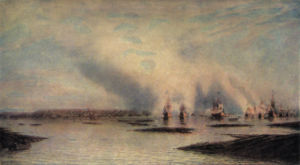 |
 |
 |
|
| Peter the Great Peter I of Russia Peter the Great, Peter I or Pyotr Alexeyevich Romanov Dates indicated by the letters "O.S." are Old Style. All other dates in this article are New Style. ruled the Tsardom of Russia and later the Russian Empire from until his death, jointly ruling before 1696 with his half-brother, Ivan V... on the frigate "Peter and Paul". Abraham Storck. 1708 |
Battle of Gangut Battle of Gangut The Battle of Gangut took place on July 27Jul./ August 7, 1714Greg. during the Great Northern War , in the waters of Riilahti Bay, north of the Hanko Peninsula, near the site of the modern-day city of Hanko, Finland, between the Swedish Navy and Imperial Russian Navy... |
Battle of Hogland Battle of Hogland The naval Battle of Hogland took place on 17 July 1788 during the Russo-Swedish War .-Origins:On the outbreak of war with Russia in 1788, Sweden planned to attack the Russian capital St. Petersburg... |
Sea battle at Vyborg(1790) Ivan Aivazovsky Ivan Aivazovsky Ivan Konstantinovich Aivazovsky July 29, 1817 – May 5, 1900) was a Russian world-renowned painter of Armenian descent living and working in Crimea, most famous for his seascapes, which constitute more than half of his paintings... , 1846 |
The Gulf of Finland had several major naval operations during World War II. In August 1941, during the evacuation of the Baltic Fleet from Tallinn to Kronstadt, German forces sank 15 Russian military boats, (5 destroyer
Destroyer
In naval terminology, a destroyer is a fast and maneuverable yet long-endurance warship intended to escort larger vessels in a fleet, convoy or battle group and defend them against smaller, powerful, short-range attackers. Destroyers, originally called torpedo-boat destroyers in 1892, evolved from...
s, 2 submarine
Submarine
A submarine is a watercraft capable of independent operation below the surface of the water. It differs from a submersible, which has more limited underwater capability...
s, 3 guard ship
Guard ship
A guard ship is a warship stationed at some port or harbour to act as a guard, and in former times in the Royal Navy to receive the men impressed for service...
s, 2 minesweepers
Minesweeper (ship)
A minesweeper is a small naval warship designed to counter the threat posed by naval mines. Minesweepers generally detect then neutralize mines in advance of other naval operations.-History:...
, 2 gunboat
Gunboat
A gunboat is a naval watercraft designed for the express purpose of carrying one or more guns to bombard coastal targets, as opposed to those military craft designed for naval warfare, or for ferrying troops or supplies.-History:...
s and 1 Motor Torpedo Boat
Motor Torpedo Boat
Motor Torpedo Boat was the name given to fast torpedo boats by the Royal Navy, and the Royal Canadian Navy.The capitalised term is generally used for the Royal Navy boats and abbreviated to "MTB"...
) as well as 43 transport and support ships. Several ships still remain on the gulf bottom near Cape Juminda, and a monument was raised there in memory of those lost in the events.
In 1978, construction was started on the Saint Petersburg Dam
Saint Petersburg Dam
The Saint Petersburg Flood Prevention Facility Complex , unofficially the Saint Petersburg Dam, is a complex of dams for flood control near Saint Petersburg, Russia...
aiming to protect Saint Petersburg from the frequent floods
Floods in Saint Petersburg
Floods in Saint Petersburg refer to a rise of water on the territory of St. Petersburg, a major city in Russia and its former capital. They are usually caused by the overflow of the delta of Neva River and surging water in the eastern part of Neva Bay but sometimes caused by melting snow...
. The work was halted at 60% completion in the late 1980s, due to the financial problems related to the breakup of the Soviet Union; it was resumed in 2001 and is — as of August 2011 — complete.
Economy
The southern coast of the gulf contains the Leningrad Nuclear Power PlantLeningrad Nuclear Power Plant
Leningrad Nuclear Power Plant is a nuclear power plant located in the town of Sosnovy Bor in Russia's Leningrad Oblast, on the southern shore of the Gulf of Finland, some to the west of the city centre of Saint Petersburg. It consists of four nuclear reactors of RBMK-1000 type. These reactors...
and a network of ports and unique natural and historical places. Navigation has long been the dominant activity in the gulf. The major port cities and their functions are, in Russia: Saint Petersburg
Big port Saint Petersburg
Big port Saint Petersburg is the state enterprise providing the organisation of trading navigation in sea port Saint Petersburg and behind its limits in established zones of responsibility of the Russian Federation.- Overview :The port...
(all kinds of goods), Kronstadt
Kronstadt
Kronstadt , also spelled Kronshtadt, Cronstadt |crown]]" and Stadt for "city"); is a municipal town in Kronshtadtsky District of the federal city of St. Petersburg, Russia, located on Kotlin Island, west of Saint Petersburg proper near the head of the Gulf of Finland. Population: It is also...
(container shipping), Lomonosov (general cargo, containers, metals), Vyborg
Vyborg
Vyborg is a town in Leningrad Oblast, Russia, situated on the Karelian Isthmus near the head of the Bay of Vyborg, to the northwest of St. Petersburg and south from Russia's border with Finland, where the Saimaa Canal enters the Gulf of Finland...
(general cargo), Primorsk
Primorsk, Leningrad Oblast
Primorsk is a coastal town in Vyborgsky District of Leningrad Oblast, Russia, and the largest Russian port on the Baltic. It is located on the Karelian Isthmus, west of St. Petersburg, at the northern coast of the Gulf of Finland, near Birch Islands, protected as a sea bird sanctuary...
(oil and petroleum products), Vysotsk
Vysotsk
Vysotsk is a coastal town and a seaport in Vyborgsky District of Leningrad Oblast, Russia, located on the Karelian Isthmus, on the eastern shore of the Bay of Vyborg, southwest of Vyborg and northwest of St. Petersburg. It hosts a base of the Russian Baltic Fleet and an oil terminal...
(oil and coal), Ust-Luga (coal, timber, containers); in Finland: Helsinki
Helsinki
Helsinki is the capital and largest city in Finland. It is in the region of Uusimaa, located in southern Finland, on the shore of the Gulf of Finland, an arm of the Baltic Sea. The population of the city of Helsinki is , making it by far the most populous municipality in Finland. Helsinki is...
(containers), Kotka
Kotka
Kotka is a town and municipality of Finland. Its former name is Rochensalm.Kotka is located on the coast of the Gulf of Finland at the mouth of Kymi River and it is part of the Kymenlaakso region in southern Finland. The municipality has a population of and covers an area of of which is water....
(containers, timber, agricultural products; it is the main transhipment cargo port for Russia), Hanko (containers, vehicles), Turku
Turku
Turku is a city situated on the southwest coast of Finland at the mouth of the Aura River. It is located in the region of Finland Proper. It is believed that Turku came into existence during the end of the 13th century which makes it the oldest city in Finland...
(containers, rail ferry), Kilpilahti/Sköldvik harbour (oil refinery
Oil refinery
An oil refinery or petroleum refinery is an industrial process plant where crude oil is processed and refined into more useful petroleum products, such as gasoline, diesel fuel, asphalt base, heating oil, kerosene, and liquefied petroleum gas...
); in Estonia: Tallinn
Tallinn
Tallinn is the capital and largest city of Estonia. It occupies an area of with a population of 414,940. It is situated on the northern coast of the country, on the banks of the Gulf of Finland, south of Helsinki, east of Stockholm and west of Saint Petersburg. Tallinn's Old Town is in the list...
(grains, refrigerators, oil), Paldiski
Paldiski
Paldiski is a town and Baltic Sea port situated on the Pakri peninsula of north-western Estonia. Originally a Swedish settlement known as Rågervik, it became a Russian naval base in the 18th century. The Russians renamed it Балтийский Порт Paldiski is a town and Baltic Sea port situated on the...
, Sillamäe
Sillamäe
Sillamäe is a town in Ida-Viru County in the northern part of Estonia, on the southern coast of the Gulf of Finland. It has a population of 16,183 and covers an area of 10.54 km²...
. Gulf of Finland is also part of the Volga-Baltic Waterway
Volga-Baltic Waterway
The Volga–Baltic Waterway, formerly known as the Mariinsk Canal System , is a series of canals and rivers in Russia which link the Volga River with the Baltic Sea...
and White Sea – Baltic Canal. Important goods include apatite
Apatite
Apatite is a group of phosphate minerals, usually referring to hydroxylapatite, fluorapatite, chlorapatite and bromapatite, named for high concentrations of OH−, F−, Cl− or Br− ions, respectively, in the crystal...
from the Kola Peninsula
Kola Peninsula
The Kola Peninsula is a peninsula in the far northwest of Russia. Constituting the bulk of the territory of Murmansk Oblast, it lies almost completely to the north of the Arctic Circle and is washed by the Barents Sea in the north and the White Sea in the east and southeast...
, Karelia
Karelia
Karelia , the land of the Karelian peoples, is an area in Northern Europe of historical significance for Finland, Russia, and Sweden...
n granite
Granite
Granite is a common and widely occurring type of intrusive, felsic, igneous rock. Granite usually has a medium- to coarse-grained texture. Occasionally some individual crystals are larger than the groundmass, in which case the texture is known as porphyritic. A granitic rock with a porphyritic...
and greenstone
Greenstone belt
Greenstone belts are zones of variably metamorphosed mafic to ultramafic volcanic sequences with associated sedimentary rocks that occur within Archaean and Proterozoic cratons between granite and gneiss bodies....
, timber
Timber
Timber may refer to:* Timber, a term common in the United Kingdom and Australia for wood materials * Timber, Oregon, an unincorporated community in the U.S...
from Arkhangelsk Oblast
Arkhangelsk Oblast
Arkhangelsk Oblast is a federal subject of Russia . It includes the Arctic archipelagos of Franz Josef Land and Novaya Zemlya, as well as the Solovetsky Islands in the White Sea....
and Vologda
Vologda Oblast
Vologda Oblast is a federal subject of Russia . Its administrative center is Vologda. The largest city is Cherepovets.Vologda Oblast is rich in historic monuments, such as the magnificent Kirillo-Belozersky Monastery, Ferapontov Convent , medieval towns of Velikiy Ustyug and Belozersk, baroque...
, ferrous metals from Cherepovets
Cherepovets
Cherepovets is the largest city in Vologda Oblast, Russia, located on the bank of the Rybinsk Reservoir of the Sheksna River, a tributary of the Volga River. Population: 311,869 ; It is served by Cherepovets Airport.-Location:...
, coal from Donetsk
Donets Basin
Donbas or Donbass , full rarely-used name Donets Basin , is a historical, economic and cultural region of eastern Ukraine. Originally a coal mining area, it has become a heavily industrialised territory suffering from urban decay and industrial pollution.-Geography:Donbas covers three...
and Kuznetsk Basin
Kuznetsk Basin
The Kuznetsk Basin in southwestern Siberia, Russia, is one of the largest coal mining areas in the world, covering an area of around . It lies in the Kuznetsk Depression between Tomsk and Novokuznetsk in the basin of the Tom River...
s, pyrite
Pyrite
The mineral pyrite, or iron pyrite, is an iron sulfide with the formula FeS2. This mineral's metallic luster and pale-to-normal, brass-yellow hue have earned it the nickname fool's gold because of its resemblance to gold...
from Ural, potassium chloride
Potassium chloride
The chemical compound potassium chloride is a metal halide salt composed of potassium and chlorine. In its pure state, it is odorless and has a white or colorless vitreous crystal appearance, with a crystal structure that cleaves easily in three directions. Potassium chloride crystals are...
from Solikamsk
Solikamsk
Solikamsk is a town in Perm Krai, Russia. It is the third-largest town in Perm Krai, with a population of It was founded in 1430. The name of the town is derived from the Russian words "" and "" .It is famous for its production of salt, in particular, potassium chloride, which is used as a...
, oil from Volga region, and grains from many regions of Russia.
Passenger transport on the gulf includes a number of ferry lines which connect the following ports: Helsinki and Hanko (Finland), Mariehamn
Mariehamn
Mariehamn is the capital of Åland, an autonomous territory under Finnish sovereignty. Mariehamn is the seat of the Government and Parliament of Åland, and 40% of the population of Åland live in the city...
(Åland Islands
Åland Islands
The Åland Islands form an archipelago in the Baltic Sea. They are situated at the entrance to the Gulf of Bothnia and form an autonomous, demilitarised, monolingually Swedish-speaking region of Finland...
), Stockholm
Stockholm
Stockholm is the capital and the largest city of Sweden and constitutes the most populated urban area in Scandinavia. Stockholm is the most populous city in Sweden, with a population of 851,155 in the municipality , 1.37 million in the urban area , and around 2.1 million in the metropolitan area...
and Kappelsher (Sweden), Tallinn and Paldiski, Rostock
Rostock
Rostock -Early history:In the 11th century Polabian Slavs founded a settlement at the Warnow river called Roztoc ; the name Rostock is derived from that designation. The Danish king Valdemar I set the town aflame in 1161.Afterwards the place was settled by German traders...
(Germany), Saint Petersburg and Kaliningrad
Kaliningrad
Kaliningrad is a seaport and the administrative center of Kaliningrad Oblast, the Russian exclave between Poland and Lithuania on the Baltic Sea...
(Russia), as well as many other cities.
Another major and historical activity in the gulf is fishing, especially on the northern coast near Vyborg, Primorsk and on the southern coast near Ust-Luga. Commercial fish species are herring
Herring
Herring is an oily fish of the genus Clupea, found in the shallow, temperate waters of the North Pacific and the North Atlantic oceans, including the Baltic Sea. Three species of Clupea are recognized. The main taxa, the Atlantic herring and the Pacific herring may each be divided into subspecies...
, sprats
European sprat
The European sprat, Sprattus sprattus, also known as bristling, brisling or skipper, is a small, herring-like, marine fish. Found in European waters, it has silver grey scales and white-grey flesh. Specific seas in which the species occurs include the Irish Sea, Baltic Sea and Sea of the Hebrides...
, European smelt
European smelt
The Smelt or European smelt is a species of fish in the Osmeridae family.- Shape and appearance :The body of the European smelt is typically 15 to 18 cm long, slender and slightly flattened on either side. Larger fish may reach 30 cm in length. Smelts have a slightly translucent body...
, whitefishes
Coregonus
Coregonus is a diverse genus of fish in the salmon family . The type species is the common whitefish . The Coregonus species are known as whitefishes...
, carp bream
Carp bream
The common bream, freshwater bream, bream, bronze bream or carp bream, Abramis brama, is a European species of freshwater fish in the family Cyprinidae....
, roaches
Rutilus
Rutilus is a genus of fishes in the family Cyprinidae, commonly called roaches. Locally, the name "roach" without any further qualifiers is also used for particular species, particularly the Common Roach Rutilus (Latin for "shining, red, golden, auburn") is a genus of fishes in the family...
, perch
Perch
Perch is a common name for fish of the genus Perca, freshwater gamefish belonging to the family Percidae. The perch, of which there are three species in different geographical areas, lend their name to a large order of vertebrates: the Perciformes, from the Greek perke meaning spotted, and the...
, European eel
European eel
The European eel, Anguilla anguilla, is a species of eel, a snake-like, catadromous fish. They can reach in exceptional cases a length of 1½ m, but are normally much smaller, about 60–80 cm, and rarely more than 1 m....
, lamprey
Lamprey
Lampreys are a family of jawless fish, whose adults are characterized by a toothed, funnel-like sucking mouth. Translated from an admixture of Latin and Greek, lamprey means stone lickers...
and others. In 2005, the catchment was 2000 tons by the ships of Saint Petersburg and Leningrad Oblast alone.
In September 2005 the agreement was signed on the construction of the Nord Stream offshore gas pipeline on the Baltic Sea, from Vyborg to the German city of Greifswald
Greifswald
Greifswald , officially, the University and Hanseatic City of Greifswald is a town in northeastern Germany. It is situated in the state of Mecklenburg-Vorpommern, at an equal distance of about from Germany's two largest cities, Berlin and Hamburg. The town borders the Baltic Sea, and is crossed...
. The first line should become operational in 2011.
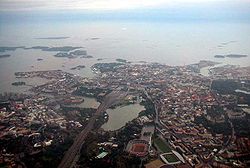 |
|||
| Main port of Saint Petersburg Big port Saint Petersburg Big port Saint Petersburg is the state enterprise providing the organisation of trading navigation in sea port Saint Petersburg and behind its limits in established zones of responsibility of the Russian Federation.- Overview :The port... |
Near the harbor of Tallinn Tallinn Tallinn is the capital and largest city of Estonia. It occupies an area of with a population of 414,940. It is situated on the northern coast of the country, on the banks of the Gulf of Finland, south of Helsinki, east of Stockholm and west of Saint Petersburg. Tallinn's Old Town is in the list... |
Aerial view of Helsinki Helsinki Helsinki is the capital and largest city in Finland. It is in the region of Uusimaa, located in southern Finland, on the shore of the Gulf of Finland, an arm of the Baltic Sea. The population of the city of Helsinki is , making it by far the most populous municipality in Finland. Helsinki is... |
Saint Petersburg Dam Saint Petersburg Dam The Saint Petersburg Flood Prevention Facility Complex , unofficially the Saint Petersburg Dam, is a complex of dams for flood control near Saint Petersburg, Russia... |
Archaeology
The bottom of the gulf is one of the world's largest ship cemeteries. Because of the low salinity and cold waters, and no shipwormShipworm
Shipworms are not worms at all, but rather a group of unusual saltwater clams with very small shells, notorious for boring into wooden structures that are immersed in sea water, such as piers, docks and wooden ships...
s, the ships are relatively well preserved. Since the 6th century, major waterways were running through the gulf, and only in the 8th through 10th centuries, about 3,000 tonnes of silver was transported there. Later, the gulf was actively used by Sweden and Russia for transport of goods. Every year saw dozens of lost ships. In the fall of 1743, 17 Russian warships returning from Finland sank in just 7 hours, and in the summer of 1747, 26 merchant vessels sank within 4 hours near Narva. A record was set in 1721 when during the evacuation of Russian troops from Finland, more than 100 vessels were lost within 3 months, including 64 in a single night.
By the end of 1996, about 5000 submerged objects were identified in the Russian part of the gulf, including 2500 ships, 1500 airplanes and small items such as boats, anchor, tanks, tractors, cars, cannons and even naval mine
Naval mine
A naval mine is a self-contained explosive device placed in water to destroy surface ships or submarines. Unlike depth charges, mines are deposited and left to wait until they are triggered by the approach of, or contact with, an enemy vessel...
s, aerial bomb
Aerial bomb
An aerial bomb is a type of explosive weapon intended to travel through the air with predictable trajectories, usually designed to be dropped from an aircraft...
s, torpedoes and other ammunition. The ships belonged to Russia (25%), Germany (19%), United Kingdom (17%), Sweden (15%), Netherlands (8%) and Finland (7%). The remaining 9% are from Norway, Denmark, France, US, Italy, Estonia and Latvia. These objects present potential hazards to navigation, fishery, coastal construction, laying of submarine pipelines and cables and the environment. Mines were laid in the gulf during World War I
World War I
World War I , which was predominantly called the World War or the Great War from its occurrence until 1939, and the First World War or World War I thereafter, was a major war centred in Europe that began on 28 July 1914 and lasted until 11 November 1918...
(38,932 units), Russian Civil War
Russian Civil War
The Russian Civil War was a multi-party war that occurred within the former Russian Empire after the Russian provisional government collapsed to the Soviets, under the domination of the Bolshevik party. Soviet forces first assumed power in Petrograd The Russian Civil War (1917–1923) was a...
and the Soviet-Finnish War of (1939–1940) with an estimated total number of 60,000; about 85,000 more mines were set during World War II, and only a fraction of all those were eliminated after the wars.
Major cities
|
Kirkkonummi Kirkkonummi is a municipality of inhabitants in southern Finland. The literal meaning of the words "Kirkkonummi" and "Kyrkslätt" in English is "church moor".... Kotka Kotka is a town and municipality of Finland. Its former name is Rochensalm.Kotka is located on the coast of the Gulf of Finland at the mouth of Kymi River and it is part of the Kymenlaakso region in southern Finland. The municipality has a population of and covers an area of of which is water.... Kronstadt Kronstadt , also spelled Kronshtadt, Cronstadt |crown]]" and Stadt for "city"); is a municipal town in Kronshtadtsky District of the federal city of St. Petersburg, Russia, located on Kotlin Island, west of Saint Petersburg proper near the head of the Gulf of Finland. Population: It is also... Loksa Loksa is a town and municipality in Harju County, northern Estonia. It has a population of 3,403 and covers an area of 3.81 km².The Valgejõgi river runs through Loksa and drains there into Hara Bay.-History:... |
Lomonosov, Russia Lomonosov is a municipal town in Petrodvortsovy District of the federal city of St. Petersburg, Russia, situated on the southern coast of the Gulf of Finland, west of St. Petersburg proper. Population:... Loviisa Loviisa is a municipality and town of inhabitants on the southern coast of Finland. About 43 per cent of the population is Swedish-speaking.The municipality covers an area of of which is water... Maardu Maardu is a town and a municipality in Harju County, Estonia. It is part of Tallinn metropolitan area. The town covers an area of 22.76 km² and has a population of 16,529 .... Narva-Jõesuu Narva-Jõesuu is a town in Ida-Viru County, Estonia, located on the country's northern Baltic Sea coast near the Russian border. The name of the town in Estonian and Russian means "mouth of the Narva River".... |
Paldiski Paldiski is a town and Baltic Sea port situated on the Pakri peninsula of north-western Estonia. Originally a Swedish settlement known as Rågervik, it became a Russian naval base in the 18th century. The Russians renamed it Балтийский Порт Paldiski is a town and Baltic Sea port situated on the... Porvoo Porvoo is a city and a municipality situated on the southern coast of Finland approximately east of Helsinki. Porvoo is one of the six medieval towns in Finland, first mentioned as a city in texts from 14th century... Primorsk, Leningrad Oblast Primorsk is a coastal town in Vyborgsky District of Leningrad Oblast, Russia, and the largest Russian port on the Baltic. It is located on the Karelian Isthmus, west of St. Petersburg, at the northern coast of the Gulf of Finland, near Birch Islands, protected as a sea bird sanctuary... |
Saint Petersburg Saint Petersburg is a city and a federal subject of Russia located on the Neva River at the head of the Gulf of Finland on the Baltic Sea... Sestroretsk Sestroretsk is a municipal town in Kurortny District of the federal city of St. Petersburg, Russia, located on the shores of the Gulf of Finland, the Sestra River and the Sestroretskiy Lake northwest of St. Petersburg... Sillamäe Sillamäe is a town in Ida-Viru County in the northern part of Estonia, on the southern coast of the Gulf of Finland. It has a population of 16,183 and covers an area of 10.54 km²... |
Tallinn Tallinn is the capital and largest city of Estonia. It occupies an area of with a population of 414,940. It is situated on the northern coast of the country, on the banks of the Gulf of Finland, south of Helsinki, east of Stockholm and west of Saint Petersburg. Tallinn's Old Town is in the list... Vantaa Vantaa is a city and municipality in Finland. Helsinki, Vantaa, Espoo and Kauniainen make up the Helsinki Metropolitan Area.Vantaa, with its population of , is the fourth most populated city of Finland. The biggest airport in Finland, the Helsinki-Vantaa Airport, is located there... Vyborg Vyborg is a town in Leningrad Oblast, Russia, situated on the Karelian Isthmus near the head of the Bay of Vyborg, to the northwest of St. Petersburg and south from Russia's border with Finland, where the Saimaa Canal enters the Gulf of Finland... Zelenogorsk, Saint Petersburg Zelenogorsk , ' before 1948, is a municipal town in Kurortny District of the federal city of Saint Petersburg, Russia, located in part of the Karelian Isthmus on the shore of the Gulf of Finland, and a station on the St. Petersburg-Vyborg railroad. It is located about northwest of central Saint... |