

Mannerheim Line

Encyclopedia
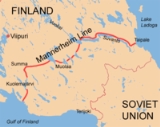
The Mannerheim Line was a defensive fortification line on the Karelian Isthmus
built by Finland
against the Soviet Union
. During the Winter War
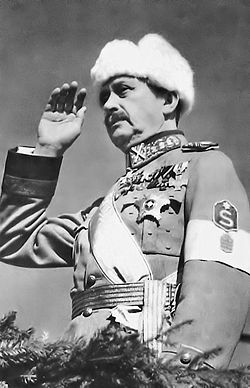
it became known as the Mannerheim Line, after Field Marshal
Baron Carl Gustaf Emil Mannerheim
. The line was constructed in two phases: 1920–1924 and 1932–1939. By November 1939, when the Winter War began, the line was by no means complete.
 After the October Revolution
in Russia
, the Finns declared independence
in 1917. Although Soviet Russia
recognized Finland's independence, the Finns did not trust their sincerity. The relationship between the two countries deteriorated, with the Soviet Union supporting the Red Guard
during the Finnish Civil War
in 1918. After the victory of the White Guard
, a group of Finnish communists fled to Soviet Russia and established the Communist Party of Finland
.
Generally, communism was seen as a threat to a democratic system. The situation was dangerous for a new nation like Finland, especially as the capital of the new communist revolution was nearby Petrograd, (now Saint Petersburg
). Furthermore, before the Treaty of Tartu
in 1921, the border area was restless. The former general of Imperial Russia, C.G.E. Mannerheim, disliked the bolshevik
s. The Finns even considered an assault toward Petrograd in 1919, but it was quickly abandoned as the situation changed in the Russian Civil War
. Construction work on the Karelian Isthmus had already begun when the Bolsheviks won the Russian Civil War in 1922. The line was constructed in two phases: 1920–1924 and 1932–1939.
in 1918, the Finnish government and high command started to develop defence plans to protect possible attack routes to Finland from Soviet Russia. The main such route was the Karelian Isthmus
. The most endangered part of that isthmus was to the west, near the Gulf of Finland, the eastern part was better protected by the natural water-ways of Vuoksi, Suvanto and Taipaleenjoki.
The first plans for a defensive line were commissioned by Mannerheim from the Swedish volunteer Lieutenant Colonel A. Rappe at the beginning of May 1918. Rappe's line was placed close to the border and designed to protect two rail lines that crossed the border, which could be used in a counterattack toward Petrograd. When Mannerheim resigned at the end of May, Rappe's plans were abandoned.
The young nation possessed no guard troops and the border area was restless. Security of the border on the isthmus was the responsibility of the 2nd division and local White Guard units in June 1918. In that form they were also entrusted with the security of the fortification construction. First efforts were weak depots without any concrete.
The Germans had ordered Colonel O. von Brandenstein to investigate defensive positions on the Karelian Isthmus, he delivered his plan on 16 July. He was the first to suggest using the lake isthmuses, where smaller lakes like Lake Kuolemajärvi, Lake Muolaa, Lake Suvanto and the Taipaleenjoki river divided the Karelian Isthmus to the shorter land sections, as defensive positions, his plan was initially approved by the Finnish high command in August 1918. In October 1918 the Finnish government allocated 300,000 marks for the work, which was to be carried out by German and Finnish sappers as well as Russian prisoners of war. However, the money allocated was insufficient and a lack of building materials and a qualified workforce hampered the building of proper fortifications. With Germany's defeat in World War I, von Brandenstein's plan was scrapped.
The prime contactor of the fortifications was the Finnish construction company Ab Granit Oy. The first hundred small bunker
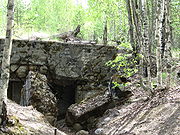
s were built between 1920–1924. For reasons of cost, the first phase hard fortifications were of unreinforced concrete, which provided only partial protection. The compression density of the concrete was too low to offer resistance to anything larger than medium artillery.
Between 1932 and 1938 the defence budget was such that the Finns could only construct two or three bunkers per year. In 1936 and 1937 they constructered two large strong-points, Sk 10 and Sj 4 in the Summankylä and Summajärvi areas. Two smaller bunkers, Le 6 and 7, in the Leipäsuo sector and Ink 6, in the Inkilä sector, were also built. New bunkers differed from earlier designs in that their troop accommodation was located between the gun chambers, thus saving the cost of expensive reinforced concrete
, the roof was protected by two to three metres of soil and one to three metres of stone rubble.
and an observation cloche
.
In Suurniemi near Muolaanjärvi, the Finns started the construction of seven new bunkers, Su 1–7. Two others, Su 3 and Su 4, were for accommodation, the rest were for machine guns. They also modernised those structures built in the 1920s. The older bunkers were given added flank-fire capability and enlarged. Some bunkers' loopholes were simply closed-up as part of a plan to make them more suitable for accommodation or command posts.
The line was still incomplete in November 1939.
 Soviet intelligence worked in Finland on multiple levels. The Finnish communist party, running in the Soviet Union, had its own military line to the Central Committee. Its intelligence concentrated on the Finnish army, taking notes on the locations of Finnish artillery and defensive positions. The most important Soviet intelligence organisations in Finland were the NKVD
and the Fourth Department of the Army General Staff. Leningrad Military District
, the Baltic Fleet
and border troops under the NKVD, conducted espionage operations.
The Finns exposed two espionage cases during the 1930s. Vilho Pentikäinen, a photographer serving on the Finnish general Staff, escaped to the Soviet Union in 1933. The second case was of Simo Haukka; he took photographs and measured roads and terrain for Soviet intelligence in 1935.
Soviet intelligence published a top-secret and very detailed photobook of the Finnish terrain and fortifications in 1938. The book included a seven page report and 22 pages of maps and photographs. Every issue was numbered, running probably only into dozens. Soviet intelligence activity increased in 1938 and expanded still further in 1939. Before the start of the Winter War, Soviet intelligence published a book for Red Army officers. It was called "Finland. Written Description of March Routes". It was later translated and republished as the "Red Army March Guide to Finland". The guide included over 200 pages of maps and photographs.
Along with the intelligence, the Soviet Union received a detailed map of the defences on the Isthmus. A German military attaché
in Helsinki
, General Arniké, handed it over in Moscow in September 1939.
in the west, through Summa to the Vuoksi River
and ended at Taipale in the east. It consisted of 157 machine gun positions and eight artillery positions built of concrete. The area around Summa
was the most heavily fortified because it was thought to be the most vulnerable position.
The Gulf of Finland coast was guarded by Fort Saarenpää, the side of Lake Ladoga (Laatokka) by Fort Järisevä. These coastal artillery
positions had 5", 6" and 10" guns.
Unlike the French Maginot Line
and other similar forts made with huge bunkers and lines of dragon's teeth
, the Mannerheim Line was mostly built by utilizing the natural terrain. Many items such as fallen trees and boulders were incorporated into defensive positions. The Finns also mastered camouflage
techniques, which they put to good use.
The Mannerheim line was not constructed at great expense. Its purpose was to delay more than repel an invasion. It used predominantly local materials.
The name Mannerheim Line was supposedly coined by Jorma Gallen-Kallela
and spread by foreign journalists.
 In the Winter War the Line halted the Soviet advance for two months. Fort Saarenpää was attacked by the Soviet battleships Marat
and Oktyabrskaya Revolutsiya
several times during December 1939 and January 1940, but they repelled the attacks, driving off the Revolutsiya by near misses on 18 December 1939.
During the war, both Finnish and Soviet propaganda
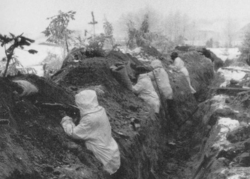
considerably exaggerated the extent of the line's fortifications: the former to improve national morale, the latter to explain their troops' slow progress against the Finnish defences. Subsequently, the myth of the "heavily fortified" Mannerheim Line entered official Soviet war history and some western sources. The vast majority of the Mannerheim Line was merely composed of trenches and other field fortifications. Bunkers along the line were mostly small and thinly spread out; the Line had hardly any artillery
.
the line was not re-fortified although both Soviets and Finns used its natural benefits in defence during the Finnish advance in 1941
and the Soviet offensive in 1944 (see VT-line
and VKT-line
).
. The Finns aimed to make its defence line impregnable, but in comparison with the Maginot line, it was thin. The Finns had funds and resources for only 101 concrete bunkers; the equivalent length of the Maginot Line had 5,800 of these structures, with railway connections between them. The weakness of the line is illustrated by the fact, that the amount of concrete used in the whole Mannerheim Line - 14,520 cubic meters or 513000 cubic feet (14,526.5 m³) - is slightly less than the amount used in the Helsinki Opera House (15,500 cubic meters or 547,000 cubic feet). The much shorter VT-line
used almost 400,000 cubic meters (14,000,000 cubic feet) of concrete.
Karelian Isthmus
The Karelian Isthmus is the approximately 45–110 km wide stretch of land, situated between the Gulf of Finland and Lake Ladoga in northwestern Russia, to the north of the River Neva . Its northwestern boundary is the relatively narrow area between the Bay of Vyborg and Lake Ladoga...
built by Finland
Finland
Finland , officially the Republic of Finland, is a Nordic country situated in the Fennoscandian region of Northern Europe. It is bordered by Sweden in the west, Norway in the north and Russia in the east, while Estonia lies to its south across the Gulf of Finland.Around 5.4 million people reside...
against the Soviet Union
Soviet Union
The Soviet Union , officially the Union of Soviet Socialist Republics , was a constitutionally socialist state that existed in Eurasia between 1922 and 1991....
. During the Winter War
Winter War
The Winter War was a military conflict between the Soviet Union and Finland. It began with a Soviet offensive on 30 November 1939 – three months after the start of World War II and the Soviet invasion of Poland – and ended on 13 March 1940 with the Moscow Peace Treaty...
it became known as the Mannerheim Line, after Field Marshal
Field Marshal (Finland)
In Finnish Defence Forces Field Marshal is officially not an active military rank but an honorary rank that can be bestowed upon 'especially distinguished generals'...
Baron Carl Gustaf Emil Mannerheim
Carl Gustaf Emil Mannerheim
Baron Carl Gustaf Emil Mannerheim was the military leader of the Whites in the Finnish Civil War, Commander-in-Chief of Finland's Defence Forces during World War II, Marshal of Finland, and a Finnish statesman. He was Regent of Finland and the sixth President of Finland...
. The line was constructed in two phases: 1920–1924 and 1932–1939. By November 1939, when the Winter War began, the line was by no means complete.
Background
October Revolution
The October Revolution , also known as the Great October Socialist Revolution , Red October, the October Uprising or the Bolshevik Revolution, was a political revolution and a part of the Russian Revolution of 1917...
in Russia
Russia
Russia or , officially known as both Russia and the Russian Federation , is a country in northern Eurasia. It is a federal semi-presidential republic, comprising 83 federal subjects...
, the Finns declared independence
Finland's declaration of independence
The Finnish declaration of independence was adopted by the Parliament of Finland on 6 December 1917. It declared Finland an independent and sovereign nation state rather than an autonomous Russian Grand duchy.-Revolution in Russia:...
in 1917. Although Soviet Russia
Russian Soviet Federative Socialist Republic
The Russian Soviet Federative Socialist Republic , commonly referred to as Soviet Russia, Bolshevik Russia, or simply Russia, was the largest, most populous and economically developed republic in the former Soviet Union....
recognized Finland's independence, the Finns did not trust their sincerity. The relationship between the two countries deteriorated, with the Soviet Union supporting the Red Guard
Red Guards (Finland)
The Red Guards formed the army of Red Finland during the Finnish Civil War in 1918. The combined strength of the Red Guard was about 30,000 at the beginning of the Civil War, and peaked at 90,000-120,000 during the course of the conflict....
during the Finnish Civil War
Finnish Civil War
The Finnish Civil War was a part of the national, political and social turmoil caused by World War I in Europe. The Civil War concerned control and leadership of The Grand Duchy of Finland as it achieved independence from Russia after the October Revolution in Petrograd...
in 1918. After the victory of the White Guard
White Guard (Finland)
The White Guard was a voluntary militia that emerged victorious over the socialist Red Guard as part of the Whites in the Finnish Civil War of 1918...
, a group of Finnish communists fled to Soviet Russia and established the Communist Party of Finland
Communist Party of Finland
The Communist Party of Finland was a communist political party in Finland. The SKP was a section of Comintern and illegal in Finland until 1944.SKP did not participate in any elections with its own name. Instead, front organisations were used...
.
Generally, communism was seen as a threat to a democratic system. The situation was dangerous for a new nation like Finland, especially as the capital of the new communist revolution was nearby Petrograd, (now Saint Petersburg
Saint Petersburg
Saint Petersburg is a city and a federal subject of Russia located on the Neva River at the head of the Gulf of Finland on the Baltic Sea...
). Furthermore, before the Treaty of Tartu
Treaty of Tartu (Russian–Finnish)
The Treaty of Tartu between Finland and Soviet Russia was signed on 14 October 1920 after negotiations that lasted for four months. The treaty confirmed the border between Finland and Soviet Russia after the Finnish civil war and Finnish volunteer expeditions in Russian East Karelia. Ratifications...
in 1921, the border area was restless. The former general of Imperial Russia, C.G.E. Mannerheim, disliked the bolshevik
Bolshevik
The Bolsheviks, originally also Bolshevists , derived from bol'shinstvo, "majority") were a faction of the Marxist Russian Social Democratic Labour Party which split apart from the Menshevik faction at the Second Party Congress in 1903....
s. The Finns even considered an assault toward Petrograd in 1919, but it was quickly abandoned as the situation changed in the Russian Civil War
Russian Civil War
The Russian Civil War was a multi-party war that occurred within the former Russian Empire after the Russian provisional government collapsed to the Soviets, under the domination of the Bolshevik party. Soviet forces first assumed power in Petrograd The Russian Civil War (1917–1923) was a...
. Construction work on the Karelian Isthmus had already begun when the Bolsheviks won the Russian Civil War in 1922. The line was constructed in two phases: 1920–1924 and 1932–1939.
Planning in 1918
During the civil warFinnish Civil War
The Finnish Civil War was a part of the national, political and social turmoil caused by World War I in Europe. The Civil War concerned control and leadership of The Grand Duchy of Finland as it achieved independence from Russia after the October Revolution in Petrograd...
in 1918, the Finnish government and high command started to develop defence plans to protect possible attack routes to Finland from Soviet Russia. The main such route was the Karelian Isthmus
Karelian Isthmus
The Karelian Isthmus is the approximately 45–110 km wide stretch of land, situated between the Gulf of Finland and Lake Ladoga in northwestern Russia, to the north of the River Neva . Its northwestern boundary is the relatively narrow area between the Bay of Vyborg and Lake Ladoga...
. The most endangered part of that isthmus was to the west, near the Gulf of Finland, the eastern part was better protected by the natural water-ways of Vuoksi, Suvanto and Taipaleenjoki.
The first plans for a defensive line were commissioned by Mannerheim from the Swedish volunteer Lieutenant Colonel A. Rappe at the beginning of May 1918. Rappe's line was placed close to the border and designed to protect two rail lines that crossed the border, which could be used in a counterattack toward Petrograd. When Mannerheim resigned at the end of May, Rappe's plans were abandoned.
The young nation possessed no guard troops and the border area was restless. Security of the border on the isthmus was the responsibility of the 2nd division and local White Guard units in June 1918. In that form they were also entrusted with the security of the fortification construction. First efforts were weak depots without any concrete.
The Germans had ordered Colonel O. von Brandenstein to investigate defensive positions on the Karelian Isthmus, he delivered his plan on 16 July. He was the first to suggest using the lake isthmuses, where smaller lakes like Lake Kuolemajärvi, Lake Muolaa, Lake Suvanto and the Taipaleenjoki river divided the Karelian Isthmus to the shorter land sections, as defensive positions, his plan was initially approved by the Finnish high command in August 1918. In October 1918 the Finnish government allocated 300,000 marks for the work, which was to be carried out by German and Finnish sappers as well as Russian prisoners of war. However, the money allocated was insufficient and a lack of building materials and a qualified workforce hampered the building of proper fortifications. With Germany's defeat in World War I, von Brandenstein's plan was scrapped.
Unreinforced concrete bunkers in 1919–1924
During October 1919 Finnish Chief of Staff Major General Oscar Enckell sited the line, mostly following the original course that von Brandenstein had presented. Major J. Gros-Coissy, a member of the French military commission, designed the fortifications together with Finnish Lt Col Johan Fabritius. During the first building period, Fabritius suggested moving the defensive line further to the south-east. The general staff discussed the issue, but Enckell's earlier plans were followed. Furthermore, insufficient funds resulted in a disagreement between the officers and Enckell resigned in 1924. Construction work was interrupted for a long period.The prime contactor of the fortifications was the Finnish construction company Ab Granit Oy. The first hundred small bunker
Bunker
A military bunker is a hardened shelter, often buried partly or fully underground, designed to protect the inhabitants from falling bombs or other attacks...
s were built between 1920–1924. For reasons of cost, the first phase hard fortifications were of unreinforced concrete, which provided only partial protection. The compression density of the concrete was too low to offer resistance to anything larger than medium artillery.
First large bunkers 1932–1937
The second construction phase started on 1 April 1934, with Fabritius in command of the construction work. He designed two new kinds of bunker, Ink 1 and Ink 2. The bunkers were mainly designed for troop accommodation, but loopholes were crafted into armour plate in 1938 and 1939. A bunker was 15–20 meters in length and 5–6 meters wide. A pioneer battalion constructed six bunkers in the Inkilä sector.Between 1932 and 1938 the defence budget was such that the Finns could only construct two or three bunkers per year. In 1936 and 1937 they constructered two large strong-points, Sk 10 and Sj 4 in the Summankylä and Summajärvi areas. Two smaller bunkers, Le 6 and 7, in the Leipäsuo sector and Ink 6, in the Inkilä sector, were also built. New bunkers differed from earlier designs in that their troop accommodation was located between the gun chambers, thus saving the cost of expensive reinforced concrete
Reinforced concrete
Reinforced concrete is concrete in which reinforcement bars , reinforcement grids, plates or fibers have been incorporated to strengthen the concrete in tension. It was invented by French gardener Joseph Monier in 1849 and patented in 1867. The term Ferro Concrete refers only to concrete that is...
, the roof was protected by two to three metres of soil and one to three metres of stone rubble.
The 1938 and 1939 period
The Karelian defensive fortifications received considerably more funds and resources from May 1938, as the European situation worsened. The Finns built new strongholds and modernized the old ones. In Summakylä and Summajärvi they built two large Sk 11 bunkers, a "Peltola", a Sj 5, a "Miljoonalinnake", and an incomplete third Sk 17. These bunkers had better fireshelters, ventilationVentilation (architecture)
Ventilating is the process of "changing" or replacing air in any space to provide high indoor air quality...
and an observation cloche
Cloche
Cloche may refer to:* Bell , especially in music directions* Row cover, a covering for protecting plants from cold temperatures* Cloche hat, a close-fitting women's hat...
.
In Suurniemi near Muolaanjärvi, the Finns started the construction of seven new bunkers, Su 1–7. Two others, Su 3 and Su 4, were for accommodation, the rest were for machine guns. They also modernised those structures built in the 1920s. The older bunkers were given added flank-fire capability and enlarged. Some bunkers' loopholes were simply closed-up as part of a plan to make them more suitable for accommodation or command posts.
The line was still incomplete in November 1939.
Soviet intelligence
NKVD
The People's Commissariat for Internal Affairs was the public and secret police organization of the Soviet Union that directly executed the rule of power of the Soviets, including political repression, during the era of Joseph Stalin....
and the Fourth Department of the Army General Staff. Leningrad Military District
Leningrad Military District
The Leningrad Military District was a military district of the Armed Forces of the Russian Federation. In 2010 it was merged with the Moscow Military District, the Northern Fleet and the Baltic Fleet to form the new Western Military District.-History:...
, the Baltic Fleet
Baltic Fleet
The Twice Red Banner Baltic Fleet - is the Russian Navy's presence in the Baltic Sea. In previous historical periods, it has been part of the navy of Imperial Russia and later the Soviet Union. The Fleet gained the 'Twice Red Banner' appellation during the Soviet period, indicating two awards of...
and border troops under the NKVD, conducted espionage operations.
The Finns exposed two espionage cases during the 1930s. Vilho Pentikäinen, a photographer serving on the Finnish general Staff, escaped to the Soviet Union in 1933. The second case was of Simo Haukka; he took photographs and measured roads and terrain for Soviet intelligence in 1935.
Soviet intelligence published a top-secret and very detailed photobook of the Finnish terrain and fortifications in 1938. The book included a seven page report and 22 pages of maps and photographs. Every issue was numbered, running probably only into dozens. Soviet intelligence activity increased in 1938 and expanded still further in 1939. Before the start of the Winter War, Soviet intelligence published a book for Red Army officers. It was called "Finland. Written Description of March Routes". It was later translated and republished as the "Red Army March Guide to Finland". The guide included over 200 pages of maps and photographs.
Along with the intelligence, the Soviet Union received a detailed map of the defences on the Isthmus. A German military attaché
Military attaché
A military attaché is a military expert who is attached to a diplomatic mission . This post is normally filled by a high-ranking military officer who retains the commission while serving in an embassy...
in Helsinki
Helsinki
Helsinki is the capital and largest city in Finland. It is in the region of Uusimaa, located in southern Finland, on the shore of the Gulf of Finland, an arm of the Baltic Sea. The population of the city of Helsinki is , making it by far the most populous municipality in Finland. Helsinki is...
, General Arniké, handed it over in Moscow in September 1939.
Structure of the Line
The line ran from the coast of the Gulf of FinlandGulf of Finland
The Gulf of Finland is the easternmost arm of the Baltic Sea. It extends between Finland and Estonia all the way to Saint Petersburg in Russia, where the river Neva drains into it. Other major cities around the gulf include Helsinki and Tallinn...
in the west, through Summa to the Vuoksi River
Vuoksi River
The Vuoksi River runs in the northernmost part of the Karelian Isthmus from Lake Saimaa in southeastern Finland to Lake Ladoga in northwestern Russia. The river enters Lake Ladoga in three branches, an older main northern branch at Priozersk , a smaller branch few km...
and ended at Taipale in the east. It consisted of 157 machine gun positions and eight artillery positions built of concrete. The area around Summa
Summa
Summa and its diminutive summula are mainly used, in English and other modern languages, for texts that 'sum up' knowledge in a field, such as the compendiums of theology, philosophy and canon law which were used both as textbooks in the schools and as books of reference during the Middle...
was the most heavily fortified because it was thought to be the most vulnerable position.
The Gulf of Finland coast was guarded by Fort Saarenpää, the side of Lake Ladoga (Laatokka) by Fort Järisevä. These coastal artillery
Coastal artillery
Coastal artillery is the branch of armed forces concerned with operating anti-ship artillery or fixed gun batteries in coastal fortifications....
positions had 5", 6" and 10" guns.
Unlike the French Maginot Line
Maginot Line
The Maginot Line , named after the French Minister of War André Maginot, was a line of concrete fortifications, tank obstacles, artillery casemates, machine gun posts, and other defences, which France constructed along its borders with Germany and Italy, in light of its experience in World War I,...
and other similar forts made with huge bunkers and lines of dragon's teeth
Dragon's teeth (fortification)
Dragon's teeth are square-pyramidal fortifications of reinforced concrete first used during the Second World War to impede the movement of tanks and mechanised infantry...
, the Mannerheim Line was mostly built by utilizing the natural terrain. Many items such as fallen trees and boulders were incorporated into defensive positions. The Finns also mastered camouflage
Camouflage
Camouflage is a method of concealment that allows an otherwise visible animal, military vehicle, or other object to remain unnoticed, by blending with its environment. Examples include a leopard's spotted coat, the battledress of a modern soldier and a leaf-mimic butterfly...
techniques, which they put to good use.
The Mannerheim line was not constructed at great expense. Its purpose was to delay more than repel an invasion. It used predominantly local materials.
The name Mannerheim Line was supposedly coined by Jorma Gallen-Kallela
Jorma Gallen-Kallela
Jorma Gallen-Kallela was a Finnish artist. He followed in the footsteps of his father, the famed artist Akseli Gallen-Kallela....
and spread by foreign journalists.
The Red Army repelled
Battleship Petropavlovsk (1914)
The Russian battleship Petropavlovsk was the third of the four dreadnoughts, the first Russian class of dreadnoughts, built before World War I. She was named after the Russian victory over the British and the French in the Siege of Petropavlovsk in 1854. The ship was completed during the winter...
and Oktyabrskaya Revolutsiya
Russian battleship Gangut (1909)
Gangut was both the lead ship of the s of the Imperial Russian Navy built before World War I and the last of her class to be completed. The Ganguts were the first class of Russian dreadnoughts. She was named after the Russian victory over the Swedish Navy in the Battle of Gangut in 1714. She was...
several times during December 1939 and January 1940, but they repelled the attacks, driving off the Revolutsiya by near misses on 18 December 1939.
During the war, both Finnish and Soviet propaganda
Propaganda
Propaganda is a form of communication that is aimed at influencing the attitude of a community toward some cause or position so as to benefit oneself or one's group....
considerably exaggerated the extent of the line's fortifications: the former to improve national morale, the latter to explain their troops' slow progress against the Finnish defences. Subsequently, the myth of the "heavily fortified" Mannerheim Line entered official Soviet war history and some western sources. The vast majority of the Mannerheim Line was merely composed of trenches and other field fortifications. Bunkers along the line were mostly small and thinly spread out; the Line had hardly any artillery
Artillery
Originally applied to any group of infantry primarily armed with projectile weapons, artillery has over time become limited in meaning to refer only to those engines of war that operate by projection of munitions far beyond the range of effect of personal weapons...
.
Aftermath
Following the Winter War, Soviet combat engineers destroyed the remaining installations. In the Continuation WarContinuation War
The Continuation War was the second of two wars fought between Finland and the Soviet Union during World War II.At the time of the war, the Finnish side used the name to make clear its perceived relationship to the preceding Winter War...
the line was not re-fortified although both Soviets and Finns used its natural benefits in defence during the Finnish advance in 1941
Finnish reconquest of the Karelian Isthmus (1941)
The Finnish reconquest of the Karelian Isthmus refers to a military campaign carried out by Finland in 1941. It was part of what is commonly referred to as the Continuation War.Early in the war Finnish forces reconquered the Karelian Isthmus...
and the Soviet offensive in 1944 (see VT-line
VT-line
The VT-line or Vammelsuu–Taipale line was a Finnish defensive line on the Karelian Isthmus built in 1942–1944 during the Continuation War and running from Vammelsuu on the northern shore of the Gulf of Finland through Kuuterselkä and Kivennapa and along Taipaleenjoki to Taipale on the western...
and VKT-line
VKT-line
The VKT-line or Viipuri–Kuparsaari–Taipale line was a Finnish defensive line on Karelian Isthmus during the Continuation War, spanning from Viipuri through Tali and Kuparsaari along the northern shore of Vuoksi River, Suvanto and Taipaleenjoki to Taipale on the western shore of Lake Ladoga, using...
).
Myth of the line
The first month of the Finnish campaign was humiliating for the Red Army. By the third week of the war, Soviet propaganda was working hard to explain the failure of the Red Army to the populace, and claimed that the Mannerheim Line was stronger than the Maginot LineMaginot Line
The Maginot Line , named after the French Minister of War André Maginot, was a line of concrete fortifications, tank obstacles, artillery casemates, machine gun posts, and other defences, which France constructed along its borders with Germany and Italy, in light of its experience in World War I,...
. The Finns aimed to make its defence line impregnable, but in comparison with the Maginot line, it was thin. The Finns had funds and resources for only 101 concrete bunkers; the equivalent length of the Maginot Line had 5,800 of these structures, with railway connections between them. The weakness of the line is illustrated by the fact, that the amount of concrete used in the whole Mannerheim Line - 14,520 cubic meters or 513000 cubic feet (14,526.5 m³) - is slightly less than the amount used in the Helsinki Opera House (15,500 cubic meters or 547,000 cubic feet). The much shorter VT-line
VT-line
The VT-line or Vammelsuu–Taipale line was a Finnish defensive line on the Karelian Isthmus built in 1942–1944 during the Continuation War and running from Vammelsuu on the northern shore of the Gulf of Finland through Kuuterselkä and Kivennapa and along Taipaleenjoki to Taipale on the western...
used almost 400,000 cubic meters (14,000,000 cubic feet) of concrete.