
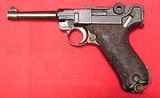
The
Pistole Parabellum 1908 or
Parabellum-Pistole (
Pistol Parabellum), popularly known as the
Luger, is a toggle-locked recoil-operated semi-automatic pistol. The design was patented by
Georg J. LugerGeorg Johann Luger was an Austrian designer of the famous Luger pistol and the 9 x 19mm Parabellum cartridge.-Early life and military service:...
in 1898 and produced by
GermanGermany , officially the Federal Republic of Germany , is a federal parliamentary republic in Europe. The country consists of 16 states while the capital and largest city is Berlin. Germany covers an area of 357,021 km2 and has a largely temperate seasonal climate...
arms manufacturer
Deutsche Waffen- und MunitionsfabrikenDeutsche Waffen- und Munitionsfabriken Aktien-Gesellschaft , known as DWM, was an arms company in Imperial Germany created in 1896 when Ludwig Loewe & Company united its weapons and ammunition production facilities within one company...
(DWM) starting in 1900; it was an evolution of the 1893
Hugo BorchardtHugo Borchardt was a firearms inventor and engineer, born in Magdeburg, Germany. He is known for his inventions of the Borchardt C-93 pistol and the Sharps-Borchardt Model 1878 rifle....
designed
C-93The Borchardt C-93 pistol was designed by Hugo Borchardt in 1893. Ludwig Loewe & Company of Berlin, Germany, a manufacturer of machine tools, produced the C-93, a semi-automatic pistol that he had invented based upon the Maxim toggle-lock principle. He also developed the 7.65×25mm Borchardt...
. It would be succeeded and partly replaced by the Walther P38.
The Luger was made popular by its use by Germany during
World War IWorld War I , which was predominantly called the World War or the Great War from its occurrence until 1939, and the First World War or World War I thereafter, was a major war centred in Europe that began on 28 July 1914 and lasted until 11 November 1918...
and
World War IIWorld War II, or the Second World War , was a global conflict lasting from 1939 to 1945, involving most of the world's nations—including all of the great powers—eventually forming two opposing military alliances: the Allies and the Axis...
. Although the Luger pistol was first introduced in
7.65×21mm ParabellumThe 7.65×21mm Parabellum is a pistol cartridge that was introduced in 1898 by German arms manufacturer Deutsche Waffen und Munitions Fabriken for their new Pistol Parabellum...
, it is notable for being the pistol for which the 9×19mm Parabellum (also known as the 9 mm Luger) cartridge was developed.
Design details
The Luger uses a toggle-lock action, which uses a jointed arm to lock, as opposed to the slide actions of almost every other semi-automatic pistol. After a round is fired, the barrel and toggle assembly (both locked together at this point) travel rearward due to recoil. After moving roughly 0.5 in (12.7 mm) rearward, the toggle strikes a cam built into the frame, causing the knee joint to hinge and the toggle and breech assembly to unlock. At this point the barrel impacts the frame and stops its rearward movement, but the toggle and breech assembly continue moving (bending the knee joint) due to momentum, extracting the spent casing from the chamber and ejecting it. The toggle and breech assembly subsequently travel forward under spring tension and the next round from the magazine is loaded into the chamber. The entire sequence occurs in a fraction of a second. This mechanism works well for higher pressure cartridges, but cartridges loaded to a lower pressure can cause the pistol to
malfunctionA firearm malfunction is the partial or complete failure of a firearm to operate as intended. Malfunctions range from temporary and relatively safe situations, such as a casing that didn't eject, to potentially dangerous occurrences that may permanently damage the gun and cause injury or death...
because they do not generate enough recoil to work the action fully. This results in either the breech block not clearing the top cartridge of the magazine, or becoming jammed open on the cartridge's base.
In World War I, as
submachine gunA submachine gun is an automatic carbine, designed to fire pistol cartridges. It combines the automatic fire of a machine gun with the cartridge of a pistol. The submachine gun was invented during World War I , but the apex of its use was during World War II when millions of the weapon type were...
s were found to be effective in
trench warfareTrench warfare is a form of occupied fighting lines, consisting largely of trenches, in which troops are largely immune to the enemy's small arms fire and are substantially sheltered from artillery...
, experiments with converting various types of pistols to
machine pistolA machine pistol is a handgun-style, often magazine-fed and self-loading firearm, capable of fully automatic or burst fire, and normally chambered for pistol cartridges. The term is a literal translation of Maschinenpistole, the German term for a hand-held automatic weapon...
s (
Reihenfeuerpistolen, literally "row-fire pistols" or "consecutive fire pistols") were conducted. Among those the Luger pistol (German Army designation
Pistole 08) was examined; however, unlike the
Mauser C96The Mauser C96 is a semi-automatic pistol that was originally produced by German arms manufacturer Mauser from 1896 to 1937...
, which was later manufactured in a selective-fire version (Schnellfeuer) or
Reihenfeuerpistolen, the Luger proved to have an excessive
rate of fireRate of fire is the frequency at which a specific weapon can fire or launch its projectiles. It is usually measured in rounds per minute , or per second .-Overview:...
in full-automatic mode.
The Luger pistol was manufactured to exacting standards and had a long service life. William "Bill" Ruger praised the Luger's 55 degree grip angle and duplicated it in his .22 LR pistol.
Service
The Swiss Army evaluated the Luger pistol in
7.65×21mm ParabellumThe 7.65×21mm Parabellum is a pistol cartridge that was introduced in 1898 by German arms manufacturer Deutsche Waffen und Munitions Fabriken for their new Pistol Parabellum...
(.30 Luger in North America) and adopted it in 1900 as its standard side arm, designated
Ordonnanzpistole 00 or
OP00, in 1900. This model uses a 120 mm barrel.
The Luger pistol was accepted by the
German NavyThe German Navy is the navy of Germany and is part of the unified Bundeswehr .The German Navy traces its roots back to the Imperial Fleet of the revolutionary era of 1848 – 52 and more directly to the Prussian Navy, which later evolved into the Northern German Federal Navy...
in 1904. The
Navy model had a 150 mm barrel and a two position (100/200 metre) rear sight. This version is known as
Pistole 04.
In 1908 the German Army adopted the Luger to replace the
ReichsrevolverThe M1879 Reichsrevolver, or Reichs-Commissions-Revolver Modell 1879 and 1883, were service revolvers used by the German Army from 1879 to 1908, when it was superseded by the Luger.The two versions of the revolver differ only in barrel length...
in front-line service. The
Pistole 08 (or
P.08) had a 100 mm barrel and was chambered in 9×19mm Parabellum. The
P.08 was the usual
side armA side arm is a weapon, usually a pistol but can be a dagger, as used in pre-modern times, which is worn on the body in a holster to permit immediate access and use. A side arm is typically required equipment for military personnel and sometimes carried by law enforcement personnel...
for
German ArmyThe German Army is the land component of the armed forces of the Federal Republic of Germany. Following the disbanding of the Wehrmacht after World War II, it was re-established in 1955 as the Bundesheer, part of the newly formed West German Bundeswehr along with the Navy and the Air Force...
personnel in both world wars, though it was being replaced by the Walther P38 starting in 1938. In 1930,
MauserMauser was a German arms manufacturer of a line of bolt-action rifles and pistols from the 1870s to 1995. Mauser designs were built for the German armed forces...
took over manufacture of the P.08 (until 1943).
The
Lange Pistole 08 (
GermanGerman is a West Germanic language, related to and classified alongside English and Dutch. With an estimated 90 – 98 million native speakers, German is one of the world's major languages and is the most widely-spoken first language in the European Union....
: "Long Pistol 08") or
Artillery Luger was a pistol carbine for use by German Army artillerymen as a sort of early
Personal Defense WeaponA personal defense weapon is a compact semi-automatic or fully automatic firearm similar in most respects to a submachine gun, but firing an armor-piercing rifle round, giving a PDW better range, accuracy and armor-penetrating capability than submachine guns, which fire pistol-caliber cartridges...
. It had a 200 mm barrel, an 8-position tangent rear sight (calibrated to 800 metres) and a shoulder stock with holster. It was sometimes used with a 32-round
drum magazineA drum magazine is a type of firearms magazine that is cylindrical in shape, similar to a drum. Instead of rounds being stored flat, as in a more common box magazine, rounds in a drum magazine are stored in a spiral around the center of the magazine, facing the direction of the barrel.There are...
(
Trommelmagazin 08).
It was also available in various
carbineA carbine , from French carabine, is a longarm similar to but shorter than a rifle or musket. Many carbines are shortened versions of full rifles, firing the same ammunition at a lower velocity due to a shorter barrel length....
versions with yet longer barrels.
The firm Armeria Belga of Santiago Chile, manufactured the Benke Thiemann retractable stock that could fold out from the grip section.
The United States evaluated several semi-automatic pistols in the late 19th century, including the
Colt M1900The Colt Model 1900 was a self-loading semi-automatic .38 caliber handgun introduced by Colt at the turn of the 20th century. It also marked the introduction of .38 ACP, the round for which it is chambered ....
,
Steyr Mannlicher M1894The M1894 Steyr Mannlicher blow-forward, semi-automatic pistol was an early semi-automatic pistol.-General features:This earliest Steyr Mannlicher pistol, manufactured by FAB.D'ARMES Neuhausen, Switzerland, was designed to be self loading and to use a special rimmed cartridge in 6.5 mm caliber...
, and an entry from
MauserMauser was a German arms manufacturer of a line of bolt-action rifles and pistols from the 1870s to 1995. Mauser designs were built for the German armed forces...
. In 1900 the US purchased 1000
7.65 mmThe 7.65×21mm Parabellum is a pistol cartridge that was introduced in 1898 by German arms manufacturer Deutsche Waffen und Munitions Fabriken for their new Pistol Parabellum...
Lugers for field trials. Later, a small number were sampled in the then-new, more powerful 9 mm round. Field experience with .38 caliber revolvers in the Philippines and ballistic tests would result in a requirement for still-larger rounds.
In 1906 and 1907, the US Army held trials for a large-caliber semi-automatic. DWM provided two sample Luger pistols chambered in
.45 ACPThe .45 ACP , also known as the .45 Auto by C.I.P., is a cartridge designed by John Browning in 1904, for use in his prototype Colt semi-automatic .45 pistol and eventually the M1911 pistol adopted by the United States Army in 1911.-Design and history:The U.S...
for testing, but neither is known to have survived. At least two pistols were manufactured later for possible commercial or military sales, and one is exhibited at the
Norton GalleryThe R. W. Norton Art Gallery, in Shreveport, Louisiana, USA, houses collections of American and European paintings, sculptures and decorative arts spanning more than four centuries. Since its opening in 1966, the museum has become particularly well-known around the country for its impressive...
, in Shreveport, Louisiana. The other was sold in 2010 and remains in a private collection. After initial trials, DWM, Savage, and Colt were asked to provide further samples for evaluation. DWM withdrew for reasons that are still debated, though the Army did place an order for 200 more samples.
Usage today
Although outdated, the Luger is still sought after by collectors both for its sleek design and accuracy, and for its connection to
ImperialThe German Empire refers to Germany during the "Second Reich" period from the unification of Germany and proclamation of Wilhelm I as German Emperor on 18 January 1871, to 1918, when it became a federal republic after defeat in World War I and the abdication of the Emperor, Wilhelm II.The German...
and
Nazi GermanyNazi Germany , also known as the Third Reich , but officially called German Reich from 1933 to 1943 and Greater German Reich from 26 June 1943 onward, is the name commonly used to refer to the state of Germany from 1933 to 1945, when it was a totalitarian dictatorship ruled by...
. Limited production of the P.08 by its original manufacturer resumed when
MauserMauser was a German arms manufacturer of a line of bolt-action rifles and pistols from the 1870s to 1995. Mauser designs were built for the German armed forces...
refurbished a quantity of them in 1999 for the pistol's centenary. More recently, Krieghoff announced the continuation of its Parabellum Model 08 line with 200 examples at $17,545.00 apiece. The Luger was prized by Allied soldiers during both of the World Wars. Thousands were taken home during both wars, and are still in circulation today. Colonel David Hackworth mentions in his autobiography that it was still a sought-after sidearm in the
Vietnam WarThe Vietnam War was a Cold War-era military conflict that occurred in Vietnam, Laos, and Cambodia from 1 November 1955 to the fall of Saigon on 30 April 1975. This war followed the First Indochina War and was fought between North Vietnam, supported by its communist allies, and the government of...
.
Recently the first serious study on the Post World War II Luger has been published (
The Parabellum is Back! 1945 - 2000); it covers the Luger production from 1945 until 2000.
In fact, in 1945 Mauser set up again the Luger production under the control of the French forces. In 1969, Mauser Werke in Oberndorf restarted the production until 1986 when the last commemorative model was produced.
External links