

Ridge

Encyclopedia
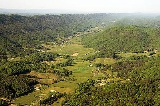
A ridge is a geological feature consisting of a chain of mountains or hills that form a continuous elevated crest for some distance. Ridges are usually termed hill
s or mountain
s as well, depending on size. There are several main types of ridges:
Hill
A hill is a landform that extends above the surrounding terrain. Hills often have a distinct summit, although in areas with scarp/dip topography a hill may refer to a particular section of flat terrain without a massive summit A hill is a landform that extends above the surrounding terrain. Hills...
s or mountain
Mountain
Image:Himalaya_annotated.jpg|thumb|right|The Himalayan mountain range with Mount Everestrect 58 14 160 49 Chomo Lonzorect 200 28 335 52 Makalurect 378 24 566 45 Mount Everestrect 188 581 920 656 Tibetan Plateaurect 250 406 340 427 Rong River...
s as well, depending on size. There are several main types of ridges:
- Dendritic ridge: In typical dissected plateauDissected plateauA dissected plateau is a plateau area that has been severely eroded so that the relief is sharp. Such an area may be referred to as mountainous, but dissected plateaus are distinguishable from orogenic mountain belts by the lack of folding, metamorphism, extensive faulting, or magmatic activity...
terrain, the stream drainage valleys will leave intervening ridges. These are by far the most common ridges. These ridges usually represent slightly more erosionErosionErosion is when materials are removed from the surface and changed into something else. It only works by hydraulic actions and transport of solids in the natural environment, and leads to the deposition of these materials elsewhere...
resistant rock, but not always – they often remain because there were more joints where the valleys formed, or other chance occurrences. This type of ridge is generally somewhat random in orientation, often changing direction frequently, often with knobs at intervals on the ridge top.
- Stratigraphic ridge: In places such as the Ridge-and-valley AppalachiansRidge-and-valley AppalachiansThe Ridge-and-Valley Appalachians, also called the Ridge and Valley Province or the Valley and Ridge Appalachians, are a physiographic province of the larger Appalachian division and are also a belt within the Appalachian Mountains extending from southeastern New York through northwestern New...
, long, even, straight ridges are formed because they are the uneroded remaining edges of the more resistant strataStratumIn geology and related fields, a stratum is a layer of sedimentary rock or soil with internally consistent characteristics that distinguish it from other layers...
that were foldedFold (geology)The term fold is used in geology when one or a stack of originally flat and planar surfaces, such as sedimentary strata, are bent or curved as a result of permanent deformation. Synsedimentary folds are those due to slumping of sedimentary material before it is lithified. Folds in rocks vary in...
laterally. Similar ridges have formed in places such as the Black HillsBlack HillsThe Black Hills are a small, isolated mountain range rising from the Great Plains of North America in western South Dakota and extending into Wyoming, USA. Set off from the main body of the Rocky Mountains, the region is something of a geological anomaly—accurately described as an "island of...
, where the ridges form concentric circles around the igneous core. Sometimes these ridges are called "hogback ridgesHogback (geology)A hogback is a homoclinal ridge, formed from a monocline, composed of steeply tilted strata of rock protruding from the surrounding area. The name comes from the ridge resembling the high, knobby spine between the shoulders of a hog. In most cases, the two strata that compose a hogback are...
".
- Oceanic spreading ridge: In tectonic spreading zones around the world, such as at the Mid-Atlantic RidgeMid-Atlantic RidgeThe Mid-Atlantic Ridge is a mid-ocean ridge, a divergent tectonic plate boundary located along the floor of the Atlantic Ocean, and part of the longest mountain range in the world. It separates the Eurasian Plate and North American Plate in the North Atlantic, and the African Plate from the South...
, the volcanic activity forming new plate boundary forms volcanic ridges at the spreading zone. IsostaticIsostasyIsostasy is a term used in geology to refer to the state of gravitational equilibrium between the earth's lithosphere and asthenosphere such that the tectonic plates "float" at an elevation which depends on their thickness and density. This concept is invoked to explain how different topographic...
settling and erosion gradually reduce the elevations moving away from the zone.
- Crater ridges: Large meteoriteMeteoriteA meteorite is a natural object originating in outer space that survives impact with the Earth's surface. Meteorites can be big or small. Most meteorites derive from small astronomical objects called meteoroids, but they are also sometimes produced by impacts of asteroids...
strikes typically form large impact craterImpact craterIn the broadest sense, the term impact crater can be applied to any depression, natural or manmade, resulting from the high velocity impact of a projectile with a larger body...
s bordered by circular ridges.
- Volcanic caldera ridges: Large volcanoVolcano2. Bedrock3. Conduit 4. Base5. Sill6. Dike7. Layers of ash emitted by the volcano8. Flank| 9. Layers of lava emitted by the volcano10. Throat11. Parasitic cone12. Lava flow13. Vent14. Crater15...
es often leave collapsed central calderaCalderaA caldera is a cauldron-like volcanic feature usually formed by the collapse of land following a volcanic eruption, such as the one at Yellowstone National Park in the US. They are sometimes confused with volcanic craters...
s that are bordered by circular ridges.
- Fault ridges: Faults often form escarpmentEscarpmentAn escarpment is a steep slope or long cliff that occurs from erosion or faulting and separates two relatively level areas of differing elevations.-Description and variants:...
s. Sometimes the tops of the escarpments form not plateaus, but slope back so that the edges of the escarpments form ridges.
- Dune ridges: In areas of large-scale duneDuneIn physical geography, a dune is a hill of sand built by wind. Dunes occur in different forms and sizes, formed by interaction with the wind. Most kinds of dunes are longer on the windward side where the sand is pushed up the dune and have a shorter "slip face" in the lee of the wind...
activity, certain types of dunes result in sandSandSand is a naturally occurring granular material composed of finely divided rock and mineral particles.The composition of sand is highly variable, depending on the local rock sources and conditions, but the most common constituent of sand in inland continental settings and non-tropical coastal...
ridges.
- Moraines and eskers: GlacialGlacierA glacier is a large persistent body of ice that forms where the accumulation of snow exceeds its ablation over many years, often centuries. At least 0.1 km² in area and 50 m thick, but often much larger, a glacier slowly deforms and flows due to stresses induced by its weight...
activity may leave ridges in the form of moraineMoraineA moraine is any glacially formed accumulation of unconsolidated glacial debris which can occur in currently glaciated and formerly glaciated regions, such as those areas acted upon by a past glacial maximum. This debris may have been plucked off a valley floor as a glacier advanced or it may have...
s and eskerEskerAn esker is a long winding ridge of stratified sand and gravel, examples of which occur in glaciated and formerly glaciated regions of Europe and North America...
s. An arêteAreteAreté is the term meaning "virtue" or "excellence", from Greek ἈρετήArete may also be used:*as a given name of persons or things:**Queen Arete , a character in Homer's Odyssey.***197 Arete, an asteroid....
is a thin ridge of rock that is formed by glacial erosion.
- Volcanic subglacial ridges: Many subglacial volcanoSubglacial volcanoA subglacial volcano, also known as a glaciovolcano, is a volcanic form produced by subglacial eruptions or eruptions beneath the surface of a glacier or ice sheet which is then melted into a lake by the rising lava...
es create ridgelike formations when lava erupts through a thick glacierGlacierA glacier is a large persistent body of ice that forms where the accumulation of snow exceeds its ablation over many years, often centuries. At least 0.1 km² in area and 50 m thick, but often much larger, a glacier slowly deforms and flows due to stresses induced by its weight...
or ice sheetIce sheetAn ice sheet is a mass of glacier ice that covers surrounding terrain and is greater than 50,000 km² , thus also known as continental glacier...
.
- Shutter ridges: A Shutter ridgeShutter ridgeA shutter ridge is a ridge which has moved along a fault line, blocking or diverting drainage. Typically, a shutter ridge creates a valley corresponding to the alignment of the fault that produces it. Shutter ridges occur exclusively at strike-slip faults...
is a ridge which has moved along a fault line, blocking or diverting drainage. Typically, a shutter ridge creates a valley corresponding to the alignment of the fault that produces it.
External links
- InterRidge An initiative for international cooperation in ridge-crest studies