

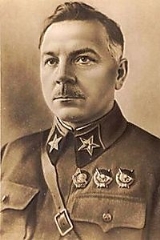
Kliment Voroshilov

Encyclopedia
Kliment Yefremovich Voroshilov , popularly known as Klim Voroshilov (4 February 1881 – 2 December 1969) was a Soviet
military officer, politician, and statesman. He served as Defense Minister and Marshal of the Soviet Union
from 1935 and 1936, respectively, until his death in 1969.
(now in Luhansk Oblast
, Ukraine), in the Russian Empire
, into a railway worker's family of Russian
ethnicity. He joined the Bolshevik
faction of the Russian Social Democratic Labour Party
in 1905. Following the Russian Revolution of 1917
, Voroshilov became a member of the Ukrainian provisional government and Commissar for Internal Affairs. He was well known for aiding Joseph Stalin
in the Military Council (led by Leon Trotsky
), having become closely associated with Stalin during the Red Army
's 1918 defense of Tsaritsyn. Voroshilov was instrumental as a commander of the Southern Front during the Russian Civil War
and the Polish-Soviet War
while with the 1st Cavalry Army
. As Political Commissar serving co-equally with Stalin, Voroshilov was responsible for the morale of the 1st Cavalry Army, whose men were chiefly composed of peasants from southern Russia. Voroshilov's efforts as Commissar did not prevent a resounding defeat at the Battle of Komarów
or regular outbreaks of murderous anti-Semitic violence within the Cavalry army's ranks.
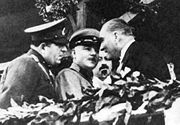 Voroshilov was elected to the Central Committee
in 1921 and remained a member until 1961. In 1925, after the death of Mikhail Frunze
, Voroshilov was appointed People's Commissar for Military and Navy Affairs and Chairman of the Revolutionary Military Council
of the USSR
, a post he held until 1934. Frunze's position was compatible with the Troika (Grigory Zinoviev
, Lev Kamenev
, Stalin), but Stalin preferred to have a close ally in charge (as opposed to Frunze, a "Zinovievite"). Frunze was urged to have surgery to treat an old stomach ulcer
. He died on the operating table of an overdose of chloroform
, an anesthetic. Stalin's critics charge that the surgery was used to disguise the assassination of Frunze. Voroshilov was made a full member of the newly formed Politburo
in 1926, remaining a member until 1960.
Voroshilov was appointed People's Commissar for Defence in 1934 and a Marshal of the Soviet Union
in 1935. Voroshilov played a central role in Stalin's Great Purge
of the 1930s, denouncing many of his own military colleagues and subordinates when asked to do so by Stalin. He went so far as to write personal letters to exiled former Soviet officers and diplomats such as Mikhail Ostrovsky to return voluntarily to the Soviet Union, reassuring them that they would not face retribution from authorities (they did). Voroshilov personally signed 185 documented execution lists, fourth among the Soviet leadership after Molotov
, Stalin and Kaganovich
.
During World War II, Voroshilov was a member of the State Defense Committee
. Voroshilov commanded Soviet troops during the Winter War
from November 1939 to January 1940, but, due to his poor planning and overall incompetence, the Red Army suffered about 185,000 casualties. When the leadership gathered at Stalin's dacha at Kuntsevo
Stalin shouted at Voroshilov who replied in kind, blaming the failure on Stalin for killing the Red Army's best generals in his purges. Voroshilov followed this by smashing a platter of roast suckling pig on the table. Nikita Khrushchev
said it was the only time he ever witnessed such an outburst. Voroshilov still became the scapegoat for the initial failures in Finland. He was later replaced as Defence Commissar by Semyon Timoshenko
. Voroshilov was then made Deputy Premier responsible for cultural matters.
Voroshilov initially argued that thousands of Polish army officers captured in September 1939 should be released but later signed the order for their execution. Vasili Blokhin
of the NKVD personally shot 7000 of them in 28 nights using German Walther pistols.
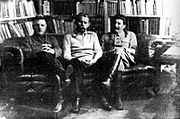 After the German invasion of the Soviet Union
in June 1941, Voroshilov was made commander of the short-lived Northwestern Direction, controlling several fronts
. In September 1941 he commanded Leningrad Front
. Working alongside military commander Andrei Zhdanov
as German advances threatened to cut off Leningrad
he displayed considerable personal bravery, prancing around in defiance of heavy shelling at Ivanovskoye; at one point he rallied retreating troops and personally led a counter-attack against German tanks armed only with a pistol. Failing to prevent the Germans from surrounding Leningrad however, he was dismissed from that post and replaced by the far abler Georgy Zhukov
on 8 September 1941.
In an embarrassing incident at the 1943 Tehran Conference
, during a ceremony to receive the "Sword of Stalingrad
" from Winston Churchill
, he took the sword from Stalin but then allowed the sword to fall from its scabbard onto his toes in the presence of the Big Three
wartime leaders.
In 1945–1947, he supervised the establishment of the communist regime in Hungary
.
In 1952, Voroshilov was appointed a member of the Presidium of the Central Committee
. Stalin's death on 5 March 1953 prompted major changes in the Soviet leadership and in March 1953, Voroshilov was approved as Chairman of the Presidium of the Supreme Soviet
(i.e., the head of state) with Nikita Khrushchev as First Secretary of the Communist Party
and Georgy Malenkov
as Premier of the Soviet Union
. Voroshilov, Malenkov and Khrushchev brought about 26 June 1953 arrest of Lavrenty Beria after Stalin's death.
chairman of the Presidium of the Supreme Council (the head of state). The Central Committee also relieved him of duties as a member of the Party Presidium (as the Politburo had been called since 1952) on 16 July 1960. In October 1961, his political defeat was complete at the 22nd party congress when he was excluded from election to the Central Committee.
Following Khrushchev's fall from power, Soviet leader Brezhnev brought Voroshilov out of retirement into a figurehead
political post. Voroshilov was again re-elected to the Central Committee in 1966. Voroshilov was awarded a second medal of Hero of the Soviet Union
1968. He died in 1969 in Moscow and was buried in the Kremlin Wall Necropolis
. The KV series of tanks, used in World War II, was named after Voroshilov. Two towns were also named after him: Voroshilovgrad in Ukraine (now changed back to the historical Luhansk
) and Voroshilov in the Soviet Far East (now renamed Ussuriysk
after the Ussuri river), as well as the General Staff Academy in Moscow. Stavropol
was called Voroshilovsk from 1935 to 1943.
, where Ekaterina was sent in 1906. While both serving on the Tsaritsyn Front in 1918, where Ekaterina was helping orphans, they adopted a four year old orphan boy who they named Petya. They also adopted the children of Mikhail Frunze
, following his death in 1925. During Stalin's rule they lived in the Kremlin
at the Horse Guards.
Soviet Union
The Soviet Union , officially the Union of Soviet Socialist Republics , was a constitutionally socialist state that existed in Eurasia between 1922 and 1991....
military officer, politician, and statesman. He served as Defense Minister and Marshal of the Soviet Union
Marshal of the Soviet Union
Marshal of the Soviet Union was the de facto highest military rank of the Soviet Union. ....
from 1935 and 1936, respectively, until his death in 1969.
Early life and Russian Revolution
Voroshilov was born in LysychanskLysychansk
Lysychans'k is a city in the Luhansk Oblast of south-eastern Ukraine. The city is designated as its own separate raion within the oblast, and is located on the high right bank of the Seversky Donets River, approximately 90 km from the oblast capital, Luhansk.Population of 01.05.2010-...
(now in Luhansk Oblast
Luhansk Oblast
Luhansk Oblast ) is the easternmost oblast of Ukraine. Its administrative center is Luhansk. The oblast was established in 1938 and bore the name Voroshilovgrad Oblast in honor of Kliment Voroshilov....
, Ukraine), in the Russian Empire
Russian Empire
The Russian Empire was a state that existed from 1721 until the Russian Revolution of 1917. It was the successor to the Tsardom of Russia and the predecessor of the Soviet Union...
, into a railway worker's family of Russian
Russians
The Russian people are an East Slavic ethnic group native to Russia, speaking the Russian language and primarily living in Russia and neighboring countries....
ethnicity. He joined the Bolshevik
Bolshevik
The Bolsheviks, originally also Bolshevists , derived from bol'shinstvo, "majority") were a faction of the Marxist Russian Social Democratic Labour Party which split apart from the Menshevik faction at the Second Party Congress in 1903....
faction of the Russian Social Democratic Labour Party
Russian Social Democratic Labour Party
The Russian Social Democratic Labour Party , also known as Russian Social Democratic Workers' Party or Russian Social Democratic Party, was a revolutionary socialist Russian political party formed in 1898 in Minsk to unite the various revolutionary organizations into one party...
in 1905. Following the Russian Revolution of 1917
Russian Revolution of 1917
The Russian Revolution is the collective term for a series of revolutions in Russia in 1917, which destroyed the Tsarist autocracy and led to the creation of the Soviet Union. The Tsar was deposed and replaced by a provisional government in the first revolution of February 1917...
, Voroshilov became a member of the Ukrainian provisional government and Commissar for Internal Affairs. He was well known for aiding Joseph Stalin
Joseph Stalin
Joseph Vissarionovich Stalin was the Premier of the Soviet Union from 6 May 1941 to 5 March 1953. He was among the Bolshevik revolutionaries who brought about the October Revolution and had held the position of first General Secretary of the Communist Party of the Soviet Union's Central Committee...
in the Military Council (led by Leon Trotsky
Leon Trotsky
Leon Trotsky , born Lev Davidovich Bronshtein, was a Russian Marxist revolutionary and theorist, Soviet politician, and the founder and first leader of the Red Army....
), having become closely associated with Stalin during the Red Army
Red Army
The Workers' and Peasants' Red Army started out as the Soviet Union's revolutionary communist combat groups during the Russian Civil War of 1918-1922. It grew into the national army of the Soviet Union. By the 1930s the Red Army was among the largest armies in history.The "Red Army" name refers to...
's 1918 defense of Tsaritsyn. Voroshilov was instrumental as a commander of the Southern Front during the Russian Civil War
Russian Civil War
The Russian Civil War was a multi-party war that occurred within the former Russian Empire after the Russian provisional government collapsed to the Soviets, under the domination of the Bolshevik party. Soviet forces first assumed power in Petrograd The Russian Civil War (1917–1923) was a...
and the Polish-Soviet War
Polish-Soviet War
The Polish–Soviet War was an armed conflict between Soviet Russia and Soviet Ukraine and the Second Polish Republic and the Ukrainian People's Republic—four states in post–World War I Europe...
while with the 1st Cavalry Army
1st Cavalry Army
The 1st Cavalry Army was the most famous Red Army сavalry formation. It was also known as Budyonny's Cavalry Army or simply as Konarmia ....
. As Political Commissar serving co-equally with Stalin, Voroshilov was responsible for the morale of the 1st Cavalry Army, whose men were chiefly composed of peasants from southern Russia. Voroshilov's efforts as Commissar did not prevent a resounding defeat at the Battle of Komarów
Battle of Komarów
The Battle of Komarów was one of the most important battles of the Polish-Bolshevik War. It took place on August 31, 1920, near the village of Komarowo near Zamość...
or regular outbreaks of murderous anti-Semitic violence within the Cavalry army's ranks.
Political career
Central Committee of the Communist Party of the Soviet Union
The Central Committee of the Communist Party of the Soviet Union , abbreviated in Russian as ЦК, "Tse-ka", earlier was also called as the Central Committee of the All-Union Communist Party ...
in 1921 and remained a member until 1961. In 1925, after the death of Mikhail Frunze
Mikhail Frunze
Mikhail Vasilyevich Frunze was a Bolshevik leader during and just prior to the Russian Revolution of 1917.-Life and Political Activity:Frunze was born in Bishkek, then a small Imperial Russian garrison town in the Kyrgyz part of Turkestan, to a Moldovan medical practitioner and his Russian wife...
, Voroshilov was appointed People's Commissar for Military and Navy Affairs and Chairman of the Revolutionary Military Council
Revolutionary Military Council
Revolutionary Military Council of the Republic or Revvoyensoviet Revolutionary Military Council of the Republic or Revvoyensoviet Revolutionary Military Council of the Republic or Revvoyensoviet (Революционный Военный Совет, Revolyutsionny Voyenny Sovyet; Реввоенсовет, Revvoyensovyet; also...
of the USSR
Soviet Union
The Soviet Union , officially the Union of Soviet Socialist Republics , was a constitutionally socialist state that existed in Eurasia between 1922 and 1991....
, a post he held until 1934. Frunze's position was compatible with the Troika (Grigory Zinoviev
Grigory Zinoviev
Grigory Yevseevich Zinoviev , born Ovsei-Gershon Aronovich Radomyslsky Apfelbaum , was a Bolshevik revolutionary and a Soviet Communist politician...
, Lev Kamenev
Lev Kamenev
Lev Borisovich Kamenev , born Rozenfeld , was a Bolshevik revolutionary and a prominent Soviet politician. He was briefly head of state of the new republic in 1917, and from 1923-24 the acting Premier in the last year of Lenin's life....
, Stalin), but Stalin preferred to have a close ally in charge (as opposed to Frunze, a "Zinovievite"). Frunze was urged to have surgery to treat an old stomach ulcer
Peptic ulcer
A peptic ulcer, also known as PUD or peptic ulcer disease, is the most common ulcer of an area of the gastrointestinal tract that is usually acidic and thus extremely painful. It is defined as mucosal erosions equal to or greater than 0.5 cm...
. He died on the operating table of an overdose of chloroform
Chloroform
Chloroform is an organic compound with formula CHCl3. It is one of the four chloromethanes. The colorless, sweet-smelling, dense liquid is a trihalomethane, and is considered somewhat hazardous...
, an anesthetic. Stalin's critics charge that the surgery was used to disguise the assassination of Frunze. Voroshilov was made a full member of the newly formed Politburo
Politburo
Politburo , literally "Political Bureau [of the Central Committee]," is the executive committee for a number of communist political parties.-Marxist-Leninist states:...
in 1926, remaining a member until 1960.
Voroshilov was appointed People's Commissar for Defence in 1934 and a Marshal of the Soviet Union
Marshal of the Soviet Union
Marshal of the Soviet Union was the de facto highest military rank of the Soviet Union. ....
in 1935. Voroshilov played a central role in Stalin's Great Purge
Great Purge
The Great Purge was a series of campaigns of political repression and persecution in the Soviet Union orchestrated by Joseph Stalin from 1936 to 1938...
of the 1930s, denouncing many of his own military colleagues and subordinates when asked to do so by Stalin. He went so far as to write personal letters to exiled former Soviet officers and diplomats such as Mikhail Ostrovsky to return voluntarily to the Soviet Union, reassuring them that they would not face retribution from authorities (they did). Voroshilov personally signed 185 documented execution lists, fourth among the Soviet leadership after Molotov
Vyacheslav Molotov
Vyacheslav Mikhailovich Molotov was a Soviet politician and diplomat, an Old Bolshevik and a leading figure in the Soviet government from the 1920s, when he rose to power as a protégé of Joseph Stalin, to 1957, when he was dismissed from the Presidium of the Central Committee by Nikita Khrushchev...
, Stalin and Kaganovich
Lazar Kaganovich
Lazar Moiseyevich Kaganovich was a Soviet politician and administrator and one of the main associates of Joseph Stalin.-Early life:Kaganovich was born in 1893 to Jewish parents in the village of Kabany, Radomyshl uyezd, Kiev Governorate, Russian Empire...
.
During World War II, Voroshilov was a member of the State Defense Committee
USSR State Defense Committee
The State Defense Committee was an extraordinary organ of state power in the USSR during the German-Soviet War which held complete state power in the country.-General scope:...
. Voroshilov commanded Soviet troops during the Winter War
Winter War
The Winter War was a military conflict between the Soviet Union and Finland. It began with a Soviet offensive on 30 November 1939 – three months after the start of World War II and the Soviet invasion of Poland – and ended on 13 March 1940 with the Moscow Peace Treaty...
from November 1939 to January 1940, but, due to his poor planning and overall incompetence, the Red Army suffered about 185,000 casualties. When the leadership gathered at Stalin's dacha at Kuntsevo
Kuntsevo Dacha
The Kuntsevo Dacha was Joseph Stalin's personal residence near the former town of Kuntsevo , where he spent the last two decades of his life and died on 5 March 1953. The building is set in a forest not far from the modern-day Victory Park.The so-called "nearer dacha" was built in 1933-34 to...
Stalin shouted at Voroshilov who replied in kind, blaming the failure on Stalin for killing the Red Army's best generals in his purges. Voroshilov followed this by smashing a platter of roast suckling pig on the table. Nikita Khrushchev
Nikita Khrushchev
Nikita Sergeyevich Khrushchev led the Soviet Union during part of the Cold War. He served as First Secretary of the Communist Party of the Soviet Union from 1953 to 1964, and as Chairman of the Council of Ministers, or Premier, from 1958 to 1964...
said it was the only time he ever witnessed such an outburst. Voroshilov still became the scapegoat for the initial failures in Finland. He was later replaced as Defence Commissar by Semyon Timoshenko
Semyon Timoshenko
Semyon Konstantinovich Timoshenko was a Soviet military commander and senior professional officer of the Red Army at the beginning of the German invasion of the Soviet Union in 1941.-Early life:...
. Voroshilov was then made Deputy Premier responsible for cultural matters.
Voroshilov initially argued that thousands of Polish army officers captured in September 1939 should be released but later signed the order for their execution. Vasili Blokhin
Vasili Blokhin
Vasili Mikhailovich Blokhin was a Soviet Major-General who served as the chief executioner of the Stalinist NKVD under the administrations of Genrikh Yagoda, Nikolai Yezhov and Lavrenty Beria...
of the NKVD personally shot 7000 of them in 28 nights using German Walther pistols.
Operation Barbarossa
Operation Barbarossa was the code name for Germany's invasion of the Soviet Union during World War II that began on 22 June 1941. Over 4.5 million troops of the Axis powers invaded the USSR along a front., the largest invasion in the history of warfare...
in June 1941, Voroshilov was made commander of the short-lived Northwestern Direction, controlling several fronts
Front (Soviet Army)
A front was a major military organization in the Soviet Army during many wars. It was roughly equivalent to an army group in the militaries of most other countries except Germany...
. In September 1941 he commanded Leningrad Front
Leningrad Front
The Leningrad Front was first formed on August 27, 1941, by dividing the Northern Front into the Leningrad Front and Karelian Front, during the German approach on Leningrad .-History:...
. Working alongside military commander Andrei Zhdanov
Andrei Zhdanov
Andrei Alexandrovich Zhdanov was a Soviet politician.-Life:Zhdanov enlisted with the Russian Social Democratic Labour Party in 1915 and was promoted through the party ranks, becoming the All-Union Communist Party manager in Leningrad after the assassination of Sergei Kirov in 1934...
as German advances threatened to cut off Leningrad
Saint Petersburg
Saint Petersburg is a city and a federal subject of Russia located on the Neva River at the head of the Gulf of Finland on the Baltic Sea...
he displayed considerable personal bravery, prancing around in defiance of heavy shelling at Ivanovskoye; at one point he rallied retreating troops and personally led a counter-attack against German tanks armed only with a pistol. Failing to prevent the Germans from surrounding Leningrad however, he was dismissed from that post and replaced by the far abler Georgy Zhukov
Georgy Zhukov
Marshal of the Soviet Union Georgy Konstantinovich Zhukov , was a Russian career officer in the Red Army who, in the course of World War II, played a pivotal role in leading the Red Army through much of Eastern Europe to liberate the Soviet Union and other nations from the Axis Powers' occupation...
on 8 September 1941.
In an embarrassing incident at the 1943 Tehran Conference
Tehran Conference
The Tehran Conference was the meeting of Joseph Stalin, Franklin D. Roosevelt and Winston Churchill between November 28 and December 1, 1943, most of which was held at the Soviet Embassy in Tehran, Iran. It was the first World War II conference amongst the Big Three in which Stalin was present...
, during a ceremony to receive the "Sword of Stalingrad
Sword of Stalingrad
The Sword of Stalingrad is a bejewelled ceremonial longsword specially forged and inscribed by command of George VI of the United Kingdom as a token of homage from the British people to the Soviet defenders of the city during the Battle of Stalingrad...
" from Winston Churchill
Winston Churchill
Sir Winston Leonard Spencer-Churchill, was a predominantly Conservative British politician and statesman known for his leadership of the United Kingdom during the Second World War. He is widely regarded as one of the greatest wartime leaders of the century and served as Prime Minister twice...
, he took the sword from Stalin but then allowed the sword to fall from its scabbard onto his toes in the presence of the Big Three
Big three
Big Three is a term used colloquially to refer to the three most prominent entities in any given grouping or subject.It may refer to:- People :* The leaders of the three major Allies of World War I: David Lloyd George, Georges Clemenceau, and Woodrow Wilson...
wartime leaders.
In 1945–1947, he supervised the establishment of the communist regime in Hungary
Hungary
Hungary , officially the Republic of Hungary , is a landlocked country in Central Europe. It is situated in the Carpathian Basin and is bordered by Slovakia to the north, Ukraine and Romania to the east, Serbia and Croatia to the south, Slovenia to the southwest and Austria to the west. The...
.
In 1952, Voroshilov was appointed a member of the Presidium of the Central Committee
Central Committee
Central Committee was the common designation of a standing administrative body of communist parties, analogous to a board of directors, whether ruling or non-ruling in the twentieth century and of the surviving, mostly Trotskyist, states in the early twenty first. In such party organizations the...
. Stalin's death on 5 March 1953 prompted major changes in the Soviet leadership and in March 1953, Voroshilov was approved as Chairman of the Presidium of the Supreme Soviet
Presidium of the Supreme Soviet
The Presidium of the Supreme Soviet was a Soviet governmental institution – a permanent body of the Supreme Soviets . This body was of the all-Union level , as well as in all Soviet republics and autonomous republics...
(i.e., the head of state) with Nikita Khrushchev as First Secretary of the Communist Party
Communist Party of the Soviet Union
The Communist Party of the Soviet Union was the only legal, ruling political party in the Soviet Union and one of the largest communist organizations in the world...
and Georgy Malenkov
Georgy Malenkov
Georgy Maximilianovich Malenkov was a Soviet politician, Communist Party leader and close collaborator of Joseph Stalin. After Stalin's death, he became Premier of the Soviet Union and was in 1953 briefly considered the most powerful Soviet politician before being overshadowed by Nikita...
as Premier of the Soviet Union
Premier of the Soviet Union
The office of Premier of the Soviet Union was synonymous with head of government of the Union of Soviet Socialist Republics . Twelve individuals have been premier...
. Voroshilov, Malenkov and Khrushchev brought about 26 June 1953 arrest of Lavrenty Beria after Stalin's death.
Retirement
After Khruschev removed most of the old Stalinists, like Molotov and Malenkov from the party, Voroshilov's career began to fade. On 7 May 1960, the Supreme Soviet of the Soviet Union granted Voroshilov's request for retirement and elected Leonid BrezhnevLeonid Brezhnev
Leonid Ilyich Brezhnev – 10 November 1982) was the General Secretary of the Central Committee of the Communist Party of the Soviet Union , presiding over the country from 1964 until his death in 1982. His eighteen-year term as General Secretary was second only to that of Joseph Stalin in...
chairman of the Presidium of the Supreme Council (the head of state). The Central Committee also relieved him of duties as a member of the Party Presidium (as the Politburo had been called since 1952) on 16 July 1960. In October 1961, his political defeat was complete at the 22nd party congress when he was excluded from election to the Central Committee.
Following Khrushchev's fall from power, Soviet leader Brezhnev brought Voroshilov out of retirement into a figurehead
Figurehead
A figurehead is a carved wooden decoration found at the prow of ships largely made between the 16th and 19th century.-History:Although earlier ships had often had some form of bow ornamentation A figurehead is a carved wooden decoration found at the prow of ships largely made between the 16th and...
political post. Voroshilov was again re-elected to the Central Committee in 1966. Voroshilov was awarded a second medal of Hero of the Soviet Union
Hero of the Soviet Union
The title Hero of the Soviet Union was the highest distinction in the Soviet Union, awarded personally or collectively for heroic feats in service to the Soviet state and society.-Overview:...
1968. He died in 1969 in Moscow and was buried in the Kremlin Wall Necropolis
Kremlin Wall Necropolis
Burials in the Kremlin Wall Necropolis in Moscow began in November 1917, when 240 pro-Bolshevik victims of the October Revolution were buried in mass graves on Red Square. It is centered on both sides of Lenin's Mausoleum, initially built in wood in 1924 and rebuilt in granite in 1929–1930...
. The KV series of tanks, used in World War II, was named after Voroshilov. Two towns were also named after him: Voroshilovgrad in Ukraine (now changed back to the historical Luhansk
Luhansk
Luhansk also known as Lugansk is a city in southeastern Ukraine. It is the administrative center of the Luhansk Oblast . The city itself is also designated as its own separate municipality within the oblast...
) and Voroshilov in the Soviet Far East (now renamed Ussuriysk
Ussuriysk
Ussuriysk is a city in Primorsky Krai, Russia, located in the fertile valley of the Razdolnaya River, north of Vladivostok and about from both the Chinese border and the Pacific Ocean. Population: -Medieval history:...
after the Ussuri river), as well as the General Staff Academy in Moscow. Stavropol
Stavropol
-International relations:-Twin towns/sister cities:Stavropol is twinned with: Des Moines, United States Béziers, France Pazardzhik, Bulgaria-External links:* **...
was called Voroshilovsk from 1935 to 1943.
Family
Voroshilov was married to Ekaterina Davidovna, born Golda Gorbman, who came from a Jewish Ukrainian family from Mardarovka. She changed her name when she converted to Orthodox Christianity in order to be allowed to marry Voroshilov. They met while both exiled in ArkhangelskArkhangelsk
Arkhangelsk , formerly known as Archangel in English, is a city and the administrative center of Arkhangelsk Oblast, Russia. It lies on both banks of the Northern Dvina River near its exit into the White Sea in the north of European Russia. The city spreads for over along the banks of the river...
, where Ekaterina was sent in 1906. While both serving on the Tsaritsyn Front in 1918, where Ekaterina was helping orphans, they adopted a four year old orphan boy who they named Petya. They also adopted the children of Mikhail Frunze
Mikhail Frunze
Mikhail Vasilyevich Frunze was a Bolshevik leader during and just prior to the Russian Revolution of 1917.-Life and Political Activity:Frunze was born in Bishkek, then a small Imperial Russian garrison town in the Kyrgyz part of Turkestan, to a Moldovan medical practitioner and his Russian wife...
, following his death in 1925. During Stalin's rule they lived in the Kremlin
Kremlin
A kremlin , same root as in kremen is a major fortified central complex found in historic Russian cities. This word is often used to refer to the best-known one, the Moscow Kremlin, or metonymically to the government that is based there...
at the Horse Guards.
See also
- OSOAVIAKhIMDOSAAFDOSAAF was a paramilitary society in the Soviet Union, Voluntary Society for Cooperation with the Army, Aviation, and Fleet . The society was preserved in a number of post-Soviet Republics, e.g., in Russia and Belarus...
badges: Voroshilov Sharpshooter and Voroshilov Horse Rider etc. - Kliment Voroshilov tankKliment Voroshilov tankThe Kliment Voroshilov tanks were a series of Soviet heavy tanks, named after the Soviet defense commissar and politician Kliment Voroshilov. The KV series were known for their extremely heavy armour protection during the early war, especially during the first year of the invasion of the Soviet...
, KV-1 and KV-2 - Voroshilov Kirov class cruiserKirov class cruiserThe Kirov-class cruisers were six vessels built between 1935 and 1944 for the Soviet Navy: Kirov, Voroshilov, Maxim Gorky, Molotov, Kalinin, and Kaganovich. After the first two ships, armor protection was increased and subsequent ships are sometimes called the Maxim Gorky class...