


Baltic Fleet

Encyclopedia
Red Banner
Red Banner was a symbol of the USSR associated with the Soviet state flag.Military units, institutions and organizations awarded with the Order of the Red Banner are referred to with the honorific title "of the Red Banner" Red Banner was a symbol of the USSR associated with the Soviet state...
Baltic Fleet - (Дважды Краснознамённый Балтийский флот) is the Russian Navy's presence in the Baltic Sea
Baltic Sea
The Baltic Sea is a brackish mediterranean sea located in Northern Europe, from 53°N to 66°N latitude and from 20°E to 26°E longitude. It is bounded by the Scandinavian Peninsula, the mainland of Europe, and the Danish islands. It drains into the Kattegat by way of the Øresund, the Great Belt and...
. In previous historical periods, it has been part of the navy of Imperial Russia
Imperial Russian Navy
The Imperial Russian Navy refers to the Tsarist fleets prior to the February Revolution.-First Romanovs:Under Tsar Mikhail Feodorovich, construction of the first three-masted ship, actually built within Russia, was completed in 1636. It was built in Balakhna by Danish shipbuilders from Holstein...
and later the Soviet Union
Soviet Navy
The Soviet Navy was the naval arm of the Soviet Armed Forces. Often referred to as the Red Fleet, the Soviet Navy would have played an instrumental role in a Warsaw Pact war with NATO, where it would have attempted to prevent naval convoys from bringing reinforcements across the Atlantic Ocean...
. The Fleet gained the 'Twice Red Banner' appellation during the Soviet period, indicating two awards of the Order of the Red Banner
Order of the Red Banner
The Soviet government of Russia established the Order of the Red Banner , a military decoration, on September 16, 1918 during the Russian Civil War...
. It is headquartered in Kaliningrad
Kaliningrad
Kaliningrad is a seaport and the administrative center of Kaliningrad Oblast, the Russian exclave between Poland and Lithuania on the Baltic Sea...
, with its main base in Baltiysk
Baltiysk
Baltiysk , prior to 1945 known by its German name Pillau , is a seaport town and the administrative center of Baltiysky District of Kaliningrad Oblast, located on the northern part of the Vistula Spit, on the shore of the Strait of Baltiysk separating the Vistula Bay from the Gdańsk Bay. Baltiysk...
and another base at Kronshtadt, in the Gulf of Finland
Gulf of Finland
The Gulf of Finland is the easternmost arm of the Baltic Sea. It extends between Finland and Estonia all the way to Saint Petersburg in Russia, where the river Neva drains into it. Other major cities around the gulf include Helsinki and Tallinn...
. Established 18 May 1703, the Fleet is the oldest Russian Navy formation.
Imperial Russia
The Imperial Russian Baltic Fleet was created during the Great Northern WarGreat Northern War
The Great Northern War was a conflict in which a coalition led by the Tsardom of Russia successfully contested the supremacy of the Swedish Empire in northern Central Europe and Eastern Europe. The initial leaders of the anti-Swedish alliance were Peter I the Great of Russia, Frederick IV of...
at the initiative of Peter the Great, who ordered the first ships for the Baltic Fleet to be constructed at Lodeynoye Pole
Lodeynoye Pole
Lodeynoye Pole is a town in Leningrad Oblast, Russia, located on the left bank of the Svir River northeast of St. Petersburg. Population: 21,400 ....
in 1702 and 1703. The first commander was a Dutch admiral, Cornelius Cruys
Cornelius Cruys
Cornelius Cruys was a Norwegian-born Vice Admiral of the Imperial Russian Navy and the first commander of the Russian Baltic Fleet.-Early life and career:...
, who in 1723 was succeeded by Count Fyodor Apraksin. In 1703, the main base of the fleet was established in Kronshtadt. One of the fleet's first actions was the taking of Shlisselburg
Shlisselburg
Shlisselburg is a town in Leningrad Oblast, Russia, situated at the head of the Neva River on Lake Ladoga, east of St. Petersburg. From 1944 to 1992, it was known as Petrokrepost...
. In 1701 Peter the Great established a special school, the School of Mathematics and Navigation (Russian: Школа математических и навигацких наук), situated in the Sukharev Tower
Sukharev Tower
The Sukharev Tower was one of the best known landmarks and symbols of Moscow until its destruction by the Soviet authorities in 1934. The tower was built in the Moscow baroque style at the intersection of the Garden Ring with the Sretenka street in 1692-1695.Tsar Peter the Great ordered the...
in Moscow. As St. Petersburg was built it was moved to St. Petersburg and in 1752 its was renamed the Naval Cadet Corps. Today it is the St. Petersburg Naval Institute - Peter the Great Naval Corps.
The Baltic fleet began to receive new vessels since 1703, the first vessel the leader is 24-gun three-master frigate Standart
Standart (frigate)
The frigate Shtandart was the first ship of Russia's Baltic fleet. Her keel was laid on April 24, 1703 at the Olonetsky shipyard near Olonets by the decree of Tsar Peter I and orders issued by commander Aleksandr Menshikov. The vessel was built by the Dutch shipwright Vybe Gerens under the direct...
is considered.
By 1724, the fleet boasted 141 sail warships and hundreds of oar-propelled ships.
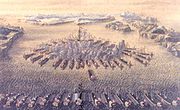
Great Northern War
The Great Northern War was a conflict in which a coalition led by the Tsardom of Russia successfully contested the supremacy of the Swedish Empire in northern Central Europe and Eastern Europe. The initial leaders of the anti-Swedish alliance were Peter I the Great of Russia, Frederick IV of...
, the Baltic Fleet assisted in taking Viborg, Tallinn
Tallinn
Tallinn is the capital and largest city of Estonia. It occupies an area of with a population of 414,940. It is situated on the northern coast of the country, on the banks of the Gulf of Finland, south of Helsinki, east of Stockholm and west of Saint Petersburg. Tallinn's Old Town is in the list...
, Riga
Riga
Riga is the capital and largest city of Latvia. With 702,891 inhabitants Riga is the largest city of the Baltic states, one of the largest cities in Northern Europe and home to more than one third of Latvia's population. The city is an important seaport and a major industrial, commercial,...
, the West Estonian archipelago (Moonsund archipelago), Helsinki
Helsinki
Helsinki is the capital and largest city in Finland. It is in the region of Uusimaa, located in southern Finland, on the shore of the Gulf of Finland, an arm of the Baltic Sea. The population of the city of Helsinki is , making it by far the most populous municipality in Finland. Helsinki is...
, and Turku
Turku
Turku is a city situated on the southwest coast of Finland at the mouth of the Aura River. It is located in the region of Finland Proper. It is believed that Turku came into existence during the end of the 13th century which makes it the oldest city in Finland...
. The first claimed victories of the Russian Navy were the Gangut
Battle of Gangut
The Battle of Gangut took place on July 27Jul./ August 7, 1714Greg. during the Great Northern War , in the waters of Riilahti Bay, north of the Hanko Peninsula, near the site of the modern-day city of Hanko, Finland, between the Swedish Navy and Imperial Russian Navy...
(Swedish: Hangöudd) in 1714 and, arguably, the Grengam
Battle of Grengam
The Battle of Grengam of 1720 was the last major naval battle in the Great Northern War that took place in the Åland Islands, in the Ledsund strait between the island communities of Föglö and Lemland. The battle marked the end of Russian and Swedish offensive naval operations in Baltic waters...
(Swedish: Ledsund) in 1720. From 1715, the Royal Navy intervened in the Baltic Sea on behalf of Hanover
Hanover
Hanover or Hannover, on the river Leine, is the capital of the federal state of Lower Saxony , Germany and was once by personal union the family seat of the Hanoverian Kings of Great Britain, under their title as the dukes of Brunswick-Lüneburg...
and more or less in a tacit alliance with Russia. During the concluding stages of the war, the Russian fleet would land troops along the Swedish coast to devastate coastal settlements. However, after the death of Charles XII, the Royal Navy would rather protect Swedish interests after a rapprochement between Sweden and George I
George I of Great Britain
George I was King of Great Britain and Ireland from 1 August 1714 until his death, and ruler of the Duchy and Electorate of Brunswick-Lüneburg in the Holy Roman Empire from 1698....
. A Russian attempt to reach Stockholm
Stockholm
Stockholm is the capital and the largest city of Sweden and constitutes the most populated urban area in Scandinavia. Stockholm is the most populous city in Sweden, with a population of 851,155 in the municipality , 1.37 million in the urban area , and around 2.1 million in the metropolitan area...
was checked at the Battle of Stäket
Battle of Stäket
The Battle of Stäket was a minor battle during the Great Northern War. A probing Russian force, circumventing Vaxholm Castle, attempted to pass through Baggensstäket, a very narrow passage in the Stockholm archipelago...
in 1719. The losses suffered by the Russian Navy at the Grengam
Battle of Grengam
The Battle of Grengam of 1720 was the last major naval battle in the Great Northern War that took place in the Åland Islands, in the Ledsund strait between the island communities of Föglö and Lemland. The battle marked the end of Russian and Swedish offensive naval operations in Baltic waters...
in 1720, as well as the arrival of a Royal Navy squadron under admiral John Norris, also prevented further operations of any greater scale before the war ended in 1721.
During the Seven Years' War
Seven Years' War
The Seven Years' War was a global military war between 1756 and 1763, involving most of the great powers of the time and affecting Europe, North America, Central America, the West African coast, India, and the Philippines...
, the Russian Baltic Sea fleet was active on the Pomeranian coast
Pomerania
Pomerania is a historical region on the south shore of the Baltic Sea. Divided between Germany and Poland, it stretches roughly from the Recknitz River near Stralsund in the West, via the Oder River delta near Szczecin, to the mouth of the Vistula River near Gdańsk in the East...
, helping the infantry to take Memel
Klaipeda
Klaipėda is a city in Lithuania situated at the mouth of the Nemunas River where it flows into the Baltic Sea. It is the third largest city in Lithuania and the capital of Klaipėda County....
in 1757 and Kolberg in 1761. The Oresund
Oresund
The Sound , is the strait that separates the Danish island Zealand from the southern Swedish province of Scania. Its width is just at the narrowest point between Helsingør, Denmark, and Helsingborg, Sweden...
was blockaded in order to prevent the British Navy from entering the Baltic sea. During Catherine II's Swedish War the fleet, commanded by Samuel Greig
Samuel Greig
Samuel Greig, or Samuil Karlovich Greig , as he was known in Russia - Scottish-born Russian admiral who distinguished himself in the Battle of Chesma and the Battle of Hogland...
, checked the Swedes at Hogland
Battle of Hogland
The naval Battle of Hogland took place on 17 July 1788 during the Russo-Swedish War .-Origins:On the outbreak of war with Russia in 1788, Sweden planned to attack the Russian capital St. Petersburg...
(1788) and the Viborg (1790). An impetuous Russian attack on the Swedish galley flotilla on the July 9, 1790 at the Second Battle of Svensksund resulted in a disaster for the Russian Navy who lost some 9,500 out of 14,000 men and about one third of their flotilla. The Russian defeat in this battle effectively ended the war.
During the Russo-Turkish Wars the fleet sailed into the Mediterranean and destroyed the Ottoman Navy at Chesma
Battle of Chesma
The naval Battle of Chesma took place on 5 -7 July 1770 near and in Çeşme Bay, in the area between the western tip of Anatolia and the island of Chios, which was the site of a number of past naval battles between the Ottoman Empire and the Republic of Venice...
(1770), the Dardanelles
Battle of the Dardanelles (1807)
The naval Battle of the Dardanelles took place on 10–11 May 1807 during the Russo-Turkish War . It was fought between the Russian and Ottoman navies near the Dardanelles Strait....
(1807), the Athos
Battle of Athos
The naval Battle of Mount Athos took place from 19–22 June 1807 and was a key naval battle of the Russo-Turkish War...
(1807), and the Navarino
Battle of Navarino
The naval Battle of Navarino was fought on 20 October 1827, during the Greek War of Independence in Navarino Bay , on the west coast of the Peloponnese peninsula, in the Ionian Sea. A combined Ottoman and Egyptian armada was destroyed by a combined British, French and Russian naval force...
(1827). At about the same time, Ivan Krusenstern circumnavigated the globe, while another Baltic Fleet officer — Fabian Gottlieb von Bellingshausen
Fabian Gottlieb von Bellingshausen
Fabian Gottlieb Thaddeus von Bellingshausen was an officer in the Imperial Russian Navy, cartographer and explorer, who ultimately rose to the rank of Admiral...
— discovered Antarctica.
In the Crimean War
Crimean War
The Crimean War was a conflict fought between the Russian Empire and an alliance of the French Empire, the British Empire, the Ottoman Empire, and the Kingdom of Sardinia. The war was part of a long-running contest between the major European powers for influence over territories of the declining...
, the fleet — although stymied in its operations by the absence of steamships — prevented the Allies from occupying Hangö, Sveaborg, and Saint Petersburg
Saint Petersburg
Saint Petersburg is a city and a federal subject of Russia located on the Neva River at the head of the Gulf of Finland on the Baltic Sea...
. Despite being greatly outnumbered by the technologically superior Allies, it was the Russian Fleet that introduced into naval warfare such novelties as torpedo mines, invented by Boris Yakobi. Other outstanding inventors who served in the Baltic Fleet were Alexander Stepanovich Popov
Alexander Stepanovich Popov
Alexander Stepanovich Popov was a Russian physicist who was the first person to demonstrate the practical application of electromagnetic waves....
(who was the first to demonstrate the practical application of electromagnetic (radio
Radio
Radio is the transmission of signals through free space by modulation of electromagnetic waves with frequencies below those of visible light. Electromagnetic radiation travels by means of oscillating electromagnetic fields that pass through the air and the vacuum of space...
) waves), Stepan Makarov
Stepan Makarov
Stepan Osipovich Makarov was a Ukrainian - born Russian vice-admiral, a highly accomplished and decorated commander of the Imperial Russian Navy, an oceanographer, awarded by the Russian Academy of Sciences, and author of several books. Makarov also designed a small number of ships...
(the first to launch torpedo
Torpedo
The modern torpedo is a self-propelled missile weapon with an explosive warhead, launched above or below the water surface, propelled underwater towards a target, and designed to detonate either on contact with it or in proximity to it.The term torpedo was originally employed for...
es from a boat), Alexei Krylov
Alexei Krylov
Aleksey Nikolaevich Krylov was a Russian naval engineer, applied mathematician and memoirist.-Biography:Alexei Nikolaevich Krylov was born on August 3 O.S., 1863 to the family of an Army Artillery officer in a village Akhmatovo near town Alatyr of the Simbirsk Gubernia in Russia...
(author of the modern ship floodability
Ship floodability
Floodability is a characteristic of the construction of a ship to resist flooding.Floodability is achieved by dividing the volume of the hull into watertight compartments with decks and bulkheads , use of double bottom, and by other means.Watertight bulkhead compartments were written of by the Song...
theory), and Alexander Mozhaiski (co-inventor of aircraft
Aircraft
An aircraft is a vehicle that is able to fly by gaining support from the air, or, in general, the atmosphere of a planet. An aircraft counters the force of gravity by using either static lift or by using the dynamic lift of an airfoil, or in a few cases the downward thrust from jet engines.Although...
).
Age of iron
As early as 1861, first armor-clad ships were built for the Baltic Fleet. In 1863, during the American Civil WarAmerican Civil War
The American Civil War was a civil war fought in the United States of America. In response to the election of Abraham Lincoln as President of the United States, 11 southern slave states declared their secession from the United States and formed the Confederate States of America ; the other 25...
, most of the fleet's ocean-going ships, including the flagship Alexander Nevsky were sent to New York
New York City
New York is the most populous city in the United States and the center of the New York Metropolitan Area, one of the most populous metropolitan areas in the world. New York exerts a significant impact upon global commerce, finance, media, art, fashion, research, technology, education, and...
. At the same time ten Uragan class monitor
Uragan class monitor
The Uragan class was a class of monitors built for the Baltic Fleet of the Imperial Russian Navy. The ships were built to the plans of the American Passaic-class monitors, a design that was tested on a smaller scale on the USS Monitor...
s based on an American design were launched. In 1869 the fleet commissioned the first turret
Turret
In architecture, a turret is a small tower that projects vertically from the wall of a building such as a medieval castle. Turrets were used to provide a projecting defensive position allowing covering fire to the adjacent wall in the days of military fortification...
battleship in the world - Pyotr Velikiy. Furthermore, in the second half of the 19th and early 20th century a strong network of coastal artillery
Coastal artillery
Coastal artillery is the branch of armed forces concerned with operating anti-ship artillery or fixed gun batteries in coastal fortifications....
batteries was created to cover the approaches to St. Petersburg, Riga
Riga
Riga is the capital and largest city of Latvia. With 702,891 inhabitants Riga is the largest city of the Baltic states, one of the largest cities in Northern Europe and home to more than one third of Latvia's population. The city is an important seaport and a major industrial, commercial,...
, and other important bases.
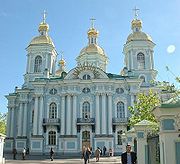
Russo-Japanese War
The Russo-Japanese War was "the first great war of the 20th century." It grew out of rival imperial ambitions of the Russian Empire and Japanese Empire over Manchuria and Korea...
. In September 1904, a squadron under the command of Admiral Zinovy Rozhestvensky
Zinovy Rozhestvensky
Zinovy Petrovich Rozhestvensky was an admiral of the Imperial Russian Navy. He was in command of the Second Pacific Squadron in the Battle of Tsushima, during the Russo-Japanese War....
was sent around Africa
Africa
Africa is the world's second largest and second most populous continent, after Asia. At about 30.2 million km² including adjacent islands, it covers 6% of the Earth's total surface area and 20.4% of the total land area...
- stopping in French, German and Portuguese colonial ports Tangier
Tangier
Tangier, also Tangiers is a city in northern Morocco with a population of about 700,000 . It lies on the North African coast at the western entrance to the Strait of Gibraltar where the Mediterranean meets the Atlantic Ocean off Cape Spartel...
, Dakar
Dakar
Dakar is the capital city and largest city of Senegal. It is located on the Cap-Vert Peninsula on the Atlantic coast and is the westernmost city on the African mainland...
, Gabon
Gabon
Gabon , officially the Gabonese Republic is a state in west central Africa sharing borders with Equatorial Guinea to the northwest, Cameroon to the north, and with the Republic of the Congo curving around the east and south. The Gulf of Guinea, an arm of the Atlantic Ocean is to the west...
, Baía dos Tigres
Baia dos Tigres
Baia dos Tigres is the largest island of Angola. It is situated in the Namibe Province. Its area is 98 km²....
, Angra Pequeña
Angra Pequena
Angra Pequena was a small coastal area in what is now known as Lüderitz, Namibia.First discovered by Europeans in 1487 by the Portuguese explorer Bartolomeu Dias. On April 10, 1883 Heinrich Vogelsang first landed at Angra Pequena...
, and Nossi Be (Madagascar
Madagascar
The Republic of Madagascar is an island country located in the Indian Ocean off the southeastern coast of Africa...
), then across the Indian Ocean
Indian Ocean
The Indian Ocean is the third largest of the world's oceanic divisions, covering approximately 20% of the water on the Earth's surface. It is bounded on the north by the Indian Subcontinent and Arabian Peninsula ; on the west by eastern Africa; on the east by Indochina, the Sunda Islands, and...
to Cam Ranh Bay
Cam Ranh Bay
Cam Ranh Bay is a deep-water bay in Vietnam in the province of Khánh Hòa. It is located at an inlet of the South China Sea situated on the southeastern coast of Vietnam, between Phan Rang and Nha Trang, approximately 290 kilometers / 180 miles northeast of Hồ Chí Minh City / Saigon.Cam Ranh is...
in French Indochina and then northward to its doomed encounter with the Japanese fleet at the Battle of Tsushima
Battle of Tsushima
The Battle of Tsushima , commonly known as the “Sea of Japan Naval Battle” in Japan and the “Battle of Tsushima Strait”, was the major naval battle fought between Russia and Japan during the Russo-Japanese War...
. The German Hamburg-Amerika Line provided 60 colliers to supply the Baltic Fleet on its epic journey. During its passage through the North Sea the fleet mistook a fleet of British fishing boats for Japanese torpedo boats and opened fire, killing three sailors in what is known as the Dogger Bank incident
Dogger Bank incident
The Dogger Bank incident occurred when the Russian Baltic Fleet mistook some British trawlers at Dogger Bank for an Imperial Japanese Navy force....
. The decision to send the fleet to the Pacific was made after Russia had suffered a string of defeats at the hands of the Japanese Army in Manchuria
Manchuria
Manchuria is a historical name given to a large geographic region in northeast Asia. Depending on the definition of its extent, Manchuria usually falls entirely within the People's Republic of China, or is sometimes divided between China and Russia. The region is commonly referred to as Northeast...
. This historic naval battle broke Russian strength in East Asia
East Asia
East Asia or Eastern Asia is a subregion of Asia that can be defined in either geographical or cultural terms...
and set the stage for the unsuccessful Russian Revolution of 1905
Russian Revolution of 1905
The 1905 Russian Revolution was a wave of mass political and social unrest that spread through vast areas of the Russian Empire. Some of it was directed against the government, while some was undirected. It included worker strikes, peasant unrest, and military mutinies...
, which began the decline that would see the monarchy brought down in 1917.
World War I
Following the catastrophic losses in battleships during the Russo-Japanese war, Russia embarked on a new naval building program which was to incorporate a number of the most modern dreadnoughtHMS Dreadnought (1906)
HMS Dreadnought was a battleship of the British Royal Navy that revolutionised naval power. Her entry into service in 1906 represented such a marked advance in naval technology that her name came to be associated with an entire generation of battleships, the "dreadnoughts", as well as the class of...
-type battleship
Battleship
A battleship is a large armored warship with a main battery consisting of heavy caliber guns. Battleships were larger, better armed and armored than cruisers and destroyers. As the largest armed ships in a fleet, battleships were used to attain command of the sea and represented the apex of a...
s into the fleet. In late 1914, four dreadnoughts of the Gangut class
Gangut class battleship
The Gangut-class battleships were the first dreadnoughts begun for the Imperial Russian Navy before World War I. They had a convoluted design history involving several British companies, evolving requirements, an international design competition, and foreign protests...
entered service with the fleet: ; ; ; and . Four more powerful battlecruisers of the Borodino class
Borodino class battlecruiser
The Borodino class battlecruisers were a group of four battlecruisers ordered by the Imperial Russian Navy before World War I. Also referred to as the Izmail class, they were laid down in December 1912All dates used in this article are New Style . at Saint Petersburg for service with the Baltic...
were under construction, but were never completed. The Fleet's main operation during World War I
World War I
World War I , which was predominantly called the World War or the Great War from its occurrence until 1939, and the First World War or World War I thereafter, was a major war centred in Europe that began on 28 July 1914 and lasted until 11 November 1918...
was the Ice Cruise of the Baltic Fleet
Ice Cruise of the Baltic Fleet
Ice Cruise of the Baltic Fleet was an operation which transferred the ships of the Baltic Fleet of the Imperial Russian Navy from their bases at Tallinn and Helsinki to Kronstadt in 1918, caused by the possible threat to those bases from the final German offensives against Russia during World War...
(1918), led by Alexander Zelenoy
Alexander Zelenoy
Alexander Pavlovich Zelenoy was a Russian and Soviet naval commander. Graduated in naval college, participated in World War I. A rear-admiral, the head of mine defence on the Baltic sea and the head of the Staff of the Baltic Fleet in 1917. Famous for being one of the commanders of the Ice Cruise...
. However, on the whole the heavy units of the fleet remained in port during the war, as the German superiority in battleships was overwhelming.
The fleet operated 355 ton submarines made by Electric Boat Co. in the United States
United States
The United States of America is a federal constitutional republic comprising fifty states and a federal district...
. Four of these submarines, AG 11, AG 12, AG 15 and AG 16 were scuttled in the harbour of Hanko on April 3, 1918, just before the 10,000-strong German Baltic Sea Division
Baltic Sea Division
The Baltic Sea Division was a 10,000 man German military unit commanded by Rüdiger von der Goltz. During the Finnish Civil War, in April 1918, it landed at Hanko and moved towards Helsinki and Lahti. The Baltic Sea Division quickly took back Helsinki from the Social Democrats of Finland, who had...
landed in support of the Whites
White movement
The White movement and its military arm the White Army - known as the White Guard or the Whites - was a loose confederation of Anti-Communist forces.The movement comprised one of the politico-military Russian forces who fought...
in the Finnish Civil War
Finnish Civil War
The Finnish Civil War was a part of the national, political and social turmoil caused by World War I in Europe. The Civil War concerned control and leadership of The Grand Duchy of Finland as it achieved independence from Russia after the October Revolution in Petrograd...
. During the war the fleet was aided by a detachment of British submarines
British submarine flotilla in the Baltic
A British submarine flotilla operated in the Baltic Sea for three years during the First World War. The squadron of nine submarines was attached to the Russian Baltic Fleet. The main task of the flotilla was to prevent the import of iron ore from Sweden to Imperial Germany...
. These subs were scuttled by their crews near the Harmaja
Harmaja
Harmaja is an island and a lighthouse outside Helsinki, south of the Suomenlinna sea fortress. The island has been functioning as a landmark since the 16th century. A landmark structure was built on the island in the 18th century and a light house in 1883. The first lighthouse was only 7.3 m high...
lighthouse outside Helsinki
Helsinki
Helsinki is the capital and largest city in Finland. It is in the region of Uusimaa, located in southern Finland, on the shore of the Gulf of Finland, an arm of the Baltic Sea. The population of the city of Helsinki is , making it by far the most populous municipality in Finland. Helsinki is...
on April 4, 1918.
Soviet era
During the October RevolutionOctober Revolution
The October Revolution , also known as the Great October Socialist Revolution , Red October, the October Uprising or the Bolshevik Revolution, was a political revolution and a part of the Russian Revolution of 1917...
the sailors of the Baltic Fleet (renamed "Naval Forces of the Baltic Sea" in March 1918) were among the most ardent supporters of Bolsheviks, and formed an elite among Red military forces. Some ships of the fleet took part in the Russian Civil War
Russian Civil War
The Russian Civil War was a multi-party war that occurred within the former Russian Empire after the Russian provisional government collapsed to the Soviets, under the domination of the Bolshevik party. Soviet forces first assumed power in Petrograd The Russian Civil War (1917–1923) was a...
, notably by clashing with the British navy operating in the Baltic as part of intervention forces
Allied Intervention in the Russian Civil War
The Allied intervention was a multi-national military expedition launched in 1918 during World War I which continued into the Russian Civil War. Its operations included forces from 14 nations and were conducted over a vast territory...
. Over the years, however, the relations of the Baltic Fleet sailors with the Bolshevik regime soured, and they eventually rebelled against the Soviet government in the Kronstadt rebellion
Kronstadt rebellion
The Kronstadt rebellion was one of many major unsuccessful left-wing uprisings against the Bolsheviks in the aftermath of the Russian Civil War...
in 1921, but were defeated.
The Fleet, renamed Red-Banner Baltic Fleet on the 11 January 1935, was developed further during the Soviet years, initially relying on tsarist warships, but adding modern units built in Soviet yards from 1930s onwards. Among the Fleet's Soviet commanders were Gordey Levchenko
Gordey Levchenko
Gordey Ivanovich Levchenko was a Soviet naval commander and admiral from 1944.Born in Ukraine, a part of the Russian Empire, in 1897, Levchenko joined the Imperial Russian Navy in 1913 and participated in World War I...
in 1938-39 and Arseniy Golovko
Arseniy Golovko
Arseniy Grigoriyevich Golovko was a Soviet admiral, whose naval service extended from the 1920s through the early Cold War....
in 1952-56. Ships and submarines commissioned
Ship commissioning
Ship commissioning is the act or ceremony of placing a ship in active service, and may be regarded as a particular application of the general concepts and practices of project commissioning. The term is most commonly applied to the placing of a warship in active duty with its country's military...
to the fleet included Soviet submarine M-256
Soviet submarine M-256
M-256 was a Project 615 short-range, diesel attack submarine of the Soviet Navy. She was commissioned into the Baltic Fleet.-Design:...
, a Project 615 short-range attack diesel
Diesel engine
A diesel engine is an internal combustion engine that uses the heat of compression to initiate ignition to burn the fuel, which is injected into the combustion chamber...
submarine
Submarine
A submarine is a watercraft capable of independent operation below the surface of the water. It differs from a submersible, which has more limited underwater capability...
of the Soviet Navy
Soviet Navy
The Soviet Navy was the naval arm of the Soviet Armed Forces. Often referred to as the Red Fleet, the Soviet Navy would have played an instrumental role in a Warsaw Pact war with NATO, where it would have attempted to prevent naval convoys from bringing reinforcements across the Atlantic Ocean...
. The fleet also acquired a large number of ground-based aircraft to form a strong naval aviation
Naval aviation
Naval aviation is the application of manned military air power by navies, including ships that embark fixed-wing aircraft or helicopters. In contrast, maritime aviation is the operation of aircraft in a maritime role under the command of non-naval forces such as the former RAF Coastal Command or a...
force.
Baltic pacts of mutual assistance and subsequent invasion
In September 1939, the fleet threatened the Baltic states as part of a series of military actions staged to encourage the Baltics to accept Soviet offers of "mutual assistance." Subsequently, in June 1940, the fleet blockaded the Baltics in support of the Soviet invasion.Winter War
Finland, which had refused to sign a "pact of mutual assistance", was attacked by the USSR. The fleet played a limited role in the Winter WarWinter War
The Winter War was a military conflict between the Soviet Union and Finland. It began with a Soviet offensive on 30 November 1939 – three months after the start of World War II and the Soviet invasion of Poland – and ended on 13 March 1940 with the Moscow Peace Treaty...
with Finland
Finland
Finland , officially the Republic of Finland, is a Nordic country situated in the Fennoscandian region of Northern Europe. It is bordered by Sweden in the west, Norway in the north and Russia in the east, while Estonia lies to its south across the Gulf of Finland.Around 5.4 million people reside...
in 1939-1940, mostly through conducting artillery bombardments of Finnish coastal fortifications. Many fleet aircraft were involved in operations against Finland, however. Its operations came to a close with the freezing of the Gulf of Finland during the exceptionally cold winter of that year.
World War II
In the beginning of the German invasioonEastern Front (World War II)
The Eastern Front of World War II was a theatre of World War II between the European Axis powers and co-belligerent Finland against the Soviet Union, Poland, and some other Allies which encompassed Northern, Southern and Eastern Europe from 22 June 1941 to 9 May 1945...
the Baltic Fleet had 2 battleship
Battleship
A battleship is a large armored warship with a main battery consisting of heavy caliber guns. Battleships were larger, better armed and armored than cruisers and destroyers. As the largest armed ships in a fleet, battleships were used to attain command of the sea and represented the apex of a...
s, 2 cruiser
Cruiser
A cruiser is a type of warship. The term has been in use for several hundreds of years, and has had different meanings throughout this period...
s, 2 flotilla leader
Flotilla leader
A flotilla leader was a warship suitable for commanding a flotilla of destroyers or other small warships, typically a small cruiser or a large destroyer...
s, 19 destroyer
Destroyer
In naval terminology, a destroyer is a fast and maneuverable yet long-endurance warship intended to escort larger vessels in a fleet, convoy or battle group and defend them against smaller, powerful, short-range attackers. Destroyers, originally called torpedo-boat destroyers in 1892, evolved from...
s, 48 MTB
Motor Torpedo Boat
Motor Torpedo Boat was the name given to fast torpedo boats by the Royal Navy, and the Royal Canadian Navy.The capitalised term is generally used for the Royal Navy boats and abbreviated to "MTB"...
s, 65 submarine
Submarine
A submarine is a watercraft capable of independent operation below the surface of the water. It differs from a submersible, which has more limited underwater capability...
s and other ships, and 656 aircraft. During the war the Fleet, commanded by the vice-admiral Vladimir Tributz
Vladimir Tributz
Vladimir Filippovich Tributs was a Soviet naval commander and admiral from 1943.Tributs joined the Navy in 1918 and during the Russian Civil War participated in combat actions on the Volga and in the Caspian. Graduated and received his commission from M.V. Frunze Higher Naval School in 1926 and...
, defended the Hanko Peninsula
Hanko Peninsula
The Hanko Peninsula , also spelled Hango, is the southernmost point of mainland Finland. The soil is a sandy moraine, the last tip of the Salpausselkä ridge, and vegetation consists mainly of pine and low shrubs...
, Tallinn
Tallinn
Tallinn is the capital and largest city of Estonia. It occupies an area of with a population of 414,940. It is situated on the northern coast of the country, on the banks of the Gulf of Finland, south of Helsinki, east of Stockholm and west of Saint Petersburg. Tallinn's Old Town is in the list...
, several islands in Estonian SSR, participated in the break through breach of the Siege of Leningrad
Siege of Leningrad
The Siege of Leningrad, also known as the Leningrad Blockade was a prolonged military operation resulting from the failure of the German Army Group North to capture Leningrad, now known as Saint Petersburg, in the Eastern Front theatre of World War II. It started on 8 September 1941, when the last...
, etc. 137 sailors of the Baltic Fleet were awarded a title of the Hero of the Soviet Union
Hero of the Soviet Union
The title Hero of the Soviet Union was the highest distinction in the Soviet Union, awarded personally or collectively for heroic feats in service to the Soviet state and society.-Overview:...
. However, for most of the war the fleet was trapped by German and Finnish minefields in Leningrad and nearby Kronstadt, the only bases left in Soviet hands on the Baltic coast. Another key factor was that the Finns had recaptured outer islands of the Gulf of Finland, Suursaari being the most important of them. Many of the fleet sailors fought on land as infantry during the siege. Only submarines could risk the passage into the open sea to strike at German shipping. They were particularly successful towards the end of the war, sinking ships like Wilhelm Gustloff
Wilhelm Gustloff (ship)
The MV Wilhelm Gustloff was a German KdF flagship during 1937-1945, constructed by the Blohm & Voss shipyards. It sank after being torpedoed by the Soviet submarine on 30 January 1945....
, Steuben
Dampfschiff General von Steuben
SS General von Steuben was a German luxury passenger liner. She was launched as the München , renamed in 1930 as the General von Steuben , and renamed again in 1938 as Steuben...
and Goya
Goya (ship)
The Goya was a German transport ship sunk by a Soviet submarine in the Baltic Sea, near the end of the Second World War, while carrying wounded Wehrmacht troops and civilians who were fleeing the advance of Soviet forces. Most of the crew and passengers died...
, causing great loss of life.
The Fleet carried out the Soviet evacuation of Tallinn in late August 1941. See also Baltic Sea Campaigns (1939-1945) for more details.
Grouping in June 1941
- Battleship squadron
- battleship MaratBattleship Petropavlovsk (1914)The Russian battleship Petropavlovsk was the third of the four dreadnoughts, the first Russian class of dreadnoughts, built before World War I. She was named after the Russian victory over the British and the French in the Siege of Petropavlovsk in 1854. The ship was completed during the winter...
(named after Jean-Paul MaratJean-Paul MaratJean-Paul Marat , born in the Principality of Neuchâtel, was a physician, political theorist, and scientist best known for his career in France as a radical journalist and politician during the French Revolution...
) - battleship Oktyabrskaya Revolutsiya (named after October revolution)
- battleship Leningrad (named after the city of LeningradLeningradLeningrad is the former name of Saint Petersburg, Russia.Leningrad may also refer to:- Places :* Leningrad Oblast, a federal subject of Russia, around Saint Petersburg* Leningrad, Tajikistan, capital of Muminobod district in Khatlon Province...
) - battleship Minsk (named after the capital of BelarusBelarusBelarus , officially the Republic of Belarus, is a landlocked country in Eastern Europe, bordered clockwise by Russia to the northeast, Ukraine to the south, Poland to the west, and Lithuania and Latvia to the northwest. Its capital is Minsk; other major cities include Brest, Grodno , Gomel ,...
)
- battleship Marat
- 1st destroyer division/1 Flotilla
- cruiser KirovSoviet cruiser KirovKirov was a Project 26 of the Soviet Navy that served during the Winter War, World War II and into the Cold War. She attempted to bombard Finnish coast defense guns during action in the Winter War, but was driven off by a number of near misses that damaged her...
- destroyer GnevnyiGnevny class destroyerThe Gnevny class were a group of destroyers built for the Soviet Navy in the late 1930s - early 1940s. They are sometimes known as the Gremyashchiy class destroyer and the Official Soviet Designation was Project 7...
- destroyer GordyyGnevny class destroyerThe Gnevny class were a group of destroyers built for the Soviet Navy in the late 1930s - early 1940s. They are sometimes known as the Gremyashchiy class destroyer and the Official Soviet Designation was Project 7...
- destroyer GrozyashchiyGnevny class destroyerThe Gnevny class were a group of destroyers built for the Soviet Navy in the late 1930s - early 1940s. They are sometimes known as the Gremyashchiy class destroyer and the Official Soviet Designation was Project 7...
- destroyer Smetlivyi
- destroyer Steregushchy
- cruiser Kirov
- 2nd destroyer division/2 Flotilla
- Serdityy
- Silnyi
- Stoikiy
- Storozhevoy
- 3rd destroyer division/3 Flotilla
- Karl Marx
- Volodarsky
- Lenin
- Yakov SverdlovSoviet destroyer Yakov SverdlovYakov Sverdlov was a destroyer of the Soviet Navy that served in the Baltic Fleet during World War I and World War II. Originally known as Novík, she was renamed Yakov Sverdlov in 1923. She was a training ship when Operation Barbarossa began, but was recalled to active duty the following day...
- Artiom
- Engels
- Kalinin
- Guard division/Naval Guards Squadron
- Burya
- Sneg
- Taifun
- Tsiklon
- Tucha
- Vihr
- Minesweeper Task Group
- minesweeper T201T201T201's, also known as Mecca Double Folders, were a type of tobacco trading card. They were issued in 1911 by the Mecca cigarette company, and featured color drawings of professional baseball players. The ‘T201’ designation comes from the American Card Catalogue, an authoritative guide to trading...
, T201T201T201's, also known as Mecca Double Folders, were a type of tobacco trading card. They were issued in 1911 by the Mecca cigarette company, and featured color drawings of professional baseball players. The ‘T201’ designation comes from the American Card Catalogue, an authoritative guide to trading...
, T203, T204, T205T205The tobacco card set known as T205 was issued in 1911 in cigarette and loose tobacco packs through 11 different brands owned by the American Tobacco Company. It is a landmark set in the history of baseball card collecting.- History :...
, T206T206The tobacco card set known as T206 was issued from 1909 to 1911 in cigarette and loose tobacco packs through 16 different brands owned by the American Tobacco Company...
, T207, T208, T209, T210, T211, T212, T213T213The tobacco card sets known as T213 were issued between 1910 and 1919 in cigarette packs through Coupon Cigarettes.T213 refers to the catalog designation assigned by Jefferson Burdick in his book The American Card Catalog...
, T214, T215, T216, T217 and T218 - 15 auxiliary minesweepers
- minesweeper T201
- 1st submarine brigade/1 Submarine Battle Fleet
- S1, S3, S4, S5, S6, S7, S8, S9, S10, S101, S102, L3Soviet submarine L-3The World War II Soviet submarine L-3 belonged to the L-class or Leninets class of minelayer submarines. It had been named Bolshevik and later Frunzenets, before it was decided that submarines should stop having names and carry numbers instead....
,. M71, M77, M78, M79, M80, M81, M83, ex-Estonian submarine Lembit, ex-Estonian submarine KalevKalev class submarineThe Kalev Class consisted of two mine laying submarines built for the Estonian Navy.-Development history:The newly independent Republic of Estonia followed the Finnish naval armament program and the common top secret defense cooperation in acquiring submarines. Unlike the German designed Finnish...
, ex-Latvian submarine Ronis, ex-Latvian submarine Spidola
- S1, S3, S4, S5, S6, S7, S8, S9, S10, S101, S102, L3
- 2nd submarine brigade/2 Submarine Battle Fleet
- SC309, SC310, SC311, SC317, SC318, SC319, SC320, SC322, SC323, SC324, M90, M94, M95, M96, M97, M98, M99, M102, M103
- support vessels
- Polyarnaya Zvezda (Polar Star)
- Oka (named after the river of OkaOka RiverOka is a river in central Russia, the largest right tributary of the Volga. It flows through the regions of Oryol, Tula, Kaluga, Moscow, Ryazan, Vladimir, and Nizhny Novgorod and is navigable over a large part of its total length, as far upstream as to the town of Kaluga. Its length exceeds...
)
- Training Task Group of the Navy
- M72, M73, M74, M75, M76, SC303, SC304, K3, K21, K22, K23, L1, L2, S11, S12, SC405, SC406
- Training Task Group
- SC301, SC302, SC305, SC306, SC307, SC308, P1, P2, P3
Cold War
During the Immediate post-war period the importance of the Red-Banner Baltic Fleet increased despite the Baltic being a shallow sea with the exits easily becoming choke points by other countries. The Baltic Fleet was increased to two Fleets, the 4th Red-Banner Baltic Fleet and the 8th Red-Banner Baltic Fleet on 15 February 1946. However during the post-Stalinist period and general reforms and downsizing in the Soviet Armed Forces the two fleets of the Baltic were again reduced, with many vessels, some built before the Revolution, were scrapped, and the Fleet was again renamed Red-Banner Baltic Fleet on the 24 December 1955.In Liepāja the Baltic Fleet's 14th submarine squadron, call sign "Kompleks" ("Комплекс") was stationed with 16 submarines (613
Whiskey class submarine
Whiskey-class submarines are a class of naval submarines that the Soviet Union built in the early Cold War period.-Design:...
, 629a
Golf class submarine
Project 629, also known by the NATO reporting name of Golf class, were diesel electric ballistic missile submarines of the Soviet Navy. They were designed after six Zulu class submarines were successfully modified to carry and launch Scud missiles...
, 651
Juliett class submarine
The Project 651, known in the West by its NATO reporting name Juliett class, was a class of Soviet diesel-electric submarines armed with cruise missiles. They were designed in the late 1950s to provide the Soviet Navy with a nuclear strike capability against targets along the east coast of the...
); as was the 6th group of rear supply of Baltic Fleet, and the 81st design bureau and reserve command center of the same force.
Far from being reduced in importance, operations of the Red-Banner Baltic Fleet during the early-Cold War
Cold War
The Cold War was the continuing state from roughly 1946 to 1991 of political conflict, military tension, proxy wars, and economic competition between the Communist World—primarily the Soviet Union and its satellite states and allies—and the powers of the Western world, primarily the United States...
period earned it a great amount of prestige and profile, with the second awarding of the Order of Red Banner being presented on the 7 May 1965 when the Fleet was again renamed to Twice Red-Banner Baltic Fleet. Although the Soviet Union poured resources into building up the Northern Fleet and the Pacific Fleet, both of which had easy access to the open ocean, the Twice Red-Banner Baltic Fleet assumed the very important position of supporting the northern flank of the European Theatre in case of a confrontation with NATO. This role was under-rated from the blue water navies
Blue-water navy
The term blue-water navy is a colloquialism used to describe a maritime force capable of operating across the deep waters of open oceans. While what actually constitutes such a force remains undefined, there is a requirement for the ability to exercise sea control at wide ranges...
perspective, but was seen as a highly valuable one from the strategic perspective of the Soviet General Staff planning. The Twice Red-Banner Baltic Fleet remained a powerful force, which in the event of war was tasked with conducting amphibious assaults against the coast of Denmark and Germany, in cooperation with allied Polish
Polish Navy
The Marynarka Wojenna Rzeczypospolitej Polskiej - MW RP Polish Navy, is the branch of Republic of Poland Armed Forces responsible for naval operations...
and East German naval forces.
A notable incident involving the fleet occurred in 1975 when a mutiny broke out on the frigate Storozhevoy. There were also numerous allegations by Sweden of Baltic Fleet submarines illegally penetrating its territorial waters.
In October, 1981 the Soviet Whiskey class submarine U 137 ran aground in Swedish territorial waters, near the important naval base of Karlskrona
Karlskrona
Karlskrona is a locality and the seat of Karlskrona Municipality, Blekinge County, Sweden with 35,212 inhabitants in 2010. It is also the capital of Blekinge County. Karlskrona is known as Sweden's only baroque city and is host to Sweden's only remaining naval base and the headquarters of the...
, causing a serious diplomatic incident. Swedish naval vessels pulled the submarine into deeper water and permitted it to return to the Soviet fleet in early November.
Commanders
| Name | Period of command |
|---|---|
| Aleksandr Vladimirovich Razvozov Aleksandr Vladimirovich Razvozov Aleksandr Vladimirovich Razvozov was a Russian and Soviet admiral. He was the first commander of the Soviet Baltic Fleet.Razvozov was born into a Naval family in Reval, Estonia. He graduated from the Sea Cadet Corps in 1989 and first served on the cruiser Gerzog Edinburgski... |
7 July- 5 December 1917 |
| Aleksandr Antonovich Ruzhek | 7 December 1917 - 13 March 1918 |
| Aleksandr Vladimirovich Razvozov | 13–20 March 1918 |
| Aleksey Mikhaylovich Shchastnyy Alexey Schastny Alexey Mikhailovich Schastny was a Russian and Soviet naval commander. he commanded the Baltic Fleet during the ice cruise.Schastny was born into a military family in Zhitomir, Ukraine. His father Mihail Mikhaylovich Schastny, was a major genneral of artillery in the Imperial Russian Army.... |
22 March - 26 May 1918 |
| Sergey Valeryanovich Zarubayev | 27 May 1918 - 18 January 1919 |
| Aleksandr Pavlovich Zelenoy | 18 January 1919 - 2 July 1920 |
| Fedor Fedorovich Raskolnikov Fedor Raskolnikov Fyodor Fyodorovich Raskolnikov , real name Fyodor Ilyin , was a Bolshevik, participant in the October Revolution, commander of Red fleets on the Caspian and the Baltic during the Russian Civil War, and later a Soviet diplomat... |
2 July 1920 - 27 January 1921 |
| Vladimir Andreyevich Kukel (Acting) | 27 January - 3 March 1921 |
| Ivan Kuzmich Kozhanov | 3 March - 4 May 1921 |
| Mikhail Vladimirovich Viktorov Mikhail Viktorov Mikhail Vladimirovich Viktorov was a Russian military leader and Commander-in-Chief of the Soviet Naval Forces from August 1937 to January 1938.... |
4 May 1921 - 6 May 1924 |
| Aleksandr Karlovich Vekman Alexander Vekman Alexander Karlovich Vekman was a Soviet military leader and vice admiral.Alexander Vekman was awarded the Order of Lenin, two Orders of the Red Banner, Order of the Patriotic War , and numerous medals.... |
1924–1926 |
| Mikhail Vladimirovich Viktorov Mikhail Viktorov Mikhail Vladimirovich Viktorov was a Russian military leader and Commander-in-Chief of the Soviet Naval Forces from August 1937 to January 1938.... |
1926–1932 |
| Lev Mikhaylovich Galler Lev Galler Lev Mikhailovich Galler was a Soviet military leader and admiral.Galler was born into a family of a military engineer and joined the Baltic Fleet on completing the Naval school in 1905... |
22 August 1932 - 25 January 1937 |
| Aleksandr Kuzmitch Sivkov | 25 January - 15 August 1937 |
| Ivan Stepanovich Isakov Ivan Isakov Hovhannes Stepani Isakov -Early life:Ivan Isakov was born Hovhannes Ter-Isahakyan in the family of an Armenian railway worker in the village of Hadjikend in the Kars Oblast, then a part of the Russian Empire... |
15 August 1937 - 9 January 1938 |
| Gordey Ivanovich Levchenko Gordey Levchenko Gordey Ivanovich Levchenko was a Soviet naval commander and admiral from 1944.Born in Ukraine, a part of the Russian Empire, in 1897, Levchenko joined the Imperial Russian Navy in 1913 and participated in World War I... |
10 January 1938 - 27 April 1939 |
| Vladimir Filippovich Tributs | 28 April 1939 - 15 February 1946 |
| Arseniy Grigoryevich Golovko Arseniy Golovko Arseniy Grigoriyevich Golovko was a Soviet admiral, whose naval service extended from the 1920s through the early Cold War.... |
27 January - 24 November 1956 |
| Nikolay Mikhaylovich Kharlamov Nikolai Kharlamov Nikolay Mikhaylovich Kharlamov , 1905 - ?) was a Soviet military leader and admiral.Kharlamov was awarded the Order of Lenin, Order of the October Revolution, three Orders of the Red Banner, Order of Ushakov , Order of Nakhimov , Order of the Red Banner of Labour, two Orders of the Red Star, and... |
24 November 1956 - 29 May 1959 |
| Aleksandr Evstafyevich Orel | 29 May 1959 - 27 January 1967 |
| Vladimir Vasilyevich Mikhaylin Vladimir Mikhailin Vladimir Vasilyevich Mikhailin is a Soviet military leader , admiral, and Hero of the Soviet Union .... |
27 January 1967 - 1 September 1975 |
| Anatoliy Mikhaylovich Kosov | 1 September 1975 - 2 June 1978 |
| Vladimir Vasilyevich Sidorov | 2 June 1978 - 12 February 1981 |
| Ivan Matveyevich Kapitanets Ivan Kapitanets Ivan Matveyevich Kapitanets is a retired Soviet Navy Admiral of the FleetKapitanets entered the Navy in 1946 and graduated from the Caspian Higher Naval School in 1950. On gradation he joined the Northern Fleet and served as torpedo officer on the destroyer Okrylenny... |
12 February 1981 - 25 February 1985 |
| Konstantin Valentinovich Makarov Konstantin Makarov Konstantin Valentinovich Makarov was a Soviet Navy Admiral of the Fleet* 1963 - Makarov completed the naval preparatory school* 1949 - Entered the Soviet Navy... |
25 February 1985 - 30 December 1985 |
| Vitaliy Pavlovich Ivanov | 30 December 1985 - December 1991 |
| Vladimir Grigoryevich Yegorov Vladimir Yegorov Vladimir Yegorov was the governor of Kaliningrad Oblast of Russia in 2001-2005. He was Admiral commanding the Baltic Fleet before he became governor. He was born in Moscow in 1938.-Naval Service:... |
13 December 1991 - 2000 |
| Vladimir Prokofyevich Valuyev | 11 April 2001 - May 2006 |
| Konstantin Semenovich Sidenko | May 2006 - 6 December 2007 |
| Viktor Nikolayevich Mardusin (:ru:Мардусин, Виктор Николаевич) | 6 December 2007 - 8 September 2009 |
| Viktor Viktorovich Chirkov | 8 September 2009–present |
Under the Russian Federation
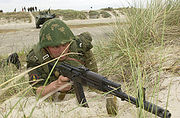
History of the Soviet Union (1985-1991)
The history of the Soviet Union from 1982 through 1991, spans the period from Leonid Brezhnev's death and funeral until the dissolution of the Soviet Union. Due to the years of Soviet military buildup at the expense of domestic development, economic growth stagnated...
of the Soviet Union
Soviet Union
The Soviet Union , officially the Union of Soviet Socialist Republics , was a constitutionally socialist state that existed in Eurasia between 1922 and 1991....
deprived the Fleet of key bases in Latvia
Latvia
Latvia , officially the Republic of Latvia , is a country in the Baltic region of Northern Europe. It is bordered to the north by Estonia , to the south by Lithuania , to the east by the Russian Federation , to the southeast by Belarus and shares maritime borders to the west with Sweden...
, Lithuania
Lithuania
Lithuania , officially the Republic of Lithuania is a country in Northern Europe, the biggest of the three Baltic states. It is situated along the southeastern shore of the Baltic Sea, whereby to the west lie Sweden and Denmark...
, and Estonia
Estonia
Estonia , officially the Republic of Estonia , is a state in the Baltic region of Northern Europe. It is bordered to the north by the Gulf of Finland, to the west by the Baltic Sea, to the south by Latvia , and to the east by Lake Peipsi and the Russian Federation . Across the Baltic Sea lies...
, leaving Kaliningrad Oblast
Kaliningrad Oblast
Kaliningrad Oblast is a federal subject of Russia situated on the Baltic coast. It has a population of The oblast forms the westernmost part of the Russian Federation, but it has no land connection to the rest of Russia. Since its creation it has been an exclave of the Russian SFSR and then the...
as the Fleet's only ice-free
Harbor
A harbor or harbour , or haven, is a place where ships, boats, and barges can seek shelter from stormy weather, or else are stored for future use. Harbors can be natural or artificial...
naval outlet to the Baltic Sea. However, the Kaliningrad Oblast between Poland
Poland
Poland , officially the Republic of Poland , is a country in Central Europe bordered by Germany to the west; the Czech Republic and Slovakia to the south; Ukraine, Belarus and Lithuania to the east; and the Baltic Sea and Kaliningrad Oblast, a Russian exclave, to the north...
and Lithuania
Lithuania
Lithuania , officially the Republic of Lithuania is a country in Northern Europe, the biggest of the three Baltic states. It is situated along the southeastern shore of the Baltic Sea, whereby to the west lie Sweden and Denmark...
is not contiguous with the rest of the national territory of the Russian Federation.
Order of Battle
As of 2008 the Baltic Fleet included about 75 combat ships of various types. The main bases is in BaltiyskBaltiysk
Baltiysk , prior to 1945 known by its German name Pillau , is a seaport town and the administrative center of Baltiysky District of Kaliningrad Oblast, located on the northern part of the Vistula Spit, on the shore of the Strait of Baltiysk separating the Vistula Bay from the Gdańsk Bay. Baltiysk...
and a second operational base is in Kronstadt. The Leningrad Naval Base
Leningrad Naval Base
-History:The Naval base was created on the basis of Order № 117 as of March 15, 1919 of the Baltic Sea Fleet. The Naval Forces of Petrograd were transformed by the order into the Petrograd Naval Base....
is an administrative entity that is not a discrete geographic location but comprises all of the naval institutions and facilities in the St. Petersburg area. Operational forces include:
- Submarines
- 1 Lada class submarineLada class submarineThe Russian Navy's Project 677 Лада is a submarine class designed by the Russian Rubin Design Bureau. The class is also referred to as the Petersburg class, after the lead ship...
- Sankt Peterburg
- 2 Kilo class submarineKilo class submarineThe Kilo class is the NATO reporting name for a naval diesel-electric submarine that is made in Russia. The original version of the vessels were designated Project 877 Paltus in Russia. There is also a more advanced version, designated as Improved Kilo in the west, and Project 636 Varshavyanka in...
s
- 1 Lada class submarine
- Destroyers / Frigates
- 2 Sovremennyy class destroyers, RFS 610 Nastoychivyy (1992) and RFS 620 Bespokoynyy (1991).
- 2 Neustrashimyy class frigates
- Neustrashimyy (Neustrashimyy class frigate. Entered service 1993, reportedly to be transferred to Black Sea Fleet.)
- Yaroslav Mudryy (727) (Neustrashimyy class frigate. Entered service 2009, reportedly to be transferred to Black Sea Fleet.)
- 2 Krivak class frigateKrivak class frigateThe Project 1135 Burevestnik class were a series of frigates built for the Soviet Navy. These ship are commonly known by their NATO reporting name of Krivak and are divided into Krivak-I, Krivak-II, and Krivak-III classes.These ships were designed as a successor to the Riga class...
s
- Corvettes
- 2 Steregushchiy class corvettes - RFS 530 SteregushchiyRussian corvette SteregushchiyThe Steregushchiy is the lead ship of the latest class of corvettes of the Russian Navy, the Steregushchiy class...
(2006) , RFS 531 SoobrazitelnyyRussian corvette SoobrazitelnyyThe Soobrazitelnyy is the second ship of the latest class of corvettes of the Russian Navy, the Steregushchiy class. The ship is being built by the Severnaya Verf shipyard in St.Petersburg and was laid down in May 2003...
(2011) - 5 Nanuchka class corvetteNanuchka class corvetteThe Nanuchka class was the NATO reporting name for a series of corvettes or small missile ships built for the Soviet Navy and export customers between 1969 and 1981. The Soviet designation was Project 1234 Ovod Small Missile Ship. These ships were designed around the P-120 Malakhit anti ship...
s - 8 Parchim class corvetteParchim class corvetteThe Parchim class corvette was developed for the East German Navy in the late 1970s, and built by the Wolgast Peene-Werft. The ships were designed for coastal anti-submarine warfare. In case of an all-out NATO-Warsaw Pact war in Europe their prime targets would have been the small U-206 coastal...
s
- 2 Steregushchiy class corvettes - RFS 530 Steregushchiy
- Amphibious ships
- 4 Ropucha class landing shipRopucha class landing shipThe Ropucha , or Project 775 class landing ships are classified in the Russian Navy as "large landing craft" . They were built in Poland in the Stocznia Północna shipyards, in Gdansk. They are designed for beach landings and can carry a 450 ton cargo...
- 1 Zubr class LCACZubr class LCACThe Zubr class is a class of air-cushioned landing craft of soviet design. This class of military hovercraft is currently, as of 2008, the world’s largest hovercraft. There are currently nine ships in active service in the world. The Zubr is used by the Russian, Ukrainian, and Greek navies...
(RFS 770 Evgeny Kocheshkov) - 2 Ondatra class landing ships
- 1 Serna class landing ship
- 4 Ropucha class landing ship
- Missile / Patrol boats
- 7 Tarantul class corvetteTarantul class corvetteThe Project 1241.1 Molniya are a class of Soviet missile corvettes. They have the NATO reporting name Tarantul...
s - 4 Pauk class corvettePauk class corvetteThe Pauk class is the NATO reporting name for a class of small patrol corvettes built for the Soviet Navy and export customers between 1977 and 1989. The Russian designation is Project 1241.2 Molniya-2. These ships are designed for coastal patrol and inshore anti-submarine warfare...
- 7 Tarantul class corvette
- Minesweepers
- 5 Sonya class minesweeperSonya class minesweeperThe Sonya class were a group of minesweepers built for the Soviet Navy and Soviet allies between 1971 and 1991. The Soviet designation is Project 1265 Yakhont.-Design:...
- 1 Natya class minesweeperNatya class minesweeperThe Natya class were a group of minesweepers built for the Soviet Navy and export customers during the 1970s and '80s. The Soviet designation was Project 266M Avkvamarin. The ships were used for ocean minesweeping.-Design:...
- 6 Lida class minesweeper
- 5 Sonya class minesweeper
- Naval Aviation
- The fleet's aviation arm currently comprises:
- 689th Independent Fighter Aviation Regiment - Kaliningrad ChkalovskKaliningrad ChkalovskKaliningrad Chkalovsk is a naval air base in Kaliningrad Oblast, Russia located 9 km northwest of Kaliningrad. Most instances in Russian aviation literature of Chkalovsk or Chkalovskoye refer specifically to this large airfield...
- operating Su-27; - 4th Independent Naval Assault Aviation Regiment - Chernyakhovsk Air BaseChernyakhovsk (air base)Chernyakhovsk – – is a naval air base located 4 km southwest of the city of Chernyakhovsk in the Kaliningrad Oblast of Russia...
- operating Su-24M/MR; - 125th Independent Helicopter Squadron - HQ at Chkalovsk - operating Mi-8Mil Mi-8The Mil Mi-8 is a medium twin-turbine transport helicopter that can also act as a gunship. The Mi-8 is the world's most-produced helicopter, and is used by over 50 countries. Russia is the largest operator of the Mi-8/Mi-17 helicopter....
, Mi-24 (this was the former 288th Independent Helicopter Regt of the 11th Guards Army and used to be at NivenskoyeNivenskoyeUzhnyi was an interceptor aircraft air base in Kaliningrad Oblast, Russia located 17 km south of Kaliningrad. A large mile-wide taxiway ring on west side fed a series of aircraft revetments. There were remote bomber or alert revetments for about 5 aircraft...
); - 396th Independent Shipborne Anti-Submarine Helicopter Squadron - Donskoye Air BaseDonskoye (air base)Donskoye is an air base in Kaliningrad Oblast, Russia, located 1 km east of Donskoye . It is a very old airfield probably dating back to World War II, nearly at Russia's most extreme western point. The facility contains 25 aircraft pads, and appears to be in a severe state of decay...
- Ka-27/PS, Ka-29; - 398th Independent Air Transport Squadron - HQ at Khrabrovo - An-2, An-12, An-24, An-26, Be-12, Mi-8Mil Mi-8The Mil Mi-8 is a medium twin-turbine transport helicopter that can also act as a gunship. The Mi-8 is the world's most-produced helicopter, and is used by over 50 countries. Russia is the largest operator of the Mi-8/Mi-17 helicopter....
.
- 689th Independent Fighter Aviation Regiment - Kaliningrad Chkalovsk
- The fleet's aviation units were equipped with a total of 23 Su-27, 26 Su-24, 14 An-12/24/26, 2 An-12 Cub (MR/EW), 11 Mi-24 Hind, 19 Ka-28 Helix, 8 Ka-29 Helix assault helicopters, and 17 Mi-8 Hip transport helicopters in 2007, according to the IISS.
- The fleet's aviation arm currently comprises:
- Ground and Coastal Forces of the Baltic Fleet
- In the late 1990s the 336th Independent Guards Naval Infantry Brigade and the remnant of the 11th Guards Army11th Guards ArmyThe 11th Guards Army was a Soviet field army active from 1943 to 1997, which traces its origins to the formation of the Soviet 16th Army in June-July 1940.-History:...
of the Baltic Military DistrictBaltic Military DistrictThe Baltic Military District was a military district of the Soviet armed forces, formed briefly before the German invasion, and then reformed after World War II and disbanded after the fall of the Soviet Union in 1991....
were subordinated to a single command named the Ground and Coastal Forces of the Baltic Fleet under a deputy fleet commander. The 11th Guards Army remnant included the 7th Guards Motor Rifle Brigade and 18th Guards Motor Rifle Division, plus several Bases for Storage of Weapons and Equipment, holding enough vehicles and weaponry for a division but only having a few hundred men assigned to maintain the equipment and guard the bases. - In 2011 two divisions of new S-400 Ground-to-Air Missile systems will be raised for the force.
- In the late 1990s the 336th Independent Guards Naval Infantry Brigade and the remnant of the 11th Guards Army
Full organization of the Baltic Fleet
- Fleet Headquarters (Kaliningrad)
- 12th Surface ship Division
- 128th Surface ship Brigade
- 71st Assault ship Brigade
- 36th Missile boat Brigade
- 1st Guards Missile boat Division
- 106th Small Missile ship Division
- 64th Coastal Defense ship Brigade
- 264th Anti-submarine ship Division
- 323rd Minesweeper Division
- 123rd Submarine Brigade
- 105th Coastal Defense ship Brigade
- 109th Small Anti-submarine ship Division
- 22nd Minesweeper Division
- 12th Surface ship Division
- Fleet Ground and Coastal Forces
- Force HQ (Kaliningrad)
- 336th Independent Guards Naval Infantry Brigade
- 78th Independent Guards Motor-rifle Brigade
- 152nd Guards Missile Brigade
- 244th Artillery Brigade
- 25th Coastal Missile Brigade
- Force HQ (Kaliningrad)
- Fleet Naval Air and Air Defense Forces
- Force HQ (Kaliningrad)
- 689th Independent Fighter Aviation Regiment
- 4th Independent Naval Assault Aviation Regiment
- 125th Independent Helicopter Squadron (this was the former 288th Independent Helicopter Regt of the 11th Guards Army and used to be at NivenskoyeNivenskoyeUzhnyi was an interceptor aircraft air base in Kaliningrad Oblast, Russia located 17 km south of Kaliningrad. A large mile-wide taxiway ring on west side fed a series of aircraft revetments. There were remote bomber or alert revetments for about 5 aircraft...
) - 396th Independent Shipborne Anti-Submarine Helicopter Squadron
- 398th Independent Air Transport Squadron
- Force HQ (Kaliningrad)
External links
- http://www.fas.org/nuke/guide/russia/agency/mf-baltic.htm
- Baltic Fleet list March 1917