


Anti-tank warfare

Encyclopedia
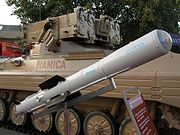
Military tactics
Military tactics, the science and art of organizing an army or an air force, are the techniques for using weapons or military units in combination for engaging and defeating an enemy in battle. Changes in philosophy and technology over time have been reflected in changes to military tactics. In...
to destroy tank
Tank
A tank is a tracked, armoured fighting vehicle designed for front-line combat which combines operational mobility, tactical offensive, and defensive capabilities...
s and their supporting infantry
Infantry
Infantrymen are soldiers who are specifically trained for the role of fighting on foot to engage the enemy face to face and have historically borne the brunt of the casualties of combat in wars. As the oldest branch of combat arms, they are the backbone of armies...
during the First World War. Because tanks represent an enemy's greatest force projection, anti-tank warfare has been incorporated into the doctrine of every combat arm and service.
The predominant anti-tank weapons at the start of the Second World War were the tank-mounted gun
Tank gun
A tank gun is the main armament of a tank. Modern tank guns are large-caliber high-velocity guns, capable of firing kinetic energy penetrators, high explosive anti-tank rounds, and in some cases guided missiles. Anti-aircraft guns can also be mounted to tanks.-Overview:Tank guns are a specific...
, limbered (towed) anti-tank guns and anti-tank grenade
Anti-tank grenade
An anti-tank grenade is a specialized explosive device to defeat heavily armored targets.-History:The first anti-tank grenades were improvised devices...
s used by the infantry. Anti-tank warfare developed rapidly, particularly on the Eastern Front
Eastern Front (World War II)
The Eastern Front of World War II was a theatre of World War II between the European Axis powers and co-belligerent Finland against the Soviet Union, Poland, and some other Allies which encompassed Northern, Southern and Eastern Europe from 22 June 1941 to 9 May 1945...
, to include infantry and infantry support weapons, anti-tank combat engineering, towed anti-tank artillery, tank mounted guns, ground-attack aircraft and self-propelled tank destroyer
Tank destroyer
A tank destroyer is a type of armored fighting vehicle armed with a gun or missile launcher, and is designed specifically to engage enemy armored vehicles...
s. Both the Red Army
Red Army
The Workers' and Peasants' Red Army started out as the Soviet Union's revolutionary communist combat groups during the Russian Civil War of 1918-1922. It grew into the national army of the Soviet Union. By the 1930s the Red Army was among the largest armies in history.The "Red Army" name refers to...
and the Wehrmacht developed complex combined-arms methods of combating tank-led offensives, including deployment of static anti-tank weapons in in-depth defensive positions, protected by anti-tank obstacles and minefields
Anti-tank mine
An anti-tank mine, , is a type of land mine designed to damage or destroy vehicles including tanks and armored fighting vehicles....
, and supported by mobile anti-tank reserves
Military reserve
A military reserve, tactical reserve, or strategic reserve is a group of military personnel or units which are initially not committed to a battle by their commander so that they are available to address unforeseen situations or exploit suddenly developing...
and ground attack aircraft.
From the Korean War
Korean War
The Korean War was a conventional war between South Korea, supported by the United Nations, and North Korea, supported by the People's Republic of China , with military material aid from the Soviet Union...
to the Cold War
Cold War
The Cold War was the continuing state from roughly 1946 to 1991 of political conflict, military tension, proxy wars, and economic competition between the Communist World—primarily the Soviet Union and its satellite states and allies—and the powers of the Western world, primarily the United States...
, Europe
Europe
Europe is, by convention, one of the world's seven continents. Comprising the westernmost peninsula of Eurasia, Europe is generally 'divided' from Asia to its east by the watershed divides of the Ural and Caucasus Mountains, the Ural River, the Caspian and Black Seas, and the waterways connecting...
and other countries faced the possibility that a nuclear weapon
Nuclear weapon
A nuclear weapon is an explosive device that derives its destructive force from nuclear reactions, either fission or a combination of fission and fusion. Both reactions release vast quantities of energy from relatively small amounts of matter. The first fission bomb test released the same amount...
could be detonated over an area of tank concentration in one strike. While technology was developed to protect crews of armoured vehicles from the effects of collateral radiation, the same could not be done for all their supporting arms
Combat support
In the United States Army, the term combat support refers to units that provide fire support and operational assistance to combat elements. Combat support units provide specialized support functions to combat units in the areas of chemical warfare, combat engineering, intelligence, security, and...
and services
Military logistics
Military logistics is the discipline of planning and carrying out the movement and maintenance of military forces. In its most comprehensive sense, it is those aspects or military operations that deal with:...
on which tanks depend. In the NATO countries little if any development took place on defining a doctrine
Military doctrine
Military doctrine is the concise expression of how military forces contribute to campaigns, major operations, battles, and engagements.It is a guide to action, not hard and fast rules. Doctrine provides a common frame of reference across the military...
of how to use armed forces without the use of tactical nuclear weapons. In the Soviet sphere of influence the legacy doctrine of operational manoeuver was being theoretically examined to understand how the tank-led force could be used even with the threat of limited use of nuclear weapons on the European battlefield. The solution they arrived at was maneuver warfare
Maneuver warfare
Maneuver warfare, or manoeuvre warfare , is the term used by military theorists for a concept of warfare that advocates attempting to defeat an adversary by incapacitating their decision-making through shock and disruption brought about by movement...
while massively increasing the number of anti-tank weapons. To achieve this, Soviet military theorists (such as Vasily Sokolovsky
Vasily Sokolovsky
Vasily Danilovich Sokolovsky was a Soviet military commander.Sokolovsky was born into a peasant family in Kozliki, a small town in the province of Grodno, near Białystok in Poland . He worked as a teacher in a rural school, where he took part in a number of protests and demonstrations against the...
) realised that anti-tank weapons had to assume an offensive role (rather than the traditionally defensive role of the Great Patriotic War) by becoming more mobile. This led to the development of guided anti-tank missiles
Anti-tank guided missile
An anti-tank missile , anti-tank guided missile , anti-tank guided weapon or anti-armor guided weapon is a guided missile primarily designed to hit and destroy heavily-armored military vehicles....
, though similar design work was being performed in Western Europe and the United States.
The French SS.10
SS.10
SS.10 is the designation of the Nord Aviation MCLOS wire-guided anti-tank missile designed by French engineer Jean Bastien-Thiry. In American service the missile was called the MGM-21A. The missile entered service in 1955 with the French army. It was used briefly by the US army in the early 1960s...
missile was the first successfully used in anti-tank combat—by the Israel Defense Forces
Israel Defense Forces
The Israel Defense Forces , commonly known in Israel by the Hebrew acronym Tzahal , are the military forces of the State of Israel. They consist of the ground forces, air force and navy. It is the sole military wing of the Israeli security forces, and has no civilian jurisdiction within Israel...
during the Suez Crisis
Suez Crisis
The Suez Crisis, also referred to as the Tripartite Aggression, Suez War was an offensive war fought by France, the United Kingdom, and Israel against Egypt beginning on 29 October 1956. Less than a day after Israel invaded Egypt, Britain and France issued a joint ultimatum to Egypt and Israel,...
of 1956, but the impact of Soviet anti-tank missile tactics was not evident until 1973, when Russian 9K11 Malyutka (Sagger) missiles were used by the Egyptian and Syrian armies during the Yom Kippur War
Yom Kippur War
The Yom Kippur War, Ramadan War or October War , also known as the 1973 Arab-Israeli War and the Fourth Arab-Israeli War, was fought from October 6 to 25, 1973, between Israel and a coalition of Arab states led by Egypt and Syria...
against Israel. The outcome suggested that although the French missiles were a threat, they could be countered. The explosive power delivered by the missiles convinced NATO tank designers to continue their emphasis on increased armour, while Soviet designers retained their emphasis on mobility of tank-led forces. The utility of the light anti-tank weapon was also recognised by both sides of the Cold War and led to further development of both shoulder-launched
Shoulder-launched missile weapon
A shoulder-fired missile, shoulder-launched missile or man-portable missile is a projectile fired at a target, small enough to be carried by a single person, and fired while held on one's shoulder...
and man-portable weapons
Anti-tank guided missile
An anti-tank missile , anti-tank guided missile , anti-tank guided weapon or anti-armor guided weapon is a guided missile primarily designed to hit and destroy heavily-armored military vehicles....
used by the infantry squad, while heavier missiles were mounted on dedicated missile tank-destroyers, including dedicated anti-tank helicopters
Attack helicopter
An attack helicopter is a military helicopter with the primary role of an attack aircraft, with the capability of engaging targets on the ground, such as enemy infantry and armored vehicles...
, and even heavier guided anti-tank missiles launched from aircraft
Air-to-surface missile
An air-to-surface missile is a missile designed to be launched from military aircraft and strike ground targets on land, at sea, or both...
. Also being developed were new varieties of artillery munitions in the form of top-attack shells, and shells that were used to saturate areas with anti-armour bomblets. Helicopters could be used as well to rapidly deliver scattered anti-tank mines.
Since the end of the Cold War in 1993, the only major new threat to tanks and other vehicles, has been the Improvised explosive device
Improvised explosive device
An improvised explosive device , also known as a roadside bomb, is a homemade bomb constructed and deployed in ways other than in conventional military action...
s used by insurgents
Insurgency
An insurgency is an armed rebellion against a constituted authority when those taking part in the rebellion are not recognized as belligerents...
following the Global War on Terror
War on Terror
The War on Terror is a term commonly applied to an international military campaign led by the United States and the United Kingdom with the support of other North Atlantic Treaty Organisation as well as non-NATO countries...
. However, while the tank remains an important part of the army, anti-tank weapons and tactics continue to develop, as was shown by the 2006 operation in Lebanon. Some anti-tank weapons from the Second World War are now used as infantryman's "artillery" to defeat sniper
Sniper
A sniper is a marksman who shoots targets from concealed positions or distances exceeding the capabilities of regular personnel. Snipers typically have specialized training and distinct high-precision rifles....
s or gain entry to structures. Even the anti-tank rifle
Anti-tank rifle
An anti-tank rifle is a rifle designed to penetrate the armour of vehicles, particularly tanks. The usefulness of rifles for this purpose ran from the introduction of tanks in World War I and until the Korean War...
has returned in its new guise of the anti-materiel rifle
Anti-materiel rifle
An anti-materiel rifle is a rifle that is designed for use against military equipment rather than against other combatants ....
. As long as there are tanks there will be specific anti-tank weapons.
Tank threat
Anti-tank warfare evolved as a countermeasure to the threat of the tank's appearance on the battlefields of the Western FrontWestern Front (World War I)
Following the outbreak of World War I in 1914, the German Army opened the Western Front by first invading Luxembourg and Belgium, then gaining military control of important industrial regions in France. The tide of the advance was dramatically turned with the Battle of the Marne...
of the First World War. The tank had been developed to negate the German system of trenches
Trench warfare
Trench warfare is a form of occupied fighting lines, consisting largely of trenches, in which troops are largely immune to the enemy's small arms fire and are substantially sheltered from artillery...
, and allow a return to manoeuver against enemy's flanks
Flanking maneuver
In military tactics, a flanking maneuver, also called a flank attack, is an attack on the sides of an opposing force. If a flanking maneuver succeeds, the opposing force would be surrounded from two or more directions, which significantly reduces the maneuverability of the outflanked force and its...
and to attack the rear
Encirclement
Encirclement is a military term for the situation when a force or target is isolated and surrounded by enemy forces. The German term for this is Kesselschlacht ; a comparable English term might be "in the bag"....
with cavalry
Cavalry
Cavalry or horsemen were soldiers or warriors who fought mounted on horseback. Cavalry were historically the third oldest and the most mobile of the combat arms...
.
The use of the tank was primarily based on the assumption that once they were able to eliminate the German trench lines with their machine gun and Infantry support gun
Infantry support gun
Infantry support guns are artillery weapons designed and used to increase fire power of infantry units they are intrinsic to, offering immediate tactical response to the needs of the unit's commanding officer. The designs are typically with short low velocity barrels, and light construction...
positions, the Allied infantry would follow and secure the breach, and the cavalry would exploit the breach in the trench lines by attacking into the depth of German-held territory, eventually capturing the field artillery
Field artillery
Field artillery is a category of mobile artillery used to support armies in the field. These weapons are specialized for mobility, tactical proficiency, long range, short range and extremely long range target engagement....
positions and interdicting logistics and reserves being brought up from the rear areas. Naval crews initially used to operate the installed naval guns and machine guns were replaced with Army personnel who were more aware of the infantry tactics with which the tanks were intended to cooperate. However, there was no way to communicate between the tank's crew and the accompanying infantry, or between the tanks participating in combat. Radios were not yet made portable or robust enough to be mounted in a tank, although Morse Code transmitters were installed in some Mark IVs at Cambrai as messaging vehicles,. Attaching a field telephone to the rear would became a practice only during the next war. With greater use of tanks by both sides it was realised that the accompanying infantry could be forced to ground by ambush
Ambush
An ambush is a long-established military tactic, in which the aggressors take advantage of concealment and the element of surprise to attack an unsuspecting enemy from concealed positions, such as among dense underbrush or behind hilltops...
fire, thus separating them from the tanks, which would continue to advance, eventually finding themselves exposed to close-assaults
Small unit tactics
Small unit tactics is the application of military doctrine for the combat deployment of platoons and smaller units in a particular strategic and logistic environment.-Squad Structure:...
by German infantry and sappers.
The early tanks were mechanically rudimentary. The 0.23 to 0.47 in (5.8 to 11.9 mm) armour generally prevented penetration by small arms
Small arms
Small arms is a term of art used by armed forces to denote infantry weapons an individual soldier may carry. The description is usually limited to revolvers, pistols, submachine guns, carbines, assault rifles, battle rifles, multiple barrel firearms, sniper rifles, squad automatic weapons, light...
fire and shell fragments
Fragmentation (weaponry)
Fragmentation is the process by which the casing of an artillery shell, bomb, grenade, etc. is shattered by the detonating high explosive filling. The correct technical terminology for these casing pieces is fragments , although shards or splinters can be used for non-preformed fragments...
. However, even a near miss from a field artillery or an impact from a mortar HE round easily disabled the tank, or destroyed it if the fuel tank
Fuel tank
A fuel tank is safe container for flammable fluids. Though any storage tank for fuel may be so called, the term is typically applied to part of an engine system in which the fuel is stored and propelled or released into an engine...
was ruptured, incinerating the tank's crew. The need for a 'male' variant was recognised as a tactical necessity to defeat any infantry field pieces found in the trench lines which could easily disable tank track with the HE ammunition. This was achieved by mounting a QF 6 pounder Hotchkiss
QF 6 pounder Hotchkiss
The QF 6 pounder Hotchkiss was a light 57 mm naval gun and coast defence gun of the late 19th century used by many countries, and was adapted for use in the early British tanks in World War I.- Canada History :...
light 57 mm naval gun mounted in the hull barbette
Barbette
A barbette is a protective circular armour feature around a cannon or heavy artillery gun. The name comes from the French phrase en barbette referring to the practice of firing a field gun over a parapet rather than through an opening . The former gives better angles of fire but less protection...
s. Hull and track engineering was largely dictated by the terrain
Terrain
Terrain, or land relief, is the vertical and horizontal dimension of land surface. When relief is described underwater, the term bathymetry is used...
—the need to cross wide trenches—although the relationship between ground pressure
Ground pressure
Ground pressure is the pressure exerted on the ground by the tires or tracks of a motorized vehicle, and is one measure of its potential mobility, especially over soft ground. Ground pressure is measured in pascals which corresponds to the EES unit of pounds per square inch...
and soil-vehicle mechanics
Soil mechanics
Soil mechanics is a branch of engineering mechanics that describes the behavior of soils. It differs from fluid mechanics and solid mechanics in the sense that soils consist of a heterogeneous mixture of fluids and particles but soil may also contain organic solids, liquids, and gasses and other...
would not be resolved until the Second World War. Turrets
Gun turret
A gun turret is a weapon mount that protects the crew or mechanism of a projectile-firing weapon and at the same time lets the weapon be aimed and fired in many directions.The turret is also a rotating weapon platform...
were later introduced on medium and light tanks to react to ambushes during the advance.
First World War
The tank, when it appeared on the Western Front in September 1916, was a total surprise to the German troops, though not to the German General StaffGerman General Staff
The German General Staff was an institution whose rise and development gave the German armed forces a decided advantage over its adversaries. The Staff amounted to its best "weapon" for nearly a century and a half....
. The French Army Staff was highly critical with the British Army's early fielding of the Mark I vehicles in small numbers because the French trials showed the armoured vehicles to be highly unreliable. They judged that large numbers had to be employed to sustain an offensive despite losses to mechanical failure or vehicles being foundered in intractable no man's land
No man's land
No man's land is a term for land that is unoccupied or is under dispute between parties that leave it unoccupied due to fear or uncertainty. The term was originally used to define a contested territory or a dumping ground for refuse between fiefdoms...
terrain. These losses, coupled with those from enemy artillery fire, later amounted to as high as 70% of the starters during some operations. Deploying small numbers of tanks would therefore cause the Allies to lose the element of surprise
Indirect approach
The Indirect approach was a strategy described and chronicled by B. H. Liddell Hart after World War I, was Liddell Hart's attempt to find a solution to the problem of high casualty rates in conflict zones with high force to space ratios, such as the Western Front on which he served. The strategy...
, allowing Germans to develop countermeasures.
Anti-tank weapons
Because the German Army was the only force in need of anti-tank weapons, it was they that had to develop a viable technology to combat the tank. These technologies took three ammunitionAmmunition
Ammunition is a generic term derived from the French language la munition which embraced all material used for war , but which in time came to refer specifically to gunpowder and artillery. The collective term for all types of ammunition is munitions...
approaches: use of grenades by infantrymen, including the Geballte Ladung ("Bunched Charge") of several stick grenades bound together by pioneers; early attempts at the small-caliber anti-tank rifles like the 13 mm Mauser bolt-action; and 3.7 cm TaK Rheinmetall in starrer Räder-lafette 1916 anti-tank gun on a light carriage which could destroy a tank using large-caliber armour piercing
Armor-piercing shot and shell
An armor-piercing shell is a type of ammunition designed to penetrate armor. From the 1860s to 1950s, a major application of armor-piercing projectiles was to defeat the thick armor carried on many warships. From the 1920s onwards, armor-piercing weapons were required for anti-tank missions...
ammunition issued in 1917 to special commands; and the existing 77 mm field guns (such as the 7.7 cm FK 16
7.7 cm FK 16
The 7.7 cm Feldkanone 16 was a field gun used by Germany in World War I. Surviving examples in German service were rebarreled postwar as the 7.5 cm FK 16 nA .-History:...
) of the infantry division's artillery regiment were also eventually issued with special armour piercing (AP) ammunition.
Anti-tank tactics
With the appearance of Allied tanks the German Army were quick to introduce new anti-tank defense detachments within the pioneer battalions of the infantry divisions. These were initially issued 1.3 cm calibre long barrel rifles firing solid shot. However these suffered from fouling after 2–3 rounds and had a recoil that was unsustainable by the mechanism or the rifleman. Stick grenades were used to destroy the tracks by individual pioneers, however this required for accompanying machine-gunners to first separate the supporting Allied infantry line from the tanks, which proved difficult. Another tactic was to lure the tank beyond the German trench-line, re-establishing it just as the Allied infantry approached. The tank would then be engaged by the divisional 7.7 cm guns brought forward, that would try to disable the tracks with ordinary HE shells (and later AP ammunition). If the crews of the disabled tanks refused to surrender, they were engaged with flamethrowers, or a mortar would be fired on the stricken vehicle until a direct hit was achieved on the top surface, usually resulting in an internal fire. Finally, anti-tank obstacles were prepared on the likely approaches by deepening and widening existing ground cratering, the precursors of the anti-tank trenchAnti-tank trench
Anti-tank trenches, also called anti-tank ditches, are ditches dug into and around fortified positions to hold up the advance of enemy tanks. Anti-tank ditches were first used in World War I by Germany in an effort to protect their trenches against the newly developed British tanks. An anti-tank...
. Finally in early 1917 the 3.7 cm TaK from Rheinmetall
Rheinmetall
Rheinmetall AG is a German automotive and defence company with factories in Düsseldorf, Kassel and Unterlüß. The company has a long tradition of making guns and artillery pieces...
was rushed to the frontline, and proved effective in destroying the tanks despite limited elevation and traverse.
Development between the World wars
Lack of consensus on the design and use of the tank after the First World War also influenced the development of its anti-tank countermeasures. However, because Germany was restricted in its military capability, and there were no other challenges to France and Britain, very little development took place in anti-tank warfare until the 1930s.The Interwar period
Interwar period
Interwar period can refer to any period between two wars. The Interbellum is understood to be the period between the end of the Great War or First World War and the beginning of the Second World War in Europe....
was dominated by the strategic thinking with fortified borders at its core. These would include obstacles consisted of natural features such as ditches
Ditch (fortification)
A ditch in military engineering is an obstacle, designed to slow down or break up an attacking force, while a trench is intended to provide cover to the defenders...
, stream
Stream
A stream is a body of water with a current, confined within a bed and stream banks. Depending on its locale or certain characteristics, a stream may be referred to as a branch, brook, beck, burn, creek, "crick", gill , kill, lick, rill, river, syke, bayou, rivulet, streamage, wash, run or...
s and urban area
Urban area
An urban area is characterized by higher population density and vast human features in comparison to areas surrounding it. Urban areas may be cities, towns or conurbations, but the term is not commonly extended to rural settlements such as villages and hamlets.Urban areas are created and further...
s, or constructed obstacles such as anti-tank ditches, minefields
Land mine
A land mine is usually a weight-triggered explosive device which is intended to damage a target—either human or inanimate—by means of a blast and/or fragment impact....
, dragon's teeth
Dragon's teeth (fortification)
Dragon's teeth are square-pyramidal fortifications of reinforced concrete first used during the Second World War to impede the movement of tanks and mechanised infantry...
, or log barriers. The pinnacle of this strategic thinking was considered to be the Maginot Line
Maginot Line
The Maginot Line , named after the French Minister of War André Maginot, was a line of concrete fortifications, tank obstacles, artillery casemates, machine gun posts, and other defences, which France constructed along its borders with Germany and Italy, in light of its experience in World War I,...
which replaced infantry-filled trenches with artillery-filled bunker
Bunker
A military bunker is a hardened shelter, often buried partly or fully underground, designed to protect the inhabitants from falling bombs or other attacks...
s, including casemate
Casemate
A casemate, sometimes rendered casement, is a fortified gun emplacement or armored structure from which guns are fired. originally a vaulted chamber in a fortress.-Origin of the term:...
s housing 37 or 47 mm anti-tank guns, and steel turrets armed with a pair of machine guns and a 25 mm anti-tank gun, although Germany was forbidden to produce tanks. The construction was partially based on the Allied experience with the Hindenburg Line
Hindenburg Line
The Hindenburg Line was a vast system of defences in northeastern France during World War I. It was constructed by the Germans during the winter of 1916–17. The line stretched from Lens to beyond Verdun...
which was breached with tank support during the battles of Cambrai and St. Quentin Canal, although German Command was more impressed by the surprise achieved by the Canadian troops at the Battle of the Canal du Nord
Battle of the Canal du Nord
The Battle of Canal du Nord was part of a general Allied offensive against German positions on the Western Front during the Hundred Days Offensive of World War I. The battle took place in the Nord-Pas-de-Calais region of France, along an incomplete portion of the Canal du Nord and on the outskirts...
. This would come to influence their planning in 1940.
The Maginot line defences - up to 16 miles deep from the forward positions to the rear line - were intended to prevent a surprise attack and delay any attack while the French Army was mobilized. With the relative numerical inferiority between the France and Germany, it was a more effective use of manpower. Within the line passive anti-tank obstacles were supported by anti-infantry and anti-tank bunkers. After Belgium declared neutrality in 1936, France began work on extending the line along the Belgium border.
Improved artillery was seen as the quickest solution to anti-tank defense, and one of the earliest post-war anti-tank gun designs was the 25 mm Hotchkiss
25 mm Hotchkiss anti-tank gun
The 25 mm Hotchkiss anti-tank gun was a French anti-tank gun that saw service in the first years of the Second World War.-Development:...
model from France. It was intended to replace an Atelier de Puteaux 37 mm weapon designed in 1916 to destroy machine gun positions. Rheinmetall
Rheinmetall
Rheinmetall AG is a German automotive and defence company with factories in Düsseldorf, Kassel and Unterlüß. The company has a long tradition of making guns and artillery pieces...
commenced design of a 37 mm anti-tank gun in 1924 and the first guns were produced in 1928 as 3.7 cm Pak L/45, later adopted in Wehrmacht service as 3.7 cm Pak 36. It made an appearance during the Spanish Civil War
Spanish Civil War
The Spanish Civil WarAlso known as The Crusade among Nationalists, the Fourth Carlist War among Carlists, and The Rebellion or Uprising among Republicans. was a major conflict fought in Spain from 17 July 1936 to 1 April 1939...
, as did the Bofors 37 mm
Bofors 37 mm
The Bofors 37 mm gun was an anti-tank gun designed by Swedish manufacturer Bofors in the early 1930s. Licensed copies were produced in a number of countries. The gun was used by some European armies during World War II, mainly at the early stage of the war.-Development history:The gun was...
developed in Sweden, and used by many early Second World War combatants. The British Army accepted for service the (40 mm) Ordnance QF 2 pounder
Ordnance QF 2 pounder
The Ordnance QF 2-pounder was a British anti-tank and vehicle-mounted gun, employed in the Second World War. It was actively used in the Battle of France, and during the North Africa campaign...
which was developed as a tank gun
Tank gun
A tank gun is the main armament of a tank. Modern tank guns are large-caliber high-velocity guns, capable of firing kinetic energy penetrators, high explosive anti-tank rounds, and in some cases guided missiles. Anti-aircraft guns can also be mounted to tanks.-Overview:Tank guns are a specific...
. The Soviet Red Army
Red Army
The Workers' and Peasants' Red Army started out as the Soviet Union's revolutionary communist combat groups during the Russian Civil War of 1918-1922. It grew into the national army of the Soviet Union. By the 1930s the Red Army was among the largest armies in history.The "Red Army" name refers to...
after the Russian Civil War also begun a search for an anti-tank gun with a French Hotchkiss 37 mm L.33 tank gun, but soon upgraded this to a higher velocity L.45 Model 1935 while also making a copy of the German 3.7 cm PaK 35. However, the Red Army was almost immediately taught a lesson about anti-tank warfare when a tank battalion
Battalion
A battalion is a military unit of around 300–1,200 soldiers usually consisting of between two and seven companies and typically commanded by either a Lieutenant Colonel or a Colonel...
sent to aid the Spanish Communists in the Spanish Civil War
Spanish Civil War
The Spanish Civil WarAlso known as The Crusade among Nationalists, the Fourth Carlist War among Carlists, and The Rebellion or Uprising among Republicans. was a major conflict fought in Spain from 17 July 1936 to 1 April 1939...
was almost entirely destroyed in an engagement
Engagement (military)
A military engagement is a combat between two forces, neither larger than a division and not smaller than a company, in which each has an assigned or perceived mission...
.
At this time the predominant ammunition used against tanks was the armour piercing kinetic energy
Kinetic energy
The kinetic energy of an object is the energy which it possesses due to its motion.It is defined as the work needed to accelerate a body of a given mass from rest to its stated velocity. Having gained this energy during its acceleration, the body maintains this kinetic energy unless its speed changes...
shell that defeated armour by direct pressure
Pressure
Pressure is the force per unit area applied in a direction perpendicular to the surface of an object. Gauge pressure is the pressure relative to the local atmospheric or ambient pressure.- Definition :...
, spiking or punching through it. During the late 1930s shaped charge
Shaped charge
A shaped charge is an explosive charge shaped to focus the effect of the explosive's energy. Various types are used to cut and form metal, to initiate nuclear weapons, to penetrate armor, and in the oil and gas industry...
ammunition was experimented with that used chemical energy
Chemical energy
Chemical energy is the potential of a chemical substance to undergo a transformation through a chemical reaction or, to transform other chemical substances...
for armour penetration. More difficult to manufacture, its advantage was in that on impact it would create a high-velocity
Velocity
In physics, velocity is speed in a given direction. Speed describes only how fast an object is moving, whereas velocity gives both the speed and direction of the object's motion. To have a constant velocity, an object must have a constant speed and motion in a constant direction. Constant ...
jet of molten metal which created tremendously high pressures, hydrodynamically
Fluid dynamics
In physics, fluid dynamics is a sub-discipline of fluid mechanics that deals with fluid flow—the natural science of fluids in motion. It has several subdisciplines itself, including aerodynamics and hydrodynamics...
deforming the armour. The depth of the penetration, though proportional to the length of the jet and the square root
Square root
In mathematics, a square root of a number x is a number r such that r2 = x, or, in other words, a number r whose square is x...
of its density, is also dependent on the strength of the armour. With the development of this new ammunition begun more advanced research into steel manufacturing
Steelmaking
Steelmaking is the second step in producing steel from iron ore. In this stage, impurities such as sulfur, phosphorus, and excess carbon are removed from the raw iron, and alloying elements such as manganese, nickel, chromium and vanadium are added to produce the exact steel required.-Older...
, and development of spaced armour
Spaced armour
Armour with two or more plates spaced a distance apart is called spaced armour. When sloped it reduces the penetrating power of bullets and solid shot as after penetrating each plate they tend to tumble, deflect, deform, or disintegrate; when not sloped it increases the protection offered by the...
that would cause "jet waver" by detonating prematurely or at the wrong angle to the surface of the main armour.
The only significant attempt to experiment in the use of tanks in the late 1920s was that of the British Army's Experimental Mechanized Force
Experimental Mechanized Force
The Experimental Mechanized Force was a brigade-sized formation of the British Army. It was officially formed on 27 August 1927, and was intended to investigate and develop the techniques and equipment required for armoured warfare. It was renamed the Experimental Armoured Force the following year...
that would influence future development of tanks, armoured troops and entire armies of both its future enemies and allies in the next war.
In Spain the anti-tank defense of the Nationalists was organised by the Wehrmacht officers, and the anti-tank guns were incorporated into a system of obstacles that were constructed with the intent to stop an attack by tanks by slowing it down, separating them from supporting infantry (advancing on foot) with machine-gun and mortar fire, and forcing tanks to conduct deliberate head-on assaults with engineer support, or seek a less-defended area to attack. Minefields laid with purpose-designed mines were used for the first time, destroying tank tracks, and forcing combat engineers to clear them on foot. Delay meant that Nationalist field artillery could engage the lightly armoured Soviet tanks. This meant a change in Republican operational and eventually strategic planning, and a more protracted combat operations, with more casualties at a greater cost.
The only change to the German anti-tank tactics of the First World War was that now an effective anti-tank weapon was available to support the defending infantry. However, the Soviet tanks armed with 45 mm guns easily destroyed the German light tanks.
Ironically, in the early 1930s until the Spanish War, German officers were conducting secret testing of a new way of employing tanks, infantry and artillery offensively
Offensive (military)
An offensive is a military operation that seeks through aggressive projection of armed force to occupy territory, gain an objective or achieve some larger strategic, operational or tactical goal...
in the Soviet Union with the cooperation of the Red Army. In Germany these developments would eventually culminate in tactics that would later come to be known as Blitzkrieg
Blitzkrieg
For other uses of the word, see: Blitzkrieg Blitzkrieg is an anglicized word describing all-motorised force concentration of tanks, infantry, artillery, combat engineers and air power, concentrating overwhelming force at high speed to break through enemy lines, and, once the lines are broken,...
, while in the Soviet Union they would form the core of the deep battle operational doctrine. The successful test of the latter would be during the Battles of Khalkhin Gol although the Red Army would founder on the Mannerheim Line in 1940, largely due to the purge in the Officer Corps, claiming many of the senior proponents of the new doctrine. Anti-tank artillery would be included in mobile tank-led Wehrmacht and Red Army units due to the possibility of encountering enemy tanks in a meeting engagement
Meeting engagement
A meeting engagement, a term used in warfare, is a combat action that occurs when a moving force, incompletely deployed for battle, engages an enemy at an unexpected time and place.-Description:...
.
The new doctrines of using the tank, were divided into infantry and cavalry schools of thought. The former regarded the tank as a mobile artillery system to be used for infantry support. This suggested that the infantry needed to be armed with integral anti-tank weapons. The latter advocated use of tanks in the traditional cavalry way of high-tempo attacks intended to outflank the enemy infantry and sever its communication lines. This approach suggested that the tank would be the best anti-tank system, and only limited anti-tank troops were required to accompany them. For this reason the late 30s tank configurations
Tank classification
Tank classification is a taxonomy of identifying either the intended role or weight class of tanks. The classification by role was used primarily during the developmental stage of the national armoured forces, and referred to the doctrinal and force structure utility of the tanks based on design...
came in a great diversity, ranging from light tankettes and cavalry tanks to multi-turreted heavy tank
Heavy tank
A heavy tank was a subset of tank that filled the heavy direct-fire role of many armies.Heavy tanks have usually been deployed to breakthrough enemy lines, though in practice have been more useful in the defensive role than in the attack...
s resembling bunkers, all of which had to be considered in training by the anti-tank artillery troops. The development of these doctrines was the most significant influence on the rapid development in anti-tank technology and tactics in the Second World War.
Second World War
Two aspects of how the Second World War commenced helped to delay development of anti-tank warfare: resignation and surprise. After Poland was attacked, its allies in the West were resigned to its defeat by a numerically superior Wehrmacht. The little information that was brought out about the conduct of combat during that campaign did nothing to convince either France, Britain or the USSR of the need for improved anti-tank technology and tactics. The reliance on the Maginot Line, and the subsequent surprise of the German offensive left no time to develop existing capabilities and tactics in the West. The British were preparing the stop lines and the anti-tank islands to slow enemy progress and restrict the route of an attack. The Red Army however was fortunate in having several excellent designs for anti-tank warfare that were either in final stages of development for production, or had been rejected earlier as unnecessary and could now be rushed into production. The relative ease with which the older models of Red Army's tank fleet were destroyed by German anti-tank weapons, using tactics already seen in Spain, once and for all focused Stavka attention on anti-tank warfare as Soviet armies were repeatedly encircled by panzer-led strategic pincer manoeuvers. Of the three iconic Soviet weapons of the Second World War, two were made exclusively for anti-tank warfare, the T-34T-34
The T-34 was a Soviet medium tank produced from 1940 to 1958. Although its armour and armament were surpassed by later tanks of the era, it has been often credited as the most effective, efficient and influential design of World War II...
and the Ilyushin Il-2
Ilyushin Il-2
The Ilyushin Il-2 was a ground-attack aircraft in the Second World War, produced by the Soviet Union in very large numbers...
Shturmovik. The former was one of the most manufactured tanks in history, and the latter, itself dubbed the 'flying tank', was one of the most manufactured aircraft.
The war also saw the creation and almost immediate abandonment of the self-propelled tank destroyer which would be replaced post war by the anti tank guided missile.
Aircraft
As tanks were rarely used in conflicts between the two World Wars, no specific aircraft or tactics were developed to combat them from the air. One solution adopted by almost all European air forces was to use bomb loads for conventional bombers that were composed from small bombs allowing a higher density during bombing. This created a greater chance of causing a direct impact on the thinner top armour of the tank while also having the ability to damage track and wheels through proximity detonation. The first aircraft capable of engaging tanks were the Junkers Ju-87 "Stuka" using dive bombing to place the bomb close to the target. Some French and German fighters fitted with 20 mm cannon were also able to engage thinner top armour surfaces of the tanks early in the war. The Stuka was also given cannons for anti-armour role though it was obsolete by 1942, and was joined by the Henschel Hs 129Henschel Hs 129
The Henschel Hs 129 was a World War II ground-attack aircraft fielded by the German Luftwaffe. Its nickname, the Panzerknacker , is a deliberate pun—in German, it also means "safe cracker"...
that mounted a podded 30 mm (1.2 in) MK 101 cannon
MK 101 cannon
The MK 101 is the designation of a 30 mm autocannon used in German combat aircraft during World War II. Although accurate and powerful, with a high muzzle velocity, it was very heavy, with a low rate of fire, which limited its production....
beneath its fuselage, while the Red Army Air Force fielded the Soviet Ilyushin Il-2
Ilyushin Il-2
The Ilyushin Il-2 was a ground-attack aircraft in the Second World War, produced by the Soviet Union in very large numbers...
armed with a pair of 23 mm cannons and unguided rockets, but armoured to enable the pilots to approach German tanks at very low altitude, ignoring small arms, machine-gun and even small anti-aircraft cannon fire that usually provided tanks with protection against the bombers.
The RAF mounted two underwing pod-mounted 40 mm Vickers S
Vickers S
The Vickers Class "S" was a 40 mm cannon used to arm British aircraft for attacking ground targets in the Second World War.-History:...
cannon on the Hawker Hurricane
Hawker Hurricane
The Hawker Hurricane is a British single-seat fighter aircraft that was designed and predominantly built by Hawker Aircraft Ltd for the Royal Air Force...
(as the Mk. IID) to give it more firepower against tanks which saw service in North Africa in 1942 and the Hawker Typhoon
Hawker Typhoon
The Hawker Typhoon was a British single-seat fighter-bomber, produced by Hawker Aircraft. While the Typhoon was designed to be a medium-high altitude interceptor, and a direct replacement for the Hawker Hurricane, several design problems were encountered, and the Typhoon never completely satisfied...
was given HE rockets though these were more effective against other ground vehicles. From March 1943 the Red Army Air Force produced the more agile Yakovlev Yak-9
Yakovlev Yak-9
The Yakovlev Yak-9 was a single-engine fighter aircraft used by the Soviet Union in World War II and after. Fundamentally a lighter development of the Yak-7 with the same armament, it arrived at the front at the end of 1942. The Yak-9 had a lowered rear fuselage decking and all-around vision canopy...
T (37 mm cannon) and K (45 mm cannon) bomber interceptor also used for ground attack, both guns in mounts attached to the engine, that had them firing through a hollow-center propeller shaft.
Field artillery
Field artillery were often the first ground combat arm to engage detected concentration of troops which included tanks through artillery airborne observers, either in assembly areas (for refueling and rearming), during approach marches to the combat zone, or as the tank unit was forming up for the attack. Conventional artillery shells were very effective against the tank's thinner top armour if fired in appropriate density while the tanks were concentrated, enabling direct hits by a sufficiently powerful shell. Even a non-penetrating shell could still disable a tank through dynamic shock, internal armour shattering or simply overturning the tank. More importantly the tanks could be disabled due to damage to tracks and wheels, and their supporting vehicles and personnel could be damaged and killed, reducing unit's ability to fight in the longer term. Because tanks were usually accompanied by infantry mounted on trucks or half-trackHalf-track
A half-track is a civilian or military vehicle with regular wheels on the front for steering, and caterpillar tracks on the back to propel the vehicle and carry most of the load. The purpose of this combination is to produce a vehicle with the cross-country capabilities of a tank and the handling...
ed vehicles that lacked overhead armour, field artillery that fired a mix of ground and air-burst ammunition was likely to inflict heavy casualties on the infantry as well.
Field guns such as the Ordnance QF 25 pounder
Ordnance QF 25 pounder
The Ordnance QF 25 pounder, or more simply, 25-pounder or 25-pdr, was introduced into service just before World War II, during which it served as the major British field gun/howitzer. It was considered by many to be the best field artillery piece of the war, combining high rates of fire with a...
were provided with armour-piercing shot for direct engagement of enemy tanks.
Anti-tank guns
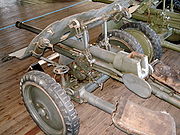
Howitzer
A howitzer is a type of artillery piece characterized by a relatively short barrel and the use of comparatively small propellant charges to propel projectiles at relatively high trajectories, with a steep angle of descent...
s. The higher velocity, flatter trajectory ballistics
Ballistics
Ballistics is the science of mechanics that deals with the flight, behavior, and effects of projectiles, especially bullets, gravity bombs, rockets, or the like; the science or art of designing and accelerating projectiles so as to achieve a desired performance.A ballistic body is a body which is...
provide terminal kinetic energy
Kinetic energy penetrator
A kinetic energy penetrator is a type of ammunition which, like a bullet, does not contain explosives and uses kinetic energy to penetrate the target....
to penetrate the armour at a given range. Any field artillery cannon
Cannon
A cannon is any piece of artillery that uses gunpowder or other usually explosive-based propellents to launch a projectile. Cannon vary in caliber, range, mobility, rate of fire, angle of fire, and firepower; different forms of cannon combine and balance these attributes in varying degrees,...
with barrel length 15 to 25 times longer than its caliber
Caliber
In guns including firearms, caliber or calibre is the approximate internal diameter of the barrel in relation to the diameter of the projectile used in it....
was able also to fire anti-tank ammunition, such as the Soviet A-19.
Prior to World War II
World War II
World War II, or the Second World War , was a global conflict lasting from 1939 to 1945, involving most of the world's nations—including all of the great powers—eventually forming two opposing military alliances: the Allies and the Axis...
few anti-tank guns had (or needed) calibers larger than 50 mm. Examples of guns in this class include the German 37 mm, US 37 mm (the largest gun able to be towed by the jeep
Jeep
Jeep is an automobile marque of Chrysler . The first Willys Jeeps were produced in 1941 with the first civilian models in 1945, making it the oldest off-road vehicle and sport utility vehicle brand. It inspired a number of other light utility vehicles, such as the Land Rover which is the second...
), French 25 mm
25 mm Hotchkiss anti-tank gun
The 25 mm Hotchkiss anti-tank gun was a French anti-tank gun that saw service in the first years of the Second World War.-Development:...
and 47 mm
47 mm APX anti-tank gun
The 47 mm APX anti-tank gun was a French anti-tank gun that saw service in the first years of the Second World War.-Development:In the 1930s the French artillery sought a replacement for the derivatives of the 75 mm mle 1897 field gun it used in the anti-tank role...
guns, British QF 2-pounder (40 mm)
Ordnance QF 2 pounder
The Ordnance QF 2-pounder was a British anti-tank and vehicle-mounted gun, employed in the Second World War. It was actively used in the Battle of France, and during the North Africa campaign...
, Italian 47 mm
Cannone da 47/32 M35
The Cannone da 47/32 M35 was an Austrian artillery piece produced under license in Italy during World War II. It was used both as an infantry gun and an anti-tank gun....
and Soviet 45 mm. All of these light weapons could penetrate the thin armour found on most pre-war and early war tanks.
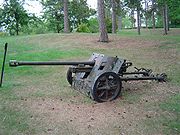
World War II
World War II, or the Second World War , was a global conflict lasting from 1939 to 1945, involving most of the world's nations—including all of the great powers—eventually forming two opposing military alliances: the Allies and the Axis...
many of these weapons were still being used operationally, along with a newer generation of light guns that closely resembled their WWI counterparts. After Soviet T-34 and KV tanks were encountered these guns were recognised as ineffective against sloped armour
Sloped armour
Sloped armour is armour that is neither in a vertical nor a horizontal position. Such "angled" armour is often mounted on tanks and other armoured fighting vehicles...
, with the German lightweight 37 mm gun quickly nicknamed the "tank door knocker" , for revealing its presence without penetrating the armour.
Germany quickly introduced more powerful anti-tank guns, some which had been in the early stages of development prior to the war. By late 1942 the Germans had an excellent 50-mm high-velocity design, while they faced the QF 6-pounder
Ordnance QF 6 pounder
The Ordnance Quick-Firing 6-pounder 7 cwt, or just 6 pounder, was a British 57 mm gun, their primary anti-tank gun during the middle of World War II, as well as the main armament for a number of armoured fighting vehicles...
introduced in the North African Campaign
North African campaign
During the Second World War, the North African Campaign took place in North Africa from 10 June 1940 to 13 May 1943. It included campaigns fought in the Libyan and Egyptian deserts and in Morocco and Algeria and Tunisia .The campaign was fought between the Allies and Axis powers, many of whom had...
by the British Army, and later adopted by the US Army. By 1943 Wehrmacht was forced to adopt still larger calibers on the Eastern Front, the 75 mm and the famous 88 mm
88 mm gun
The 88 mm gun was a German anti-aircraft and anti-tank artillery gun from World War II. It was widely used by Germany throughout the war, and was one of the most recognizable German weapons of the war...
guns. The Red Army used a variety of 45 mm, 57 mm, and 100 mm guns, as well as deploying general-purpose 76.2 mm and 122-mm guns in the anti-tank role. For the Invasion of Normandy the British QF 17 pounder
Ordnance QF 17 pounder
The Ordnance Quick-Firing 17 pounder was a 76.2 mm gun developed by the United Kingdom during World War II. It was used as an anti-tank gun on its own carriage, as well as equipping a number of British tanks. It was the most effective Allied anti-tank gun of the war...
, whose design had begun before the 6 pounder entered service, was produced that proved to be a highly effective anti-tank gun also used as a tank
Sherman Firefly
The Sherman Firefly was a World War II British variant of the American Sherman tank, fitted with the powerful British 17 pounder anti-tank gun as its main weapon...
and tank destroyer
Archer (tank destroyer)
The SP 17pdr, Valentine, Mk I, Archer was a British self propelled anti-tank gun of the Second World War based on the Valentine infantry tank chassis fitted with a Ordnance QF 17 pounder gun.-Design and development:...
gun.

Self-propelled anti-tank guns
As towed anti-tank cannon guns grew in size and weight, they became less mobile and more cumbersome to maneuver, and required ever larger gun crews, who often had to wrestle the gun into position while under heavy artillery and/or tank fire. As the war progressed, this disadvantage not infrequently resulted in the loss or destruction of both the antitank gun and its trained crew. This gave impetus to the development of the self-propelled, lightly armored "tank destroyer
Tank destroyer
A tank destroyer is a type of armored fighting vehicle armed with a gun or missile launcher, and is designed specifically to engage enemy armored vehicles...
" (TD). The tank destroyer was usually based on the hull of existing tank designs, using either a gun integrated into the hull or a fully rotating turret much like that of a conventional tank. These self-propelled (SP) AT guns were first employed as infantry support weapons in place of towed antitank guns. Later, due to a shortage of tanks, TDs sometimes replaced the former in offensive armored operations.
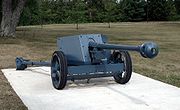
Ambush
An ambush is a long-established military tactic, in which the aggressors take advantage of concealment and the element of surprise to attack an unsuspecting enemy from concealed positions, such as among dense underbrush or behind hilltops...
positions. Such designs were easier and faster to manufacture and offered good crew protection, though the lack of a turret limited the gun's traverse to a few degrees. This meant that if the TD became immobilized due to engine failure or track damage, it could not rotate its gun to counter opposing tanks, making it an easy target. This vulnerability was later exploited by opposing tank forces. Late in the war, it was not unusual to find even the largest and most powerful tank destroyer abandoned on the field after a battle, having been immobilized by a single high explosive shell to the track or front drive sprocket.
US Army pre-war infantry support doctrines emphasized the use of tank destroyers with open-top fully rotating turrets, featuring less armor the standard M4 Sherman
M4 Sherman
The M4 Sherman, formally Medium Tank, M4, was the primary tank used by the United States during World War II. Thousands were also distributed to the Allies, including the British Commonwealth and Soviet armies, via lend-lease...
tanks, but with more powerful cannon. A 76 mm long-barrel tank cannon was fitted to the M10 and M18
M18 Hellcat
The 76 mm Gun Motor Carriage M18 was an American tank destroyer of World War II. The manufacturer, Buick, gave it the nickname "Hellcat" and it was the fastest tracked armored fighting vehicle during the war with a top speed up to 60 mph. Hellcat crews took advantage of the vehicle's...
designs. Late in 1944, the M36 appeared, equipped with a 90 mm cannon. With rotating turrets and good combat maneuverability, American TD designs generally worked well, although their light armor was no match for enemy tank cannon fire during one on one confrontations. Another disadvantage proved to be the open, unprotected turret, and casualties from artillery fire soon led to the introduction of folding armor turret covers. Near the war's end, a change in official doctrine caused both the self-propelled tank destroyer and the towed antitank gun to fall from favor in U.S. service, increasingly replaced by conventional tanks or infantry level antitank weapons. Despite this change, the M36 tank destroyer continued in service, and was used in combat as late as the Korean War
Korean War
The Korean War was a conventional war between South Korea, supported by the United Nations, and North Korea, supported by the People's Republic of China , with military material aid from the Soviet Union...
.
Rifles
Anti-tank rifles were introduced in some armies before the Second World War to provide infantry with a stand-off weapon when confronted with a tank assault. The intention was to preserve good morale of the infantry by using a weapon that could actually defeat a tank.Anti-tank rifle
Anti-tank rifle
An anti-tank rifle is a rifle designed to penetrate the armour of vehicles, particularly tanks. The usefulness of rifles for this purpose ran from the introduction of tanks in World War I and until the Korean War...
s were developed in several countries during the 1930s. By the beginning of WW2, anti-tank rifle teams could knock out most tanks from a distance of about 500 m, and do so with a weapon that was man-portable and easily concealed. Although the AT rifle performance was negated by the increased armour of medium and heavy tanks by 1942, they remained viable against lighter-armoured and unarmoured vehicles, and against field fortification embrasures.
Notable examples include the Finnish
Finland
Finland , officially the Republic of Finland, is a Nordic country situated in the Fennoscandian region of Northern Europe. It is bordered by Sweden in the west, Norway in the north and Russia in the east, while Estonia lies to its south across the Gulf of Finland.Around 5.4 million people reside...
Lahti L-39 (which was also used as a sniper rifle during the Winter War
Winter War
The Winter War was a military conflict between the Soviet Union and Finland. It began with a Soviet offensive on 30 November 1939 – three months after the start of World War II and the Soviet invasion of Poland – and ended on 13 March 1940 with the Moscow Peace Treaty...
), the automatic Japan
Japan
Japan is an island nation in East Asia. Located in the Pacific Ocean, it lies to the east of the Sea of Japan, China, North Korea, South Korea and Russia, stretching from the Sea of Okhotsk in the north to the East China Sea and Taiwan in the south...
ese Type 97 20 mm anti-tank rifle, the German
Germany
Germany , officially the Federal Republic of Germany , is a federal parliamentary republic in Europe. The country consists of 16 states while the capital and largest city is Berlin. Germany covers an area of 357,021 km2 and has a largely temperate seasonal climate...
Panzerbüchse 38, Panzerbüchse 39, the Polish
Poland
Poland , officially the Republic of Poland , is a country in Central Europe bordered by Germany to the west; the Czech Republic and Slovakia to the south; Ukraine, Belarus and Lithuania to the east; and the Baltic Sea and Kaliningrad Oblast, a Russian exclave, to the north...
wz.35 and the Soviet
Soviet Union
The Soviet Union , officially the Union of Soviet Socialist Republics , was a constitutionally socialist state that existed in Eurasia between 1922 and 1991....
14.5 mm PTRD
PTRD
The PTRD-41 was an anti-tank rifle produced and used from early 1941 by the Soviet Red Army during World War II. It was a single-shot weapon which fired a 14.5x114mm round...
and PTRS-41
PTRS-41
The PTRS-41 is the semi-automatic cousin of the PTRD anti-tank rifle.-Design:The PTRS-41 was produced and used by the Soviet Union during World War II. In the years between the World Wars, Soviet Union began experimenting with different types of armour-piercing anti-tank cartridges...
.
Although by 1943 other armies judged the anti-tank rifle to lack combat effectiveness due to their diminished ability to penetrate the thicker armour of new tanks, the anti-tank rifle
Anti-tank rifle
An anti-tank rifle is a rifle designed to penetrate the armour of vehicles, particularly tanks. The usefulness of rifles for this purpose ran from the introduction of tanks in World War I and until the Korean War...
remained in Soviet use during the conflict for its place in the system of anti-tank defensive tactics.
Rockets and shaped charges
The development of light, man-portable, anti-tank weapons increased during the Second World War. Most were based on the Munroe effect which led to the development of the high explosive shaped chargeShaped charge
A shaped charge is an explosive charge shaped to focus the effect of the explosive's energy. Various types are used to cut and form metal, to initiate nuclear weapons, to penetrate armor, and in the oil and gas industry...
. These weapons were called High Explosive Anti-Tank (HEAT). The destructive effect was reliant entirely on the kinetic energy of the explosion,rather than the ballistic speed of the round on the damage inflicted to the armour. The effect was also concentrated, and could penetrate more armour for a given amount of explosives. The first HEAT rounds were rifle grenades, but better delivery systems were soon introduced: the British PIAT
PIAT
The Projector, Infantry, Anti Tank was a British hand-held anti-tank weapon developed during the Second World War. The PIAT was designed in 1942 in response to the British Army's need for a more effective infantry anti-tank weapon, and entered service in 1943.The PIAT was based on the spigot...
was propelled by an explosive charge combined with a powerful spring, the US Bazooka
Bazooka
Bazooka is the common name for a man-portable recoilless rocket antitank weapon, widely fielded by the U.S. Army. Also referred to as the "Stovepipe", the innovative bazooka was amongst the first-generation of rocket propelled anti-tank weapons used in infantry combat...
and the German Panzerschreck
Panzerschreck
Panzerschreck was the popular name for the Raketenpanzerbüchse , an 88 mm calibre reusable anti-tank rocket launcher developed by Nazi Germany in World War II. Another popular nickname was Ofenrohr ....
used rockets; and the German Panzerfaust
Panzerfaust
The Panzerfaust was an inexpensive, recoilless German anti-tank weapon of World War II. It consisted of a small, disposable preloaded launch tube firing a high explosive anti-tank warhead, operated by a single soldier...
was a small recoilless gun. The HEAT warhead was retroactively used to give more power to smaller calibre weapons such as in the conversion of the otherwise limited German 37 mm PaK guns to fire a large shell (that fitted over the barrel rather than down in it) to a greater range than the Panzerschreck could manage.
After the war, research on infantry anti-tank weapons continued, with most designers focused on two primary goals; first, an anti-tank weapon that could defeat more heavily-armored postwar tanks and fighting vehicles, and second, a weapon lightweight and portable enough for infantry use.
Mines and other explosives
- Though unsophisticated, the satchel chargeSatchel chargethumb|right|250px|Weapons used in [[Winter War]]. The original Finnish satchel charge at left.A satchel charge is a demolition device, primarily intended for combat, whose primary components are a charge of dynamite or a more potent explosive such as C-4 plastic explosive, a carrying device...
was an effective anti-tank weapon during World War II; the blast could sever the tracks of a tank, damage internal components or injure the crew. - Hawkins mine
- The WehrmachtWehrmachtThe Wehrmacht – from , to defend and , the might/power) were the unified armed forces of Nazi Germany from 1935 to 1945. It consisted of the Heer , the Kriegsmarine and the Luftwaffe .-Origin and use of the term:...
employed the Goliath tracked mineGoliath tracked mineThe Goliath tracked mine - complete German name: Leichter Ladungsträger Goliath - was a remote controlled German-engineered demolition vehicle, also known as the beetle tank to Allies....
, an unmanned demolition vehicle - The Soviet UnionSoviet UnionThe Soviet Union , officially the Union of Soviet Socialist Republics , was a constitutionally socialist state that existed in Eurasia between 1922 and 1991....
employed anti-tank dogAnti-tank dogAnti-tank dogs were dogs taught to carry explosives to tanks, armored vehicles and other military targets. They were intensively trained by the Soviet and Russian military forces between 1930 and 1996 and used in 1941–1942 against German tanks in World War II...
s during World War II, with very limited success; as a counterpart to the German Goliath the TeletankTeletankTeletanks were a series of wireless remotely controlled unmanned robotic tanks produced in the Soviet Union in the 1930s and early 1940s. They saw their first combat use in the Winter war, at the start of World War II. A teletank is controlled by radio from a control tank at a distance of...
was used as a remote-controlled unmanned tank. - The Japanese forces employed suicide attacks with pole-mounted anti-tank mines dubbed Lunge Mines during late World War II
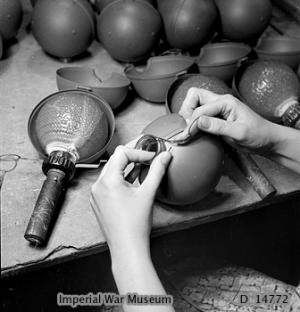
Grenades
Regular fragmentation grenadeFragmentation grenade
A fragmentation grenade is an anti-personnel weapon that is designed to disperse shrapnel upon exploding. The body is made of hard plastic or steel. Flechettes, notched wire, ball bearings or the case itself provide the fragments...
s were ineffective against tanks, so many kinds of anti-tank grenades were developed. These ranged from hollow charge designs (e.g., the British No. 68 AT Grenade
No. 68 AT Grenade
The Grenade, Rifle No. 68 /AT was a British anti-tank rifle grenade used during World War II.-Overview:The No. 68 was an early form of shaped charge grenade, and has some claim to have been the first High Explosive, Anti Tank device in use...
), to ones that simply contained a lot of explosive (the British No. 73 Grenade
No. 73 Grenade
The No. 73 grenade, also known as the Thermos or Woolworth bomb, was a British anti-tank grenade used during the Second World War. It got its nickname from the resemblance to a Thermos flask.-Development:...
). To increase their effectiveness, some grenades were designed so that they adhered to the tank either through an adhesive (sticky bomb
Sticky bomb
The Grenade, Hand, Anti-Tank No. 74, commonly known as the sticky bomb, was a British hand grenade designed and produced during the Second World War. The grenade was one of a number of anti-tank weapons developed for use by the British Army and Home Guard as an ad hoc solution to a lack of...
) or with a magnet. The Germans used a magnetic grenade, the Hafthohlladung
Hafthohlladung
The Hafthohlladung, also known as the "Panzerknacker" was a shaped charge anti-tank grenade used by German forces in World War II.-Details:...
to ensure that the shaped charge
Shaped charge
A shaped charge is an explosive charge shaped to focus the effect of the explosive's energy. Various types are used to cut and form metal, to initiate nuclear weapons, to penetrate armor, and in the oil and gas industry...
would fire at the optimal 90° angle to the armour.
There was also a special type of grenade called the Nebelhandgranaten or Blendkörper ("smoke hand grenades"), which was supposed to be smashed over an air vent and fill the tank with smoke, widely used by both sides in World War II
World War II
World War II, or the Second World War , was a global conflict lasting from 1939 to 1945, involving most of the world's nations—including all of the great powers—eventually forming two opposing military alliances: the Allies and the Axis...
. Molotov cocktails also saw much use, especially in the Winter War
Winter War
The Winter War was a military conflict between the Soviet Union and Finland. It began with a Soviet offensive on 30 November 1939 – three months after the start of World War II and the Soviet invasion of Poland – and ended on 13 March 1940 with the Moscow Peace Treaty...
, early tanks (such as the T-26
T-26
The T-26 tank was a Soviet light infantry tank used during many conflicts of the 1930s as well as during World War II. It was a development of the British Vickers 6-Ton tank and is widely considered one of the most successful tank designs of the 1930s....
) being very vulnerable to them, but later tanks required a well-thrown bottle directly over the engine compartment to have any effect at all.
On the whole, thrown anti-tank weapons suffered from a variety of drawbacks. In addition to the inherently short range, they required careful aim to be effective, and those that relied on explosive force were often so powerful that the user had to take cover immediately.
Tactics
Anti-tank tactics developed rapidly during the war, but along different paths in different armies based on the threats they faced, and the technologies they were able to produce. Very little development took place in UK because weapons available in 1940 were judged adequate for engaging Italian and German tanks during most of the North African CampaignNorth African campaign
During the Second World War, the North African Campaign took place in North Africa from 10 June 1940 to 13 May 1943. It included campaigns fought in the Libyan and Egyptian deserts and in Morocco and Algeria and Tunisia .The campaign was fought between the Allies and Axis powers, many of whom had...
. Its experience therefore failed to influence US Army's anti-tank doctrine prior to 1944.
From 1941 German anti-tank tactics developed rapidly as a result of being surprised by the previously unknown Soviet tank designs, forcing introduction of new technologies, and new tactics. The Red Army was also faced with a new challenge in anti-tank warfare after losing most of its tank fleet and a considerable part of its anti-tank capable cannons.
Anti-tank tactics during the war were largely integrated with the offensive or defensive posture of the troops being supported, usually infantry. Much of anti-tank tactics depend on the range effectiveness of various weapons and weapon systems available. These are divided as follows:
- Operational range over the horizon (20–40 km range) – bomber aircraft and long range artillery
- Tactical staging areas (7–20 km range) – ground attack aircraft and field artillery including MRLMultiple rocket launcherA multiple rocket launcher is a type of unguided rocket artillery system. Like other rocket artillery, multiple rocket launchers are less accurate and have a much lower rate of fire than batteries of traditional artillery guns...
s - Tactical zone forming-up area and rear combat zone (2–7 km range) – heavy anti-tank guns and mortars
- Tactical forward combat zone (1–2 km range) – anti-tank guns and tanks deployed in defense
- Engagement distance (200–1000 m range) – mines and anti-tank rifles
- Close combat distance (25–200 m range) – infantry anti-tank weapons
Although ground-to-air cooperation was not yet systematic in any army of the period, but given sufficient warning, ground attack aircraft could support ground troops even during an enemy attack in an attempt to interdict the enemy units before they come into tactical combat zone. Various bomb loads can be used depending on what type of tank unit is engaged in at the time, or who its accompanying troops are. This is an indirect form of anti-tank warfare where the tanks are denied the opportunity to even reach combat.
Field artillery was particularly effective in firing against tank formations because although they were rarely able to destroy a tank by direct penetration, they would severely crater the area preventing the tanks from moving, and therefore causing them to become nearly stationary targets for the ground attack aircraft, or disrupting the enemy schedule and allowing own troops more time to prepare their defense.
Anti-tank defense proper was, by 1942, designed in First World War fashion with several prepared trench lines incorporating anti-tank weapons of different capabilities. Depending on terrain and available line-of-sight, the longer-ranged guns could begin to fire on approaching tanks from as far as 2 kilometers, which was also the range at which German Panther and Tiger tank gunners were trained to fire. Anti-tank guns were usually deployed to cover terrain more suitable for tanks, and were protected by minefields laid at about 500 meters to 1 kilometer from their positions by combat engineers. In the Red Army the anti-tank rifle units would be positioned throughout the forward trench line, and would engage the lighter tanks and any other vehicles, such as infantry half-tracks, in an attempt to separate them from the tanks. The anti-tank guns deployed further back would often hold their fire until enemy tanks were within the most effective range for their ammunition. Where there were insufficient anti-tank weapons, engineers would construct anti-tank obstacles such as "dragon's teeth"
Dragon's teeth (fortification)
Dragon's teeth are square-pyramidal fortifications of reinforced concrete first used during the Second World War to impede the movement of tanks and mechanised infantry...
.
Towed anti-tank guns were thought to be the primary means of defeating tanks. At battle of Kursk
Battle of Kursk
The Battle of Kursk took place when German and Soviet forces confronted each other on the Eastern Front during World War II in the vicinity of the city of Kursk, in the Soviet Union in July and August 1943. It remains both the largest series of armored clashes, including the Battle of Prokhorovka,...
, for example, the Red Army deployed more artillery regiments than infantry regiments, and towed gun densities reached over 20 guns per kilometer of defended tactical zone. A towed gun was much cheaper than a tank, and could be concealed in a shallow position. When time allowed, dugouts with strong overhead cover could be constructed. Guns deployed on reverse slopes and in flanking positions could take a toll of attacking tanks. However, gun crews were vulnerable to artillery and mortar HE fire and enemy infantry. Their positions had to be carefully selected and, once engaged, they generally could not redeploy. Experience strongly suggested that towed AT guns were less effective than self-propelled AT weapons and took heavier casualties.
Self-propelled anti-tank guns were rare at the beginning of WW2, although the Belgian Army
Belgian Army
The Land Component is organised using the concept of capacities, whereby units are gathered together according to their function and material. Within this framework, there are five capacities: the command capacity, the combat capacity, the support capacity, the services capacity and the training...
deployed a few T.15 tank destroyers and the French army was developing several wheeled and tracked designs. The advantages of mobility and even thin armour protection were so compelling, however, that most armies were using self-propelled AT guns by mid-war. Examples of these weapons included the US M10, German Marder II, and Soviet SU-85
SU-85
The SU-85 was a Soviet self-propelled gun used during World War II, based on the chassis of the T-34 medium tank. Earlier Soviet self-propelled guns were meant to serve as either assault guns, such as the SU-122, or as mobile anti-tank weapons; the SU-85 fell into the latter category...
.
The British Army had abandoned the anti-tank rifle by 1942, and the Wehrmacht by 1943, while the US Army never adopted the weapon, though the USMC used Boys anti-tank rifles in the Pacific Theatre.
The Red Army did not abandon the anti-tank rifle due to the importance it occupied in its doctrine of anti-tank in-depth defense, first demonstrated during the defense of Moscow, and again during the Kursk battles. This became particularly true later in the war when the Red Army assumed an almost constant offensive, and anti-tank in-depth defensive deployments were used for protecting flanks of the operational breakthroughs against German tactical counterattacks. By firing on the lighter armoured infantry and support vehicles (e.g. artillery tractor
Artillery tractor
Artillery tractor is a kind of tractor, also referred to as a gun tractor, a vehicle used to tow artillery pieces of varying weights.-Traction:...
s) the anti-tank rifle units helped to separate the supporting infantry (panzergrenadiers) and artillery of the German tanks and so forcing the tanks to halt at short distances from the concealed anti-tank guns and leaving them exposed to fire from larger, longer ranged anti-tank guns. PTRS-41 semi-automatic anti-tank rifles were also used for sniping since an additional tracer round enabled rapid fire adjustment by the gunner. Although optical sniper scopes were tried with the PTRS-41, the weapons proved too inaccurate at sniping distances (800 m or more), and the recoil to much for effective use of the scopes.
Infantry close assault
The tank is still vulnerable to infantry, especially in close country or built-up areas. Rough terrain may expose the floor armour, and high ground such as multi-story buildings may expose the top armour. Their large size and loud noise can allow enemy infantry to spot, track, and evade tanks until an opportunity presents itself for counter-attack.Because tank crews have limited visibility from inside the tank, infantry can get close to a tank given enough concealment and if the hatches are closed. If tank crewmen unbutton for better visibility they become vulnerable to small arms fire. An infantryman cannot be targeted by a tank's main gun when close as it cannot depress sufficiently. Close defense weapons such as pistol ports, hull-, coaxial- and pintle-mounted machine guns gave them some protection however.
Whilst many hand-held infantry anti-tank weapons will not penetrate the front armour of a tank, they may penetrate the less heavily armoured top, rear, and sides. Damage to the tracks or running gear can inflict a mobility kill
Mobility kill
A mobility kill in armoured warfare refers to a weapon or vehicle that is immobilized, or the act of immobilizing such a target. Typically this term is used to refer to tanks and other armoured fighting vehicles that have their engines, tracks, or running gear damaged...
. Early WWII tanks had open vision slits which could be fired through to kill the crew. Later tanks' slits had thick glass, as well as sights and periscopes which could still be damaged with powerful small arms such as anti-tank rifle
Anti-tank rifle
An anti-tank rifle is a rifle designed to penetrate the armour of vehicles, particularly tanks. The usefulness of rifles for this purpose ran from the introduction of tanks in World War I and until the Korean War...
s and heavy machine gun
Heavy machine gun
The heavy machine gun or HMG is a larger class of machine gun generally recognized to refer to two separate stages of machine gun development. The term was originally used to refer to the early generation of machine guns which came into widespread use in World War I...
s, hampering the crew. If all else fails, the hatch could also be forced open and grenades thrown inside, although later tank designs often have hatches designed to be difficult to open from the outside.
Tanks were also vulnerable to hand-placed anti-tank mines. Infantry have even immobilised tanks using a set of plates covered with leaves and dirt as dummy mines – the ruse being augmented by the crew's obscured vision – infantry can then attack the stopped tank. This tactic was taught to the British Home Guard
British Home Guard
The Home Guard was a defence organisation of the British Army during the Second World War...
during World War II since they were not often provided with long-range anti-tank weapons.
In some cases in World War II, a tactic of the some infantry was to run directly up to a tank, avoiding their main and machine guns, and pour petroleum over and into the tank and light it, sometimes blocking the exit, burning the crew alive. Used by Soviet and German infantry respectively.
In the Japanese army, the use of satchel charges and pole charges was widespread. Although the charges could knock out any allied tank, the tactic was extremely close-range, and the sappers were vulnerable to all allied weapons.
Korean War
The Korean WarKorean War
The Korean War was a conventional war between South Korea, supported by the United Nations, and North Korea, supported by the People's Republic of China , with military material aid from the Soviet Union...
highlighted the difficulties that can arise with tank forces when vulnerable logistical support is combined with poor terrain
Terrain
Terrain, or land relief, is the vertical and horizontal dimension of land surface. When relief is described underwater, the term bathymetry is used...
. In the early stages of the war, North Korea
North Korea
The Democratic People’s Republic of Korea , , is a country in East Asia, occupying the northern half of the Korean Peninsula. Its capital and largest city is Pyongyang. The Korean Demilitarized Zone serves as the buffer zone between North Korea and South Korea...
's well-equipped tank divisions were pushed back to the Yalu River
Yalu River
The Yalu River or the Amnok River is a river on the border between North Korea and the People's Republic of China....
, the border with China
China
Chinese civilization may refer to:* China for more general discussion of the country.* Chinese culture* Greater China, the transnational community of ethnic Chinese.* History of China* Sinosphere, the area historically affected by Chinese culture...
, by superior American air power combined with artillery and infantry support. However, when the Chinese entered the war, they managed to reverse the American advances with infantry
Infantry
Infantrymen are soldiers who are specifically trained for the role of fighting on foot to engage the enemy face to face and have historically borne the brunt of the casualties of combat in wars. As the oldest branch of combat arms, they are the backbone of armies...
power alone. Because of the terrain and the need to keep the tanks supplied, American tanks were limited to two main roads. The Chinese merely occupied the land between the roads and harried the American supply lines and troop transports along the road. The Chinese infantry stuck to land that was impassable to tanks, such as rocky prominences and rice paddies, neutralizing the advantage of both American armoured divisions and air support.
In the U.S., the 2.36 in (59.9 mm) M9A1 bazooka
Bazooka
Bazooka is the common name for a man-portable recoilless rocket antitank weapon, widely fielded by the U.S. Army. Also referred to as the "Stovepipe", the innovative bazooka was amongst the first-generation of rocket propelled anti-tank weapons used in infantry combat...
rocket launcher evolved into the more powerful 3.5 in (88.9 mm) M20 "Super Bazooka", which was used to good effect against North Korean armored spearheads during the Korean War
Korean War
The Korean War was a conventional war between South Korea, supported by the United Nations, and North Korea, supported by the People's Republic of China , with military material aid from the Soviet Union...
. However, the M20 proved difficult and cumbersome to portage on foot over long distances. The Anti-Tank Aircraft Rocket, developed by the navy, also proved effective against North Korean tanks.
Cold War
In the Cold War era, HEAT became an almost universal choice outside of artillery and tank units. The British had developed the High explosive squash headHigh explosive squash head
High explosive squash head is a type of explosive ammunition that is effective against buildings and is also used against tank armour. It was fielded chiefly by the British Army as the main explosive round of its main battle tanks during the Cold War...
(HESH) warhead as a weapon for attacking fortifications during the war, and found it surprisingly effective against tanks. Although these systems allowed infantry to take on even the largest tanks, and, like HEAT, its effectiveness was independent of range, infantry typically operated at short range. A major influence in anti-tank warfare came with the development and evolution of anti-tank guided missile
Anti-tank guided missile
An anti-tank missile , anti-tank guided missile , anti-tank guided weapon or anti-armor guided weapon is a guided missile primarily designed to hit and destroy heavily-armored military vehicles....
s (ATGW) that could be fired by infantry operators, from ground vehicles and by aircraft. Increasing use of combined arms
Combined arms
Combined arms is an approach to warfare which seeks to integrate different branches of a military to achieve mutually complementary effects...
tactics allowed the attacking infantry to suppress the anti-tank crews effectively, meaning that they could typically get off only one or two shots before being countered or forced to move.
Aircraft
Cold War aircraft, such as the A-10 Thunderbolt IIA-10 Thunderbolt II
The Fairchild Republic A-10 Thunderbolt II is an American single-seat, twin-engine, straight-wing jet aircraft developed by Fairchild-Republic in the early 1970s. The A-10 was designed for a United States Air Force requirement to provide close air support for ground forces by attacking tanks,...
and SU-25 Frogfoot
Sukhoi Su-25
The Sukhoi Su-25 is a single-seat, twin-engine jet aircraft developed in the Soviet Union by the Sukhoi Design Bureau. It was designed to provide close air support for the Soviet Ground Forces. The first prototype made its maiden flight on 22 February 1975...
, have been specifically built for close air support
Close air support
In military tactics, close air support is defined as air action by fixed or rotary winged aircraft against hostile targets that are close to friendly forces, and which requires detailed integration of each air mission with fire and movement of these forces.The determining factor for CAS is...
, including tank destruction. They can use a variety of weaponry, including large-caliber anti-tank guns, air-to-surface missiles (i.e. AGM-65 Maverick
AGM-65 Maverick
The AGM-65 Maverick is an air-to-ground tactical missile designed for close-air support. It is effective against a wide range of tactical targets, including armor, air defenses, ships, ground transportation and fuel storage facilities....
), volleys of unguided rockets, and various bombs (unguided or laser-guided and with or without submunitions such as HEAT bomblets, an example of which would be the CBU-100 Cluster Bomb
CBU-100 Cluster Bomb
The CBU-100 Cluster Bomb is an American cluster bomb which is employed primarily in an anti-tank mode. It weighs 490 pounds and carries 247 Mk 118 Mod 1 bomblets....
).
Helicopters
The anti-tank helicopter armed with ATGW
Anti-tank guided missile
An anti-tank missile , anti-tank guided missile , anti-tank guided weapon or anti-armor guided weapon is a guided missile primarily designed to hit and destroy heavily-armored military vehicles....
s (Anti-Tank Guided Weapons) or anti-tank cannons is one of the biggest threats to a modern tank. The helicopter can position itself where it is not easily seen from a tank and then attack from any quarter, exposing the weaker parts of the tank's armour. The limited visibility from a closed-down tank also makes sighting a helicopter harder.
Most helicopter-launched ATGWs have sufficient range that they can under the right conditions be fired at a range too long for the tank to retaliate with its own weapons. This may change with the Israelis fielding the Lahat
LAHAT
The LAHAT is a third generation semi-active laser homing low-weight anti-tank guided missile developed since 1992 and manufactured by Israel Aerospace Industries...
missile that can be fired from the main gun of the Merkava MBT. With both anti-tank and anti-helicopter role, it does level the playing field somewhat. The Indian Arjun tank has also been modified to fire this missile. The People's Republic of China has developed 100 mm gun-launched missiles based on Russian designs such as the GP2 (based on the Russian Bastion
9M117 Bastion
The 9M117 Bastion is a Russian laser beam-riding anti-tank missile. It is used in a number of separate weapon systems including the 9K116-1 Bastion missile system , 9K118 Sheksna , Kastet and the 3UBK12 fired from the BMP-3...
). It has been reported to have successfully engaged aerial targets, as well as being an anti-tank missile. Similar missiles are available for Chinese tanks equipped with the 105 mm gun. The Russians have also displayed a similar if more advanced system in the Reflex. The system involves an automatic targeting of an aerial/land target instigated by a laser warning system.
Although putting weapons on helicopters (probably) dates back to the 1955 with the Bell 47
Bell 47
The Bell 47 is a two-bladed, single engine, light helicopter manufactured by Bell Helicopter. Based on the third Model 30 prototype, Bell's first helicopter designed by Arthur M. Young, the Bell 47 became the first helicopter certified for civilian use on 8 March 1946...
, the first specific attack helicopter
Attack helicopter
An attack helicopter is a military helicopter with the primary role of an attack aircraft, with the capability of engaging targets on the ground, such as enemy infantry and armored vehicles...
that went into mass production was the Bell AH-1 Cobra
AH-1 Cobra
The Bell AH-1 Cobra is a two-bladed, single engine attack helicopter manufactured by Bell Helicopter. It shares a common engine, transmission and rotor system with the older UH-1 Iroquois...
in 1966. The AH-1 was equipped with TOW
BGM-71 TOW
The BGM-71 TOW is an anti-tank missile. "BGM" is a weapon classification that stands for "Multiple Environment , Surface-Attack , Missile ". "TOW" is an acronym that stands for "Tube-launched, Optically-tracked, Wire command data link, guided missile"...
missiles in 1973 for anti-tank capability.
Artillery
In the last thirty years, however, a variety of artillery projectiles have been developed specifically to attack tanks. These include laser-guided projectiles, such as the US's now-cancelled Copperhead Cannon Launched Guided Projectile (CLGP), which increases the chances of a direct hit. Some of these CLGPs (including the Copperhead) have HEAT warheads instead of common HE.Guided and unguided scatter munitions and submunitions have also been developed: a single artillery shell containing a number of smaller munitions designed to attack a tank. A six-gun battery might be able to fire several hundred submunitions in a minute or two.
In one form, the shell bursts in the air above the tank and a number of shaped charge
Shaped charge
A shaped charge is an explosive charge shaped to focus the effect of the explosive's energy. Various types are used to cut and form metal, to initiate nuclear weapons, to penetrate armor, and in the oil and gas industry...
(HEAT) or HEDP (High Explosive Dual Purpose) bomblets or grenades rain down. Any that hit the tank have a good chance of causing damage, since they are attacking the thin top armour.
Another form scatters a number of small anti-tank mines in the tank's path, which probably will not penetrate the armour but can damage a track, leaving the tank immobile and vulnerable.
More sophisticated are submunitions with a homing capability. Once again the shell explodes above the tank position and dispenses a number of submunitions. The munitions contain some circuitry to identify tanks, such as IR or millimetre radar; when a tank is identified, a rocket propellant is fired to shoot the projectile at the tank. These munitions will often descend by parachute, to allow time for target acquisition and attack.
All of the above but the CLGP can be fired from medium (122/152/155-mm) artillery, both tube and rocket. There has also been development of large calibre (81 mm and larger) guided mortar munitions with both internal (e.g., IR or radar) or external (i.e., laser designator) guidance.
Missiles
Guided Missile
Guided Missile is a London based independent record label set up by Paul Kearney in 1994.Guided Missile has always focused on 'the underground', preferring to put out a steady flow of releases and developing the numerous GM events around London and beyond....
, or Anti-Tank Guided Weapon (ATGW) systems came into use in the late 1950s and 1960s that could defeat any known tank at ranges beyond that of the guns of the accompanying infantry. The United Kingdom, France, and other NATO countries were among the first to develop such weapons (e.g., the Malkara missile
Malkara missile
The Malkara missile was one of the earliest anti-tank guided missiles . It was jointly developed by Australia and the United Kingdom between 1951 and 1954, and was in service from 1958 until gradually replaced by the Swingfire missile in the late 1960s...
by the UK and Australia in 1958). The Soviet Union, and now Russia, put extensive development into these weapons; the first man-portable model to enter service was the AT-3
AT-3
AT-3 may be:* AT III, a protein in the coagulation system that is activated by Heparin* AT-3 of the Republic of China Air Force * AT-3 plane, Very Light Aircraft* AT-3 Sagger, Soviet anti-tank missile...
in 1961. The United States was one of the last, coming up with the BGM-71 TOW
BGM-71 TOW
The BGM-71 TOW is an anti-tank missile. "BGM" is a weapon classification that stands for "Multiple Environment , Surface-Attack , Missile ". "TOW" is an acronym that stands for "Tube-launched, Optically-tracked, Wire command data link, guided missile"...
in 1970.
For a time, it appeared that the tank was a dead end. A small team of infantry with a few missiles in a well-concealed position could take on a number of the largest and most expensive tanks. In the 1973 Yom Kippur War
Yom Kippur War
The Yom Kippur War, Ramadan War or October War , also known as the 1973 Arab-Israeli War and the Fourth Arab-Israeli War, was fought from October 6 to 25, 1973, between Israel and a coalition of Arab states led by Egypt and Syria...
, Soviet first-generation wire-guided missiles employed by the Egyptian forces inflicted heavy casualties on Israeli
Israel Defense Forces
The Israel Defense Forces , commonly known in Israel by the Hebrew acronym Tzahal , are the military forces of the State of Israel. They consist of the ground forces, air force and navy. It is the sole military wing of the Israeli security forces, and has no civilian jurisdiction within Israel...
tank units, causing a major crisis of confidence for tank designers.
Active protection system
Active protection system
An active protection system is a system designed to prevent sensor-based weapons from acquiring and/or destroying a target....
s such as the Russian Arena active protection system
Arena Active Protection System
The Arena is an active protection system developed at Russia's Kolomna-based Engineering Design Bureau for the purpose of protecting armoured fighting vehicles from destruction by light anti-tank weapons, anti-tank guided missiles , and missiles with top attack warheads. It uses a Doppler radar...
are starting to be more common, with similar systems such as the Israeli Iron Fist active protection system
Iron Fist Active Protection System
Iron Fist is a hard-kill active protection system designed by Israel Military Industries , with a modular design allowing adaptation to a range of platforms ranging from light utility vehicles to heavy armoured fighting vehicles. The concept was revealed by IMI in 2006 and was expected to enter...
. The tank may be on a comeback because of active defense systems, which attack missiles in mid-air. This may allow the tank to be competitive on the battlefield once again.
Guns
Of the world's major armies, only the Soviet Red ArmyRed Army
The Workers' and Peasants' Red Army started out as the Soviet Union's revolutionary communist combat groups during the Russian Civil War of 1918-1922. It grew into the national army of the Soviet Union. By the 1930s the Red Army was among the largest armies in history.The "Red Army" name refers to...
retained anti-tank guns in any significant quantity, mostly in 100 mm, 115 mm, and 125 mm calibers. The 125 mm anti-tank guns are extremely bulky and massive, and require large tractors to tow them for any significant distance. This is offset by their cheapness and potentially deadly effect, particularly now that they have been upgraded with laser rangefinders and depleted uranium
Depleted uranium
Depleted uranium is uranium with a lower content of the fissile isotope U-235 than natural uranium . Uses of DU take advantage of its very high density of 19.1 g/cm3...
ammunition. However, their tactical usefulness in many types of modern, mobile warfare is still unclear: in Desert Storm for example, tanks set up in emplacements were very vulnerable and could be spotted well in advance. In an environment with more cover, for example in urban terrain, they would be harder to spot.
Mines
Owing to greater sophistication of the tank, and engineering support available to tank units to detect and negate minefields, a considerable effort was made to develop more effective anti-tank mine technology in the effort to deny tank-led formations manoeuver space, or channel their movement into unsuitable avenues of approach.Infantry
The search for a more suitable, longer-range delivery system took up much of the immediate post-war era. The US invested in the recoilless rifleRecoilless rifle
A recoilless rifle or recoilless gun is a lightweight weapon that fires a heavier projectile than would be practical to fire from a recoiling weapon of comparable size. Technically, only devices that use a rifled barrel are recoilless rifles. Smoothbore variants are recoilless guns...
, delivering a widely-used 75 mm design, and less common 90 mm and 106 mm designs (the latter was usually mounted rather than infantry-handled). The 106 mm formed the basis of a dedicated anti-tank vehicle, the Ontos tank, which mounted six 106 mm rifles. The Soviet Union also built recoilless rifles in various calibers intended to be used as anti-tank weapons, most commonly 73 mm, 82 mm, and 110 mm (only the 73 mm remains in service with the Russian military today, though the other two can be found all over the world due to Soviet military aid during the Cold War). The British used a 120 mm (4.7 inch) design to equip infantry units, the BAT series
L6 Wombat
The L6 Wombat, was a 120 mm calibre recoilless anti-tank rifle used by the British Army. They were used until anti-tank guided missiles such as Vigilant and MILAN took their place....
, which served from the 1950s until replaced by MILAN
MILAN
MILAN " is French and German for "kite bird") is a European anti-tank guided missile. Design of the MILAN started in 1962. It was ready for trials in 1971, and was accepted for service in 1972. It is a wire guided SACLOS missile, which means the sight of the launch unit has to be aimed at the...
, but it was generally too heavy for infantry use and had to be towed by, or mounted on, a vehicle for maneuverability.
The Soviets developed the RPG-2
RPG-2
The RPG-2 was the first rocket-propelled grenade launcher designed in the Soviet Union.-Development:The RPG-2 , was a man-portable, shoulder-launched rocket-propelled grenade anti-armor weapon...
from the German Panzerfaust 150. Further development led to the ubiquitous RPG-7
RPG-7
The RPG-7 is a widely-produced, portable, unguided, shoulder-launched, anti-tank rocket-propelled grenade launcher. Originally the RPG-7 and its predecessor, the RPG-2, were designed by the Soviet Union, and now manufactured by the Bazalt company...
. The RPG-7 is one of the most widely used Anti-tank weapon, favored most by soldiers of Irregular Militaries
Irregular military
Irregular military refers to any non-standard military. Being defined by exclusion, there is significant variance in what comes under the term. It can refer to the type of military organization, or to the type of tactics used....
. The RPG-7 could fire a range of different warheads, from Thermobaric warheads to a single HEAT or Tandem-charge
Tandem-charge
A tandem-charge weapon is an explosive device or projectile that has two or more stages of detonation. It is effective against cage armor, which is designed to protect an armored vehicle against anti-tank munitions. The first stage of the weapon triggers the reactive armor of the target, limiting...
HEAT warheads against Explosive reactive armour equipped tanks. The RPG-7 has a long combat history, and has been used in most wars from the Vietnam war
Vietnam War
The Vietnam War was a Cold War-era military conflict that occurred in Vietnam, Laos, and Cambodia from 1 November 1955 to the fall of Saigon on 30 April 1975. This war followed the First Indochina War and was fought between North Vietnam, supported by its communist allies, and the government of...
all the way to present day wars. In modern times, the RPG-7 is generally used in an Urban
Urban area
An urban area is characterized by higher population density and vast human features in comparison to areas surrounding it. Urban areas may be cities, towns or conurbations, but the term is not commonly extended to rural settlements such as villages and hamlets.Urban areas are created and further...
environment, which would enhance their effectiveness due to the close ranges involved. However, the aging RPG-7 has evolved to the even more potent RPG-29
RPG-29
The RPG-29 is a Russian rocket-propelled grenade launcher. Adopted by the Soviet Army in 1989, it was the most recent weapon of its type to be adopted by the Russian military before the fall of the Soviet Union in 1991. The RPG-29 has since been supplemented by other rocket-propelled systems, such...
which has proven its worth in conflicts in the Middle East
Middle East
The Middle East is a region that encompasses Western Asia and Northern Africa. It is often used as a synonym for Near East, in opposition to Far East...
, disabling or destroying Merkava IV, Challenger 2 and M1 Abrams
M1 Abrams
The M1 Abrams is a third-generation main battle tank produced in the United States. It is named after General Creighton Abrams, former Army Chief of Staff and Commander of US military forces in Vietnam from 1968 to 1972. The M1 is a well armed, heavily armored, and highly mobile tank designed for...
Main battle tank
Main battle tank
A main battle tank , also known as a battle tank or universal tank, is a tank that fills the heavy direct fire role of many modern armies. They were originally conceived to replace the light, medium, heavy and super-heavy tanks. Development was spurred onwards in the Cold War with the development...
s.
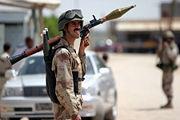
M72 LAW
The M72 LAW is a portable one-shot 66 mm unguided anti-tank weapon, designed in the United States by Paul V. Choate, Charles B. Weeks, and Frank A. Spinale et al...
rocket, a lightweight, collapsible rocket launcher with the ability to penetrate moderate thicknesses of enemy armor. During Vietnam War
Vietnam War
The Vietnam War was a Cold War-era military conflict that occurred in Vietnam, Laos, and Cambodia from 1 November 1955 to the fall of Saigon on 30 April 1975. This war followed the First Indochina War and was fought between North Vietnam, supported by its communist allies, and the government of...
, the weapon was used primarily against NVA and Viet Cong defensive works and emplacements, as there were few encounters against enemy armor. Overall, the LAW was regarded as a success, though its ignition system frequently suffered from misfires in the heat and humidity of Vietnamese jungles. The LAW has since been replaced by the AT4
AT4
The AT4 is an 84-mm unguided, portable, single-shot recoilless smoothbore weapon built in Sweden by Saab Bofors Dynamics...
(M136).
Tactics
Changes in the anti-tank tactics since the Second World War mostly came from the appearance of new technologies, and increased firepower of the infantry mounted on fully armoured vehicles. The most profound anti-tank technology has been the guided missile, which when coupled with a helicopter can mean that tanks can be engaged beyond ground line of sight (LOS), and at one of their most vulnerable aspect, the top armour.Effectiveness
The effect of anti-tank warfare is to prevent enemy tanks, and their supporting troops from manoeuvring, which is the primary capability of the tanks. In the US Army the degree of effect by an anti-tank weapon on a vehicle is referred to as either "mobility killMobility kill
A mobility kill in armoured warfare refers to a weapon or vehicle that is immobilized, or the act of immobilizing such a target. Typically this term is used to refer to tanks and other armoured fighting vehicles that have their engines, tracks, or running gear damaged...
", "firepower kill", and "catastrophic kill
Catastrophic kill
A catastrophic kill, K-Kill or complete kill refers to damage inflicted on a vehicle by a weapon that renders it both unusable and unrepairable whereas a "knocked out" vehicle is completely inoperable but not beyond repair...
". In a mobility kill (M-kill), the vehicle loses its ability to move, for example, by breaking a tank track
Caterpillar track
Continuous tracks or caterpillar tracks are a system of vehicle propulsion in which modular metal plates linked into a continuous band are driven by two or more wheels...
; the target is then immobile, but may retain full use of its weapons and still be able to fight to some extent. A firepower kill (F-kill) is some loss of the vehicle's ability to fire its weapons. M-kills and F-kills may be complete or partial, the latter corresponding to reductions in a target's ability to move or fire. A catastrophic kill (K-kill) removes the tank's ability to fight completely; this may entail complete destruction of the tank or disabling the weapon system(s) or crew.
Future
Although the future of the tank was questioned in the 1960s due to the development of the anti-tank missiles, increases in thickness and composition of armour, and other improvements in tank design meant that infantry operated systems were no longer sufficiently effective by the 1970s, and the introduction of Chobham armourChobham armour
Chobham armour is the name informally given to a composite armour developed in the 1960s at the British tank research centre on Chobham Common, Surrey, England...
by the British Army and reactive armor by the Soviet Army forced the HEAT rounds to be increased in size, rendering them less portable.
Weapon systems like the RPG-29
RPG-29
The RPG-29 is a Russian rocket-propelled grenade launcher. Adopted by the Soviet Army in 1989, it was the most recent weapon of its type to be adopted by the Russian military before the fall of the Soviet Union in 1991. The RPG-29 has since been supplemented by other rocket-propelled systems, such...
and FGM-148 Javelin
FGM-148 Javelin
The FGM-148 Javelin is a United States-made man-portable third generation anti-tank missile fielded to replace the Dragon antitank missile.-Overview:Javelin is a fire-and-forget missile with lock-on before launch and automatic self-guidance...
use a Tandem warhead where the first warhead disables reactive armor, while the second warhead defeats the shell armour by means of a HEAT or a shaped charge
Shaped charge
A shaped charge is an explosive charge shaped to focus the effect of the explosive's energy. Various types are used to cut and form metal, to initiate nuclear weapons, to penetrate armor, and in the oil and gas industry...
.
Today the anti-tank role is filled with a variety of weapons, such as portable "top attack" artillery ammunition and missiles, larger HEAT
Heat
In physics and thermodynamics, heat is energy transferred from one body, region, or thermodynamic system to another due to thermal contact or thermal radiation when the systems are at different temperatures. It is often described as one of the fundamental processes of energy transfer between...
missiles fired from ground vehicles and helicopter
Helicopter
A helicopter is a type of rotorcraft in which lift and thrust are supplied by one or more engine-driven rotors. This allows the helicopter to take off and land vertically, to hover, and to fly forwards, backwards, and laterally...
s, a variety of high velocity autocannon
Autocannon
An autocannon or automatic cannon is a rapid-fire projectile weapon firing a shell as opposed to the bullet fired by a machine gun. Autocannons often have a larger caliber than a machine gun . Usually, autocannons are smaller than a field gun or other artillery, and are mechanically loaded for a...
, and ever-larger and heavier tank guns.
One of the first lessons of the 2006 Israel-Lebanon conflict
2006 Israel-Lebanon conflict
The 2006 Lebanon War, also called the 2006 Israel-Hezbollah War and known in Lebanon as the July War #Other uses|Tammūz]]) and in Israel as the Second Lebanon War , was a 34-day military conflict in Lebanon, northern Israel and the Israeli-occupied territories. The principal parties were Hezbollah...
is the effectiveness of portable rocket propelled grenades, in particular, Russian-made RPG-29
RPG-29
The RPG-29 is a Russian rocket-propelled grenade launcher. Adopted by the Soviet Army in 1989, it was the most recent weapon of its type to be adopted by the Russian military before the fall of the Soviet Union in 1991. The RPG-29 has since been supplemented by other rocket-propelled systems, such...
, and Metis-M, Kornet
9M133 Kornet
The Kornet is a Russian anti-tank missile . It is a second generation ATGM intended to deal with main battle tanks and to engage slow and low flying helicopters, but is not intended to fully replace previous systems, due to the cost...
and European MILAN
MILAN
MILAN " is French and German for "kite bird") is a European anti-tank guided missile. Design of the MILAN started in 1962. It was ready for trials in 1971, and was accepted for service in 1972. It is a wire guided SACLOS missile, which means the sight of the launch unit has to be aimed at the...
anti-tank missiles.