
All Topics  
Landing craft

 
Landing Craft

   Email Print
   Bookmark   Link


Landing craft


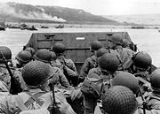
Landing craft are boat
Boat

A boat is a watercraft of modest size designed to float or plane on water, and provide transport over it. Usually this water will be inland or in protected coastal areas....
s and seagoing vehicles used to convey a landing force (infantry
Infantry

Infantry are soldiers who are primarily trained for the role of fighting on foot. A soldier in the infantry is known as an infantryman. Infantry units have more physically demanding training than other branches of armies, and place a greater emphasis on fitness, physical strength and aggression....
 and vehicles) from the sea to the shore during an amphibious assault
Amphibious warfare

Amphibious warfare is the utilization of naval firepower, logistics and strategy to project military power ashore. In previous eras it stood as the primary method of delivering troops to non-contiguous enemy-held terrain....
. Most renowned are those used to storm the beaches of Normandy
Normandy

Normandy is a geographical region corresponding to the former Duchy of Normandy. It is situated along the coast of France south of the English Channel between Brittany and Picardy and comprises territory in northern France and the Channel Islands....
, the Mediterranean, and many Pacific islands
Pacific Islands

The Pacific Ocean contains an estimated 20,000 to 30,000 islands . Those islands lying south of the tropic of Cancer but excluding Australia are traditionally grouped into three divisions: Melanesia, Micronesia, and Polynesia....
 during WWII
World War II

World War II, or the Second World War , was a global military conflict which involved a Participants in World War II, including all of the great powers, organised into two opposing military alliances: the Allies of World War II and the Axis powers....
.


Discussion
Ask a question about 'Landing craft'
Start a new discussion about 'Landing craft'
Answer questions from other users
Full Discussion Forum


Recent Posts


Encyclopedia


Lcu 1656 Uss Bataan (lhd 5) August 31, 2005
Landing craft are boat
Boat

A boat is a watercraft of modest size designed to float or plane on water, and provide transport over it. Usually this water will be inland or in protected coastal areas....
s and seagoing vehicles used to convey a landing force (infantry
Infantry

Infantry are soldiers who are primarily trained for the role of fighting on foot. A soldier in the infantry is known as an infantryman. Infantry units have more physically demanding training than other branches of armies, and place a greater emphasis on fitness, physical strength and aggression....
 and vehicles) from the sea to the shore during an amphibious assault
Amphibious warfare

Amphibious warfare is the utilization of naval firepower, logistics and strategy to project military power ashore. In previous eras it stood as the primary method of delivering troops to non-contiguous enemy-held terrain....
. Most renowned are those used to storm the beaches of Normandy
Normandy

Normandy is a geographical region corresponding to the former Duchy of Normandy. It is situated along the coast of France south of the English Channel between Brittany and Picardy and comprises territory in northern France and the Channel Islands....
, the Mediterranean, and many Pacific islands
Pacific Islands

The Pacific Ocean contains an estimated 20,000 to 30,000 islands . Those islands lying south of the tropic of Cancer but excluding Australia are traditionally grouped into three divisions: Melanesia, Micronesia, and Polynesia....
 during WWII
World War II

World War II, or the Second World War , was a global military conflict which involved a Participants in World War II, including all of the great powers, organised into two opposing military alliances: the Allies of World War II and the Axis powers....
. This was the high point of the landing craft, with a significant number of different designs produced in large quantities by the United Kingdom
United Kingdom

The United Kingdom of Great Britain and Northern Ireland, commonly known as the United Kingdom , the UK or Britain,is a sovereign state located off the northwestern coast of continental Europe....
 and United States
United States

The United States of America is a Federal government constitutional republic comprising U.S. state and a federal district. The country is situated mostly in central North America, where its Contiguous United States and Washington, D.C., the Capital districts and territories, lie between the Pacific Ocean and Atlantic Oceans, Borders of the U...
.

Because of the need to run up onto a suitable beach, WWII landing craft were flat-bottomed, and many designs had a flat front, often with a lowerable ramp, rather than a normal bow
Bow (ship)

The bow is a List of nautical terms that refers to the forward part of the hull of a ship or boat, the point that is most forward when the vessel is underway....
. This made them difficult to control and very uncomfortable in rough seas. The control point (bridge
Bridge (ship)

The bridge of a ship is an area or room from which the ship can be commanded. When a ship is underway, the ship's Captain or a senior officer is on the bridge at all times to maintain command and control....
 was far too fancy a description for the facilities of the LCA and DUKW) was normally situated at the extreme rear of the vessel as were the engines. In all cases they tended to be known by an abbreviation
Abbreviation

An abbreviation is a shortened form of a word or phrase. Usually, but not always, it consists of a letter or group of letters taken from the word or phrase....
 derived from the official name rather than by the full title.

Origin

In the days of sail, the ship's boats were used as landing craft. These rowing boats were sufficient, if inefficient, in an era when marine corps
Marine corps

Marines are military forces optimised for operations at sea. Historically marine forces are part of a navy. However, in some countries the marine force is under independent command....
 were effectively light infantry
Light infantry

Traditionally light infantry were soldiers whose job was to provide a skirmishing screen ahead of the main body of infantry, Harassment and delaying the enemy advance....
, participating mostly in small-scale campaigns in far-flung colonies
Colony

In politics and in history, a colony is a Territory under the immediate political control of a state. For colonies in antiquity, city-states would often found their own colonies....
 against inferiorly-equipped 'native' opponents.

However during World War I
World War I

World War I, or the First World War , was a global military conflict which involved the Great powers, organized into two opposing military alliances: the Allies of World War I and the Central Powers....
, mass mobilization of troops equipped with rapid-fire weapons quickly rendered such boats obsolete; after the disastrous landing phase of the Battle of Gallipoli
Battle of Gallipoli

The Gallipoli Campaign took place at Gallipoli peninsula in Turkey from 25 April 1915 to 9 January 1916, during the World War I. A joint British Empire and French operation was mounted to capture the Ottoman Empire capital of Constantinople , and secure a sea route to Russia....
 in 1915, military powers around the world tended to avoid large-scale amphibious warfare
Amphibious warfare

Amphibious warfare is the utilization of naval firepower, logistics and strategy to project military power ashore. In previous eras it stood as the primary method of delivering troops to non-contiguous enemy-held terrain....
 altogether.

The British produced a landing craft in 1920 that could put their then-current medium tank directly onto a beach. From 1924 it was used with landing boats in annual exercises in amphibious landings. It would later be given the name "Landing Craft, Mechanized" (abbreviated to LCM). In the 1930s the British Army
British Army

The British Army is the Army branch of the British Armed Forces. It came into being with the unification of the Kingdoms of Kingdom of England and Kingdom of Scotland into the Kingdom of Great Britain in 1707....
 carried out divisional sized amphibious landing exercises. A boat for landing infantry, the Landing Craft Assault
Landing Craft Assault

The Landing Craft Assault was the British and Commonwealth landing craft of the Second World War. It was the main small landing craft used to put troops ashore on Omaha Beach, Utah Beach, Juno Beach, Gold Beach and Sword Beaches....
, was drawn up after research by the Inter-Service Training and Development Centre in 1938.

In the United States, the interest in amphibious warfare was revived during the late 1930s, when the United States Marine Corps
United States Marine Corps

The United States Marine Corps is a branch of the United States Armed Forces responsible for providing Military power projection from the sea, using the mobility of the United States Navy to rapidly deliver Marine Air-Ground Task Force....
 became interested in the military potential of Andrew Higgins
Andrew Higgins

Andrew Jackson Higgins was the founder and owner of Higgins Industries, the New Orleans, Louisiana-based manufacturer of "Higgins boats" during World War II....
's design of a powered, shallow-draught
Draft (hull)

The draft of a ship's Hull is the vertical distance between the waterline and the bottom of the hull , with the thickness of the hull included; in the case of not being included the draft outline would be obtained....
 boat. These LCVP
LCVP

The Landing Craft, Vehicle, Personnel or Higgins boat was a landing craft used extensively in World War II. The craft was designed by Andrew Higgins of Louisiana, United States based on boats made for operating in swamps and marshes....
s, dubbed the 'Higgins Boats', were developed to a final design with a ramp and were produced in large numbers.

Types

Nine-ton Landing Craft Navigation (LCN) were used by British "Combined Operations Assault Pilotage Parties" (Royal Marine and Special Boat Service
Special Boat Service

The Special Boat Service is the special forces unit of the British Royal Navy. The service's motto is "By Strength and Guile". It forms part of the United Kingdom Special Forces group, alongside the Special Air Service , Special Reconnaissance Regiment , Special Forces Support Group and 18 Signal Regiment....
 crew) for surveying landing sites.

The "Landing Craft Control" (LCC) or were 56-foot U.S. Navy
United States Navy

The United States Navy is the navy of the United States Armed Forces. It is one of the seven uniformed services of the United States. The U.S. Navy currently has approximately 331,682 personnel on active duty as of 31 December 2008 and 124,000 in the United States Navy Reserve....
 vessels, carrying only the crew (Scouts and Raiders) and newly-developed radar. Their main job was to find and follow the safe routes in to the beach, lanes which had been cleared of obstacles and mines. There were 8 in the entire Normandy invasion (two per beach). After leading in the first wave, they were to head back out and bring in the second wave. After that, they were used as all-purpose command and control assets during the invasion. The smallest landing craft were amphibians such as the U.S.
United States

The United States of America is a Federal government constitutional republic comprising U.S. state and a federal district. The country is situated mostly in central North America, where its Contiguous United States and Washington, D.C., the Capital districts and territories, lie between the Pacific Ocean and Atlantic Oceans, Borders of the U...
-designed DUKW
DUKW

The DUKW is a six-wheel-drive amphibious vehicle that was designed by General Motors Corporation during World War II for transporting goods and troops over land and water and for use approaching and crossing beaches in amphibious warfare attacks....
, basically an amphibious truck, and the Landing Vehicle Tracked
Landing Vehicle Tracked

The Landing Vehicle Tracked was an amphibious warfare vehicle used by the United States Navy, United States Marine Corps and United States Army during World War II....
, an amphibious armoured personnel carrier. These were operated by Army personnel, not naval crews. They had a capacity of about three tons. The British introduced their own amphibian the Terrapin
Terrapin (amphibious vehicle)

The Terrapin "4-ton amphibian" was a United Kingdom manufactured, amphibious armoured transport of the Second World War. It was first used at Antwerp in 1944, and to great effect during the Battle of the Scheldt....
 into use after the landings.

Of the landing craft proper the smallest were the U.S. Landing Craft Personnel, Large (10 tons) and the British Landing Craft Assault
Landing Craft Assault

The Landing Craft Assault was the British and Commonwealth landing craft of the Second World War. It was the main small landing craft used to put troops ashore on Omaha Beach, Utah Beach, Juno Beach, Gold Beach and Sword Beaches....
 (LCA) (13 tons). These were small craft intended to be transported around by larger vessels then lowered into the water off the target beach. Typically they could carry 36 fully armed soldiers. The LCPL sometimes came with an enclosed cockpit and was often used as a command boat. It lacked a loading ramp which the LCA did have.

The U.S. Landing Craft Vehicle/Personnel
LCVP

The Landing Craft, Vehicle, Personnel or Higgins boat was a landing craft used extensively in World War II. The craft was designed by Andrew Higgins of Louisiana, United States based on boats made for operating in swamps and marshes....
 (LCVP), also known as a Higgins Boat, was a more flexible variant of the LCPL with a wide ramp — it could carry 36 troops or a small vehicle such as a Jeep, or a corresponding amount of cargo.

Landing Craft, Mechanized
Landing Craft Mechanized

The Landing Craft Mechanized or Landing Craft Mechanical was a landing craft designed for carrying vehicles. They came to prominence during the Second World War when they were used to land troops or tanks during Allies amphibious assaults....
 were larger (36 tons), capable of carrying one small tank
Tank

A tank is a Continuous track, armoured fighting vehicle designed for front-line combat which combines operational mobility and Military tactics Offensive and defence capabilities....
 or 100 troops.

None of the above was capable of making a voyage longer than about 6-12 hours, mainly through fuel limitations. The Landing Craft Utility
Landing Craft Utility

The Landing Craft Utility is a type of boat used by amphibious forces to transport equipment and troops to the shore. They are capable of transporting Tracked vehicle or wheeled vehicles and troops from amphibious assault ships to beachheads or Dock ....
 (LCU) is used transport equipment and troops to the shore. They are capable of transporting tracked or wheeled vehicles and troops from amphibious assault ships to beachheads or piers.

Landing Craft Infantry Lci(l)196
Then came the Landing Craft Infantry
Landing Craft Infantry

The Landing craft, Infantry or LCI were several classes of sea-going amphibious assault ships of the Second World War utilized to land large numbers of infantry directly onto beaches....
 (Large) or LCI(L), capable of making serious voyages under its own power (some were sailed directly from the United Kingdom
United Kingdom

The United Kingdom of Great Britain and Northern Ireland, commonly known as the United Kingdom , the UK or Britain,is a sovereign state located off the northwestern coast of continental Europe....
 to take part in the Operation Torch
Operation Torch

Operation Torch was the United Kingdom-United States invasion of French North Africa in World War II during the North African Campaign, started 8 November 1942....
 landings, and U.S. Navy LCIs island hopped
Island hopping

Island hopping is a term that has several different definitions as it is applied in various fields. Generally, the term refers to the means of crossing an ocean by a series of shorter journeys between islands, as opposed to a single journey directly across the ocean to the destination....
 across the Pacific). LCI(L)s were about 158 feet long and 23 feet wide and carried around 200 troops. There were several sub-types of the craft, with the LCI(L) infantry carrier dominating; but LCIs also served as rocket (LCI(R)) and mortar (M), and gunboat (G) platforms, as well as a flotilla flagship (FF). While still intended to run up on the beach, these tended to have a normal type bow with stepped ramps each side for the troops to disembark. The LCI was re-classified Landing Ship Infantry (LSI) by the U.S. in 1949.

Of a similar size was the Landing Craft Tank
Landing craft tank

The Landing Craft, Tank was an amphibious assault ship for landing tanks on beachheads. The first examples appeared during the Second World War....
, which could carry up to 4 Tank
Tank

A tank is a Continuous track, armoured fighting vehicle designed for front-line combat which combines operational mobility and Military tactics Offensive and defence capabilities....
s or other vehicles. These had a ramp at the front which was dropped for the vehicles to get ashore. Behind the ramp was an open space known as the Tank Deck. There were several different designs and sizes varied.

The next step was the Landing Ship Tank
Tank landing ship

Landing Ship, Tank was the military designation for naval vessels created during World War II to support amphibious operations by carrying significant quantities of vehicles, cargo, and landing troops directly onto an unimproved shore....
. This carried more vehicles than the LCT (20 in the US-built versions) and had normal looking bows, although the bows were actually formed by doors which were opened for the unloading ramp to drop. Fully loaded, these displaced more than 3,000 tons, rather more than any Royal Navy
Royal Navy

The Royal Navy of the United Kingdom is the oldest of the British Armed Forces . From the mid-18th century until well into the 20th century, it was the most powerful navy in the world, playing a key part in establishing the British Empire as the dominant world power from 1815 until the early 1940s....
 destroyers of the period.

Finally there was the Landing Ship Dock
Dock landing ship

A Dock landing ship or Landing ship is a form of auxiliary warship designed to support amphibious operations. These amphibious assault ships transport and launch amphibious craft and vehicles with their crews and embarked personnel....
, which had a large open compartment at the back. Opening a stern
Stern

The stern is the rear or aft part of a ship or boat, technically defined as the area built up over the sternpost, extending upwards from the counter to the taffrail....
 door and flooding special compartments allowed this area to be open to the sea and LCI-sized vessels could enter or leave.

Initial British
United Kingdom

The United Kingdom of Great Britain and Northern Ireland, commonly known as the United Kingdom , the UK or Britain,is a sovereign state located off the northwestern coast of continental Europe....
 nomenclature used different type names leading to alternate names such as Assault Landing Craft, Infantry Landing Craft and Tank Landing Craft.

Due to their rather small size the majority were not given names and were simply given serial numbers, e.g., LCT 304. The LSTs were an exception to this being much the same size as a small cruiser
Cruiser

A cruiser is a large type of warship, which had its prime period from the late 19th century to the end of the Cold War. The first cruisers were intended for individual raiding and protection missions on the seas....
. Three British-built LSTs were named as well, HMS Boxer
HMS Boxer (1941)

HMS Boxer was built as a Landing Ship, Tank at Harland and Wolff. Launched in December 1942 and commissioned the following April, she saw service as part of the Allies Allied invasion of Italy....
, Bruiser and Thruster which were somewhat larger than the U.S. design; they also had proper funnels.

Armament

DUKWs, LCAs and LCMs had no fixed armament, but there were ways for troops on board to use their own weapons.

LCIs and LCTs carried weapons such as the Oerlikon 20 mm cannon
Oerlikon 20 mm cannon

The term "Oerlikon 20 mm cannon" refers to a series of autocannons, based on an original designed by Reinhold Becker during World War I, and widely produced by Oerlikon Contraves and others....
 each side of the bridge structure. LSTs had a somewhat heavier armament.

Imperial Japanese Navy landing craft

The Imperial Japanese Navy
Imperial Japanese Navy

The origins of the Imperial Japanese Navy trace back to early interactions with nations on the Asia, beginning in the early history of Japan#Feudal Japan and reaching a peak of activity during the 16th and 17th centuries at a time of cultural diffusion with European power during the Age of Discovery....
 operated the following landing craft during World War II
World War II

World War II, or the Second World War , was a global military conflict which involved a Participants in World War II, including all of the great powers, organised into two opposing military alliances: the Allies of World War II and the Axis powers....
  • Chuhatsu Class
  • Daihatsu Class
  • Mokusei Daihatsu Class
  • Shohatsu Class
  • Toku Daihatsu Class


Special purpose craft

Some Landing craft were converted for special purposes either to give defence for the other landing craft in the attack or as support weapons during the landing.

Landing Craft Assault (Hedgerow)

The LCA(HR) was a conversion of the British LCA which carried 24 spigot mortars
Mortar (weapon)

A mortar is a Muzzleloader indirect fire weapon that fires shell at low velocities, short ranges, and high-arcing Ballistics trajectories. It typically has a barrel length less than 15 times its caliber....
, the Royal Navy's Hedgehog anti-submarine weapon
Hedgehog (weapon)

The Hedgehog was an anti-submarine weapon developed by the Royal Navy during World War II, that was deployed on convoy escort warships such as destroyers to supplement the depth charge....
 instead of personnel. The mortars were fired as a barrage onto the beach to clear mines and other obstructions. Having discharged its mortars and its duty the LCA(HR) would then leave the beach area. They were towed to the beach by larger craft such as the LCT which would carry the assault teams of the Royal Engineers with their specialist vehicles and equipment
Hobart's Funnies

Hobart's Funnies were a number of unusually modified tanks operated during World War II by the United Kingdom's 79th Armoured Division or by specialists from the Royal Engineers....
 to complete the beach clearance.

There were 3 flotillas (of 18, 18 and 9 craft) used across Juno, Gold and Sword beaches.

Landing Craft Gun

The Landing Craft Gun (LCG) was similar and was intended to give supporting fire to the landing. Apart from the Oerlikons as per a normal LCT they had two 4.7 inch destroyer guns. Crewing was similar to the LCF. LCGs played a very important part in the Walcheren
Walcheren

Media:Nl-Walcheren.ogg is a former island in the province of Zeeland in the Netherlands at the mouth of the Scheldt estuary. It lies between the Oosterschelde in the north and the Westerschelde in the south and is roughly the shape of a rhombus....
 operation in October 1944.

Landing Craft Flak

The Landing Craft Flak (LCF) was a conversion of the LCT intended to give anti-aircraft support to the landing. They were first used in the Dieppe Raid
Dieppe Raid

The Dieppe Raid, also known as The Battle of Dieppe or Operation Jubilee, during the World War II, was an Allies of World War II attack on the German-occupied port of Dieppe, Seine-Maritime on the Northern coast of France on 19 August 1942....
 early in 1942. The ramp was welded shut, and a deck built on top of the Tank deck. They were equipped with several light anti-aircraft guns—a typical fitting was eight 20 mm Oerlikons
Oerlikon 20 mm cannon

The term "Oerlikon 20 mm cannon" refers to a series of autocannons, based on an original designed by Reinhold Becker during World War I, and widely produced by Oerlikon Contraves and others....
 and four QF 2 pdr "pom-poms"
QF 2 pounder naval gun

The 2-pounder gun, officially designated the QF 2-pounder and universally known as the pom-pom, was a 1.575 inch United Kingdom autocannon, used famously as an Anti-aircraft warfare by the Royal Navy....
 and had a crew of 60. Royal Navy examples had mixed crews, with the operation of the craft being the responsibility of RN crew and the manning of the guns being done by Royal Marines
Royal Marines

The Royal Marines are the marine and amphibious warfare infantry of the United Kingdom and, along with the Royal Navy and Royal Fleet Auxiliary, form the Naval Service....
. They carried two naval officers and two marine officers.

Landing Craft Rocket

Finally there was the Landing Craft Rocket, known as the Landing Craft Tank (Rocket) (LCT(R)) to denote that it was a modified LCT.

This had a large set of launchers for the British RP-3
RP-3

The RP-3 , was a United Kingdom rocket used in the Second World War. Though primarily an air-to-ground weapon, it saw limited use in other roles....
 60 lb (27 kg), 3 in (76 mm) rockets mounted on the covered-over tank deck. The full set of launchers was "in excess of" 1,000 and reloads totaling 5,000 rockets were kept below. The firepower was claimed to be equivalent to 80 light cruiser
Light cruiser

A light cruiser is a warship. The term is a shortening of the phrase "light armoured cruiser", describing a small ship that carried armour in the same way as an armoured cruiser: a protective belt and deck....
s or 200 destroyers.

The method of operation was to anchor off the target beach, pointing towards the shore. The distance to the shore was then measured by radar
Radar

Radar is a system that uses electromagnetic radiation waves to identify the range, altitude, direction, or speed of both moving and fixed objects such as aircraft, ships, motor vehicles, weather formations, and terrain....
 and the elevation of the launchers set accordingly. The crew then vanished below (apart from the commanding officer who retreated to a special cubby hole to control things) and the launch was then set off electrically. The launch could comprise the entire set or individual ranks of rockets.

A full reload was a very labor-intensive operation and at least one LCT(R) went alongside a cruiser and got a working party from the larger ship to assist in the process.

Landing Craft Support

The Landing craft Support were used to give some firepower close in.

The Landing Craft Support (Medium), LCS(M), Mark 2 and Mark 3 were used at Normandy. The crew was Royal Navy with Royal Marines to operate the weapons: two 0.5 inch Vickers machine gun
Vickers machine gun

The Vickers machine gun or Vickers gun is a name primarily used to refer to the Water cooling .303 British machine gun produced by Vickers Limited, originally for the British Army....
s and a 4-inch mortar to fire smoke shells.

The Landing Craft Support (Large) was a converted Landing Craft, Infantry (Small). Armour was added to its wooden hull and a turret with an anti-tank gun fitted. The LCS(L) Mark 1, had a 2–pdr (40 mm) gun in a Daimler armoured car
Daimler Armoured Car

The Daimler Armoured Car was a United Kingdom Armored car of the Second World War....
 turret. The Mark 2s had a 6–pdr (57 mm) anti–tank gun.

Amphibious mechanized utility and landing craft

The mechanized utility and landing craft, more commonly known as an amphibious landing craft or boat. This was the kind used during the second world war, and while the mechanized landing crafts of today are similar in construction, a lot of improvements have been made. Normally using diesel engines, the best amphibious landing boats (such as the LCM 8 of the US Navy) are capable of a military lift of 183 metric tons at a speed of 22 km/h, carrying even heavy equipment like M1 Abrams
M1 Abrams

The M1 Abrams is a Tank classification#Main battle tank produced in the United States. The M1 is named after General Creighton Abrams, former Army Chief of Staff of the United States Army and Commander of US military forces in Vietnam from 1968 to 1972....
 tanks with little trouble. Amphibious landing craft normally mount several machine gun
Machine gun

A machine gun is a Automatic firearm mounted or portable firearm, usually designed to fire List of rifle cartridgess in quick succession from an Belt or large-capacity Magazine , typically at a rate of several hundred rounds per minute....
s or similar weapons for the defense of troops and/or vehicle crews inside.

Inflatable landing craft


Inflatable boat
Inflatable boat

An inflatable boat is a lightweight boat constructed with its sides and bow made of flexible tubes containing pressurised gas. For smaller boats, the floor and hull beneath it is often flexible....
s were often used to transport amphibious troops from high speed transport
High speed transport

High Speed Transports were converted destroyers and destroyer escorts used to support Amphibious warfare in World War II and afterward. They received the US Hull classification symbol APD; "AP" for transport and "D" for destroyer....
s and submarine
Submarine

A submarine is a watercraft capable of independent operation below water. It differs from a submersible, which has only limited underwater capability....
s. The United States used a 7 man Landing Craft, Rubber (Small) (LCR-S) and a 10 man Landing Craft, Rubber (Large) (LCR-L.)

Air-cushioned landing craft

Lcac 19970620
The air cushioned landing craft is based on small to mid sized multi-purpose hovercraft
Hovercraft

A hovercraft, or air-cushion vehicle , is a craft , designed to travel over any smooth surface supported by a cushion of slowly moving, high-pressure air, ejected downwards against the surface below, and contained within a "skirt." Hovercraft are used throughout the world as a method of specialized transport where ever there is the nee...
, Also known as "over the beach" ("OTB") craft, they allow troops and material to access more than 70 percent of the world's coastline, while only approximately 15 percent of that coastline is available to conventional landing craft. Like the mechanized landing craft, they are usually equipped with mounted machine gun
Machine gun

A machine gun is a Automatic firearm mounted or portable firearm, usually designed to fire List of rifle cartridgess in quick succession from an Belt or large-capacity Magazine , typically at a rate of several hundred rounds per minute....
s, although they also support grenade launcher
Grenade launcher

A grenade launcher is a weapon that launches a grenade with more accuracy, higher velocity and to greater distances than a soldier could throw it by hand....
s and heavy weapons. These vehicles are commonly used in the United States Navy
United States Navy

The United States Navy is the navy of the United States Armed Forces. It is one of the seven uniformed services of the United States. The U.S. Navy currently has approximately 331,682 personnel on active duty as of 31 December 2008 and 124,000 in the United States Navy Reserve....
, the United Kingdom
United Kingdom

The United Kingdom of Great Britain and Northern Ireland, commonly known as the United Kingdom , the UK or Britain,is a sovereign state located off the northwestern coast of continental Europe....
's Royal Navy
Royal Navy

The Royal Navy of the United Kingdom is the oldest of the British Armed Forces . From the mid-18th century until well into the 20th century, it was the most powerful navy in the world, playing a key part in establishing the British Empire as the dominant world power from 1815 until the early 1940s....
, the Russian Navy
Russian Navy

The Russian Navy or VMF is the Navy of the Russian Armed Forces. The international designation of Russian naval vessels is "RFS" - "Russian Federation Ship"....
, and the Hellenic Navy
Hellenic Navy

The Hellenic Navy is the Navy force of Greece, part of the Military of Greece. The modern Greek navy has its roots in the naval forces of various Aegean Islands, which fought in the Greek War of Independence....
.

Landing barges

Landing barges were adaptations of British Thames barges and lighter
Lighter (barge)

A lighter is a type of flat-bottomed barge used to transfer goods to and from moored ships. Lighters were traditionally unpowered and were moved and steered using long oars called ?sweeps,? with their motive power provided by water currents....
s as landing craft. In size they came between the landing craft and landing ships. They were used at all beaches during the landings at Normandy manned by British crews.

Some were fitted with engines while others were towed to the beach. They were used for defence, transportation, supply (food, water and oil) and repair (fitted out with workshops).

Those fitted for vehicle carrying had a ramp fitted in place at the rear and they had to back onto beaches. They would work from ships and coasters to the shore and back.

Two flotillas were made up of "flak barges" to provide defence of the beaches. Like landing craft, flak barges carried A/A guns: two 40 mm Bofors and two 20 mm Oerlikon, with army gunners and naval crew.

The "Landing Barge Kitchen" (LBK) was fitted with a large superstructure containing the galley. With a crew of 20 plus they could carry food for 800 for a week and provide 1,600 hot and 800 cold meals a day, including freshly baked bread.

See also

  • Balikpapan class LCH
    Balikpapan class LCH

    The Balikpapan class LCH were originally a class of eight vessels built for the Australian Army. Today the Royal Australian Navy operates six vessels of this class, all the ships in the class having been transferred to the RAN while they were still under construction....
  • Ramped Craft Logistic
    Ramped Craft Logistic

    The Ramped Craft Logistic is a type of landing craft operated by the Royal Logistic Corps of the British Army. From the early 1980s onwards it was deployed to replace the RPL ....


External links