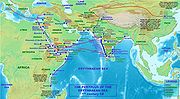
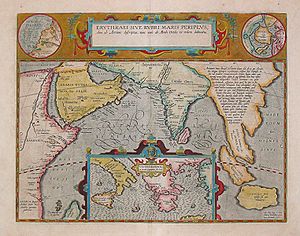
The
Periplus of the Erythraean Sea or
Periplus of the Red Sea is a
Greco-RomanThe Greco-Roman world, Greco-Roman culture, or the term Greco-Roman , when used as an adjective, as understood by modern scholars and writers, refers to those geographical regions and countries that culturally were directly, protractedly and intimately influenced by the language, culture,...
periplusPeriplus is the Latinization of an ancient Greek word, περίπλους , literally "a sailing-around." Both segments, peri- and -plous, were independently productive: the ancient Greek speaker understood the word in its literal sense; however, it developed a few specialized meanings, one of which became...
, written in
GreekGreek is an independent branch of the Indo-European family of languages. Native to the southern Balkans, it has the longest documented history of any Indo-European language, spanning 34 centuries of written records. Its writing system has been the Greek alphabet for the majority of its history;...
, describing navigation and
trading opportunitiesRoman trade was the engine that drove the Roman economy of the late Republic and the early Empire. Fashions and trends in historiography and in popular culture have tended to neglect the economic basis of the empire in favor of the lingua franca of Latin and the exploits of the Roman legions...
from Roman Egyptian ports like
BereniceBerenice or Berenice Troglodytica , also known as Baranis and now known as Medinet-el Haras, is an ancient seaport of Egypt on the west coast of the Red Sea...
along the coast of the
Red SeaThe Red Sea is a seawater inlet of the Indian Ocean, lying between Africa and Asia. The connection to the ocean is in the south through the Bab el Mandeb strait and the Gulf of Aden. In the north, there is the Sinai Peninsula, the Gulf of Aqaba, and the Gulf of Suez...
, and others along
Northeast AfricaThe Horn of Africa is a peninsula in East Africa that juts hundreds of kilometers into the Arabian Sea and lies along the southern side of the Gulf of Aden. It is the easternmost projection of the African continent...
and
IndiaIndia , officially the Republic of India , is a country in South Asia. It is the seventh-largest country by geographical area, the second-most populous country with over 1.2 billion people, and the most populous democracy in the world...
. The text has been ascribed to different dates between the 1st and 3rd centuries AD, but a mid-1st century date is now the most commonly accepted. Although the author is unknown, it is clearly a firsthand description by someone familiar with the area and is nearly unique in providing accurate insights into what the ancient world knew about the lands around the
Indian OceanThe Indian Ocean is the third largest of the world's oceanic divisions, covering approximately 20% of the water on the Earth's surface. It is bounded on the north by the Indian Subcontinent and Arabian Peninsula ; on the west by eastern Africa; on the east by Indochina, the Sunda Islands, and...
.
Although
Erythraean Sea literally means "Red Sea", to the Greeks it included the Indian Ocean and the
Persian GulfThe Persian Gulf, in Southwest Asia, is an extension of the Indian Ocean located between Iran and the Arabian Peninsula.The Persian Gulf was the focus of the 1980–1988 Iran-Iraq War, in which each side attacked the other's oil tankers...
.
Overview
The work consists of 66 chapters, most of them about the length of a long paragraph in English. For instance, the short Chapter 9 reads in its entirety:
- "From Malao (Berbera
Berbera is a city and seat of Berbera District in Somaliland, a self-proclaimed Independent Republic with de facto control over its own territory, which is recognized by the international community and the Somali Government as a part of Somalia...
) it is two courses to the mart of Moundou, where ships anchor more safely by an island lying very close to the land. The imports to this are as aforesaid [Chapter 8 mentions iron, gold, silver, drinking cups, etc.], and from it likewise are exported the same goods [Chapter 8 mentions myrrh, douaka, makeir, and slaves], and fragrant gum called mokrotou. The inhabitants who trade here are more peaceful."
In many cases, the description of places is sufficiently accurate to identify their present locations; for others, there is considerable debate. For instance, a "
RhaptaRhapta was a marketplace on the coast of eastern Africa, which first rose to prominence in the 1st century CE. Its location has not yet been firmly identified, although there are a number of plausible candidate sites....
" is mentioned as the farthest market down the African coast of "
AzaniaAzania is the name that has been applied to various parts of sub-Saharan Africa. In Roman times—and perhaps earlier—the name referred to a portion of the Southeast African coast south of the Horn of Africa, extending south perhaps as far as modern Tanzania....
", but there are at least five locations matching the description, ranging from
TangaTanga is both the name of the most northerly seaport city of Tanzania, and the surrounding Tanga Region. It is the Regional Headquarters of the region.With a population of 243,580 in 2002, Tanga is one of the largest cities in the country...
to south of the
Rufiji RiverThe Rufiji River lies entirely within the African nation of Tanzania. The river is formed by the convergence of the Kilombero and Luwegu rivers. It is approximately 600 km long, with its source in southwestern Tanzania and its mouth on the Indian Ocean at a point between Mafia Island called Mafia...
delta. The description of the Indian coast mentions the
Ganges RiverThe Ganges or Ganga, , is a trans-boundary river of India and Bangladesh. The river rises in the western Himalayas in the Indian state of Uttarakhand, and flows south and east through the Gangetic Plain of North India into Bangladesh, where it empties into the Bay of Bengal. By discharge it...
clearly, yet after that is somewhat garbled, describing China as a "great inland city Thina" that is a source of raw
silkSilk is a natural protein fiber, some forms of which can be woven into textiles. The best-known type of silk is obtained from the cocoons of the larvae of the mulberry silkworm Bombyx mori reared in captivity...
.
Another interesting feature of the
Periplus is that some of the words describing trade goods are seen nowhere else in ancient literature, and so we can only guess as to what they might mean. The
Periplus also describes how
HippalusHippalus was a Greek navigator and merchant who probably lived in the 1st century BCE. He is sometimes conjectured to have been the captain of the Greek explorer Eudoxus of Cyzicus' ship....
first discovered the direct route from the Red Sea to southern India.
The text derives from a Byzantine 10th-century manuscript in minuscule hand, contained in the collections of the
University Library HeidelbergThe University Library Heidelberg is the central library of the University of Heidelberg. It constitutes together with the 83 decentralized libraries of the faculties and institutes the University Library System, which is headed by the director of the University Library...
(CPG 398: 40v-54v), and a copy of it dating from the 14th or 15th century in the British Museum (B.M. Add 19391 9r-12r). In the 10th-century manuscript, the text is attributed to
ArrianLucius Flavius Arrianus 'Xenophon , known in English as Arrian , and Arrian of Nicomedia, was a Roman historian, public servant, a military commander and a philosopher of the 2nd-century Roman period...
, probably for no deeper reason than that the manuscript was adjacent to the
Periplus Ponti Euxini written by him. The
Periplus was edited by Sigmund Gelen (Zikmund Hruby z Jeleni of
PraguePrague is the capital and largest city of the Czech Republic. Situated in the north-west of the country on the Vltava river, the city is home to about 1.3 million people, while its metropolitan area is estimated to have a population of over 2.3 million...
) and first published in a modern edition by
Hieronymus FrobenHieronymus Froben was a famous pioneering printer in Basel and the eldest son of Johann Froben. He was educated at the University of Basel and traveled widely in Europe....
in 1533. This edition was corrupt and full of errors but served for later editions for three centuries until the rediscovery of the 10th century
Heidelberg-Early history:Between 600,000 and 200,000 years ago, "Heidelberg Man" died at nearby Mauer. His jaw bone was discovered in 1907; with scientific dating, his remains were determined to be the earliest evidence of human life in Europe. In the 5th century BC, a Celtic fortress of refuge and place of...
manuscript which was taken to Rome during the Thirty Years War (1618–1648), then to Paris under Napoleon, and finally returned to Heidelberg in 1816.
Date/Authorship
One historical analysis, published by Schoff in 1912, narrowed the date of the text to 60 A. D. Though narrowing the date down, from 1912, to a single year roughly 2000 years earlier might be considered remarkable by modern standards, a date of 60 A. D. nevertheless remains in perfect agreement with present day estimates of in the middle of the 1st century. Schoff additionally provides an historical analysis as to the text's original authorship and arrives at the conclusion that the author must have been a "
GreekThe Greeks, also known as the Hellenes , are a nation and ethnic group native to Greece, Cyprus and neighboring regions. They also form a significant diaspora, with Greek communities established around the world....
in
EgyptEgypt , officially the Arab Republic of Egypt, Arabic: , is a country mainly in North Africa, with the Sinai Peninsula forming a land bridge in Southwest Asia. Egypt is thus a transcontinental country, and a major power in Africa, the Mediterranean Basin, the Middle East and the Muslim world...
, a Roman subject," and by Schoff's calculations this would be during the time of
Tiberius Claudius BalbilusTiberius Claudius Balbillus or Balbilus, also known as ‘Balbillus the Wise‘, was an Egyptian Greek astrologer and a learned scholar. Balbillus was the son of astrologer Tiberius Claudius Thrasyllus, also known as Thrasyllus of Mendes and Princess Aka II of Commagene, who was either a granddaughter...
(who coincidentally also was an
EgyptEgypt , officially the Arab Republic of Egypt, Arabic: , is a country mainly in North Africa, with the Sinai Peninsula forming a land bridge in Southwest Asia. Egypt is thus a transcontinental country, and a major power in Africa, the Mediterranean Basin, the Middle East and the Muslim world...
ian
GreekThe Greeks, also known as the Hellenes , are a nation and ethnic group native to Greece, Cyprus and neighboring regions. They also form a significant diaspora, with Greek communities established around the world....
).
John Hill maintains that the "Periplus can now be confidently dated to between 40 and 70 CE and, probably, between CE 40 and 50."
Schoff continues by noting that the author could not have been "a highly educated man" as "is evident from his frequent confusion of
GreekGreek is an independent branch of the Indo-European family of languages. Native to the southern Balkans, it has the longest documented history of any Indo-European language, spanning 34 centuries of written records. Its writing system has been the Greek alphabet for the majority of its history;...
and
LatinLatin is an Italic language originally spoken in Latium and Ancient Rome. It, along with most European languages, is a descendant of the ancient Proto-Indo-European language. Although it is considered a dead language, a number of scholars and members of the Christian clergy speak it fluently, and...
words and his clumsy and sometimes ungrammatical constructions." Because of "the absence of any account of the journey up the
NileThe Nile is a major north-flowing river in North Africa, generally regarded as the longest river in the world. It is long. It runs through the ten countries of Sudan, South Sudan, Burundi, Rwanda, Democratic Republic of the Congo, Tanzania, Kenya, Ethiopia, Uganda and Egypt.The Nile has two major...
and
across the desert' is a dry river bed in Egypt's Eastern Desert, about halfway between Qusier and Qena. It was a major mining region and trade route east from the Nile Valley in ancient times, and three thousand years of rock carvings and graffiti make it a major scientific and tourist site today.-Trade...
from Coptos," Schoff prefers to pinpoint the author's residence to "Berenice rather than
AlexandriaAlexandria is the second-largest city of Egypt, with a population of 4.1 million, extending about along the coast of the Mediterranean Sea in the north central part of the country; it is also the largest city lying directly on the Mediterranean coast. It is Egypt's largest seaport, serving...
." Though Schoff is unclear about which "Berenice" he is referring to and
several possibilities exist for "Berenice"-People:* Berenice I of Egypt, mother of Magas of Cyrene and wife of Ptolemy I of Egypt* Berenice , daughter of Ptolemy II of Egypt and wife of Seleucid monarch Antiochus II Theos...
, it is actually Berenice Troglodytica which is documented, discussed at length and vividly described within the periplus text itself.
One peculiarity noted by Schoff while translating from the original
GreekGreek is an independent branch of the Indo-European family of languages. Native to the southern Balkans, it has the longest documented history of any Indo-European language, spanning 34 centuries of written records. Its writing system has been the Greek alphabet for the majority of its history;...
version is that "the text is so vague and uncertain that [the author] seems rather to be quoting from someone else, unless indeed much of this part of the work has been lost in copying."
Opone (Somalia)
Ras Hafun in northern
SomaliaSomalia , officially the Somali Republic and formerly known as the Somali Democratic Republic under Socialist rule, is a country located in the Horn of Africa. Since the outbreak of the Somali Civil War in 1991 there has been no central government control over most of the country's territory...
is believed to be the location of the ancient trade center of Opone.
Ancient EgyptAncient Egypt was an ancient civilization of Northeastern Africa, concentrated along the lower reaches of the Nile River in what is now the modern country of Egypt. Egyptian civilization coalesced around 3150 BC with the political unification of Upper and Lower Egypt under the first pharaoh...
ian,
RomanThe Roman Empire was the post-Republican period of the ancient Roman civilization, characterised by an autocratic form of government and large territorial holdings in Europe and around the Mediterranean....
and
Persian GulfThe Persian Gulf, in Southwest Asia, is an extension of the Indian Ocean located between Iran and the Arabian Peninsula.The Persian Gulf was the focus of the 1980–1988 Iran-Iraq War, in which each side attacked the other's oil tankers...
pottery has been recovered from the site by an
archaeologicalArchaeology, or archeology , is the study of human society, primarily through the recovery and analysis of the material culture and environmental data that they have left behind, which includes artifacts, architecture, biofacts and cultural landscapes...
team from the
University of MichiganThe University of Michigan is a public research university located in Ann Arbor, Michigan in the United States. It is the state's oldest university and the flagship campus of the University of Michigan...
. Opone is in the thirteenth entry of the
Periplus of the Erythraean Sea, which in part states:
In ancient times, Opone operated as a port of call for merchants from
PhoeniciaPhoenicia , was an ancient civilization in Canaan which covered most of the western, coastal part of the Fertile Crescent. Several major Phoenician cities were built on the coastline of the Mediterranean. It was an enterprising maritime trading culture that spread across the Mediterranean from 1550...
,
EgyptEgypt , officially the Arab Republic of Egypt, Arabic: , is a country mainly in North Africa, with the Sinai Peninsula forming a land bridge in Southwest Asia. Egypt is thus a transcontinental country, and a major power in Africa, the Mediterranean Basin, the Middle East and the Muslim world...
,
GreeceGreece , officially the Hellenic Republic , and historically Hellas or the Republic of Greece in English, is a country in southeastern Europe....
, Persia,
YemenThe Republic of Yemen , commonly known as Yemen , is a country located in the Middle East, occupying the southwestern to southern end of the Arabian Peninsula. It is bordered by Saudi Arabia to the north, the Red Sea to the west, and Oman to the east....
, Nabataea,
AzaniaAzania is the name that has been applied to various parts of sub-Saharan Africa. In Roman times—and perhaps earlier—the name referred to a portion of the Southeast African coast south of the Horn of Africa, extending south perhaps as far as modern Tanzania....
, the
Roman EmpireThe Roman Empire was the post-Republican period of the ancient Roman civilization, characterised by an autocratic form of government and large territorial holdings in Europe and around the Mediterranean....
and elsewhere, as it possessed a strategic location along the coastal route from Azania to the
Red SeaThe Red Sea is a seawater inlet of the Indian Ocean, lying between Africa and Asia. The connection to the ocean is in the south through the Bab el Mandeb strait and the Gulf of Aden. In the north, there is the Sinai Peninsula, the Gulf of Aqaba, and the Gulf of Suez...
. Merchants from as far afield as
IndonesiaIndonesia , officially the Republic of Indonesia , is a country in Southeast Asia and Oceania. Indonesia is an archipelago comprising approximately 13,000 islands. It has 33 provinces with over 238 million people, and is the world's fourth most populous country. Indonesia is a republic, with an...
and
Malaysia passed through Opone, trading spices, silks and other goods, before departing south for
AzaniaAzania is the name that has been applied to various parts of sub-Saharan Africa. In Roman times—and perhaps earlier—the name referred to a portion of the Southeast African coast south of the Horn of Africa, extending south perhaps as far as modern Tanzania....
or north to
YemenThe Republic of Yemen , commonly known as Yemen , is a country located in the Middle East, occupying the southwestern to southern end of the Arabian Peninsula. It is bordered by Saudi Arabia to the north, the Red Sea to the west, and Oman to the east....
or
EgyptEgypt , officially the Arab Republic of Egypt, Arabic: , is a country mainly in North Africa, with the Sinai Peninsula forming a land bridge in Southwest Asia. Egypt is thus a transcontinental country, and a major power in Africa, the Mediterranean Basin, the Middle East and the Muslim world...
on the
trade routeA trade route is a logistical network identified as a series of pathways and stoppages used for the commercial transport of cargo. Allowing goods to reach distant markets, a single trade route contains long distance arteries which may further be connected to several smaller networks of commercial...
s that spanned the length of the
Indian OceanThe Indian Ocean is the third largest of the world's oceanic divisions, covering approximately 20% of the water on the Earth's surface. It is bounded on the north by the Indian Subcontinent and Arabian Peninsula ; on the west by eastern Africa; on the east by Indochina, the Sunda Islands, and...
's rim. As early as 50 AD, Opone was well-known as a center for the cinnamon trade, along with the trading of
cloveCloves are the aromatic dried flower buds of a tree in the family Myrtaceae. Cloves are native to the Maluku islands in Indonesia and used as a spice in cuisines all over the world...
s and other
spiceA spice is a dried seed, fruit, root, bark, or vegetative substance used in nutritionally insignificant quantities as a food additive for flavor, color, or as a preservative that kills harmful bacteria or prevents their growth. It may be used to flavour a dish or to hide other flavours...
s,
ivoryIvory is a term for dentine, which constitutes the bulk of the teeth and tusks of animals, when used as a material for art or manufacturing. Ivory has been important since ancient times for making a range of items, from ivory carvings to false teeth, fans, dominoes, joint tubes, piano keys and...
, exotic animal skins and
incenseIncense is composed of aromatic biotic materials, which release fragrant smoke when burned. The term "incense" refers to the substance itself, rather than to the odor that it produces. It is used in religious ceremonies, ritual purification, aromatherapy, meditation, for creating a mood, and for...
.
Malao (Somalia)
The ancient port city of Malao, situated in present-day
BerberaBerbera is a city and seat of Berbera District in Somaliland, a self-proclaimed Independent Republic with de facto control over its own territory, which is recognized by the international community and the Somali Government as a part of Somalia...
in northwestern Somalia, is also mentioned in the Periplus:
Aksum Empire (Eritrea and Ethiopia)
Aksum is mentioned in the
Periplus as an important market place for ivory, which was exported throughout the ancient world:
According to the
Periplus, the ruler of Aksum in the 1st century AD was Zoscales, who, besides ruling in Aksum also held under his sway two harbours on the
Red SeaThe Red Sea is a seawater inlet of the Indian Ocean, lying between Africa and Asia. The connection to the ocean is in the south through the Bab el Mandeb strait and the Gulf of Aden. In the north, there is the Sinai Peninsula, the Gulf of Aqaba, and the Gulf of Suez...
: Adulis (near
MassawaMassawa, also known as Mitsiwa Massawa, also known as Mitsiwa Massawa, also known as Mitsiwa (Ge'ez ምጽዋዕ , formerly ባጽዕ is a city on the Red Sea coast of Eritrea. An important port for many centuries, it was ruled by a succession of polities, including the Axumite Empire, the Umayyad Caliphate,...
) and Avalites (
AssabAssab is a port city in the Southern Red Sea Region of Eritrea on the west coast of the Red Sea. In 1989, it had a population of 39,600. Assab possesses an oil refinery, which was shut down in 1997 for economic reasons...
). He is also said to have been familiar with Greek literature:
Himyarite kingdom and Saba (Arabia)
Ships from Himyar regularly traveled the East African coast. The
Periplus of the Erythraean Sea describes the trading empire of Himyar and
SabaSheba was a kingdom mentioned in the Jewish scriptures and the Qur'an...
, regrouped under a single ruler Charibael (Karab Il Watar Yuhan'em II), who is said to have been on friendly terms with
RomeRome is the capital of Italy and the country's largest and most populated city and comune, with over 2.7 million residents in . The city is located in the central-western portion of the Italian Peninsula, on the Tiber River within the Lazio region of Italy.Rome's history spans two and a half...
:
Frankincense kingdom (Hadramaut)
The Frankincense kingdom is described further east along the southern coast of the
Arabian PeninsulaThe Arabian Peninsula is a land mass situated north-east of Africa. Also known as Arabia or the Arabian subcontinent, it is the world's largest peninsula and covers 3,237,500 km2...
, with the harbour of Cana (South Arabic
Qana, modern Bir Ali in Hadramaut). The ruler of this kingdom is named
EleazusEleazus, also Eleazar or Iliazz Yalit I was the Hadramaut king of the southern tip of the Arabian peninsula, the "Frankincense kingdom", in the 1st century CE. The main harbour of the kingdom was Cana...
, or Eleazar, thought to correspond to King Iliazz Yalit I:
Rhapta (Tanzania - or Mozambique?)
Recent research by the
TanzaniaThe United Republic of Tanzania is a country in East Africa bordered by Kenya and Uganda to the north, Rwanda, Burundi, and the Democratic Republic of the Congo to the west, and Zambia, Malawi, and Mozambique to the south. The country's eastern borders lie on the Indian Ocean.Tanzania is a state...
n archaeologist Felix Chami has uncovered extensive remains of Roman trade items near the mouth of the
Rufiji RiverThe Rufiji River lies entirely within the African nation of Tanzania. The river is formed by the convergence of the Kilombero and Luwegu rivers. It is approximately 600 km long, with its source in southwestern Tanzania and its mouth on the Indian Ocean at a point between Mafia Island called Mafia...
and the nearby
Mafia islandMafia Island is part of the Tanzanian Spice Islands, together with Unguja and Pemba. As one of the six districts of the Pwani Region, Mafia Island is governed from the mainland, not from the semi-autonomous region of Zanzibar, of which it has never been considered to be a part.According to the...
, and makes a strong case that the ancient port of
RhaptaRhapta was a marketplace on the coast of eastern Africa, which first rose to prominence in the 1st century CE. Its location has not yet been firmly identified, although there are a number of plausible candidate sites....
was situated on the banks of the Rufiji River just south of
Dar es SalaamDar es Salaam , formerly Mzizima, is the largest city in Tanzania. It is also the country's richest city and a regionally important economic centre. Dar es Salaam is actually an administrative province within Tanzania, and consists of three local government areas or administrative districts: ...
.
The
Periplus informs us that:
"Two runs beyond this island [Menuthias = ZanzibarZanzibar ,Persian: زنگبار, from suffix bār: "coast" and Zangi: "bruin" ; is a semi-autonomous part of Tanzania, in East Africa. It comprises the Zanzibar Archipelago in the Indian Ocean, off the coast of the mainland, and consists of numerous small islands and two large ones: Unguja , and Pemba...
?] comes the very last port of trade on the coast of Azania, called RhaptaRhapta was a marketplace on the coast of eastern Africa, which first rose to prominence in the 1st century CE. Its location has not yet been firmly identified, although there are a number of plausible candidate sites....
["sewn"], a name derived from the aforementioned sewn boats, where there are great quantities of ivory and tortoise shell."
Chami summarizes the evidence for Rhapta's location as follows:
"The actual location of the Azanian capital, Rhapta, remains unknown. However, archaeological indicators reported above suggest that it was located on the coast of Tanzania, in the region of the Rufiji River and Mafia Island. It is in this region where the concentration of Panchaea/Azanian period settlements has been discovered. If the island of Menuthias mentioned in the Periplus was ZanzibarZanzibar ,Persian: زنگبار, from suffix bār: "coast" and Zangi: "bruin" ; is a semi-autonomous part of Tanzania, in East Africa. It comprises the Zanzibar Archipelago in the Indian Ocean, off the coast of the mainland, and consists of numerous small islands and two large ones: Unguja , and Pemba...
, a short voyage south would land one in the Rufiji region.
The 2nd century geographer, Ptolemy, locates Rhapta at latitude 8º south, which is the exact latitude of the Rufiji Delta and Mafia Island. The metropolis was on the mainland about one degree west of the coast near a large river and a bay with the same name. While the river should be regarded as the modern Rufiji River, the bay should definitely be identified with the calm waters between the island of Mafia and the Rufiji area. The peninsula east of Rhapta would have been the northern tip of Mafia Island. The southern part of the bay is protected from the deep sea by numerous deltaic small islets separated from Mafia Island by shallow and narrow channels. To the north the bay is open to the sea and any sailor entering the waters from that direction would feel as if he were entering a bay. Even today the residents identify these waters as a bay, referring to it as a 'female sea', as opposed to the more violent open sea on the other side of the island of Mafia."
In recent years, Felix Chami has found archaeological evidence for extensive Roman trade on Mafia Island and, not far away, on the mainland, near the mouth of the Rufiji River, which he dated to the first few centuries CE. Furthermore, J. Innes Miller points out that Roman coins have been found on Pemba island, just north of Rhapta.
Nevertheless, Carl Peters has argued that Rhapta was near modern-day Quelimane in Mozambique, citing the fact that (according to the
Periplus) the coastline there ran down towards the southwest. Peters also suggests that the description of the "Pyralaoi" (i.e., the "Fire people") - "situated at the entry to the [Mozambique] Channel" - indicates that they were the inhabitants of the volcanic Comoro Islands. He also maintains that Menuthias (with its abundance of rivers and crocodiles) cannot have been Zanzibar; i.e., Madagascar seems more likely.
Interestingly, the
Periplus informs us that Rhapta, was under the firm control of a governor appointed by
ArabArab people, also known as Arabs , are a panethnicity primarily living in the Arab world, which is located in Western Asia and North Africa. They are identified as such on one or more of genealogical, linguistic, or cultural grounds, with tribal affiliations, and intra-tribal relationships playing...
ian king of
MusaMūša is a river in Northern Lithuania and Southern Latvia , having its confluence with river Nemunėlis , in Latvia, near city Bauska. Mūša is a tributary of the river Lielupė. Mūša is 164 kilometres long....
, taxes were collected, and it was serviced by "merchant craft that they staff mostly with Arab skippers and agents who, through continual intercourse and intermarriage, are familiar with the area and its language."
The Periplus explicitly states that Azania (which included Rhapta) was subject to Charibaêl, the king of both the Sabaeans and Homerites in the southwest corner of Arabia. The kingdom is known to have been a Roman ally at this period. Charibaêl is stated in the Periplus to be “a friend of the (Roman) emperors, thanks to continuous embassies and gifts” and, therefore, Azania could fairly be described as a vassal or dependency of Rome, just as Zesan is described in the 3rd century Chinese history, the
WeilüeThe Weilüe written by Yu Huan between CE 239, the end of Emperor Ming’s reign, and 265 CE, the end of the Cao Wei . Although not an "official historian," Yu Huan has always been held in high regard amongst Chinese scholars....
.
Barygaza (India)
Trade with the Indian harbour of Barygaza is described extensively in the
Periplus.
NahapanaNahapana was an important ruler of the Western Kshatrapas, descendant of the Indo-Scythians, in northwestern India. According to one of his coins, he was the son of Bhumaka.-History:...
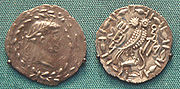
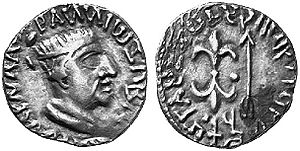
, ruler of the Indo-Scythian Western Satraps is mentioned under the name
Nambanus, as ruler of the area around Barigaza:
Under the Western Satraps, Barigaza was one of the main centers of
Roman trade with IndiaRoman trade with India through the overland caravan routes via Anatolia and Persia, though at a relative trickle compared to later times, antedated the southern trade route via the Red Sea and monsoons which started around the beginning of the Common Era following the reign of Augustus and his...
. The
Periplus describes the many goods exchanged:
Goods were also brought down in quantity from
UjjainUjjain , is an ancient city of Malwa region in central India, on the eastern bank of the Kshipra River , today part of the state of Madhya Pradesh. It is the administrative centre of Ujjain District and Ujjain Division.In ancient times the city was called Ujjayini...
, the capital of the Western Satraps:
Early Chera, Chola, and early Pandyan kingdoms (India)
The lost port city of
MuzirisMuziris is an ancient sea-port in Southwestern India on the Periyar River 3.2 km from its mouth. The derivation of the name Muziris is said to be from "Mucciripattanam," "mucciri" means "cleft palate" and "pattanam" means "city". Near Muziris, Periyar River was branched into two like a...
(Near present day Cochin) in the
Chera kingdomChera Dynasty in South India is one of the most ancient ruling dynasties in India. Together with the Cholas and the Pandyas, they formed the three principle warring Iron Age Tamil kingdoms in southern India...
, as well as the
Early Pandyan KingdomThe Early Pandyas of the Sangam period were one of the three main kingdoms of the ancient Tamil country, the other two being the Cholas and the Cheras. As with many other kingdoms around this period , most of the information about the Early Pandyas come to us mainly through literary sources and...
are mentioned in the
Periplus as major centers of trade, pepper and other spices, metal work and semiprecious stones, between Damirica and the
Roman EmpireThe Roman Empire was the post-Republican period of the ancient Roman civilization, characterised by an autocratic form of government and large territorial holdings in Europe and around the Mediterranean....
.
According to the
Periplus, numerous Greek seamen managed an intense trade with Muziris:
Damirica or Limyrike is
TamilakkamThe Sangam period is the classical period in the history of Tamil Nadu, Kerala and other parts of South India, spanning about the 3rd century BCE to the 3rd century CE...
(Tamil தமிழகம்) – the "
Tamil countryThe Sangam period is the classical period in the history of Tamil Nadu, Kerala and other parts of South India, spanning about the 3rd century BCE to the 3rd century CE...
". Further, this area served as a hub for trade with the interior, in the Gangetic plain:
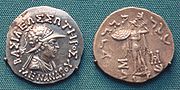
Remains of the Indo-Greek kingdom
The
Periplus describes numerous Greek buildings and fortifications in
BarigazaBharuch , also known as Broach, is the oldest city in Gujarat, situated at the mouth of the holy river Narmada. Bharuch is the administrative headquarters of Bharuch District and a municipality of more than 1,50,000 inhabitants. As Bharuch is a major seaport city, a number of trade activities have...
, although mistakenly attributing them to
Alexander the Great, who never went this far south. If true, this account would relate to the remains of the southern expansion of the Indo-Greeks into
Gujarat:
The
Periplus further testifies to the circulation of Indo-Greek coinage in the region:
The Greek city of
Alexandria BucephalousAlexandria Bucephalous, or Alexandria Bucephalus or Alexandria Bucephala or Bucephala or Bucephalia, was a city founded by Alexander the Great in memory of his beloved horse Bucephalus. Founded in May 326 BC, the town was located on the Hydaspes , east of the Indus River. Bucephalus had died after...
on the
Jhelum RiverJehlum River or Jhelum River , ) is a river that flows in India and Pakistan. It is the largest and most western of the five rivers of Punjab, and passes through Jhelum District...
is mentioned in the
Periplus, as well as in the Roman Peutinger Table:
External links
- http://depts.washington.edu/silkroad/texts/periplus/periplus.html "The present text has been digitalized from the translation of William H. Schoff, The Periplus of the Erythraean Sea: Travel and Trade in the Indian Ocean by a Merchant of the First Century (New York: Longmans, Green, and Co., 1912). Some additional commentary including alternate spellings or translations from Lionel Casson's more recent edition are given in square brackets."
- Ancient history sourcebook: The basic text from Schoff's 1912 translation.
The source of this article is
wikipedia, the free encyclopedia. The text of this article is licensed under the
GFDL.